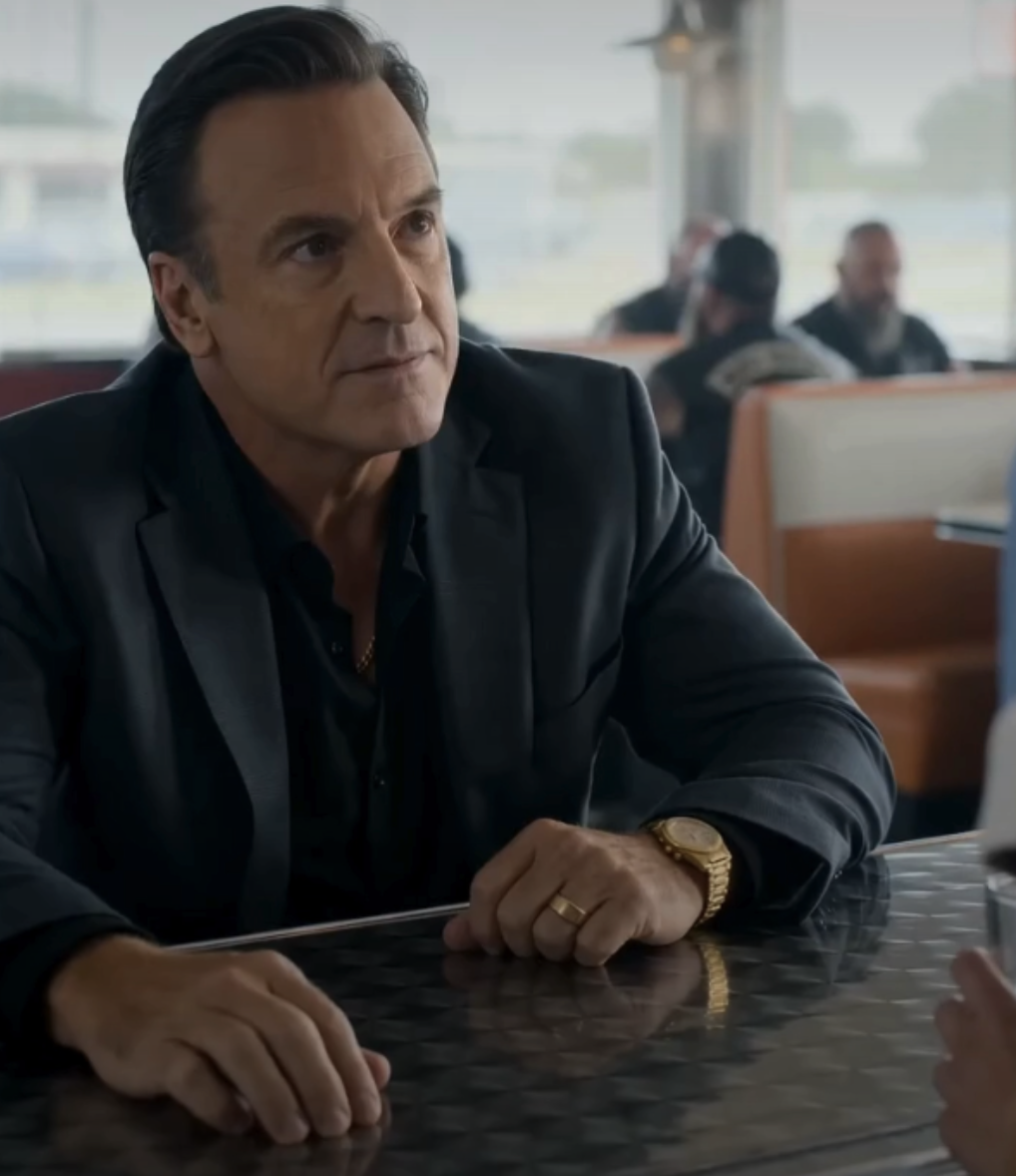
The first thing Alexander Cross noticed about the old biker was that he wasn’t afraid of him.
The second thing he noticed was that everyone in the diner had stopped eating.
And the third thing, which he wouldn’t understand until much later, was that the old man had already lost everything a person could lose and survived.
Alexander had spent thirty-two years believing that money could solve almost any problem. He wore a charcoal suit that cost more than some people earned in a month, drove a black luxury sedan, and carried himself with the confidence of someone whose last name opened doors before he even reached them.
His father, Richard Cross, was one of the most powerful banking executives in America. Politicians returned his calls. Businessmen waited outside his office. Companies that had existed for generations sometimes disappeared after a single meeting with him.
Alexander had grown up watching his father win.
He had never bothered to ask what winning cost everyone else.
That afternoon, he was sitting inside a roadside diner along Route Nine, tapping his expensive watch against the table and glaring toward the kitchen.
He had been waiting for his steak for forty minutes.
When the waitress finally appeared, carrying a plate with mashed potatoes, vegetables, and a perfectly cooked steak, Alexander didn’t even let her finish speaking.
“I’m sorry for the delay, sir,” she said. “The grill broke down, and we had to prepare your order again. I’ll bring you a fresh drink while you—”
BANG!
Alexander slammed his fist against the table.
A glass jumped off the edge and shattered across the floor.
The waitress screamed and stumbled backward.
Every conversation in the diner stopped.
“Are you people completely incompetent?” Alexander shouted. “I’ve been sitting here for forty minutes! Do you have any idea how much time you’re wasting?”
The waitress, whose name tag read EMILY, stared at the broken glass.
“I apologize, sir. I’ll clean this up immediately.”
“You should have done your job properly in the first place!”
“Sir, I understand you’re upset.”
“You don’t understand anything!”
He stood up, straightened his jacket, and looked around the diner as though he expected the other customers to applaud him.
“People like you should be grateful that a person like me even comes here to eat.”
Emily lowered her head.
Her eyes were already wet.
She was twenty-four years old, working double shifts to help pay for her younger brother’s medical treatment. She had been on her feet since six that morning and had barely eaten anything herself.
But she didn’t tell Alexander any of that.
She simply bent down and began picking up the broken pieces of glass.
Alexander reached into his wallet.
He pulled out a hundred-dollar bill and dropped it beside her shoes.
“There. That’s your apology. Pick it up.”
Emily froze.
A man sitting near the window slowly lowered his coffee cup.
He was an elderly biker with a thick silver beard, weathered hands, and a faded black leather vest. His gray hair was tied behind his head, and the scars on his knuckles suggested a lifetime of difficult roads.
A small silver ring rested on his right hand.
He had been sitting quietly in the corner booth for almost an hour, drinking coffee and reading an old newspaper.
Now he folded the newspaper.
“Why are you doing this to her?” he asked.
Alexander turned.
“What?”
The biker looked at the broken glass.
“You heard me.”
Alexander laughed.
“Listen, old man. This doesn’t concern you.”
“It concerns me when a man thinks he can humiliate somebody just because he has more money.”
Alexander walked toward the booth.
His polished shoes clicked against the floor.
“And what are you going to do about it?”
The biker slowly rose to his feet.
He was tall, though his shoulders had begun to stoop with age. He moved carefully, but there was nothing uncertain about his eyes.
“I’m giving you a chance to apologize to her.”
For a moment, Alexander stared at him.
Then he burst out laughing.
“You’re giving me a chance?”
He leaned forward.
“Do you know who my father is?”
The old man didn’t answer.
“Richard Cross. The chairman of Cross National Banking. The man who finances half the businesses in this state.”
Alexander pointed toward the biker’s chest.
“And you are an old man who should know when to keep his mouth shut.”
The biker looked at Emily.
She was still standing beside the broken glass.
He bent down, picked up the hundred-dollar bill, and placed it gently in her hand.
“That’s yours now, sweetheart. Not because he threw it at you. Because you deserve to be paid for the work you do, and you deserve respect while doing it.”
Emily looked at him with tears in her eyes.
“Thank you.”
He nodded.
Then he turned back to Alexander.
“You still owe her an apology.”
Alexander’s face darkened.
He had never been spoken to like that by someone he considered beneath him.
He wanted to shout. He wanted to threaten the old man. He wanted the entire diner to see him put this nobody in his place.
But something about the biker’s expression unsettled him.
The old man wasn’t angry in the way Alexander expected.
He looked disappointed.
As though Alexander had reminded him of something terrible.
“Get out of my way,” Alexander muttered.
The biker stepped aside.
“Of course.”
Alexander straightened his tie and walked toward the counter.
He was about to demand that the manager throw the old man out when a voice came from behind the kitchen doors.
“Turn off the music.”
The diner manager, Frank Miller, emerged carrying a towel.
He looked toward the booth.
Then he stopped so abruptly that the towel slipped from his hand.
His face lost all color.
For several seconds, he couldn’t speak.
The old biker looked at him.
“Hello, Frank.”
Frank took one step forward.
Then another.
“No,” he whispered. “No, that can’t be.”
The biker gave him a tired smile.
“It’s been a long time.”
Frank stared at the silver beard, the scar beside the left eyebrow, and the faded patch on the man’s leather vest.
Then his eyes filled with tears.
“Samuel?”
The old man nodded.
Frank covered his mouth.
“Oh, my God.”
Alexander turned around.
“What is this? You know him?”
Frank barely seemed to hear him.
He walked straight toward Samuel Reed and grabbed his shoulders.
“I thought you were dead.”
Samuel shook his head.
“Not yet.”
Frank began to cry.
He was fifty-nine years old, a former mechanic who had spent most of his adult life trying to forget a terrible period in the town’s history.
But standing in front of him was the man whose life had been destroyed before his eyes.
The man whose garage had burned.
The man whose family had fled in the middle of the night.
The man who had disappeared for twenty-two years.
Frank looked toward Alexander.
Then back at Samuel.
His voice dropped to a whisper.
“Please tell me you didn’t come back for revenge.”
Samuel didn’t answer immediately.
He looked through the diner window at the empty stretch of highway beyond the parking lot.
Then he said, “I came back to finish something.”
Alexander scoffed.
“What’s all this drama? He used to own a garage or something?”
Frank turned toward him.
For the first time since Alexander had entered the diner, the manager looked genuinely furious.
“Your father made sure he lost it.”
Alexander’s smile disappeared.
“What?”
Frank pointed at Samuel.
“This man built a business with his own hands. He employed men nobody else would hire. He helped families who couldn’t afford repairs. And your father took it all away because Samuel refused to sell him a piece of land.”
Alexander shook his head.
“My father doesn’t steal property.”
Frank’s eyes hardened.
“Then you don’t know your father as well as you think you do.”
Samuel placed a few bills on the table for his coffee.
He picked up his jacket.
“Frank, I’m not here to argue about the past in front of customers.”
Frank grabbed his arm.
“Then tell me why you came back.”
Samuel looked toward the window again.
“Because the same thing is happening to another family.”
He paused.
“And this time, I intend to stop it.”
Outside, a motorcycle engine rumbled.
Then another.
Alexander turned toward the glass.
The sound grew louder.
And somewhere along Route Nine, the first of more than seven hundred outlaw bikers began turning into the parking lot.
## Chapter One: The Man Who Lost Everything
Twenty-two years earlier, Samuel Reed had been a different man.
He was fifty years old, broad-shouldered, strong, and known throughout three counties as a mechanic who could repair almost anything.
His garage stood on six acres of land outside a small American town. It had a corrugated metal roof, a concrete floor stained with decades of oil, and a large wooden sign that read REED’S MOTORCYCLE REPAIR.
The garage wasn’t particularly beautiful.
But it was his.
Samuel had bought the land with money he saved over fifteen years. He had built the workshop himself, working through freezing winters and blazing summers.
His wife, Margaret, handled the accounts.
His son, Daniel, worked beside him after school.
His daughter, Lily, spent afternoons sitting on an overturned bucket, drawing motorcycles on pieces of cardboard.
On Sundays, Samuel opened the garage to anyone who needed help.
Sometimes a veteran arrived with a broken-down motorcycle and no money.
Sometimes a single mother needed her car repaired before Monday morning.
Sometimes a young man who had made terrible choices came looking for a job because nobody else would hire him.
Samuel helped them all.
“People don’t need you to save the whole world,” Margaret used to tell him. “Sometimes they just need somebody who won’t turn them away.”
Samuel would kiss her forehead and reply, “Then I suppose I’ll keep the doors open.”
Over the years, dozens of men became regulars at the garage.
Some were former military servicemen. Some were truck drivers. Some rode with motorcycle clubs that other people feared.
They called themselves the Road Saints.
They weren’t saints in the literal sense. Many had rough histories, broken marriages, and mistakes they regretted. But they had one rule that Samuel insisted on from the beginning.
Nobody was allowed to use their strength to prey on someone weaker.
If a member hurt an innocent person, he was out.
If somebody needed help, the others showed up.
And if one of their own was in trouble, nobody was left behind.
Samuel had earned their loyalty through years of standing beside them when it was inconvenient, expensive, or dangerous.
By the time he turned fifty, more than thirty men considered him their brother.
He never called himself their leader.
They called him Old Reed.
Then Richard Cross arrived.
Richard was forty-six years old at the time, a rising executive who had recently taken control of the regional operations of Cross National Banking.
He wore tailored suits, drove expensive cars, and spoke in a voice that made people feel they were wasting his time.
His bank had begun buying land throughout the county.
Warehouses, factories, farms, and small businesses were being acquired, cleared, and replaced with commercial developments.
Samuel’s land sat directly beside a highway expansion project.
It was worth far more than Samuel had paid for it.
Richard wanted it.
The first offer was generous.
Samuel declined politely.
The second offer was nearly double the property’s estimated value.
Samuel declined again.
He explained that his business was more than a building. It was his livelihood, his home, and the place where his children had grown up.
Richard listened without interest.
“Mr. Reed, everything has a price.”
Samuel shook his head.
“Not everything.”
Richard smiled.
“That’s what people say before they discover what refusing costs them.”
Samuel stood.
“I think we’re finished here.”
Richard left without another word.
For the next three months, the bank made Samuel’s life increasingly difficult.
A loan that had been renewed for years suddenly became due in full.
A supplier canceled a contract after receiving an unexpected financial review.
An insurance company requested additional inspections.
Then a local official informed Samuel that the garage’s permits were being reconsidered.
Samuel hired an attorney.
The attorney discovered irregularities in the bank’s documents and warned Samuel that someone appeared to be applying pressure from several directions at once.
Samuel didn’t panic.
He had spent his life working hard, keeping records, and treating people fairly.
He believed the truth would protect him.
He was wrong.
One night, a brick crashed through the garage office window.
A note was attached.
SELL THE LAND.
The following week, two of Samuel’s mechanics were attacked in a parking lot.
One suffered a broken arm.
The other was left with a concussion.
When Samuel went to the police, he was told there wasn’t enough evidence to make an arrest.
Then the threats reached his home.
A black sedan began appearing outside the house after dark.
Someone called the landline and remained silent.
Margaret found a photograph of Lily’s school taped to their front door.
Samuel stared at it for a long time.
Then he took it inside and locked every door.
That night, he sat at the kitchen table while Margaret prepared tea.
“They’re trying to frighten us,” he said.
Margaret placed a cup in front of him.
“They’re succeeding.”
He looked up.
She was crying.
“I can handle threats against me, Samuel. I can handle losing the garage. But I can’t watch our children live like this.”
Samuel reached for her hand.
“Nothing is going to happen to them.”
“How can you promise that?”
He had no answer.
Three days later, Samuel was attacked outside the garage.
He remembered the sound of boots approaching behind him.
He remembered a voice telling him to sign the papers.
He remembered refusing.
Then the first blow struck his ribs.
He fought back, but there were too many men.
They beat him until he could barely stand.
When they finally left, Samuel lay on the pavement staring at the night sky.
He could hear traffic passing on the highway.
Nobody stopped.
He dragged himself inside the garage and called Margaret.
She arrived with Daniel and Lily.
The sight of their father covered in blood made Lily scream.
Daniel stood frozen, his fists clenched.
Margaret knelt beside Samuel and held his face between her hands.
“That’s it,” she whispered. “We’re leaving.”
Samuel tried to protest.
Margaret shook her head.
“Please. I am begging you. Let us go.”
He looked at his children.
His son was trying not to cry.
His daughter had hidden behind her mother’s coat.
And Samuel finally understood something that pride had prevented him from seeing.
Staying wasn’t courage anymore.
It was gambling with the lives of the people he loved.
He agreed to leave.
But before they could pack, the garage burned.
It happened three nights later.
Samuel was awakened by a telephone call shortly after midnight.
By the time he reached the highway, flames were rising above the roof.
The fire department was already there, but the building was beyond saving.
Samuel stood beside his motorcycle, watching twenty years of work collapse into a storm of sparks.
Inside were his tools, his father’s old watch, the photographs of his family, and the framed certificate he had received when he opened the business.
Daniel stood beside him.
“Dad, we can rebuild.”
Samuel looked at the flames.
“Yes,” he whispered. “We can.”
But they didn’t rebuild.
By morning, the bank had filed its final claim against the property.
Samuel’s accounts were frozen.
His insurance company refused to cover the loss while investigators examined the circumstances surrounding the fire.
The attorney who had been helping him suddenly stopped returning calls.
And Richard Cross publicly described the entire matter as a regrettable business dispute.
Within weeks, Samuel’s family had left town.
Thirty-one Road Saints rode with them.
They traveled through several states before finding a place where Margaret felt safe enough to sleep without checking the windows every hour.
Samuel found work repairing motorcycles in a small workshop owned by an old friend.
He kept his head down.
He raised his children.
He helped Margaret build a new life.
But he never forgot the sound of his garage burning.
And he never forgot the face of Richard Cross.
## Chapter Two: The Promise
The years that followed were difficult.
Samuel worked long hours, often taking jobs that paid less than he deserved because he wanted to keep his family together.
Margaret found work at a medical office.
Daniel finished school and became a mechanic, though he struggled with anger and distrust.
Lily grew quiet.
For years, she slept with a small lamp burning beside her bed.
Whenever a car slowed outside their house, she would stop talking and watch the windows.
Samuel tried everything he could think of to make his children feel safe.
He bought Lily a bicycle.
He took Daniel fishing.
He repaired old motorcycles and taught neighborhood children how engines worked.
But he couldn’t repair what had happened to them.
Margaret saw it.
One evening, she found Samuel sitting alone in the garage after everyone else had gone to bed.
He was holding a photograph of the family taken before the fire.
“You’re still thinking about Richard Cross,” she said.
Samuel didn’t deny it.
“I want him to answer for what he did.”
Margaret sat beside him.
“And if he never does?”
Samuel looked at her.
“I don’t know.”
She took his hand.
“Then you must make sure he doesn’t take anything else from us.”
He frowned.
“What do you mean?”
“You can’t let that man become the center of our lives. He already took our home. He already took our peace. Don’t give him the years we still have.”
Samuel looked down at their joined hands.
“I don’t know how to stop being angry.”
Margaret leaned against his shoulder.
“Then learn. But learn for yourself, not for him.”
For a while, Samuel tried.
He focused on his work.
He attended his children’s school events.
He helped the Road Saints establish a small repair shop of their own.
He even stopped reading newspapers whenever Richard Cross’s name appeared.
But the anger remained.
It sat quietly inside him, waiting.
Then Margaret became ill.
The diagnosis came after months of unexplained fatigue and pain.
Samuel drove her to appointments, sat beside her during treatments, and learned how to cook the few meals she could tolerate.
On bad days, she could barely walk from the bedroom to the kitchen.
On good days, she insisted on sitting outside the garage to watch Samuel work.
One evening, as the sun disappeared behind the trees, Margaret asked him to sit beside her.
“Promise me something.”
Samuel took her hand.
“Anything.”
“Don’t let Richard Cross decide what kind of man you become.”
He stared at her.
“Margaret…”
“Promise me.”
He swallowed.
“I promise.”
She smiled faintly.
“And when the time comes, don’t make our children carry your anger.”
Samuel kissed her forehead.
“I promise.”
Margaret died several months later.
Samuel held her hand until the final moment.
For a long time afterward, he couldn’t enter the small room where she had spent her last days.
He continued working because he had to.
He continued helping people because it was the only thing that made him feel connected to the man he had been before the fire.
But the promise he had made Margaret remained.
He wouldn’t let revenge define his life.
He would seek justice if the opportunity came.
He would protect his children.
And he would never become the kind of man who destroyed another family to satisfy his own anger.
Still, there was one thing Samuel hadn’t yet understood.
Forgiveness wasn’t something he could force himself to feel.
It was something he would have to choose when the moment arrived.
And that moment was still years away.
## Chapter Three: The Call That Brought Seven Hundred Bikers Home
Twenty-two years after the fire, Samuel was sitting in his small workshop when a familiar voice came through the telephone.
It belonged to Frank Miller.
Frank had been a mechanic at Samuel’s original garage before becoming the manager of the roadside diner.
They had lost contact for years.
Frank had finally found Samuel through an old Road Saints member.
“I wouldn’t call unless it mattered,” Frank said.
Samuel set down his wrench.
“What happened?”
“Richard Cross is trying to take another family’s land.”
Samuel closed his eyes.
“Who?”
“Linda Miller. Her husband died three years ago. She runs a small repair shop with her two sons. The bank claims she’s behind on her loans, but the documents don’t add up.”
Samuel said nothing.
Frank continued.
“She refused to sell the property. Now her accounts are frozen, her suppliers are disappearing, and men have started visiting her house at night.”
Samuel felt something cold move through his chest.
“Have you called the police?”
“Twice. Nobody has done anything.”
“Then call them again.”
“I have.”
Samuel walked toward the window.
Outside, two young mechanics were repairing a motorcycle. One was laughing at something the other had said.
For a moment, Samuel saw Daniel and Lily as children.
He remembered Margaret begging him to leave.
He remembered the flames.
He remembered promising that his family would never again be forced to live in fear.
“Frank,” he said quietly, “send me everything you have.”
Frank exhaled.
“I knew you’d help.”
Samuel paused.
“I’m not promising what you think I’m promising.”
“Then what are you promising?”
“The truth.”
That afternoon, Samuel called Daniel.
His son was forty years old now, living several states away with his wife and two children.
Samuel explained what was happening.
Daniel listened in silence.
Then he asked, “Are you going back?”
“Yes.”
“To the town?”
“Yes.”
Daniel exhaled sharply.
“Dad, you know what this means.”
“I do.”
“You’ve spent twenty-two years trying to move on.”
“I know.”
“Then why go back?”
Samuel looked at Margaret’s photograph on the wall.
“Because someone else is standing where we once stood.”
Daniel was quiet for a long time.
Finally, he said, “Then you’re not going alone.”
Within forty-eight hours, the Road Saints had begun calling their old friends.
Some had moved away.
Some had retired.
Some had grandchildren and bad knees.
One man had undergone two hip replacements.
Another walked with a cane.
But when they heard Samuel’s name and learned why he was returning, they answered.
The original thirty-one riders were no longer young men.
Their beards had turned gray.
Their faces carried wrinkles and scars.
Some had lost their wives.
Some had lost children.
Some had spent years rebuilding lives that other people had tried to destroy.
Yet they remembered the night Samuel’s garage burned.
They remembered the way he had stood beside them when their own families needed help.
And they remembered Margaret.
A former military mechanic named Thomas Briggs called Samuel from Texas.
“Are we riding?”
Samuel looked at the photograph of his wife.
“Yes.”
Thomas didn’t ask anything else.
Then the calls spread beyond the original Road Saints.
Other motorcycle clubs heard about the situation.
Some had known Samuel personally.
Others had heard stories about the man who once helped a stranded rider travel hundreds of miles to reach his dying mother.
A club in Tennessee remembered Samuel helping one of their members after a serious accident.
A group in Ohio remembered him giving work to men who had just left prison.
A veteran motorcycle association remembered the way Samuel had organized repairs for families of wounded servicemen.
The invitation wasn’t a call to violence.
It was a call to stand beside a man who wanted a powerful institution held accountable.
More than seven hundred bikers committed to the ride.
They came from across the country.
They arrived in groups, carrying their own food, paying for their own fuel, and arranging their own lodging.
Some rode old Harleys that rattled at every stop.
Others rode modern touring motorcycles.
One man drove a battered pickup because his doctor had forbidden him from riding long distances.
He said he was coming anyway.
Samuel didn’t know what to say when he saw the growing list.
He sat at his kitchen table for a long time, staring at the names.
Daniel called that evening.
“How many?”
Samuel rubbed his eyes.
“Seven hundred, give or take.”
His son laughed softly.
“Dad, what are you going to do with seven hundred bikers?”
Samuel looked at Margaret’s photograph.
“Make sure nobody gets hurt.”
“And after that?”
Samuel was silent.
“After that, I don’t know.”
Daniel understood.
His father had spent twenty-two years trying to answer a question that had no easy answer.
How do you seek justice without allowing hatred to consume you?
The ride would begin in three days.
Samuel packed his old leather vest, the photograph of Margaret, and a folder containing the first pieces of evidence Frank had sent him.
He didn’t pack a weapon.
He didn’t pack anything he couldn’t explain to a police officer.
He wasn’t returning to burn a bank or threaten a family.
He was returning to make sure a truth that had been buried for twenty-two years could finally be heard.
But he knew Richard Cross would see the motorcycles and believe the worst.
Perhaps that was inevitable.
For Richard, power had always meant controlling the way other people saw the world.
This time, Samuel intended to let the evidence speak for itself.
## Chapter Four: The Diner
The convoy arrived in town on a cloudy Thursday afternoon.
The first motorcycles rolled past the old courthouse shortly after two.
People stepped out of stores to watch.
Some recognized the Road Saints patches.
Others simply stared at the long line of leather-clad riders moving through the streets.
By the time the first hundred motorcycles reached Route Nine, the local radio station was reporting an unusual gathering.
By the time the convoy reached the diner, the parking lot was already filling.
Samuel told the riders to wait outside while he went in for coffee.
He wanted to see Frank before the meeting with the lawyers.
He wanted a quiet moment to remember the town before everything became complicated.
Instead, he walked into the middle of Alexander Cross’s tantrum.
The broken glass.
The hundred-dollar bill.
The frightened waitress.
Samuel had seen that expression before.
Not on Alexander’s face.
On the faces of men who believed that money gave them the right to humiliate people.
For a moment, Samuel saw Richard Cross standing in front of him twenty-two years earlier.
He heard the same arrogance.
The same certainty that nobody would dare challenge him.
But Alexander was not Richard.
Samuel knew that.
He was a younger man who had inherited his father’s privileges without understanding their cost.
Samuel could have walked away.
He could have ignored the incident and continued toward the counter.
Instead, he stood up.
And the afternoon took a different turn.
After Frank recognized him, Samuel explained why he had returned.
He showed Frank the photographs and documents.
Frank stared at the papers with growing horror.
Then he looked at Alexander.
“Your father has been doing this again.”
Alexander shook his head.
“I don’t know anything about that.”
“Then ask him.”
Alexander looked toward the window.
Outside, motorcycles were parked in neat rows.
The riders stood in small groups, talking quietly.
Nobody was threatening anyone.
Nobody was blocking the road.
But the sheer number of them made it impossible to ignore their presence.
Alexander had seen motorcycle clubs before.
He had never seen anything like this.
“Why are there so many?” he asked.
Samuel followed his gaze.
“Because people remember.”
“What do they want?”
“Justice.”
Alexander scoffed, though the sound lacked conviction.
“You think seven hundred bikers can change a bank?”
Samuel looked at him.
“No. I think seven hundred people can make it harder for a bank to pretend nobody is watching.”
The diner door opened.
Three older bikers entered.
Thomas Briggs walked with a cane.
Raymond Cole had a scar running along his jaw.
Eddie Lawson wore an old military jacket beneath his leather vest.
They greeted Samuel with the ease of men who had survived too much together to need explanations.
Thomas embraced him.
“Took you long enough, old man.”
Samuel smiled.
“Traffic.”
Raymond looked at Alexander.
“That’s Cross’s boy?”
Samuel nodded.
Raymond’s expression hardened.
For a moment, the diner seemed to grow colder.
But Samuel raised a hand.
“Not here.”
Raymond looked at him.
Then he nodded.
“Your call.”
Alexander noticed the exchange.
He had expected the bikers to surround him, shout at him, perhaps threaten him.
Instead, they listened to Samuel.
They respected him.
And Samuel had made it clear that nobody was to touch Alexander.
That frightened Alexander more than anger would have.
Anger could be dismissed as irrational.
This was discipline.
This was a group of men who had chosen to follow someone because they believed in him.
Alexander had spent his life surrounded by people who followed his father because they feared losing money.
He had never seen the difference so clearly.
Then his phone rang.
Richard Cross’s name appeared on the screen.
Alexander answered.
“Dad?”
“Where are you?”
“At the diner.”
“What diner?”
Alexander gave him the name.
The silence that followed was so complete that Alexander checked whether the call had disconnected.
Then Richard shouted, “Get out of there!”
Alexander stared at Samuel.
“Why are you afraid of him?”
His father’s answer was barely audible.
“Because you don’t understand what he knows.”
Samuel held out his hand.
“Put it on speaker.”
Alexander hesitated.
Then he obeyed.
“Hello, Richard,” Samuel said.
The reply came after several seconds.
“Samuel.”
“Twenty-two years.”
“You should have stayed away.”
“You should have left my family alone.”
Richard’s voice hardened.
“You can’t prove anything.”
Samuel looked at the envelope on the table.
“Then come and say that to my face.”
The call ended.
Alexander stared at his phone.
He had heard fear in his father’s voice.
Not irritation.
Not anger.
Fear.
And for the first time, he began to wonder what kind of man his father had been when nobody was looking.
## Chapter Five: The Evidence
Richard Cross arrived at the diner less than an hour later.
He came with two security officers and a private attorney.
His black sedan stopped near the entrance.
The driver opened the door.
Richard stepped out, adjusted his jacket, and looked across the parking lot.
Hundreds of motorcycles stretched toward the highway.
He recognized several of the patches.
He recognized Thomas Briggs.
He recognized Raymond Cole.
And he recognized Samuel’s old leather vest.
For the first time in years, Richard felt the past moving toward him.
He had spent twenty-two years convincing himself that Samuel Reed had disappeared.
He had believed the man was too broken to return.
He had believed the people who had witnessed his actions would eventually grow old, forget, or die.
Now they were standing in front of him.
Richard entered the diner.
Samuel was waiting beside the window.
“Sit down,” Samuel said.
Richard remained standing.
“I won’t be ordered around by you.”
Samuel nodded.
“Then stand.”
Richard glanced at the bikers outside.
“Is this your idea of negotiation?”
“No.”
Samuel placed a folder on the table.
“This is.”
Richard looked at the folder.
Inside were copies of loan documents, payment records, police reports, and correspondence from former bank employees.
Richard recognized several signatures.
One belonged to a senior manager who had retired years earlier.
Another belonged to his former head of security.
A third was his own.
Richard’s jaw tightened.
“These documents are stolen.”
“Some were provided by former employees. Others came from public records. A few were preserved by my attorney before he disappeared.”
Richard’s eyes narrowed.
“Your attorney?”
“Daniel Mercer. He died three years ago.”
For a moment, Richard said nothing.
Samuel continued.
“He kept copies of everything. He believed the truth might matter one day.”
Richard looked through the documents.
Then he found the photograph.
It showed the burned remains of Samuel’s garage.
Standing beside the wreckage was Richard’s former security chief, holding a cigarette.
Richard stared at it.
“That proves nothing.”
Samuel placed another photograph beside it.
A black sedan parked outside Samuel’s house.
The license plate belonged to a vehicle registered to the bank’s security division.
Richard pushed the photographs away.
“You have no idea how complicated those operations were.”
Samuel’s eyes hardened.
“Operations?”
Richard realized what he had said.
Samuel leaned forward.
“You sent men to threaten my family. You used the bank to destroy my business. You let me believe I was losing everything because I wasn’t smart enough to protect it.”
Richard looked toward the door.
Samuel continued.
“And when my garage burned, you stood in front of a camera and called it a regrettable business dispute.”
Richard lowered his voice.
“You were in the way.”
The words escaped before he could stop them.
The diner became silent.
Alexander stared at his father.
“What did you just say?”
Richard turned.
“Alexander, stay out of this.”
“No.”
His son stepped closer.
“Did you do it?”
Richard’s face hardened.
“You don’t understand the world.”
“Did you send men to hurt him?”
“I built a business that employs thousands of people.”
“That’s not what I asked!”
Richard’s voice rose.
“Everything I did was to protect this family!”
Alexander stared at him.
“You destroyed another family to protect ours?”
Richard looked away.
That was the moment something inside Alexander broke.
Not because his father had admitted every crime.
He hadn’t.
But because he had refused to deny the suffering.
For Richard, the people he had hurt were still numbers on a page.
Alexander looked at Samuel.
“I’m sorry.”
Samuel shook his head.
“You didn’t do this.”
“But I benefited from it.”
Samuel studied him.
“Then decide what you’re going to do now.”
Alexander looked at the folder.
“What happens next?”
Samuel answered calmly.
“The documents go to investigators. The families get lawyers. The bank answers the questions it has avoided for years.”
Richard laughed bitterly.
“You think the authorities will take your side because you brought a crowd of bikers?”
“No,” Samuel replied. “I think they’ll take the side supported by evidence.”
Richard stood.
“You’ll regret this.”
Samuel remained seated.
“I’ve regretted plenty of things, Richard. But standing up to you isn’t one of them.”
Richard turned toward the door.
Before leaving, he looked at Alexander.
“Come with me.”
Alexander didn’t move.
“Alexander.”
His son looked at him.
“I’ll see you later, Dad.”
Richard stared at him as if he had never seen him before.
Then he walked out alone.
Outside, hundreds of bikers watched him cross the parking lot.
Nobody blocked his path.
Nobody shouted.
Nobody touched him.
And that quiet restraint made Richard understand something he had never understood before.
Samuel Reed had not returned because he had become a more dangerous man.
He had returned because he no longer needed to be afraid.
## Chapter Six: The Daughter Who Came Back
The investigation began the following week.
Samuel’s attorney arranged interviews with former employees, local officials, and families who had suffered similar treatment.
The evidence was not complete.
Some records were missing.
Several witnesses were afraid.
And Richard Cross’s legal team immediately challenged the authenticity of the documents.
But the investigation continued.
Then Lily returned.
Samuel had not seen his daughter in almost eight years.
They had remained in contact after she moved away, but their relationship had become strained.
Lily blamed Samuel for refusing to let go of the past.
Samuel blamed himself for not understanding how deeply the years of fear had affected her.
They loved each other.
They simply didn’t know how to speak about what had happened.
Lily arrived at the garage on a rainy afternoon carrying a cardboard box.
Samuel was repairing a motorcycle when she appeared in the doorway.
He looked up.
For several seconds, neither of them spoke.
Then Samuel put down his wrench.
“Lily?”
She nodded.
“Hi, Dad.”
He walked toward her slowly.
She looked older than he remembered.
There were faint lines around her eyes, and her hair had been cut short.
But when she smiled, he saw the little girl who used to sit on an overturned bucket and draw motorcycles on cardboard.
Samuel embraced her.
He held her tightly.
“I thought you weren’t coming.”
Lily began to cry.
“I wasn’t sure I could.”
They sat together in the small office behind the workshop.
For a while, they talked about ordinary things.
Her job.
Her apartment.
The weather.
Daniel’s children.
Then Lily placed the box on the desk.
“There’s something you need to see.”
Samuel opened it.
Inside were old photographs, a broken wristwatch, and a cassette recorder.
He recognized the watch immediately.
It had belonged to Margaret.
He touched it gently.
“Where did you find this?”
“In Mom’s things. She kept a box of papers at Aunt Rebecca’s house. I found it after Aunt Rebecca moved.”
Lily took out a folded letter.
“Mom wrote this before we left town.”
Samuel opened the letter.
The handwriting was unmistakable.
*Samuel, if you’re reading this, I hope we’ve finally found a place where our children can sleep without fear.*
His hands began to shake.
He continued reading.
Margaret had written about the threats.
About the men outside the house.
About the way Lily cried whenever a car slowed down.
And about a secret she had never told him.
She had kept a copy of a recording made by a bank employee who had overheard Richard Cross discussing the intimidation campaign.
The employee had given it to her shortly before the garage burned.
Margaret had hidden it because she feared the men would search their home.
Samuel looked up.
“You’ve had this all these years?”
Lily shook her head.
“I didn’t know what it was. I was too young to understand. When Mom died, I couldn’t bring myself to look through her things. I only found the recorder recently.”
She placed the cassette inside the machine.
Her finger hovered over the PLAY button.
“Are you sure?” Samuel asked.
Lily nodded.
The recording crackled.
A younger Richard Cross spoke first.
“If Reed won’t sign the property over, make sure he understands what happens to people who stand in my way.”
Another voice answered.
“And the family?”
Richard paused.
“Especially the family.”
The recording continued for several seconds before cutting off.
Samuel sat completely still.
He had spent twenty-two years wondering whether the threats against his family had been part of a larger plan.
Now he had heard the answer.
Lily reached for his hand.
“Dad?”
He didn’t respond.
“Dad, please.”
Samuel finally looked at her.
She was crying.
“I kept thinking that if I had found this sooner, maybe we could have done something. Maybe Mom wouldn’t have suffered so much. Maybe you wouldn’t have spent all those years angry.”
Samuel shook his head.
“No, sweetheart.”
“But—”
“You were a child.”
He took her hands.
“You were a child who had already seen too much. None of this was your responsibility.”
Lily lowered her head.
“I thought you were going to do something terrible when you went back.”
Samuel looked toward the garage doors.
“So did I, for a while.”
She looked at him.
“What changed?”
Samuel thought about Margaret’s promise.
He thought about the seven hundred bikers waiting outside the diner.
He thought about Alexander, standing in front of his father and finally asking the questions he had avoided for years.
“I realized that if I let anger make every decision, Richard would still be controlling my life.”
Lily wiped her eyes.
“Mom would have wanted that.”
Samuel nodded.
“Yes. She would.”
Then Lily looked at the recorder.
“There is another reason I came back.”
Samuel waited.
She took a second letter from the box.
This one was addressed to her.
She unfolded it.
Her mother’s handwriting was shaky.
*Lily, if you ever find this, remember that your father is not a cruel man. He may be angry. He may struggle to let go. But he has always believed that people can become better than their worst mistakes.*
Lily began to cry harder.
Samuel placed his arm around her shoulders.
For the first time since returning to town, he felt something other than anger, fear, or determination.
He felt the beginning of peace.
Not because Richard had been exposed.
Not because the evidence would guarantee justice.
But because his daughter had come home.
And because the family he had spent years trying to protect was finally sitting beside him again.
## Chapter Seven: The Man in the Suit
Alexander Cross didn’t sleep well after the diner confrontation.
He replayed his father’s words.
*You were in the way.*
He remembered the way Richard had looked at Samuel.
Not with remorse.
Not with regret.
With irritation that an old problem had returned.
Alexander had spent years believing his father was a great man.
Richard had paid for his education, bought him his first car, and introduced him to people who could open doors to powerful careers.
He had also taught Alexander that confidence was more important than kindness.
When Alexander was a teenager, Richard once dismissed a waiter for bringing the wrong drink.
Alexander remembered laughing.
He had thought it was funny.
Now the memory made him sick.
The next morning, he drove to the diner.
Emily was cleaning tables when he entered.
She saw him and immediately looked away.
Alexander approached slowly.
“Emily?”
She turned cautiously.
“Yes?”
“I owe you an apology.”
She didn’t answer.
He took a breath.
“I was disrespectful. I humiliated you in front of everyone, and I acted as if your time and dignity meant nothing because I had money.”
He looked down.
“I can’t undo what I did. But I wanted to tell you that I’m sorry.”
Emily studied him.
“Why are you apologizing now?”
“Because I finally understand how I treated people.”
She folded the towel in her hand.
“Do you?”
Alexander nodded.
“I think I’m beginning to.”
She looked at him for a long moment.
Then she said, “My brother is sick. I work two jobs because I need the money. That day, I was late bringing your food because I had spent ten minutes helping an elderly customer who had fallen outside.”
Alexander’s face changed.
“I didn’t know.”
“No. You didn’t ask.”
The words struck him harder than any insult could have.
Emily continued.
“You looked at me and decided I was beneath you. You didn’t care why the food was late. You didn’t care that I was trying to do my job.”
Alexander swallowed.
“You’re right.”
She looked toward the kitchen.
“I accept your apology. But I hope you understand that saying sorry is the easy part.”
He nodded.
“I do.”
He offered to pay for the broken glass and the time she had spent cleaning up after him.
Emily accepted the money for the damage but refused anything extra.
“I don’t want charity,” she said. “I want people to treat me like a human being.”
Alexander looked at her.
“You’re right.”
He left the diner quietly.
That afternoon, he drove to Samuel’s garage.
He arrived wearing jeans and an ordinary shirt.
Samuel was working beneath a motorcycle.
“Can I help you?” Alexander asked.
Samuel slid out from underneath the engine.
“Do you know anything about motorcycles?”
“No.”
Samuel handed him a wrench.
“Then you’re going to learn.”
Alexander stared at the tool.
“That’s it?”
“What did you expect? A lecture?”
Alexander almost smiled.
“Maybe.”
Samuel pointed toward the engine.
“Lectures don’t fix motorcycles.”
For the next three hours, Alexander learned how to remove old bolts, clean engine parts, and identify worn components.
He was clumsy.
He asked too many questions.
He got grease on his shirt.
At one point, he dropped a wrench and nearly hit his foot.
Samuel laughed so hard that he had to sit down.
Alexander looked at him.
“You’re enjoying this.”
“More than you can imagine.”
By the end of the afternoon, Alexander’s hands were black with oil.
He had never done anything so physically demanding.
And he had never felt so strangely peaceful.
Before leaving, he asked Samuel a question.
“Do you hate my father?”
Samuel wiped his hands.
“Yes.”
Alexander looked down.
Samuel continued.
“Sometimes. When I remember the fire. When I think about Margaret being afraid in her own home. When I remember Daniel trying to act brave because he thought he had to protect his sister.”
He paused.
“But hatred isn’t the only thing I feel.”
“What else do you feel?”
“Grief. Mostly.”
Alexander looked at him.
“For what?”
Samuel’s eyes softened.
“For the man your father could have been. For the people he hurt. For the years none of us can get back.”
Alexander swallowed.
“I don’t know how to be different from him.”
Samuel placed the wrench on the workbench.
“Then start by doing the next right thing.”
“What if I get it wrong?”
“You will.”
Alexander looked surprised.
Samuel smiled faintly.
“Everybody does. The question is whether you admit it, learn from it, and try again.”
Alexander nodded slowly.
He returned the following morning.
Then the next day.
And the day after that.
At first, he came because he wanted Samuel to know that he wasn’t like his father.
But after several weeks, he stopped thinking about what Samuel believed.
He began thinking about what kind of person he wanted to become.
## Chapter Eight: The Truth About the Bank
The investigation took months.
Former bank employees provided statements.
The attorney working for Samuel uncovered suspicious transfers and altered documents.
A retired police officer admitted that he had been pressured to close an early investigation into the garage fire.
The former head of Richard’s security team eventually agreed to cooperate after learning that investigators had obtained financial records linking him to payments made around the time of the attacks.
The evidence did not prove that Richard personally ordered the fire.
But it revealed that he had authorized a campaign of intimidation designed to force Samuel to surrender the property.
It also revealed that the bank had used similar tactics against other small business owners.
Richard’s lawyers fought every disclosure.
They challenged witnesses.
They disputed the documents.
They attempted to frame Samuel’s return as a personal vendetta orchestrated by a group of dangerous bikers.
But the bikers weren’t the story.
The evidence was.
And the families who had been afraid to speak finally found the courage to do so.
Linda Miller, the widow whose property had triggered Samuel’s return, testified about the men who had appeared outside her home.
A former mechanic described the beating he had suffered after refusing to abandon his job.
An elderly couple explained how the bank had forced them out of their family business after decades of successful operation.
Their stories were different.
The pattern was the same.
Richard Cross had built a powerful business by making people believe resistance was pointless.
Now those people were speaking together.
Alexander attended several of the meetings.
He didn’t sit at the head of the table.
He didn’t try to control the conversation.
He listened.
When investigators asked about transactions he had seen while working for the bank, he provided copies of documents he had lawfully retained from his own work.
Some of the records were embarrassing.
Others showed that he had benefited from decisions he had never questioned.
He didn’t try to hide that fact.
One evening, he told Samuel, “I used to think my father’s success proved he was right.”
Samuel was repairing a motorcycle chain.
“Success proves somebody succeeded at something.”
Alexander looked at him.
“That’s all?”
“That’s all.”
“What if they hurt people along the way?”
“Then they succeeded at something they shouldn’t have done.”
Alexander sat quietly.
He had spent years believing that the world was divided between winners and losers.
Samuel was teaching him that the real question was what people did with the power they had.
As the investigation progressed, Richard’s position became increasingly difficult to defend.
The bank’s board placed him on leave.
Business partners distanced themselves.
Several executives resigned.
The company agreed to an independent review of its lending practices and established a compensation process for affected families.
Richard lost the position he had spent decades building.
For the first time, he had to sit at home while other people decided what would happen next.
He called Alexander repeatedly.
Sometimes he shouted.
Sometimes he pleaded.
Sometimes he asked his son to persuade Samuel to withdraw the complaint.
Alexander refused.
“I can’t do that, Dad.”
“You’re my son!”
“I know.”
“Then act like it!”
Alexander closed his eyes.
“I am acting like your son. I’m telling you the truth even though you don’t want to hear it.”
Richard hung up.
Alexander sat alone for a long time afterward.
He wanted to believe his father could change.
He wanted to believe that one day Richard would understand the damage he had caused.
But he was beginning to accept that he couldn’t force another person to become better.
He could only choose what he would do himself.
And that choice was becoming clearer every day.
## Chapter Nine: The Man Who Refused to Become His Enemy
The legal process continued through the summer.
Richard was no longer running the bank, but he still had considerable wealth and a powerful legal team.
Samuel’s lawyers advised him to remain patient.
The case was complicated.
Some witnesses were elderly.
Some documents had been damaged.
The passage of twenty-two years made certain details difficult to establish.
But the case moved forward.
During that period, Samuel and Alexander grew closer.
Alexander began arriving at the garage early in the morning.
He brought coffee.
He swept the floor.
He learned how to repair motorcycles.
He listened to the older bikers tell stories about roads they had traveled, mistakes they had made, and friends they had lost.
At first, some of the riders refused to speak to him.
Raymond Cole was particularly blunt.
“Your father made my friend watch his life burn,” Raymond told him one afternoon. “You think changing your shirt and learning to hold a wrench makes everything different?”
Alexander shook his head.
“No.”
“Then why are you here?”
Alexander looked at Samuel, who was working near the back of the garage.
“Because I want to become somebody who wouldn’t do what my father did.”
Raymond studied him.
“That’s a good answer. But answers are cheap.”
“I know.”
“Then keep showing up.”
Alexander did.
He helped repair motorcycles for veterans.
He drove elderly customers to medical appointments when their vehicles were being serviced.
He began working with a local charity that provided emergency repairs to families who couldn’t afford them.
He did not put his name on the building.
He did not invite reporters.
He simply worked.
One afternoon, Samuel found him sitting alone beside an old motorcycle.
Alexander was holding a photograph of his father.
“I don’t know what to do with this,” he said.
Samuel sat beside him.
“You don’t have to throw it away.”
“But every time I look at it, I think about what he did.”
Samuel nodded.
“You can remember the good things without pretending the bad things never happened.”
Alexander stared at the photograph.
“My father taught me to ride a bicycle. He came to my school plays. He sat beside me when I was sick.”
He swallowed.
“And he did terrible things to people who never deserved it.”
Samuel remained quiet.
“I keep thinking that if I admit how bad he was, I’m betraying the man who raised me.”
Samuel placed a hand on his shoulder.
“Your father was a human being. He was capable of love, and he was capable of cruelty. One doesn’t erase the other.”
Alexander looked at him.
“How do you live with that?”
“By telling the truth.”
Samuel paused.
“And by remembering that you are not responsible for every choice your father made. You are responsible for what you choose now.”
Alexander began to cry.
He had spent his entire life trying to earn his father’s approval.
Now he was learning how to live without it.
Samuel sat beside him until the tears passed.
Neither man spoke for a long time.
Then Alexander asked, “Do you think I’ll ever stop feeling ashamed?”
Samuel looked toward the garage doors.
“Maybe not completely.”
Alexander frowned.
Samuel smiled gently.
“Sometimes a little shame reminds us not to become the person we used to be. Just don’t let it convince you that you can’t become somebody better.”
Alexander nodded.
He folded the photograph carefully and placed it inside his wallet.
He wasn’t ready to forget his father.
But he was finally ready to stop defending everything Richard had done.
## Chapter Ten: The Last Conversation
As the investigation reached its final stages, Richard’s health began to decline.
He had spent months fighting the accusations, sleeping badly, and refusing to acknowledge the damage his decisions had caused.
He had lost his position at the bank.
His closest associates had abandoned him.
His name appeared in newspapers for all the wrong reasons.
But the greatest loss was the distance between him and Alexander.
His son no longer visited regularly.
When he did, he refused to discuss ways to make the investigation disappear.
One afternoon, Richard called Alexander and asked him to come home.
Alexander arrived at the large house where he had grown up.
The garden was immaculate.
The windows were clean.
The expensive furniture remained exactly where it had always been.
But the house felt empty.
Richard was sitting in his study.
He looked older than Alexander remembered.
His shoulders were thinner.
His hands trembled slightly when he lifted his glass of water.
“Sit down,” Richard said.
Alexander sat.
For a while, they spoke about ordinary things.
The weather.
The bank’s board.
A former colleague who had resigned.
Then Richard looked directly at his son.
“Are you still spending time with Reed?”
“Yes.”
Richard’s mouth tightened.
“Why?”
“Because he’s my friend.”
“He is the man who destroyed my life.”
Alexander stared at him.
“No, Dad. He didn’t.”
Richard looked away.
“You don’t understand what he has done.”
“I understand what you did.”
The words hung between them.
Richard’s face reddened.
“I built everything you have!”
Alexander nodded.
“You gave me opportunities. You gave me a good education. You gave me a home.”
“Then why are you standing against me?”
“Because none of those things gives you the right to destroy other people’s lives.”
Richard looked down at his hands.
For the first time, he didn’t immediately respond.
Alexander waited.
After several minutes, Richard asked, “Do you think I’m a monster?”
Alexander’s throat tightened.
He had imagined this conversation many times.
He had imagined shouting.
He had imagined telling his father exactly what he thought of him.
But now that the moment had arrived, all he felt was sadness.
“I think you did terrible things,” Alexander said. “I think you hurt people who trusted you. And I think you spent years convincing yourself that the ends justified the means.”
Richard closed his eyes.
“That’s not an answer.”
“It’s the truth.”
Richard stared at the wall behind his desk.
“I wanted to build something that would last.”
Alexander waited.
“I grew up poor,” Richard continued. “My father worked two jobs. My mother counted every dollar. I promised myself that nobody would ever look down on me again.”
He swallowed.
“When I became successful, I told myself that being strong meant never backing down. Every compromise felt like weakness. Every person who refused to cooperate became an obstacle.”
Alexander’s eyes filled with tears.
“You could have been successful without hurting people.”
Richard shook his head.
“I know that now.”
For the first time, Alexander heard something that sounded like genuine regret.
Richard looked at him.
“Does Reed hate me?”
Alexander didn’t know what to say.
“Sometimes,” he finally answered. “But I don’t think he wants to spend the rest of his life hating you.”
Richard lowered his head.
“I don’t deserve his forgiveness.”
“No,” Alexander said softly. “You don’t get to decide whether he forgives you.”
Richard nodded.
They sat in silence.
Then Richard asked, “Do you think you can forgive me?”
Alexander felt tears slide down his cheeks.
“I don’t know yet.”
Richard looked at him.
Alexander continued.
“But I don’t want to spend my life becoming angry at everyone because of what you did. I don’t want to become you.”
Richard’s face crumpled.
For the first time in Alexander’s life, he saw his father cry.
Not because he had lost money.
Not because his reputation had been damaged.
But because he had finally understood what his choices had cost him.
“I am sorry,” Richard whispered.
Alexander moved closer.
“I’m listening, Dad.”
Richard reached for his hand.
“I don’t know if I can repair what I have done. I don’t know whether the people I hurt will ever forgive me.”
He paused.
“But I am sorry.”
Alexander held his father’s hand.
He didn’t tell him everything was all right.
It wasn’t.
He didn’t promise to stop cooperating with the investigation.
He wouldn’t.
He simply stayed beside his father until the evening light faded through the windows.
When he finally left, Richard was sitting alone in the study, looking at an old photograph of the two of them.
For the first time, Alexander understood that a person could regret what they had done and still have to face the consequences.
And for the first time, he wondered whether his father might finally be beginning to change.
## Chapter Eleven: The Decision
Samuel learned about Richard’s apology from Alexander.
They were sitting on the porch of the garage, watching the sun set behind the trees.
Alexander had brought two cups of coffee.
“He said he’s sorry,” Alexander told him.
Samuel stared at the road.
“What did you say?”
“I told him I didn’t know whether I could forgive him.”
Samuel nodded.
“That’s honest.”
Alexander looked down at his cup.
“Do you think he means it?”
“I don’t know.”
“You don’t?”
Samuel shook his head.
“People can feel sorry for different reasons. Sometimes they regret hurting someone. Sometimes they regret being caught. Sometimes they regret losing the life they built.”
Alexander considered that.
“How do you know the difference?”
Samuel took a sip of coffee.
“Time.”
He paused.
“An apology is a beginning. What a person does afterward tells you more.”
Alexander looked toward the garage.
The old bikers were finishing their work for the day.
One was helping a young mechanic replace a tire.
Another was cleaning tools.
Raymond was arguing with Thomas about the proper way to tune an old engine.
Their voices carried across the yard.
Alexander smiled faintly.
“I never knew people could be like this.”
“Like what?”
“Loyal without being afraid. Strong without needing to hurt somebody.”
Samuel watched the men.
“They’ve made plenty of mistakes. So have I.”
“But you help each other.”
“That’s the point.”
Alexander was quiet for a while.
Then he asked, “If my father really regrets what he did, would you ever forgive him?”
Samuel didn’t answer immediately.
He thought about Margaret.
He remembered her sitting beside him in the garage, asking him not to let Richard decide what kind of man he would become.
He remembered the night of the fire.
He remembered the years of fear.
He remembered standing beside Richard in the diner, holding evidence that could bring down his empire.
And he remembered the promise he had made to his wife.
“I don’t know,” Samuel admitted.
Alexander looked surprised.
Samuel smiled sadly.
“Forgiveness isn’t a switch. You don’t flip it because somebody asks.”
He looked toward the horizon.
“Some wounds take years to heal. Some never heal completely. But I know I don’t want to carry this anger until the day I die.”
Alexander nodded.
Samuel placed his cup on the porch railing.
“If your father is truly sorry, then he must tell the truth. He must accept the consequences. He must do what he can to repair the damage.”
“And after that?”
Samuel looked at him.
“After that, I’ll decide what I can forgive.”
For the first time, Alexander felt that his father might still have a chance to make something right.
Not to escape responsibility.
Not to recover his position.
But to become a better man before his life ended.
He hoped Richard would take that chance.
Because he was beginning to understand that forgiveness was not about pretending nothing had happened.
It was about deciding what kind of future could still be built after the truth was known.
## Chapter Twelve: The Final Blow
The investigation reached a turning point when Richard’s former security chief agreed to provide a full statement.
He confirmed that he had organized the intimidation campaign against Samuel and other business owners.
He identified the men who had carried out the threats.
He described payments made through accounts connected to the bank.
He also admitted that he had been present near Samuel’s garage on the night of the fire.
His statement did not establish that Richard had personally ordered the fire, but it provided crucial evidence that the bank’s campaign had escalated far beyond legitimate business practices.
The case became national news.
Cross National Banking announced a settlement with affected families and agreed to an independent review of its lending and property acquisition practices.
Several executives resigned.
Richard’s lawyers continued to contest the allegations, but the evidence was no longer something they could dismiss as the claims of an angry old biker.
Samuel gave his statement.
He described the threats, the beating, the fire, and the years his family had spent trying to rebuild their lives.
He did not exaggerate.
He did not call for Richard to suffer.
He simply told the truth.
When reporters asked him whether he wanted revenge, Samuel gave the same answer every time.
“I want accountability. I want the families who were hurt to be heard. I want the people responsible to face the consequences of their actions.”
One reporter asked, “Would you be satisfied if Richard Cross lost everything?”
Samuel looked at her.
“No.”
The reporter appeared surprised.
Samuel continued.
“Losing everything didn’t make me a better man. It just made me a man who had lost everything. I don’t want another family to experience what mine did.”
That statement spread throughout the country.
People who had expected a dramatic confrontation began to see the story differently.
The seven hundred bikers had not come to attack a bank.
They had come to support a man who wanted the truth heard.
And the man who had been treated as a dangerous outsider had shown more restraint than the powerful people who had once tried to silence him.
Richard watched Samuel’s interview from his living room.
He sat alone.
When the reporter asked about revenge, Richard expected Samuel to condemn him.
Instead, the old biker had spoken about accountability and the suffering of families.
Richard turned off the television.
For a long time, he sat in silence.
Then he called his attorney.
“I want to make a statement.”
His attorney immediately objected.
“Richard, you need to understand the risks.”
“I understand.”
“Anything you say could be used against you.”
Richard looked at the photograph on the table.
It showed him standing beside Alexander when his son was ten years old.
“I’ve spent twenty-two years worrying about what might happen to me if the truth came out.”
He swallowed.
“I think it’s time I worried about what happened to the people I hurt.”
His attorney said nothing.
Richard continued.
“Arrange the statement.”
He knew he could not undo what had happened.
He knew that no apology would restore Samuel’s garage or bring Margaret back.
He knew the investigation would continue.
But for the first time, he was prepared to stop pretending that his success justified everything he had done.
The statement was released two days later.
Richard acknowledged that he had approved aggressive tactics against Samuel’s business and other property owners.
He admitted that his decisions had created an environment in which threats and intimidation were allowed to flourish.
He apologized to the families who had suffered.
He did not ask for forgiveness.
He did not demand that anyone forget.
He simply accepted responsibility for the choices he had made.
Samuel watched the statement in the garage.
When it ended, Raymond turned toward him.
“Do you believe him?”
Samuel folded his arms.
“I believe he finally said something he should have said twenty-two years ago.”
“That’s not what I asked.”
Samuel looked at the screen.
“I don’t know whether his regret will last. But I know the truth is out now.”
Raymond nodded.
“And what happens next?”
Samuel looked around the garage.
“Now we keep doing what we came here to do.”
The investigation continued.
The families received compensation.
The bank changed its procedures.
The people responsible for the intimidation campaign faced legal consequences.
Nothing about the process was perfect.
Nothing could restore the years that had been lost.
But the families who had once been afraid to speak finally had a chance to be heard.
And Samuel began to feel that the long journey back to town had served a purpose.
He had returned believing he needed to defeat Richard Cross.
He was beginning to understand that what mattered most was making sure Richard’s actions did not define the future of everyone around him.
## Chapter Thirteen: The Last Phone Call
Several months after the statement, Richard’s health deteriorated.
He had suffered a series of medical complications, and his doctors warned that he needed to rest.
He stopped attending public events.
He rarely left the house.
The man who had once commanded rooms with a single glance now spent long afternoons looking through old photographs.
Alexander visited him regularly.
Their conversations were quieter.
Sometimes they spoke about the bank.
Sometimes they talked about Alexander’s childhood.
Sometimes they sat together without speaking.
Richard never asked Alexander to interfere with the investigation again.
He seemed to understand that his son had made a decision he would not reverse.
One evening, Richard called Samuel.
Samuel was sitting in his garage when the telephone rang.
He almost let it go to voicemail.
Then he answered.
“Hello?”
“Samuel.”
The voice was weak.
Samuel sat down.
“Richard.”
“I wanted to speak to you.”
“I’m listening.”
Richard took a long breath.
“I have been thinking about what happened to your family.”
Samuel said nothing.
“I have thought about it for years, but I always found a way to tell myself it wasn’t entirely my fault. I told myself that business was difficult, that you refused to cooperate, that other people made decisions without my knowledge.”
His voice trembled.
“I told myself whatever I needed to hear so I could sleep at night.”
Samuel looked toward the photograph of Margaret.
Richard continued.
“I cannot give you back your wife. I cannot give you back your home. I cannot give you the years your children spent afraid.”
He paused.
“But I want you to know that I understand now that what I did was wrong.”
Samuel closed his eyes.
“Why are you telling me this?”
“Because I may not have much time left.”
The words hung between them.
Richard continued.
“I don’t want to die pretending I was the victim of my own success. I made choices. I hurt people. I allowed power to become more important than decency.”
Samuel’s throat tightened.
He had imagined hearing those words for twenty-two years.
He had imagined feeling triumphant.
Instead, he felt an immense sadness.
“I appreciate you telling me the truth,” Samuel said.
Richard exhaled shakily.
“Do you forgive me?”
Samuel looked down at his hands.
He thought about Margaret’s final request.
He thought about the men who had stood beside him.
He thought about the years of anger he had carried.
Then he answered honestly.
“I am trying.”
Richard began to cry.
Samuel listened.
Neither man spoke for a long time.
Finally, Samuel said, “You need to understand something, Richard. Forgiveness doesn’t mean the harm disappears. It doesn’t mean the people you hurt must welcome you back into their lives. It doesn’t mean you don’t have to face the consequences.”
“I understand.”
“But I don’t want to spend the rest of my life wishing you pain.”
Richard’s breathing grew uneven.
“Thank you.”
Samuel shook his head, even though Richard couldn’t see him.
“Don’t thank me yet. There’s still work to do.”
Richard gave a weak laugh.
“Even now, you’re telling me what to do.”
Samuel smiled faintly.
“Somebody has to.”
For the first time in many years, both men laughed.
It was a small, fragile sound.
But it was real.
Before ending the call, Richard asked one final question.
“Samuel, would you do me a favor?”
“What is it?”
“If something happens to me, please don’t let Alexander believe he has to spend his life paying for my mistakes.”
Samuel looked toward the garage doors.
“I won’t.”
Richard was quiet.
Then he whispered, “Thank you.”
The call ended.
Samuel sat alone for a long time.
He had expected the return to town to end with a confrontation.
Instead, it was ending with two old men trying to make peace with the things they could no longer change.
Samuel didn’t know whether he had fully forgiven Richard.
Perhaps he never would.
But the anger no longer felt like a chain around his chest.
For the first time in twenty-two years, he could remember Margaret without immediately seeing the fire.
He could remember his children as children.
He could remember the life he had built before everything fell apart.
And he could imagine a future that was not defined by what Richard Cross had done.
## Chapter Fourteen: The Morning Everything Changed
Richard Cross died on a cold Friday morning.
Alexander was at home when the call came.
He drove to the hospital, but his father had already passed away.
For several minutes, Alexander stood beside the bed, unable to move.
He had spent months preparing himself for the possibility of losing his father.
But knowing something might happen did not make it easier when it finally did.
He remembered the good years.
He remembered his father’s laughter when Alexander was a child.
He remembered the man who had taught him to ride a bicycle.
He remembered the father who had sat beside him during a school play and applauded louder than anyone else.
Then he remembered the diner.
The documents.
The things Samuel had lost.
The families who had been hurt.
Alexander felt grief and anger rising together.
He didn’t know how to separate them.
He sat beside the bed and took his father’s hand.
“I don’t know if I ever understood you,” he whispered.
His voice broke.
“I wanted you to be somebody I could be proud of.”
He lowered his head.
“I still wish you had been different.”
Nobody answered.
For a long time, Alexander stayed there.
Then he called Samuel.
Samuel answered after the second ring.
“Alexander?”
His son-in-everything-but-name struggled to speak.
“He’s gone.”
Samuel closed his eyes.
For a moment, the old biker felt the weight of twenty-two years settle over him.
He remembered Richard as the confident executive who had walked into his garage and offered to buy the land.
He remembered the threats.
The fire.
The public statements.
He remembered the man who had finally apologized.
And he remembered the weak voice on the telephone, asking whether forgiveness was still possible.
Samuel sat down.
“I’m sorry, son.”
Alexander began to cry.
“I don’t know what I’m supposed to do.”
“You don’t have to know right now.”
“Everybody is going to be there for the funeral. His business partners. Politicians. People who used to praise him. And people who hate him.”
Samuel listened.
“I don’t want to stand there alone.”
“You won’t.”
Alexander wiped his eyes.
“Would you come?”
Samuel looked toward the photograph of Margaret.
He had imagined Richard’s funeral many times during the worst years of his life.
In some versions, he imagined standing over the grave and telling Richard everything he had wanted to say.
In others, he imagined never attending at all.
But he had never imagined that Richard’s son would call him and ask him to stand beside him.
“Yes,” Samuel said.
“I’ll be there.”
Alexander exhaled shakily.
“Thank you.”
Samuel paused.
“Alexander?”
“Yes?”
“Eat something. Drink some water. And call me if you need me before Friday.”
Alexander nodded, even though Samuel couldn’t see him.
“Okay.”
When the call ended, Samuel sat in silence.
Then he walked to the back of the garage and opened a wooden chest.
Inside were old photographs, letters, and small objects he had carried through years of moving.
He found Margaret’s photograph.
She was standing beside him outside the original garage, her hand resting on his shoulder.
Samuel touched the edge of the picture.
“I think it’s time,” he whispered.
He didn’t know whether he was speaking to her or himself.
Perhaps both.
## Chapter Fifteen: Seven Hundred Riders at a Funeral
Richard Cross’s funeral was scheduled for the following Friday.
The family expected a modest ceremony attended by former colleagues, relatives, and a handful of public figures.
They did not expect motorcycles.
But at eight in the morning, the first riders began arriving at the cemetery.
Thirty-one old bikers came first.
Thomas Briggs walked with his cane.
Raymond Cole carried a single white rose.
Eddie Lawson wore his old military jacket.
They had ridden beside Samuel when he lost everything.
They had helped him rebuild.
And they would stand beside him now.
Then the larger groups arrived.
Motorcycles lined the road.
Riders parked in orderly rows.
Some had gray hair.
Some had white beards.
Some were young men who had joined the clubs years after Samuel’s original story had become a legend among them.
More than seven hundred bikers had answered the call.
But there were no banners calling for revenge.
No angry speeches.
No threats.
They came quietly.
They came to support Samuel.
And they came because Alexander had asked them to let the day remain peaceful.
When Alexander arrived, he saw the motorcycles from the cemetery entrance.
He stopped beside his car.
For a moment, he couldn’t understand what he was seeing.
He had expected Samuel to come alone.
Instead, the old biker was standing near the front of the gathering, surrounded by men who looked as though they had crossed half the country to be there.
Alexander walked toward him.
Samuel wore his faded black leather vest.
He held a single white rose.
“You came,” Alexander whispered.
Samuel looked at him.
“I told you I would.”
Alexander’s eyes filled with tears.
“I didn’t know you would bring everyone.”
Samuel glanced toward the road.
“They wanted to come.”
“Why?”
Samuel considered the question.
“Because a funeral isn’t a trial. It’s a place for people to say goodbye.”
Alexander lowered his head.
“I don’t know if my father deserves this.”
Samuel looked at him carefully.
“Today isn’t about deciding what your father deserved.”
He placed a hand on Alexander’s shoulder.
“Today is about helping you say goodbye.”
Alexander began to cry.
Samuel embraced him.
The young man held on tightly, as though he was afraid that if he let go, he would fall apart completely.
Samuel held him until his breathing steadied.
Then he stepped back.
“Let’s go.”
They walked toward the coffin together.
The funeral director watched in astonishment as the riders took their places along the cemetery road.
Former executives whispered among themselves.
Some recognized the men who had once been called dangerous.
Others knew only the headlines.
But everyone could see that the bikers had come without hostility.
They stood silently.
Their helmets were held at their sides.
Their faces were solemn.
When the service began, Alexander sat in the front row.
Samuel sat beside him.
A minister spoke about Richard’s life.
He described Richard as a successful businessman, a father, and a man whose decisions had affected thousands of people.
He spoke carefully.
He did not ignore the controversy.
He did not pretend Richard had been perfect.
He simply acknowledged that every human life contains choices, consequences, and unfinished stories.
Then Alexander was invited to speak.
He stood slowly.
His hands trembled as he unfolded a sheet of paper.
“My father taught me many things,” he began.
He paused.
“He taught me how to work hard. He taught me how to read a contract. He taught me how to negotiate and how to stand confidently in a room.”
His voice broke.
“But he also taught me some things without realizing it. He taught me what happens when a person becomes so afraid of losing power that he forgets the people around him.”
The crowd remained silent.
Alexander continued.
“I loved my father. I still do. But loving someone doesn’t mean pretending they never hurt anybody.”
He looked toward Samuel.
“Over the last year, I met a man who lost almost everything because of my father’s choices. I thought he would hate me. I thought he would want me to suffer because of the name I carried.”
Alexander wiped his eyes.
“Instead, he taught me how to repair a motorcycle. He taught me how to listen. He taught me that an apology doesn’t erase the past, but it can be the beginning of something different.”
His voice became softer.
“He showed me that I don’t have to spend my life repeating my father’s mistakes.”
Alexander looked down at the paper.
“I wish my father had understood that before it was too late.”
He folded the page.
“I hope he found peace. And I hope the people he hurt can find peace, too, in their own time.”
He returned to his seat.
Samuel placed a hand on his shoulder.
Neither man spoke.
Then the minister invited the family to approach the coffin.
Alexander stood.
Samuel rose beside him.
Together, they walked forward.
Alexander placed a small photograph of himself and his father on the coffin.
Samuel placed the white rose beside it.
He stood there for a long time.
He remembered the man Richard had been.
He remembered the man Richard had become.
He remembered the family that had suffered because of him.
And he remembered the final telephone call.
*I don’t want to die pretending I was the victim of my own success.*
Samuel lowered his head.
“Goodbye, Richard,” he whispered.
Then he stepped back.
The minister began the final prayer.
And as the coffin was lowered, more than seven hundred bikers bowed their heads.
No engines roared.
No one shouted.
There was only the sound of the wind moving through the trees and the quiet sobbing of a son who had lost his father.
## Chapter Sixteen: The Forgiveness Nobody Expected
After the funeral, the guests began leaving.
Some approached Alexander to offer condolences.
Others quietly departed without speaking to him.
The bikers remained near the cemetery road.
Alexander stood beside his father’s grave long after most people had gone.
Samuel waited nearby.
Finally, Alexander turned toward him.
“Why did you put the rose on his coffin?”
Samuel looked at the grave.
“Because I wanted to.”
“But after everything he did to you?”
Samuel nodded.
“I haven’t forgotten.”
Alexander looked confused.
“Then how could you forgive him?”
Samuel took a long breath.
“Do you remember what your father said in his final telephone call to me?”
Alexander nodded.
“He said he was sorry.”
Samuel looked toward the trees.
“For twenty-two years, I thought I needed Richard Cross to suffer before I could move on. I thought if I could make him understand what he had done, the pain would finally stop.”
He paused.
“But pain doesn’t always disappear when the person who caused it is punished.”
Alexander listened.
“Sometimes justice is necessary. Sometimes people must face consequences. Sometimes the truth needs to be told even when it hurts everyone involved.”
Samuel turned toward him.
“But revenge is different. Revenge asks you to keep living inside the worst thing that ever happened to you.”
Alexander’s eyes filled with tears.
Samuel continued.
“I didn’t come here because your father deserved my forgiveness. I came because I didn’t want hatred to be the last thing connecting us.”
He looked at the grave.
“I forgave him for my own sake. Not to excuse him. Not to erase what happened. Not to demand that anyone else forgive him.”
Alexander began to cry.
Samuel placed his hand on the young man’s shoulder.
“Your father was responsible for his choices. You are responsible for yours.”
Alexander looked down.
“I wish I had known the truth sooner.”
“I know.”
“I wish I had stopped him.”
Samuel’s voice softened.
“You were not the man who made those decisions.”
“But I benefited from them.”
“Then spend your life helping people instead of pretending you never benefited.”
Alexander nodded.
“I will.”
Samuel looked at him for a long moment.
Then he pulled him into an embrace.
Alexander buried his face against the old biker’s shoulder and wept.
“I don’t want to lose you, too,” he whispered.
Samuel closed his eyes.
“You won’t lose me today, son.”
Alexander froze.
He slowly lifted his head.
“What did you call me?”
Samuel smiled sadly.
“Son.”
Alexander stared at him.
He had heard the word countless times from his biological father.
But it had never sounded like this.
Richard had used the word when he wanted obedience.
He had used it when he wanted Alexander to defend the family name.
He had used it when he wanted his son to follow in his footsteps.
Samuel had said it without asking for anything in return.
Alexander broke down again.
Samuel held him tightly.
For a long time, they stood beside Richard’s grave.
A few yards away, Thomas Briggs wiped his eyes.
Raymond Cole looked toward the sky.
Eddie Lawson lowered his head.
These were men who had survived accidents, violence, war, and the deaths of people they loved.
They had come expecting to stand beside Samuel during a painful farewell.
Instead, they were watching him offer a grieving young man something none of them had expected.
A place in his family.
## Chapter Seventeen: The Son Who Stayed
The following morning, Alexander arrived at Samuel’s garage at seven o’clock.
He was wearing jeans and an old shirt.
He carried two cups of coffee and a paper bag containing breakfast.
Samuel was already working.
He looked up.
“You’re early.”
Alexander smiled faintly.
“You told me to come at seven.”
“I didn’t tell you to bring breakfast.”
“I thought you might be hungry.”
Samuel took the coffee.
“Smart man.”
Alexander sat on the workbench.
For several minutes, they drank in silence.
Then Alexander asked, “What happens now?”
Samuel looked at him.
“Now we keep living.”
Alexander nodded.
“I mean with the investigation. The bank. Everything.”
“The investigation will continue. The families will receive the support they’re owed. And we’ll keep the garage running.”
Alexander looked around.
“I want to help.”
Samuel raised an eyebrow.
“You already are.”
“I mean properly. I want to dedicate my time to the repair program. I want to help veterans and families who can’t afford to fix their vehicles.”
Samuel studied him.
“Why?”
Alexander looked down at his hands.
“Because I spent my life surrounded by people who had everything and still wanted more. I never understood what it meant to help somebody who couldn’t give you anything in return.”
He paused.
“I want to understand that now.”
Samuel smiled.
“Then we’ll start today.”
They spent the morning repairing a motorcycle belonging to an elderly veteran.
The man arrived in a battered pickup, apologizing repeatedly because he couldn’t afford the full cost of the repairs.
Samuel waved away his concerns.
“We’ll work something out.”
Alexander examined the motorcycle.
“How much can you afford?”
The veteran named an amount that was barely enough to cover the replacement parts.
Alexander nodded.
“That’s fine.”
Samuel watched him carefully.
The veteran looked relieved.
“You’re sure?”
Alexander smiled.
“I’m sure.”
After the man left, Samuel turned toward Alexander.
“You know we could have charged him more.”
Alexander nodded.
“I know.”
“Why didn’t you?”
Alexander looked at him.
“Because he needed help.”
Samuel smiled.
“Good answer.”
Alexander laughed.
“I learned from the best.”
Over the next year, the garage became a place where people could get their vehicles repaired regardless of their financial circumstances.
The Road Saints organized fundraisers.
Local businesses donated parts.
Former customers volunteered their time.
Alexander helped establish a nonprofit program that covered emergency repairs for veterans, single parents, and low-income workers.
He refused to name the program after himself.
He refused to put his photograph on the promotional material.
When a reporter asked why, Alexander replied, “The people we help don’t need to know who I am. They need to know that somebody is willing to help.”
Samuel heard about the interview and laughed.
“That sounds familiar.”
Alexander grinned.
“I’m trying.”
One afternoon, Raymond Cole approached Alexander in the garage.
The older biker had remained suspicious of him for months.
Now he stood beside him, watching as Alexander helped a young mechanic repair a damaged engine.
“You’re getting better,” Raymond said.
Alexander looked up.
“At motorcycles?”
“At being a decent human being.”
Alexander laughed softly.
“That’s a much harder skill.”
Raymond nodded.
“Sure is.”
Then he held out his hand.
Alexander shook it.
It was a small gesture.
But it meant more than a speech.
The Road Saints had begun to accept him.
Not because his father had died.
Not because Samuel had forgiven Richard.
But because Alexander had continued to show up, day after day, without demanding that anyone forget who he had once been.
He had earned their respect slowly.
And he understood that was the only way it could have happened.
## Chapter Eighteen: The Last Ride of the Old Biker
Two years after Richard Cross’s funeral, Samuel organized a ride through the countryside.
The purpose was simple.
The Road Saints wanted to raise money for the community garage and honor the people who had helped them rebuild their lives.
More than three hundred riders participated.
Some were old friends.
Others were young bikers who had heard Samuel’s story and wanted to ride beside him.
Alexander rode near the front.
He wore a leather vest Samuel had given him after his first year volunteering at the garage.
The vest wasn’t new.
It had been repaired several times.
Its edges were worn, and the leather had softened with use.
But Alexander treated it with care.
He knew what it represented.
They stopped at a small diner along the highway.
Samuel laughed when he saw the sign.
It was the same diner where he had first confronted Alexander.
Frank was still the manager.
He came outside when he heard the engines.
“Well, look at this,” he called. “The old man brought his whole family.”
Samuel grinned.
“Some of them are difficult to feed.”
Frank laughed.
Inside, Emily was working the lunch shift.
She saw Alexander and smiled.
“Coffee?”
“Please.”
He looked toward the table where he had once thrown money at her.
For a moment, he remembered the man he had been.
Then he looked at Samuel, who was talking with Thomas Briggs near the window.
He felt grateful.
Not because Samuel had saved him from punishment.
Not because the old biker had made his life easy.
But because Samuel had given him a chance to become somebody different.
After lunch, the riders gathered outside.
Samuel stood beside his motorcycle, looking over the group.
The years had begun to catch up with him.
His knees hurt.
His hands trembled more than they once had.
He could no longer ride as far as he used to.
But when he looked at the men and women gathered around him, he felt something close to happiness.
These were people who had chosen to stand together.
People who understood that strength meant protecting others, not making them afraid.
People who had learned that loyalty was not blind obedience.
It was the willingness to tell someone the truth, even when the truth was difficult.
Samuel raised his hand.
The engines quieted.
“I want to thank everyone for coming,” he said.
He paused, looking at the faces before him.
“Some of you have been riding with me for forty years. Some of you joined this group last month. But every one of you has helped build something that matters.”
He looked toward Alexander.
“When I came back to this town, I thought I was returning to settle an old score. I thought the past had one final lesson to teach me.”
Samuel smiled faintly.
“But I learned something else.”
The riders waited.
“I learned that you can demand justice without becoming cruel. You can remember what happened without allowing it to control every day of your life. And you can forgive somebody without pretending that what they did was acceptable.”
He looked toward the highway.
“I spent too many years thinking the strongest thing a man could do was refuse to bend.”
He paused.
“Sometimes the strongest thing you can do is let go.”
Nobody spoke.
Samuel put on his helmet.
Then he looked at Alexander.
“You ready, son?”
Alexander smiled.
“Always.”
Samuel laughed.
“Good. Try not to drop your motorcycle this time.”
The riders burst into laughter.
Alexander shook his head.
“That happened once!”
“Twice,” Thomas called.
“Three times,” Raymond added.
The laughter grew louder.
For a moment, Samuel saw the old garage again.
He saw Daniel as a boy.
He saw Lily drawing motorcycles on cardboard.
He saw Margaret standing in the doorway, smiling at him.
The memory no longer felt like a wound.
It felt like a gift.
Samuel climbed onto his motorcycle.
The engine started with a deep, familiar rumble.
Alexander pulled alongside him.
Together, they rode toward the open road.
Behind them, hundreds of riders followed.
And for the first time in twenty-two years, Samuel Reed wasn’t riding away from something.
He was riding toward the life he had chosen to build.
## Epilogue: The Family That Forgiveness Built
Years later, people in the town still told the story of the day seven hundred outlaw bikers returned with an old man who had been wronged.
Some remembered the diner.
They remembered the wealthy young man who had humiliated a waitress and the biker who stood up for her.
Some remembered the investigation that exposed the banking empire.
They remembered the documents, the witnesses, and the families who finally had the courage to speak.
Others remembered the funeral.
They remembered the motorcycles lining the cemetery road.
They remembered the white rose on Richard Cross’s coffin.
And they remembered the moment Samuel Reed embraced the son of the man who had destroyed his family.
But the people who knew Samuel best remembered something smaller.
They remembered a quiet morning at the garage.
They remembered Alexander arriving at seven o’clock with two cups of coffee.
They remembered Samuel teaching him how to repair an engine.
They remembered the young man who had once believed money made him better than everyone else slowly learning to measure himself by something different.
Kindness.
Honesty.
Responsibility.
The willingness to admit when he was wrong.
Alexander never became a perfect man.
He made mistakes.
Sometimes he spoke too quickly.
Sometimes he tried to solve problems with money before remembering that people needed to be heard.
But whenever he struggled, he returned to the garage.
Samuel would hand him a wrench, point toward a motorcycle, and remind him that becoming a better person was not something anyone finished in a single day.
It was something they practiced.
Every morning.
Every decision.
Every time they chose to treat another human being with dignity.
Alexander eventually became the director of the community repair program, helping thousands of people keep their vehicles running and their lives moving.
He never used his father’s name to demand respect.
Instead, he spent his life trying to make sure that other families would never experience the fear Samuel’s family had endured.
And every Sunday, he visited Samuel.
Sometimes they worked on motorcycles.
Sometimes they drank coffee and talked about the past.
Sometimes they sat on the porch without saying anything at all.
One evening, when Samuel was in his late seventies, Alexander asked him a question.
“Do you ever regret forgiving my father?”
Samuel looked at the sunset.
“No.”
“Even after everything he did?”
Samuel smiled.
“I regret what happened. I regret the years we lost. I regret the pain your father caused my family and so many others.”
He paused.
“But I don’t regret choosing peace.”
Alexander nodded slowly.
Samuel continued.
“Forgiving him didn’t mean I had to pretend he was a good man. It meant I refused to let the worst thing he did become the most important thing about my life.”
Alexander looked toward the garage.
“I’m glad you came back.”
Samuel smiled.
“So am I.”
Alexander hesitated.
Then he asked, “Do you think my father would have been proud of the man I’ve become?”
Samuel considered the question.
“I think he would have had to learn a few things from you.”
Alexander laughed.
“That’s not an answer.”
“It’s the best one I’ve got.”
They sat together as the sun disappeared.
After a while, Alexander spoke again.
“Thank you for treating me like your son.”
Samuel turned toward him.
“You never had to earn the right to be treated with kindness.”
Alexander’s eyes filled with tears.
Samuel placed a hand on his shoulder.
“But you did earn my respect.”
Alexander leaned against him.
For a long time, neither man spoke.
Then Samuel looked toward the old leather vest hanging inside the garage.
It had once belonged to a man who believed his life had ended when his family was driven from their home.
Now it hung in a place filled with laughter, work, and people who had found a second chance.
Samuel had returned to town with seven hundred bikers because he wanted justice.
He had found justice through the truth.
He had found peace through forgiveness.
And he had found another son in the last place he ever expected.
Richard Cross’s name would always be associated with the damage he had caused.
Samuel never tried to erase that truth.
But Alexander’s life became proof that a person’s past did not have to dictate every choice they made afterward.
He could have inherited his father’s arrogance.
He could have defended the family fortune.
He could have spent his life blaming Samuel for the consequences of Richard’s decisions.
Instead, he chose a different path.
He chose to become a man who helped people.
A man who listened.
A man who understood that respect could not be purchased and that kindness was not weakness.
And every time someone asked why he spent his days working beside an old biker, Alexander gave the same answer.
“Because he taught me how to become the man my father wanted me to be, but never knew how to teach me to become.”
Samuel always pretended to be annoyed when he heard that story.
“Your father wanted you to be successful,” he would say.
Alexander would smile.
“And you taught me what success actually means.”
Samuel would shake his head and return to his motorcycle.
But when nobody was watching, he would smile, too.
Because the old biker who had returned to destroy an empire had discovered something far more valuable than revenge.
He had discovered that the past could be faced without allowing it to poison the future.
He had discovered that forgiveness could be an act of strength rather than surrender.
And he had discovered that family was not always defined by blood, money, or the name written on a birth certificate.
Sometimes, family was the person who stood beside you when the world had turned against you.
Sometimes, it was the person who told you the truth when you were wrong.
And sometimes, it was the person who had every reason to hate you but chose to help you become better instead.
Samuel Reed had lost his first home in a fire.
He had lost his wife.
He had lost years he could never recover.
But he had never lost the ability to love.
That was why, when Richard Cross’s son stood beside him at the funeral, Samuel had not seen an enemy.
He had seen a grieving young man who still had a chance to choose a better life.
And he had offered him a place in his family.
The seven hundred bikers had come expecting a final confrontation.
They left having witnessed something far more difficult.
An old man standing beside the grave of the man who had hurt him, choosing to forgive without forgetting.
A son learning to honor his father’s memory without defending his father’s mistakes.
And two people from opposite sides of a terrible history discovering that love could begin where hatred ended.
The greatest revenge Samuel Reed ever achieved was not the collapse of Richard Cross’s banking empire.
It was that Richard’s son became a better man.
And the greatest victory Alexander Cross ever achieved was not rebuilding his family’s fortune.
It was learning that he didn’t need to be rich to matter.
Years after Samuel’s final ride, the old biker’s leather vest remained hanging inside the community garage.
Beneath it was a small wooden plaque.
It carried only one sentence.
“Never let the pain someone caused you turn you into the person who caused it.”
Every Sunday morning, Alexander unlocked the garage, made coffee, and opened the doors to anyone who needed help.
And somewhere along the highway, when a motorcycle engine rumbled in the distance, he would look up and smile.
Because he knew that the old biker had given him something his father’s money never could.
A home.
A family.
And a second chance.
The man who returned for revenge had found forgiveness.
The son of his enemy had become his son.
And the old biker’s final legacy was not the number of riders who followed him, the battles he had survived, or the empire he had helped bring to justice.
It was the people he had taught to become better than their past.
And that was a victory no amount of money could ever buy.