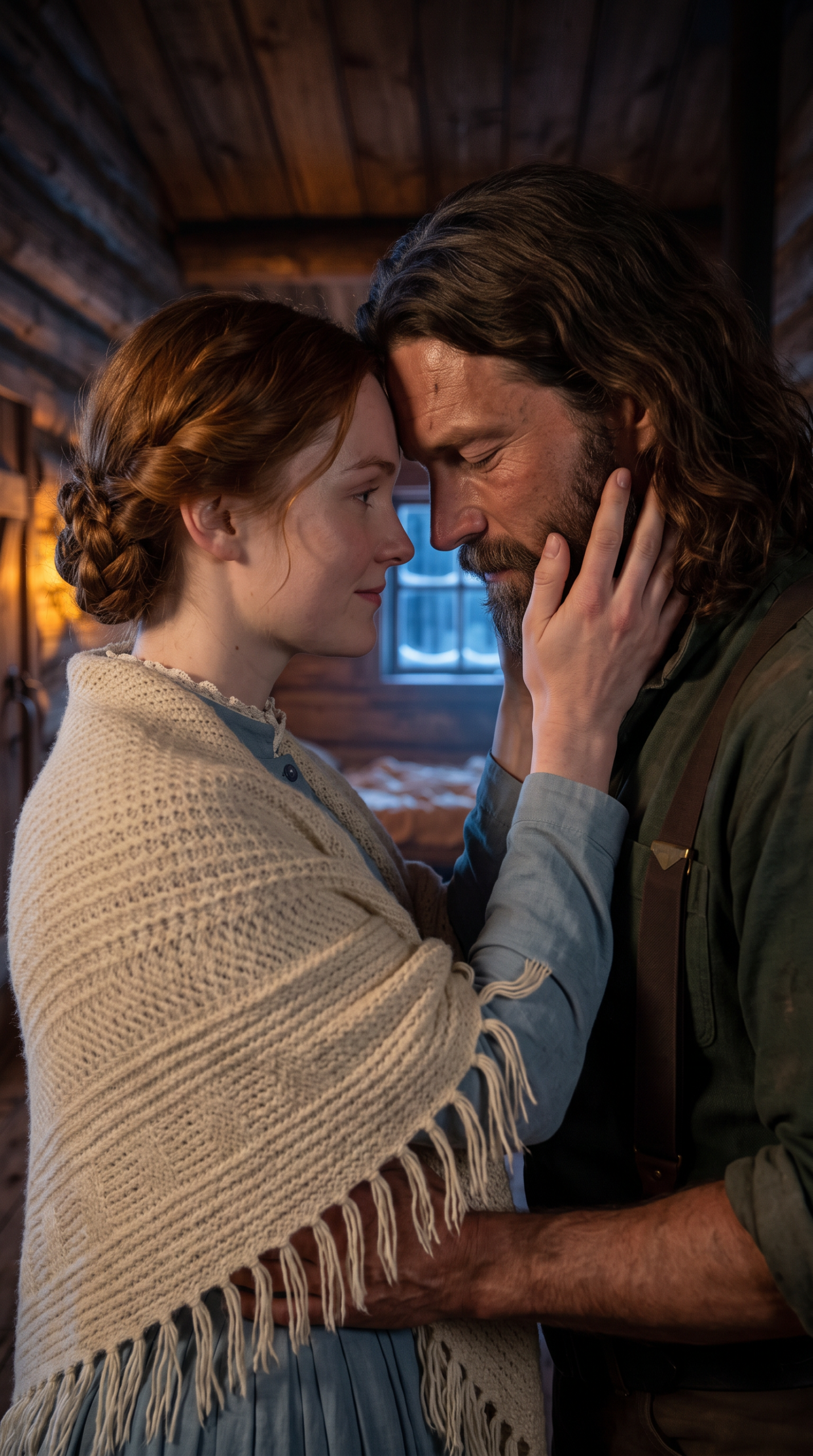
The Mountain Man Who Had Never Known a Woman—And the Widow Who Taught Him What Love Really Meant
*A powerful Western romance about a lonely mountain man, a widowed woman searching for freedom, a dangerous secret, and a love neither of them expected to find.*
—
Chapter 1: The Widow Who Married a Stranger
The first time Eleanor Whitmore saw Caleb Mercer, she wondered whether she had made the worst mistake of her life.
He stood outside a lonely cabin in the Colorado mountains, his enormous shoulders nearly filling the doorway. Snow clung to his dark hair and thick beard. A pale scar disappeared beneath the collar of his heavy coat, and his hands looked powerful enough to crush a man’s wrist without effort.
Eleanor tightened her grip on her battered traveling trunk.
She was twenty-eight years old, recently widowed, and married to a man she had met only that afternoon.
And there was nowhere left for her to run.
Three months earlier, Eleanor had still been living in Baltimore, surrounded by the fading comforts of a life she once believed secure.
Her husband, Henry Whitmore, had been a respected businessman. At least, that was what everyone believed.
When he died unexpectedly, Eleanor discovered that his respectable reputation had been built on borrowed money, unpaid obligations, and carefully concealed financial disasters.
Creditors arrived before the mourning flowers had wilted.
First came the bank.
Then came furniture dealers and men carrying legal documents Eleanor could barely understand. Within six weeks, the house she had shared with Henry was no longer hers.
Her jewelry disappeared into a creditor’s ledger. Her furniture was sold. Even the silver tea service inherited from her mother was taken.
But losing her possessions was not what hurt most.
It was discovering how little control she had ever possessed over her own life.
Henry had made every important decision. He had decided where they lived, whom they entertained, what Eleanor wore, and how much money she was permitted to spend.
During their courtship, he had been charming.
After their wedding, his affection gradually became a series of expectations.
A good wife did not question her husband.
A good wife did not embarrass him.
A good wife understood that gratitude and obedience were practically the same thing.
Eleanor had spent years trying to become the woman Henry wanted.
By the time he died, she barely remembered the woman she had once been.
Then, one rainy afternoon, she found an advertisement in a newspaper.
A respectable Western gentleman sought a wife willing to live in a remote mountain settlement. Transportation and financial arrangements would be provided.
Eleanor read it three times.
She had heard frightening stories about the frontier. Loneliness. Hunger. Harsh winters. Dangerous men.
But Baltimore offered her nothing except pity and mounting debt.
So she wrote a letter.
She explained her circumstances without attempting to make herself sound younger, prettier, or wealthier than she was. She admitted she was a widow and had little money. She offered her skills in cooking, sewing, preserving food, and maintaining a household.
Then she mailed the letter before she could lose her nerve.
Two weeks later, a reply arrived.
The handwriting was large, careful, and slightly uneven.
The man introduced himself as Caleb Mercer.
He was thirty-two years old. He owned a cabin in the Colorado mountains and earned his living trapping, hunting, and trading.
He did not drink. He had no children. He wanted a wife who could tolerate solitude and difficult winters.
His final paragraph was the strangest.
*I cannot promise a fine house or easy living. I can promise you will have food, warmth, and a place that belongs to you as much as it belongs to me.*
Eleanor stared at those words for a long time.
A place that belonged to her.
Henry had never spoken that way.
She answered yes.
Caleb settled the outstanding debts that threatened her freedom and paid for her journey west. Their correspondence continued until arrangements were made for a simple wedding near the mountain settlement.
The ceremony took place in a small chapel with a traveling minister and two witnesses.
Caleb wore a dark green coat that strained across his shoulders. Eleanor wore her best blue dress.
When the minister pronounced them husband and wife, Caleb touched her hand so gently that she almost failed to notice.
He did not kiss her until the minister suggested it.
Even then, he merely brushed his lips against her forehead.
She found that peculiar.
But not nearly as peculiar as what happened when they reached his cabin.
The journey took hours through towering pines, frozen streams, and snow-covered ridges.
By late afternoon, the world seemed to contain nothing except mountains and silence.
Then Caleb pointed toward a clearing.
“Home,” he said.
The cabin was built of thick logs, with a stone chimney and a sturdy roof buried beneath snow. A small barn stood nearby. Firewood was stacked beneath a covered shelter.
Everything looked practical, carefully maintained, and terribly isolated.
Caleb climbed down from the wagon.
Eleanor waited for him to help her.
Instead, he approached slowly and extended his hand, palm upward.
“Step’s high,” he said. “Wouldn’t want you slipping.”
She placed her gloved fingers in his enormous palm.
He steadied her without pulling.
Then he immediately released her.
Inside, the cabin was warmer than she expected. A fire burned in the stove. A braided rug covered part of the wooden floor. Shelves held books and carefully arranged cooking utensils.
There was one large bed beneath a window overlooking the forest.
Eleanor noticed the bed immediately.
So did Caleb.
His ears turned red.
“I made stew,” he announced.
She blinked.
“You cook?”
“Been doing it since I was thirteen.”
He carried her trunk inside and returned to the stove.
For the next hour, he behaved like a man desperately attempting to avoid standing too close to his new wife.
At supper, Eleanor tried to establish some understanding of their arrangement.
“I can cook,” she began. “And sew. I know how to preserve meat, and I can maintain the house.”
Caleb stopped eating.
“You don’t have to earn your supper.”
Eleanor stared.
“I beg your pardon?”
“I didn’t bring you here to work like hired help.”
“But you asked for a wife.”
“Yes.”
“Then surely you have expectations.”
He looked down at his bowl.
“Suppose I do.”
Her stomach tightened.
“What are they?”
Caleb considered the question for so long that Eleanor began to regret asking.
Finally, he said, “I’d like somebody to talk to.”
She waited.
“And?”
“Somebody to sit with when the weather turns bad.”
“And?”
His expression grew embarrassed.
“Maybe somebody who doesn’t mind hearing me read aloud sometimes.”
Eleanor nearly laughed, but stopped when she realized he was entirely serious.
Later, she changed behind a canvas screen while Caleb found unnecessary tasks to occupy himself.
He checked the stove.
Then the windows.
Then the rifle above the mantel.
Finally, he began sharpening a knife.
“Caleb.”
He looked up.
“That knife is already sharp.”
He examined the blade.
“Reckon it is.”
“Are you nervous?”
“No.”
The knife slipped slightly in his hand.
He set it down.
“Maybe.”
Eleanor glanced toward the bed.
Caleb followed her gaze and immediately stood.
“I can sleep beside the stove.”
She frowned.
“On the floor?”
“I’ve slept in worse places.”
“But we’re married.”
“I know.”
“Then why would you sleep there?”
He looked directly at her.
“Because being married doesn’t mean you owe me anything tonight.”
The room seemed to grow very quiet.
Eleanor had never heard a husband speak that way.
She folded her hands tightly.
“You paid my debts.”
“Yes.”
“You paid for my journey.”
“Yes.”
“You gave me your name.”
Caleb nodded.
“And your home.”
“Our home,” he corrected.
Her throat tightened.
“Then what do you expect in return?”
His expression changed. Not to anger, but to something that looked almost like pain.
“I didn’t buy you, Eleanor.”
“Didn’t you?”
“No.”
The answer came firmly.
“I paid those debts because you couldn’t get free of them. I asked you to marry me because I wanted a wife. Those are two different things.”
She searched his face.
“Why would a man like you need to advertise for a wife?”
Caleb looked toward the window.
“Because mountains don’t make much conversation.”
She waited.
He continued quietly.
“I’ve lived alone most of my life. Thought I liked it that way. Then one winter I got sick, and I spent nine days wondering whether anybody would notice if I died.”
Eleanor’s expression softened.
“That must have been frightening.”
“Wasn’t dying that frightened me.”
“What was it?”
His voice dropped.
“Thinking nobody would miss me.”
For the first time, Eleanor saw something beyond his intimidating appearance.
She saw a lonely man.
A man who had survived storms, wild animals, and years of isolation but had never learned how to ask another person to stay.
She crossed the room and turned the lock on the cabin door.
Click.
Caleb watched her, his shoulders stiffening.
Eleanor faced him.
“Caleb, what do you expect from me on our wedding night?”
The enormous mountain man took one step backward.
Then another.
His cheeks reddened beneath his beard.
Finally, in a voice barely louder than the crackling fire, he confessed something Eleanor would remember for the rest of her life.
“I’ve never been with a woman.”
She stared.
He looked utterly miserable.
“I know that sounds foolish.”
“No,” she whispered.
“I wouldn’t even know where to start.”
Eleanor approached him slowly.
“Come sit beside me.”
He obeyed.
On the edge of the bed, he left enough distance between them for another person.
She almost smiled.
“You’re afraid of me.”
Caleb shook his head.
“I’m afraid of hurting you.”
Something inside her broke open.
For years, she had lived with a man who worried more about his authority than her comfort. Now this giant of a stranger was trembling because he feared causing her pain.
She placed her hand over his.
His fingers were warm and rough.
“If I’m uncomfortable,” she whispered, “I’ll tell you.”
“And if you tell me to stop?”
“Then you stop.”
“Always,” he promised.
Eleanor touched his cheek.
Then she kissed him.
It was awkward. Hesitant. Sweet.
When she pulled away, Caleb stared at her in astonishment.
“Was that wrong?”
For the first time in months, Eleanor smiled without forcing herself.
“No,” she whispered. “That was very right.”
He looked at her for another moment.
Then he asked the question that would change both their lives.
“Will you teach me?”
Outside, the snow continued falling.
Inside, Eleanor Whitmore realized she had not married the frightening man she had imagined.
She had married a man who had never been loved.
And perhaps, for the first time in her life, she had found someone willing to learn.
Neither of them knew that before winter ended, they would have to decide whether that love was strong enough to survive a secret buried for fifteen years.
—
## Chapter 2: The Man Behind the Beard
The first week of their marriage was filled with small discoveries.
Eleanor discovered that Caleb could identify dozens of birds by their calls but had no idea how to make conversation with a woman over breakfast.
She discovered that he could track a deer across frozen ground, repair a broken wagon wheel, and split a cord of wood before noon.
But he had never learned to dance.
He had never bought a woman flowers.
And when Eleanor laughed unexpectedly, he looked at her as though the sound were something precious he had stumbled upon in the wilderness.
Caleb discovered that Eleanor talked to herself while cooking, hummed when she was nervous, and read the final page of a book before beginning the first.
He also discovered that she was afraid of thunderstorms.
The first time a storm rolled through the mountains, Eleanor tried to hide her fear.
She stood by the window, watching black clouds swallow the peaks.
When the first crack of thunder shook the cabin, her hands tightened around a folded towel.
Caleb noticed.
“You all right?”
“Perfectly.”
Another thunderclap struck.
Eleanor flinched.
Caleb approached but stopped several feet away.
“Would you like me to sit with you?”
She looked at him.
“You don’t have to.”
“I know.”
That answer was becoming familiar.
He brought two chairs beside the fireplace. Eleanor sat in one, and Caleb settled into the other.
For a while, neither spoke.
Then he reached for a book.
“Would reading help?”
“What are you reading?”
“An old adventure story. Man gets lost at sea.”
“That sounds dreadful.”
“He’s doing rather well so far.”
She laughed.
Caleb looked so pleased that she began laughing harder.
“What?” she asked.
“Nothing.”
“Caleb.”
He rubbed the back of his neck.
“I like it when you laugh.”
Her smile softened.
“You should say things like that more often.”
His expression turned serious.
“Would you like me to?”
“Yes.”
He nodded as though she had given him an important instruction.
“I shall try.”
The storm continued for another hour, but Eleanor eventually stopped trembling.
By the time Caleb reached the final chapter, her chair had moved closer to his.
Neither mentioned it.
That evening, Eleanor began teaching him how to dance.
She had intended it as a joke.
The cabin was warm, supper was finished, and a fiddle tune drifted from the phonograph she had found among Caleb’s belongings.
She extended her hand.
“Dance with me.”
Caleb stared at her.
“I don’t dance.”
“Neither does a dead man. Are you telling me you have less life in you than a dead man?”
His eyebrows rose.
“That seems an unfair comparison.”
“Then prove me wrong.”
He stood reluctantly.
Eleanor placed one hand on his shoulder and guided his other hand to her waist.
He held her as if she were made of thin glass.
“You can breathe,” she told him.
“I am breathing.”
“Not properly.”
He exhaled so dramatically that she burst into laughter.
His face reddened.
“You’re enjoying this.”
“Immensely.”
“Then I reckon I’ll survive.”
They moved awkwardly across the floor.
Caleb stepped on her foot twice, apologized three times, and nearly collided with the table.
Yet when the tune ended, he did not release her immediately.
His gaze had settled on her face.
“Eleanor?”
“Yes?”
“Would you mind if I kissed you?”
Her heart gave an unexpected little leap.
“No.”
He bent toward her.
This time, the kiss was less uncertain.
His hand rested lightly against her back. Her fingers curled into his shirt. The kiss lasted only a few moments, but when they parted, something between them had changed.
Caleb looked almost stunned.
“I understand why people write poems about that,” he murmured.
Eleanor’s eyes filled with warmth.
“You’ve been reading poetry?”
“Sometimes.”
“Romantic poetry?”
“Mostly when the weather’s bad.”
She touched his cheek.
“You don’t have to be embarrassed about wanting tenderness.”
He turned his face slightly, pressing his cheek into her palm.
“I don’t know how to do any of this.”
“Neither did I, once.”
“You were married.”
“Being married and being loved aren’t always the same thing.”
The words escaped before she could stop them.
Caleb’s expression darkened.
“Did he hurt you?”
“Not in the way you’re thinking.”
She lowered her hand.
“Henry never struck me. But he made me feel as though every kindness had a price and every disagreement was a failure on my part.”
Caleb was silent for a long time.
Then he said, “You won’t have to earn kindness here.”
Eleanor looked into his eyes.
“Promise me something.”
“Anything I can honestly promise.”
“If we disagree, don’t punish me with silence. If you’re angry, tell me. And if I make a mistake, remember I’m a person, not a possession.”
Caleb considered her words.
“All right.”
“And you may ask the same of me.”
He nodded.
“Then I’ll ask one thing.”
“What?”
“If you ever decide you don’t love me, tell me the truth. Don’t stay because you feel sorry for me.”
The request hurt more than Eleanor expected.
She took his hand.
“Caleb, I have known you for less than a week.”
“I know.”
“I cannot promise I will love you forever.”
He looked down.
“But I can promise not to lie about what I feel.”
He lifted his eyes again.
“And if I do come to love you?”
“Then I hope you tell me.”
His fingers tightened around hers.
“I believe I could do that.”
For the first time, Eleanor saw the possibility of a future that did not resemble her past.
A future in which she could disagree without fear.
Laugh without permission.
Love without being ordered to prove it.
But the next morning, the past arrived at their door.
A rider came through the snow shortly after breakfast.
He wore a black coat, polished boots, and the expression of a man who believed the world existed to inconvenience him.
Caleb stepped outside to meet him.
Eleanor watched through the window.
The stranger removed his gloves and handed Caleb an envelope.
Even from a distance, she could see the change in her husband’s face.
His shoulders stiffened.
His jaw tightened.
When the stranger finally rode away, Caleb stood in the snow holding the envelope as though it were a weapon.
Eleanor opened the door.
“Who was that?”
Caleb folded the letter and slipped it into his pocket.
“Nobody important.”
She studied him.
It was the first time he had lied to her.
And somehow, that frightened her more than the storm.
—
## Chapter 3: The Letter from Baltimore
For two days, Eleanor tried not to ask about the letter.
She told herself that Caleb was entitled to private thoughts. Their marriage was new, and trust could not be demanded simply because two people had exchanged vows.
Yet something had changed.
Caleb checked the windows more frequently. He began keeping his rifle near the door. Twice, Eleanor woke during the night and found him sitting beside the stove, staring into the darkness.
On the third evening, she could bear it no longer.
“Is somebody coming for us?”
Caleb looked up from the book he was reading.
“No.”
“Are you in trouble?”
“No.”
“Then why have you been watching the road?”
He closed the book.
For a moment, she thought he might refuse to answer.
Instead, he sighed.
“That letter came from a lawyer in Denver. He says a man named Silas Rourke has been asking questions about me.”
“Who is Silas Rourke?”
“Someone I knew a long time ago.”
“An enemy?”
Caleb’s silence answered her.
Eleanor sat across from him.
“Does this have something to do with why you live alone?”
He rubbed his beard.
“Partly.”
“Will you tell me?”
Caleb looked toward the fire.
“When I was seventeen, my father worked for a mining company. He was a good man, but he trusted people who didn’t deserve it. One of them was Rourke.”
He explained that the company had been accused of stealing wages and falsifying safety reports. When an accident killed several miners, the owners blamed Caleb’s father.
His father had insisted the reports were fraudulent.
Nobody believed him.
He was dismissed, arrested, and later died in prison after falling ill.
Caleb had spent years believing he could prove his father’s innocence.
Then, at twenty, he discovered that the company had destroyed most of its records.
“I tried to fight them,” he said. “Went to lawyers. Wrote letters. Spent every dollar I had.”
“What happened?”
“They threatened me. Said if I kept digging, they’d make sure nobody ever believed a word I said.”
“So you left.”
“I came here.”
Eleanor stared at him.
“You abandoned the fight?”
His eyes lifted sharply.
“I was twenty years old, Eleanor. I had no money, no influence, and no proof.”
She immediately regretted her words.
“I’m sorry.”
He shook his head.
“No. You’re right to ask.”
He looked into the flames.
“Sometimes I think I came here because I was afraid. Other times I think I came here because I knew I couldn’t save my father by getting myself killed.”
Eleanor reached across the table.
“You were a boy.”
“I was old enough to know what was happening.”
“Not old enough to defeat every cruel man in the world.”
Caleb stared at their joined hands.
“Rourke says some of those old records have turned up. He wants to meet me.”
“Will you?”
“I don’t know.”
Eleanor considered the matter.
“Perhaps he wants to settle things peacefully.”
Caleb gave a humorless laugh.
“Men like Rourke don’t send polite letters because they’ve discovered a conscience.”
She studied him.
“What will you do if he comes here?”
“Keep you safe.”
“And what will you do about the truth?”
His jaw tightened.
“That’s different.”
“Is it?”
He looked at her.
Eleanor took a breath.
“Caleb, I understand fear. I know what it is to remain silent because speaking seems too dangerous. But I also know what happens when you allow another person to decide the limits of your life.”
“You think I should fight him?”
“I think you should decide what you want. Not what he’s frightened you into wanting.”
Caleb remained quiet.
Then, unexpectedly, he smiled faintly.
“You’ve got a way of making a man feel foolish without raising your voice.”
“Years of practice.”
He laughed.
It was the first time she had heard him laugh without trying to suppress it.
She leaned forward and kissed him.
When she pulled away, he looked at her with such tenderness that she felt something warm and unfamiliar settle in her chest.
“Eleanor?”
“Yes?”
“If this trouble gets worse, I need you to know something.”
She waited.
“You can leave. I’ll arrange a safe journey to town. You won’t owe me an explanation.”
Her smile disappeared.
“Why do you keep offering me the door?”
“Because I want you to know it’s there.”
She looked at him for a long moment.
Then she took the letter from his pocket, placed it on the table, and folded her hands over it.
“I have spent too much of my life being sent wherever someone else decided I belonged.”
Caleb watched her.
“I chose to come here. I chose to marry you. If danger comes, I will decide what I can bear.”
“You shouldn’t have to face it.”
“Perhaps not. But I would rather face it beside a man who respects me than hide behind a man who thinks he owns my choices.”
His eyes shone in the firelight.
He reached for her hand.
“Then we face it together.”
Neither noticed the shadow moving beyond the window.
Someone had been watching the cabin.
And before dawn, that someone would return.
—
## Chapter 4: The Night the Cabin Burned
The fire began shortly after midnight.
Eleanor woke to the smell of smoke.
For one confused moment, she thought the stove had malfunctioned. Then she heard Caleb shouting her name.
“Eleanor! Get up!”
She stumbled from the bed.
Flames were climbing the outer wall beside the woodpile, licking toward the roof. Smoke poured through the narrow gaps around the window.
Caleb seized a blanket, soaked it in a bucket, and threw it over her shoulders.
“Stay low!”
“What about you?”
“I’m right behind you.”
He pushed open the door.
A wave of cold air struck her face.
They stumbled into the snow as the roof above the storage room began to crackle.
Eleanor turned toward the barn.
“The animals!”
“Leave them!”
“There are horses inside!”
Caleb caught her arm.
For the first time since their marriage, his voice rose in anger.
“Eleanor, I will not watch you die in that fire!”
She froze.
He seemed to realize what he had said.
His expression softened.
“Please,” he whispered. “Let me get them.”
Before she could answer, he disappeared into the smoke.
Eleanor stood outside in her nightdress, shivering beneath the blanket, watching flames climb the walls of the only home she had known since arriving in Colorado.
Then she heard a horse scream.
She ran toward the barn.
Inside, smoke filled the rafters. One of the horses had broken its lead, and another was kicking desperately against the stall door.
Eleanor pulled the first latch.
The horse bolted past her into the snow.
She opened the second stall.
A heavy beam crashed down behind her.
For a moment, she could not move.
Then Caleb appeared through the smoke.
He caught her around the waist and dragged her toward the door.
They tumbled into the snow just as part of the barn roof collapsed.
Eleanor coughed violently.
Caleb rolled onto his knees.
“Are you hurt?”
She shook her head.
He examined her face, her hands, her shoulders.
Then he pulled her against his chest.
His arms closed around her with such desperation that she felt his whole body trembling.
“I thought I’d lost you,” he whispered.
Eleanor wrapped her arms around him.
“I’m here.”
“I couldn’t see you.”
“I’m here, Caleb.”
He pressed his face into her hair.
For several seconds, neither spoke.
Then Eleanor realized that he was crying.
Not loudly.
Not dramatically.
But the tears were real.
She held him tighter.
The cabin burned until dawn.
By sunrise, the roof had collapsed, the storage room was gone, and most of their winter supplies had been destroyed.
The barn had suffered heavy damage, but the animals were alive.
Caleb stood amid the blackened ruins, his face covered in soot.
Eleanor approached him.
“We can rebuild.”
He looked at her.
“They burned our home.”
“Yes.”
“They could have killed you.”
“But they didn’t.”
He turned away, fists clenched.
For the first time, Eleanor saw the anger beneath his quiet nature.
It frightened her—not because she thought he would harm her, but because she understood how long he had been carrying it.
He picked up a charred piece of wood and threw it into the snow.
“I’m going to town.”
“To do what?”
“Find Rourke.”
“And then?”
He did not answer.
Eleanor stepped in front of him.
“Look at me.”
He reluctantly met her eyes.
“Don’t let a cruel man turn you into someone you don’t recognize.”
His breathing was harsh.
“He tried to kill us.”
“Then we make sure he answers for it.”
“How?”
“With evidence. With witnesses. With the truth.”
Caleb shook his head.
“You don’t understand these men.”
“Then explain them to me.”
He stared at her.
She took his soot-covered hands.
“I am not asking you to forgive him. I am asking you not to throw your life away because he has already stolen so much of it.”
For a long moment, the only sound was the wind moving through the trees.
Finally, Caleb lowered his head.
“What if I can’t prove anything?”
“Then we keep looking.”
“And if he comes back?”
“Then we will be ready.”
He studied her face.
“You make it sound so simple.”
“It isn’t simple. But it is possible.”
He brought her hand to his lips.
“I have never had anyone stand beside me like this.”
Eleanor’s throat tightened.
“Then you will have to get used to it.”
A faint smile touched his mouth.
“I reckon I can try.”
That afternoon, while searching the surviving storage room, Eleanor discovered something buried beneath a fallen shelf.
A small iron box.
Inside lay several old letters, a folded map, and a leather-bound notebook.
The notebook belonged to Caleb’s father.
Eleanor opened it carefully.
Most of the pages contained ordinary accounts, notes about mining supplies, and names of workers.
But near the back, one sentence had been underlined three times.
*If anything happens to me, the original inspection records are hidden beneath the old mill foundation. Rourke must never find them.*
Eleanor read the sentence again.
Then she looked toward Caleb.
For the first time since the fire, she smiled.
“Your father left us a trail.”
Caleb stared at the notebook.
His expression changed from exhaustion to disbelief.
Then, slowly, hope returned to his eyes.
—
## Chapter 5: The Secret Beneath the Old Mill
The old mill stood nearly twenty miles from the cabin, beside a frozen stream at the edge of a mining settlement that had been abandoned years earlier.
Caleb had not visited it since he was a young man.
The journey took most of a day.
They left before sunrise, carrying provisions, a lantern, a shovel, and Caleb’s rifle.
Eleanor wore two coats and a wool scarf. Caleb checked the wagon’s harness three times before allowing her to climb aboard.
“You know,” she said, “if you keep worrying over me, I’ll begin to think you care.”
He glanced at her.
“That’s a terrible thing to accuse a man of.”
She smiled.
He looked away, but not before she saw the answering smile beneath his beard.
They reached the mill shortly after noon.
The building leaned dangerously to one side, its broken windows filled with snow. The stream beside it was frozen, and the surrounding trees stood silent beneath the winter sky.
Caleb stopped the wagon.
“Stay close.”
“I had no intention of wandering into the wilderness.”
“Good.”
“And if I did?”
“I’d find you.”
The quiet certainty of his answer made her heart ache.
They searched the building first.
Eleanor examined the old office while Caleb checked the machinery room.
Dust covered the desks. Papers had rotted into brown fragments. A rusted stove stood in one corner.
Then Eleanor noticed a narrow trapdoor beneath a fallen cabinet.
“Caleb!”
He hurried over.
Together, they pulled away the debris and lifted the door.
Below lay a shallow stone chamber.
At the bottom, wrapped in oilcloth, was a metal box.
Caleb descended the ladder.
Eleanor waited above, holding the lantern.
When he opened the box, his face went pale.
Inside were inspection reports, wage ledgers, signed statements, and letters bearing the company seal.
He lifted one page.
“My father’s handwriting.”
Eleanor climbed down beside him.
The document described a dangerous support structure in one of the mines. It had been declared unsafe weeks before the accident that killed the workers.
Another report showed that the company had ordered the inspection results altered.
And several letters carried Silas Rourke’s signature.
Caleb sat down on the cold stone floor.
For fifteen years, he had wondered whether his father had died believing nobody would ever know the truth.
Now he held proof that his father had tried to save those men.
Eleanor knelt beside him.
“Caleb?”
He could not answer.
She placed a hand on his shoulder.
For a long moment, he stared at the papers.
Then he whispered, “He wasn’t lying.”
“No.”
“My father wasn’t a liar.”
“No,” Eleanor repeated. “He was telling the truth, and they punished him for it.”
Caleb bowed his head.
His shoulders began to shake.
Eleanor pulled him into her arms.
She did not tell him to be strong.
She did not tell him to stop crying.
She simply held him while the years of grief finally found somewhere to go.
When he lifted his head, his eyes were red.
“I thought I had forgotten his voice.”
Eleanor brushed the snow from his hair.
“Perhaps you were trying not to remember how much you missed him.”
He pressed his forehead against hers.
“How do you always know what to say?”
“I don’t. I simply know what it feels like to lose someone and be left with questions.”
They remained together in the chamber until Caleb had gathered every document.
Before leaving, Eleanor noticed a second envelope tucked beneath the ledger.
It contained a letter addressed to Caleb.
The handwriting belonged to his father.
Caleb unfolded it with trembling fingers.
*My son,*
*If you are reading this, then I have failed to return home, and I fear the truth may be buried with me.*
*I want you to know that I have never been ashamed of you. You are a good boy, Caleb, even when the world tells you otherwise.*
*Do not spend your whole life fighting men who have forgotten how to be human. Seek justice when you can, but do not allow hatred to consume the years you have left.*
*There is more to life than proving that a wicked man is wicked.*
*There is love, there is laughter, and there are people who need you.*
*If I could ask one thing of you, it would be this: do not make your life a monument to my death.*
*Live, my son.*
*Live well enough for both of us.*
Caleb lowered the letter.
For a long time, he could not speak.
Eleanor slipped her hand into his.
“You have spent fifteen years trying to give your father justice,” she whispered. “Perhaps now you can give yourself permission to live.”
He looked at her.
“And what if I don’t know how?”
She smiled through her tears.
“Then we learn together.”
He kissed her forehead.
Then her cheek.
Finally, he kissed her lips with a tenderness that made the abandoned mill feel less cold.
When they returned to the wagon, Caleb helped Eleanor into her seat.
But before climbing up himself, he stopped.
“Eleanor?”
“Yes?”
“I need to tell you something.”
She waited.
“When I first wrote that advertisement, I thought I wanted a wife because I was tired of being alone.”
“And now?”
He looked at her as though the answer frightened him more than any mountain storm.
“Now I think I was waiting for you before I even knew your name.”
Eleanor’s eyes filled with tears.
She reached for his hand.
“Then I hope you understand that I’m not staying because I need a place to live.”
He swallowed.
“Why are you staying?”
She kissed his knuckles.
“Because when you look at me, I feel like a person again.”
For a moment, the mountains seemed to fall silent.
Then Caleb climbed into the wagon, gathered the reins, and turned them toward home.
Neither saw the rider waiting behind the distant ridge.
Silas Rourke had discovered that the records were missing.
And he knew exactly who had taken them.
—
## Chapter 6: The Town That Turned Against Them
By the time Caleb and Eleanor reached the settlement, word of the burned cabin had spread.
So had the rumors.
Some people said Caleb had started the fire himself to collect insurance money, though he had no insurance.
Others whispered that Eleanor had married him only for his land.
And a few claimed that the old mining records were forgeries created to ruin a respectable businessman.
Silas Rourke had spent fifteen years building a reputation as a generous benefactor.
He donated money to the church, paid for school supplies, and made certain the local newspaper printed his name whenever he contributed to a public cause.
People saw the polished boots and expensive coat.
They did not see the man who had ordered records destroyed and workers threatened.
Caleb and Eleanor carried the documents to the local sheriff.
Sheriff Thomas Bell was a broad-faced man with gray hair and tired eyes.
He read the first report carefully.
Then the second.
By the time he reached the letters bearing Rourke’s signature, his expression had hardened.
“These are serious accusations.”
“They are records,” Caleb replied. “You can compare the signatures with the company filings.”
Bell looked at him.
“You understand Rourke has friends in Denver?”
“I understand my father died in prison because those friends refused to listen.”
The sheriff sighed.
“I’ll send copies to the district attorney.”
“Copies?”
“The originals will need to be examined.”
Caleb’s jaw tightened.
“How long?”
“Several days. Perhaps longer.”
Eleanor noticed the hesitation in his voice.
“Is something wrong, Sheriff?”
Bell lowered his eyes.
“Rourke arrived in town this morning. He says he’ll be filing a complaint against your husband for theft of company property.”
Caleb went still.
“Those records belonged to my father.”
“I know.”
“Then why are you listening to him?”
“Because the law requires me to investigate both sides.”
Caleb leaned forward.
“That man burned my home.”
The sheriff’s expression changed.
“Do you have proof?”
“No.”
“Then I cannot arrest him on suspicion alone.”
Caleb stood so abruptly that the chair scraped against the floor.
Eleanor touched his arm.
“Caleb.”
He stopped.
She looked at the sheriff.
“We understand. Please send the documents to the district attorney as quickly as possible.”
Outside the office, Caleb walked into the snow without speaking.
Eleanor followed.
“They’re going to let him walk free,” he muttered.
“They haven’t decided anything yet.”
“They’ve already decided who they believe.”
She caught his hand.
“Then we find someone who will examine the evidence.”
He looked at her.
“What if there isn’t anyone?”
“There is always someone who cares about the truth.”
“You sound certain.”
“No. I sound determined.”
He stared at her for a long moment.
Then he laughed bitterly.
“You have more courage than I do.”
Eleanor shook her head.
“I am afraid every day.”
“Of what?”
“Of losing the little freedom I have found. Of waking one morning and discovering that I have returned to being the woman who apologizes for existing.”
She took a breath.
“But I have learned that fear does not always mean you should run.”
Caleb’s expression softened.
Before he could answer, a voice called from across the street.
“Mrs. Mercer?”
A woman in a dark traveling cloak hurried toward them.
She was in her early forties, with sharp eyes and a notebook tucked beneath one arm.
“My name is Abigail Foster. I write for the Denver Evening Ledger.”
Caleb immediately moved in front of Eleanor.
Abigail noticed.
“I’m not here to cause trouble.”
“Then why are you here?”
“Because someone told me that a man named Caleb Mercer had recovered documents proving that a mining company falsified safety reports fifteen years ago.”
Caleb said nothing.
Abigail opened her notebook.
“My father worked in that mine. He was one of the men who died.”
Eleanor’s expression changed.
“Your father?”
Abigail nodded.
“For years, we were told that the accident was unavoidable. My mother died believing the company had done nothing wrong.”
She looked at Caleb.
“If those documents are genuine, there are families who deserve to know what happened.”
Caleb studied her carefully.
“Why should I trust you?”
“You shouldn’t. Not until I’ve earned it.”
The answer surprised him.
Abigail continued.
“I can verify the records independently. I know the names of several surviving workers, and I have access to the original newspaper reports. If the documents match, I’ll publish the story.”
“And if they don’t?”
“Then I won’t.”
Caleb looked at Eleanor.
She gave him a small nod.
For the first time in days, he felt something other than anger.
Possibility.
He handed Abigail a copy of the first report.
She read it, her expression growing more serious with every line.
Then she looked up.
“Mr. Mercer, if this is authentic, it could change everything.”
“That’s what I’m hoping.”
Abigail closed her notebook.
“I’ll need two days.”
Caleb nodded.
“Take three if you need them. Just don’t let those papers disappear.”
Abigail’s eyes hardened.
“I lost my father once. I won’t let anyone erase him twice.”
That evening, Caleb and Eleanor stayed at a small boardinghouse while arrangements were made to rebuild their cabin.
For the first time since the fire, they slept beneath a roof that belonged to someone else.
Caleb lay awake beside Eleanor, listening to the wind.
She turned toward him.
“Can’t sleep?”
“No.”
“Thinking about Rourke?”
“Thinking about you.”
She blinked.
“That sounds much more pleasant.”
He smiled faintly.
“I keep wondering whether I deserve this.”
“What?”
He gestured toward her.
“You. A home. Someone who wants to stand beside me.”
Eleanor propped herself up on one elbow.
“Caleb, look at me.”
He did.
“You do not have to suffer enough to deserve happiness.”
He stared at her.
“You don’t have to defeat every cruel man, prove every lie, or carry every grief alone before you’re allowed to be loved.”
His eyes glistened.
“Nobody has ever said that to me.”
“Then somebody should have.”
She touched his face.
“And I am saying it now.”
He drew her gently into his arms.
For the first time in fifteen years, Caleb Mercer allowed himself to imagine a future that was not defined by the man who had destroyed his family.
He imagined a cabin rebuilt.
A garden beside the porch.
A woman laughing in the kitchen.
Children running through the snow, perhaps, if they were fortunate enough to have them.
And himself, no longer watching the road for enemies.
Only watching it for the people he loved.
But across town, Silas Rourke was preparing to make certain that future never came.
—
## Chapter 7: The Woman Who Refused to Be Bought
Silas Rourke arrived at the boardinghouse the following afternoon.
He came alone, dressed in an expensive black coat and carrying a polished walking stick.
Caleb opened the door.
For several seconds, neither man spoke.
Then Rourke smiled.
“Mercer. You’ve grown into quite the mountain savage.”
Caleb’s expression remained cold.
“What do you want?”
“To settle a misunderstanding.”
“There is no misunderstanding.”
Rourke glanced past him toward Eleanor.
“So this is the wife.”
Eleanor stood from her chair.
“My name is Eleanor Mercer.”
“Of course.”
His smile widened.
“I hope you’re enjoying your new life, Mrs. Mercer. The frontier can be unforgiving to women accustomed to more civilized surroundings.”
Eleanor met his gaze.
“I have found it kinder than some drawing rooms.”
Caleb almost smiled.
Rourke’s expression tightened.
He stepped inside without being invited.
“I understand you have obtained certain old company documents.”
“They belonged to my father,” Caleb said.
“Those documents are stolen property.”
“Then you should have no objection to an investigation.”
Rourke tapped his walking stick against the floor.
“Let’s not pretend this is about justice. Your father was a stubborn man who refused to understand how business worked.”
“My father tried to save those men.”
“He caused unnecessary trouble.”
“He died in prison.”
“And now he’s dead. What good will it do to drag his name through the mud again?”
Caleb moved closer.
“You’re the one who dragged his name through the mud.”
Rourke’s eyes narrowed.
For a moment, his polished mask slipped.
Then he turned to Eleanor.
“Perhaps you can help your husband understand reason. I know what a woman in your circumstances needs. Security. Comfort. A future.”
He placed a thick envelope on the table.
“There is enough money inside to buy a respectable house in town. You could live comfortably for the rest of your life.”
Eleanor looked at the envelope.
Then at Rourke.
“You expect me to leave my husband?”
“I expect you to be practical.”
“And if I refuse?”
His smile disappeared.
“Your husband will lose everything. The cabin, the land, whatever reputation he has left. Men who challenge powerful interests rarely end well.”
Eleanor picked up the envelope.
Caleb stiffened.
For one painful second, he wondered whether she might take it.
Not because he believed she was greedy, but because he feared the world had taught her to accept security wherever it could be found.
She opened the envelope.
Inside were banknotes and a folded document.
She examined the money, then set it back on the table.
“Mr. Rourke, I spent years married to a man who believed everything had a price.”
Rourke watched her.
“My first husband taught me to smile when I was unhappy, to remain silent when I disagreed, and to mistake obedience for love.”
She folded the envelope closed.
“I will not make that mistake again.”
She pushed it toward him.
“Take your money.”
Rourke’s face reddened.
“You will regret this.”
“Perhaps. But at least the regret will be mine.”
Caleb stared at his wife.
There was no fear in her expression.
No desperation.
No apology.
She had refused the money not because she was certain life would be easy without it, but because she finally understood the value of a choice freely made.
Rourke snatched the envelope.
“You have no idea what you’ve done.”
Eleanor opened the door.
“I know exactly what I’ve done. I have refused to sell my future to a man who believes he can purchase everyone’s silence.”
Rourke glared at her.
Then he looked at Caleb.
“You should have stayed in your mountains.”
Caleb stepped aside.
“And you should have left my father alone.”
Rourke departed without another word.
When the door closed, the room fell silent.
Eleanor turned.
Caleb was looking at her with an expression she had never seen before.
“What?” she asked.
He shook his head.
“I thought I was the brave one.”
She laughed softly.
“You are.”
“Not compared to you.”
Eleanor stepped closer.
“Caleb, courage isn’t the absence of fear. It is deciding that something matters more than the fear.”
He considered that.
Then he took her hands.
“You matter more than anything to me.”
Her breath caught.
He seemed surprised by his own words.
“I didn’t mean to say it like that.”
“Like what?”
“Like a man in one of your books.”
She smiled.
“You could try saying it again.”
He swallowed.
“I love you, Eleanor.”
The words were simple.
No grand speech. No promise of riches or a life without hardship.
Just the truth, spoken by a man who had spent most of his life believing he had nothing worth offering.
Eleanor’s eyes filled with tears.
“I love you too.”
Caleb closed his eyes briefly, as if he needed a moment to believe her.
Then he kissed her.
It was no longer the uncertain kiss of a man afraid of doing something wrong. It was the kiss of someone who had learned that tenderness did not diminish strength.
When they parted, he rested his forehead against hers.
“I should have told you sooner.”
“You told me when you were ready.”
He smiled.
“Will you stay with me, even when this is over?”
Eleanor looked into his eyes.
“I married you because I needed a way out of my old life. I am staying because I want the life we are building together.”
He drew her close.
Outside, the wind rattled the shutters.
Inside, they held one another as though the world could wait.
But the world was not finished with them.
The following morning, Abigail Foster returned with terrible news.
Someone had broken into her rented room.
Her notes were missing.
And Silas Rourke had disappeared.
—
## Chapter 8: The Price of the Truth
Abigail arrived at the boardinghouse before sunrise.
Her hair was untidy, her face pale with exhaustion.
“They took everything,” she said. “My notes, the copies of the reports, the names of the surviving workers.”
Caleb stood immediately.
“Did you see who did it?”
“No. But the landlord heard a wagon leave shortly before midnight.”
Eleanor brought Abigail a cup of coffee.
“Did they take the original documents?”
“No. I left those with the newspaper office.”
Abigail rubbed her forehead.
“Unfortunately, the editor has received a letter threatening to sue the paper if the story is published.”
“From Rourke?” Caleb asked.
“His lawyer.”
Caleb swore under his breath.
Eleanor placed a hand on his arm.
“Then we need more evidence.”
Abigail looked at her.
“There’s a retired engineer named Samuel Price living outside Denver. He signed one of the original inspection reports. If we can find him, he may be able to confirm the records.”
“Then we’ll find him,” Caleb said.
They left the next morning.
The journey was difficult. Snow covered the road, and the wagon moved slowly over the frozen ground.
But the thought of finding a witness kept them moving.
They reached Price’s farm shortly before dusk.
The old engineer lived in a small house surrounded by bare apple trees. He was nearly seventy, with a bent back and hands that trembled when he opened the door.
When Caleb explained why they had come, Price’s expression changed.
“I wondered when someone would ask about that mine again.”
He invited them inside.
Eleanor noticed the fear in his eyes.
“Mr. Price, you knew Caleb’s father?”
The old man nodded.
“Thomas Mercer was a good man. Better than most of us.”
“Why didn’t you speak up after he was accused?”
Price looked down.
“Because I had a wife and two children. Rourke made it clear that if I testified, I’d lose my job. He threatened to have my son arrested for stealing tools.”
Caleb’s face hardened.
“So you let my father take the blame.”
Price flinched.
“Yes.”
The admission hung in the room.
Caleb rose from his chair.
For a moment, Eleanor feared he might leave in anger.
Instead, he walked to the window and stared into the darkness.
When he spoke, his voice was quiet.
“My father spent his final days believing nobody would tell the truth.”
Price’s eyes filled with tears.
“I know.”
“No. You don’t know.”
Caleb turned.
“You lived with your family. You grew old. You watched your children grow up. My father died in a prison cell because men like you were afraid.”
Price lowered his head.
“I cannot change what I did.”
“No,” Caleb replied. “But you can decide what you do now.”
The old engineer looked up.
“What would you have me do?”
“Tell the truth.”
Price closed his eyes.
Then he nodded.
“I will.”
The following morning, he signed a sworn statement confirming that the inspection reports had been altered under Rourke’s orders.
He also identified two surviving workers who had witnessed the company’s attempts to silence the miners.
Abigail took the statement to the newspaper office.
Caleb and Eleanor returned to the settlement with the original records.
For the first time, the case against Rourke was becoming impossible to dismiss.
But Rourke had one final weapon.
A letter arrived at the boardinghouse that evening.
It was addressed to Eleanor.
She opened it alone.
The message was short.
*Mrs. Mercer,*
*Your husband has spent fifteen years trying to destroy me. He will never stop, and neither will I.*
*You have a chance to end this before it ruins both your lives.*
*Come to the old mill tomorrow evening. Bring the original records. Come alone.*
*If you refuse, your husband will learn what it means to lose everything.*
*Silas Rourke.*
Eleanor read the letter twice.
Then she folded it carefully.
She could have shown Caleb immediately.
But she knew what he would do.
He would insist on coming with her. He would risk his life to protect her. And Rourke would use that devotion against them.
Eleanor had spent too many years being told that she was helpless.
She was not going to let fear make her helpless again.
The following evening, she told Caleb she was going to speak with Abigail.
Instead, she took a horse and rode toward the abandoned mill.
She carried no weapon.
Only the letter and a small notebook in which she had copied the names and dates from the original records.
She intended to make Rourke explain himself.
And she intended to make certain someone knew where she had gone.
Before leaving, she had slipped a note beneath Caleb’s book.
*If I am not back by midnight, take the papers to Sheriff Bell. Trust Abigail. Do not come looking for me alone.*
It was not a perfect plan.
But it was the only one she could think of.
At the old mill, Rourke was waiting beside a lantern.
“You came,” he said.
“You threatened my husband.”
“I offered you a chance to save him.”
“You offered me money to betray him. Now you threaten him when I refuse.”
Rourke’s smile was thin.
“You are more stubborn than I expected.”
“I have been underestimated before.”
She placed the copied pages on the table.
“Tell me why you ordered the reports altered.”
His expression darkened.
“You have no idea how business works.”
“Then explain it to me.”
“The company was struggling. The mine needed repairs, but the owners refused to spend the money. I was trying to keep the operation alive.”
“By sending men into an unsafe mine?”
“Men work dangerous jobs.”
“Men died.”
Rourke struck the table with his walking stick.
“Accidents happen!”
Eleanor did not move.
“And when Caleb’s father tried to expose the truth?”
Rourke’s breathing grew heavier.
“Thomas Mercer was going to ruin everything.”
“So you destroyed him.”
“I protected the company.”
“You protected yourself.”
For a moment, Rourke looked genuinely startled.
Then his face hardened.
“You think you can judge me? You have no money, no standing, and no family willing to protect you.”
Eleanor felt fear rise in her chest.
But beneath it was something stronger.
“You are wrong about one thing.”
Rourke stepped closer.
“What is that?”
“I have a family.”
His eyes narrowed.
“My husband. My friends. And the people whose fathers died in that mine.”
She lifted her chin.
“You cannot make us disappear simply because we refuse to be silent.”
Rourke reached for the papers.
Eleanor pulled them away.
He seized her wrist.
“Give them to me!”
She struggled.
“Let go!”
He twisted her arm, and the pages scattered across the floor.
Eleanor cried out.
Rourke released her only long enough to gather the documents.
Then he shoved her toward the wall.
She struck the wooden boards and fell to her knees.
For a moment, she could not breathe.
Rourke bent over her.
“You should have taken the money.”
Eleanor looked up at him.
Even frightened and injured, she managed a bitter smile.
“And you should have learned when to stop.”
A sound came from outside.
Hooves.
More than one horse.
Rourke turned sharply.
The mill door burst open.
Caleb stood in the doorway, his face white with fury.
Behind him were Sheriff Bell, Abigail Foster, and two deputies.
For one terrible second, nobody moved.
Then Caleb saw Eleanor on the floor.
He crossed the room in three strides and knelt beside her.
“Eleanor.”
She reached for his hand.
“I’m all right.”
His eyes searched her face.
“Are you hurt?”
“My wrist.”
He looked as though he wanted to tear the building apart.
Instead, he gently helped her stand.
Sheriff Bell seized Rourke’s arm.
“Silas Rourke, you’re under arrest on suspicion of assault, evidence tampering, and conspiracy related to the mining accident.”
Rourke struggled.
“You cannot arrest me! I know the governor!”
Bell’s expression was cold.
“Then I suggest you explain that to the district attorney.”
As the deputies led him away, Rourke turned toward Caleb.
“This isn’t over!”
Caleb held Eleanor close.
“No,” he replied. “It isn’t.”
He looked down at his wife.
“But the truth has finally begun.”
—
## Chapter 9: The Mountain Man’s Promise
The weeks that followed were unlike anything Eleanor had ever experienced.
The story appeared on the front page of the Denver Evening Ledger.
**FIFTEEN-YEAR MINING SCANDAL EXPOSED: NEW EVIDENCE POINTS TO COMPANY COVER-UP**
Abigail’s article named the dead miners, described the falsified inspections, and included statements from surviving workers.
For the first time, the families were able to speak openly about what had happened.
The district attorney ordered a full investigation.
Silas Rourke was charged with multiple offenses, including conspiracy and evidence tampering. His lawyers attempted to discredit the documents, but the signatures, ledgers, and sworn testimony proved difficult to explain away.
Samuel Price testified.
So did two former miners.
And Caleb Mercer, the son of the man who had been blamed, finally told his father’s story in a public courtroom.
He did not shout.
He did not threaten anyone.
He simply described the man he had known.
A father who worked long hours.
A man who believed a promise should mean something.
A man who had tried to save his fellow workers and had been punished for refusing to lie.
When Caleb finished speaking, the courtroom remained silent.
Then one of the miners’ widows began to cry.
Another woman reached for her hand.
Eleanor sat in the gallery, holding her husband’s hat in her lap.
She had never been prouder of anyone in her life.
But justice did not repair everything.
The cabin still lay in ruins.
Their savings had been spent on rebuilding the barn and replacing supplies lost in the fire. Winter was beginning to loosen its grip, but spring remained distant.
One evening, Caleb returned from town carrying a small wooden box.
Eleanor was sitting by the stove, mending a torn shirt.
“What have you got there?” she asked.
“Something I should have given you earlier.”
He placed the box on the table.
Inside lay a simple silver locket.
It was not expensive, but it had been polished carefully.
Eleanor lifted it.
“It’s beautiful.”
“My mother owned it.”
She looked up.
“You never told me much about her.”
Caleb sat opposite her.
“She died when I was young. Before my father was sent away. She used to say that a home wasn’t made from walls and furniture. It was made from the people who returned to it.”
Eleanor’s fingers tightened around the locket.
“Why are you giving it to me?”
He looked uncomfortable.
“Because I want you to have something that belonged to someone who loved me before I knew how to love anybody.”
Her eyes filled with tears.
“Caleb.”
He continued quickly, as though afraid he might lose his courage.
“I know I haven’t given you much. The cabin is gone. The land isn’t worth a fortune. I cannot promise you an easy life.”
Eleanor set the locket down.
“Why do you keep apologizing for the life we have?”
He stared at her.
“Because you could have had better.”
She rose and crossed the room.
“Better than what?”
“Better than a lonely cabin and a man who spent most of his life talking to animals.”
She laughed softly.
“Do you know what I had before I came here?”
Caleb fell silent.
“I had fine furniture and expensive dresses. I had a husband who could buy me anything except peace. I had a house in which I was afraid to speak honestly.”
She took his hands.
“And do you know what I have now?”
He shook his head.
“A man who asks before he kisses me. A man who listens when I speak. A man who lets me disagree with him without making me afraid.”
Her voice trembled.
“I have a home where I am not required to disappear in order to be loved.”
Caleb’s eyes shone.
“I don’t know how to thank you for that.”
“You don’t have to thank me.”
She touched his cheek.
“Just keep being the man you are learning to be.”
He drew her into his arms.
For a long time, they stood together beside the stove.
Then Caleb stepped back.
“Eleanor, there is something else I want to ask you.”
She smiled.
“You seem to have many questions lately.”
“Only important ones.”
“Go on, then.”
He took a breath.
“Would you like to help me build a new cabin?”
She blinked.
“A new cabin?”
“One with a bigger kitchen. A proper porch. Windows facing the valley.”
“And a second bedroom?”
He looked surprised.
“If you want one.”
“For guests?”
“Or children.”
The word hung between them.
Eleanor searched his face.
“Do you want children?”
Caleb looked down at their joined hands.
“I do. But I don’t want you to think that loving me means you must give me anything you don’t want.”
Her heart ached.
“Caleb, you don’t have to turn every hope into an apology.”
He looked up.
She smiled through her tears.
“I would like children. Someday. If we are fortunate enough to have them.”
His expression changed.
Hope spread across his face so openly that she nearly cried again.
“Really?”
“Really.”
He laughed softly.
Then he kissed her.
This time, there was no hesitation.
No fear that he might be asking too much.
Only two people who had chosen one another and were finally learning how to build a future together.
Later that night, Eleanor sat beside Caleb while he read aloud from his adventure book.
She rested her head against his shoulder.
He paused halfway through a sentence.
“What is it?” she murmured.
“Nothing.”
“Caleb.”
He smiled.
“I was just thinking that I used to believe being alone meant nobody could hurt me.”
“And now?”
“Now I know it means nobody gets the chance to hold you when you’re hurting, either.”
Eleanor lifted her head and kissed his cheek.
“That sounds like something a poet would say.”
“Don’t tell anyone. I’ve got a reputation to maintain.”
She laughed.
He began reading again.
Outside, the wind moved through the pines.
But for the first time in fifteen years, Caleb Mercer did not listen for danger.
He listened to his wife breathing beside him.
And he was grateful.
—
## Chapter 10: The Cabin at the Edge of the World
Spring arrived slowly in the Colorado mountains.
The snow melted from the southern slopes first, revealing dark earth and patches of stubborn grass. Streams began running beneath the ice. Birds returned to the trees, and the air carried the scent of pine needles and damp soil.
Caleb and Eleanor began rebuilding their cabin.
They worked side by side.
Caleb cut the logs and raised the walls. Eleanor planned the rooms, organized supplies, and insisted on a proper kitchen window that would let the morning sunlight fall across the table.
“You know,” Caleb said one afternoon, “I’ve built three cabins in my life.”
“And?”
“Never once did anyone tell me where to put a window.”
“Then you’ve been doing it wrong for years.”
He laughed.
“Seems I have.”
They built a wide porch overlooking the valley.
Eleanor planted wildflowers beside the steps. Caleb constructed a sturdy wooden table and two chairs for the porch, though Eleanor complained that the chairs were far too large.
“They’re comfortable,” he insisted.
“They are suitable for bears.”
“Then the bears can visit.”
She threw a small cushion at him.
He caught it easily.
For a moment, they simply stood there laughing beneath the afternoon sun.
The new cabin was not grand.
Its roof was plain, the floorboards were uneven in places, and the kitchen shelves had been built by a man who considered a straight line an unnecessary luxury.
But the windows were wide.
The fireplace was strong.
The porch was large enough for two people to sit together beneath a blanket and watch the mountains turn gold at sunset.
Most importantly, every part of it had been chosen by both of them.
It was their home.
Not Caleb’s home with Eleanor added to it.
Not Eleanor’s refuge granted by a generous stranger.
A home they had built together.
One afternoon, Caleb returned from town carrying a newspaper.
“Eleanor!”
She looked up from the garden.
“What happened?”
He waved the paper.
“The court has reached a decision.”
Her heart quickened.
“What did they say?”
He handed her the newspaper.
The headline announced that Silas Rourke had been convicted on several charges connected to the mining scandal. Additional civil proceedings would determine compensation for the families of the dead workers.
The article also described Thomas Mercer as a man whose reputation had been unfairly destroyed.
Eleanor read the words twice.
Then she looked at Caleb.
He was staring toward the mountains.
“What are you thinking?” she asked.
He took a long breath.
“I used to imagine what I’d do when the truth finally came out.”
“And?”
“I thought I’d feel victorious. Like the world would suddenly become right again.”
“Does it?”
He shook his head.
“No. My father is still gone. Those men are still dead. Their families still had to live through years of grief.”
Eleanor took his hand.
“But the truth matters.”
“Yes.”
“And your father’s name has been cleared.”
He looked at her.
“Yes.”
She smiled.
“Then perhaps we can be grateful without pretending the past never happened.”
Caleb considered that.
Finally, he nodded.
“I think my father would have liked you.”
Eleanor’s eyes filled.
“I wish I could have met him.”
“Me too.”
He reached into his pocket and removed the letter they had found beneath the old mill.
The paper was worn at the edges.
“I’ve read it so many times I nearly know it by heart.”
“Then why carry it?”
Caleb smiled.
“Because I don’t want to forget what he asked me to do.”
He folded the letter and returned it to his pocket.
“Live well.”
Eleanor squeezed his hand.
“Then let’s do that.”
That evening, they sat on the porch watching the sun sink behind the mountains.
Caleb had prepared supper, and Eleanor had baked a small apple pie with the last of the preserved fruit from the previous autumn.
He had learned to make coffee the way she liked it.
She had learned to repair a saddle.
He could now dance without stepping on her feet.
Mostly.
And when she laughed, he no longer looked astonished.
He simply smiled, as though he had finally discovered that happiness was allowed to visit a man more than once.
After supper, Eleanor brought a blanket onto the porch.
Caleb wrapped it around both of them.
“Are you happy?” he asked.
She turned toward him.
“Yes.”
He looked almost shy.
“Even here?”
“Especially here.”
He stared into the valley.
“I used to think I needed someone who could make the loneliness disappear.”
“And now?”
“Now I know loneliness doesn’t always disappear. Sometimes it just gets smaller when somebody sits beside you.”
Eleanor rested her head on his shoulder.
“That is a very good answer.”
He kissed the top of her head.
“I’ve had a good teacher.”
She lifted her face.
“And I have had a good student.”
He laughed.
Then his expression grew serious.
“Eleanor, if I had known what love felt like, I would have been less afraid of it.”
She studied his face.
“Why?”
“Because I thought loving someone meant giving them the power to destroy you.”
“And what do you think now?”
He took her hand and pressed it against his chest.
“I think loving someone means trusting them with the parts of you that have already been hurt.”
Her eyes filled with tears.
She leaned forward and kissed him.
For a long time, neither spoke.
Then Eleanor whispered, “I want you to know something.”
“What?”
“When I first saw you standing outside that cabin, I was terrified.”
Caleb grinned.
“I remember.”
“I thought you might be the most frightening man I had ever met.”
“And now?”
She pretended to consider the question.
“Now I think you’re the most stubborn man I have ever met.”
“That’s not very romantic.”
“Wait. I’m not finished.”
He smiled.
“I think you’re stubborn, awkward, overly serious, and incapable of making a decent cup of tea.”
“That’s a terrible speech.”
She touched his cheek.
“But you’re also the kindest man I’ve ever known. You gave me a home without demanding that I surrender myself to you. You listened when I was afraid. You trusted me when I challenged you. And you loved me without trying to make me smaller.”
Caleb’s smile faded.
“Eleanor…”
“I love you because of those things. Not because you rescued me. Not because you paid my debts. Not because I needed somewhere to go.”
She placed her palm against his heart.
“I love you because, beside you, I am free to be myself.”
Caleb drew her into his arms.
“I will spend the rest of my life trying to deserve that.”
She shook her head.
“You don’t have to spend your life earning my love.”
He looked at her.
“You only have to keep sharing it.”
He kissed her.
And under the wide Colorado sky, the mountain man who had once believed he was destined to die alone finally understood the one thing his years in the wilderness had never taught him.
A person could survive without love.
But survival was not the same as living.
—
## Epilogue: Fifteen Years Later
Fifteen years passed.
The cabin grew larger, the garden grew wilder, and the porch acquired several new chairs because Eleanor insisted that a home should always have room for unexpected visitors.
Two children grew up beneath its roof.
Their daughter, Rose, inherited Eleanor’s quick mind and stubborn spirit. Their son, Thomas, inherited Caleb’s dark hair and quiet habit of watching the world before deciding what to say about it.
Caleb taught them to ride horses, read animal tracks, and respect the mountains.
Eleanor taught them to read, question unfair rules, and understand that kindness was not weakness.
Their home became known throughout the settlement as a place where travelers could find shelter, hungry families could find food, and anyone who needed to talk could find someone willing to listen.
Caleb still read aloud beside the fire.
He still danced with Eleanor on winter evenings.
And sometimes, when the weather was particularly bad, she caught him looking at her with the same astonishment he had shown on their first night together.
One snowy evening, Rose asked her father a question while they sat around the fireplace.
“Papa, is it true you had never spoken to a woman before you married Mama?”
Caleb nearly choked on his coffee.
Eleanor covered her mouth to hide her laughter.
“I spoke to women,” he replied carefully.
“Then why did Mama say you were frightened of her?”
“Because your mother enjoys exaggerating.”
“I do not,” Eleanor protested.
Thomas looked up from his book.
“Did you really sleep beside the stove on your wedding night?”
Caleb sighed.
“Apparently, this family has decided to discuss every embarrassing detail of my life.”
Rose grinned.
“Tell us the story.”
Caleb looked at Eleanor.
She smiled at him.
And so, for the first time, he told their children the story of a widow who had arrived at his cabin carrying a battered trunk and more courage than she knew she possessed.
He told them how he had been afraid to kiss her.
How she had taught him to dance.
How they had rebuilt their home after the fire.
And how, when a cruel man had tried to frighten them into silence, Eleanor had refused to surrender.
When Caleb finished, the children were quiet.
Then Rose asked, “Papa, when did you know you loved Mama?”
He looked toward Eleanor.
She was watching him with the same warm expression she had worn so many years earlier.
“I think,” he said slowly, “I knew when she laughed at me for being afraid.”
Eleanor raised an eyebrow.
“That is your answer?”
“No. That’s when I began to suspect.”
“And when did you know for certain?”
Caleb reached for her hand.
“When she stayed.”
Eleanor’s eyes filled.
He continued.
“Not because she had nowhere else to go. Not because she was afraid of the world. But because she had every chance to leave, and she chose to build a life with me.”
Rose smiled.
“That sounds like love.”
Caleb nodded.
“It is.”
Later, after the children had gone to bed, Eleanor and Caleb sat together on the porch.
Snow drifted gently across the valley.
She rested her head on his shoulder.
“Do you ever regret marrying me?”
He turned toward her so quickly that she laughed.
“Never.”
“Not even when I insist on rearranging your tools?”
“Especially then. It keeps life interesting.”
She nudged him with her elbow.
He wrapped his arms around her.
After a while, Eleanor asked, “Do you remember what you told me on our first night?”
“Which part?”
“That you were afraid nobody would miss you if you died.”
Caleb’s smile faded.
“I remember.”
She took his hand.
“I hope you know that’s no longer something you need to fear.”
He looked through the window at the warm light spilling across the floor.
He could hear the children moving in their bedrooms. He could smell the woodsmoke from the fireplace. Beside him sat the woman who had transformed his lonely cabin into a home.
“I know,” he whispered.
Then he kissed her forehead.
And together, they watched the snow fall.
The mountains remained vast and indifferent.
The winters remained harsh.
Life continued to bring grief, uncertainty, and challenges neither could predict.
But Caleb Mercer was no longer the man who waited for death in a silent cabin.
And Eleanor Whitmore was no longer the woman who believed she had to earn the right to be loved.
They had discovered something neither of them had expected to find on the frontier.
Not a perfect life.
Not a life without pain.
But a life in which neither had to face the pain alone.
And that, they learned, was what love really meant.
**The End.**
—
## A Message for Our Wonderful Readers ❤️
Dear readers, thank you for joining Eleanor and Caleb on their journey from loneliness and heartbreak to trust, courage, and lasting love.
Eleanor arrived in the mountains believing she had lost everything. Caleb had spent most of his life believing he was destined to be alone. Neither expected that two wounded hearts could help each other find a new beginning.
Their story reminds us that **real love does not demand obedience, purchase loyalty, or make us smaller. Real love gives us the courage to become who we were always meant to be.**
Now we would love to hear from you!
**Tell us in the comments:**
1. Do you think Eleanor was right to refuse Silas Rourke’s money, even when accepting it might have made her life easier?
2. What touched your heart most: Caleb’s gentle nature, Eleanor’s courage, or the way they learned to trust each other?
3. Do you believe a person can find true love after experiencing a painful marriage?
If Caleb and Eleanor’s story touched your heart, please **LIKE, SHARE, and leave a ❤️ in the comments.** Your support helps more readers discover these emotional stories.
And one final question: **Would you have married a stranger like Caleb, knowing you would be leaving your old life behind?**
Comment **YES** or **NO** below. We would love to hear your answer!