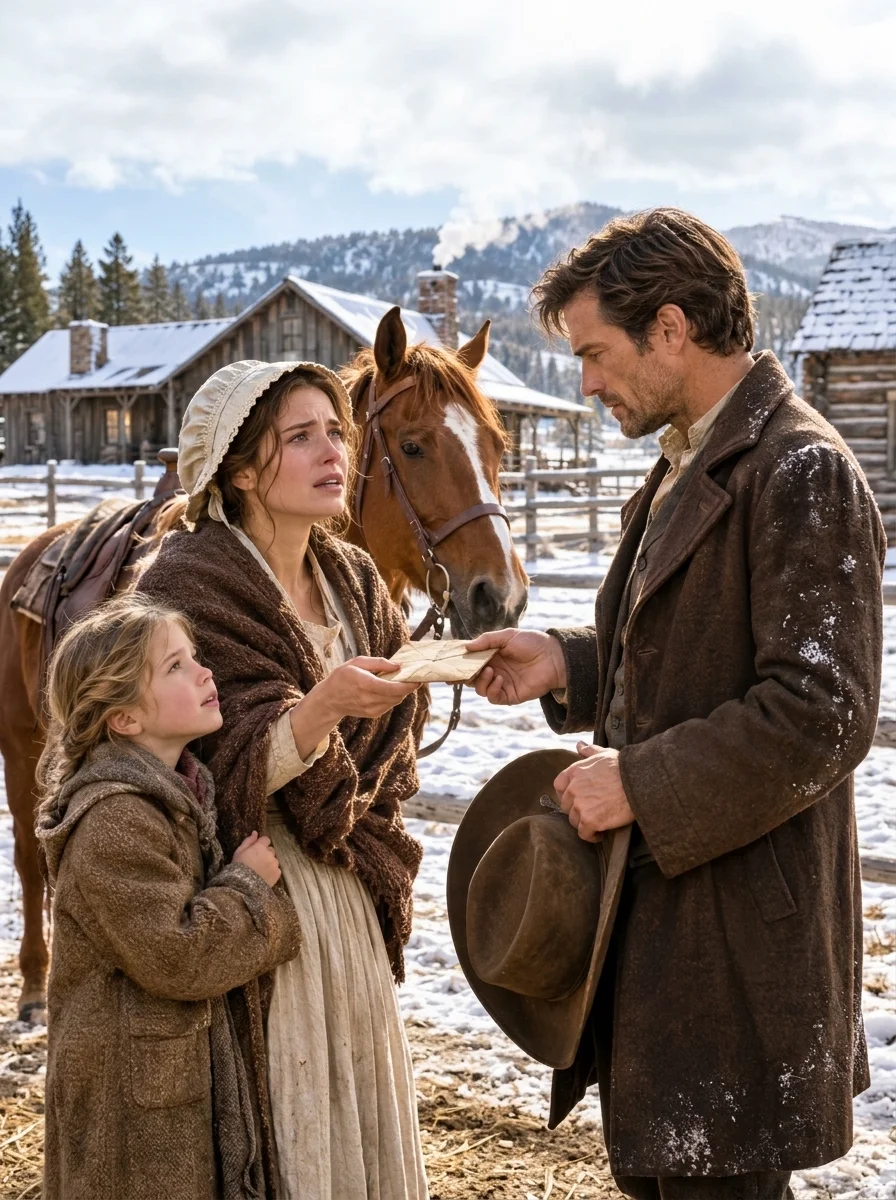
# SHE OFFERED HER LAST HORSE FOR $2—BUT THE LONELY RANCHER HAD BEEN KEEPING HER DYING HUSBAND’S SECRET FOR 13 MONTHS
## CHAPTER ONE: TWO DOLLARS FOR A HORSE
“Two dollars,” Ruth Bellamy whispered, clutching her daughter’s hand. “Please, Mr. Kane. My little girl hasn’t eaten a proper meal in three days.”
Silas Kane looked at the exhausted widow standing in front of his barn.
Then he looked at the beautiful chestnut mare beside her.
The horse was worth at least forty dollars. Perhaps fifty, considering her strong legs, healthy coat, and gentle temperament.
Yet the woman was asking for almost nothing.
His answer was only one word.
“No.”
Ruth blinked.
For a moment, she thought she had misunderstood him.
“I’m sorry?”
“I said no.”
She tightened her fingers around the reins.
“Mr. Kane, I understand she’s worth more. But I cannot wait for a better offer. I need the money today.”
Silas examined her face.
Her cheeks were pale from the cold. Her dark brown hair had escaped from beneath a faded wool bonnet, and her coat was so thin that the Wyoming wind seemed to pass straight through it.
A little girl stood beside her.
She couldn’t have been more than six years old.
The child wore an oversized man’s coat, its sleeves folded twice around her small wrists. Her blonde hair was tied with a faded blue ribbon, and her eyes kept drifting toward the farmhouse chimney.
Smoke rose from it in a steady stream.
The little girl was watching the smoke as though it were something wonderful.
Silas noticed.
“What’s your name, sweetheart?”
The child looked at her mother before answering.
“Ellie.”
“That’s a pretty name.”
“Thank you.”
“Are you cold?”
Ellie nodded.
Silas looked at Ruth again.
“Why are you here?”
“To sell my horse.”
“I know that. I asked why.”
Ruth swallowed.
“Because my daughter needs food.”
Silas glanced at Mercy, the chestnut mare.
“What’s happened to your husband?”
Ruth’s eyes lowered.
“He died thirteen months ago.”
Silas became very still.
“Thomas Bellamy?”
“Yes.”
He looked toward the distant mountains.
For several seconds, he said nothing.
Then he turned back.
“Thomas was a good man.”
Ruth’s expression softened.
“He was.”
She paused.
“He was the best man I ever knew.”
Silas looked at the horse again.
“Did Thomas know you were coming here?”
Ruth hesitated.
“Not exactly.”
“What does that mean?”
“Before he died, he told me that if I ever had nowhere else to turn, I should bring Mercy north to your ranch.”
Silas’s face changed.
“He told you that?”
“Yes.”
“When?”
“During his last week.”
Silas slowly removed his hat.
“Did he tell you why?”
Ruth shook her head.
“No. I asked him, but he was very sick. He only made me promise.”
The rancher looked toward the house.
Then he looked back at the woman and the little girl.
“Come inside.”
Ruth shook her head.
“I can’t accept charity.”
“I didn’t offer you charity.”
“Then what are you offering?”
“Warm food for your daughter. A place to sit. And a conversation.”
Ruth hesitated.
Silas pointed toward the farmhouse.
“Your horse can rest in the barn. Nobody is taking her.”
Ruth looked at Mercy.
The mare gently touched her shoulder with her nose.
For a moment, the widow seemed unable to move.
Then Ellie tugged at her sleeve.
“Mama?”
“Yes, sweetheart?”
“Can we have something warm?”
Ruth closed her eyes.
That was enough.
She nodded.
“All right.”
And with that, she followed Silas Kane toward the farmhouse, unaware that the man walking ahead of her had spent thirteen months keeping a promise to her dying husband.
A promise that was about to change everything.
—
## CHAPTER TWO: THE WINTER THAT TOOK EVERYTHING
Thirteen months earlier, Ruth Bellamy had believed she was living an ordinary but happy life.
She and Thomas owned a small homestead outside the town of Red Hollow, Wyoming.
It wasn’t much.
Their house had two bedrooms, a kitchen with a wood-burning stove, and a narrow porch overlooking several acres of grazing land.
Behind the house stood a weathered barn, a small chicken coop, and a wooden fence that Thomas had repaired so many times that almost none of the original boards remained.
They had no great fortune.
They had no servants, no fine furniture, and no expensive clothing.
But they had enough.
Thomas worked as a carpenter and occasional ranch hand. Ruth kept the house, tended the garden, cared for the animals, and made preserves during the summer.
Their daughter Ellie was the center of their world.
She loved wildflowers, horses, and stories about brave women who traveled across mountains.
Her favorite horse was Mercy, a chestnut mare Thomas had bought when Ellie was only two.
The horse had a gentle temperament and an unusual habit of following Ellie around the yard.
Sometimes, the little girl would spend an entire afternoon brushing Mercy’s mane.
Thomas would watch from the porch, smiling.
“She’s going to grow up thinking that horse is her sister,” he would say.
Ruth would laugh.
“Maybe Mercy is the better-behaved one.”
Thomas would pretend to be offended.
“Are you saying our daughter is difficult?”
“I’m saying she’s stubborn.”
“Must have inherited that from her father.”
Their life was simple.
And they were happy.
Then winter came.
It arrived earlier than expected, bringing bitter winds and heavy snow.
Thomas developed a cough after spending several days repairing a roof during a storm.
At first, Ruth thought it was only a cold.
But the cough worsened.
His fever rose.
Within weeks, he could barely stand without becoming exhausted.
The doctor came from Red Hollow and examined him.
He spoke quietly to Ruth outside the bedroom.
“His lungs are badly affected. I can give him medicine, but he needs rest and warmth.”
“Will he recover?”
The doctor hesitated.
“I cannot promise that.”
Ruth felt the ground disappear beneath her feet.
She sold two of their strongest calves to pay for medicine.
Then she sold the spare wagon.
Thomas protested.
“Ruth, you shouldn’t sell everything.”
“What good is a wagon if I lose you?”
He reached for her hand.
“You’re not going to lose me.”
But he knew his condition was serious.
And so did she.
As the weeks passed, he became weaker.
Some nights, he would wake coughing and struggle to catch his breath.
Ruth sat beside him, holding a cloth against his forehead.
Ellie would sometimes stand in the doorway, clutching her stuffed rabbit.
“Is Daddy going to get better?”
Ruth would force a smile.
“Of course, sweetheart. Daddy just needs some rest.”
But one evening, Thomas called Ellie to his bedside.
“Come here, little bird.”
She climbed carefully onto the bed.
Thomas brushed her hair away from her face.
“Do you remember the story about the little girl who crossed the mountains?”
Ellie nodded.
“She wasn’t afraid.”
“That’s right.”
“Because she was brave.”
Thomas smiled.
“Being brave doesn’t mean you’re never afraid. It means you keep going even when you are.”
Ellie thought about that.
“Are you going somewhere, Daddy?”
Thomas looked toward Ruth.
Then he kissed his daughter’s forehead.
“Not yet, sweetheart.”
But he knew he was running out of time.
—
## CHAPTER THREE: THE LAST PROMISE
Three days before Thomas died, someone arrived at the homestead.
It was a tall, broad-shouldered man wearing a dark coat and carrying a worn leather saddlebag.
Ruth recognized him immediately.
Silas Kane.
He was a rancher from the northern valley, known for owning a large property and employing several ranch hands.
Ruth had met him only twice.
The first time had been at a cattle auction.
The second time had been when Thomas helped repair a broken gate at Kane’s ranch.
Silas stood at the doorway.
“Mrs. Bellamy.”
Ruth looked surprised.
“Mr. Kane. What brings you here?”
“I came to see Thomas.”
“He’s resting.”
“May I?”
Ruth stepped aside.
Silas entered quietly.
Thomas was lying beneath a thick blanket, his face pale and his breathing shallow.
When he saw Silas, he tried to sit up.
“You shouldn’t have come all this way.”
Silas pulled a chair beside the bed.
“Didn’t seem right to stay away.”
Thomas glanced at Ruth.
“Could you give us a few minutes?”
She hesitated.
“Thomas, you need to rest.”
“I know, sweetheart. Just a few minutes.”
Ruth looked between the two men.
Then she nodded.
She took Ellie outside to gather eggs.
When the door closed, Thomas reached beneath his pillow and pulled out a small leather pouch.
Silas looked at it.
“You still have it?”
Thomas nodded.
“I’ve kept it safe.”
He placed the pouch in Silas’s hand.
Inside was a folded document, a brass key, and a small silver coin.
Silas stared at the contents.
“You should give this to Ruth.”
“Not yet.”
“Thomas, she’s your wife.”
“I know who she is.”
Thomas coughed.
Silas poured water into a glass and helped him drink.
After a moment, Thomas continued.
“She won’t accept anything if she thinks it came from someone else’s pity.”
Silas said nothing.
“She believes we built our life with our own hands. She’ll think I failed her if she learns what I did.”
“You didn’t fail her.”
Thomas looked toward the window.
“I promised myself I would tell her when the time was right.”
“And when will that be?”
“When she comes to you.”
Silas frowned.
“Thomas, what if she never does?”
“She will.”
“How can you be certain?”
“Because I know my wife. She’ll sell everything before asking another person for help.”
Thomas smiled sadly.
“She’ll probably sell Mercy last.”
Silas looked down.
“Then I hope she never has to.”
Thomas reached for his arm.
“Listen to me. If she comes here, don’t let her sell that horse.”
“I won’t.”
“Feed Ellie. Give Ruth time to read the letter. Don’t tell her what to do.”
Silas nodded.
“And one more thing.”
Thomas’s voice became weaker.
“What?”
“If she decides she cannot stay here, let her leave. Don’t make her feel she owes you.”
Silas looked at his old friend.
“I understand.”
Thomas closed his eyes.
“Thank you.”
Silas placed the pouch back in his hand.
“I’ll keep the promise.”
Thomas shook his head.
“No. Keep the promise to her.”
Silas nodded.
He stayed for another hour.
Before leaving, he stood beside the bed.
Thomas caught his sleeve.
“Silas?”
“Yes?”
“Tell her I loved her.”
Silas’s throat tightened.
“You can tell her yourself.”
Thomas smiled faintly.
“I hope so.”
But he knew he would not.
The following morning, Thomas Bellamy died.
Ruth buried him beneath the old cottonwood tree behind their home.
Silas attended the funeral.
He stood at the back, holding his hat in both hands.
When the last prayer was spoken, he approached Ruth.
“Thomas was a good man.”
She nodded through her tears.
“Yes.”
Silas wanted to tell her everything.
He wanted to place the leather pouch in her hands.
But he remembered Thomas’s request.
Wait until she comes.
So he said nothing.
And for thirteen months, he kept his promise.
—
## CHAPTER FOUR: A LETTER FROM THE DEAD
Silas led Ruth and Ellie into the farmhouse.
The room was warm.
A large fireplace stood against one wall, and the smell of fresh bread filled the kitchen.
Ruth stopped near the doorway.
She hadn’t seen a room that warm in months.
“Sit down,” Silas said.
Ellie immediately looked toward the kitchen table.
Silas noticed.
“Have you eaten breakfast?”
The little girl shook her head.
“Not yet.”
“Then we’ll fix that.”
He called toward the kitchen.
“Mrs. Harper!”
A moment later, a woman in her late fifties appeared.
She wore a dark blue dress and a white apron.
“Mr. Kane?”
“Could you prepare some breakfast for our guests?”
The woman looked at Ruth and Ellie.
Her expression softened.
“Of course.”
“Something warm.”
“Right away.”
Silas pulled out a chair for Ellie.
The little girl sat carefully.
Mrs. Harper placed a bowl of oatmeal in front of her, followed by a slice of buttered bread and a glass of milk.
Ellie stared at the food.
“Is this all for me?”
Mrs. Harper smiled.
“Yes, sweetheart.”
Ellie looked toward her mother.
Ruth nodded.
“Go ahead.”
The child took a spoonful.
Her eyes closed.
“It’s good.”
Mrs. Harper laughed softly.
“Then you’d better eat before it gets cold.”
Ruth sat across from her daughter.
She tried to smile, but her attention remained on Silas.
“What did you mean when you said Thomas came here before he died?”
Silas sat opposite her.
“He came thirteen months ago.”
“Why didn’t he tell me?”
“He wanted to.”
“Then why didn’t he?”
Silas looked toward the window.
“Because he was afraid you would refuse what he had to tell you.”
Ruth frowned.
“What could he possibly have to tell me?”
Silas reached into the drawer of his desk.
He removed a weathered envelope.
The paper was yellowed around the edges.
On the front, written in Thomas’s unmistakable handwriting, were three words.
**For my Ruth.**
Her hands began trembling.
She recognized the handwriting immediately.
It was the same writing she had seen on birthday cards, shopping lists, and the little notes Thomas used to leave beside her coffee cup.
She reached for the envelope.
“Why do you have this?”
“Thomas gave it to me.”
Ruth looked up.
“Before he died?”
Silas nodded.
“He asked me to keep it safe until you came here.”
Ruth stared at the envelope.
“Did he know I would come?”
“I believe he hoped you would never need to.”
She carefully opened it.
Inside was a letter folded twice.
The first line made her breath catch.
*My dearest Ruth,*
She pressed the paper against her chest.
Then she began reading.
*If you are holding this letter, it means life has become harder than I ever wanted it to be for you.*
*I wish I were there beside you. I wish I could hold your hand and tell you that everything will be all right.*
*But if I am not there, I need you to trust something I never had the courage to explain.*
*Silas Kane is not a stranger to us.*
Ruth stopped.
She looked at Silas.
He lowered his eyes.
She continued.
*Thirteen years ago, before I met you, I worked for a man who owned a small ranch near Red Hollow. His name was Samuel Kane.*
*Samuel was Silas’s father.*
*I was young, careless, and desperate for work. I made a mistake that nearly cost the Kane family everything.*
Ruth looked up again.
“What mistake?”
Silas answered quietly.
“Keep reading.”
She returned to the letter.
*I was responsible for losing a packet of important land papers. I thought they had been destroyed in a fire. Samuel Kane believed the loss would ruin his family.*
*But I eventually found the papers and returned them.*
*Samuel forgave me.*
*He told me that one day, if I ever needed help, I should come to him.*
*I never forgot that kindness.*
*Before he died, Samuel left a private agreement with me. It concerned the land north of Red Hollow.*
Ruth’s eyes moved down the page.
Then she stopped.
Her fingers began trembling more violently.
*The land was not mine to keep. It was meant for you and our daughter.*
She read the sentence again.
Then once more.
“Silas…”
He looked at her.
“What does this mean?”
Silas leaned forward.
“It means your husband left you something.”
Ruth looked down at the letter.
And for the first time since Thomas’s death, she felt that the man she had buried beneath the cottonwood tree had somehow found a way to reach her.
—
## CHAPTER FIVE: THE LAND BEHIND THE MOUNTAINS
Silas took Ruth outside after breakfast.
Ellie stayed with Mrs. Harper, who had promised to show her the chickens.
The rancher saddled two horses.
“Where are we going?”
“To see something.”
Ruth hesitated.
“Is it far?”
“About twenty minutes.”
They rode north along a narrow trail.
The landscape opened gradually.
Beyond the main pasture lay a wide valley surrounded by low mountains. A creek ran through the center, its water sparkling beneath the winter sun.
At the far end stood a small wooden cabin.
It was weathered but sturdy.
A barn stood nearby, and several acres of open grassland stretched toward the hills.
Ruth stopped her horse.
“Whose place is this?”
Silas turned toward her.
“Yours.”
She stared at him.
“What?”
“Your husband’s.”
Ruth shook her head.
“No. We never owned land up here.”
“Thomas did.”
“That isn’t possible.”
Silas dismounted.
He pulled a folded document from his coat.
“Thirteen years ago, Samuel Kane purchased this parcel from a struggling rancher. Thomas helped him recover the original property papers. In exchange, Samuel promised to transfer the land to Thomas once the legal title was settled.”
Ruth looked at the document.
“Why would Thomas never tell me?”
“Because the transfer was never completed until last year.”
Silas pointed toward the valley.
“Your husband made arrangements to purchase the land from the estate after Samuel died. He used the money he had saved from his carpentry work and an inheritance from his mother.”
Ruth looked confused.
“Thomas never received an inheritance.”
“He did. A small one. He kept it separate because he wanted to build something for you and Ellie.”
Ruth looked toward the cabin.
“How much land?”
“Eighty acres.”
She nearly dropped the reins.
“Eighty?”
Silas nodded.
“The deed is in your name and Ellie’s. Thomas arranged it that way.”
Ruth stared at the property.
She could barely understand what she was hearing.
For thirteen months, she had been selling everything she owned.
Her kitchen table.
Her wedding silver.
Thomas’s tools.
And now her husband had left her eighty acres.
“Why didn’t you tell me?”
Silas looked at her.
“I promised Thomas I would wait until you came.”
“But you knew I was struggling.”
“I did.”
“You knew I had sold my things?”
Silas’s expression tightened.
“I heard about some of it.”
“And you did nothing?”
He lowered his eyes.
“Thomas asked me not to interfere unless you came here.”
Ruth felt anger rise through her confusion.
“So you watched me struggle?”
“I didn’t know how bad things had become.”
“You could have sent word.”
“I could have.”
“Then why didn’t you?”
Silas looked toward the valley.
“Because I was afraid of breaking my promise to a dying man.”
Ruth’s eyes filled.
She turned away.
For several moments, neither spoke.
Then Silas said quietly:
“I am sorry.”
Ruth looked at the cabin.
The wind moved through the dry grass.
She imagined Thomas standing there, looking across the land, planning a future he would never see.
She imagined him building a porch.
Planting trees.
Watching Ellie ride Mercy across the pasture.
Her knees weakened.
Silas stepped forward.
“Mrs. Bellamy?”
She shook her head.
“I’m all right.”
But she wasn’t.
She was grieving again.
Only this time, the grief carried something else.
A terrible realization.
Thomas had been planning to give them a better life.
And he had died before he could tell her.
—
## CHAPTER SIX: THE MAN WHO KEPT THE PROMISE
That evening, Ruth sat alone on the porch of Silas’s farmhouse.
Ellie was asleep upstairs.
The child had eaten two bowls of stew, a piece of bread, and an apple. For the first time in weeks, she had fallen asleep without complaining that her stomach hurt.
Ruth watched the fireflies gathering near the barn.
Silas came outside carrying two cups of coffee.
He placed one beside her.
“Mrs. Harper says Ellie is sleeping soundly.”
Ruth smiled.
“She hasn’t slept that well in months.”
Silas sat at the other end of the porch.
For a while, neither spoke.
Then Ruth asked:
“Were you and Thomas close?”
Silas nodded.
“Closer than most people knew.”
“How?”
“We worked together when we were young. We rode cattle trails, repaired fences, and spent more nights sleeping beneath the stars than inside a house.”
Ruth listened.
“He was a good friend,” Silas continued. “He was also the kind of man who would give away his last dollar and then pretend he hadn’t noticed.”
She smiled sadly.
“That sounds like him.”
Silas looked at the darkness.
“After my father died, I nearly lost the ranch. I was young, angry, and convinced I could do everything alone.”
“What happened?”
“Thomas helped me.”
“How?”
“He found a way to recover the land papers my father had misplaced. Without them, the bank would have taken half the property.”
Ruth looked at him.
“So Thomas saved your ranch?”
Silas nodded.
“He never wanted credit.”
Ruth lowered her eyes.
“He never told me.”
“He didn’t want you to think he had done something extraordinary.”
She smiled faintly.
“He always said ordinary kindness was enough.”
Silas looked at her.
“That sounds like Thomas.”
A long silence followed.
Then Ruth asked:
“Why do you live alone?”
Silas looked down at his cup.
“Because I got used to it.”
“That isn’t an answer.”
He almost smiled.
“You ask difficult questions.”
“I’m a widow. I have very little left to lose.”
Silas looked toward the barn.
“My wife died seven years ago.”
Ruth’s expression softened.
“I didn’t know.”
“Her name was Margaret. She died during childbirth. The baby didn’t survive.”
Ruth lowered her eyes.
“I’m sorry.”
Silas nodded.
“I tried to keep working. I thought if I stayed busy enough, I wouldn’t have to think about it.”
“Did it work?”
“No.”
He looked at the stars.
“Not really.”
Ruth understood that silence.
It was the silence of someone who had learned to live with an empty chair.
“Thomas used to say grief is like winter,” she whispered. “You can’t stop it from coming. You can only learn how to keep a fire burning until it passes.”
Silas looked at her.
“He said that?”
“Yes.”
The rancher smiled.
“Sounds like something he would say.”
For the first time that evening, Ruth felt a little less alone.
—
## CHAPTER SEVEN: THE MAN FROM RED HOLLOW
The following morning, Silas took Ruth and Ellie to the cabin.
Mrs. Harper packed a basket of food for them.
The cabin needed work.
The roof had several damaged shingles. The front door stuck, and the windows needed new frames.
But the structure was solid.
There was a fireplace, a small kitchen, two bedrooms, and a wide porch facing the creek.
Ruth walked through the rooms slowly.
In the corner of the main bedroom stood a wooden chest.
She recognized it immediately.
It belonged to Thomas.
She knelt and opened it.
Inside were several shirts, a leather notebook, a carpenter’s hammer, and a bundle of old letters.
At the bottom lay a small wooden horse.
Ruth picked it up.
It was a toy Thomas had carved for Ellie before she was born.
A memory returned.
Thomas sitting beside the stove, working carefully with a small knife.
Ruth had asked what he was making.
“A horse.”
“For the baby?”
“For our little girl.”
He had smiled.
“Every child should have something made by hand.”
Ruth held the toy against her chest.
Ellie came running into the room.
“Mama! Look!”
She had discovered a small garden behind the cabin.
There were dry flower stems and a wooden fence around the plot.
Ruth smiled.
“Your father planted flowers here.”
“Can we plant more?”
“Yes, sweetheart.”
Ellie ran back outside.
Ruth opened the notebook.
Most pages contained Thomas’s familiar notes about wood measurements, expenses, and repairs.
But near the back, she found a list of names.
One name appeared repeatedly.
**Caleb Voss.**
Ruth frowned.
She remembered that name.
Caleb Voss was a land agent in Red Hollow.
He had visited their homestead several months before Thomas died.
At the time, he had offered to buy their land.
Thomas had refused.
Caleb had returned twice.
The last time, he had become angry.
He claimed the Bellamy property had an old boundary problem and that Thomas might lose the land if he did not sign a new agreement.
Thomas had told him to leave.
Ruth remembered the argument.
She had asked Thomas what it was about.
He had simply said:
“Some men believe a desperate person is easier to cheat.”
Now she looked at the notebook again.
Beside Caleb’s name, Thomas had written:
*He knows about the northern parcel.*
Ruth felt a chill.
Why would Caleb Voss know about Thomas’s land?
And why had Thomas written his name so many times?
—
## CHAPTER EIGHT: THE LAND AGENT’S VISIT
Two days later, a black carriage arrived at Kane Ranch.
A narrow-faced man climbed down.
He wore a dark suit, polished boots, and a hat that looked too expensive for the dusty road.
Silas saw him from the barn.
His expression hardened.
“Caleb Voss.”
Ruth stepped out onto the porch.
She recognized him immediately.
“Mrs. Bellamy,” Caleb said with a smile. “I heard you were here.”
Ruth didn’t smile.
“What do you want?”
Caleb looked around.
“Just a friendly visit.”
Silas walked toward them.
“She didn’t invite you.”
Caleb glanced at him.
“Mr. Kane. Always the welcoming gentleman.”
Silas stopped beside Ruth.
“Say what you came to say.”
Caleb adjusted his gloves.
“I understand that the Bellamy property has changed hands.”
Ruth frowned.
“What property?”
“The northern valley.”
Silas’s expression changed.
“How do you know about that?”
Caleb smiled.
“I’m a land agent. I know things.”
Ruth stepped forward.
“What do you want?”
Caleb looked at her.
“I believe your late husband owed money to several people.”
“He did not.”
“Perhaps you don’t know everything.”
Silas moved closer.
“Careful, Voss.”
Caleb ignored him.
“Mrs. Bellamy, I have documents showing that Thomas borrowed money against the northern parcel.”
Ruth stared.
“That is impossible.”
“I would be happy to explain.”
“Show me the documents.”
Caleb smiled.
“I have them in my office.”
“Then bring them.”
His smile disappeared slightly.
“Perhaps you should come to town.”
Silas stepped between them.
“She isn’t going anywhere with you.”
Caleb’s expression hardened.
“This is not your business.”
“Thomas made it my business.”
For a moment, the two men stared at each other.
Then Caleb looked toward Ruth.
“You should be careful, Mrs. Bellamy. Land disputes can become expensive.”
Ruth held his gaze.
“My husband left me the land legally.”
“Did he?”
“Yes.”
Caleb smiled.
“Then I suppose you have nothing to fear.”
He climbed into his carriage.
Before leaving, he turned once more.
“I’ll see you in Red Hollow.”
The carriage disappeared down the road.
Ruth looked at Silas.
“Who is he really?”
Silas’s jaw tightened.
“A man who believes every piece of land has a price.”
“And Thomas?”
“He knew Caleb was trying to take the property.”
Ruth looked toward the road.
“Why didn’t he tell me?”
Silas answered quietly.
“Because he wanted to protect you from worrying while he was sick.”
Ruth closed her eyes.
She was beginning to understand how much Thomas had carried alone.
But she was also beginning to realize that his final gift came with an unfinished fight.
—
## CHAPTER NINE: WHAT THOMAS HAD BEEN HIDING
That night, Ruth read the rest of Thomas’s letters.
The first explained the land arrangement.
The second described the history of the northern valley.
The third contained something she had never expected.
A confession.
*My Ruth,*
*There is one thing I have not told you.*
*When I first started working for Samuel Kane, I was not an honest man.*
*I was young and desperate. I had a debt I could not repay, and I made a foolish agreement with a man who promised me quick money.*
*I took a set of land papers from Samuel’s office. I intended to use them as security for a loan.*
*I never meant to steal his land.*
*But the man I trusted disappeared, and the papers were lost.*
*For months, I was afraid to confess what I had done.*
*Eventually, I found the papers and returned them. Samuel could have sent me to prison. Instead, he asked why I had done it.*
*I told him the truth.*
*He said that a man is not defined only by the worst thing he has done. He is also defined by what he does afterward.*
*I spent the rest of my life trying to become worthy of that forgiveness.*
Ruth stopped reading.
She had never known this part of Thomas.
She sat quietly, holding the letter.
Then she continued.
*Samuel and I became friends. He trusted me with the valley because he believed I had changed.*
*But Caleb Voss discovered the old story. He has been threatening to use it against me.*
*He wants the valley because a new railway survey may pass near the northern ridge.*
*I refused to sell.*
*If Caleb comes after you, remember this: the land is yours. The original deed is safe. Do not sign anything without Silas or a lawyer.*
Ruth lowered the letter.
The railway.
She remembered hearing rumors about a railway expansion.
Several men had visited Red Hollow, asking about land prices.
The northern valley might become valuable.
Caleb was not interested in helping a widow.
He wanted the property.
And he believed she would be too desperate to fight him.
Ruth folded the letter carefully.
Then she stood.
She was no longer the woman who had arrived at Kane Ranch asking for two dollars.
She was still grieving.
She was still frightened.
But she now had something to protect.
And she intended to protect it.
—
## CHAPTER TEN: A WOMAN WHO REFUSED TO BE DEFEATED
Silas found Ruth in the barn the next morning.
She was brushing Mercy.
The mare had settled comfortably into the warm stall and seemed delighted to be back among familiar horses.
“You’re up early,” Silas said.
Ruth continued brushing.
“I couldn’t sleep.”
“Thinking about Voss?”
“Yes.”
Silas leaned against the stall.
“I can handle him.”
Ruth looked at him.
“No.”
He frowned.
“No?”
“I appreciate everything you’ve done. But I won’t spend the rest of my life waiting for someone else to solve my problems.”
Silas studied her face.
“Thomas would have wanted me to help.”
“Then help me understand what he left behind. Don’t fight every battle for me.”
Silas considered that.
Then he nodded.
“All right.”
Ruth rested her hand against Mercy’s neck.
“I want to see the deed. I want to speak to a lawyer. And I want to know exactly what Caleb Voss is claiming.”
“That’s sensible.”
“Can you take me to town?”
“Tomorrow.”
Ruth looked at him.
“Thank you.”
He nodded.
Then he hesitated.
“Thomas would be proud of you.”
Ruth’s eyes softened.
“I hope so.”
Silas looked at Mercy.
“Your husband chose a good horse.”
Ruth smiled.
“He chose a good friend too.”
Silas looked away.
For a moment, the ranch seemed very quiet.
—
## CHAPTER ELEVEN: THE LAWYER’S OFFICE
The next morning, Silas drove Ruth to Red Hollow.
They visited a lawyer named Henry Wallace.
He was an older gentleman with silver spectacles and a careful manner.
When Ruth explained the situation, he examined the documents Silas had brought.
He studied the deed.
Then he studied the original agreement between Thomas and Samuel Kane.
Finally, he removed his spectacles.
“Mrs. Bellamy, this is quite clear.”
Ruth leaned forward.
“What does it say?”
“The eighty acres were transferred legally to you and your daughter. The document was recorded with the county clerk eleven months ago.”
“So the land is ours?”
“Yes.”
Ruth let out a breath.
“Then what can Caleb Voss do?”
The lawyer tapped the paper.
“He can make a claim. He can threaten legal action. But unless he produces a valid agreement signed by Thomas, his position is weak.”
Ruth remembered the old arguments.
“He came to our home and said Thomas owed money.”
“Do you have any proof?”
“Not yet.”
Silas placed Thomas’s notebook on the desk.
“Would this help?”
The lawyer examined it.
He read the notes about Caleb’s visits and the railway survey.
His expression changed.
“This may be important.”
Ruth looked at him.
“Why?”
“Because it suggests that Mr. Voss knew about the property before the transfer was completed.”
Henry Wallace leaned back.
“I would like to see the original documents and speak to the county clerk.”
Ruth nodded.
“Do whatever is necessary.”
The lawyer looked at her carefully.
“Are you prepared for this to become unpleasant?”
Ruth thought of Ellie.
She thought of Thomas.
Then she thought of the winter when she had sold nearly everything just to keep her daughter alive.
“Yes,” she said.
“I am.”
—
## CHAPTER TWELVE: THE SECRET OF THE RAILWAY
The lawyer’s investigation revealed something important.
The railway company had been negotiating with several landowners near the northern ridge.
A new route would connect Red Hollow with two growing towns farther west.
The railway needed a stretch of land near the valley.
The Bellamy property was particularly valuable because it offered the safest passage through the hills.
Caleb Voss had learned about the route before the public announcement.
He had begun buying small parcels of land through other people.
He hoped to acquire the Bellamy property cheaply and sell it to the railway company for a substantial profit.
Thomas had discovered the plan.
He had refused to cooperate.
That was why Caleb had threatened him.
And that was why he had visited the homestead repeatedly during Thomas’s final months.
When Ruth learned the truth, she felt sick.
“He knew Thomas was dying.”
Silas nodded.
“He probably believed you would sell.”
Ruth stared at the papers.
“He thought I would be easy to frighten.”
Henry Wallace folded his hands.
“Then we should make certain he understands that you are not.”
The lawyer sent a formal notice to Caleb.
It demanded that he provide proof of the alleged debt and cease making threats regarding the property.
Caleb responded two days later.
He claimed that Thomas had signed a private loan agreement.
But when the lawyer requested the original document, Caleb produced only a copy.
The signature looked similar to Thomas’s.
But something was wrong.
Ruth studied it.
Then she shook her head.
“Thomas never wrote his name like that.”
Henry Wallace looked up.
“Are you certain?”
“Yes.”
She pointed to the final letter.
“Thomas always connected the last two letters. He never lifted his pen there.”
The lawyer examined the signature.
He nodded slowly.
“I see what you mean.”
He arranged for a handwriting expert to review the document.
The report arrived a week later.
The signature was likely forged.
Caleb Voss had made a serious mistake.
He had assumed a grieving widow would never question the paperwork.
He had underestimated her.
—
## CHAPTER THIRTEEN: THE NIGHT THE BARN CAUGHT FIRE
The trouble did not end with the forged document.
One bitter evening, Ruth woke to the sound of Mercy screaming.
She jumped out of bed.
A red glow flickered beyond the window.
“Silas!”
She rushed outside.
The barn was on fire.
Flames climbed the eastern wall, and thick smoke rolled into the night.
Silas was already running toward it with two ranch hands.
“Get the horses out!”
Ruth grabbed her coat.
“Mercy!”
Silas turned.
“Stay back!”
But Ruth was already moving.
She reached the barn as one of the ranch hands opened the first stall.
Horses rushed into the yard.
Mercy stood near the back, frightened and refusing to move.
Ruth ran toward her.
“Come on, girl!”
The mare backed away.
Smoke filled the stall.
Ruth grabbed the halter.
“Mercy, please!”
The horse suddenly reared.
A burning piece of wood fell from the roof.
Silas reached them.
He pulled Ruth backward just as part of the roof collapsed.
“Are you out of your mind?”
“Mercy!”
“I’ve got her!”
Silas rushed forward, caught the horse’s halter, and pulled her toward the open door.
The mare stumbled into the yard.
Ruth ran to her.
She wrapped both arms around the horse’s neck.
“Thank you. Thank you.”
Silas stood behind her, breathing hard.
His sleeve was burned, and a small cut marked his cheek.
Ruth looked at him.
“Are you hurt?”
“Nothing serious.”
“Your arm—”
“It’s fine.”
She touched his sleeve.
He looked at her hand.
For a brief moment, neither moved.
Then Ellie appeared at the farmhouse door, wrapped in a blanket.
“Mama!”
Ruth immediately went to her.
“I’m here, sweetheart.”
Ellie clung to her.
“Was Mercy going to die?”
Ruth held her close.
“No. She’s safe.”
Silas looked toward the barn.
The fire had spread to the roof, but the ranch hands were managing to contain it.
He turned to one of them.
“Get the sheriff.”
Ruth looked at him.
“Why?”
Silas pointed toward the eastern wall.
Near the doorway, something dark lay in the snow.
A broken lantern.
And beside it, the unmistakable mark of a boot.
Someone had started the fire deliberately.
—
## CHAPTER FOURTEEN: THE MAN WHO THOUGHT HE COULD BURN THE TRUTH
Sheriff Daniel Brooks arrived before midnight.
He examined the barn and questioned the ranch hands.
One of them remembered seeing a carriage near the property earlier that evening.
The tracks led toward the southern road.
The sheriff followed them the next morning.
By noon, he returned with news.
A stable boy in Red Hollow had seen Caleb Voss’s carriage near Kane Ranch.
Caleb denied being there.
But the sheriff discovered another piece of evidence.
A bottle of lamp oil had been purchased in Caleb’s name.
The storekeeper remembered the transaction because Caleb had argued about the price.
When the sheriff questioned him, Caleb became angry.
“You can’t arrest a man because he bought oil!”
“I’m not arresting you for buying oil,” the sheriff replied. “I’m asking why your carriage was seen near a burning barn.”
Caleb demanded a lawyer.
The sheriff allowed him to leave pending further investigation.
But the situation had changed.
Caleb was no longer simply a land agent making threats.
He was a suspect in a serious criminal investigation.
When Ruth heard the news, she sat quietly at the kitchen table.
Silas placed a cup of tea in front of her.
“You all right?”
She shook her head.
“He could have killed Ellie.”
Silas sat opposite her.
“I know.”
“Why would someone do that for land?”
“Greed makes people do things they would never admit to themselves.”
Ruth looked at him.
“Do you think he’ll stop?”
Silas was silent.
“Not willingly.”
Ruth looked toward the window.
“Then we won’t wait for him to stop.”
—
## CHAPTER FIFTEEN: THE ORIGINAL LETTER
Three days after the fire, Silas found another document in the leather pouch Thomas had left behind.
It was a short letter written by Samuel Kane.
The paper was old, but the writing remained clear.
It explained the original agreement between Samuel and Thomas.
Samuel had promised Thomas the northern valley because Thomas had saved the Kane family from losing their land.
But the letter also mentioned something else.
A second parcel.
An additional twenty acres near the creek.
Samuel had intended it to become a shared grazing area for the Bellamy and Kane families.
The property was never transferred because the railway survey had been delayed.
Silas showed the letter to Ruth.
She read it twice.
“Thomas knew about this?”
“Yes.”
“Why didn’t he tell me?”
Silas smiled faintly.
“He wanted to surprise you.”
Ruth laughed softly.
Then her expression changed.
“What happened to the twenty acres?”
“Samuel’s estate retained ownership. The original agreement gave Thomas the first right to purchase it.”
“Can we still purchase it?”
Silas nodded.
“If you want to.”
Ruth looked toward the valley.
“I don’t know if I want more land.”
Silas smiled.
“That’s a sensible answer.”
She folded the letter.
“But I want to know what Thomas intended to build there.”
Silas looked at the creek.
“He wanted a small school.”
Ruth turned toward him.
“A school?”
“For children from the surrounding homesteads. He thought families shouldn’t have to send their children miles away just to learn to read.”
Ruth’s eyes filled.
“That sounds like him.”
Silas nodded.
“He asked me to help build it.”
Ruth looked at him.
“Then perhaps we should.”
—
## CHAPTER SIXTEEN: THE TRUTH COMES TO TOWN
The handwriting expert confirmed that Caleb’s loan agreement was forged.
The sheriff also found evidence that Caleb had paid a stable worker to set the barn fire.
The young man eventually confessed.
He said Caleb had promised him money to destroy the barn and frighten Ruth into selling the land.
The sheriff arrested Caleb Voss.
At the courthouse, Caleb tried to blame everyone else.
He claimed the documents had been misunderstood.
He accused Silas of manipulating Ruth.
He even suggested that Thomas had been dishonest throughout his life.
But the evidence was strong.
The forged signature.
The threatening letters.
The purchase of lamp oil.
The stable worker’s testimony.
And Thomas’s notebook.
Caleb was charged with fraud, forgery, and conspiracy to commit arson.
The railway company withdrew its negotiations with him.
For the first time in months, Ruth could breathe without wondering whether someone was waiting outside her door.
After the hearing, Henry Wallace approached her.
“You did well, Mrs. Bellamy.”
Ruth shook her head.
“I was frightened.”
“Courage doesn’t require the absence of fear.”
She smiled.
“That sounds familiar.”
The lawyer smiled back.
“Then perhaps someone taught you well.”
Ruth looked toward the courthouse steps.
Silas was waiting beside the wagon.
For a moment, she remembered the first day she had arrived at his ranch.
She had been prepared to sell Mercy for two dollars.
Now she owned a valley, a home, and a future she had never imagined.
But she knew the most important thing was not the land.
It was the chance to begin again.
—
## CHAPTER SEVENTEEN: A HOME BUILT FROM MEMORY
Spring arrived slowly.
Snow melted from the hills, and the creek began to run stronger.
Ruth moved into the cabin with Ellie.
Silas arranged for repairs to the roof and windows, but he insisted that Ruth choose the furniture and decorations herself.
She wanted the house to feel like her own.
She painted the kitchen pale yellow.
She hung Thomas’s old coat beside the door.
She placed his wooden horse on the mantel.
And in the garden, she planted wildflowers.
Ellie helped with everything.
She planted seeds, carried small buckets of water, and spent hours brushing Mercy.
One afternoon, she ran into the kitchen.
“Mama!”
“What is it?”
“Can we have a school?”
Ruth smiled.
“Perhaps.”
“Like Daddy wanted?”
Ruth stopped.
She looked at her daughter.
“How do you know about that?”
“Mr. Silas told me.”
Ruth glanced through the window.
Silas was repairing the fence.
She smiled.
“Then perhaps we should build one.”
Ellie clapped her hands.
“Can I be the first student?”
“You certainly can.”
That evening, Ruth found Silas sitting on the porch.
She brought him a cup of coffee.
“Ellie tells me you mentioned the school.”
Silas nodded.
“She asked about it.”
“She wants to be the first student.”
Silas smiled.
“Then we should make sure we have a good teacher.”
Ruth looked at him.
“I was thinking I could teach her.”
“You?”
“I can read, write, and count. I helped several children in Red Hollow before Ellie was born.”
Silas considered that.
“You would be good at it.”
Ruth looked toward the creek.
“Then let’s build it.”
He smiled.
“Together?”
She nodded.
“Together.”
—
## CHAPTER EIGHTEEN: THE RANCHER’S LONELY HEART
As spring turned into summer, Ruth and Silas spent more time together.
At first, their conversations were practical.
They discussed the land, the repairs, the schoolhouse, and the animals.
Then the conversations became longer.
They began sharing meals.
Silas helped Ellie learn to ride.
Ruth taught Mrs. Harper how to make a particular apple pie that Thomas had loved.
Sometimes Silas would stop by the cabin after work and sit on the porch.
He never stayed too long.
He never asked Ruth to invite him inside.
And he never treated her kindness as an invitation to demand more.
One evening, Ruth found him repairing a broken chair.
“You don’t have to fix everything yourself,” she said.
Silas smiled.
“Old habit.”
“You own six hundred acres and employ several ranch hands. Surely one of them can repair a chair.”
“Probably.”
“Then why are you doing it?”
He looked at the chair.
“Because it belonged to my father.”
Ruth sat beside him.
“I understand.”
Silas continued working.
“My father built most of the furniture in the farmhouse. He believed a man’s work should remain useful long after he’s gone.”
Ruth touched the arm of the chair.
“Thomas believed that too.”
Silas looked at her.
“Do you miss him every day?”
Ruth thought for a moment.
“Yes.”
“Does it get easier?”
“Some days.”
She looked toward the sunset.
“Other days, something happens and I want to tell him about it. Then I remember.”
Silas nodded.
“I know that feeling.”
Ruth studied his face.
“Do you still miss Margaret?”
“Every day.”
“Would you ever love someone again?”
Silas stopped working.
The question seemed to surprise him.
“I don’t know.”
Ruth looked away.
“I’m sorry. I shouldn’t have asked.”
“No. It’s all right.”
He placed the chair down.
“I thought my life was finished when Margaret died. I built the ranch around the idea that I didn’t need anyone.”
He paused.
“Then Thomas came along and reminded me that friendship mattered. And now…”
He stopped.
Ruth looked at him.
“Now?”
Silas shook his head.
“Nothing.”
But Ruth understood.
Something was changing between them.
And it frightened her more than she wanted to admit.
—
## CHAPTER NINETEEN: THE FIRST KISS
It happened on a warm evening in July.
Ruth had spent the day working in the garden.
Silas arrived just before sunset, carrying a small wooden box.
“What is that?” she asked.
“Something Thomas asked me to give you.”
Her heart skipped.
She took the box.
Inside lay a simple silver necklace.
A small heart-shaped pendant hung from it.
Ruth recognized it immediately.
Thomas had given it to her on their fifth wedding anniversary.
She had thought it was lost during the difficult winter.
“How did you get this?”
Silas smiled.
“He left it with me.”
Ruth lifted the necklace carefully.
There was a folded note beneath it.
She opened it.
*My Ruth,*
*If you are reading this, then Silas has finally given you the things I asked him to keep.*
*I wish I could have been there to place this around your neck myself.*
*You were the best part of my life.*
*Please don’t spend the rest of yours believing that loving me means you must remain alone.*
*You deserve laughter again.*
*You deserve warm mornings, beautiful summers, and someone who asks how your day went.*
*You deserve to be happy.*
*Always remember that.*
*All my love,*
*Thomas.*
Ruth began crying.
Silas stepped closer.
“I’m sorry.”
She shook her head.
“No. Don’t be.”
She held the letter against her chest.
“He knew.”
Silas looked at her.
“What?”
“He knew I would be afraid to move forward.”
The rancher lowered his eyes.
“He wanted you to be happy.”
Ruth looked at him.
“And what do you want?”
Silas seemed unable to answer.
Finally, he said:
“I want you to have the life you deserve.”
She stepped closer.
“That’s not what I asked.”
He looked at her.
For several seconds, neither spoke.
Then Silas said quietly:
“I want to see you smile when you wake up. I want to hear Ellie laughing in the yard. I want to sit with you on the porch after a long day.”
His voice became softer.
“And if I’m honest, Ruth, I want to be the man you look for when something wonderful happens.”
Ruth’s eyes filled.
“Silas…”
“I know you loved Thomas. I know you still do. I’m not asking you to forget him.”
She looked at the necklace in her hand.
“I could never forget him.”
“I wouldn’t ask you to.”
Ruth took a breath.
“Then perhaps we can stop being afraid of what might happen.”
Silas stepped closer.
“Are you sure?”
She nodded.
“Yes.”
He gently touched her cheek.
Then he kissed her.
It was not a hurried kiss.
It was gentle, uncertain, and filled with everything neither had dared to say.
When they finally pulled apart, Ruth smiled.
For the first time in thirteen months, she felt no guilt about being happy.
—
## CHAPTER TWENTY: THE SCHOOLHOUSE
By autumn, the schoolhouse was complete.
It stood near the creek, built from strong pine boards with a small porch and two large windows.
Silas had paid for the lumber.
Ruth had helped design the interior.
Several ranch families contributed desks, books, and supplies.
On the first morning, six children arrived.
Ellie was the youngest.
She wore a blue dress and carried a small slate.
Ruth stood at the front of the room.
“Good morning, everyone.”
The children answered together.
“Good morning, Mrs. Bellamy.”
Ruth smiled.
“Today, we’re going to learn something important.”
She wrote three words on the board.
**Kindness. Courage. Hope.**
“Can anyone tell me what kindness means?”
A boy near the window raised his hand.
“Helping someone?”
“Exactly.”
Another child spoke.
“Sharing?”
“Yes.”
Ellie raised her hand.
“Giving someone food when they’re hungry.”
Ruth looked at her daughter.
“Yes, sweetheart. That’s kindness too.”
She glanced through the window.
Silas stood outside, leaning against the fence.
He smiled when their eyes met.
Ruth smiled back.
The schoolhouse was not grand.
It had no expensive furniture or impressive decorations.
But it was warm.
And it was full of children who had a chance to learn because Thomas had once dreamed of giving them a place to do so.
—
## CHAPTER TWENTY-ONE: A PROMISE FULFILLED
One year after Ruth arrived at Kane Ranch, she returned to the old homestead.
The house was still standing, although the roof needed repairs.
The garden had become overgrown.
The cottonwood tree remained beside Thomas’s grave.
Ruth rode Mercy along the familiar path.
Silas rode beside her.
Ellie sat in front of him, holding the saddle horn.
When they reached the grave, Ruth dismounted.
She knelt beside the simple wooden marker.
“Hello, my love.”
She brushed away a few fallen leaves.
“I wanted to tell you something.”
Silas and Ellie stayed back.
Ruth placed the silver necklace against the marker.
“You were right about Silas.”
She smiled through her tears.
“He kept his promise.”
The wind moved gently through the cottonwood branches.
Ruth continued.
“Ellie is healthy. She’s eating properly. She has friends, and she is learning to read.”
She paused.
“And I am happy.”
Her voice trembled.
“I didn’t think I would ever be able to say that again.”
She looked toward Silas.
He was standing beside Mercy, helping Ellie adjust her coat.
Ruth smiled.
“He is a good man, Thomas.”
She touched the wooden marker.
“I hope you know that I will always love you. But I think you would want me to keep living.”
A breeze moved through the grass.
Ruth stood.
She felt lighter than she had in a long time.
She had not forgotten Thomas.
She had simply stopped treating happiness as a betrayal of his memory.
—
## CHAPTER TWENTY-TWO: THE QUESTION SILAS HAD BEEN AFRAID TO ASK
Winter returned.
The first snow covered the valley.
One evening, Silas arrived at the cabin carrying a small package.
Ruth was making supper.
Ellie was upstairs, reading one of her new books.
“Come in,” Ruth said.
Silas removed his coat.
“I brought something.”
She looked at the package.
“What is it?”
“Open it.”
Inside was a small brass key attached to a leather strap.
Ruth frowned.
“What does it open?”
“The front door of my farmhouse.”
She looked up.
Silas took a breath.
“I know this is sudden.”
Ruth smiled.
“Silas, we’ve known each other for more than a year.”
“I know.”
“And you’ve been coming here almost every evening.”
“I know.”
She laughed softly.
“Then what are you afraid of?”
He looked at her.
“I don’t want to ask you for something you aren’t ready to give.”
Ruth placed the key on the table.
“What are you asking?”
Silas reached into his coat and removed a folded paper.
It was not a deed.
It was a simple written proposal.
He had arranged for a new house to be built on the eastern edge of the Kane property, close enough to the schoolhouse and the creek, but with its own land and entrance.
It would belong to Ruth.
He wanted her to have a place that was hers, whether she chose to marry him or not.
Ruth read the paper carefully.
Then she looked at him.
“You’ve done all this?”
“Yes.”
“Why?”
“Because I love you.”
Her eyes filled.
Silas continued.
“I don’t want you to feel that accepting me means giving up what Thomas left you. Your land will remain yours. Your home will remain yours. Ellie will always have a place here.”
Ruth stood.
“Silas.”
He looked worried.
“Is it too much?”
She shook her head.
“No.”
She stepped closer.
“You’ve spent so long trying not to ask for anything.”
He smiled faintly.
“I suppose I have.”
Ruth took his hand.
“Then let me answer.”
She looked into his eyes.
“Yes.”
Silas stared.
“Yes?”
“Yes, I’ll marry you.”
For a moment, he could not speak.
Then he smiled.
It was the kind of smile Ruth had rarely seen from him.
A real smile.
A happy one.
He kissed her forehead.
And upstairs, Ellie shouted:
“Does this mean Mr. Silas is going to be my father?”
Ruth and Silas looked toward the staircase.
Ellie stood there holding her book.
Ruth laughed.
Silas knelt.
“Only if you want me to.”
Ellie considered the question.
Then she ran down the stairs and threw her arms around him.
“I do!”
Silas held her carefully.
And for the first time in seven years, the lonely rancher felt that his house might become a home again.
—
## CHAPTER TWENTY-THREE: THE WEDDING BENEATH THE COTTONWOOD
Ruth and Silas married the following spring.
They did not choose a grand church or a large celebration.
They held the ceremony beneath the old cottonwood tree where Thomas was buried.
Ruth wore a simple ivory dress.
Ellie wore a pale blue ribbon in her hair.
Silas wore his father’s old black suit.
Mrs. Harper cried before the ceremony even began.
The sheriff stood beside the lawyer.
Several ranch families arrived with food and flowers.
When Ruth walked toward Silas, he looked at her as though the entire world had disappeared.
The minister spoke about love, patience, and the courage to begin again.
When it was time for the vows, Silas held Ruth’s hands.
“I cannot promise you that life will never be difficult,” he said. “I cannot promise that every winter will be gentle or every road will be easy.”
He paused.
“But I can promise that you will never have to face those things alone if you don’t want to.”
Ruth smiled through her tears.
“I cannot promise that I will never be afraid,” she answered. “But I can promise to keep choosing hope. I can promise to care for the home we build and to love the little girl who has already brought us together.”
She looked toward Ellie.
“And I can promise to remember the people who helped us become who we are.”
Silas slipped the ring onto her finger.
Then he kissed her.
The people gathered beneath the tree applauded.
Ellie clapped louder than anyone.
And somewhere in the quiet wind moving through the branches, Ruth felt that Thomas would have understood.
He had not sent her north to replace him.
He had sent her north so she and Ellie could survive.
Everything else had grown from that one promise.
—
## EPILOGUE: THE TWO DOLLARS
Five years later, the Bellamy-Kane schoolhouse had grown into a small community center.
Children came from neighboring ranches to learn reading, writing, and arithmetic.
The northern valley had become a peaceful place where families could gather, work, and help one another.
Ruth and Silas raised Ellie together.
Mercy lived to a very old age and spent her final years grazing peacefully beside the creek.
The eighty acres Thomas had left Ruth became the foundation of a thriving little homestead.
But Ruth never forgot the day she had arrived at Silas Kane’s ranch.
One summer afternoon, a young woman appeared at the gate.
She was carrying a small child and leading a tired horse.
Her clothes were dusty, and her face showed the exhaustion of someone who had traveled too far with too little.
Silas saw her first.
“Good afternoon. Can I help you?”
The woman hesitated.
“I heard you might buy horses.”
Silas looked at the animal.
Then he looked at the child.
“How much are you asking?”
The woman lowered her eyes.
“Two dollars.”
Ruth, who was standing on the porch, froze.
She recognized the words.
She remembered the cold morning, the empty flour barrel, and Ellie watching the smoke rise from the farmhouse chimney.
She remembered Mercy standing beside her.
And she remembered the man who had said no.
Ruth walked down the steps.
“What’s your name, dear?”
“Anna.”
“And your little one’s name?”
“James.”
Ruth smiled.
“Have you eaten today?”
Anna looked embarrassed.
“Not yet.”
Ruth held out her hand.
“Then come inside.”
Anna looked uncertain.
“I don’t want charity.”
Ruth smiled gently.
“Neither did I.”
She looked toward Silas.
He was watching her with a knowing expression.
Ruth turned back to the young woman.
“Sometimes a person doesn’t need someone to buy what they have. Sometimes they need someone to remind them that they still have a future.”
Anna’s eyes filled.
“Why would you help me?”
Ruth looked toward the old cottonwood tree in the distance.
“Because someone helped me when I had nothing left.”
She took the child’s hand.
“Come along. There’s bread in the kitchen, and plenty of room at the table.”
As Anna followed her inside, Silas approached the porch.
He wrapped an arm around Ruth’s shoulders.
“Do you remember what you asked me that morning?”
Ruth smiled.
“Two dollars.”
“And what did I say?”
“You said no.”
Silas laughed.
“I did.”
Ruth leaned against him.
“You know, I thought you were the cruelest man in Wyoming.”
“I’ve been told worse.”
She laughed.
Then she looked at the valley.
At the schoolhouse.
At the horses grazing beside the creek.
At the home Thomas had dreamed of giving them.
And at the man who had kept his promise.
“Silas?”
“Yes?”
“Thank you for not buying Mercy.”
He looked confused.
“Why?”
“Because if you had bought her, I might never have learned what Thomas had left me.”
Silas smiled.
“Your husband knew exactly where to send you.”
Ruth looked at him.
“He knew exactly whom to trust.”
They stood together as the evening sun settled over the Wyoming hills.
Thirteen months of silence had once seemed like an impossible betrayal.
But now Ruth understood why Thomas had made Silas wait.
He had wanted her to arrive not as a woman begging for rescue, but as the rightful owner of a future he had worked so hard to protect.
And the greatest thing Thomas had left her was never the eighty acres, the cabin, or the hidden money.
It was the chance to begin again.
A chance to raise Ellie in a home filled with kindness.
A chance to love without fear.
And a chance to discover that sometimes the smallest act of mercy can become the beginning of an entirely new life.
**THE END.**