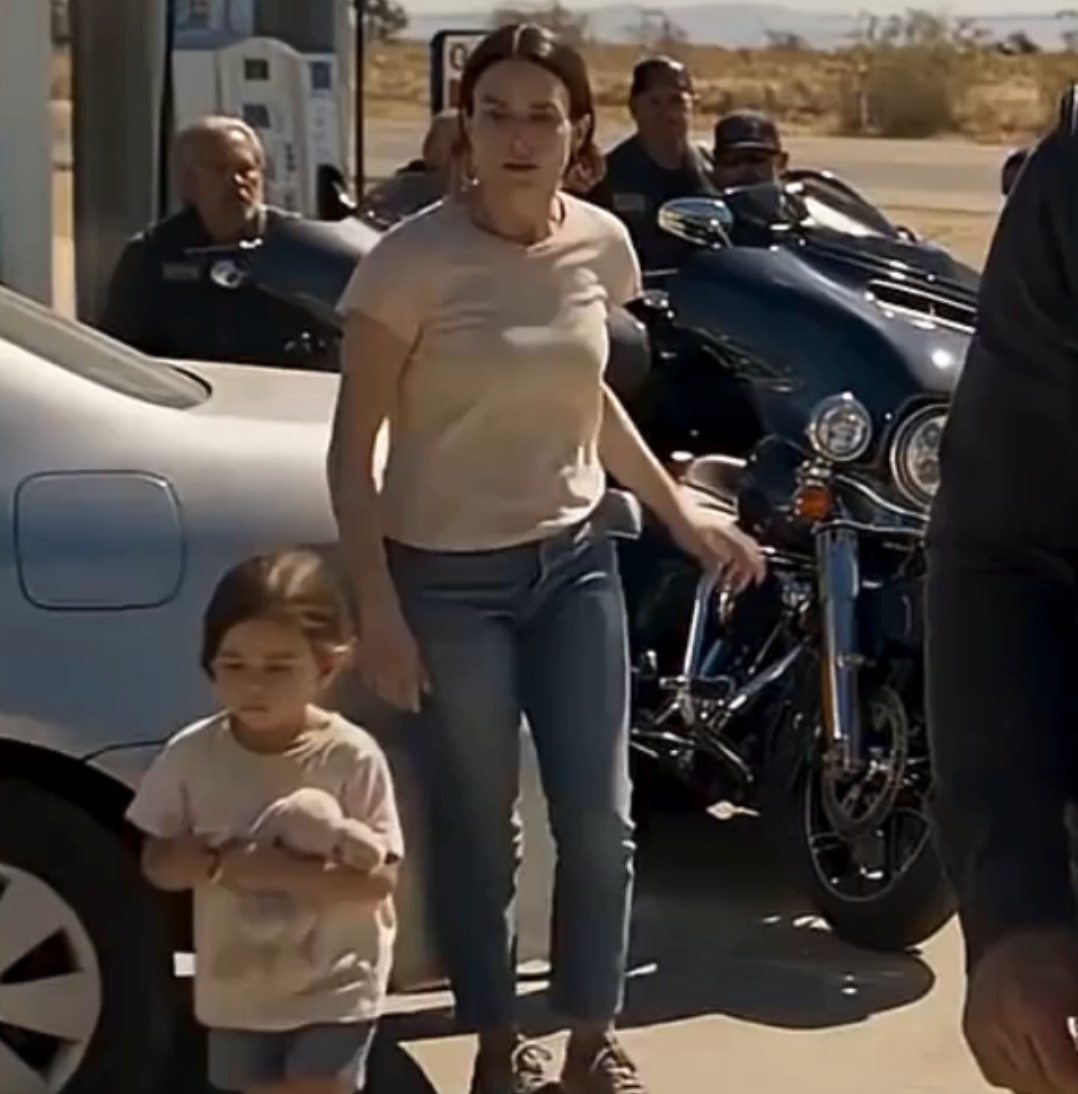
A Little Girl Walked Up To Our Table Of Outlaw Bikers At Denny’s, Put $5 On The Table, And Said, “Please Kill My Stepdad. I’ll Hire You.” What Happened Next Cost Us Three Years, Two Brothers, And A War We Never Expected To Fight.
It was 11:43 on a Thursday night when the little girl walked into Denny’s. Outside, a cold November rain was falling, and the parking lot was almost empty except for a few trucks, two delivery vehicles, and nine motorcycles parked beneath the restaurant’s yellow lights. Inside, nine of us occupied two tables pushed together near the window. We were wearing our leather vests, drinking coffee, eating burgers, and arguing about an engine that had been giving one of our brothers trouble for almost three weeks.
My name is Frank Mercer. I was fifty-seven years old at the time, and I had spent more than thirty years riding with an outlaw motorcycle club. I had a gray beard, a damaged left knee, and enough scars to make strangers uncomfortable. Most people saw our leather vests and immediately decided what kind of men we were. Some of their assumptions weren’t entirely wrong. We had made mistakes, spent nights in jail, fought people we shouldn’t have fought, and buried friends whose names still appeared on our club memorial wall. But there were nine men sitting at those tables that night, and every one of us understood something about loyalty.
The little girl appeared beside the entrance without making a sound. She was probably eight years old, although she looked younger because of how small she was. She wore pink pajamas, a winter coat that was much too large for her, and one white shoe with its laces dragging across the floor. Her brown hair was tangled, and there were tears on both cheeks. She stood near the entrance for several seconds, looking around the restaurant as if she were searching for somebody she recognized.
The waitress noticed her first.
“Sweetheart, are you here with somebody?”
The girl didn’t answer. Instead, she looked toward our table. I noticed her eyes moving from one face to another, stopping briefly on our leather vests and the patches on our backs. Then she took a deep breath and started walking toward us.
Our conversation slowly faded. Tommy, who was sitting across from me, stopped chewing. Danny lowered his coffee cup. Our club president, Walter, turned around in his chair. The little girl stopped directly beside me and looked up.
“Are you really bad men?” she asked.
Tommy almost smiled, but something about her expression stopped him.
“Depends who’s asking, sweetheart,” I replied.
She reached into her coat pocket and pulled out five crumpled one-dollar bills. She placed them carefully on the table, one at a time, and tried to smooth the wrinkles with her little fingers.
Then she said something that made every conversation in Denny’s stop cold.
“Can you kill my stepdad, please? I’ll hire you. I have five dollars. It’s all my money.”
Nobody laughed. Nobody made a joke. Even the waitress stopped moving.
I stared at the money, then looked at her face.
“What’s your name, sweetheart?”
“Lily.”
“Where’s your mommy, Lily?”
“At home.”
“Does she know you’re here?”
The little girl shook her head. Her lower lip trembled, and she looked toward the entrance again.
“She’s hurt. He hit her yesterday. He said if she tells anybody, he’ll make her disappear. He said nobody can stop him because he’s rich and everybody listens to him.”
I slowly pushed the five dollars back toward her.
“Listen to me, Lily. We’re not going to kill anybody. But we’re going to help your mother. You understand?”
She looked confused.
“But you have guns, right?”
I glanced at the other men. Nobody answered immediately.
“Some people carry guns,” I said. “But guns aren’t how we’re going to solve this. First, we’re going to make sure you and your mother are safe.”
She started crying harder.
“He said he would hurt her again if I told anyone. He said he would put her in a hospital and tell everybody she fell down the stairs.”
Danny stood up and moved a chair beside him.
“Come sit with us, little one. Have you eaten anything tonight?”
She shook her head.
Danny ordered pancakes, scrambled eggs, and a glass of milk. The waitress brought a warm blanket from the back of the restaurant. Lily sat between Danny and me, holding the blanket around her shoulders while we tried to understand what had happened.
Then she told us something that made my stomach turn.
“Mommy told me that if he starts hitting her again, I should run outside and find somebody who looks scary. She said scary people might not be afraid of him.”
I looked at Walter.
He looked at me.
Neither of us needed to say anything.
We were going to find out who Richard Harlan was.
And we were going to make sure that little girl never had to offer another stranger five dollars to save her mother.
Lily slowly began eating her pancakes. She was so hungry that she finished the first one before Danny had even poured syrup over the second. Every few bites, she looked toward the restaurant entrance. Whenever somebody opened the door, her shoulders tightened, and her fingers wrapped around the edge of the blanket.
I asked her whether she knew her home address. She nodded and gave us the name of a street on the eastern side of town. It was a neighborhood filled with expensive houses, tall fences, private security cameras, and driveways longer than some people’s entire properties. Richard Harlan lived in a three-story house behind an iron gate. His property included a swimming pool, a detached garage, and a security booth near the entrance.
I knew the name.
Everybody in town knew Richard Harlan.
He owned construction companies, several apartment complexes, a shopping center, and a company that supplied materials to government contractors. His photograph appeared regularly in the local newspaper. He sponsored school events, donated money to hospitals, and had his name engraved on the wall of a children’s charity building.
He was the kind of man who shook hands with politicians in public and expected ordinary people to lower their eyes when he entered a room.
Three years earlier, I had seen him at a charity dinner. He had been surrounded by businessmen and local officials, wearing an expensive watch and smiling for photographs. At the time, I hadn’t thought much about him. He was just another wealthy businessman who wanted people to believe he was generous.
Now I was looking at a frightened eight-year-old who claimed that the same man was beating her mother.
“Does he have people working for him?” I asked.
Lily nodded.
“Two men stay outside the house. One has a black car. The other one has a big beard. They watch everybody.”
“Do they hurt your mommy too?”
“Sometimes they hold her arms when Richard gets angry.”
Tommy leaned forward.
“Jesus Christ.”
Walter raised his hand, telling him to lower his voice. He didn’t want to frighten Lily.
I asked whether her mother had any relatives who could help. Lily said Sarah’s parents had died several years earlier, and she barely knew her mother’s brother. Richard had gradually separated Sarah from nearly everyone she had known before their marriage.
That was when I understood the situation was bigger than a single incident of domestic violence. Richard had built a world around Sarah in which he controlled the money, the transportation, the household, the social relationships, and even the story other people heard about her.
He had made her dependent on him.
And he had made her afraid to ask for help.
I asked Lily whether she had a telephone number for her mother. She gave me a number she had memorized. I didn’t call it immediately. We first asked the restaurant manager to contact the police and emergency services, explaining that a young child had arrived alone and disclosed possible ongoing abuse at home.
A few minutes later, two officers arrived. They spoke gently to Lily, and a female officer sat beside her while the other officer took down the information. Lily became frightened when they mentioned returning to her house.
“Please don’t send me back,” she whispered.
The female officer reassured her that she would not be sent anywhere without the appropriate safety arrangements. The officers contacted the relevant child-protection personnel and arranged for Lily to remain in a safe environment while they investigated.
Before she left with the officer, Lily turned around and looked at me.
“Are you coming?”
I looked at Walter.
“We’ll make sure your mother gets help.”
She hesitated.
“Promise?”
I held out my hand, and she placed her tiny palm against mine.
“Promise.”
That was the moment our three-year nightmare began.The following morning, we learned more about Sarah Harlan.
She was thirty-four years old and had worked as a receptionist at a dental clinic before marrying Richard. Her first husband had died in a traffic accident when Lily was two. For almost two years, Sarah had raised her daughter alone, working long hours and living in a small apartment.
Then she met Richard.
He was charming, confident, and generous. He brought flowers to her workplace, remembered Lily’s birthday, and treated the little girl like his own daughter. He offered to help Sarah financially and promised that she would never have to struggle again.
Within a year, they were married.
The first signs of trouble appeared during their honeymoon. Richard began questioning Sarah about telephone calls and asking why she needed to speak with old friends. He complained about her clothing, her work, and the people she visited. He insisted that she quit her job because he could provide everything the family needed.
Sarah eventually agreed.
At first, she thought he was simply protective. She didn’t understand that he was gradually removing every part of her independence.
The first physical incident happened during their second year of marriage. Richard became furious because Sarah had secretly spoken to an old colleague. He grabbed her arm and pushed her against a kitchen cabinet. The following morning, he bought her expensive jewelry and apologized.
It happened again.
And again.
The apologies became shorter, the violence became worse, and the threats became more frightening.
Richard eventually began using Lily as a weapon. He told Sarah that he could arrange for her to lose custody of her daughter. He claimed that his lawyers knew judges, that the police would believe him, and that Sarah would be portrayed as an unstable woman who had become jealous of her wealthy husband.
He also made sure that Lily heard those threats.
When Sarah finally tried to leave, Richard found her before she could reach a friend’s apartment. He took her telephone, brought her home, and told her that if she ever attempted it again, she would regret it.
For the next several months, Sarah lived like a prisoner.
She hid small amounts of money inside an old sewing box. She memorized telephone numbers and taught Lily what to do if something terrible happened. She had no idea whether anybody would believe them, but she wanted her daughter to have one possible way out.
That was why she had whispered those instructions on Thursday night.
And that was why Lily had walked into Denny’s.
By Friday afternoon, Sarah had been located and taken for medical evaluation. The authorities documented her injuries, and a social worker began arranging a safe placement for both mother and daughter.
Richard, however, wasn’t prepared to let them go.
He arrived at the hospital with two lawyers and demanded to see Sarah.
The hospital refused to give him unrestricted access. He became furious, arguing with the staff and insisting that his wife was mentally unstable.
One nurse later told investigators that Richard smiled at her before leaving and said, “You people have no idea how much trouble you’ve just invited into your lives.”
That sentence would become important later.
We first saw Richard Harlan in person two days after Lily came to Denny’s.
Walter had asked us not to approach him aggressively. We were not going to give him an excuse to accuse the club of threatening or attacking him. Sarah had lawyers now, and the authorities were investigating. Our job was to support her, provide information when requested, and make sure she wasn’t left alone.
But Richard had other plans.
He arrived at the temporary residence where Sarah was staying, accompanied by three men. He wasn’t supposed to have unsupervised contact with her, and the authorities had already been informed that he might attempt to approach her.
We happened to be nearby because Sarah had asked Danny to help collect some belongings from a storage unit. When Richard’s black SUV pulled up, Danny called me.
“Frank, we’ve got company.”
I arrived a few minutes later with Walter and Tommy.
Richard stepped out of the vehicle. He was wearing a charcoal suit, polished shoes, and a silver watch. He looked like somebody who had just left a business meeting rather than a man whose wife was hiding from him.
He looked at our motorcycles and shook his head.
“So this is the circus she’s hiding behind.”
Walter remained calm.
“You’re not supposed to be here.”
Richard laughed.
“Do you know who I am?”
Tommy muttered something under his breath, but Walter gave him a warning look.
Richard walked closer.
“I own half the buildings in this town. I know the mayor. I know the sheriff. I know people in the state government. And you three idiots think you can stand between me and my family?”
I looked him in the eyes.
“Your family isn’t property, Richard.”
His smile disappeared.
“Listen carefully, old man. I don’t know what she told you, but she’s a liar. She’s been having problems for years. I paid for everything she has. I gave that child a home. Without me, they’d be living in a rented apartment.”
“Then why is your wife afraid to be in the same room with you?”
Richard’s jaw tightened.
He looked toward the building.
“Sarah!”
Nobody answered.
He turned back to us.
“You have no idea what you’re getting involved in.”
I took a step closer, but Walter placed a hand against my chest.
“Frank. Don’t.”
Richard adjusted his jacket.
“Enjoy your little club while it lasts.”
Then he returned to his SUV.
Before the vehicle pulled away, one of his security men leaned out of the passenger window and stared directly at Danny.
Danny didn’t look away.
We watched the SUV disappear around the corner.
For several seconds, nobody spoke.
Then Tommy said what all of us were thinking.
“That man isn’t going to stop.”
Walter nodded.
“No. And that’s exactly why we need to do everything properly.”
Three days later, Tommy’s workshop burned.
The building stood on a quiet industrial street, surrounded by tire shops, welding businesses, and warehouses. Tommy had owned it for eleven years. It wasn’t fancy, but it was his pride and joy. He repaired motorcycles, restored old engines, and occasionally helped young riders who couldn’t afford expensive repairs.
At approximately 2:20 in the morning, a neighboring business owner noticed smoke coming from the roof. By the time firefighters arrived, flames had already spread through most of the building.
Two motorcycles were destroyed. Another was badly damaged. Tommy lost thousands of dollars in equipment, spare parts, and customer property.
He stood outside the next morning, staring at the blackened walls.
I had seen Tommy angry before. I had seen him get into fights, lose money, and receive bad news without changing his expression.
But that morning, he looked broken.
“Eleven years, Frank,” he said quietly. “Eleven years building this place.”
I put my hand on his shoulder.
“We’ll help you rebuild.”
He shook his head.
“That’s not what I’m worried about.”
He showed me a message he had received shortly before the fire.
Stay away from Richard Harlan’s family. This is your last warning.
We immediately gave the message to investigators. The fire was treated as suspicious, and the authorities began examining nearby security footage and possible witnesses. We also informed Sarah’s legal team because the timing suggested a possible connection to the ongoing case.
Tommy wanted to confront Richard.
He wanted to drive straight to his mansion and make him answer for what had happened.
Walter refused.
“That’s exactly what he wants,” he said. “He wants us to lose our heads. He wants us in handcuffs. He wants Sarah to look like she’s being protected by criminals who can’t control themselves.”
Tommy kicked a piece of burnt wood.
“So we just sit here?”
“No,” Walter answered. “We document everything. We cooperate with investigators. We rebuild the shop. And we make sure Sarah has the legal support she needs.”
That afternoon, Danny arranged a meeting with a lawyer who specialized in domestic abuse and witness protection matters. The lawyer explained that Sarah needed to preserve every message, medical report, photograph, and threatening communication.
He also explained that Richard’s wealth could make the legal process difficult, but it did not make him immune from the law.
For the first time, we had a plan that didn’t depend on anger.
It depended on evidence.
And Richard was about to discover that evidence could be more dangerous to him than any motorcycle club.
Sarah agreed to give a formal statement.
The interview lasted almost five hours.
She described the first time Richard hit her, the threats he made afterward, and the ways he controlled her life. She explained that he had taken her bank cards, restricted her access to money, and threatened to have Lily removed from her care if she ever tried to leave.
She also described several incidents involving Richard’s employees.
One man, a security supervisor named Paul, had once stood in the bedroom doorway while Richard struck her. Sarah remembered asking him to call the police.
Instead, he had looked at Richard and asked whether he wanted the doctor contacted.
Another time, a driver had followed Sarah when she attempted to visit a former colleague. Richard later showed her photographs of the visit and warned her that he knew where everybody went.
Sarah had spent years wondering whether anybody would believe her.
Now she was finally speaking.
But telling the truth didn’t make the fear disappear.
That night, she called me.
“Frank, I need to ask you something.”
“Go ahead.”
“What happens if he gets out?”
I was quiet for a moment.
“Then we’ll follow the protective arrangements. Your lawyer and the authorities will deal with him. You won’t have to face him alone.”
“But what if he comes after Lily?”
I leaned back in my chair.
“Sarah, listen. Lily has already survived more than any child should ever have to experience. The most important thing now is to give her a safe place, professional support, and a childhood that doesn’t revolve around Richard.”
She started crying.
“I should have left earlier.”
I had heard that sentence from people who had suffered abuse. They blamed themselves for staying, even though they had been threatened, controlled, isolated, and frightened.
“Don’t do that,” I told her. “He made those choices. Not you.”
The next morning, Danny visited Sarah and brought Lily a small bicycle.
It was pink, with a white basket attached to the handlebars.
Lily looked at it as if she had never seen anything so beautiful.
“Is it really mine?”
Danny smiled.
“Unless somebody else in this town has your name on it.”
She laughed.
It was the first time I had heard her laugh without immediately looking around to see whether somebody was angry.
I watched from the doorway and thought about how little it took to make a frightened child happy.
A bicycle.
A safe room.
A mother who could sleep through the night.
And a promise that somebody would come if she needed help.
The first major hearing took place four months after Lily walked into Denny’s.
Richard arrived with an expensive legal team. Sarah had a lawyer who was experienced and determined, but she did not have unlimited money. The difference between the two sides was obvious.
Richard’s lawyers argued that Sarah had fabricated the abuse allegations because she wanted financial compensation. They claimed she had been influenced by the motorcycle club and was using the allegations to gain an advantage in a custody dispute.
They also tried to paint us as violent criminals.
One lawyer asked whether I had ever been arrested.
I answered honestly.
“Yes.”
He smiled.
“Have you ever been involved in a physical altercation?”
“Yes.”
“Have you ever threatened another man?”
“Yes.”
“Then why should this court believe anything you say?”
I looked at him.
“Because I’m not asking the court to believe I’m a saint. I’m telling the court what I witnessed, what I heard, and what I know. The evidence should decide the rest.”
His smile disappeared.
The hearing continued for several hours. The judge reviewed the initial medical documentation, the police reports, and Sarah’s statements. Lily’s situation was also considered, with professionals explaining the importance of protecting her from further exposure to conflict.
Richard’s request for unrestricted access to Sarah was denied, and temporary protective arrangements remained in place while the investigation continued.
Outside the courthouse, Sarah looked exhausted.
She had been holding Lily’s hand throughout the proceedings. When the doors opened, she stopped and looked at the crowd.
Richard was standing near his lawyers.
He leaned toward one of them, whispered something, and laughed.
Sarah’s face went pale.
“He’s laughing,” she said.
I looked at Richard.
“Let him laugh.”
“How can he laugh after everything?”
“Because he still thinks this is about money and power. He hasn’t understood that the evidence is going to speak whether he laughs or not.”
That evening, Lily asked her mother whether they had won.
Sarah sat on the edge of the bed.
“Not yet, sweetheart.”
“How many more times do we have to go?”
Sarah hugged her.
“I don’t know.”
Lily looked at the floor.
“I wish grown-ups could just tell the truth.”
Sarah kissed her forehead.
“Me too.”
I heard that conversation from the hallway.
It was the kind of sentence that stays with a man long after everybody else has gone home.
By the sixth month, we understood that Richard’s greatest weapon wasn’t his money. It was the number of people who depended on him.
He employed hundreds of workers through his construction companies. He had security personnel, drivers, accountants, lawyers, and business partners. Some genuinely believed he was a good man. Others knew enough about his private behavior to stay quiet.
He had built a system in which people were rewarded for loyalty and punished for asking questions.
His security supervisor, Paul Dwyer, was particularly dangerous. Paul was a former military contractor who had worked for Richard for nearly seven years. He was tall, heavily built, and rarely spoke. People who had encountered him described him as a man who could stand in a room for an hour without changing his expression.
He was also the man Sarah had identified as one of the people who helped Richard control her.
We learned that Paul had been contacting people associated with our club. He knew where some of our members lived, where we worked, and which family members were most important to us. One afternoon, he appeared outside Marcus’s house.
Marcus was forty-nine, divorced, and had a teenage daughter. He had been a mechanic before joining our club and was one of the most patient men I knew. He wasn’t somebody who went looking for trouble.
Paul approached him while he was working in his driveway.
“You should tell your friends to stop involving themselves in Richard’s personal business,” Paul said.
Marcus continued working on his motorcycle.
“Does Richard send you everywhere to deliver messages?”
Paul stepped closer.
“You’re making a mistake.”
Marcus finally looked up.
“Maybe. But standing in a stranger’s driveway telling him what to do isn’t a particularly smart career move either.”
Paul smiled.
“Your daughter goes to Westbrook High, doesn’t she?”
Marcus stopped moving.
That was the first time we understood that Richard’s people were willing to threaten families.
Marcus immediately contacted the police and reported the encounter. We helped him document everything and arranged additional safety measures through the appropriate authorities.
Richard had crossed a line.
Not because he had insulted us, but because he had brought an innocent teenager into his intimidation campaign.
Walter called a club meeting that night.
“We have wives, children, jobs, and people who depend on us. Nobody is going to put their family at risk by trying to be a hero. We work with the authorities. We don’t chase these men around town.”
He paused.
“But nobody is going to abandon Sarah and Lily either.”
Everybody agreed.
That was the difference between what Richard understood as loyalty and what we understood as loyalty.
He expected people to obey because they were afraid.
We stayed because we had given our word.
It happened on a rainy Tuesday.
Danny, Marcus, and I had attended a legal meeting with Sarah’s lawyer. We were returning to our clubhouse when a dark vehicle began following us. At first, I assumed it was ordinary traffic. But after several turns, I realized the vehicle was maintaining the same distance.
I called Walter.
“Something’s wrong. We’ve got a car behind us.”
“Don’t go to the clubhouse. Stay on the main road and contact the police.”
We did exactly that.
The vehicle suddenly accelerated and pulled alongside Marcus’s truck. I heard shouting, followed by several gunshots.
Glass shattered.
Marcus lost control of the vehicle and struck a roadside barrier. Danny was thrown against the passenger door, and I felt something strike my shoulder before everything became confused.
The attackers disappeared into the rain.
I remember the sound of the windshield cracking. I remember Danny shouting for Marcus. I remember trying to open the driver’s door and finding that it wouldn’t move.
Then I heard sirens.
Marcus had been shot in the upper arm. Danny suffered a serious head injury, and I had a bullet wound through my shoulder.
We were taken to different hospitals.
I woke up the following afternoon with a nurse telling me that I had survived surgery and would need several weeks of recovery.
My first question was about Danny.
She didn’t answer immediately.
That was when I knew.
Danny died before reaching the hospital.
He was forty-six years old.
He had two grown children, a small house with a garden, and a habit of calling his mother every Sunday morning. He had been the man who ordered pancakes for Lily at Denny’s. He had been the man who bought her a bicycle. He had been the first person to tell her that she deserved to feel safe.
And now he was gone.
The police opened a major investigation. The shooting was reported as a targeted attack, and investigators examined possible connections to the ongoing threats against Sarah and the club.
Richard denied any involvement.
His lawyer issued a statement calling the incident an unfortunate act of violence unrelated to his client.
I read the statement from my hospital bed.
Then I threw the newspaper across the room.
Walter visited me that evening.
He was carrying Danny’s leather vest.
He placed it on the chair beside my bed.
“His daughter asked me to bring it.”
I stared at the vest.
“Did you tell her?”
Walter nodded.
“She knows.”
I closed my eyes.
“God help us.”
Walter sat down.
“Frank, we’re going to let the investigators do their work. We’re not going to turn Danny’s death into an excuse to become the thing Richard says we are.”
I looked at him.
“Then what are we supposed to do?”
He answered quietly.
“Finish what Danny started.”
Danny’s funeral took place on a Saturday morning.
The weather was cold, and the sky was covered with heavy gray clouds. More than two hundred people attended. There were bikers from neighboring states, old friends, former customers, relatives, and people who had never met Danny but had heard what happened.
His daughter, Emily, stood beside the coffin.
She was twenty-two years old. She had her father’s eyes and the same habit of looking down when she was trying not to cry.
Lily attended with Sarah.
She wore a black dress and carried a small envelope. Before the service began, she walked toward Danny’s coffin and placed the envelope beside the flowers.
Inside was a drawing.
It showed a motorcycle, a little girl, and a man with a big beard. Above them, Lily had written:
Thank you for giving me pancakes when I was hungry. Thank you for making me feel safe. I will miss you, Danny.
Emily read the note.
Then she knelt in front of Lily.
“Did my dad really help you?”
Lily nodded.
“He bought me a bicycle.”
Emily started crying.
“He always wanted to buy somebody a bicycle.”
For a moment, the two of them hugged each other.
I watched from several feet away.
I had known Danny for seventeen years. We had ridden through storms, crossed state lines, slept in roadside motels, and spent countless nights arguing about things that didn’t matter.
I remembered him once stopping in the middle of a highway because he had spotted a stranded family with a broken-down vehicle. He had spent two hours helping them, then refused the money they offered.
That was Danny.
He wasn’t perfect. None of us were.
But he had understood that sometimes the smallest act of kindness could become the biggest thing in another person’s life.
After the funeral, Walter gathered the club members.
He held Danny’s vest in both hands.
“We’ve lost a brother,” he said. “And I know some of you want revenge. I understand that. But if we let Richard turn us into a gang of angry men looking for somebody to hurt, then he wins twice.”
He looked around.
“We’re going to fight him in court. We’re going to give investigators every piece of evidence we have. We’re going to protect Sarah and Lily. And we’re going to make sure Danny’s death is not forgotten.”
Nobody cheered.
Nobody needed to.
We simply stood together in the rain.
Five months after Danny’s death, Marcus was attacked again.
He had returned to work part-time, although his injured shoulder still caused him severe pain. His daughter had temporarily moved in with her aunt because Marcus was worried about her safety.
One afternoon, he was leaving a hardware store when two men approached him in the parking lot.
There was an argument.
A witness later told investigators that one of the men appeared to recognize Marcus and shouted something about Richard Harlan.
Then a gunshot rang out.
Marcus fell beside his truck.
The attackers fled.
He survived, but the bullet caused extensive damage to his lower spine. After several operations and months of rehabilitation, doctors told him that he would probably never walk independently again.
When I visited him, he was sitting beside a hospital window in a wheelchair.
He looked at me and tried to smile.
“Well, Frank. I guess I’m not riding for a while.”
I sat down.
“Doctors are still working on your recovery.”
He shrugged.
“Don’t give me that hospital speech. I know what they said.”
For a while, we discussed ordinary things. His daughter had passed her examinations. His sister had brought him a new television. Tommy was rebuilding his workshop.
Then Marcus became serious.
“Did Sarah and Lily hear about Danny?”
“Yes.”
“Are they still safe?”
I nodded.
“Yes. They’re still protected.”
He stared through the window.
“Good.”
I couldn’t help asking the question that had been sitting inside me for months.
“Do you regret getting involved?”
Marcus turned his head.
“Are you asking me whether I regret helping a little girl whose mother was being beaten?”
I said nothing.
He shook his head.
“Frank, I regret that Danny is dead. I regret that I can’t ride with you boys. I regret that my daughter has to see her father sitting in this chair. But I don’t regret helping Lily.”
He reached toward the bedside table and picked up a small photograph.
It showed Lily standing beside him at the workshop, wearing a helmet that was too large for her.
“Look at that kid,” he said. “She’s smiling.”
He put the photograph down.
“That’s enough for me.”
I walked out of that hospital room feeling both proud and ashamed.
Proud to know Marcus.
Ashamed that I had ever questioned whether we should have helped.
By the beginning of the second year, Richard had started losing people.
His company accountant resigned. One of his drivers disappeared from work. A security employee requested a transfer. Two former business partners quietly ended their relationships with him.
At first, we thought these were ordinary business changes.
Then Sarah’s lawyer received an unexpected telephone call.
The caller was Michael Reeves, a former personal driver who had worked for Richard for six years.
Michael had witnessed several incidents involving Sarah. He had also been present when Richard threatened to take Lily away from her mother. He claimed that Richard had instructed him to follow Sarah on several occasions and report where she went.
Michael had kept records.
He had photographs, copies of messages, and financial documents that he believed showed payments made to individuals who had been involved in intimidating Sarah.
He was frightened.
He had two children and a mortgage. He knew what had happened to people who crossed Richard.
But something had changed.
His own daughter had recently asked him why he worked for a man who frightened women.
That question had stayed with him.
Michael met Sarah’s lawyer in a secure office and provided an initial statement. Investigators subsequently reviewed the information and determined which records could be independently verified.
One detail was especially important.
Michael had been instructed to take Sarah to a private medical clinic after an incident in which Richard had allegedly assaulted her. The clinic’s records, combined with Sarah’s medical documentation, supported her account of the event.
Another piece of evidence involved a series of messages between Richard and his security supervisor.
The messages did not prove every allegation, but they gave investigators a new direction.
For the first time, Richard was no longer facing only Sarah’s testimony.
Other people were beginning to speak.
When we heard about Michael, Tommy called a meeting.
“I knew somebody would eventually get tired of carrying that man’s secrets.”
Walter nodded.
“Let’s hope more people do.”
But there was a problem.
Michael had become frightened after giving his statement. He received anonymous calls, and someone had photographed his children’s school entrance.
Investigators arranged appropriate protective measures for him and his family.
Richard’s world was beginning to crack.
And he knew it.
The third year started with a letter.
It was delivered to Sarah’s lawyer in a plain white envelope. There was no return address, no signature, and no explanation.
Inside was a photograph of Sarah and Lily walking outside a grocery store.
On the back, someone had written:
Three years of trouble. You should have accepted the money and gone away.
Sarah became physically sick when she saw it.
She had been making progress. Lily was attending school regularly, receiving counseling, and beginning to make friends. Sarah had found part-time employment and was slowly rebuilding her independence.
The photograph brought everything back.
She called me that evening.
“Frank, I can’t do this anymore.”
I knew what she meant.
“I’m tired of being frightened,” she continued. “I’m tired of looking behind me. I’m tired of explaining to Lily why we can’t go somewhere. I just want an ordinary life.”
I let her speak.
“I sometimes think about taking the money Richard offered and leaving town. Maybe that would be easier.”
I understood why she felt that way.
The previous three years had cost her almost everything. She had lost her home, her marriage, her financial security, and many of the relationships she once depended on. She had spent more time in legal offices than she had spent enjoying her daughter’s childhood.
But I reminded her that she didn’t owe Richard silence.
“You don’t have to be brave every day, Sarah. You can be tired. You can be angry. You can cry. But don’t let that man convince you that you did something wrong by telling the truth.”
She was quiet.
Then she asked:
“Do you think we’ll ever be free?”
I looked at Danny’s photograph on my desk.
“Yes.”
I didn’t know how long it would take.
But I believed it.
The letter was immediately reported to investigators. The photograph was examined, and the circumstances surrounding its delivery were added to the existing investigation.
Sarah’s lawyer also requested additional protective arrangements.
Meanwhile, the prosecution was preparing a much larger case.
Richard had spent years believing that people were too frightened to testify against him.
Now there were witnesses, records, medical reports, and investigators who were no longer treating the allegations as an isolated domestic dispute.
The next important witness was a man named Paul Dwyer.
Yes, the same Paul who had once stood outside Marcus’s house.
Paul had worked for Richard for years. He had been involved in security operations, supervised drivers, and managed the men who guarded the property.
He was not an innocent bystander.
But he had also witnessed enough to understand that Richard was prepared to sacrifice anybody who became inconvenient.
Paul contacted investigators after an argument with Richard over money. He claimed that Richard had refused to pay him for several months and had threatened to blame him for incidents involving Sarah.
At first, investigators were suspicious.
They had good reason to be.
Paul had previously denied knowing anything about the abuse. His involvement in the security arrangements meant his testimony needed to be carefully examined.
But he provided information that could be checked.
He identified dates, vehicles, employees, and locations. He described several conversations in which Richard allegedly discussed ways to frighten Sarah into withdrawing her allegations.
He also provided information about the men who had been following members of our club.
The investigators began comparing his account with telephone records, financial information, and witness statements.
Some details matched.
Others required further investigation.
Paul eventually agreed to cooperate formally.
When Sarah heard that he had come forward, she didn’t celebrate.
She simply said:
“How many people knew what was happening?”
I had no answer.
That question bothered me for a long time.
How many people had seen the injuries? How many had heard the shouting? How many had watched Richard control Sarah and Lily? How many had looked away because he signed their paychecks?
We had spent three years fighting one powerful man.
But the real problem was the silence surrounding him.
And now that silence was finally breaking.
The pressure was taking its toll on us.
Our club had lost two members to violence, another was permanently disabled, and several others had moved away because they feared for their families.
Tommy’s workshop was operating again, but it was nowhere near what it had been before the fire.
I was still dealing with shoulder pain. Some mornings, I couldn’t put on my leather vest without assistance.
Walter had started sleeping badly.
One evening, he called me into his office.
There was a cardboard box on his desk.
Inside were photographs of Danny, Marcus, Tommy, and the rest of us from happier days. There were pictures from motorcycle rallies, roadside diners, birthday parties, and long trips across the country.
Walter picked up one photograph.
It showed nine of us standing outside Denny’s.
Lily wasn’t in the photograph. It had been taken a few months before we met her.
“Look at these idiots,” he said.
I smiled.
“We were younger.”
“We were stupid.”
“That too.”
He put the photograph down.
“Frank, I’ve been thinking about stepping down.”
I looked at him.
“Why?”
“Because I’m tired. I’ve been president for nineteen years. I’ve watched good men get buried. I’ve watched families suffer. I don’t know how much longer I can keep everyone together.”
I sat opposite him.
“You think leaving will make the past disappear?”
“No.”
“Then don’t leave because you’re tired. Leave when you’ve finished what you promised.”
Walter stared at me.
“What if we lose?”
I looked at the photograph of Danny.
“Then at least we didn’t run.”
He didn’t answer.
But he didn’t resign either.
The next morning, he called a meeting and announced that the club would continue supporting Sarah through the legal process. He also made it clear that no member was to approach Richard or his associates outside lawful procedures.
We weren’t going to let our grief become another weapon Richard could use against us.
We had learned that lesson the hardest possible way.
By the middle of the third year, Richard was becoming desperate.
His construction company had lost two major contracts. A bank had suspended one of his business credit arrangements pending an internal review. Several local politicians who had once appeared beside him at charity events suddenly stopped returning his calls.
His reputation was deteriorating.
But the most serious problem was that his former employees were beginning to cooperate with investigators.
Richard responded the way he always had: with threats, pressure, and attempts to control the people around him.
Then he made a mistake that changed the entire case.
He contacted Sarah directly.
It happened on a Sunday evening. Sarah was preparing dinner when her telephone rang. The number was unfamiliar, but she answered because she thought it might be someone from Lily’s school.
It was Richard.
For several seconds, neither spoke.
Then he said:
“Sarah, this has gone far enough.”
She put the telephone on speaker and immediately contacted her lawyer, following the safety arrangements she had been given.
Richard continued.
“Look what you’ve done. You’ve destroyed my business. You’ve turned people against me. You’ve got those bikers involved, and now everybody thinks I’m some kind of monster.”
Sarah’s hands were shaking.
“You did this to yourself, Richard.”
He laughed.
“You think that little girl is going to remember you as a hero? She’ll grow up and realize what you’ve done.”
Sarah looked toward the living room, where Lily was doing homework.
“Don’t talk about my daughter.”
“She’s my daughter too, in every way that matters.”
“No. You were supposed to be the adult who protected her.”
There was a long silence.
Then Richard’s voice became colder.
“You have no idea what happens next.”
The call ended.
Sarah immediately preserved the recording and reported the contact to her lawyer and investigators. The call was added to the existing evidence, and the authorities examined whether it constituted a violation of the applicable protective arrangements.
When I heard about it, I was furious.
Walter told me to sit down.
“Frank, listen to me. We have spent three years trying to make this case stronger. Don’t ruin that because the man has finally started panicking.”
I knew he was right.
Richard had wanted Sarah to become frightened enough to withdraw her statements.
Instead, he had created another piece of evidence.
And this time, Sarah had not been alone when it happened.
Until that point, Lily had been protected from much of the legal process.
Professionals had worked with her to make sure she wasn’t repeatedly forced to describe frightening experiences. She was receiving counseling, and her mother was doing everything possible to give her a normal childhood.
But as the investigation continued, her memories became relevant to certain proceedings.
Her lawyer and the professionals involved carefully considered how her account could be obtained without unnecessarily exposing her to further distress.
One afternoon, I visited Sarah’s house.
Lily was sitting at the kitchen table drawing a picture of a horse. She had grown taller, and her hair was now neatly tied behind her head. She looked like an ordinary ten-year-old girl.
She asked whether I had brought Danny.
The question caught me off guard.
I sat down.
“Danny isn’t here anymore, sweetheart.”
“I know.”
She looked at her drawing.
“Sometimes I forget and think he’s coming to visit.”
I nodded.
“Me too.”
She put down her pencil.
“Frank, can I tell you something?”
“Of course.”
“Sometimes I think about that night at Denny’s.”
I waited.
“I remember putting the money on the table. I thought you would take it and do what I asked.”
I smiled sadly.
“We weren’t going to do that.”
“I know now.”
She continued.
“I was scared because Mommy was crying all the time. I thought if Richard disappeared, everything would become normal again. I didn’t know that grown-ups could help without hurting somebody.”
I looked at her.
“That’s something many adults have trouble understanding too.”
She became quiet.
Then she asked:
“Did Danny die because of me?”
The question felt like somebody had punched me in the chest.
“No, Lily. Danny died because somebody chose to use violence. You did nothing wrong. You were a child asking for help. You didn’t cause any of this.”
“But if I hadn’t gone to Denny’s…”
I leaned forward.
“Listen carefully. You did the right thing by asking for help. The responsibility belongs to the people who chose to hurt others. Never carry their choices on your shoulders.”
She nodded, although I could tell she was still trying to understand.
Before I left, she gave me her drawing.
It showed nine motorcycles lined up outside a restaurant. There were only seven riders in the picture now.
Two spaces were marked with little black crosses.
I folded the paper carefully and placed it inside my jacket.
I still have it. Richard’s legal team knew the case was becoming serious.
They began challenging the credibility of witnesses, questioning the authenticity of documents, and arguing that some evidence had been obtained improperly.
Several motions were filed.
One witness withdrew an earlier statement after claiming that he had been pressured by investigators. Another former employee refused to testify because he feared losing his job.
The defense also attempted to introduce our club’s criminal histories to suggest that we had fabricated the entire story.
It was exhausting.
Every time we thought the case was moving forward, another legal obstacle appeared.
Then Tommy received a telephone call from an unknown number.
The caller told him that the club should stop cooperating with the prosecution.
Tommy asked who was speaking.
The caller replied:
“Some people are tired of burying their friends.”
Tommy immediately ended the call and reported it.
That evening, he came to the clubhouse.
He looked older than I had ever seen him.
“I’m not afraid of getting hurt,” he said. “But I’m afraid they’ll go after somebody who has nothing to do with this.”
Walter nodded.
“That’s why we keep everything documented. That’s why we let the authorities handle the threats.”
Tommy sat down.
“I used to think the worst thing a man could do was betray his brothers. Now I think the worst thing is making somebody’s family pay for something they never chose.”
Nobody disagreed.
A few days later, investigators obtained additional records from Richard’s former security operation. The material included communications that supported parts of the witnesses’ accounts.
The case was getting stronger.
But the final hearing was still months away.
And Richard still had enough influence to make everybody nervous. The day of the major hearing arrived in November.
Three years had passed since Lily walked into Denny’s.
I was fifty-nine years old. My beard had turned almost completely gray, and my shoulder still hurt whenever the weather changed.
Tommy had rebuilt his workshop. Marcus was attending rehabilitation and had learned to transfer independently from his wheelchair. Walter was still club president, although he looked ten years older than he had when everything began.
Sarah had become stronger.
She was working again, managing her finances, and making decisions without asking anybody’s permission. Lily was attending school, playing with friends, and beginning to enjoy ordinary things that most children took for granted.
Richard arrived at court at 8:30 in the morning.
He was wearing a dark blue suit and carrying a leather briefcase. His lawyers surrounded him.
For a moment, he looked exactly like the man I had seen at the charity dinner three years earlier.
Confident.
Expensive.
Untouchable.
Then he noticed Sarah.
She was sitting beside her lawyer, holding a photograph of Lily. She looked directly at him and didn’t lower her eyes.
Richard leaned toward his lawyer and whispered something.
His lawyer shook his head.
The proceedings began.
The prosecution presented the medical documentation, witness statements, financial records, communications, and testimony gathered throughout the investigation. Each piece had to meet the legal requirements for admission, and the defense challenged several items.
Michael Reeves testified about his years working for Richard. He described the instructions he had received to monitor Sarah and the occasions when he witnessed Richard threatening her.
Paul Dwyer was also questioned about his role in Richard’s security arrangements. His testimony was examined carefully because of his own involvement in the events.
Then the prosecutor returned to the recovered communications.
One message showed Richard discussing Sarah’s movements and expressing anger that she had found legal assistance.
Another involved an alleged attempt to pressure a witness into changing his account.
The defense argued that the messages were being interpreted without their full context.
But the prosecution presented additional records and testimony to support its interpretation.
The courtroom remained silent as the evidence was reviewed.
Then Sarah was called.
She walked toward the witness stand slowly.
Her hands were trembling, but her voice was clear.
She described meeting Richard, marrying him, and gradually losing control over her own life. She explained the isolation, the financial restrictions, the threats, and the violence.
At one point, the prosecutor asked her:
“Why didn’t you leave earlier?”
Sarah looked toward the judge.
“Because I was afraid. I was afraid he would hurt me. I was afraid he would take my daughter. I was afraid nobody would believe me. And eventually, I was so frightened that I couldn’t imagine a life outside that house.”
She paused.
“Then my daughter came home one night and told me she had asked strangers to kill him because she didn’t know what else to do.”
Richard stared at the table.
Sarah continued.
“She was eight years old. She had five dollars. She thought that was the price of saving her mother.”
There wasn’t a dry eye among the people sitting behind her.
She took a breath.
“I don’t want his money. I don’t want his house. I don’t want his companies. I want my daughter to grow up knowing that nobody has the right to frighten her into silence.”
Richard’s lawyer stood up to object.
The judge instructed him to wait.
Sarah finished her testimony.
When she returned to her seat, Lily reached for her hand.
I looked at Walter.
He was staring straight ahead, but tears were running down his face.
For three years, we had waited to hear Sarah speak without fear.
That day, she finally did. The case continued for several more weeks.
There were additional witnesses, further legal arguments, and detailed examination of the evidence. The prosecution also presented material concerning the intimidation of witnesses and the attacks associated with Richard’s security network.
Not every allegation could be established, and not every incident resulted in a criminal conviction. Some investigations remained separate. But the central case against Richard was substantially stronger than it had been when Lily first asked us for help.
The verdict finally arrived on a cold Friday afternoon.
Richard was found guilty of multiple offenses supported by the evidence presented in court, including serious offenses involving violence and witness intimidation. The court imposed a substantial prison sentence.
The judge explained that wealth, business influence, and public reputation did not place anybody above the law.
Richard stood motionless as the sentence was read.
His lawyers immediately began discussing an appeal.
But he was taken into custody.
Outside the courtroom, reporters gathered around Sarah.
One asked whether she felt victorious.
She looked at the cameras, then at Lily.
“No,” she said. “I feel relieved. I don’t think anybody wins when a family spends years living in fear. I just want my daughter to have a peaceful life.”
Another reporter asked what she would say to Richard.
Sarah paused.
“Nothing. I’ve spent enough of my life talking to that man.”
Then she walked away.
I watched her disappear through the crowd.
For three years, we had imagined what this moment might look like. We had pictured Richard shouting, Sarah celebrating, and the whole town finally understanding what had happened.
Instead, it was quiet.
A mother holding her daughter’s hand.
A little girl carrying a photograph.
And a powerful man finally facing the consequences of his actions. Three weeks after the sentencing, I received a letter.
It came through the mail at the clubhouse. There was no return address, only my name written across the envelope.
I opened it in Walter’s office.
The handwriting was familiar.
It was Richard.
The letter was short.
He wrote that he had lost his business, his reputation, his freedom, and the people who once surrounded him. He blamed Sarah for turning his employees against him. He blamed the lawyers for destroying his family. He blamed the police for believing people who had no money.
Then he wrote something that made me shake my head.
You bikers think you won. But you have nothing. Two of your men are dead, another will never walk again, and your club is falling apart. Tell me, Frank, was that little girl worth everything you lost?
I read the letter twice.
Then I placed it on Walter’s desk.
He read it without speaking.
Finally, he folded it and put it back inside the envelope.
“He’s still trying to control the story,” Walter said.
I nodded.
“Even from prison.”
Walter looked at me.
“Then let’s give him an answer.”
He took a sheet of paper and wrote only three sentences.
We lost two brothers, but we didn’t lose our humanity. We lost money, but we didn’t sell our conscience. And the little girl you tried to silence is growing up without being afraid of you.
We sent the response through the appropriate legal channel.
We never heard from Richard again.
His appeal would take time, and his legal proceedings were not necessarily over. But the immediate danger that had dominated our lives for three years had finally begun to recede.
For the first time, we could think about something other than the next threat.
We could think about living. Six months after Richard’s conviction, Marcus visited the clubhouse.
It was his first visit since the attack that had left him in a wheelchair.
Tommy drove him there.
When they arrived, everybody came outside.
Marcus looked at the building, then at the motorcycles parked in front.
“Still the ugliest place in town,” he said.
Tommy laughed.
“Good to see you too, sweetheart.”
We helped Marcus inside and placed him at the main table. His wheelchair was positioned beside the chair where Danny used to sit.
Nobody had planned it that way.
It just happened.
Walter brought out a bottle of coffee and poured everybody a cup. We sat together for almost an hour, discussing ordinary things.
Tommy complained about customers who didn’t pay their repair bills. Marcus talked about his daughter starting college. Walter told us that somebody had stolen the club’s old barbecue grill.
For a little while, it almost felt like the old days.
Then Marcus looked toward Danny’s empty chair.
“Anybody heard from his daughter?”
I nodded.
“Emily called last week. She’s doing okay. She has a job and is thinking about moving closer to her mother.”
Marcus smiled.
“Good.”
He looked around the table.
“Do you remember what Danny said the night we first met Lily?”
I thought for a moment.
“He said the kid needed pancakes.”
Marcus laughed.
“No. After that. He said somebody ought to make sure she had a bicycle.”
I smiled.
“Yeah. I remember.”
Marcus looked down at his hands.
“Funny how something so small became such a big thing.”
Nobody answered.
He continued.
“I’ve spent months wondering what my life would look like if none of this had happened. I used to ride every weekend. I used to work on engines. I used to take my daughter fishing. Now I need help getting into a truck.”
He paused.
“But I keep thinking about Lily. She gets to go to school. She gets to ride her bicycle. She gets to sleep without listening for somebody coming down the hallway.”
He looked at me.
“I’d make the same choice again.”
I reached across the table and squeezed his shoulder.
“So would Danny.” A year after the verdict, Sarah invited the club to Lily’s eleventh birthday party.
It was held in a small community park. There were balloons, a birthday cake, paper decorations, and a table filled with sandwiches. Sarah had invited a few neighbors, some school friends, and the people who had helped her rebuild her life.
We arrived on our motorcycles.
The children immediately ran toward us.
One boy pointed at Tommy’s beard and asked whether he had ever been in prison.
Tommy laughed.
“Only enough to learn that the food is terrible.”
Sarah shook her head.
“Tommy, please don’t give the children ideas.”
Lily came running across the grass.
She was wearing a yellow dress and carrying a little birthday crown. She hugged me before I could even take off my gloves.
“Frank!”
“Happy birthday, kid.”
She looked behind me.
“Where’s Marcus?”
“He’s coming with Tommy.”
A few minutes later, they arrived.
Lily ran straight toward Marcus’s wheelchair and hugged him.
“I missed you!”
Marcus smiled.
“Well, I didn’t go anywhere.”
She handed him a birthday invitation she had made herself.
It had a drawing of a motorcycle on the front.
“You have to keep this.”
“I’ll put it somewhere special.”
She looked toward the other bikers.
“Everybody has to come.”
Walter smiled.
“We wouldn’t miss it.”
During the party, Sarah approached me.
She was wearing an ordinary blue sweater and jeans. There was no expensive jewelry, no designer handbag, and no security personnel standing outside.
She looked like an ordinary woman enjoying her daughter’s birthday.
That was something I had once thought she might never experience again.
“Frank,” she said, “I want to thank you.”
I shook my head.
“You’ve thanked us enough.”
“No. I need you to understand something.”
She looked toward Lily, who was laughing with her friends.
“Before that night, I thought our lives were finished. I thought Richard had taken everything from us. I didn’t know how to escape, and I didn’t know how to protect my daughter. Then she walked into that restaurant.”
Sarah wiped her eyes.
“She told me what she had done. She said she offered you five dollars.”
I smiled.
“She was a serious businesswoman.”
Sarah laughed through her tears.
“She told me you pushed the money back and promised to help. She remembers that moment every day.”
I looked at Lily.
“She’s the brave one.”
Sarah nodded.
“She was brave because she had no other choice.”
We stood quietly for a moment.
Then she said something I will never forget.
“Please don’t let her grow up thinking the world is full of monsters.”
I looked at her.
“We won’t.” After the birthday party, Lily asked me to come inside her house.
She wanted to show me something.
Her room had changed considerably since the first time I had heard about her. There were bookshelves, colorful curtains, stuffed animals, photographs, and drawings taped to the walls.
On one shelf was a small plastic frame.
Inside it were five one-dollar bills.
The same five dollars she had placed on our table at Denny’s.
She had flattened the bills and placed them inside the frame. Beneath them was a handwritten sentence:
The money I offered to save my mommy.
I stared at it for a long time.
“Why did you keep it?”
She shrugged.
“Because it’s important.”
I sat on the edge of her bed.
“Do you still think about that night?”
“Sometimes.”
“Does it make you sad?”
She thought about it.
“A little.”
Then she pointed toward another photograph on the shelf.
It showed Danny standing beside her new bicycle.
“I miss him.”
“So do I.”
She picked up the photograph.
“He was nice.”
“Yes, he was.”
“Why did somebody shoot him?”
I took a slow breath.
“Because some people make terrible choices, sweetheart. Danny was helping somebody, and somebody else chose to hurt him. That was wrong. It wasn’t your fault, and it wasn’t Danny’s fault.”
She nodded.
Then she looked at the framed money.
“Do you think I should give it to charity?”
I smiled.
“That’s your decision.”
She thought for a moment.
“Maybe I can give it to a place that helps children.”
I looked at her.
“That sounds like a wonderful idea.”
She smiled.
“Then somebody else won’t have to hire bikers.”
I laughed.
“Hopefully nobody ever has to do that again.”
A few weeks later, Sarah told me that Lily had donated the money to a local children’s support organization. She wanted other children who were frightened at home to have somewhere safe to go.
I didn’t tell her that I wished she had kept it.
I understood what the gesture meant.
The five dollars had started as a desperate attempt to purchase violence.
Now it had become something completely different.
It had become a promise that another child deserved help before things became unbearable. Three years after Lily first walked into that restaurant, we returned to the same Denny’s.
It was a Thursday night.
The same yellow lights illuminated the parking lot. The same waitress was working behind the counter, although she had moved into a supervisory position. The restaurant had new chairs and a different menu, but the corner table was still there.
We were seven men that night.
Danny was gone.
Marcus was with us in his wheelchair.
Walter had finally stepped down as club president, and Tommy had become the new one. I was still riding, although my shoulder reminded me every morning that I wasn’t twenty-five anymore.
Sarah and Lily joined us around eight o’clock.
Lily was eleven years old and considerably taller than the little girl who had offered us five dollars. She had her hair tied back, wore a blue jacket, and carried a school backpack.
She walked toward our table.
For a second, I remembered that first night.
The pink pajamas.
The untied shoe.
The shaking hands.
The five crumpled dollar bills.
She stopped beside me.
“Can I sit here?”
I moved my coffee cup.
“That seat belongs to you.”
She sat down.
The waitress brought pancakes, scrambled eggs, and a glass of milk.
Lily smiled.
“Same as last time.”
Danny’s name wasn’t mentioned immediately.
But eventually, Sarah took a photograph from her purse.
It was the picture of Danny standing beside Lily’s bicycle.
She placed it in the middle of the table.
We all looked at it.
Walter cleared his throat.
“To Danny.”
Everybody raised their coffee cups.
“To Danny.”
Marcus raised his cup too.
Then Lily looked at us.
“Can I say something?”
We turned toward her.
She stood up and placed a small envelope on the table.
Inside was a photograph of our entire group at her birthday party. On the back, she had written a message.
To the men who helped my mother when I thought nobody could. Thank you for showing me that people can look frightening and still have good hearts.
She looked at each of us.
“I used to think bad people were always easy to recognize. I thought good people were always supposed to look nice. But I was wrong.”
She paused.
“Some people wear expensive suits and hurt others. Some people wear leather jackets and help strangers.”
Nobody said anything.
Then she looked toward Danny’s empty place.
“I wish he could have been here.”
Marcus wiped his eyes.
“So do we, kid.”
She sat down.
For the next hour, we talked about school, bicycles, motorcycles, and the ordinary things that had once seemed impossible for Sarah and Lily.
When it was time to leave, Lily walked with us to the parking lot.
She stood beside the motorcycles, looking at the headlights and leather seats.
“Frank?”
“Yeah?”
“Can I ask you something?”
“Anything.”
“That night, when I asked you to kill Richard, were you angry with me?”
I looked at her.
“No, sweetheart. Never.”
“Even though I asked something bad?”
I knelt slightly so I could look directly at her.
“You were a frightened little girl. You didn’t understand how to make the hurting stop. You were trying to save your mother. Nobody was angry with you for asking for help.”
She looked down at the pavement.
“I don’t want anybody to get hurt anymore.”
I nodded.
“Neither do we.”
She hugged me.
Then she hugged Tommy, Walter, and Marcus.
When she reached the last motorcycle, she turned around and waved.
We watched Sarah and Lily walk toward their car.
They weren’t running.
They weren’t hiding.
They weren’t checking whether somebody was following them.
They were simply going home.
And that was the most beautiful thing we had seen in three years.
Epilogue: The job we never accepted
People sometimes ask me whether I would do everything again.
They hear about the fire, the shooting, Danny’s funeral, Marcus’s injuries, and the three years we spent fighting through the courts. They ask whether a little girl and her mother were worth all that suffering.
I never know how to answer immediately.
Because the truth is, I wish none of it had happened.
I wish Danny had lived long enough to grow old. I wish Marcus could still ride his motorcycle. I wish Tommy had never watched his workshop burn. I wish Sarah had never experienced the things she described in that courtroom. Most of all, I wish Lily had never needed to walk into a restaurant and offer five dollars to strangers because she believed murder was the only way to save her mother.
But I also know what would have happened if nobody had listened to her.
She might have gone back to that house.
Sarah might have remained trapped.
Richard might have continued believing that money could buy silence.
And another little girl might have grown up thinking that being frightened every night was simply part of being a family.
We couldn’t change everything that happened.
We couldn’t bring Danny back.
We couldn’t give Marcus his old life.
We couldn’t return the three years Sarah and Lily lost.
But we could make sure they had a future.
Today, I still ride.
My beard is almost completely white, and I take longer breaks than I used to. My shoulder aches when the weather turns cold, and I sometimes find myself looking at an empty chair when we gather at the clubhouse.
Danny’s photograph hangs on the wall.
Beside it is Lily’s drawing of nine motorcycles.
The drawing is old now. The paper has yellowed around the edges, and the little black crosses she drew beside Danny and Marcus have faded.
But I have never removed it.
Underneath the drawing, Walter placed a small wooden sign.
It reads:
WE DIDN’T SAVE THE WORLD. WE JUST REFUSED TO LEAVE ONE LITTLE GIRL BEHIND.
And beneath that sign, inside a small glass frame, there is a photograph of five one-dollar bills.
The five dollars Lily once offered us.
Sometimes young riders visit the clubhouse and ask about the photographs. They want to know about the men, the motorcycles, and the story behind the money.
I tell them everything.
I tell them about the little girl in pink pajamas. I tell them about Denny’s, the pancakes, and the five dollars. I tell them about the three years of legal battles, the men who threatened us, the brother we buried, and the brother who never walked again.
Then I tell them about Sarah standing in court and finally speaking without fear.
I tell them about Lily’s birthday party.
And I tell them that the most important part of the story wasn’t the day Richard Harlan went to prison.
It was the day Lily stopped looking over her shoulder.
Because we never accepted her five-dollar job.
We never killed the man she wanted gone.
We did something much harder.
We stood beside her mother for three years, even when it became dangerous, expensive, exhausting, and heartbreaking. We let the evidence speak, we trusted the legal process, and we refused to let threats turn us into the people Richard wanted everyone to believe we were.
And if you ask me what that five dollars was really worth, I’ll tell you something.
It was worth every mile we rode, every courtroom we sat in, and every night we spent wondering whether we would make it through another day.
Not because we wanted to be heroes.
But because somewhere in this world, there was an eight-year-old girl who believed five dollars was all she could offer to save the only person she had left.
She thought she was hiring nine killers that night. Instead, she found nine men who refused to let her grow up believing that the world had forgotten her.