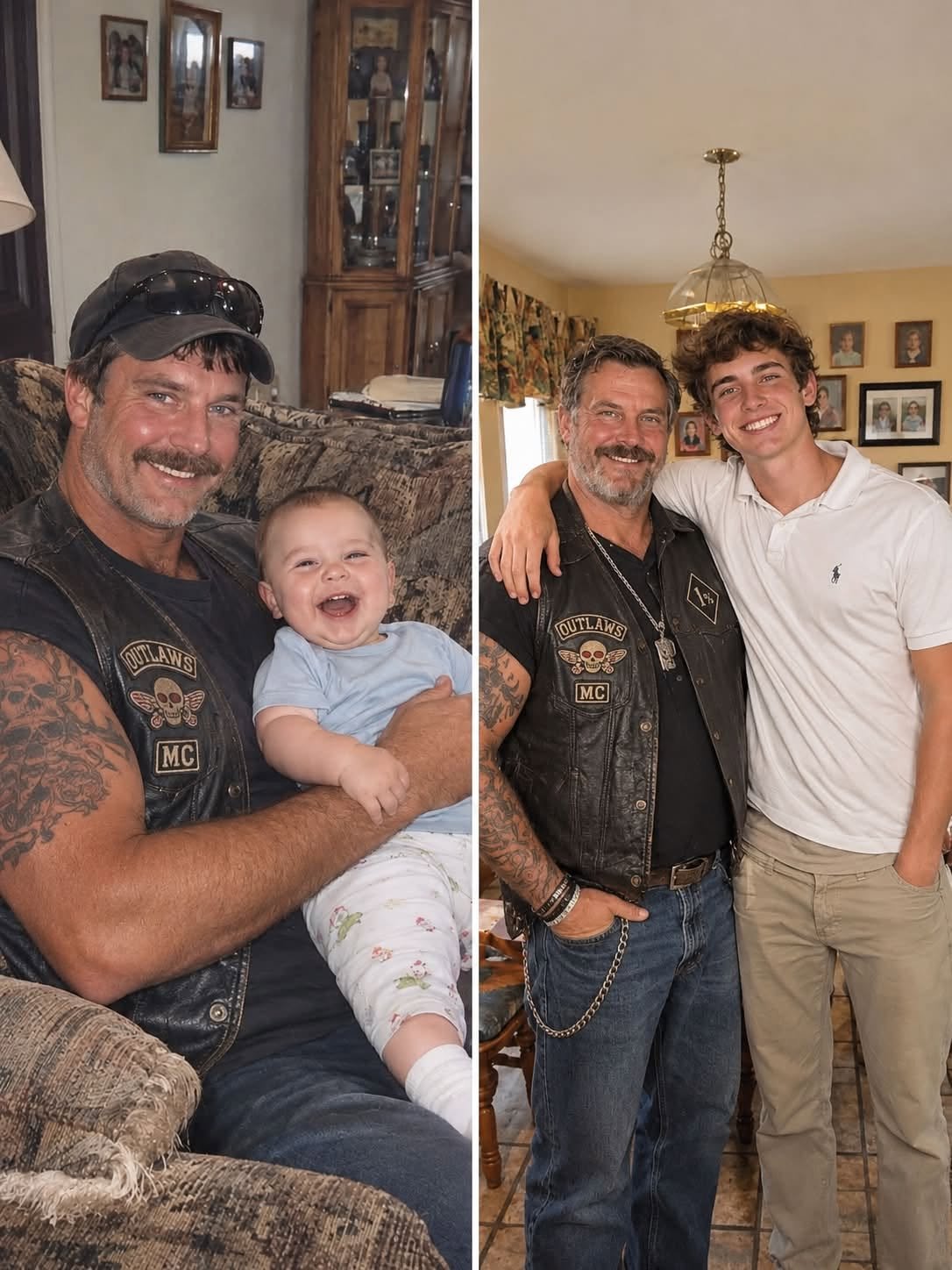
For five years, I believed my father cared more about collecting rent from me than he did about having a relationship with his own son. He was a hard-looking outlaw biker with a shaved head, short gray hair, a thick beard, tattooed arms, and a black leather vest covered in faded motorcycle club patches. He could spend an entire evening laughing with his riding buddies, telling stories, and helping them repair their motorcycles, but when I tried to talk to him, most conversations ended with a grunt, a warning, or a reminder that I was old enough to look after myself.
On my eighteenth birthday, he told me that staying in my childhood bedroom would cost me $250 every month. I thought he was joking. I waited for him to smile, but he simply pushed a piece of paper across the kitchen table and told me the first payment was due on the first of the following month. For five years, I handed him that money while struggling to save enough to move out. I worked extra shifts, repaired my old shoes instead of replacing them, and turned down invitations because I couldn’t afford to spend money on anything unnecessary.
I thought he was taking advantage of me.
Then he died unexpectedly, and his closest friend arrived with a sealed cardboard box. Inside it was something that made me question every argument, every payment, every cold conversation, and every year I had spent believing my father didn’t love me.
But the truth wasn’t simply that he had saved my money. It was about why he had done it, what he had hidden from me about my mother, and the promise he had made to her before she died.
My father’s name was Raymond Carter, although almost everyone called him Ray. In his motorcycle club, he was known as Grizzly, a nickname he had earned because of his broad shoulders, weathered face, and habit of staring silently at people until they reconsidered whatever foolish thing they were about to say. He was fifty-six when I turned eighteen, lean but strong, with short gray hair and a beard that had begun turning white in the middle. He had ridden motorcycles for most of his adult life, and his garage was filled with tools, spare parts, old photographs, and leather jackets belonging to men who had been riding together since before I was born.
Some people in town crossed the street when they saw his club members approaching, but I knew that many of those same men had helped stranded motorists, raised money for struggling families, and repaired motorcycles for veterans who couldn’t afford the work. My father was respected by his friends, feared by some strangers, and almost impossible to understand as a son.
I lost my mother, Elaine, when I was nine years old. She died after a long illness that had gradually taken away her strength. Before she became sick, she was the person who made our house feel like a home. She remembered birthdays, attended school events, asked about my day, and could somehow tell when I was upset even if I insisted everything was fine.
My father loved her deeply, although I didn’t understand that until much later. When she died, something inside him seemed to close. He continued working at the motorcycle garage, paid the bills, kept food in the refrigerator, and made sure I had everything required for school. But he stopped talking about feelings, stopped asking questions, and stopped doing the little things my mother had always done.
I remember the first Christmas after her death. I woke up early and found a few presents beneath the tree, including a jacket I had wanted. Dad had bought it, wrapped it, and placed it there, but he was already outside working on his motorcycle when I opened it. I wanted to show him how much I liked it, so I walked into the garage wearing the jacket.
He glanced at me and said, “Good. It’ll keep you warm.”
Then he returned to his work.
I stood there for a moment, waiting for him to say something else. When he didn’t, I went back inside.
That was how our relationship slowly became. He provided what I needed, but I never felt comfortable asking him for anything beyond the basics. If I needed money for a school trip, he asked how much it cost. If I needed a new backpack, he told me to choose one that would last. If I wanted to talk about something that had happened at school, he usually listened for a few seconds before finding a reason to return to the garage.
I didn’t think he was a bad father. I simply believed he had stopped wanting to be one.
When I was thirteen, I showed him a pair of shoes that had developed holes near the soles. It had rained heavily that week, and my socks were wet by the time I reached home. I stood in the garage doorway while he worked on an old motorcycle engine.
“Dad, could I get a new pair of shoes?”
He didn’t look up.
“What’s wrong with the ones you’ve got?”
“They have holes. Water gets inside.”
He wiped his hands with a rag and examined them briefly.
“Put on another pair of socks until we can replace them.”
I nodded, although I was disappointed. A few days later, I noticed a new set of motorcycle equipment sitting on his workbench. It looked expensive. I didn’t say anything, but I remember wondering why he could spend money on something for himself while I was still wearing shoes that leaked.
I didn’t know then that my father had a way of making decisions without explaining them, and that his silence would eventually become the biggest problem between us.
My eighteenth birthday fell on a Saturday. I had invited two friends over, but both had other plans, so I spent most of the afternoon working at the local supermarket. When I returned home, Dad was sitting at the kitchen table wearing a black T-shirt, faded jeans, and the same heavy boots he wore almost everywhere. There was no birthday cake. There wasn’t even a card.
He had placed a folded piece of paper beside an envelope.
“Sit down,” he said.
I put my backpack on the floor and took the chair opposite him. He pushed the paper toward me. It was a simple handwritten agreement stating that beginning that month, I would pay $250 in rent on the first day of every month if I wanted to continue living in the house.
I read it twice.
“What’s this?”
“Rent.”
I looked up.
“You’re charging me rent?”
“That’s what it says.”
“Today is my birthday.”
“I’m aware.”
I waited for him to smile, but his expression didn’t change. I tried to explain that I was still finishing school, that I had only recently started working, and that I was trying to save money. He listened without interrupting, then pointed at the paper.
“You’re eighteen. You want to be treated like an adult, you start contributing like one.”
I felt my face getting hot.
“I’m not asking you to buy me anything. I’m asking why I have to pay to sleep in the room I’ve lived in since I was a baby.”
“Because the house costs money. Electricity costs money. Water costs money. Food costs money. You use all of it.”
“You’re my father.”
“And you’re old enough to work.”
That was the end of the conversation.
I signed the paper because I didn’t have anywhere else to go. I told myself it was temporary. I would save enough, find a small apartment, and leave. I imagined the day I could close the door behind me without hearing his boots moving around the house or his motorcycle starting before sunrise.
The first payment was difficult, but I managed it. I worked evening shifts stocking shelves, accepted weekend hours, and stopped buying anything that wasn’t necessary. I kept my money in a small savings account and wrote down every expense in a notebook.
Dad collected the $250 on the first of every month.
Sometimes he took it from my hand without saying anything. Sometimes he placed it in an envelope and locked it inside the metal cabinet in his bedroom. Once, I asked whether I could pay a week late because my car had needed a new battery.
He looked at me and said, “The first is the first.”
I paid him on time.
Over the next few years, I became increasingly frustrated. I watched him return from motorcycle rallies with new equipment, buy expensive parts for his bike, and spend evenings at the garage with his friends. Meanwhile, I repaired my own shoes, packed cheap lunches, and turned down invitations because I couldn’t afford to go out.
The worst part was that he never explained what the money was for. I assumed it went toward household expenses, but the house had been paid off years earlier, and he rarely bought groceries. I began to suspect that he simply enjoyed having control over me.
One evening, when I was twenty, I finally confronted him.
“Why do you need my money so badly?”
He was cleaning his motorcycle helmet at the kitchen counter.
“What?”
“The rent. Why do you need it? You’re not struggling to pay the bills.”
He put down the cloth.
“Do you know how much it costs to maintain a house?”
“I work here. I know what things cost. I also see the money you spend on your motorcycle.”
His eyes narrowed.
“Watch your tone.”
“I’m not a child anymore. You told me that yourself.”
He stared at me for several seconds.
“Then act like an adult. Pay what you agreed to pay, or find somewhere else to live.”
I walked away before I said something I couldn’t take back.
That night, I sat on my bed and searched for apartments. Most required a deposit, proof of income, and enough money to cover moving expenses. I had some savings, but not enough. Every time I came close, another expense pulled me backward.
I started to believe that my father had deliberately set the rent at an amount that would keep me in the house without ever allowing me to leave.
I didn’t know whether that was true, but I stopped giving him the benefit of the doubt.
By my twenty-second birthday, our relationship had become almost entirely transactional. I paid the rent. He acknowledged receiving it. We shared a kitchen, a hallway, and a roof, but we rarely shared a conversation.
Sometimes I heard him talking to his motorcycle club friends in the garage. He laughed with them, told stories, and asked about their families. When I walked in, the conversation often became quiet. I assumed they knew about our arrangement and thought I was an ungrateful son.
I had no idea that several of those men had been keeping a secret from me.
The last serious argument I had with my father happened on a cold evening in October, a few months before he died. I had just finished a double shift at the supermarket and returned home with a bag of groceries. My car had been making a strange noise for days, and I knew the repair would take most of the money I had saved that month.
Dad was in the garage with his friend Frank Dalton. Frank was a tall, broad-shouldered biker in his early sixties, with a bald head, a short gray beard, and a deep voice. He had known my father since they were young men and was one of the few people who could disagree with him without starting an argument.
I placed the groceries on the kitchen counter and went to the garage to ask Dad whether he knew anyone who could look at my car cheaply.
He was polishing a motorcycle tank.
“Can you help me find someone to check my car? The engine is making a noise, and I don’t have much money for a repair shop.”
He didn’t turn around.
“Ask around at work.”
“I did. Nobody knows a mechanic.”
“Then save up.”
I stared at him.
“I give you $250 every month. I work almost every day. I can’t even get a little help with my car?”
He finally looked at me.
“Your car is your responsibility.”
I felt something inside me snap.
“You’ve made everything my responsibility since I turned eighteen. Rent, food, repairs, everything. What exactly are you responsible for?”
Frank stopped working and looked between us.
Dad slowly placed the polishing cloth on the workbench.
“Don’t start something you can’t finish.”
“I’m not starting anything. I’m telling you how it feels to live here.”
“Then move.”
I laughed, but there was no humor in it.
“That’s what I’ve been trying to do for five years.”
For a moment, I thought he might say something. His expression changed slightly, and his eyes moved toward Frank. But then he picked up the cloth again.
“Then keep trying.”
I walked out.
Frank followed me into the driveway.
“Hey, son.”
I turned around.
“What?”
He looked toward the garage, then back at me.
“Your old man isn’t easy to understand.”
I shook my head.
“That’s an understatement.”
Frank seemed as though he wanted to say more, but he stopped himself.
“Just don’t assume silence always means what you think it means.”
I was too angry to listen.
“With respect, Frank, you don’t live with him. You don’t have to hand him money every month just to sleep in your own bedroom.”
Frank lowered his eyes.
“No. I don’t.”
I got into my car and drove away.
That was the last time I spoke to Frank before my father’s death.
I later learned that he had gone back into the garage and argued with Dad for nearly an hour. I learned that Dad had told him not to interfere, and Frank had told him that he was making a serious mistake by allowing his son to believe he was unwanted.
At the time, I knew none of this.
I only knew that my father had once again chosen silence over a conversation with me.
My father died on a Tuesday morning.
I was at work when my phone rang. The number belonged to Frank, and I almost let it go to voicemail because I assumed he was calling about something related to the garage.
When I answered, I heard his voice, but it sounded different.
“Where are you?”
“At work. What’s going on?”
There was a pause.
“It’s your dad, son.”
I stepped away from the shelves.
“What about him?”
Frank took a breath.
“He’s gone.”
I didn’t understand the words immediately.
“What do you mean, gone?”
“He had a medical emergency while he was out riding. The ambulance came, but they couldn’t bring him back.”
I leaned against the wall.
For a few seconds, the supermarket seemed to become completely silent. I could see people moving at the end of the aisle, but their voices sounded distant.
“Are you sure?”
Frank’s voice broke.
“I’m sorry.”
I asked where he was, but Frank told me the arrangements were being handled and that I should come home. I left work without changing out of my uniform and drove back to the house.
My father’s motorcycle was not in the garage. His boots were beside the door, and his leather jacket was hanging over the back of a chair. His coffee mug sat on the counter, with a small amount of coffee still inside.
I stood there for a long time.
I had spent five years imagining what it would feel like to live without him. I had pictured the relief of not paying rent, not listening to his rules, and not feeling like a stranger in my own home. But when I finally had the house to myself, it didn’t feel like freedom.
It felt like someone had removed the person I had been angry with and left every unanswered question behind.
At the funeral, I saw more people than I had expected. Bikers came from neighboring towns. Some wore old leather vests with faded patches, while others wore simple black shirts. They stood in the cemetery in quiet rows, and several of them cried openly.
I learned that my father had helped many people over the years. He had repaired motorcycles without charging struggling veterans, helped a club member’s daughter through college, and spent weekends delivering food to families after a local flood. People told stories about him that I had never heard.
One man said Dad had driven three hours through a storm to help him after his motorcycle broke down. Another woman explained that Dad had quietly paid for her husband’s funeral when the family couldn’t afford it.
I listened politely, but each story made me feel more confused.
How could a man who had been so generous to strangers be so cold toward his own son?
After the funeral, I returned home and found myself standing in the kitchen again. I looked at the chair where he used to sit and remembered the rent payments. I remembered the arguments, the shoes, the birthday without a cake, and the way he had told me to move if I didn’t like his rules.
I was angry with him.
I missed him.
And I hated that both feelings could exist at the same time.
It was nearly eight that evening when someone knocked on the front door.
I opened it and found Frank standing on the porch. He wasn’t wearing his leather vest. He had on a plain black jacket, and his eyes looked tired. In his arms was an ordinary cardboard box sealed with several layers of packing tape.
“Can I come in?”
I stepped aside.
Frank carried the box into the kitchen and placed it on the table. He didn’t sit immediately. Instead, he stood beside it, running one hand over the top as though he were remembering the day my father had given it to him.
“Your dad left this with me,” he said.
I looked at the box.
“What’s inside?”
“He made me promise I wouldn’t give it to you until after he was gone.”
I let out a bitter laugh.
“That sounds like him. Even dead, he still has to make things difficult.”
Frank didn’t react.
“He was very serious about this. He made me swear that I wouldn’t open it, move anything inside, or tell you what it contained.”
I pulled out a chair.
“Well, he got his wish. He’s gone. So let’s see what he was hiding.”
Frank sat opposite me.
“Before you open it, I want you to understand something. Your father knew you were angry with him. He knew you thought he didn’t care about you. I told him more than once that he needed to explain himself, but he refused.”
“Why?”
Frank looked down.
“That’s what you’re about to find out.”
I reached for the tape. My fingers were shaking, partly because of grief and partly because I was afraid I would find another disappointment inside. I peeled away the first strip, then the second. When the cardboard flaps finally opened, I saw several envelopes, a small metal key, a thick folder, and a black leather pouch.
At the top was a photograph of my mother.
She was sitting on the front steps of our old house, holding me when I was a baby. My father was standing behind us, one hand resting on her shoulder. He was younger, clean-shaven, and smiling in a way I barely remembered.
I picked up the photograph.
On the back, my mother had written:
Our little family. The reason we keep going.
My throat tightened.
Beneath it was an envelope with my name on it.
I recognized my father’s handwriting immediately.
I opened it.
The letter began with a sentence I had never expected to read.
Son, if you’re reading this, then I failed to tell you something while I was alive. I don’t know whether you’ll forgive me. I don’t know whether you should. But I need you to understand why I made you pay rent, and why I never spent a dollar of it.
I stopped.
I read the sentence again.
Then I looked at Frank.
“What does this mean?”
Frank leaned forward.
“Keep reading.”
I returned to the letter.
The $250 you gave me every month was never rent. It was yours. Every payment went into an account in your name. I opened it before your eighteenth birthday, and I arranged for the money to be deposited there. I added to it whenever I could.
My hands began trembling.
I looked at the folder.
Inside were bank statements, deposit records, and a printed account summary. There were sixty payments listed, each corresponding to a month I had handed my father $250.
The total was $15,000.
But that wasn’t all.
My father had added money of his own, and the account had earned interest over the years. The balance was considerably higher than the amount I had paid him.
I stared at the number.
“Fifteen thousand dollars?”
Frank nodded.
“At least that much came from you. Your father added to it.”
I looked at the letter again.
I didn’t want you to believe that money was something I could take from you. I wanted you to learn to work, save, and understand what it costs to live independently. But I also wanted you to have something I never had when I was your age: a proper start.
I couldn’t speak.
Then I noticed a second envelope.
It had my mother’s name written on the front.
And beneath it, in my father’s handwriting, were the words:
Read this one last.
I looked at Frank.
“What is this?”
He took a slow breath.
“Your father asked me to stay with you when you opened that envelope. He knew it would hurt.”
I stared at the writing.
My mother’s name.
For five years, I had believed my father had been charging me rent because he didn’t want me living in his house for free. Now I was looking at proof that he had been saving every payment. But I still couldn’t understand why he had allowed me to believe the worst about him.
I picked up the second envelope.
The letter was written in my mother’s handwriting.
I recognized the rounded letters immediately. She used to leave little notes in my school lunchbox, usually reminding me to eat my fruit or telling me she loved me. Even after all those years, I could still recognize the way she crossed her “t” and placed a tiny heart beside my name.
The letter was dated three weeks before she died.
My dear boy,
If you’re reading this, then your father has finally decided that you’re old enough to understand something we talked about when you were little. I wish I could have told you myself, but I wanted your father to decide when the time was right.
I know he isn’t always easy to understand. He loves you more than he knows how to explain. Your father grew up believing that a man should never show weakness, never ask for help, and never let anyone see how much he is hurting. When I became ill, he was frightened. He didn’t know how to talk about losing me, and he didn’t know how to prepare himself for raising you without me.
I asked him to promise me something. I asked him to make sure that when you became an adult, you would have the opportunity to stand on your own feet. I didn’t want you to grow up believing that the world owed you something, but I also didn’t want you to struggle without a chance.
I asked him to help you save for a home, a business, or whatever future you chose. I told him that one day you would need a beginning of your own.
He promised me he would do it.
Please don’t mistake his silence for a lack of love. Your father has never been good at saying what he feels. Sometimes he tries to protect people by making decisions for them, and sometimes he gets those decisions wrong.
I hope you will remember that you are loved, even on the days when you don’t feel it.
Love always,
Mom.
I reached the final line and couldn’t see the paper anymore.
My mother had written those words before I turned ten. She had known that my father would struggle to raise me alone, and she had asked him to prepare me for adulthood. But she had never asked him to make me feel unwanted.
I looked at Frank.
“Why didn’t he just tell me?”
Frank didn’t answer immediately. He pulled the chair closer and sat down.
“Because your father was a stubborn man. He believed that if he told you the money was yours, you might not take the responsibility seriously. He thought you’d see it as a gift instead of something you had earned.”
“That’s ridiculous.”
“I told him the same thing.”
I wiped my face.
“He let me think he was taking advantage of me. I thought he was keeping me here because he wanted my money.”
Frank nodded.
“I know.”
“I asked him why he needed it. I asked him whether he was struggling. I told him I couldn’t afford to live there. He could have said something.”
Frank looked toward the hallway.
“He wanted to. More than once.”
“Then why didn’t he?”
Frank leaned back.
“Because every time he tried, he remembered the promise he made to your mother. He thought if he explained too early, you’d stop saving. He also thought you’d understand his reasons when you were older.”
I shook my head.
“That doesn’t make it right.”
“No,” Frank said quietly. “It doesn’t.”
For the first time that evening, Frank wasn’t defending my father. He was acknowledging what had happened.
“Your dad did something good in a way that caused you pain. He thought he was preparing you, but he didn’t understand what it was doing to your relationship. I argued with him about it. I told him you were growing up believing he didn’t love you.”
I looked at the account statement again.
“Did he ever say anything about me?”
Frank smiled sadly.
“Every time I visited the garage.”
I looked up.
“What?”
“He kept a small notebook in his toolbox. He wrote down how much you had paid, how much he had added, and how close you were getting to your goal. He knew when you got your first full-time shift. He knew when you repaired your car. He knew when you had to replace your work shoes.”
I remembered the shoes.
The old pair with the separating soles.
“How did he know about the shoes?”
Frank looked at me.
“Because he bought you a new pair.”
I frowned.
“What?”
“That pair you were wearing at the supermarket last winter. The black work shoes. Your father bought them.”
I stared at him.
“No. I bought those.”
Frank shook his head.
“You thought you did. He went to the store after you mentioned your old shoes were falling apart. He asked me to go with him because he didn’t know which ones you’d like. He bought two pairs, took them home, and left them outside your bedroom door.”
I remembered that morning.
I had found a shopping bag outside my room. I assumed my father had bought something for himself and left the wrong bag there. Inside were two pairs of work shoes in my size.
When I asked him about them, he had said, “They were on sale.”
I had thanked him.
He had shrugged and walked away.
I had never known he had gone out of his way to find them.
I lowered my head.
Frank continued.
“Your father watched you leave for work every morning. He knew you were trying to save. He knew you were tired. He wasn’t always good at showing it, but he was proud of you.”
I stared at the table.
For five years, I had interpreted his silence as rejection.
Now I was discovering that some of the things I had thought were careless or indifferent had been his awkward attempts to help.
But I still couldn’t understand why he had never simply hugged me, asked about my day, or told me he was proud.
Frank seemed to understand the question before I asked it.
“Ray wasn’t your mother,” he said. “He didn’t know how to make a home feel warm after she was gone. He knew how to work, how to fix things, how to protect people, and how to keep his promises. But when it came to talking about his feelings, he was lost.”
I looked at the letter.
My mother had known that.
She had warned me.
But knowing why my father had been distant didn’t erase the years I had spent feeling alone.
And I wasn’t ready to pretend it did.
I returned to the box and noticed the black leather pouch beneath the bank statements. It was old, with worn stitching and a small brass button. I opened it carefully.
Inside was a key, a photograph, and a folded document.
The photograph showed my mother standing beside a small building. It was a simple garage with two large doors, a narrow office window, and a faded sign above the entrance. I had never seen it before.
On the back, my father had written:
The place where your mother wanted us to begin again.
I turned the photograph over.
“What is this place?”
Frank leaned forward.
“That’s the first garage your father and I worked in. Before the motorcycle club became what it is now, before he bought the house, before you were born.”
I examined the building.
“Why does Mom have a picture of it?”
“Because she wanted your father to buy it.”
Frank explained that years earlier, my father and my mother had dreamed of owning a small repair business together. My mother had handled the paperwork and customer accounts while my father repaired motorcycles. They had saved for years, but just before they could buy the property, my mother became ill.
The plans were abandoned.
My father continued working as a mechanic, but he never forgot the building.
I unfolded the document.
It was a property agreement.
The garage had recently been purchased through a small business arrangement, and the ownership documents listed my father’s name. A second document showed that he had arranged for the property to be transferred to me through his estate.
I stared at the papers.
“Why would he buy a garage?”
Frank looked at me.
“Because he knew you liked working on engines.”
I did like engines. When I was younger, I used to sit in the garage and watch my father repair motorcycles. I had even asked him once whether he could teach me properly. He had told me that I needed to finish school first, and after that, I had assumed he wasn’t interested.
But I had never forgotten those afternoons.
I remembered the smell of oil, the sound of tools, and the way my father could identify an engine problem simply by listening.
Frank continued.
“Your father wanted you to have a place where you could build something of your own. He didn’t want you to be forced into the motorcycle club or into his business. He wanted you to have a choice.”
I looked at the property document again.
The garage was not a large building, but it was in a good location. It had enough room for several motorcycles, a workbench, and a small office.
“How long has he owned it?”
“Almost two years.”
I stared at Frank.
“Two years? He bought an entire garage and never told me?”
Frank nodded.
“He wanted to surprise you when you were ready to move out.”
I looked at the account statement again.
The money from the rent payments, combined with what my father had added, was intended to help me establish the business. The garage was already purchased, and the savings would cover equipment, insurance, supplies, and the early expenses of running it.
I couldn’t speak.
Frank reached into the box and pulled out one final envelope.
“This one is from your father. He told me it was the most important letter.”
I took it.
My name was written across the front.
I opened it slowly.
Son,
I have written this letter more times than I can count. Every time I tried to talk to you, I found a reason to stop. Sometimes I thought you weren’t ready. Sometimes I thought you were too angry. Sometimes I was simply afraid that you would look at me and see a man who had failed you.
Your mother used to tell me that I was better at fixing broken engines than fixing broken hearts. She was right.
When she died, I didn’t know how to be a father and a mother at the same time. I didn’t know how to answer your questions about why she was gone, and I didn’t know what to do when you cried at night. I thought that if I kept working, kept the house running, and made sure you had everything you needed, you would be okay.
I was wrong.
You needed me to talk to you. You needed me to ask how your day went. You needed me to sit beside you when you missed your mother. Instead, I spent too many evenings in the garage because it was easier to work on a motorcycle than to admit how much I missed her.
I know you think I charged you rent because I didn’t want you in my house. I know you thought I cared more about my motorcycle than I cared about you. I cannot blame you for feeling that way. I gave you plenty of reasons to believe it.
The money you paid was always yours. I put every payment into your account. I added what I could from my own earnings, and I kept records because I wanted you to know that none of it disappeared.
I wanted you to have enough money to leave this house without being frightened about where you would sleep next. I wanted you to have a place of your own, a business if you wanted one, and the freedom to choose a life that didn’t depend on me.
The garage is yours now. Your mother wanted us to own that place when we were young. We never got the chance. I thought perhaps you could do something with it.
But there is something more important than the money or the building.
I am sorry.
I am sorry I didn’t buy you the shoes when you asked. I am sorry I didn’t make your birthdays feel special. I am sorry I made you feel like a tenant in your own home. I am sorry I allowed you to believe that you had to earn your place in my life.
You never had to pay me to be my son.
I should have told you that every day.
I don’t know whether you’ll forgive me. I don’t expect you to forget the things I did wrong. I only hope that when you think about me, you remember that I loved you, even when I was too foolish and too stubborn to show it.
Your mother would have been proud of the man you’re becoming.
I am proud of you, too.
I love you, son.
Dad.
I reached the end of the letter and put it down.
I couldn’t breathe properly.
For five years, I had waited for those words. I had wanted to hear that he was proud of me, that he loved me, and that I wasn’t just another person living in his house. Now I had them, but the man who had written them was never going to walk into the kitchen and say them aloud.
I pressed my hands against my face.
Frank moved closer.
“Take your time.”
I shook my head.
“Why did he have to wait until he was dead?”
Frank didn’t have an answer.
I looked at the letter again.
“He could have told me. He could have just sat down with me one night and explained it. I would have understood.”
Frank nodded.
“I know.”
“Did he really think this was the right way?”
“No. Not at the end. He knew he’d made mistakes. But he couldn’t find the courage to undo them while he was still here.”
I started crying again.
Frank put an arm around my shoulders.
For several minutes, neither of us spoke.
Then Frank told me something I hadn’t known.
A few weeks before his death, my father had gone to the garage and asked Frank to help him prepare the box. He had brought the bank statements, the property papers, the photographs, and the letters. He had checked every document twice, making sure the account information was correct and that the garage would pass to me according to his estate plan.
Frank had asked him whether he planned to tell me about it before the funeral.
My father had shaken his head.
“I don’t know how to look him in the eye and explain five years of being wrong.”
Frank had told him that the explanation was not a substitute for an apology.
My father had agreed.
Then he had said something Frank remembered word for word.
“He’s going to think I didn’t love him. That’s what hurts the most. I spent all those years trying to give him a future, and I forgot to make him feel like he had a father.”
I lowered my head.
That sentence hurt more than anything else.
Because it was true.
He had been thinking about my future, but he had forgotten about my childhood.
He had saved money for me, but he hadn’t saved enough time to sit beside me.
He had bought a garage, but he hadn’t built the relationship I had wanted.
And now I had a box full of proof that he cared, but no chance to ask him why he had made it so difficult to see.
Frank stayed for another hour.
Before leaving, he told me that several members of my father’s motorcycle club wanted to visit. I wasn’t sure I wanted to see anyone. I had spent most of my life feeling uncomfortable around those men, especially when they arrived in groups, filling the driveway with motorcycles and loud engines.
But Frank asked me to give them a chance.
“They loved your father,” he said. “And some of them knew things about him that you never got to see.”
The following afternoon, three bikers arrived.
The first was Ronnie, a tall man in his late fifties with a gray beard and a tattoo running down his right forearm. The second was Pete, a broad-shouldered former construction worker who had ridden with Dad for more than twenty years. The third was a quiet man named Harold, who had been part of the club almost as long as my father.
They came without their motorcycles.
Ronnie carried a small wooden box. Pete brought a folder of photographs, and Harold held a paper bag containing a cake.
I looked at them in confusion.
“What’s all this?”
Ronnie smiled.
“Your dad wanted us to bring you a few things.”
We sat around the kitchen table.
Pete opened the folder first. Inside were photographs of my father at different stages of his life. There was one of him standing beside his first motorcycle, another of him working on an engine with Frank, and several pictures of the club at charity events.
Then I saw a photograph of my mother.
She was standing in front of the old garage, laughing while my father held a wrench. He was looking at her instead of the camera.
I had never seen him look that happy.
Ronnie pointed at the picture.
“Your mom used to come down to the garage every Saturday. She brought sandwiches for everybody and kept the books. She knew more about running a business than all of us combined.”
Pete laughed.
“She also knew how to tell your father when he was being an idiot.”
For the first time that day, I smiled.
Harold opened the wooden box.
Inside were several small objects: a worn motorcycle keychain, an old club photograph, a folded note, and a small metal badge that had belonged to my father.
Ronnie explained that the badge had been given to him years earlier by a group of riders after he helped them raise money for a family whose home had burned down. It wasn’t an official award. It was something the men had made themselves.
“Your father never displayed it,” Ronnie said. “He kept it in his toolbox.”
I turned it over.
On the back were three words:
Show up. Always.
I looked at the men.
“What does that mean?”
Pete leaned forward.
“It means your father believed that if somebody needed you, you showed up. You didn’t make excuses. You didn’t ask whether they could pay you back. You didn’t wait for somebody else to handle it.”
Ronnie nodded.
“He lived by that rule with us. He just struggled to live by it at home.”
Nobody tried to defend him.
Nobody told me I should forget the painful years.
They simply shared stories.
They told me about the times my father had driven through storms to help stranded riders. They remembered him repairing a club member’s motorcycle for free after the man’s wife lost her job. They talked about how he had quietly paid for school supplies for a young boy whose father had died.
One story stayed with me.
A young mechanic named Daniel had been working at the garage. Daniel’s father had abandoned the family, and the boy had been struggling to finish his training. My father had noticed him staying late to practice repairs and eventually gave him a set of professional tools.
Daniel had asked how he could repay him.
My father had replied, “When you’re in a position to help somebody else, do it. That’s how you pay me.”
I sat quietly.
I had thought my father was a man who didn’t care about people.
Now I was learning that he had spent years helping others without telling anyone.
But I also understood something else.
His generosity toward strangers did not erase the hurt he had caused me.
Both things could be true.
He could have been a good friend, a loyal biker, and a generous man while still failing to be the father I needed.
I was beginning to accept that I didn’t have to choose between loving him and acknowledging what he had done wrong.
A week after opening the box, I visited the property with Frank.
The building was on the edge of town, beside an old industrial road. It wasn’t impressive from the outside. The paint was fading, the sign was weathered, and the front windows needed cleaning. But the structure was solid, the roof had been repaired, and the workshop area was larger than I had expected.
Frank unlocked the door.
“Your father bought it because he knew you would like the place.”
I stepped inside.
There were two workbenches, a small office, shelves for tools, and enough space to work on several motorcycles. A few old parts were stored along the back wall, and a large window allowed sunlight into the main workshop.
On the office wall, I noticed a framed photograph.
It was my mother.
She was standing beside the same building, smiling at the camera. Beneath the photograph was a small wooden sign.
Elaine Carter Motor Works.
I stared at it.
“Why did he put her name there?”
Frank stood beside me.
“Because it was her dream first.”
I walked closer.
The sign was simple, made from dark wood with carefully carved letters. I ran my fingers across the surface.
My father had remembered a dream my mother had carried for years. He had bought the building, arranged the paperwork, and left it for me to turn into something of my own.
I opened the office door.
On the desk was another notebook.
I recognized my father’s handwriting on the cover.
Business plan.
Inside were pages of notes about equipment, insurance, suppliers, repairs, and operating costs. There were lists of tools I would need and suggestions about how to attract customers. He had even written down the names of several local businesses that might send work my way.
On the last page, he had written:
Don’t try to do everything at once. Build something people can trust. Treat customers fairly. Pay your workers properly. And never forget that a person’s circumstances don’t tell you what they’re worth.
I sat in the office chair.
Frank remained near the door.
“He came here almost every weekend,” he said. “Sometimes he’d sit in that chair for hours, planning what you might do with the place. He never wanted to choose the business for you. He just wanted to leave you an opportunity.”
I looked around.
For years, I had imagined leaving my father’s house and never looking back. I had planned to find a small apartment, get a better job, and build a life far away from the garage.
Now I was standing in a building my father had bought because he remembered the things I enjoyed when I was a child.
I felt anger rising again, but this time it was mixed with something else.
“Frank, do you think he ever planned to tell me?”
Frank nodded.
“He talked about it several times. He wanted to give you the keys on your twenty-fourth birthday. He had even planned to take you out for dinner afterward.”
I looked at him.
“Why didn’t he?”
“He kept saying he wanted to get the paperwork right. Then he kept waiting for the right moment. Your arguments made him think you’d reject the gift. He was afraid you’d believe he was trying to buy your forgiveness.”
I looked at the photograph of my mother.
“Maybe I would have.”
Frank nodded.
“Maybe. But at least you would have had the chance to talk.”
That was the part I couldn’t stop thinking about.
My father had spent five years preparing something for me, but he had never given me the chance to understand him while he was alive.
I didn’t open the garage immediately.
I spent several weeks learning what needed to be done. Frank helped me review the business plan, and Ronnie introduced me to a local accountant who explained the paperwork. Pete helped repair the front sign, while Harold brought a set of old tools my father had once given him.
I also spoke to the bank about the savings account.
The money was real.
Every payment I had made was there, along with my father’s contributions and the interest it had earned. After paying the necessary expenses and setting aside a reserve, I had enough to buy equipment, cover the first months of operating costs, and begin the business without taking on a large loan.
I could have sold the garage and used the money to move somewhere else.
For a while, I considered doing exactly that.
I was still hurt.
There were days when I looked at the building and felt angry that my father had waited until his death to reveal everything. I wished he had been more honest. I wished he had sat beside me on my eighteenth birthday and said, “I’m going to help you save for your future, but I need you to learn how to contribute.”
I wished he had told me that I mattered.
But one evening, while cleaning the office, I found an old photograph of my mother sitting at the desk. My father was standing behind her with his arms around her shoulders.
On the back, she had written:
Someday, we’ll have our own place. Ray says he’ll do the repairs, and I’ll handle the customers. We’ll make it a family business.
I looked at the photograph for a long time.
Then I decided to keep the garage.
I spent the next two months cleaning, painting, organizing the tools, and making the building ready for customers. Frank helped me install the workbenches. Ronnie repaired the front door. Pete found a used air compressor at a reasonable price, and Harold helped me set up the office.
Nobody asked for money.
When I offered to pay them, they refused.
Frank finally explained why.
“Your dad helped all of us at some point. Let us help you start.”
The garage opened on a Monday morning.
My first customer was a delivery driver whose motorcycle had stopped running. He looked nervous when he saw the sign and asked whether I could inspect it without charging too much.
I remembered my father’s notebook.
Treat customers fairly.
I checked the motorcycle, found a damaged electrical connection, and repaired it. I charged him only for the parts and a reasonable amount for the labor.
When he left, he shook my hand.
“Thanks. I was worried I’d have to replace the whole thing.”
I watched him ride away.
Then I looked at the photograph of my mother on the office wall.
For the first time, the building felt less like a gift from a dead father and more like something I could make my own.
Several months after opening the garage, I found an old storage box beneath the workbench.
It contained my father’s personal tools, a few motorcycle magazines, and several receipts. Most were ordinary purchases: oil, spare parts, replacement bulbs, and hardware.
But one receipt caught my attention.
It was from a shoe store.
The date was from the winter I had asked him for new work shoes. The receipt listed two pairs of shoes in my size, along with a waterproof pair of boots.
I stared at it.
There was a handwritten note folded around the receipt.
He needs the waterproof ones for work. Don’t forget to leave them outside his room.
I recognized the handwriting.
It was Frank’s.
I called him.
“Did you write this?”
He laughed quietly.
“Your father couldn’t remember which size you wore. He asked me to go with him.”
I sat down.
“Why didn’t he just give them to me?”
Frank sighed.
“Because he didn’t know how to make a simple gesture without turning it into a lecture. He told me he was worried you’d think he was trying to make up for everything with a pair of shoes.”
I looked at the receipt again.
“That’s exactly what I thought.”
Frank was silent.
Then he said, “Your father was proud of you, but he was afraid that if he showed too much affection, you’d think he was weak. That was an old mistake he carried from his own childhood.”
I had never known much about my grandfather. He had been a strict man who believed boys should work, keep their promises, and never complain. My father had grown up under those rules and carried them into his own parenting.
He had learned how to provide.
He had never learned how to communicate.
I put the receipt back in the box.
It didn’t make the years of hurt disappear, but it helped me understand where some of that distance had come from.
That evening, I drove to the cemetery.
I stood beside my father’s grave and placed the receipt beneath a small stone.
“I found the shoes,” I said quietly.
The wind moved through the trees.
I looked at his name carved into the stone.
“I wish you’d just told me.”
I waited, although I knew there would be no answer.
Then I said the words I had wanted to say for years.
“I missed you even when you were standing right in front of me.”
My eyes filled.
“I hope you knew that.”
I stayed there until the sun began to set.
I didn’t tell him that everything was forgiven.
I wasn’t ready to say that.
But I told him I was going to keep the garage open.
And I promised I would try to build the kind of relationship with the people I loved that he had struggled to build with me.
A year after my father’s death, the garage was doing better than I had expected.
I had hired a young mechanic named Daniel, who was learning the trade and trying to support his younger sister. I recognized something familiar in him: the exhaustion of working long hours, the embarrassment of asking for help, and the determination to build a better life.
One afternoon, he came into the office looking worried.
“Can I talk to you?”
I put down the paperwork.
“Of course.”
He explained that his car had broken down, and he needed it to get to work. He had enough money for the parts but not enough to pay for the repair.
I looked at him for a moment.
Then I remembered my father’s notebook.
Treat your workers properly. Remember that a person’s circumstances don’t tell you what they’re worth.
I told Daniel that we would repair the car, and he could pay the labor cost gradually when he was able.
He looked surprised.
“You’d really do that?”
I nodded.
“Just keep showing up and learning. That’s what matters.”
He thanked me.
After he left, I sat at the desk and looked at the old photograph of my parents.
I thought about how my father had helped people quietly, sometimes without expecting anything in return. I understood that part of him now. I also understood that kindness should not be hidden behind rules that make people feel unwanted.
If I ever had children, I wouldn’t make them guess whether they were loved.
I would tell them.
I would ask about their days, remember their birthdays, and sit with them when they were struggling. I would teach them responsibility without making them feel that affection had to be earned.
My father had left me money, a garage, tools, and an opportunity.
But the most important thing he left me was a lesson about the kind of parent I wanted to become.
On what would have been my father’s sixtieth birthday, I closed the garage early.
Frank arrived around noon with a small cake. Ronnie and Pete came shortly afterward, followed by several other members of the club. They parked their motorcycles outside and gathered in the workshop.
Nobody had planned a big celebration.
We simply wanted to remember him.
Frank placed the cake on the workbench.
“Your father would have complained about the icing,” he said.
I laughed.
“He complained about everything.”
“Especially the price.”
We shared coffee and talked about the old days. One man told a story about Dad getting lost on a ride because he refused to stop and ask for directions. Another remembered how he once spent an entire afternoon repairing a motorcycle for a stranger who had broken down outside town.
At the end of the afternoon, Frank handed me a small envelope.
“Your dad gave me this before he died. He told me to give it to you on his sixtieth birthday.”
I opened it.
Inside was a photograph of my father sitting on a motorcycle with me as a toddler in his arms. My mother stood beside him, laughing.
On the back was a short message.
I hope you have a better sixtieth birthday than I will. I love you, son.
I smiled through my tears.
Frank placed a hand on my shoulder.
“He knew he might not make it.”
I looked at the photograph.
“Why didn’t he tell me he was sick?”
Frank lowered his eyes.
“He didn’t know how much time he had. He didn’t want you to spend your last months with him worrying about his health. He thought the box would explain everything.”
I shook my head.
“That was another mistake.”
Frank nodded.
“Yes. It was.”
We stood together in the garage.
For a long time, nobody spoke.
Then I placed the photograph beside the one of my mother.
They were both smiling.
And for the first time, I didn’t feel that I had to choose which version of my father to remember.
I could remember the man who had hurt me, the man who had helped strangers, the man who had saved my money, and the man who had failed to say what he felt.
They were all the same person.
And I could love him without pretending he had been perfect.
Today, the garage is still open.
The sign above the entrance reads Elaine Carter Motor Works, just as my father arranged. I kept the old photograph of my parents in the office, and beside it is a photograph of me standing with Frank and the other bikers on the day we finished the renovation.
I still have the box.
I keep the letters, the bank statements, the photograph, and the small metal badge inside it. Sometimes, when business is quiet, I open the box and read my father’s final letter again.
I don’t read it because I need to convince myself that he loved me.
I know he did.
I read it because it reminds me how easily love can become invisible when people are too frightened or too stubborn to express it.
I also keep the first $250 receipt I ever gave him. It is folded and worn, with the date written in my handwriting. I used to look at that payment as proof that my father wanted money more than he wanted a son.
Now I see it as the beginning of something he had planned for me, even though he handled it in a way that caused years of unnecessary pain.
I wish he had chosen a different way.
I wish he had told me about the account when I turned eighteen. I wish he had explained my mother’s letter, shown me the garage, and let me share the dream with him while he was alive. I wish I had been able to thank him in person.
But life doesn’t always give us the conversations we deserve.
Sometimes we receive the explanation after the person who owes it to us is gone. Sometimes we discover that someone cared in ways we couldn’t recognize, while also realizing that their mistakes were real and their silence hurt us.
I don’t believe every difficult parent is secretly doing something wonderful behind the scenes. I don’t believe children should have to endure emotional distance or unfair treatment simply because a parent claims to have good intentions. Love should be shown while people are alive, not hidden away in a box for someone to discover after a funeral.
My father learned that lesson too late.
I learned it just in time to live differently.
Every month, I put a little money into a separate account for my future family. But I don’t intend to make anyone pay for the right to feel at home. If I have a child, I’ll teach them to work, save, and take responsibility. I’ll also make sure they never have to wonder whether they are loved.
And whenever a young mechanic comes into my garage struggling to get started, I remember the way my father quietly helped people. I offer what I can, but I also explain why I’m doing it. I want them to know they matter, not spend years guessing.
Frank still visits the garage regularly. Sometimes he sits in the old chair near the office, drinking coffee and telling stories about my father. We don’t always agree about him, but we’ve learned that we don’t need to pretend the past was perfect to appreciate what was good.
One afternoon, a young customer asked me about the photograph of my father wearing his leather vest.
“Was he a real outlaw biker?”
I smiled.
“He was a biker, all right. And he was a complicated man.”
“Was he a good father?”
I looked at the photograph for a moment.
Then I answered honestly.
“He loved me. But he didn’t always know how to show it. I hope I do better.”
The young man nodded and returned to his motorcycle.
I stayed in the office for a while after he left.
Outside, the late afternoon sun was falling across the workshop floor. My father’s old tools were hanging on the wall, and my mother’s photograph was resting beside the business records. I could almost imagine Dad walking through the door, dropping his keys on the counter, and telling me that I was charging too little for labor.
I would have argued with him.
He would have pretended not to hear.
And then, perhaps, he would have sat down and asked how my day had gone.
I would give almost anything to have that conversation now.
The $250 was never the greatest gift my father left me. The savings helped me open the garage, and the property gave me a chance to build something of my own. But the letters gave me something else: a better understanding of the man who raised me, the woman who loved us both, and the importance of saying the words that should never be left unsaid.
I still miss my father.
I still wish he had been warmer.
And I still believe he should have told me the truth while he was alive.
But when I close the garage each evening, I look at the sign bearing my mother’s name and remember the promise he tried to keep.
He wanted me to have a future that belonged to me.
He just forgot that I needed a father along the way.
And if there is one thing I have learned from the five years of rent, the sealed box, and the letters left behind, it is this:
You can leave someone a fortune, a business, and a lifetime of good intentions, but none of those things can replace the simple words they needed to hear while you were still there to say them.
My father finally told me he loved me.
I only wish he hadn’t waited until I could no longer tell him I loved him, too.