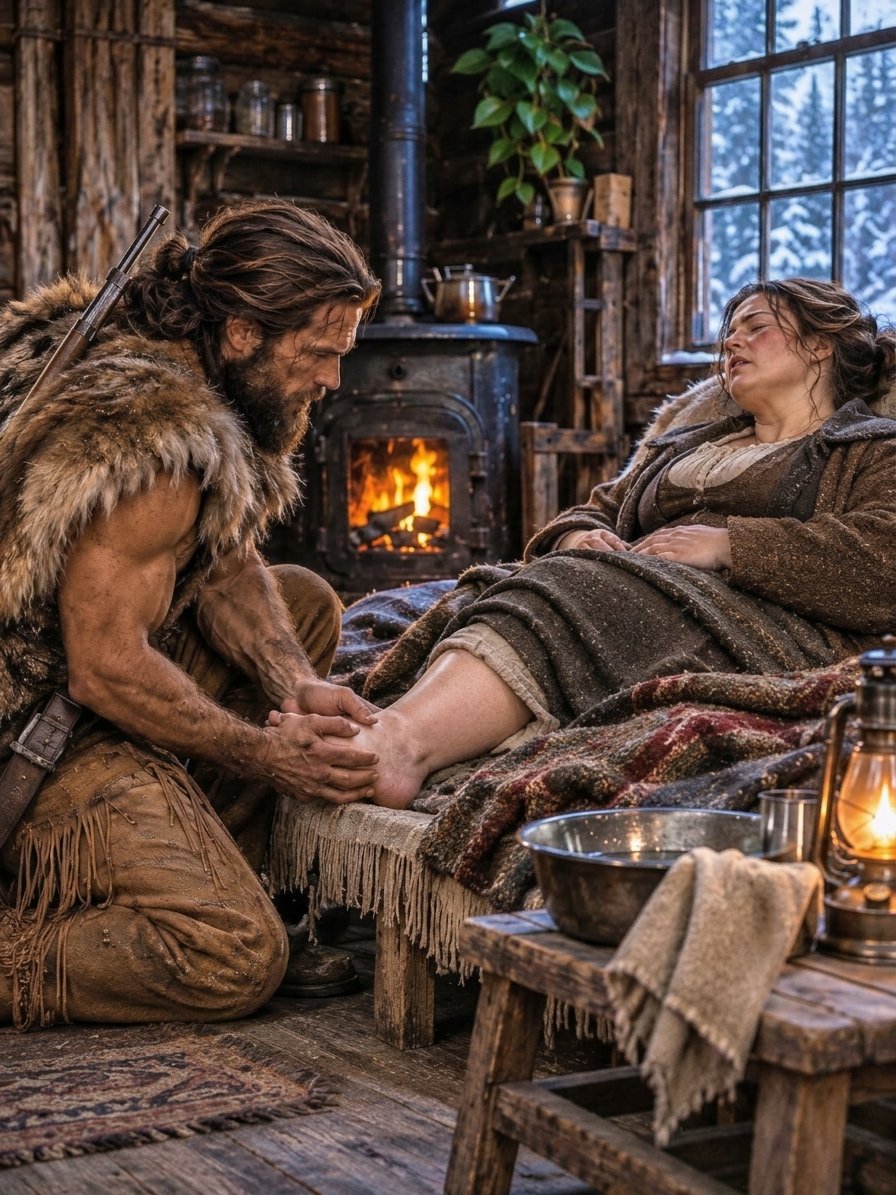
# A Mountain Man Discovered a Woman Living Alone in a Crumbling Snow Cabin — What He Did Next Left the Entire Town Speechless
**A Complete Western Frontier Drama | November 1879 | Wind River Mountains, Wyoming Territory**
## CHAPTER 1: THE SMOKE THAT SHOULD NOT HAVE BEEN THERE
In November of 1879, a man who survived the Wind River High Country did it by following one rule.
You did not meddle in another person’s winter.
You minded your traps. You kept your powder dry. You protected your horses, watched the sky, and let the snow bury whatever could not outrun it.
Ethan Shaw had lived by that rule for eleven years.
He had learned it the hard way.
He had seen men freeze because they had trusted the wrong trail. He had watched hunters disappear into white valleys, never to be found. He had buried friends beneath piles of stones and learned that the mountains did not care how much a man had loved them.
At forty-two, Ethan had become a quiet, weathered man who preferred the company of his horse to that of other people.
His wife, Sarah, had died seven winters earlier in Missouri, taken by cholera before the doctor could reach their little farmhouse.
Afterward, Ethan had sold what remained of their property, traveled west, and eventually disappeared into the mountains.
He had no children.
No close family.
No reason to return to the world he had left behind.
His only regular companions were Buck, a heavy-shouldered bay gelding, and an old pack mule that had survived more winters than most men.
Then, on a bitter afternoon in November 1879, Ethan smelled something unusual.
He was riding through a narrow valley nearly nine thousand feet above sea level when he noticed a thick ribbon of smoke drifting between the pine trees.
He stopped Buck.
Good wood smoke was thin and blue. It carried the clean smell of seasoned lodgepole pine or dry aspen.
This smoke was different.
It was black, heavy, and sour.
Someone was burning green spruce.
Ethan looked toward the east.
A small cabin stood in a hollow beneath a ridge, half buried in snow.
Its roof sagged beneath the weight of the first heavy snowfall. The chimney leaned dangerously to one side, and the single window was covered with greased paper rather than glass.
A woman stood outside.
She was trying to split a frozen stump with a short-handled hatchet.
She wore an oversized man’s canvas coat, two layers of worn skirts, and boots that appeared to belong to someone twice her size.
Her hands were bare.
Her knuckles were split and bleeding.
She raised the hatchet again.
It struck the wood and bounced away.
The force sent her stumbling backward.
She caught herself against the chopping block, closed her eyes, and took a long breath.
Then she tried again.
Ethan watched for several seconds.
There was something unusual about the way she refused to give up.
She was clearly exhausted, but she kept working as though stopping would mean admitting something she could not afford to admit.
Buck snorted.
The woman spun around.
In one quick movement, she dropped the hatchet, grabbed a double-barreled shotgun leaning against the cabin, and pointed it toward Ethan.
“Stay where you are!”
Ethan raised both hands.
“Easy, ma’am.”
“I said stay back!”
He examined the shotgun.
“That left hammer is rusted. I wouldn’t recommend firing it.”
Her eyes narrowed.
“I know how to use a gun.”
“Maybe. But that one’s more dangerous to you than it is to me.”
She did not lower it.
Ethan noticed that she was shaking.
Not from fear alone.
She was cold.
Deeply, dangerously cold.
“You’re a long way from the trail,” she said.
“The trail is buried.”
“Then keep riding.”
Ethan looked past her.
There was no horse.
No mule.
No woodpile.
A collapsed lean-to stood beside the cabin, and thirty yards away, near the trees, a pile of river stones marked a grave.
A crooked wooden cross stood at its head.
“Who’s buried there?” he asked.
The woman’s expression changed.
“My husband.”
Ethan nodded.
“How long ago?”
“Three weeks.”
“Name?”
“Roy Mercer.”
She lowered the shotgun a fraction.
“Now you’ve had your answer. Ride on.”
Ethan looked at the chimney.
“You’re burning green wood.”
“It’s what’s available.”
“Your flue is filling with pitch. If you keep that up, the pipe will clog. Smoke will come back into the cabin.”
“I’ve been managing.”
“For how long?”
“Long enough.”
Ethan looked at her hands again.
The skin around her fingers was cracked. One knuckle had begun turning a troubling shade of purple.
“Have you eaten today?”
She said nothing.
“Yesterday?”
“That’s none of your concern.”
He studied her face.
She might have been thirty. Perhaps thirty-five. It was difficult to tell beneath the dirt, cold, and exhaustion.
Her dark hair escaped from a frayed wool scarf.
Her eyes were sharp, but something behind them looked terribly tired.
“My name is Ethan Shaw,” he said.
“I didn’t ask.”
He almost smiled.
“No. You didn’t.”
He glanced at the sky.
A dark wall of clouds was gathering beyond the ridge.
“There’s a blue norther coming. You have maybe two hours of daylight left.”
“I’ve survived worse.”
“Not with that roof.”
She tightened her grip on the shotgun.
“Listen carefully, Mr. Shaw. My husband is dead. My nearest neighbor is miles away. I have nothing worth taking, and I have no interest in company.”
Ethan looked toward the grave.
He understood more than she knew.
There were some kinds of loneliness a person defended because it was the last thing they believed belonged to them.
He reached behind his saddle, untied one of the elk quarters from the pack mule, and dropped it into the snow ten paces from her.
The meat landed heavily.
She stared at it.
“What is that?”
“Food.”
“I can see that.”
“I’ve got more than I need.”
She looked suspicious.
“Why?”
“Because the wolves are already following the blood. Leave it outside, and they’ll be scratching at your door tonight.”
He turned Buck around.
“Wait.”
Ethan stopped.
The woman still held the shotgun.
“What’s your price?”
He looked over his shoulder.
“My price?”
“Nothing is free out here.”
Ethan was silent for a moment.
Then he said, “Keep yourself alive until morning. That’s all.”
He rode into the trees.
He did not look back until he had traveled fifty yards.
When he finally turned, the woman was still standing beside the cabin.
The shotgun remained pointed toward the empty trail.
The elk meat lay in the snow.
And she was staring at it as though accepting it might cost her more than hunger ever could.
## CHAPTER 2: THE WOMAN WHO HAD FORGOTTEN HOW TO ASK
The woman’s name was Clara Mercer.
She had been born in a small farming settlement in Iowa and had spent most of her younger years believing she would become a schoolteacher.
She had loved books, music, and the smell of fresh bread.
At twenty-three, she had traveled west with a family seeking land.
That was where she met Roy Mercer.
Roy was a trapper and occasional ranch hand. He was not wealthy, handsome in the conventional sense, or particularly good at conversation.
But he was kind.
He had a quiet laugh and a habit of remembering small things.
When Clara mentioned that she liked wildflowers, he began bringing them home whenever he returned from the mountains.
When she complained that the cabin roof leaked, he spent three days fixing it.
When she became frightened during thunderstorms, he sat beside her until the noise passed.
They married in 1872.
For several years, their life was simple but happy.
They lived in the valley, close enough to a settlement called Pine Creek to purchase supplies and sell pelts.
Clara taught a handful of children in a small schoolhouse.
Roy trapped during the winter and worked as a guide during the warmer months.
They had little money, but they had plans.
Roy wanted to build a larger cabin.
Clara wanted a garden.
They spoke of having children someday.
Then Roy fell from the roof.
It happened while he was replacing damaged shingles after an early autumn storm.
He landed badly, breaking his hip and injuring his lower back.
At first, Clara believed he would recover.
She brought him water, prepared broth, and rode to the settlement for medicine.
But infection followed.
The fever came.
Then the pain.
Then the terrible nights when Roy could barely recognize her.
The nearest doctor was away on a long journey, and the weather made travel impossible.
Roy died four days after the fall.
Clara buried him near the pines.
She placed his favorite hunting knife beside the grave.
After that, everything became difficult.
The roof still leaked.
The woodpile was almost empty.
The horse had died earlier that autumn after breaking a leg.
And the small amount of money Roy had saved was nearly gone.
Clara tried to reach Pine Creek, but the first serious snowfall blocked the trail.
She wrote a letter asking for help and left it with a passing freight driver who promised to deliver it.
She never received an answer.
She did not know that the driver had lost the letter somewhere along the trail.
She did not know that people in Pine Creek believed she had left the valley.
She only knew that nobody came.
At first, she waited.
Then she stopped waiting.
She began rationing flour and beans.
She burned whatever wood she could find.
She repaired her husband’s old clothing and wore his coat.
Every morning, she walked to the grave.
Every evening, she returned to the cabin.
She spoke to Roy sometimes.
Not because she believed he could answer.
Because silence had become unbearable.
By the time Ethan arrived, Clara had almost convinced herself that she would not survive the winter.
She simply refused to admit it aloud.
That evening, after Ethan disappeared into the trees, she stood beside the elk meat for nearly ten minutes.
Finally, she dragged it inside.
She barred the door.
She cleaned the meat, cut a small portion, and placed it in a pot.
The rest she wrapped in cloth and stored in the coldest corner of the cabin.
For the first time in days, the smell of cooking food filled the room.
She sat near the stove and ate slowly.
The warmth felt almost painful.
She looked toward Roy’s empty chair.
“Someone came today,” she whispered.
She paused.
“He left food.”
The wind shook the cabin.
Clara swallowed.
“I don’t know why.”
She looked at the little pile of wood near the stove.
Then at the window.
Then at the grave outside.
For a moment, she allowed herself to wonder whether the stranger might return.
She quickly pushed the thought away.
Hope was dangerous.
It made people wait for things that never arrived.
## CHAPTER 3: THE MIDNIGHT BLIZZARD
Half a mile downstream, Ethan made camp behind a wall of granite boulders.
He built a small fire using dry deadfall, rubbed Buck down, and checked the mule’s legs.
The storm arrived just after sunset.
The wind dropped from the mountains with such force that the trees began groaning.
Snow swept through the valley.
Ethan tightened the ropes around his supplies and pulled his buffalo robe over his shoulders.
He had survived many storms.
He knew how to find shelter.
He knew how to keep his fire small.
He knew when to stop traveling.
But that evening, he found himself looking toward the hollow.
He could not see Clara’s cabin.
Only the ridge above it.
A faint ribbon of smoke rose through the trees.
At least she had managed to get a fire going.
Ethan drank his coffee.
He told himself that was enough.
He had given her food.
He had warned her about the chimney.
The rest was her responsibility.
He had lived eleven years without interfering in other people’s troubles.
He was not about to change his ways because a stubborn woman had pointed an old shotgun at him.
He pulled his hat down and settled against the rocks.
But sleep did not come easily.
His thoughts returned to Sarah.
He remembered the last winter they had spent together.
She had been ill for several days, but she insisted that she would recover.
On the final night, she had asked him to repair the loose button on his coat.
“You’ll need it when you go into town,” she had said.
He had promised to fix it in the morning.
There had been no morning for Sarah.
He had carried that unfinished promise west with him.
Sometimes he wondered whether the mountains had made him stronger or simply given him somewhere to hide.
At midnight, the wind shifted.
Ethan woke with frost stiffening his beard.
He stepped outside to check Buck and the mule.
Both animals stood with their backs to the gale.
The moon appeared briefly between the clouds.
Ethan looked toward the hollow.
Then he smelled the air.
Nothing.
No smoke.
No burning wood.
No scent of ash.
He waited.
Five minutes passed.
The wind continued blowing directly from the cabin toward his camp.
There should have been something.
Even a poor fire would have produced smoke.
But the air smelled only of snow and frozen stone.
Ethan cursed quietly.
He walked back to the shelter, kicked snow over his own fire, and gathered his equipment.
He left the horses behind.
The snow was already waist-deep in places. Taking them into the deadfall would risk breaking a leg.
He strapped on his ashwood snowshoes, slung his Hawken rifle across his back, and packed his hand axe, dry birch bark, rope, and a small blanket.
Then he began climbing toward the cabin.
The journey was miserable.
The wind struck his face.
Snow filled the gaps around his scarf.
Several times, he had to stop and use his axe to clear fallen branches.
He knew the valley well, but the darkness made every familiar shape look different.
He moved slowly.
At one point, a branch snapped overhead and fell across his path.
Ethan stopped.
He listened.
The mountains were full of noises during storms.
Not all of them were harmless.
He continued.
After nearly forty minutes, he reached the cabin.
The chimney stood silent.
The door was shut.
No light came through the window.
Ethan knocked.
“Ma’am!”
No answer.
He knocked again.
“Clara!”
He did not know why he had used her name. He had not heard it from her.
Perhaps he had simply decided that a woman should not have to be called ma’am while dying alone.
Still no answer.
He tried the door.
It was barred.
“Open up!”
Nothing.
He pushed against it.
The old wood groaned but held.
Ethan stepped back and struck the latch with his shoulder.
The bar cracked.
The door swung inward.
Cold air rushed out.
The cabin was dark.
A thin layer of smoke hung near the ceiling.
Ethan covered his mouth and moved inside.
“Clara?”
He found her beside the stove.
She was lying on the floor, one hand stretched toward a small pile of wood.
Her lips were pale.
Her hair was damp with sweat.
A blanket had slipped from her shoulders.
Ethan dropped to his knees.
“Clara. Can you hear me?”
Her eyelids moved.
He touched her neck.
There was a pulse.
Weak, but present.
He checked her breathing.
She was alive.
Barely.
The chimney had become blocked, and smoke had filled the room.
The fire had nearly died.
Ethan dragged her away from the stove and opened the door fully.
Then he rushed outside and cleared the snow from the chimney base.
The pipe was clogged with thick pitch.
He used his hand axe to break apart the packed material and pulled the worst of it free.
The wind nearly knocked him off balance.
He worked until the chimney began drawing properly.
Then he returned inside.
Clara had begun coughing.
He lifted her carefully and carried her outside, wrapping his buffalo robe around her.
She stirred.
“What…”
“Don’t speak.”
“Roy…”
“You’re safe.”
She tried to pull away.
“Don’t leave me.”
The words were so faint Ethan almost missed them.
He stopped.
Then he adjusted the blanket around her shoulders.
“I’m not leaving.”
He carried her toward a sheltered hollow behind the cabin.
There he found a place protected from the wind and laid her down.
He built a small fire beneath a natural rock overhang, using the dry birch bark he had brought.
He warmed snow in a pot.
He did not force water into her mouth while she was barely conscious.
He waited until her breathing became steadier.
Then he helped her take a few careful sips.
Her hands were ice cold.
Ethan rubbed them gently between his own gloved palms.
“Stay with me, Clara.”
She opened her eyes.
For several seconds, she stared at him without understanding.
Then she whispered:
“Why did you come back?”
Ethan looked at the fire.
He had no good answer.
Finally, he said, “Because your chimney stopped smoking.”
She closed her eyes.
“That’s a foolish reason.”
“Maybe.”
He pulled the blanket higher.
“But it’ll do for tonight.”
## CHAPTER 4: THE FIRST MORNING OF A DIFFERENT LIFE
The storm lasted until sunrise.
Ethan remained awake most of the night.
He kept the fire burning and checked Clara’s breathing.
Whenever she began shivering, he added another layer of clothing.
He found an old kettle in the cabin and used it to melt snow.
The cabin was too dangerous to remain in for long, but leaving immediately would have been worse.
By dawn, the wind had weakened.
Ethan returned to the cabin and examined the damage.
The stove was badly clogged.
The chimney needed proper repair.
The roof sagged dangerously.
The north wall had gaps large enough to let snow blow through.
The woman had been living inside a structure that was barely fit to shelter a person.
He found a few remaining pieces of dry wood beneath the bed.
He also found a small bag of flour, a handful of beans, and a tin containing dried apples.
There was almost nothing.
When Clara finally woke properly, Ethan was sitting beside the fire.
She tried to sit up.
“Don’t.”
“I can manage.”
“You nearly suffocated.”
She looked at him.
For a moment, she appeared embarrassed.
Then her expression hardened.
“I told you to leave.”
“I remember.”
“Then why didn’t you?”
Ethan shrugged.
“Didn’t feel like it.”
She looked toward the cabin.
“Is it damaged?”
“Yes.”
“How badly?”
“Bad enough.”
She tried to stand.
Ethan held out a hand.
“Slowly.”
She ignored it and attempted to rise on her own.
Her knees gave way.
He caught her before she fell.
She pulled away immediately.
“Don’t.”
He released her.
“All right.”
The simple response surprised her.
Most people who tried to help her also tried to control her.
Ethan seemed willing to let her be angry.
He handed her a cup of warm water.
“Drink.”
She accepted it.
“Thank you.”
It was the first time she had thanked him.
Ethan pretended not to notice.
After she had eaten a little broth, he explained what needed to be done.
“The roof needs bracing. The chimney needs a proper cleaning. You need dry wood, and those boots are finished.”
“They’re all I have.”
“I noticed.”
“I can manage.”
He looked at her hands.
“Your fingers say otherwise.”
Clara lowered her eyes.
Ethan continued.
“I can bring supplies from my camp. There’s a safe shelter not far south. You can stay there while I work on the cabin.”
She looked alarmed.
“No.”
“Why?”
“Because I don’t know you.”
“That’s fair.”
“And I don’t want to owe you.”
“You don’t.”
“Everyone wants something.”
Ethan looked at her.
For a moment, his expression became difficult to read.
Then he said, “I had a wife once. Her name was Sarah. She died seven years ago.”
Clara remained silent.
“I know what it is to come home and find the person you love missing from the room. I know what it is to spend years pretending you don’t need anyone.”
He looked toward the grave.
“But I also know a person can die from being left alone when somebody could have helped.”
Clara stared at him.
He did not say anything more.
After a long silence, she asked:
“What happened to your wife?”
“Cholera.”
“I’m sorry.”
He nodded.
“So am I.”
For the first time, something passed between them that neither needed to explain.
Not love.
Not friendship.
Something smaller.
Recognition.
That afternoon, Ethan brought Buck and the mule from his camp.
He unloaded flour, salt pork, coffee, medicine, dry blankets, and several bundles of seasoned wood.
Clara watched him stack the supplies.
“You brought all that?”
“Most of it.”
“Why?”
He looked at her.
“Because winter is long.”
She shook her head.
“You can’t keep feeding every person you find.”
“No.”
He paused.
“But I can feed one.”
## CHAPTER 5: THE NAME ON THE OLD LETTER
During the next several days, Ethan worked on the cabin.
He replaced the damaged roof supports, cleaned the chimney, and repaired the worst gaps in the walls.
He built a proper wood shelter and stacked enough seasoned aspen to last several weeks.
Clara gradually regained her strength.
She insisted on helping.
At first, Ethan refused.
Then he realized that refusing her any work made her more determined to do it.
So he gave her small tasks.
She sorted nails.
She prepared meals.
She helped him measure boards.
She even managed to sew a tear in his coat.
One afternoon, while searching for a piece of cloth, Clara opened a wooden chest.
Inside were several old belongings.
A small book.
A cracked photograph.
A folded piece of paper.
Ethan noticed her expression.
“Something wrong?”
She held the paper.
“It’s a letter.”
“From whom?”
“From the county office.”
She opened it carefully.
The paper was old and creased.
Ethan stood nearby.
Clara began reading.
Her face slowly changed.
The letter concerned Roy’s homestead claim.
It stated that a survey had been scheduled, but no official had visited the property.
There was also a note about an outstanding payment.
Clara frowned.
“This doesn’t make sense.”
“What’s wrong?”
“Roy paid the land fee.”
“You’re certain?”
“I helped him count the money. We paid it at the office in Pine Creek.”
She searched the chest.
Then she found another paper.
A receipt.
The amount matched the payment mentioned in the letter.
Ethan examined it.
The receipt bore the signature of a man named Silas Vane.
Clara looked troubled.
“Who is he?” Ethan asked.
“He worked at the land office. He also owned the general store in Pine Creek.”
“Does he still?”
“I don’t know.”
She sat down.
“Roy believed he had been cheated.”
“By Vane?”
“Yes.”
She explained that Roy had discovered a discrepancy in the land records several months before his accident.
The property boundaries had been changed.
A section of land near the creek, which Roy believed belonged to his claim, had been marked for another buyer.
Roy had traveled to Pine Creek to question the records.
Afterward, he had become worried.
He believed Silas Vane was trying to force him off the property.
But Roy had never completed his complaint.
His fall had happened only days later.
Ethan studied the receipt.
“Did Roy tell anyone else?”
“He said he was going to speak with the county clerk.”
“Did he?”
“I don’t know.”
Clara’s eyes filled.
“I should have asked him more questions.”
Ethan shook his head.
“You were taking care of a dying man. Don’t punish yourself for not solving a land dispute.”
She looked down.
For a while, neither spoke.
Then Clara said:
“Roy wanted to build a school here someday.”
Ethan looked at her.
“A school?”
“He thought there were too many children growing up without proper lessons. He wanted to build a small schoolhouse near the valley.”
She smiled sadly.
“He said I could teach again.”
Ethan looked around the cabin.
There were books on a shelf.
A small slate.
Several pieces of chalk.
She had kept them all.
“You were a teacher?”
“Before I married.”
“Do you miss it?”
“Every day.”
Ethan nodded.
“Then perhaps you should teach again.”
She laughed without humor.
“Who would send their children to a school run by a woman living in a broken cabin?”
“Someone who wants their children educated.”
She looked at him.
He was serious.
For the first time in months, Clara felt a small possibility opening before her.
It frightened her.
But it was there.
## CHAPTER 6: THE MAN WHO OWNED THE TOWN
By the second week of December, Clara could walk outside without becoming exhausted.
The cabin was warmer.
The roof no longer leaked.
The chimney worked.
Ethan had built a proper woodpile and repaired the broken lean-to.
He also made a small wooden bench for the grave.
Clara found him working on it one morning.
“What are you making?”
“A bench.”
“For whom?”
He glanced toward Roy’s grave.
“For you.”
She looked away.
“Thank you.”
Ethan drove the final nail into the wood.
Then he stood.
“You mentioned Pine Creek.”
Clara nodded.
“I need to go there.”
“Why?”
“To find out what happened to the land papers.”
Ethan examined the sky.
“The trail will be difficult.”
“I know.”
“You shouldn’t travel alone.”
“I won’t.”
He looked at her.
She raised an eyebrow.
“Unless you have somewhere better to be.”
For the first time, Ethan laughed.
It was a quiet sound, unfamiliar even to him.
They prepared for the journey.
Ethan packed supplies and checked Buck’s harness.
Clara wore a warm coat, a wool scarf, and a pair of boots Ethan had brought from his own supplies.
They traveled slowly.
The valley was beautiful beneath the snow.
Pine Creek lay several miles beyond the ridge.
It was a small settlement with a church, a general store, a blacksmith, a boardinghouse, and a schoolhouse.
When they arrived, several people looked up.
A woman standing near the church steps stared at Clara.
“Clara Mercer?”
Clara stopped.
“Mrs. Bell.”
The older woman approached.
“My goodness. We thought you had left the mountains.”
Clara looked at her.
“I never left.”
Mrs. Bell glanced at Ethan.
“Who is this?”
“Ethan Shaw.”
The older woman nodded.
Then she looked at Clara again.
“Where have you been?”
Clara almost laughed.
Where had she been?
Living in a freezing cabin.
Burying her husband.
Waiting for someone to answer a letter that never arrived.
Trying to survive.
But she simply said:
“At home.”
Mrs. Bell’s expression changed.
She looked embarrassed.
Before she could respond, a man emerged from the general store.
He was tall, broad-shouldered, and dressed in a fine black coat.
Silas Vane.
He recognized Clara immediately.
“Well, I’ll be.”
He smiled.
“Mrs. Mercer. We had heard you were gone.”
Clara faced him.
“I’m still here.”
Vane’s smile weakened.
He looked at Ethan.
“And who might you be?”
“Ethan Shaw.”
“Ah. A mountain man.”
His tone carried just enough contempt to be noticed.
Ethan said nothing.
Vane turned back to Clara.
“What brings you into town?”
“I want to see the county land records.”
Vane’s expression changed for a fraction of a second.
“Those records are complicated.”
“I have a receipt proving Roy paid his fees.”
“Your husband had outstanding obligations.”
“He paid what was owed.”
Vane gave a dismissive smile.
“Grief can make memories unreliable.”
Clara’s cheeks reddened.
Ethan stepped forward.
“She has a receipt.”
Vane looked at him.
“This is a private matter.”
“Then you won’t mind showing the records.”
The storekeeper’s smile disappeared.
“The county clerk is away.”
“Where?”
“That is none of your concern.”
Ethan watched him carefully.
He had seen men like Vane before.
Men who wore expensive coats and spoke politely while making sure everyone around them understood who held the power.
Clara tightened her grip on the papers.
“Roy paid for that land. I want the record corrected.”
Vane leaned closer.
“Mrs. Mercer, you should be grateful anyone remembers your property at all. You have no money, no husband, and no one to speak for you.”
Ethan’s expression hardened.
“She’s speaking for herself.”
Vane looked at him.
For several seconds, neither man moved.
Then the storekeeper stepped backward.
“Good day.”
He disappeared into the store.
Clara stood still.
She had imagined returning to Pine Creek many times.
She had imagined being welcomed.
She had imagined someone asking about Roy.
Instead, she had been treated as an inconvenience.
Ethan looked at her.
“Are you all right?”
She nodded.
But her eyes were wet.
“Let’s go,” she whispered.
## CHAPTER 7: THE LETTER THAT NEVER ARRIVED
They did not return to the mountains immediately.
Ethan wanted to find the county clerk.
He discovered that the clerk, Thomas Bell, had returned to Pine Creek two days earlier.
They found him at the boardinghouse.
Thomas was an older man with silver hair and a careful manner.
When Clara showed him the receipt, he examined it closely.
“Where did you get this?”
“Roy paid Silas Vane himself.”
Thomas looked at the signature.
“This is genuine.”
Clara leaned forward.
“Then why does the record say we owe money?”
Thomas frowned.
“I don’t know.”
He searched through a stack of documents.
After nearly an hour, he found the original payment record.
It showed that Roy had paid the required fee.
But another document, filed several weeks later, listed the payment as missing.
Thomas examined both.
“Someone altered the account.”
Clara felt her stomach tighten.
“Who?”
Thomas did not answer immediately.
He compared the handwriting.
Then he looked up.
“Silas Vane.”
Ethan folded his arms.
“Can you prove it?”
Thomas nodded slowly.
“The original register is still here. The ink and handwriting are different.”
Clara stared at the papers.
“Roy was telling the truth.”
Thomas nodded.
“It appears so.”
Her eyes filled.
For months, she had wondered whether she had misunderstood something.
Whether Roy had made a mistake.
Whether the land really belonged to someone else.
Now she knew.
Her husband had been cheated.
But another discovery followed.
Thomas opened a drawer and removed a small envelope.
“Mrs. Mercer, did you send a letter to the town asking for help after your husband died?”
Clara looked up.
“Yes.”
“Who carried it?”
“A freight driver named Harlan.”
Thomas nodded.
“That explains something.”
He removed a folded paper from the envelope.
It was Clara’s letter.
The edges were stained.
The paper had been damaged by water.
“I found this among documents delivered to the office several weeks ago. It was never entered into the correspondence register.”
Clara took it.
Her own handwriting stared back at her.
She remembered writing it beside Roy’s bed.
She remembered asking for help.
She remembered folding it carefully and giving it to the driver.
She had waited for an answer.
No answer had ever come.
She sat down.
For a moment, she could not speak.
Ethan stood beside her.
Thomas looked ashamed.
“I am sorry, Mrs. Mercer.”
Clara read the letter again.
It was short.
She had written that Roy was dead, that the cabin needed repairs, and that she was running out of food.
She had asked whether someone could send a doctor or supplies.
At the bottom, she had written:
“I do not ask for much. I only hope someone remembers that I am still here.”
Her hands began to tremble.
Ethan took the paper gently.
He folded it and placed it back in the envelope.
“Someone remembers now.”
Clara looked at him.
And for the first time since Roy died, she allowed herself to cry in front of another person.
She did not hide her face.
She did not apologize.
Ethan simply stood beside her until the tears passed.
## CHAPTER 8: THE TOWN THAT TURNED ITS BACK
The following morning, the church minister called a meeting.
Thomas Bell had explained what he discovered.
The town needed to understand what had happened.
People gathered inside the small church.
Some came because they were curious.
Others came because they felt ashamed.
Clara stood near the front.
Ethan remained beside her.
Silas Vane arrived late.
He looked irritated.
“What is this supposed to be?”
The minister stood.
“We have gathered to discuss the treatment of Mrs. Clara Mercer and the alteration of her husband’s land records.”
Vane laughed.
“This is absurd.”
Thomas placed the documents on a table.
“These are the original payment records.”
Vane glanced at them.
“Records can be misunderstood.”
Thomas opened the ledger.
“Your signature is here.”
Vane’s face tightened.
The minister continued.
“We also found Mrs. Mercer’s letter asking for help. It was never delivered.”
Several people exchanged glances.
Mrs. Bell covered her mouth.
A rancher near the back stood.
“I thought Clara had left.”
Another woman spoke.
“I heard she had moved south.”
Clara looked at them.
“Did any of you ask?”
The room became quiet.
She continued.
“Did anyone ride out to check?”
Nobody answered.
“I buried my husband three weeks before the first snow. I had no horse. I had very little food. I wrote a letter asking for help.”
Her voice trembled.
“I waited for an answer.”
She looked toward the people seated in the pews.
“Every day, I thought perhaps someone would come.”
She paused.
“Nobody did.”
Mrs. Bell began crying.
“Clara, we didn’t know.”
Clara looked at her.
“You didn’t know because nobody came to find out.”
The words landed heavily.
Even Ethan lowered his eyes.
The minister looked at the congregation.
“We have failed this woman.”
Silas Vane stood.
“This is a waste of time. The woman has no legal claim until the land office confirms the boundaries.”
Thomas responded.
“The boundaries have been confirmed.”
Vane turned sharply.
Thomas continued.
“The alteration of the payment record will be reported to the territorial authorities. Until the matter is settled, the claim remains in Mrs. Mercer’s name.”
A murmur spread through the church.
Vane’s face reddened.
“You cannot do this!”
Thomas closed the ledger.
“I believe I can.”
For the first time, the storekeeper had nothing to say.
Clara stood silently.
She had not come to Pine Creek seeking revenge.
She had come because she wanted the truth.
But now the truth was standing in front of the entire town.
And nobody could pretend they had never heard it.
## CHAPTER 9: THE MAN WHO HAD FORGOTTEN HOW TO LIVE
The weeks that followed were difficult.
Silas Vane’s business suffered.
People stopped trusting him.
The territorial office opened an investigation into the altered land records.
Thomas Bell secured the original documents.
Clara’s property claim was restored.
But the most important change happened quietly.
People began visiting her.
Mrs. Bell brought flour.
The blacksmith brought a new stove pipe.
A rancher named Daniel Price offered to repair the fence.
The church minister arranged for several families to help with the roof.
Clara accepted some of the assistance.
Not all of it.
She was still learning how to trust people.
Ethan continued visiting.
Sometimes he brought supplies.
Sometimes he helped repair the cabin.
Sometimes he simply sat beside the fire while Clara read.
They spoke more often.
She learned that Ethan had once loved music.
He had learned to play the fiddle from his father, but he had not touched one since Sarah died.
He told her about Missouri.
About the small farmhouse.
About the apple tree Sarah had planted.
About the winter she had tried to mend his coat despite being too weak to stand.
Clara listened.
One evening, she asked:
“Do you ever think about going back?”
Ethan stared into the fire.
“Sometimes.”
“Why don’t you?”
He was quiet for a long time.
“Because I don’t know what I’d find.”
“Perhaps the house is still there.”
“Perhaps.”
“Perhaps the tree is still growing.”
He smiled faintly.
“Perhaps.”
Clara closed her book.
“You speak about your wife as if loving her means you cannot live again.”
Ethan looked at her.
She continued carefully.
“I don’t believe that is what love asks of us.”
He lowered his eyes.
“I loved Sarah.”
“I know.”
“I still do.”
Clara nodded.
“Then remember her.”
She reached for another piece of firewood.
“But don’t bury yourself beside her.”
Ethan looked at her.
For several seconds, he said nothing.
Then he laughed softly.
“You’re a stubborn woman.”
Clara smiled.
“So I’ve been told.”
That night, Ethan stayed longer than usual.
Before leaving, he placed something on the table.
It was an old photograph.
A woman stood beside a small farmhouse.
She had a gentle smile and dark hair.
“Sarah,” he said.
Clara studied the photograph.
“She looks kind.”
“She was.”
Clara handed it back.
“Thank you for showing me.”
Ethan put it carefully into his coat.
Then he looked at her.
“I think I might like to visit Missouri someday.”
Clara smiled.
“That sounds like a good idea.”
He nodded.
“But not this winter.”
“No?”
He glanced around the cabin.
“Someone still needs a proper woodpile.”
Clara laughed.
And the sound stayed with him all the way down the mountain.
## CHAPTER 10: THE SCHOOLHOUSE IN THE VALLEY
By the time spring arrived, Clara had changed.
She still missed Roy.
She still visited his grave.
But the grief no longer controlled every hour of her day.
She planted a small garden near the cabin.
She repaired the old curtains.
She began reading again.
One morning, she opened the wooden chest and removed her old schoolbooks.
Ethan watched from the doorway.
“What are you planning?”
She smiled.
“Something Roy wanted.”
“What?”
“A school.”
Ethan looked at her.
She explained that several families in the valley lived too far from Pine Creek for their children to attend regularly.
Some children had never learned to read.
Others had no access to proper lessons.
She wanted to build a small schoolhouse near the creek.
Ethan looked toward the open land.
“How many children?”
“Perhaps six.”
“Maybe eight.”
He nodded.
“That’s enough.”
Clara raised an eyebrow.
“You think so?”
“Eight children need a school as much as eighty.”
She smiled.
“Will you help?”
Ethan looked at her.
“Of course.”
They began with a simple plan.
The schoolhouse would have two windows, a wood stove, a blackboard, and enough benches for twelve children.
The church donated timber.
The blacksmith provided nails.
The ranchers contributed labor.
Even people who had once ignored Clara began helping.
Construction took several weeks.
Ethan worked on the foundation.
Daniel Price brought lumber.
The minister organized donations.
Mrs. Bell collected books.
And Clara prepared the classroom.
When the schoolhouse was finished, she stood in the doorway for a long time.
The building was not large.
It was not beautiful.
But it was warm, strong, and full of possibility.
Ethan approached.
“Well?”
Clara smiled.
“It’s perfect.”
The first day of lessons arrived in June.
Eight children entered the schoolhouse.
Some were shy.
Some were excited.
One little boy had never held a pencil before.
Clara welcomed each of them.
She wrote the alphabet on the blackboard.
Then she turned toward the children.
“My name is Mrs. Mercer. I will be your teacher.”
The children smiled.
Ethan stood outside the window.
He watched Clara begin the lesson.
And for a moment, he imagined Sarah sitting among the children, smiling at the woman who had found her way back to life.
He looked toward the mountains.
The snow was disappearing from the highest peaks.
The valley was green again.
And somewhere inside him, something that had been frozen for seven years began to thaw.