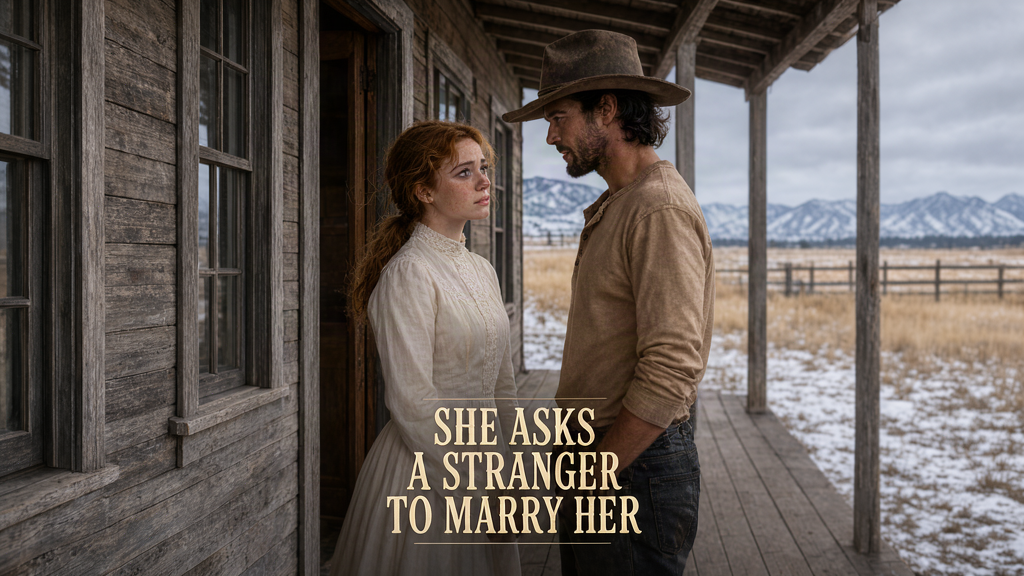
# SHE ASKED A STRANGER COWBOY TO MARRY HER FOR ONE YEAR — BUT HE GAVE HER AN ANSWER THAT CHANGED BOTH THEIR LIVES
## Chapter 1: The Marriage Proposal No Stranger Should Have Accepted
“I’m asking you to marry me.”
The words escaped Rachel Foster’s lips before she could lose her nerve.
Across the threshold of her weathered Montana ranch house stood a man she had met less than an hour earlier. He was tall, broad-shouldered, and covered in the dust of a hundred miles of hard traveling. Beneath the brim of his battered brown hat, his dark eyes studied her with an expression that suggested he was deciding whether she was desperate, foolish, or completely out of her mind.
Benjamin Hayes had come looking for work.
Instead, a woman in a faded ivory dress had just asked him to become her husband.
Rachel tightened her trembling fingers around the edge of the door.
“Just for one year,” she added quickly. “Nothing more.”
For several seconds, Benjamin said absolutely nothing.
Behind him, a chestnut horse shifted beside the porch. Beyond the ranch yard, the Rocky Mountains rose against an evening sky crowded with dark clouds. Autumn was coming to Montana, and with it came the kind of winter that could bury cattle, freeze streams, and break people who had spent their entire lives believing themselves strong.
Rachel knew exactly how little time she had left.
Benjamin finally removed his hat.
“Ma’am,” he said slowly, “I believe I must have misunderstood you.”
“You didn’t.”
“You’re asking a stranger to marry you?”
“Yes.”
“A stranger whose name you learned this afternoon?”
“That would be correct.”
He looked past her into the modest house, then out toward the leaning fences and neglected pasture.
“That’s a mighty unusual way to hire a ranch hand.”
Rachel almost smiled.
Almost.
But there was nothing funny about the truth waiting behind her.
Six weeks earlier, she had buried her father beneath a cottonwood tree overlooking the eastern meadow. Since that terrible morning, everything he had built had begun slipping through her fingers.
The ranch was drowning in debt.
The autumn cattle sale was approaching.
Winter feed was running dangerously low.
And Martin Crowley, the wealthiest rancher in the valley, was determined to take the property from her.
Rachel had already tried asking for help.
She had tried borrowing money.
She had tried selling equipment and doing the work of three men with only two exhausted hands.
Nothing had been enough.
Now the man standing before her represented the last possibility she could imagine.
“I know what it sounds like,” she said.
“Do you?”
“Yes, Mr. Hayes. I do.”
“Then perhaps you’d better explain.”
Rachel stepped aside.
“Come inside.”
Benjamin hesitated before crossing the threshold.
The house smelled faintly of woodsmoke, lavender soap, and the bread Rachel had baked that morning. A small table stood beneath the window, covered with account books, overdue notices, and a folded letter bearing the name of Crowley Cattle Company.
Benjamin noticed the papers immediately.
He also noticed that the room was clean despite its obvious poverty. The curtains had been repaired by hand. The wooden floor had been swept. Fresh water stood in a chipped pitcher beside two mismatched glasses.
It was a house fighting to remain respectable while everything around it fell apart.
Rachel followed his gaze.
“That was my father’s desk,” she said.
Benjamin looked toward a worn oak chair.
“How long has he been gone?”
“Six weeks.”
“I’m sorry.”
She lowered her eyes.
“Thank you.”
Those two words nearly broke her.
Since the funeral, everyone had offered condolences. Few had offered anything more.
Her father’s name was Samuel Foster. He had arrived in Montana thirty years earlier with a mule, a rifle, and enough money to purchase forty acres of difficult land that nobody else wanted.
He had spent the following decades turning those acres into one of the most promising small cattle ranches in the valley.
He had dug irrigation channels with his own hands, built barns through bitter winters, and planted cottonwood trees along a narrow creek that ran through the eastern pasture.
When Rachel was a little girl, he had carried her on his shoulders and shown her the distant mountains.
“Someday,” he had told her, “all this will be yours, Rosie.”
He was the only person who ever called her Rosie.
And now he was gone.
The fever had taken him in four terrible days.
One afternoon he had been repairing a gate.
By the following Sunday, Rachel had been standing beside his grave while the whole valley watched.
She had not cried until everyone left.
Then she had fallen to her knees in the empty house and sobbed until morning.
But grief, she discovered, did not stop the arrival of bills.
The banker still wanted his money.
The cattle still needed feeding.
The fences still needed mending.
And Martin Crowley still wanted her land.
Rachel opened the account book.
“My father borrowed money last spring to purchase breeding stock and replace the north barn roof. He expected to repay most of it after the autumn cattle sale.”
Benjamin examined the neat columns of figures.
“How much?”
“Nine hundred dollars on the bank note. Another two hundred and eighteen owed to merchants and suppliers.”
“That’s a considerable sum.”
“I know.”
“How many cattle?”
“Seventy-three, counting the calves. Thirty-two should be ready for market if we can get them through the next several weeks.”
“And how many hands do you have?”
Rachel looked down at the table.
“One.”
“Where is he?”
“You’re looking at her.”
Benjamin’s gaze returned to her face.
He had traveled across Kansas, Wyoming, and Colorado. He had seen ranches fail because of drought, sickness, bad management, and worse luck.
But he had rarely encountered someone trying to save an operation this size entirely alone.
“Your father didn’t have men working here?”
“Two. One left after the funeral because I couldn’t promise his wages. The other had a family in Nebraska and couldn’t afford to wait.”
“Can’t say I blame them.”
“Neither do I.”
“Then why not hire a crew until the cattle sale?”
“Because I have fourteen dollars and sixty cents.”
The answer settled between them.
Outside, a gust of wind rattled the porch railing.
Rachel swallowed.
“I sold my mother’s silver to buy feed last month. I sold my father’s spare saddle to pay the blacksmith. I’ve repaired what fences I could, but the west boundary needs new posts, and the north pasture has a washout.”
Benjamin said nothing.
“The calves are losing weight. Two cows got loose yesterday. If I can’t get the herd to market, the bank will have every reason to demand payment I can’t make.”
He glanced at the letter.
“And Crowley?”
Rachel’s expression hardened.
“Martin Crowley owns nearly everything south of here. His property borders ours along the eastern creek. For years, he’s wanted the spring-fed meadow that belongs to this ranch.”
“Why?”
“Water.”
Benjamin understood immediately.
In Montana cattle country, a dependable spring could be worth more than a hundred acres of dry pasture.
“He offered my father five thousand dollars for the entire property two years ago,” Rachel continued. “Father refused.”
“And now?”
“Three thousand.”
“For the whole place?”
“Last week he told me he’d lower it again if I waited too long.”
Benjamin’s jaw shifted.
“He thinks you’ll get desperate enough to accept.”
“He’s counting on it.”
Rachel closed the book.
“I won’t sell.”
Benjamin looked toward the window.
Outside lay the evidence of a ranch that had once been loved and was now barely surviving.
The lower fence sagged against its posts.
The barn door hung crooked.
A water trough needed repair.
There were no hired men moving through the yard, no wagons arriving with supplies, no sounds of a prosperous ranch preparing for winter.
Only one exhausted woman and the memory of her father.
“You could lose everything,” Benjamin said.
“I know.”
“And you’re still refusing?”
Rachel looked him straight in the eyes.
“My father is buried on this property, Mr. Hayes. My mother is buried beside him. Every fence post out there was paid for with years of their lives.”
Her voice tightened.
“Mr. Crowley thinks I’m going to hand him those years because he has more money than I do.”
She shook her head.
“I won’t.”
For the first time since entering the house, Benjamin looked at her with something beyond curiosity.
It was respect.
He had seen stubborn people before.
But stubbornness without purpose was foolishness.
Rachel Foster had purpose enough to fill the room.
“All right,” he said. “Tell me about this marriage idea.”
She reached beneath the ledger and withdrew a sheet of paper.
“I’ve thought about it carefully.”
“That worries me more than if you’d thought of it five minutes ago.”
This time, she really did smile.
It disappeared almost immediately.
“You would work the ranch through the autumn cattle sale and stay through winter. I’d provide meals, lodging, and a fair share of the profits once the bank is paid.”
“And the marriage?”
“One year.”
“Why marriage at all?”
Rachel hesitated.
“Because a husband could stand beside me when Crowley comes calling. People around here listen to a man before they listen to a woman.”
Benjamin disliked how naturally she said it.
He disliked even more that she was probably right.
“And because,” she continued, “I need someone committed to staying, not someone who can ride away the moment another ranch offers more money.”
He considered that.
A hired man could leave without giving much explanation.
A man who stood before a preacher and promised to share a woman’s burdens would have a much harder time pretending those promises meant nothing.
Rachel placed her proposal on the table.
“The property remains mine. That will be written down. You receive room, board, and an agreed share of the cattle profits. We keep separate sleeping quarters.”
She paused.
“No romantic promises. No expectations beyond what we agree to. At the end of the year, we’ll decide how to arrange a lawful separation if that’s what we both want.”
Benjamin studied the paper.
“And you trust a stranger with all that?”
“No.”
The honesty surprised him.
“I don’t trust you yet,” she continued. “But I’ve watched the way you treated your horse, and I’ve listened to you talk about work. You didn’t ask for advance wages. You asked which fence needed fixing first.”
“A horse tells you something about a man?”
“A great deal.”
Benjamin glanced toward the chestnut gelding standing outside.
“That horse has better manners than I do.”
“Then perhaps I should have proposed to him.”
A short laugh escaped Benjamin before he could stop it.
The sound was warm and unexpected.
For one moment, the room felt less lonely.
Then he returned his attention to the proposal.
“There’s something you should understand about me, Miss Foster.”
“What?”
“I don’t own land. I don’t have a family waiting somewhere. I’ve been moving from one ranch to another for years.”
“Are you running from something?”
“No.”
He answered too quickly.
Rachel noticed.
But she did not press him.
Benjamin looked toward the mountains.
He had spent most of his adult life believing that a man was safer when he belonged to nothing.
No mortgage.
No promises.
No expectations.
He had buried that belief deep enough that he seldom examined it.
And now a woman who had every reason to mistrust the world was asking him to tie his future to hers.
He could not understand why the thought frightened him more than any dangerous cattle drive he had survived.
“Marriage isn’t something I take lightly,” he said.
“Neither do I.”
“You don’t know whether I’m good with cattle.”
“I’ve seen your hands.”
He looked down.
His palms were rough, with old scars across the knuckles.
“You can tell that, too?”
“Men who pretend to work usually don’t have hands like yours.”
Benjamin almost smiled again.
Rachel leaned forward.
“Please understand me. I’m not asking you to love me. I’m asking you to help me save my home.”
There it was.
The one sentence she had spent all afternoon trying not to say.
*Help me.*
She hated how helpless it sounded.
She hated that she needed to say it.
But Benjamin did not look at her with pity.
He looked at the ledger again.
“How long until the bank note comes due?”
“November fifteenth.”
“And the cattle sale?”
“Three weeks.”
He ran the figures through his mind.
Even if the herd brought a good price, they would need enough money left to feed the remaining cattle through winter.
There was almost no room for error.
“What about the ranch’s water rights?”
“They belong with the property. My father made certain of that.”
“Any other debts you haven’t shown me?”
“No.”
“Are you prepared to let me make decisions about repairs and livestock?”
“I’ll listen to your judgment. But this ranch remains mine.”
Benjamin nodded.
“Fair enough.”
Rachel could hear her own heartbeat.
For one astonishing moment, she thought he might agree.
But then he stood.
“I need a night to think about it.”
The words struck harder than she expected.
She had prepared herself for laughter, anger, even an insult.
She had not prepared herself for a reasonable answer that left her suspended between hope and disappointment.
“Of course,” she said.
Benjamin collected his hat.
“I’ll be staying near the creek. There’s a sheltered place down by the cottonwoods.”
“You can use the barn.”
“Thank you, but I’ll manage.”
She followed him to the doorway.
The evening sun had slipped lower behind the mountains, painting the clouds in colors of copper and rose.
Benjamin settled his hat over his dark hair.
“Miss Foster?”
“Yes?”
“Whatever I decide, don’t sign anything Crowley brings you tomorrow.”
She stiffened.
“How did you know he was coming?”
“I didn’t.”
He looked toward the distant road.
“But men like that rarely wait patiently when they think someone is running out of choices.”
Rachel watched him mount his horse.
“Good night, Mr. Hayes.”
“Good night, Rachel.”
It was the first time he had spoken her given name.
Something about the quiet way he said it stayed with her long after he rode away.
That night, Rachel lay awake listening to the wind.
Every creak of the house reminded her of a task waiting unfinished.
Every gust against the windows sounded like another piece of the ranch coming apart.
She remembered her father’s laughter.
She remembered her mother’s hands kneading bread beside the stove.
She remembered being seven years old, riding on her father’s shoulders while he pointed toward the pasture.
“Land doesn’t make a family, Rosie,” he had told her. “It’s what a family builds upon.”
Now she wondered whether she had confused honoring his memory with refusing to accept defeat.
Maybe Crowley was right.
Maybe a woman alone couldn’t hold a ranch together.
Maybe tomorrow she would have to admit that courage did not replace money, strength, or time.
At some point before dawn, she finally slept.
She woke to a sharp sound.
*Bang.*
Then another.
*Bang. Bang.*
Rachel sat upright.
For a moment, she thought someone was breaking into the barn.
She threw on her shawl and hurried outside.
Cold morning air struck her cheeks.
The sun had barely appeared above the eastern hills.
Near the western pasture, a man stood beside the broken fence.
His brown hat was tipped low.
A hammer rose and fell in his hand.
Benjamin Hayes had returned.
Beside him lay several freshly cut posts, a coil of wire, and tools arranged with the confidence of someone who knew exactly what needed doing.
Rachel stopped halfway across the yard.
“Mr. Hayes?”
He drove another nail into the rail before turning.
“Morning.”
“What are you doing?”
“Fence won’t fix itself.”
She stared.
“But I thought—”
“That I needed a night to think?”
“Yes.”
“I did.”
He tested the repaired rail with his hand.
Then he turned fully toward her.
“Get those terms written down, Rachel.”
Her breath caught.
Benjamin’s expression remained calm.
“If we’re doing this, we’re doing it right.”
For several seconds, Rachel could not speak.
She felt relief so powerful that her knees nearly weakened.
Yet Benjamin wasn’t finished.
“One more thing,” he said.
She braced herself.
“What?”
“I won’t take a share of anything you haven’t earned yet. First, we get your cattle to market. Then we talk about profits.”
“That’s not what I offered.”
“I know.”
“Why would you do that?”
Benjamin looked toward the broken fence, the struggling pasture, and the old farmhouse behind her.
“Because your father didn’t build this place so a man like Crowley could steal it for the price of a few unpaid bills.”
He picked up his hammer.
“And because I don’t much care for bullies.”
Rachel lowered her head before he could see the tears gathering in her eyes.
For the first time in six weeks, the ranch no longer felt completely silent.
There was hammering.
There was movement.
There was another person who believed the place could still be saved.
Neither Rachel nor Benjamin noticed the rider who had stopped on the distant ridge.
Martin Crowley sat motionless on his black horse, watching the stranger repair Samuel Foster’s fence.
He had spent months waiting for Rachel’s resistance to crumble.
Now another man was working on her property.
Crowley’s mouth tightened.
He turned his horse toward town.
And by the time Rachel Foster finished breakfast that morning, the richest man in the valley had already decided that Benjamin Hayes was going to become a very serious problem.
—
## Chapter 2: A Marriage Written in Ink
By noon, Rachel had discovered two things about Benjamin Hayes.
The first was that he worked as though the world would end if he stopped moving.
The second was that he had a remarkable talent for making her feel as if she were getting in his way.
She found him in the barn, inspecting the cattle.
“Mr. Hayes?”
He was examining a brown cow’s hoof.
“Benjamin.”
She blinked.
“Pardon?”
“If we’re discussing marriage, I suppose you can call me Benjamin.”
Rachel felt her cheeks warm.
“Benjamin, then.”
He straightened.
“What can I do for you?”
“I’ve prepared the agreement.”
She held out several sheets of paper.
Benjamin wiped his hands on a cloth before taking them.
The document was written in her father’s old legal style. It listed the marriage’s duration, the property arrangements, and the responsibilities of both parties.
He read every line carefully.
“You’ve been busy.”
“I didn’t sleep much.”
“Neither did I.”
Rachel looked at him.
“Why?”
Benjamin folded the paper.
“Because I was trying to decide whether I was doing something foolish.”
“And?”
“Still deciding.”
She looked away.
He noticed the disappointment in her expression.
“Rachel, I said I’d help. I didn’t say I’d run away.”
“Those are two different things.”
“Yes. They are.”
He placed the document on a feed barrel.
“Where’s the nearest lawyer?”
“Town. About eight miles.”
“Then we’ll ride there after lunch.”
“You agree?”
“I agree that if we’re doing this, we ought to make certain nobody can use it against either of us.”
Rachel let out a breath she hadn’t realized she was holding.
“Thank you.”
“Don’t thank me yet. You haven’t seen how terrible I am at choosing wedding clothes.”
She laughed.
It was a small sound, but it surprised both of them.
They rode to town that afternoon.
The lawyer, Mr. Samuel Whitcomb, had practiced in the valley for nearly twenty years. He was a narrow-faced gentleman with silver spectacles and a habit of speaking as though every sentence were being entered into a record book.
When Rachel explained their arrangement, he removed his glasses.
“You’re asking me to prepare a marriage agreement with a fixed one-year term?”
“Yes,” Rachel replied.
“And both parties understand that marriage itself cannot be treated as a simple employment contract?”
Benjamin nodded.
“We understand.”
Whitcomb studied them.
“Then I recommend a prenuptial agreement establishing the ownership of the ranch, separate property, financial responsibilities, and the terms under which either of you may seek a lawful dissolution after the required period.”
Rachel nodded.
“That’s what we want.”
“Miss Foster, are you certain you’re not being pressured?”
Benjamin answered before she could.
“She’s the one who asked me.”
Whitcomb looked at Rachel.
She met his eyes.
“I’m certain.”
The lawyer worked for nearly an hour.
When he finished, he handed them a document.
Rachel’s property would remain hers. Benjamin would have no ownership claim to the land, livestock, house, or inheritance. Any money he earned independently would remain his. Their arrangement would be voluntary, and neither could demand affection, intimacy, or personal obedience from the other.
They would share household responsibilities and make practical ranch decisions together.
At the end of one year, they would discuss their future honestly.
Whitcomb signed as witness after both had reviewed the terms.
“One more matter,” he said. “The marriage must be solemnized by a recognized minister and recorded properly. You should understand that there may be social consequences.”
Benjamin almost smiled.
“Something tells me the entire valley will hear about it.”
Rachel’s expression tightened.
“Let them.”
Outside, the afternoon sun was bright.
Benjamin helped Rachel onto her horse.
“You really are determined,” he said.
“I have to be.”
“No. You don’t.”
She turned toward him.
“What does that mean?”
“It means you could have sold the ranch. You could have left. You could have accepted Crowley’s money.”
Rachel looked toward the distant mountains.
“I promised my father I wouldn’t abandon it.”
Benjamin studied her.
“Promises can become heavy things.”
“Some are worth carrying.”
He said nothing.
They returned to the ranch just before sunset.
The wedding was scheduled for the following morning.
Rachel had never imagined marrying in such circumstances. Her mother had once dreamed of a grand ceremony beneath the cottonwoods, with flowers on the church steps and a gathering of friends from every ranch in the valley.
Instead, Rachel would wear her mother’s ivory dress and marry a man she barely knew.
Yet when she stood before the mirror that evening, she felt something unexpected.
Not happiness.
Not exactly.
But hope.
And for the first time in weeks, that was enough.
—
## Chapter 3: The Wedding Nobody Expected
The church in Willow Creek was small, with white-painted walls and a bell tower that leaned slightly to one side.
Rachel arrived with her neighbor, Mrs. Abigail Turner, who had helped her mother through two difficult winters and had never stopped treating Rachel like family.
Mrs. Turner adjusted the lace collar of Rachel’s dress.
“Your mother would have loved this dress on you.”
Rachel swallowed.
“She wore it when she married Father.”
“I know.”
Rachel looked down at the ivory fabric.
The dress had been carefully preserved for years. It was not expensive, but it carried memories that money could never replace.
Mrs. Turner took her hands.
“Are you frightened?”
“A little.”
“Of marrying him?”
Rachel considered the question.
“Of needing him.”
Mrs. Turner softened.
“There’s no shame in needing help, child.”
Rachel’s eyes filled.
“I don’t want to become someone who depends on a man for everything.”
“Then don’t. Marriage doesn’t have to mean surrendering your life.”
Outside, a horse whinnied.
Benjamin had arrived.
He stood near the church entrance wearing a clean dark suit borrowed from the local undertaker. His brown hair had been combed back, though one stubborn strand refused to stay in place.
His cowboy hat was in his hands.
When Rachel stepped into view, he straightened.
For a moment, he forgot what he was supposed to say.
She looked beautiful.
Not because of the dress alone, but because she stood there with her chin lifted, trying to be brave despite everything she had lost.
Benjamin had known many women in his life.
He had never seen anyone look quite like Rachel Foster.
“You look lovely,” he said.
She lowered her eyes.
“Thank you.”
“You look nervous.”
“So do you.”
He glanced down at his suit.
“I’m not accustomed to wearing clothes that make it difficult to move.”
Rachel laughed softly.
Then the church bell rang.
The ceremony was simple.
There were no flowers except a small bunch of wild asters Mrs. Turner had collected from the roadside. There was no orchestra, no grand reception, and no crowd of relatives.
Only the minister, Mrs. Turner, the lawyer, and a handful of curious townspeople.
Benjamin stood beside Rachel.
The minister began speaking.
He spoke about patience, honesty, loyalty, and the responsibilities of marriage.
Rachel listened, but her attention kept returning to Benjamin’s hand resting beside hers.
His fingers were rough and scarred.
They looked like hands that could repair a barn, lift a frightened calf, or hold someone through a terrible night.
When the minister asked Benjamin whether he would take Rachel as his wife, he answered without hesitation.
“I will.”
When the question came to Rachel, her voice trembled.
“I will.”
The minister joined their hands.
“Then I pronounce you husband and wife.”
For a brief second, nobody moved.
Then the church bell rang again.
Mrs. Turner wiped her eyes.
Benjamin turned toward Rachel.
The minister smiled.
“You may kiss your bride.”
Rachel froze.
She had forgotten about that part.
Benjamin noticed immediately.
He leaned closer, lowering his voice.
“Would you prefer we didn’t?”
She looked at him.
“Not in front of everyone.”
His expression softened.
“Then we won’t.”
He turned toward the minister.
“I believe a handshake will do.”
A few people chuckled.
Rachel felt an enormous wave of relief.
Benjamin held out his hand.
She took it.
And that was how Rachel Foster became Rachel Hayes.
The news traveled through Willow Creek faster than a wildfire.
By lunchtime, half the valley knew.
By evening, Martin Crowley knew too.
He received the information from his foreman, a thin man named Silas Reed.
“She married the stranger,” Silas reported.
Crowley put down his whiskey glass.
“Who?”
“Benjamin Hayes.”
Crowley narrowed his eyes.
“Hayes?”
“That’s what he calls himself.”
“Where did he come from?”
“Nobody knows much. Says he’s worked ranches across the territory.”
Crowley stood and walked to the window.
Rachel had surprised him.
He had expected desperation to make her weak.
Instead, she had found a man.
A man he did not know.
A man who might interfere.
“Find out everything about him,” Crowley said.
Silas nodded.
“And Crowley?”
“Yes, sir?”
“Don’t make the mistake of thinking this is a love story.”
Crowley smiled without warmth.
“It’s business.”
—
## Chapter 4: The First Night as Husband and Wife
The journey home was quiet.
Rachel rode ahead for a while, letting the wind cool her cheeks. Benjamin followed at a comfortable distance.
When they reached the ranch, he dismounted and helped her down.
“Your horse is tired,” he said.
“So is yours.”
“Mine has complained less.”
Rachel smiled.
Inside the house, she placed the wedding certificate on her father’s desk.
It looked strangely ordinary.
A single sheet of paper.
A few signatures.
A new name.
She had expected the moment to feel enormous.
Instead, she felt exhausted.
Benjamin removed his hat.
“Where would you like me to sleep?”
Rachel pointed toward the spare bedroom.
“It’s at the end of the hall. The bed needs a new mattress, but the blankets are clean.”
“I’ve slept on worse.”
She hesitated.
“I’ll make supper.”
“You’ve been riding all day. I’ll cook.”
“You?”
“I can boil beans without setting the kitchen on fire.”
“That sounds reassuring.”
He smiled.
For the first time, they worked together in the kitchen.
Rachel chopped vegetables while Benjamin prepared the meat.
He was surprisingly good with a knife.
“Where did you learn to cook?” she asked.
“Army camps.”
“You served in the army?”
“Years ago.”
She looked up.
“Where?”
“Colorado Territory. Then farther west.”
He said no more.
Rachel sensed that the subject carried memories he preferred to leave untouched.
She returned to the vegetables.
They ate by the fireplace.
For a while, neither spoke.
Then Benjamin broke the silence.
“Can I ask you something?”
“Yes.”
“Why did you choose me?”
Rachel looked at him.
“Because you looked like someone who knew how to work.”
“That’s all?”
“You didn’t ask how much I could pay you before looking at the ranch.”
Benjamin nodded slowly.
“And if I’d been a terrible man?”
“I would have discovered it sooner or later.”
“That’s not much of a plan.”
“It’s the only one I had.”
He studied her face.
“You’re braver than you think.”
Rachel looked away.
“I don’t feel brave.”
“Most people who are brave don’t.”
After supper, Benjamin stood.
“Good night, Rachel.”
“Good night.”
He paused at the hallway.
“For what it’s worth, I won’t make this harder than it needs to be.”
She nodded.
“I appreciate that.”
He disappeared into the spare bedroom.
Rachel remained beside the fireplace.
She had a husband.
But the house still felt lonely.
And somehow, that hurt more than she expected.
—
## Chapter 5: The Ranch Begins to Breathe Again
Benjamin started work before sunrise.
He inspected the water troughs, repaired the western fence, and checked the cattle for signs of illness.
He discovered three problems Rachel hadn’t noticed.
The north pasture had a damaged drainage channel. The barn roof leaked near the feed storage. And several cattle were losing weight because the best grazing area had been left unused.
He showed Rachel how to move the herd toward the eastern meadow without exhausting the animals.
She listened carefully.
By the third day, she was helping him repair the drainage channel.
“Hold that board,” he instructed.
Rachel held it.
“Not there.”
“Where, then?”
“Two inches to the left.”
She shifted it.
“Your other left.”
She stared at him.
“Are you always this pleasant?”
“Only before breakfast.”
She laughed.
Benjamin looked up.
He liked that sound.
It was becoming one of his favorite things about the ranch.
Over the following days, they developed a rhythm.
Rachel prepared meals while Benjamin worked outside. In the afternoons, she helped him with the cattle. At night, they reviewed the accounts together.
He discovered that Rachel knew more about the ranch than she realized.
She could identify every cow by its markings.
She understood which pastures produced the best grass.
She remembered the location of every irrigation channel her father had dug.
Her knowledge was not the problem.
She simply had too much work and too little help.
Benjamin began teaching her a few practical skills.
He showed her how to repair a saddle strap, sharpen a blade, and judge whether a fence post was likely to survive another winter.
Rachel, in return, taught him how her father had organized the cattle records.
One evening, Benjamin found her sitting at the kitchen table with her mother’s old recipe book.
“What’s wrong?”
“Nothing.”
He looked at the untouched tea.
“That’s a convincing answer.”
Rachel closed the book.
“I found my mother’s handwriting.”
Benjamin pulled out a chair.
“May I see?”
She handed him the book.
He read the faded note beside a bread recipe.
*For Samuel, because he always says my bread tastes better when I make it with love.*
Benjamin smiled.
“Your mother sounds like she knew how to keep a man happy.”
“She did.”
Rachel’s smile faded.
“I miss her.”
Benjamin returned the book.
“I know.”
For a long moment, she looked at the fire.
Then she said something she had never told anyone.
“Sometimes I still expect to hear my father calling me from the barn.”
Benjamin remained quiet.
“I’ll be walking through the yard, and I’ll think he’s waiting by the gate. Then I remember.”
Her voice broke.
“Every day, I remember.”
Benjamin moved his chair closer.
He didn’t reach for her.
He simply stayed.
And somehow, that was exactly what she needed.
—
## Chapter 6: Martin Crowley’s First Move
Martin Crowley arrived at the ranch on a cold Tuesday morning.
His black horse was expensive, his saddle was polished, and his coat looked as though it had never touched mud.
He rode directly to the farmhouse.
Benjamin was repairing a gate.
Rachel was carrying a basket of eggs.
Crowley removed his hat.
“Mrs. Hayes.”
Rachel stopped.
“Mr. Crowley.”
“I hear congratulations are in order.”
“Thank you.”
His eyes moved toward Benjamin.
“And this must be your new husband.”
Benjamin straightened.
“Benjamin Hayes.”
Crowley looked him over.
“Interesting choice.”
Rachel placed the basket on the porch.
“What do you want, Martin?”
Crowley smiled.
“Straight to business. I always admired that about your father.”
“Then you should remember that he refused to sell.”
Crowley’s smile disappeared.
“Your father was a stubborn man.”
“He was an honest man.”
“Sometimes those qualities are expensive.”
Benjamin stepped forward.
“Is there something you need?”
Crowley looked at him.
“I was speaking to your wife.”
“And I’m standing right here.”
A tense silence followed.
Crowley adjusted his gloves.
“I came to offer Rachel a final opportunity to sell the property. Three thousand dollars. Cash.”
Rachel’s jaw tightened.
“I already answered.”
“That was before you had a husband. Perhaps he might help you understand what a difficult position you’re in.”
Benjamin’s voice remained calm.
“She understands perfectly.”
Crowley looked at him with contempt.
“You don’t know this land.”
“Not yet.”
“You don’t know the debt.”
“I’ve seen the figures.”
“You don’t know what winter does to a small ranch.”
Benjamin glanced toward the cattle.
“I’ve survived a few winters.”
Crowley leaned forward.
“Listen carefully, Hayes. This valley belongs to men who have spent generations building something. You are a stranger. You have no family here, no property, and no reason to interfere.”
Benjamin didn’t move.
“Maybe I have a reason now.”
Crowley looked toward Rachel.
“Think about my offer. I’ll return in a week.”
“You can save yourself the journey.”
Crowley mounted his horse.
Before riding away, he turned.
“Your father made a mistake by refusing me. Don’t repeat it.”
Rachel watched him disappear down the road.
Benjamin looked at her.
“Has he always been like that?”
“Worse.”
“Then we should expect trouble.”
She nodded.
Neither realized how soon it would arrive.
—
## Chapter 7: A Secret in the Old Barn
Two days later, Rachel discovered a locked wooden box beneath the floorboards of the barn.
She had been looking for an old ledger when her boot caught on a loose plank.
When she lifted it, she found a narrow space beneath the floor.
Inside sat a small oak box covered in dust.
“Benjamin!”
He came running from the pasture.
“What happened?”
She showed him the box.
“Found it under the floor.”
He examined the lock.
“Do you know what’s inside?”
“No.”
“Was it your father’s?”
“I think so.”
Benjamin found a small iron key taped beneath the lid.
The lock clicked open.
Inside were old papers, a photograph, a folded map, and a letter addressed to Rachel.
Her hands began trembling.
She recognized her father’s handwriting.
*My dearest Rosie,*
*If you are reading this, then I am no longer here to explain what I should have told you long ago.*
Rachel sat down on an overturned bucket.
Benjamin crouched beside her.
She unfolded the letter.
*There is something about the eastern creek that you must understand. Years ago, before the Crowley family owned the land south of ours, the water rights were disputed. Your grandfather and the previous owner reached a written agreement. The spring and the creek remain part of the Foster property, regardless of what happens to the neighboring land.*
Rachel looked up.
“What does that mean?”
Benjamin examined the map.
“It means Crowley may have less claim to the water than he’s pretending.”
She continued reading.
*I kept the original agreement because I never trusted Martin’s father. I believed the matter was settled, but his son has been trying to challenge it for years.*
Rachel’s eyes widened.
“Father never told me.”
“Perhaps he didn’t want you worrying.”
She opened the folded map.
A red line marked the boundary between the Foster ranch and the neighboring property.
There was a small note beside the eastern creek.
*Spring source and water access protected by original deed.*
Benjamin studied the document.
“This could be important.”
Rachel nodded.
“But why would Crowley offer so much for the ranch if he believed he could take the water anyway?”
Benjamin looked at the map again.
“Because he can’t.”
The discovery changed everything.
They took the papers to Samuel Whitcomb, the lawyer.
He examined them carefully.
“This agreement appears to be genuine,” he said.
“Can Crowley challenge it?” Rachel asked.
“He can try. But if this is the original document, his position is considerably weaker than he has suggested.”
Benjamin leaned forward.
“Can you make certified copies?”
“Certainly.”
Rachel looked at the old letter.
Her father had left her more than land.
He had left her a defense.
For the first time, she began to believe the ranch might survive.
But someone else had learned of the discovery.
And that someone was already planning to steal it.
—
## Chapter 8: The Man Who Had Nothing to Lose
Benjamin had never told Rachel why he moved from ranch to ranch.
He had been born in Missouri, the son of a hardworking farmer.
His father died when Benjamin was nineteen, leaving him responsible for a small farm and a younger sister named Mary.
Benjamin had worked every day to keep the property.
Then came a terrible winter.
The crops failed.
The livestock became sick.
The bank foreclosed.
Benjamin fought to save the farm, but there was nothing left to fight with.
Mary became ill the following spring.
They could not afford the medicine.
She died before her twentieth birthday.
Benjamin never forgave himself.
He had sold what remained of the property and left Missouri.
He traveled west, taking whatever work he could find.
Every time a ranch began to feel like home, he moved on.
He had learned that belonging to something only made losing it more painful.
One evening, Rachel found him sitting outside the barn, staring toward the mountains.
She brought him a cup of coffee.
“You’ve been quiet.”
“Have I?”
“More than usual.”
He accepted the cup.
“Thank you.”
She sat beside him.
“Can I ask you something?”
“You can.”
“Why did you really come to Montana?”
He looked at the horizon.
“Work.”
“That’s what you told me.”
“It’s still true.”
Rachel waited.
Benjamin sighed.
“I had a sister.”
Rachel turned toward him.
“Had?”
“Her name was Mary.”
He told her about the farm, the winter, the debt, and the illness that had taken Mary.
He didn’t cry.
But his voice became quieter as he spoke.
“I promised her I’d keep the farm. I couldn’t.”
Rachel looked down at her hands.
“I’m sorry.”
“So am I.”
“How old was she?”
“Nineteen.”
Rachel reached for his hand.
He looked at their joined fingers.
“I know what it feels like to watch something you love disappear,” she said.
Benjamin turned toward her.
For a moment, the space between them seemed smaller than it had ever been.
“Maybe that’s why I came back,” he said.
“Back?”
He looked at the ranch.
“Maybe I was tired of running.”
Rachel didn’t know what to say.
She simply held his hand.
And for the first time since their wedding, Benjamin didn’t feel like a stranger in the house.
—
## Chapter 9: The First Dance
The town held its autumn harvest celebration the following Saturday.
Rachel initially refused to attend.
“We have too much work,” she told Benjamin.
“One evening won’t ruin the ranch.”
“There’s still fencing to repair.”
“The fence will still be there tomorrow.”
She folded her arms.
“You’re becoming very confident about telling me what to do.”
“Someone has to.”
Rachel tried not to smile.
Benjamin offered his hand.
“Come with me.”
They arrived in Willow Creek shortly after sunset.
The town hall was decorated with lanterns, ribbons, and autumn leaves.
A fiddle player sat near the fireplace.
People danced in the center of the room.
Rachel felt nervous when they entered.
Whispers followed them.
Some people were curious.
Others looked at her with sympathy.
A few smiled.
“Mrs. Hayes!”
An elderly woman approached.
“Congratulations, dear.”
“Thank you, Mrs. Parker.”
The woman looked at Benjamin.
“You’re a lucky man.”
Benjamin glanced at Rachel.
“I believe I am.”
Rachel’s cheeks warmed.
They spent the first hour speaking to neighbors.
Then the music changed.
A slow waltz began.
Benjamin turned toward Rachel.
“Would you like to dance?”
“I don’t know if I remember how.”
“I’ll try not to step on your feet.”
She laughed.
He led her onto the floor.
At first, Rachel moved awkwardly.
Benjamin placed one hand gently at her waist.
“Relax.”
“I’m trying.”
“You’re thinking too much.”
“That’s because you keep watching me.”
“Hard not to.”
She looked up.
Their eyes met.
For a few moments, the music seemed to disappear.
Rachel began to move more comfortably.
Benjamin guided her through the dance with surprising grace.
“You’ve done this before,” she said.
“Once or twice.”
“With whom?”
He looked at her.
“Nobody important.”
Rachel didn’t believe him.
But she didn’t ask.
Across the room, Martin Crowley watched them.
His expression darkened.
He had come to the celebration with the intention of speaking to the banker.
Instead, he found Rachel laughing in another man’s arms.
He realized that his problem was no longer simply a piece of land.
Benjamin Hayes was becoming important to her.
And Crowley intended to make certain that didn’t happen.
—
## Chapter 10: The Offer That Almost Destroyed Them
The following Monday, Crowley sent a letter.
It was delivered by a young ranch hand.
Rachel opened it at the kitchen table.
Inside was an offer to purchase the eastern meadow for eight hundred dollars.
The amount was generous.
But the letter included a condition.
Rachel would have to surrender all claims to the spring and water access.
Benjamin read it over her shoulder.
“Don’t sign it.”
“I wasn’t going to.”
“He’s trying to buy the most valuable part of the ranch.”
“I know.”
Benjamin examined the letter.
“There’s something else.”
“What?”
“He’s offering eight hundred dollars because he thinks the original agreement is missing.”
Rachel looked at him.
“But we found it.”
“Exactly.”
They took the letter to Whitcomb.
The lawyer confirmed that Crowley’s offer was a sign of desperation.
“If he had a strong legal claim, he wouldn’t need to buy your rights.”
Rachel felt relief.
But Whitcomb was not finished.
“There is another matter. Your bank note.”
Her stomach tightened.
“The bank?”
“The manager has received a request from Crowley’s company to review the security on your loan.”
“Why would he do that?”
“Because Crowley wants the bank to demand immediate payment.”
Rachel looked at Benjamin.
The nine hundred dollars was still due.
The cattle sale was only two weeks away.
If the bank called in the note early, they could lose the ranch before the cattle reached market.
Benjamin stood.
“Who owns the bank?”
“Mr. Albert Mason.”
“Then we’ll speak with him.”
The following morning, they rode into town.
Mason listened carefully.
He examined the accounts, the original water agreement, and the cattle inventory.
“I understand your situation,” he said.
Rachel sat straight.
“My father always paid his obligations.”
“I know Samuel was a good man.”
“Then give me until the cattle sale.”
Mason looked at Benjamin.
“And you?”
Benjamin nodded.
“I’ll work beside her. We’ll bring the herd to market and pay what we owe.”
Mason leaned back.
“I’ll extend the note for thirty days. But I need to see progress.”
Rachel released a breath.
“Thank you.”
As they left the bank, Benjamin placed a hand on her shoulder.
“One problem solved.”
“One.”
“That’s how it goes.”
Rachel looked at him.
“Why are you doing this?”
He frowned.
“We’ve discussed that.”
“No. I mean all of it. You could have found work anywhere. You could have taken your wages and left. You don’t owe me anything beyond our agreement.”
Benjamin looked at her for a long moment.
“Maybe I don’t want to leave.”
Rachel’s heart skipped.
Neither spoke again until they reached the horses.
—
## Chapter 11: A Night in the Storm
The weather changed without warning.
A dark wall of clouds rolled over the mountains, and the wind began howling across the pasture.
Benjamin was checking the cattle when he noticed several animals breaking away toward the northern ridge.
He rode after them.
Rachel saw him leave and hurried to saddle her horse.
“Rachel!” he shouted when he noticed her.
“You’re not doing this alone!”
They followed the cattle into the hills.
Rain began falling heavily.
The animals scattered through the brush.
Benjamin managed to turn most of them back, but one young calf became trapped near a rocky stream.
Rachel dismounted.
She crawled carefully through the mud and reached the animal.
“It’s all right,” she whispered.
The calf struggled.
She caught its legs and helped guide it toward the bank.
Benjamin appeared beside her.
“Careful!”
The ground gave way beneath Rachel’s boot.
She slipped.
Benjamin grabbed her arm before she fell into the rushing water.
For one terrifying second, both were balanced on the edge.
Then he pulled her backward.
They landed in the mud.
Rachel’s heart hammered.
“Are you hurt?”
“No.”
“Are you certain?”
She nodded.
Benjamin touched her cheek.
“Don’t ever do that again.”
“I was saving the calf.”
“You could have been killed.”
“So could you.”
He stared at her.
The rain ran down his face.
Then he laughed.
It was the first time Rachel had heard him laugh like that.
Not a quiet chuckle.
A full, helpless laugh.
She began laughing too.
They stood in the rain, soaked and muddy, surrounded by frightened cattle and distant thunder.
For a moment, the world seemed simple.
They returned to the ranch after dark.
Rachel prepared hot soup.
Benjamin sat beside the fireplace, his shirt drying near the stove.
“Your shoulder is bleeding,” she said.
He looked down.
A cut ran along his upper arm.
“It’s nothing.”
“Let me see.”
She brought a basin of warm water and a clean cloth.
Benjamin sat still while she cleaned the wound.
Her fingers were gentle.
He watched her face.
“You don’t have to do this.”
“I know.”
She wrapped the bandage around his arm.
When she finished, neither moved.
Benjamin reached for her hand.
“Thank you.”
Rachel looked into his eyes.
Something had changed between them.
She could feel it.
But neither knew what to call it.
—
## Chapter 12: The Truth About Benjamin’s Past
The next morning, a stranger arrived at the ranch.
He was a thin man with a gray beard and a dusty coat.
Benjamin recognized him immediately.
His expression changed.
“Thomas.”
The stranger removed his hat.
“Ben.”
Rachel looked between them.
“You know each other?”
Thomas nodded.
“We served together.”
Benjamin stepped away from the porch.
“What are you doing here?”
“Looking for you.”
“I told you I was leaving.”
Thomas shook his head.
“That was years ago.”
Rachel sensed the tension.
“Would you like some coffee?”
Thomas glanced at her.
“You’re his wife?”
Benjamin answered quietly.
“Yes.”
Thomas studied him.
“Well, I’ll be.”
They sat at the kitchen table.
Thomas explained that a former officer named Captain Richard Lawson had been asking questions about Benjamin.
“He’s in Denver,” Thomas said. “He heard you were in Montana.”
Benjamin’s jaw tightened.
“What does he want?”
“To speak with you about the old incident.”
Rachel looked at Benjamin.
“What incident?”
Benjamin remained silent.
Thomas sighed.
“Ben saved a man’s life during a river crossing. The man was a lieutenant. The accident happened during a supply journey. Benjamin was blamed when the wagon went over.”
“Why?”
“Because someone needed to take responsibility.”
Benjamin’s eyes remained fixed on the table.
Thomas continued.
“The investigation eventually cleared him. But by then he’d lost his position and most of his savings.”
Rachel looked at Benjamin.
“You never told me.”
“I didn’t think it mattered.”
“It matters to me.”
Benjamin looked up.
Thomas left after lunch.
When the door closed, Rachel approached her husband.
“Why didn’t you tell me?”
Benjamin stared at the fireplace.
“Because I was ashamed.”
“Of what?”
“Of being blamed for something I didn’t do.”
Rachel touched his arm.
“That isn’t your shame to carry.”
He looked at her.
She continued.
“You saved a man’s life. Someone else made you pay for it. You don’t have to spend the rest of your life hiding.”
Benjamin’s eyes softened.
For years, he had believed his past made him less worthy of belonging anywhere.
Rachel had just told him the opposite.
He pulled her into a quiet embrace.
She rested her cheek against his chest.
And neither of them wanted to let go.
—
## Chapter 13: Crowley’s Dirty Work
Martin Crowley was growing impatient.
His attempts to pressure Rachel had failed.
The bank had extended her loan.
The water-rights document had weakened his position.
And Benjamin Hayes had become a serious obstacle.
Crowley summoned Silas Reed to his office.
“I want the ranch,” he said.
Silas nodded.
“Understood.”
“Not the whole valley. Not the whole world. Just that property.”
“What do you want me to do?”
Crowley poured himself a drink.
“Find a way to make the girl believe she has no future there.”
Silas hesitated.
“She has a husband now.”
Crowley smiled.
“Then we’ll give her a reason to doubt him.”
The plan was simple.
A valuable saddle belonging to a neighboring rancher would disappear.
A few witnesses would claim they had seen Benjamin near the property.
Then Crowley would spread rumors that Benjamin had a history of stealing.
Silas was uncomfortable.
But Crowley paid him well.
Two nights later, the saddle disappeared.
By morning, the rumor had reached town.
Benjamin heard it from the blacksmith.
“People are saying you stole a saddle.”
Benjamin frowned.
“Whose?”
“Mr. Walker’s.”
“I’ve never touched it.”
“I know.”
The blacksmith lowered his voice.
“But Crowley has been telling everyone you’re a drifter with a criminal past.”
Benjamin’s expression hardened.
He returned to the ranch and told Rachel.
She didn’t hesitate.
“I believe you.”
He looked at her.
“You haven’t even heard the whole story.”
“I don’t need to.”
“Rachel—”
“I know the kind of man you are.”
Benjamin stared at her.
He had spent years expecting people to believe the worst.
Rachel’s trust felt almost unbearable.
That evening, they rode into town together.
Benjamin spoke to Mr. Walker.
He explained where he had been on the night the saddle disappeared.
The blacksmith confirmed that Benjamin had spent the evening repairing a broken harness in his shop.
Walker eventually admitted that he had never actually seen Benjamin near his property.
The accusation began to fall apart.
But Crowley had already spread another rumor.
That Benjamin had married Rachel only to gain control of her land.
This time, the words reached Rachel.
And for the first time, she began to wonder whether the entire marriage had been a mistake.
—
## Chapter 14: The Argument
Rachel was waiting when Benjamin returned.
“We need to talk.”
He dismounted.
“What’s wrong?”
“People are saying you married me for the ranch.”
Benjamin removed his gloves.
“People say all sorts of things.”
“They’re saying you knew about the water rights before you came here.”
His expression changed.
“That’s ridiculous.”
“Did you?”
“No.”
“Then why didn’t you tell me about your past?”
He looked at her.
“Because it had nothing to do with you.”
“It has everything to do with me now. We’re married.”
Benjamin’s voice grew sharper.
“You wanted a husband for one year. You didn’t ask for every secret I’ve ever carried.”
Rachel flinched.
He immediately regretted the words.
But the damage was done.
She turned away.
“You’re right.”
“Rachel—”
“No. You’re right. This was an arrangement. I shouldn’t have expected anything else.”
She walked inside.
Benjamin remained in the yard.
He wanted to follow her.
He wanted to explain.
But he had spent so many years protecting himself from emotional pain that he had forgotten how to repair it.
That night, they ate separately.
The next morning, Rachel left for town without telling him.
Benjamin found a note on the table.
*I went to speak with Mr. Whitcomb about the marriage agreement. I’ll return before dark.*
He read it twice.
Then he folded it carefully.
For the first time since accepting the proposal, he felt afraid.
Not of losing the ranch.
Of losing Rachel.
—
## Chapter 15: The Letter from Her Father
Rachel spent the afternoon with Mr. Whitcomb.
She asked whether the marriage agreement could be ended early.
The lawyer looked troubled.
“Is there a problem?”
“Not exactly.”
“Has Benjamin mistreated you?”
“No.”
“Then why?”
Rachel looked down.
“Because I think we both made a mistake.”
Whitcomb removed his spectacles.
“Marriage is difficult even when people know each other for years. You two began with a business arrangement. It will take time.”
Rachel nodded.
But she didn’t feel better.
Before leaving, Whitcomb handed her another envelope.
“This was found among your father’s papers. I believe it belongs to you.”
Rachel recognized the handwriting.
She opened it outside the office.
*My dearest Rosie,*
*There is one thing I hope you will remember when the days become difficult.*
*Never mistake accepting help for surrendering your independence.*
*You are stronger than you know. But strength does not mean carrying every burden alone.*
*Your mother taught me that a good marriage is not built on one person protecting the other. It is built on two people choosing to stand beside each other.*
*If someday you find someone who makes you feel safe enough to be yourself, do not push him away simply because you are frightened of needing him.*
*Love is not a debt, Rosie. It is a gift.*
*With all my heart,*
*Father.*
Rachel read the letter twice.
Then she cried.
Not because she missed the ranch.
Not because she feared Crowley.
But because she finally understood what she had been doing.
She had asked Benjamin to marry her because she needed help.
But she had begun to care for him.
And now she was frightened of what that meant.
She returned to the ranch just before sunset.
Benjamin was waiting near the barn.
He looked exhausted.
“Rachel.”
She stopped.
“I read Father’s letter.”
He nodded.
“Good.”
“I think I’ve been unfair to you.”
He shook his head.
“No. I haven’t been honest enough.”
She approached him.
“Then let’s start again.”
Benjamin looked at her.
“How?”
“Tell me the truth. All of it.”
He took a slow breath.
Then he began.
—
## Chapter 16: The Man Who Had Been Running
Benjamin told Rachel everything.
He told her about Missouri, his father’s farm, his sister, and the terrible winter.
He explained that he had spent years believing he had failed his family.
He had never forgiven himself for leaving the farm.
He had never forgiven the world for taking Mary.
He had moved from ranch to ranch because he was afraid to build something again.
Rachel listened without interrupting.
When he finished, she reached for his hands.
“You didn’t fail her.”
“I couldn’t save her.”
“You loved her. You did everything you could.”
Benjamin lowered his head.
“Sometimes I still hear her voice.”
Rachel stepped closer.
“Then remember it.”
He looked at her.
“Remember the good things. Not only the last days.”
His eyes filled.
He turned away, but Rachel held his hands.
For the first time in years, Benjamin allowed himself to cry.
He didn’t hide it.
He didn’t apologize.
He simply stood in the arms of the woman who had asked him to marry her for one year.
When he finally looked at her again, she was crying too.
“I’m sorry I pushed you away,” she whispered.
Benjamin brushed a tear from her cheek.
“I’m sorry I made you feel like you were alone.”
Rachel looked up.
“Are we still strangers?”
He considered the question.
“No.”
She smiled.
“Good.”
He leaned closer, then stopped.
“May I kiss you?”
Rachel nodded.
Their first kiss was gentle.
It was not the kiss of two people trying to fulfill an agreement.
It was the kiss of two people who had finally stopped pretending they felt nothing.
When they separated, Benjamin rested his forehead against hers.
“I know we agreed on one year.”
Rachel closed her eyes.
“I remember.”
“But I don’t want to count the days anymore.”
She smiled.
“Neither do I.”
—
## Chapter 17: The Cattle Drive
The autumn cattle sale was only days away.
Benjamin decided the herd needed to be moved early.
The route to Willow Creek market crossed a wide stretch of open country. It was dangerous in bad weather, but the shorter route would save time and keep the cattle from losing weight.
Rachel insisted on riding with him.
“You don’t have to come,” Benjamin said.
“I know.”
“Then why are you saddling your horse?”
“Because they’re my cattle.”
He smiled.
“Can’t argue with that.”
They left before sunrise.
The herd moved slowly across the valley.
Dust rose beneath hundreds of hooves.
Benjamin rode at the front while Rachel stayed near the rear, keeping the younger animals together.
For several hours, everything went smoothly.
Then they reached a narrow pass.
A group of cattle began pushing toward a steep embankment.
Benjamin shouted.
Rachel rode forward.
She managed to turn the lead animals, but a young steer broke away and ran toward the rocks.
Benjamin followed.
The steer stumbled.
His horse reared.
Benjamin fell hard against the ground.
Rachel’s heart stopped.
“Benjamin!”
She rode toward him.
He was conscious, but his leg was trapped beneath the fallen horse’s saddle.
Rachel jumped down.
“Don’t move.”
“I’m fine.”
“You’re not fine.”
She worked to free his leg.
The horse struggled.
Rachel spoke softly, calming the animal until Benjamin could pull himself free.
He sat up with a groan.
“That was close.”
Rachel touched his face.
“I thought I’d lost you.”
He looked at her.
“You didn’t.”
She pressed her forehead against his.
“Don’t scare me like that again.”
“I’ll try.”
They rested for an hour before continuing.
By late afternoon, the cattle reached the market.
The sale went better than expected.
The thirty-two animals brought a strong price.
Rachel counted the money twice.
They had enough to pay the bank note, settle the merchant accounts, and purchase winter feed.
For the first time in months, the ranch was financially safe.
Rachel looked at Benjamin.
“We did it.”
He smiled.
“You did it.”
“We.”
He looked at her.
“All right. We did it.”
They rode home beneath a sky turning gold.
Neither knew that Crowley had one final plan waiting for them.
—
## Chapter 18: The Fire at Foster Ranch
The fire began just after midnight.
Rachel woke to the smell of smoke.
At first, she thought the fireplace had spread embers.
Then she heard the cattle bellowing.
She rushed to the window.
The north barn was burning.
“Benjamin!”
He was already awake.
He grabbed his boots and ran outside.
Flames climbed the dry wooden walls.
The wind pushed the fire toward the hay storage.
Rachel rushed to the water trough.
Benjamin shouted orders.
They worked together, carrying buckets and leading frightened animals away from the flames.
Several neighbors arrived after seeing the smoke.
Mrs. Turner brought blankets.
The blacksmith brought horses.
The entire valley seemed to gather.
For hours, they fought the fire.
By dawn, the barn was destroyed.
But the house remained untouched.
The cattle were safe.
The water troughs were intact.
Rachel stood in the yard, covered in soot.
Benjamin approached her.
“Are you hurt?”
She shook her head.
He touched her shoulder.
“We’ll rebuild.”
Rachel looked at the blackened remains.
“My father built that barn.”
“I know.”
“It took him two years.”
Benjamin pulled her into his arms.
“We’ll build it again.”
She began crying.
He held her while the sun rose over the mountains.
Then a neighbor approached.
“Rachel, you need to see something.”
He held up a small metal lantern.
Its glass was broken.
The fuel cap was open.
Rachel stared at it.
“Where did you find that?”
“Near the north wall.”
Benjamin examined it.
“This didn’t happen by accident.”
The neighbor nodded.
“Looks like someone left it burning.”
Rachel looked toward the road.
Crowley.
She knew it.
And this time, she would not let him walk away.
—
## Chapter 19: The Witness
Sheriff Daniel Cooper arrived before noon.
He examined the remains of the barn and questioned the neighbors.
Rachel showed him the lantern.
“We believe someone started the fire deliberately.”
The sheriff frowned.
“Do you have a suspect?”
Rachel looked at Benjamin.
He nodded.
“Martin Crowley.”
The sheriff sighed.
“That’s a serious accusation.”
“We have reason to believe he’s been trying to force us off this land.”
Cooper looked at the burned barn.
“I’ll investigate.”
Before leaving, he spoke privately with Benjamin.
“There’s something you should know. One of Crowley’s former workers came to town this morning.”
“Who?”
“Silas Reed.”
Benjamin’s expression changed.
“What did he say?”
“He claims Crowley ordered him to damage the barn.”
Rachel stepped closer.
“Can he prove it?”
Cooper nodded.
“He says he has a letter.”
That afternoon, Silas arrived at the ranch.
He looked frightened.
“I didn’t want anyone getting hurt,” he said.
Rachel crossed her arms.
“Then why did you do it?”
Silas lowered his eyes.
“Crowley threatened to fire me. My wife is ill. I needed the money.”
Benjamin’s voice was hard.
“You could have killed someone.”
Silas looked ashamed.
“I know.”
He handed the sheriff a folded letter.
It contained instructions from Crowley.
The handwriting was unmistakable.
Crowley had ordered Silas to set a small fire near the barn, believing the family would abandon the property once the insurance investigation began.
But the wind had changed.
The fire had spread.
The sheriff read the letter.
“This is enough to bring him in.”
Rachel felt her hands trembling.
For months, Crowley had controlled her through fear.
Now the truth was finally coming into the open.
—
## Chapter 20: The Last Offer
Crowley was arrested the following morning.
He did not resist.
He simply smiled when the sheriff entered his office.
“You’re making a mistake, Cooper.”
“That may be. But you’ll come with me.”
Crowley looked past him.
Benjamin stood outside.
Their eyes met.
“You think you’ve won?” Crowley asked.
Benjamin said nothing.
Crowley turned toward Rachel.
“You’ll regret this, girl.”
Rachel stepped forward.
“No, Martin. I regret believing you could be reasoned with.”
Crowley was taken to the county jail.
The investigation lasted several weeks.
Silas testified.
The sheriff gathered evidence of attempted intimidation, property damage, and fraud.
Crowley’s lawyers tried to challenge the evidence, but the original letter and Silas’s testimony were difficult to dismiss.
The wealthy rancher who had controlled much of the valley finally faced consequences.
When the news reached Rachel, she sat quietly at the kitchen table.
Benjamin placed a cup of coffee beside her.
“It’s over.”
She looked at him.
“Is it?”
“The fire is out. The cattle are safe. The bank is paid. Crowley is in custody.”
Rachel smiled faintly.
“Then perhaps it is.”
Benjamin sat opposite her.
“What now?”
She looked around the kitchen.
The old curtains.
The worn floor.
Her father’s desk.
Her mother’s recipe book.
The house was still modest.
But it no longer felt like a place waiting to collapse.
“Now we rebuild the barn.”
Benjamin smiled.
“That sounds like a good beginning.”
—
## Chapter 21: A New Beginning
Winter arrived early that year.
Snow covered the mountains and settled across the pasture.
The creek continued flowing beneath a thin layer of ice.
The ranch was quieter now.
The cattle had been moved into the sheltered fields, the feed storage was secure, and the new barn was already taking shape.
Rachel and Benjamin worked together every day.
They hired two local men to help with construction.
The blacksmith supplied new hinges.
Mrs. Turner brought food.
Neighbors who had once doubted Rachel now came to offer assistance.
One afternoon, Rachel found Benjamin standing beneath the cottonwood tree where her parents were buried.
He was holding his hat.
She approached quietly.
“Thinking?”
He nodded.
“About your father.”
Rachel stood beside him.
“What about him?”
“I think he’d be proud of you.”
She looked at the graves.
“I hope so.”
Benjamin turned toward her.
“He would.”
Rachel rested her head against his shoulder.
“Do you think your sister would have liked me?”
Benjamin smiled.
“I think she would have adored you.”
“Why?”
“Because you argue with me, work harder than anyone I know, and somehow manage to make a house feel like home.”
Rachel laughed softly.
They stood together until the snow began falling.
Then Benjamin took her hand.
“Rachel?”
“Yes?”
“I’ve been thinking about our agreement.”
Her heart tightened.
“The one-year agreement?”
He nodded.
“We’re getting close to the end.”
She looked toward the house.
“I know.”
“I don’t want you to feel trapped.”
She looked at him.
“Do you?”
“No.”
“Then what do you want?”
Benjamin took a slow breath.
“I want to stay.”
Rachel’s eyes filled.
“Because of the ranch?”
“Because of you.”
She stared at him.
He continued.
“I came here looking for work. You offered me a marriage that was supposed to last one year. I thought I was agreeing to a practical arrangement.”
He smiled faintly.
“But somewhere along the way, I stopped thinking about the end date.”
Rachel reached for his hand.
“Then don’t.”
He looked at her.
“Don’t what?”
“Don’t think about the end.”
He kissed her beneath the cottonwood tree.
Snow fell around them.
And for the first time, neither wondered how long their marriage would last.
—
## Chapter 22: The Promise Beneath the Mountains
Spring arrived slowly.
The snow melted from the mountain slopes.
Wildflowers appeared along the creek.
The new barn stood strong beside the old farmhouse.
The cattle grew healthy again.
The ranch had survived.
On the anniversary of their wedding, Rachel woke before sunrise.
She found Benjamin outside, repairing a gate.
He looked up when she approached.
“Morning, wife.”
She smiled.
“Morning, husband.”
He set down his hammer.
“Do you remember what happened one year ago today?”
“I remember asking a complete stranger to marry me.”
“And I remember thinking you were out of your mind.”
Rachel laughed.
“You were right.”
Benjamin stepped closer.
“Do you regret it?”
She looked toward the ranch.
The house.
The pasture.
The cottonwood trees.
The barn.
Then she looked at him.
“Not for a single day.”
Benjamin reached into his coat.
He held out a small wooden box.
Rachel frowned.
“What is that?”
“Open it.”
Inside was a simple silver ring.
It was not expensive.
But it was beautiful.
The band had been polished, and a small stone caught the morning light.
Rachel looked up.
“Benjamin…”
“I know we said one year. I know we agreed that we could go our separate ways.”
He took her hands.
“But I don’t want a marriage that ends because a piece of paper says the time has come.”
Rachel’s eyes filled.
“I want to choose you again. Not because you need help. Not because I need a place to stay. Because I love you.”
He swallowed.
“I don’t have much money. I don’t have a grand house waiting somewhere. But I can promise you this: I’ll work beside you, stand beside you, and never make you carry the hard days alone if I can help it.”
Rachel began crying.
Benjamin looked worried.
“Those aren’t the tears I was hoping for.”
She laughed through them.
“They’re the right ones.”
He held out the ring.
“Will you marry me again, Rachel Foster?”
She looked at the man who had once been a stranger standing on her porch.
The man who had repaired her fence before agreeing to marry her.
The man who had stayed through the fire, the debt, the winter, and every difficult day.
“Yes,” she whispered.
“Yes, Benjamin. A thousand times yes.”
He placed the ring on her finger.
Then he kissed her beneath the morning sun.
—
## Chapter 23: The Rancher’s Wedding
Their second wedding was nothing like the first.
This time, the entire valley came.
The church was decorated with wildflowers.
Mrs. Turner arranged white ribbons along the pews.
The blacksmith brought a polished wooden bench for the ceremony.
The minister wore his finest coat.
And Rachel wore her mother’s ivory dress again.
Benjamin stood at the front in a clean dark suit, his brown cowboy hat resting beside him.
When Rachel entered, he smiled.
Not the polite smile of a man fulfilling an agreement.
The smile of a man who had finally found the place where he belonged.
The ceremony was simple.
There were no legal conditions.
No fixed duration.
No separate arrangement.
Only two people promising to remain beside one another.
When the minister asked Benjamin whether he would take Rachel as his wife, he answered immediately.
“With all my heart.”
When he asked Rachel, she looked directly into Benjamin’s eyes.
“Always.”
The minister smiled.
“Then I pronounce you husband and wife.”
This time, when he invited Benjamin to kiss his bride, nobody needed to ask permission.
Benjamin leaned forward.
Rachel met him halfway.
The church erupted in applause.
Outside, the sun shone over the mountains.
The valley had gathered to celebrate a marriage that began as a desperate bargain and became something far more precious.
—
## Chapter 24: The Letter from Mary
Several weeks after the wedding, Benjamin received a letter from Thomas.
It contained an old envelope.
Benjamin recognized the handwriting immediately.
Mary’s.
He sat at the kitchen table for a long time before opening it.
Rachel noticed.
“Is everything all right?”
He nodded slowly.
“It’s from my sister.”
Rachel sat beside him.
“Do you want me to leave?”
“No.”
He opened the letter.
*Dear Ben,*
*I know you worry about the farm. I know you think you have to save everything yourself.*
*But I want you to remember something.*
*You are my brother, not my father. You don’t have to be perfect. You don’t have to fix every problem. I just want you to be happy.*
*When I get better, I want us to travel west. I want to see the mountains you keep talking about.*
*Maybe someday we’ll have a little house with a garden and a dog.*
*Don’t spend your whole life worrying about what you might lose. You deserve to enjoy what you have.*
*Love,*
*Mary.*
Benjamin lowered the letter.
His eyes were wet.
Rachel put her arms around him.
“She knew you loved her.”
He nodded.
“I wish I’d read this sooner.”
“Maybe you needed to read it now.”
He looked at the letter again.
For years, he had carried the belief that he had failed his sister.
Now he understood something he had never allowed himself to believe.
Mary had wanted him to live.
Not punish himself.
Not spend his life wandering.
Not remain alone.
She had wanted him to be happy.
Benjamin folded the letter carefully and placed it in the wooden box beside the family photograph.
Then he kissed Rachel’s forehead.
“I think she’d have liked this place.”
Rachel smiled.
“I think she’d have liked you being here.”
—
## Chapter 25: The House That Was No Longer Lonely
A year later, the Foster ranch was one of the healthiest small operations in the valley.
The barn was complete.
The fences were strong.
The spring-fed meadow was green.
The cattle had multiplied.
Rachel had hired two permanent ranch hands and established a small account reserve for difficult seasons.
Benjamin had repaired the farmhouse porch and built a new table for the kitchen.
He even planted a garden beside the eastern window.
Rachel teased him about the flowers.
“You look like a man who has become far too comfortable.”
Benjamin wiped his hands.
“Is that a complaint?”
“Perhaps.”
He walked over and kissed her.
“Then I’ll try to be less comfortable tomorrow.”
She laughed.
Their life was not perfect.
There were still difficult mornings, broken tools, sick animals, and unexpected bills.
But they faced those problems together.
And sometimes, when Rachel walked through the house, she found Benjamin sitting beside her father’s old desk.
He had begun keeping a journal of the ranch.
Every repair.
Every cattle sale.
Every new calf.
Every storm.
He wanted the next generation to understand how much work had gone into saving the place.
One evening, Rachel found him writing.
“What are you doing?”
“Recording today’s events.”
“Anything interesting?”
He looked at her.
“One important thing.”
“What?”
“Today my wife told me I was the most stubborn man in Montana.”
Rachel folded her arms.
“I did not say that.”
“You implied it.”
“I said you were the most stubborn man in this house.”
Benjamin laughed.
She leaned over his shoulder.
On the page, he had written:
*The ranch is safe. The cattle are healthy. The spring is flowing. And Rachel is still the strongest woman I’ve ever known.*
She read it twice.
Then she kissed his cheek.
“You forgot something.”
“What?”
“That I love you.”
Benjamin put down his pen.
He turned toward her.
“I’ll add it.”
He wrote one final line.
*And I love her more than anything this land could ever hold.*
Rachel wrapped her arms around his shoulders.
Outside, the wind moved softly through the cottonwood trees.
The creek flowed beneath the evening sky.
The ranch was alive.
And the house was no longer lonely.
—
## Epilogue: The Stranger Who Stayed
Five years later, the first snow of winter fell over the Montana mountains.
The Foster ranch had grown beyond anything Rachel could have imagined during those desperate weeks after her father’s death.
The cattle herd was larger.
The barns were full.
The fences stretched across the property like strong lines protecting a family legacy.
Rachel and Benjamin had welcomed a daughter named Mary, in honor of Benjamin’s sister.
She was four years old and already had her father’s stubbornness.
One morning, she ran through the kitchen wearing a little brown hat that was far too large for her head.
“Papa!”
Benjamin looked up from his coffee.
“Yes, little one?”
“Can I ride the big horse?”
“Not until you’re older.”
“But I’m already big.”
He lifted her into his arms.
“You’re certainly getting there.”
Rachel stood near the stove, smiling.
“She’s been asking all morning.”
Benjamin looked at his daughter.
“Have you been bothering your mother?”
Mary shook her head.
“Only a little.”
Rachel laughed.
“That’s not what happened.”
Benjamin kissed the child’s forehead.
“Well, perhaps we can take the pony out after breakfast.”
Mary cheered.
Later that morning, Rachel walked to the cottonwood tree where her parents were buried.
She carried a small bouquet of wildflowers.
Benjamin followed with Mary sitting on his shoulders.
Rachel knelt and placed the flowers beside the stones.
“Hello, Father,” she whispered.
She looked toward the ranch.
“We kept it.”
The wind moved through the branches.
She remembered the day she had asked a stranger to marry her.
She remembered the fear in her chest.
The unpaid bills.
The broken fences.
The approaching winter.
She remembered thinking that she had run out of choices.
Then she looked at Benjamin.
He was helping Mary adjust her little hat.
He caught Rachel watching and smiled.
She smiled back.
The stranger she had asked to marry her for one year had become the man she wanted beside her for every year that followed.
Benjamin approached and held out his hand.
“Ready, Mrs. Hayes?”
Rachel took it.
“Always.”
Together, they walked back toward the house.
The mountains stood tall behind them.
The cattle moved peacefully across the meadow.
The creek continued flowing.
And the old farmhouse, once filled with grief and silence, was filled with laughter.
Rachel had once believed she needed a husband to save her father’s ranch.
But the truth was far more beautiful.
She had saved the ranch herself.
Benjamin had simply stood beside her when she needed someone to believe she could.
And somewhere along the way, two people who had spent their lives afraid of losing everything had discovered something neither had expected to find.
A home.
A family.
And a love that had never needed a one-year agreement.
**THE END**