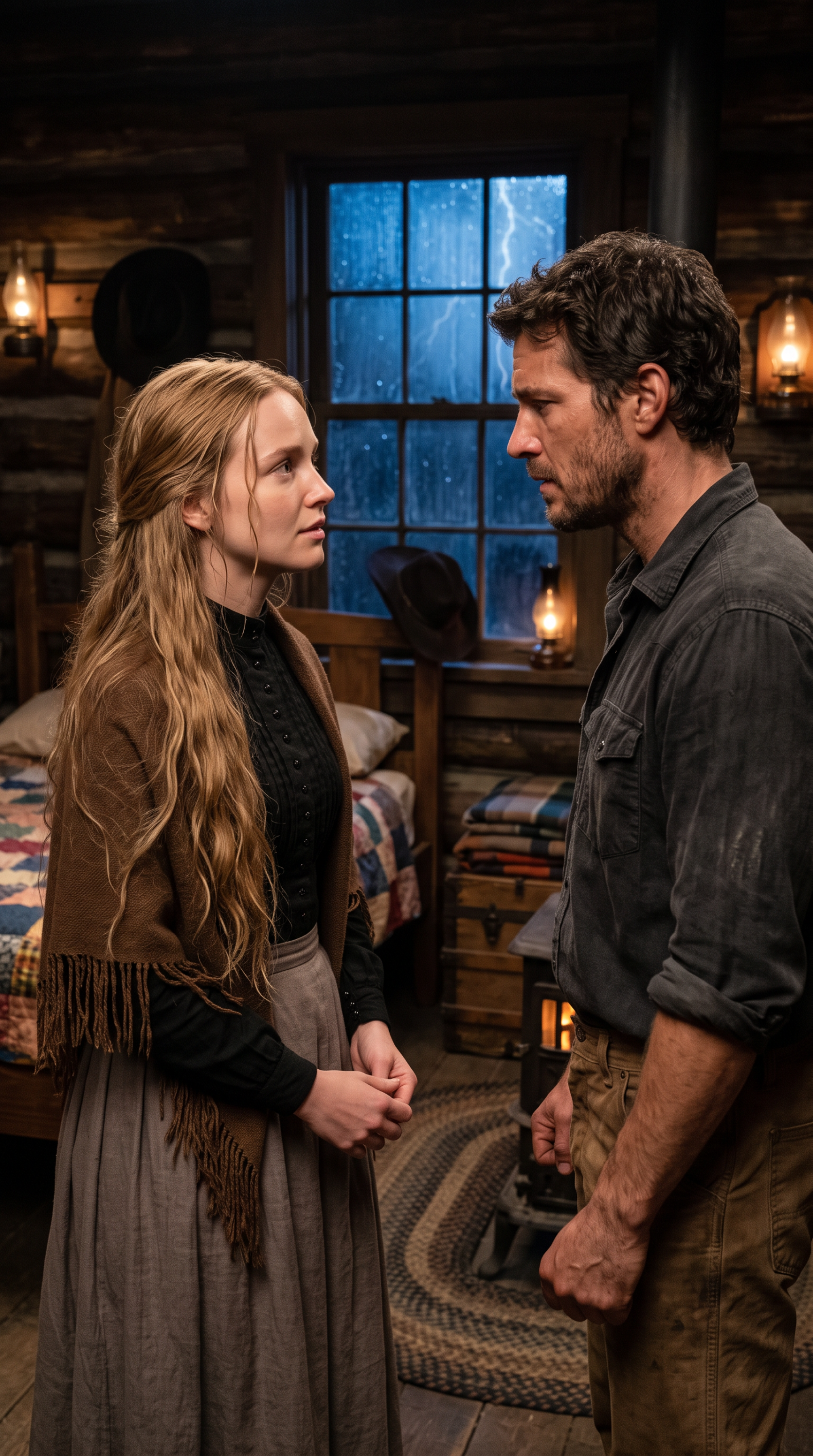
Chapter 1: The Secret He Was Afraid to Tell
“The reason I asked you to come here is because…”
Callaway stopped.
Rain rattled against the roof, and a sudden gust of wind pushed cold air through the cracks around the window. The fire cast long shadows across his weathered face.
The young Irishwoman waited.
Her name was Margaret O’Connell, though the few people who had met her during her journey west had called her Maggie. She had spent twenty-six years learning how to survive disappointment, but something about the expression on Callaway’s face made her feel like a child waiting for bad news.
He rubbed his palm over his beard.
“I have a daughter.”
Maggie stared at him.
For a moment, the only sound was the rain.
“A daughter?”
“Her name is Rose. She’s six years old.”
Maggie slowly lowered the cup she had been holding.
“Where is she?”
“With Mrs. Bell, a widow who lives about five miles east of here. She’s been caring for Rose since last winter.”
“Why?”
Callaway looked toward the window.
“Because I haven’t been much of a father.”
There was no excuse in his voice. No attempt to make himself sound better than he was.
Only shame.
Maggie sat down.
“Is the child ill?”
“No.”
“Then why isn’t she living with you?”
He closed his eyes briefly.
“Her mother died two years ago. Rose was in the house when it happened. She heard everything. By the time I got back from town, my wife was gone, and my little girl had stopped speaking.”
Maggie’s expression softened.
“She hasn’t spoken for two years?”
“Not a word.”
“And you sent her away?”
The question came out sharper than she intended.
Callaway flinched.
“I thought she needed someone who knew how to care for a child. Mrs. Bell had raised four of her own. I thought I could work enough to provide for Rose while she helped her recover.”
“And did she recover?”
“She’s healthier now. She laughs sometimes. But she won’t talk to me.”
He swallowed.
“She looks at me as though I remind her of something she wants to forget.”
Maggie studied him.
“Why didn’t you tell me this in your letter?”
“Because I was ashamed.”
“That isn’t an answer.”
“No.” He looked at her. “It isn’t.”
He drew a long breath.
“I wrote that advertisement because I needed help on the ranch. But when your letter arrived, something changed. You wrote about wanting a place where you could begin again. You said you knew what it meant to lose a home without losing the desire to build another.”
Maggie remembered those words. She had written them late one evening in a boardinghouse, when loneliness had become almost unbearable.
Callaway continued.
“I thought perhaps you might be the kind of person who could help me make this place feel like a home again. I wanted someone who could cook, certainly. But I also hoped that, if you were willing, you might help Rose feel safe here.”
Maggie stared at him.
“You brought me across an ocean because you wanted me to care for your child?”
“No.” His answer came quickly. “I brought you here because I offered you honest work and a chance at a new life. I should have told you about Rose. That was wrong.”
“Very wrong.”
“I know.”
“And what did you expect would happen when I arrived?”
He looked down at his hands.
“I didn’t know. I thought perhaps you’d stay long enough for us to get to know each other. If you wanted to leave after that, I’d help you find another position.”
Maggie stood and walked to the window.
She had imagined many possibilities since boarding the train in New York. She had imagined a lonely rancher, a difficult employer, perhaps even a man who would mistake her poverty for an invitation to control her.
She had not imagined a six-year-old girl sitting in another woman’s house, unable to speak to her own father.
“Does Rose know about me?” she asked.
“Yes. Mrs. Bell told her that a woman was coming to help at the ranch.”
“And what did she say?”
“Nothing.”
Maggie turned.
“Then perhaps she has already said enough.”
Callaway frowned.
“What do you mean?”
“She has been through something terrible. Everyone around her has been waiting for her to speak, haven’t they?”
He did not answer.
“Perhaps she is tired of people waiting.”
For the first time that evening, Callaway looked at her with something other than embarrassment.
“You think you can help her?”
“I think she needs someone who won’t treat her silence as a problem to be solved.”
Maggie returned to the table.
“But I need you to understand something, Mr. Callaway.”
“Caleb,” he said quietly. “My name is Caleb.”
She paused.
“Caleb, I came here because I needed work. I didn’t come looking for a husband, and I didn’t come looking to replace a dead woman.”
“I wouldn’t ask that of you.”
“Good. Because I cannot promise to love your daughter immediately, and I certainly cannot promise that she will love me.”
“I understand.”
“But I can promise to treat her kindly.”
His shoulders sagged with relief.
“That is more than I have any right to ask.”
Maggie studied the broad, scarred man standing before her.
For all his size, he looked painfully small in that moment.
“What happened to your wife?” she asked gently.
Caleb’s face changed.
“Her name was Anna. She was twenty-four when she died. The winter was bitter, and Rose became sick with a fever. Anna went to fetch the doctor when I was away. The wagon overturned on the icy road.”
He stopped.
“I found her beside the road when I came home. Rose had been waiting for her mother to return.”
Maggie felt tears sting her eyes.
“And you believe your daughter blames you?”
“I believe she remembers that I wasn’t there.”
“Children remember things differently from adults.”
“Maybe.”
He glanced toward the bedroom.
“I don’t know how to make her understand that I never meant to leave her alone.”
Maggie reached for her shawl.
“Then perhaps you should stop trying to explain it and start showing her.”
Caleb watched as she crossed the room.
“Where are you going?”
“To fetch your daughter.”
He stared.
“Tonight? In this weather?”
“She has spent enough nights away from her father.”
He looked at the rain hammering the windows.
“You don’t have to do this.”
Maggie lifted her chin.
“I know.”
It was the same answer he had given her earlier.
But now, when she said it, she understood why those three words mattered.
She was choosing to stay.
Not because she owed him.
Not because she had nowhere else to go.
Because a little girl needed someone willing to begin.
Caleb reached for his coat.
“I’ll hitch the wagon.”
Maggie smiled faintly.
“Then let’s go before the storm gets worse.”
Neither of them noticed the small figure standing in the darkness beyond the kitchen doorway.
Rose had come to the ranch earlier that afternoon to collect her father’s spare blanket. Mrs. Bell had promised to bring her back the next morning.
But when the storm began, the child had become frightened and hidden inside the wagon shed.
She had heard every word.
And for the first time in two years, she had a reason to wonder whether home might be a place she could return to.
—
## Chapter 2: The Little Girl Who Would Not Speak
Mrs. Bell lived in a white farmhouse surrounded by bare apple trees and a low wooden fence.
By the time Caleb and Maggie arrived, the rain had softened to a cold drizzle.
A lamp glowed in the front window.
Mrs. Bell opened the door before they had even knocked.
“Caleb! What on earth are you doing out in this weather?”
“I’m here for Rose.”
The older woman’s expression changed.
“Is something wrong?”
“No,” he replied. “At least, I hope not.”
Maggie stepped forward.
“I’m Margaret O’Connell. I’m helping at the ranch.”
Mrs. Bell looked her over, then smiled warmly.
“Oh, you must be the young woman from Ireland. Come inside, dear. You’re soaked through.”
The farmhouse smelled of cinnamon, woodsmoke, and fresh bread.
Maggie immediately understood why Rose had felt comfortable there. Mrs. Bell had filled every room with small signs of care: knitted blankets, framed family photographs, bowls of dried flowers, and little wooden animals on the mantel.
A small pair of boots stood beside the stove.
“Rose is asleep,” Mrs. Bell explained. “She’s had a difficult evening.”
Caleb’s face tightened.
“Why?”
“Thunder. It reminds her of that night.”
He looked away.
Maggie touched his arm.
“Let’s see her.”
They found Rose curled beneath a quilt in a narrow bedroom.
She had dark brown hair, large gray eyes, and a small face that seemed much too serious for a six-year-old.
When she saw Caleb, she immediately pulled the blanket over her head.
He stopped in the doorway.
“Rose?”
The blanket remained still.
“It’s Papa.”
Nothing.
Caleb took one step forward, then stopped.
Maggie watched his expression crumple.
She understood that he wanted to scoop his daughter into his arms, tell her everything would be all right, and carry her home.
But she also understood that Rose was not ready.
“Caleb,” she whispered, “why don’t you wait in the kitchen?”
He looked at her uncertainly.
“Are you sure?”
“Yes.”
After a moment, he nodded and left.
Maggie pulled a chair beside the bed.
“Hello, Rose.”
The blanket shifted slightly.
“My name is Maggie. Your father told me about you.”
No answer.
“I came all the way from Ireland. It’s a very long journey, and the train was so uncomfortable that I thought my bones might fall apart.”
A tiny movement beneath the blanket.
Maggie smiled.
“I thought about complaining to the railway company, but then I remembered that the train was probably built by a man who had never traveled on it himself.”
The blanket moved again.
This time, Maggie heard something that sounded suspiciously like a giggle.
She pretended not to notice.
“I also discovered that American coffee is strong enough to wake the dead. If you ever want to frighten a ghost, give it a cup of that.”
The blanket slipped down just enough for one gray eye to appear.
Maggie continued talking.
She told Rose about the ship that had carried her across the Atlantic, the enormous waves that had made her sick, and the woman who had snored so loudly in the next bunk that Maggie had wondered whether a bear had come aboard.
Rose’s eyes widened.
“And then,” Maggie whispered, “the woman woke up and accused me of making the noise.”
A small smile appeared.
Maggie smiled back.
“There you are.”
Rose immediately hid again.
“That’s all right,” Maggie said. “You don’t have to look at me.”
She took a small cloth rabbit from her pocket.
It had belonged to her younger sister, Nora, who had died of fever when Maggie was seventeen.
The rabbit was old and slightly misshapen, with one button eye and a crooked ear.
“I brought this with me from Ireland,” Maggie said. “His name is Patrick, although I cannot remember why I chose such a serious name for a rabbit.”
She placed it on the bedside table.
“You can borrow him if you like.”
Rose stared at the toy.
Maggie rose.
“I’ll be in the kitchen if you need anything.”
As she reached the doorway, a tiny hand emerged from beneath the blanket.
It touched the rabbit.
Maggie felt her throat tighten.
She did not turn around.
She did not ask Rose to speak.
She simply walked out.
In the kitchen, Caleb was standing beside the stove with his hands braced against the counter.
“Did she say anything?”
“No.”
His face fell.
“But she smiled.”
He looked up.
“She did?”
“Twice.”
For the first time that evening, he looked as though someone had opened a window inside him.
Maggie sat down.
“Caleb, she isn’t refusing to speak because she wants to hurt you. She is frightened. She has lost the person she trusted most, and she doesn’t know whether she can trust the world again.”
He rubbed his eyes.
“How long will it take?”
“I don’t know.”
“What if she never speaks again?”
Maggie considered her answer.
“Then we will learn to listen in other ways.”
He looked at her for a long moment.
“You make everything sound possible.”
“No. I simply don’t believe everything difficult is impossible.”
They returned to the ranch the following morning with Rose sitting between them on the wagon seat.
The child held the cloth rabbit tightly.
She did not speak to Caleb.
But she did not hide when he reached for the reins, either.
When they arrived, Maggie carried Rose’s small bag into the bedroom and helped her arrange her clothes.
Then she showed her the kitchen, the barn, and the garden patch beside the house.
Rose examined everything solemnly.
Finally, she pointed toward the old rocking chair beside the window.
“That’s where your father sits when he reads,” Maggie explained.
Rose touched the armrest.
Then she looked toward Caleb.
He stood in the doorway, watching them.
For one brief moment, Rose’s expression softened.
Caleb took a hesitant step forward.
Rose immediately turned away.
He stopped.
Maggie saw the pain in his face.
But she also saw something new.
He did not demand that his daughter look at him.
He did not ask why she was still angry.
He simply walked to the stove and began preparing breakfast.
And that morning, for the first time in two years, Rose ate at the same table as her father.
She sat beside Maggie.
Caleb sat across from them.
No one mentioned the silence.
But the little house felt less empty than it had the day before.
—
## Chapter 3: A Home Made of Small Things
The first month passed without any dramatic changes.
Rose did not suddenly begin speaking. She did not throw her arms around Caleb or ask him to tell her stories about her mother.
Instead, she began leaving small signs of trust.
A wooden horse appeared beside Caleb’s boots one morning.
A drawing of three people sitting beneath a yellow sun was placed on Maggie’s pillow.
One evening, Maggie discovered a tiny handprint drawn in flour on the kitchen table.
She knew it was Rose’s because the child had been helping her knead bread.
Maggie did not clean it away immediately.
When Caleb noticed it, he stood staring at the handprint.
“That’s hers,” he said quietly.
“Yes.”
He touched the flour with one finger.
“She used to do this when she was little. Anna would let her help make biscuits.”
Maggie watched him.
“Tell me about Anna.”
Caleb looked surprised.
“Why?”
“Because Rose loves her. And because I cannot help a child understand her memories if I know nothing about the person she misses.”
He sat down.
For a while, he said nothing.
Then he began telling Maggie about his wife.
Anna had been cheerful, impatient, and endlessly curious. She loved wildflowers and hated mending socks. She could ride a horse better than most men in the county, but she cried whenever she saw a wounded bird.
“She once brought a half-dead crow into the kitchen,” Caleb said. “Insisted it needed soup.”
Maggie laughed.
“What happened?”
“The crow stole a piece of bacon and flew away through the window.”
“And Anna?”
“Declared it a success.”
Maggie laughed again.
Caleb watched her.
“I haven’t told those stories in a long time.”
“Perhaps you should tell them more often.”
He shook his head.
“I thought talking about Anna would make Rose sad.”
“Perhaps it does. But sadness isn’t always something we must prevent. Sometimes it’s something we need to share.”
Caleb stared at the table.
“I was so frightened of seeing her cry that I stopped mentioning her mother at all.”
“And Rose may have thought that meant she was supposed to forget.”
His face tightened.
“Good Lord.”
Maggie reached for his hand.
“You were grieving too, Caleb. You did what you thought was best.”
“It wasn’t enough.”
“No. But you can begin again.”
That evening, Caleb brought Rose a small wooden bird he had carved during the afternoon.
He placed it on the table beside her.
“I made this for you,” he said.
Rose examined it.
“Your mother liked birds. She once tried to raise a crow in the kitchen.”
Rose’s eyes widened.
Caleb smiled faintly.
“It stole our bacon and flew away.”
For a moment, Rose seemed confused.
Then a tiny sound escaped her.
It was not a word.
It was a laugh.
Caleb froze.
Rose looked at him, startled by her own reaction.
Then she ran to the bedroom.
Caleb remained standing beside the table.
Maggie approached him.
“You heard her.”
He nodded, unable to speak.
“She laughed.”
“Yes.”
His eyes filled with tears.
Maggie slipped her hand into his.
“That’s a beginning.”
He turned toward her.
“Thank you.”
She shook her head.
“Don’t thank me for being kind to your daughter.”
“I’m not thanking you for that.”
He looked at her with an expression she had begun to recognize.
“I am thanking you for helping me remember how to be her father.”
Maggie felt warmth spread through her chest.
She had arrived in Colorado expecting to earn enough money to survive.
She had not expected to become part of a family.
And she certainly had not expected to find herself looking forward to the sound of Caleb’s footsteps outside the kitchen each evening.
He was still awkward around her.
He apologized whenever their hands touched unexpectedly. He asked permission before sitting beside her on the porch. Sometimes, when she caught him watching her, he looked away so quickly that she nearly laughed.
But he was kind.
He worked hard.
And when he listened to her, she never felt that her words were less important than his.
One Sunday afternoon, they walked together along the creek while Rose played nearby.
Caleb carried a basket of freshly washed blankets. Maggie carried a jar of blackberry preserves.
“You know,” she said, “I thought the American West would be filled with adventure.”
He glanced at her.
“Isn’t it?”
“So far, I’ve washed more socks than I’ve seen wild horses.”
He laughed.
“Give it time.”
“And I imagined cowboys were all tall, handsome men who sang to their horses.”
“What do you think now?”
She examined him thoughtfully.
“I think most cowboys are tall men who smell of leather and forget to wash their cups.”
He looked offended.
“I wash my cups.”
“Occasionally.”
He laughed so hard that the basket nearly slipped from his hands.
Rose watched them from the creek bank.
Then, slowly, she smiled.
Maggie noticed.
So did Caleb.
Neither said anything.
But that evening, when Maggie tucked Rose into bed, the child reached for her hand.
Maggie sat beside her until her breathing grew slow and even.
Just before she fell asleep, Rose moved her lips.
No sound emerged.
Maggie leaned closer.
“What is it, darling?”
Rose touched the cloth rabbit.
Then she pointed toward the door.
“Papa?” Maggie whispered.
Rose nodded.
Maggie kissed her forehead.
“I’ll tell him you’re thinking of him.”
Rose closed her eyes.
Outside, Caleb stood on the porch, staring at the stars.
For the first time in two years, he allowed himself to hope that his daughter might someday call him Papa without pain.
And for the first time since arriving in America, Maggie found herself wondering whether she had finally reached the place where she belonged.
—
## Chapter 4: The Man Who Wanted to Buy the Ranch
The trouble began with a black carriage.
It arrived on a bright morning in early spring, when the snow had nearly disappeared from the lower pastures.
A well-dressed man climbed down from the carriage and adjusted his gloves.
He was in his late forties, with neatly combed hair, a polished walking stick, and a smile that never quite reached his eyes.
“Mr. Callaway,” he called.
Caleb stepped out of the barn.
“Mr. Whitcomb.”
The stranger glanced toward the house.
“I see you’ve acquired some help.”
Maggie was standing on the porch with Rose.
She immediately disliked the way he looked at them, as though he were inspecting furniture in a shop.
“Mrs. O’Connell,” Caleb said, introducing her. “And my daughter, Rose.”
Whitcomb tipped his hat.
“Charmed.”
Rose moved closer to Maggie.
Whitcomb noticed.
“Still silent, I see.”
Caleb’s expression hardened.
“What do you want?”
“To discuss business.”
They went inside.
Maggie remained near the kitchen doorway, pretending to arrange the shelves while listening.
Whitcomb spread a map across the table.
“The railway company is extending its line through this region. Your property lies directly along the proposed route.”
Caleb glanced at the map.
“I’ve heard rumors.”
“They’re more than rumors. The company wants the land, and I have been authorized to negotiate a purchase.”
“How much?”
Whitcomb named a figure.
Maggie nearly dropped a plate.
It was an enormous sum.
Enough to buy a comfortable house in town, pay off every debt Caleb might have, and leave money for Rose’s future.
Caleb barely looked at the number.
“No.”
Whitcomb blinked.
“You haven’t even considered it.”
“I have.”
“You could purchase a larger ranch elsewhere.”
“I don’t want another ranch.”
Whitcomb’s smile disappeared.
“Mr. Callaway, I suggest you think carefully. The railway will come through here whether you sell or not. If you cooperate, you will be compensated generously. If you resist, you may find yourself surrounded by construction crews and legal disputes.”
Caleb folded the map.
“Then I’ll deal with them when they arrive.”
Whitcomb stood.
“You are making a foolish decision.”
“Perhaps.”
The visitor turned toward the door.
Then he paused beside Maggie.
“Mrs. O’Connell, I hope you understand that a woman in your circumstances should encourage her employer to think practically.”
Maggie met his gaze.
“I find that men who tell women to think practically usually mean they should think as the men wish.”
Whitcomb’s face reddened.
Caleb’s mouth twitched.
The stranger left without another word.
That evening, Caleb sat at the kitchen table examining the map.
Maggie placed a cup of tea beside him.
“You could have sold the land,” she said.
“Yes.”
“Why didn’t you?”
He stared toward the window.
“My father built the first cabin here. I planted the trees beside the creek with Anna. Rose took her first steps on that porch.”
He swallowed.
“Some things cannot be replaced with money.”
Maggie sat across from him.
“I understand.”
He looked up.
“Do you?”
She nodded.
“When my mother died, we had to sell the little house where I grew up. I remember standing outside it the day the new owners arrived. I wanted to tell them that the marks on the kitchen wall were mine and that the apple tree in the garden had been planted by my father.”
Her eyes grew distant.
“But they didn’t know any of that. To them, it was simply a house.”
Caleb reached for her hand.
“I’m sorry.”
She smiled sadly.
“So am I. But I learned that a home is more than the building itself.”
She squeezed his fingers.
“Perhaps that’s why I wanted to come here.”
He studied her face.
“Because of the ranch?”
“Because I wanted to make something again. Something that couldn’t be taken from me simply because a man had decided I didn’t deserve it.”
Caleb’s eyes softened.
“You deserve far more than you know.”
For a moment, neither spoke.
Then he looked down at their joined hands.
“Maggie, there is something I’ve wanted to ask you.”
She felt her heart begin to beat faster.
“What is it?”
“Would you consider staying here permanently?”
She stared at him.
“As your cook?”
He shook his head.
“No.”
“As Rose’s governess?”
“No.”
“Then what?”
He drew a slow breath.
“As my wife.”
The words seemed to fill the room.
Maggie slowly withdrew her hand.
Caleb immediately looked stricken.
“I shouldn’t have asked. I know you’ve only been here a few weeks, and I don’t want you to feel trapped.”
“Caleb—”
“I mean it. You can leave whenever you wish. I’ll pay you what I owe, and I’ll help you find a position in town. You don’t owe me an answer tonight.”
She stared at him.
“Why do you want to marry me?”
He looked at her as though the question was the simplest thing in the world.
“Because I think about you when you’re not here. Because the house feels empty when you go into town. Because I find myself saving stories to tell you at supper.”
He paused.
“And because when Rose laughs, I look for you to see if you heard it too.”
Maggie’s eyes filled.
Caleb continued, his voice growing quieter.
“I know I’m not a polished man. I cannot offer you a grand house or a life without hardship. But I can promise you a place where your voice matters. Where you can disagree with me. Where you will never have to wonder whether kindness comes with a price.”
Maggie looked toward the window.
She had not expected to fall in love in Colorado.
She had not even expected to like the man who had hired her.
But somewhere between the first loaf of bread and the first evening spent listening to rain on the roof, Caleb had become more than an employer.
He had become the person she wanted to see at the end of each day.
Still, she was afraid.
She had once believed that marriage would protect her from uncertainty. Instead, it had taught her how easily love could become a cage.
“Caleb,” she said carefully, “I cannot promise you an answer simply because you have been kind to me.”
“I wouldn’t ask you to.”
“And I cannot marry you because Rose needs a mother.”
He nodded.
“I know.”
“If I ever marry again, it must be because I want the man. Not because a child needs someone to care for her.”
Caleb looked at her.
“And do you want me?”
Maggie swallowed.
The honest answer frightened her.
“Yes,” she whispered. “I think I do.”
His expression changed.
But before he could speak, a loud crash came from the bedroom.
They hurried down the hall.
Rose stood beside a fallen chair, her face pale with terror. A framed photograph of Anna lay broken on the floor.
The child stared at the shattered glass.
Then she looked at Maggie.
Her lips trembled.
And suddenly, a word emerged.
“No!”
Caleb stopped in the doorway.
Rose pointed at Maggie, then at the photograph.
“No Mama!”
The words came again, louder this time.
“No Mama!”
Maggie’s heart broke.
Caleb dropped to his knees.
“Rose, darling—”
But Rose was already backing away.
She ran into the corner of the room, shaking her head.
“No Mama! No!”
Maggie stood motionless.
She understood now.
Rose had finally begun to trust her, but the thought of Maggie becoming part of the family had frightened her.
To the little girl, loving Maggie might mean betraying Anna.
And no amount of kindness could make that fear disappear overnight.
Maggie knelt several feet away.
“Rose, look at me.”
The child sobbed.
“I will never ask you to stop loving your mother.”
Rose looked up.
“Never,” Maggie repeated.
She picked up the broken photograph and carefully set it on the dresser.
“Your mother will always be your mother. Nobody can take her place.”
Rose’s breathing slowly eased.
Maggie held out her hand.
“You can love your mother and still let someone else care about you. Those things can exist together.”
The child stared at her.
Then she crawled into Maggie’s arms.
Caleb turned away, wiping his eyes.
For several minutes, the room remained quiet.
Then Rose lifted her head from Maggie’s shoulder.
She looked at her father.
Her lips moved.
“Papa.”
The word was barely audible.
But Caleb heard it.
He sank to his knees.
Rose reached for him.
And when he gathered her into his arms, she did not pull away.
For the first time in two years, father and daughter held one another without fear.
Maggie sat beside them, crying quietly.
She knew then that whatever happened between her and Caleb, something important had changed.
The house was no longer simply a place where three lonely people happened to live.
It was becoming a family.
—
## Chapter 5: The Letter from Ireland
Three days after Rose spoke her first words, a letter arrived from Ireland.
Maggie recognized the handwriting immediately.
Her older brother, Patrick, had written to her only twice since she left.
The first letter had arrived while she was still aboard the ship.
The second had come months later, explaining that their father’s health was failing.
Maggie had replied to both.
Neither answer had ever reached her family.
Now, holding the familiar envelope, she felt the past rise around her.
She opened it beside the kitchen window.
*My dear Maggie,*
*I have written to you many times, though I fear my letters have not found you.*
*Father died in January. He spoke of you during his final days and asked whether you had found the happiness you deserved.*
*I told him that I believed you had.*
*I hope I was right.*
Maggie’s eyes filled with tears.
She sat down.
The letter continued.
*There is something else you should know. Before Father died, he gave me a small packet of papers that belonged to Mother. Among them was a letter addressed to you.*
*I have enclosed it.*
*I do not know what she intended to tell you, but I believe you should read it.*
Maggie unfolded the second letter.
The handwriting was her mother’s.
She had not seen it in years.
*My darling Margaret,*
*If you are reading this, then I have failed to tell you something I should have told you long ago.*
*Your father and I were never wealthy, but there was a time when we believed we might leave Ireland and build a new life in America.*
*When I was young, I had a brother who traveled west. His name was Michael O’Connell.*
*He settled in Colorado and worked on a ranch owned by a kind man named Thomas Callaway.*
Maggie stopped reading.
Thomas Callaway.
Caleb’s father.
She continued.
*Michael wrote to us for several years. He spoke of the mountains, the cattle, and the beautiful land where he hoped to build a permanent home.*
*He also told us about the Callaway family. Thomas was generous to him when he had no money, and Michael never forgot that kindness.*
*After Michael died, Thomas sent us the money to bring his body home. He wrote that my brother had been like family to him.*
*I kept those letters because I wanted you to know that kindness can travel farther than we imagine.*
Maggie stared at the page.
Her mother had never mentioned an uncle who had traveled to America.
She had grown up believing that nearly all her relatives had remained in Ireland.
She read the final paragraph.
*There was one other thing Michael asked me to do.*
*He wanted me to send his old pocket watch to Thomas Callaway’s son when the time was right. He believed that one day the boy would need reminding that the world was not entirely cruel.*
*I never sent it. I was afraid the parcel would be lost, and after your father became ill, I forgot.*
*The watch is in the small wooden box beneath my bed.*
*If you ever travel to Colorado, perhaps you can deliver it.*
Maggie lowered the letter.
Her hands trembled.
She had come to the ranch because of a newspaper advertisement.
She had accepted the position because she needed work.
And now she had discovered that her family had once been connected to Caleb’s.
She rose and hurried into the main room.
Caleb was repairing a harness.
“Caleb, I need to tell you something.”
He looked up immediately.
“What happened?”
She handed him the letter.
He read it slowly.
When he reached the name of his father, his expression changed.
“Your uncle worked for my father?”
“For a short time, apparently.”
Caleb sat down.
“Father never mentioned a nephew or niece.”
“Perhaps he never knew Michael had family in Ireland.”
He read the letter again.
Then he looked at Maggie.
“Do you have the watch?”
“No. It’s still in Ireland.”
Caleb was silent for a long time.
Finally, he said, “My father kept a small box of letters in his desk. I remember seeing one from a man named Michael.”
Maggie stared.
“You do?”
He nodded.
“He used to tell me that Michael was the best horseman he’d ever known. Said he could ride a wild stallion as if the animal had been born beneath him.”
A faint smile crossed his face.
“He also said Michael had a terrible habit of singing while he worked.”
Maggie laughed through her tears.
“That sounds like my family.”
Caleb returned the letter.
“I wish your mother had sent the watch.”
“So do I.”
He took her hand.
“But perhaps the fact that you came here is enough.”
Maggie looked at him.
“Do you believe that?”
“I believe our families were connected long before either of us knew it.”
He paused.
“But I don’t want you to think that means you owe me anything.”
She smiled.
“You really do have a habit of saying that.”
“Because I mean it.”
She leaned forward and kissed his cheek.
“I know.”
That evening, Maggie sat beside Caleb on the porch.
They talked about their families, the people they had lost, and the places they hoped to visit someday.
For the first time, Maggie told him about the years before her father’s death.
She described the cold rooms, the unpaid bills, and the way her former employer’s son had begun following her home from work.
She had left Ireland not because she disliked her country, but because she had become frightened of a future in which her choices grew smaller every year.
Caleb listened without interrupting.
When she finished, he took her hand.
“You should never have had to face that alone.”
She rested her head against his shoulder.
“Neither should you.”
They sat quietly beneath the stars.
And Maggie began to understand that love was not always a lightning strike.
Sometimes it was the slow discovery that another person could hear the worst parts of your story without looking away.
—
## Chapter 6: The Night the Truth Came Out
The railway company returned in early summer.
This time, Whitcomb brought two lawyers and a surveyor.
They announced that the proposed route would cross the northern edge of the Callaway property.
Caleb refused to sign the agreement.
Whitcomb warned him that the company would challenge his land boundaries.
Caleb told him to do what he believed necessary.
The men left.
Three days later, a notice arrived stating that part of the ranch had been claimed by a distant investor who argued that the original property records were incomplete.
Caleb read the document twice.
Then he sat down heavily.
“They’re trying to take the land.”
Maggie examined the papers.
“Is the claim legitimate?”
“I don’t know.”
“Where are the original deeds?”
“In the old trunk beneath the bed.”
They spent the afternoon searching through the documents.
Some were faded and brittle. Others had been damaged by years of smoke and moisture.
But one paper was missing.
The original survey map.
Without it, proving the boundaries would be difficult.
Caleb stood by the stove, his face pale with anger.
“My father kept everything.”
“Perhaps he moved it.”
“I searched the trunk.”
“Then we should search somewhere else.”
He looked at her.
“You think it might still be here?”
“I think we should look before assuming it’s gone.”
They searched the barn, the shed, and the old storage room.
Nothing.
As evening approached, Caleb sat on the porch, staring at the mountains.
Maggie brought him a cup of tea.
“What will happen if they win?”
“I don’t know.”
“Could you buy another property?”
“Not one like this.”
He rubbed his face.
“My father worked his whole life to build this place. I spent my childhood here. Rose took her first steps in that kitchen.”
He looked at her.
“I cannot lose it.”
Maggie sat beside him.
“Then we will do everything we can to keep it.”
He shook his head.
“You’ve already given so much.”
“Caleb, stop deciding how much I am allowed to give.”
He looked startled.
She continued.
“I know what it means to lose a home. I know what it means to be told that someone else has a better claim to your future.”
She took his hand.
“But I am not a guest here anymore. This is my home too.”
His eyes filled.
“You would stay even if we lost the ranch?”
Maggie looked at him steadily.
“I would stay even if we had to leave Colorado. I would stay if we lived in a little house in town. I would stay if we had to begin again with nothing.”
She paused.
“But I would rather fight to keep what we’ve built.”
Caleb drew her into his arms.
For several minutes, neither spoke.
Then Rose appeared in the doorway holding a small wooden box.
“Papa?”
Caleb turned.
“What is it, sweetheart?”
Rose held out the box.
“I found it.”
The words were clear.
Caleb stared at her.
Maggie covered her mouth.
Rose looked uncertain.
“Is that wrong?”
Caleb rose so quickly that his chair nearly fell over.
“No, darling. No. It’s wonderful.”
He knelt in front of her.
“You spoke.”
Rose smiled shyly.
“I did.”
He gathered her into his arms.
Maggie knelt beside them, crying.
Rose had spoken before, but this was different.
She had not simply repeated a word in fear or surprise.
She had chosen to tell them something.
She had trusted them enough to let her voice be heard.
After the excitement settled, Rose opened the wooden box.
Inside lay a collection of old papers, a brass compass, and a folded map.
Caleb stared.
“That’s Father’s survey box.”
Rose nodded.
“It was behind the flour barrels.”
Maggie laughed softly.
“You have a very good eye, darling.”
Caleb unfolded the map.
There it was.
The original survey, complete with the signatures of the county surveyor and two witnesses.
He looked at Rose as though she had just handed him a fortune.
“You’ve saved the ranch.”
Rose’s eyes widened.
“Really?”
“Really.”
She smiled.
Then she looked toward Maggie.
“Mama?”
The word fell softly into the room.
Maggie stopped breathing.
Rose immediately covered her mouth.
“I mean—”
Maggie knelt before her.
“It’s all right.”
Rose’s eyes filled with tears.
“I didn’t mean to forget my real mama.”
Maggie gathered her gently into her arms.
“You haven’t forgotten her, sweetheart. You could never forget her.”
Rose began to cry.
“I miss her.”
“I know.”
“I want her to come home.”
Maggie held her tighter.
“So do I wish she could.”
Rose cried for a long time.
Maggie did not tell her to stop.
She did not try to replace Anna with cheerful stories or distractions.
She simply held the child while the grief that had been trapped inside her for two years finally found a way out.
When Rose had calmed, she looked up.
“Can I call you Mama Maggie?”
Maggie’s tears fell freely.
“Of course you can.”
Rose hugged her again.
Across the room, Caleb stood with his hand over his mouth.
He had spent two years believing his daughter had lost the ability to speak because he had failed her.
Now he understood that she had been waiting for a place where she could speak without fear.
Maggie had not forced her to return to the world.
She had made the world feel safe enough for Rose to return on her own.
That night, after Rose was asleep, Caleb found Maggie sitting beside the fireplace.
He knelt in front of her.
“I love you.”
She looked at him.
He had said it before, but this time his voice held no uncertainty.
“I love you, Maggie. Not because you’ve helped Rose. Not because you can turn a broken house into a home. I love you because you are the woman I want beside me when life is difficult and when it’s wonderful.”
He took her hands.
“I want to marry you. I want to grow old with you. And I want to spend the rest of my life making sure you never regret choosing me.”
Maggie’s heart filled.
She touched his cheek.
“I love you too, Caleb.”
He smiled.
“Is that a yes?”
She laughed through her tears.
“Yes, you stubborn cowboy. It’s a yes.”
He kissed her gently.
And when he drew back, she rested her forehead against his.
For the first time in his life, Caleb Callaway no longer felt that happiness was something he had to earn by suffering.
He simply allowed himself to receive it.
—
## Chapter 7: The Wedding Beneath the Cottonwoods
They married in late summer.
The ceremony took place beneath two enormous cottonwood trees beside the creek.
Mrs. Bell brought flowers from her garden. Abigail, the schoolteacher from the settlement, arranged the benches. The local minister arrived on horseback and complained about the heat until Rose offered him a glass of lemonade.
Maggie wore a simple ivory dress she had sewn herself.
Her blond hair fell in natural curls around her shoulders, and a small bouquet of wildflowers rested in her hands.
Caleb wore his best dark suit.
He had polished his boots twice, shaved carefully, and spent the entire morning asking whether his collar looked crooked.
When Maggie finally appeared, he forgot every question he had intended to ask.
She smiled.
“Is something wrong?”
He shook his head.
“No.”
“You look as though you’ve seen a ghost.”
“Not a ghost.”
He took a breath.
“An angel, perhaps.”
Maggie laughed.
“That’s a terrible line.”
“I know. I’ve been practicing all week.”
She squeezed his hand.
“You’ll have to practice harder.”
He grinned.
Then the minister began.
Rose stood beside Maggie, holding her hand.
When the vows came, Caleb’s voice trembled.
“I promise to respect you, to listen to you, and to stand beside you in the difficult days as well as the good ones. I promise never to mistake your kindness for weakness or your love for something I am entitled to.”
Maggie’s eyes filled.
She answered with vows of her own.
“I promise to be honest with you, to build a home with you, and to remember that love is not proven by how much we sacrifice, but by how faithfully we care for one another. I promise to laugh with you, argue with you, and never let you believe that you must face the world alone.”
When the minister pronounced them husband and wife, Caleb kissed her.
The people gathered beneath the cottonwoods cheered.
Rose clapped so enthusiastically that she nearly dropped the flowers.
Later, while everyone ate beneath the trees, Maggie found Caleb standing beside the creek.
He was holding a small wooden box.
“What is that?” she asked.
He opened it.
Inside lay a silver pocket watch.
Maggie stared.
“Where did you get it?”
“Mrs. Bell found it among the things your brother sent. The parcel arrived this morning.”
Maggie’s hands flew to her mouth.
“Patrick sent it?”
Caleb nodded.
A letter lay beneath the watch.
Maggie opened it.
*Dear Maggie,*
*I hope this reaches you in time.*
*I found the watch beneath Mother’s bed, just as she said. I sent it because I thought you might want to fulfill her wish.*
*I have also enclosed a photograph of our family. Father kept it until the day he died.*
Maggie unfolded the photograph.
There stood her parents, her brother, and a younger version of herself.
She began to cry.
Caleb wrapped his arms around her.
“I know it’s difficult to be so far from home.”
She shook her head.
“These are happy tears.”
She placed the watch in his hand.
“My uncle wanted you to have this.”
Caleb stared at the silver casing.
The back bore a small inscription.
*To Thomas Callaway’s son, with gratitude for the kindness shown to a man far from home.*
Caleb closed his eyes.
For a moment, he felt his father’s presence so strongly that he could almost hear his voice.
He looked at Maggie.
“Our families have been trying to bring us together for years.”
She smiled.
“Perhaps they simply needed us to be stubborn enough to find our way here.”
He laughed softly.
Then he slipped the watch into his pocket.
They returned to the celebration hand in hand.
As the sun lowered behind the mountains, someone began playing a fiddle.
Caleb looked at Maggie.
“Would you dance with me?”
She raised an eyebrow.
“Can you dance?”
“Not particularly.”
“Then I suppose I must teach you.”
He held out his hand.
She took it.
They moved awkwardly across the grass, laughing whenever Caleb stepped on her foot.
Rose watched them with delight.
Then she ran toward the minister.
“Sir! Can I dance too?”
The minister blinked.
“You most certainly can.”
And beneath the cottonwoods, while the fiddle played and the mountains glowed in the evening light, three people who had once been separated by grief found themselves surrounded by something they had almost forgotten to hope for.
A future.
—
## Chapter 8: The Storm That Tested Their Love
Happiness did not make the world gentle.
The following autumn, a severe storm swept through the valley.
Rain fell for two days without stopping. The creek rose rapidly, flooding the lower pasture and threatening the bridge that connected the ranch to the main road.
Caleb worked from dawn until dark, moving livestock to higher ground and reinforcing the barn.
Maggie organized food and blankets while Rose helped carry small supplies.
On the second evening, Caleb returned from the lower pasture with a deep cut across his forehead.
Maggie gasped.
“What happened?”
“A branch came down.”
“Sit.”
“It’s nothing.”
“Caleb.”
He sat.
She cleaned the wound while he winced.
“You could have been killed.”
“I wasn’t.”
“That is not a satisfactory answer.”
He smiled faintly.
“You sound like my wife.”
“I am your wife.”
“Then I suppose I’m in trouble.”
She tried not to smile.
When she finished bandaging the cut, she pressed her forehead against his.
“Please be careful.”
He wrapped his arms around her.
“I will.”
But an hour later, a frantic pounding sounded at the door.
Mrs. Bell stood on the porch, drenched and terrified.
“The bridge is gone!”
Caleb rose immediately.
“What?”
“The creek has washed it away. Two men are stranded on the other side, and one of them is injured.”
Caleb reached for his coat.
Maggie caught his arm.
“You cannot go out in that storm.”
“They’ll die if nobody reaches them.”
“Then take another man with you.”
“There isn’t time.”
He pulled on his boots.
Maggie’s heart pounded.
“Caleb, please.”
He stopped.
For a moment, she saw the conflict in his face.
He wanted to help.
But he also knew what it would mean to leave her and Rose waiting through another terrible night.
He returned to her.
He took her face gently between his hands.
“I love you.”
Her eyes filled.
“Don’t say that as though you’re saying goodbye.”
“I’m not.”
He kissed her forehead.
“I am coming home.”
Then he left.
Maggie stood at the window until his lantern disappeared into the darkness.
The hours that followed were the longest of her life.
Rose sat beside her, clutching the cloth rabbit.
Neither spoke.
At midnight, the wind grew stronger.
At one, the rain became so heavy that the windows rattled.
At two, Maggie heard horses.
She ran to the door.
Caleb stumbled inside, soaked and exhausted, supporting an injured ranch hand.
Behind them came two other men carrying a stretcher.
Maggie rushed forward.
“Caleb!”
He smiled weakly.
“I’m home.”
She threw her arms around him.
For a moment, neither cared about the mud, the rain, or the exhausted men crowding the room.
Then Caleb winced.
Maggie pulled back.
“What happened?”
“Slipped on the rocks.”
She looked at his arm.
Blood had soaked through his sleeve.
Her heart stopped.
“Caleb!”
“It’s only a cut.”
She stared at him.
“You are the most infuriating man I have ever known.”
He laughed weakly.
“I’ve heard that before.”
She helped him sit while the others carried the injured man to the spare room.
The cut on Caleb’s arm was deep but not dangerous.
By dawn, the storm had begun to weaken.
The bridge was gone, part of the pasture had flooded, and several fences needed repair.
But everyone was alive.
Maggie sat beside Caleb’s bed while he slept.
Rose curled up in the chair beside her.
For the first time since arriving in Colorado, Maggie allowed herself to admit how frightened she had been.
She had fallen in love with a man who would risk his life to help others.
It was one of the things she admired most about him.
It was also one of the things that terrified her.
When Caleb woke, she was still holding his hand.
He blinked.
“You stayed.”
She looked at him in disbelief.
“Of course I stayed.”
He smiled faintly.
“I thought perhaps you might be angry.”
“I am furious.”
He nodded solemnly.
“That seems fair.”
She leaned forward and kissed him.
Then she rested her forehead against his.
“Next time you go into a storm, remember that someone is waiting for you to come home.”
His expression softened.
“I will.”
“And if you are in danger, ask for help.”
“I will try.”
“No. Promise.”
He looked at her.
“I promise.”
She kissed him again.
Outside, the creek continued rushing through the valley.
The storm had taken part of their land and destroyed the bridge.
But it had also reminded them of something important.
Love did not mean keeping one another safe from every danger.
It meant remembering that every risk affected someone else.
It meant coming home whenever possible.
And it meant never treating the people waiting for you as though their fear mattered less than your courage.
—
## Chapter 9: The Ranch They Refused to Lose
The legal dispute over the ranch continued through the winter.
Whitcomb’s lawyers argued that the railway company had a right to cross the northern pasture.
Caleb’s attorney insisted that the original survey proved otherwise.
The case dragged on for months.
Maggie organized the documents, copied letters, and prepared detailed accounts of the property boundaries.
She had learned bookkeeping while working for a merchant in Ireland, and her careful records proved invaluable.
When the hearing finally began, Caleb sat beside her in the small courthouse.
Rose waited with Mrs. Bell outside.
Whitcomb’s lawyer argued that the Callaway property records were incomplete and unreliable.
Maggie’s attorney presented the original survey, the county register, and sworn statements from two elderly neighbors who remembered the boundaries being marked.
Then Maggie took the stand.
She explained how the original map had been discovered, how the documents had been preserved, and why the company’s proposed route would cross land that did not belong to it.
The opposing lawyer tried to intimidate her.
“Mrs. Callaway, you are not a surveyor, are you?”
“No.”
“You are not a lawyer?”
“No.”
“Then what makes you qualified to interpret these documents?”
Maggie looked at him calmly.
“I am qualified to read them.”
A few people in the courtroom laughed.
The lawyer’s face reddened.
He continued.
“Isn’t it true that you arrived in Colorado with almost no money and accepted employment from Mr. Callaway?”
“Yes.”
“And that you subsequently married him?”
“Yes.”
“So your testimony is hardly impartial, is it?”
Maggie considered the question.
“My husband and I would prefer to keep our home. That does not change the measurements written on a survey or the signatures recorded in a county register.”
The courtroom fell silent.
She continued.
“You may question my motives, sir. But you cannot change the facts by questioning the person who presents them.”
Caleb looked at her with quiet pride.
The judge examined the documents for several minutes.
Then he ruled in the Callaways’ favor.
The railway company could negotiate for a right of passage, but it could not seize the disputed land.
Whitcomb’s face darkened.
Caleb stood.
“Thank you, Your Honor.”
Outside the courthouse, Maggie embraced him.
“We did it.”
He laughed.
“You did it.”
“We did it,” she repeated.
He drew her close.
“You were magnificent.”
She smiled.
“I was terrified.”
“Couldn’t tell.”
“That is because you were too busy looking at me as though I had hung the moon.”
He laughed.
“I might have been.”
They returned to the ranch that evening.
Rose ran toward them before they had even climbed down from the wagon.
“Did we win?”
Caleb lifted her into his arms.
“We did.”
Rose cheered.
Maggie kissed her cheek.
“And now we are going to celebrate.”
They made a large supper, baked an apple pie, and invited Mrs. Bell and several neighbors.
For the first time in months, the house was filled with laughter.
Later, after everyone had gone home, Maggie sat beside Caleb on the porch.
The stars shone brightly above the mountains.
“Do you ever think about what would have happened if I had never answered your advertisement?” she asked.
Caleb considered the question.
“I would probably still be eating burnt biscuits.”
She laughed.
“Your biscuits were not that bad.”
“They were terrible.”
“Some were.”
He smiled.
“But I would have been alone. Rose would still have been frightened. And I would never have known what it felt like to have someone waiting for me at the end of the day.”
Maggie rested her head against his shoulder.
“I might have found another job.”
“Perhaps.”
“Perhaps I would have returned to Ireland.”
“Perhaps.”
She looked at him.
“Does that frighten you?”
He thought for a moment.
“No.”
“Why not?”
“Because I know you chose this life. And I know you can choose differently if you ever need to.”
He kissed her forehead.
“I want you to stay because you want to stay, Maggie. Not because you believe you have nowhere else to go.”
Her eyes filled.
She took his hand.
“That is why I will stay.”
He looked at her.
“Because you have nowhere else to go?”
She shook her head.
“Because I have finally found somewhere I want to be.”
He kissed her.
And in the quiet of the mountain night, with their home standing solid behind them, Maggie understood that the greatest gift Caleb had ever given her was not the ranch, the money, or the promise of marriage.
It was the freedom to choose him.
Every day.
—
## Chapter 10: The Family They Built
Three years later, the ranch looked different.
The old house had been expanded. A second bedroom had been added, along with a larger kitchen and a covered porch where Maggie could sit and sew during the long summer evenings.
Rose was nine now.
She spoke freely, laughed often, and had developed a fierce love of horses.
She still missed her mother.
Some evenings, she sat beside Maggie and asked questions about the photograph above the fireplace.
Maggie never tried to hide Anna’s memory.
She told Rose that her mother had loved wildflowers, that she had been brave, and that she had possessed a laugh capable of filling a room.
Rose listened.
Sometimes she cried.
Sometimes she laughed.
And gradually, she learned that grief did not have to disappear for happiness to exist beside it.
One morning, Rose came running into the kitchen.
“Mama Maggie!”
Maggie looked up from the bread she was kneading.
“What is it, darling?”
“Papa says I can have my own pony!”
Maggie raised an eyebrow.
“Does he now?”
Rose nodded enthusiastically.
“A brown one with a white stripe on its nose!”
Maggie wiped her hands.
“And who will care for this pony?”
“I will!”
“Who will clean its stall?”
Rose hesitated.
“Papa?”
Maggie laughed.
“I thought so.”
Rose grinned.
Then she hurried outside to find her father.
Maggie watched her go.
For a moment, she remembered the little girl who had hidden beneath a blanket, unable to speak because the world had become too frightening.
Now Rose ran through the house without fear.
She called Caleb Papa.
She called Maggie Mama Maggie.
And she had learned that loving someone new did not require forgetting someone who had been lost.
Later that afternoon, Maggie found Caleb repairing a fence beside the pasture.
She stood beside him, watching his hands work.
“Do you remember the first night I arrived?”
He glanced at her.
“How could I forget?”
“You told me your ranch was nothing more than a room and a stove.”
“It was.”
“You forgot to mention the daughter.”
He grimaced.
“I deserved that.”
She smiled.
“You certainly did.”
He set down his hammer.
“Do you ever regret coming here?”
Maggie looked toward the house.
The porch was covered in flowers. Smoke rose from the chimney. Rose was chasing a chicken across the yard while Mrs. Bell shouted advice from the kitchen doorway.
“No,” Maggie said.
“Not even once?”
She considered the question.
“There have been difficult days. Days when I’ve missed Ireland so much that I could hardly breathe. Days when I have worried about money, the weather, or whether we were doing right by Rose.”
Caleb nodded.
“But regret coming here?”
She took his hand.
“Never.”
He smiled.
“Good.”
She leaned against him.
“Do you regret asking me to come?”
He looked toward the mountains.
“I regret not telling you about Rose in the first letter. I regret making you travel so far without knowing the whole truth. And I regret that I was so frightened of being rejected that I nearly made the decision for you.”
He turned toward her.
“But I will never regret meeting you.”
Maggie felt tears sting her eyes.
She kissed him.
When she pulled away, he looked at her with the same tenderness she had first seen on the porch during that stormy night.
“You know,” he said, “I used to believe that being a good man meant never needing anybody.”
“And now?”
“Now I think being a good man means knowing when to ask for help.”
She smiled.
“That’s a much better lesson.”
He wrapped his arms around her.
“I learned it from you.”
They stood together beneath the wide Colorado sky.
Then Rose came racing toward them.
“Papa! Mama Maggie! The pony is here!”
Behind her, a neighbor led a small brown pony through the gate.
Rose squealed with delight.
Caleb laughed.
Maggie shook her head.
“You have spoiled her.”
“She deserves it.”
“She also deserves to learn responsibility.”
“I’ll teach her.”
“You had better.”
He kissed her cheek.
“Yes, ma’am.”
That evening, they sat together on the porch.
Rose had fallen asleep after an exhausting afternoon with her new pony. The house was quiet, the fire was warm, and the mountains glowed beneath the setting sun.
Caleb took Maggie’s hand.
“I have something for you.”
She looked at him.
“What now?”
He produced a small silver locket.
Inside was a photograph of the two of them on their wedding day, standing beneath the cottonwood trees.
Maggie stared at it.
“When did you have this made?”
“Last time I went to town.”
She smiled.
“It’s beautiful.”
He fastened the chain around her neck.
Then he sat beside her.
“I was thinking about the day you arrived. You stood on that platform with fourteen dollars and sixty cents, and you looked as though you were ready to fight the whole world.”
Maggie laughed.
“I might have been.”
“I know.”
He took her hand.
“I didn’t know then what I was asking you to become part of. I only knew that the house was lonely, Rose was hurting, and I was afraid I had forgotten how to be happy.”
His voice softened.
“You gave us a chance to begin again.”
Maggie’s eyes filled.
“Caleb, you gave me one too.”
He looked at her.
“I had spent years believing that leaving Ireland was the only way I could be free. But freedom isn’t simply getting away from the people who hurt you. It’s finding a place where you can finally live without being afraid.”
She touched his cheek.
“You helped me find that place.”
He kissed her hand.
“Then I suppose we saved each other.”
Maggie smiled.
“Perhaps.”
They sat quietly as the last light faded from the mountains.
Neither needed to speak.
The silence no longer frightened them.
It was simply the peaceful quiet of two people who knew they were loved.
And when Caleb finally drew Maggie into his arms, she rested her head against his chest and listened to the steady beat of his heart.
She had crossed an ocean believing she was searching for work.
She had arrived in Colorado believing she had only fourteen dollars and sixty cents to her name.
But she had found something worth far more than money.
A husband who respected her.
A daughter who trusted her.
A home she had helped build.
And a future that belonged to her as much as it belonged to anyone else.
For Caleb, the greatest miracle had not been finding a woman willing to marry him.
It had been learning that love could not be bought, demanded, or earned through endless sacrifice.
It could only be offered.
And accepted.
And renewed, day after day, by two people who chose to remain.
—
## Epilogue: The Promise Beneath the Stars
Ten years later, the Callaway ranch had become one of the most welcoming places in the valley.
Travelers stopped for meals. Neighbors came to borrow tools. Children from the settlement visited to ride the horses and listen to Maggie tell stories about Ireland.
Rose was sixteen now, tall and confident, with her father’s determination and Maggie’s quick wit.
She still kept the little cloth rabbit beside her bed.
Its crooked ear had been repaired, and the button eye had been replaced twice.
One evening, Rose found Maggie sitting on the porch with an old letter in her lap.
“What’s that, Mama Maggie?”
Maggie smiled.
“The letter that brought me here.”
Rose sat beside her.
“Can I read it?”
Maggie handed it over.
Rose examined the faded paper.
Then she looked at the woman who had helped her find her voice.
“Were you frightened when you arrived?”
“Terrified.”
“Then why did you stay?”
Maggie considered the question.
“At first, because I needed work. Then because I wanted to help your father. And eventually, because I loved you both.”
Rose leaned against her shoulder.
“I’m glad you came.”
Maggie kissed the top of her head.
“So am I, darling.”
Across the yard, Caleb was putting away his tools.
He looked toward the porch and smiled when he saw them together.
After Rose went inside, he joined Maggie beneath the stars.
He sat beside her and took her hand.
“Do you remember what you asked me the first night?”
Maggie laughed softly.
“I asked you many things.”
“You asked why I brought you here.”
She nodded.
“I remember.”
He looked toward the house.
“I think I finally have a proper answer.”
She turned toward him.
“Tell me.”
He squeezed her hand.
“I brought you here because I thought I needed someone to help me rebuild my home.”
“And?”
“And I discovered that I needed someone to teach me what a home was.”
Maggie’s eyes filled.
Caleb continued.
“I thought I needed someone to help my daughter speak again. But you taught me that sometimes the most important thing a person can do is listen.”
He paused.
“And I thought I was offering you a job.”
She smiled.
“But you were offering me a beginning.”
He nodded.
“Yes.”
He lifted her hand and kissed it.
“I will always be grateful that you said yes.”
Maggie rested her head against his shoulder.
“And I will always be grateful that you gave me the freedom to choose.”
The stars shone above the mountains.
The wind moved gently through the cottonwoods.
Inside the house, Rose laughed at something she was reading.
Caleb closed his eyes and listened.
For years, he had believed the West was a place where a man could hide from his past.
But he had learned that no amount of distance could heal a broken heart by itself.
Healing came from honesty.
From patience.
From kindness freely given.
And from the courage to let another person see the parts of you that you had spent years trying to hide.
Maggie had crossed an ocean with almost nothing.
Caleb had spent years believing that loneliness was the price a man paid for surviving.
Together, they had discovered that neither of those things had to define the rest of their lives.
And so, beneath the endless Colorado sky, the rancher and the Irishwoman remained side by side.
Not because fate had trapped them together.
Not because either had nowhere else to go.
But because they had found, in one another, the rarest kind of love.
The kind that made a person feel free.
**THE END**
—
## ❤️ A Message for Our Wonderful Readers
Thank you for joining Maggie, Caleb, and little Rose on this emotional journey from loneliness and loss to trust, family, and love.
Maggie arrived in Colorado with only fourteen dollars and sixty cents, believing she was searching for a job. Instead, she found a man who needed to learn how to open his heart, a little girl who needed to feel safe again, and a home she could finally call her own.
Caleb learned that being strong does not mean carrying every burden alone. Rose learned that loving someone new does not mean forgetting someone she lost. And Maggie discovered that a true home is not simply a place where we live, but a place where we are free to be ourselves.
**Now we want to hear from you!**
1. **Would you have stayed with Caleb after discovering he had hidden the truth about his daughter?** Tell us why.
2. **What touched your heart most?** Maggie’s kindness toward Rose, Caleb’s struggle to become a better father, or the family’s journey toward healing?
3. **Do you believe love can help someone heal after a terrible loss?** Share your thoughts in the comments.
If this story touched your heart, please LIKE and SHARE it with someone who believes in second chances.
And tell us one final thing:
**If you had only fourteen dollars and sixty cents left, would you have been brave enough to start a new life in a place you had never seen?**
Write **YES** or **NO** in the comments. Your stories and opinions make this community special. ❤️