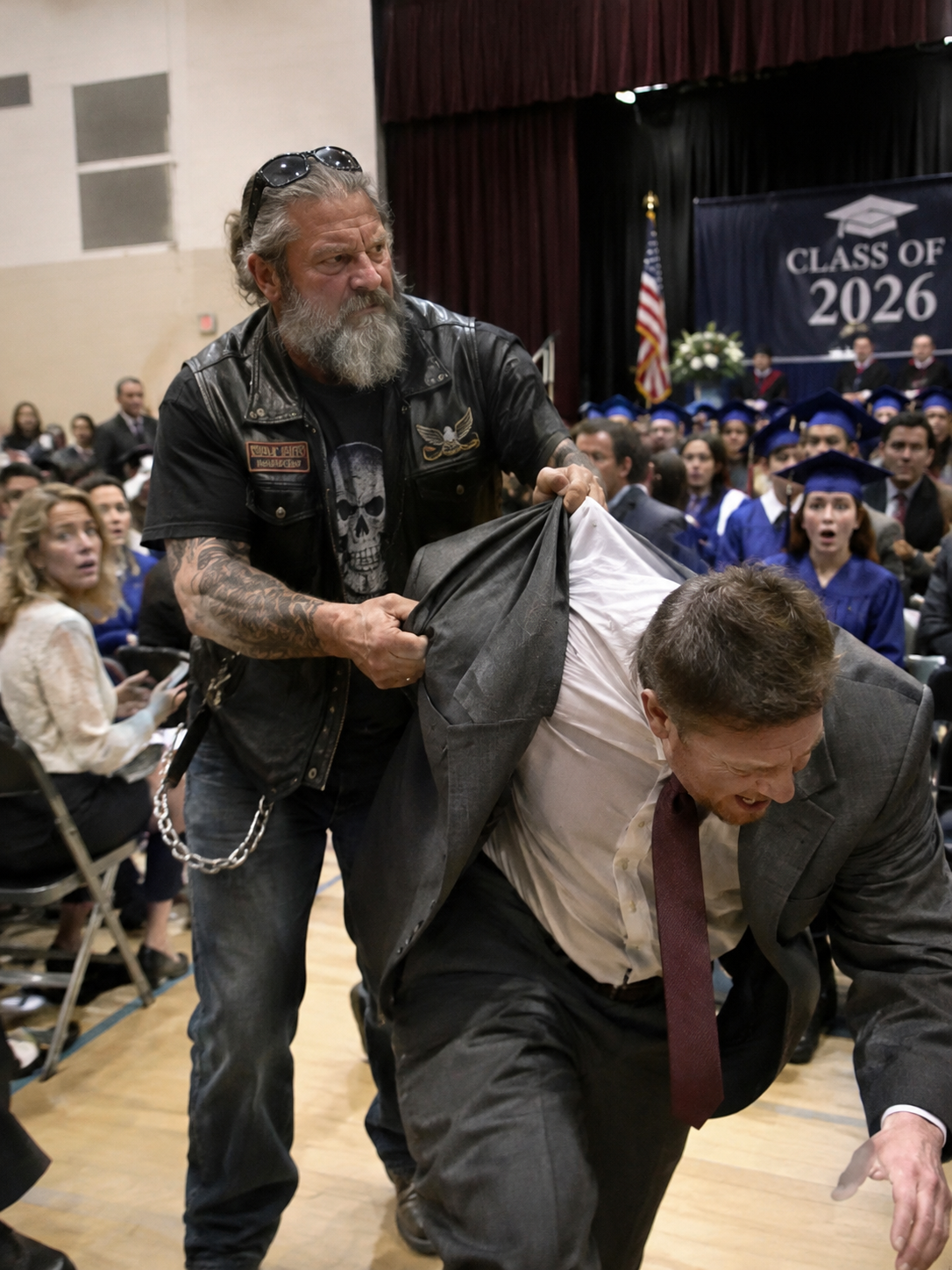
A Biker Dragged a Man in a Gray Suit Out of My Son’s Graduation Ceremony. What Happened Next Left the Entire School Speechless.
The biker grabbed the man in the gray suit by the back of his expensive jacket and shoved him away from the auditorium entrance. A row of folding chairs crashed behind them, a woman’s purse hit the floor, and several parents jumped to their feet as the graduation ceremony came to an abrupt stop.
“You’re not getting anywhere near that boy,” the biker growled.
The man in the gray suit stumbled, caught himself against a chair, and immediately turned toward the biker with an expression of pure anger.
“Get your hands off me! Do you have any idea who I am?”
The biker didn’t answer. He simply stepped between the man and the stage, his broad shoulders blocking the aisle. His black leather vest was covered in faded patches, his gray beard reached halfway down his chest, and his tattooed hands were clenched at his sides.
The school principal hurried toward them, followed by two security officers.
“Sir, you need to step away from him immediately!” one officer shouted.
But the man in the suit wasn’t looking at the security guards anymore. He was staring past the biker, directly at a seventeen-year-old boy standing with his graduating class.
“Daniel!” he shouted. “Tell these people who I am! Tell them I’m your father!”
The boy’s face suddenly lost all its color.
His graduation cap slipped slightly to one side, and the diploma program he had been holding fell from his hands.
I was sitting in the fourth row, holding my phone, ready to record the happiest moment of my son’s life. Instead, I watched a stranger in a leather vest nearly start a fight in the middle of a school ceremony.
And then I heard my son whisper something that made my stomach turn.
“Mom, please don’t let him come near me.”
My name is Laura Bennett. I’m forty-six years old, and until that Saturday morning, I believed I had finally reached the end of one of the hardest chapters of my life.
I had raised my son Daniel almost entirely on my own. His father, Michael, had walked out when Daniel was six years old, leaving behind unpaid bills, a broken promise to return, and a little boy who spent months believing he had somehow done something wrong.
Michael hadn’t been the kind of father who left after one argument. His departure had been the result of years of drinking, gambling, unstable employment, and promises that lasted only until the next paycheck disappeared. I spent years trying to keep our household together while making excuses for a man who rarely came home on time and almost never remembered the things he promised our son.
The last time Daniel saw his father, Michael was standing in our driveway loading a suitcase into the trunk of his old sedan. Daniel was wearing dinosaur pajamas and holding a plastic toy truck. He followed his father across the driveway and asked whether he would be home for breakfast the next morning.
Michael crouched down, kissed his forehead, and said, “We’ll see, buddy.”
Then he drove away.
He never came back.
For a long time, Daniel waited. He asked whether his father had called on birthdays, checked the mailbox around Christmas, and sometimes looked through old photographs when he thought I wasn’t watching. I tried explaining that adults sometimes made mistakes, but there were things I couldn’t explain to a six-year-old without making him feel even worse.
Eventually, the questions stopped.
By the time Daniel turned twelve, he rarely mentioned his father. He became quieter, more independent, and unusually careful about asking anyone for help. I thought he had simply grown out of the disappointment, but years later I realized he had learned to hide it.
Daniel was never interested in the things most boys in our neighborhood talked about. He didn’t care much about sports, expensive sneakers, or video games. He loved taking things apart, especially old radios, broken lawnmowers, and anything with an engine. If something stopped working, he wanted to know why.
When he was fourteen, he started spending afternoons at a motorcycle repair shop called Miller’s Cycle & Repair. It was located on an old commercial road about three miles from our house, between a tire store and a small warehouse. The building had a faded sign, two service bays, and a gravel parking lot that always seemed to have oil stains in the same places.
The owner was Raymond Miller, although everyone called him Ray.
Ray was sixty-one years old, stood about six feet three inches tall, and had a thick gray beard that made him look older than he really was. His arms were covered in tattoos, and he rode a black Harley-Davidson Road King that could be heard long before it appeared around a corner.
He was also a member of a local motorcycle club. His leather vest carried several patches, and some of the people who rode with him had reputations that made parents uncomfortable.
I wasn’t particularly interested in letting my fourteen-year-old son spend his afternoons around a group of older bikers. So when Daniel came home one evening with grease on his jeans, a small cut across his knuckles, and an excited explanation about rebuilding an engine, I drove straight to the shop.
Ray was standing beside a workbench when I walked in.
“You’re Daniel’s mother, aren’t you?” he asked.
I folded my arms.
“Yes. And I’d like to know why my fourteen-year-old son is spending his afternoons here.”
Ray looked toward the back room, where Daniel was cleaning a set of tools.
“Well, ma’am, I hope you’re not about to arrest me. He’s not working for me. He comes in after school, asks questions, and sometimes helps me hold a flashlight.”
“Then why does he have a cut on his hand?”
Ray looked at Daniel’s knuckles and sighed.
“Because he didn’t listen when I told him to wear gloves. I cleaned it and put a bandage on it. He’s a good kid, but he thinks he’s smarter than a thirteen-millimeter wrench.”
I wasn’t particularly amused.
Ray noticed my expression and became more serious.
“Look, I understand you’re protective of him. You should be. But your boy has a real interest in this stuff. I’m not going to let him operate dangerous equipment, and he doesn’t get to ride anything without your permission. If you want, you can come by whenever you like and see what he’s doing.”
There was something honest about the way he spoke. He wasn’t defensive, and he didn’t try to charm me into changing my mind. He simply explained the situation and gave me room to make my own decision.
I looked toward Daniel, who was standing beside an old motorcycle engine with a huge smile on his face.
For the first time in months, he looked completely happy.
So I agreed to let him continue, with some rules.
What I didn’t realize was that the little motorcycle shop would become one of the most important places in my son’s life.
Over the following three years, Ray taught Daniel more than I could have imagined. He showed him how to change oil, inspect brake lines, rebuild carburetors, replace damaged cables, and recognize problems that inexperienced mechanics often overlooked. When Daniel struggled with mathematics at school, Ray introduced him to a retired mechanical engineer named Frank who occasionally visited the shop.
Frank began helping Daniel with algebra and physics every Thursday afternoon. He explained how the same calculations Daniel disliked in the classroom were used to design engines, calculate pressure, and understand mechanical systems.
Daniel’s grades improved.
He started reading engineering books, watching technical lectures, and spending weekends fixing old machines. Sometimes I would arrive at the shop to find him sitting beside Ray, both of them arguing about the correct way to solve a problem.
Ray never treated him like a little boy who needed constant praise. If Daniel made a mistake, he made him correct it. If he forgot to clean a tool, he had to clean the entire workbench. If he wanted to use expensive equipment, he had to demonstrate that he understood how it worked.
But Ray also noticed when Daniel was having a difficult day.
One afternoon, Daniel came home unusually quiet after receiving a disappointing grade on a physics test. He went straight to his bedroom and didn’t come out for dinner. I tried talking to him, but he insisted everything was fine.
The next day, Ray called me.
“Daniel’s been a little down,” he said. “I think he’s putting too much pressure on himself.”
I explained what had happened at school.
Ray listened and then said, “Tell him one bad test doesn’t decide what kind of man he’s going to become. Some of the best mechanics I know failed more exams than they passed.”
That evening, Daniel came home smiling.
Ray had apparently spent an hour showing him how to calculate engine compression ratios, and Daniel had forgotten all about his test.
Slowly, Ray became a dependable presence in our lives. He attended Daniel’s school science exhibition, helped him prepare a small engine demonstration, and once drove forty minutes through heavy rain because Daniel had called to say he was stranded after his bicycle chain broke.
He never asked for anything in return.
When Daniel turned seventeen, he received an acceptance letter from a state university with a place in its mechanical engineering program. He had also earned a partial academic scholarship.
I remember that afternoon clearly.
Daniel came running into the kitchen with his laptop open, shouting that he had received an email from the university. I was preparing dinner, and I initially thought something terrible had happened because he was so excited he could barely speak.
When I finally understood, I started crying.
Daniel hugged me, and we stood in the kitchen laughing and crying together.
Then he asked whether he could call Ray.
I handed him his phone.
Ray answered after the second ring.
“What’s going on, kid? You break something?”
Daniel laughed.
“I got accepted.”
There was a short silence.
Then Ray shouted so loudly I could hear him through the phone.
“Well, I’ll be damned! You actually did it!”
Daniel laughed again.
“I’m going to study mechanical engineering.”
“I know what you’re going to study. You think I haven’t been telling everybody at this shop that you’re going to become an engineer?”
Then Ray became quieter.
“Your mama must be proud.”
Daniel looked at me.
“She already cried.”
“Good,” Ray replied. “That’s what mamas are supposed to do.”
A few weeks later, Daniel invited Ray to his graduation ceremony. He handed him the invitation personally at the shop and asked whether he would come.
Ray looked at the envelope for a moment.
“You’re sure you want an old biker sitting around with all those school officials?”
Daniel smiled.
“You’re coming, Ray. I want you there.”
Ray nodded.
“Then I’ll be there.”
Neither of us knew how important that promise would become.
The weeks leading up to graduation were busy. I bought Daniel a new shirt, polished his shoes, and spent an entire evening trying to find a graduation tie that matched his blue gown. He complained that I was treating the ceremony like a royal wedding, but he never asked me to stop.
I wanted everything to be perfect.
After all, I had spent eleven years working extra shifts, paying bills, attending parent-teacher meetings, and making sure my son had opportunities that I never had. I wasn’t wealthy, and I couldn’t give him everything he wanted, but I had done everything I could to help him build a future.
Graduation day arrived on a warm Saturday morning in May.
The school gymnasium was decorated with blue and white banners. Folding chairs had been arranged in neat rows, and a temporary stage stood at the front with a podium, several microphones, and a large display showing the names of the graduating students.
Parents were taking photographs outside, grandparents were searching for their seats, and teenagers in blue gowns were laughing nervously as teachers tried to organize them.
Daniel looked handsome in his white shirt and blue tie. He kept adjusting his graduation cap because it wouldn’t sit properly over his hair.
“Mom, please don’t embarrass me by crying when they call my name,” he said.
I laughed.
“I make no promises.”
He smiled.
Before leaving the house, he had asked me whether Ray had confirmed he was coming.
I told him Ray had been busy at the shop but had promised to attend.
Daniel nodded, although I noticed he checked his phone several times on the drive to school.
We arrived at approximately 9:15 a.m. and found our seats in the fourth row. The ceremony was scheduled to begin at ten, and I was already preparing my phone camera when I noticed a man standing near the side entrance.
He was wearing a gray business suit, a white shirt, and polished black shoes. He looked to be in his early fifties, with thinning dark hair and a narrow face. His clothing was expensive, but his appearance was slightly disheveled, as though he hadn’t slept properly.
At first, I assumed he was somebody’s relative.
But something about him seemed unusual.
He wasn’t carrying flowers, a camera, or even a graduation program. He kept looking at the students, checking his phone, and glancing toward the entrance.
Then I noticed he was watching Daniel.
I leaned forward, trying to get a better look, but he turned away.
A few minutes later, he moved closer to the area where the graduating students were waiting.
I thought about asking a security officer whether he belonged there, but I didn’t want to create unnecessary trouble. There were hundreds of people in the building, and I assumed the school had already checked the guests.
At 10:38 a.m., the principal began calling the names of students receiving academic awards.
That was when the rear auditorium doors opened.
Ray walked inside.
He was wearing a clean gray T-shirt beneath his black leather vest, dark jeans, and polished boots. His beard had been trimmed, and he carried a small gift bag in one hand.
I smiled when I saw him.
He looked around the room, searching for us.
But before he could reach our seats, he noticed the man in the gray suit.
Ray stopped walking.
His expression changed immediately.
He stared at the man for several seconds, then placed the gift bag on an empty chair.
The man noticed him too.
They exchanged a few words from a distance.
I couldn’t hear what they were saying, but I saw the man shake his head and gesture toward the stage. Ray began walking toward him.
The man attempted to move away.
Ray followed.
Then the man said something that made Ray step directly into his path.
I watched Ray lean forward and speak quietly.
The man shook his head again and tried to push past him.
That was when everything happened.
Ray grabbed the back of the man’s jacket.
“You’re leaving,” he said.
The man pulled backward.
“Who the hell do you think you are?”
Ray held on.
“Not here. Not today.”
The man tried to free himself, and the two collided with a row of chairs. Several parents jumped out of the way, and someone shouted for security.
Ray finally pushed him toward the side entrance.
“You’re not getting anywhere near that boy.”
The man’s face turned red.
“Get your hands off me!”
Two school security officers hurried down the aisle. One of them ordered Ray to release him, and Ray immediately stepped back.
But he remained between the man and the stage.
The principal approached with an expression of disbelief.
“What is going on here?”
The man in the suit straightened his jacket and pointed at Ray.
“This man attacked me! I have every right to be here!”
Ray looked toward the stage.
“Ask him who he is.”
The principal turned toward the man.
“Sir, who are you?”
The man took a breath and answered loudly enough for the entire front section to hear.
“I’m Michael Bennett. I’m that boy’s father.”
I felt my stomach tighten.
Michael.
My ex-husband.
The man who had disappeared eleven years earlier.
For a moment, I couldn’t move. I recognized his face, although time had made him thinner and added several years to his appearance. His hair was shorter, his clothes were more expensive, but his eyes were exactly the same.
He turned toward me.
“Laura.”
I stood up.
“What are you doing here?”
He smiled awkwardly.
“Come on. Is that really how you’re going to greet me? I’m here to see my son graduate.”
I couldn’t believe what I was hearing.
“You haven’t spoken to him in eleven years.”
“That’s not entirely true.”
Ray immediately interrupted.
“Don’t start with that.”
Michael turned toward him.
“Stay out of this.”
The security officer stepped between them.
“Everybody needs to calm down. We are not going to have another confrontation.”
Michael pointed toward the stage.
“That’s my son. I have every right to see him.”
I looked toward Daniel.
He was standing with his classmates, holding his graduation program against his chest. His face was pale, and his eyes were fixed on the floor.
I walked toward him.
“Daniel?”
He didn’t answer.
“Sweetheart, what’s happening?”
He swallowed hard.
“Mom, he’s been contacting me.”
I stopped.
“What?”
Daniel finally looked at me.
“Since February.”
The noise in the auditorium seemed to disappear.
I looked at Michael, then at my son.
“What do you mean, contacting you?”
Daniel took a shaky breath.
“I didn’t tell you because I didn’t want you to get upset.”
I wanted to ask a hundred questions, but he was visibly struggling to speak.
Ray approached us slowly.
“Laura, I think you should know what happened.”
Michael immediately raised his voice.
“Don’t listen to him! He’s been filling this boy’s head with lies!”
The security officer ordered Michael to remain where he was.
Ray looked at me.
“Daniel showed me the messages yesterday. His father has been asking him for money.”
I turned toward Michael.
“Is that true?”
Michael shook his head.
“This is ridiculous. I reached out because I wanted to reconnect with my son. Is there something wrong with that?”
“Then why was he afraid to tell me?”
Michael looked away.
That was the first moment I realized he might not have an innocent explanation.
Daniel finally began telling me what had happened.
It started in February, when he received a message from an unfamiliar Instagram account.
The message said:
*Hey, buddy. It’s Dad. I know it’s been a long time.*
Daniel initially ignored it. He wasn’t sure whether the account was genuine, and he didn’t know what to say.
A few days later, another message arrived.
*I heard you’re graduating this year. I’m proud of you.*
Then Michael sent an old photograph of himself holding Daniel as a baby.
Daniel remembered that photograph. It had been taken in our old apartment when he was barely six months old.
He stared at it for a long time.
Eventually, he replied.
At first, the conversations seemed harmless. Michael asked about school, his friends, and his plans after graduation. He apologized for leaving and said he had struggled with personal problems for years.
He claimed he had stopped drinking, found steady work, and was trying to rebuild his life.
Daniel wanted to believe him.
After all, despite everything that had happened, he was still his father.
They exchanged messages for several weeks. Michael occasionally called, and Daniel began answering.
Then Michael suggested they meet in person.
Daniel agreed to meet him at a diner outside town.
He didn’t tell me because he was afraid I would become angry and forbid him from seeing his father. He told himself that one meeting couldn’t hurt.
When he arrived, Michael was already sitting in a booth near the window.
He looked tired and older than Daniel remembered. But when he saw his son, he stood up, smiled, and hugged him.
Daniel told me he almost cried.
They talked for nearly two hours. Michael asked about school, showed him photographs of places he had worked, and apologized repeatedly for missing so much of his childhood.
He even admitted that he had made terrible decisions.
Daniel said it was the first time in years he had heard his father take responsibility for anything.
Then, near the end of the meeting, Michael asked him for two hundred dollars.
He explained that he was temporarily staying in a motel while waiting for a construction job to begin. He claimed he had been paid late and needed money for a room.
Daniel hesitated.
He didn’t have much savings, but he had been working at Ray’s shop and had put aside money for college expenses.
Eventually, he gave his father the two hundred dollars.
Michael thanked him and promised to repay it.
He never did.
A week later, Michael asked for another three hundred dollars. This time, he claimed he needed money to repair his car so he could get to work.
Daniel told him he couldn’t afford it.
Michael became irritated.
He said he had sacrificed plenty for Daniel when he was young, and now that his son was finally in a position to help, he was refusing.
Daniel didn’t know how to respond.
He had no memory of his father making sacrifices for him, but he didn’t want another argument.
He gave him another hundred dollars.
After that, the requests became more frequent.
Michael began asking about the scholarship Daniel had received, whether the university would provide additional financial assistance, and how much money Daniel expected to have available when he started college.
Daniel found the questions uncomfortable.
Then, in April, Michael asked whether he could borrow five thousand dollars.
He claimed he had an opportunity to invest in a small construction business and needed the money to secure his position.
Daniel refused.
He explained that the scholarship money was intended for his education and that he had no savings of that size.
Michael’s attitude changed immediately.
He accused Daniel of being selfish and reminded him that he was his father.
He also began blaming me for keeping them apart.
Daniel tried to end the conversation, but Michael continued sending messages.
Some were apologies.
Others were angry accusations.
Three days before graduation, Michael sent a message that Daniel showed Ray.
*I know you’re getting money for college. We need to talk before you leave town. Don’t make this difficult.*
Daniel didn’t respond.
Michael called several times.
Then he sent another message.
*I’m coming to your graduation. We can settle everything afterward.*
Daniel became frightened.
He finally went to Ray’s shop on Friday afternoon and showed him the messages.
Ray read them carefully.
He didn’t immediately become angry or start making threats. Instead, he asked Daniel to explain everything from the beginning.
When Daniel finished, Ray sat quietly for a while.
Then he asked whether I knew.
Daniel shook his head.
Ray told him that hiding the situation from me wasn’t helping anyone, but he also understood why Daniel had been afraid.
He helped Daniel save screenshots of the messages and advised him not to meet Michael alone again.
He also offered to accompany him if he wanted to speak with his father.
Daniel refused.
He begged Ray not to tell me until after graduation.
He didn’t want the day to become another argument about Michael.
Ray reluctantly agreed, but he told Daniel to contact him immediately if his father showed up or threatened him again.
That was exactly what happened on graduation morning.
At 8:12 a.m., Daniel received a message from Michael.
*I’m outside the school. We need to talk.*
Daniel replied that he didn’t want to speak before the ceremony.
Michael became angry.
He told Daniel he had no intention of leaving without seeing him.
Then he made a threat.
*If you embarrass me in front of everyone, you’ll regret it.*
Daniel immediately contacted Ray.
Ray called him twice, but Daniel was already inside the school preparing for the ceremony. He sent another message explaining where Michael was standing.
Ray called the school office, but nobody answered.
He then got on his motorcycle and rode straight to the school.
When he arrived, he spotted Michael standing near the side entrance, watching the graduating students.
Ray approached him and asked him to leave.
Michael refused.
Ray told him that Daniel was frightened and didn’t want to see him.
Michael responded that nobody had the right to prevent a father from attending his son’s graduation.
Ray asked him to wait until the ceremony ended and let the school staff handle the situation.
Michael tried to walk around him.
According to Ray, Michael then said something that made him lose his temper.
“If he won’t give me five thousand dollars, I’m going to make sure he understands what happens when he turns his back on his own family.”
Ray grabbed his jacket.
And that was the confrontation everyone had witnessed.
When Daniel finished explaining, I felt a mixture of anger, sadness, and guilt.
I was angry that Michael had used our son’s feelings against him.
I was sad that Daniel had been carrying the situation alone.
And I felt guilty because my son had believed he couldn’t come to me.
I took his hands.
“Why didn’t you tell me, sweetheart?”
Daniel looked down.
“Because I thought you’d be disappointed in me.”
“Disappointed?”
He nodded.
“I knew you would tell me not to trust him. But I wanted him to be my dad again. I thought maybe he had changed.”
I pulled him into my arms.
For a moment, I couldn’t speak.
Then I whispered, “You don’t have to apologize for wanting your father. Not ever.”
Daniel started crying.
Behind us, Michael was still arguing with the school officials.
“I’m his father! You can’t just throw me out!”
The principal had now spoken with the security officers and asked Michael to provide identification. He confirmed that he was Daniel’s biological father, but explained that being a parent didn’t give him permission to disrupt the ceremony or approach a student who had expressed fear of him.
Michael continued insisting that he had done nothing wrong.
Ray stood several feet away, speaking quietly with another officer.
I approached the principal.
“Please ask him to leave. My son doesn’t want him here.”
The principal nodded.
Michael turned toward me.
“Laura, you’re really going to do this? After everything?”
I stared at him.
“After everything? You disappeared for eleven years. You came back and asked our son for money. Now you’re threatening him because he won’t give it to you. What exactly do you expect me to do?”
He opened his mouth, but I continued.
“This day belongs to Daniel. Not you.”
For once, Michael had no answer.
The security officers escorted him toward the exit. He complained that he would contact the school district and speak to an attorney, but he eventually walked outside.
Before leaving, he turned toward Daniel.
“You’ll regret this one day.”
Daniel looked at him.
Then, for the first time in his life, he answered without looking frightened.
“No, Dad. I think I’ve regretted waiting for you long enough.”
Michael stopped.
He looked at his son for several seconds, then walked through the doors.
The auditorium became quiet.
The principal approached the microphone and explained that there had been an incident involving a guest, but that the ceremony would resume shortly.
Parents slowly returned to their seats.
Some looked uncomfortable. Others were still whispering.
A woman sitting beside me quietly handed me a tissue.
“Your son is a good young man,” she whispered.
I thanked her.
Daniel returned to the line with his classmates.
His hands were still shaking slightly, but he stood straighter than before.
At 11:07 a.m., the principal called his name.
“Daniel Michael Bennett.”
My son stepped forward.
He walked across the stage, shook the principal’s hand, and accepted his diploma.
I stood up and clapped.
I was crying so hard that I could barely see him.
Daniel turned toward the audience.
His eyes found mine.
Then he looked toward the rear of the auditorium.
Ray was standing near the entrance, speaking with a school security officer.
He had been asked to remain while the school documented the incident. He wasn’t being treated as a hero or given special permission to ignore what he had done. The school was simply making sure everyone involved provided an account of the confrontation.
Daniel raised his diploma slightly.
Ray lifted one hand and gave him a small wave.
My son smiled.
It was the first genuine smile I had seen on his face that morning.
After the ceremony, families gathered outside for photographs. There were balloons, flowers, grandparents holding homemade signs, and teenagers throwing their graduation caps into the air despite the teachers repeatedly asking them not to.
Daniel and I stood near the parking lot.
He hadn’t said much since receiving his diploma.
I knew he was trying to process everything.
Ray eventually walked over carrying the small gift bag he had brought earlier. One of the handles was torn, and the bottom had a noticeable crease from where it had fallen.
He looked embarrassed.
“Well,” he said, “that wasn’t exactly how I planned to spend my Saturday.”
Daniel laughed quietly.
Ray handed him the bag.
Inside was a professional socket wrench set.
It wasn’t particularly expensive, but it was good quality, and I knew Ray had chosen it carefully.
There was also a small envelope.
Daniel opened it and found a handwritten card.
*For the first toolbox you buy when you get your own place. Don’t waste it all on motorcycle parts. And don’t forget to call your mother.*
*Proud of you, kid.*
*Ray.*
There was a check for five hundred dollars inside.
Daniel stared at it.
“Ray, I can’t take this.”
Ray shrugged.
“Already bought it. Don’t make me argue with you in front of your mother.”
Daniel smiled, but his eyes were filling with tears.
“Why did you come today?”
Ray looked confused.
“What do you mean?”
“You knew he might be here. You knew there could be trouble. You could’ve stayed at the shop.”
Ray looked toward the parking lot, where several motorcycles were parked.
Then he turned back to Daniel.
“Because you asked me to come to your graduation.”
Daniel lowered his head.
Ray continued.
“I gave you my word. I don’t make promises to kids unless I intend to keep them.”
Daniel stepped forward and hugged him.
Ray looked surprised. He wasn’t a man who usually showed affection in public, but after a moment, he wrapped both arms around my son.
I took a photograph.
Daniel was wearing his blue graduation gown, Ray was standing beside him in his black leather vest, and the damaged gift bag was sitting on the pavement between their feet.
It wasn’t a perfect photograph.
The lighting was harsh, a few people were walking through the background, and Daniel’s graduation cap was slightly crooked.
But it became my favorite photograph of the entire day.
Before we left, Ray asked whether Daniel wanted to stop by the shop.
Daniel looked at me.
I smiled.
“Go ahead. Just don’t come home covered in grease. Your graduation clothes are going in the washing machine.”
They both laughed.
I followed them to the parking lot and watched Daniel climb into Ray’s pickup.
For a moment, I thought about how different our lives might have been if Michael had stayed.
Then I realized something.
I didn’t need to imagine a different past anymore.
I could see the people who were actually standing beside my son.
And that mattered more.
The following Monday, Ray received a call from a county deputy who wanted to discuss the incident at the school. He was asked to provide a statement about why he had grabbed Michael and what had happened before security arrived.
Ray didn’t make excuses.
He admitted that he had lost his temper and that he should have allowed school security to handle the confrontation.
He also explained that he had seen the messages Daniel received and had been concerned about the threat.
The deputy listened, documented his account, and asked whether there had been any previous physical confrontations between the two men.
There hadn’t been.
Michael later decided not to pursue a complaint, although the school retained its incident report.
Ray told Daniel afterward that he could have handled things differently.
“I was angry,” he said. “But being angry doesn’t mean you get to do whatever you want. Next time, I’ll get security involved first.”
Daniel nodded.
I appreciated that conversation because Ray wasn’t pretending he had done everything perfectly. He was showing my son that being a decent person also meant accepting responsibility when you made a mistake.
As for Michael, he continued trying to contact Daniel.
He sent messages apologizing for the graduation incident. Then he sent messages blaming me and Ray for interfering in his relationship with his son.
A few days later, he asked Daniel whether he had reconsidered lending him the money.
That was the final confirmation Daniel needed.
He saved the messages, blocked the accounts, and agreed that any further communication would be handled through me or an appropriate legal channel.
It wasn’t an easy decision.
There were nights when he wondered whether he had been too harsh. Sometimes he looked at the old photographs of Michael holding him as a baby and became quiet.
I never told him he had to hate his father.
I simply reminded him that forgiveness didn’t require him to put himself in a situation where he felt threatened or pressured.
“You can wish someone well without giving them control over your life,” I told him one evening.
He thought about that for a while.
Then he nodded.
Summer arrived, and Daniel began preparing for college.
He continued working at Miller’s Cycle & Repair, saving money for books and personal expenses. Ray gave him more responsibility around the shop, allowing him to help with customer intake, inventory, and basic repairs under supervision.
One Saturday, Daniel and Ray decided to rebuild an old 1982 Honda motorcycle that had been sitting behind the shop for several years.
The bike was in terrible condition.
Its paint was faded, the seat was torn, the wiring was damaged, and the engine hadn’t been started in more than a decade.
Daniel loved it immediately.
They spent several weekends cleaning the frame, checking the fuel system, replacing worn components, and carefully rebuilding the engine.
I occasionally brought them sandwiches and coffee.
Sometimes I found them arguing over a stubborn bolt. Other times, they were laughing about something that had happened years before I met them.
One afternoon, I arrived earlier than usual and heard Daniel speaking from inside the garage.
“Ray, can I ask you something?”
“Depends. Are you about to ask me for money?”
Daniel laughed.
“No.”
“Then go ahead.”
There was a pause.
“I used to think something was wrong with me.”
Ray stopped working.
“What do you mean?”
Daniel looked down at the motorcycle frame.
“When my dad left, I thought maybe I wasn’t good enough. Maybe if I’d been smarter or better behaved, he would’ve wanted to stay.”
Ray put down his wrench.
“Daniel, look at me.”
My son raised his eyes.
“Your father’s decisions belong to him. You were six years old. You weren’t responsible for keeping a grown man in your life.”
Daniel rubbed his face.
“I know that now. But sometimes I still think about it.”
Ray nodded.
“That’s normal. It takes time to stop blaming yourself for things you never controlled.”
He picked up the wrench again, then added something that made me stop outside the open garage door.
“Listen, kid. You’re going to meet plenty of people in your life who disappoint you. Some of them will be family. Some will be friends. Some will promise you things they never intend to do. Don’t let their choices convince you that you’re not worth showing up for.”
Daniel was quiet.
Then he nodded.
“Thanks, Ray.”
Ray handed him the wrench.
“You’re welcome. Now help me get this thing running before I retire.”
I smiled outside the garage.
I didn’t want them to know I had heard.
In August, it was time to take Daniel to college.
We packed his clothes, books, computer, and several boxes of personal belongings into my old Honda Accord. Ray followed in his pickup because Daniel had somehow accumulated more tools than clothes.
The drive took a little over two hours.
When we arrived, we discovered that Daniel’s dormitory was on the third floor of a building without an elevator.
Ray looked at the stairs, then at the boxes.
“Whoever designed this place clearly hates old people.”
Daniel laughed.
“You volunteered to help.”
“I was promised a building with an elevator.”
“You were promised pizza.”
“That’s not the same thing.”
We carried boxes upstairs for nearly an hour.
Ray complained about his knees, Daniel complained about the weight of his books, and I kept telling both of them to stop arguing and move faster.
When everything was finally inside, we stood in the middle of the small dorm room.
Daniel looked around.
It wasn’t particularly impressive.
There was a narrow bed, a desk, a wardrobe, and a window overlooking the campus parking lot.
But to him, it represented something enormous.
He was starting a new life.
Before leaving, Ray handed him a small envelope.
Daniel opened it.
Inside was a photograph of the old 1982 Honda they had rebuilt together.
On the back, Ray had written:
*Never stop learning. Never stop asking questions. And if something breaks, don’t throw it away before you understand why.*
Daniel smiled.
“Thanks, Ray.”
Ray nodded.
“Now go become an engineer.”
Daniel hugged him.
Then he hugged me.
I held him longer than I probably should have, but I didn’t care.
When Ray and I finally walked back toward the parking lot, I glanced over my shoulder.
Daniel was standing at the dormitory window, watching us leave.
He raised his hand.
Ray raised his.
Neither of us said anything for a while.
Then Ray started his pickup.
“He’s going to do fine,” he said.
I looked out the window.
“I hope so.”
Ray nodded.
“He will. That kid knows how to work for something.”
The first few months of college were difficult.
Daniel called regularly, but I could tell he was struggling to adjust. His classes were demanding, the workload was heavier than he expected, and he missed working at the shop.
Sometimes he called Ray to ask questions about mechanical problems he encountered during laboratory assignments.
Ray didn’t always know the answers.
When he didn’t, he told Daniel to ask his professors.
“You’re at college now,” he would say. “Use the people you’re paying to teach you.”
Daniel would laugh.
During his first semester, he received a disappointing grade on an engineering examination. He was embarrassed and considered dropping one of his more difficult classes.
He called me late one evening.
“Mom, I don’t know if I’m good enough for this.”
I listened while he explained how difficult everything had become.
Then I asked him whether he remembered the first motorcycle engine he had helped Ray rebuild.
“Of course.”
“Do you remember how many times you got something wrong?”
He laughed.
“Probably a hundred.”
“And did Ray let you give up?”
“No.”
“Then why are you giving up on yourself?”
He became quiet.
The following morning, he called Ray.
They spoke for almost forty minutes.
A few days later, Daniel emailed me a photograph of his notes spread across a library table.
Underneath it, he wrote:
*I’m not quitting. Just need to work harder.*
I printed the photograph and put it on the refrigerator.
Months passed.
Daniel completed his first year of college with better grades than he expected. He also found a part-time position in a campus engineering workshop, where he helped maintain equipment and assist students with mechanical projects.
During the summer break, he returned home.
Ray was waiting for him at the shop.
When Daniel walked through the door, Ray looked up from a motorcycle engine.
“Well, look who’s finally back.”
Daniel smiled.
“Miss me?”
“Not particularly. The shop was peaceful.”
They both laughed.
Daniel spent much of that summer working at the garage again. He also began helping Ray organize old customer records and update the shop’s inventory system.
One afternoon, he noticed something unusual.
Ray had framed the photograph from graduation and placed it above his workbench.
It showed the two of them standing together outside the school auditorium.
Daniel was holding his diploma.
Ray was wearing his black leather vest.
Underneath the photograph was a small handwritten note.
*Thanks for showing up, every time.*
Daniel stood looking at it for several seconds.
“Ray?”
“Yeah?”
“You kept that?”
Ray didn’t look up.
“Well, I wasn’t going to throw away a perfectly good photograph.”
Daniel smiled.
“You know what I mean.”
Ray finally put down his wrench.
“Yeah, kid. I know.”
He looked at the photograph.
Then he said something quietly.
“Your mother did the hard part. She raised you. I just helped you with a few things along the way.”
Daniel shook his head.
“You helped more than you think.”
Ray didn’t answer.
He simply picked up his wrench and returned to work.
A few weeks later, Daniel had an assignment for one of his college classes. The professor asked students to write about someone who had influenced their lives and explain how that person had shaped their understanding of responsibility.
Daniel spent several evenings working on the essay.
When he finished, he sent it to me.
I read it at the kitchen table.
The opening paragraphs described my years raising him alone. He wrote about the difficult financial decisions I had made, the extra shifts I had worked, and the times I had pretended everything was fine because I didn’t want him to worry.
I cried before I reached the middle.
Then he began writing about Ray.
He described the motorcycle shop, the first engine he had rebuilt, and the lessons he had learned from a man who had never asked to be called a father.
The final paragraph read:
*My biological father taught me that people can leave without explaining why. My mother taught me that life continues even when someone disappoints you. But an old motorcycle mechanic taught me something I needed to understand for myself. Being there for someone isn’t about what you call yourself. It’s about what you do when that person needs you. Ray never promised to replace anyone. He simply kept showing up. And after a while, I realized that was worth more than all the promises I’d ever received.*
I read it twice.
Then I drove to Miller’s Cycle & Repair.
Ray was working beneath an old Harley when I arrived.
I handed him the printed essay.
“Daniel wanted you to read this.”
He wiped his hands on a towel and accepted the pages.
At first, he read casually.
Then his expression changed.
He slowed down.
When he reached the final paragraph, he stopped.
He removed his glasses and rubbed his eyes.
For several seconds, he didn’t say anything.
Finally, he folded the paper carefully and placed it inside the pocket of his leather vest.
“Good kid,” he said.
I smiled.
“He’s a very good kid.”
Ray nodded.
“Yeah. He is.”
I looked toward the workbench.
Something new was hanging above it.
The graduation photograph.
The one with Daniel holding his diploma.
The one with the damaged gift bag at their feet.
Underneath it, in Daniel’s handwriting, were six words.
**”Thanks for showing up, every time.”**
I stood there looking at that photograph for a long time.
Because for years, I had thought the saddest part of my son’s childhood was that his father had walked away.
I had spent so much time thinking about the person who wasn’t there that I sometimes overlooked the people who were.
There was my mother, who helped us when money was tight.
There were Daniel’s teachers, who encouraged him when he struggled.
There were the neighbors who brought food when I worked late.
And there was Ray, a gray-bearded biker who had entered our lives through a motorcycle repair shop and never once demanded recognition for what he did.
I don’t believe Ray was a perfect man.
He lost his temper that morning, and grabbing Michael’s jacket was not the right way to handle the situation. He knew that himself, and he admitted it.
But I also know what happened after the confrontation.
He helped Daniel understand that his father’s abandonment wasn’t his fault.
He taught him to work hard, admit mistakes, and take responsibility.
He showed up for school events, answered late-night questions, and kept his promises even when doing so was inconvenient.
And when the man who had abandoned my son suddenly returned demanding money, Ray didn’t ask what he would get in return for helping.
He simply made sure Daniel wasn’t facing the situation alone.
Last month, Daniel came home for the weekend.
We were having dinner when he mentioned that he had been offered an opportunity to assist with a research project at the university. It involved studying engine efficiency and developing improvements to an existing mechanical system.
I was thrilled.
Ray was even more excited when Daniel called to tell him.
“Look at you,” Ray said. “I leave you alone for one year, and suddenly you’re doing engineering work.”
Daniel laughed.
“You’re the one who taught me to work on engines.”
“I taught you to change oil. Don’t give me credit for your college degree.”
After the call, Daniel sat at the kitchen table for a while.
Then he looked at me.
“Mom?”
“Yes?”
“Do you still have that photograph from graduation?”
I nodded.
“It’s in the living room.”
He smiled.
“Can you send me a copy? I want to put one in my room.”
I went to get it.
When I returned, Daniel was looking at the photograph.
His graduation gown.
His diploma.
Ray’s leather vest.
The two of them standing together outside the auditorium.
Daniel ran his finger along the edge of the picture.
Then he said something I will never forget.
“Mom, I used to think having a father meant having someone who was supposed to love you. Now I think it means having someone who actually does.”
I sat beside him.
For a moment, neither of us spoke.
Then I put my arm around his shoulders.
And I realized that the boy who had once waited by the window for his father to return had finally stopped waiting.
He had grown up.
He had found his direction.
And he had learned that the people who truly care about you aren’t always the people whose names appear on your birth certificate.
Sometimes they’re the people who show up in the rain, help you rebuild a broken motorcycle, attend your graduation, and stand beside you when the world suddenly becomes frightening.
That Saturday morning, everyone at the school saw a frightening-looking biker drag a man in an expensive gray suit out of a graduation ceremony.
They saw a confrontation.
They saw a disturbance.
They saw a man with tattoos and a leather vest lose his temper.
But they didn’t know the years behind that moment.
They didn’t know about the little boy who had waited eleven years for his father to return.
They didn’t know about the messages, the borrowed money, or the threats.
And they certainly didn’t know that the biker had spent three years quietly helping that boy build a future.
I still have the graduation photograph.
It’s framed in our living room, just beside the picture of Daniel holding his university acceptance letter.
Whenever I look at it, I remember the words Ray said when Daniel asked why he had come that morning.
“Because you asked me to come to your graduation.”
It wasn’t a complicated answer.
It wasn’t a speech.
It wasn’t even particularly dramatic.
But after everything my son had experienced, it was probably the most important promise anyone had ever kept for him.
And sometimes, I think that’s what makes someone family.
Not the blood they share.
Not the title they carry.
Not the promises they make when everything is easy.
**It’s whether they show up when it matters.**