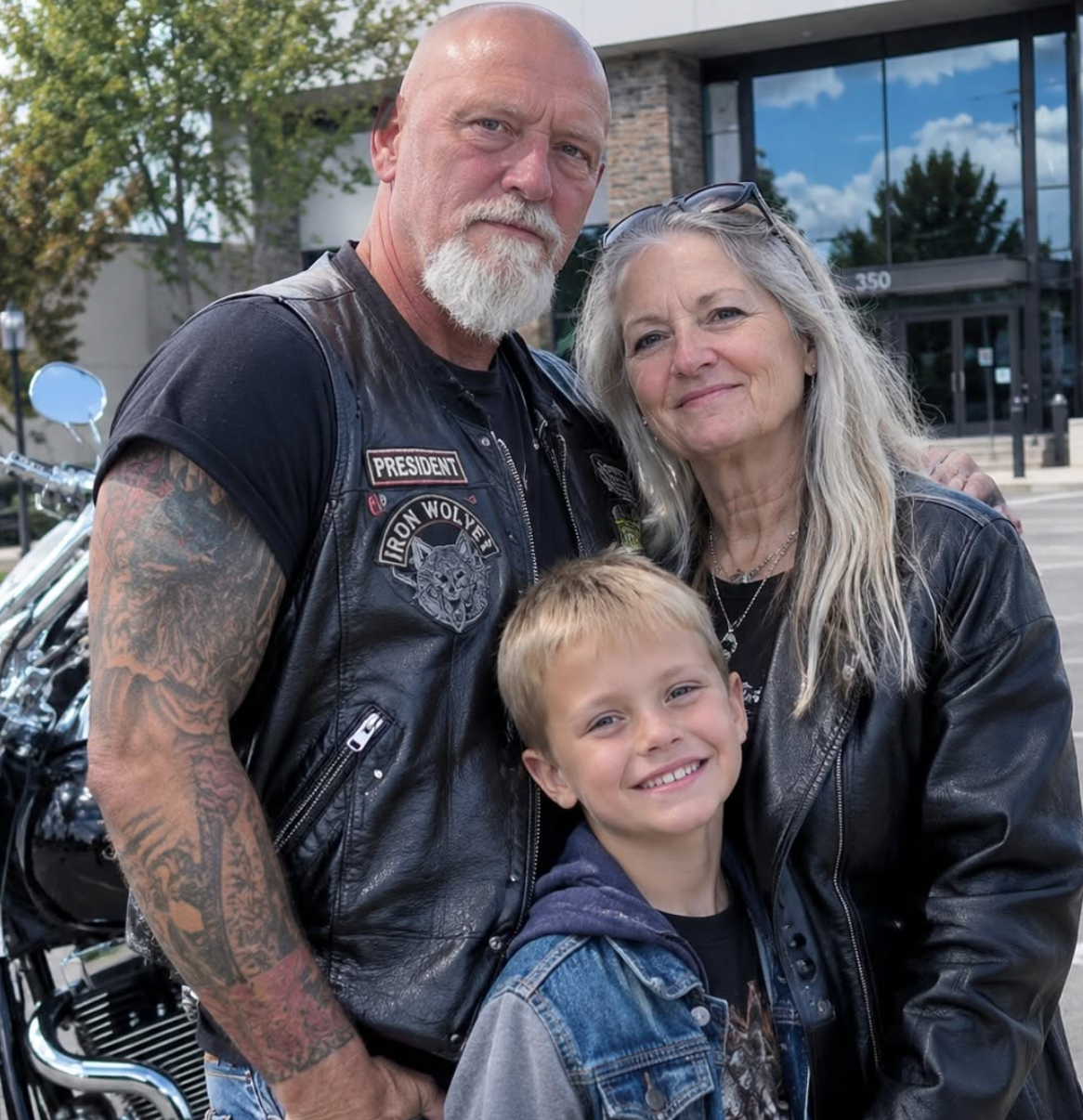
A photograph.
It showed Danny standing beside his father in front of an old Harley-Davidson, both of them covered in grease, smiling like two boys who had just finished rebuilding an engine together.
On the back, Walt had written one sentence: “To the son who gave his mother a home when he believed he had nothing to offer.”
Michael was the first to open his envelope.
He pulled out several pages, adjusted his glasses, and began reading. At first, his expression was one of confusion. Then his eyebrows rose, and he looked across the table at me as though he wasn’t entirely sure what he was holding.
Stephanie had already opened hers. She was reading quickly, moving her eyes from one paragraph to another, occasionally glancing at the papers in Michael’s hands.
Danny hadn’t opened his envelope yet.
He was sitting beside his wife, Kayla, at the end of the small folding table. His youngest boy was leaning against his shoulder, still wearing a shirt with a gravy stain from dinner. Danny looked uncomfortable with all the attention and kept turning the envelope over in his hands.
Michael finally broke the silence.
“Mom, what exactly is this?”
I folded my hands in my lap.
“It’s something your father wanted you all to have.”
“These documents say Dad sold the company.”
“Yes.”
Michael looked down again.
“Three years ago?”
“Two years before he became sick.”
Stephanie stopped reading.
“Wait. What?”
I took a breath.
“Your father sold his transportation business two years before he died. The sale was worth considerably more than we ever expected.”
Michael placed his papers on the table.
“How much?”
I looked at him.
“Enough.”
“Mom, I’m asking how much.”
“Three million eight hundred thousand dollars.”
Nobody spoke.
The only sound in the room was the washing machines running downstairs and the occasional clatter of dishes coming from the kitchen sink.
Michael slowly leaned back in his chair.
Stephanie covered her mouth.
Danny looked at me, then at the envelope in his hands.
“Mom, I don’t understand. You told us the hospital bills took everything. You said the bank was taking the house.”
I nodded.
“I know what I told you.”
Michael’s voice became sharper.
“Are you telling us you lied?”
“Yes,” I answered. “I lied.”
He stared at me.
“Why?”
I looked around the small apartment. The table was crowded with leftover food, the chairs didn’t match, and one of the boys had fallen asleep on the sofa with a toy truck resting against his stomach.
Then I looked at my three children.
“Because your father and I wanted to know something before we made any decisions about his money. We wanted to know what would happen if I had nothing left.”
Stephanie immediately became defensive.
“Mom, that’s not fair. You can’t judge us based on one phone call.”
I didn’t answer.
Michael pushed his papers away.
“This is ridiculous. You should have told us about the company. We could have helped you manage everything.”
Danny finally opened his envelope.
The first thing he found was the photograph.
It showed him standing beside his father in front of an old Harley-Davidson. Both of them were covered in grease, smiling at the camera. Walt had one arm around Danny’s shoulders, and the motorcycle’s fuel tank was resting on a workbench behind them.
Danny turned the photograph over.
He read the handwritten sentence on the back.
“To the son who gave his mother a home when he believed he had nothing to offer.”
His lips began to tremble.
Then he pulled out the letter beneath it.
And that was when I realized the evening was about to become much harder than I had expected.
But to understand why that photograph meant so much, you need to understand the man who had written those words.
My husband, Walter Bennett, was known as Walt to most people.
He was sixty-seven when he died.
For nearly forty years, he had been part of a motorcycle club called the Iron Wolves. He had tattoos covering both arms, a thick gray beard that reached his chest, and a collection of motorcycles that he maintained with almost religious dedication.
His favorite was a black Harley-Davidson Road King that he had owned for more than twenty years.
People often judged him before he even opened his mouth. His leather vest, heavy boots, and the patches on his back made strangers nervous. Some parents crossed the street when they saw him coming, and a few of our neighbors initially assumed he was the kind of man who spent his evenings looking for trouble.
They couldn’t have been more wrong.
Walt was a mechanic, a businessman, a husband, and a father who loved his children even when they made decisions he didn’t understand. He was also the kind of man who would stop on a highway to help a stranded motorist, spend an afternoon repairing a neighbor’s broken lawnmower, and quietly pay for groceries when he learned an elderly couple was struggling.
He never talked much about the things he did for people.
If I thanked him, he usually shrugged.
“Don’t make a big deal out of it, Dolores. Anybody could’ve done the same.”
But I knew not everybody would.
Walt started his transportation business with one battered delivery truck and a secondhand trailer. He was thirty-two years old at the time, and we had barely enough money to cover our mortgage.
He drove the truck himself during the day, repaired it at night, and spent weekends looking for customers. Sometimes he returned home after midnight smelling of diesel fuel, road dust, and coffee.
I remember one winter when the truck broke down on a delivery route. He spent almost twelve hours repairing the engine in freezing weather because he couldn’t afford to pay someone else.
When he finally returned home, his hands were swollen, his clothes were soaked, and he could barely stand.
I told him he needed to find another line of work.
He looked at me and smiled.
“Give me five years.”
It took him considerably longer, but he eventually built a successful regional transportation company with several trucks, employees, and contracts across multiple states.
Michael, our oldest, grew up watching his father build that business. He was ambitious and intelligent, and Walt always believed he would become a successful businessman himself.
Stephanie, our only daughter, was the social one. She loved beautiful clothes, expensive restaurants, and the kind of lifestyle Walt had never been particularly interested in.
Danny was different from both of them.
He was born eleven years after Michael and six years after Stephanie. By the time Danny was old enough to understand what his father did for a living, the company was already established.
He wasn’t interested in office meetings or business contracts.
He wanted to be in the garage.
When he was eight, Walt gave him an old set of tools and showed him how to remove a motorcycle wheel. By ten, Danny could identify several engine parts. At thirteen, he was spending entire Saturdays helping his father clean motorcycles and organize the workshop.
Walt loved those afternoons.
Sometimes I would find the two of them sitting on the garage floor, arguing about something mechanical while eating sandwiches.
Michael rarely joined them.
Stephanie preferred spending time with her friends.
But Danny was always there.
That didn’t mean Walt loved the younger boy more. He loved all three children, but he understood that each of them needed something different.
He paid for Michael’s college education and helped him get his first business job. He helped Stephanie with the down payment on her first home. And when Danny decided he wanted to become a mechanic, Walt encouraged him, even though he knew it wouldn’t lead to the kind of financial success Michael had achieved.
Walt used to say that a person could earn a million dollars and still be poor if nobody wanted to sit beside them at dinner.
I didn’t fully understand what he meant until the final years of his life.
Two years before Walt became seriously ill, he received an offer to sell his transportation company.
The buyers had been interested for several months. They wanted the contracts, vehicles, operating licenses, and established customer relationships.
Walt initially refused.
He had spent most of his adult life building that business, and selling it felt like giving away a part of himself.
But his health was beginning to slow him down, and he was tired of spending every morning dealing with deliveries, employees, and insurance paperwork.
After months of negotiations, he finally agreed.
The sale brought in approximately $3.8 million after taxes, expenses, and outstanding business obligations.
I remember the day the final paperwork was signed.
Walt came home, placed his leather briefcase on the kitchen table, and sat down.
“Well, Dolores, I think we’re officially retired.”
I laughed.
“You’ve been saying that for fifteen years.”
“This time I mean it.”
He poured himself a cup of coffee and looked around our modest kitchen.
“Do you want a bigger house?”
I shook my head.
“Why?”
“Because we don’t need one.”
“New car?”
“No.”
“Vacation?”
“Maybe somewhere with a beach.”
He smiled.
“See? I knew I married a sensible woman.”
We could have purchased a mansion, bought expensive cars, and traveled around the world.
Instead, we stayed in the same house.
Walt continued riding his Harley. I continued shopping at the same grocery store. We still drove our older vehicles, and our neighbors had no idea that the man mowing his lawn in worn-out jeans had recently become a multimillionaire.
We also made a decision not to tell our children immediately.
It wasn’t because we wanted to deceive them.
We simply wanted to understand how they would live their own lives without expecting an inheritance to solve every problem.
Walt had watched too many business partners become careless after receiving money. He had seen family relationships destroyed by arguments over property and investments.
He didn’t want that happening to our children.
One evening, while we were sitting on the back porch, he said something I never forgot.
“Dolores, money doesn’t change people. It just gives them permission to show you who they really are.”
I looked at him.
“What are you getting at?”
He shook his head.
“Nothing. Just something I’ve learned.”
He then told me that he wanted the money protected in a properly established estate plan. He arranged for an attorney and financial adviser to help us structure our assets, and he made sure I would have financial security regardless of what happened to him.
He also wrote three personal letters, one for each child.
He told me not to open them until the time was right.
I placed them in his old black leather briefcase.
At the time, I didn’t realize how important those letters would become.
Then Walt became sick.
The first symptoms were easy to dismiss. He became tired more quickly, lost weight, and occasionally complained about pain that wouldn’t go away.
We visited doctors, completed tests, and spent weeks waiting for answers.
Eventually, we received the diagnosis.
Cancer.
The following months were difficult.
Walt went through treatment, hospital appointments, and long nights when he couldn’t sleep. His beard became thinner, his shoulders lost some of their strength, and the man who had once lifted heavy motorcycle engines without assistance sometimes needed help getting out of bed.
But he never lost his sense of humor.
One morning, a nurse entered his hospital room and found him arguing with a television.
She asked what was wrong.
Walt pointed at the screen.
“That guy’s trying to sell me a motorcycle for more than it’s worth.”
The nurse laughed.
“Sir, that’s a cooking program.”
He looked at me.
“Well, that explains why the engine looked unusual.”
Even during the worst days, he tried to make me laugh.
Our children visited, although not as often as I had hoped.
Michael was busy with his company and frequently traveled for work. Stephanie came when she could, usually staying for an hour before leaving to collect her children or attend an appointment.
Danny visited almost every evening after finishing work at the repair shop.
Sometimes he brought Walt coffee.
Other times he simply sat beside the bed and talked about motorcycles.
Walt loved those visits.
A few weeks before he died, Danny brought a photograph of the old Harley they had rebuilt together. He showed it to his father and talked about the work they had done.
Walt looked at the photograph for a long time.
Then he said, “You remember that afternoon?”
Danny smiled.
“Of course.”
“You dropped the wrench into the drain.”
Danny laughed.
“I was fourteen.”
“You were old enough to know better.”
They both laughed.
Then Walt became serious.
“Listen to me, son. Keep doing what you’re doing. Don’t let anybody convince you that your life is worth less because you don’t have a fancy office or a big house.”
Danny nodded.
“I know, Dad.”
Walt reached for his hand.
“And look after your mother.”
Danny squeezed his father’s hand.
“Always.”
Walt died twelve days later.
He was surrounded by the people who loved him.
His funeral was attended by family, friends, former employees, and dozens of bikers from the Iron Wolves. Many arrived on motorcycles, parking along the road outside the funeral home.
Some wore leather vests with faded patches. Others wore simple black shirts.
They stood quietly beside the entrance.
Several had known Walt for more than thirty years.
I remember one of them, a man named Frank, approaching me after the service.
He was a large man with a white beard and a scar across his left cheek.
He shook my hand.
“Walt was a good man, Dolores.”
I nodded.
“He was.”
Frank looked toward the motorcycles.
“He helped a lot of people who never knew his name.”
I thanked him.
Then he added something that stayed with me.
“He always said his greatest achievement wasn’t the company. It was the family he built.”
I looked toward my three children.
Michael was standing beside his wife, checking his phone.
Stephanie was talking to a relative about the funeral arrangements.
Danny was in the kitchen helping the club members carry trays and clean up.
I wondered whether Walt would have been pleased with what he saw.
A week after the funeral, I sat alone at the kitchen table.
Walt’s reading glasses were beside me. His leather riding jacket still hung near the front door, and his photograph from the last motorcycle rally rested on the shelf.
The house felt unbearably quiet.
I knew I needed to make some decisions.
The attorney had explained the estate arrangements, and I knew I was financially secure. But Walt’s words about money and family kept returning to my mind.
I remembered the three letters.
I remembered his warning.
And I remembered something he had told me several months before he died.
“Don’t judge our children by what they say when everything is comfortable. Watch what they do when they think there’s nothing to gain.”
So I made three phone calls.
I didn’t enjoy what I was about to do.
But I needed to know whether our children saw me as their mother or simply as another responsibility they could avoid.
I called Michael first.
He answered on the fourth ring.
“Hey, Mom. Everything okay?”
I took a breath.
“Michael, I need to talk to you.”
He immediately sounded concerned.
“What’s wrong?”
I told him that the medical bills had taken most of our savings, that the bank was beginning proceedings against the house, and that I didn’t have anywhere to go.
There was a long silence.
Then he sighed.
“Mom, that’s terrible.”
I waited.
“I wish you had told me sooner, but things are complicated right now. Jenna’s mother visits in the spring, and our guest room has basically become her office.”
I looked at Walt’s empty chair.
“Michael, I don’t have anywhere else.”
He hesitated.
“I understand. Maybe we can figure something out.”
I waited for him to offer something.
Instead, he continued.
“Have you looked into senior housing? Some places are actually quite nice. I can send you a few links.”
Michael lived in a five-bedroom house with a finished basement, three-car garage, and a guest room that was almost never used.
He never offered to let me stay.
Later that afternoon, he emailed me three links.
There wasn’t a personal message attached.
I called Stephanie next.
She answered quickly.
“Mom! How are you doing?”
I explained everything.
She began crying.
“Oh, Mom. That’s horrible. I can’t believe this is happening after everything you’ve been through.”
She talked about how much she missed Dad and how unfair life could be.
Then she asked something that surprised me.
“But how much money is actually left?”
I told her there was nothing.
Her crying stopped.
“Oh.”
There was a pause.
“Have you looked into community shelters? Some of them are actually quite nice now.”
I stared at the telephone.
She continued explaining that her house was already crowded because her children had activities, her husband worked from home, and her guest room had become a storage area.
Before ending the call, she told me she loved me.
Then she remembered she had to collect her children from tennis practice.
I sat for several minutes without moving.
Then I called Danny.
He answered while working at the repair shop.
“Hey, Mom.”
His voice sounded tired.
I began explaining.
I hadn’t even finished telling him about the house when he interrupted.
“Come tonight.”
I stopped.
“Danny, you don’t understand. I’ve lost everything.”
“Okay. Come tonight.”
“You and Kayla already have the boys. You don’t have room for me.”
“Then we’ll make room.”
“I can’t afford to pay you anything.”
He laughed softly.
“Mom, you’re not a customer. You’re my mother.”
I started crying.
He continued.
“Don’t worry about money. Don’t worry about where you’re going to sleep. I’m coming to get you.”
Forty minutes later, his old pickup pulled into my driveway.
He was still wearing his work clothes, with a wrench tucked into his back pocket and engine grease covering his hands.
He walked through the front door, saw my packed bags, and immediately hugged me.
“Why didn’t you call earlier?”
I couldn’t answer.
He carried my bags to the truck.
When we arrived at his apartment, Kayla opened the door.
She had clearly been told what was happening.
She didn’t ask questions.
She simply hugged me and said, “You’re staying with us, Dolores. We’ll figure everything else out later.”
Their apartment was small.
It had two bedrooms, a narrow kitchen, and a living room that barely accommodated the sofa and television.
The laundry machines downstairs made a constant humming noise.
But Kayla had already cleaned their bedroom.
She had placed fresh sheets on the bed and moved some of their belongings into the living room.
Danny and Kayla would sleep on the couch.
I protested immediately.
“Absolutely not. I can sleep on the couch.”
Danny shook his head.
“No argument, Mom.”
Kayla smiled.
“We’ve got two little boys who will probably take up half your bed anyway.”
And she was right.
The boys were delighted.
They thought having Grandma in their bedroom was the greatest thing that had ever happened.
Every morning, they climbed into bed with me, bringing toys, cartoons, and occasionally breakfast that was mostly crumbs and spilled juice.
The apartment wasn’t comfortable in the way our old house had been.
But it was full of life.
Danny came home exhausted every evening, yet he always checked whether I needed anything. Kayla made sure I had my favorite tea, and the boys competed over who could sit beside me during dinner.
I noticed the sacrifices.
Danny stopped buying lunch at work.
Kayla began preparing meals in larger portions.
They delayed purchasing a replacement washing machine because they wanted to save money.
One night, I overheard them discussing the bills.
“We can manage it,” Danny said.
“Your truck needs new tires,” Kayla replied.
“I’ll wait another month.”
“And the boys need new shoes.”
“I know. I’ll take care of it.”
I sat in the bedroom listening to them.
My heart ached.
They had so little, yet they had given me everything they could.
Michael called twice during those three months.
The first time, he asked whether I had found somewhere permanent to stay.
The second time, he asked whether I still had some of Dad’s old business documents.
Stephanie called once.
She mainly wanted to know whether Walt’s vintage wristwatch was still in my possession.
Neither visited.
Neither asked whether I was comfortable.
Danny, meanwhile, never once made me feel like a burden.
One Saturday, I found him sitting on the floor repairing one of his son’s toy trucks.
He had spent the entire day working at the shop, but he was still fixing a broken wheel because the little boy had been upset.
I sat beside him.
“Danny?”
He looked up.
“Yeah, Mom?”
“Thank you.”
He smiled.
“For what?”
“For everything.”
He shook his head.
“You don’t need to thank me.”
I wanted to tell him the truth.
I wanted to explain that we hadn’t lost the house, that the money was safe, and that he didn’t need to sacrifice his comfort for me.
But I remembered Walt’s instructions.
The Thanksgiving dinner was approaching.
And I needed to finish what we had started.
I invited all three children and their families to Danny’s apartment.
I told them I had something important from their father that needed to be distributed.
Michael agreed immediately.
Stephanie said she would come, although she asked whether there would be enough parking.
Danny simply said he would help Kayla prepare dinner.
On Thanksgiving morning, the apartment was busy.
Kayla started cooking early.
The boys helped arrange napkins, although most of them ended up on the floor.
Danny carried an extra folding table upstairs from the storage room and borrowed two chairs from a neighbor.
It wasn’t a fancy celebration.
There were no expensive decorations, crystal glasses, or professionally prepared dishes.
There was turkey, mashed potatoes, vegetables, homemade gravy, and a pumpkin pie Kayla had baked the night before.
But everyone had a place to sit.
When Michael arrived, he looked around the apartment.
His expensive shoes seemed out of place on the worn carpet.
Stephanie came in shortly afterward, carrying a small dessert box.
Both of them greeted me.
Michael hugged me briefly.
Stephanie kissed my cheek.
Neither said much about the three months I had spent living with Danny.
Dinner began at approximately six.
The children were noisy, the table was crowded, and Danny had to make two trips to the kitchen because there wasn’t enough room for everything.
At one point, Michael complained that the apartment was too warm.
Danny opened a window.
Stephanie asked whether the laundry machines downstairs were always so loud.
Kayla smiled politely and continued serving food.
I watched everything.
I wasn’t angry.
I wasn’t even surprised anymore.
I simply felt sad that my children had become so different from one another.
After dinner, I stood and walked to the front closet.
I returned carrying Walt’s old black leather briefcase.
The same one he had used when he ran the transportation business.
I placed it on the folding table.
Michael immediately recognized it.
“That’s Dad’s old briefcase.”
I nodded.
“I thought it was time to open it.”
I released the metal clasps.
Inside were three thick envelopes.
Each had a child’s name written across the front in Walt’s handwriting.
Michael leaned forward.
“Is this Dad’s will?”
“Not exactly.”
I handed him his envelope.
Stephanie received hers.
Then I gave Danny the third.
Michael opened his first.
Inside was a letter from Walt and a copy of the estate documents.
He began reading.
Stephanie did the same.
Their expressions changed as they reached the paragraphs explaining the business sale and the financial arrangements.
Michael looked up.
“Mom, Dad sold the company for $3.8 million?”
“Yes.”
“And you have all of it?”
“The money was placed in a properly structured estate arrangement, and I am the primary beneficiary. Your father made sure I would be financially secure.”
Michael frowned.
“Why didn’t he tell us?”
I looked at him.
“Because he wanted to protect our family from money becoming the most important thing in our lives.”
Stephanie turned another page.
“What does this mean for us?”
I explained that Walt had arranged for me to control the family assets during my lifetime, with the children’s future inheritance governed by his estate plan and the arrangements we had established with our attorney.
There were no secret piles of cash or hidden bank accounts that could simply be divided at the dinner table.
Everything had been documented properly.
But Walt had also left personal letters for each child.
And he had asked me to give them out together.
Michael looked impatient.
“Can we get to the point, Mom?”
I glanced at Danny.
He was still holding the photograph.
His eyes were moving across the handwritten sentence on the back.
I knew he was trying not to cry.
“Read your father’s letter,” I said.
Michael unfolded his.
It began:
My dear Michael,
If you’re reading this, I am no longer sitting across from you, arguing about business or telling you to slow down when you drive.
I want you to know that I have always been proud of your ambition. You worked hard, built a successful career, and created a comfortable life for your family. Those are things worth respecting.
But there is something I want you to remember.
When I was building my company, I spent too many evenings away from home. I missed birthdays, school events, and ordinary family dinners because I believed providing money was the same thing as providing a life.
It took me years to understand that those things are not the same.
I hope you don’t make the same mistake.
Your mother is not an obligation to be transferred to someone else when life becomes inconvenient. She is the woman who stood beside me when I had one truck, no savings, and more debt than sense.
If she ever needs you, I hope you remember that.
Michael stopped reading.
He looked down at the letter.
Then he folded it.
Stephanie began reading hers.
My dear Stephanie,
You have always had a gift for making things beautiful. You care about your home, your appearance, and the people around you. I have watched you work hard to build the life you wanted.
But I hope you never become so concerned with maintaining that life that you forget the people who helped you reach it.
Your mother spent years putting her own needs aside for this family. She never complained when money was tight, and she never asked for anything in return.
If she needs a place to sit, make room.
If she needs a meal, set another plate.
If she needs someone to listen, put your phone away.
Those things cost very little, but they mean more than you might understand.
Stephanie lowered the letter.
Her eyes were wet.
For several seconds, she didn’t speak.
Then Danny finally opened his envelope.
His letter was longer.
It began with a memory from the old workshop.
My dear Danny,
I still remember the first time you helped me remove a motorcycle wheel. You were so small that you could barely hold the wrench, but you insisted on doing everything yourself.
You dropped a bolt, lost a washer, and nearly gave up when the wheel wouldn’t come loose.
I told you something that day.
I said that every machine has a reason for the way it behaves. You just have to be patient enough to find it.
I hope you remember that lesson in life too.
Danny paused.
He wiped his eyes.
Then continued.
You never asked me for expensive things. You never complained that I spent time working when I should have been home. You understood that I was trying to build something for our family.
But I want you to understand something now.
I never measured your worth by how much money you made, how big your house was, or what kind of car you drove.
I was proud of you when you were a little boy helping me in the garage. I was proud of you when you chose an honest trade. And I was proud of you every time you treated someone kindly without expecting anything in return.
If your mother ever needs you, I hope you give her the same kindness she gave us.
You don’t need a big house to make someone feel welcome.
You don’t need money to make someone feel loved.
You just need to open the door.
Danny stopped reading.
He couldn’t continue.
Kayla placed her hand on his shoulder.
He took a breath and looked at the photograph again.
On the back was the sentence Walt had written:
To the son who gave his mother a home when he believed he had nothing to offer.
Danny began crying.
Not quietly this time.
He covered his face with one hand.
I reached across the table and held his other hand.
Michael shifted uncomfortably.
Stephanie looked down.
Then Michael spoke.
“Mom, I think we need to talk about what happened.”
I nodded.
“Yes. We do.”
He looked at Danny.
“I didn’t know she was going to stay with you permanently.”
Danny looked up.
“She called me and said she had nowhere to go.”
Michael sighed.
“Things were complicated at our house.”
Danny didn’t respond.
Stephanie joined in.
“We weren’t trying to abandon Mom. We just didn’t understand the situation.”
I looked at her.
“You both understood enough to send me links to shelters.”
Stephanie’s face reddened.
“Mom, I was overwhelmed.”
“And Danny wasn’t?”
She looked toward her younger brother.
He was still holding the photograph.
I continued.
“Your brother works long hours. He has two children, rent, bills, and a wife who works hard to keep their household running. He didn’t have an extra bedroom. He didn’t have extra money. He didn’t even have a comfortable sofa.”
I paused.
“But he opened his door.”
Michael leaned forward.
“You’re making us sound like terrible people.”
“I’m not making you sound like anything. I’m telling you what happened.”
The room became quiet.
I took a breath.
“I lied to you about losing everything. Your father and I were financially secure. The medical bills were covered, the house is paid for, and I have enough money to live comfortably for the rest of my life.”
Michael shook his head.
“So this was a test?”
I looked at him.
“It was a question your father wanted answered.”
“What question?”
“Whether our children would make room for their mother when they believed she had nothing to give them.”
Nobody spoke.
Then Danny quietly asked, “Mom, did you really need to stay with us?”
I looked at him.
“No, sweetheart. I didn’t.”
His expression changed.
I continued before he could misunderstand.
“But I wanted to know whether you would let me. And I wanted to know whether your father had been right about something.”
Danny looked confused.
“About what?”
I glanced toward Walt’s photograph on the shelf.
“He used to say that money doesn’t make people good or bad. It simply reveals what they value when they have a choice.”
Danny lowered his head.
I squeezed his hand.
“You didn’t know there was money. You didn’t expect anything. You opened your home because you thought your mother was in trouble.”
He shook his head.
“That’s what family does.”
I smiled through my tears.
“Yes. That’s what family does.”
Michael stood up.
He walked toward the kitchen window and looked outside.
After a few moments, he turned around.
“Mom, I made a mistake.”
His voice was quieter than before.
“I thought you had other options. I thought Danny would probably help you temporarily. I didn’t realize you were going to be sleeping in his room.”
I looked at him.
“Did you ask?”
He didn’t answer.
“Did you call Danny to find out how I was doing?”
He shook his head.
“No.”
“Did you visit?”
“No.”
“Then what exactly did you assume?”
He sat down again.
For the first time that evening, he looked genuinely ashamed.
Stephanie began crying.
“I should have done more.”
I reached across the table.
“Yes, you should have.”
She looked at me.
I continued gently.
“But I don’t want you spending the rest of your life feeling guilty. I want you to understand what happened and make a different choice next time.”
Michael rubbed his forehead.
“Does Danny get more money than us?”
The question came so quickly that I almost couldn’t believe it.
Danny looked up.
“Michael, I don’t want your money.”
“I didn’t say you did.”
“Then why are you asking?”
Michael looked away.
I answered for him.
“Your father’s estate arrangements are not a competition. Nobody is being rewarded for one Thanksgiving dinner, and nobody is being punished because they have a larger house. The money is there to protect the family and make sure I am cared for.”
I explained that Walt had arranged for equal financial provisions for the three children within his estate plan, subject to the legal structure and timing of the distributions.
There would be no sudden gifts handed out according to my emotions that evening.
But he had left something else for Danny.
Something that had nothing to do with the size of his inheritance.
I asked Danny to look inside the envelope again.
There was another folded document beneath his father’s letter.
It was a certificate showing that Walt had established an educational and business-development fund for him several years earlier.
The fund had been set up with a specific purpose: to help Danny purchase equipment, acquire a suitable property, and eventually establish his own independent automotive repair business if he wanted to.
The money had been set aside before Walt became ill.
Danny stared at the document.
“What is this?”
I explained.
“Your father wanted you to have the opportunity to build something of your own. He knew you loved working with engines, and he wanted you to have a chance to own a proper workshop.”
Danny looked at me.
“How much?”
“Enough to get you started properly. The exact amount and release conditions are in the paperwork. The attorney will explain everything.”
He slowly placed the document on the table.
Then he shook his head.
“I can’t take this.”
I smiled.
“Why not?”
“Because I didn’t help Dad for money.”
“I know.”
“I didn’t let you stay with us because I expected anything.”
“I know that too.”
He looked down at the photograph.
“Then why would he do this?”
I felt tears forming in my eyes.
“Because he knew you.”
Danny began crying again.
Kayla wrapped her arms around him.
Michael stared at the documents.
Stephanie was wiping her eyes.
And for the first time that evening, nobody was talking about the $3.8 million.
We were talking about Walt.
We were remembering his jokes, his motorcycles, his stubbornness, and the way he used to fall asleep in his favorite chair while watching old western movies.
Danny eventually stood up and walked into the bedroom.
I found him sitting on the edge of the bed a few minutes later.
He was holding the photograph.
“Mom?”
“Yes?”
“Do you think Dad knew?”
I sat beside him.
“About what?”
“That I would take you in.”
I thought about Walt’s final months, his conversations with Danny, and the way he had watched our youngest son grow into a responsible man.
Then I answered honestly.
“I think he hoped you would. But I don’t think he needed to know. He already knew what kind of person you were.”
Danny looked at the photograph.
“I miss him.”
I put my arm around him.
“So do I.”
We sat together for a while.
Then he asked whether I was going back to the old house.
I smiled.
“Eventually. But not because I don’t want to be here.”
He looked surprised.
I continued.
“These three months have meant more to me than you realize. I got to see my grandchildren every morning. I got to watch you and Kayla build a home together. I got to be part of ordinary family life again.”
Danny smiled.
“You’re always welcome here.”
I leaned against his shoulder.
“I know, sweetheart.”
The Thanksgiving gathering ended later that evening.
Michael and Stephanie helped clean the table.
It was the first time I had seen either of them volunteer to do so without being asked.
Before leaving, Stephanie hugged Danny.
“I’m sorry,” she whispered.
Danny nodded.
“It’s okay.”
Michael stood beside the door for a moment before turning toward his younger brother.
“I should have made room.”
Danny looked at him.
“Yeah. You should have.”
Michael nodded.
Then he left.
I didn’t expect everything to change overnight.
One Thanksgiving dinner couldn’t erase years of distance, and a few apologies couldn’t suddenly make our family perfect.
But something had shifted.
The following week, Michael called me.
He didn’t ask about the money.
He asked whether I wanted to have lunch.
I agreed.
We met at a small restaurant near his office.
For the first time in a long while, he put his phone away and listened while I talked about his father.
He told me about his children and asked whether I would like to attend their school concert.
I said yes.
Stephanie began calling more regularly.
Sometimes she asked whether I needed groceries. Other times, she simply wanted to talk.
One afternoon, she came to Danny’s apartment with a bag of groceries and stayed to help Kayla prepare dinner.
She also brought the boys new winter jackets.
It wasn’t a grand gesture.
But it was a beginning.
Michael eventually invited me to stay at his house for a weekend.
I went, but I returned to Danny’s apartment afterward.
Not because Michael’s home was uncomfortable.
It was beautiful.
He had a guest bedroom, a large kitchen, and more space than he knew what to do with.
But I had learned something during those three months.
A house can have five bedrooms and still feel empty.
And a small apartment above a laundromat can feel like the safest place in the world.
Six months after Thanksgiving, Danny began looking for a suitable location for his own repair shop.
Walt’s business-development fund made it possible for him to purchase equipment and lease a modest commercial building.
It wasn’t a glamorous location.
It had two service bays, a small office, and a parking lot that needed repairs.
But Danny loved it.
He named the business Bennett’s Garage.
The first person he invited to see it was me.
The second was Michael.
The third was Stephanie.
On opening day, several members of the Iron Wolves arrived on their motorcycles.
Frank, the white-bearded man from Walt’s funeral, brought a framed photograph of Walt.
He handed it to Danny.
“Your father would have wanted this hanging somewhere people could see it.”
Danny placed it above the office desk.
It showed Walt standing beside his old black Harley, wearing his leather vest and smiling at the camera.
Underneath the photograph, Danny hung another picture.
The one from Thanksgiving.
All three children were sitting around the folding table, with the black briefcase in the middle.
I was standing behind them.
Walt’s photograph was visible on the shelf.
Danny explained that he wanted to remember the day his father taught the family one final lesson.
Years later, I still think about that Thanksgiving.
I think about the three phone calls.
I think about Michael’s expensive house and Stephanie’s beautiful neighborhood.
I think about the little apartment above the laundromat, where Danny and Kayla gave up their bedroom without knowing whether I could ever repay them.
And I think about the $3.8 million.
It gave me financial security, and it gave Danny the opportunity to build a business.
But it wasn’t the most valuable thing Walt left behind.
The most valuable thing was the lesson he had written in those letters.
A person’s worth cannot be measured by the size of their bank account, the house they own, or the car parked outside.
It is measured by what they do when someone they love needs help and there is nothing obvious to gain in return.
Michael and Stephanie eventually understood that.
They became more involved in my life, and I slowly rebuilt my relationship with both of them.
But I never forgot those three months.
And I never forgot what Danny said when I told him I had nowhere left to go.
“Then we’ll make room.”
Sometimes I visit his garage in the afternoon.
He usually has music playing, tools scattered across the workbench, and at least one motorcycle waiting for repairs.
His boys run around the office, occasionally asking whether they can help their father.
I always smile when I see them.
Because I remember another little boy who once stood beside his father in a garage, learning how to hold a wrench.
One afternoon, I found Danny cleaning Walt’s old black Harley.
He had restored it carefully, replacing worn parts while keeping the original appearance.
I stood beside him for a while.
“Your father would be proud,” I said.
Danny smiled.
“I hope so.”
Then he looked at the photograph hanging above his workbench.
“Do you remember what he wrote on the back of that picture?”
I nodded.
“To the son who gave his mother a home when he believed he had nothing to offer.”
Danny looked down at the motorcycle.
Then he said something that made me smile.
“I think he got it backward, Mom.”
I raised an eyebrow.
“What do you mean?”
Danny wiped his hands on a rag.
“He gave me everything I needed long before I knew what it was worth. The tools, the lessons, the time he spent with me. And you gave me a home when I was growing up.”
He paused.
“Letting you stay with us wasn’t me giving you something. It was just my turn.”
I couldn’t answer.
I walked over and hugged him.
And for a moment, I felt as though Walt was standing beside us, smiling that familiar smile.
He had spent forty years building a business, creating wealth, and providing for his family.
But in the end, his greatest legacy wasn’t the company he sold or the $3.8 million he left behind.
It was the three children he raised, the lessons he taught them, and the kindness that remained when everything else was stripped away.
I still have his leather jacket.
I still have his reading glasses.
And I still keep the three letters in his old black briefcase.
Sometimes, when I miss him, I open them and read his handwriting.
The final sentence in my own letter is the one I return to most often.
Dolores, if our children ever have to choose between protecting their comfort and showing someone they love that they matter, I hope they choose love. Everything else can be rebuilt.
Walt was right.
Money can be spent.
Houses can be sold.
Businesses can close.
But the kindness someone shows when they believe there is nothing to gain is something money can never buy.
And if I had to choose between living in a mansion surrounded by people who made excuses and living in that little apartment above a laundromat with Danny, Kayla, and those two noisy boys, I would choose that little apartment every single time.
Because when I thought I had lost everything, I discovered something my husband had understood all along.
The richest person in a family isn’t necessarily the one with the most money. Sometimes it’s the one who opens the door when they believe you have nothing left.