For three weeks, I kept seeing the same biker near my daughter Mia. He appeared outside the playground, near the library, and even in a Walgreens parking lot.
He never approached us or said a word, but wherever we went, his motorcycle seemed to be nearby. I told my husband Tyler, but he thought I was worrying over nothing. Eventually, I became so frightened that I called the police, yet they said there was nothing they could do because the man had committed no offense.
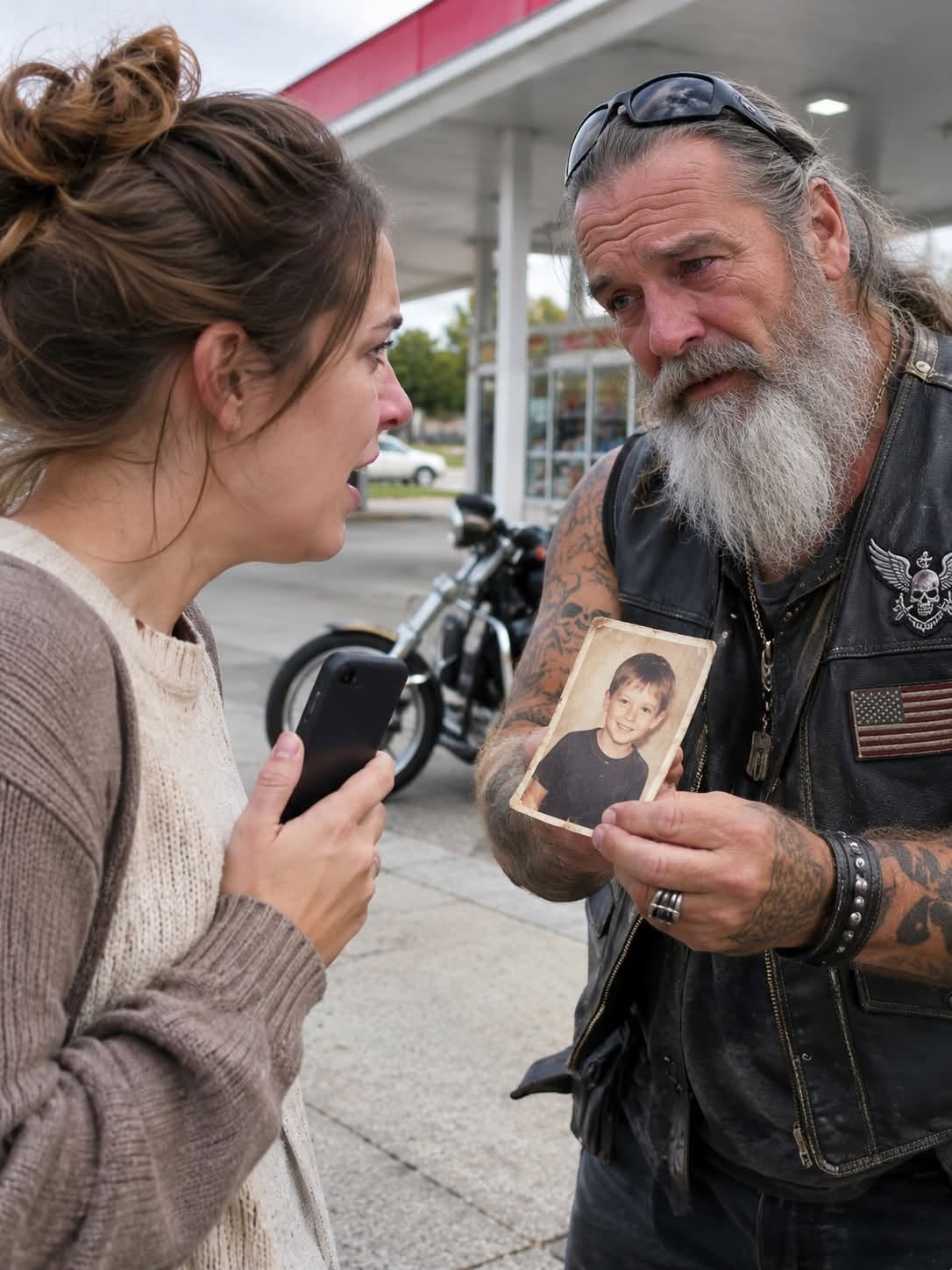
Then one Saturday morning, I spotted him again at a gas station. This time, I couldn’t hold back. I walked straight toward him, demanding that he stay away from my daughter, with my phone ready to call 911.
The biker didn’t get angry or try to defend himself. He simply looked at me, reached into his leather vest with trembling hands, and asked, “Ma’am, please… can I show you something?”
When he placed an old photograph in my hand, I recognized the little boy in it immediately. It was my husband, Tyler, as a child. Then the biker said six words that made my legs feel weak: “Tyler is my son.”
I had no idea who this man really was, why he had stayed away for so many years, or why he had driven 1,400 miles just to see my little girl. What happened next changed our family forever.
For a moment, I couldn’t breathe.
I stood beside the gas pump, holding an old photograph with both hands. The little boy in the picture had messy blond hair, a missing front tooth, and a crooked smile. He was sitting on a red motorcycle, wearing a blue shirt that I had seen in dozens of photographs from my husband’s childhood.
It was Tyler.
I looked up at the enormous man standing in front of me. He had a long gray beard, weathered skin, tattoos running down both arms, and a black leather vest covered in motorcycle club patches. His eyes were red, and his hands were shaking.
“You’re telling me you’re Tyler’s father?”
He nodded slowly.
“My name is Raymond. Raymond Carter. I haven’t seen my son since he was five years old.”
I stepped backward, still clutching the photograph.
“Then why have you been following my daughter?”
He lowered his eyes.
“I know how that sounds. And I know I should have approached you differently. But every time I saw that little girl, I saw my boy. I wasn’t trying to frighten her. I just needed to know if she was really his daughter.”
I wanted to believe him, but I was terrified. For three weeks, this stranger had appeared wherever Mia went. I had imagined every possible danger, and now he was telling me he was my husband’s father.
“Why didn’t you just contact Tyler?” I demanded.
Raymond swallowed hard.
“Because I didn’t know where he was. I’ve been looking for him for years.”
He reached into his vest again, slowly this time, and pulled out a folded piece of paper. It was an old photograph of a young woman holding a little boy. On the back, someone had written a date and an address.
“That’s my wife, Evelyn,” he said. “And that’s Tyler when he was little.”
I recognized the woman from one faded photograph Tyler kept in a box in our bedroom. He had told me she died when he was young. I had never seen the man standing beside her.
Raymond explained that he and Evelyn had been married for six years. He worked as a mechanic and rode with a motorcycle club, spending long hours on the road. Their marriage had become difficult, and arguments had grown more frequent. One night, after another terrible argument, Evelyn took Tyler and left.
At first, Raymond believed she needed time. Then weeks became months, and months became years. When he finally returned to the house where they had lived, the family was gone. He tried contacting relatives, but nobody would tell him where they had moved.
He admitted that he had made mistakes. He had been young, stubborn, and too proud to understand how badly his choices were hurting his family.
“I thought I’d have another chance to fix things,” he said. “But by the time I understood what I’d lost, they were gone.”
I looked at the photograph again.
“Tyler believes his mother died when he was little.”
Raymond nodded.
“She did. She passed away when he was eight. I found out years later, but by then, he had been adopted by his stepfather. I tried to find him through the people who knew Evelyn, but every trail ended somewhere.”
I felt a strange mixture of anger and sadness. My husband had grown up believing he had no father, while this man had apparently spent decades searching for him.
But there was still one question.
“How did you find us?”
Raymond took a long breath.
“About two months ago, I was at a motorcycle charity event outside Indianapolis. One of the mechanics there mentioned a man named Tyler Carter who owned a repair shop in your town. He said Tyler had a little girl named Mia. I didn’t know if it was my son, but the name was too close to ignore.”
He explained that he had driven more than 1,400 miles after finding Tyler’s business address. He had gone there once, but Tyler wasn’t working that day. He saw a photograph of Mia on a public family page and recognized the same crooked smile his son had as a child.
“I wanted to be sure before I walked into his life,” he whispered. “I didn’t want to make a mistake. I thought if I could see him, even from a distance, I’d know.”
“Instead, you frightened his daughter,” I said.
His face tightened.
“I know. I’m sorry.”
I didn’t know what to say. Part of me wanted to call the police immediately. Another part couldn’t ignore the photograph or the pain in his voice.
I took out my phone and called Tyler.
“Where are you?” I asked.
“At the shop. What’s wrong?”
“I need you to come to the gas station on Maple Road. Right now.”
“Why? Is Mia okay?”
“She’s fine. But there’s someone here you need to meet.”
I looked at Raymond.
“Someone who says he’s your father.”
There was silence on the other end.
Then Tyler said, very quietly, “What?”
“Just come, Tyler.”
He arrived about twenty minutes later, still wearing his work shirt, with grease on his forearms. He stepped out of his truck and immediately looked toward Mia, who was sitting safely inside my car.
Then his eyes moved to the biker.
Raymond stood completely still.
Tyler stared at him for several seconds before asking, “Who are you?”
Raymond didn’t approach him.
“My name is Raymond Carter.”
Tyler’s expression changed.
“That’s impossible.”
“I know you probably have a thousand questions.”
“My mother told me you were gone. She said you never wanted to see me.”
Raymond’s eyes filled with tears.
“Your mother was hurt, son. And I gave her reasons to be. I was not the husband or father I should have been. But I never stopped loving you.”
Tyler shook his head.
“Don’t call me son.”
Raymond looked down.
“All right.”
That quiet answer seemed to hurt him more than anything Tyler could have shouted.
For several minutes, nobody spoke. The gas station traffic continued around us. Cars pulled in, people bought coffee, and an ordinary Saturday morning carried on while our family stood in the middle of something none of us had expected.
Finally, I handed Tyler the photograph.
He stared at it.
I watched his fingers tighten around the edges. He turned it over and read the writing on the back. Then he looked at Raymond again.
“Where did you get this?”
“It was taken in our backyard. You were four. You wanted to ride my motorcycle, but your mother wouldn’t let you.”
Tyler looked at the picture for a long time.
“I remember that motorcycle,” he whispered. “I remember sitting on it.”
Raymond nodded, barely able to speak.
Tyler’s eyes filled with tears, but he quickly turned away.
“You have no idea what it was like growing up without a father.”
“I know,” Raymond said. “And I can’t ask you to forgive me for that.”
Tyler looked back at him.
“Then why now?”
Raymond glanced toward our car, where Mia was watching us through the window.
“Because I heard you had a daughter. I wanted to know what my granddaughter looked like. I wanted to see if she had your smile.”
Tyler’s expression hardened again.
“You don’t get to follow my little girl around because you suddenly regret your past.”
“No,” Raymond answered. “I don’t. You’re right.”
That was the first moment I believed he understood how frightened we had been.
Tyler walked to the car, opened the back door, and checked on Mia. She was holding her stuffed rabbit, looking from her father to the large biker.
“Daddy, is that the man Mommy was scared of?”
Tyler crouched beside her.
“He’s someone from my past, sweetheart. We need to talk to him, but you don’t have to go near him.”
Mia looked at Raymond.
“Why does he have a motorcycle?”
Raymond gave a small, uncertain smile.
“Because I’ve been riding them a very long time.”
Mia thought about that.
“Can it go really fast?”
“Faster than I should probably admit.”
For the first time that morning, Tyler almost smiled.
But he wasn’t ready to welcome Raymond into our family. He told him that clearly. He also told him never to appear near Mia again without permission.
Raymond accepted every condition.
Before leaving, he handed Tyler a small envelope.
“I don’t expect you to read it today. It’s just something I’ve carried for a long time.”
Tyler put it in his pocket without opening it.
Raymond walked toward his motorcycle, climbed on, and started the engine. He looked back once, but he didn’t wave. Then he rode away.
For the next several days, Tyler barely spoke about the encounter. The envelope stayed on the kitchen counter. Sometimes I caught him looking at it, but he never opened it while I was around.
On Wednesday evening, I found him sitting alone in the garage, holding the old photograph.
“Are you going to read the letter?” I asked.
He nodded.
He opened the envelope carefully. Inside was a handwritten letter, several faded photographs, and a small hospital bracelet with Tyler’s name on it.
The letter was dated twenty-five years earlier.
Raymond had written that he had spent years trying to locate his son. He described the places he had visited, the people he had contacted, and the letters he had sent to addresses that no longer existed. He also admitted that he had waited too long to fight for his family because he had been ashamed of the way he had behaved.
Near the bottom, one sentence was underlined.
“I don’t know if you’ll ever want to see me again, but I hope you grow up knowing that leaving you was never what I wanted.”
Tyler read it twice.
Then he found another photograph. It showed Raymond sitting beside a hospital bed, holding a tiny newborn baby.
Tyler stared at it.
“That’s me,” he whispered.
Raymond had been there when Tyler was born.
For years, Tyler had believed his father had disappeared before he could remember him. Now he was looking at proof that the man had once held him in his arms.
“I don’t know what to do with this,” he said.
I sat beside him.
“You don’t have to decide today.”
He folded the letter and placed it back inside the envelope.
Two days later, Tyler called Raymond.
I heard only one side of the conversation, but I knew it was important.
“Hello?”
A pause.
“This is Tyler.”
Another pause.
“Yes. I read your letter.”
He listened for a long time.
Then he said, “I’m not ready to call you Dad. But maybe we can have coffee.”
Raymond must have answered something, because Tyler looked down and rubbed his forehead.
“Tomorrow. Ten in the morning. And don’t bring the motorcycle club.”
When he hung up, he sat quietly for a moment.
“Are you sure?” I asked.
“No,” he said honestly. “But I want to know the truth.”
The next morning, Raymond arrived at the little diner near Tyler’s repair shop. He wore jeans, a plain black shirt, and his leather vest. He had left his motorcycle outside and brought no one with him.
He looked nervous.
Tyler arrived a few minutes later and sat across from him.
They talked for nearly two hours.
Raymond told him about his childhood, his marriage to Evelyn, and the years he had spent working as a mechanic. He didn’t make excuses for his mistakes. He admitted that he had allowed anger and pride to destroy his marriage, and that he should have done more to find his son.
Tyler told him about his mother, the man who had helped raise him, and the difficult questions he had carried since childhood. Some memories were painful. Others were surprisingly ordinary.
When they left the diner, they hadn’t solved twenty-five years of hurt. But they had agreed to meet again.
Over the following weeks, Raymond began visiting Tyler at the repair shop. He never arrived unannounced at our home, and he never followed Mia anywhere. He respected every boundary Tyler set.
One afternoon, Tyler invited him to our house for dinner.
Mia was in the living room drawing pictures when Raymond walked through the door. She looked up and recognized him immediately.
“You’re the motorcycle man!”
Raymond smiled.
“That’s me.”
She held up her drawing. It showed three people, a dog, and a very large motorcycle with purple wheels.
“That’s my daddy, my mommy, and me. And that’s your motorcycle.”
Raymond studied the picture as if it were the most valuable thing he had ever received.
“Those are some pretty impressive wheels.”
“They’re purple because I like purple.”
“Then purple they should be.”
Mia thought for a moment before asking, “Can you come to my school someday and show me your motorcycle?”
Raymond looked at Tyler first.
Tyler hesitated, then nodded.
“Maybe one day. If we plan it properly.”
Raymond’s eyes filled with tears.
“That would mean a lot to me.”
A month later, he came to Mia’s school for a family day. He parked his motorcycle outside the school grounds and waited until Tyler arrived with us. He didn’t want to make anyone uncomfortable, and he didn’t want Mia to feel pressured.
When she saw him, she ran toward him with a handmade drawing in her hands.
“Grandpa Raymond!”
The word stopped him completely.
He knelt down, his rough hands trembling as she wrapped her little arms around his neck.
He didn’t cry loudly. He simply closed his eyes and held her carefully, as if he were afraid the moment might disappear.
Tyler stood beside me, watching them.
Later that evening, after Raymond had left, Tyler told me something I hadn’t expected.
“I don’t think I can get back the father I needed when I was five,” he said. “But maybe I can get to know the man standing in front of me now.”
I took his hand.
“That’s enough for a beginning.”
Raymond never again appeared unexpectedly wherever Mia went. He became part of our lives slowly, through planned visits, family dinners, school events, and ordinary afternoons at the repair shop. He and Tyler still had difficult conversations, and some wounds took longer to heal than others, but neither of them stopped trying.
One Sunday, Raymond brought an old red motorcycle to our house. It was the same model as the one in the childhood photograph.
Tyler stared at it for a long time.
“I thought you sold this.”
“I did,” Raymond replied. “I bought another one years later. It took me a while to find the same model.”
Tyler ran his hand along the faded tank.
“I remember sitting on the first one.”
“I remember you refusing to get off it.”
They both laughed.
Mia climbed onto Tyler’s shoulders and pointed at the motorcycle.
“Can Grandpa take me for a ride?”
“Not until you’re old enough and have all the proper safety gear,” Tyler answered.
Raymond nodded seriously.
“Your daddy’s right. Some things are worth waiting for.”
That evening, after everyone had gone inside, I watched Raymond sitting alone on the porch. He was looking at the old photograph of Tyler as a little boy.
I finally understood something.
For three weeks, I had believed a dangerous stranger was following my daughter. I had imagined the worst, and I had every right to protect my child. Raymond had made a terrible mistake by watching us from a distance instead of approaching us honestly.
But the photograph had revealed something none of us knew: the stranger I feared had once been the little boy’s father, and he had spent most of his life regretting the years he had lost.
He hadn’t come looking for money, a place to stay, or anything we could give him.
He had come looking for a family he thought he would never see again.
And although twenty-five years could never be undone, one photograph had opened a door that had been closed for far too long.
Sometimes forgiveness doesn’t begin with an apology or a perfect explanation. Sometimes it begins with a cup of coffee, an old photograph, and two people willing to sit across from each other long enough to hear the truth.