It was the beginning of something Maeve had been planning quietly for months, something she was terrified to tell me because she didn’t know whether I would want the same future.
The captain had one final message to share.
And as Maeve squeezed my hand, I realized that the anniversary surprise I had planned for her had become the most unexpected gift of my life….
The photograph was still in my hand when Maeve finally sat down beside me. Her eyes were red, and she kept looking toward the cockpit as though she was waiting for someone to tell her what to say next.
I looked at the picture again. It showed a modest white house with a small garden, a wooden porch, and a swing hanging beneath an old tree. It wasn’t particularly large or luxurious, but there was something about it that felt familiar, almost like a place I had imagined many times without ever seeing it.
I turned the photograph over.
*For the life we postponed.*
I looked at my wife.
“Maeve, what does this mean?”
She took a slow breath and held my hand.
“It means I finally stopped waiting for the perfect time.”
I didn’t understand.
“For what?”
“To come home. To build the life we always talked about. To stop telling ourselves that we’ll do everything someday, when work gets easier, when we have more money, or when the schedule finally gives us a break.”
I stared at her.
“Are you leaving the airline?”
She nodded.
“Today is my final flight.”
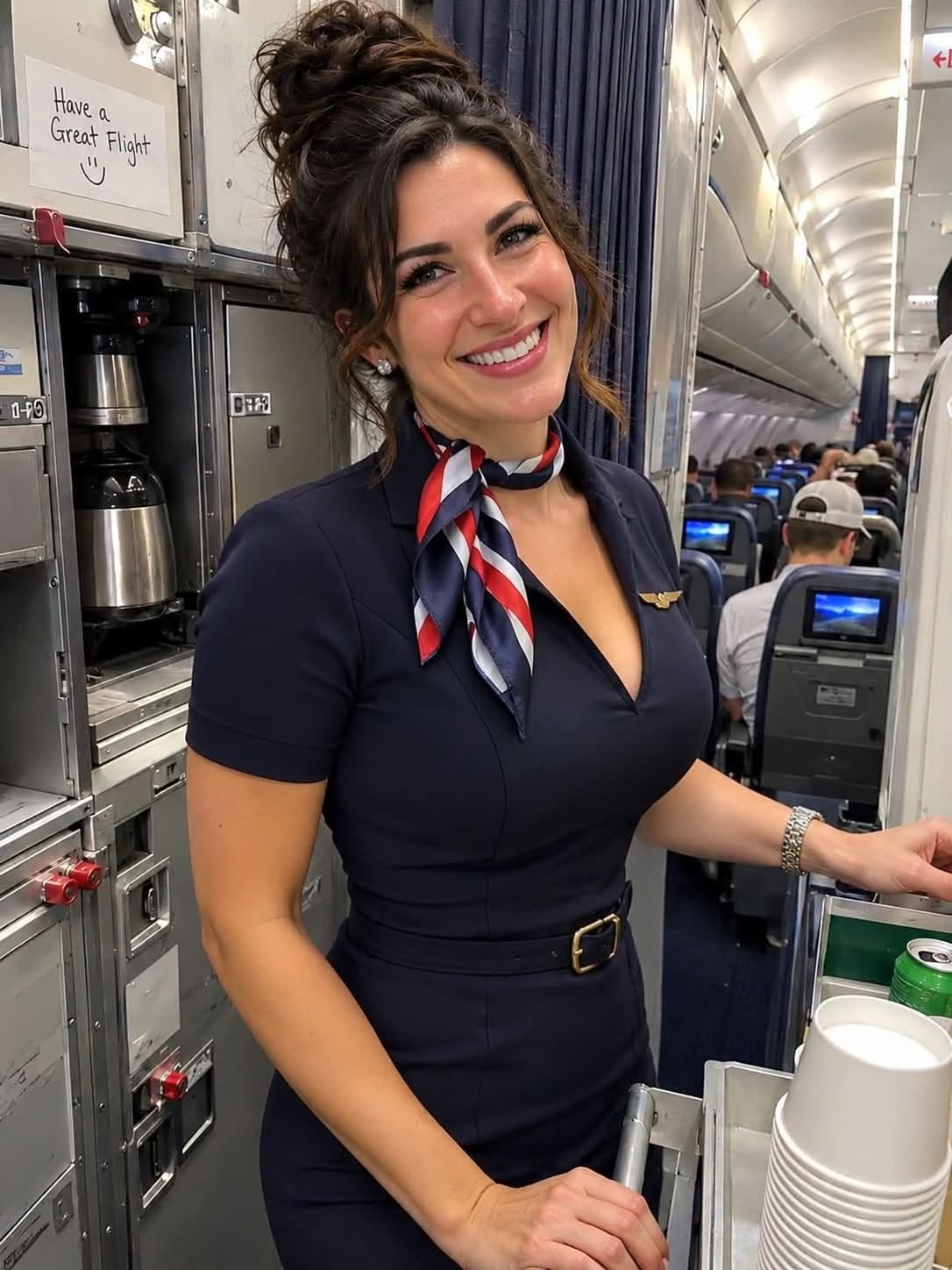
I looked toward the cockpit, then back at her. The captain had just announced that my wife was leaving after twelve years of service, and apparently everyone on the aircraft knew something about her decision that I didn’t.
“Why didn’t you tell me?”
Maeve lowered her eyes.
“Because I wanted to be certain. And because I was afraid you’d think I was giving up something important.”
I squeezed her hand.
“Maeve, you’ve spent twelve years building your career. I would never ask you to give that up.”
“I know,” she whispered. “That’s why this was so difficult.”
Before I could ask another question, the captain’s voice came through the speakers again.
“There’s one more thing we’d like to share before departure. Maeve has asked us to keep a promise today. It concerns a place she has been working toward for several months, and a dream she has carried for much longer than most of us know.”
The passengers were quiet.
Maeve looked at me.
“Would you come with me for a moment?”
She stood, and I followed her toward the front of the aircraft. One of the other flight attendants was waiting near the galley, holding a small bouquet of white flowers. She handed them to Maeve, who smiled through her tears.
The captain opened the cockpit door slightly and stepped into view.
He was an older man with silver hair, and he had the calm, friendly expression of someone who had spent decades making announcements to people who were nervous about flying.
“Happy anniversary,” he said to me.
I looked at Maeve.
“How does he know?”
She laughed softly.
“I may have mentioned it to the crew.”
The captain smiled.
“Your wife has been talking about this anniversary for months. She wanted to make sure that, whatever happened today, you both remembered it for the right reasons.”
He handed Maeve a small envelope.
She turned toward me.
“Before I explain the house, there’s something I need you to understand.”
I nodded.
She took my hands.
“Do you remember the first apartment we lived in?”
I smiled faintly.
“Of course. The one with the leaking kitchen ceiling?”
“And the terrible heating?”
“And the neighbor who played music at two in the morning.”
Maeve laughed.
“That apartment was awful.”
“It was our awful apartment.”
She smiled, but her expression soon became serious.
“Do you remember what we used to say when we sat on that little balcony?”
I thought for a moment.
We had been married for only a few months. We didn’t have much money, but we had plenty of plans. We talked about buying a house, having a garden, adopting a dog, and perhaps having children one day. We imagined Sunday breakfasts, family holidays, and evenings when neither of us had to rush off to work.
“We said we’d buy a house someday,” I replied.
Maeve nodded.
“And we said we’d stop living out of suitcases.”
I laughed.
“That was mostly because you kept stealing my suitcase.”
She smiled.
Then she looked down.
“We also said we’d start a family when we were ready.”
The words settled between us.
For years, we had wanted children. We had talked about it often, but our schedules never seemed to cooperate. When I was available, Maeve was flying. When she had time off, I was working. We kept postponing the conversation because we believed there would eventually be a better moment.
There was always another trip, another promotion, another expense, or another reason to wait.
Eventually, the subject became something we avoided.
Not because we no longer wanted a family, but because talking about it reminded us of everything we hadn’t managed to do.
Maeve looked at me.
“I never stopped wanting that life.”
I swallowed.
“Neither did I.”
She nodded.
“I know. But I was afraid we’d keep waiting until we had forgotten how to begin.”
Then she opened the envelope.
Inside was a letter from a local property solicitor, along with a photograph of the same white house.
At the top of the letter was an address.
I read it twice.
“Where is this?”
“About forty minutes from where we grew up.”
I looked at her.
“You bought a house?”
She nodded.
“Not exactly alone. I used the money I’d saved over the last several years, and I had some help from my aunt’s estate. The house belonged to an elderly couple who had moved closer to their daughter. They wanted someone to look after it rather than leave it empty.”
I stared at the photograph.
“Maeve, that’s a huge decision.”
“I know.”
“Why didn’t you tell me?”
She took a breath.
“Because I wanted to show you what I had been working toward, not just tell you about another plan we might never have time to complete.”
I looked at the house again.
It was small, with white walls and a dark roof. The garden looked slightly overgrown, and the porch needed painting. But the windows were large, and the tree in the front yard seemed to offer enough shade for a swing.
It looked like the kind of place where people could grow old together.
“What about your job?” I asked.
Maeve glanced toward the cabin.
“I’ve been thinking about leaving for almost a year. I love flying, and I will always be grateful for the people I’ve met. But I realized I had spent so much time helping other people get where they were going that I hadn’t made enough time to decide where I wanted to go.”
She paused.
“I don’t hate my job. I just don’t want to spend the next twelve years postponing everything that matters to us.”
I looked at the photograph.
Then I looked at her.
“Does this mean you want children?”
Her eyes filled.
“Yes. If you still do.”
I couldn’t answer immediately.
Not because I didn’t want children, but because I hadn’t expected to hear those words on an aircraft, with passengers watching and the captain waiting near the cockpit.
I had spent years telling myself that we were happy as we were. I had convinced myself that our life was simply different from the lives of our friends. We had our routines, our little traditions, and our shared memories.
But I remembered the evenings when Maeve would stop outside a toy store and look at the children’s clothes in the window. I remembered her smiling at babies in airport terminals. I remembered the way she would quietly save photographs of small bedrooms and family gardens on her phone.
I knew she had never stopped wanting a family.
Neither had I.
I reached for her hand.
“Of course I still do.”
She began crying.
“Really?”
I nodded.
“Maeve, I booked a seat on this flight because I wanted to surprise my wife on our anniversary. I wasn’t expecting to discover that she’d been planning an entirely new life for us.”
She laughed through her tears.
“That’s why I was so nervous.”
I pulled her closer.
“But I need you to promise me something.”
She looked up.
“What?”
“Next time you’re planning something this important, tell me before the captain does.”
She laughed, and I kissed her forehead.
The passengers began clapping.
I turned toward them, embarrassed, but Maeve was smiling. The other flight attendants were standing near the galley, some with tears in their eyes. One of them held up a small card.
It read:
*Happy anniversary. Your next journey starts at home.*
I looked at Maeve.
“Did you arrange all of this?”
She nodded.
“Some of it.”
The captain smiled.
“She was very particular about the wording. We had three versions before she approved this one.”
Everyone laughed.
Then he continued.
“Maeve has been an important part of this airline for twelve years. She has looked after passengers, supported new crew members, and helped colleagues through some very difficult days. We will miss her, but we are happy that she has found something worth coming home for.”
He paused.
“Maeve, on behalf of the entire crew, thank you. And to your husband, happy anniversary. We hope the next chapter is your best one yet.”
The cabin applauded again.
Maeve wiped her cheeks.
Then she turned to the captain.
“Thank you. All of you.”
She hugged the other flight attendants one by one. Some had worked with her for years, while others had only known her for a few months. They gave her flowers, cards, and small gifts.
I stood nearby, realizing that I had never fully understood how much she meant to the people she worked with.
One of the younger flight attendants approached me.
“She helped me when I first joined,” she said. “I was terrified during my first month. I thought I wasn’t good enough for the job, and Maeve was the one who stayed after a long flight to help me prepare for my assessment.”
Another crew member smiled.
“She remembers everybody’s birthday. Even people who have only worked one flight with her.”
I looked at Maeve.
She was hugging an older colleague, and both were laughing through tears.
I suddenly felt proud of her in a way I hadn’t expected.
For twelve years, I had seen her as my wife who worked long hours. I knew the inconvenience of the schedule, the missed dinners, and the cancelled plans. But I hadn’t always understood the other side of her life: the people she had helped, the friendships she had built, and the countless small moments that had made her career meaningful.
She wasn’t simply walking away from a job.
She was saying goodbye to a part of herself.
And I wanted her to know that she didn’t have to feel guilty about it.
When she returned to my seat, I held out my hand.
“Come here.”
She sat beside me.
“I’m proud of you,” I said.
She rested her head against my shoulder.
“I was hoping you’d say that.”
—
The aircraft never departed.
Not because anything was wrong, but because the airline had arranged for Maeve to finish her farewell ceremony before the passengers were transferred to another flight. The captain explained that the aircraft had been scheduled for a short ground delay anyway, and the airline had approved the small celebration.
Maeve and I were escorted off the aircraft after the other passengers had been thanked for their patience. Several people stopped to congratulate her as they passed.
A little girl who had been sitting near the front approached Maeve with her mother.
“Are you really not going to be a flight attendant anymore?” the girl asked.
Maeve crouched down.
“Not for a little while.”
“Why?”
Maeve smiled.
“Because I have a new adventure waiting for me.”
The little girl considered that.
“Will you still fly?”
“Maybe one day. But for now, I’m going to spend more time at home.”
The girl nodded.
“That’s good. My mom says home is important.”
Maeve smiled.
“Your mom is right.”
When we reached the terminal, Maeve turned toward the windows and looked at the aircraft.
I stood beside her.
“Are you sad?”
She nodded.
“A little.”
“Do you regret it?”
She shook her head.
“No. But I think I’ll miss the people more than the actual flying.”
I put my arm around her.
“You can still see them.”
“I know.”
She looked through the glass one more time.
“I just didn’t expect saying goodbye to feel this difficult.”
I squeezed her shoulder.
“Leaving something you love doesn’t mean it wasn’t worth loving.”
She looked at me.
“That’s a good line.”
“I’ve been saving it for twelve years.”
She laughed.
Then she reached into her bag and pulled out a small photograph.
It was another picture of the house, this time taken from the back garden.
There was a little wooden table beneath a tree and a patch of grass large enough for children to play.
“There’s something else I haven’t told you,” she said.
I raised an eyebrow.
“Should I be worried?”
She laughed.
“No. But I wanted to show you something.”
She handed me the photograph.
On the back was another handwritten note.
*Room for a family.*
I looked at her.
“Maeve…”
She took my hand.
“I know we haven’t talked about children properly in a long time. And I know there are things we need to work through before making any decisions. I don’t expect us to walk into that house and suddenly have everything figured out.”
She paused.
“But I want us to have the space to try. I want us to wake up in the same place more often. I want us to have ordinary evenings together. I want to cook dinner while you’re sitting at the kitchen table complaining about the news. I want to have a garden where we can sit when we’re old.”
I smiled.
“You’ve thought about this quite a lot.”
“Every day.”
I looked at the house again.
Then I noticed something in the photograph.
There was a small wooden swing hanging from the tree.
I smiled.
“You’ve already bought the swing?”
Maeve laughed.
“No. The previous owners left it there. I thought we could keep it.”
I looked at her.
“Then we definitely need to keep it.”
—
We drove to the house that afternoon.
Maeve had arranged for the keys to be collected from the solicitor, and she had already placed a few things inside. There were two mugs on the kitchen counter, a small vase of flowers beside the window, and a framed photograph from our wedding day.
The house smelled faintly of fresh paint and old wood.
I walked through the living room, opened the back door, and stepped into the garden.
The grass needed cutting, and the flower beds were full of weeds. The wooden swing creaked gently in the breeze.
I stood beneath the tree.
For the first time in years, I could imagine what our weekends might look like without having to check a flight schedule or rearrange a shift.
Maeve came outside carrying two cups of tea.
“What do you think?”
I looked around.
“It’s beautiful.”
She smiled.
“It’s not finished.”
“Neither are we.”
She laughed.
I walked over and took one of the cups.
Then I noticed a small envelope on the garden table.
“What’s that?”
Maeve looked at it.
“Oh. I nearly forgot.”
She handed it to me.
Inside was a handwritten list titled:
*Things we said we’d do someday.*
I read through it.
– Have breakfast together without checking the time.
– Grow vegetables in the garden.
– Adopt a dog.
– Take a proper holiday without worrying about work.
– Have a family.
– Spend Christmas at home.
– Take photographs every year.
– Learn to sit still.
– Make this house feel like ours.
I looked at her.
“You remembered all of these?”
She nodded.
“I kept a note on my phone. Every time we talked about something we wanted to do, I added it.”
I looked down again.
At the bottom, she had written one final line.
*Stop waiting for someday.*
I folded the paper carefully.
Then I walked over and kissed her.
“Let’s start with breakfast tomorrow.”
She smiled.
“That sounds manageable.”
“And perhaps the dog.”
“One thing at a time.”
We sat together on the old wooden swing.
For a while, neither of us spoke. The afternoon sun moved slowly across the garden, and somewhere nearby, a dog barked behind a fence.
I rested my arm around her.
“Do you know what I was planning to do on the flight?” I asked.
She looked at me.
“What?”
“I was going to ask the crew to bring you a little cake. I had even written a ridiculous anniversary message.”
She laughed.
“What did it say?”
I looked embarrassed.
“Something about twelve years of putting up with me.”
“That’s not ridiculous. That’s accurate.”
I laughed.
“I also bought you a necklace.”
Her eyes widened.
“Where is it?”
“In my bag.”
She leaned forward.
“Why didn’t you give it to me?”
“Because the captain started announcing your retirement, and I completely forgot how to behave.”
She laughed again.
“Well, I still want it.”
I went inside and retrieved the small gift box.
When I returned, she was still sitting beneath the tree.
I opened it.
Inside was a simple silver necklace with a small pendant shaped like a compass.
Maeve looked at it.
“It’s beautiful.”
I fastened it around her neck.
“I thought it was appropriate for someone who spends her life travelling.”
She touched the pendant.
“Thank you.”
Then she looked at me.
“Can I tell you something?”
“Of course.”
“I didn’t know whether you’d be happy about me leaving.”
I frowned.
“Why?”
“Because you always encouraged me to keep working. You were proud of my career, and I thought you might believe I was throwing it away.”
I took her hand.
“I was proud of your career. I still am. But I don’t love you because you wear a uniform or because you work for an airline. I love you because you’re Maeve. And I want you to be happy, even if that means your life looks different from the one we planned years ago.”
She leaned against me.
“That’s all I wanted to hear.”
—
The first few weeks in the new house were not as romantic as the photographs had made them look.
The kitchen tap leaked. One of the bedroom windows wouldn’t close properly, and the garden required far more work than either of us had expected. We spent an entire Saturday trying to assemble a cupboard, only to discover that we had fitted two panels upside down.
Maeve blamed me.
I blamed the instructions.
Neither of us admitted that we had been arguing about a piece of furniture for forty minutes.
But those ordinary problems became some of my favorite memories.
For the first time in twelve years, we could have breakfast together without checking whether one of us needed to leave for the airport. We went shopping on weekday mornings, took walks after dinner, and started making plans that didn’t depend on an airline schedule.
Maeve still woke early out of habit.
Sometimes she would walk into the kitchen before sunrise, make coffee, and sit by the window.
I would find her there, looking at the garden.
“Missing the job?” I asked one morning.
She nodded.
“Sometimes.”
“Do you want to go back?”
She smiled.
“Not yet.”
She explained that she missed the people, the excitement, and the feeling of being part of a team. But she didn’t miss rushing through airports, sleeping in unfamiliar hotels, or spending important days away from home.
She had also started helping at a local community center. It wasn’t a full-time job, and she wasn’t looking for another career immediately. She simply wanted to do something useful with the experience she had gained over twelve years.
The center organized activities for children whose parents worked irregular hours. Some had parents in healthcare, transportation, emergency services, and aviation. Maeve helped organize reading sessions, art activities, and occasional trips to the local airport.
She found that she still enjoyed caring for people.
She just wanted to do it without spending every night away from home.
One afternoon, I found her helping a little boy build a paper airplane.
He had been struggling to fold the wings properly, and she was showing him how to make the edges line up.
I watched from the doorway.
She noticed me.
“What?”
“Nothing.”
“You’re staring.”
“I’m just thinking.”
“About what?”
“That you haven’t changed at all.”
She smiled.
“I hope not.”
I walked over and picked up the paper airplane.
“Can I have a go?”
The boy handed me another sheet.
Maeve looked at me.
“You’re going to need help.”
“How difficult can it be?”
Five minutes later, the boy had built two airplanes, Maeve had built one, and mine looked like a folded receipt.
She laughed so hard that she had to sit down.
I didn’t mind.
It was the kind of afternoon we had talked about for years.
—
A few months after Maeve’s final flight, we began discussing the possibility of starting a family more seriously.
We didn’t rush into anything.
We spoke to a doctor, discussed our health, and considered the different paths available to us. We had spent too many years postponing important conversations, and we wanted to make this decision together rather than let excitement or fear push us into something we weren’t ready for.
One evening, we sat at the kitchen table with a notebook between us.
Maeve had written several questions.
I looked at the page.
“You’re making this look like a business meeting.”
She smiled.
“I like being prepared.”
“You used to prepare for flights. Now you’re preparing for parenthood.”
“Both involve planning, patience, and people who don’t always listen.”
I laughed.
Then I took her hand.
“Whatever happens, I want us to remember that we’re already a family.”
She looked at me.
“I know.”
“We don’t need a child to make this house meaningful.”
“I know that too.”
“But if we have the chance to become parents, I want to do it with you.”
She smiled through her tears.
“That’s what I wanted.”
We talked for hours that evening.
We discussed adoption, fostering, and the possibility of having a child of our own. We didn’t make any promises about how quickly things would happen. We simply agreed that we would explore the options together.
And for the first time, the future didn’t feel like something waiting somewhere beyond our work schedules.
It felt like something we were finally allowed to build.
—
About a year after Maeve’s final flight, we received a phone call from the local adoption agency.
We had completed the initial paperwork, attended several meetings, and gone through the necessary assessments. We knew the process could take time, and we had been warned that there were no guarantees.
The call wasn’t an announcement that a child was waiting for us.
It was an invitation to meet a little girl named Sophie, who was living with a temporary foster family while plans for her future were being considered.
She was six years old.
She had experienced several changes in her young life and needed a stable home where she could feel safe. The agency believed we might be suitable, but the decision would take time, and we would need to meet her gradually.
Maeve sat quietly after the call ended.
I looked at her.
“Are you okay?”
She nodded.
“I’m just nervous.”
“Me too.”
She smiled faintly.
“What if she doesn’t like us?”
“Then we’ll try not to take it personally.”
Maeve laughed.
We spent the next several weeks preparing for the first meeting. We didn’t decorate a bedroom or buy piles of toys. We were told to keep things simple and let Sophie get to know us at her own pace.
When we finally met her, she sat beside her foster mother and held a small stuffed rabbit.
She didn’t say much.
Maeve sat across from her and introduced herself.
“Hello, Sophie. I’m Maeve.”
The little girl nodded.
“And this is my husband.”
I smiled.
“Hello.”
Sophie looked at me.
“Are you a pilot?”
I laughed.
“No, I’m not. But my wife used to work on airplanes.”
Sophie looked at Maeve.
“Did you fly?”
“Yes. For many years.”
“Did you see the clouds?”
Maeve smiled.
“Every day.”
Sophie considered that.
“Did you ever see a rainbow?”
“Sometimes.”
The little girl looked down at her rabbit.
“Was it pretty?”
Maeve nodded.
“Very.”
That was the beginning.
We didn’t expect Sophie to hug us or call us anything special. We didn’t ask her to. We simply visited, played games, read stories, and allowed her to decide how comfortable she felt.
During one visit, she asked Maeve whether she could see an airplane.
Maeve promised to take her to the airport observation area if the agency approved it.
On another visit, Sophie asked whether we had a garden.
“We do,” I said.
“Do you have flowers?”
“We’re growing sunflowers.”
She looked interested.
“Can I plant one?”
I smiled.
“If the adults looking after you say it’s okay.”
She nodded seriously.
“I know how to plant seeds.”
Maeve looked at me.
I could see the emotion in her eyes.
The process continued for several months. There were interviews, home visits, and more meetings. We had to demonstrate that we understood Sophie’s needs and could offer her a stable environment.
Eventually, the agency approved us as prospective adoptive parents, and the placement process moved forward.
When Sophie first came to stay with us, she brought a small suitcase, her stuffed rabbit, and a collection of drawings.
She stood in the hallway, looking around.
Maeve knelt beside her.
“This is your room.”
Sophie walked inside slowly.
There was a small bed, a bookshelf, a desk, and a lamp shaped like a moon. We had left the walls mostly plain so she could help choose the decorations.
She looked at the window.
“Can I see the garden from here?”
Maeve nodded.
Sophie moved closer.
“Is that the swing?”
I smiled.
“Yes. You can sit on it whenever you want, as long as we’re outside together.”
She turned toward us.
“Can I put my rabbit on the bed?”
“Of course,” Maeve said.
Sophie placed the rabbit carefully on the pillow.
Then she looked at us again.
“Do I have to go back tonight?”
Maeve’s eyes filled, but she kept her voice calm.
“We’re going to follow the plan the adults have made. But we’re very happy you’re here.”
Sophie nodded.
She didn’t hug us.
She didn’t call us Mum and Dad.
And that was perfectly fine.
We knew trust wasn’t something we could demand. It had to grow.
That evening, Maeve sat beside Sophie while she drew a picture of our house. I watched them from the doorway.
The picture showed three people standing beneath the tree.
There was a woman with long hair, a man with a small smile, and a little girl holding a stuffed rabbit.
Above them, Sophie had written three names.
Maeve.
Dad.
Sophie.
I had to turn away for a moment.
Not because I wanted to cry in front of her, but because I suddenly understood what Maeve had meant when she said she wanted to build a different kind of life.
She hadn’t simply wanted to stop flying.
She had wanted to be present.
She wanted to be there for breakfast, for school mornings, for bedtime stories, and for the ordinary moments that make a child feel secure.
And now we were getting the chance to build that life together.
—
The following year, on our thirteenth wedding anniversary, I found Maeve sitting in the garden with Sophie.
They were looking through an old photograph album.
I recognized the picture immediately.
It was the photograph of the white house that Maeve had handed me on the aircraft.
Sophie pointed at it.
“Was this our house before?”
Maeve smiled.
“Yes. It looked a little different when we first found it.”
“Why did you buy it?”
Maeve looked toward me.
Then she answered.
“Because we wanted somewhere we could come home to. Somewhere we could make memories together.”
Sophie thought about that.
“Like my room?”
“Exactly.”
She turned another page.
There was a photograph of Maeve in her airline uniform, standing beside the aircraft on her final day.
Sophie looked at it.
“Were you a pilot?”
Maeve laughed.
“No, sweetheart. I was a flight attendant.”
“What did you do?”
“I helped people during their journeys. I made sure they were safe, comfortable, and knew where to go.”
Sophie looked at the photograph again.
“Did you like it?”
Maeve nodded.
“I loved many parts of it.”
“Then why did you stop?”
Maeve considered the question.
“Because I had another journey I wanted to take.”
Sophie looked confused.
“What journey?”
Maeve smiled and gently touched her shoulder.
“This one. Being here with you.”
Sophie leaned against her.
I stood behind them, listening.
Then Sophie looked up at me.
“Dad, are we going somewhere today?”
I smiled.
“Where would you like to go?”
She thought for a moment.
“Can we go to the airport?”
Maeve laughed.
“Why the airport?”
“I want to see the airplanes. And maybe we can wave at the people inside.”
I looked at Maeve.
She smiled.
“That sounds like a good anniversary plan.”
We spent the afternoon at the airport observation area. Sophie watched the planes taxi toward the runway, and Maeve explained how the crew prepared for each flight.
When a large aircraft lifted into the sky, Sophie waved both hands.
“Goodbye!”
I stood beside Maeve.
“Do you miss it?”
She watched the plane disappear into the clouds.
“Sometimes.”
“Would you ever go back?”
She smiled.
“Maybe one day. But I’m not in a hurry.”
She took my hand.
“I don’t regret those twelve years. They gave me friendships, experiences, and a life I was proud of. But I don’t regret leaving, either.”
I nodded.
“Good.”
She looked at me.
“Do you remember what you planned for our anniversary that day?”
I laughed.
“The necklace?”
“And the cake?”
“And the ridiculous message.”
She smiled.
“I still have the necklace.”
I looked at the small compass pendant around her neck.
“I noticed.”
She rested her head against my shoulder.
“That day, I thought you might be upset with me. I thought you’d see my decision as the end of something.”
I turned toward her.
“It was the end of something.”
She looked up.
I smiled.
“But it was also the beginning of something else.”
She squeezed my hand.
Sophie came running back toward us, holding a small paper airplane she had made from an old boarding pass.
“Dad! Look!”
I examined it.
“That’s a good one.”
“Can you make it fly?”
I took the paper airplane and threw it gently across the observation area. It glided a short distance before landing on the floor.
Sophie laughed.
Maeve shook her head.
“Still not very good at flying, are you?”
I smiled.
“I married a flight attendant. I thought she’d teach me.”
She laughed and picked up the paper airplane.
“Some things take time.”
—
That evening, we returned home and sat together beneath the old tree in the garden.
Sophie was tired from the airport and had fallen asleep on the sofa. Her stuffed rabbit was tucked beneath her arm.
Maeve leaned against me.
I looked at the house, the garden, and the wooden swing that had once appeared in a photograph on an aircraft.
I thought about the man who had booked a seat on his wife’s flight because he wanted to surprise her on their anniversary. I remembered how excited I had been when I saw her standing in the aisle, and how quickly that excitement had turned into confusion when the captain announced her final flight.
At the time, I had thought I was watching my wife leave the career she loved.
I hadn’t understood that she was making room for something else.
I turned toward her.
“Do you remember what you wrote on the back of that photograph?”
She smiled.
“For the life we postponed.”
I nodded.
“I think we’ve started it.”
She rested her head against my shoulder.
“We have.”
We sat quietly for a while.
Then she looked toward the house.
“Do you ever think about how strange it was that you booked a seat on my flight?”
I laughed.
“Probably the best seat I’ve ever booked.”
She smiled.
“And you nearly ruined the surprise by looking so nervous when the captain started speaking.”
“I thought you were secretly getting divorced.”
Maeve burst out laughing.
“On our anniversary?”
“You looked terrified!”
She shook her head.
“You’re impossible.”
I kissed her forehead.
“Still married, though.”
“Fortunately.”
We laughed together.
A few minutes later, Sophie woke up and came outside carrying her rabbit.
“Are you two talking about me?”
I smiled.
“Always.”
She climbed onto the swing and looked up at Maeve.
“Can you push me?”
Maeve stood and gently pushed the swing.
Sophie laughed as it moved back and forth beneath the tree.
I watched them, feeling something I hadn’t felt in a long time.
Not excitement about a holiday, a promotion, or a new destination.
Just gratitude for being exactly where I was.
Maeve had spent twelve years helping strangers reach their destinations. She had missed birthdays, holidays, and anniversaries because she believed her work mattered, and it did. She had built a career that deserved to be remembered with pride.
But she had also realized that the life she wanted was waiting somewhere beyond the airport gates.
The house wasn’t perfect. The garden still needed work, the kitchen cupboard was slightly crooked, and we were learning every day how to become the parents Sophie needed.
There were difficult mornings and complicated conversations. There were days when we were tired and days when we weren’t sure whether we were doing everything right.
But we were there.
We were together.
And we were no longer postponing every important part of our lives for some imaginary perfect moment.
Sometimes, when an airplane passes overhead, Maeve still looks up. I can see the old excitement in her eyes, and I know a part of her will always belong to the sky.
I never ask her to forget those years.
I wouldn’t want her to.
They helped make her the woman I fell in love with.
But now, when the aircraft disappears beyond the clouds, she turns toward our house, where a little girl is usually waiting to show her a drawing or ask her to read one more bedtime story.
And that is the journey she chose.
The day I booked a seat on my wife’s anniversary flight, I thought I was giving her a surprise.
I had no idea she had been preparing one for me for months.
I thought the captain’s announcement was going to tell me that my wife was leaving her job.
Instead, it told me that she was finally coming home.
And the most beautiful part wasn’t the house, the garden, the swing, or even the new family we were slowly building.
It was that after twelve years of saying *someday*, we had finally begun saying *today*.
Because sometimes the greatest journey isn’t the one that takes you across oceans or into the clouds.
Sometimes it’s the journey that brings you back to the people waiting for you at home.