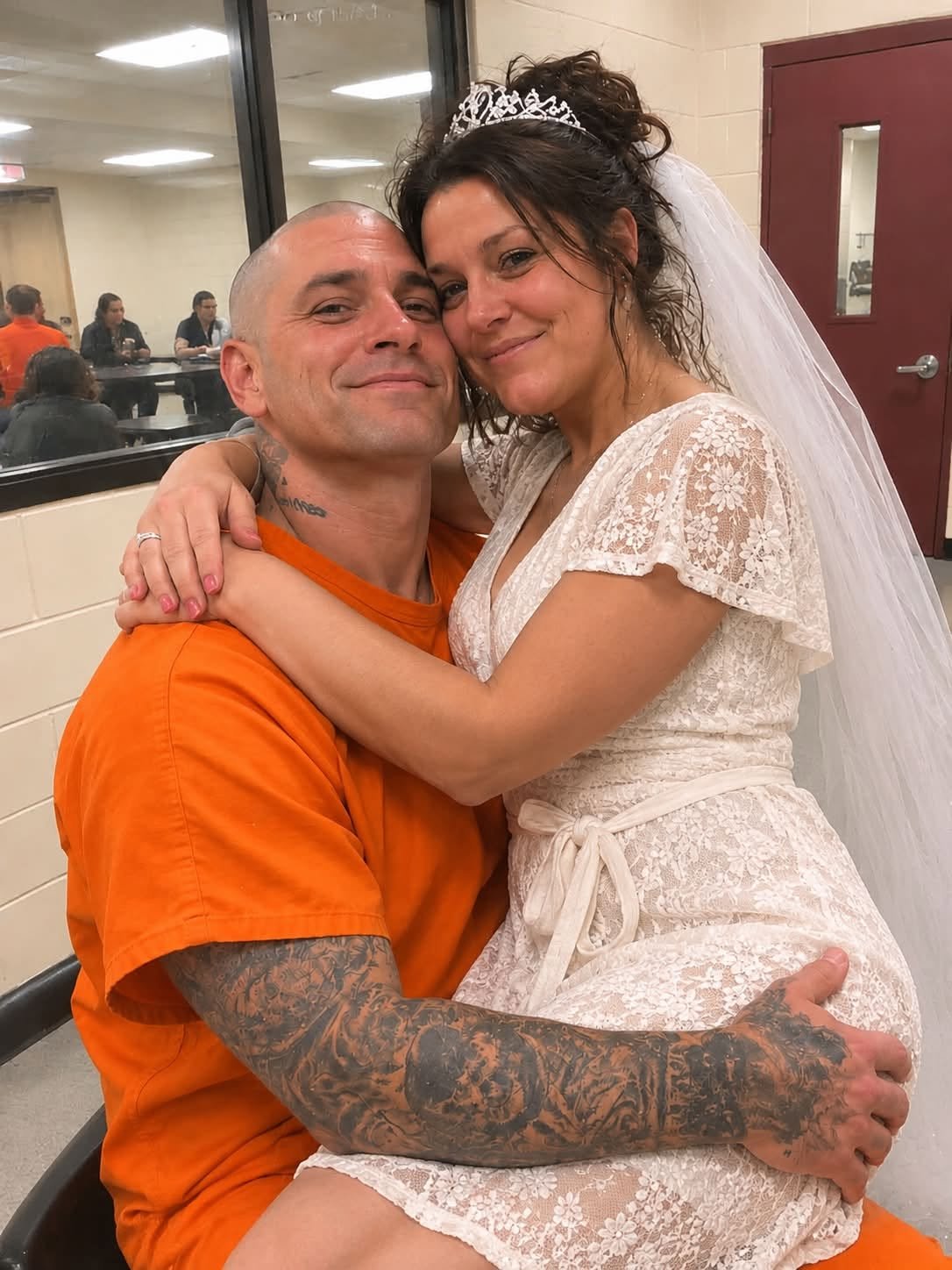
I Agreed to Marry an Outlaw Biker in Prison for $2,000 a Month. But When He Was Finally Released, He Arrived at My Apartment Carrying a Mysterious Black Box…
I agreed to marry a man serving a life sentence in prison in exchange for money. At the time, I didn’t particularly care whether he was innocent or guilty. His name was Jonah Blackwood, a former outlaw biker who had been convicted of stealing nearly $2 million from a charity organization connected to his motorcycle club.
I was twenty-seven, behind on rent, and struggling to look after my younger brother. Our mother had passed away, and I was the only family he had left. I was working two part-time jobs, barely keeping food on the table, and receiving eviction warnings from our landlord. So when Jonah’s mother offered me $2,000 a month to become her son’s legal wife, I accepted before I had time to consider how unusual or humiliating the arrangement might become.
“There’s something you need to understand,” his mother told me during our first meeting. “Jonah has spent most of his adult life riding with the Black Vultures Motorcycle Club. He’s not an ordinary man, and his conviction has destroyed everything he built. I need someone who will visit him, write to him, and make sure he doesn’t believe his family has abandoned him.”
She explained that I would need to visit Jonah at least twice a month, write to him regularly, and remain married to him while his legal appeal was being reviewed. The arrangement was supposed to be temporary, and the monthly payments would help me take care of my brother.
I knew the risks. Jonah had been involved with an outlaw motorcycle club for years. His photograph had appeared in newspapers after his arrest, showing a broad-shouldered man with short dark hair, a thick beard beginning to turn gray, tattooed arms, and a black leather vest covered in club patches. The newspapers described him as dangerous, stubborn, and connected to a criminal organization.
Our wedding took place inside the prison visiting facility, separated from the outside world by security doors, concrete walls, and armed guards. Jonah wore a plain prison uniform instead of his leather vest. His wrists were restrained when the ceremony began, and a guard stood nearby, repeatedly checking his watch.
I expected him to be angry, intimidating, and emotionally closed off.
I even worried he might treat me cruelly.
But the man sitting across from me was nothing like the person described in the newspapers.
He spoke gently, thanked me for agreeing to the arrangement, and apologized for the inconvenience I had gone through to reach the prison. Before the ceremony ended, he asked about my younger brother.
“How old is he?” Jonah asked.
“Fourteen.”
“Does he like motorcycles?”
I was surprised by the question.
“He’s never been on one.”
Jonah smiled slightly.
“Maybe one day he’ll get the chance.”
I assumed he was simply making conversation.
During my first few visits, Jonah never behaved like someone expecting anything from me. He didn’t demand affection, complain about his situation, or try to make me feel guilty about the money I was receiving. Instead, he asked whether my brother was doing well, whether I had enough groceries, and whether our landlord was still threatening to evict us.
He remembered my brother’s birthday and sent him a handwritten card. Sometimes his letters included small drawings of motorcycles, mountain roads, and places he said he hoped to visit again.
At first, I only pretended to care about him.
I was fulfilling an agreement, collecting the monthly payment, and trying to keep my family from falling apart.
But somewhere along the way, pretending stopped being necessary.
I began looking forward to his letters. I found myself thinking about him while working late shifts, wondering whether he had eaten dinner or whether he was having another difficult day inside those prison walls. When I visited, I noticed the little things: how carefully he listened, how he never interrupted me, and how he always asked about my brother before talking about himself.
One afternoon, I asked him something I had been thinking about for months.
“Jonah, did you really steal that money?”
He looked at me for a long moment.
Then he shook his head.
“No. But I know what everyone thinks.”
“Why don’t you explain what happened?”
He lowered his eyes.
“Because the people who did it are still out there, and I don’t want you getting dragged into something you don’t understand.”
That answer stayed with me.
I began looking into the case myself. I wasn’t a lawyer, and I had never imagined spending my evenings reading court documents, but something about the conviction didn’t feel right.
Some signatures were missing. Several dates didn’t match. Money had been transferred from accounts Jonah supposedly controlled, even though prison records showed he had been detained during part of the period in question. One witness had also relocated to another state shortly after testifying.
I started taking piles of case records to courthouses and asking lawyers whether they would examine the evidence again. Most dismissed me. A few told me the case was too complicated to reopen. Others warned me that Jonah had powerful enemies and that I should be careful about involving myself in his affairs.
I kept going.
Eventually, I discovered that Jonah’s cousin, Marcus, had been managing the charity’s finances while Jonah was away on motorcycle club business. Marcus had access to the accounts, knew the organization’s internal procedures, and had signed several documents that later appeared in the prosecution’s evidence.
The deeper I investigated, the more suspicious the case became.
Jonah never asked why I had become so determined to help him. He never demanded that I continue, and he never promised me anything in return.
The truth was simple.
I’d fallen deeply in love with my husband.
Three years after our prison wedding, new evidence finally emerged. Financial records and independent forensic examinations revealed that Marcus had stolen the charity’s money, forged Jonah’s signature, and manipulated the records to make it appear that Jonah had authorized the transfers.
The evidence was strong enough to overturn the conviction.
When the judge announced the decision, I sat in the courtroom with tears running down my face. I had spent three years visiting a prison, reading documents, fighting through legal obstacles, and trying to convince people that the man I loved was not the criminal they believed him to be.
Jonah was finally going home.
I imagined him walking out of the prison gates and running straight into my arms. I imagined the first proper hug we would share without a guard watching us or a security door separating us. I imagined introducing him to my brother without having to explain why we could only see him through prison glass.
But when Jonah was finally released, he looked strangely troubled.
He had been given back his personal belongings, including a battered leather jacket and a small bag containing a few photographs. His beard was longer than I remembered, and his face looked thinner after three years behind bars. He was still the same intimidating-looking biker, but there was something different in his eyes.
He walked toward me slowly.
I threw my arms around him.
For a moment, he stood completely still. Then he wrapped his arms around me and held me tightly.
“You’re really here,” I whispered.
He rested his forehead against mine.
“You kept your promise.”
I smiled through my tears.
“So did you.”
He looked at me for a long moment before taking my hand.
“Come home with me.”
For the next seven days, life felt almost perfect. Jonah moved into my apartment, met my younger brother, and slowly began adjusting to ordinary life outside prison. He helped repair a broken kitchen cabinet, cooked dinner one evening, and spent hours listening to my brother talk about school and motorcycles.
My brother was fascinated by him.
He had seen photographs of Jonah in his old leather vest and couldn’t believe that the man sitting at our kitchen table was the same person.
One evening, Jonah even promised to take him for a motorcycle ride someday, once everything was settled and they had the proper safety equipment.
I genuinely believed the worst was over.
But on our eighth evening together, something changed.
I was washing dishes when I noticed Jonah sitting at the kitchen table, staring at a small object beside his coffee cup. He had barely spoken throughout dinner. His expression was serious, and he kept rubbing his thumb against the edge of the table.
“Are you okay?” I asked.
He looked up.
“There’s something I need to tell you.”
I turned off the tap.
“What is it?”
He reached beside his chair and lifted a small black box. It was made of dark wood, with metal corners and an old-fashioned brass latch. It looked unusually heavy for its size, and there were several scratches along its surface.
He placed it carefully in the middle of the kitchen table.
I dried my hands and approached him.
“Jonah, what is that?”
He looked at the box, then at me.
“There’s something I’ve kept from you, and I need to explain it.”
I tried to smile, though my nerves were already tightening.
“You’re starting to scare me.”
His expression changed.
“Promise you won’t jump to conclusions. Just open the box first. Then I’ll tell you everything.”
I sat opposite him.
My fingers trembled as I reached for the brass latch. I had spent three years believing I knew almost everything about this man. I had defended him when strangers called him a criminal, fought to prove his innocence, and waited for him when everyone else had walked away.
But suddenly, I wondered whether there was something important he had never told me.
I slowly lifted the lid.
Inside were several old photographs, a folded document, a small leather pouch, and something wrapped in a piece of faded black cloth.
I picked up the first photograph.
My face went pale.
I recognized the person standing beside Jonah immediately, but what shocked me was the date written on the back. It had been taken years before I ever met him, and the person in the photograph had a connection to my family that I never could have imagined.
I looked at Jonah.
He had tears in his eyes.
“Why do you have this?”
He took a deep breath.
“Because the reason my mother offered you that money wasn’t the whole truth. And the reason I agreed to marry you has something to do with a promise I made long before I was sent to prison.”
I looked down at the black box again.
Then Jonah said something that made my entire body go cold:
“Before you decide whether you still want to be my wife, you need to know what really happened to your father.”
I couldn’t speak.
Because my father had been dead for eleven years.
And according to the photograph in my hands, Jonah Blackwood had known him…
The photograph slipped from my fingers and landed on the kitchen table.
For several seconds, I couldn’t move. I knew the man standing beside Jonah. I recognized his crooked smile, the small scar above his left eyebrow, and the old leather jacket he had worn almost every winter of my childhood.
It was my father.
But the photograph was more than eleven years old, and Jonah was standing beside him wearing a Black Vultures Motorcycle Club vest. They looked comfortable together, as though they had known each other for years.
I slowly looked up.
“How did you know my father?”
Jonah didn’t answer immediately. He reached into the black box and carefully removed the folded document. His fingers were trembling.
“His name was Michael, wasn’t it?”
I nodded.
“Michael Bennett.”
Jonah closed his eyes.
“Your father saved my life.”
I stared at him.
“What?”
“He was the reason I survived the worst night of my life. And before he died, he made me promise something. A promise I’ve carried for eleven years.”
I felt my stomach tighten.
“Why didn’t you tell me this when we first met?”
Jonah looked at me with an expression I had never seen before. It wasn’t the calm, patient look he usually gave me during our prison visits. It was the expression of a man who had been carrying something too heavy for too long.
“Because I was afraid you would think everything between us was arranged. I was afraid you’d believe I married you because of your father, not because of the woman you became.”
I looked at the photograph again.
The man beside Jonah was unmistakably my father. I had spent years believing I knew everything important about him, but apparently there was an entire part of his life I had never known existed.
“Start from the beginning,” I whispered.
Jonah pulled the chair closer and placed the photograph between us.
“Your father and I met long before you were born. I was twenty-four, reckless, and convinced that being feared was the same thing as being respected. I had just joined the Black Vultures, and I thought wearing a leather vest and riding with a group of men made me invincible.”
He gave a faint, sad smile.
“Your father was different. He was older than me, but he never acted like he had something to prove. He rode an old Harley, worked as a mechanic, and didn’t talk much unless he had something worth saying. He was the kind of man who could walk into a room full of angry people and somehow make everybody calm down.”
I listened without interrupting.
“One night, I was riding home after a club meeting. It was raining heavily, and a driver crossed into my lane. I tried to avoid him, lost control, and went down hard. My motorcycle slid across the road, and I ended up against a guardrail. I was badly injured, and I couldn’t get up.”
Jonah paused.
“Your father was driving behind me. He stopped, called for help, and stayed beside me until the ambulance arrived. I remember being cold, barely able to breathe, and thinking I wasn’t going to see another morning. Your father held my hand and kept talking to me.”
He looked at the photograph.
“He told me to stay awake because he wasn’t going to explain to my mother why her son had died on a wet road.”
I almost smiled, despite the tears gathering in my eyes.
“That sounds like him.”
Jonah nodded.
“It does.”
He explained that after the accident, my father visited him at the hospital. They became close friends, and over time, Jonah began treating him like an older brother. My father helped him repair motorcycles, taught him how to manage money, and repeatedly warned him that the club would eventually demand more from him than he was willing to give.
“Your father wasn’t ashamed of being a biker,” Jonah explained. “But he believed a man’s loyalty should never become an excuse to hurt innocent people. He used to tell me that the road was big enough for everyone, and that a man who needed to frighten people to feel powerful wasn’t really powerful at all.”
I wiped my cheek.
“Why didn’t he ever tell me about you?”
Jonah lowered his eyes.
“Because he left the club before you were old enough to understand. He wanted to build a quieter life with your mother and raise you without having to explain every argument, every police visit, or every dangerous situation he’d experienced.”
I remembered my father’s old photographs, the leather jacket hanging in the garage, and the occasional motorcycle magazine hidden beneath his workbench. I had always thought he simply liked motorcycles.
I had never understood that they were part of a life he had deliberately left behind.
Jonah reached into the box again and removed a small envelope. It was yellowed with age, and my name was written across the front in my father’s handwriting.
My hands began shaking.
“That’s my name.”
“I know.”
“Why do you have a letter addressed to me?”
Jonah pushed it gently across the table.
“Your father gave it to me before he died. He told me not to open it, and he made me promise that I would deliver it to you if I ever found you.”
I stared at the envelope.
“Did you know he was going to die?”
Jonah shook his head.
“No. Nobody knew. He was helping me with something at the garage, and we were talking about the future. He told me that he wanted to spend more time with you, take you fishing, teach you how to ride a bicycle, and eventually show you how to repair an engine.”
A painful memory came back to me.
I remembered sitting on the floor of our old garage when I was little, watching my father work on an engine. I remembered asking him whether he would teach me to fix motorcycles someday.
He had smiled and said, “When you’re older, sweetheart.”
I had forgotten that conversation.
Jonah continued.
“He told me he was trying to become a better father than the one he had grown up with. He said he wanted you to know that you could come to him with anything, even if you made a terrible mistake. He wanted you to grow up feeling safe.”
My eyes filled.
“Then why did he leave me?”
Jonah looked down at the table.
“He didn’t leave you, sweetheart. He was taken from you.”
I pressed my fingers against my lips.
My father had died in a highway accident when I was sixteen. A truck had lost control on a wet road and struck his car. I remembered the phone call, the hospital, and my mother’s cries. I remembered standing in the funeral home, staring at a photograph of him because I couldn’t understand how someone could be there one day and gone the next.
After his death, everything changed.
My mother struggled to keep the household together. She worked two jobs, and I helped look after my younger brother. A few years later, she became seriously ill and passed away too.
By the time I was twenty-seven, I had almost no family left.
And now I was sitting across from a man who had known my father better than I had ever realized.
I carefully opened the envelope.
Inside was a letter written in my father’s handwriting.
*My darling girl,*
*If Jonah has finally found you, then I hope he has kept his promise. I don’t know how old you will be when you read this, and I don’t know what life will look like for you. But I want you to understand something.*
*There are good people in this world who sometimes make terrible decisions. There are people who look frightening but have gentle hearts, and there are people who look respectable but cannot be trusted. Never judge a person’s character only by their appearance.*
*Jonah is a good man who has spent too much of his life trying to prove himself to the wrong people. I hope he finds a better road.*
*If you ever meet him, don’t feel that you owe him anything because of what he did for me. I don’t want you carrying my promises as burdens. I only want you to know that he was there for me when I needed a friend.*
*I love you more than I will ever be able to explain.*
*Dad.*
I reached the end of the letter and started crying.
Jonah sat quietly across from me.
For a long time, I couldn’t say anything. I had spent eleven years wishing I could hear my father’s voice again, wishing I could ask him questions about things I had forgotten to ask when he was alive.
Now, somehow, I had a piece of him sitting in front of me.
But I still had one question.
“Why did you agree to marry me?”
Jonah looked up.
“I need you to understand that I never expected to marry your father’s daughter. I didn’t even know who you were when my mother first mentioned your name.”
“Then how did you find out?”
He took a breath.
“When my mother began searching for someone who could visit me regularly, she found your name through a charity organization that had helped your family after your mother’s death. She recognized your father’s surname from an old photograph I had kept. She showed it to me.”
He opened the box and removed another photograph.
It showed my father, Jonah, and several other bikers standing outside a roadside garage. My father was holding a small girl in his arms.
It was me.
I looked no older than three.
I touched the photograph.
“That’s me.”
Jonah nodded.
“I recognized you immediately. I remembered your father’s little girl. He used to carry you around the garage, and you would fall asleep against his shoulder while we worked.”
I felt tears running down my face.
Jonah continued.
“My mother had offered you the arrangement because she knew you were struggling. She wanted someone to visit me and help me keep my spirits up. When I saw your name and that photograph, I agreed to meet you. I didn’t know whether you’d recognize me, and I didn’t know whether you’d ever want to hear about your father.”
“Why didn’t you tell me at the wedding?”
“Because I didn’t want you to feel pressured. Your mother was gone, your brother needed you, and you were accepting the money because you needed it. I didn’t want to use your father’s memory to make you stay.”
I looked at him.
“So you let me believe you were just another prisoner who needed a wife.”
Jonah nodded.
“I did.”
“That wasn’t fair.”
“No,” he said quietly. “It wasn’t.”
For the first time since I had met him, Jonah didn’t try to explain away a mistake. He simply accepted that he had made one.
I looked at the black box.
“What else is in there?”
Jonah glanced at the remaining items.
“Something your father wanted you to have.”
He removed the folded document and placed it in front of me.
It was a property deed.
I read the address twice.
It was the address of an old house outside town. I recognized it immediately because I had spent part of my childhood there with my father and mother. It had belonged to my grandparents, and I remembered the small garden, the wooden porch, and the huge tree beside the driveway.
After my grandparents died, the property had been sold.
Or at least, that was what I had been told.
“Why do you have this?”
Jonah explained that my father had been trying to buy the property back shortly before his death. He had wanted to restore the house so that my mother and I would have somewhere safe to live. He had made several payments, but the arrangement had never been completed.
After the accident, the paperwork became tangled in a dispute between the previous owners and a relative who claimed to have an interest in the property.
Jonah had spent years trying to find out what had happened.
He eventually discovered that my father had paid a substantial amount toward the purchase, but the money had never been properly accounted for.
“Your father didn’t want the house for himself,” Jonah said. “He wanted it for you and your mother. He thought it would give you a place to grow up without worrying about rent.”
I looked at the document.
“Is it ours?”
“Not exactly. The deed in the box is the original agreement, not the final transfer. There’s still some legal work to do, but the records show that your father paid much more than the previous owner admitted.”
I stared at him.
“How did you find all this?”
“Your father’s old friend helped me. Frank. He was the one who kept some of the paperwork after the accident.”
Jonah explained that he had spent years trying to settle the matter, even before his conviction. He had gathered documents, contacted lawyers, and tried to locate the people involved. But when he was arrested, everything stopped.
The black box contained the evidence he had collected.
There were bank statements, old receipts, copies of letters, and photographs of the property before it had been sold.
I looked at Jonah.
“Why didn’t your mother tell me about any of this?”
“She didn’t know the whole story. She knew your father had helped me, and she knew I wanted to keep a promise. But I didn’t tell her about the property until after I was arrested.”
I leaned back in my chair.
Everything felt overwhelming.
The man I had married for $2,000 a month had known my father. He had been carrying a letter from him for eleven years. He had spent years trying to recover a property my father had wanted us to have.
But I still didn’t understand the most important part.
“Jonah, why did your mother keep paying me after the first year? The arrangement was supposed to be temporary.”
He looked at me.
“Because I asked her to.”
I frowned.
“You asked her?”
“Yes. I knew you were using the money to look after your brother. I also knew you were working two jobs and barely sleeping. I didn’t want you to lose your apartment or be forced to pull your brother out of school.”
I stared at him.
“But you were in prison. You didn’t owe me anything.”
Jonah looked at the photograph of my father.
“I owed him a promise. But that doesn’t mean you owed me your life.”
I lowered my head.
He reached across the table and gently touched my hand.
“Listen to me. I know how our marriage began. I know you agreed because you needed money, and I know I was part of an arrangement that wasn’t exactly romantic. But somewhere during those three years, I stopped thinking about the arrangement.”
I looked up.
“I started looking forward to your visits. I started waiting for your letters. I wanted to know what happened at work, whether your brother passed his exams, and whether you had eaten dinner. I began imagining what it would be like to sit across from you at a kitchen table instead of behind prison glass.”
His voice became quieter.
“I fell in love with you. And I didn’t want you to feel that you had to love me back just because I was your husband.”
I couldn’t look away.
“I thought I was the one who had been pretending,” I whispered.
Jonah gave a small smile.
“Maybe we both were, at the beginning.”
I laughed through my tears.
Then he told me the final part of the story.
The reason he had been convicted of stealing nearly $2 million from the charity was connected to the same people who had tried to take my father’s property.
Marcus, his cousin, had been using the charity to move money through several accounts. Jonah discovered the scheme and confronted him. Marcus knew Jonah had access to the financial records, so he forged documents, manipulated the accounts, and arranged for evidence to point toward him.
Jonah had been convicted because the prosecution believed the records showed he had authorized the transfers.
But there was another detail.
My father had known Marcus.
He had met him several times through the motorcycle club and had warned Jonah that Marcus was dishonest. Before my father’s death, he had even written down some information about suspicious financial activity involving the charity.
Those notes were in the black box.
I picked up the folded papers.
“Are these what helped overturn your conviction?”
Jonah nodded.
“Some of them. The rest came from an independent accountant who discovered that the money had been moved while I was already in custody.”
I looked at the papers.
“Then your father helped prove your innocence.”
Jonah nodded.
“He started it. I finished what he couldn’t.”
I sat silently, trying to absorb everything.
The black box no longer looked mysterious. It looked like a collection of unfinished promises, old memories, and years of effort that had finally found their way back to the people they belonged to.
I reached into the box and found a small leather pouch.
Inside was a silver motorcycle keychain with a tiny engraved name.
*Michael.*
I recognized it immediately.
My father had carried that keychain for years. I remembered playing with it as a little girl whenever he placed his keys on the kitchen counter.
I held it against my chest.
Jonah watched me.
“He gave it to me the night before the accident. He said I should keep it until I found the right moment to give it back to you.”
I looked at him.
“Why didn’t you give it to me sooner?”
“Because I couldn’t find you. After your father died, your mother moved several times. I tried contacting the family, but the addresses I had were no longer valid. By the time I finally located you, I was already facing the investigation that sent me to prison.”
I stared at the keychain.
“You carried this all those years?”
Jonah nodded.
“Every day.”
I began crying again.
He reached across the table and held my hand.
“I wanted to give it to you myself. I wanted you to know that your father hadn’t been forgotten.”
I looked at the man sitting opposite me.
For three years, I had visited him because I needed money. Then I stayed because I loved him. Now I was beginning to understand that the story between us had started long before either of us knew it.
But I didn’t want to ignore something important.
“Jonah, I need to ask you one thing.”
“Anything.”
“Did you marry me because my father asked you to?”
He shook his head immediately.
“No.”
“Then what was the promise?”
Jonah leaned back.
“Your father asked me to look after you if you ever needed help. He never asked me to marry you. He never asked me to take responsibility for your life. He simply asked me not to turn away if I could help.”
He paused.
“When I saw your name, I remembered that promise. I agreed to the arrangement because I wanted to help, but I never expected you to become the person I would want to spend my life with.”
I looked down at our hands.
“Then I need you to understand something, too.”
He waited.
“I didn’t fall in love with you because you helped my father. I didn’t fall in love with you because of the money. I fell in love with the man who remembered my brother’s birthday, who listened when I talked about my problems, and who never made me feel ashamed of needing help.”
Jonah’s eyes filled.
I squeezed his hand.
“I love you, Jonah.”
He lowered his head, and for the first time since his release, he began to cry.
Not loudly. Not dramatically.
He simply covered his face with one hand and let the tears fall.
I moved around the table and sat beside him.
He wrapped his arms around me.
For a long time, we stayed there, holding each other in the quiet kitchen.
The next morning, my younger brother came into the kitchen and found us sitting together with the black box open on the table.
He looked at the photographs.
“Is that Dad?”
I nodded.
He picked up the picture of Jonah and my father standing outside the garage.
“How did Jonah know him?”
I smiled sadly.
“They were friends a long time ago.”
My brother studied the photograph.
“Was Jonah a biker back then?”
Jonah laughed softly.
“Still am, kid.”
My brother grinned.
“Can I see your motorcycle?”
Jonah nodded.
“After breakfast.”
That morning, Jonah took him outside and showed him the old motorcycle he had bought shortly before his conviction. It had been stored at Frank’s garage for years, and he had only recently brought it back.
My brother listened as Jonah explained the different parts, showed him how to check the tires, and explained why wearing proper protective equipment mattered.
I watched from the kitchen window.
The two of them were standing beside the motorcycle, laughing.
For the first time in years, I felt that our little family might finally have a future that wasn’t built around surviving one difficult day after another.
But the black box still had one final secret.
A week later, Jonah and I drove to the old house outside town.
The property had changed since my childhood. The paint was peeling, the garden had become overgrown, and the wooden porch needed repairs. But the big tree was still standing beside the driveway.
I stepped out of the car and stared at it.
I remembered my father hanging a tire swing from one of its branches. I remembered my mother sitting on the porch with a book while I played in the garden. I remembered my younger brother learning to walk across the grass.
I hadn’t thought about those memories in years.
Jonah walked over and stood beside me.
“Your father loved this place.”
I nodded.
“He used to say the house had the best afternoon sunlight.”
Jonah smiled.
“He was right.”
We walked around the property and examined the old building. Inside, there were still a few things left from the previous owners. A broken chair, an old cupboard, and several boxes of papers had been pushed into a back room.
Jonah found a folder behind the cupboard.
It contained the final receipts from my father’s payments.
There was also a letter from the previous owner acknowledging that most of the purchase price had been paid before my father’s death.
The remaining balance was small.
I looked at Jonah.
“Does this mean we can get the house back?”
He nodded.
“With the right lawyer, I think we can.”
We contacted an attorney who reviewed the documents. The process took several months, and there were difficult conversations with the people who had inherited the property. But the records were clear enough to establish that my father had made substantial payments under an agreement that had never been completed.
Eventually, the legal dispute was settled.
The house was transferred into my name.
When the attorney called to tell me, I sat in my car and cried.
I wasn’t crying because of the money or the property. I was crying because I felt as though a piece of my childhood had finally come home.
Jonah didn’t celebrate loudly.
He simply took my hand and said, “Your dad would have liked this.”
I nodded.
“I wish he could see it.”
“Me too.”
We began repairing the house slowly.
Jonah handled most of the physical work. He replaced damaged boards, repaired the porch, fixed the old fence, and cleaned the garage. I painted the kitchen and restored the garden. My brother helped whenever he could, although his idea of helping sometimes involved holding tools and asking questions.
One afternoon, while we were cleaning the garage, Jonah found a small wooden box hidden behind an old cabinet.
It was not the black box from our apartment.
This one was smaller, and the lid had a faded photograph of my parents attached to it.
I opened it carefully.
Inside were several childhood drawings, an old birthday card, and a small notebook.
The notebook belonged to my father.
Most of the pages contained ordinary notes about household expenses, repairs, and appointments. But near the back, I found a page with my name written at the top.
*Things I want to do with my daughter.*
There were several items underneath.
*Teach her to ride a bicycle.*
*Take her fishing.*
*Show her how engines work.*
*Take her to the ocean.*
*Build her a treehouse.*
*Tell her every day that she can come to me with anything.*
I sat down on the garage floor.
Jonah looked over.
“What is it?”
I handed him the notebook.
He read the page quietly.
Then he placed one hand on my shoulder.
“He loved you very much.”
I nodded.
“He didn’t get to do all of these things.”
Jonah looked toward the old tree outside.
“No. But perhaps we can still do a few of them.”
That weekend, he helped my brother build a small wooden platform beneath the tree. It wasn’t quite a treehouse, but it was enough for the three of us to sit together in the shade.
We also took a trip to the ocean.
I brought my father’s notebook with me.
Jonah and I sat on the beach while my brother walked along the water. I opened the notebook and read the list again.
The ocean was one of the things my father had wanted to show me.
I looked at Jonah.
“Do you think he would have liked you?”
Jonah laughed.
“I think he would have given me a hard time.”
I smiled.
“He probably would have.”
“Then he would have asked me to help him fix something.”
We both laughed.
For a moment, I could almost imagine my father sitting beside us.
Later that evening, Jonah took something from his jacket pocket.
It was a small black leather patch from his old motorcycle vest. The edges were worn, and the stitching had begun to loosen.
“I wanted to give you this,” he said.
I looked at it.
“Why?”
“Your father gave me my first lesson about loyalty. He told me that a man’s loyalty should be measured by what he does when nobody is watching.”
He placed the patch in my hand.
“I kept wearing this vest even when I was in prison. But I don’t want you to think my life is only about the club. I want you to know that I can build something different now.”
I looked at the patch.
“Are you leaving the club?”
Jonah considered the question.
“I’m changing the way I live. Some of those men are my friends, and some of them helped me when I had nothing. But I don’t want the rest of my life to be defined by what I did years ago. I want to be a husband. I want to be there for your brother. And I want to build a home where nobody has to wonder whether they’re safe.”
I leaned against him.
“That sounds like a good plan.”
He kissed the top of my head.
“It’s the plan your father would have wanted.”
Over the following months, our marriage changed in ways neither of us had expected.
There were no more prison visits, no more security doors, and no more letters that had to be checked before they reached their destination. Jonah could finally sit across from me at breakfast, ask about my day, and be there when my brother came home from school.
We still had difficult days.
Jonah sometimes woke from nightmares about prison. He struggled with ordinary things, such as crowded stores and unfamiliar noises. I sometimes worried that the past would follow us into our future.
But we learned to talk.
When something bothered him, he told me. When I felt overwhelmed, I told him. We stopped pretending that everything was fine simply because we wanted it to be.
One evening, several months after the house was restored, I found Jonah sitting in the garage with the black box on his workbench.
He had cleaned it carefully and repaired the damaged brass latch.
I walked over.
“What are you doing?”
He looked up.
“Putting everything back where it belongs.”
Inside were the photographs, my father’s letters, the property documents, and the little silver keychain.
Jonah had also added one new photograph.
It was a picture of the three of us standing outside the restored house. My brother was smiling, Jonah had one arm around my shoulder, and I was holding my father’s old notebook.
I picked it up.
“You added this?”
He nodded.
“I thought your father should be part of the family photographs.”
I smiled.
“He always was.”
Jonah closed the lid.
For a moment, I simply stood beside him.
Then I asked something that had been on my mind since the night he first opened the box.
“Do you ever regret marrying me?”
He looked genuinely surprised.
“Why would you ask that?”
“Because it started as an arrangement. You were in prison, I needed money, and neither of us expected any of this.”
Jonah took my hands.
“I regret that I didn’t tell you about your father sooner. I regret that I let you believe I was hiding something because I didn’t trust you. But I don’t regret marrying you.”
He paused.
“I would have chosen you even if there had been no arrangement, no money, and no promise. I just wish I had been brave enough to tell you the truth before you fell in love with me.”
I smiled through my tears.
“Maybe we needed those three years to get to know each other.”
“Maybe.”
He kissed my forehead.
Then he said something I will never forget.
“Your father gave me a second chance at life when I was lying beside that road. I spent eleven years trying to repay him. But I think he gave me something much better than a promise. He gave me the chance to meet you.”
I wrapped my arms around him.
And for the first time, I understood that the black box had never been about money, property, or even the secrets surrounding my father’s death.
It was about the people who had loved us before we understood how much they mattered.
My father had saved Jonah’s life.
Jonah had spent years trying to honor that kindness.
And somewhere between prison visits, handwritten letters, and a marriage that began with a monthly payment, we had built something neither of us had expected.
A real family.
Today, the old house is ours. The garage has been repaired, the garden is growing again, and my brother still spends hours listening to Jonah talk about motorcycles. Sometimes Frank visits on weekends, bringing coffee and stories about the days when my father and Jonah rode together.
The black box remains on a shelf in our living room.
I don’t keep it locked anymore.
Inside are the photographs, letters, documents, and small objects that brought our families together. Every now and then, I open it and read my father’s letter again.
There is one sentence I return to more than any other:
*There are good people in this world who sometimes make terrible decisions. Never judge a person’s character only by their appearance.*
My father was right.
The man in the photograph looked like someone I might once have been afraid to approach. He had tattoos, a leather vest, and a reputation that made strangers uncomfortable. But he was also the man who sat beside me during prison visits, remembered my brother’s birthday, and waited three years without demanding that I love him.
And Jonah was right about something, too.
A promise should never become a burden placed on someone who didn’t make it.
He had spent eleven years trying to honor my father’s final request, but the best thing he did was allow me to choose him for myself.
Sometimes I still think about the strange way our story began. I had agreed to marry a prisoner because I needed $2,000 a month. I expected a difficult arrangement, a few uncomfortable visits, and eventually a divorce when the legal case was over.
Instead, I found a man who had known my father, a family I thought I had lost, and a love that grew in the most unexpected place.
The first time Jonah walked into my apartment carrying that black box, I thought he was about to tell me something that would destroy our marriage.
Instead, he gave me back a part of my childhood.
And although I will always wish my father had lived long enough to see the life we built, I know one thing with certainty.
The promise he made to Jonah was finally fulfilled, but not in the way either man had imagined.
Jonah didn’t simply protect his friend’s daughter.
He became the man she chose to stand beside.
And the little black box that once held eleven years of unfinished promises now holds the beginning of our family’s future.