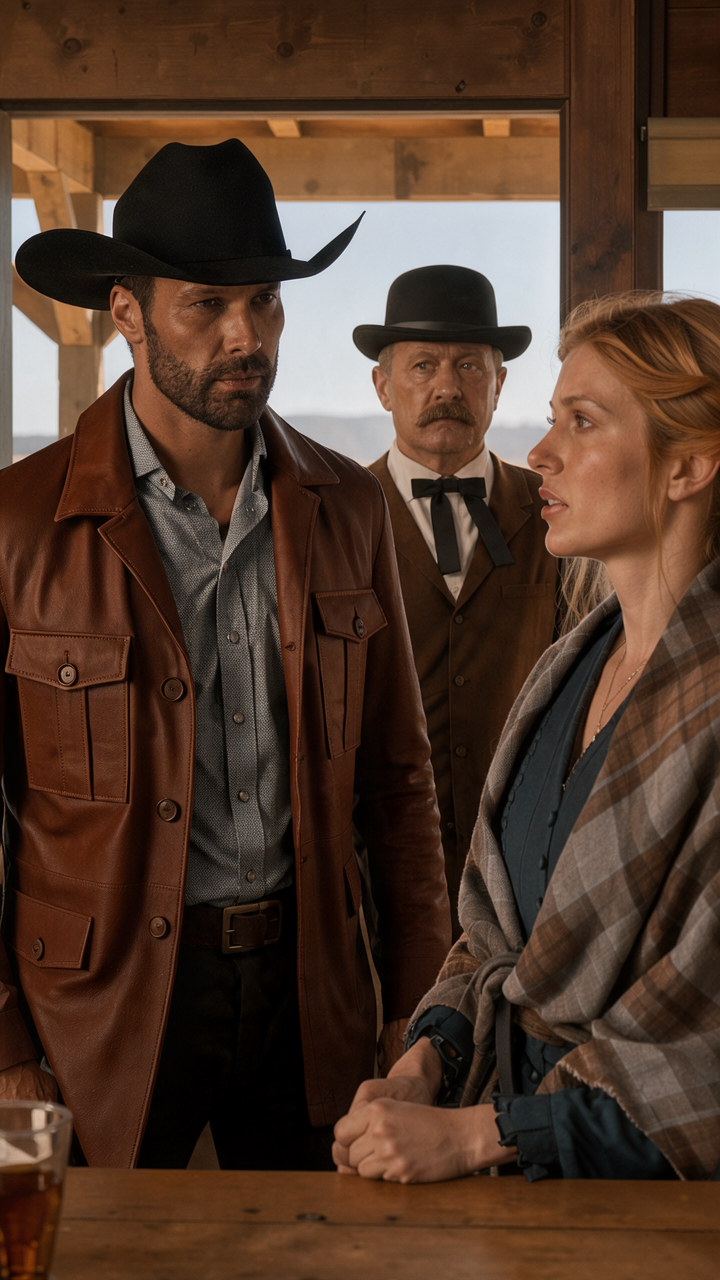
# SHE WAS SELLING HER WEDDING RING FOR FOOD… UNTIL A STRANGER COWBOY RECOGNIZED HER NAME
## Chapter 1: The Ring on the Counter
The afternoon sun shone through the dusty windows of a small general store in the frontier town of Silver Creek, Montana.
It was the summer of 1887, but the woman standing near the wooden counter felt colder than she had ever felt during the harshest winter.
Her name was Clara Bennett.
She was twenty-four years old, with long chestnut-brown hair, blue eyes, and a faded blue Victorian frontier dress. A worn brown shawl covered her shoulders, and her shoes were so badly damaged that her feet hurt with every step.
She had not eaten a proper meal in almost two days.
Her husband, Daniel, had died three months earlier after a terrible accident at a mining camp. Since then, her life had fallen apart.
The small house they had rented was gone.
Their savings had disappeared into medical bills.
The few belongings she owned had been sold one by one.
And now she had reached the last thing she possessed.
Her wedding ring.
Clara stood before the wealthy shopkeeper, Mr. Whitmore, a fifty-two-year-old man with a thick mustache, a black vest, and a white shirt.
He was known throughout Silver Creek for his expensive merchandise and his unpleasant treatment of poor customers.
Clara slowly removed the gold ring from her finger.
Her hands trembled.
She placed it on the wooden counter.
“Please, sir. It’s all I have.”
Whitmore picked up the ring and examined it beneath the sunlight.
He turned it over, rubbed it with his thumb, and gave a short laugh.
“This little thing won’t even buy you a decent meal.”
Clara swallowed.
“It belonged to my husband.”
Whitmore barely looked at her.
“Then perhaps you should have kept it.”
Two customers standing near the shelves exchanged amused glances.
One of them whispered something to the other.
Clara heard the laughter.
Her cheeks burned with embarrassment.
“My husband is dead,” she whispered. “I have nowhere to go.”
Whitmore placed the ring on the counter.
“That isn’t my problem, young woman.”
Clara lowered her eyes.
She had expected little kindness from the world, but hearing those words still hurt.
She reached for the ring.
Then a voice came from the doorway.
“Wait.”
Everyone turned.
A tall cowboy stood beneath the wooden doorframe.
He was about thirty-five years old, with dark hair, a short beard, and sharp, thoughtful eyes. He wore a black cowboy hat and a dark brown leather coat.
His name was Thomas Reed.
He had arrived in Silver Creek that morning after spending several weeks inspecting a property outside town.
He had heard the shopkeeper’s cruel words while entering the store.
But something else had caught his attention.
The woman’s name.
He stepped closer.
“Did you say your name was Bennett?”
Clara looked up.
“Yes, sir. Clara Bennett.”
Thomas froze.
For a moment, the entire store seemed to disappear around him.
He stared at her face.
Then he looked at the ring.
His voice changed.
“Wait… What’s your father’s name?”
Clara frowned.
“Why do you want to know?”
“Please. Just tell me.”
She hesitated.
Then she answered.
“His name was William Bennett.”
Thomas went completely still.
His eyes filled with emotion.
“William Bennett saved my life.”
Clara stared at him.
“You knew my father?”
Thomas stepped closer.
He picked up the wedding ring and gently placed it back in her trembling hand.
“I owe that man more than you’ll ever know.”
Then he looked directly into her eyes.
“Come with me. There’s something he left for you.”
Clara’s eyes widened.
Behind the counter, Mr. Whitmore suddenly looked terrified.
Because he knew exactly what Thomas Reed was talking about.
And he had spent the last eleven years making sure Clara never discovered it.
—
## Chapter 2: The Cowboy Who Remembered
Thomas Reed had not spoken William Bennett’s name in eleven years.
Not because he had forgotten him.
But because remembering him brought back the worst night of his life.
In 1876, Thomas had been twenty-four years old.
He was younger, reckless, and desperate to prove himself.
His father had owned a small ranch outside Cheyenne, but after a series of financial problems, the family lost almost everything.
Thomas left home with little more than a horse, a rifle, and a determination to make something of himself.
He found work as a ranch hand, then as a cattle driver.
One autumn, he joined a group of men transporting cattle through the Montana Territory.
The journey was supposed to last two weeks.
Instead, it nearly cost him his life.
A group of armed outlaws attacked their camp during a stormy night.
The cattle scattered.
The wagon overturned.
And Thomas was struck by a bullet in his side.
He managed to crawl behind a fallen tree, but the wound was severe.
His companions had either been killed or fled.
Thomas believed he would die before morning.
Then a stranger found him.
The man was William Bennett.
William was a respected rancher who lived with his wife and young daughter near Helena.
He had been traveling home when he heard gunshots.
Instead of riding away, he turned toward the danger.
He found Thomas barely conscious and bleeding heavily.
William carried him to his wagon.
He used his own coat to stop the bleeding and drove through the night toward a doctor.
For three days, William stayed beside him.
He paid for the medicine.
He arranged a room.
And when Thomas finally woke, William was sitting beside his bed.
“You’re a stubborn young fool,” William had said.
Thomas had tried to smile.
“Guess I wasn’t ready to die.”
William laughed.
“Then make sure you do something worthwhile with the life you’ve been given.”
Those words stayed with Thomas.
Before leaving, he promised to repay William one day.
But William refused.
“You don’t owe me money, son. Just remember that when you meet someone who needs help.”
Thomas never forgot.
Several months later, he returned to find William.
But the house had been abandoned.
The neighbors told him that William had died unexpectedly.
His wife had already passed away, and his young daughter had been taken to live with relatives.
Thomas tried to locate the girl.
He searched Helena.
He asked ranchers.
He visited the county office.
But the trail disappeared.
For eleven years, he carried the guilt of never having repaid the man who saved his life.
And now, in a small general store in Silver Creek, he had found William Bennett’s daughter standing before a cruel shopkeeper, trying to sell her wedding ring for food.
Thomas looked at Clara.
“Your father was a good man.”
Clara’s eyes filled.
“He died when I was nineteen.”
“I know he helped me once. I never got the chance to thank him properly.”
She looked confused.
“He never told me about you.”
“He probably never thought it was important.”
Thomas turned toward Whitmore.
“How much did you offer her for that ring?”
Whitmore straightened his vest.
“That’s between me and the customer.”
Thomas placed several silver dollars on the counter.
“Then I’ll buy every meal she’s had to miss because of your treatment.”
Whitmore’s face reddened.
“Now see here—”
Thomas looked at him.
“I don’t believe I asked for your opinion.”
The two customers who had laughed earlier suddenly became very interested in the shelves.
Thomas turned back to Clara.
“Have you eaten today?”
She shook her head.
“Then let’s fix that first.”
For the first time in months, Clara felt that someone was looking at her as a human being rather than a problem.
She picked up her ring.
Then she followed the cowboy outside.
—
## Chapter 3: The Secret Behind the Name
Thomas took Clara to a small restaurant across the street.
It was a modest place with wooden tables, a brick fireplace, and the smell of freshly baked bread.
He ordered stew, potatoes, and coffee.
Clara stared at the food.
“You don’t have to do this.”
Thomas removed his hat.
“I know.”
“Then why are you?”
He looked at her.
“Because your father once did the same thing for me.”
Clara slowly began eating.
For a while, neither spoke.
When she finished half the meal, she finally asked the question that had been troubling her.
“What exactly did my father leave for me?”
Thomas leaned back.
“I don’t know all the details. But I know he was working on something before he died.”
“What kind of something?”
“A property arrangement. A piece of land, perhaps. He mentioned it during one of our conversations.”
Clara frowned.
“My father owned a small ranch, but we lost it after he died.”
Thomas shook his head.
“Did he sell it?”
“That’s what I was told.”
“By whom?”
Clara hesitated.
“Mr. Whitmore.”
Thomas looked up sharply.
“Whitmore?”
“He helped my father with some business matters. After Father died, he said there were debts. He explained that the ranch had to be sold.”
Thomas placed his cup on the table.
“Did you see the sale documents?”
Clara shook her head.
“I was young. I trusted him.”
“Did your father have a lawyer?”
“Yes. A man named Edward Collins. But I never heard from him after the funeral.”
Thomas looked toward the window.
Something about the story troubled him.
William Bennett had been a careful man.
He had spoken often about protecting his daughter’s future.
Thomas remembered one particular conversation.
William had once shown him a map.
It displayed a large stretch of land near Silver Creek, including a river, a small timber property, and a section of valuable grazing pasture.
William had explained that he intended to place the property in a trust for Clara.
He wanted her to have something that nobody could take away from her.
“Clara,” Thomas said carefully, “did your father ever mention a place called Bennett Ridge?”
Her spoon stopped halfway to her mouth.
“Yes.”
Thomas leaned forward.
“What did he say?”
“He used to talk about it when I was little. He said it was the land where our family would always belong.”
Thomas nodded slowly.
“Then I think we need to find out what happened to it.”
Clara looked worried.
“Mr. Whitmore said the property was sold.”
Thomas’s expression hardened.
“Sometimes the people who tell us something is gone are the same people who took it.”
—
## Chapter 4: A Man With Too Much Money
Mr. Whitmore was not merely a wealthy shopkeeper.
He owned several commercial buildings in Silver Creek, two warehouses, and a controlling interest in the town’s transportation business.
He had become rich by purchasing land from desperate families and selling it at a much higher price.
He also had a habit of using his influence to silence anyone who questioned his dealings.
Eleven years earlier, when William Bennett became seriously ill, Whitmore had offered to help him manage his property.
William had trusted him.
He believed Whitmore was a respectable businessman.
But Whitmore had discovered something William had never intended him to know.
The Bennett land was worth far more than anyone in town realized.
A railway company was planning to expand its route through the region.
Bennett Ridge sat directly along the proposed route.
If the railway reached the property, its value would increase dramatically.
Whitmore decided he wanted it.
He arranged false debt documents.
He convinced William that his business was in trouble.
And after William died, he used forged papers to claim the property.
But he made one mistake.
William had left the original deed and a sealed letter with his attorney.
Whitmore had never found them.
He had spent years trying to locate the documents.
And now Clara Bennett had returned.
When Thomas walked her out of the restaurant, Whitmore was watching from the general store.
He immediately sent a message to his assistant.
“Find out where Reed is staying.”
The assistant nodded.
“And Clara Bennett?”
Whitmore’s face darkened.
“Especially her.”
—
## Chapter 5: A Place to Sleep
Thomas took Clara to the boarding house where he was staying.
The owner, Mrs. Abigail Turner, was a kind widow in her sixties who managed the property with the help of her niece.
Thomas explained the situation.
“Miss Bennett needs a room for a few nights.”
Mrs. Turner looked at Clara’s worn clothes and tired face.
“Of course, dear.”
Clara looked uncomfortable.
“I can pay once I find work.”
Mrs. Turner smiled.
“We’ll discuss that later.”
She showed Clara to a small room upstairs.
It contained a narrow bed, a wooden dresser, and a window overlooking the main street.
Clara placed her small bag on the floor.
For the first time in weeks, she had a place to close the door and rest without worrying about being thrown out.
Thomas waited in the hallway.
“Are you comfortable?”
She nodded.
“More than you know.”
“Good.”
He started to leave.
“Mr. Reed?”
He turned.
“Thomas.”
She smiled faintly.
“Thomas. Thank you.”
He nodded.
“Your father would have done the same for me.”
Clara looked down.
“I wish he were here.”
Thomas’s expression softened.
“So do I.”
That evening, Thomas went to the town office to search for records relating to Bennett Ridge.
Clara stayed in her room.
She took out her wedding ring and placed it on the dresser.
Her late husband, Daniel, had given it to her three years earlier.
They had not been wealthy, but he had been a kind man.
He had worked as a carpenter and dreamed of owning a small home.
When he died in a mining accident, Clara lost more than her husband.
She lost the only person who had made her feel safe.
She touched the ring.
“I wish you could see that I’m trying,” she whispered.
Then she opened her small bag.
Inside was an old photograph of her parents.
Her father stood beside a wooden fence, smiling.
Clara traced his face with her finger.
She remembered his voice.
His hands.
The way he used to carry her on his shoulders.
And suddenly she wondered whether the cowboy was right.
Perhaps her father had left her something after all.
—
## Chapter 6: The First Clue
Thomas spent most of the next morning at the county records office.
The clerk was a thin man named George Miller who had worked there for nearly twenty years.
Thomas asked to see the property records for Bennett Ridge.
George frowned.
“That property was transferred years ago.”
“To whom?”
“Whitmore Holdings.”
Thomas leaned forward.
“Who authorized the transfer?”
George searched through the old ledger.
After several minutes, he found an entry.
“William Bennett.”
Thomas examined the date.
The transfer had supposedly taken place three weeks before William died.
But Thomas remembered William telling him that he intended to protect the land for his daughter.
Something was wrong.
“Can I see the original document?”
George hesitated.
“That file is missing.”
“Missing?”
“Yes. The original deed was removed from the archive several years ago.”
Thomas’s expression hardened.
“Who signed it out?”
George searched another book.
He stopped.
Then he looked up.
“Mr. Whitmore.”
Thomas leaned back.
Now he had something worth investigating.
But it was not enough.
He needed the original papers.
And he needed someone who could confirm William’s intentions.
He thought of Edward Collins, the attorney William had mentioned.
Thomas asked George for the man’s last known address.
It was outside Helena.
Thomas decided he would send a telegram immediately.
As he left the office, he noticed a man standing across the street.
The man was watching him.
When their eyes met, the stranger quickly walked away.
Thomas recognized the type.
Someone was following him.
—
## Chapter 7: Clara’s Courage
Clara spent the next few days helping Mrs. Turner in the boarding house.
She cleaned rooms, prepared meals, and helped organize the laundry.
Mrs. Turner was impressed by her work.
“You have a good head on your shoulders, child.”
Clara smiled.
“My father taught me to work hard.”
“Then he taught you well.”
One afternoon, Clara walked into the general store to purchase flour.
Whitmore saw her immediately.
His expression changed.
“Well, well. The unfortunate Mrs. Bennett.”
Clara stopped.
“I only need a small bag of flour.”
Whitmore smiled.
“Planning to pay for it this time?”
Clara’s cheeks reddened.
“I have money.”
He leaned across the counter.
“From your cowboy friend?”
She said nothing.
Whitmore laughed.
“Be careful, young woman. Men like Reed don’t help people without expecting something in return.”
Clara looked at him.
“Not everyone is like you, Mr. Whitmore.”
The shopkeeper’s smile disappeared.
A customer near the door looked up.
Clara continued.
“My father trusted you. You told me he sold his land because he owed money. But I never saw the papers.”
Whitmore’s face hardened.
“You should be careful about making accusations.”
“Then perhaps you should be careful about telling lies.”
She picked up her flour and walked out.
For several seconds, Whitmore stood motionless.
Then he turned toward his assistant.
“Get Reed here.”
The assistant swallowed.
“Sir?”
“I want him gone from this town.”
—
## Chapter 8: The Cowboy’s Promise
That evening, Thomas found Clara sitting on the boarding house porch.
She was reading a small book.
He approached and removed his hat.
“Mind if I sit?”
“Not at all.”
He sat beside her.
“How was your day?”
“Busy.”
“Good busy?”
Clara smiled.
“Mrs. Turner says I work harder than two people.”
Thomas laughed.
“Sounds like your father.”
She closed the book.
“Did you find anything?”
Thomas nodded.
“I found the record of the land transfer. Something about it doesn’t look right.”
Clara looked concerned.
“What does that mean?”
“I think Whitmore may have forged the documents.”
She stared at him.
“Are you certain?”
“Not yet. But the original deed is missing, and Whitmore was the last person to handle it.”
Clara looked toward the street.
“Why would he do that?”
“Because the land is valuable.”
Thomas explained the railway plans.
Clara was stunned.
“My father never told me it was worth so much.”
“Perhaps he wanted you to grow up without worrying about money.”
She smiled sadly.
“That sounds like him.”
Thomas leaned forward.
“Listen, Clara. I made your father a promise eleven years ago. I told him I’d repay his kindness.”
She looked at him.
“He never asked you to.”
“I know. But I never forgot.”
He paused.
“I won’t let Whitmore take what belongs to you.”
Clara looked into his eyes.
For the first time, she believed that the past might not be something she had to fear.
Perhaps it could also be the beginning of something good.
—
## Chapter 9: The Letter From Helena
Two days later, Thomas received a reply from the attorney’s office in Helena.
The letter was brief.
Edward Collins was alive.
He had been waiting for someone from the Bennett family to contact him.
More importantly, he still possessed a sealed letter written by William Bennett.
The letter had been placed in his care shortly before William’s death.
Thomas read it twice.
Then he hurried to find Clara.
She was preparing supper at the boarding house.
“Clara!”
She turned.
“What happened?”
“I heard from your father’s attorney.”
Her hands stopped moving.
“Mr. Collins?”
Thomas nodded.
“He has something your father left behind.”
“What?”
“A sealed letter.”
Clara covered her mouth.
Thomas continued.
“He says it contains instructions concerning your inheritance.”
Tears filled her eyes.
“Why didn’t he contact me?”
“He tried. The address he had for you was no longer valid.”
Clara sat down.
For a moment, she could not speak.
Then she whispered.
“My father remembered me.”
Thomas looked at her.
“He never stopped.”
She began to cry.
Thomas pulled out a chair beside her.
He did not try to stop the tears.
He simply stayed.
After a while, Clara looked at him.
“Will you take me to Helena?”
“Of course.”
“Thank you.”
Thomas smiled.
“You’re welcome.”
But neither of them knew that Whitmore had already learned about the letter.
And he had no intention of allowing it to reach Clara.
—
## Chapter 10: The Man in the Black Coat
That night, Thomas returned to his room and found the door slightly open.
He immediately reached for his revolver.
Someone had entered.
The room looked untouched at first glance.
Then he noticed the dresser drawer.
It was open.
His papers had been disturbed.
A small envelope was missing.
Thomas searched the room.
The letter from Helena was still there.
But his notes about the property records were gone.
He walked to the window.
Outside, a man in a black coat was disappearing into the darkness.
Thomas rushed downstairs.
By the time he reached the street, the stranger was gone.
He returned to the boarding house and spoke with Mrs. Turner.
“Has anyone asked about Clara?”
She nodded.
“A gentleman came this afternoon. Said he was an old family friend.”
Thomas’s eyes narrowed.
“What did he look like?”
“Dark coat. Tall. Had a scar near his chin.”
Thomas knew the description.
The same man who had followed him outside the county office.
Whitmore was becoming desperate.
Thomas went upstairs and knocked on Clara’s door.
She opened it.
“Thomas?”
“We need to leave for Helena sooner than planned.”
Her expression changed.
“Why?”
“Somebody broke into my room.”
She stepped back.
“Did they take anything?”
“My notes.”
Clara looked frightened.
“Do you think it was Whitmore?”
“I know it was somebody working for him.”
She looked at the small travel bag beside her bed.
“Then what do we do?”
Thomas put on his hat.
“We get the truth before he can destroy it.”
—
## Chapter 11: A Journey Through the Mountains
The next morning, Thomas and Clara left Silver Creek.
They traveled in a small wagon pulled by two strong horses.
Thomas carried a rifle and a revolver.
Clara carried her father’s photograph and the letter from Edward Collins.
The journey to Helena would take nearly two days.
The road passed through forests, open grasslands, and narrow mountain paths.
For the first few hours, they spoke very little.
Then Clara asked a question.
“Thomas?”
“Yes?”
“Did you ever marry?”
He glanced at her.
“No.”
“Why not?”
He looked toward the road.
“I came close once.”
“What happened?”
“She wanted a different life. I couldn’t give her what she wanted.”
Clara waited.
Thomas continued.
“She wanted a wealthy man who would settle in town. I wanted a ranch and open country. Neither of us was wrong. We simply wanted different things.”
Clara nodded.
“Do you regret it?”
“Sometimes.”
He looked at her.
“But I learned that love shouldn’t require somebody to abandon who they are.”
Clara looked down at her hands.
“I wish I had learned that sooner.”
Thomas turned toward her.
“You loved your husband.”
“Yes.”
“Then don’t blame yourself for trusting him.”
She smiled faintly.
“You’re very good at saying the things people need to hear.”
He laughed.
“Don’t tell Samuel. He’ll think I’ve become soft.”
Clara laughed too.
The sound made the long journey feel shorter.
But as the sun began setting, Thomas noticed hoofprints behind them.
Someone was following.
He slowed the wagon.
Clara noticed.
“What is it?”
“Nothing to worry about yet.”
He looked toward the distant ridge.
Then he quietly checked his rifle.
—
## Chapter 12: The Ambush
The attack came just before sunset.
Three riders emerged from behind a group of pine trees.
One raised a revolver.
“Stop the wagon!”
Thomas pulled the reins.
“Stay down, Clara!”
A gunshot shattered the quiet.
The bullet struck the wooden side of the wagon.
Thomas jumped down and returned fire.
One rider fell.
The other two scattered toward the trees.
Thomas moved behind the wagon wheel.
“Are you hurt?”
Clara shook her head.
“No!”
Another shot struck the ground near his boots.
Thomas fired again.
The second rider disappeared behind a rocky outcrop.
The third turned his horse and fled.
Thomas waited until the road was quiet.
Then he climbed back into the wagon.
Clara was trembling.
“Who were they?”
“Whitmore’s men, most likely.”
“Why would he go this far?”
Thomas looked at her.
“Because he knows what’s waiting for us in Helena.”
Clara swallowed.
“Are we going to turn back?”
Thomas shook his head.
“No.”
“Even after that?”
He nodded.
“Especially after that.”
He reached for her hand.
“Your father didn’t save my life so I could abandon his daughter when things became difficult.”
Clara looked at him.
For the first time, she understood that Thomas’s promise was not simply an old debt.
It was something he had carried in his heart for eleven years.
And she was beginning to care about him far more than she had intended.
—
## Chapter 13: The Attorney’s Office
They arrived in Helena the following afternoon.
Edward Collins was an elderly attorney with silver hair and round spectacles.
When Clara entered his office, he immediately stood.
“Miss Bennett.”
She nodded.
“Mr. Collins.”
He looked at her for a long moment.
“You look so much like your father.”
Clara’s eyes filled.
“Did he really leave something for me?”
The attorney nodded.
“Yes. And I have been waiting a very long time to give it to you.”
He opened a locked cabinet.
Inside was a wooden box.
He placed it on the desk.
Then he unlocked it.
The box contained several documents, an old photograph, and a sealed envelope.
Clara picked up the photograph.
It showed her father standing beside a young Thomas Reed.
She looked surprised.
“You knew each other before?”
Thomas smiled.
“Your father introduced us.”
The attorney nodded.
“Mr. Reed was there the day William signed the final documents.”
Thomas looked at him.
“I didn’t know you were involved.”
“I was his attorney.”
Edward opened the envelope.
“Your father wanted you to receive this after your twenty-first birthday. Unfortunately, the original documents were never delivered because of the circumstances surrounding his death.”
Clara listened carefully.
The attorney explained that William had placed Bennett Ridge in a private trust.
The property was intended to belong entirely to Clara once she reached adulthood.
No debt could be used to seize it without proper legal evidence.
And no sale could be valid without her personal signature.
Whitmore had forged both.
Clara stared at the documents.
“Then the ranch is still mine?”
Edward nodded.
“Every acre.”
She covered her mouth.
For eleven years, she had believed that her father had left her nothing.
Now she discovered that he had tried to protect her future even after his death.
—
## Chapter 14: What Her Father Really Left
The sealed letter was addressed to Clara.
She opened it carefully.
“My dearest Clara,
If you are reading this, then you are old enough to understand why I made certain decisions.
I know the world can be difficult, especially for a young woman without a husband or a family to protect her.
But I want you to remember something.
You do not need a powerful man to give you value.
You do not need wealth to deserve respect.
And you should never trade your dignity for the approval of another person.
The land at Bennett Ridge is yours.
I have arranged for it to provide you with a home and a future.
I hope you will use it wisely.
I also hope you will find someone who loves you for the person you are, not for what you own.
Your mother and I loved you more than anything.
No matter where life takes you, remember that.
Father.”
Clara could no longer hold back her tears.
She pressed the letter against her heart.
Thomas stood quietly beside her.
Edward Collins looked at the young woman with sympathy.
“Your father spoke about you constantly.”
Clara wiped her eyes.
“Thank you for keeping this safe.”
The attorney nodded.
“It was my duty.”
He then explained that the next step was to file a formal challenge against Whitmore’s fraudulent claim.
The documents would need to be presented before the county judge.
It would not be easy.
Whitmore had money, influence, and friends in powerful positions.
But now Clara had the evidence.
And she was no longer alone.
—
## Chapter 15: The Truth About Mr. Whitmore
When Whitmore discovered that Clara had reached Helena, he became furious.
He summoned his assistant.
“Where is Reed?”
“Still in Helena, sir.”
“And the documents?”
“They have them.”
Whitmore slammed his fist against the desk.
“Then we have a serious problem.”
His assistant looked nervous.
“Perhaps we should negotiate.”
Whitmore laughed.
“Negotiate? With a penniless widow?”
He walked toward the window.
“I made her father an offer. He refused. Then he died before he could understand the consequences.”
The assistant stared at him.
Whitmore continued.
“I have spent eleven years building my business around that property. I will not lose everything because a foolish young woman suddenly discovers a few old papers.”
He opened a drawer.
Inside was a second set of documents.
These were the forged originals that had been used to transfer the land.
Whitmore had kept them hidden.
But he had made another mistake.
One of the signatures had been copied from a letter written after William Bennett’s death.
If the judge examined the dates carefully, the fraud would become obvious.
Whitmore knew it.
And he was beginning to panic.
He decided to travel to Helena himself.
—
## Chapter 16: A Different Kind of Courage
During the following days, Thomas accompanied Clara to the attorney’s office.
They reviewed every document.
Clara learned about property taxes, legal trusts, and the value of the land.
She was surprised by how much she enjoyed understanding the business.
Her father had always encouraged her to learn.
Now she understood why.
One afternoon, Edward Collins handed her a ledger.
“Your father wanted you to manage this property yourself.”
Clara looked at the pages.
“I don’t know if I can.”
The attorney smiled.
“You already understand more than you think.”
Thomas leaned against the desk.
“Your father would be proud.”
Clara looked at him.
“Do you really believe that?”
“I know it.”
She smiled.
Then she turned back to the ledger.
For the first time, she was not simply trying to survive.
She was building something.
That evening, Thomas took her to a small park overlooking the city.
They sat beneath an old tree.
Clara looked at him.
“Why did you never give up looking for my family?”
Thomas was quiet for a moment.
“Because your father saved my life.”
“But eleven years is a long time.”
He nodded.
“I know.”
“Most people would have forgotten.”
Thomas looked at her.
“I didn’t.”
She smiled.
Then she reached for his hand.
He held it gently.
And neither of them pulled away.
—
## Chapter 17: The Man Who Had Nothing to Lose
Whitmore arrived in Helena three days later.
He went directly to Edward Collins’s office.
Clara was there with Thomas.
Whitmore entered without knocking.
“Miss Bennett.”
Clara stood.
“Mr. Whitmore.”
He smiled.
“I believe there has been a misunderstanding.”
Thomas stepped forward.
“You’re not welcome here.”
Whitmore ignored him.
“Clara, I am prepared to offer you a generous settlement.”
She frowned.
“What kind of settlement?”
“Enough money to start a comfortable life somewhere else.”
Thomas laughed coldly.
“You’re offering her money for land you stole?”
Whitmore’s face tightened.
“Stay out of this, Reed.”
Clara looked at the shopkeeper.
“You told me my father sold the property.”
“He had debts.”
“You told me there were no documents.”
“There were complications.”
“You told me I had no inheritance.”
Whitmore sighed.
“Your father was a difficult man.”
Clara stepped closer.
“He was an honest man. And you knew that.”
Whitmore’s smile disappeared.
“Listen carefully. You are a young widow with no experience managing property. I am offering you a chance to walk away with something rather than lose everything in a legal battle.”
Clara looked at him.
“Are you threatening me?”
“I’m trying to help you.”
“No,” she said firmly. “You’re trying to buy my silence.”
Thomas looked at her with admiration.
Whitmore turned toward him.
“This is your doing.”
Thomas stepped forward.
“William Bennett was a better man than you could ever hope to become.”
Whitmore’s eyes narrowed.
“Be careful, Reed.”
Thomas smiled without humor.
“I’ve been careful for eleven years. I’m done with that.”
Whitmore left the office.
But Clara noticed that his hands were trembling.
He was afraid.
And frightened men often made dangerous decisions.
—
## Chapter 18: The Missing Witness
The case was scheduled to be heard in court the following week.
Edward Collins had prepared everything.
But one important piece of evidence was still missing.
The original county registry entry from the year of William’s death.
It contained the record of the trust.
Without it, Whitmore’s attorneys could argue that the documents were incomplete.
George Miller, the county clerk, had agreed to testify.
But when Thomas went to find him, the clerk was nowhere to be seen.
His office was empty.
His house was locked.
And his neighbors said he had left town suddenly.
Thomas immediately suspected Whitmore.
He went to the sheriff.
Sheriff Robert Hayes was an experienced lawman who had been investigating Whitmore for several months.
“I think Miller has been threatened,” Thomas said.
The sheriff nodded.
“We’ve been watching Whitmore’s men.”
“Then find Miller before the hearing.”
The sheriff sent two deputies to search the surrounding towns.
Meanwhile, Clara became increasingly anxious.
“What if we lose?”
Thomas sat beside her.
“We won’t.”
“But what if he gets away with it?”
Thomas looked at her.
“Then we’ll keep fighting.”
Clara smiled sadly.
“You make it sound so easy.”
“It isn’t.”
He took her hand.
“But you don’t have to do it alone.”
She looked into his eyes.
And for a moment, the fear disappeared.
—
## Chapter 19: A Letter From a Prisoner
Two days before the hearing, a messenger arrived at the attorney’s office.
He carried a letter addressed to Clara.
The handwriting was unfamiliar.
Clara opened it.
Inside was a short message.
“Miss Bennett,
My name is George Miller.
I have been forced to leave Helena because I discovered information concerning the Bennett property.
I am currently staying at the old Miller farm outside town.
I have the original registry entry.
I am willing to testify.
Please come with someone you trust.
George.”
Thomas read the letter.
“We need to get him.”
Edward Collins frowned.
“It could be a trap.”
Thomas nodded.
“I know.”
Clara looked at him.
“Then we shouldn’t go.”
Thomas shook his head.
“If Miller has the original document, we can’t ignore it.”
The sheriff agreed to accompany them.
They left before sunrise.
The old Miller farm was located near a narrow creek, surrounded by pine trees.
When they arrived, the house appeared empty.
Thomas dismounted.
“Stay behind me.”
He approached the door.
Then it opened.
George Miller stood inside.
His face was bruised.
He looked terrified.
“Mr. Reed?”
Thomas nodded.
“Are you all right?”
George shook his head.
“Not exactly.”
He led them inside.
Then he opened a wooden box.
The original registry entry was inside.
Clara examined the document.
Her father’s signature was clearly visible.
And beside it was the official seal of the county office.
George looked at her.
“Your father wanted you protected. Whitmore tried to destroy this record after his death.”
Clara’s eyes filled.
“Why did you keep it?”
George swallowed.
“Because I knew what happened was wrong.”
Thomas placed a hand on the clerk’s shoulder.
“You did the right thing.”
But outside, a horse whinnied.
Thomas turned toward the window.
Three riders had arrived.
Whitmore had found them.
—
## Chapter 20: The Last Threat
Thomas moved toward the door.
“Stay inside.”
Clara stepped forward.
“No.”
He looked at her.
“Clara.”
“I’m not hiding anymore.”
Thomas studied her face.
Then he nodded.
“All right. But stay close.”
The riders dismounted.
One of them was Whitmore’s assistant.
He carried a revolver.
“We want the papers.”
Thomas stepped onto the porch.
“You’re going to have to ask more politely.”
The assistant laughed.
“Don’t make this difficult.”
Clara appeared behind Thomas.
“You’re not getting them.”
The man pointed his gun.
“Give us the documents.”
Thomas slowly raised his rifle.
“Put the weapon down.”
The man hesitated.
Then a voice came from behind the riders.
“That’s enough!”
Sheriff Hayes and two deputies emerged from the trees.
The assistant dropped his revolver.
The other men were quickly restrained.
Whitmore’s assistant looked terrified.
“He told us to get the papers!”
The sheriff stepped closer.
“Who?”
The man lowered his head.
“Mr. Whitmore.”
The sheriff turned toward Thomas.
“I think we’ve got what we need.”
Clara held the original document tightly.
For the first time, she knew that Whitmore’s power was beginning to collapse.
—
## Chapter 21: Justice for William Bennett
The courtroom was crowded on the morning of the hearing.
People from Silver Creek and Helena had come to watch.
Whitmore sat beside his attorney.
He looked confident.
His expensive black suit was perfectly pressed, and his thick mustache was neatly trimmed.
Clara sat beside Edward Collins.
Thomas sat directly behind her.
When the judge entered, everyone stood.
The hearing began.
Whitmore’s attorney argued that the land had been transferred legally.
He presented the documents bearing William Bennett’s signature.
But Edward Collins calmly introduced the original trust agreement.
Then George Miller testified.
He explained how Whitmore had removed the original registry entry and attempted to replace it with a false document.
The attorney presented the official county seal.
Then came the handwriting evidence.
The forged signature had been copied from a letter dated after William Bennett’s death.
The courtroom became silent.
Whitmore’s face turned pale.
Edward Collins presented one final document.
A letter from William Bennett.
It described his intention to leave Bennett Ridge entirely to his daughter.
The judge read it carefully.
Then he looked toward Whitmore.
“Mr. Whitmore, do you have an explanation for these discrepancies?”
Whitmore stood.
“This is a misunderstanding.”
The judge shook his head.
“I have heard enough.”
He ruled that the transfer was fraudulent.
Bennett Ridge legally belonged to Clara Bennett.
He also ordered the county authorities to investigate the financial transactions connected to Whitmore’s company.
Whitmore was arrested immediately after the hearing.
As the sheriff led him away, he turned toward Clara.
“You think you’ve won?”
Clara looked at him calmly.
“I didn’t win anything that wasn’t already mine.”
Whitmore was taken through the courtroom doors.
Thomas stood and placed his hand on Clara’s shoulder.
She looked up at him.
Her eyes were filled with tears.
“It’s over,” she whispered.
He nodded.
“Yes. It’s over.”
—
## Chapter 22: The Land Her Father Loved
Several weeks later, Clara returned to Bennett Ridge.
Thomas rode beside her.
The property was larger than she remembered.
A wide river crossed the western side.
Green hills stretched toward the mountains.
There was an old farmhouse near the center of the land, surrounded by trees and a weathered wooden fence.
Clara dismounted.
She stood silently.
“This is where I grew up.”
Thomas looked around.
“It’s beautiful.”
She walked toward the farmhouse.
The front door was still standing.
Inside, dust covered the furniture.
But the walls remained strong.
She found an old wooden chair near the fireplace.
Her father used to sit there every evening.
She remembered him reading newspapers and telling stories.
She remembered her mother laughing in the kitchen.
She remembered being a little girl who believed the world was full of wonderful possibilities.
Clara sat down.
A tear rolled down her cheek.
Thomas approached quietly.
“Are you all right?”
She nodded.
“I just wish they could see this.”
He sat beside her.
“I think they would be proud.”
Clara looked around.
“I want to restore the house.”
Thomas smiled.
“Then we’ll restore it.”
She turned toward him.
“Will you help me?”
He nodded.
“Every step.”
For the next several weeks, they worked together.
They repaired the roof, replaced broken windows, cleaned the rooms, and rebuilt the fence.
Samuel came to help.
Mrs. Turner sent supplies.
Even some people from Silver Creek volunteered.
Slowly, Bennett Ridge became a home again.
—
## Chapter 23: The Man Who Kept His Promise
One evening, Thomas was repairing the front porch when Clara brought him a cup of coffee.
He accepted it.
“Thank you.”
She sat beside him.
“Thomas, can I ask you something?”
“Anything.”
“Why did you really spend eleven years looking for my family?”
He smiled.
“I told you. Your father saved my life.”
“I know. But you could have sent a letter. You could have tried once and stopped.”
Thomas looked toward the mountains.
“After your father died, I felt like I had left something unfinished.”
Clara listened.
“I wanted to repay him. I wanted him to know that the life he saved had become something worthwhile.”
He looked at her.
“Then I found you.”
She smiled.
“And now?”
He was quiet.
“Now I want something different.”
“What?”
Thomas took her hand.
“I want to stay.”
Clara looked into his eyes.
“At Bennett Ridge?”
“With you.”
She felt her heart beating faster.
Thomas continued.
“I know you’ve been through enough. I won’t ask you for anything you’re not ready to give.”
Clara smiled.
“You’re not asking too much.”
He looked at her.
“Then what are you saying?”
She leaned closer.
“I’m saying I think my father sent you back into my life for a reason.”
Thomas laughed softly.
“Your father was a better matchmaker than I ever expected.”
Clara kissed him.
It was gentle and unhurried.
And for the first time in years, Thomas felt that he had finally fulfilled the promise he had made to William Bennett.
Not by returning money.
Not by offering protection.
But by helping the daughter of the man who had saved him find her future.
—
## Chapter 24: A New Beginning
Clara decided not to sell Bennett Ridge.
Instead, she restored the old farmhouse and opened a small trading post near the main road.
It sold food, clothing, tools, and supplies to travelers and nearby ranchers.
She wanted the business to be different from Whitmore’s general store.
Nobody would be turned away because they were poor.
If someone could not afford a meal, Clara would feed them.
If a widow needed work, she would offer it.
If a traveler had nowhere to sleep, she would find a place.
Thomas helped her manage the property.
He built a stable and hired several ranch hands.
Samuel eventually moved to Bennett Ridge permanently.
Mrs. Turner visited often and became something like family.
The trading post became known throughout the region for its fairness.
One day, a young mother entered with a little boy.
She looked nervous.
“Ma’am, I was wondering if you might have any work.”
Clara smiled.
“What kind of work can you do?”
“Cooking, cleaning, sewing. Anything.”
Clara looked at the child.
“Have you eaten today?”
The woman hesitated.
“No, ma’am.”
Clara walked behind the counter.
“Then let’s start with lunch.”
The woman began crying.
“Thank you.”
Clara placed a warm plate in front of her.
And in that moment, she remembered herself standing in Whitmore’s store, trembling as she offered her wedding ring for a little food.
She remembered the humiliation.
The laughter.
The feeling that nobody cared.
Then she remembered the cowboy who had stopped everything by asking one simple question.
What is your father’s name?
She smiled.
Kindness had saved her twice.
First when Thomas recognized her name.
And again when she decided to pass that kindness forward.
—
## Chapter 25: The Ring She Never Sold
One year later, Bennett Ridge was thriving.
The farmhouse had been restored.
The trading post was busy.
And the surrounding land was filled with cattle.
Thomas and Clara had grown closer with every passing season.
They were no longer two strangers brought together by an unfortunate afternoon.
They had become partners.
One evening, Thomas asked Clara to walk with him beside the river.
The sun was setting behind the mountains.
The water reflected the golden sky.
Thomas stopped near a large oak tree.
Clara smiled.
“Why did you bring me here?”
He reached into his coat.
“I have something for you.”
She looked surprised.
He removed a small velvet box.
Inside was a beautiful gold ring.
Clara stared at it.
“Thomas…”
He took her hands.
“I know you once stood in a store and offered your wedding ring for a meal. I know you were trying to survive, and I know that ring meant a great deal to you.”
She nodded.
“I never wanted to sell it.”
“I know.”
He continued.
“I don’t want you to forget the man you loved or the life you had before. But I want you to know that you deserve happiness again.”
He opened the box.
“Clara Bennett, would you allow me to spend the rest of my life making sure you never have to face the world alone?”
Tears filled her eyes.
“Thomas…”
He smiled.
“I suppose I should ask the question properly.”
He lowered himself onto one knee.
“Will you marry me?”
Clara began crying.
Then she laughed.
“Yes.”
Thomas stood and slipped the ring onto her finger.
She threw her arms around him.
He held her close.
For several moments, they stood beside the river, listening to the wind moving through the trees.
Then Clara whispered:
“My father would have liked you.”
Thomas smiled.
“I hope so.”
“He would have said you took long enough.”
Thomas laughed.
“Then he was probably right.”
—
## Chapter 26: The Wedding at Bennett Ridge
Their wedding took place the following spring.
It was held beneath the old oak tree beside the river.
The entire town attended.
Samuel stood beside Thomas, wearing a suit that looked slightly uncomfortable.
Mrs. Turner helped Clara prepare.
Clara wore an elegant ivory dress with delicate lace around the sleeves.
Her chestnut-brown hair fell in soft curls.
The original wedding ring from her first marriage was kept safely in a small velvet box.
She had decided to preserve it as a reminder of a chapter in her life that had mattered, even though it had ended in loss.
Thomas waited beneath the tree.
When Clara appeared, he forgot about everyone else.
She walked toward him with a smile.
The minister began the ceremony.
He spoke about loyalty, kindness, and the importance of choosing one another every day.
Thomas held Clara’s hands.
“I cannot promise that life will always be easy. But I promise to respect your dreams, stand beside your choices, and never make you feel that you are less than you are.”
Clara smiled through her tears.
“And I promise to love you honestly, to build a home with you, and to remind you that even the strongest cowboy sometimes needs someone to take care of him.”
Samuel wiped his eyes.
“Something’s in my eye again,” he muttered.
Everyone laughed.
The minister pronounced them husband and wife.
Thomas kissed Clara.
The crowd cheered.
And as the sun disappeared behind the mountains, music filled Bennett Ridge.
The little girl who had once believed she had nothing left now had a home, a future, and a man who loved her without trying to own her.
—
## Chapter 27: The Legacy of William Bennett
Five years passed.
Bennett Ridge became one of the most successful ranches in the region.
The trading post expanded into a larger store.
Clara established a small fund to help widows and families who had lost their homes.
She also helped several young women learn bookkeeping and business management.
Thomas often joked that she had become a more powerful businessperson than any man in Silver Creek.
Clara would simply smile.
One summer morning, they stood outside the farmhouse watching their little son run across the grass.
They had named him William, after Clara’s father.
Thomas lifted the boy into his arms.
“Your grandfather was a good man,” he told him.
Clara stood beside them.
“Yes, he was.”
Thomas kissed her forehead.
“And he brought us together.”
She smiled.
“Not exactly.”
Thomas looked confused.
“What do you mean?”
Clara looked toward the road.
“He saved your life. You remembered him. But you were the one who stopped when you saw a hungry woman standing in a store.”
Thomas smiled.
“Maybe that’s true.”
She placed her hand against his.
“One man’s kindness can travel farther than he ever knows.”
Thomas looked at her.
“Your father taught me that.”
Clara rested her head against his shoulder.
And they watched the sunset over the land that had once been stolen from her family.
The land that had been restored.
The land that had become their home.
—
## Epilogue: The Stranger Who Remembered
Many years later, when Clara was an old woman with silver beginning to appear in her chestnut hair, she still kept her father’s letter in a small wooden box.
She also kept the original wedding ring from her first marriage.
And beside them was a photograph of Thomas standing with William Bennett.
Sometimes, when children visited the trading post, they asked Clara how she and Thomas had met.
She always smiled before answering.
“I was hungry,” she would say.
The children would look surprised.
“And he gave you food?”
Clara would laugh.
“Something much more important.”
“What?”
“He reminded me that I wasn’t forgotten.”
She would tell them about the old general store, the cruel shopkeeper, the wedding ring, and the cowboy who recognized her father’s name.
Then she would tell them the most important part.
“Never judge someone by the clothes they wear or the money they carry. The poorest person in the room may have the greatest story. And sometimes, the stranger who stops to help you is carrying a promise that began long before you ever met.”
Outside, the wind would move gently across Bennett Ridge.
And somewhere in the distance, a horse would gallop along the old frontier road.
The road where two lives had changed forever.
**Because Clara Bennett had walked into a store hoping to sell the last piece of her past for a little food.**
**Instead, she discovered the future her father had spent his final days protecting.**
**And the cowboy who recognized her name became the man who gave her a reason to believe in love again.**
**THE END.**