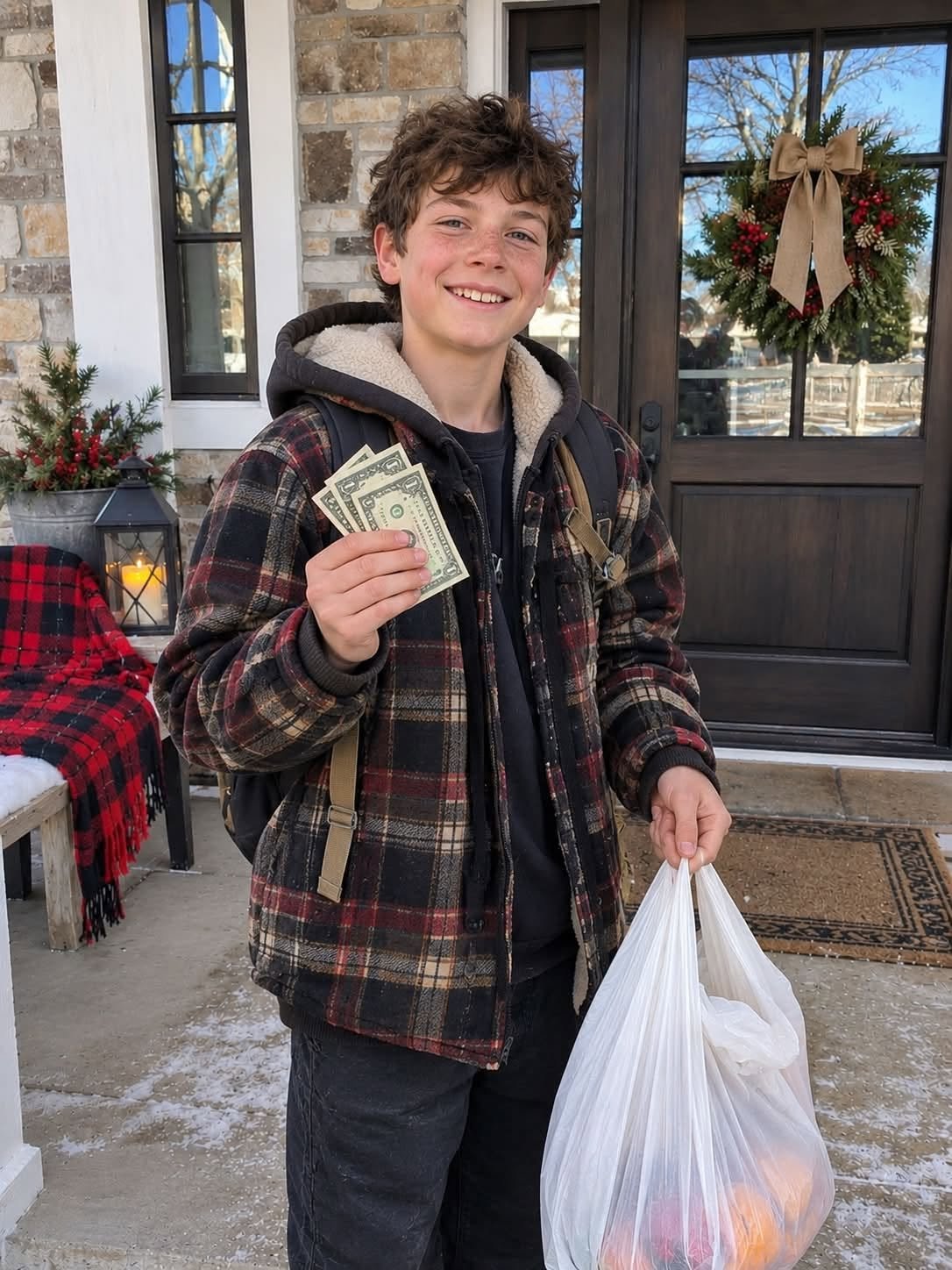
I sent my twelve-year-old son to buy a Thanksgiving turkey with our last thirty dollars. An hour later, my neighbor called me, screaming, “Rachel, you need to get over here! You won’t believe what your son has done!”
At first, I thought something terrible had happened. I grabbed my coat, ran outside, and hurried down the street, never imagining that my little boy had just done something that would bring thirty-seven outlaw bikers into our neighborhood and change the way I understood the word family.
My name is Rachel Miller, and for the past four years, it had been just Noah and me.
His father, Daniel, had been an outlaw biker with the Iron Wolves Motorcycle Club. He was forty-one when he died, a big man with tattooed arms, a thick brown beard, and a black Harley-Davidson that he polished every Sunday morning. His leather vest was covered in club patches, and his motorcycle boots were so heavy that I could hear him walking through the house before he even reached the kitchen.
Strangers sometimes crossed the street when they saw him coming. Children, however, seemed to love him. He had a way of making even the shyest little kid feel important. He remembered birthdays, carried spare toys in his saddlebags, and never passed a stranded motorist without stopping to help.
To Noah, Daniel wasn’t an outlaw biker. He was simply Dad.
He was the man who made pancakes shaped like dinosaurs, let Noah sit on his motorcycle while it was parked in the garage, and carried him on his shoulders during neighborhood parades. He attended every school event he could, even when it meant riding hundreds of miles back from a club gathering the night before.
Thanksgiving was their favorite holiday.
Daniel believed Thanksgiving was more important than Christmas because it reminded people to appreciate what they still had instead of worrying about what they didn’t. Every year, he invited his motorcycle brothers over, bought a huge turkey, and filled our little dining room with more food than the table could comfortably hold.
He had one rule: nobody was allowed to spend Thanksgiving alone if he could do something about it.
“There’s always room for one more plate, Rachel,” he used to tell me. “You never know who might need a place to sit.”
I would laugh and remind him that we didn’t have enough chairs for all his friends. He would simply drag another folding chair out of the garage.
That was Daniel.
He looked like a man people should fear, but he had the softest heart of anyone I had ever known.
Four years ago, on a rainy December evening, Daniel never came home.
He had been returning from a charity ride when a pickup truck lost control on a wet road. Daniel swerved to avoid another vehicle, struck the guardrail, and was thrown from his motorcycle. The driver called emergency services, but Daniel’s injuries were too severe.
He died before the ambulance could get him to the hospital.
I still remember the police officer standing on our porch, holding Daniel’s helmet in both hands. I remember looking past him, expecting to see my husband’s motorcycle pulling into the driveway. I remember Noah standing at the top of the stairs, wearing his pajamas and asking why the police were at our house.
He was eight years old.
When I finally told him that Daddy wasn’t coming home, he shook his head and said, “But he promised he’d take me riding when I turned ten.”
I had no answer.
At Daniel’s funeral, more than a hundred motorcycles lined the road outside the cemetery. His club brothers stood together in their black leather vests, many of them crying openly. Hank, Daniel’s closest friend, delivered the eulogy. He talked about Daniel’s loyalty, his stubbornness, his terrible jokes, and the way he would give away his last dollar to someone who needed it.
After the service, Hank hugged me.
“You and Noah aren’t alone, Rachel. Daniel was our brother. That makes you family.”
For the first few months, the Iron Wolves kept their promise. They repaired our porch, checked the car, brought groceries, and helped with small things around the house. Some of them even visited Noah on his birthday.
But time has a way of changing routines. Members moved away, some started families, and others became busy with work. I never blamed them. They had their own lives, and I had to learn how to manage ours.
I kept Daniel’s old leather vest in a box in the bedroom closet. His motorcycle helmet sat on a shelf in the garage, and his photograph remained beside the living-room window. I couldn’t bring myself to throw away his boots or the old coffee mug he used every morning.
Noah grew taller, but he never stopped missing his father.
Sometimes he would sit in the garage with Daniel’s old motorcycle gloves and ask me to tell him stories about their rides together. I told him about the time Daniel got lost on a charity ride and arrived home three hours late, or the time he accidentally dropped a whole tray of Thanksgiving potatoes because he was trying to show off a magic trick.
Noah loved those stories.
But the hardest moments were holidays.
Every Thanksgiving, he would ask whether we could invite Dad’s motorcycle friends again. I always told him we would try, although I wasn’t sure how many would come.
This year, things were especially difficult.
I worked as a house cleaner, traveling between clients and taking whatever jobs I could find. For years, two families had provided me with steady work, but both had recently moved away. I lost nearly half my income within a month.
The rent was overdue. My car needed new tires, and the electricity company had already sent a warning notice. I had started buying groceries carefully, checking prices and putting things back when the total became too high.
There were evenings when I told Noah I wasn’t hungry because I wanted him to have enough food. He knew we were struggling, but I tried to protect him from the worst of it.
I didn’t want him growing up believing that being poor meant he had to stop enjoying childhood.
Thanksgiving was approaching, and I had been saving a little money whenever I could. I wanted to buy a small turkey, some potatoes, and perhaps a pie. It wouldn’t be the enormous celebration Daniel used to organize, but at least Noah could have the holiday he loved.
On Thanksgiving morning, I opened my wallet and counted what I had.
Thirty dollars.
Three ten-dollar bills.
That was everything until my next paycheck.
I stood in the kitchen for a moment, looking at the empty refrigerator. There was a little milk, half a loaf of bread, some butter, and a few eggs. I knew thirty dollars wouldn’t buy everything I wanted, but it might be enough for a small turkey and a couple of side dishes if I found the right discounts.
Noah came downstairs wearing his old winter jacket. It was the same jacket Daniel had bought him shortly before the accident. The sleeves were beginning to look short, but Noah refused to replace it.
“Morning, Mom. Are we still having turkey?”
I smiled.
“That’s the plan, sweetheart.”
He grinned.
“Can I help cook it?”
“Of course. You can be in charge of the potatoes.”
I placed the three ten-dollar bills in his hand.
“Go to the supermarket, sweetheart. Find the smallest turkey you can. If there’s enough left, get some potatoes.”
He counted the money carefully.
“Thirty dollars?”
“That’s all we’ve got for now.”
He looked at me, then smiled.
“Don’t worry, Mom. Dad always said the best turkey is the one you share.”
I felt a lump forming in my throat.
“That’s what he said.”
Noah kissed my cheek, put the money into his jacket pocket, and headed out.
I watched him walk down the driveway until he disappeared around the corner.
The supermarket was only a short walk away. Noah had gone there many times before, and he knew the route. I wasn’t worried at first.
I cleaned the kitchen, washed the dishes, and took Daniel’s photograph from the shelf. I placed it beside the window, as I did every Thanksgiving.
“Happy Thanksgiving, Daniel,” I whispered.
I was just beginning to prepare the potatoes when I noticed how quiet the house felt.
Twenty minutes passed.
Then thirty.
I checked the clock and called Noah.
His phone rang, but he didn’t answer.
I waited five minutes and called again.
Nothing.
By the time forty minutes had passed, I was becoming uncomfortable. I told myself the supermarket was probably busy, or perhaps Noah had run into someone from school.
Then another ten minutes passed.
I called a third time.
Still no answer.
I was pulling on my shoes when my phone rang.
It was Linda, our neighbor.
Her daughter, Ellie, was six years old. She had been seriously ill for months and had spent much of the year receiving treatment for a blood disorder. Linda was raising her alone after her husband left the family the previous spring.
She had become a close friend, and Noah often visited Ellie after school. Sometimes he played board games with her, sometimes he read her stories, and sometimes they simply sat together watching cartoons.
I answered immediately.
“Linda, have you seen Noah?”
Her voice was shaking.
“Rachel! You need to come over here immediately!”
My stomach dropped.
“What’s happened? Is Ellie okay?”
“It’s Noah! You won’t believe what your son has done!”
I grabbed my coat.
“Is he hurt?”
“No! Just come over. Please!”
I ran out of the house, locking the door behind me. As I hurried down the street, I imagined every possible disaster. Maybe Noah had fallen. Maybe someone had frightened him. Maybe he had lost the money and was too scared to come home.
When I turned onto Linda’s street, I saw something that made me stop.
Motorcycles.
They were parked along both sides of the road, their chrome catching the afternoon sunlight. Some were large touring bikes, others were old Harleys with customized tanks and worn leather seats. There were so many that I couldn’t count them at first.
Then I recognized the men standing beside them.
Black leather vests. Tattoos. Gray beards. Heavy boots.
The Iron Wolves.
I recognized Hank immediately. He was standing near Linda’s front steps, talking to another biker. His beard had turned almost completely white, but his broad shoulders and familiar voice were unmistakable.
I hurried toward him.
“Hank?”
He turned.
“Rachel.”
“What happened? Where’s Noah?”
Hank didn’t answer immediately. He placed a hand gently on my shoulder.
“He’s inside. He’s okay.”
I pushed past him and entered the house.
“Noah!”
My son was sitting on the living-room floor beside Ellie. He looked up, and his face immediately changed.
“Mom!”
I rushed over and hugged him.
“Are you hurt? Why didn’t you answer your phone? I’ve been worried sick!”
“My battery died.”
I pulled back and looked at him.
“Where is the turkey? What happened to the money?”
Noah lowered his eyes.
I looked around the room. There were grocery bags everywhere. A small turkey sat on the kitchen counter, along with potatoes, bread, vegetables, and several boxes of food. Linda was standing near the doorway, wiping tears from her cheeks.
“Noah, what’s all this?”
He looked at Ellie before answering.
“I bought the turkey, Mom.”
“Then why are there so many groceries here?”
He took a breath.
“Because I gave the rest to them.”
I stared at him.
“Sweetheart, we only had thirty dollars. We needed that money.”
“I know.”
“Then why did you give it away?”
His eyes filled with tears.
“Because Ellie wasn’t having Thanksgiving.”
I turned toward Linda.
She covered her mouth and looked down.
Noah continued.
“Yesterday, Ellie told me her mom said they couldn’t buy a turkey this year. She said they were going to eat soup. She also said she didn’t want to ask for anything because her medicine was expensive.”
Ellie looked down at her hands.
Noah gently took her hand.
“She told me she thought her mom couldn’t buy her Christmas presents because she was sick. She said she wished she could make everything easier for her.”
My heart began to ache.
“Sweetheart, you should have told me.”
“I wanted to, but I didn’t know what to do. I thought we could share our turkey, but then I saw how much food they didn’t have. The cashier said there was a special on some groceries, so I used the money for those.”
I looked at the bags.
There was a small turkey, a bag of potatoes, canned vegetables, bread, milk, fruit, and a few other things. Noah had somehow managed to buy food for Linda and Ellie with the thirty dollars.
“But what about our Thanksgiving?” I asked softly.
He looked up at me.
“We can eat sandwiches, Mom. We still have bread at home.”
I couldn’t speak.
This child had been looking forward to Thanksgiving for weeks. He knew how much the holiday meant to me, and he knew how much it reminded us of his father. Yet he had given away the money because another child needed something more.
I pulled him into my arms.
“Oh, Noah.”
He hugged me tightly.
“I’m sorry, Mom. I didn’t want you to be mad.”
I kissed the top of his head.
“I’m not mad, sweetheart. I’m just trying to understand how you became such a wonderful little person.”
A deep voice came from behind us.
“His father would have done exactly the same thing.”
I turned.
Hank was standing in the doorway.
He walked into the living room, carrying something long and dark over his arm.
It was a black leather motorcycle vest.
I recognized it immediately.
Daniel’s vest.
The one I had packed away after his funeral because I couldn’t bear to see it hanging by the front door.
I stood up slowly.
“Hank… where did you get that?”
He looked down at the vest.
“Daniel gave it to me a few weeks before the accident. He told me he wanted Noah to have it when he was old enough to understand what it meant.”
My hands began trembling.
“Why didn’t you give it to him before?”
Hank’s expression softened.
“Because I couldn’t.”
He sat down carefully on the sofa.
“After Daniel died, I went through a rough period. I kept thinking about that last conversation we had. I knew he had trusted me with something important, but every time I came to your house, I couldn’t bring myself to hand it over. I was afraid it would make you both hurt all over again.”
He looked at Noah.
“Then I heard what you did today, little brother.”
Noah stared at the vest.
“Is that Dad’s?”
Hank nodded.
“Every bit of it.”
He placed it on the coffee table.
Noah reached out and touched the leather. His fingers moved over the patches, the stitching, and the name sewn above the club emblem.
“Dad wore this?”
“Almost every ride,” Hank answered. “He was very proud of it.”
Noah smiled faintly.
“I remember.”
Hank opened the inside pocket.
There was a small envelope tucked beneath the lining.
“I found this when I checked the vest after the accident. Your dad had written your name on it. He told me to give it to you someday.”
He handed it to Noah.
The boy looked at me.
“Can I open it?”
I nodded.
Noah carefully pulled out the folded letter. The paper was yellowed around the edges, but Daniel’s handwriting was still clear.
He began reading silently. His lips moved slowly over the words.
Then he stopped.
“Mom, can you read it?”
I took the letter gently.
My husband’s handwriting brought back a thousand memories. I recognized the way he formed his capital letters, the little marks he made when his pen ran out of ink, and the way he always signed his name with a long underline.
I unfolded the paper.
“My little man,
If you’re reading this, you’re probably getting older. I hope your mother has told you how much I love you, because there will never be enough words to explain it.
I know I won’t be there for every birthday, every school day, or every time you need someone to teach you how to ride a motorcycle. That breaks my heart, but I want you to remember something.
You don’t have to be the biggest man in the room to be strong. You don’t need a loud voice, a fancy house, or a motorcycle to make people respect you.
Being strong means doing the right thing when nobody is watching.
Your mother has the biggest heart of anyone I’ve ever known. Take care of her. Listen to her, make her laugh, and never make her feel alone.
Be kind to people, especially those who have less than you do. You may not always have money to help someone, but you will always have something to give. Your time, your friendship, your kindness, and your love.
If you ever have a seat at your table and someone else doesn’t, make room.
That’s what family is.
I love you more than every mile I’ve ever ridden.
Love, Dad.”
By the time I reached the end, my voice had broken.
Noah was crying.
He pressed the letter against his chest and leaned against me.
“Mom, Dad knew.”
I kissed his forehead.
“Yes, baby. He knew.”
Hank lowered his head. Around the room, several of the bikers were wiping their eyes. One of them, a huge man with tattoos covering his neck, quietly stepped outside.
For a few moments, nobody spoke.
Then Ellie reached toward Noah.
“Can I see the letter?”
Noah carefully showed it to her.
“My dad wrote this before he died,” he explained.
Ellie looked at the photograph of Daniel on the shelf.
“He sounds nice.”
Noah nodded.
“He was.”
Hank cleared his throat.
“All right, everyone. We have a Thanksgiving dinner to organize.”
The room suddenly became busy.
Two bikers carried the turkey into the kitchen. Another brought in a large cooler. Three more started unloading boxes of vegetables, canned food, bread, and desserts. One man began assembling a folding table in the living room.
I looked at Hank.
“What are you all doing?”
He smiled.
“Making sure nobody eats sandwiches today.”
I laughed through my tears.
“That’s a lot of food.”
“Then we’ll invite more people.”
He looked toward Linda.
“Is there anyone else nearby who might need a meal?”
Linda hesitated.
“There’s an elderly couple two houses down. Mr. and Mrs. Peterson. Their son usually visits for Thanksgiving, but he’s working out of state this year. I think they’re spending the day alone.”
Hank nodded.
“Then somebody should take them a plate.”
One of the younger bikers immediately volunteered.
“Give me their address.”
Another asked whether there were any families at the local shelter who could use food.
Within twenty minutes, the Iron Wolves had turned Linda’s little house into a Thanksgiving kitchen.
Some cooked. Some carried chairs. Others organized food parcels to deliver to neighbors. The men who looked intimidating enough to frighten a stranger on the street were now arguing about the correct way to peel potatoes.
One biker named Duke, who had a skull tattoo on his neck and a beard reaching his chest, sat on the living-room floor with Ellie, helping her color a picture.
Another, a man called Benny, was teaching Noah how to fold paper napkins into little Christmas trees.
I stood in the kitchen watching all of them.
It reminded me of Daniel.
He had always believed that a person’s character was revealed by what they did when nobody was watching. Seeing his brothers respond to Noah’s kindness made me feel as though a piece of my husband had returned to that little house.
While the turkey cooked, Hank came over and sat beside me.
“How are you holding up, Rachel?”
I looked at the crowded room.
“Honestly? I don’t know.”
He nodded.
“Daniel talked about you two all the time. Even when we were riding, he’d be checking the time because he promised Noah he’d be home before bedtime.”
I smiled.
“He was always late.”
Hank laughed.
“Yeah. And he’d blame the motorcycle.”
We both smiled, but then Hank’s expression became serious.
“There’s something I should have told you a long time ago.”
I turned toward him.
“What?”
“Daniel helped me when I was at my lowest. Years ago, I was going through a divorce. I had lost my house, my job, and almost everything I owned. I was sleeping in my truck behind the clubhouse.”
I listened quietly.
“Daniel found out. He didn’t tell the other guys. He just showed up one morning with a bag of groceries, a set of keys, and enough money to help me get an apartment. He told me I could pay him back whenever I was able.”
Hank paused.
“I tried to pay him back. He wouldn’t take it. He said if I ever wanted to repay him, I should help someone else when they needed it.”
He looked toward Noah.
“Today, your boy did exactly what his father taught us.”
I wiped my eyes.
“Daniel would have been so proud.”
Hank nodded.
“He already was.”
The turkey was ready just after five.
We set the tables, arranged the food, and invited the Petersons over. Linda’s elderly neighbors arrived wearing their best clothes, surprised to find a house full of bikers welcoming them with plates of food.
The dining room was crowded. There were folding chairs, mismatched plates, and enough food to feed everyone twice.
Before dinner, Hank stood up.
“I want to say something.”
The room became quiet.
“Four years ago, we lost a good man. Daniel was one of the strongest brothers this club ever had. But if you asked him what mattered most, he wouldn’t have talked about his motorcycle, his vest, or how many miles he’d ridden.”
Hank looked at Noah.
“He would’ve talked about his family. He would’ve talked about Rachel and that little boy sitting over there.”
He paused.
“Today, that boy reminded us of something Daniel taught us a long time ago. You don’t measure a man by what he owns. You measure him by what he’s willing to give when he has almost nothing.”
Hank raised his glass.
“To Daniel. And to the son who carries his heart.”
Everyone raised their glasses.
“To Daniel!”
Noah looked down, smiling through his tears.
Then Ellie reached across the table and held his hand.
“Thank you for buying my Thanksgiving,” she whispered.
Noah smiled.
“You’re my friend. Friends don’t let friends eat soup on Thanksgiving.”
Everyone laughed.
It was the first time I had heard Ellie laugh like that in weeks.
After dinner, the bikers helped clean the kitchen. They packed plates for the Petersons and prepared food parcels for two other families Linda knew were struggling.
When the last dishes were washed, Hank came over to me.
“Rachel, can I talk to you outside?”
I followed him onto the porch.
He reached into his jacket and pulled out a white envelope.
“What’s this?” I asked.
“Something for you.”
I opened it.
Inside was a check.
I stared at the amount, then looked at Hank.
“I can’t accept this.”
“Rachel, listen to me.”
He placed his hands in his jacket pockets.
“Daniel took care of us when we were broke, broken, or lost. He never asked for anything in return. He helped people because that’s who he was.”
I shook my head.
“I don’t want anyone feeling sorry for us.”
“This isn’t pity. It’s brothers keeping a promise.”
I looked at the check again.
It was enough to cover our overdue bills, repair my car, and give Noah and me a little breathing room.
Hank continued.
“Some of us have been putting money aside for Daniel’s family for years. We never knew the right time to give it to you. Today reminded us that we shouldn’t keep waiting.”
I looked at him.
“Why didn’t you tell me?”
“Because we didn’t want you to feel like you owed us anything. You don’t.”
I finally nodded.
“Thank you.”
Hank smiled.
“Don’t thank me. Thank Daniel. He was the one who taught us to look after people.”
When I went back inside, Noah was sitting beside Ellie, showing her the letter again.
He looked up.
“Mom, can I ask something?”
“Of course.”
“Can I go to the clubhouse with Hank sometime? I want to hear more stories about Dad.”
Hank smiled.
“Anytime, little brother. We’ll even show you some old pictures.”
Noah looked at me hopefully.
I nodded.
“One day, we’ll arrange it.”
He grinned.
Before the bikers left, they helped load the remaining groceries into Linda’s kitchen. They made sure she had enough food for the following weeks and left a small collection of toys and books for Ellie.
Then they gathered outside.
The engines started one by one, filling the street with the deep rumble of motorcycles.
Noah ran toward Hank.
“Wait!”
Hank turned off his engine.
“What’s up?”
Noah was holding Daniel’s old vest.
“Can you keep this safe for me until I’m older? I don’t want anything to happen to it.”
Hank smiled.
“Of course. I’ll take care of it.”
Noah hugged him.
“Thank you for bringing Dad’s letter.”
Hank climbed off the motorcycle and knelt in front of him.
“Your dad was my brother, Noah. But you should know something. You don’t have to become a biker to make him proud. Just keep being the kind of person you were today.”
Noah nodded.
Hank gently tapped his shoulder.
“That’s all your father ever wanted.”
Then the bikers rode away.
I stood beside Noah, watching the last motorcycle disappear around the corner.
For the first time in four years, I didn’t feel like the only person keeping Daniel’s memory alive.
That evening, Noah placed his father’s letter on the bedside table and folded the old vest carefully over the chair.
I tucked him into bed.
“Did you have a good Thanksgiving, sweetheart?”
He smiled.
“The best one.”
I brushed his hair away from his forehead.
“Even better than the ones when Dad was here?”
He thought for a moment.
“Different. But I think Dad would’ve liked this one.”
I kissed his forehead.
“I think he would’ve loved it.”
As I turned off the light, he called after me.
“Mom?”
“Yes, baby?”
“Next Thanksgiving, can we invite Ellie again? And maybe some of Dad’s brothers?”
I smiled.
“Of course we can.”
He closed his eyes.
I stood in the doorway for a moment, watching him sleep. His father’s letter was beside him, and the old photograph of Daniel was still on the shelf.
I went downstairs and sat at the kitchen table.
For years, Thanksgiving had been the day I missed Daniel most. I remembered his laugh, his terrible cooking jokes, and the way he always insisted on carving the turkey even though he never did it properly.
I remembered the empty chair.
But that evening, the house didn’t feel empty.
It felt full of the things Daniel had left behind: kindness, friendship, generosity, and people who still cared about his family.
The next morning, I found a small folded note inside the pocket of Daniel’s vest. It must have slipped out when Hank handed it to Noah.
It was dated three weeks before the accident.
The message was short.
“If Noah ever grows up to be half the man I hope he becomes, I’ll know I did something right.”
I sat on the edge of the bed and cried.
Because Daniel had never lived long enough to see what his son had done with thirty dollars. He hadn’t seen Noah give away the money we desperately needed. He hadn’t seen him choose another child’s happiness over his own Thanksgiving dinner.
But I knew Daniel would have understood.
His little boy had learned the lesson he had spent twelve years trying to teach him.
A few weeks later, Hank returned with a small photo album. It contained pictures of Daniel and the Iron Wolves from years earlier. Noah spent the entire afternoon looking through them, laughing at his father’s long hair, ridiculous sunglasses, and younger face.
On the last page was a photograph of Daniel standing in front of his motorcycle with his arm around Hank.
Someone had written beneath it:
“Brothers by choice. Family for life.”
Noah looked at the words and smiled.
“Mom, Dad really had a lot of brothers.”
I nodded.
“He did, sweetheart.”
He closed the album carefully.
“Then I guess I do too.”
And I realized that was the greatest gift those men could have given him.
They couldn’t bring his father back. They couldn’t give him another childhood or erase the pain of losing someone he loved. But they could make sure he never felt that his father’s family had disappeared.
That Thanksgiving, I had sent my son out with our last thirty dollars, hoping he would return with a small turkey.
He came home with something far more valuable.
He brought back the people who had loved his father, reminded his mother that she wasn’t alone, and gave a little girl the Thanksgiving she thought she would never have.
Daniel used to say that a table was never full until there was room for one more person.
Now I understood what he meant.
Sometimes the richest family isn’t the one with the biggest house or the most food. It’s the one that makes room for somebody else, even when there’s barely enough to go around.
And sometimes, the greatest inheritance a father can leave his child isn’t money, property, or a motorcycle.
It’s a heart that knows how to share its last thirty dollars.