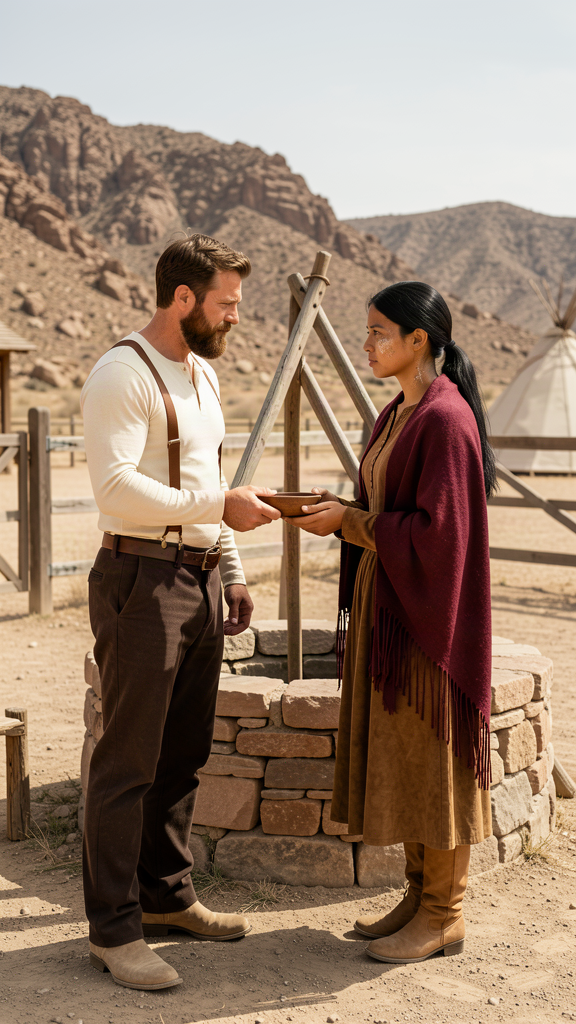
Chapter 1: The Woman Beside the Well
The desert had a way of making a person feel small.
For miles in every direction, there was nothing but dry earth, scattered stones, and mountains that looked as though they had been carved from the bones of the world. The sun hung high above the land, burning the colour from everything it touched.
A wooden fence surrounded an old stone well near the edge of a forgotten settlement. Its wooden frame leaned slightly to one side, and the rope hanging from its pulley had been repaired so many times that nobody remembered what it had originally looked like.
Most travellers avoided the place.
The settlement had once been busy. Wagons had stopped there, merchants had traded supplies, and ranchers had gathered to exchange news. But when the railway was built farther north, the settlement slowly lost its importance. Families moved away, businesses closed, and the old well became one of the few places where a traveller could still find water.
Thomas Reed knew the well better than anyone.
At thirty-eight, he had spent most of his life in the West. He had worked as a ranch hand, driven cattle across dangerous country, and survived winters that had nearly killed him. His face carried the marks of a difficult life. A short brown beard covered his jaw, and his eyes had the tired expression of a man who had learned not to expect too much from the world.
He wore a cream-coloured henley beneath brown suspenders, dark trousers, and dusty boots. A faded cowboy hat rested low over his forehead.
Thomas had not always been a lonely man.
Once, he had a wife named Margaret and a small house filled with laughter. They had planned to build a proper ranch together. They had even chosen names for the children they hoped to have.
But a fever had taken Margaret during a winter when the roads were blocked by snow.
After her death, Thomas had discovered that grief could become a habit. He stopped visiting neighbours. He stopped attending church. He stopped making plans.
He bought a small ranch beyond the mountains and worked from sunrise until darkness.
The animals needed him. The land needed him.
People, he had decided, were better left alone.
That afternoon, he had come to the well to collect water for his horses.
He was lowering the bucket when he noticed movement near the distant fence.
At first, he thought it was an animal.
Then he saw a woman.
She was walking slowly across the dry ground, one hand holding the edge of a deep burgundy shawl around her shoulders. Her long black hair was tied behind her neck, and dust covered the hem of her brown suede dress.
She looked exhausted.
Her steps were uneven. Every few moments, she stopped and looked toward the mountains behind her.
Thomas watched her approach.
He did not reach for his rifle. He did not call out. He simply waited.
The woman stopped several feet away from the well.
For a moment, neither spoke.
Thomas noticed her cracked lips and the dust on her face. She looked as though she had been walking for days.
He knew that look.
He had seen men collapse on the trail after refusing to admit they needed help. He had seen horses stumble from thirst. He had buried a stranger who had been found too late.
He pulled the bucket from the well and placed it beside him.
Then he looked at the woman.
“You need water?”
His voice was low, almost cautious.
The woman did not answer.
She looked at the bucket, then at him. Her eyes were dark and guarded. There was fear in them, but something else too—something that looked like determination.
Thomas waited.
He did not ask where she had come from. He did not demand her name.
He simply lowered the bucket again.
The rope creaked as it descended into the darkness. A moment later, the sound of water echoed from below.
He pulled it up, filled a small brown wooden bowl, and held it out.
“Take it.”
The woman stared at the bowl.
Thomas could see that she was trying to decide whether she could trust him.
He understood.
The world had not been kind to people who travelled alone, especially those who had learned that a friendly face could sometimes hide a cruel intention.
So he did not step closer.
He placed the bowl on the stone edge of the well and moved back.
The woman slowly approached.
Her fingers trembled as she lifted the bowl. She drank carefully at first, then more quickly. A little water ran down her chin.
Thomas turned his attention toward his horse.
He pretended not to notice her embarrassment.
When she finished, she held the empty bowl in both hands.
Thomas looked at her.
“You can rest here.”
The woman said nothing.
But she did not immediately leave.
For the first time that afternoon, her shoulders relaxed.
Thomas returned to his horse and began securing the water containers. He could feel her watching him.
After a few minutes, she placed the bowl on the stone.
Then she walked toward the wooden gate.
Just before leaving, she stopped.
She turned her head and looked back at him.
It was not a smile.
It was not a promise.
But it was the first moment in a long time that Thomas felt someone had looked at him without seeing only a stranger.
He watched until she disappeared beyond the fence.
Then he picked up the bowl.
He did not know her name.
He did not know where she was going.
And he had no idea that before the week was over, the woman who had come to his well searching for water would change everything he believed about his life.
Chapter 2: The Woman Who Would Not Give Her Name
The following morning, Thomas woke before sunrise.
He fed his horses, checked the fence surrounding the eastern pasture, and repaired a broken hinge on the stable door. It was an ordinary morning, the kind he preferred.
But something kept pulling his attention toward the old well.
He told himself it was nothing.
The woman had probably continued travelling. There was no reason to think she would return.
Still, when he loaded his wagon with supplies and rode toward the settlement, he found himself looking at the road more often than necessary.
He stopped near the general store.
The settlement consisted of a few wooden buildings, a blacksmith’s shop, a church, and a boarding house. Most of the people who remained were older ranchers or merchants who had nowhere else to go.
Inside the general store, a bell rang as Thomas entered.
“Morning, Reed,” called Samuel Carter, the storekeeper.
Thomas nodded.
“Need flour, coffee, and salt.”
Samuel began gathering the supplies.
“You’re looking tired.”
“Didn’t sleep much.”
“Trouble with the horses?”
“No.”
Samuel placed a sack of flour on the counter.
“Then something else is bothering you.”
Thomas ignored the comment.
Samuel was a man who enjoyed asking questions, especially when he believed someone was hiding an interesting story.
“By the way,” Samuel continued, “there was some trouble near the southern trail yesterday.”
Thomas looked up.
“What kind of trouble?”
“Two riders came through asking about a woman.”
Thomas’s hand stopped over his money.
“What woman?”
Samuel shrugged.
“Didn’t give me a name. Said she was travelling alone. They wanted to know if anyone had seen her.”
“What did they look like?”
“One was tall, wearing a black coat. The other had a scar across his cheek. Both carried rifles.”
Thomas looked through the window.
“Did you tell them anything?”
“I told them I don’t keep track of every traveller who passes through here.”
“Good.”
Samuel raised an eyebrow.
“Why?”
Thomas placed the money on the counter.
“No reason.”
He collected his supplies and left.
Outside, the morning wind carried dust through the empty street.
He thought about the woman at the well.
Her exhausted face. Her silence. The way she had looked over her shoulder before leaving.
He mounted his horse and rode home.
But he did not take the usual northern trail.
He turned toward the well.
When he arrived, he saw her immediately.
She was sitting near the fence, beneath the thin shadow of an old tree. Her burgundy shawl was wrapped tightly around her shoulders. Beside her lay a small cloth bundle.
She looked up when she heard his horse.
Thomas dismounted.
“You came back.”
The woman nodded slightly.
He looked at the bundle.
“Planning on staying?”
She did not answer.
Thomas studied her face. She looked stronger than the previous day, but she still seemed frightened.
He removed his hat and wiped his forehead.
“There’s a ranch about three miles north of here. Mine. You can have a meal there if you need one.”
The woman lowered her eyes.
Thomas waited.
He had never been good at convincing people to trust him. He had spent years making sure nobody needed to.
“You don’t have to tell me anything,” he said. “But you shouldn’t stay out here. There are men travelling through these parts who aren’t interested in helping anyone.”
Her eyes lifted.
For the first time, she seemed genuinely concerned.
Thomas noticed the change.
“You know the men I’m talking about?”
She looked toward the southern road.
Then she nodded.
Thomas felt a cold sensation move through him despite the heat.
“Are they looking for you?”
She said nothing.
But her expression answered him.
Thomas looked down the road.
He thought about Samuel’s description: a tall man in a black coat and another with a scar.
He knew men like that.
Three years earlier, he had worked for a cattle company owned by a wealthy businessman named Silas Whitcomb. Whitcomb had controlled a large amount of land in the region. He employed armed men to protect his property and used legal tricks to take water rights from smaller ranchers.
Thomas had left after discovering that some of the company’s men were stealing cattle from neighbouring families and blaming innocent ranchers.
He had never forgotten the faces of the men who worked for Whitcomb.
One of them had been called Harlan Pike.
A tall man with a black coat.
Thomas looked at the woman again.
“Listen,” he said quietly. “I don’t know what’s happened to you, but those men shouldn’t be anywhere near you.”
She tightened her grip on her bundle.
Thomas stepped toward the wagon.
“I’ll take you to my ranch. There’s food, clean water, and a locked room if you want privacy.”
She looked at him for a long moment.
Then she stood.
Thomas helped her onto the wagon without touching her more than necessary.
As they began moving, he noticed that she kept looking behind them.
After several minutes, she finally spoke.
“My name is Mara.”
Thomas turned his head.
“Mara?”
She nodded.
He gave a small smile.
“Thomas Reed.”
She looked at him.
Then she turned toward the road again.
It was a small exchange.
But for Thomas, it felt like the beginning of something he had not allowed himself to imagine in years.
Chapter 3: A House With Two Empty Chairs
Thomas’s ranch stood in a shallow valley surrounded by low mountains.
It was not impressive.
The main house was built from weathered timber, with a wide porch and a chimney that leaned slightly to the west. A small barn stood behind it, along with a stable, a chicken coop, and a fenced pasture.
The property had once belonged to a family with dreams of expanding their land.
Now it belonged to one man who rarely invited visitors.
When the wagon arrived, Thomas helped Mara down.
“You can leave your things inside.”
He pointed toward the house.
Mara hesitated.
Thomas noticed her discomfort.
“There’s a separate room at the back. You can stay there. I’ll sleep in the main room.”
She looked at him.
“No one will bother you,” he added.
Mara nodded.
Inside, the house was simple but clean. A wooden table stood near the window. Two chairs faced each other across it. A fireplace occupied one wall, and an old clock ticked above the mantel.
There were no family photographs except one.
A small framed picture of a young woman with gentle eyes.
Mara noticed it.
Thomas followed her gaze.
“That was my wife.”
Mara looked back at him.
“Her name was Margaret.”
He paused.
“She died six years ago.”
Mara lowered her eyes.
Thomas placed a kettle on the stove.
“She liked this house. Said it had good light in the morning.”
He stopped speaking.
He had not mentioned Margaret to anyone in months.
Mara looked at the photograph again.
Then she noticed two chairs at the table.
One had a small cushion. The other was plain.
“She used to sit there,” Thomas explained, pointing toward the chair with the cushion.
Mara gently touched the back of it.
Thomas looked away.
“I should make something to eat.”
He prepared bread, beans, and a small amount of smoked meat. Mara ate slowly, as though she was not accustomed to having enough food.
Thomas pretended to be busy with the dishes.
After lunch, he showed her the back room.
It had a narrow bed, a small table, and a window overlooking the pasture. A blanket was folded neatly at the foot of the bed.
“You can use this room for as long as you need.”
Mara looked around.
“Thank you.”
Her voice was quiet.
Thomas nodded.
“You’re welcome.”
For the rest of the afternoon, they hardly spoke.
Mara stayed inside while Thomas repaired a section of the fence. When he returned, he found her standing near the kitchen window, watching the horses.
One of them, a chestnut mare named Daisy, had approached the fence.
Mara smiled faintly.
Thomas noticed.
“She’s friendly. Too friendly, actually. Thinks every visitor has brought her an apple.”
Mara looked at him.
“May I?”
Thomas nodded.
She walked outside and approached the mare slowly.
Daisy lowered her head.
Mara placed her hand against the horse’s neck.
The animal remained perfectly still.
Thomas watched from the porch.
He had not seen anyone touch Daisy that gently in years.
Later, he found Mara sitting on the porch with a small piece of cloth in her lap. She was repairing a tear in her shawl.
Thomas brought her a cup of coffee.
She accepted it.
“Thank you.”
He sat on the opposite side of the porch.
For a while, they watched the sun sink behind the mountains.
Then Thomas asked, “Those men who were looking for you. Do they know where you are?”
Mara stopped sewing.
She stared at the valley.
“I don’t know.”
“Are you in danger?”
She hesitated.
Then she nodded.
Thomas placed his cup on the floor.
“Do you want to tell me why?”
Mara’s hands tightened around the cloth.
“Not yet.”
Thomas nodded.
“All right.”
He did not ask again.
That evening, he prepared another meal.
They sat at opposite ends of the table.
For the first time in six years, the second chair was occupied.
Thomas looked at the photograph of Margaret.
He wondered what she would have thought of Mara.
Then he looked at the woman across from him.
He saw exhaustion, fear, and a strength that had survived something he could not yet understand.
After dinner, Mara stood.
“I should wash the dishes.”
Thomas shook his head.
“You’re a guest.”
“I can help.”
He looked at her for a moment.
Then he moved aside.
“All right.”
They washed the dishes together.
It was an ordinary thing.
But as the warm light from the kitchen fell across the table, Thomas realised how long it had been since he had shared a quiet evening with another person.
He had thought loneliness was easier.
Now he was beginning to wonder whether he had simply become accustomed to it.
Chapter 4: The Men From the Southern Road
Three days passed.
Mara began to settle into the routine of the ranch.
She helped Thomas prepare meals, collected eggs from the chicken coop, and brushed Daisy whenever she had spare time. She rarely spoke, but she no longer seemed afraid of every sound.
Thomas learned that she preferred tea to coffee.
He learned that she liked watching the mountains in the early morning.
He also learned that she woke from nightmares.
Sometimes, in the middle of the night, he heard movement from the back room. A sudden breath. The sound of a chair scraping against the floor.
He never entered.
Instead, he would quietly light a lamp in the kitchen so she would know someone was awake.
On the fourth morning, he found her standing beside the fence.
She was staring toward the southern trail.
Thomas approached.
“Something wrong?”
Mara did not turn.
“They found me.”
Thomas followed her gaze.
Far away, two riders were approaching.
One wore a long black coat.
The other had a scar running down his cheek.
Thomas recognised them immediately.
Harlan Pike and Deputy Cole.
They rode toward the ranch without slowing.
Thomas stepped in front of Mara.
“Go inside.”
She shook her head.
“Please.”
“I don’t want you near them.”
Mara hesitated, then walked toward the house.
Thomas waited by the gate.
The riders stopped several feet away.
Harlan Pike removed his hat.
“Morning, Reed.”
Thomas did not return the greeting.
“Pike.”
“Didn’t expect to see you out here.”
“Funny. I was thinking the same thing.”
Pike smiled.
His face was narrow, and his eyes were pale and cold.
“We’re looking for a woman.”
Thomas leaned against the fence.
“Plenty of women in the territory.”
“This one travelled through the southern settlement.”
“Then perhaps you should look there.”
Pike studied him.
“She’s a thief.”
Thomas remained silent.
“Stole something valuable from an employer. We have papers proving it.”
“What did she steal?”
Pike’s smile disappeared.
“That isn’t your concern.”
Thomas straightened.
“Then neither is she.”
Cole shifted in his saddle.
“Careful, Reed. You’re interfering with an official investigation.”
Thomas looked at the deputy.
“Since when do official investigations involve chasing exhausted women across the desert?”
Pike laughed.
“You always did have a soft heart.”
Thomas said nothing.
Pike leaned forward.
“We know she’s here.”
The ranch suddenly felt very quiet.
A horse snorted behind the barn.
Thomas’s right hand rested near his belt, but he did not move toward his gun.
“She’s a guest,” he said. “She hasn’t stolen anything from me.”
“She doesn’t belong here.”
“Neither do you.”
Pike’s eyes narrowed.
For a few seconds, neither man spoke.
Then Pike smiled again.
“You’re making a mistake.”
“Maybe.”
“We’ll be back.”
Thomas stepped away from the gate.
“Don’t bother.”
The two riders turned their horses and rode away.
Thomas watched until they disappeared.
When he entered the house, Mara was standing near the window.
She had heard everything.
Thomas removed his hat.
“Are you all right?”
Mara looked at him.
“They will come again.”
“Then they’ll find me here.”
She shook her head.
“You don’t understand.”
“Then help me understand.”
Mara sat at the table.
For several moments, she stared at her hands.
Then she reached into the cloth bundle she had brought from the well.
She removed a small leather pouch.
Inside were several folded papers, a silver pendant, and a narrow notebook.
Thomas looked at them.
“What are those?”
“Proof.”
“Proof of what?”
Mara opened the notebook.
Inside were names, dates, payments, and descriptions of land.
Thomas recognised one name immediately.
Silas Whitcomb.
His expression changed.
“Where did you get this?”
“My father worked with the people who managed the water routes in this region. He kept records of the agreements between families and the land company.”
Thomas turned a page.
The handwriting was careful.
Some entries described payments made to officials. Others recorded wells that had been blocked or destroyed after families refused to sell their land.
Then he saw a name he recognised.
Harlan Pike.
Thomas looked up.
“What happened?”
Mara swallowed.
“My family lived near the eastern valley. We had water rights there. My father refused to sell them to Whitcomb.”
She paused.
“After he died, the company said our land was no longer protected by the old agreement. They wanted us to leave.”
Thomas looked at the papers.
“And you refused.”
Mara nodded.
“They burned our storage buildings. They took our horses. My brother tried to stop them.”
Her voice became unsteady.
“They arrested him.”
Thomas looked at her carefully.
“Where is he now?”
“I don’t know.”
The room seemed to grow smaller.
Mara continued.
“My father had hidden the notebook before he died. I found it after the men came to our home. I took it because I knew they would destroy it.”
Thomas turned another page.
There were signatures.
Dates.
Records of land purchases that had never taken place.
A list of payments made to a local judge.
It was more than a family dispute.
It was evidence of organised fraud.
Thomas closed the notebook.
“Why didn’t you take this to the sheriff?”
Mara looked at him.
“The sheriff works for Whitcomb.”
Thomas understood.
That was why Pike had come looking for her.
That was why she had travelled alone.
She was carrying something that could destroy powerful men.
And now those men knew where she was.
Chapter 5: The Price of Doing Nothing
Thomas spent the rest of the day reading the notebook.
The more he read, the angrier he became.
He recognised several of the places described in the records. One was a small ranch owned by an old man named Henry Wallace. Another belonged to a family who had been forced to leave after their well mysteriously dried up.
Thomas remembered hearing rumours about both cases.
At the time, he had not questioned them.
He had been working for Whitcomb’s company and had believed that the landowner was simply a difficult businessman.
Now he understood.
The company had been taking water rights from families for years.
Thomas remembered one particular winter.
He had been ordered to accompany Pike on a journey to a settlement east of the mountains. Pike had carried papers claiming that several families had sold their water rights.
Thomas had noticed that the signatures looked suspicious.
He had asked questions.
Pike had told him to mind his business.
A week later, Thomas resigned.
He had never known what happened to those families.
Now he was looking at their names in Mara’s notebook.
He closed it and rubbed his face.
Mara stood near the window.
“Do you believe me?”
Thomas looked up.
“Yes.”
She seemed surprised.
“Why?”
“Because I’ve seen enough of Whitcomb’s work to know what he’s capable of.”
He placed the notebook on the table.
“I should have asked more questions when I worked for him.”
Mara sat down.
“You didn’t know.”
“Maybe not. But I knew something wasn’t right.”
For the first time, he spoke about the guilt he had carried for years.
He told her how he had worked for Whitcomb, how he had delivered supplies to company men, and how he had once ignored a frightened family who claimed their land had been taken unfairly.
He had been afraid of losing his job.
So he had looked away.
“After I left, I told myself I had done the right thing,” Thomas said. “But I never found out what happened to those people.”
Mara listened without interrupting.
“Sometimes doing nothing feels safer,” he continued. “Until you realise someone else pays the price.”
Mara looked down at the notebook.
“My father used to say that a person is responsible for what they choose to protect.”
Thomas gave a small nod.
“He sounds like a good man.”
“He was.”
She reached for the silver pendant in her pouch.
It was simple, with a small engraved design.
“My mother gave this to me when I was young. She said it would remind me that I was never alone, even when I had to walk a difficult road.”
Thomas looked at the pendant.
“Do you still believe that?”
Mara considered the question.
“I want to.”
He did not know what to say.
He wanted to tell her that she was safe here.
But he knew that safety was not something he could promise while men like Whitcomb still had power over the territory.
That night, Thomas made a decision.
He would take the notebook to a trustworthy lawyer in the town of Red Creek, nearly a day’s ride away. The lawyer was named Joseph Bell. Thomas had met him years earlier when Bell had defended a rancher accused of stealing cattle.
If anyone could make the records useful, it was Bell.
Mara listened as Thomas explained the plan.
“We leave at first light,” he said. “We’ll take the eastern trail. It’s longer, but Pike won’t expect us to use it.”
Mara looked worried.
“They will follow.”
“Probably.”
“You could lose your ranch.”
Thomas looked toward the photograph on the mantel.
For a moment, he remembered Margaret standing in that same room, telling him that he could not spend his entire life hiding from trouble.
He looked back at Mara.
“I’ve spent enough years protecting an empty house.”
Mara’s eyes softened.
“Thomas…”
He waited.
She seemed to struggle with the words.
“Thank you.”
He nodded.
“Get some sleep. We have a long ride tomorrow.”
But neither slept well.
Outside, the wind moved through the dry grass.
Far beyond the valley, two riders were already heading toward Whitcomb’s headquarters.
And Harlan Pike had no intention of letting Mara reach Red Creek.
Chapter 6: A Road Through the Mountains
They left before sunrise.
Thomas packed food, water, ammunition, and a blanket into the wagon. Mara carried the notebook inside her clothing, wrapped in a piece of oilcloth.
They travelled east.
The road was narrow and uneven, passing through a dry creek bed before climbing toward the mountains.
For the first few hours, they saw nobody.
Mara sat beside Thomas, holding the reins when the road became difficult. She seemed calmer than she had been at the ranch.
Thomas noticed that she occasionally looked at him.
“What?”
“Nothing.”
“You keep looking at me.”
She turned away.
Thomas smiled faintly.
“Just checking I haven’t grown another head?”
Mara almost smiled.
It was the first time he had heard something close to laughter from her.
The sound surprised him.
He realised he wanted to hear it again.
Around midday, they stopped near a small stream.
Thomas watered the horses and prepared a simple meal.
Mara sat on a flat stone.
“Did you always live alone?” she asked.
Thomas looked at her.
“No.”
He told her about Margaret.
He described how they had met at a church gathering, how she had laughed at his terrible dancing, and how she had convinced him to buy the ranch.
“She wanted a big family,” he said. “I wanted a quiet life. Somehow, she convinced me we could have both.”
“What happened to her?”
“Fever. The doctor came too late.”
Mara lowered her eyes.
“I’m sorry.”
Thomas nodded.
“For a long time, I thought I could have saved her if I’d done something differently. Taken her to another town. Found another doctor. Tried harder.”
He looked at the water moving over the stones.
“Eventually, I understood that some things happen no matter how much we wish they wouldn’t.”
Mara listened.
“Do you miss her?”
“Every day.”
“Then why did you help me?”
Thomas turned toward her.
“Because helping someone doesn’t mean forgetting someone else.”
Mara looked at him.
For a long moment, neither spoke.
Then she reached for her cup.
Thomas returned to the horses.
They continued travelling.
Near sunset, they reached a narrow pass between two rocky hills.
Thomas slowed the wagon.
Something about the silence bothered him.
He looked at the ground.
Fresh hoofprints.
Several horses had passed recently.
He raised his hand.
“Stay close.”
Mara looked at him.
Thomas moved the wagon forward slowly.
A moment later, a gunshot echoed through the pass.
The bullet struck the wooden frame above the wagon.
The horses panicked.
Thomas grabbed the reins.
“Down!”
Mara ducked.
A second shot struck the ground near the left wheel.
Thomas saw two riders on the ridge.
Pike and Cole.
Thomas pulled the wagon behind a large rock formation.
“Are you hurt?”
Mara shook her head.
Thomas checked his rifle.
He knew he could not outrun them with the wagon.
He also knew that if they reached the notebook, Mara would have nothing left to protect her family.
“There’s a narrow trail behind those rocks,” he said. “It leads toward the creek.”
Mara looked at him.
“We can leave the wagon and take the horses.”
Thomas nodded.
“That’s the plan.”
He helped her down.
They moved behind the rocks as another shot struck the wagon.
Thomas led the horses through the narrow trail.
The path was difficult, but it was hidden from the ridge.
They reached the creek just as darkness began falling.
Thomas stopped beneath a group of trees.
He looked back.
No riders.
For the moment, they were safe.
Mara was breathing heavily.
Thomas placed a hand on her shoulder.
“You’re all right.”
She looked at him.
Then, unexpectedly, she held his hand.
He looked down at their joined fingers.
She quickly released him.
“Sorry.”
Thomas shook his head.
“Don’t be.”
He wanted to say more.
But the sound of distant hoofbeats stopped him.
They had to keep moving.
Chapter 7: The Man Who Came Back
They reached Red Creek the following afternoon.
It was a larger town, with a railway station, a courthouse, several hotels, and a busy main street.
Thomas took Mara to the office of Joseph Bell.
Bell was a thin man in his early fifties with round spectacles and a habit of tapping his pencil against the desk.
When Thomas explained the situation, Bell’s expression changed.
He examined the notebook carefully.
“Where did you get this?”
Mara explained.
Bell turned several pages.
“These records could be important.”
“Can you help us?” Thomas asked.
Bell leaned back.
“I can try. But Whitcomb has friends in the courthouse. We need copies of these documents and witnesses who can confirm the entries.”
Mara looked worried.
“Will they believe me?”
Bell removed his spectacles.
“They may not believe you at first. But they will have to explain these records.”
He stood.
“I know a newspaper editor in town. If we publish the details, it will become much harder for Whitcomb to bury this.”
Thomas nodded.
“Then let’s do it.”
Bell looked at him.
“You’re aware that this could bring trouble to your ranch?”
Thomas gave a tired smile.
“Trouble already knows where I live.”
Bell almost laughed.
He arranged for the notebook to be copied and secured in his office.
He also promised to contact several families named in the records.
Mara sat quietly while the two men discussed the next steps.
For the first time since leaving home, she felt that someone might actually listen.
When they left the office, Thomas noticed that she looked pale.
“What’s wrong?”
“I need to find out about my brother.”
Thomas stopped.
“Do you know where he was taken?”
“Whitcomb’s men said he was sent to the old mining camp near Black Ridge.”
Thomas knew the place.
It had once been a small silver mine, but the operation had closed years earlier. Whitcomb had purchased the land and used some of the old buildings for storage.
Thomas frowned.
“That camp is dangerous.”
“My brother could be there.”
“We’ll find out.”
Mara looked at him.
“You have already done so much.”
Thomas studied her face.
“I know what it’s like to lose someone without knowing what happened to them.”
He paused.
“We’ll find him.”
That evening, they stayed at a modest hotel.
Thomas arranged separate rooms.
Mara stood in the doorway of hers.
“Thomas?”
He turned.
“Yes?”
“If something happens tomorrow…”
“Nothing is going to happen.”
“But if it does, I want you to know that I am grateful.”
He looked at her.
“You don’t have to keep thanking me.”
“I know.”
She hesitated.
“Nobody has helped me without asking for something in return.”
Thomas felt something tighten in his chest.
He understood more than she knew.
For years, he had avoided helping anyone because he feared becoming responsible for another person’s pain.
But Mara had never asked him to rescue her.
She had only needed someone to offer water.
And somehow, that small act had led him here.
“Get some rest,” he said.
Mara nodded.
He turned to leave.
Then she spoke again.
“Good night, Thomas.”
He looked back.
“Good night, Mara.”
He walked down the hallway with a strange feeling.
It was not happiness exactly.
It was something he had not felt in a very long time.
Hope.
Chapter 8: The Old Mining Camp
The next morning, Joseph Bell received a message from a railway worker.
The worker had seen several prisoners being taken toward Black Ridge. One of them matched the description Mara had given of her brother.
Bell warned them not to go.
“Whitcomb’s men control that camp,” he said. “If your brother is there, we need help from the marshal.”
Thomas looked at Mara.
She was already preparing to leave.
“We can’t wait,” she said.
Bell frowned.
“Going alone would be foolish.”
Thomas nodded.
“Then we won’t go alone.”
He contacted Marshal Daniel Harris, a respected lawman who had recently arrived in Red Creek to investigate reports of land fraud.
Harris agreed to accompany them, but he needed time to gather two deputies.
They would leave at dawn the following day.
That night, Mara could barely sleep.
Thomas found her sitting on the hotel steps.
The street was quiet.
A few lamps glowed above the shop doors, and a cold wind moved through the town.
He sat beside her.
“Thinking about your brother?”
She nodded.
“When we were children, he always walked ahead of me. He said he wanted to make sure the road was safe.”
Thomas listened.
“He used to bring me wildflowers. Even when there were hardly any left.”
She looked at her hands.
“I don’t know if he is alive.”
Thomas did not offer false promises.
He simply sat beside her.
After a while, Mara leaned her head against his shoulder.
Thomas went still.
He did not move away.
They stayed like that for several minutes.
Then Mara whispered, “I am afraid.”
Thomas looked toward the empty street.
“So am I.”
She lifted her head.
“You?”
“Yes.”
“Why?”
He considered his answer.
“Because I know what it feels like to lose someone. And I don’t want you to go through that.”
Mara looked at him.
For the first time, she saw the loneliness behind his calm expression.
She understood that Thomas had not helped her because he was fearless.
He had helped her despite being afraid.
The following morning, they rode toward Black Ridge with Marshal Harris and two deputies.
The old mining camp stood between two steep hills. Several wooden buildings remained, and a tall fence surrounded the storage yard.
They approached slowly.
Harris ordered the deputies to remain near the entrance.
Thomas and Mara followed him toward the main building.
A guard stepped outside.
“Nobody’s allowed in.”
Harris showed his badge.
“Marshal Harris. We’re here to inspect the premises.”
The guard looked uncomfortable.
“You need permission from Mr. Whitcomb.”
“I’ll speak to him later.”
The guard reached for his rifle.
Harris raised his weapon.
“Don’t.”
The guard froze.
A moment later, another man appeared.
It was Harlan Pike.
His eyes moved from Harris to Thomas, then settled on Mara.
He smiled.
“Well, look who found her way home.”
Thomas stepped forward.
“Where is her brother?”
Pike laughed.
“You still think you can order people around, Reed?”
Marshal Harris moved beside Thomas.
“Answer the question.”
Pike’s smile faded.
“You have no authority here.”
Harris showed his badge again.
“Actually, I do.”
A tense silence followed.
Then a voice came from inside the building.
“What’s going on?”
A man stepped into the doorway.
It was Silas Whitcomb.
He wore a dark suit and a polished silver watch. His hair was neatly combed, and his face carried the confidence of someone who had rarely been told no.
He looked at Thomas.
“Reed. I thought you had more sense.”
Thomas said nothing.
Whitcomb turned toward Mara.
“And you. You have caused a great deal of trouble.”
Mara stepped forward.
“Where is my brother?”
Whitcomb adjusted his coat.
“Your brother is a criminal.”
“Where is he?”
Whitcomb looked toward Pike.
Pike nodded toward the building behind them.
Harris ordered his deputies to search the premises.
Whitcomb protested.
But the marshal ignored him.
Several minutes later, one of the deputies emerged.
“We found someone.”
Mara ran toward the building.
Thomas followed.
Inside a small room, a young man sat against the wall with one arm in a sling. His face was bruised, and his clothes were torn.
But he was alive.
“Mara?”
Her brother struggled to stand.
She rushed forward and embraced him.
For several seconds, neither could speak.
Thomas stood near the doorway.
He watched them hold each other.
And for the first time in years, he felt that perhaps some losses could still be prevented.
Chapter 9: The Truth Comes Into the Light
The events at Black Ridge changed everything.
Marshal Harris arrested Harlan Pike and several men connected to the camp. Whitcomb was not arrested immediately, but the discovery of the prisoners gave the authorities a reason to investigate his operations.
Mara’s brother, whose name was Elias, was taken to Red Creek for medical treatment.
He was weak, but he was alive.
The reunion between the siblings lasted most of the afternoon.
Thomas gave them privacy.
He sat outside the medical office while a doctor treated Elias’s injuries.
After a while, Mara came out.
Her eyes were red.
Thomas stood.
“How is he?”
“He will recover.”
Thomas nodded.
“Good.”
Mara looked at him.
“I thought I had lost him.”
Thomas gently placed his hand on her shoulder.
“But you found him.”
She looked down.
“Because of you.”
Thomas shook his head.
“Because you kept going.”
They stood together beneath the wooden awning.
Mara reached for his hand.
This time, she did not pull away.
Several days passed.
Joseph Bell and Marshal Harris gathered statements from families whose land had been taken. The newspaper published an account of the evidence, including records of false signatures and payments to officials.
Whitcomb’s reputation began to collapse.
Some of his business partners abandoned him.
Others attempted to deny their involvement.
But the notebook had become the centre of a growing investigation.
The old agreements were examined by the court. Several families received confirmation of their water rights.
Mara’s family was among them.
The land near the eastern valley had never legally belonged to Whitcomb.
The company had no right to force them away.
When Mara heard the news, she sat quietly for a long time.
Then she cried.
Not loudly.
Not dramatically.
She simply covered her face and allowed the tears to come.
Thomas stood nearby.
He wanted to comfort her, but he did not know whether she wanted to be touched.
After a moment, she reached for him.
He wrapped his arms around her.
She held on tightly.
For a long time, neither spoke.
When she finally stepped back, she wiped her cheeks.
“My father would have wanted to see this.”
Thomas nodded.
“I think he would be proud of you.”
Mara looked at him.
“Do you think he would have trusted you?”
Thomas smiled faintly.
“I hope so.”
“He would have asked many questions.”
“Then I would have been in trouble.”
Mara laughed.
It was a real laugh this time.
Thomas felt it reach somewhere deep inside him.
He realised that the sound had become important to him.
Perhaps more important than he was ready to admit.
Chapter 10: A Place to Return To
When the investigation began to settle, Mara and Elias had a choice.
They could return to their family’s land in the eastern valley, rebuild their home, and begin again.
Thomas offered to help them repair the damaged buildings.
Elias accepted.
But Mara hesitated.
She had grown comfortable at Thomas’s ranch.
She liked the quiet mornings, the sound of the horses, and the warm light that entered the kitchen.
She liked the way Thomas always left a cup of tea near the stove when he knew she would wake early.
Most of all, she liked the way he never demanded that she explain her silence.
One evening, she stood on the porch watching the sunset.
Thomas approached with two cups.
“Tea.”
She accepted one.
“Thank you.”
He leaned against the porch railing.
“Elias says they’ll begin rebuilding next week.”
Mara nodded.
“He wants me to come home.”
“That makes sense.”
She looked at him.
“Do you want me to go?”
Thomas did not answer immediately.
He had expected this moment.
He knew Mara belonged with her family. He knew she had a home to rebuild and a future that did not depend on him.
But knowing something was right did not make it easy.
“I want you to have a place where you feel safe,” he said.
Mara looked toward the pasture.
“I feel safe here.”
Thomas lowered his cup.
The words stayed between them.
He wanted to ask her to remain.
But he had learned that love could not be built by keeping someone from leaving.
Mara turned toward him.
“Why did you help me?”
Thomas smiled faintly.
“I told you. You needed water.”
“No. I mean after that. You could have sent me away. You could have ignored the men. You could have taken the notebook and told me to find help somewhere else.”
Thomas looked across the valley.
“Maybe I was tired of watching bad things happen and doing nothing.”
Mara waited.
“And maybe,” he added, “I was tired of being alone.”
Her expression softened.
Thomas looked at her.
“I don’t expect anything from you, Mara. You have your family and your land. You should choose what makes you happy.”
She placed her cup on the railing.
Then she stepped closer.
“I have spent a long time running from people who wanted to control my life.”
Thomas listened.
“You never tried to control me. You gave me water. You gave me a place to rest. You believed me when nobody else would.”
She paused.
“That means more than you know.”
Thomas looked into her eyes.
For a moment, he was reminded of Margaret.
Not because Mara was like her.
She was different in every way.
But because she made the house feel alive again.
He lowered his gaze.
“I don’t know how to start again.”
Mara gently took his hand.
“Neither do I.”
They stood together as the sun disappeared behind the mountains.
No promises were made.
No future was decided.
But something had changed.
Chapter 11: The House With an Open Door
Spring arrived slowly in the valley.
The snow melted from the mountains, and small patches of green appeared near the creek. The horses grew restless, and the mornings became warmer.
Thomas repaired the fence around the eastern pasture.
Mara helped him paint the porch.
They worked side by side, sometimes speaking, sometimes remaining quiet.
Elias visited often.
He had recovered enough to help rebuild the family property. He and Thomas became friends, although Elias never missed an opportunity to tease him.
One afternoon, Elias found Thomas repairing a wagon wheel.
“My sister likes your ranch.”
Thomas kept working.
“Does she?”
“She talks about it every time she comes home.”
Thomas tightened a bolt.
“That’s good.”
Elias folded his arms.
“She also talks about you.”
Thomas stopped working.
“Does she?”
“Yes.”
“What does she say?”
Elias smiled.
“That you’re stubborn.”
Thomas shook his head.
“She’s not wrong.”
“And that you make terrible coffee.”
Thomas laughed.
“That’s just an insult.”
Elias sat on the fence.
“She has been through a difficult time. I don’t want anyone hurting her again.”
Thomas placed the wrench down.
“Neither do I.”
Elias studied him.
“Are you going to tell her how you feel?”
Thomas looked toward the house.
Mara was standing on the porch, speaking to an elderly neighbour who had come to visit.
“I don’t want to rush her.”
Elias nodded.
“Good.”
He stood and dusted his trousers.
“But don’t wait forever. Sometimes people need to know they’re wanted.”
After Elias left, Thomas continued working.
But his thoughts remained with Mara.
That evening, she found him sitting on the porch.
“You’re quiet today.”
“Thinking.”
“About what?”
Thomas looked at her.
“About the future.”
She sat beside him.
For a while, they watched the horses grazing.
Then Thomas spoke.
“I’ve been thinking about the house.”
Mara looked at him.
“What about it?”
“It has two bedrooms. A good kitchen. Plenty of land. More than one person needs.”
Mara smiled faintly.
“Are you planning to invite someone?”
Thomas turned toward her.
“Maybe.”
She waited.
He took a slow breath.
“I don’t want you to stay because you feel you owe me anything. You don’t.”
Mara nodded.
“But if you ever wanted to make this place your home, I’d be glad.”
She looked toward the valley.
Then she turned back.
“Would you still want me here if I never became the woman you expected?”
Thomas frowned slightly.
“I don’t expect you to become anyone else.”
“Even if I remain quiet?”
“Especially then.”
She laughed softly.
Thomas smiled.
He reached for her hand.
This time, she held it.
“I would like to stay,” she said.
Thomas looked at her.
“Are you sure?”
“Yes. But I also want to help rebuild my family’s land. I want to visit Elias. I want to make my own decisions.”
Thomas nodded.
“Then that’s what we’ll do.”
Mara leaned her head against his shoulder.
For the first time, the ranch did not feel like a place where Thomas was hiding from the world.
It felt like a home.
Chapter 12: The Promise Beneath the Old Tree
Summer came.
The eastern valley slowly recovered.
Families returned to their properties, repaired their wells, and rebuilt the homes that had been destroyed. Joseph Bell continued working on the legal cases, while Marshal Harris made sure the remaining men connected to Whitcomb’s company faced investigation.
Silas Whitcomb was eventually charged with fraud, unlawful imprisonment, and conspiracy to seize land.
The trial lasted several weeks.
Mara testified.
She spoke about her father, the destroyed buildings, and the day she had found the notebook.
Her voice shook at first.
But she continued.
When the trial ended, several families received legal recognition of their water rights.
Whitcomb lost much of his influence.
Pike and the men who had helped him were sentenced for their crimes.
The territory was not suddenly a perfect place.
There were still greedy men, dishonest officials, and families struggling to rebuild.
But people had begun to believe that they could defend what belonged to them.
Mara returned to her family’s land regularly.
She and Elias rebuilt the house where they had grown up. They repaired the old well and planted trees near the eastern fence.
Thomas helped whenever he could.
He never asked Mara to choose between her family and his ranch.
Instead, he made room for both.
One evening, after a long day of work, Thomas found Mara beneath an old tree near the pasture.
She was sitting with a small wooden box in her lap.
He approached.
“What’s that?”
She opened the box.
Inside was the silver pendant her mother had given her, along with a small photograph of her parents.
“I found this while we were repairing the old house.”
Thomas sat beside her.
Mara looked at the photograph.
“My mother always wanted me to have a life filled with kindness.”
Thomas listened.
“She used to say that a person’s worth isn’t measured by the land they own or the money they carry. It’s measured by what they do when someone needs help.”
Thomas looked toward the distant well.
“Your mother sounds like Margaret.”
Mara turned toward him.
“You told me she was kind.”
“She was.”
“Do you still talk to her?”
Thomas thought for a moment.
“Sometimes.”
Mara smiled.
“What do you say?”
“Usually that I wish she could see how the ranch has changed.”
He looked at the house.
“She would have liked you.”
Mara lowered her eyes.
“I wish I had known her.”
Thomas smiled.
“She would have asked you a hundred questions.”
“Like Elias?”
“Worse.”
Mara laughed.
Then she became quiet.
“Thomas?”
“Yes?”
“I want to ask you something.”
He turned toward her.
“What is it?”
She took his hand.
“When you first saw me at the well, what did you think?”
Thomas considered the memory.
“I thought you looked exhausted.”
“Anything else?”
“I thought you were afraid.”
She waited.
“And I thought,” he continued, “that nobody should have to stand in the sun looking that thirsty.”
Mara smiled.
“You didn’t think I was beautiful?”
Thomas looked surprised.
Then he laughed.
“Well, I noticed that too.”
She shook her head.
He turned toward her.
“Can I ask you something?”
“Yes.”
“Why did you look back that first day?”
Mara looked toward the old well.
“Because you offered me water without asking me to explain why I needed it.”
Thomas said nothing.
“You didn’t know my name. You didn’t know my family. You didn’t know what I was carrying. You simply helped.”
She looked at him again.
“I wanted to remember the face of the first person who treated me like a human being when I had almost stopped believing people could be kind.”
Thomas felt his throat tighten.
He reached for her hand.
Mara moved closer.
They sat beneath the tree as the evening wind moved through the grass.
The world around them was quiet.
And for once, the silence did not feel lonely.
Chapter 13: The Last Ride to the Well
One year later, Thomas and Mara returned to the old well.
The settlement had changed little.
The same wooden buildings stood near the dusty road. The blacksmith’s shop still operated, and Samuel Carter still complained about the price of supplies.
But the well had been repaired.
Thomas had replaced the old rope, strengthened the wooden frame, and built a small roof to protect travellers from the sun.
A simple sign hung beside the gate:
WATER IS FREE. TAKE WHAT YOU NEED.
Mara stood beside him, reading the words.
“You made this?”
Thomas nodded.
“Thought it was a good idea.”
She smiled.
They had married quietly the previous autumn.
There had been no grand ceremony or expensive celebration. Elias had stood beside Mara, and Samuel had served as a witness. Joseph Bell had even travelled from Red Creek to congratulate them.
Their wedding had taken place beneath the old tree near Thomas’s ranch.
Mara had worn a simple cream dress with her burgundy shawl.
Thomas had worn his best shirt and the same brown suspenders he wore every day.
They had exchanged promises in front of the people who mattered.
Now they stood beside the place where everything had begun.
Thomas lowered a bucket into the well.
The rope creaked.
He pulled it up and filled the small wooden bowl.
Then he offered it to Mara.
She looked at him.
“Take it.”
She laughed.
“You’re still saying that?”
“Seems to work.”
She accepted the bowl and drank.
Then she handed it back.
Thomas placed it on the stone edge.
For a moment, they stood quietly.
A wagon approached from the southern road.
It carried a young family.
The man driving looked tired, and a woman sat beside him holding a small child.
They stopped near the well.
The father climbed down.
“Excuse me. Is there water here?”
Thomas nodded.
“Plenty.”
The man looked relieved.
“Thank you. We’ve been travelling since sunrise.”
Thomas lowered the bucket again.
Mara watched him.
The father took the water and gave it to his wife.
The child reached for the bowl.
Thomas smiled.
“Take your time.”
The family drank and thanked them.
Before leaving, the woman looked at Mara.
“May I ask your name?”
Mara smiled.
“Mara.”
“I’m Anna. Thank you for helping us.”
Mara nodded.
The family climbed back into the wagon and continued toward the settlement.
Thomas watched them disappear.
Then he looked at Mara.
“What?”
She shook her head.
“Nothing.”
He knew that expression.
She was remembering the first day.
The woman standing alone in the heat.
The exhausted traveller who had almost nothing left.
The man who had offered her water without asking questions.
Thomas took her hand.
“Ready to go home?”
Mara looked at the road.
Then she looked at him.
“Yes.”
They mounted their horses and rode toward the mountains.
The afternoon sun stretched their shadows across the desert.
Thomas rode beside Mara, his hand occasionally brushing hers.
They did not need to speak.
They had learned that some of the strongest promises were not made with words.
They were made through patience.
Through respect.
Through the decision to stay when leaving would have been easier.
And through small acts of kindness that seemed ordinary at the time but changed everything.
Epilogue: The Kindness That Remained
Years later, travellers still stopped at the old well.
Some came from distant towns. Others were ranchers moving cattle across the territory. A few were families who had lost their homes and needed a safe place to rest.
The well never ran dry.
Thomas and Mara made sure of it.
They kept fresh water available and repaired the wooden frame whenever the weather damaged it. They also built a small shelter beside the fence where travellers could escape the heat.
People in the region began calling it Reed’s Well.
But Thomas never liked the name.
He preferred to call it the travellers’ well.
He believed that water belonged to everyone who needed it.
The ranch became busier too.
Elias visited often, bringing supplies from the eastern valley. Samuel sometimes arrived with news from town. Joseph Bell continued to send letters whenever there was an important development in the territory.
Thomas was no longer the lonely rancher who avoided every visitor.
He still enjoyed quiet mornings, but he no longer feared the sound of someone approaching the house.
Mara became part of the community.
She helped families who had lost their homes, taught young children how to care for animals, and made sure no traveller left the valley without food or water.
She never forgot what had happened to her family.
But she refused to let those events define the rest of her life.
One winter evening, Thomas sat near the fireplace while Mara prepared tea.
Snow had begun falling outside.
The house was warm, and a small lamp illuminated the photograph of Margaret on the mantel.
Mara placed two cups on the table.
Thomas looked at her.
“Do you ever think about that first day?”
She smiled.
“At the well?”
He nodded.
“Every time I see that wooden bowl.”
Thomas glanced toward the kitchen.
The same small brown bowl sat on the shelf.
He had kept it all those years.
Mara sat beside him.
“Do you know what I remember most?”
“What?”
“Not the water.”
Thomas raised an eyebrow.
“No?”
She shook her head.
“I remember that you stepped away so I wouldn’t feel afraid.”
Thomas looked at her.
“I didn’t want to frighten you.”
“I know.”
She placed her hand over his.
“That was the first time in a long while that someone gave me a choice instead of an order.”
Thomas looked down at their hands.
Outside, the wind moved gently through the trees.
He thought about how different his life might have been if he had ignored the woman at the well.
He might still have been living alone.
He might still have believed that keeping people away was the safest way to avoid pain.
Instead, he had offered a bowl of water.
And a stranger had given him something he thought he had lost forever.
A reason to open the door.
A reason to look toward tomorrow.
A reason to believe that love could begin quietly, without grand speeches or impossible promises.
Mara leaned against him.
Thomas placed his arm around her.
The fire crackled.
The old clock continued ticking.
And the house that had once held only memories finally became a home filled with life.
Far away, beyond the mountains, the old well stood beneath the winter sky.
Its wooden frame creaked softly in the wind.
The sign beside the gate remained:
WATER IS FREE. TAKE WHAT YOU NEED.
And beneath those words, Thomas had carved one more sentence:
KINDNESS COSTS NOTHING, BUT IT CAN CHANGE EVERYTHING.
The End.