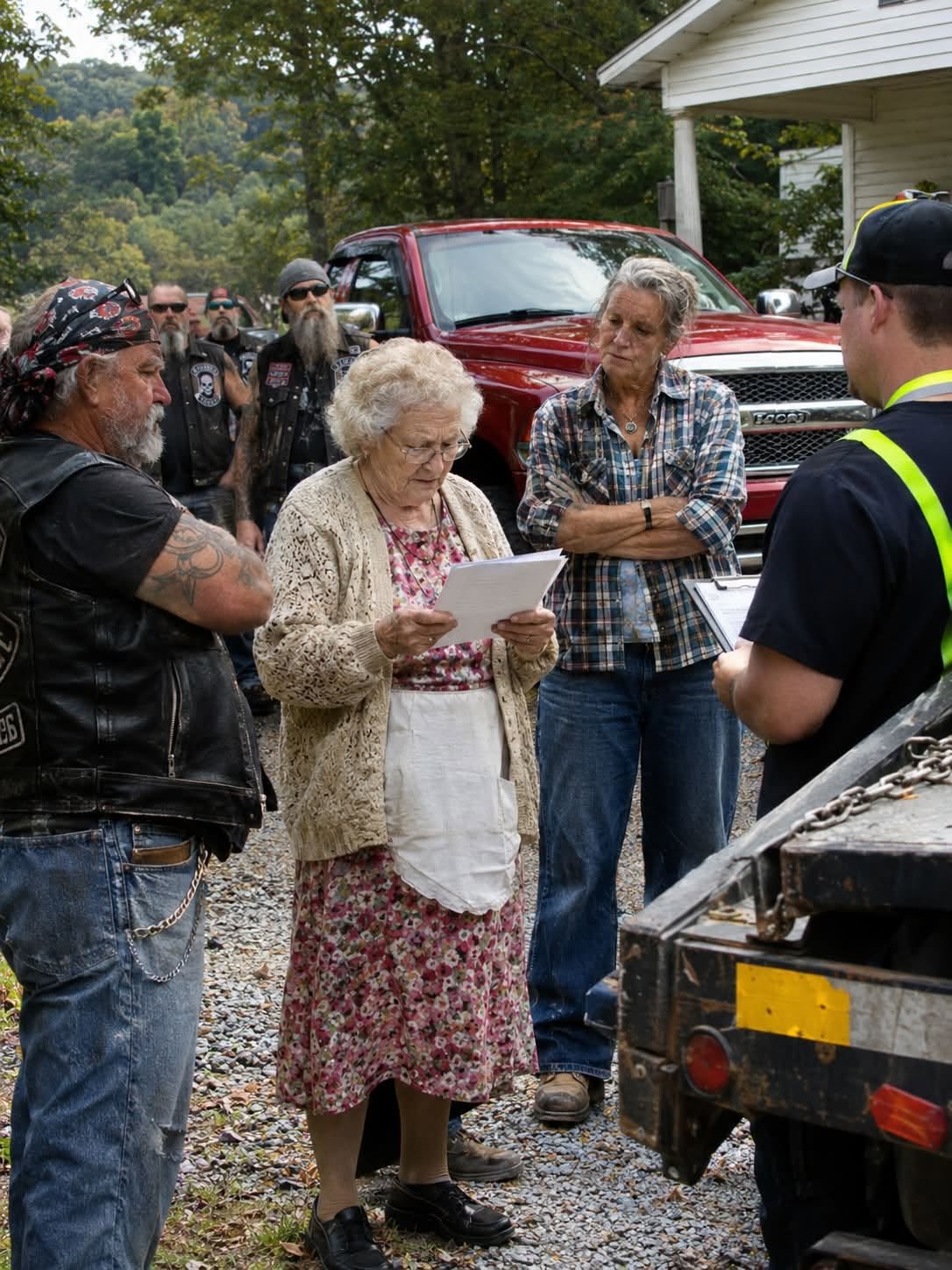
I looked at him. “And where exactly did sixty-eight thousand dollars come from?”
He slapped the hood.
“Your mama would’ve wanted me to have it.”
I stared at him for a moment.
“Delmas, my mama spent the last twenty years telling me she couldn’t stand the sight of your motorcycle boots on her porch. I don’t believe she left you a truck.”
His smile faded slightly.
“Come on, Stell. Don’t start.”
“I’m not starting anything. I’m asking a question.”
He pulled a folded piece of paper from his jacket pocket and handed it to me. It was a dealership receipt showing a $12,000 down payment, followed by monthly payments of just over $1,100 for the next six years.
I read it twice.
“Who’s paying these payments?”
He looked at me as though the answer should have been obvious.
“We are.”
“No, Delmas. You bought a sixty-eight-thousand-dollar truck. You tell me who’s paying for it.”
He laughed.
“Your mama left you two hundred and fourteen thousand dollars. We’re not exactly broke anymore.”
I folded the paper and handed it back.
“That money is mine.”
His expression changed.
“Excuse me?”
“I said it’s mine. Mama left it to me.”
He shook his head.
“Stell, we’ve been married forty-four years. What’s yours is mine.”
I looked at him.
“Funny. I don’t remember you saying that when I spent twenty years paying the electric bill while you bought motorcycle parts.”
He stepped closer.
“Don’t make this ugly.”
I walked past him toward the house.
“Then don’t make it expensive.”
He followed me inside, still talking about the truck, the leather seats, the towing package, and how he’d always wanted something with a little more power. I went straight to the kitchen, poured myself a glass of water, and ignored him.
That night, he slept in our bedroom.
I slept in the guest room.
The next morning, I called my bank.
I asked them to confirm that my inheritance account was separate from our household accounts and that no one could withdraw money without my authorization. The woman on the phone confirmed it, then asked whether I was expecting any large purchases.
I told her about the truck.
She became quiet.
“Ma’am, I need to ask you something. Did you sign any financing paperwork for that vehicle?”
“No.”
“Did you authorize anyone to use your personal information?”
“No.”
She asked me to hold.
A few minutes later, she returned.
“There’s a financing application associated with your Social Security number. It lists you as a co-borrower on a vehicle purchased yesterday.”
My glass nearly slipped out of my hand.
“What?”
“I’m seeing a digital signature here. Do you recognize this transaction?”
“No. Absolutely not.”
She explained that the dealership had submitted the financing application using my information. The loan was still undergoing verification, and the lender had flagged a discrepancy.
I asked for a copy of the paperwork.
When I finally received it, I sat at the kitchen table for nearly twenty minutes without moving.
My name was there.
My address was there.
My Social Security number was there.
And at the bottom of the document was a signature that looked enough like mine to fool someone who didn’t know me.
But I hadn’t signed it.
Delmas had.
Or somebody had signed it for him.
I didn’t confront him immediately.
Instead, I called the dealership and spoke to the finance manager. I explained that I had never agreed to co-sign the loan and that my personal information had been used without my permission.
He sounded uncomfortable.
“Mrs. Stell, your husband told us you were aware of the purchase and that you would be providing the remaining funds once the inheritance cleared.”
I closed my eyes.
“He told you that?”
“Yes, ma’am.”
“Did he tell you I was sitting at home when he bought the truck?”
There was a long silence.
I asked them to preserve every document and communication associated with the purchase. Then I contacted my bank again and reported the unauthorized application. They advised me to document everything and make a formal report.
By lunchtime, I had spoken to a lawyer.
Her name was Patricia Collins. She had handled Mama’s estate, and she knew exactly how carefully Mama had arranged her affairs.
When I explained what had happened, Patricia asked me to bring the financing paperwork to her office.
I drove there that afternoon.
She read every page, then looked at me over her glasses.
“Stell, has Delmas ever used your information without your permission before?”
“Not that I know of.”
“Has he ever borrowed money against property you own?”
“No.”
She nodded.
“Then we need to make sure he hasn’t done anything else.”
She explained that the inheritance was not automatically available for Delmas to spend simply because we were married. The exact legal treatment depended on how the assets were held and whether they had been mixed with marital funds, but the money had been deposited into an account solely in my name.
She also explained that the unauthorized loan application was a serious matter.
I left her office with instructions to secure my financial records, change my account passwords, and avoid signing anything Delmas brought home.
When I returned, the red truck was gone.
I found Delmas sitting on the porch with a beer.
“Where’s your new toy?” I asked.
He didn’t look up.
“Put it at Mama’s house.”
“Your mama’s?”
“Yeah. She wanted to see it.”
I almost laughed.
His mother, Mildred, lived about fifteen minutes away in a little brick house near the old highway. She was eighty-three, sharp-tongued, and had never particularly liked me.
She had spent forty-four years believing her son could do no wrong.
That evening, Delmas told me I had embarrassed him by calling the dealership.
“You made me look like some kind of criminal.”
I looked at him.
“Did you sign my name?”
He stared at me.
“I was going to tell you.”
“When?”
“When the truck was paid for.”
I couldn’t believe what I was hearing.
“You were going to tell me after you used my information to borrow money?”
He threw his hands up.
“It’s a truck, Stell! It’s not like I bought a damn yacht.”
“You didn’t buy it with your money.”
“I put twelve thousand down!”
“Where did that twelve thousand come from?”
He looked away.
I waited.
Finally, he muttered, “Our savings.”
I stared at him.
That money had come from our joint checking account, where we kept the funds for household expenses. It was money I had helped save over years of careful budgeting.
He had taken twelve thousand dollars without asking me.
Then he had used my identity to finance the rest.
And he expected me to pay the monthly installments because my mother had died.
I went into the bedroom and closed the door.
I didn’t cry.
Not that night.
I was too angry to cry.
The following morning, I drove to Mildred’s house.
I wanted to speak to her before Delmas had a chance to tell his version of events.
She opened the door wearing a pink housecoat.
“Well, look what the cat dragged in.”
“Good morning, Mildred.”
She looked behind me.
“Where’s Delmas?”
“At home.”
She frowned.
“Then why are you here?”
“I wanted to talk about the truck.”
Her expression immediately brightened.
“Isn’t it beautiful? My boy finally got himself something decent.”
I stood on her porch.
“He used my information to finance it without my permission.”
Mildred’s smile disappeared.
“Oh, Stell. Don’t start that nonsense.”
“It’s not nonsense. My name is on a loan I never agreed to.”
She crossed her arms.
“Your mother left you plenty of money.”
“That doesn’t mean Delmas gets to spend it.”
Mildred sighed.
“You women always want to make everything difficult. He’s your husband.”
I looked at her.
“And you’re his mother. If you think the truck is such a wonderful idea, perhaps you should help him make the payments.”
She became offended.
“I raised that boy. I don’t owe him anything.”
I almost smiled.
Neither did I.
I turned to leave.
Then I heard her say something behind me.
“Your mother wasn’t exactly generous when she was alive. Maybe it’s time somebody enjoyed what she left behind.”
I stopped.
Slowly, I turned around.
“What did you say?”
Mildred looked uncomfortable.
“Nothing.”
I walked back toward her.
“Did Delmas tell you how much Mama left me?”
She hesitated.
Then she said, “He mentioned it.”
“How much?”
She looked away.
“Enough.”
I nodded.
That was all I needed to know.
I drove home and called Patricia.
She told me to come by the following morning.
When I arrived, she had already reviewed the dealership documents and contacted the lender’s fraud department with my authorization.
There was another problem.
The dealership had received an electronic application showing that I had consented to the loan. But the verification process had not been completed because the signature and identity checks were inconsistent.
Patricia advised me not to negotiate with Delmas about paying the loan.
She also advised me to make a formal report about the suspected identity misuse.
I did.
I wasn’t trying to destroy my husband.
I was trying to protect myself.
And I was done allowing forty-four years of marriage to become an excuse for him to make decisions with my name and money.
Three days after the truck arrived, I received a call from the dealership.
The lender had suspended the financing application pending investigation. The dealership wanted the vehicle returned while the matter was resolved.
I told them I had never taken possession of the vehicle and had never authorized the loan.
They said they would handle the next steps directly with the purchaser.
I thought that would be the end of it for a while.
I was wrong.
That Saturday morning, I was making coffee when my phone rang.
It was Mildred.
Her voice was unusually high.
“Stell! You need to get over here!”
“What happened?”
“They’re taking Delmas’s truck!”
I put down my coffee.
“Who’s taking it?”
“A tow truck! Some man says there’s a problem with the financing. Delmas is out here raising Cain!”
I closed my eyes.
“Tell him to speak with the dealership.”
“Stell, you can’t let them take it!”
I looked at the kitchen window.
“Why not?”
“Because it’s his truck!”
I almost laughed.
“No, Mildred. It’s the bank’s truck until it’s paid for.”
She started shouting.
I ended the call.
About twenty minutes later, I received another call.
This time it was Delmas.
“Stell, you need to get down here right now!”
I could hear a diesel engine in the background.
“What happened?”
“They’re taking my truck!”
I took a sip of coffee.
“That’s unfortunate.”
“Unfortunate? Are you out of your mind? They’re loading it onto a flatbed!”
“Then perhaps you should speak with whoever sold it to you.”
He went silent.
Then he said something I never expected.
“You did this.”
I looked at the photograph of Mama sitting on the porch of her old house.
“No, Delmas. You did this when you signed my name.”
He started shouting.
“You’re my wife!”
“And you’re a grown man. You should have known better.”
He hung up.
I didn’t hear from him for the rest of the morning.
Around lunchtime, Mildred called again.
This time, she wasn’t shouting.
She was crying.
“Stell, please come over.”
I almost refused.
But something in her voice made me pause.
I drove to her house.
The red truck was gone.
The tow truck had already left, and Delmas was sitting on the front steps with his head in his hands.
His leather vest was lying beside him.
He looked older than he had three days earlier.
When he saw me, he stood.
“You happy now?”
I looked at him.
“No.”
He laughed bitterly.
“You got what you wanted.”
“What did I want, Delmas?”
“To humiliate me.”
I shook my head.
“You humiliated yourself.”
He looked toward his mother.
Mildred was standing in the doorway, wiping her eyes.
Then Delmas said something that made me realize he still didn’t understand.
“I thought you would help me. I thought we’d enjoy that money together.”
I looked at him for a long time.
“Did you ever ask me?”
He didn’t answer.
“Did you ask whether I wanted a new truck? Did you ask whether I could afford the payments? Did you ask whether I was comfortable spending Mama’s money?”
He looked down.
“No.”
“Then why did you assume?”
He rubbed his face.
“Because we’re married.”
I nodded slowly.
“That’s exactly why you should have asked.”
For a moment, nobody spoke.
Then Mildred stepped forward.
“Stell, maybe you can call the bank and explain. Tell them it was a misunderstanding.”
I turned toward her.
“It wasn’t a misunderstanding. My name was forged.”
She looked shocked.
“Delmas wouldn’t do that.”
I stared at her.
“He already did.”
Delmas finally spoke.
“I didn’t think it would turn into all this.”
I felt something inside me soften, but only slightly.
“That’s the problem, Delmas. You never think about what happens after you get what you want.”
He sat back down.
I could see that he was ashamed.
But shame wasn’t the same as responsibility.
I told him that Patricia was handling the matter and that he needed to cooperate with the lender and the authorities.
Then I turned to leave.
He called after me.
“Stell.”
I stopped.
“Are you leaving me?”
I looked back at him.
For forty-four years, I had been the person who cleaned up after his mistakes.
I had paid bills he forgot, apologized for arguments he started, and quietly repaired the damage caused by his decisions.
I had convinced myself that marriage meant standing beside someone through everything.
But I had never understood that standing beside someone didn’t mean allowing them to stand on top of you.
“I don’t know yet,” I said.
And for the first time in our marriage, I meant it.
The next few weeks were difficult.
Delmas had to cooperate with the lender’s investigation. The dealership recovered the truck, and the financing arrangement was cancelled after the unauthorized co-borrower information was addressed. The twelve thousand dollars from our joint account became another matter that we had to resolve.
Patricia helped me separate the inheritance funds from our ordinary household finances and review the legal implications of the situation.
I also discovered something else.
Delmas had been telling his friends at the motorcycle club that we were going to use Mama’s inheritance to buy a bigger house.
He had already been talking about purchasing a second motorcycle.
He had even promised to help one of his old riding friends buy a trailer.
None of those conversations had included me.
When I confronted him, he looked embarrassed.
“I was just talking.”
“About money that wasn’t yours?”
He sighed.
“Stell, I got carried away.”
I shook my head.
“You’ve been carried away for forty-four years.”
That evening, he finally apologized.
Not the kind of apology that began with I’m sorry you got upset.
A real one.
He admitted that he had become obsessed with the idea of owning an expensive truck. He had watched some of his old club friends purchase new vehicles, and he felt embarrassed driving his aging pickup.
He wanted to prove that he still had something to show for his life.
He also admitted that he had assumed my inheritance would solve the financial consequences.
“I thought you’d understand,” he said.
I looked at him.
“Understand what? That you used my mother’s death as an opportunity to buy yourself a toy?”
He lowered his head.
I didn’t forgive him that night.
But I listened.
Over the next several months, Delmas began making changes.
He sold some of his unused motorcycle equipment and repaid the money he had taken from our joint account. He agreed to financial counseling with me and stopped making purchases without discussing them.
He also began attending a local support group for retired men who were struggling with identity and aging.
I didn’t go with him.
That was his responsibility.
As for me, I finally made a decision about Mama’s inheritance.
I didn’t buy a bigger house.
I didn’t buy a new car.
Instead, I kept most of the money protected and used a portion to repair Mama’s old property. I replaced the roof, fixed the porch, and restored the little white house beside the creek.
I couldn’t bring Mama back, but I could preserve the place where she had raised me.
One afternoon, while the contractor was repairing the porch railing, I found an old envelope tucked inside the kitchen drawer.
It was addressed to me in Mama’s handwriting.
I sat at the table and opened it.
Inside was a short letter.
My sweet Stell,
If you’re reading this, I’m probably not around to fuss at you anymore. I want you to remember something. I worked hard for that little house, and I left it to you because I know what it means to you.
Don’t let anybody make you feel guilty for keeping something that belongs to you. A good marriage is built on respect, not on one person giving everything while the other takes.
And don’t ever confuse being a good wife with being a doormat.
Love, Mama.
I read it three times.
Then I laughed.
It sounded exactly like her.
A few weeks later, Delmas came with me to the old house.
He stood on the porch, looking toward the creek.
“Your mama loved this place,” he said.
“She did.”
He looked at me.
“I shouldn’t have said she would’ve wanted me to have that truck.”
“No,” I replied. “You shouldn’t have.”
He nodded.
Then he looked toward the woods.
“Think she’d mind if I fixed the porch steps?”
I smiled.
“She’d probably ask why it took you forty-four years.”
He laughed.
It was the first time in a long while that his laughter didn’t make me angry.
We worked on the porch together that afternoon.
He carried the tools, I handed him screws, and we argued about whether the railing needed another coat of paint.
It wasn’t a perfect marriage suddenly becoming perfect.
We still had difficult conversations ahead of us.
But Delmas had finally learned that being married didn’t give him ownership of everything I had.
And I had finally learned that loving someone didn’t require me to surrender my own voice.
The red pickup never came back.
Delmas eventually bought a used truck he could afford without borrowing against my inheritance. It wasn’t shiny, and it didn’t have leather seats or a fancy sound system.
But he paid for it himself.
One Sunday morning, I found him sitting on the porch at Mama’s old house, drinking coffee and looking at the creek.
He glanced at me.
“Stell?”
“What?”
“You think your mama would’ve liked this truck?”
I looked at the old pickup parked beside the porch.
Then I smiled.
“She would’ve liked that you paid for it yourself.”
He laughed.
And for once, I laughed with him.
Because Mama left me $214,000, but the most valuable thing she left behind was the reminder that a woman can love her husband for forty-four years and still know when to say no.