The restaurant manager grabbed the little boy’s backpack and threw it beside the front door.
“I told you yesterday, Sarah. We don’t run a daycare here. Bring your son to work again, and you’re finished.”
Sarah stood frozen behind the counter, her six-year-old son Noah holding tightly to her apron. His eyes were red, and he was trying desperately not to cry.
“I’m sorry, Mr. Collins. My babysitter canceled, and I had nobody else. Please, I just need this job until I can find someone.”
The manager pointed toward the exit.
“You’re fired. Get your things and leave.”
Sarah didn’t argue. She couldn’t afford to. She had already missed two rent payments, her car was barely running, and Noah’s father had disappeared before the boy’s second birthday.
She picked up her son’s backpack, removed her apron, and walked out into the cold morning air. Noah followed her, holding her hand.
What she didn’t know was that someone inside the restaurant had witnessed everything.
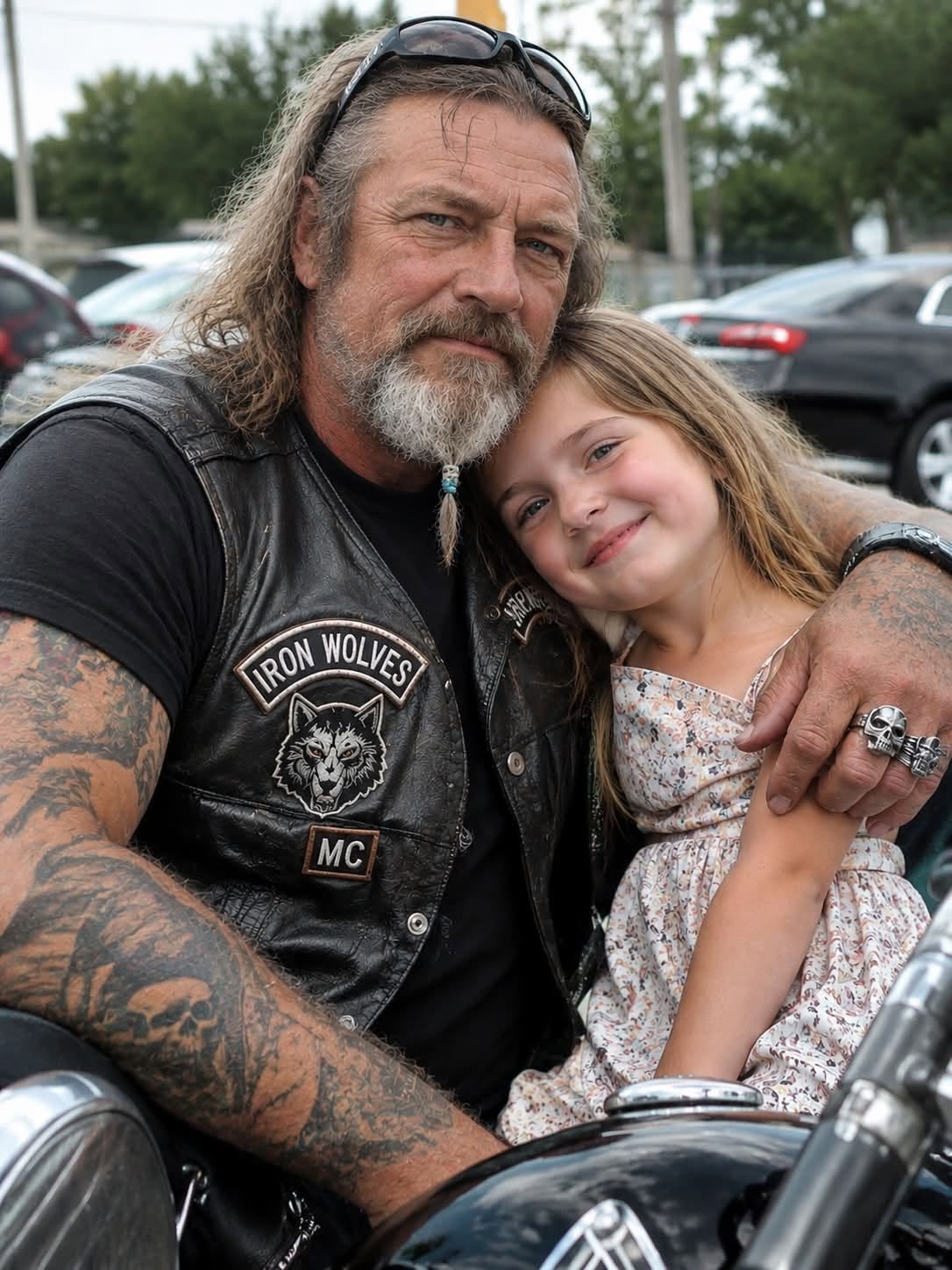
His name was Hank. He was a fifty-eight-year-old biker with a gray beard, tattooed arms, and an Iron Wolves Motorcycle Club patch across his leather vest. He had been sitting in the corner booth, drinking coffee after an overnight ride.
He had watched the manager humiliate Sarah, but something else had caught his attention.
While Sarah was pleading for her job, Noah had quietly walked over to an elderly customer sitting alone. The man was struggling to eat because his hands were shaking. Noah had placed two cookies from his little lunch bag on the table and whispered, “You can have these. My mommy says nobody should eat alone.”
Hank had heard every word.
He had also noticed that Noah didn’t have much food in his own lunch bag.
When Sarah and her son disappeared through the restaurant doors, Hank finished his coffee, paid the bill, and walked outside.
“Ma’am, excuse me.”
Sarah turned, wiping her eyes.
“If you’re here to complain about my son, I already lost my job.”
Hank shook his head.
“I’m not here to complain. My name’s Hank. I saw what happened inside.”
She looked down at Noah.
“Please, I don’t need charity.”
Hank crouched until he was at the boy’s eye level.
“What’s your name, young man?”
“Noah.”
“Well, Noah, I think your mother needs someone to tell her something.”
He looked up at Sarah.
“Come back here tomorrow morning. Bring your boy. And don’t worry about that manager.”
Sarah frowned.
“What are you going to do?”
Hank gave her a small smile.
“Just show up.”
Sarah didn’t understand what he meant, but she had nothing to lose. She thanked him quietly and walked toward the bus stop with Noah.
Hank watched them disappear around the corner.
Then he pulled out his phone.
“Brother, I need a favor. Remember that restaurant on Maple Street? The one where we had breakfast this morning?”
He listened for a moment.
“Yeah. I need everyone available tomorrow. And bring the old photograph I gave you. It’s time someone saw it.”
Sarah barely slept that night.
She sat at her small kitchen table, looking at the bills scattered in front of her. The rent was overdue, her electricity payment was due in three days, and she had only enough money left to buy a little food.
Noah was asleep on the couch because the bedroom heater had stopped working. His backpack was beside him, and one of his shoes was lying on the floor.
Sarah picked it up and placed it near the door.
She couldn’t stop thinking about what the manager had said.
She had worked at that restaurant for almost three years. She had never been late without a good reason, never stolen anything, and never complained when she was asked to stay after closing. Yet the moment she needed a little understanding, she had been thrown out like garbage.
She looked at Noah.
“I promise I’ll find another job, baby,” she whispered.
The next morning, Noah woke up early.
“Mom, are we going back to the restaurant?”
Sarah hesitated.
“I don’t know, sweetheart.”
“But the biker man said we should.”
She smiled faintly.
“Yes. He did.”
“Do you think he’s going to help us?”
“I don’t know, Noah.”
The boy thought about it.
“Maybe he’s like Daddy.”
Sarah went quiet.
Noah’s father had left when he was very young. He occasionally sent birthday cards, but he had never been a reliable part of their lives. Sarah had stopped making promises about him a long time ago.
She helped Noah put on his jacket.
“Let’s go see what happens.”
They reached the restaurant at 7:15 the following morning.
At first, everything looked normal. The lights were on, the front windows were glowing, and Mr. Collins was standing behind the counter talking to one of the servers.
When he saw Sarah, his expression hardened.
“What are you doing here?”
Sarah took a breath.
“Someone asked me to come back.”
Mr. Collins laughed.
“Well, whoever it was doesn’t make the decisions here.”
Then he noticed Noah.
“Didn’t I tell you yesterday? You’re not welcome here.”
Before Sarah could answer, a motorcycle engine rumbled outside.
Then another.
And another.
Within minutes, the entire parking lot was filled with motorcycles.
Sarah turned toward the window.
Thirty-seven bikers were arriving.
Some wore black leather vests with the Iron Wolves patch. Others wore worn denim jackets and heavy boots. Several had long gray beards, while younger riders carried themselves with the same quiet confidence.
They parked in neat rows and began walking toward the entrance.
Mr. Collins rushed out from behind the counter.
“What is this? We don’t want trouble!”
The first biker through the door was Hank.
He walked straight to the counter.
“Morning. We’d like breakfast.”
Mr. Collins looked around nervously.
“All thirty-seven of you?”
“That’s right.”
Hank turned toward Sarah.
“Morning, ma’am. I told you we’d be here.”
Sarah stood speechless.
Then Hank looked at Noah.
“Good to see you again, little man.”
Noah smiled.
“Hi, Hank.”
Mr. Collins folded his arms.
“This is a private business. I can refuse service to anyone.”
Hank nodded calmly.
“Of course you can. But we’re paying customers, and we’d like breakfast. Unless you have a problem with that?”
The manager looked at the parking lot through the window. Thirty-seven motorcycles stood outside, and thirty-seven men were waiting inside.
He swallowed.
“No. No problem.”
The bikers began taking seats.
They didn’t shout. They didn’t threaten anyone. They simply ordered coffee, eggs, pancakes, bacon, and breakfast sandwiches. One asked for extra toast. Another requested oatmeal.
Hank remained standing near the counter.
Then he reached into his leather vest and removed an old photograph.
He placed it on the counter in front of Mr. Collins.
The manager glanced down.
His face went completely pale.
It was a photograph of a teenage girl standing beside a young man with long hair and a black motorcycle. The girl had a bright smile, a small gap between her front teeth, and a silver necklace around her neck.
Mr. Collins stared at it.
“Where did you get that?”
Hank’s expression became serious.
“Do you recognize her?”
The manager picked up the photograph with trembling fingers.
“That’s my daughter.”
Hank nodded.
“Her name is Emily Collins, isn’t it?”
Mr. Collins looked at him sharply.
“How do you know my daughter’s name?”
“Because I knew her.”
The restaurant became quiet.
Hank continued.
“Twelve years ago, Emily worked at this restaurant. She was seventeen. She used to come here after school and help wash dishes. She was one of the kindest young women I’ve ever met.”
Mr. Collins stared at the photograph.
“She’s dead.”
Hank looked directly at him.
“No, sir. She’s not.”
The manager’s hand began shaking.
“What?”
“Your daughter is alive. She’s thirty now. She lives about forty miles from here.”
Mr. Collins stepped backward.
“That’s impossible. I was told she died.”
Hank lowered his voice.
“You weren’t told the truth. You told everyone she died.”
The words landed heavily.
Sarah looked from one man to the other, trying to understand.
Mr. Collins sat down slowly.
“How do you know my daughter?”
Hank pulled out another photograph.
This one showed Emily standing beside a group of bikers outside a small house. She was older, perhaps in her mid-twenties, and she was holding a baby wrapped in a blue blanket.
“Emily was my niece,” Hank said. “My sister raised her after you threw her out.”
Mr. Collins closed his eyes.
Hank continued.
“Twelve years ago, Emily came here and told you she was pregnant. She was scared. She was seventeen, and the father of the baby had disappeared. She needed her dad.”
Mr. Collins stared at the photograph.
“I remember.”
“You told her she had embarrassed you. You told her she was no longer welcome in your house. You gave her a few dollars and told her to leave.”
The manager’s lips trembled.
“She was a child. I was angry.”
“She was your child, too.”
Hank paused.
“Emily came to my sister’s house that night. She was crying so hard she could barely speak. My sister took her in. She raised that little boy like her own grandson.”
Mr. Collins looked down.
“Why didn’t anyone tell me?”
Hank’s voice grew quieter.
“Because you didn’t want to know. You told people your daughter had died. You made up a story about a car accident because it was easier than admitting you had thrown your pregnant daughter out of your home.”
Mr. Collins covered his face.
For several moments, the only sound in the restaurant was the coffee machine.
Then Hank said something that made the manager look up.
“Emily asked about you last month.”
Mr. Collins stared at him.
“What?”
“She wanted to know whether you were still working here. She wanted to know if you were healthy. She even asked whether you still drank your coffee with two sugars.”
The manager began crying.
“She remembers that?”
“She remembers everything.”
Hank placed the photograph back on the counter.
“She hasn’t forgotten you, Collins. But she hasn’t forgotten what happened either.”
The manager looked at the photograph of his daughter holding the baby.
“Can I see her?”
Hank didn’t answer immediately.
“That’s not my decision.”
He pulled out his phone.
“I told her I would let her know if I ever spoke to you again. If you really want to see her, I can call her. But you need to understand something. You don’t get to walk back into her life and demand forgiveness.”
Mr. Collins nodded.
“I know.”
Hank studied him for a moment.
“Do you?”
The manager looked toward the front window, where Sarah and Noah were standing.
Then he looked down at the photograph again.
“I think I finally do.”
While the conversation had been happening, Noah had quietly walked toward the elderly customer who had been sitting in the corner booth the previous morning.
The man was there again.
His name was Mr. Peterson. He was seventy-eight years old and came to the restaurant almost every morning because he lived alone and didn’t enjoy eating breakfast at home.
Noah recognized him immediately.
“Good morning, sir.”
Mr. Peterson smiled.
“Well, look who’s back. How are you, young man?”
“I’m okay.”
Noah reached into his jacket pocket and pulled out a small paper bag.
“I brought you something.”
Inside were two homemade cookies.
Mr. Peterson looked at them.
“For me?”
Noah nodded.
“My mom made them last night.”
Sarah turned toward her son.
She hadn’t made cookies the previous night. She had only made two pieces of toast.
But before she could say anything, she noticed Noah’s other hand.
He was holding a small wrapped sandwich.
He had brought part of his own breakfast to share with the elderly man.
Mr. Peterson’s eyes filled with tears.
“Thank you, son.”
Noah smiled.
“You’re welcome.”
Hank watched the exchange from across the room.
He turned toward the other bikers.
“That’s the boy I told you about.”
One of the younger riders nodded.
“His mother got fired for bringing him to work?”
“That’s right.”
Another biker looked toward Sarah.
“Then we need to do something about that.”
Hank shook his head.
“Not because we want to make trouble. Because that woman deserves a chance, and that boy deserves to see people do the right thing.”
He turned toward the counter.
“Mr. Collins, could you come here for a moment?”
The manager walked over slowly.
Hank pointed toward Sarah.
“That woman worked here for three years. She lost her job because she had nobody to watch her six-year-old son for one morning.”
Mr. Collins looked down.
“I didn’t know her situation.”
“You didn’t ask.”
The manager had no answer.
Hank continued.
“She wasn’t stealing from you. She wasn’t causing trouble. She was trying to keep a roof over her son’s head.”
Mr. Collins looked at Sarah.
“I shouldn’t have spoken to you that way.”
Sarah remained silent.
“I shouldn’t have thrown your son’s backpack outside, either.”
He looked toward Noah.
“I’m sorry, young man.”
Noah glanced at his mother before answering.
“It’s okay.”
Sarah gently touched his shoulder.
“Thank you for apologizing.”
Mr. Collins took a breath.
“Sarah, I want to offer you your job back. Same position, same hours. And if you need to bring Noah occasionally while you arrange childcare, we can work something out.”
Sarah stared at him.
“Why?”
Mr. Collins looked at the photograph in his hand.
“Because I was wrong. And because I need to start doing some things differently.”
Sarah didn’t answer immediately.
She had spent the previous night worrying about rent, groceries, and how she would explain to Noah that she had lost her job. Now the man who had fired her was offering it back.
But she wasn’t ready to pretend nothing had happened.
“I appreciate the offer,” she said. “But I need you to understand something. My son isn’t a problem I bring to work. He’s my responsibility. If I have to bring him again, I need to know he won’t be humiliated for it.”
Mr. Collins nodded.
“You’re right.”
He looked at Noah.
“And I owe you an apology, too.”
Noah smiled shyly.
Sarah finally agreed to return, but she made one condition: the restaurant needed a proper arrangement for employees who occasionally faced childcare emergencies.
Mr. Collins agreed.
Hank watched the conversation and gave a small nod.
That was what he had wanted.
Not revenge. Not intimidation.
A little understanding.
After breakfast, Hank asked Sarah if she could spare a few minutes.
They sat at a booth near the window while Noah colored with the other bikers.
Hank placed a business card on the table.
“I want you to meet someone.”
Sarah looked at it.
It belonged to a local community center that provided emergency childcare and after-school programs for working parents.
“One of our club members volunteers there,” Hank explained. “They have a program for single parents. The center is looking for a part-time kitchen assistant, too. It’s not a fortune, but it pays fairly, and the hours are flexible.”
Sarah looked at the card.
“Why are you doing all this for me?”
Hank leaned back.
“Because I saw your boy share his cookies with a man who had nobody. Then I saw you stand in front of a manager and apologize for trying to take care of your child.”
He paused.
“That told me something about your family.”
Sarah looked down.
“I don’t want people feeling sorry for us.”
“Nobody here feels sorry for you. We respect you.”
Hank glanced toward Noah.
“That little guy reminded a room full of grown men that kindness doesn’t cost much. We figured we could return the favor.”
Sarah’s eyes filled with tears.
“Thank you.”
Hank nodded.
“Just promise me you’ll let people help when they offer.”
She smiled.
“I’ll try.”
Before leaving, Hank stepped outside and made a phone call.
A few minutes later, he returned and handed Mr. Collins his phone.
“Someone wants to speak with you.”
The manager took it hesitantly.
“Hello?”
A woman’s voice came through.
“Dad?”
Mr. Collins froze.
His eyes filled instantly.
“Emily?”
There was a long silence.
Then he whispered, “Is that really you?”
“Yes, Dad.”
He began crying.
“I thought I’d lost you.”
Emily’s voice trembled.
“You didn’t lose me. You told me to leave.”
Mr. Collins closed his eyes.
“I know. I know, sweetheart. I’m sorry.”
Another silence followed.
Then Emily asked, “Are you still at the restaurant?”
“Yes.”
“Uncle Hank told me what happened yesterday.”
Mr. Collins looked toward Sarah and Noah.
“I did something terrible. I fired a woman because she brought her little boy to work. I treated them badly.”
Emily was quiet.
Then she said, “You know, Dad, I used to take my little boy to work with me when he was small. I remember how frightened I was that someone would tell me I couldn’t bring him.”
Mr. Collins began crying harder.
“I wish I had known.”
“You could have known. I tried to tell you.”
He lowered his head.
“I know.”
Emily took a breath.
“Uncle Hank says you want to see me.”
“More than anything.”
“I’m not ready to come back to your house. But maybe we could have coffee. Just you and me.”
Mr. Collins wiped his face.
“I’d be grateful for that.”
“Tomorrow afternoon. The little diner near the hospital.”
“I’ll be there.”
“And Dad?”
“Yes?”
“Don’t make promises you can’t keep this time.”
He nodded, even though she couldn’t see him.
“I won’t.”
When the call ended, Mr. Collins sat quietly with the phone in his hand.
Hank placed a hand on his shoulder.
“One step at a time, brother.”
The bikers didn’t leave immediately.
They ordered another round of coffee, paid for their meals, and tipped the servers generously. Several asked Sarah whether she needed help with anything around her apartment.
One offered to look at her car. Another gave Noah a small model motorcycle. A third invited him to a charity ride that the club organized every summer, promising that he could sit on a stationary motorcycle and take photographs with the riders.
Noah was smiling from ear to ear.
Then Hank approached Sarah with a small envelope.
“There’s something else.”
She opened it.
Inside was a handwritten note and a check from the Iron Wolves’ community fund. It was enough to cover her overdue rent and the car repairs she had been putting off.
Sarah immediately shook her head.
“I can’t take this.”
Hank smiled.
“You can.”
“I don’t even know you men.”
“You knew Daniel’s club. That’s enough.”
Sarah looked at the check.
“I don’t want charity.”
Hank leaned closer.
“Then don’t call it charity. Call it a hand up. Daniel helped us when some of us had nothing. We promised each other we’d keep doing that for people who needed it.”
Sarah looked toward Noah.
He was sitting with Mr. Peterson, laughing as the old man showed him a photograph of his grandchildren.
She finally nodded.
“Thank you.”
Hank smiled.
“You’re welcome.”
The following afternoon, Mr. Collins arrived at the diner twenty minutes early.
He sat in a booth near the window and ordered coffee. He kept looking toward the entrance, nervously adjusting his shirt cuffs.
At exactly two o’clock, Emily walked in.
She was thirty years old now, with the same bright smile from the photograph, although life had left a few more lines around her eyes. She wore a simple coat and carried a small handbag.
Mr. Collins stood.
“Emily.”
She stopped in front of him.
“Hi, Dad.”
For a moment, neither knew what to do.
Then Mr. Collins stepped forward, but he stopped before reaching for her.
“May I hug you?”
Emily looked at him for a long moment.
Then she nodded.
They embraced.
He cried against her shoulder.
“I’m sorry,” he whispered. “I’m so sorry.”
Emily closed her eyes.
“I know.”
They sat down and talked for nearly two hours.
He asked about her son, her work, and the years he had missed. She told him about the difficult early days, the people who helped her, and the little boy who had grown into a happy, curious twelve-year-old.
She didn’t forgive everything that afternoon.
But she agreed to meet him again.
And that was enough for a beginning.
Three months later, Sarah was still working at the restaurant, but her life had changed.
Mr. Collins had kept his promise. He had arranged flexible scheduling for employees with childcare difficulties, and he had stopped treating the staff as though they were replaceable machines.
Sarah also began working a few mornings each week at the community center. Noah had a safe place to go after school, where he could play, read, and spend time with other children.
Her rent was current, her car had been repaired, and she no longer had to choose between buying groceries and paying the electricity bill.
But the biggest change was in Noah.
He had made friends with several members of the Iron Wolves. Hank visited occasionally, always bringing a new story about Daniel. He told Noah about his father’s first motorcycle, the time he got lost during a charity ride, and the day he helped a stranded family push their broken-down car off the highway.
Noah loved every story.
One Saturday, Hank invited Sarah and Noah to the clubhouse for a family barbecue.
Sarah hesitated at first. The building looked intimidating from the road, with its dark windows and rows of motorcycles outside. But when they walked through the door, they found children running around, women preparing food, and bikers arguing over who had burned the burgers.
Noah immediately spotted Hank.
“Hey, Hank!”
The gray-bearded man turned and smiled.
“There’s my little brother!”
He handed Noah a plate.
“Come on. You’re in charge of the potato salad.”
Noah laughed.
Sarah stood near the entrance, watching her son become part of a family she had once believed she had lost.
Then she noticed someone walking through the doorway.
It was Emily.
She was holding the hand of a little boy.
Mr. Collins was walking beside them.
Sarah looked surprised.
Hank noticed her expression.
“Some families need a little help finding their way back to each other.”
Emily approached Sarah.
“You’re Noah’s mom, right?”
Sarah nodded.
“I’m Emily.”
They shook hands.
Emily smiled.
“I heard what happened at the restaurant. Uncle Hank told me everything. I wanted to thank your little boy.”
Sarah looked toward Noah.
“He’s over there making friends.”
Emily laughed.
“Sounds like him.”
Then she looked toward her father, who was standing near the doorway with his grandson.
“Sometimes children remind us what adults forget.”
Sarah nodded.
“Yes, they do.”
That evening, as Sarah and Noah drove home, he sat in the passenger seat holding a small photograph Hank had given him.
It showed Daniel standing with the Iron Wolves outside the clubhouse. He was younger, smiling, and wearing his old leather vest.
Noah stared at it for a long time.
“Mom?”
“Yes, sweetheart?”
“Do you think Dad would have liked what happened at the restaurant?”
Sarah glanced at him.
“I think he would’ve been proud of you.”
Noah smiled.
“Even though I didn’t do anything big?”
Sarah reached over and squeezed his hand.
“Especially because you didn’t think it was big. You just saw someone who needed a friend.”
He looked down at the photograph.
“That’s what Dad used to say.”
She nodded.
“Yes, baby. It is.”
When they arrived home, Noah placed the photograph beside his bed.
Sarah tucked him in and kissed his forehead.
“Goodnight, sweetheart.”
“Goodnight, Mom.”
She was almost at the door when he called her back.
“Mom?”
“Yes?”
“Can we invite Hank and the bikers for Thanksgiving?”
Sarah smiled.
“Of course.”
“And Mr. Peterson?”
“Absolutely.”
“And Emily and her little boy?”
Sarah laughed softly.
“We’ll invite everyone.”
Noah closed his eyes, satisfied.
Sarah stood in the doorway for a moment, listening to the quiet house.
She remembered the day she had been fired. She remembered walking out with her son’s backpack, feeling as though the whole world had decided they weren’t worth helping.
Then she remembered the thirty-seven motorcycles outside the restaurant.
Those men hadn’t arrived to threaten anyone. They had arrived because a six-year-old boy had shown them something they had almost forgotten: that kindness is never wasted, and that one small act can change more than one person’s life.
Mr. Collins had been given a chance to make things right with his daughter. Sarah had been given another chance to provide for her son. And Noah had discovered that his father’s family was still there, even after all those years.
A few weeks later, Sarah found a note tucked into Noah’s backpack.
It was from Hank.
“Tell the little man his father would be proud. And remind him that the Iron Wolves always have room for one more at the table.”
Sarah folded the note and placed it beside Daniel’s photograph.
For the first time in years, she didn’t feel as though she and Noah were facing the world alone.
She finally understood something Daniel had always believed.
Family isn’t only the people who share your last name. Sometimes it’s the people who show up when you have nothing to offer, stand beside you when everyone else walks away, and make room for you at their table.
And sometimes, all it takes to bring thirty-seven outlaw bikers through a restaurant door is a little boy sharing two cookies with a stranger.
Noah had gone to work with his mother because she had nowhere else to take him.
He had walked out believing he was the reason she lost her job.
But the next morning, thirty-seven men showed him something he would remember for the rest of his life:
Being kind doesn’t make you weak. And you never have to be rich, powerful, or grown up to make a difference in someone else’s life.