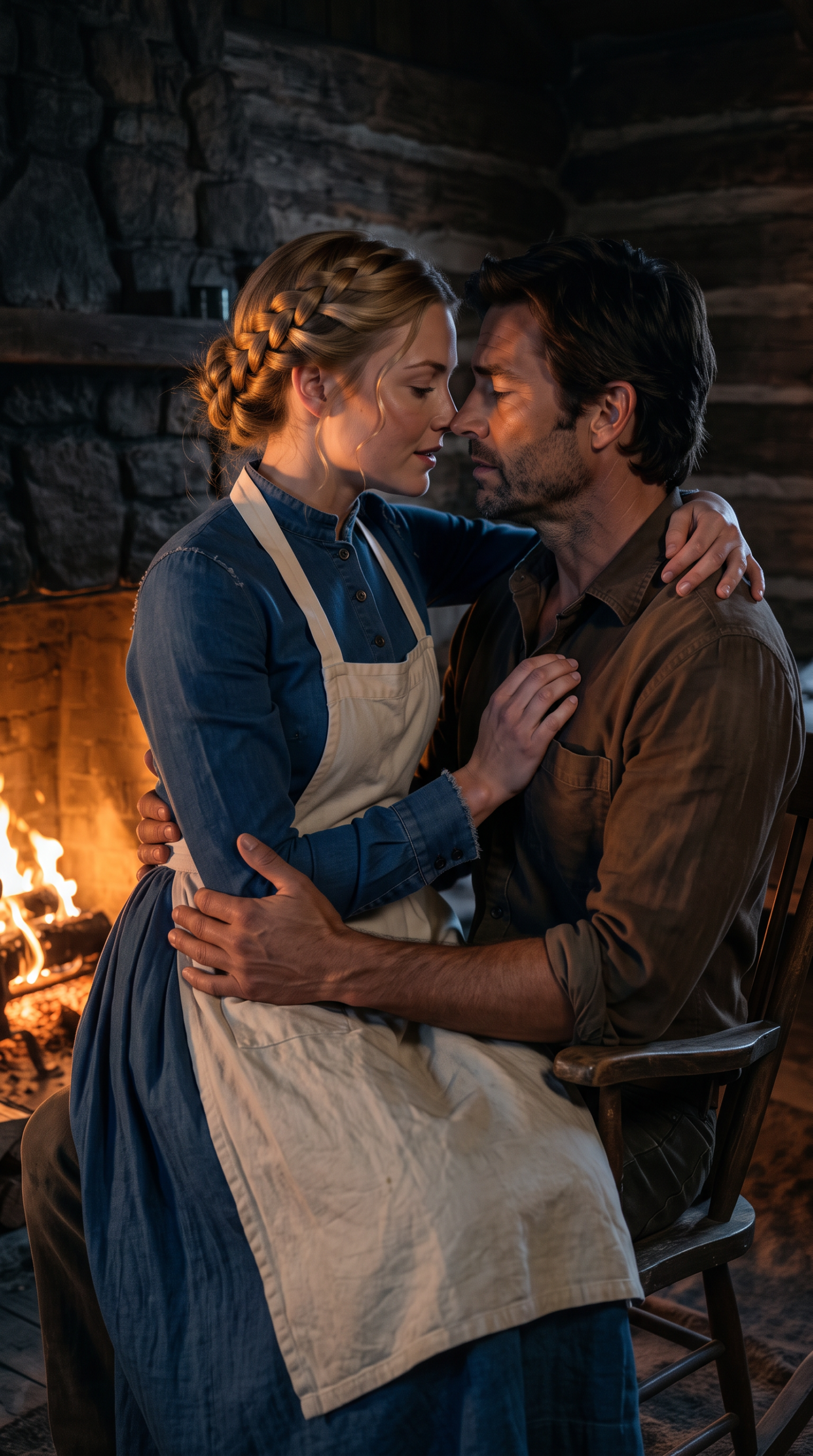
*A Complete Western Romance Story*
## Chapter 1: The Words He Never Expected to Hear
“I’m not afraid of the man you are, Caleb,” Clara whispered. “I’m afraid you’ll spend the rest of your life believing you have to face everything alone.”
For several seconds, Caleb Hart couldn’t move. He had heard men threaten to kill him without blinking, watched armed strangers reach for their revolvers, and stood beneath skies that promised to bury him alive in snow, but no danger had ever made him feel as helpless as the woman sitting on his lap.
Clara’s hand remained against his chest, directly over the heart he had spent years pretending was made of stone. She could feel it pounding beneath her palm, and when she looked into his eyes, she saw something he had never allowed anyone to see: a frightened man hiding inside a dangerous reputation.
“You shouldn’t be here,” Caleb muttered.
“Perhaps not.”
“You don’t understand what you’re doing.”
“Then explain it to me.”
He looked toward the window, where the prairie wind rattled the wooden shutters. Beyond the glass lay thousands of acres of frozen grass, an empty stretch of land where a man could disappear without leaving so much as a footprint, and Caleb suddenly wished he could vanish into it.
“I have nothing to offer you,” he said. “No fine house, no gentle life, and no promise that tomorrow will be kinder than today.”
Clara tilted her head. “You have a house that keeps the cold away, hands that help people who cannot repay you, and a heart that is trying very hard to convince everyone it doesn’t exist.”
His jaw tightened.
“You think you know me because you’ve seen me fix a fence and calm a horse?”
“No,” she answered. “I think I know you because every time somebody thanks you, you look uncomfortable, and every time somebody mentions the people they love, you find a reason to leave.”
The words struck him harder than an accusation ever could. Caleb’s fingers loosened around the arms of his chair, and for one terrible moment, he felt as though Clara had reached through his ribs and touched something he had buried years ago.
“Get off my lap,” he said, but his voice lacked its usual authority.
Clara studied him carefully before rising. She straightened her blue skirts, stepped away from the chair, and gave him enough room to breathe without giving him the satisfaction of believing she had surrendered.
“I will leave when you ask me to leave because you don’t want me here,” she said. “But I won’t leave simply because you’re frightened of what might happen if I stay.”
Caleb looked up sharply.
“I am not frightened.”
“Then look me in the eyes and tell me you feel nothing for me.”
He opened his mouth.
Nothing came out.
Clara’s expression softened, and she reached for the shawl hanging beside the hearth. “I thought so.”
“Clara.”
She stopped at the door.
“You don’t know what loving me would cost you.”
“Perhaps you should stop deciding what I can afford.”
Before he could answer, she opened the door and stepped into the freezing night. The wind caught her skirts immediately, and Caleb rose so quickly that his chair scraped across the floor, but by the time he reached the porch, Clara was already walking toward the small house where she lodged on the edge of town.
He stood there watching until her figure disappeared into the darkness.
Then he returned inside, shut the door, and leaned against it as though the entire frontier had just pushed him backward.
For the first time in seven years, Caleb Hart wished someone would come back.
And for the first time in seven years, he was terrified that she might.
## Chapter 2: The Man Everyone Feared
By sunrise, the story had already begun spreading through Dry Creek.
Mrs. Bell, who owned the general store, claimed she had seen Clara leaving Caleb’s cabin after dark, while the blacksmith insisted he had heard shouting from the rancher’s property. By the time the church bell rang for morning service, half the town had invented a different explanation for why Clara Whitmore had visited the most feared cowboy in Wyoming.
Some said she was foolish.
Others said she wanted his land.
A few suggested that a woman with Clara’s appearance should be grateful for any man who showed interest in her, even if that man was Caleb Hart.
Clara heard the last remark while buying flour and sugar at the general store. She turned toward the speaker, a thin woman named Beatrice Larkin, whose sharp nose and sharper tongue had made her unpopular with nearly everyone who knew her.
“Is that what you believe?” Clara asked.
Beatrice raised her eyebrows. “I believe a woman should know her place.”
“And where is mine?”
“Somewhere more suitable than the lap of a man like Caleb Hart.”
The store fell quiet.
Clara could have answered with anger, but she had learned that people who enjoyed humiliating others often mistook silence for victory. Instead, she placed her coins on the counter and looked Beatrice directly in the eyes.
“My place is wherever I choose to stand,” she said. “And the worth of a man or woman isn’t decided by the number of people who approve of them.”
She collected her parcel and walked out before Beatrice could respond.
Outside, the morning sun shone across the muddy street, illuminating horse tracks and wagon ruts left by the early traffic. Clara breathed in the cold air and reminded herself that she had not crossed half the frontier to let a stranger’s opinion determine her future.
She had arrived in Dry Creek eight months earlier with one trunk, a few dollars, and a letter from her late aunt. The aunt had left her a modest cottage and a small sum of money, enough to begin again if Clara was careful, but not enough to protect her from the judgment of people who believed a woman’s life should be measured by her appearance and her ability to secure a husband.
Clara had heard those judgments since childhood.
She had heard them in parlors, at church gatherings, at school, and from relatives who believed they were helping her by reminding her to expect less from life. When she was younger, she had tried to make herself smaller in every possible way, lowering her voice, avoiding attention, and pretending not to notice when people laughed.
Eventually, she realized that she could spend her entire life apologizing for existing and still never satisfy those who wanted her to disappear.
So she stopped apologizing.
She began traveling, learning, reading, and helping wherever she could. She discovered that people who had suffered often recognized pain in others, even when that pain wore a different face, and she developed a habit of looking beyond the first impression.
That habit had led her to Caleb Hart.
The first time Clara saw him, he was standing outside the blacksmith’s workshop, holding the bridle of a terrified horse while two men argued about how to control it. The animal had been injured in a wagon accident, and every attempt to approach it had made it rear and strike at the air.
Caleb had walked forward without shouting.
He spoke to the horse in a low voice, waited for its breathing to settle, and slowly placed one enormous hand against its neck. The animal trembled beneath his touch, then lowered its head until its forehead rested against his shoulder.
Clara had watched from across the street.
She had seen a man whose arms were covered in scars, whose face could frighten a stranger, and whose name people whispered as though it belonged to a dangerous animal. Yet the horse trusted him more quickly than most people trusted their own neighbors.
That was the moment she began wondering what Caleb Hart was hiding.
Over the following weeks, she noticed him helping an elderly farmer repair a broken fence. She saw him leave a sack of flour on a widow’s porch after her husband died, then ride away before anyone could thank him, and she watched him quietly pay for medicine when a ranch hand’s child became sick.
He never asked for recognition.
He never accepted praise.
And whenever anyone tried to get close, he became cold enough to make them retreat.
Clara understood that kindness did not erase a man’s flaws, but she also understood that cruelty was not the only explanation for silence. Sometimes silence was simply where a wounded person hid until the world felt safe again.
She did not believe she could save Caleb.
She only wanted him to understand that he did not have to save himself from every person who approached him.
That morning, however, she wondered whether she had mistaken his loneliness for an invitation.
Perhaps he truly wanted to be left alone.
Perhaps his heart had closed so tightly that no amount of patience could persuade it to open.
Clara was still thinking about him when a horse approached from the northern road. The rider wore a dark coat, a black hat, and a silver badge pinned to his vest, and the sight of that badge made several people turn away from their conversations.
Sheriff Amos Pike dismounted outside the general store.
“Miss Whitmore,” he called.
Clara faced him. “Good morning, Sheriff.”
“I need to ask you something about Caleb Hart.”
She felt a small, unwelcome chill move through her.
“What about him?”
Pike glanced toward the street before lowering his voice. “Has he spoken to you about his past?”
“No.”
“Has he told you why he left Montana?”
“No.”
“Then I suggest you keep it that way.”
Clara studied his face. “Is that a warning?”
“It’s advice.”
“Those are often the same thing when a man refuses to explain himself.”
The sheriff’s expression hardened, and for a moment she saw something behind his calm manner that did not belong to an ordinary lawman.
“Caleb Hart is not the man you think he is,” Pike said.
Clara lifted her chin. “Then perhaps someone should tell me who he really is instead of expecting me to be frightened by rumors.”
Pike stared at her for a long moment.
Then he put his hat back on, mounted his horse, and rode away without another word.
Clara watched him disappear around the corner.
For the first time, she wondered whether Caleb’s past was not merely painful.
Perhaps someone was still trying to bury it.
## Chapter 3: Seven Years of Silence
Caleb had been twenty-nine when he learned that a man could lose everything without ever leaving the place where he stood.
Seven years earlier, he had owned a small ranch in Montana with his younger brother, Samuel. The land was poor, the winters were brutal, and the cattle business barely earned enough to keep their roof repaired, but the brothers had built a life from almost nothing.
Samuel was the opposite of Caleb in nearly every way.
He laughed easily, trusted strangers too quickly, and believed that a man’s reputation meant little if his actions were good. Where Caleb planned every step, Samuel rushed toward the future as though it were an adventure waiting to begin.
They argued constantly.
They also loved each other more than either knew how to say.
Samuel wanted to expand the ranch and buy land near the river, while Caleb believed their money should remain untouched until they had enough to survive another bad winter. Their disagreements became louder whenever the cattle market fell, but neither brother ever considered abandoning the other.
Then Samuel fell in love with a schoolteacher named Margaret Ellis.
Margaret was twenty-four, with dark hair, bright eyes, and a habit of speaking honestly even when honesty made people uncomfortable. She believed Samuel’s dreams were worth pursuing, and she persuaded him that the brothers could build a better future if they were willing to take a risk.
Caleb disliked the idea.
He thought Margaret encouraged Samuel to dream beyond his means, and he worried that their marriage would leave his younger brother vulnerable to disappointment. He said things he regretted, accused Margaret of interfering in family matters, and warned Samuel that love could not pay a rancher’s debts.
Samuel answered with a sentence Caleb never forgot.
“Perhaps love isn’t supposed to pay the debts, Caleb. Perhaps it’s supposed to give us a reason to keep paying them.”
They did not speak for three days.
On the fourth morning, Samuel rode into town to discuss a cattle shipment with a buyer named Silas Whitmore, a powerful rancher whose wealth had made him one of the most influential men in the territory. Silas owned several thousand acres, employed dozens of cowboys, and had connections with merchants, bankers, and local officials.
He also had a reputation for taking what he wanted.
Samuel returned that evening carrying a contract.
He believed the agreement would save the ranch. Silas had offered to purchase a portion of their cattle at a generous price, providing enough money to pay their debts and expand their herd, but Caleb noticed that the contract included a clause transferring control of their river pasture if the shipment failed to arrive on time.
“You signed this?” Caleb asked.
Samuel nodded. “It’s a fair agreement.”
“It’s a trap.”
“Not everything is a trap simply because you don’t trust it.”
Caleb threw the contract onto the table. “Whitmore doesn’t make generous offers unless he expects to take something worth twice as much.”
Samuel’s face reddened. “You think everyone is a thief.”
“No. I think some men are thieves who wear clean coats.”
“And I think you’re so afraid of losing what little we have that you’ll never allow us to build anything more.”
The argument ended when Samuel stormed out.
Three nights later, the cattle shipment vanished.
The herd had been driven toward the railhead by a hired crew, but the men never reached their destination. Two were found dead near a ravine, the wagon had been burned, and the cattle had disappeared into the night.
Samuel rode out to investigate.
Caleb followed him before dawn, but the brothers became separated in a snowstorm. By the time Caleb found the trail again, he discovered Samuel’s horse wandering alone beside a frozen creek.
His brother was gone.
Search parties combed the surrounding hills for days. They found a broken rifle, a torn coat, and a patch of blood on the snow, but they never found Samuel’s body.
Silas Whitmore arrived two days later with an offer to settle the brothers’ debts in exchange for their remaining land.
Caleb refused.
Whitmore reminded him that the missing cattle had been sold under Samuel’s signature, that the bank would soon demand repayment, and that the law would not be interested in Caleb’s suspicions without evidence. Then he offered Caleb one final warning.
“Men who accuse powerful people without proof tend to discover how lonely the truth can be.”
Caleb nearly killed him.
Only the arrival of the sheriff stopped the confrontation from becoming a murder. Whitmore left the ranch unharmed, and within a week, Caleb was arrested for assault, accused of threatening a respected businessman and interfering with a lawful contract.
The charges were eventually dropped, but his reputation was ruined.
People whispered that he had attacked Whitmore because he was jealous of his brother’s success. Others said Samuel had stolen the cattle and fled, leaving Caleb to face the debts, and some believed the brothers had fought so violently that Caleb himself had killed Samuel.
Caleb knew none of those stories was true.
He also knew he could prove nothing.
Margaret Ellis disappeared from Montana shortly afterward. Some claimed she had returned east, while others said she had accepted money from Whitmore and agreed to keep silent about the shipment.
Caleb never learned which story was correct.
He sold what remained of the ranch, paid as much of the debt as he could, and rode south until the mountains gave way to Wyoming’s open plains. There, he bought an isolated piece of land and built a cabin with his own hands.
He did not seek revenge.
At least, that was what he told himself.
Instead, he worked until his body ached, avoided friendships, and refused every opportunity to build a life beyond his ranch. He learned to sleep alone, eat alone, and speak only when necessary, convincing himself that the absence of love was preferable to the pain of losing it.
Seven years passed.
Then Clara Whitmore walked into his life.
She carried the same surname as the man Caleb blamed for his brother’s disappearance, but she had no connection to Silas that he knew of. She had arrived in Dry Creek from the east, claiming only that she had come to settle her late aunt’s affairs and begin a new life.
Caleb had never asked about her family.
Now, after Clara’s visit, he found himself wondering whether he should have.
He stood by the window long after midnight, remembering the way she had looked at him when he told her to leave. She had not seemed offended or frightened, and that troubled him more than anger would have.
He had built his defenses around the belief that people would eventually abandon him.
Clara had looked at those defenses and refused to accept them as the truth.
He wanted her to return.
He wanted her to stay away.
And he hated himself for wanting both.
## Chapter 4: The Letter in the Blue Dress
The next morning, Caleb discovered a folded note tucked beneath the door of his cabin.
It contained only one sentence.
*If you want to know what happened to your brother, meet me at the abandoned church before sunset.*
There was no signature.
Caleb read it twice, then held the paper close to the window, searching for some clue in the handwriting. The letters were narrow and deliberate, written by someone who had taken care not to leave an obvious mark.
He had spent seven years trying to stop asking questions.
One sentence had undone all of it.
He saddled his horse and rode into town, determined to discover who had delivered the note. The streets were busy with wagons, farmers, and merchants preparing for the winter market, but the people who usually avoided Caleb seemed especially interested in pretending not to notice him.
At the general store, Mrs. Bell watched him approach the counter.
“Looking for something, Mr. Hart?”
“Someone left a message at my cabin.”
Her hands paused over a stack of receipts.
“What kind of message?”
“One about my brother.”
Mrs. Bell’s expression changed so quickly that Caleb almost missed it. She recovered by reaching for a jar on the shelf, but he had spent too many years watching men conceal their intentions to overlook the fear in her eyes.
“You know something,” he said.
“I know many things.”
“Then tell me one of them.”
She glanced toward the front window. “You should leave this matter alone.”
“That seems to be the only advice anyone in this town knows how to give.”
“Perhaps because the people giving it have something to lose.”
Caleb leaned closer. “Did Silas Whitmore send that note?”
Mrs. Bell’s face went pale.
Before she could answer, the bell above the door rang, and Clara entered carrying a small basket. She stopped when she saw Caleb, then looked from him to the storekeeper.
“Is something wrong?”
“No,” Mrs. Bell said too quickly. “Everything is perfectly fine.”
Caleb straightened.
“Did you know my brother, Clara?”
Her expression became cautious. “No. Why?”
“Your surname is Whitmore.”
“My mother’s maiden name was Whitmore,” she explained. “My father died when I was young, and I was raised by my mother and her sister.”
“Silas Whitmore was your mother’s brother?”
Clara’s fingers tightened around the basket.
“Yes.”
For a moment, the store seemed to lose every sound.
Caleb stared at her, remembering every kindness she had shown him, every conversation they had shared, and the way she had looked at his scars without disgust. He suddenly felt foolish for believing he had found someone who saw him as a man rather than a rumor.
“You knew who I was,” he said.
“I knew your name.”
“And you said nothing.”
“Because I didn’t know about your brother.”
“Convenient.”
Clara set the basket on the counter. “You have every right to be angry, but don’t accuse me of knowing something I don’t.”
“You expect me to believe that you arrived in this town by accident?”
“I came because my aunt left me a home here.”
“And you just happened to start speaking to me.”
“I spoke to you because I wanted to.”
Caleb gave a bitter laugh. “Your uncle destroyed my life.”
“I know what people say about him.”
“Then you know enough.”
“No,” Clara answered. “I know that my uncle was a cruel man, that my mother spent years afraid of him, and that my aunt stopped speaking to him long before I was born. I also know that being related to a man does not make me responsible for every evil he has done.”
Her voice trembled, but she did not look away.
Caleb wanted to believe her.
That was what frightened him most.
“Stay away from my ranch,” he said.
Clara swallowed. “Is that what you truly want?”
“Yes.”
She nodded once, picked up her basket, and walked toward the door.
Caleb watched her leave, feeling as though he had just repeated the worst mistake of his life. Yet the thought of being deceived by someone he loved was more painful than the thought of never seeing her again.
Outside, Clara paused on the boardwalk.
“I never lied to you about how I feel,” she said without turning around. “You may decide you don’t want me in your life, but don’t pretend that my uncle’s sins have changed what I see when I look at you.”
Then she walked away.
Caleb stood in the middle of the store, staring at the empty doorway.
Mrs. Bell waited until the sound of Clara’s footsteps had faded.
“There’s something you ought to know,” she said.
Caleb turned.
“What?”
“Silas Whitmore has been asking about you for three weeks.”
“Why?”
“Because someone found a letter in Montana, and he believes it may lead to the truth about Samuel.”
Caleb felt the room tilt beneath him.
“Who found it?”
Mrs. Bell reached beneath the counter and pulled out a small envelope. She placed it in front of him, then stepped back as though the paper itself were dangerous.
“The woman who brought it to town was asking for Clara.”
Caleb looked at the envelope.
On the front, written in faded ink, were four words that made his blood run cold.
*To be given to Caleb.*
## Chapter 5: A Secret Buried in Snow
Caleb took the envelope to the abandoned church before sunset.
The building stood beyond the northern edge of Dry Creek, its roof sagging beneath years of snow and its windows clouded with dust. He had passed it many times without stopping, never imagining that the place would become the doorway to a past he had tried so desperately to escape.
Inside, the air smelled of old wood and frozen earth.
A woman stood near the broken altar, wrapped in a dark traveling cloak. Her face was thinner than Caleb remembered, her hair streaked with gray, and her shoulders carried the exhausted posture of someone who had spent years expecting the worst.
But when she turned, he recognized her immediately.
“Margaret.”
She closed her eyes.
“Hello, Caleb.”
He could not speak for several seconds. Margaret Ellis had vanished seven years earlier, leaving behind unanswered questions and rumors that she had accepted Whitmore’s money to abandon Samuel’s memory.
Now she stood before him as though she had merely been away for a season.
“Where is my brother?” Caleb finally demanded.
Margaret’s face crumpled.
“I don’t know.”
He crossed the room in two strides. “You knew something.”
“I knew he was alive when I last saw him.”
Caleb grabbed the back of a pew to steady himself.
“What do you mean?”
“Samuel survived the attack on the cattle shipment,” Margaret whispered. “He was wounded, but he escaped into the hills with help from one of the men who worked for Whitmore.”
Caleb’s knees nearly gave way.
“Why didn’t he come home?”
“Because Silas had threatened to kill you if Samuel returned.”
The words seemed to echo through the ruined church.
Margaret explained that Samuel had discovered evidence of a scheme to steal cattle from several small ranchers, sell the animals under false contracts, and seize the land of anyone who could not repay the resulting debts. Silas had been using forged agreements and bribed officials to expand his holdings, and Samuel had found a ledger that could expose the entire operation.
When Samuel tried to confront him, the cattle shipment became a trap.
Two men were killed, the herd was stolen, and Samuel was forced to flee after being shot in the shoulder. He survived by hiding with a family in the mountains, but Silas had made certain that anyone who helped him would suffer.
Margaret had been Samuel’s intended wife.
She had tried to reach Caleb after the attack, but Silas intercepted her letters and threatened to accuse her of helping Samuel steal the cattle. When she refused to cooperate, he arranged for her father to lose his business and used the resulting debt to force her into silence.
“I was afraid,” she said. “I was young, and I believed if I spoke, everyone I loved would be destroyed.”
Caleb’s face hardened.
“So you disappeared.”
“I thought I was protecting Samuel.”
“You let me believe he was dead.”
“I believed he might be.”
“You let me carry that guilt for seven years.”
Margaret began to cry.
“I know.”
Caleb turned away, breathing hard. He wanted to shout at her, to demand why she had not trusted him, why she had not found a way to send even one message, and why he had been left to bury a brother whose body he had never found.
But beneath his anger lay something worse.
Hope.
For seven years, he had mourned Samuel as though the world had ended. Now he had been told that his brother might still be alive, and the possibility was almost too painful to bear.
“Where is he?” Caleb asked.
Margaret reached into her cloak and removed a folded letter.
“He sent this to me three months ago.”
Caleb snatched it from her hands.
The paper was worn and stained, but the handwriting was unmistakable. Samuel had always written quickly, allowing his letters to slope across the page as though even the words were eager to escape.
*Caleb,*
*If this letter reaches you, it means I have finally found someone I can trust. I am alive, but I cannot return until I know the men who destroyed our lives can no longer hurt anyone.*
*I have evidence against Whitmore. The ledger is hidden where the river bends beneath the old cottonwoods, near the place Father taught us to fish. I have waited too long, and I am tired of running.*
*If you still remember the boy who followed you everywhere, please come.*
*Your brother, Samuel.*
Caleb read the letter again.
Then he read it a third time.
He remembered the river bend, the cottonwoods, and the summer afternoons when Samuel had followed him through the tall grass, asking questions about horses, cattle, and the world beyond their ranch. He remembered promising their mother that he would always protect his younger brother.
He had failed to keep that promise.
Now, perhaps, he had a chance to fulfill it.
“Where is he?” Caleb demanded.
“I don’t know,” Margaret said. “The letter was delivered through a man who travels between Montana and Wyoming. He said Samuel was moving south, but he didn’t know his destination.”
“Then why come here now?”
“Because Silas knows the ledger still exists.”
A floorboard creaked behind them.
Caleb turned, his hand moving instinctively toward the revolver at his belt.
Sheriff Amos Pike stood in the doorway.
“I was hoping you’d come alone,” the sheriff said.
Margaret stepped backward.
Caleb drew his revolver. “How long have you been listening?”
“Long enough.”
“Then you know why I’m going after him.”
Pike sighed. “I know exactly why, and that’s why I’m here.”
He stepped inside, keeping his hands visible.
“Whitmore has men watching the northern road,” he said. “If you ride toward Montana, they will follow you, and if they find Samuel before you do, he won’t survive a second attempt.”
Caleb’s eyes narrowed. “Why are you helping me?”
The sheriff looked down at the floor.
“Because I helped them the first time.”
## Chapter 6: The Sheriff Who Looked Away
Amos Pike had not always been a corrupt lawman.
Twenty years earlier, he had arrived in the territory with a new badge, a borrowed horse, and a belief that the law could protect ordinary people from men who possessed too much money and too little conscience. He had arrested thieves, settled disputes, and spent nights riding through storms because a frightened farmer had asked for help.
Then Silas Whitmore began buying land.
At first, the rancher offered donations to the town, paid for repairs to the schoolhouse, and helped finance a new bridge across the creek. Pike had welcomed the support because Dry Creek was struggling, and he believed a wealthy businessman could help the town prosper.
The trouble began when a widow accused Whitmore’s men of driving her cattle across the county line.
Pike investigated.
He found evidence that the animals had been taken, but Whitmore offered him money to dismiss the complaint and warned that the widow’s land would be seized for unpaid taxes if the case continued. Pike hesitated, then accepted the payment, telling himself he would use the money to help the town.
The first compromise made the second easier.
Over the following years, Pike altered reports, ignored threats, and discouraged witnesses from speaking against Whitmore. He never considered himself a villain, but he became the kind of man who could watch an innocent person suffer and convince himself that doing nothing was the safest choice.
The cattle shipment involving Samuel had been the worst of it.
Pike had received a warning that something was wrong, yet he allowed the shipment to proceed because Whitmore promised to clear a debt that threatened Pike’s own family. After the attack, he helped spread the story that Samuel had stolen the cattle and fled.
“I told myself it was too late to change anything,” Pike said in the ruined church. “Then the years passed, and every year made it harder to admit what I had done.”
Caleb kept his revolver pointed at him.
“You helped destroy my family.”
“Yes.”
“You let me believe my brother was dead.”
“Yes.”
“Why should I believe a single word you say now?”
“You shouldn’t,” Pike answered. “Not until I give you something worth believing.”
He reached inside his coat and removed a small brass key.
“Whitmore keeps a second set of books in a locked office at his ranch. The ledger there records the payments he made to men who stole cattle, bribed officials, and forced ranchers to surrender their land. Your brother’s name is in it, and so is mine.”
Caleb did not lower the revolver.
“Why tell me?”
“Because Whitmore has decided I know too much. Two nights ago, one of his men followed me home, and yesterday I found my horse’s throat cut in the stable.”
Margaret covered her mouth.
Pike looked at Caleb with exhausted eyes.
“I have spent years protecting a man who would destroy me without hesitation. I cannot undo what I did, but I can stop helping him.”
Caleb studied the sheriff’s face.
He wanted to believe that the man had finally discovered his conscience, but he had seen too many people make promises when their own survival was at stake. Trust was not something a person could demand simply because they had grown tired of being afraid.
“You will give me the books,” Caleb said.
“I will.”
“And you will tell the truth about Samuel.”
“In front of the entire town.”
“If you’re lying, Pike, I will find you.”
The sheriff nodded.
“I expect you will.”
When Caleb finally lowered his revolver, he felt no relief. The past had become larger than he had imagined, and the people responsible for Samuel’s disappearance were not distant strangers but men who had lived among ordinary families for years.
He also understood something that frightened him.
If Whitmore had learned that Samuel was alive, then the danger was no longer confined to Montana.
It had followed Caleb to Wyoming.
And Clara Whitmore, the woman he had tried so hard to push away, was standing directly in its path.
## Chapter 7: The Woman Who Refused to Be Protected
Clara was waiting outside her cottage when Caleb rode into town the following morning.
She wore her ocean-blue dress beneath a heavy wool coat, and a white scarf was tied neatly around her neck. Her expression was calm, but the way she held her hands told him she had been waiting for a long time.
“Have you come to tell me to stay away again?” she asked.
Caleb dismounted.
“No.”
“Then why are you here?”
He took off his hat and held it between his hands. For once, he had no clever insult, no harsh command, and no excuse that could make the conversation easier.
“I owe you an apology.”
Clara blinked.
“That is not what I expected.”
“I know.”
He looked at the ground before forcing himself to meet her eyes.
“I was angry because your uncle hurt my family, and I decided that meant you must have been hiding something from me. I didn’t ask you what happened, and I didn’t give you the chance to explain.”
Clara remained silent.
“I treated you like the people who betrayed me,” he continued. “You didn’t deserve that.”
“No,” she said quietly. “I didn’t.”
The simplicity of her answer made the apology harder rather than easier.
Caleb had expected her to soften, perhaps even to forgive him immediately, but Clara did not rush to comfort him for the pain he had caused her. She stood before him as a person whose feelings mattered, and for the first time, he understood that admitting a mistake did not erase its consequences.
“I am sorry,” he said again.
Clara’s expression changed slightly.
“Thank you.”
He swallowed.
“There is something else. My brother may be alive.”
Her hand rose to her chest.
“Samuel?”
“You knew his name?”
“Only from the stories you never told me.”
Caleb almost smiled, but the expression disappeared before it reached his eyes.
“I have to find him. Whitmore is involved, and I believe the sheriff has been helping him cover it up.”
“Then we need to find the evidence.”
“We?”
“Yes, Caleb. We.”
He shook his head immediately. “No.”
Clara’s eyes narrowed.
“Do not start.”
“This isn’t a discussion.”
“Then you can have it with yourself.”
“Clara, Whitmore is dangerous.”
“So are you, according to half the people in this town, yet I have never once seen you threaten an innocent person.”
“You don’t know what his men are capable of.”
“And you don’t know what I am capable of.”
He stared at her.
Clara stepped closer.
“My uncle spent years teaching my mother that fear was a reason to obey him. When she finally left, he told everyone she was unstable, ungrateful, and incapable of caring for herself. He used his money to make her look foolish, and he used his influence to make people believe his version of every story.”
Her voice remained steady, but her eyes shone with anger.
“I know what he is capable of, Caleb. I have spent most of my life watching him hurt people and then blame them for being hurt.”
“Why didn’t you tell me?”
“Because I wanted you to know me before you decided what my family name meant.”
He lowered his gaze.
“I should have asked.”
“Yes, you should have.”
The honesty between them felt uncomfortable, but it also felt different from the silence Caleb had lived with for so many years. There was no need to pretend he had done nothing wrong, and no need for Clara to pretend that his apology had erased the hurt.
She could be angry with him and still care about him.
He could be frightened for her and still respect her choices.
It was a kind of closeness he had never learned how to manage.
“I don’t want you hurt,” he admitted.
Clara’s face softened.
“Then don’t hurt me yourself by deciding I have no right to choose what risks I take.”
Caleb looked at her for a long moment.
Finally, he nodded.
“Stay close to me.”
“That’s a beginning.”
“And if I tell you to get behind me—”
“I’ll consider it.”
He almost laughed.
The sound surprised them both.
Clara smiled, and Caleb felt something inside him loosen, something he had mistaken for a permanent part of his character. It was not happiness exactly, but the possibility of it, and that possibility was enough to make him want to stay beside her rather than run.
They agreed to meet Sheriff Pike at the church that evening.
Before Caleb mounted his horse, Clara touched his arm.
“One more thing.”
He turned.
“When you find Samuel, don’t make the mistake of thinking you must be the strong one every second. He may need his brother, but you may need him too.”
Caleb looked away.
He did not answer, because the truth was too close to the surface.
Clara did not demand that he speak.
She simply stood beside him until he was ready to leave.
## Chapter 8: A Dangerous Ride North
The road toward Montana stretched across frozen plains and rocky hills, passing through valleys where winter sunlight rarely reached the ground. Caleb rode ahead, with Clara beside him and Sheriff Pike following several lengths behind, carrying a small satchel that contained food, ammunition, and the brass key to Whitmore’s office.
They planned to reach an abandoned mining settlement where a ranch hand named Thomas Reed had reportedly seen Samuel three months earlier. Reed had worked for Whitmore before leaving the ranch, and he was one of the few people who might know where Samuel had gone.
Caleb had not told Clara how frightened he was.
He had not slept properly since reading Samuel’s letter, and every mile north brought him closer to the possibility of seeing his brother again. He imagined Samuel older, thinner, perhaps angry that Caleb had spent seven years believing him dead, and each possibility made him wonder whether the reunion would heal the past or tear it open again.
Clara noticed his silence.
“You can tell me what you’re thinking,” she said.
“I’m thinking about the road.”
“Of course you are.”
He glanced at her.
“What does that mean?”
“It means you are staring at the same stretch of snow as though it might answer a question you are afraid to ask.”
Caleb looked ahead again.
“What if he doesn’t want to see me?”
Clara did not answer immediately.
“Then you will have to listen to him,” she said. “You cannot decide what Samuel feels any more than you can decide what I feel.”
Caleb considered that.
“What if he blames me?”
“For what?”
“For not finding him.”
Clara turned toward him.
“You searched for him.”
“Not long enough.”
“You searched until you had no evidence, no money, and no trail to follow. You cannot punish yourself for not knowing what no one allowed you to know.”
He said nothing.
She continued, “You have spent seven years acting as though suffering proves you loved him. But if Samuel is alive, I doubt he wants you to spend another seven years suffering in his name.”
Caleb’s grip tightened around the reins.
“I promised our mother I would protect him.”
“And perhaps he made the same promise to himself about you.”
The thought followed him for miles.
By late afternoon, they reached the ruins of an old mining settlement where several buildings stood half-buried beneath snow. A single chimney released a thin trail of smoke, and the sight of it made Caleb reach for his revolver.
They approached slowly.
A man stepped out of the largest cabin carrying a rifle. He was broad through the shoulders, with a weathered face and a limp that made his right leg drag slightly across the snow.
“State your business,” he called.
Caleb raised his hands.
“I’m looking for Thomas Reed.”
The man’s eyes narrowed.
“Who wants to know?”
“Caleb Hart.”
The rifle lowered a fraction.
Thomas studied him carefully.
“You’re Samuel’s brother.”
Caleb’s throat tightened.
“You’ve seen him?”
Thomas glanced toward the trees.
“Not recently.”
“Where did he go?”
“I can’t tell you until I know who else is looking.”
Sheriff Pike rode forward.
“Amos Pike, sheriff of Dry Creek.”
Thomas immediately raised the rifle again.
“Then you’ve brought the wrong company.”
Pike did not reach for his weapon.
“You have every reason to hate me.”
“I do.”
“Then hate me after you tell Caleb what you know.”
Thomas looked between them, weighing the danger.
Finally, he motioned for them to enter the cabin.
Inside, a small fire burned in a stone hearth, and maps covered one wall. Thomas explained that Samuel had stayed at the settlement several months earlier, recovering from an old wound and planning to return to Montana once he had enough evidence to expose Whitmore.
He had been working with two other former employees, collecting records of stolen cattle and forged land contracts. One of them had been murdered, while the other disappeared after a meeting with a banker who had connections to Whitmore.
“Samuel knew the rancher was looking for him,” Thomas said. “He believed the only way to survive was to bring the evidence into the open.”
“Where is he now?” Caleb asked.
Thomas removed a map from the wall.
“He went to the river.”
Caleb stared at the paper.
“The old cottonwoods?”
Thomas nodded.
“He said there was something hidden there that Whitmore would kill to recover.”
Before Caleb could ask another question, a sharp crack split the air outside.
The cabin window shattered.
Clara cried out as Caleb pulled her to the floor, covering her with his body while bullets tore through the wooden wall. Thomas extinguished the lantern, and Pike drew his revolver, moving toward the back of the room.
“They followed us,” Thomas whispered.
Caleb felt Clara trembling beneath his arm.
“Stay down.”
She gripped his sleeve.
“I am down.”
Even in the middle of the attack, the answer nearly made him smile.
Then a second volley struck the cabin.
Caleb crawled toward the door, listening for the movement of horses beyond the walls. He counted at least three riders, perhaps four, and recognized the disciplined pattern of men who had been paid to do more than frighten their targets.
He had fought men like them before.
But this time, he was not alone.
He was responsible for Clara, for Pike, and for the possibility that Samuel was still somewhere in the frozen wilderness waiting for help.
Caleb looked toward the back door.
“We leave through the rear,” he whispered. “Thomas, take the map. Pike, cover us.”
Clara shook her head.
“What about you?”
“I’ll be right behind you.”
She knew that tone.
It was the same tone he used whenever he intended to sacrifice himself and call it protection.
“Caleb,” she whispered, “we leave together.”
He looked into her eyes.
For a moment, the gunfire seemed distant.
Then he nodded.
“Together.”
They slipped through the rear door into the snow as the attackers concentrated their fire on the front of the cabin. Thomas led them toward a narrow ravine behind the settlement, where the terrain offered cover from the riders, and Caleb stayed close to Clara, holding her hand whenever the ground became steep.
They did not stop until darkness swallowed the trail.
Only then did Caleb allow himself to look back.
The cabin was burning.
And somewhere beyond the flames, men hired by Silas Whitmore were searching for them.
## Chapter 9: The Promise Beneath the Cottonwoods
They traveled through the night, sheltering beneath a rocky overhang until the worst of the wind passed. Thomas knew the mountain trails, and he led them through a narrow valley that opened onto a frozen river, where the bare branches of ancient cottonwoods stretched over the snow.
Caleb recognized the place immediately.
He and Samuel had fished there as boys, sitting on the riverbank with their boots dangling above the water while their mother called them home for supper. They had once promised that if either brother ever became lost, the other would return to this bend and wait until they found each other again.
Caleb had not thought of that promise in years.
Now he stood beneath the same trees, searching the frozen landscape for a sign that his brother had been there.
Thomas pointed toward a cluster of rocks beside the river.
“Samuel said the evidence was buried near the largest cottonwood.”
Caleb knelt in the snow and began digging with his gloved hands. The frozen earth resisted him, but he continued until his fingers struck a small metal box hidden beneath a flat stone.
He pulled it free.
Inside lay a leather ledger, several folded letters, and a photograph of two young men standing beside a cattle wagon. One was Samuel, smiling broadly, while the other was a ranch hand Caleb remembered from the old days.
Beneath the photograph lay a note.
*Caleb, if you have found this, I hope you came because you still believe there is something worth saving.*
*I am sorry I disappeared. I thought leaving would keep you safe, but I now understand that silence can wound the people we are trying to protect.*
*I am going to the old Whitmore ranch house. If I can get the last records, we will have everything we need.*
*Meet me there if you can.*
Caleb pressed the paper against his chest.
“He’s alive,” he whispered.
Clara knelt beside him.
“We’ll find him.”
He looked at her, and for once, he did not try to hide the fear in his eyes.
“I don’t know what I’ll say.”
“Start with the truth.”
“What if that’s not enough?”
“Then stay long enough to find the rest of the words.”
Caleb nodded slowly.
The ledger contained names, dates, payment records, and descriptions of land transactions that had been manipulated through forged signatures. Several pages listed payments to Sheriff Pike, along with the names of men involved in the cattle theft, and one entry described the night Samuel had been attacked.
There was also a record of a payment made to a physician in a small settlement near the border.
The physician’s name was written beside a note indicating that a wounded man had been treated under an assumed identity.
Caleb felt a wave of anger rise through him.
Samuel had been alive.
He had been hiding, injured and hunted, while Caleb lived in Wyoming believing he had failed to save him. Every year of grief had been built upon a lie, and every memory of the brothers’ last argument had become a punishment Caleb carried without understanding the truth.
He wanted to tear the ledger apart.
Instead, he closed the box carefully.
“This ends now,” he said.
Sheriff Pike nodded.
“With this evidence, we can arrest Whitmore.”
“Not yet,” Thomas replied.
He pointed to the final page of the ledger.
Several transactions had been marked with a symbol Caleb did not recognize, and beneath them was a list of names belonging to men who held positions in neighboring towns. The evidence suggested that Whitmore’s operation extended far beyond one ranch, and exposing it would mean confronting people who had spent years protecting him.
“If we go straight to the sheriff’s office, the evidence could disappear,” Thomas said. “Whitmore has friends everywhere.”
Pike’s face tightened.
“Then we take the ledger to the territorial judge.”
“Which means crossing the territory with half the men in Whitmore’s employ searching for us,” Clara said.
Nobody answered.
She looked at Caleb.
“Then we need a plan.”
He studied her, and something like admiration replaced the fear in his expression. Clara had endured the attack without panicking, followed the trail through the mountains, and helped them reach the place where Samuel had hidden the evidence.
She had never claimed to be fearless.
She had simply refused to let fear make every decision.
Caleb took her hand.
“I am glad you’re here.”
Clara’s eyes softened.
“That is the first sensible thing you’ve said all day.”
He laughed quietly.
The sound was brief, but it carried farther than he expected beneath the silent cottonwoods.
Then Thomas noticed something in the snow beyond the river.
Fresh hoofprints.
A rider had passed through the valley within the last hour, heading toward the old Whitmore ranch house.
Caleb followed the tracks with his eyes.
He knew what that meant.
Samuel was there.
And Whitmore might be there too.
## Chapter 10: The Brother Who Came Back
The old Whitmore ranch house stood on a rise above the river, its dark windows reflecting the pale winter sky. The main building had once been a fine residence, with carved wooden trim, a wide porch, and a stable large enough for twenty horses, but years of neglect had left the property looking like a monument to a man who believed ownership was the same thing as greatness.
Caleb approached from the western side with Clara and Thomas, while Pike took a narrow trail toward the rear entrance. They agreed that nobody would fire unless absolutely necessary, because the evidence was more valuable than revenge and Samuel’s safety mattered more than settling old scores.
Caleb moved through the trees, listening.
Then he heard a voice from inside the stable.
“Caleb?”
He froze.
The voice was older than he remembered, rougher around the edges, but the sound reached him with the force of a memory he had spent seven years trying to bury.
“Samuel?”
A man stepped into the doorway.
His hair had grown longer, his beard was streaked with gray, and a scar crossed the side of his neck, disappearing beneath his collar. He leaned heavily on a wooden cane, and his left shoulder sat slightly lower than his right, but his eyes were unmistakable.
For a moment, neither brother moved.
Caleb had imagined this reunion a thousand times.
In some versions, Samuel embraced him immediately. In others, he accused Caleb of abandoning him, and sometimes Caleb woke from dreams in which his brother stood beside the frozen creek, forever waiting for help that never arrived.
Reality offered no easy script.
Samuel stared at him, his expression shifting from disbelief to relief and then to something that looked painfully like regret.
“You came,” he whispered.
Caleb’s throat tightened.
“Of course I came.”
Samuel looked down at his cane.
“I thought you might hate me.”
“I thought you were dead.”
They stood facing each other, seven years of silence stretched between them like a frozen river.
Then Caleb crossed the distance and pulled his brother into his arms.
Samuel stumbled against him, and Caleb held him tightly, afraid that if he loosened his grip, the man would disappear again. He felt Samuel’s hand clutch the back of his coat, and for several seconds, neither brother attempted to speak.
“I looked for you,” Caleb whispered.
“I know.”
“I looked everywhere.”
“I know.”
“I thought I had failed you.”
Samuel drew back enough to look at him.
“You didn’t fail me, Caleb. I was the one who ran.”
Caleb shook his head.
“You were wounded.”
“And you were being hunted. If I had returned, Whitmore would have used me to destroy you.”
“You should have trusted me.”
Samuel’s eyes filled with tears.
“Yes.”
The admission hurt more than an excuse would have, because it was the truth neither brother had been willing to say. Samuel had believed he was protecting Caleb, while Caleb had believed he had failed to protect Samuel, and both had spent years suffering under the weight of decisions made from fear.
Caleb looked at his brother’s scarred face.
“You look terrible.”
Samuel laughed through his tears.
“You look worse.”
For the first time in seven years, the brothers smiled at each other.
Then Samuel noticed Clara standing a few steps away.
“Who is she?”
Caleb glanced at her, and something in his expression changed.
“This is Clara Whitmore.”
Samuel’s smile vanished.
“Whitmore?”
“She is Silas’s niece,” Caleb explained. “But she is not him.”
Samuel studied Clara carefully.
She stepped forward and offered her hand.
“I know my surname carries a great deal of pain for your family. I cannot change what my uncle did, but I can help make sure he answers for it.”
Samuel hesitated before taking her hand.
“Then you are welcome here.”
Caleb felt a warmth in his chest that had nothing to do with the winter sun. His brother had met Clara for less than a minute and had already done what Caleb had struggled to do for weeks: judge her by her own actions rather than the sins of someone else.
Samuel invited them into the house.
Inside, they found a small fire burning in the hearth, a table covered with papers, and a revolver resting beside an unfinished cup of coffee. Samuel explained that he had returned to the property because he believed Whitmore had hidden the final records in his father’s old office.
He had discovered that the ledger was only part of the evidence.
The remaining documents included original land deeds, signed statements from former employees, and a letter from Silas himself ordering the attack on the cattle shipment. If they could retrieve those records, Whitmore would have little chance of escaping prosecution.
“Where are they?” Caleb asked.
Samuel pointed toward a locked door at the end of the hallway.
“Behind that door.”
Before Caleb could move, a slow clap echoed from the staircase.
Silas Whitmore emerged from the shadows.
He was older than Caleb remembered, with silver hair, a neatly trimmed mustache, and the polished appearance of a man who had never spent a day worrying about where his next meal would come from. He wore a dark suit and carried a revolver, but his expression was almost pleasant.
“Well,” he said. “The family reunion is finally complete.”
Caleb moved in front of Clara.
Whitmore smiled.
“Still playing the hero, Hart?”
Caleb’s hand hovered near his gun.
“It’s over, Silas.”
“No,” Whitmore replied. “It ends when I decide it ends.”
## Chapter 11: The Man Behind the Name
Silas Whitmore had spent most of his life believing that people could be divided into two categories: those who possessed power and those who begged for it.
He had grown up poor, watching wealthy landowners treat his family as though they were invisible. His father had worked himself into an early grave, and his mother had spent her final years living in a house that leaked whenever it rained.
Silas had sworn that he would never be powerless again.
At first, he worked honestly, buying cattle, saving money, and acquiring land one small parcel at a time. But success did not satisfy him, because every new possession reminded him of something larger he had not yet obtained, and every man who refused to obey him became a reminder of the helpless boy he had once been.
He began manipulating contracts.
Then he began bribing officials.
Eventually, he learned that a frightened man could be persuaded to surrender far more than a poor man could be forced to sell.
The cattle operation had been one of his most profitable schemes. He arranged for small ranchers to sign contracts they did not fully understand, then used missing shipments and forged debts to seize their land, often purchasing it through companies that concealed his ownership.
Samuel had discovered the operation by accident.
The younger Hart brother had been examining a contract when he noticed that several cattle brands were recorded under the wrong names. He followed the discrepancy to a local buyer and uncovered a chain of payments that connected Whitmore to stolen herds across two territories.
Silas had tried to buy his silence.
Samuel refused.
That refusal had cost him his home, his health, and seven years of his life.
Now Silas stood in the old ranch house, looking at the brothers he had tried to destroy, and felt the first genuine uncertainty he had experienced in years.
“You should have stayed away,” he told Samuel.
Samuel leaned on his cane.
“You should have left honest people alone.”
Whitmore’s eyes hardened.
“Honesty is a luxury for people who cannot afford ambition.”
“No,” Clara said. “It is a choice people make when they could get away with doing something worse.”
Silas turned toward her.
“You have no idea what the world requires.”
“I know what you required of my mother. I know how you threatened her, how you made her believe she was helpless, and how you convinced everyone that her fear was proof she was weak.”
Whitmore’s expression became dangerous.
“Your mother was ungrateful.”
“My mother was afraid of you.”
“She was afraid because she understood what happens to people who oppose me.”
Clara lifted her chin.
“She was afraid because you spent your life teaching people that cruelty was the same thing as strength.”
For a moment, Silas looked almost startled.
He had expected Clara to remain silent, as she had done at family gatherings when he humiliated her mother. He had expected her to accept his authority because he had money, influence, and a reputation that made other people cautious.
He had never understood that silence did not always mean submission.
Sometimes it meant a person was waiting until they could finally speak without being interrupted.
Caleb watched Clara with a mixture of pride and fear.
He wanted to pull her away from Whitmore, but he also knew she was doing something he had never managed to do himself: confronting the man without allowing him to dictate the terms of the conversation.
Whitmore raised his revolver slightly.
“Enough.”
The room fell silent.
“Give me the ledger,” he ordered.
Caleb did not move.
“You can take it from me.”
Whitmore laughed softly.
“You think this is about courage? You think a man becomes powerful by standing in front of a gun?”
“No,” Caleb said. “I think a man becomes powerful when he stops being afraid of what he might lose.”
The words surprised him as much as they surprised Whitmore.
For years, Caleb had believed that the safest life was one in which he needed no one. Now he stood beside his brother, Clara, Thomas, and a sheriff who was finally willing to admit his guilt, and he understood that the people he loved were not weaknesses to hide.
They were the reason he could no longer afford to run.
Whitmore’s finger tightened around the trigger.
Then a voice came from the hallway.
“Silas, lower the gun.”
Sheriff Pike stepped into the room, his revolver raised.
Whitmore’s expression turned to fury.
“You fool.”
“Perhaps,” Pike answered. “But I’m finished being yours.”
For a long second, the two men stared at each other.
Then Whitmore smiled.
“You think one honest decision will erase twenty years of corruption?”
“No,” Pike said. “I think it will give the truth a chance to begin.”
Whitmore moved suddenly.
The gunshot shattered the silence.
## Chapter 12: The Shot That Changed Everything
Clara heard the gunfire before she understood what had happened.
Caleb lunged toward her, forcing her behind the heavy table as a second shot struck the wall. Samuel fell against the doorway, clutching his wounded shoulder, while Thomas rushed toward the locked office to protect the documents.
Pike staggered backward, his revolver slipping from his hand.
Whitmore stood near the staircase, his face twisted with rage, and for the first time, he looked less like a respected rancher than a man who had finally lost control of the world he had built.
“Get the papers!” he shouted toward the hallway.
Two armed men appeared at the entrance.
Caleb drew his revolver and fired toward the floor in front of them, forcing them to retreat behind the doorway. He did not want to kill anyone, but he would not allow them to reach Clara or Samuel, and he knew the next few seconds would determine whether the evidence survived.
“Clara, stay down!”
She looked toward Pike, who had collapsed beside the wall.
“He’s been shot!”
“I know!”
Caleb moved toward his brother.
Samuel had fallen to one knee, blood spreading across his sleeve, but he was conscious and gripping his cane with his good hand. Caleb helped him behind the table, then pressed a folded cloth against the wound.
“Can you stand?”
Samuel grimaced.
“Can you stop asking stupid questions?”
Caleb let out a breath that was almost a laugh.
“Good. You’re still yourself.”
Across the room, Clara crawled toward Pike.
The sheriff was pale, his breathing shallow, and blood had soaked through his coat near the ribs. She pressed her hands against the wound, trying to slow the bleeding, while Thomas searched the office for a way to secure the records.
Pike opened his eyes.
“Clara.”
“Don’t speak.”
“I need you to listen.”
“You need to stay alive.”
He managed a weak smile.
“I’ve spent too many years avoiding the truth. I won’t let this be another excuse.”
She leaned closer.
“Then tell it when you’re safe.”
Pike shook his head.
“Whitmore has a safe in the office. The original contracts are inside, along with letters from the men he paid. If he escapes with those records, he’ll destroy them.”
Clara looked toward the locked door.
“Thomas is getting them.”
“Good.”
Pike’s eyes drifted toward Caleb.
“Tell him I’m sorry.”
Clara tightened her hands over the wound.
“You can tell him yourself.”
A loud crash sounded from the hallway.
Whitmore had reached the office door and was trying to force his way inside. Thomas shouted for help, and Caleb rose, leaving Samuel behind the table with Clara.
“Don’t you dare die while I’m gone,” Caleb told his brother.
Samuel managed a crooked smile.
“Don’t you dare make a speech when you return.”
Caleb moved toward the hallway.
Whitmore was already inside the office, his revolver aimed at Thomas, who stood beside an open safe. Papers lay scattered across the desk, and a small leather case rested beneath Thomas’s hand.
“Step away from the documents,” Whitmore ordered.
Thomas looked at Caleb.
“Take them!”
Whitmore turned and fired.
The bullet struck the doorframe beside Caleb’s head, showering him with splinters. Caleb fired back, striking Whitmore’s gun hand and sending the revolver spinning across the floor, but the rancher did not surrender.
He lunged for the leather case.
Caleb tackled him before he could reach it.
They crashed against the desk, knocking papers into the air. Whitmore fought with desperate strength, striking Caleb across the face and trying to reach a small knife hidden in his boot, but Caleb caught his wrist and drove him away from the weapon.
For several seconds, the two men struggled across the floor.
Whitmore was older, but his anger gave him a frightening energy. He clawed at Caleb’s coat, slammed a fist into his ribs, and whispered threats through clenched teeth, promising that every person Caleb loved would suffer if he did not let him go.
Caleb felt the old rage rise inside him.
He remembered the frozen creek.
He remembered the empty ranch.
He remembered seven years of grief, seven years of believing his brother was dead, and every night he had spent convincing himself that his loneliness was a punishment he deserved.
He could end it here.
One more blow would silence Whitmore, and nobody in the room would blame him for wanting revenge.
Then Caleb remembered Clara’s hand against his chest.
He remembered the way she had looked at his scars without fear, and the words she had spoken when he tried to push her away.
*I’m afraid you’ll spend the rest of your life believing you have to face everything alone.*
Caleb loosened his grip just enough to pull Whitmore’s arms behind his back.
“No,” he said through clenched teeth. “You don’t get to turn me into you.”
He held the rancher down until Thomas secured his wrists with a length of rope.
For the first time, Silas Whitmore was powerless.
And Caleb Hart had defeated him without becoming the man he hated.
## Chapter 13: The Truth Comes to Dry Creek
By dawn, the storm had passed.
Sheriff Pike was alive, though the bullet had left him weak and feverish. Samuel’s wound had been treated by a physician who arrived from a nearby settlement, and Thomas had secured the documents from the safe, placing them in a locked case that remained under Caleb’s watch.
Whitmore was tied to a chair in the main room.
He said little.
The man who had spent years controlling conversations now understood that every word he spoke could become evidence against him. His lawyers might challenge the documents, his allies might attempt to deny their involvement, and his wealth could still buy him time, but the ledger and the original contracts had created a trail he could no longer erase with a single payment.
Caleb stood near the window, watching snow fall from the branches outside.
Samuel sat beside the hearth, his injured shoulder wrapped in clean bandages, while Clara prepared coffee for the exhausted group. Every so often, Caleb looked toward her, and each time he did, she met his eyes with a quiet smile that reminded him he was no longer standing alone.
By midmorning, a group of riders arrived from Dry Creek.
The territorial judge had received a message from Thomas, and he had brought two deputies and a clerk to secure the evidence. When they entered the house, Sheriff Pike insisted on making a formal statement before anyone questioned Whitmore.
He admitted to accepting bribes, altering reports, and helping conceal the theft of cattle.
He named the officials who had received payments and identified the men who had participated in the attack on Samuel. He also confessed that he had spread false rumors about the Hart brothers because Whitmore had threatened to destroy his family if he refused.
The confession did not erase his crimes.
It did, however, make it impossible for Whitmore to claim that the entire case had been invented by a bitter rancher seeking revenge.
The judge examined the documents for hours.
By evening, he had ordered Whitmore held for trial and instructed the deputies to secure the ranch while investigators searched for additional evidence. Several men who had worked for Whitmore were arrested over the following days, and others fled the territory before their names could be added to the official record.
The news spread through Dry Creek faster than any rumor before it.
People who had once praised Whitmore’s generosity began remembering the ranchers who had lost their land. Merchants recalled suspicious payments, former employees described threats they had endured, and families who had remained silent for years finally found the courage to tell their stories.
Not every person admitted what they had known.
Some continued to defend Whitmore, claiming that a wealthy man could not possibly have committed so many crimes without someone noticing. Others insisted that Pike’s confession was merely an attempt to save himself, and a few accused Caleb of manipulating the entire situation because he had never accepted his brother’s disappearance.
Caleb listened without answering.
He had spent years allowing strangers to define him, first as a dangerous man, then as a failure, and now as a hero who had defeated a powerful rancher. He understood that reputations could change overnight, but a person’s life was built from choices made long before anyone began telling stories about them.
He did not need every person in Dry Creek to admire him.
He only needed to live in a way he could respect.
Three days after Whitmore’s arrest, Caleb and Samuel returned to the old cottonwoods beside the river. The sky was clear, and the snow had begun to soften beneath the winter sun, revealing patches of brown grass along the riverbank.
Samuel stood with his cane resting against a tree.
“I used to think about coming home every day,” he said.
Caleb looked at the water moving beneath the ice.
“Why didn’t you?”
“Because I was afraid Whitmore would hurt you. Then I was afraid you would hate me for leaving, and eventually I became afraid that too much time had passed for either of us to repair what happened.”
Caleb nodded slowly.
“I understand that fear.”
Samuel glanced at him.
“Do you?”
“For seven years, I told myself I was protecting you by refusing to need anyone. I thought if I stopped caring, nobody could hurt me again.”
“And did it work?”
Caleb looked toward the distant hills.
“No.”
Samuel smiled sadly.
“Then perhaps we’re both finished making decisions out of fear.”
Caleb reached into his coat and removed the old photograph from the ledger. He looked at the two young men standing beside the cattle wagon, their faces bright with the confidence of people who believed the world was waiting for them.
“I wish I had trusted you,” Caleb said.
Samuel took the photograph.
“I wish I had trusted you too.”
They stood together in silence.
There was no grand speech, no promise that the past would disappear, and no easy explanation for the years they had lost. There was only the river, the trees, and two brothers who had finally stopped running from the truth.
After a while, Samuel placed the photograph back in Caleb’s hand.
“Let’s go home.”
Caleb folded the paper carefully.
“Yes,” he said. “Let’s.”
## Chapter 14: The Woman He Could No Longer Push Away
Spring arrived slowly in Dry Creek.
The snow retreated from the hills, the river broke free from its winter ice, and the fields began showing the first signs of green. Caleb spent his days repairing fences and rebuilding the ranch, while Samuel recovered from his injury and learned to walk without relying so heavily on his cane.
Clara visited often.
Sometimes she brought food, sometimes she helped organize the documents needed for the trial, and sometimes she simply sat on the porch while Caleb worked, reading a book and offering occasional observations about the horses that made him pretend to be offended.
He began to look forward to those visits.
At first, he tried to hide it by finding unnecessary tasks whenever he heard her approaching. He repaired a fence that did not need repairing, cleaned a saddle that was already spotless, and once spent nearly an hour reorganizing tools that had been hanging in the same place for years.
Samuel watched the performance with growing amusement.
“You know,” he said one afternoon, “you could simply tell her you enjoy her company.”
Caleb kept his eyes on the saddle.
“I enjoy the peace and quiet.”
“Then why do you stop working whenever she leaves?”
Caleb glared at him.
Samuel laughed so hard that his injured shoulder began to hurt.
“You’re a terrible brother.”
“I’m an excellent brother. I’m the only one brave enough to tell you the truth.”
Caleb threw a rag at him.
The moment would have been impossible a year earlier. Caleb had once believed laughter was a luxury he could no longer afford, but Samuel’s return had reminded him that grief did not have to consume every part of a person’s life.
The past remained painful.
It simply no longer occupied every room in his heart.
One afternoon, Clara arrived carrying a small parcel wrapped in brown paper. She wore her familiar ocean-blue dress, its white apron bright against the fabric, and her cheeks were pink from the spring wind.
“I brought you something.”
Caleb wiped his hands on a cloth.
“What is it?”
“You’ll have to open it.”
Inside the parcel was a small framed picture.
It showed Caleb standing beside a young horse in the field, his large hand resting gently against the animal’s neck. Someone had painted the scene from a sketch, capturing the afternoon light and the expression of concentration on his face.
He stared at it for a long time.
“Who made this?”
“A young artist passing through town. I thought the picture deserved a place where you could see it.”
“Why?”
“Because it shows something you keep forgetting.”
He looked up.
“What?”
“That you can be strong without frightening people. That your hands can protect something instead of simply defending themselves.”
Caleb’s throat tightened.
He set the picture carefully on the table.
“Thank you.”
Clara smiled.
“You are welcome.”
For several minutes, they stood together on the porch, watching the horses move through the field. Caleb wanted to tell her that he thought about her whenever she was away, that her laughter had become one of his favorite sounds, and that the prospect of a future without her no longer felt like safety.
But the words remained trapped behind the habits of a lifetime.
Clara turned toward him.
“You look as though you’re preparing to argue with yourself.”
“I’m not.”
“Then say what you’re thinking.”
Caleb drew a slow breath.
“I want you to stay.”
Her expression softened, but she did not immediately answer.
He continued before fear could silence him.
“Not because I need help with the ranch. Not because I think you owe me anything, and not because I expect you to spend your life trying to make me happy.”
He took her hand.
“I want you here because my life is better when you’re part of it. I want to hear you complain about the weather, argue with me about the best way to repair a fence, and tell me when I’m being an unreasonable fool.”
Clara’s eyes filled with tears.
“I can certainly manage the last one.”
A quiet laugh escaped him.
“I know.”
He squeezed her hand gently.
“I love you, Clara. I don’t know how to do it perfectly, and I can’t promise that I will never be afraid, but I don’t want to spend another day pretending that losing you would be easier than loving you.”
Clara stared at him.
For once, Caleb did not look away.
She stepped closer and placed her hand against his chest, just as she had done on the night he tried to send her away. Beneath her palm, his heart beat steadily, no longer hidden behind a wall of anger and silence.
“You don’t have to love me perfectly,” she whispered. “You only have to love me honestly.”
He bent his head and kissed her.
The kiss was gentle, hesitant at first, and filled with all the words they had struggled to say. Caleb held her as though she mattered, but not as though she were fragile, and Clara rested her arms around him without asking him to become someone different.
When they finally drew apart, she smiled.
“Now, was that so difficult?”
Caleb rested his forehead against hers.
“Terrifying.”
She laughed, and he found himself smiling with her.
For the first time in many years, the future did not look like an empty stretch of land he had to cross alone.
It looked like a road they could travel together.
## Chapter 15: A Trial Built on Truth
The trial of Silas Whitmore began in early summer.
The courtroom was crowded from the first morning, with ranchers traveling from neighboring counties to hear the evidence and townspeople filling every available bench. Whitmore arrived wearing an expensive black suit, accompanied by two lawyers who spoke confidently about mistaken identities, unreliable witnesses, and the danger of allowing personal grudges to influence the law.
He looked composed.
He had spent years purchasing the loyalty of men who were supposed to challenge him, and he still believed money could persuade the truth to become negotiable.
But the evidence was difficult to dismiss.
The ledger recorded payments to the men involved in the cattle theft. The original contracts showed that several landowners had been deceived, and letters in Whitmore’s own handwriting described plans to seize the properties of those who could not repay their debts.
Thomas Reed testified about the stolen cattle.
Margaret Ellis described the threats made against her and Samuel.
Sheriff Pike admitted to taking bribes and concealing evidence, then identified the officials who had helped Whitmore avoid investigation. His testimony damaged his own reputation, but it also revealed the structure of the scheme in a way that no single document could have achieved.
Caleb took the witness stand on the fourth day.
He described the argument he had shared with Samuel before the cattle shipment, the disappearance that followed, and the years he spent believing his brother was dead. He explained how Whitmore had used rumors to destroy his reputation and how the threat of violence had prevented witnesses from speaking openly.
The defense tried to make him appear unstable.
One lawyer asked whether Caleb had threatened Whitmore seven years earlier. Another questioned whether his anger over Samuel’s disappearance had influenced his judgment, suggesting that he had built an elaborate accusation to justify his own failure.
Caleb answered every question calmly.
“Yes, I threatened him,” he said. “I was angry, and I believed he had harmed my brother.”
“Then your testimony is based on hatred, is it not?”
“My testimony is based on the evidence in front of you.”
“You expect this court to believe you have no personal feelings about the accused?”
Caleb looked toward Whitmore.
“I have many feelings about him. But none of them changes the words written in his own letters.”
A murmur passed through the courtroom.
The lawyer attempted to continue, but the judge instructed him to move on.
When Clara testified, the defense tried a different approach.
They asked whether she had spoken to Caleb before deciding to help him, whether she had a romantic interest in him, and whether her relationship with the rancher might have influenced her willingness to accuse her uncle.
Clara answered without hesitation.
“Yes, I care about Caleb Hart.”
Her voice carried clearly through the room.
“But caring about someone does not require me to lie for him. I am here because the evidence is real, because innocent people were hurt, and because my uncle believed his power made him untouchable.”
The lawyer narrowed his eyes.
“Isn’t it possible that you are simply trying to punish a relative with whom you disagree?”
Clara looked directly at him.
“If I wanted revenge, I could have spent my life spreading stories about my uncle. Instead, I came here to present documents, answer questions, and allow the court to decide what the law requires.”
She paused.
“Truth does not become false because the person telling it has feelings.”
The courtroom fell silent.
Caleb watched her from his seat, pride and love filling his chest. Clara did not need him to speak for her, protect her from every difficult question, or make her voice louder, and he finally understood that loving someone meant respecting the strength they already possessed.
The trial lasted three weeks.
Whitmore’s lawyers challenged the ledger, questioned the witnesses, and attempted to discredit Pike by emphasizing his own corruption. Yet the more they argued, the more the court heard about the years of intimidation, the stolen property, and the families who had been forced from their homes.
The verdict came on a warm afternoon in June.
Silas Whitmore was found guilty of fraud, conspiracy, bribery, and several offenses connected to the theft and concealment of cattle. Additional charges remained pending as investigators uncovered more evidence, but the court ordered him held without the possibility of immediate release.
When the judge finished reading the decision, the courtroom erupted into whispers.
Some people cried.
Others simply sat in stunned silence, unable to believe that the man who had controlled their town for so long had finally been held accountable.
Whitmore looked toward Caleb as the deputies led him away.
“You think you’ve won,” he said.
Caleb stood.
“No. I think the truth has finally been heard.”
Whitmore’s expression twisted.
“You’ll discover that people never change.”
Caleb looked toward Clara, who stood beside Samuel near the courtroom door.
“Some do,” he answered.
Then he walked away.
Outside, the summer sun shone across the street, and the air smelled of dust, warm wood, and horses. Clara reached for Caleb’s hand, and he took it without hesitation.
For years, he had believed the past would always control the future.
Now he knew the past could be faced, the truth could be spoken, and a man could choose not to repeat the cruelty that had shaped him.
The victory did not return the years he had lost.
It did, however, allow him to stop living as though those years were all he had left.
## Chapter 16: The Wedding No One Expected
Caleb proposed to Clara in September.
He had planned to do it beside the river, beneath the cottonwoods where he had found Samuel’s letter, but the morning arrived with heavy rain that turned the trail into mud. After spending nearly an hour trying to persuade his horse to cross a flooded stream, he abandoned the plan and returned home soaked to the skin.
Clara found him standing beside the hearth, holding a small velvet box.
She looked at his wet coat, muddy boots, and thoroughly miserable expression.
“Should I ask what happened?”
“No.”
“Was it the weather?”
“Yes.”
“Did the weather defeat you?”
Caleb sighed.
“Completely.”
Clara laughed so hard that she had to sit down.
He looked at her, and the words he had rehearsed suddenly seemed unnecessary. She was the woman who had walked toward him when he begged her to leave, who had challenged his fear without mocking his pain, and who had stood beside him when the truth threatened to destroy everything he believed about the world.
He knelt before her.
“Clara Whitmore, I have spent most of my life believing that needing someone was a weakness. You taught me that it takes more courage to open your heart than it does to raise a gun, and I would rather face every storm the frontier can bring with you than spend another peaceful day without you.”
Clara covered her mouth.
He opened the box.
Inside lay a simple gold ring, purchased from a jeweler in the next county with money Caleb had saved over several months. It was not the largest ring in the shop, nor the most expensive, but it had been chosen carefully, and the small engraved leaves around its band reminded him of the cottonwoods beside the river.
“Will you marry me?”
Clara’s eyes filled with tears.
“Yes.”
He blinked.
“Yes?”
She laughed through her tears.
“Yes, Caleb. Before you change your mind or blame the weather again.”
He rose, slipped the ring onto her finger, and kissed her while the rain continued tapping against the windows. Samuel appeared in the doorway halfway through the embrace, took one look at them, and announced that he had never seen two people make such a fuss over a perfectly sensible decision.
Clara threw a cushion at him.
Samuel caught it and bowed.
The wedding took place six weeks later in the little church at Dry Creek.
People came from neighboring ranches, some out of genuine affection and others because they could not resist seeing whether the feared cowboy would actually stand beside a woman who had never once been intimidated by him. Mrs. Bell brought flowers, Thomas Reed arrived with a freshly polished pair of boots, and Sheriff Pike attended quietly at the back of the church, his expression solemn as he continued rebuilding his life after admitting his crimes.
Margaret Ellis came too.
She stood beside Samuel, holding his hand, and the two of them looked at each other with the tenderness of people who had survived years of separation and finally understood how much time they had lost. They had decided not to rush into marriage, choosing instead to rebuild their relationship one honest conversation at a time.
Caleb respected that choice.
He had learned that love was not a race toward a destination, but a daily decision to remain present even when the past made staying difficult.
When Clara entered the church, the room grew quiet.
She wore a beautiful ocean-blue gown with a clean white apron-like sash at the waist, a style that reflected the dresses she had worn when Caleb first met her. Her hair was pinned neatly beneath a delicate veil, and the ring on her hand caught the afternoon light as she walked toward him.
Caleb forgot every word he had planned to say.
He had faced armed men, violent storms, and the loneliness of a winter that seemed to have no end, but seeing Clara approach made his heart pound with a nervousness he had never experienced before. He was afraid of making a mistake, afraid of failing her, and afraid that happiness could vanish if he reached for it too eagerly.
Then Clara smiled.
The fear did not disappear.
It simply stopped controlling him.
She reached the front of the church and placed her hand in his.
“You look terrified,” she whispered.
“I am.”
“Good.”
He stared at her.
“Good?”
“It means this matters to you.”
The minister began the ceremony.
Caleb listened carefully as the familiar words were spoken, but the meaning felt different from anything he had imagined. Marriage was not a promise that nothing painful would ever happen, and it was not a guarantee that two people would never disagree or disappoint each other.
It was a promise to face the difficult days honestly.
When the minister asked Caleb whether he would take Clara as his wife, he answered without hesitation.
“I will.”
When Clara was asked the same question, her voice was clear.
“I will.”
The minister smiled.
“You may kiss the bride.”
Caleb leaned forward, and Clara met him halfway.
The church filled with applause.
Samuel whistled loudly enough to make the minister lose his place, Thomas clapped Caleb on the shoulder hard enough to make him stumble, and Mrs. Bell wiped her eyes while insisting that the room was simply too warm.
Outside, the townspeople had gathered beneath the late autumn sun.
Someone had decorated the church steps with flowers, and a group of children ran between the wagons, laughing as they chased one another around the hitching posts. The celebration continued into the evening, with music, food, and dancing that lasted long after the lamps were lit.
Caleb danced badly.
Clara told him so.
He informed her that a man who could manage a thousand cattle should be capable of managing two feet, but his next attempt nearly sent them both into a table, and Clara laughed until tears ran down her cheeks.
For once, Caleb did not care who was watching.
He held his wife close, listened to her laughter, and allowed himself to enjoy the simple miracle of being happy in front of other people.
Later that evening, when the celebration had ended and the last guests had departed, they returned to the ranch together.
The cabin looked much the same as it had on the night Clara first sat beside the hearth and refused to walk away. The same wooden chair stood near the fireplace, the same window faced the prairie, and the same wind moved across the grass beyond the walls.
But the room no longer felt like a place where Caleb went to hide from the world.
It felt like a home.
Clara removed her veil and placed it on the table.
“Do you remember the first time I came here?”
Caleb looked at the chair.
“I remember telling you to leave.”
“You were very rude.”
“I was frightened.”
“I know.”
He moved closer and took her hands.
“I thought if I loved you, I would eventually lose you. I thought the pain would be unbearable, so I decided the only way to survive was to keep you at a distance.”
Clara brushed her thumb across his knuckles.
“And what do you think now?”
He looked into her eyes.
“I think losing you would hurt. But I would rather risk that pain than miss the life we could build together.”
She leaned against him.
“That is a much better answer.”
Caleb kissed her forehead, then held her close as the fire crackled in the hearth.
Outside, the prairie stretched into darkness, wide and silent beneath the stars. For the first time in seven years, Caleb did not listen to the wind as though it were bringing news of danger.
He listened to it as the sound of a world that had room for more than grief.
## Chapter 17: The Life They Built Together
The first winter of their marriage was difficult.
A storm arrived in December and remained for nearly a week, burying the fences beneath snow and forcing Caleb to spend long hours checking the cattle. One night, a section of the stable roof collapsed under the weight of ice, and two frightened horses broke through the damaged gate and disappeared into the darkness.
Caleb rode out to find them.
Clara wanted to go with him, but he told her the storm was too dangerous and promised he would return before sunrise. In the past, she might have accepted the decision simply because he was trying to protect her, but marriage had taught them both that love could not survive on unspoken fear.
“Are you telling me I cannot help,” she asked, “or are you telling me you are frightened something might happen to me?”
Caleb stopped fastening his saddle.
He looked at her for a long moment.
“Both.”
Clara nodded.
“Thank you for telling me the truth.”
She helped him prepare a lantern, extra rope, and a blanket, then insisted that he take a second horse in case the first became exhausted. She did not demand to ride into the storm, but she did not pretend his fear was the same thing as an order.
Caleb returned at dawn with both horses.
He was cold, exhausted, and covered in snow, but he was alive, and Clara met him at the door with a blanket and a cup of hot coffee. He held her for a long time before admitting how frightened he had been when the wind erased the trail in front of him.
She listened without telling him he should have been braver.
That was one of the things he loved most about her.
Clara never demanded that he stop being afraid. She only asked him to stop pretending that fear made him unworthy of love.
Over the following months, they rebuilt the stable, improved the fencing, and began expanding the ranch with Samuel’s help. Samuel’s recovery continued slowly, and although his shoulder never regained its full strength, he discovered that he could still manage cattle, train young ranch hands, and teach the next generation how to care for horses.
Margaret remained nearby.
She helped Clara establish a small school for children whose families lived too far from Dry Creek to attend regular lessons. At first, only six children came, but word spread that Margaret was a patient teacher who believed every child deserved a chance to learn, and by spring, the classroom was filled with eager faces.
Clara helped with the lessons whenever ranch work allowed.
She taught reading, writing, and arithmetic, but she also encouraged the children to ask questions and think independently. She wanted them to understand that intelligence was not measured by how quietly someone sat or how quickly they obeyed, and she made certain that every child, regardless of family wealth or appearance, received the same respect.
Some townspeople criticized her methods.
They claimed she was too permissive, too outspoken, and too willing to challenge the traditions that had governed the territory for years. Clara listened politely, then continued teaching.
Caleb supported her.
When a rancher complained that his daughter had become too confident after attending the school, Caleb asked whether the man preferred his child to remain ignorant simply because ignorance made her easier to control.
The rancher left without answering.
Samuel laughed about it for days.
“You’re becoming dangerous, brother.”
Caleb looked up from the fence he was repairing.
“People have been saying that for years.”
“Yes, but now you’re dangerous with words. It’s much worse.”
Caleb threw a piece of rope at him.
The years that followed were not perfect.
There were disagreements over money, long days when work left them too tired to speak, and nights when old memories returned without warning. Caleb occasionally withdrew into silence when something reminded him of Samuel’s disappearance, while Clara sometimes struggled with the fear that her family name would forever define how others saw her.
They learned to recognize those moments.
Caleb began speaking when he felt himself pulling away, even if all he could manage was to admit that he needed time. Clara learned that she could support him without taking responsibility for every emotion he experienced, and she allowed him the dignity of finding his own way through difficult memories.
Their love became stronger because it was not built on the idea that either of them could repair the other completely.
It was built on the belief that neither had to face life alone.
One evening, nearly a year after their wedding, Caleb returned from the far pasture and found Clara sitting on the porch with a letter in her hands.
Her expression was troubled.
“What is it?” he asked.
She passed him the paper.
The letter had arrived from a lawyer in Montana, informing Clara that her uncle’s remaining property was being sold to settle legal claims against his estate. Among the documents was a request for her to attend a hearing concerning the disposition of land that had once belonged to several families.
Caleb read the letter carefully.
“Do you want to go?”
Clara looked at the prairie.
“I don’t know.”
He waited.
“For years, I believed I had to stay away from anything connected to my uncle. I thought that if I left his world behind, I could finally become my own person.”
“And now?”
“Now I wonder whether walking away is the same as being free.”
Caleb sat beside her.
“You don’t owe him anything.”
“I know.”
“You don’t have to go just because someone asks.”
“I know that too.”
He took her hand.
“Then decide what you want to do, Clara. Not what your uncle would have wanted, not what people expect, and not what you think you must prove.”
She looked at him.
“When did you become so wise?”
“Marriage has improved me.”
She laughed.
“Marriage has made you unbearable.”
“Perhaps.”
He leaned back against the porch rail.
“But I’m serious. You spent years refusing to let other people decide your worth. Don’t let the past become another voice telling you where you can and cannot go.”
Clara looked at the letter again.
Then she folded it carefully.
“I think I will go.”
Caleb nodded.
“Then I’ll go with you.”
She smiled.
“I was hoping you would say that.”
## Chapter 18: The Final Journey to Montana
They left Wyoming in early summer.
Caleb, Clara, Samuel, and Margaret traveled north with a small wagon carrying food, clothing, and the documents needed for the hearing. Thomas remained behind to manage the ranch, while two trusted hands agreed to oversee the cattle until the group returned.
The journey brought Caleb back through landscapes he had avoided for years.
He recognized the distant mountains, the narrow trails, and the valleys where he had once searched desperately for Samuel. Each familiar landmark stirred memories, but the pain no longer arrived as an overwhelming force that left him unable to breathe.
He could remember the past without being trapped inside it.
Clara noticed the change.
Sometimes he spoke about their childhood, describing the games Samuel invented and the trouble they caused whenever they tried to help their father repair equipment. Other times he grew quiet, and she simply rode beside him until he was ready to talk.
They reached the old ranch site on the fifth day.
The house was gone, the fences had collapsed, and weeds had grown through the earth where their mother once planted flowers. A few stones remained from the old chimney, but the land had been neglected for so long that the place looked almost unfamiliar.
Samuel dismounted slowly.
“I thought it would be smaller,” he said.
Caleb looked at the ruined foundation.
“Everything seemed larger when we were children.”
They walked through the property together.
Samuel showed Clara where their mother had kept a garden, where their father had stored tools, and where the brothers had once built a wooden platform to watch the stars. He described the winter they lost half their cattle, the summer they found a stray dog, and the afternoon Caleb had fallen into the river while attempting to rescue a hat that did not belong to him.
Caleb protested every detail.
Samuel insisted that the story was true.
Margaret laughed more freely than she had in years.
For a little while, the old ranch became a place of memories rather than tragedy, and the brothers discovered that the land could hold both the painful and the beautiful parts of their past without demanding that one erase the other.
The hearing took place two days later.
Several families appeared to claim property that Whitmore had obtained through fraudulent contracts. The judge reviewed the evidence, listened to the witnesses, and ordered the land returned wherever the original owners or their heirs could be identified.
Clara testified about the pressure her uncle had placed on her mother and the methods he used to silence people who challenged him. She did not speak with hatred, and she did not pretend that her family history had left her untouched.
She simply told the truth.
After the hearing, a woman approached her outside the courthouse.
The woman was elderly, dressed in a plain brown coat, and carried a small photograph in a frame. She introduced herself as the widow of a rancher whose property had been taken by Whitmore nearly fifteen years earlier.
“My husband died believing we would never get our land back,” she said. “I wanted you to know that what you did mattered.”
Clara’s eyes filled with tears.
“I am sorry for what happened to your family.”
The woman shook her head.
“You didn’t do it. You helped stop it.”
She placed the photograph in Clara’s hands and walked away before Clara could find another answer.
That evening, Clara sat beside Caleb outside the inn where they were staying.
The sun was setting over the mountains, turning the clouds gold and red, and the air carried the scent of pine trees and warm earth. She held the photograph in her lap, thinking about the people who had suffered because one man believed his power mattered more than their lives.
“I used to think my family name was a weight I would carry forever,” she said.
Caleb turned toward her.
“Perhaps it is part of your story.”
She looked at him.
“But it isn’t the whole story.”
“No,” he said. “It isn’t.”
She leaned against his shoulder.
For years, Clara had wanted to prove that she was not like her uncle, that she could build a life based on kindness rather than control. Now she understood that she did not have to spend the rest of her life defending herself against a man who was no longer free to command her.
She could simply live.
The realization brought a quiet peace that no argument could have given her.
Caleb kissed the top of her head.
“Ready to go home?”
Clara smiled.
“Yes.”
And for the first time, Montana no longer felt like a place they had escaped.
It felt like a place they could leave behind.
## Chapter 19: A Different Kind of Strength
Years passed.
The ranch grew steadily, not into the largest property in Wyoming, but into one of the most respected. Caleb became known for treating his workers fairly, paying debts promptly, and refusing to take advantage of people who did not understand the contracts placed before them.
Some men considered him foolish.
Others considered him stubborn.
Caleb did not mind either description.
He had learned that a man’s character was revealed most clearly when he possessed enough power to behave badly and chose not to. He paid his workers well, offered injured hands time to recover, and made certain that no one who worked for him was forced to remain out of fear.
Clara’s school flourished.
Children traveled from distant ranches to attend lessons, and parents who had once questioned her methods began asking her to help their sons and daughters prepare for examinations. She expanded the schoolhouse, organized a small library, and convinced several merchants to donate books that would otherwise have gathered dust in storage.
She also became a trusted adviser to women who needed help managing property, challenging unfair contracts, or leaving households where they were treated cruelly.
Clara never claimed to have all the answers.
She simply listened carefully and helped people discover the choices they still possessed.
Samuel eventually married Margaret.
Their wedding was smaller than Caleb and Clara’s, held beneath the cottonwoods beside the river, with a handful of friends and a simple meal prepared over an open fire. Samuel walked without his cane by then, though his shoulder still ached during cold weather, and Margaret wore a pale dress that moved gently in the summer breeze.
Caleb stood beside his brother as the vows were exchanged.
When Samuel promised to love Margaret honestly, even when the truth was difficult, he glanced toward Caleb and smiled.
Caleb understood the message.
He smiled back.
Their lives were not free from loss.
A winter illness claimed an old ranch hand who had worked beside Caleb for nearly a decade, and several years later, a fire destroyed part of the stable before the workers could contain it. The family mourned, rebuilt, and learned to accept that no amount of courage could prevent every painful thing from happening.
But Caleb no longer treated hardship as proof that he should have remained alone.
He allowed himself to grieve when someone died.
He asked for help when the work became too much.
And when Clara reached for his hand during a difficult night, he did not pretend he needed no comfort.
One evening, as the sun sank behind the western hills, Caleb found her standing beside the fence overlooking the pasture. She was older now, with faint lines around her eyes and a few silver strands in her hair, but the confidence that had first drawn him toward her remained unchanged.
“What are you thinking about?” he asked.
She smiled.
“The first time I saw you.”
Caleb groaned.
“Must we revisit that?”
“Yes.”
“I was perfectly pleasant.”
“You grunted at me.”
“I was busy.”
“You were terrified.”
He shook his head.
“You have been telling that story incorrectly for years.”
Clara laughed and slipped her hand into his.
They stood together watching the cattle move through the grass.
After a while, she said, “Do you ever regret that I refused to leave your cabin that night?”
Caleb turned toward her.
“Not for a single moment.”
“Even though I was stubborn?”
“Especially because you were stubborn.”
She rested her head against his shoulder.
“I thought you might never let me get close.”
“I nearly didn’t.”
“What changed?”
Caleb looked toward the cabin in the distance, its windows glowing in the evening light.
“You kept showing me that being loved wasn’t something I had to earn by becoming a different man. You wanted me to be honest, to treat you with respect, and to stop hiding behind my fear, but you never asked me to pretend the past hadn’t happened.”
Clara squeezed his hand.
“And you learned.”
“I am still learning.”
She smiled.
“Good. I would hate to think I had married a man who believed he knew everything.”
He laughed.
The sound carried across the pasture, startling a bird from the fencepost.
For years, the people of Dry Creek had called Caleb Hart the most feared cowboy in Wyoming. They had spoken of his scars, his strength, and the men who stepped aside when he entered a room, believing those things explained who he was.
They had never understood that his greatest struggle had not been learning how to fight.
It had been learning when to stop.
## Chapter 20: The Cabin Where Fear Finally Ended
Many years later, when Caleb’s beard had turned gray and Clara’s hair had become almost entirely silver, the old cabin still stood on the ranch.
They had built a larger house nearby, with more rooms, a broad kitchen, and a porch where visitors could sit without feeling as though they were intruding. Yet Caleb kept the original cabin in good repair, refusing to let the roof collapse or the wooden walls rot, because the place held the memory of the night his life had begun to change.
One autumn afternoon, Clara found him sitting in the old chair beside the hearth.
The fire burned low, and sunlight fell through the window in long golden bands. Caleb held a small wooden box in his hands, turning it slowly as though he were examining something he had not seen in years.
“What have you found?” she asked.
He looked up.
“Something I should have thrown away a long time ago.”
Inside the box lay an old photograph of Samuel, a folded letter from their mother, and the first note Clara had received from Caleb after their engagement. The note contained only a few awkward sentences, written in Caleb’s uneven handwriting, thanking her for staying beside him when he had given her every reason to leave.
Clara took the paper carefully.
“You kept this?”
“Of course.”
“You told me it was embarrassing.”
“It is embarrassing.”
She laughed.
“Then why keep it?”
Caleb looked at her.
“Because it reminds me of the day I finally stopped pretending I didn’t need you.”
Clara sat beside him.
For a while, neither spoke.
The fire crackled softly, and the wind moved across the prairie outside, carrying the scent of dry grass and approaching winter. Caleb reached for Clara’s hand, and she rested her head against his shoulder as naturally as she had on countless evenings throughout their marriage.
“I used to believe that if I loved someone, I would eventually lose them,” he said.
Clara looked up.
“Did you ever stop being afraid?”
“No.”
She frowned slightly.
“Then what changed?”
Caleb considered the question.
“I stopped treating fear as a prophecy. I learned that being afraid of losing someone doesn’t mean the loss has already happened, and it doesn’t mean I should spend every day preparing for it.”
Clara’s expression softened.
“That is a lesson worth learning.”
He nodded.
“I wish I had learned it sooner.”
“So do I.”
She touched his cheek.
“But you learned it.”
He turned his face into her palm.
Outside, the ranch stretched toward the distant hills, its fences repaired and its pastures green beneath the autumn sun. The horses moved quietly through the field, and the chimney smoke rose into a pale blue sky, marking the place where a family had built a life from work, honesty, and the willingness to begin again.
Caleb looked toward the doorway.
“Do you remember what you said when you sat on my lap?”
Clara smiled.
“I remember that you looked as though you might faint.”
“I did not.”
“You gripped that chair like it was the only thing keeping you alive.”
“It was a sturdy chair.”
She laughed.
Then her expression grew tender.
“I told you that I wasn’t afraid of the man you were. I was afraid you would spend the rest of your life believing you had to face everything alone.”
Caleb nodded.
“And you were right.”
“I usually am.”
He smiled.
The years had changed them both, but the truth of that night remained. Clara had not rescued Caleb by defeating his enemies, erasing his memories, or demanding that he become someone else, and Caleb had not earned her love by proving he was the strongest man in the territory.
They had simply chosen to remain honest with one another.
They had learned to speak when silence became dangerous, to apologize when pride caused harm, and to understand that love was not the absence of fear but the decision to keep showing up despite it.
Caleb lifted Clara’s hand and kissed her wedding ring.
“You know,” he said, “when you first walked toward me that night, I thought you were making a terrible mistake.”
Clara leaned closer.
“And now?”
“Now I think it was the bravest thing anyone ever did for me.”
Her eyes shone.
“I didn’t do it to be brave.”
“Why did you do it?”
“Because I loved you.”
Caleb closed his eyes for a moment, allowing the words to settle into the quiet place inside him that had once been filled with grief.
Then he opened them and looked at the woman who had changed his life without ever asking him to become a different person.
“I love you too, Clara.”
She kissed him gently.
Outside, the prairie wind moved through the grass, but Caleb no longer heard it as a warning. He heard the sound of the world continuing, of seasons changing and life unfolding, of a future that could never be guaranteed but was still worth embracing.
The most feared cowboy in Wyoming had faced armed men, brutal storms, and stampeding cattle.
He had survived betrayal, grief, and seven years of believing that the person he loved most was gone forever.
But the greatest challenge of his life had not been learning how to fight.
It had been learning how to stay.
And the woman who refused to walk away had taught him that courage was not measured by the scars a man carried, the enemies he defeated, or the fear he inspired in others.
Sometimes, courage was simply opening the door when love came knocking.
Sometimes, it was allowing another person to see the wounds you had spent years hiding.
And sometimes, it was sitting beside the fire in a quiet cabin, holding the hand of the person who had once walked straight toward you when every instinct told you to run.
Caleb Hart had once believed that needing no one was the only way to survive.
Clara Whitmore taught him that a life spent avoiding loss could become a different kind of loss altogether.
He had feared the world because it had taken so much from him.
She showed him that the world could still give something back.
And when the fire burned low and the evening shadows gathered around the cabin, Caleb held his wife’s hand and understood, at last, that the strongest man was not the one who never needed anyone.
It was the one who finally found the courage to love, to trust, and to remain.
**THE END**