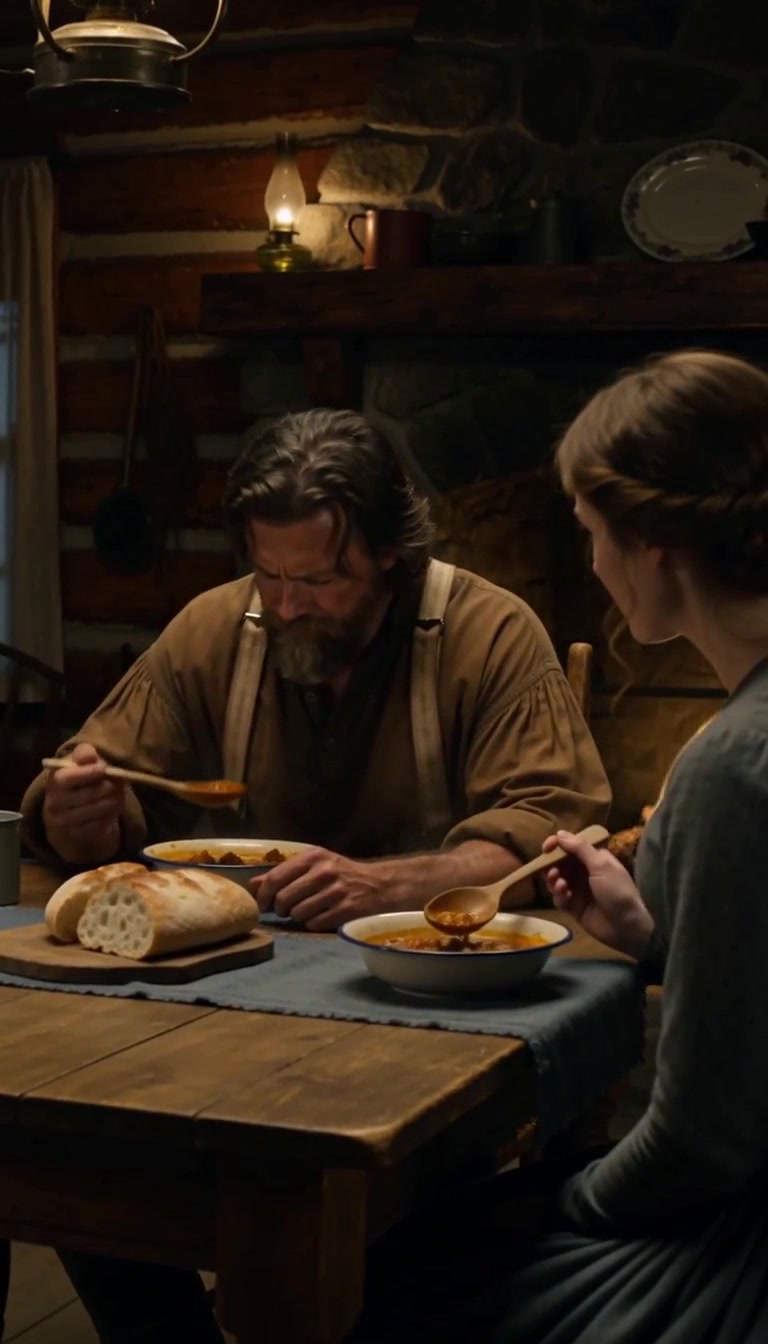
# FOR TWENTY YEARS, THE LONELY FRONTIERSMAN HAD FORGOTTEN WHAT LOVE FELT LIKE—UNTIL ONE WOMAN SERVED HIM A BOWL OF STEW 🐺
For twenty years, the lonely frontiersman had survived deadly blizzards, hungry wolves, freezing winters, and a loneliness so deep that he had almost forgotten the sound of another person’s laughter.
But nothing—not even the fiercest Montana storm—had prepared him for what happened when Ruth Fairchild placed a simple bowl of stew before him.
The enormous frontiersman froze.
His spoon stopped halfway to his mouth. His broad shoulders stiffened, and his weathered blue eyes remained fixed on the steaming bowl.
Five seconds passed.
Then ten.
Ruth, standing beside the stove, slowly lost her playful smile.
“Well?” she asked nervously. “Is something wrong with it?”
Callum lowered his spoon.
For a moment, he couldn’t speak.
Then, in a voice so quiet she barely recognized it, he whispered, “My mother used to make stew like this.”
Ruth’s expression softened.
“Oh…”
“She died when I was twelve.”
The cabin fell silent.
Outside, the Montana wind whispered through towering pines. Inside, the fire crackled softly, illuminating the giant man’s rugged face.
And suddenly, Ruth understood.
Beneath the thick beard, scarred hands, and intimidating strength was a little boy who had lost his mother—and spent decades searching for a warmth he could never replace.
“I haven’t tasted anything like it since,” Callum admitted.
Ruth swallowed the lump rising in her throat.
“That good?”
He nodded.
Then he tasted another spoonful.
“It might actually be better.”
Ruth burst into laughter.
And something extraordinary happened.
Callum smiled.
A genuine, unguarded smile.
For the first time in twenty years, his lonely cabin sounded like a home.
But neither of them knew that the simple meal would become the beginning of a story neither had expected.
And neither knew how much they would have to risk before they could finally call that cabin home.
## CHAPTER ONE: THE MAN BEHIND THE MOUNTAIN
Callum Brek was forty-three years old, and most people in the Montana Territory considered him a man best left alone.
He stood well over six feet tall, with broad shoulders, powerful hands, and a face weathered by years of hard work and harsh winters. His dark brown hair fell in waves past his shoulders, and his thick beard had begun collecting silver strands around his chin.
His blue eyes were perhaps the most misleading thing about him.
They looked cold from a distance, but anyone who had known him as a boy would have recognized the kindness still hidden behind them.
Callum had not always been lonely.
When he was young, he had lived with his parents in a small farmhouse near the Missouri River. His father, Thomas, worked as a carpenter, while his mother, Margaret, managed the household and grew vegetables behind their home.
Margaret was a remarkable woman.
She could mend a torn coat, calm an angry child, recognize approaching rain by the smell of the wind, and turn a handful of vegetables into a meal that made the entire family gather around the table.
Her stew was famous among their neighbors.
She always added thyme, carrots, potatoes, onions, and a little secret combination of spices she refused to explain.
Callum remembered sitting beside her while she cooked.
He remembered the warmth of the stove, the wooden spoon resting beside the pot, and her habit of humming old songs while she worked.
But when Callum was twelve, an illness took her life.
His father never truly recovered.
The cheerful farmhouse became quiet. Meals became shorter. The garden grew wild.
Three years later, Thomas died following a winter accident while repairing a barn roof.
By seventeen, Callum had lost both parents.
He spent the next few years working wherever he could find employment. Eventually, he traveled west, determined to build a life where nobody knew his name or his history.
He settled in the mountains of Montana, purchased a small piece of land, built a cabin, and learned to survive.
He hunted, trapped, repaired fences, sold animal pelts, and occasionally worked for ranchers in nearby settlements.
He became strong enough to survive almost anything the wilderness could throw at him.
But he never learned how to stop being alone.
He had known women over the years. A few had shown interest in him, but whenever a relationship began to become serious, Callum found an excuse to withdraw.
He told himself that he preferred his freedom.
The truth was that he feared losing someone again.
After twenty years, he had become comfortable with silence.
Until Ruth Fairchild arrived.
## CHAPTER TWO: THE WOMAN WHO NEEDED A PLACE TO BEGIN AGAIN
Ruth was thirty-four years old when she first met Callum.
She had spent most of her adult life in a small town in Missouri, where she had worked in a boardinghouse alongside her aunt.
She was not wealthy, and she had never expected to become famous or important.
She wanted something simple.
A safe home. Honest work. People she could trust.
But life had not been particularly kind to her.
Her husband, Daniel, had died of pneumonia four years earlier. Their marriage had been happy, but they had never had children. After his death, Ruth spent nearly two years caring for her elderly aunt.
When her aunt passed away, Ruth discovered that the boardinghouse had been sold to settle old debts.
She suddenly had nowhere permanent to go.
She could have remained in Missouri and found another position, but she had always dreamed of seeing the western mountains.
An advertisement in a newspaper eventually brought her to Montana.
A family near the settlement of Willow Creek needed someone to help manage a small boardinghouse. Ruth accepted the position and traveled west with two trunks, a little money, and a photograph of her late husband.
She arrived in the settlement on a cold afternoon in early March.
The first thing she noticed was the mountains.
They seemed enormous compared with anything she had ever seen.
The second thing she noticed was that everyone seemed to know everyone else.
The third thing she noticed was a very large man standing outside the general store, struggling to load a sack of flour into the back of a wagon.
He wore a brown work shirt, suspenders, and a battered hat.
His long hair was tied loosely behind his head.
Ruth watched him lift the sack as if it weighed nothing.
Then the shopkeeper called out.
“Careful with that one, Callum! The stitching’s coming apart!”
The man looked down at the sack.
A small cloud of flour escaped through a tear.
He sighed.
“I noticed.”
Ruth tried not to laugh.
The man glanced toward her.
For a second, their eyes met.
Then he returned to his work.
That evening, Ruth learned more about him from the woman who ran the boardinghouse.
“That’s Callum Brek,” the woman explained. “Lives about six miles north of here. Keeps mostly to himself.”
“Is he married?”
The older woman gave a small laugh.
“Callum? No. I don’t believe that man has had a proper conversation with a woman since the last century.”
Ruth smiled.
“Perhaps he’s simply shy.”
“Perhaps. Or perhaps he likes his company better when it has four legs.”
Ruth laughed.
She had no idea that within a few weeks, she would be the person responsible for making that lonely man look forward to coming home.
## CHAPTER THREE: A SMALL ACCIDENT
Their second meeting happened because of a broken wagon wheel.
Ruth had been sent to deliver a parcel to a family living outside Willow Creek. On her return, one of the wagon’s wheels struck a hidden rock.
The wheel broke.
Her horse became restless, and the wagon tilted dangerously toward the roadside.
Ruth climbed down and tried to assess the damage.
She had no idea how to repair it.
After several unsuccessful attempts, she heard the sound of approaching hoofbeats.
A large man appeared along the trail.
Callum.
He stopped his horse and looked at the broken wheel.
“Trouble?”
Ruth brushed dirt from her skirt.
“Only a little.”
He studied the wagon.
“That’s a fairly large little.”
“I was hoping you might say something more encouraging.”
Callum looked at her.
Then, unexpectedly, the corner of his mouth lifted.
“Get your belongings out. I’ll take a look.”
He worked for nearly twenty minutes, replacing a damaged wooden support and tightening the iron fittings.
Ruth watched him.
His movements were confident and practiced. He barely spoke, but he never made her feel foolish for not knowing how to repair the wagon.
When he finished, he stepped back.
“That should hold until you reach town.”
Ruth smiled.
“Thank you. I don’t know what I would have done without you.”
“Probably walked.”
“With two trunks and a wagon?”
Callum considered the problem.
“Would have taken longer.”
Ruth laughed.
He looked almost surprised by the sound.
She reached into her bag and offered him a small wrapped piece of bread.
“Please. At least let me give you something for your trouble.”
He shook his head.
“No need.”
“It’s homemade.”
He hesitated.
Then he accepted it.
“Thank you.”
As he rode away, Ruth watched him disappear between the trees.
She noticed something strange.
For a man who seemed so comfortable in the wilderness, he looked remarkably uncomfortable accepting kindness.
## CHAPTER FOUR: THE CABIN THAT FORGOT HOW TO BE A HOME
Three weeks later, Ruth found herself standing outside Callum’s cabin.
The boardinghouse owner had asked her to deliver a letter concerning a shipment of supplies.
The cabin stood in a clearing surrounded by tall pine trees.
It was sturdy and well-built, with a stone chimney and a small covered porch. A woodpile stood beside the entrance, and several tools hung neatly beneath the roof.
Ruth knocked.
No answer.
She knocked again.
A moment later, the door opened.
Callum stood there wearing his usual brown shirt and suspenders.
His expression suggested that he was surprised to find anyone on his doorstep.
“Miss Fairchild.”
“Good afternoon, Mr. Brek.”
“Callum.”
“Ruth.”
He looked at the letter in her hand.
“Something wrong?”
“No. I was asked to bring this to you.”
He accepted it.
“Thank you.”
Ruth glanced past him.
The cabin was clean enough, but something about it made her heart sink.
There was no decoration. No flowers. No curtains. No tablecloth.
A single wooden table stood in the center of the room, surrounded by two mismatched chairs.
A blackened cooking pot rested near the fireplace.
There was a bed in the corner, a shelf of books, and a collection of hunting equipment.
Everything was functional.
Nothing looked loved.
“Do you always eat alone?” she asked before she could stop herself.
Callum looked at her.
“Most days.”
“And what do you cook?”
“Whatever is available.”
“That’s not an answer.”
“Meat.”
“Only meat?”
“Sometimes potatoes.”
Ruth stared at him.
“Good heavens.”
Callum frowned slightly.
“What’s wrong?”
“Nothing. I just hope the potatoes are receiving proper attention.”
He looked confused.
She laughed.
For the first time, Callum realized that he enjoyed being teased.
“Would you like some tea?” he asked suddenly.
Ruth blinked.
“Are you inviting me inside?”
“I suppose I am.”
“Then I would be delighted.”
He stepped aside.
She entered the cabin and immediately noticed the smell of wood smoke and leather.
It was warm, but the room felt strangely empty.
While Callum prepared the tea, Ruth examined the kitchen.
There were several sacks of flour stacked near the stove, onions stored beside potatoes, and dried beans scattered across a shelf.
She looked at the arrangement.
Then she looked at him.
“Callum, do you know how long some of these things have been sitting here?”
“Not exactly.”
“Do you know which sack of flour is newest?”
He pointed.
“That one.”
She touched the sack.
It was damp.
Ruth closed her eyes.
“Lord help us.”
Callum frowned.
“What?”
“Nothing. I can already tell we’re going to have a great deal of work to do.”
He didn’t understand what she meant.
But he smiled anyway.
## CHAPTER FIVE: THE FIRST BOWL OF STEW
A few days later, Callum found a small parcel hanging from his front door.
Inside was a folded note.
*Mr. Brek,*
*I made too much stew this afternoon. Rather than allow it to go to waste, I thought you might appreciate a bowl.*
*Please return the dish whenever convenient.*
*Ruth.*
Callum stared at the note for a long time.
Then he looked inside the parcel.
A covered bowl sat beneath a clean cloth.
The smell was extraordinary.
He carried it inside, placed it on the table, and lifted the lid.
Carrots.
Potatoes.
Onions.
Thyme.
And something else.
Something familiar.
He sat down.
The first spoonful took him back thirty-one years.
He could almost hear his mother’s humming.
He remembered sitting beside the kitchen stove while Margaret stirred a large iron pot.
He remembered her wiping flour from his cheek.
He remembered the way she used to say that a meal tasted better when someone shared it.
Callum lowered the spoon.
His eyes became wet.
He had not cried over his mother in many years.
Yet there he sat, staring at a bowl of stew prepared by a woman he barely knew.
The following afternoon, he returned the empty dish to Ruth.
She was in the boardinghouse kitchen, arranging vegetables.
“Was it acceptable?” she asked.
Callum stood awkwardly beside the door.
“Yes.”
“Only acceptable?”
He hesitated.
“It reminded me of my mother.”
Ruth stopped working.
He told her about Margaret.
About the farmhouse.
About the years after her death.
He did not usually speak about his childhood, but something about Ruth made the words easier.
When he finished, she quietly said, “She must have been a wonderful woman.”
“She was.”
“Then I’m glad I could remind you of her.”
Callum looked down.
“Thank you.”
Ruth smiled.
“You’re welcome.”
That evening, Callum ate his dinner slowly.
He even washed the bowl himself.
And the next morning, he caught himself wondering what Ruth might be cooking.
## CHAPTER SIX: THE CHANGES
Over the following weeks, Ruth transformed Callum’s world in ways he never anticipated.
One morning, she discovered three sacks of flour.
“Callum, two of these are damp!”
“I know.”
“You KNOW?”
“I was planning to deal with them.”
“When?”
He considered the question seriously.
“Eventually.”
Ruth stared at him.
“You’ve survived forty-three years by accident!”
“That seems unfair.”
“And why are your onions stored beside your potatoes?”
Callum raised both enormous hands in surrender.
“I withdraw my complaint.”
Little by little, everything changed.
A beautiful blue cloth covered the rough wooden table.
Dried herbs appeared along the ceiling beams.
Fresh bread cooled beside the window, filling the cabin with an aroma he had almost forgotten.
Ruth showed him how to preserve vegetables properly and how to keep flour dry.
Callum repaired a loose shelf and built her a proper wooden storage cupboard.
He even made a small wooden stand for her cooking utensils.
When Ruth asked why he had gone to so much trouble, he shrugged.
“You needed somewhere to put them.”
“That was very thoughtful.”
“I had the wood.”
She laughed.
But the greatest change wasn’t something Ruth cooked or cleaned.
It was a lamp.
Every evening, when Callum returned from checking traps, repairing fences, or working deep beyond the tree line, a small golden light shone through his front window.
Someone was inside.
Someone knew he was coming home.
Someone cared whether he returned.
Callum told himself the lamp was merely convenient.
Until one evening he came home earlier than expected and found Ruth asleep in the chair beside the fireplace.
A book rested open on her lap.
The lamp was still burning.
He stood in the doorway for several moments.
She looked peaceful.
A strand of brown hair had escaped her bun, and her hands rested loosely over the book.
Callum quietly removed his coat and placed it over her shoulders.
She stirred.
“Callum?”
“Go back to sleep.”
“What time is it?”
“Late.”
“Did you eat?”
He looked at her.
There was a plate covered beside the stove.
He understood then.
She had waited for him.
“I’ll eat now,” he whispered.
Ruth smiled sleepily.
“Good.”
Then she closed her eyes again.
Callum sat at the table and ate his meal.
For the first time in twenty years, he was not listening to the wind.
He was listening to someone breathe.
## CHAPTER SEVEN: THE SECRET BEHIND THE LAMP
Ruth had her own reasons for being careful with her heart.
Her marriage to Daniel had been happy, but his death had left a wound that she had never completely understood.
For years, she had believed that loving someone meant preparing herself to lose them.
She had learned to manage a household alone, pay bills, repair clothing, and keep moving even when she felt empty.
When she first arrived in Montana, she had not been searching for another husband.
She simply wanted a place where she could begin again.
Callum was different from the men she had known.
He never made promises he could not keep.
He never demanded attention.
He never tried to impress her.
Instead, he noticed little things.
When her hands became cold, he placed another log on the fire.
When she struggled to carry a sack of potatoes, he lifted it without being asked.
When she mentioned that her boots were wearing thin, a new pair appeared beside the door three days later.
He never explained where they came from.
Ruth eventually asked.
“You bought me boots?”
Callum continued repairing a chair.
“They were needed.”
“You cannot simply buy me things whenever you notice something.”
“Why not?”
“Because I have money of my own.”
He looked up.
“Then consider them a gift.”
Ruth smiled.
“You’re a difficult man to argue with.”
“I’ve been told.”
One afternoon, while sorting through a cupboard, Ruth discovered an old wooden box.
Inside were several photographs.
One showed a younger Callum standing beside a woman with kind eyes and a gentle smile.
“Your mother?” Ruth asked.
Callum appeared in the doorway.
He nodded.
“Margaret.”
Ruth carefully picked up the photograph.
“She looks lovely.”
“She was.”
There was a long silence.
Then Callum said something he had never told anyone.
“Sometimes I still dream about coming home and hearing her in the kitchen.”
Ruth looked at him.
“That must be difficult.”
“It is.”
“Do you know something?”
“What?”
“I don’t think remembering someone means you have to remain alone.”
Callum looked at the photograph.
Then he looked at Ruth.
For a moment, he seemed ready to answer.
But he said nothing.
He was still afraid.
## CHAPTER EIGHT: THE STORM
One terrifying evening in late April, the Montana sky turned black before sunset.
Thunder rolled across the mountains.
Rain lashed the forest, and powerful winds bent the towering pines.
Callum had spent hours repairing a broken fence.
By the time he finished, his coat was drenched, his boots sank into the mud, and cold rain streamed through his beard.
He hurried toward the familiar glow of his cabin.
But as he stepped out of the trees, he stopped dead.
Someone stood on the porch.
Ruth.
Waiting.
The moment she saw him, she crossed her arms.
“You’re soaked!”
Callum climbed the steps, water dripping from his clothes.
Then he noticed something.
A dry towel rested over her arm.
He looked from the towel to her face.
“You waited for me?”
“No.”
The answer came suspiciously quickly.
“You brought a towel?”
“I happened to be holding it.”
“Outside?”
“Yes.”
“During a rainstorm?”
Ruth narrowed her eyes.
“You ask too many questions for a man who keeps damp flour.”
Normally, Callum would have laughed.
But this time, he couldn’t.
Because something inside him had suddenly broken open.
For twenty years, he had returned to an empty cabin, eaten alone, and fallen asleep listening to the wind.
Nobody had worried about him.
Nobody had waited at the door.
Nobody had cared whether he survived another night.
Until Ruth.
The blue tablecloth.
The fresh bread.
The hanging herbs.
The little lamp glowing against the darkness.
They weren’t simply changes to his cabin.
Ruth had given him something he believed he’d lost forever.
A home.
“Ruth…”
The strange tenderness in his voice made her stop smiling.
She looked up.
Callum stepped closer.
She didn’t retreat.
Rain battered the roof as they stood inches apart, their eyes locked.
The enormous frontiersman had faced wolves and blizzards without trembling.
Yet now his hands shook.
“There’s something I need to tell you,” he whispered.
Ruth’s breath caught.
For a long moment, neither moved.
Then Callum finally gathered the courage to confess the secret his lonely heart had guarded for twenty years.
“Ruth, I think I’ve fallen in love with you.”
She stared at him.
He continued before fear could silence him.
“I don’t know when it happened. Maybe it was the first time you laughed at my flour. Maybe it was when you put that lamp in the window. Or maybe it was when I tasted that stew and remembered what it felt like to be a boy sitting beside his mother.”
His voice broke.
“I’ve spent most of my life believing that being alone was easier. I convinced myself I didn’t need anyone. But now, when I leave this cabin, all I can think about is coming back.”
Ruth’s eyes filled with tears.
Callum looked down.
“You don’t have to say anything. I know you’ve already lost someone. I don’t expect you to forget him, and I don’t want you to feel that you owe me anything.”
He took a breath.
“I just couldn’t keep pretending that you’re only here because you happen to enjoy fixing my kitchen.”
Ruth let out a small, trembling laugh.
Then she placed the towel over his shoulders.
“Callum…”
He looked at her.
“I was beginning to think you would never say it.”
He blinked.
“What?”
She stepped closer.
“I’ve been waiting for you to tell me.”
“Why didn’t you?”
“Because I wasn’t sure you wanted me to.”
Callum stared at her as if she had just spoken another language.
Ruth reached for his hand.
“I loved my husband, Callum. I will always be grateful for the years I had with him. But loving someone who has died doesn’t mean my heart has to remain closed forever.”
He squeezed her hand gently.
“And you?” she whispered. “Do you really think I would keep bringing you food, fixing your flour, and waiting in the rain if you meant nothing to me?”
A genuine smile slowly appeared on his face.
“Probably not.”
“You’re learning.”
Then Ruth rose slightly onto her toes and kissed his cheek.
Callum closed his eyes.
It was the smallest kiss.
Yet it felt more precious than anything he had experienced in twenty years.
## CHAPTER NINE: THE MORNING AFTER
The following morning, Callum woke before sunrise.
For several seconds, he lay still, staring at the wooden ceiling.
Then he remembered the previous evening.
The rain.
The confession.
Ruth’s hand in his.
Her kiss.
He sat up.
A strange feeling filled his chest.
Happiness.
It was almost frightening.
He had forgotten how vulnerable happiness could make a person.
When he entered the kitchen, Ruth was already preparing breakfast.
She turned.
“Good morning.”
“Morning.”
He stood awkwardly near the doorway.
Ruth raised an eyebrow.
“Are you planning to stay there all morning?”
“No.”
“Then come sit down.”
He did.
She placed a plate before him.
Eggs, fried potatoes, and warm bread.
Callum looked at the food.
Then at her.
“Thank you.”
Ruth smiled.
“You’re welcome.”
He ate quietly for a few minutes.
Then he finally asked, “Does this mean something has changed between us?”
Ruth set down her cup.
“I think something has been changing for quite some time.”
Callum nodded.
“I don’t want to rush you.”
“Neither do I.”
“I don’t want you to feel that you have to stay here.”
“I know.”
“And I don’t want you to think I expect you to replace anyone.”
Ruth reached across the table and placed her hand over his.
“Callum, I don’t want to replace the past. I want to build something new.”
He looked at their hands.
Then he nodded.
For the first time in years, he allowed himself to imagine a future that included another person.
## CHAPTER TEN: THE MAN WHO HAD BEEN WATCHING
Unfortunately, happiness rarely arrives without being noticed.
In Willow Creek, a man named Silas Mercer had been watching Ruth.
Silas owned several properties near the settlement and considered himself an important figure.
He was wealthy, well-dressed, and accustomed to getting what he wanted.
He had been interested in Ruth since she began working at the boardinghouse.
He had offered her gifts, invitations, and promises of a comfortable life.
Ruth had refused every time.
Silas did not like rejection.
When he heard that she had been spending time at Callum’s cabin, he became angry.
“That mountain brute?” he said to the boardinghouse owner. “Surely she can do better.”
The older woman frowned.
“Callum is a decent man.”
“Decent? He lives like an animal.”
“He has more kindness in one finger than you have in your entire body.”
Silas ignored her.
He decided to visit Callum himself.
Three days later, he arrived at the cabin with two men.
Callum was repairing a fence when he heard the horses.
He turned.
Silas climbed down from his horse.
“Mr. Brek.”
Callum wiped his hands.
“Mercer.”
“I came to speak with you.”
“Then speak.”
Silas looked toward the cabin.
“I understand you’ve been spending time with Miss Fairchild.”
Callum’s expression did not change.
“That’s none of your business.”
Silas smiled coldly.
“She’s a respectable woman. She deserves better than a man who lives in the woods and spends his days hunting animals.”
Callum looked at him for a moment.
Then he returned to the fence.
“Have a pleasant ride home.”
Silas’s smile disappeared.
“I’m offering you a chance to understand something. Ruth is not the sort of woman who belongs out here.”
Callum tightened a wooden brace.
“She can decide where she belongs.”
Silas stepped closer.
“You think she wants to spend her life cooking for a mountain hermit?”
Callum turned.
His eyes were suddenly hard.
“Be careful.”
The two men behind Silas exchanged glances.
Silas adjusted his coat.
“Just remember, Brek. A woman like Ruth deserves a future.”
Callum’s voice remained quiet.
“Then she should choose it herself.”
Silas mounted his horse.
But as he rode away, he made a decision.
If he couldn’t persuade Ruth to choose him, he would find another way to separate her from Callum.
## CHAPTER ELEVEN: THE LETTER
A week later, Ruth received a letter from Missouri.
It came from a lawyer who had handled her late husband’s affairs.
She opened it at the boardinghouse and read it twice.
Daniel had left her a small parcel of money in a trust that had been overlooked during the settlement of his estate.
The amount was enough to purchase a modest property and begin a new business.
For the first time in years, Ruth had a real opportunity to establish a home of her own.
She should have been happy.
Instead, she felt uncertain.
She had been thinking about Callum constantly.
She loved the cabin.
She loved the little lamp.
She loved the way he listened when she spoke.
But she also knew that she could not remain at his home simply because it was comfortable.
She wanted to make her own decisions.
She wanted to contribute.
She wanted a future in which neither of them felt indebted to the other.
That evening, she told Callum about the letter.
He listened quietly.
“That’s wonderful,” he said.
“Is it?”
“Of course.”
She studied his face.
“You’re not upset?”
“Why would I be?”
“Because I might use the money to buy a place of my own.”
Callum looked at her.
“Then I hope you find a place you love.”
Ruth felt a small ache in her chest.
“That’s all?”
He frowned.
“What else should I say?”
She looked away.
“I don’t know.”
Callum reached for her hand.
“Ruth, I want you here because you choose to be here. Not because you have nowhere else to go.”
She looked back at him.
He continued.
“If you want your own house, I’ll help you build it. If you want to run a boardinghouse, I’ll help you find a good location. If you want to stay in this cabin, there’s room for you.”
He hesitated.
“There’s room for you in my life, too.”
Ruth’s eyes filled.
“You’re a good man, Callum.”
He shook his head.
“I’m just trying to do things right.”
For the first time, Ruth understood that Callum’s love was not an attempt to keep her.
It was an invitation to stay.
And that made her love him even more.
## CHAPTER TWELVE: THE WOLF AT THE DOOR
One cold evening, a strange sound came from the edge of the clearing.
Callum immediately reached for his rifle.
Ruth looked up from her sewing.
“What is it?”
“Stay inside.”
He stepped onto the porch.
A large grey wolf stood near the woodpile.
Its coat was wet, and one of its front legs appeared injured.
The animal watched Callum without moving.
Ruth appeared in the doorway.
“Is it hurt?”
“Looks like it.”
“Can we help it?”
Callum glanced at her.
“It’s a wild animal.”
“I can see that.”
“It might bite.”
“Then perhaps you should be careful.”
Callum almost smiled.
He approached slowly, carrying a piece of meat.
The wolf growled.
He stopped.
After several minutes, the animal finally moved closer.
Callum examined its leg from a distance.
A metal trap had caught its paw.
The frontiersman carefully released it.
The wolf limped away into the darkness.
Ruth watched.
“You were very gentle.”
“Didn’t want it suffering.”
She looked at him.
“You’re gentler than you pretend to be.”
Callum shrugged.
“Don’t tell anyone.”
Ruth laughed.
That night, as they sat beside the fire, she asked him why he had never married.
He stared into the flames.
“I was afraid.”
“Of marriage?”
“Of losing someone.”
Ruth nodded.
“I understand.”
He continued.
“When my parents died, I promised myself I wouldn’t allow anyone to become that important to me again.”
“Did it work?”
He looked at her.
“No.”
She smiled softly.
“Good.”
He reached for her hand.
Outside, somewhere among the trees, the wolf howled.
Callum listened for a moment.
Then he turned back toward the woman beside him.
For the first time, the sound of the wilderness did not make him feel alone.
## CHAPTER THIRTEEN: A PLACE OF HER OWN
Spring slowly gave way to summer.
Ruth used part of her inheritance to purchase a small building in Willow Creek.
It had once been a general store, but the owner had closed it several years earlier.
The roof needed repairs, the windows were cracked, and the wooden floor had several holes.
Ruth loved it immediately.
She planned to turn it into a small boardinghouse where travelers could find a warm bed and a proper meal.
When she told Callum, he studied the building.
“You want to fix all this?”
“I do.”
He looked at the roof.
“That could take a while.”
“I know.”
He examined the windows.
“And the floor.”
“I know.”
He looked at her.
“You’re certain?”
Ruth smiled.
“Very.”
Callum nodded.
“Then we’ll begin tomorrow.”
She blinked.
“We?”
He looked confused.
“Unless you want to do it alone.”
Ruth stepped forward and kissed his cheek.
“I think I’d prefer your help.”
For the next several weeks, Callum worked on the building every morning.
He repaired the roof, replaced the broken windows, strengthened the floor, and built a new staircase.
Ruth painted the walls, cleaned the rooms, and prepared the kitchen.
They worked side by side.
Sometimes they argued about small things.
Sometimes they laughed.
Sometimes they sat on the floor eating bread because the chairs had not yet been delivered.
One afternoon, Ruth discovered Callum had built a small wooden sign.
It read:
**THE WARM TABLE – ROOMS AND MEALS**
She ran her fingers over the letters.
“You made this?”
He nodded.
“Figured a place that serves meals ought to have a name.”
Ruth looked at him.
“Why The Warm Table?”
Callum shrugged.
“Because that’s what you gave me.”
She couldn’t speak.
Instead, she wrapped her arms around him.
He held her close.
And in that moment, the man who had spent twenty years believing he was meant to live alone understood that love was not something he had to earn through strength.
Sometimes it arrived in the form of a woman with a bowl of stew.
## CHAPTER FOURTEEN: SILAS’S LAST ATTEMPT
When The Warm Table finally opened, the settlement welcomed it.
Travelers appreciated the clean rooms and generous meals.
Local families began visiting for Sunday dinners.
Ruth’s stew became especially popular.
Callum continued working on his land, but he spent most evenings helping at the boardinghouse.
Silas Mercer was furious.
He had expected Ruth’s business to fail.
Instead, it became successful.
Worse, people in town began speaking warmly about Callum.
The man who had once been considered an unfriendly mountain hermit was now helping travelers unload their wagons and carrying firewood for elderly neighbors.
Silas could not stand it.
One evening, he entered the boardinghouse and approached Ruth.
“Miss Fairchild.”
Ruth looked up from the counter.
“Good evening, Mr. Mercer.”
“I hear business is going well.”
“Very well, thank you.”
He glanced around.
“Perhaps you would like to sell.”
Ruth frowned.
“Sell?”
“I could make you a generous offer.”
“This place isn’t for sale.”
Silas smiled.
“Everything has a price.”
“Not everything.”
His expression hardened.
“You should think carefully. A woman running a business alone can attract unpleasant attention.”
Ruth straightened.
“Is that a warning?”
“Merely advice.”
“Then I suggest you keep it to yourself.”
Silas stared at her.
“You’ve changed.”
“No. I’ve simply stopped being afraid of disappointing men like you.”
He left without another word.
But that night, Ruth told Callum what had happened.
Callum’s expression darkened.
“I’ll speak to him.”
“No.”
“Ruth—”
“I don’t need you to fight my battles.”
He stopped.
She placed a hand against his chest.
“I need you to stand beside me. That’s different.”
Callum looked at her.
Then he nodded.
“You’re right.”
The following morning, Ruth reported Silas’s threats to the town sheriff.
The sheriff already knew of Silas’s reputation and promised to keep an eye on him.
For once, Ruth did not feel powerless.
She had built something of her own.
And she had someone who respected her enough to let her defend it.
## CHAPTER FIFTEEN: THE QUESTION
Summer passed.
The trees turned golden.
The first cold winds began sweeping down from the mountains.
One evening, Callum invited Ruth to dinner at his cabin.
She arrived wearing her dusty blue dress and cream apron.
The familiar lamp glowed beside the window.
The blue tablecloth covered the wooden table.
Fresh bread rested beside a bowl of stew.
Ruth looked around.
“You’ve been busy.”
Callum nodded.
“Had some help.”
“From whom?”
He smiled.
“A woman who complains about damp flour.”
Ruth laughed.
They sat together.
Callum served the stew.
Ruth watched him take the first spoonful.
He closed his eyes briefly.
Then he looked at her.
“Still tastes like home.”
Ruth smiled.
“Good.”
They ate slowly, speaking about the boardinghouse, the coming winter, and the possibility of planting a larger garden in spring.
After dinner, Callum stood and walked toward the fireplace.
“There’s something I’ve been thinking about.”
Ruth looked up.
“That sounds serious.”
“It is.”
He reached into the pocket of his coat and removed a small wooden box.
Ruth’s breath caught.
Callum returned to the table.
He placed the box between them and opened it.
Inside lay a simple gold ring.
It wasn’t extravagant.
It had a small blue stone set in the center.
“My mother wore something similar,” he said. “It belonged to her. I kept it after she died.”
Ruth looked at the ring.
“Callum…”
He swallowed.
“I know we haven’t known each other forever. And I know we both carry things from our past that will never completely disappear.”
He paused.
“But I don’t want to spend another winter wondering what my life might have been if I had been brave enough to ask you.”
He took her hand.
“Ruth Fairchild, would you marry me?”
For several seconds, she could not answer.
Her eyes filled with tears.
Then she looked at the man sitting before her.
The man who had once believed loneliness was the safest way to live.
The man who had learned to laugh again.
The man who had given her a place to begin again without ever asking her to become someone else.
She smiled.
“Yes.”
Callum blinked.
“Yes?”
She laughed through her tears.
“Yes, you enormous fool.”
He laughed too.
Then he placed the ring on her finger.
For a long moment, neither spoke.
Then Ruth leaned forward and kissed him.
Outside, the wind moved through the pine trees.
Inside, the fire burned warmly.
And the little cabin that had once known only silence finally witnessed a promise.
## CHAPTER SIXTEEN: THE WEDDING
They married three weeks later.
There was no grand celebration.
No expensive decorations.
No elaborate ceremony.
Just a small gathering at the church in Willow Creek.
Ruth wore a simple cream dress with a blue ribbon around her waist.
Callum wore his best brown suit, which Ruth had spent two evenings repairing.
The sheriff stood beside them.
The boardinghouse owner sat in the front row.
Several neighbors came to celebrate.
When Ruth entered the church, Callum looked at her as though he had forgotten how to breathe.
She smiled.
“What’s wrong?”
He shook his head.
“Nothing.”
“You look nervous.”
“I am.”
“Why?”
He looked at her.
“Because I’ve never wanted anything more.”
Ruth took his hand.
“Then don’t let go.”
The minister began the ceremony.
When the time came for Callum to speak his vows, he paused.
He had never been a man of many words.
But he looked into Ruth’s eyes and spoke clearly.
“I cannot promise you an easy life. The winters here are hard, the roads are rough, and I have more stubbornness than sense.”
A few people laughed.
Callum continued.
“But I can promise you that you will never have to wonder whether someone is waiting for you at home. I will listen to you. I will stand beside you. And I will love you for as long as I draw breath.”
Ruth’s tears fell.
When it was her turn, she held his hands.
“I cannot promise that every meal will be perfect. I may still complain about your flour, your onions, and the way you leave your boots in the doorway.”
The congregation laughed.
“But I promise that I will never stop trying to make this world a little warmer for us. I will share your joys, your sorrows, your quiet mornings, and your long winters. And I will choose you, every day.”
The minister smiled.
Then he pronounced them husband and wife.
Callum kissed her gently.
The entire church erupted in applause.
For the first time in twenty years, the frontiersman no longer had to imagine what it felt like to belong to someone.
He did.
## CHAPTER SEVENTEEN: THE FIRST WINTER TOGETHER
Their first winter as husband and wife was one of the harshest Montana had seen in years.
Snow covered the mountains.
The river froze.
Wolves came closer to the settlement, and several families struggled to keep their livestock safe.
Callum worked harder than ever.
He repaired fences, helped neighbors cut firewood, and checked the trails after heavy snowfall.
Ruth kept The Warm Table running.
She prepared meals for travelers, sheltered families during storms, and made sure nobody left hungry.
Their days were busy.
Their evenings were precious.
Sometimes Callum returned home so tired he could barely remove his boots.
Ruth would have a hot meal waiting.
Sometimes Ruth worked until midnight, and Callum would sit beside her, helping with accounts or repairing broken furniture.
They learned each other’s habits.
Callum learned that Ruth preferred her tea with honey.
Ruth learned that Callum became quiet whenever he was worried.
Callum discovered that his wife talked to the chickens.
Ruth discovered that her husband secretly fed scraps to a stray dog that had begun following him.
They argued occasionally.
Usually about small things.
Once, Ruth found a pile of wet firewood stacked beside the kitchen door.
“Callum!”
He appeared.
“What?”
“Why is the firewood wet?”
“It was outside.”
“That is generally where rain falls!”
He looked at the wood.
Then at her.
“I’ll move it.”
“Please do.”
He began carrying the wood away.
Ruth watched him.
Then she smiled.
“Thank you.”
He turned.
“You’re welcome.”
She shook her head.
“You’re impossible.”
He smiled.
“But you married me.”
“Yes. I clearly wasn’t thinking straight.”
He laughed.
And the sound filled the cabin.
## CHAPTER EIGHTEEN: THE GIFT THAT CHANGED EVERYTHING
One evening in February, Ruth noticed that Callum had been unusually quiet.
He sat beside the fireplace, holding an old photograph of his parents.
She approached and sat beside him.
“Thinking about them?”
He nodded.
“I wish my mother could have met you.”
Ruth leaned against his shoulder.
“I wish I could have met her.”
“She would have liked you.”
“How do you know?”
He smiled faintly.
“She liked people who laughed.”
Ruth laughed softly.
Then Callum opened the wooden box where he kept the photograph.
He removed a folded piece of paper.
“I found this last week.”
Ruth looked at it.
“What is it?”
“A letter my mother wrote to me.”
He unfolded it carefully.
The paper was old and yellowed.
His mother’s handwriting was still visible.
He began reading.
*My dear Callum,*
*If you are reading this, I hope you have grown into a kind man. I hope you have found people who make you laugh and a place where you feel safe.*
*Never believe that being strong means being alone. A strong man is not someone who carries every burden without help. A strong man is someone who allows others to stand beside him.*
*If life ever becomes difficult, remember that there is always room at the table for one more person.*
Callum stopped.
His voice had become unsteady.
Ruth placed her hand over his.
He looked at her.
“For twenty years, I thought I had lost everything when she died.”
Ruth gently touched his cheek.
“You haven’t lost her, Callum. She’s part of the man you became.”
He looked down at the letter.
Then he smiled.
“She would have liked you.”
Ruth kissed his forehead.
“And I think I would have liked her.”
That evening, they placed the letter in a small frame beside the fireplace.
Underneath it, Callum wrote a single sentence.
**There is always room at the table for one more person.**
## CHAPTER NINETEEN: THE NEW ARRIVAL
Spring returned.
The snow melted.
The trees became green again, and wildflowers appeared along the mountain trails.
One morning, Ruth woke feeling unusually tired.
At first, she blamed the busy boardinghouse.
But over the following weeks, she began noticing other changes.
She became sensitive to certain smells.
She felt dizzy occasionally.
And the smell of stew, which she normally loved, suddenly made her feel sick.
Callum noticed.
“Are you feeling unwell?”
“I’m fine.”
“You don’t look fine.”
“Thank you. That’s a very romantic observation.”
He frowned.
“I’m serious.”
“So am I.”
He watched her carefully.
“Perhaps we should ask the doctor.”
Ruth looked away.
She had been thinking the same thing.
Two days later, the doctor visited the boardinghouse.
After examining her, he smiled.
“Well, Mrs. Brek, I believe congratulations are in order.”
Ruth stared at him.
“What?”
The doctor chuckled.
“You’re going to have a child.”
For a moment, she could not speak.
She had never expected to hear those words.
She had believed that part of her life had passed.
When Callum returned that evening, he found Ruth sitting quietly beside the fireplace.
He immediately knew something was different.
“What happened?”
She looked at him.
“Callum, I have something to tell you.”
He sat beside her.
“Is everything all right?”
She took his hand and placed it gently against her stomach.
“We’re going to have a baby.”
Callum stared at her.
He looked at her face.
Then at her stomach.
Then back at her face.
“Are you certain?”
Ruth laughed through her tears.
“Quite certain.”
He stood up suddenly.
Then he sat down again.
Then he stood once more.
Ruth began laughing.
“Callum?”
He covered his face with both hands.
For a moment, she thought he was frightened.
Then she heard a sound.
He was crying.
Not from sadness.
From a happiness so overwhelming that he could barely contain it.
He knelt in front of her and gently rested his forehead against her hands.
“I never thought…”
He couldn’t finish.
Ruth touched his hair.
“I know.”
He looked up.
“Are you happy?”
She smiled.
“More than I know how to explain.”
Callum kissed her hands.
Then he rested one enormous palm gently against her stomach.
“Hello, little one,” he whispered.
Ruth watched him.
The man who had spent twenty years believing that his family was gone was about to become a father.
And she knew that he would love that child with everything he had.
## CHAPTER TWENTY: THE HOUSE THAT NEVER WENT QUIET AGAIN
Their daughter was born in December, during the first heavy snowfall of winter.
Callum paced outside the bedroom for nearly three hours.
The doctor had arrived before midnight.
Ruth was strong, but the labor was difficult.
Callum had faced wolves, blizzards, broken bones, and dangerous trails.
Yet nothing had ever frightened him as much as hearing his wife cry out behind that bedroom door.
Finally, the doctor emerged.
Callum nearly knocked over a chair as he approached.
“Is she all right?”
The doctor smiled.
“Your wife is doing well.”
“And the baby?”
“A healthy little girl.”
Callum closed his eyes.
He let out a breath he felt he had been holding for hours.
“Can I see them?”
The doctor stepped aside.
Callum entered quietly.
Ruth lay in bed, exhausted but smiling.
In her arms was a tiny baby wrapped in a white blanket.
Callum approached slowly.
“She’s beautiful,” he whispered.
Ruth smiled.
“Would you like to hold her?”
He hesitated.
“I might break her.”
“You won’t.”
He carefully sat beside her.
Ruth placed the baby in his arms.
Callum looked down.
The tiny girl opened her eyes.
For a moment, the frontiersman could not move.
She had a small nose, soft cheeks, and a little tuft of dark hair.
He looked at his daughter as though the entire world had suddenly become smaller and more precious.
“What shall we call her?” Ruth asked.
Callum looked toward the photograph of his mother, which hung beside the fireplace.
“Margaret.”
Ruth smiled.
“After your mother?”
He nodded.
“If that’s all right.”
She kissed his cheek.
“I think it’s perfect.”
Callum bent his head and kissed the baby’s forehead.
“Welcome home, Margaret.”
Outside, snow covered the mountains.
Inside, the cabin was filled with warmth.
The fire crackled.
The lamp glowed.
And somewhere in the kitchen, a pot of stew simmered quietly on the stove.
## EPILOGUE: THE LAST EMPTY CHAIR
Years passed.
The Warm Table became one of the most beloved places in Willow Creek.
Travelers came from distant settlements to enjoy Ruth’s cooking.
Children ran through the dining room.
Farmers gathered near the fireplace after long days in the fields.
Callum became known as a man who would help anyone in need.
He still hunted occasionally, but he spent more time repairing fences, building furniture, and teaching young men how to work with wood.
Their daughter, Margaret, grew into a lively little girl who inherited her mother’s kindness and her father’s stubbornness.
She loved hearing stories about wolves, mountain storms, and the old days when her father lived alone.
One evening, when she was seven, she asked him a question.
“Papa, were you really lonely before Mama came?”
Callum looked at Ruth.
She was arranging plates on the table.
Then he looked at his daughter.
“Yes, sweetheart. Very lonely.”
“Didn’t you have friends?”
“Not many.”
“Didn’t you have a family?”
Callum smiled.
“I did once. Then I lost them.”
Margaret climbed onto his lap.
“Are you lonely now?”
Callum wrapped his arms around her.
He looked across the room at Ruth.
She was smiling at him.
Then he looked at the blue tablecloth, the hanging herbs, the warm fireplace, and the full table.
“No, little one.”
He kissed the top of her head.
“Not anymore.”
Later that evening, after Margaret had gone to bed, Ruth found Callum sitting beside the fireplace.
She placed two cups of tea on the table.
“Thinking about something?”
He smiled.
“Just remembering.”
“Your mother?”
“Yes.”
Ruth sat beside him.
Callum took her hand.
“Do you remember the first bowl of stew you brought me?”
Ruth laughed.
“I remember you looking at it as though it had personally offended you.”
He chuckled.
“I was afraid to taste it.”
“Why?”
“Because I knew it would remind me of everything I’d lost.”
Ruth rested her head against his shoulder.
“And now?”
Callum looked around the cabin.
Then he looked at his wife.
“Now it reminds me of everything I found.”
He kissed her forehead.
Outside, the wind moved through the pine trees.
Somewhere in the distance, a wolf howled.
But Callum no longer heard loneliness in the wilderness.
He heard the familiar sounds of home.
A child sleeping upstairs.
A fire burning in the hearth.
His wife’s quiet laughter.
And the soft clinking of dishes being put away after dinner.
For twenty years, Callum Brek had believed that his story had already ended.
He had accepted the mountains as his only companions and silence as his permanent friend.
Then one woman placed a bowl of stew before him.
She didn’t arrive with promises of wealth.
She didn’t offer him a grand adventure.
She simply brought warmth into a cold cabin.
And somehow, that was enough to change everything.
**Because sometimes, the greatest love story doesn’t begin with a kiss, a wedding, or a grand declaration.**
**Sometimes, it begins with a simple meal, a small golden lamp in the window, and someone who cares enough to wait for you to come home.**
And for Callum Brek, that was the greatest gift he had ever received.
**THE END.**