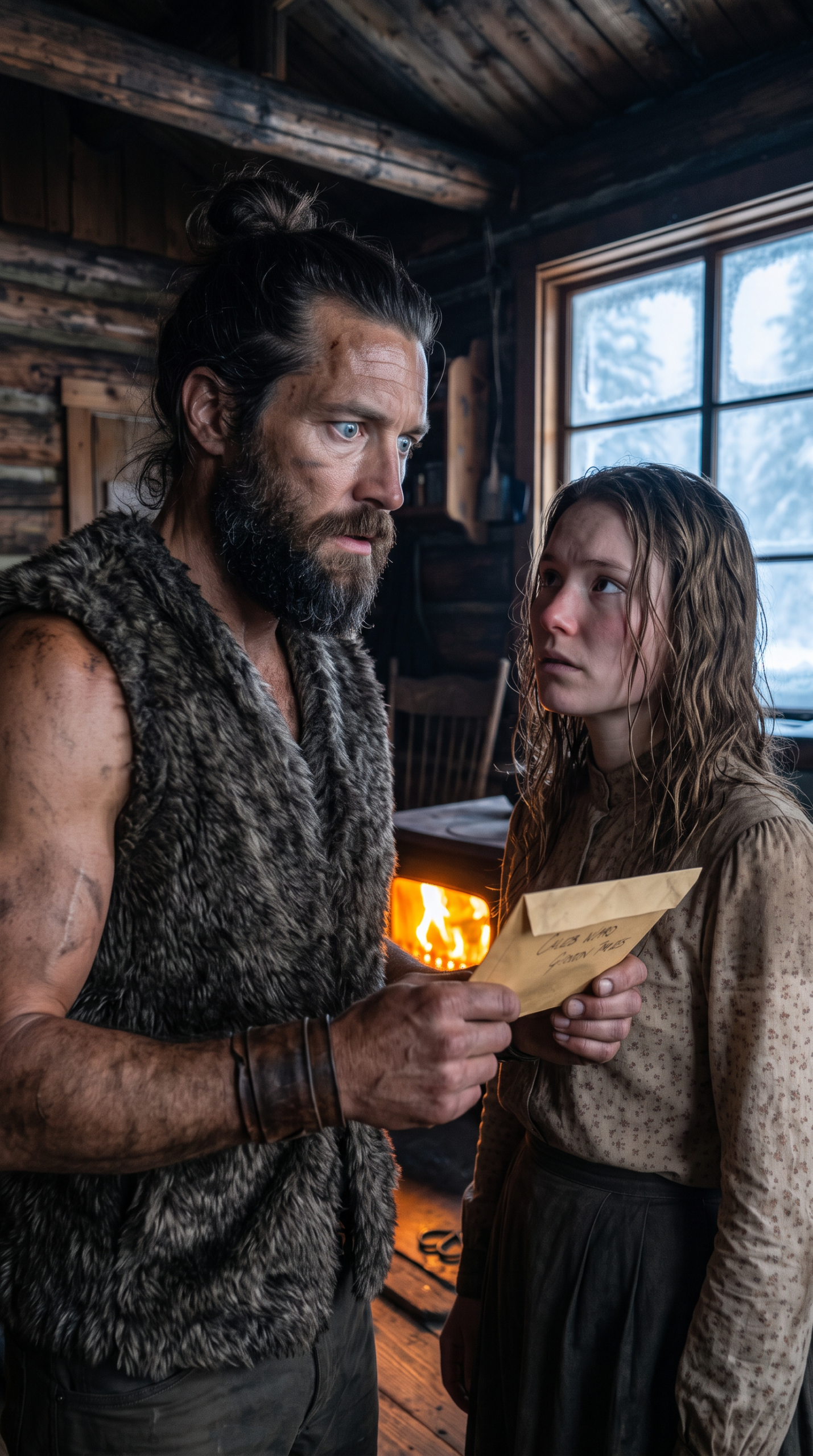
# HE FOUND A LETTER AT HIS CABIN DOOR—THEN THE WOMAN BESIDE HIM READ THE NAME THAT CHANGED EVERYTHING
## Chapter 1: The Stranger in the Snow
The winter of 1889 arrived in the Montana Territory with a cruelty that even the oldest settlers struggled to remember. Snow buried the mountain trails, frozen winds swept across the pine forests, and the scattered cabins along the northern ridge became islands in a white wilderness where a person could disappear without leaving a trace.
Caleb Ward had lived alone in those mountains for almost seven years. At thirty-eight, he had grown accustomed to the silence, the long days of hunting and chopping wood, and the nights when the only sounds came from the wind pressing against his cabin walls.
People in the nearest settlement called him a hard man. Some said he had killed someone, others believed he had abandoned a family, and a few insisted that he was simply the sort of man who had seen too much suffering to remain among ordinary people.
Caleb never corrected them. The truth was more complicated than any rumor, and he had learned that explanations often invited questions he could not bear to answer.
His cabin stood beside a frozen creek, surrounded by tall pines and steep, rocky slopes. Inside, a black iron stove warmed the room, a rifle rested above the door, and a narrow bed sat against the wall beneath a window that looked toward the northern trail.
On most mornings, Caleb woke before daylight, fed the fire, and checked the traps he had placed along the ridge. He worked until the light faded, ate whatever he had managed to hunt, and sat beside the stove with a battered book that he had read so many times he could remember entire passages.
It was not a happy life, but it was a life he understood. More importantly, it was a life in which nobody depended on him enough to be destroyed by his failures.
That belief had kept him alive through seven winters. It had also kept him lonely.
On the morning everything changed, Caleb was repairing a broken latch when three sharp knocks sounded against his door. He froze with the hammer still in his hand, because nobody visited his cabin during a storm unless they were lost, desperate, or carrying trouble.
He took his rifle from the wall and approached the door. Through a narrow gap in the curtain, he saw a figure standing in the snow, its shoulders bent against the wind.
When he opened the door, a young woman stumbled forward and nearly fell across the threshold. She was soaked from head to toe, her brown hair clung to her cheeks, and her thin coat was torn along one sleeve.
Caleb caught her before she struck the floor. She weighed so little that he wondered how she had survived the climb through the mountains.
“Please,” she whispered. “You have to help me.”
He closed the door behind her and guided her toward the stove. Her hands were almost blue from the cold, and her lips trembled so violently that she struggled to form another sentence.
Caleb wrapped a wool blanket around her shoulders and placed a cup of warm water between her hands. He did not ask her name immediately, because he knew that a frightened person sometimes needed a moment before the truth could come out.
After several minutes, she looked up at him. “Are you Caleb Ward?”
His grip tightened around the cup he was holding. “Who wants to know?”
“My name is Eleanor Price,” she said. “And someone is trying to kill me.”
Caleb stared at her for a long moment. He had heard that sentence before, spoken by people who were frightened, dishonest, or both, but something in Eleanor’s expression told him she was not inventing a story to gain sympathy.
“Who is trying to kill you?”
She opened her mouth, then looked toward the window. Snow swept past the glass in thick white sheets, making the outside world almost invisible.
“I don’t know how many of them there are,” she whispered. “But I know who sent them.”
“Who?”
Eleanor reached inside her coat and removed a small envelope. It was damp at the edges, but the handwriting across the front remained clear.
**CALEB WARD.**
Beneath his name was a second line.
**DELIVER ONLY IF THE GIRL SURVIVES.**
Caleb felt the blood drain from his face. He took the envelope from her hand, turned it over, and stared at the dark red seal pressed into the paper.
He recognized the seal immediately.
It belonged to a man who had been dead for seven years.
For a moment, the room seemed to tilt around him. The fire cracked inside the stove, but Caleb barely heard it, because the past he had buried beneath years of silence had just knocked on his door.
“Where did you get this?” he demanded.
Eleanor looked at him with frightened eyes. “From my father.”
Caleb’s hand began to shake.
“What was your father’s name?”
She swallowed hard. “Daniel Price.”
The envelope slipped from Caleb’s fingers and landed on the floor.
Daniel Price had been his closest friend, the man who had saved his life in a war neither of them ever wanted to discuss, and the only person who knew why Caleb had abandoned the world seven years earlier.
Daniel had died in a fire.
At least, that was what Caleb had been told.
## Chapter 2: The Letter Beneath the Firelight
Caleb did not open the envelope immediately. He stood beside the stove, staring at the handwriting, while Eleanor watched him as though she expected him to throw her out into the snow.
“Did your father tell you to find me?” he finally asked.
“Yes.”
“When?”
“Before he died.”
Caleb turned sharply. “You just said he gave you the letter.”
“He gave it to me three weeks before he disappeared,” Eleanor replied. “He told me that if anything happened to him, I had to find you and give you the envelope.”
The word *disappeared* struck Caleb harder than the wind outside. Eleanor had not said her father was dead, and he suddenly realized that he had been assuming something she had never actually told him.
“What do you mean, disappeared?”
She lowered her eyes. “My father went to town to meet someone. He never came home.”
“When was this?”
“Six weeks ago.”
Caleb walked to the window and looked toward the trail. Six weeks was long enough for a man to travel hundreds of miles, but it was also long enough for a body to vanish beneath snow or for a witness to be frightened into silence.
“Did you report him missing?”
“I went to the sheriff. He told me my father had probably run away because of debts.”
“Did he have debts?”
“No.”
“Then why would the sheriff say that?”
Eleanor looked at him bitterly. “Because the man who told him that owns half the town.”
Caleb turned back toward her. “Who?”
“Silas Mercer.”
The name made his stomach tighten. Silas Mercer was a powerful landowner and businessman who controlled the freight routes, several mines, and much of the timber trade across the northern territory.
Caleb had met Mercer years earlier, when he was still working as a tracker for a surveying company. He remembered a polished man with cold eyes, a pleasant smile, and a remarkable talent for making threats sound like friendly advice.
Mercer had also been connected to the fire that supposedly killed Daniel Price.
Caleb had never been able to prove it. He had spent months searching for evidence, questioning witnesses, and following rumors until he was forced to admit that every lead ended in silence.
Then a man Caleb trusted had been shot on a mountain road, and another disappeared after promising to speak. By the time the authorities warned Caleb to stop asking questions, he understood that the truth had become more dangerous than he could handle.
He left the territory and built his cabin far from the people who had once known him.
Now Daniel’s daughter was sitting beside his stove, carrying a letter that might reopen everything.
Caleb picked up the envelope. “Why didn’t you come sooner?”
“I tried.”
He looked at her.
Eleanor explained that her father had hidden the envelope beneath a loose board in their home. She had been too frightened to open it, believing the letter might contain information that could lead Mercer to her.
After her father vanished, strangers began appearing near the house. One asked whether Daniel had kept any papers, while another offered Eleanor money if she would leave town and never return.
She refused. Two nights later, someone broke into the house and searched every room.
“I hid in the cellar,” she said. “When I came upstairs, the letter was gone.”
Caleb frowned. “You said you brought it here.”
“I did. I found it the next morning beneath the floorboards, where someone must have dropped it while searching.”
“Then they know you have it.”
Eleanor nodded. “That’s why I left.”
Caleb looked toward the door, suddenly aware of how exposed the cabin was. It sat far from the settlement, but the trail was easy enough to follow if someone knew where to look.
He broke the seal.
Inside lay two sheets of paper, a small brass key, and a faded photograph. The photograph showed Caleb and Daniel standing beside a survey wagon, both younger, both smiling, and both unaware of how much their lives would change.
Caleb had not seen the picture in years. He remembered that day clearly, the dust rising along the road and Daniel joking that they would become rich enough to buy a ranch if they survived the summer.
He turned the photograph over.
On the back, Daniel had written a date and four words.
**The night they buried us.**
Caleb’s breath caught.
He unfolded the letter and began to read.
*Caleb,*
*If this letter reaches you, then I have failed to return to you in person. I have spent seven years trying to repair what happened on the night of the Black Hollow fire, and I have finally discovered that the man responsible was never punished.*
*You were right about Mercer. You were right about the missing records, the false survey, and the men who were paid to keep silent. But there is something you never knew, something I was too ashamed to tell you.*
*The fire was not meant to kill me.*
Caleb stopped reading.
He stared at the sentence until the words blurred before his eyes. For seven years, he had believed Daniel died in the blaze that destroyed the old surveying office, because the remains found inside had been identified as his friend’s.
If the fire had not been intended to kill Daniel, then what had really happened that night?
He continued.
*The man they buried was not me. I escaped the building through the rear passage, but I was badly injured, and I knew Mercer would hunt me if he discovered I had survived.*
*I spent years living under another name. I kept away from you because I believed you were being watched, and I thought my disappearance would protect you.*
Caleb’s knees weakened. He reached for the table and gripped its edge.
Daniel was alive.
Or he had been alive when he wrote the letter.
The next lines were written more hurriedly.
*I have found proof that Mercer ordered the fire to destroy the original land records. Those records show that he stole thousands of acres from families who had already paid for their property. I also found the names of the men who helped him, including the man who testified against you.*
Caleb felt a sudden, bitter anger rise inside him. Seven years earlier, he had been accused of stealing the survey documents and setting the fire himself.
The accusation had cost him his job, his reputation, and the woman he had planned to marry. He had escaped a prison sentence only because the prosecution lacked enough evidence to convict him.
But the town had never forgotten the accusation. In their eyes, Caleb Ward was a dangerous man who had fled before justice could catch him.
Daniel’s letter continued.
*There is one more thing you must know. Eleanor is not simply my daughter. She is the only person who can lead you to the original records, because I hid the key where she would find it if I could not return.*
Caleb looked toward Eleanor.
She was watching him carefully, her hands clasped tightly in her lap.
“What does it say?” she asked.
He folded the letter, unable to answer immediately.
“It says your father may still be alive.”
Eleanor’s face crumpled. She pressed both hands over her mouth, and a sob escaped her before she could stop it.
Caleb had seen men cry on battlefields, had watched friends die in his arms, and had stood beside graves while families begged for miracles. But he had never seen hope return to a person’s face so suddenly, and it frightened him more than despair.
“Where is he?” she whispered.
“I don’t know.”
“Can we find him?”
Caleb looked down at the brass key in his hand. For the first time in seven years, he had a reason to leave the mountains.
“Yes,” he said. “But first, we need to understand what your father was trying to tell us.”
Outside, the wind struck the cabin hard enough to rattle the windowpanes. Neither of them noticed the fresh hoofprints appearing in the snow beyond the trees.
Someone had followed Eleanor to the cabin.
And whoever it was had stopped just beyond the edge of the clearing.
## Chapter 3: Footprints Beyond the Window
Caleb spent the next hour examining the letter, the photograph, and the brass key. He found no additional writing on the envelope, but the paper carried a faint smell of smoke, as though it had been stored for years in a place where fire had once burned.
The key was small and old-fashioned, with a square bow and a narrow shaft. It was not the kind used for a house or ordinary lock, and Caleb suspected it belonged to a strongbox or a cabinet.
Eleanor sat quietly beside the stove, watching him turn it between his fingers. She had stopped crying, but her eyes remained red, and every time Caleb mentioned her father, she looked up as though she expected him to appear in the doorway.
“Tell me about Daniel,” Caleb said.
Eleanor hesitated. “What do you want to know?”
“Everything you remember. Especially anything that seemed strange before he disappeared.”
She told him that Daniel had lived quietly in a small house near the edge of town. He repaired clocks, saddles, and tools for a living, and he rarely discussed the years before Eleanor was born.
He had taught her to read maps, recognize animal tracks, and keep a journal of important events. When she was young, she believed those lessons were simply the habits of a careful father.
As she grew older, she began to notice that Daniel sometimes stopped speaking when strangers entered a room. He kept the curtains closed after dark, avoided the main road whenever possible, and always checked the lock twice before going to bed.
“He told me that some people are dangerous because they enjoy hurting others,” Eleanor said. “But the worst people are those who can convince everyone else that they’re respectable.”
Caleb looked up from the letter. “That sounds like Daniel.”
She smiled faintly. “You knew him well?”
“He saved my life.”
Eleanor waited, sensing there was more to the story.
Caleb leaned back in his chair. For years, he had avoided speaking about his past, but Daniel’s letter had made silence feel like a betrayal.
They had met during a winter expedition to survey a remote valley. A sudden avalanche trapped their team, and Caleb was buried beneath snow and broken timber.
Daniel dug for hours until he found him. He dragged Caleb from the wreckage, carried him to a shelter, and stayed awake through the night to keep him alive.
Afterward, they became inseparable. Daniel was patient where Caleb was impulsive, hopeful where Caleb was suspicious, and brave in ways that did not require anyone to notice.
When the surveying company hired them to examine land near Black Hollow, Daniel believed they had finally found a peaceful job. They were supposed to map property boundaries, record existing claims, and identify routes for a new freight road.
Instead, they discovered that several official maps had been altered. Families who had paid for their land were being told that their deeds were invalid, while Mercer acquired the same properties through secret agreements.
Daniel wanted to report the fraud. Caleb wanted to gather more evidence first.
That difference became the beginning of the end.
“Did you fight about it?” Eleanor asked.
“Every day.”
Caleb explained that Daniel had believed the truth would protect them, while Caleb knew how easily powerful men could destroy witnesses. They eventually agreed to copy the records and take them to a territorial investigator.
But the night before they planned to leave, the surveying office burned.
The authorities claimed that Caleb had stolen the original records and set the fire to cover his tracks. A witness testified that he had seen Caleb leaving the building shortly before the flames appeared.
Caleb insisted he had been at the stable, preparing the horses for their journey. Nobody believed him, and Daniel was declared dead after a body was found inside the office.
“I should have stayed and fought the accusation,” Caleb said. “Instead, I ran.”
Eleanor shook her head. “You were afraid.”
“I was guilty of leaving people behind, even if I didn’t set the fire.”
He looked at the photograph again. “Daniel would have told me to stay.”
“Would he have blamed you for running?”
Caleb considered the question. “No. He would have blamed me for giving up.”
The words settled heavily between them.
A faint scratching sound came from outside.
Caleb immediately stood and reached for his rifle. He moved toward the window, keeping his body away from the glass, and looked through a narrow gap in the curtain.
The clearing appeared empty.
He waited, listening to the wind and the distant groan of trees under the snow. Then he noticed a dark shape near the woodpile, partially hidden behind a pine.
Someone was crouching there.
Caleb raised the rifle, but the figure disappeared before he could get a clear look. He rushed to the door, pulled it open, and stepped into the freezing air.
“Come out!” he shouted.
Only the wind answered.
He followed the tracks around the woodpile and found a narrow trail leading toward the trees. The footprints were fresh, and whoever had made them had been wearing boots with a distinctive metal heel.
Caleb crouched beside the prints. He had seen that pattern before, worn by men who worked for the freight company controlled by Silas Mercer.
He returned to the cabin and barred the door.
“We’re leaving at first light,” he said.
Eleanor stood. “Where will we go?”
“To a place your father trusted.”
“Where?”
Caleb took the brass key from the table and slipped it into his pocket.
“Black Hollow.”
Eleanor stared at him. “But that is where the fire happened.”
“Exactly.”
He explained that the old surveying office had stood near a mining settlement that was abandoned after the land dispute. If Daniel had hidden the original records, Black Hollow was the most likely place.
Eleanor looked toward the window. “And if Mercer knows that too?”
Caleb loaded his rifle.
“Then we had better find them before he does.”
## Chapter 4: The Cabin’s Hidden Room
Before they left, Caleb insisted on securing the cabin. He moved supplies away from the windows, checked the rifle and revolver, and placed enough food in a canvas bag to last several days.
Eleanor helped without complaint. She packed dried meat, flour, matches, a small tin of coffee, and the warmest clothes she owned.
When she returned from the bedroom, she noticed Caleb studying the envelope again.
“What is it?” she asked.
He held the paper near the firelight. “Your father wrote that you could lead us to the records, but he didn’t explain how.”
Eleanor examined the brass key. “Perhaps it opens something he left behind.”
“Perhaps.”
She turned the key over, running her thumb along the shaft. Then she noticed a small mark near the end, almost hidden beneath the tarnish.
It was a tiny engraving of a pine tree.
Caleb recognized it immediately. Daniel used to mark important possessions with the same symbol, a habit he had developed as a child when his family moved frequently.
Eleanor looked at the photograph again. “The picture was taken near Black Hollow, wasn’t it?”
“Yes.”
“Then maybe the key belongs to something in the picture.”
They examined the photograph together. Behind the two men stood a wooden survey wagon, a weathered signpost, and a stone building with a narrow chimney.
Caleb recognized the building as the old supply office. It had been used to store maps, tools, and field records before the main surveying office was built.
“If Daniel hid the documents there,” he said, “he would have chosen a place nobody thought to search.”
Eleanor leaned closer. “Could it still be standing?”
“I don’t know.”
Caleb returned to the photograph and studied the background. Near the building’s side wall, a narrow door was partly visible, almost concealed by stacked timber.
He remembered that door. The building had a cellar beneath it, used to keep supplies dry during wet weather.
A cellar would be an ideal place to hide a strongbox.
Caleb folded the photograph and placed it inside his coat. Then he checked the windows one last time and turned toward the door.
A strange sound came from beneath the floor.
Both of them froze.
It was a low, hollow thump, followed by a scraping noise that seemed to come from the far corner of the cabin. Caleb raised his rifle and signaled Eleanor to stay behind him.
He moved slowly across the room, testing each floorboard with his boot. When he reached the corner near the bed, he heard the sound again.
Something was moving beneath the cabin.
Caleb knelt and examined the boards. One of them had been cut more recently than the others, and a thin line of darkness showed around its edges.
He slid the knife from his belt and worked the blade beneath the board. After several attempts, the wood lifted with a soft creak.
Beneath it was a narrow opening and a set of rough steps leading into darkness.
Eleanor stared. “You have a cellar?”
“I didn’t build one.”
Caleb had lived in the cabin for three years without knowing the space existed. The previous owner had been an old trapper who died before Caleb arrived, and the man had never mentioned a hidden room.
Caleb lowered a lantern through the opening. The light revealed a cramped chamber with stone walls, a dirt floor, and a small wooden chest resting beneath a shelf.
He climbed down first, holding the rifle in one hand. Eleanor followed with the lantern, her face pale but determined.
The chest was locked.
Caleb removed the brass key from his pocket and slid it into the lock. It turned smoothly.
Inside lay a bundle of letters, a folded map, and a small notebook with a dark leather cover. The handwriting on the first letter was Daniel’s.
Caleb opened it.
*If you have found this room, then the past has finally caught up with you. I am sorry for the danger this knowledge may bring, but I could not allow the truth to disappear with me.*
The letter explained that Daniel had visited the cabin shortly before the surveying office burned. He had discovered that the previous owner, a trapper named Elias Boone, had once worked as a courier for Mercer.
Elias had helped transport stolen land records between settlements. When he realized what Mercer was doing, he secretly copied several documents and hid them in the cabin.
Daniel had found the copies while searching for a safe place to store evidence. He intended to retrieve them later, but the fire forced him to abandon the plan.
Caleb read the next page.
*The original records are not here. I moved them to the cellar at Black Hollow, beneath the old supply office. The key will open the strongbox.*
Eleanor leaned over his shoulder. “Then we were right.”
Caleb nodded, but his attention had shifted to the final paragraph.
*There is one more danger. Mercer did not act alone. The man who identified the body after the fire was paid to claim it was mine, and the man who testified against Caleb was not an eyewitness at all.*
Caleb felt anger burn through his exhaustion.
“Who was he?” Eleanor asked.
Daniel had written a name beneath the paragraph.
**Sheriff Thomas Bell.**
Eleanor looked at him. “The sheriff who told me my father had run away?”
Caleb nodded slowly. “The same man.”
A sudden crash sounded above them.
The cabin door had been forced open.
Caleb extinguished the lantern, pulled Eleanor into the darkest corner of the cellar, and raised his rifle toward the opening.
Footsteps crossed the floor overhead.
A man’s voice spoke from the cabin.
“Find the girl. Mercer wants her alive.”
Another voice answered, “And Ward?”
There was a pause.
“Mercer wants him dead.”
Caleb looked at Eleanor in the darkness. She pressed one hand over her mouth, trying not to make a sound.
The footsteps moved toward the bedroom.
Then a third voice spoke, quieter than the others.
“There’s a board loose near the bed.”
Caleb tightened his grip on the rifle.
The men had found the hidden entrance.
## Chapter 5: The Escape Through the Snow
Caleb waited until the first man reached the loose floorboard. He heard the wood creak, then a startled curse as the hidden opening became visible.
A lantern beam swept across the cellar steps.
“There’s a room down here!”
Caleb pushed Eleanor toward the far wall, where a narrow passage disappeared behind a stack of old crates. He had never explored it, but the air coming from the passage smelled of frozen earth and pine roots.
“Go,” he whispered.
Eleanor hesitated. “What about you?”
“Go now.”
She crawled into the passage as the first attacker began descending the steps. Caleb waited until the man was close enough to see his face, then struck the lantern from his hand.
The cellar plunged into darkness.
The man shouted and stumbled, and Caleb drove his shoulder into him. They crashed against the wall, struggling for control of the rifle, while another attacker shouted from above.
Caleb struck the man’s wrist, tore the weapon free, and shoved him down the remaining steps. Then he turned and followed Eleanor into the passage.
The tunnel was barely wide enough for a person to crawl through. Roots hung from the ceiling, and the frozen earth scraped against their coats as they moved deeper into the darkness.
Behind them, voices echoed through the cellar.
“They went through the wall!”
“Find another entrance!”
Caleb kept moving until he saw a faint line of daylight ahead. The passage opened into a shallow ravine about thirty yards beyond the cabin, hidden beneath a fallen tree and a thick layer of snow.
He helped Eleanor climb out. Both of them were covered in dirt, and Caleb’s left sleeve was torn where one of the men had grabbed him.
The cabin stood silent behind them.
Caleb knew they could not return for their supplies. The attackers had probably searched the entire building, and more men might already be approaching from the settlement.
He pointed toward the ridge. “We need to reach the old mining trail before dark.”
Eleanor looked back at the cabin. “Will they burn it?”
“Possibly.”
The thought made her face tighten. She had never seen the place before that morning, yet the cabin had become the first place where she felt safe since her father’s disappearance.
Caleb saw the expression and understood it.
“I’ll build another one,” he said.
She looked at him. “You don’t have to promise me things you can’t guarantee.”
For a moment, he was surprised. Then he nodded.
“You’re right. I don’t know what will happen to the cabin, but I know we can’t let them stop us.”
They began climbing the ridge.
The snow was deep enough to slow every step, and Eleanor struggled to keep pace despite her determination. Caleb cut a walking stick from a young pine and showed her how to use it to test the ground ahead.
By midday, the clouds had thickened, and the wind began to rise. They reached a narrow ledge overlooking a valley where the trees stood like dark needles beneath the white sky.
Caleb stopped to study the trail. He had expected to find tracks from the attackers, but the snow had begun filling the path, and the wind was erasing their footprints.
“We should rest here,” he said.
Eleanor sank onto a fallen log. Her hands trembled as she tried to open the small food bag she had carried from the cabin.
Caleb noticed that she was hiding the pain in her fingers. He removed his gloves and wrapped them around her hands.
“You’ll need those,” she protested.
“I have another pair.”
It was a lie, but she did not challenge him.
They ate a little dried meat and drank from a flask of water. Eleanor stared at the valley, her face drawn with exhaustion.
“Do you think my father is alive?” she asked.
Caleb considered the question carefully. He wanted to give her hope, but he had spent too many years watching hope turn into another form of suffering.
“I think he was alive when he wrote the letter.”
“That isn’t the same thing.”
“No.”
She looked down. “I keep imagining that he will walk through a door and explain everything. Then I remember that I haven’t seen him in six weeks, and I don’t know whether I’m being foolish.”
Caleb sat beside her.
“When Daniel disappeared, I spent months believing I would find him around the next bend in the road. I thought if I searched hard enough, I could make the world return to the way it had been.”
“Did you stop believing?”
“I stopped searching.”
Eleanor turned toward him. “That’s not the same thing.”
Caleb looked at her for a long moment. He had expected fear from Daniel’s daughter, perhaps even resentment, but she was showing him something he had nearly forgotten.
Courage did not always look like a person charging into danger. Sometimes it looked like a frightened woman who continued walking because giving up would be worse than being afraid.
“We’ll find the records,” he said. “And then we’ll find out what happened to your father.”
Eleanor nodded, accepting the promise without mistaking it for certainty.
They resumed their journey.
As the afternoon faded, they reached the remains of an old hunting shelter tucked beneath a rocky overhang. The roof had partially collapsed, but three walls remained standing, and Caleb believed they could use it for the night.
He cleared the snow from the entrance, gathered dry branches from beneath the rocks, and built a small fire. Eleanor helped by breaking the branches into smaller pieces and arranging the food near the heat.
For several hours, the shelter felt almost peaceful.
Then Caleb noticed something strange.
A line of fresh tracks crossed the snow outside the entrance. They were not the wide prints left by the men who had attacked the cabin, but narrow boot marks that approached the shelter and stopped near the fire.
Someone had been watching them.
Caleb stood and reached for his rifle.
Eleanor followed his gaze. “Are they here?”
“I don’t know.”
A soft whistle drifted from the trees.
Caleb stepped outside, keeping the shelter between himself and the darkness. “Show yourself.”
A figure emerged from behind a pine. It was a young man wearing a battered coat, with a scar running from his jaw to his ear.
He raised both hands.
“My name is Samuel Pike,” he said. “And if you want to find Daniel Price, you need to listen to me.”
## Chapter 6: The Man Who Escaped Black Hollow
Caleb kept the rifle pointed toward Samuel Pike. The stranger looked exhausted, and his coat was stained with mud, but he carried himself like someone who had learned to remain calm when threatened.
“How do you know Daniel?” Caleb asked.
Samuel glanced toward Eleanor. “Because I was there the night he escaped the fire.”
Caleb’s finger tightened against the rifle.
“Prove it.”
Samuel reached slowly into his coat and removed a small silver pocket watch. He held it out by its chain.
Caleb recognized the watch immediately. Daniel had carried it for years, repairing the mechanism himself whenever it stopped working.
Eleanor made a small sound. “That belonged to my father.”
Samuel nodded. “He gave it to me when I helped him escape.”
Caleb did not lower the rifle. “Where is he now?”
“I don’t know.”
The answer was honest, but it was not enough.
Samuel explained that he had worked as a stable hand for the surveying company when he was sixteen. On the night of the fire, he had been ordered to bring a horse to the rear of the building and wait for a man wearing a gray coat.
He had expected a routine delivery. Instead, he saw smoke pouring from the windows and heard shouting inside.
A man emerged through the rear passage, badly burned and barely able to stand. Samuel recognized him as Daniel Price, though he had been told that Daniel was already dead.
Daniel had begged Samuel to take him to an abandoned mine beyond the ridge. Samuel helped him onto the horse and rode through the night, stopping only when Daniel became too weak to remain upright.
At the mine, another man was waiting.
“He called himself Dr. Harlan,” Samuel said. “He treated Daniel’s burns and told me to leave before daylight.”
“Did you?” Eleanor asked.
“I was afraid. I had seen Mercer standing near the office before the fire, and I knew what he was capable of.”
Samuel admitted that he had remained silent for years. He moved between settlements, changed jobs frequently, and avoided anyone connected to Mercer.
Then, six weeks earlier, he heard that Daniel had returned to the territory. He began searching for him, but Mercer’s men were also looking, and Samuel was forced to hide in the mountains.
“I followed the girl from town,” he said, looking at Eleanor. “I saw the men break into your cabin. I wanted to help, but there were too many of them.”
Caleb lowered the rifle slightly. “Why didn’t you come to us sooner?”
“Because I needed to know whether you were still working for Mercer.”
The accusation angered Caleb. “I have spent seven years trying to prove he framed me.”
Samuel nodded. “I know. That’s why I came.”
He explained that Daniel had left him with a message before disappearing into the mine.
“If I don’t come back,” Daniel had said, “find Caleb Ward. Tell him the truth is buried where the river bends beneath the old bridge.”
Caleb looked toward the valley. “The old bridge is near Black Hollow.”
“Yes.”
Eleanor stood abruptly. “Then my father might be there.”
“Or he might have left the message for someone else to find,” Samuel replied. “I don’t know what happened after I left.”
Caleb studied him. Samuel’s story fit the details in Daniel’s letter, but it also raised a new question.
“Why did you wait six weeks before looking for us?”
Samuel’s expression darkened. “Because Mercer found me first.”
He pulled back his sleeve, revealing a deep scar across his forearm. He explained that two men had cornered him near a freight station and demanded to know where Daniel had hidden the records.
Samuel escaped, but he was injured and forced to hide in an abandoned cabin until the wound began to heal. By the time he could travel, he learned that Eleanor had left town.
“I followed her tracks as far as the ridge,” he said. “Then I saw your cabin and recognized the smoke.”
Caleb looked toward the shelter. The stranger had been watching them, but he had also risked approaching them despite knowing that Mercer’s men were hunting everyone connected to Daniel.
“Do you have a weapon?” Caleb asked.
Samuel slowly lifted his coat to reveal a small revolver tucked into his belt. “One bullet left.”
Caleb almost laughed. “Then we have something in common.”
Eleanor looked from one man to the other. “Can we trust him?”
Caleb considered the question. “Not completely.”
Samuel nodded as though he respected the answer. “You shouldn’t trust anyone completely until you know what they’re willing to lose.”
The words stayed with Caleb long after Samuel joined them beside the fire.
For the first time in years, Caleb was not traveling alone. He had Daniel’s daughter beside him and a witness to the fire walking behind them, and he felt the weight of responsibility returning to his shoulders.
It frightened him.
But beneath the fear was something he had not felt since the night he fled the territory.
Purpose.
## Chapter 7: The Bridge Where the River Turned
They left the shelter before sunrise. Samuel knew a narrow path that crossed the ridge without passing through the settlement, and he led them through the trees while Caleb watched their rear.
The weather had worsened overnight. Snow fell steadily, covering the tracks almost as quickly as they made them, and the mountains seemed to rise around them like walls.
By midday, they reached the frozen river. It wound through the valley beneath steep banks, disappearing behind a bend where an old wooden bridge connected two abandoned roads.
The bridge had been built by the surveying company years earlier. Its planks were warped, its railings leaned at dangerous angles, and the ropes supporting the structure had begun to fray.
Caleb stopped before the first plank. “We cross one at a time.”
Samuel nodded and went first. He tested each board with his boot, moving slowly until he reached the middle.
Eleanor followed, gripping the railing with both hands. The river below was covered with broken ice, and the sound of water moving beneath it echoed through the valley.
Caleb crossed last.
When they reached the far side, Samuel pointed toward a cluster of rocks near the riverbank. “Daniel said the truth was buried where the river bends. I thought he meant the bridge, but I never found anything.”
Caleb examined the surrounding ground. The snow was deep, but the bank beneath the bridge had a sheltered hollow where the wind had swept the ground nearly clear.
He knelt and brushed away the remaining snow.
A flat stone lay beneath the roots of a pine tree. Its surface was marked with the same tiny symbol that appeared on the brass key.
The pine tree.
Caleb used his knife to pry the stone loose. Beneath it was a narrow hole lined with pieces of wood, and inside the hole sat a small metal box.
Eleanor crouched beside him. “Is that it?”
Caleb lifted the box carefully. It was heavier than it looked, and the lock was rusted around the edges.
He inserted the brass key.
It turned.
Inside were folded maps, property deeds, payment records, and several pages of handwritten testimony. The documents were protected by oilcloth, and although the paper was stained, most of the writing remained legible.
Caleb recognized the original land survey at once. It showed the boundaries of several properties that Mercer had claimed through fraudulent deeds.
There were also records of payments made to the sheriff, the judge who had dismissed the original complaint, and the men who had testified against Caleb.
One page listed the names of families whose land had been taken. Beside each name was the amount paid to silence the rightful owner.
Eleanor examined the list, her face growing pale.
“My father said Mercer had stolen land,” she whispered. “I never understood how much.”
Samuel pointed toward the bottom of the page. “Look at the last name.”
Caleb read it.
**Daniel Price.**
The record stated that Daniel had been paid to alter the survey maps and conceal evidence of the fraud. But beside the entry was a handwritten note that changed everything.
*Refused payment. Threatened to expose the operation.*
Caleb looked at Samuel. “Mercer tried to buy Daniel’s silence.”
Samuel nodded. “And when he refused, they set the fire.”
Eleanor picked up another sheet. It contained a list of people who had helped Mercer, but one name had been crossed out repeatedly.
**Thomas Bell.**
The sheriff.
A second note was written in the margin.
*Bell arranged the identification of the body. The remains belonged to an unknown laborer killed in the fire.*
Caleb felt a surge of anger so fierce that he had to steady himself against the tree.
For seven years, he had lived with the knowledge that people believed him guilty. He had lost his work, his friends, and the woman he loved because a powerful man had decided that truth was inconvenient.
Now the evidence lay in his hands.
“We take this to the territorial judge,” he said.
Samuel shook his head. “Mercer will intercept us before we reach the main road.”
“Then we’ll find another route.”
Eleanor had been examining the documents in silence. Suddenly, she held up a folded page.
“This one has my father’s handwriting.”
Caleb took it from her.
The note was brief.
*Eleanor, if you ever find these records, know that I did not leave you because I stopped loving you. I left because the men hunting me would use you to force me into silence.*
*I have tried to return, but every road has led back to Mercer. If I cannot reach you, remember that the truth is worth protecting, but your life is worth more than any document.*
*I am sorry for the years I have stolen from you.*
Eleanor pressed the paper to her chest. Tears streamed down her face, and she turned away so the men would not see her cry.
Caleb stood beside her without speaking.
After a while, she folded the letter and placed it in her coat. “We need to find him.”
Caleb nodded. “We will.”
A sharp crack sounded from the trees above the river.
Samuel dropped to one knee.
A bullet struck the stone beside Caleb’s hand, scattering fragments of rock across the snow.
“Down!” Caleb shouted.
Three men emerged from the trees on the opposite bank. The man in front carried a rifle, and his dark coat bore the insignia of Mercer’s freight company.
Caleb pulled Eleanor behind the pine tree as another shot rang out.
Samuel drew his revolver, but he had only one bullet. He looked toward the bridge, then back at the men.
“We can’t cross that again under fire,” he said.
Caleb scanned the riverbank. A steep trail led upward toward a narrow gap between two cliffs, barely wide enough for a person to pass.
“Then we climb.”
They grabbed the metal box and ran.
The first bullet struck the tree behind them. Another tore through Samuel’s coat, but he kept moving, helping Eleanor up the rocky trail while Caleb covered their retreat.
By the time they reached the gap, the attackers had begun crossing the bridge.
Caleb looked back once. He recognized the man leading them.
It was Sheriff Thomas Bell.
The man who had declared him guilty seven years earlier was now hunting him through the mountains.
And this time, Caleb had the proof that could destroy him.
## Chapter 8: The Man Beneath the Mountain
The narrow trail climbed toward a ridge where the snow had drifted against the rocks. Eleanor struggled to keep her footing, and Samuel’s injured arm began to bleed through his sleeve, but neither stopped.
Caleb led them into a shallow cave hidden behind a curtain of frozen vines. It was not deep enough to shelter them for long, but it offered protection from the wind and a place to examine their injuries.
Samuel sat against the wall while Eleanor wrapped his arm with a strip of cloth torn from her underskirt. He tried to make a joke about the quality of the bandage, but the pain in his face made it difficult to smile.
Caleb kept watch at the entrance. He could hear distant voices drifting through the valley, but the wind made it impossible to determine how close the attackers had come.
“We can’t stay here,” he said.
Samuel nodded. “There’s an old mine beyond the ridge. If Daniel is alive, he may have gone there.”
Eleanor looked up sharply. “You said he escaped to a mine after the fire.”
“That was the first place I took him. He may have moved later.”
Caleb studied the map they had found in the metal box. A small mark appeared near the northern edge of Black Hollow, where the river curved beneath a mountain.
It matched the location of an abandoned silver mine.
They began moving again.
By late afternoon, they reached the entrance to the mine. A rusted gate hung from one hinge, and the wooden supports around the tunnel were cracked and blackened by age.
Caleb called Daniel’s name.
Only the echo answered.
Eleanor stepped past him. “Father?”
Her voice trembled as it disappeared into the darkness.
They entered carefully, using a lantern Samuel had found in the cave. The tunnel descended through damp stone, with old tools and broken carts scattered along the sides.
After several minutes, they reached a fork. One passage ended at a collapsed wall, while the other continued deeper into the mountain.
Caleb noticed fresh scratches in the dust near the second passage. Someone had moved through recently.
They followed the marks until they reached a wooden door built into the rock. It was locked from the inside.
Eleanor pressed her hand against it. “Father?”
For a moment, nothing happened.
Then a voice came through the wood.
“Who’s there?”
Eleanor began to cry. “It’s me.”
Silence.
Then the door opened.
A thin man stood in the doorway, his hair streaked with gray and his face marked by old burns. He looked older than his years, and he leaned heavily on a walking stick, but his eyes were unmistakable.
Daniel Price stared at his daughter.
Eleanor threw herself into his arms.
He caught her with a broken cry, holding her as though he were afraid that she might disappear if he loosened his grip. She buried her face against his shoulder, sobbing, while he repeated her name over and over.
“I thought I’d lost you,” he whispered. “I thought they had taken you from me.”
Eleanor pulled back enough to look at him. “You left me.”
Daniel’s expression crumpled.
“I know.”
“You promised you would come home.”
“I know.”
“You let me believe you were dead.”
Daniel closed his eyes. “I thought staying away was the only way to keep you alive.”
Eleanor struck his chest with both hands, not hard enough to hurt him, but with all the anger she had carried for six weeks.
“You should have trusted me!”
Daniel did not defend himself. He held her while she cried, accepting every accusation because he knew that love could not erase the pain his choices had caused.
Caleb stood in the doorway, unable to move.
For seven years, he had imagined Daniel lying beneath the ashes of the surveying office. He had mourned his friend, blamed himself for surviving, and built a life around the belief that he had failed the only person who had ever truly trusted him.
Now Daniel was standing before him.
Older. Injured. Alive.
Daniel looked up and saw him.
“Caleb.”
Caleb tried to answer, but no words came.
Daniel took a step forward, then stopped when pain crossed his face. “I’m sorry.”
Caleb shook his head, his eyes filling with tears. “Don’t.”
“I should have found you.”
“You were hiding from men who wanted you dead.”
“I should have told you I was alive.”
“Yes,” Caleb whispered. “You should have.”
They stood in silence for several seconds. Then Caleb crossed the room and embraced his friend, holding him with a desperation he had not allowed himself to feel in years.
Daniel gripped his coat and wept.
For a moment, the mountain, the storm, and the men hunting them seemed far away. There were only two old friends who had been separated by fear and lies, finally standing together again.
Then a distant sound echoed through the mine.
A rifle shot.
Daniel released Caleb and turned toward the tunnel.
“They’ve found us,” he said.
## Chapter 9: The Price of a Father’s Love
Daniel led them into the hidden chamber behind the wooden door. It was small but well supplied, with blankets, canned food, a stove, and several boxes of documents stacked against the wall.
He had lived there for weeks, moving only at night and avoiding the main trails. He explained that Mercer had discovered his survival several months earlier and had begun searching the mountains for the original records.
“I thought I could reach the territorial authorities before he found me,” Daniel said. “But every person I trusted either disappeared or turned out to be working for him.”
Eleanor sat beside him, holding his hand as though she needed the physical proof that he was real. She listened without interrupting, but her expression remained wounded.
“Why didn’t you send me a message?” she asked.
“I tried twice.”
“I never received anything.”
Daniel looked toward the floor. “Mercer’s men intercepted the first letter. The second time, I was told that you had left town and no one knew where you had gone.”
Eleanor stared at him. “Who told you that?”
“Sheriff Bell.”
Caleb felt anger rise again. Bell had not only helped Mercer frame him, but had also kept a father and daughter apart by manipulating the truth.
Daniel explained that he had survived the fire by escaping through a rear passage, but he had been badly burned. Samuel had helped him reach an abandoned mine, where a doctor treated his injuries.
When he recovered, he learned that Mercer had declared him dead and arranged for a stranger’s body to be identified as his. Daniel realized that revealing his survival would expose Eleanor to danger, so he chose to remain hidden while he gathered evidence.
“I thought I could end it before it reached you,” he said. “I was wrong.”
Eleanor wiped her eyes. “You don’t get to decide that my life is safer without you.”
Daniel lowered his head. “I know.”
Caleb looked at the boxes. “Are these the original records?”
“Some of them. The rest are copies of letters, payment receipts, and statements from people Mercer bribed.”
“Enough to convict him?”
Daniel hesitated. “Enough to make him desperate.”
As if summoned by the words, another shot echoed through the mine.
Then came the sound of boots against stone.
Caleb moved toward the entrance and listened. Several men were approaching, their voices bouncing off the tunnel walls.
Daniel reached beneath a blanket and pulled out a revolver. “There’s another way out.”
He pointed toward a narrow opening at the back of the chamber. It led to an old ventilation shaft that emerged on the far side of the mountain.
“It’s steep,” Daniel warned. “And part of it has collapsed.”
Caleb examined the opening. “Can we get the documents through?”
“If we divide them into smaller bundles.”
They worked quickly. Eleanor packed the most important records into a canvas bag, while Samuel helped Daniel gather the remaining papers.
The footsteps grew louder.
A voice called from the tunnel.
“Daniel Price! We know you’re in there!”
It was Sheriff Bell.
Daniel froze, and Caleb saw the old fear return to his friend’s face. For seven years, Bell had controlled the story of what happened at Black Hollow, and he had used that power to keep Daniel hiding in the mountains.
Bell’s voice echoed again.
“Come out, and I can make this easier for everyone. Mercer only wants the papers.”
Caleb raised his rifle. “Then why did your men shoot at us?”
There was a pause.
“Because you made this difficult, Ward.”
Caleb felt a grim smile touch his face. “You always did mistake fear for obedience.”
He fired a warning shot into the tunnel ceiling. Dust fell from the stone, and the approaching footsteps stopped.
“Go!” he shouted.
Eleanor crawled into the ventilation shaft with the canvas bag. Samuel followed, helping Daniel through the narrow opening, while Caleb remained behind to delay the attackers.
The first man appeared at the chamber entrance with a rifle raised. Caleb struck the weapon aside and drove him into the wall.
Another man rushed forward, but Caleb kicked a wooden crate into his path. The man stumbled, and Caleb used the moment to retreat toward the shaft.
Bell appeared behind them.
“Stop him!”
A shot rang out, striking the stone near Caleb’s head. He dropped low and crawled into the passage just as another bullet shattered the lantern.
Darkness swallowed the chamber.
Caleb followed the others through the shaft, scraping his hands against the rock. The passage narrowed until he could barely breathe, and twice he thought he would become trapped beneath the mountain.
At last, a cold draft touched his face.
He emerged onto a rocky slope overlooking the valley. Snow swirled through the trees, and the sky had turned almost black.
Eleanor was waiting beside Daniel, who leaned against a pine tree, breathing hard. Samuel stood nearby with his revolver ready.
Caleb pulled himself upright.
“Did they follow us?”
Daniel looked toward the mine entrance. “They will.”
“Then we keep moving.”
Eleanor took her father’s hand. This time, he did not tell her to stay behind or insist that he could manage alone.
They descended the mountain together.
## Chapter 10: The Man Who Bought the Law
They reached an abandoned hunting lodge just before midnight. It stood beside a narrow creek, far from the main trail, and its roof had survived the winter better than the cabin at the ridge.
Caleb barred the door while Samuel searched the surrounding trees. Daniel sat beside the stove, exhausted by the climb, and Eleanor prepared a warm drink with the supplies they had carried from the mine.
For the first time since finding her father, she had a quiet moment to look at him properly. The burns had left scars along his neck and cheek, and his right hand trembled when he tried to lift the cup.
“You should have told me,” she said.
Daniel nodded. “I should have.”
“I spent six weeks thinking you were dead.”
“I know.”
“I thought about every argument we had, every time I told you I didn’t want to live in that little house, every time I wished you would let me make my own decisions. I thought the last thing I said to you might have been something cruel.”
Daniel’s eyes filled with tears. “What did you say?”
Eleanor looked away. “I told you that I was tired of living like a prisoner.”
Daniel bowed his head.
“I thought you were angry with me,” she continued. “I thought you had gone because you couldn’t bear to hear it anymore.”
“I left because I loved you,” he whispered. “But I understand that love doesn’t make the pain I caused disappear.”
Eleanor leaned against him, crying quietly. Daniel held her without trying to explain himself further.
Across the room, Caleb watched them and felt a deep ache in his chest. He had spent years telling himself that solitude was a kind of protection, but seeing Daniel and Eleanor together made him realize how much life he had missed by refusing to let anyone close.
Samuel returned from the trees with troubling news.
“There’s a telegraph station six miles east,” he said. “If we can reach it by morning, we can send the records to the territorial judge.”
Caleb shook his head. “Mercer will have men watching the roads.”
“Then we go through the creek valley.”
Daniel looked up. “The old telegraph operator is Martin Hale. He owes me a favor.”
“Will he help us?”
“He will if he believes the evidence is real.”
Caleb placed the documents on the table. “We need more than one person willing to help. We need copies in several places before Mercer can destroy them.”
Daniel nodded. “There is a newspaper office in Helena that once tried to investigate the land theft. The editor refused to publish the story because he couldn’t verify the documents.”
“Then we’ll give him enough to verify it.”
They spent the remaining hours sorting the records. Eleanor copied names and dates into a notebook, while Samuel organized the payment receipts and Daniel explained which documents proved the strongest connections.
Caleb studied the list of people who had helped Mercer. Several were dead, but others still held positions of authority, including the sheriff and a judge who had dismissed the original case.
At the bottom of the list, one name stood out.
**Silas Mercer.**
Beside it was a note describing a payment made to the sheriff the day after the Black Hollow fire.
The amount was enormous.
Caleb stared at the entry. “Why would Mercer pay Bell so much after the fire?”
Daniel looked toward the stove. “Because Bell was not simply a witness. He was the man who arranged everything.”
He explained that Bell had been responsible for securing the surveying office before the fire. He had claimed to be protecting the records, but Daniel later discovered that Bell had removed several documents and replaced them with forged copies.
The fire destroyed what remained, and Bell testified that Caleb had been seen leaving the building with a bundle of papers.
“The accusation was planned before the flames appeared,” Daniel said. “Mercer needed someone to blame, and Bell chose you.”
Caleb felt the old anger return, but this time it was joined by something else.
Clarity.
For years, he had wondered what he could have done differently. He had replayed the night of the fire, searching for a mistake that might explain why everyone had turned against him.
Now he understood that he had not lost because he had failed to make people believe him. He had lost because the men controlling the evidence had decided the truth was inconvenient.
He had not been defeated by his own weakness.
He had been framed.
A knock sounded against the lodge door.
Everyone froze.
Samuel raised his revolver, and Caleb moved toward the entrance with his rifle. Daniel reached for the documents, while Eleanor stepped behind the table.
The knock came again.
A voice called from outside.
“It’s Martin Hale. I came as soon as I received the message.”
Caleb did not open the door immediately. He looked through a crack in the curtain and saw an older man standing alone in the snow, holding a lantern.
“Show me your hands,” Caleb called.
Martin raised both arms. “I have no weapon.”
Caleb opened the door just enough to let him enter.
Martin was a thin man with spectacles and a long gray coat. He looked at Daniel, then at the documents on the table, and his face changed.
“You’re alive,” he whispered.
Daniel nodded. “And I need your help.”
Martin removed his hat. “I thought they had killed you.”
“They tried.”
The telegraph operator explained that Mercer had sent a message to the station that evening, ordering him to report any suspicious activity near the old mining roads. Martin had ignored the instruction because he had recognized Caleb’s name in the message and suspected that something was wrong.
“I have kept copies of every message Mercer sent through my station,” he said. “Some of them mention the payments to Bell.”
Caleb stared at him. “You have those messages?”
Martin nodded. “Hidden in my office.”
For the first time that night, hope felt like something more than a fragile wish.
They had the land records, Daniel’s testimony, Samuel’s account of the fire, and now the telegraph messages that could connect Mercer directly to the sheriff.
If they reached Helena, the evidence might finally be enough to break the power that had ruled their lives for seven years.
But Martin’s expression grew grave.
“There’s something else you need to know,” he said. “Mercer has already sent a message to Helena.”
“What did it say?” Eleanor asked.
Martin looked toward the window.
“It said that Caleb Ward, Daniel Price, and their accomplices are wanted for murder and theft. The reward is five thousand dollars.”
Silence filled the lodge.
Mercer had moved first.
## Chapter 11: The Night of the Burning Lodge
Caleb understood immediately what the message meant. Mercer had learned that the records had been found, and he was trying to turn the law against them before they could reach anyone willing to listen.
Martin believed the telegraph station was being watched, and he warned them that the roads into Helena would be dangerous. Even if they reached the city, they might be arrested before they could speak to the judge.
“We need another way,” Eleanor said.
Martin thought for a moment. “There is a stage route through the southern pass, but it is rarely used in winter. A small settlement called Red Creek sits beyond the ridge, and the people there have never been friendly with Mercer.”
Daniel shook his head. “The southern pass is dangerous after a storm.”
“So is every road we’re considering,” Caleb replied.
They decided to leave before dawn. Martin would return to the telegraph station and make copies of the messages, while the others would travel through the southern pass toward Red Creek.
Before they could depart, however, the dogs outside began barking.
Caleb moved toward the window. Beyond the trees, lanterns flickered through the snow.
“Get away from the windows,” he ordered.
The first gunshot shattered the glass.
Everyone dropped to the floor as bullets struck the lodge walls. Samuel pulled Eleanor behind the stove, while Daniel dragged the document boxes beneath the table.
Caleb fired through the doorway, forcing the attackers to take cover behind the trees. He could hear men shouting orders, and he recognized Sheriff Bell’s voice above the others.
“Alive if possible! Mercer wants the records!”
Another bullet struck the wall beside Caleb’s head. He ducked and reloaded, his hands moving automatically despite the fear tightening his chest.
The lodge had only one main entrance, and the windows were too low to climb through safely. If the attackers reached the door, they would be trapped.
Martin pointed toward the rear wall. “There’s a storage shed behind the lodge. A passage connects it to the kitchen.”
Caleb nodded. “Take Eleanor and the records through there.”
“What about you?” Daniel asked.
“I’ll hold them here.”
Daniel shook his head. “Not again.”
The words struck Caleb with unexpected force.
For seven years, he had carried the belief that running from Black Hollow had been his greatest failure. Now Daniel was asking him not to repeat the same pattern, but Caleb understood that this time the choice was different.
He did not have to stand alone to prove he was brave.
“Then we leave together,” he said.
They moved through the kitchen as another volley struck the front of the lodge. Samuel carried the heaviest box, Daniel held the notebook and letters, and Eleanor kept the canvas bag close against her chest.
Caleb remained at the rear, covering the passage.
They reached the storage shed just as the attackers forced open the lodge door. Voices filled the building, followed by the crash of furniture being overturned.
A man shouted, “The papers are gone!”
Bell answered with a furious curse.
Caleb led the others into the trees. They moved through the snow until they reached a narrow ravine, where the sound of the gunfire faded behind them.
For several minutes, nobody spoke.
Then Eleanor stumbled.
Caleb caught her before she fell. Her face was pale, and she was breathing hard, but she shook her head when he asked whether she was injured.
“I’m frightened,” she admitted.
“So am I,” Caleb said.
She looked at him, surprised by the honesty.
He had spent years pretending that fear was something a person should overcome before taking action. Now he understood that fear could remain, even when a person chose to keep moving.
They continued through the ravine until they reached a rocky shelter. The group rested briefly while Samuel examined the documents and Daniel checked the path behind them.
Martin had separated from them before the attack, promising to make the copies and meet them at Red Creek. They could only hope that he had escaped the lodge safely.
As dawn approached, the wind began to ease. Caleb looked toward the southern pass, where the mountains opened into a narrow valley.
“We can reach Red Creek by tomorrow afternoon,” he said.
Daniel nodded. “If the pass is clear.”
Eleanor adjusted the strap of the canvas bag. “And if Mercer sends more men?”
Caleb looked at her. “Then we keep going.”
She smiled faintly. “You sound different from the man who lived alone in that cabin.”
Caleb considered the words. “Maybe I was never as strong as I thought I was.”
“Or maybe you were tired of being alone.”
He looked away, unable to answer.
They started toward the pass.
Behind them, the lodge burned, its orange flames rising through the snow. Mercer had destroyed another shelter, but this time the evidence had survived.
And the people carrying it were no longer running from the truth.
## Chapter 12: The Girl Who Refused to Surrender
The southern pass was steeper than Caleb remembered. Snow covered the narrow trail, and the wind had piled drifts against the rocks until the path was barely visible.
Daniel struggled to climb, and Samuel’s injured arm made it difficult for him to use the walking stick. Eleanor carried the documents, refusing to let anyone take the bag from her even when Caleb offered to shoulder the weight.
“You don’t have to prove anything,” he told her.
“I know.”
“Then let me carry it.”
She shook her head. “This is my father’s work. I want to carry it myself.”
Caleb studied her face, then nodded. He had learned that protecting someone did not always mean taking the burden from their hands.
They climbed until the trail narrowed between two cliffs. At the top, they found an old wooden marker pointing toward Red Creek, its lettering nearly erased by weather.
Caleb was examining the marker when he heard the sound of horses behind them.
He turned.
Three riders were approaching from the lower trail.
The men wore dark coats and carried rifles. One of them shouted for the group to stop, and Caleb immediately moved in front of Eleanor.
Daniel recognized the rider leading them.
“Mercer,” he whispered.
Silas Mercer dismounted with deliberate calm. He was older than Caleb remembered, but his clothes were immaculate, and his face carried the same expression of effortless superiority.
“Daniel,” he said. “You’ve caused me a great deal of inconvenience.”
Daniel’s jaw tightened. “You burned the office. You framed Caleb. You stole land from families who trusted the law.”
Mercer sighed. “You always were sentimental.”
“And you always believed money made you untouchable.”
Mercer looked at Eleanor. “You must be the daughter.”
Eleanor stood her ground. “My name is Eleanor Price.”
“Your father should have stayed dead.”
The words struck her like a slap, but she refused to look away.
Mercer turned toward Caleb. “Give me the documents, and I’ll let the rest of you leave. I can arrange new identities, money, and a place to live where no one will ever bother you again.”
Caleb almost laughed. “You think we came this far for money?”
“I think everyone has a price.”
“Then you’ve spent your life buying the wrong people.”
Mercer’s expression hardened.
He ordered his men to take the documents. One rider advanced toward Eleanor, but she stepped back and clutched the bag against her chest.
“Don’t touch her,” Daniel warned.
Mercer drew a pistol.
“You have one last chance.”
For a moment, the entire mountain seemed to hold its breath. Caleb could see the rifle in Samuel’s hand, the blood staining Daniel’s sleeve, and the fear in Eleanor’s eyes.
He also saw something else.
Eleanor was not waiting for him to save her. She was watching the riders, studying the trail, and looking for a way to escape.
Caleb realized that she had learned the same lesson he was only beginning to understand.
Fear did not have to make a person helpless.
Mercer raised the pistol toward Daniel.
Eleanor moved.
She hurled the canvas bag down the slope.
The documents spilled across the snow, scattering toward the edge of the ravine. Mercer’s men turned instinctively to catch them, and for one brief second their attention shifted away from the people standing before them.
Samuel fired his single remaining round into the air.
The horses panicked.
Caleb charged the nearest rider, knocking him from the saddle, while Daniel grabbed Mercer’s pistol arm and forced it aside. The weapon fired into the rocks, and the sound echoed through the pass.
Eleanor ran toward the scattered papers.
Mercer broke free from Daniel and seized her by the arm. “You foolish girl!”
She twisted away, striking his face with the metal clasp of the bag. He staggered backward, and she ran toward Caleb.
The second rider raised his rifle.
A gunshot rang out from the ridge above them.
The rider’s rifle flew from his hands as a bullet struck the stock. Everyone looked up.
Martin Hale stood on the ridge with two men from Red Creek. Behind them, several armed settlers were emerging from the trees.
“Drop your weapons!” Martin shouted.
Mercer looked from the ridge to the papers scattered across the snow. For the first time, the confidence vanished from his face.
He attempted to reach his horse, but Samuel blocked his path. Daniel stepped forward, his expression filled with seven years of grief and anger.
“You don’t get to disappear this time,” Daniel said.
Mercer looked at him with hatred. “You have no idea what you’ve done.”
“I know exactly what I’ve done,” Daniel replied. “I’ve stopped hiding.”
The settlers secured Mercer and his men. They gathered the documents from the snow, carefully brushing away the loose powder before placing them back in the canvas bag.
Eleanor stood beside her father, trembling from exhaustion and shock. Caleb approached her slowly.
“Are you hurt?”
She shook her head. “No.”
He looked at the place where Mercer had grabbed her arm. “Are you sure?”
“Yes, Caleb.”
He nodded, then let out a long breath.
For seven years, he had imagined the moment when the men who framed him would finally face justice. He had expected to feel triumphant, perhaps even satisfied, but the feeling that came over him was quieter.
Relief.
He was no longer running from a lie.
And he was no longer alone.
## Chapter 13: The Truth Reaches Helena
The journey to Helena took another two days. The settlers from Red Creek provided fresh horses, warm food, and a guide who knew the safest route through the mountains.
Silas Mercer and his men traveled under guard. For the first time in years, Mercer had no power to order people around, threaten their families, or buy his way out of a difficult situation.
He remained silent throughout the journey, but Caleb could see the anger in his eyes. The man had built his life on the belief that everyone could be controlled, and he could not understand why so many people had suddenly refused to obey him.
When they reached Helena, Martin delivered the telegraph messages to the territorial authorities. Daniel provided a sworn statement describing the fire, the land fraud, and the years he had spent hiding from Mercer.
Samuel testified that he had helped Daniel escape the burning office. He also identified the man who had arranged the false identification of the body.
Eleanor gave the authorities the letters her father had written, including the message that explained why he had remained hidden.
Caleb stood before the same officials who had once accepted the accusations against him. This time, he brought evidence, witnesses, and a truth that could no longer be buried beneath a convenient story.
The hearing lasted several days. Investigators examined the land records, compared the forged signatures, and traced the payments from Mercer’s company to the sheriff and other officials.
Thomas Bell was arrested after the telegraph messages confirmed that he had coordinated the false testimony against Caleb. The judge who had dismissed the original case was removed from office pending an investigation, and several other officials were charged with accepting bribes.
Mercer’s lawyers attempted to challenge the documents, but Daniel knew the records well enough to explain every alteration and every false boundary. Martin’s telegraph copies established when the payments had been arranged, while Samuel’s testimony connected Mercer to the night of the fire.
The case that had once seemed impossible to prove began to unravel.
Caleb was formally cleared of the accusations against him. The territorial authorities issued a public statement acknowledging that the evidence used to accuse him had been fabricated.
When Caleb read the statement, he felt no sudden joy. He had imagined receiving such a document for years, but the words could not return the time he had lost or erase the loneliness that had shaped his life.
Eleanor found him standing alone outside the courthouse.
“You thought it would feel different,” she said.
Caleb looked at the paper in his hand. “I thought I’d feel like the man I was before.”
“Are you disappointed that you aren’t?”
He considered the question. “I don’t know who that man was anymore.”
Eleanor stood beside him. “Maybe you don’t have to become him again.”
Caleb looked at her.
“You survived something terrible,” she continued. “You learned things you never wanted to learn. That doesn’t mean your life has to go backward to be worth living.”
He folded the statement and placed it inside his coat.
“You sound like your father.”
She smiled. “He would say that’s an insult.”
Caleb laughed, and for the first time in years, the sound came easily.
Daniel joined them a moment later. He had been speaking with the judge about recovering the land that Mercer had stolen from several families, and his expression was more peaceful than it had been since they found him in the mine.
“The authorities want us to remain in Helena until the trial begins,” Daniel said. “They may need our testimony for several weeks.”
Eleanor nodded. “Then we’ll stay.”
Daniel looked at his daughter. “You don’t have to remain here for me. You can go wherever you want.”
She took his hand. “I know. But I want to stay.”
The words moved him deeply. For six weeks, he had believed that his choices had cost him the right to be part of her life, and he was beginning to understand that forgiveness would not come from asking her to forget.
It would come from being present, telling the truth, and allowing her to make her own decisions.
Caleb watched them together and felt a quiet ache in his chest. He had spent years imagining that the past could only be repaired if he somehow returned to the moment before everything went wrong.
Now he understood that the past could not be changed, but the future could still be chosen.
He looked toward the courthouse steps, where people were gathering to hear the latest news about the case.
For the first time in seven years, Caleb Ward did not feel the need to disappear.
## Chapter 14: The Woman Who Chose Her Own Road
The trial of Silas Mercer began six weeks later. By then, the land fraud had become the subject of newspapers across the territory, and families who had been afraid to speak were coming forward with their own stories.
Some had lost farms that had belonged to their parents. Others had been driven away from timber claims or forced to sell property after Mercer threatened to have them arrested for trespassing.
The evidence showed that the fraud had continued for more than a decade. Mercer had used forged maps, false witnesses, and bribed officials to acquire land, then sold portions of it to businesses that believed the titles were legitimate.
The money had made him wealthy, but it had also given him the power to frighten anyone who tried to challenge him.
Daniel testified for two days. He described the original survey, the altered records, and the night the office burned, while Samuel explained how he had helped Daniel escape.
Martin produced the telegraph messages that linked Mercer to the payments, and Caleb testified about the false accusation that had destroyed his career.
When Mercer took the stand, his lawyers attempted to portray him as a successful businessman targeted by jealous rivals. But he could not explain the payments, the forged deeds, or the messages ordering his men to silence witnesses.
The jury found him guilty of fraud, conspiracy, and obstruction of justice. Additional charges followed as investigators uncovered more evidence, and the authorities began the process of returning stolen land to its rightful owners.
Sheriff Bell was convicted for his role in the scheme. The judge who had dismissed the original case resigned before the investigation could be completed, while several other officials lost their positions.
The verdict did not repair every broken life. Some families had died before the truth emerged, and others could never recover the homes they had lost.
But the verdict established something that had been missing for years.
Mercer’s wealth had not made him innocent, and the people he harmed had never been worthless simply because they lacked the power to defend themselves.
After the trial, Eleanor and Daniel stayed in Helena for several weeks. Daniel needed medical care for the injuries and burns he had suffered, while Eleanor wanted to help organize the records so the families could reclaim their property.
Caleb remained with them, uncertain what to do with the freedom he had finally regained.
One evening, Eleanor found him sitting outside their boardinghouse, watching the streetlights appear one by one.
“Have you decided what you’ll do?” she asked.
Caleb shook his head. “I could return to the mountains.”
“Would you want to?”
He thought about the cabin, the quiet mornings, and the years he had spent convincing himself that solitude was enough.
“Part of me does.”
“And the other part?”
He looked at her. “The other part doesn’t want to disappear again.”
Eleanor sat beside him.
“You don’t have to decide everything tonight,” she said. “You spent years living as though the future had already been taken from you. Perhaps you can give yourself time to discover what you actually want.”
Caleb smiled faintly. “You make it sound simple.”
“It isn’t simple. It’s just possible.”
They sat quietly for a while.
Eleanor told him that she planned to return to her father’s house once the legal work was finished. She wanted to repair it, reopen the small workshop, and help the families who had lost their land.
“I don’t want to spend the rest of my life being the frightened girl who ran through the snow,” she said. “I want to become someone who can help other people when they’re frightened.”
Caleb listened carefully. “You’ll do that.”
She looked at him. “How can you be sure?”
“Because you already did.”
Eleanor smiled, but her eyes grew serious.
“You helped me because my father trusted you. But you stayed because you chose to help me, even when it frightened you.”
Caleb looked down at his hands.
“I was afraid of failing again.”
“Did you?”
“No.”
“Then perhaps you should stop treating every new beginning as though it were another chance to fail.”
He laughed softly. “You really do sound like Daniel.”
“That’s because he has been lecturing me about courage since I was five.”
For a moment, they both laughed.
Then Eleanor grew quiet.
“When you found me in the cabin, you looked at me as though I had brought a ghost into your house,” she said. “I think I understand why now.”
Caleb nodded.
“You had spent years believing my father was dead, and suddenly I was carrying proof that he might still be alive. But I think you were also afraid that if he returned, you would have to face the person you had been before everything happened.”
Caleb stared at her, surprised by how clearly she understood him.
“Perhaps,” he admitted.
Eleanor reached for his hand. “You don’t have to be that person again. You can be the man who opened the door.”
Caleb looked at her for a long moment.
He had not realized how much he needed to hear those words until she spoke them. For years, he had thought his life had ended on the night of the fire, and everything afterward had been a long, empty struggle to survive.
But his life had not ended.
It had become smaller because he had been afraid to let it grow again.
He squeezed Eleanor’s hand gently.
“Thank you.”
She smiled. “You don’t have to thank me for telling you the truth.”
He laughed. “I think I owe the truth a great deal.”
“Yes,” she replied. “But you can start by buying me supper.”
## Chapter 15: A Cabin With an Open Door
By early spring, the snow began to retreat from the mountain valleys. The roads became passable, the rivers swelled beneath the melting ice, and the first patches of green appeared along the southern slopes.
Daniel decided to return to his home near the settlement. He had lost years with his daughter, and he wanted to spend whatever time remained making up for them.
Eleanor went with him. She helped repair the house, opened the workshop again, and began working with the families who were trying to reclaim their land.
Caleb traveled with them as far as the northern road.
At the fork where the trail turned toward his cabin, he stopped his horse and looked toward the mountains. The place had once represented everything he believed he needed: distance, silence, and the freedom to live without risking another loss.
Now it looked different.
The cabin had been damaged during the search, and part of the roof had burned when Mercer’s men set fire to the surrounding woodpile. Caleb could have abandoned it and found another place, but he realized that he did not want to leave simply because the past had finally caught up with him.
He wanted to return because it was his home, not because it was a hiding place.
Daniel rode beside him.
“You could come with us,” he said. “There’s room in the house, and I could use help rebuilding the workshop.”
Caleb smiled. “I appreciate it.”
“But?”
Caleb looked toward the mountain trail. “I think I need to repair the cabin.”
Daniel nodded. “Then repair it.”
They sat quietly for a moment.
“I should have found you sooner,” Daniel said. “I should have trusted you with the truth.”
Caleb looked at his friend. “Yes, you should have.”
Daniel accepted the answer without protest.
“But you came back,” Caleb continued. “And when you did, you told the truth. That matters too.”
Daniel’s eyes filled with tears.
“I missed you, Caleb.”
Caleb reached across and clasped his friend’s forearm. “I missed you too.”
They said goodbye at the fork.
Caleb rode toward the mountains alone, but the loneliness felt different from the silence he had known for seven years. He was not running from people anymore, and he was not trying to punish himself for surviving.
He was simply going home.
The cabin stood beneath the pines, its windows dark and its roof damaged by the fire. Caleb dismounted, walked to the door, and placed his hand on the wooden frame.
He remembered the morning Eleanor had stumbled inside, shaking from the cold and carrying the letter that had changed everything.
He remembered the fear in her eyes, the envelope bearing his name, and the moment he realized that Daniel might still be alive.
For the first time, he was grateful that the past had found him.
He spent the next several weeks repairing the cabin. He replaced the damaged roof, rebuilt the woodpile, fixed the broken latch, and cleared the snow from the path leading to the door.
He also made a change he had never considered before.
He removed the heavy bar he had used to secure the door from the inside and replaced it with a simple latch that could be opened easily.
The cabin had once been a place where he shut the world out. Now he wanted it to be a place where someone could come in.
When the repairs were finished, Caleb rode into town to buy supplies. He was surprised by how many people greeted him, some apologizing for believing the accusations against him and others simply offering a nod of respect.
He did not ask them to explain their behavior. He had learned that people often needed to live with their own choices before they could understand them.
At the general store, he found a letter waiting behind the counter.
The handwriting was Eleanor’s.
*Caleb,*
*Father is getting stronger, and the workshop is almost ready to open again. The families have begun receiving their land documents, and several have asked me to help them organize their records.*
*I think about the cabin often. I remember how frightened I was when I arrived, and how certain I was that my life had ended when Father disappeared.*
*I don’t feel that way anymore.*
*I hope you have repaired the roof. You should also replace the broken chair beside the stove, because it looked as though it might collapse beneath anyone who sat on it.*
Caleb laughed as he read the final line.
The letter continued.
*I wanted to thank you again for helping me, but I realized that you might tell me I don’t need to thank you for telling the truth. So I will simply say that I am glad you opened the door.*
*Your friend,*
*Eleanor.*
Caleb folded the letter carefully and placed it inside his coat.
He rode home beneath a sky that was beginning to turn gold, and when he reached the cabin, he lit the stove and set a kettle over the fire.
The room was quiet, but it no longer felt empty.
He placed Daniel’s photograph on the shelf above the table, beside the small brass key that had led them to the records. Then he sat in the chair beside the stove and opened the battered book he had read so many times.
For the first time in years, he found that he could concentrate on the words.
Outside, the wind moved gently through the pines.
And when a knock sounded against the door, Caleb did not reach for his rifle.
He stood, crossed the room, and opened it.
A traveler stood on the porch, exhausted from the road and carrying a small bag. He looked surprised when Caleb stepped aside and invited him in.
“Come inside,” Caleb said. “The fire is warm, and there’s food on the stove.”
The traveler thanked him and entered.
Caleb closed the door behind them, leaving the latch unfastened.
He had spent seven years believing that the safest life was one in which nobody could reach him. Now he understood that a locked door might keep danger outside, but it could also keep hope from entering.
He would still be careful. He would still remember what happened at Black Hollow, and he would never pretend that the world was kinder than it was.
But he would no longer let fear decide every choice he made.
Because the letter that arrived at his cabin door had not simply revealed that his oldest friend was alive. It had returned Caleb Ward to the life he thought he had lost, forced him to confront the truth he had buried, and taught him that courage was not the absence of fear.
It was the decision to open the door anyway.
## Epilogue: The Last Letter
One year later, Caleb received another letter from Eleanor. This time, the envelope contained a photograph of Daniel standing outside his restored workshop, with Eleanor beside him and several children gathered around the doorway.
On the back, she had written a single sentence.
**Father says the best thing you ever did was open the door.**
Caleb smiled as he read it.
He placed the photograph beside the old picture of himself and Daniel, then sat quietly for a while, remembering the years that had separated those two images.
He could not reclaim the time he had lost, and he could not erase the suffering caused by Mercer and the men who helped him. But he no longer believed that the past had the power to decide everything that came next.
The cabin was warm, the woodpile was full, and the road leading down the mountain was clear. On the table lay a fresh map, a new notebook, and a list of families who still needed help recovering their property.
Caleb had begun traveling to the settlements again, offering his knowledge of the mountains to people who needed to find their homes or protect their land. He had also begun writing down what happened at Black Hollow, determined that the truth would survive even after the witnesses were gone.
He was no longer the man who hid in the mountains because he believed he had nothing left to offer the world.
He was a man who had been given another chance and had finally learned how to accept it.
As evening settled over the pines, Caleb heard the familiar sound of a horse approaching the cabin. He stepped onto the porch and saw Eleanor riding up the trail, her coat bright against the snow and a smile on her face.
She dismounted and handed him a small parcel.
“I brought you something,” she said.
Caleb opened it carefully. Inside was a new wooden sign, carved with his name and decorated with a small pine tree.
**CALEB WARD — ALL TRAVELERS WELCOME.**
He looked at her, unable to speak for a moment.
Eleanor smiled. “I thought the cabin deserved a new name.”
Caleb ran his fingers over the carved letters. “What should I call it?”
She glanced toward the open doorway, where the warm light of the stove spilled across the porch.
“Home,” she said.
Caleb looked at the sign again, then back at the woman who had arrived carrying a letter and a terrible fear.
“Home,” he repeated.
They went inside together.
The wind moved through the pines, the fire crackled in the stove, and the door remained open long enough for the last light of the evening to cross the floor.
For seven years, Caleb Ward had believed that his story ended in ashes.
But the letter had taught him something the mountains never could.
Sometimes the past returns not to destroy the life you have built, but to give you the courage to build a better one.
And sometimes, when the world has convinced you that every door leads to danger, the person who knocks is the very person who helps you find your way home.
**THE END**