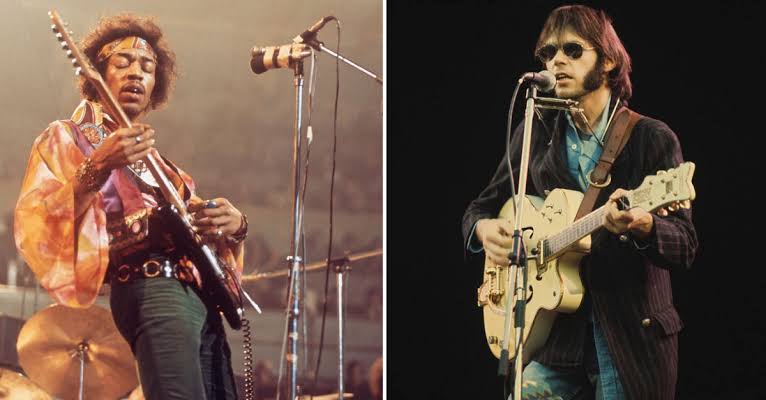
When Jimi Hendrix began performing in London, it did not take long for people to recognise that they were witnessing something extraordinary. He was not only a remarkable guitarist but also a captivating performer who transformed the electric guitar into an instrument of limitless possibilities. His fearless improvisation, theatrical stage presence, and unconventional playing style challenged everything audiences thought they knew about live rock music.
Even established guitarists found themselves amazed by what Hendrix could do.
Jeff Beck, one of the most respected guitarists of his generation, recalled feeling almost embarrassed when he first watched Hendrix perform.
“I was embarrassed because I thought, ‘God, that should be me up there’,” Beck admitted.
Although Beck had already begun establishing himself as a major talent, Hendrix showed him an entirely different approach to performing. His confidence, energy, and raw musical instinct were unlike anything Beck had experienced.
“I just hadn’t had the guts to come out and do it so flamboyantly, really,” he explained. “He just looked like an animal, played like an animal, and everybody went crazy.”
It was a powerful reminder that Hendrix was not simply playing guitar. He was creating an experience that audiences could feel as much as hear.
Neil Young Explains What Made Hendrix So Extraordinary
Hendrix’s mainstream career lasted only a few short years before his death in 1970, but his influence has continued for more than five decades. His innovative use of distortion, feedback, and improvisation permanently changed the possibilities of the electric guitar.
For generations of musicians, he remains the standard against which other guitarists are measured.
Neil Young, himself an influential guitarist and songwriter, has offered a compelling explanation for Hendrix’s lasting reputation. Reflecting on his extraordinary abilities, Young praised the way Hendrix seemed to become completely connected to his instrument.
“He was excellent. He was one with his instrument,” Young said.
He continued by explaining just how far Hendrix had pushed the boundaries of electric guitar playing.
“At that time, no one had pushed the electric guitar so far, and that goes for today, too. He was over everybody. Totally gone. So fluid, using the feedback to create such beautiful things. For a guitar fan like me, it was a revelation.”
Young’s words capture something essential about Hendrix’s genius. His playing was not simply about speed, technical precision, or playing the loudest notes. He could make the guitar scream, sing, cry, and drift into sounds that seemed almost impossible to control.
Rather than treating feedback as an unwanted noise, Hendrix turned it into an expressive musical tool. He explored the instrument’s possibilities with an imagination that continues to inspire musicians today.
For Young, witnessing that level of creativity was a revelation.
Why We Often Overlook Great Guitarists Outside Rock
Young’s admiration for Hendrix also raises an interesting question: when people discuss the greatest guitarists of all time, why do the same names so often dominate the conversation?
Jimi Hendrix, Jeff Beck, Jimmy Page, Eddie Van Halen, and Slash are frequently mentioned among the most influential guitarists in rock history. Their contributions are undeniable, and each helped shape the sound and direction of modern music.
However, the conversation often remains centred on rock guitarists.
Rock music naturally lends itself to spectacular guitar performances. Distorted tones, powerful solos, high-volume amplification, and dramatic stage shows make technical ability immediately noticeable. Guitarists can command an audience through sheer energy and virtuosity.
But guitar greatness does not belong to one genre.
In folk, jazz, blues, classical, and other musical traditions, guitarists have developed equally impressive ways of expressing themselves. Their abilities may be less theatrical, but they can be just as sophisticated, emotionally powerful, and innovative.
Neil Young recognised this distinction. He understood that measuring every guitarist by the standards of rock music overlooks musicians whose brilliance lies in a different approach to the instrument.
One of the musicians he held in particularly high regard was British folk guitarist Bert Jansch.
Bert Jansch: The Acoustic Guitarist Neil Young Compared to Hendrix
Although Bert Jansch did not perform with Hendrix’s explosive stage presence or electric sound, his acoustic guitar playing possessed a distinctive power of its own.
Jansch became a major figure in the British folk scene during the 1960s. His intricate fingerpicking, unusual tunings, inventive arrangements, and expressive songwriting helped expand the possibilities of acoustic guitar music.
His self-titled debut album, released in 1965, established him as an exceptional musician. The record demonstrated how a single acoustic guitar could create rich musical textures without relying on elaborate production or a full band.
For Neil Young, Jansch’s talent was comparable to Hendrix’s, even though the two musicians worked in very different musical worlds.
“As for acoustic guitar, Bert Jansch is on the same level as Jimi. That first record of his is epic,” Young said.
He was particularly moved by Jansch’s song “The Needle of Death,” a haunting composition addressing the devastating consequences of drug addiction.
“It came from England, and I was especially taken by ‘The Needle of Death’, such a beautiful and angry song. That guy was so good…”
Young’s description is revealing. He did not praise Jansch merely for his technical ability. He recognised the emotional intensity, originality, and musical depth behind his work.
Like Hendrix, Jansch could make his instrument communicate feelings that words alone could not fully express. The difference was in how he achieved it: Hendrix explored the electric guitar’s explosive sonic possibilities, while Jansch discovered extraordinary depth within the delicate sound of an acoustic instrument.
Both approaches demanded imagination, sensitivity, and a profound understanding of music.
How Bert Jansch Influenced Neil Young’s “Ambulance Blues”
Young’s admiration for Jansch went beyond simply listening to his records. The British guitarist’s music also influenced Young’s own songwriting.
Young revealed that Jansch’s “The Needle of Death” played a direct role in shaping the guitar part of “Ambulance Blues,” a song from his 1974 album On the Beach.
“And years later, on On the Beach, I wrote the melody of ‘Ambulance Blues’ by styling the guitar part completely on ‘Needle of Death’,” Young explained.
The connection offers a fascinating glimpse into how musicians learn from one another. Inspiration does not always come from artists who share the same genre, instrument, or performance style. Sometimes, a quiet acoustic song can influence a rock musician as profoundly as an electrifying concert performance.
Young’s acknowledgment also highlights Jansch’s importance beyond the British folk scene. His intricate playing and emotionally charged songwriting reached musicians across the Atlantic, helping shape the work of artists whose music sounded very different from his own.
For listeners familiar with On the Beach, Young’s comments provide another reason to revisit “Ambulance Blues” and consider the folk influences woven into his distinctive guitar style.
Great Guitar Playing Is About More Than Speed
The comparison between Hendrix and Jansch illustrates an important truth about musical greatness. There is no single formula for becoming an extraordinary guitarist.
Hendrix expanded the electric guitar’s vocabulary through feedback, distortion, improvisation, and fearless experimentation. Jansch demonstrated how acoustic fingerpicking, inventive arrangements, and emotionally direct songwriting could achieve a similar level of artistic distinction.
Neither approach diminishes the other.
Their music reminds us that virtuosity is not always about playing the fastest notes or delivering the most spectacular solo. It can also mean finding a unique voice, creating a memorable melody, or making a simple instrument express complicated human emotions.
Neil Young’s praise for both musicians reflects an appreciation of guitar playing that extends beyond conventional rankings. He recognised Hendrix’s revolutionary impact while also understanding the extraordinary artistry of a folk guitarist whose work might otherwise be overlooked in conversations dominated by rock legends.
Ultimately, Jimi Hendrix and Bert Jansch approached the guitar from different directions, but both demonstrated how deeply one musician can transform an instrument through imagination and individuality.
And perhaps that is the most meaningful lesson in Young’s comparison: the greatest guitarists are not necessarily those who sound alike, but those who discover something new to say through their music.