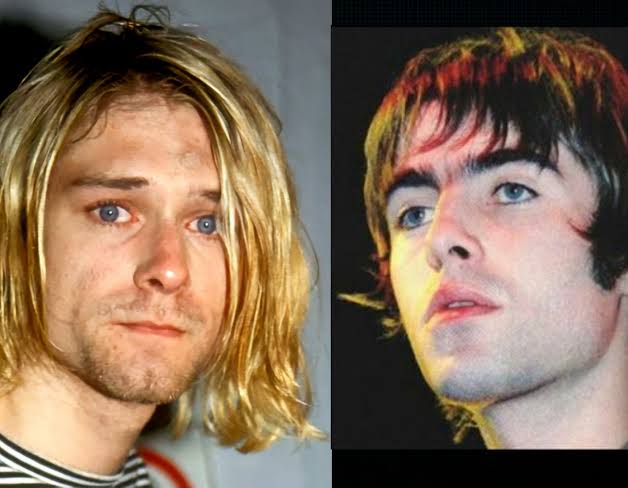
Noel Gallagher and Kurt Cobain came from different musical worlds, yet the Oasis frontman has long felt a surprising connection to the late Nirvana singer. Although Gallagher once viewed Nirvana’s music as the opposite of Oasis’s approach to life, he later revealed that he had always felt a certain affinity with Cobain.
During the height of the grunge movement in the early 1990s, Gallagher wrote Live Forever as a response to the darker themes that dominated some of the era’s music. In a 2013 interview, he explained how Nirvana’s song “I Hate Myself and Want to Die” influenced his thinking.
“At the time it was written in the middle of grunge and all that,” Gallagher recalled. He made it clear that he did not want Oasis to embrace the same outlook, believing that young people needed music that offered hope rather than despair.
Gallagher contrasted Cobain’s public expressions of misery with his own experiences as a struggling musician. Oasis had very little when the band was starting out, but Gallagher remembered those days with excitement and optimism. For him, simply waking up each morning and wondering where life might lead was something worth celebrating.
Despite their different perspectives, however, Gallagher had a personal admiration for Cobain that went beyond music. Speaking to NME in 2017, he revealed several unexpected similarities between them.
“I always had an affinity with him because he was left-handed, he had blue eyes, he was a Gemini and he was into The Beatles and that’s what I was,” Gallagher said.
These seemingly small details helped create a sense of connection with a musician he never had the opportunity to meet.
Gallagher also recalled hearing positive stories about Cobain from people who had encountered him. Mark Coyle, who co-produced Oasis’s debut album Definitely Maybe, had worked with Teenage Fanclub during their tour with Nirvana. When Gallagher asked what Cobain was like, Coyle reportedly described him as a great person who was unpredictable but enjoyable to be around. Members of Teenage Fanclub also spoke highly of him.
Sadly, Gallagher never got the chance to meet Cobain himself.
“I’m gutted that he died before I met him, I’d have loved to have shot the fucking shit with him,” he told NME.
Although their musical approaches differed, Gallagher held deep respect for the lasting influence of Nirvana and other groundbreaking artists. He argued that truly great albums do not lose their relevance with time. Nirvana’s Nevermind, the Sex Pistols’ Never Mind the Bollocks, Here’s the Sex Pistols, and the La’s self-titled album were among the records he believed continued to sound fresh long after their release.
For Gallagher, Nirvana’s Nevermind still sounded like the future of rock music. He made a similar point about the Stone Roses’ “Fools Gold,” explaining that certain recordings remain contemporary because of something that cannot necessarily be planned or manufactured.
He applied the same idea to Oasis’s Definitely Maybe, suggesting that the enduring quality of a great record often happens naturally rather than by design.
Cobain’s death in 1994 remains one of rock music’s most devastating losses. His career was still in its early stages, leaving fans to wonder what other music he might have created and how his artistic journey could have developed.
In some ways, Oasis and Nirvana occupied comparable cultural positions in their respective countries. Their sounds were different, but both became voices for a generation of young people who wanted music that reflected their experiences, frustrations and hopes. Each band helped define a wider cultural movement and left an influence that extended far beyond its songs.
Ultimately, Noel Gallagher’s relationship with Kurt Cobain was built on a fascinating mixture of differences and similarities. Gallagher rejected the despair he associated with some of Nirvana’s music, yet admired Cobain as a person and respected the timeless power of his work.
Their stories are a reminder that musicians do not have to share the same philosophy or artistic vision to recognise something meaningful in one another. Sometimes, the strongest connections exist between people who see the world differently but share a genuine love for music.