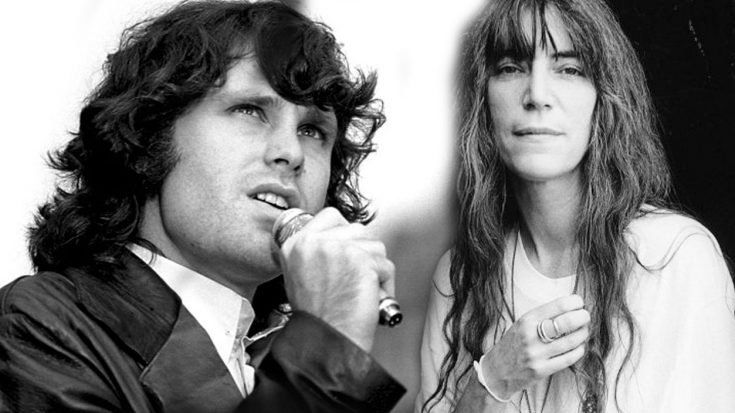
Patti Smith and Jim Morrison may have come from different corners of the rock world, but they shared something deeper than music: a powerful connection to poetry, performance, and the raw spirit of rock ’n’ roll.
Smith, often celebrated as the Godmother of Punk, has long admired Morrison for his distinctive stage presence and poetic approach to music. Although some critics dismissed his work as juvenile, his combination of rebellious energy, vivid imagery, and intense performances helped make him one of rock’s most enduring figures. For Smith, however, Morrison represented something even more personal—the possibility that someone like her could find a place in rock music.
“I Could Do That”: The Moment That Inspired Patti Smith
During a Q&A with CBS about her memoir Just Kids, Smith recalled seeing The Doors perform live in 1967. As she watched Morrison onstage, she experienced an unexpected feeling that she struggled to explain.
“I went to see Jim Morrison in 1967 and I was sitting there thinking I could do that,” Smith recalled. “I also was a little embarrassed that I thought that. It’s not that I wasn’t inspired, I just felt this strange kinship.”
At the time, Smith was simply a young woman from South Jersey working in a bookstore. She had not yet established herself as a public performer, and the idea that she might one day become a rock singer was far from certain.
“I was just a girl from South Jersey working in a bookstore,” she explained. “I don’t know why I thought that. It was a mystery to me.”
Smith was quick to clarify that her reaction was not about believing she could outperform Morrison. Rather, she felt an unusual connection to him—one that made performing rock music suddenly seem possible.
“Of course, I admired him and still do,” she added. “Jim Morrison was one of our great poets and unique performers, his body of work will always endure.”
That moment became an important part of Smith’s personal journey. Sometimes, seeing another artist express themselves with complete freedom can awaken something that has been quietly waiting inside us. Morrison’s performance appeared to give Smith a glimpse of a future she had not previously considered.
An Unexpected Meeting at a Doors Party
Smith’s connection to Morrison did not end with that first experience of watching him perform. Several years later, in the early 1970s, she unexpectedly met the legendary singer at a party in New York.
At the time, Smith was still writing poetry privately and had not yet become the celebrated punk icon she would eventually be known as. She later recalled attending press parties for rock bands, although she was not particularly interested in the social scene.
Her reason for attending was surprisingly practical: the free food.
“I did meet Jim Morrison once,” Smith explained. “Just once, it was the early 1970s, probably around ’70s and they used to have press parties for rock bands and sometimes the rock bands would be there and we never had enough food so I would go to these because there was lots of free food.”
She even brought a bag so she could take food home for herself and her friend Robert Mapplethorpe, the photographer and artist who played an important role in her early life.
Unlike the glamorous image often associated with rock-star parties, Smith remembered these gatherings mainly as an opportunity to collect something to eat without having to participate in the socializing she disliked.
The Doors’ party, however, was particularly appealing because of the way the food was arranged.
“The Doors party was cool,” she recalled. “Because they had all these long tables with all the food and then you went into the party, so the food was first.”
“The Hamburgers Are Really Good Too”
While Smith was filling her bag with food for herself and Mapplethorpe, she suddenly heard a voice offering a recommendation.
“I had this big bag and I’m getting all this food for me and Robert, and I hear this voice going, ‘The hamburgers are really good too,’” she remembered.
When she looked toward the voice, she noticed a man sitting alone at the far end of the room.
It was Jim Morrison.
The encounter was wonderfully ordinary. There was no dramatic introduction, no grand conversation about poetry, and no elaborate exchange between two future icons of music. Instead, Morrison simply pointed out that the hamburgers were worth trying.
Smith responded by walking over and taking a hamburger from the man whose performance had once made her imagine a future in rock ’n’ roll.
The moment offers a charming contrast to Morrison’s larger-than-life reputation. Known for his intense stage presence, poetic lyrics, and rebellious image, he was also simply a man sitting at a party, talking about the food.
A Connection That Went Beyond Music
Looking back, Smith’s memories of Morrison reveal why artistic influence can be difficult to explain. She did not describe their connection as a formal mentorship or a close friendship. Instead, she spoke of a strange sense of kinship that began when she watched him perform.
Morrison showed her that rock ’n’ roll could be more than entertainment. It could be poetry, self-expression, and a way for someone who had never imagined themselves onstage to discover a new possibility.
Smith would eventually develop a distinctive artistic identity of her own, combining poetry, punk rock, and an uncompromising approach to performance. Her work would influence generations of musicians and help reshape the role of women in rock music.
Her brief meeting with Morrison may not have changed the course of rock history on its own, but it remains a memorable anecdote connecting two artists whose work blurred the boundaries between poetry and music.
Sometimes, the most meaningful moments in rock history happen far away from the stage. For Patti Smith, one of those moments began with a feeling of kinship while watching Jim Morrison perform—and continued years later with a simple recommendation about hamburgers at a party.
It is a reminder that inspiration can arrive in unexpected ways, and that even the smallest encounters can become unforgettable pieces of music history.