The day I sold Mama’s house for $214,000, my husband came home with a brand-new red pickup truck and announced that I was paying for it.
“Your mama would’ve wanted me to have something nice,” Delmas said, patting the hood.
I looked at the truck, then at my sixty-eight-year-old husband.
“Well, it sure is red.”
He laughed because he thought I’d agreed.
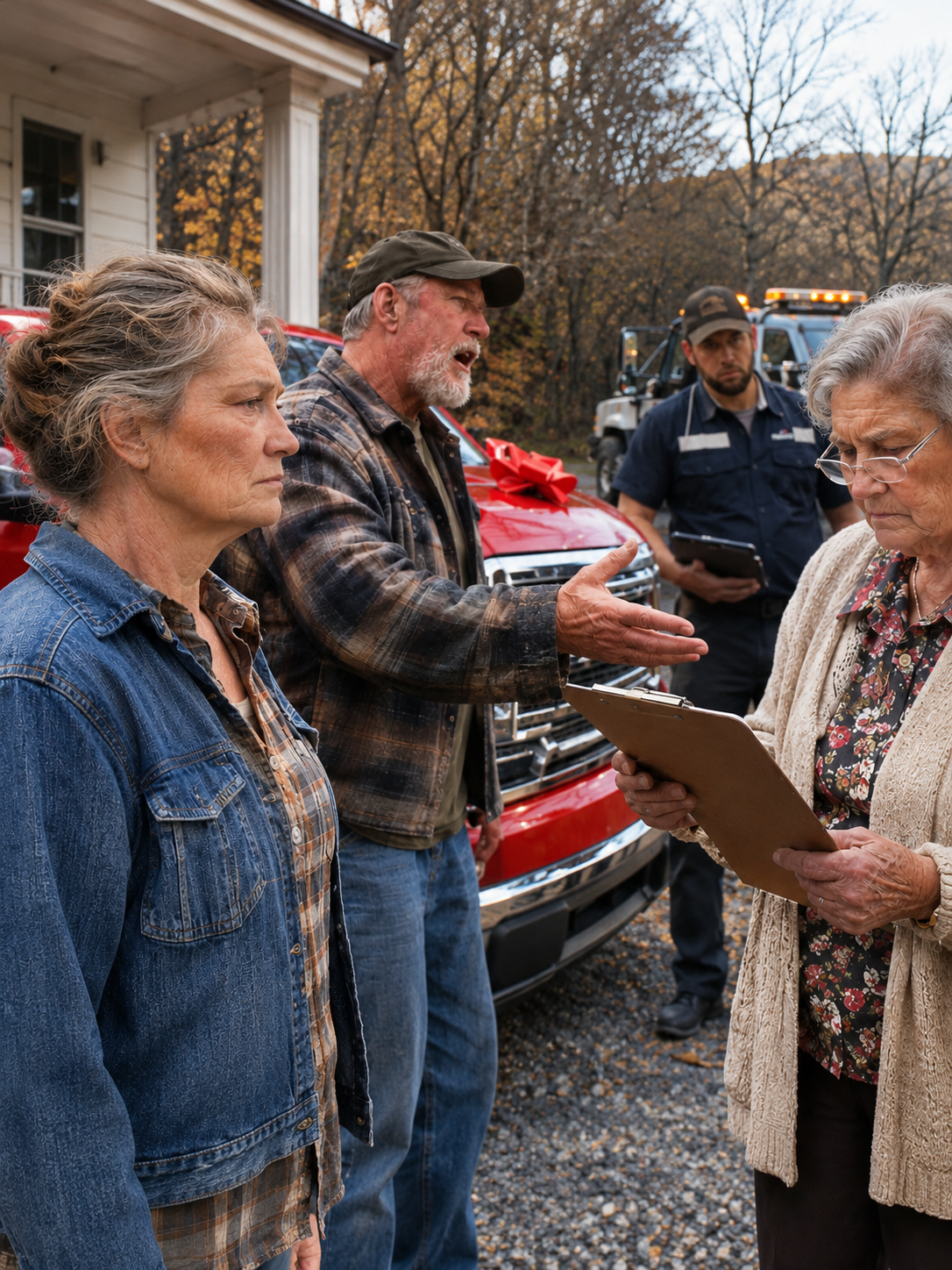
He wasn’t laughing three days later when a tow truck pulled into his mother’s driveway and his eighty-nine-year-old mother asked to see the paperwork.
Mama’s house sat outside Whitesburg, Kentucky, at the end of a narrow road that followed a creek. It was a little white farmhouse with a tin roof, a crooked front porch, and forty acres of woods behind it. I’d grown up there, scraped my knees on those porch steps, and watched my father teach my brothers how to split firewood.
Mama lived there until she was ninety-one. She passed away in March, peacefully, in the same bedroom where she’d slept for most of her life.
She left the property to me alone.
I was sixty-six, and I’d been married to Delmas for forty-four years. I worked in an upholstery shop in Hazard for most of my adult life, repairing furniture for people who often had more money than they knew what to do with. Delmas worked construction until his back gave him trouble. We had never been rich, but we’d always managed.
When the closing papers were signed, the money was transferred into an account in my name. I sat in the parking lot afterward and cried. I wasn’t crying because of the money. I was crying because Mama’s house was no longer mine to walk into whenever I wanted.
I thought I’d have a quiet evening when I got home.
Instead, there was a brand-new red pickup in my driveway.
It had leather seats, chrome wheels, a large touchscreen, and a white bow stretched across the hood. Delmas stood beside it with the biggest grin I’d seen on his face in years.
“Surprise, Stell!”
I set my purse down.
“What’s all this?”
“My new truck.”
I walked around it slowly.
“How much?”
“Sixty-eight thousand.”
I turned toward him.
“Sixty-eight thousand dollars?”
He shrugged.
“It’s a good truck. I’ve driven old ones my whole life. Figured I deserved something decent before I get too old to enjoy it.”
I looked at him carefully.
“And how are you paying for it?”
He pointed toward me.
“Your mama’s money.”
I stared at him.
“My mama’s money?”
“Well, we’re married, aren’t we? What’s yours is mine. Besides, your mama would’ve wanted me to have something nice after all these years.”
That nearly made me laugh.
Mama had tolerated Delmas for forty-four years, but she never trusted him with a dollar. She once told me that if he ever borrowed her lawn mower, she’d check the oil before letting him leave.
I looked at the truck again.
“Did you already buy it?”
“Signed everything this morning. They let me take it home. The money’s due Friday.”
I felt my stomach tighten.
“You signed a contract before talking to me?”
“Don’t start, Stell. It’s just a truck.”
I didn’t argue. I had learned over the years that arguing with Delmas often meant listening to him explain why I was being unreasonable.
So I went inside, washed my hands, and started making supper.
But that night, I barely slept.
—
The following afternoon, my neighbor Juanice stopped by.
She worked in the office at the dealership in Hazard. The previous year, when she was going through chemotherapy, I’d driven her to appointments in Corbin several times. We had never discussed repayment. That’s just what neighbors did where we lived.
She came through my back door and sat at the kitchen table.
“Stell, I need to tell you something, and I don’t want you thinking I’m trying to cause trouble.”
I poured her some coffee.
“What happened?”
She lowered her voice.
“Delmas bought that truck yesterday. He told the dealership you’d be bringing in the sixty-eight thousand dollars by Friday.”
I stared at her.
“I never agreed to that.”
“I know. That’s why I’m here. I checked the paperwork because something didn’t sound right. Your name isn’t on the purchase agreement, and you haven’t signed anything promising to pay.”
“So what happens Friday?”
“If the payment isn’t made, they’ll follow the agreement they have with him. The dealership can arrange to recover the truck.”
I sat quietly.
Juanice reached across the table.
“Stell, don’t let anybody pressure you into spending your mother’s inheritance on something you never agreed to buy.”
After she left, I stood at the kitchen sink for a long time.
I wasn’t angry about the truck itself. I was hurt that Delmas had treated my inheritance as if it belonged to him before I’d even had time to grieve my mother.
For forty-four years, I’d put our family first. I’d worked, saved, repaired clothes instead of buying new ones, and gone without things so we could keep our bills paid.
Now, the one thing Mama had left me was being treated like a prize Delmas had already won.
I thought about calling the dealership and telling them everything.
Instead, I waited.
—
Friday came and went.
I didn’t go to the bank.
Delmas didn’t ask me for the money. He spent most of the day driving around town in that red truck, waving to people and showing off the leather seats.
That evening, I heard him on the phone outside.
“She’s sorting it out,” he said. “The money will be there Monday.”
I stood in the kitchen holding a dish towel.
He hadn’t even bothered to ask me.
Saturday was supper at his mother’s house, as it had been for years. His mother, Ethelene, lived on Pine Branch Road. She was eighty-nine, small and sharp-eyed, and still cooked every Saturday in the same black skillet she’d owned since before Delmas was born.
Delmas insisted on driving the new truck.
He parked it directly in front of her porch, making sure it was visible from every window.
At supper, he talked about it constantly.
“It’s got heated seats, Mother. You wouldn’t believe how comfortable they are.”
Ethelene passed him the potatoes.
“Must’ve cost a pretty penny.”
“Sixty-eight thousand.”
She stopped serving the potatoes.
“Where’d you get that kind of money?”
Delmas glanced at me.
“Stell’s mama left us some. We’re finally doing something nice for ourselves.”
I put down my fork.
“Your mama left it to me, Delmas.”
He gave a little laugh.
“Don’t get technical.”
Ethelene looked from him to me.
“Did you ask Stell before buying that truck?”
Delmas shifted in his chair.
“We’re married, Mother.”
“That wasn’t what I asked.”
He cleared his throat and changed the subject.
I didn’t say anything else.
We were halfway through dessert when a diesel engine rumbled outside.
A flatbed tow truck slowly backed into the driveway.
Delmas stood so quickly that his chair scraped across the floor.
“What in the world?”
He rushed outside.
A young man in a dealership shirt stepped down from the tow truck with a clipboard.
“Mr. Delmas? We’re here about the red pickup.”
Delmas pointed at the truck.
“That’s mine!”
“Sir, the payment wasn’t received by the agreed date. We tried reaching you this morning.”
“My wife is paying for it!”
I walked onto the porch, carrying my coffee.
“Delmas, I never said I was paying for that truck.”
He turned toward me, his face red.
“Stell! Don’t do this in front of everybody!”
The dealership employee looked uncomfortable.
“Ma’am, we just need to follow the agreement. The purchase is in his name.”
Before I could answer, Ethelene stepped onto the porch.
“Give me that paper.”
The young man handed her the clipboard.
She put on her glasses, adjusted them twice, and read the first page slowly.
Then she looked at her son.
“You told me Stell agreed to pay for this.”
Delmas rubbed the back of his neck.
“She was going to. We discussed it.”
“No, you didn’t,” I said quietly.
Ethelene continued reading.
“Did you tell them you had the money?”
Delmas said nothing.
She turned another page.
“Did you sign this yourself?”
“Yes, Mother.”
“And you expected your wife to pay a bill she never agreed to?”
“It’s family money!”
Ethelene lowered the paperwork.
“No, son. It’s her mother’s inheritance.”
Nobody spoke.
Then she looked at the dealership employee.
“Is there anything in this agreement that says this woman owes you money?”
The young man shook his head.
“No, ma’am. The agreement is with Mr. Delmas.”
Ethelene handed the papers back.
“Then you have your answer.”
Delmas stared at her.
“Mother, you’re taking their side?”
She looked him straight in the eyes.
“I’m taking the side of what’s right.”
—
The dealership employee explained that the truck would be returned under the terms of the agreement. Delmas argued for several minutes, but the paperwork was clear. He had signed the contract, and the payment he promised had never arrived.
The tow operator began preparing the truck.
Delmas turned toward me.
“You’re really going to let them take it?”
I looked at him.
“You bought it without asking me. You told people I was paying. You spent money that wasn’t yours, and now you want me to rescue you from the decision you made.”
“I thought you’d help me!”
“I’ve helped you for forty-four years. But helping you doesn’t mean letting you spend my mother’s inheritance without my permission.”
He looked away.
Then Ethelene said something that made him go completely still.
“Delmas, your father worked thirty-seven years to keep this family out of debt. He drove an old truck until the floorboards rusted through. He never once demanded that I sell something my mother left me so he could show off in town.”
Delmas shook his head.
“Mother, that’s different.”
“No, it isn’t.”
She pointed toward the red truck.
“You wanted people to think you could afford something expensive. But you didn’t want to pay for it yourself. That’s not a birthday present, son. That’s pride.”
He looked like he wanted to argue, but his mother wasn’t finished.
“Your wife buried her mother this year. She sold the house she grew up in. Maybe you ought to have asked how she was feeling before you started shopping with her grief.”
I looked down.
Those words reached somewhere I hadn’t been able to explain.
For the first time that evening, Delmas stopped talking.
The truck was loaded onto the flatbed.
He stood in the driveway watching it disappear down the road.
—
The ride home was quiet.
When we reached our house, Delmas went straight to the bedroom. I remained in the kitchen, taking off my coat and putting the coffee cups in the sink.
A little later, he came back.
“Stell.”
I turned.
“I’m sorry.”
I waited.
“I got carried away. I’ve wanted a new truck for years. When your mama’s house sold, I thought we could finally afford something nice.”
“You could have asked me.”
“I know.”
“You didn’t even give me time to think about what I wanted to do with the money.”
He sat down.
“I thought you’d understand.”
I looked at him for a long moment.
“Delmas, I spent forty-four years making sure we had enough. I didn’t buy things without talking to you. I didn’t treat your money like it was mine to spend whenever I felt like it. Why did you think you could do that to me?”
He rubbed his hands together.
“I don’t know.”
I sat across from him.
“I didn’t sell Mama’s house because I wanted to become rich. I sold it because I couldn’t keep it up anymore. Every room reminded me of her. I cried in that title office because I knew I’d never walk through that front door again.”
My voice broke.
“And you came home with a truck.”
He lowered his head.
“I didn’t think about it that way.”
“That’s what hurts.”
For a long time, neither of us spoke.
Then he reached across the table and held my hand.
“I should’ve asked.”
“Yes,” I said. “You should have.”
—
The next morning, Ethelene called.
“Stell, I hope you don’t mind me speaking plainly.”
“Go ahead.”
“I owe you an apology. I knew my son could be stubborn, but I didn’t realize he’d gone and done something like that.”
“You don’t owe me anything.”
“Yes, I do. I should’ve asked more questions before believing what he told me.”
She paused.
“And I want you to know something. That money belongs to you. Don’t let anybody make you feel guilty for keeping it.”
I thanked her.
Then she said something I never expected.
“Your mama raised a sensible woman. Don’t forget that just because you’ve been married a long time.”
After we hung up, I went to my bedroom and opened the little wooden box where I’d kept Mama’s old photographs.
I found one of her sitting on the porch, wearing her faded blue dress, with one hand resting on the arm of her chair.
I smiled.
“You’d have had something to say about that truck, wouldn’t you, Mama?”
I could almost hear her answer.
—
Delmas never bought another sixty-eight-thousand-dollar truck.
He eventually purchased a used pickup he could afford, and this time he made sure the payments fit his own budget. We had some difficult conversations afterward, but they were conversations we should have had years earlier.
I kept Mama’s inheritance in my own account. I used part of it to repair my roof, paid off a small debt, and put the rest into savings.
I also took a little money and bought a wooden porch swing.
I had it installed at our house because Mama always said a home needed somewhere to sit and watch the evening go by.
Sometimes Delmas joins me there.
He doesn’t always say much, but he’s learned to ask before making decisions that affect both of us.
And I learned something too.
Being married for forty-four years doesn’t mean you have to surrender every boundary. Loving somebody doesn’t mean they get to make decisions with what belongs to you.
Mama left me a house, forty acres, and $214,000.
But the most valuable thing she left me wasn’t the money.
It was the reminder that I was still allowed to stand up for myself.
And the day that red truck left on the back of a tow truck, I finally did.