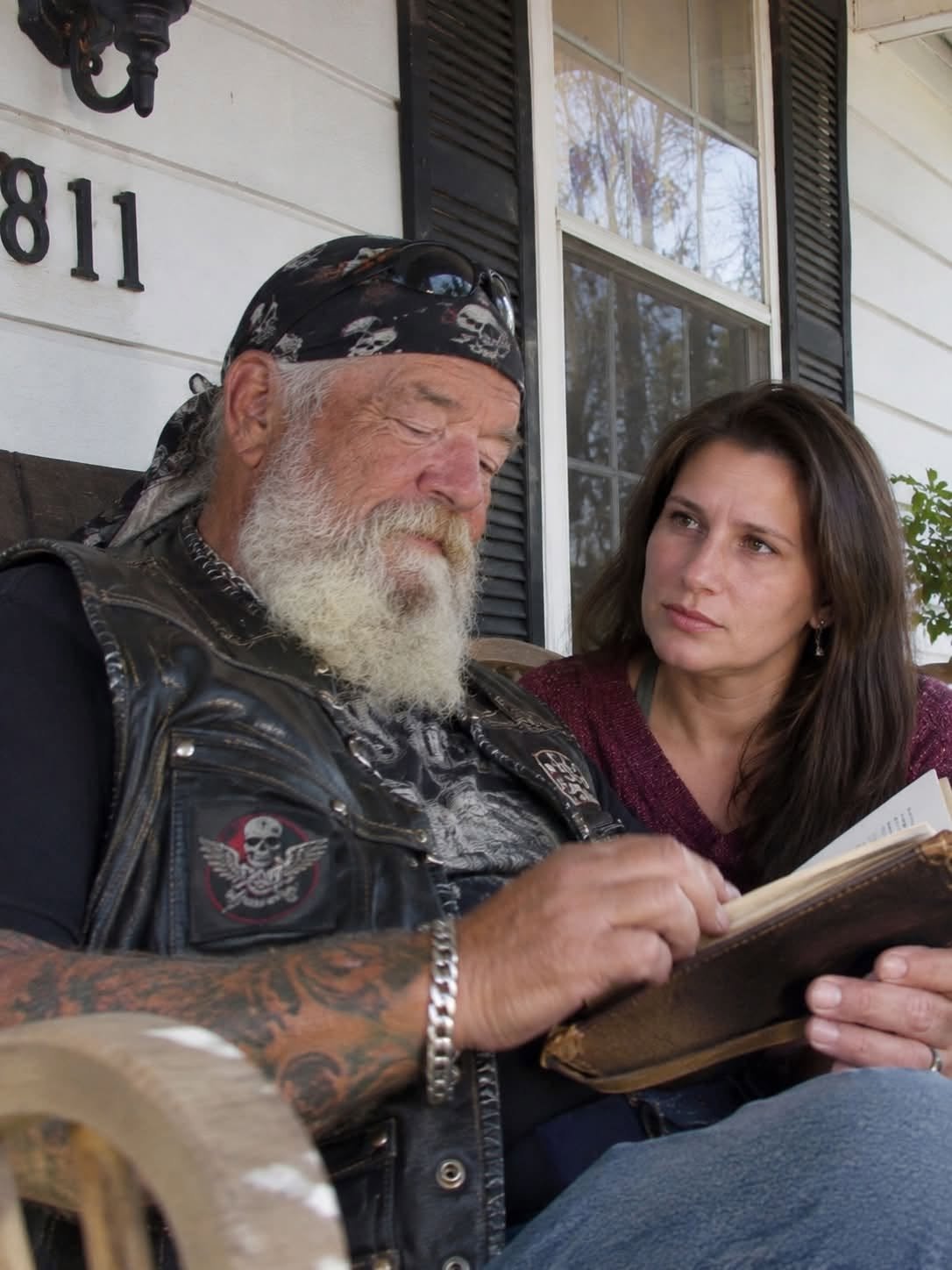
My brother called from the airport and laughed.
“We left Dad on your porch. He’s your responsibility now.”
He had no idea our father was sitting beside me with the phone on speaker. Dad heard every word, but he didn’t argue or ask my brother to come back.
Instead, my seventy-eight-year-old outlaw biker father calmly opened his old leather checkbook and said, “Take me to my estate attorney before their flight lands.”
My brother thought Dad was too old to understand what was happening. He assumed he could leave him with me, enjoy his vacation in Florida, and continue controlling the family arrangements as usual.
What he didn’t understand was that our father had been quietly watching everything for months. He knew about the questions concerning his property, the requests for financial information, and the conversations that happened whenever someone thought he wasn’t listening.
And that afternoon, he decided he was finished allowing other people to make decisions about his life.
My name is Claire Brooks, and my father is Walter Brooks. Most people who meet him today see an old man with a gray beard, a stiff left knee, and hands that sometimes shake when he tries to button his shirt.
But that isn’t how I remember him.
For most of my childhood, Dad was the biggest man in any room. He rode a Harley-Davidson, wore a black leather vest covered in old club patches, and belonged to a motorcycle club called the Iron Wolves. His arms were covered in tattoos, his voice could make a room go quiet, and he had a reputation for never walking away when someone needed help.
He was never a perfect father. He worked long hours, spent weekends riding with his brothers, and sometimes came home later than he promised. But he made sure we had a roof over our heads, food on the table, and a father who showed up when things mattered.
My mother, Eleanor, was the gentler one. She kept the family organized, remembered birthdays, and somehow managed to make our modest house feel warm even when money was tight.
My older brother, Mark, was always Dad’s favorite riding companion. He learned to work on motorcycles in our garage and eventually became the person Dad trusted with many of his business and financial arrangements.
I was younger, and I moved away after getting married. I lived about twenty minutes from Dad, while Mark lived closer and visited him more frequently.
When Mom died, everything changed.
Dad became quieter. He stopped riding as often, although he still kept his Harley in the garage and occasionally took it out with one of his old club brothers. The house that had once been full of family dinners became a place where he watched television alone and ate whatever was easiest to prepare.
Mark gradually took over more of Dad’s daily responsibilities. He helped with appointments, checked the bills, and arranged transportation when Dad didn’t feel comfortable driving.
At first, I was grateful.
I thought my brother was doing what a good son should do.
I didn’t realize that somewhere along the way, helping Dad had started to look more like controlling him.
### The morning my brother left Dad on my porch
That Monday started like any other.
I was carrying groceries from my car when Mark called. Dad was sitting on my porch swing, wearing his blue shirt and old black leather vest. He had come over after a cardiology appointment because Mark had promised to take him home afterward.
I thought my brother was calling to tell me they were running late.
Instead, he laughed.
“We left Dad on your porch. He’s your responsibility now.”
I stopped walking.
“What are you talking about?”
“We’re at the airport. We’re flying to Florida.”
“Mark, you were supposed to take him home.”
“Plans changed.”
“Then why didn’t you call me before leaving him here?”
“We just did.”
I looked toward Dad. He was staring at the wooden floorboards beneath his boots.
I couldn’t believe what I was hearing.
“You left him without his overnight bag?”
“He’s got everything he needs at your place.”
“His medication is in that bag, Mark.”
There was a pause.
Then I heard his wife, Melissa, laughing in the background.
“Claire, please don’t start. We have a flight to catch.”
I tightened my grip on the phone.
“At least come back and bring his things.”
Mark sighed.
“We’re already through security. You’ll manage.”
Then he said something that made my stomach turn.
“Good luck looking after the old man.”
The call ended.
I stood there holding the groceries, feeling as though someone had dropped a heavy stone into my chest.
Dad hadn’t moved.
I walked over and sat beside him.
“Are you all right?”
He nodded.
“I’m fine.”
“I’m sorry, Dad.”
He looked at me.
“You didn’t leave me here.”
I asked where his medication was.
“In Mark’s car.”
“What about your overnight bag?”
“Same place.”
I reached for my phone.
“I’m calling him back.”
Dad placed his hand over mine.
“No.”
“He’s your son, Dad. He can’t just leave you without your medication.”
“I know what he did.”
“Then let me tell him to come back.”
Dad looked toward the street.
“Claire, I don’t want to spend another afternoon begging someone to do something they should have done without being asked.”
He reached into the inside pocket of his leather vest and pulled out an old checkbook. Its brown leather cover was worn around the corners. My mother had bought it for him many years earlier, and he had carried it through countless business meetings.
He opened it, checked a small piece of paper tucked inside, and closed it again.
“Take me to William Bennett’s office.”
I looked at him.
“Your estate attorney?”
“Yes.”
“Today?”
“Before their flight lands.”
I studied his face.
He wasn’t shouting. He wasn’t trembling with anger. He looked disappointed, but there was something else in his expression.
Determination.
“Are you sure, Dad?”
He nodded.
“I’ve been putting this off long enough.”
### The drive to the attorney’s office
Before leaving, I contacted Dad’s pharmacy and arranged an emergency supply of his medication. I also called his doctor’s office to confirm what he needed that afternoon.
Then I helped him into my car.
During the drive, he barely spoke.
We passed a gas station where Dad used to stop after weekend rides. He pointed toward an old diner near the highway.
“Your mother and I used to eat breakfast there.”
I smiled.
“I remember. You always ordered too much.”
“Your mother said I ate like I was feeding the entire motorcycle club.”
For a moment, he almost laughed.
Then his expression changed.
“She wouldn’t believe what has happened to this family.”
I kept my eyes on the road.
“What do you mean?”
He looked out the window.
“Your mother trusted people easily. She believed that if you raised children with love, they’d remember that love when you got old.”
He paused.
“I believed it too.”
I didn’t know what to say.
After a few minutes, he continued.
“Mark has been making decisions for me. At first, I appreciated the help. I didn’t want to keep asking you children to drive me everywhere. But lately, he doesn’t ask anymore. He tells me what’s happening.”
“Why didn’t you tell me?”
“Because I didn’t want you two fighting.”
“You’re our father. We should know.”
He looked at me.
“I know. I made that mistake.”
Then he told me something I hadn’t expected.
Mark had been asking him to sell the old motorcycle workshop outside town.
It was a small property Dad had purchased decades earlier. There was a garage, a storage building, and enough land for several motorcycles to park. He had spent years repairing bikes there with his Iron Wolves brothers.
Mark said the property was becoming too expensive to maintain.
He suggested selling it and placing the money into an investment account that he could manage.
Dad had refused.
Mark had become irritated.
He told Dad that he was getting too old to understand property values and that he needed to let someone younger handle the complicated decisions.
I felt anger rising.
“That workshop means everything to you.”
Dad nodded.
“Your mother used to bring us sandwiches there. Your brother learned to change a tire in that garage. I’ve had some of my happiest days in that place.”
“Then you shouldn’t sell it.”
“I’m not planning to.”
He looked down at his hands.
“But that’s not the only thing Mark has been asking about.”
### The blue folder
William Bennett had been our family’s attorney for more than thirty years.
He had handled my parents’ property purchase, helped Dad establish his business, and prepared the estate documents after Mom died.
His office was on the second floor of an old brick building.
When we arrived, the receptionist recognized Dad immediately.
“Mr. Brooks! We weren’t expecting you.”
“I know. Is William available?”
She called his office.
A few minutes later, William appeared in the hallway. He was in his seventies, wore a brown suit, and had a silver watch that Dad had once helped him repair.
“Walter, what brings you here?”
Dad shook his hand.
“I need to review my estate documents.”
William looked at me.
“Would you like Claire to stay?”
“Yes. She stays.”
We entered his office.
William offered Dad water and asked whether he was comfortable. Then he began explaining that he represented Dad alone and that any decisions would need to be made freely, without pressure from family members.
He asked Dad several questions to confirm that he understood his property, finances, and the purpose of the documents.
Dad answered clearly.
Then he explained what had happened that morning.
He repeated Mark’s exact words.
“We left Dad on your porch. He’s your responsibility now.”
William stopped writing.
“Did your son know you were being left without your medication?”
“Yes.”
“Did he arrange for someone to bring your overnight bag?”
“No.”
William took off his glasses.
“Has anything like this happened before?”
Dad thought about it.
“Not exactly like this. But there have been other things.”
William opened a drawer and removed a blue folder.
“Walter, before we make any changes, there’s something I think you should know.”
He turned several pages.
“Your son contacted this office three times recently.”
Dad sat straighter.
“About what?”
“The first time, he asked for a summary of your trust and property holdings. He said he was helping you organize your financial affairs because you were becoming overwhelmed by paperwork.”
Dad frowned.
“I never asked him to do that.”
William nodded.
“The second time, he asked whether your trust could be amended to give him authority over certain property decisions. He said the family was concerned that you might need assisted living soon.”
Dad looked at me.
I felt a cold feeling spread through my chest.
He had never told us he wanted to move into assisted living.
William turned another page.
“The third request was more concerning. Mark asked whether some of your assets could be transferred into an account managed by the family, supposedly to make it easier to pay your expenses.”
Dad stared at the folder.
“Did he tell you I had agreed?”
“He suggested that you had.”
“Did you believe him?”
“No. I told him I needed to speak directly with you before considering any changes.”
Dad leaned back.
For several seconds, he said nothing.
Then he asked:
“Did he ask about the workshop?”
William nodded.
“Yes. He asked whether it could be sold without requiring your personal involvement.”
Dad looked at the attorney.
“Can it?”
“Not under the documents currently in place. You remain the owner, and your approval is required.”
Dad nodded slowly.
“Good.”
I looked at him.
“Dad, why didn’t you tell me any of this?”
He answered quietly.
“Because I kept thinking he’d stop.”
### The decisions my father made
William explained that Dad had every right to review his estate plan and change any outdated financial authorizations.
He also explained something important.
Being seventy-eight did not mean Dad had lost the right to make his own decisions. Unless a court had determined otherwise, he remained legally entitled to control his property and finances.
Dad understood.
He asked William to review all existing powers of attorney, account authorizations, and trust arrangements.
They went through everything carefully.
Dad decided to revoke an outdated financial authorization that allowed Mark to assist with certain matters. He wanted to appoint an independent professional to help manage complicated financial transactions, while keeping his own decision-making authority.
He also instructed William to make sure that the motorcycle workshop could not be sold or transferred without his direct approval.
Then came the estate plan.
William explained that Dad could decide how his assets would be distributed after his death, subject to the law and the terms of the relevant accounts and trusts.
Dad took his time.
He asked questions.
He read every page.
He didn’t simply sign because someone placed a document in front of him.
Eventually, he made his decisions.
He wanted the old workshop preserved for as long as it could reasonably be maintained. He wanted his grandchildren to receive educational support. He wanted his medical and living expenses covered. He also wanted both his children treated fairly, but he did not want anyone rewarded for pressuring him or attempting to control his property.
William prepared the necessary documents and explained the consequences.
Dad signed after reviewing them.
When we finished, William placed the papers in a folder.
“Walter, I want you to understand that these documents do not solve every family problem. But they make your wishes clear.”
Dad nodded.
“That’s all I want.”
Before we left, he asked William to send formal notice of the changes to anyone whose previous authority had been revoked.
He wanted everything documented properly.
There would be no secret arrangements and no arguments about what he had supposedly said.
### The call from Florida
We stopped at a restaurant on the way home.
Dad ordered a steak, mashed potatoes, and iced tea.
He was halfway through his meal when my phone rang.
It was Mark.
I looked at Dad.
He nodded.
“Answer it.”
I put the phone on speaker.
“Hello?”
“Claire, where’s Dad?”
“He’s with me.”
“Why isn’t he answering his phone?”
“Maybe because he doesn’t feel like talking.”
Mark sighed.
“Listen, we need you to look after him until we get back. Our flight was expensive, and we’re not changing it.”
I looked at Dad.
He continued eating.
“Mark, his medication was in your car.”
“I’ll send it over when we get back.”
“He needed it today.”
“You’re making this into a bigger problem than it is.”
Then Dad put down his fork.
“Mark.”
There was silence.
“Dad?”
“Yes.”
“Where are you?”
“Having dinner.”
“Why are you with Claire?”
“Because she invited me.”
Mark sounded irritated.
“Well, that’s good. Listen, we had to leave quickly. Melissa found a good deal on the flights, and we didn’t want to lose the money.”
Dad looked at his plate.
“You could have asked me before leaving.”
“We thought you’d be fine with Claire.”
“Did you ask her?”
Mark paused.
“No.”
“Did you make sure I had my medication?”
“Dad, we’ll sort it out.”
“That’s what you keep saying.”
Mark’s voice became louder.
“What’s that supposed to mean?”
Dad took a slow breath.
“It means you don’t get to make decisions about my life simply because you happen to be the person who drives me to appointments.”
There was silence.
Then Mark asked:
“What are you talking about?”
“I went to see William Bennett today.”
I could hear the change in Mark’s breathing.
“Why?”
“To review my estate documents.”
“What did he tell you?”
“He told me about your three visits to his office.”
Mark didn’t answer.
Dad continued.
“He told me about the requests concerning my trust, the workshop, and the accounts.”
Mark finally spoke.
“I was trying to help you.”
“Then why didn’t you ask me?”
“Because you don’t understand how complicated these things are anymore.”
Dad looked directly at the phone.
“I understand perfectly well when someone tries to take control of something that belongs to me.”
“That’s not what I was doing.”
“Then you shouldn’t have a problem with the documents William has prepared.”
Mark’s voice changed.
“What documents?”
“The ones that make sure my decisions remain my decisions.”
“You’re letting Claire get involved in this?”
Dad shook his head.
“Claire didn’t make these decisions. I did.”
Mark became angry.
“You’re going to regret this, Dad.”
Dad didn’t raise his voice.
“No, son. I regret waiting this long to have this conversation.”
Then he ended the call.
I stared at him.
He picked up his fork.
“Your steak’s getting cold,” he said.
### The brother who came home angry
Mark returned from Florida four days later.
He called me before he even went to Dad’s house.
“You need to stay out of this.”
I was standing in my kitchen.
“Out of what?”
“Whatever you’ve been telling Dad.”
“I haven’t told him anything he didn’t already know.”
“He’s changed his legal documents.”
“Yes. He did.”
“He’s revoked my financial authorization.”
“Yes.”
“Do you understand what that means?”
I took a breath.
“It means Dad wants to manage his own affairs.”
Mark became furious.
“I’ve spent years helping him. I’ve taken him to appointments. I’ve handled his bills. I’ve spent my weekends making sure he’s all right. And now he’s treating me like a criminal.”
I felt my voice rising.
“Then maybe you should ask yourself why he feels he needs to protect himself.”
Mark hung up.
That evening, he went to Dad’s house.
I was there because I had brought groceries and helped put away his medication.
When Mark walked through the front door, Dad was sitting in his recliner.
“Hello, son.”
Mark didn’t sit down.
“What have you done?”
Dad looked at him.
“Good evening to you too.”
“Why did you change your documents?”
“Because I wanted to.”
“You can’t just cut me out of everything.”
“I haven’t cut you out of my life.”
“You know what I mean.”
Dad pointed toward the chair.
“Sit down.”
Mark remained standing.
Dad looked at him for a moment.
Then he said something I had never heard him say before.
“Mark, I am still your father. I am not your business opportunity.”
My brother’s face changed.
“That’s not fair.”
Dad continued.
“You have helped me. I appreciate the appointments, the groceries, and the paperwork. I have never denied that. But helping your father does not mean you own his decisions.”
Mark shook his head.
“You think I wanted your money?”
“I don’t know what you wanted. That’s why I asked William to review everything.”
“I was trying to protect you.”
“Then why did you leave me on your daughter’s porch without my medication?”
Mark looked at me.
“Claire could have handled it.”
Dad raised his voice slightly.
“Stop using your sister as an excuse.”
The room became quiet.
Dad leaned forward.
“You had a flight to catch. I understand that. But you could have called her before leaving. You could have arranged my medication. You could have brought my bag inside. You could have asked whether I was comfortable staying there.”
Mark looked down.
Instead of doing those things, he had laughed.
Dad’s voice softened.
“Do you know what hurt me most?”
Mark didn’t answer.
“It wasn’t that you left me at Claire’s. I love my daughter. I was safe here.”
Dad paused.
“It was hearing you talk about me as though I was something you wanted to get rid of.”
Mark finally sat down.
### The workshop and the old photographs
For several minutes, nobody spoke.
Then Dad got up slowly and walked toward the hallway.
“Come with me.”
He led Mark and me into the garage.
His old Harley stood near the workbench. It was a black touring motorcycle with worn leather saddlebags and chrome that Dad polished whenever his hands were steady enough.
Beside it was an old wooden cabinet.
Dad opened the cabinet and removed a photograph.
It showed him standing beside the first motorcycle he had owned. He was younger, with dark hair and no gray beard. Mom was standing beside him, smiling.
Mark picked it up.
“I remember this.”
Dad nodded.
“Your mother hated that motorcycle.”
He laughed softly.
“She said it was too loud and that I spent more time cleaning it than cleaning the house.”
For a moment, the three of us smiled.
Then Dad took another photograph from the cabinet.
It showed Mark as a little boy, sitting on a motorcycle with his father holding the handlebars.
Mark stared at it.
“I was about eight.”
“Seven,” Dad corrected.
“You promised you’d teach me to ride.”
“And I did.”
Mark smiled faintly.
Dad placed the photograph on the workbench.
“Do you remember why I bought this workshop?”
Mark nodded.
“So you could work on the bikes.”
“Partly. But I also wanted a place where people could come when they needed help.”
Dad explained that over the years, several club members had fallen on hard times. One had lost his job. Another had been injured in an accident. The workshop had become a place where they could repair motorcycles, share tools, and sometimes find temporary work.
It wasn’t simply a property.
It was part of Dad’s life.
“Your mother used to bring food here,” he said. “She knew half the men by their first names. She never liked the noise, but she liked knowing people had somewhere to go.”
Mark looked at the photograph.
“I didn’t know you still cared about this place so much.”
Dad shook his head.
“You never asked.”
That sentence seemed to settle over the garage.
### The truth Mark finally admitted
Mark returned to Dad’s house the following week.
This time, he came alone.
He asked whether they could talk privately.
I offered to leave, but Dad asked me to stay.
Mark sat at the kitchen table.
He looked exhausted.
“I want to explain something.”
Dad nodded.
“Go ahead.”
Mark rubbed his forehead.
“I’ve been under a lot of pressure.”
Dad waited.
Mark explained that he and Melissa had taken out a loan to renovate their house. They had also invested in a small business that hadn’t performed as expected. Their monthly expenses had become difficult to manage.
He had started looking at Dad’s property as a way to simplify things.
At first, he told himself he was only trying to organize the estate. Then he began imagining what selling the workshop might accomplish.
He said he had convinced himself that Dad didn’t need the property anymore.
“I thought it would make sense to sell it now rather than leave everything complicated later.”
Dad listened.
Then he asked:
“Did you tell me about your financial problems?”
Mark shook his head.
“No.”
“Why?”
“Because I didn’t want you worrying.”
Dad looked at him.
“But you were willing to make decisions about my property without telling me.”
Mark lowered his eyes.
“I know.”
Dad leaned back.
“Son, if you needed help, you could have asked.”
Mark’s eyes filled.
“I didn’t want you to think I had failed.”
Dad was quiet for a moment.
Then he said:
“I would rather have a son who admits he’s struggling than a son who tries to take control of his father’s life because he’s embarrassed.”
Mark wiped his eyes.
“I’m sorry.”
Dad nodded.
“I hear you.”
But he didn’t immediately say everything was forgiven.
Instead, he explained that the legal changes would remain in place. Mark would no longer have authority over his financial affairs. If Dad needed help, he would decide who helped him and under what conditions.
Mark accepted that.
He also agreed to repay a few personal expenses he had charged to an account Dad had allowed him to use for household purchases. The amounts were reviewed and documented with the attorney so there would be no confusion later.
It wasn’t a dramatic confession involving millions of dollars.
It was a family problem that had grown because one person had stopped being honest.
And Dad wanted it handled honestly.
### The day the Iron Wolves came to visit
A few weeks later, Dad’s old motorcycle club brothers came to the workshop.
There were seven of them.
Some were in their sixties. Others were older. They arrived on motorcycles, parked near the garage, and walked inside carrying coffee and sandwiches.
Their club president, a man named Raymond, had known Dad for more than forty years.
He looked at Dad.
“Word is you’ve been having trouble with your family.”
Dad smiled.
“Word travels too fast.”
Raymond looked at Mark.
Then back at Dad.
“We’re not here to interfere. We just wanted to check on you.”
Dad nodded.
“I appreciate it.”
They spent the afternoon talking about old rides, broken engines, and friends who were no longer around.
At one point, Raymond noticed Mark standing near the workbench.
He walked over and shook his hand.
“Your father taught you to work on engines, didn’t he?”
Mark nodded.
“He did.”
Raymond smiled.
“Then you know he doesn’t give up on something just because it gets difficult.”
Mark looked at his father.
“I know.”
Before leaving, Raymond handed Dad a small envelope.
Inside was a photograph of the Iron Wolves from an old charity ride.
Dad studied it.
“Look at all those young fools.”
Raymond laughed.
“Most of us still are.”
Dad placed the photograph beside the one of Mom.
That evening, he seemed lighter than he had in months.
### What happened to the estate
Dad’s legal arrangements remained in place.
The workshop stayed under his ownership. His accounts were reviewed, and an independent professional helped him with the financial matters he no longer wanted to handle alone.
He also arranged a clear plan for medical care and transportation.
He wanted both Mark and me involved in his life, but neither of us would have automatic control over his decisions.
His estate plan was updated to reflect his wishes. He made reasonable provisions for both children and established a separate fund to help his grandchildren with education and future needs.
He also included a provision for the maintenance of the workshop, so it could continue serving its original purpose for as long as the estate could reasonably support it.
There was no secret fortune hidden in the garage and no magical document that made one child wealthy overnight.
Dad had worked hard for what he owned, and he wanted those things handled responsibly.
The biggest change was not the money.
It was that everyone finally understood he was still in charge of his own life.
### Thanksgiving at Dad’s house
That November, Dad invited us all for Thanksgiving.
I arrived early to help prepare the food.
Mark arrived with Melissa and their children. He carried a pumpkin pie and a large bag of groceries.
For a moment, I wondered whether the day would become uncomfortable.
Then I saw Dad standing near the kitchen wearing his old leather vest.
“You’re late,” he told Mark.
Mark smiled.
“Traffic.”
Dad pointed toward the table.
“Then get those potatoes peeled.”
We laughed.
Dinner was not perfect.
The turkey was a little dry, the gravy was too thick, and one of the children spilled cranberry sauce on the tablecloth.
But nobody cared.
After dinner, Dad asked everyone to stay at the table.
He reached into a drawer and took out an old photograph of Mom.
He placed it in the middle.
“Your mother loved Thanksgiving,” he said.
We all looked at the photograph.
“She used to say that a family doesn’t have to agree about everything. But it should remember how to sit together.”
Dad looked at Mark.
Then he looked at me.
“I’ve made mistakes as a father. I worked too much. Sometimes I didn’t listen. Sometimes I thought providing money was the same as providing time.”
He paused.
“But I never stopped loving either of you.”
Mark looked down.
Dad continued.
“I don’t want my children fighting over my property while I’m still sitting at the table. I don’t want anybody making plans for my funeral while I’m still making plans for breakfast.”
A few of us laughed quietly.
Then Dad’s expression became serious.
“I am getting older. I know that. I need help sometimes. But I still have a mind, and I still have a voice. I expect you to respect both.”
Mark nodded.
“I understand, Dad.”
Dad looked at him.
“Do you?”
Mark stood.
He walked around the table and placed a hand on his father’s shoulder.
“I’m sorry I left you at Claire’s that day. I’m sorry I made you feel like a burden. And I’m sorry I tried to handle things without asking you.”
Dad looked up at him.
For a moment, I thought he might tell him to sit down.
Instead, he reached up and held his son’s hand.
“You’re still my boy.”
Mark began crying.
Dad pulled him into a hug.
It wasn’t a dramatic movie moment. Nobody applauded. Nobody suddenly forgot what had happened.
But it was a beginning.
### The old man who still rode
The following spring, Dad took his Harley out of the garage.
His knee still hurt, and he no longer rode long distances. He had spoken with his doctor and made sure he was fit enough for a short ride.
Mark came over to help him prepare the motorcycle.
I watched from the garage door.
“Where are you going?”
Dad smiled.
“Just around the old roads.”
Mark helped him with his helmet.
“Want me to come with you?”
Dad looked at him.
“Only if you can keep up.”
Mark laughed.
They rode together for a short distance, with Mark following behind.
When they returned, Dad was smiling like the young man in the old photograph.
He removed his helmet and looked at me.
“Not bad for an old man.”
I shook my head.
“You’re impossible.”
He laughed.
That afternoon, he asked me to bring him the photograph of Mom.
He placed it on the workbench beside the motorcycle.
“She would have liked seeing us all together again,” he said.
I nodded.
“She would.”
Then he looked at me.
“Claire, I want you to remember something.”
“What?”
“Never confuse someone needing help with someone losing their dignity.”
I looked at him.
He continued.
“One day, you might need help getting out of bed. You might need someone to drive you to the doctor. You might need someone to handle your bills. None of that means you stop being the person you were before.”
He picked up his old leather gloves.
“Getting old changes what you can do. It doesn’t change what you deserve.”
### The last Thanksgiving lesson
Dad is still living in his own house.
He has help when he needs it, and his medical appointments are arranged properly. Mark visits regularly, but he no longer makes decisions without asking. I help with groceries and household tasks, and the three of us communicate more openly than we did before.
The old workshop remains standing.
Sometimes Dad’s former club brothers gather there. Sometimes Mark joins them. Sometimes I bring lunch and listen to their stories, even though half of them seem to begin with the words, “You wouldn’t believe what happened on that ride.”
Dad still wears his leather vest.
The patches are faded, and the leather has softened with age. But he says he has no intention of replacing it.
Last Thanksgiving, I found him sitting alone on the porch.
I brought him a cup of coffee and sat beside him.
“Thinking about Mom?”
He nodded.
“She would have been happy today.”
I looked toward the kitchen, where Mark was helping his children set the table.
“Things are better now.”
Dad smiled.
“They are.”
Then he looked at me.
“Do you remember what I said when Mark left me on your porch?”
I nodded.
“You said you wanted to see William before their flight landed.”
Dad laughed.
“I remember.”
He looked down at his hands.
“I was angry that day. More disappointed than angry. But I wasn’t going to let one bad afternoon decide the rest of my life.”
He took a sip of coffee.
“I could have spent the next few years punishing your brother. I could have made every family gathering miserable. I could have used my money to make him suffer.”
He looked at me.
“But what would that have fixed?”
I didn’t answer.
Dad continued.
“I wanted him to understand that he had hurt me. I wanted him to take responsibility. And I wanted him to remember that I was his father, not a responsibility he could pass around.”
I rested my head against his shoulder.
Inside the house, Mark called out that dinner was ready.
Dad stood slowly.
Then he offered me his arm.
“Come on, sweetheart. Your mother would be upset if we let the food get cold.”
We walked inside together.
There was a place at the table for everyone.
And there was a photograph of Mom in the middle, just as Dad had requested.
I looked around at my family.
We had not become perfect people. We still had disagreements, old wounds, and things we needed to work on. But we were finally learning to speak honestly before resentment turned into something worse.
My brother had once laughed and told me our father was my responsibility.
He had believed an old man with a gray beard and a bad knee was no longer capable of standing up for himself.
He was wrong.
Dad didn’t need a motorcycle to prove he was still strong. He didn’t need to shout, threaten, or use his money to control anyone.
He simply needed to remember that his life still belonged to him.
And perhaps the most important thing he taught us was that forgiveness doesn’t mean pretending someone never hurt you. It means giving them a chance to take responsibility, while still protecting yourself from being hurt the same way again.
That Thanksgiving, my seventy-eight-year-old outlaw biker father sat at the head of the table, held my brother’s hand, and thanked everyone for coming.
Then he raised his glass.
“To family,” he said. “Not because we’re perfect, but because we still have a chance to do better.”
And for the first time in a long while, everyone at the table raised a glass with him.
**My brother once thought our father was too old to make his own decisions. But the day he left Dad on my porch, he learned that getting older doesn’t mean becoming powerless. Our father didn’t need someone to take control of his life. He needed his family to remember that he was still a father, still a man, and still deserving of respect.**