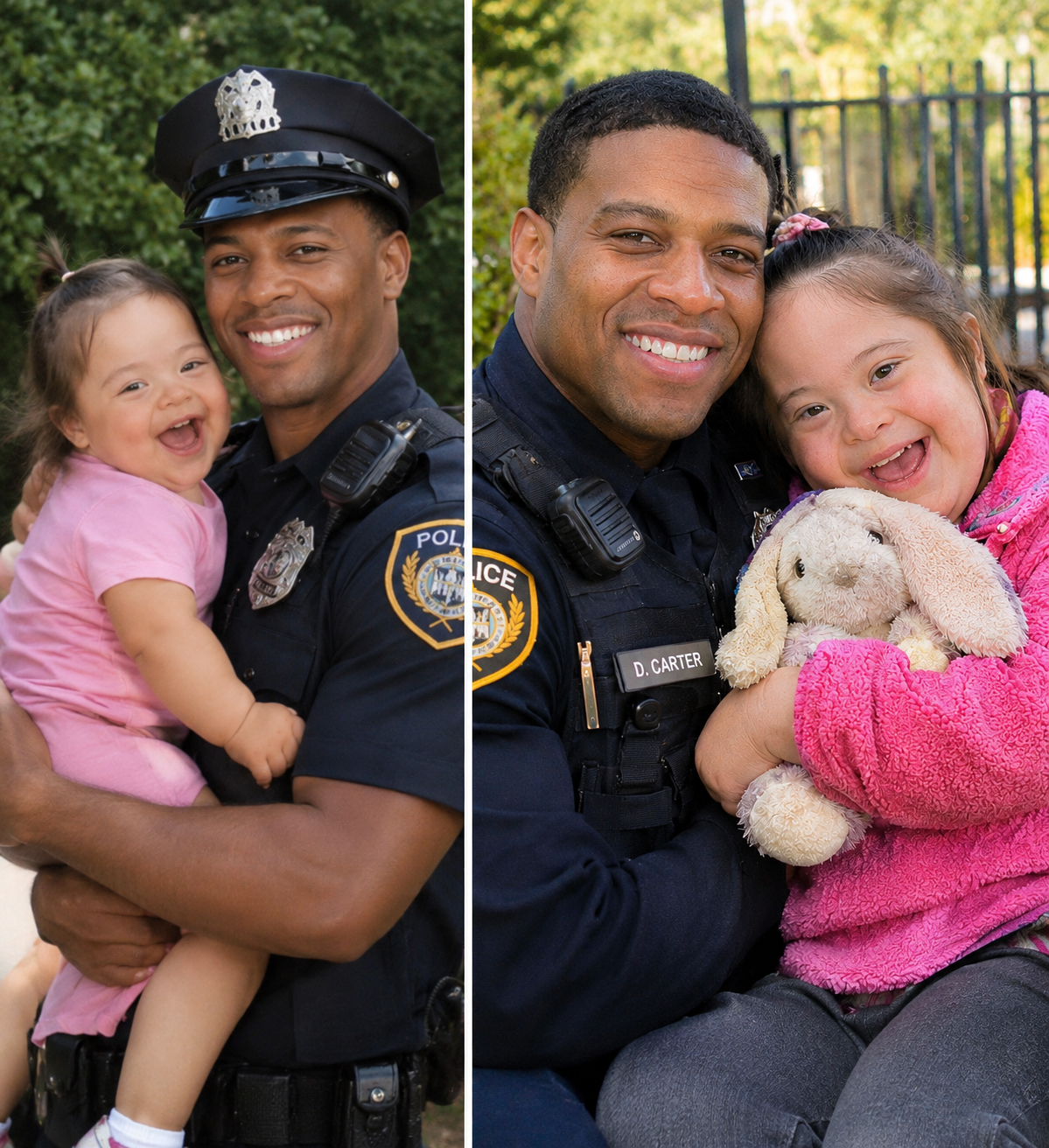
When Officer Marcus Reed first met six-year-old Olivia Carter, she was sitting alone in a corner of a children’s care center in Cleveland, Ohio, holding a worn-out stuffed rabbit against her chest.
Other children were playing nearby. Some were drawing, others were building towers with colorful blocks, and a little boy was laughing as a volunteer pushed him around in a toy car. Olivia watched them quietly, occasionally smiling when someone looked her way, but she rarely joined in.
She had Down syndrome, and she needed a little extra time to communicate, learn new things, and feel comfortable around unfamiliar people. She also had a mild hearing impairment, which sometimes made conversations difficult in noisy rooms. None of that meant she couldn’t learn, laugh, make friends, or dream about her future. She simply needed people to be patient with her.
But patience was something she hadn’t received very often.
Marcus was a police officer with the Cleveland Division of Police. He had volunteered at the center through a community outreach program, helping with school-supply donations and family-support events. He wasn’t there looking for a child to adopt. He had no idea that a brief conversation with a little girl holding a stuffed rabbit would eventually change the direction of his life.
He approached her slowly and sat on a small chair nearby.
“Hello there. What’s your rabbit’s name?”
Olivia looked at him, then down at the toy.
“Mr. Buttons,” she answered.
Marcus smiled.
“That’s a very important name. Is he your best friend?”
She nodded.
“He’s my friend when nobody plays with me.”
Marcus looked toward the other children. Then he looked back at Olivia.
“Well, I think Mr. Buttons and I might have something in common. I’m pretty good at making friends.”
She studied his uniform.
“Are you a police officer?”
“I am.”
“Do you catch bad people?”
“Sometimes. But I also help people when they need someone.”
Olivia looked at him for a moment.
“Can you help me?”
Marcus leaned forward.
“Of course. What do you need?”
She held up Mr. Buttons.
“His ear is coming off.”
Marcus examined the stuffed rabbit. One of its ears was hanging by a few threads.
“That’s serious,” he said, pretending to look concerned. “I think we need to find someone who knows how to sew.”
Olivia smiled.
It was a small smile, but Marcus remembered it long after he left that afternoon.
He returned to the center several times over the following months. He learned that Olivia had been in care since she was very young. Her biological family had been unable to provide the support she needed, and her case had involved several changes in placements. She had spent time with different caregivers, but no permanent family had yet been found.
The staff explained that some prospective families had decided not to proceed after learning about her medical and developmental needs. Others had concerns about the additional time and resources she might require.
Marcus never judged those families. Adoption was a serious commitment, and every child deserved someone prepared to care for them.
But he couldn’t stop thinking about Olivia.
One afternoon, he noticed that she had drawn a picture of a house. There was a large tree beside it, a small dog in the yard, and two people standing near the front door.
“Who’s in the picture?” he asked.
Olivia pointed to the smaller person.
“Me.”
“And who’s the other person?”
She looked at him.
“I don’t know yet.”
Marcus felt something tighten in his chest.
He didn’t make any promises that day. He simply told her that the picture was beautiful and asked whether she wanted another sheet of paper to draw a bigger tree.
But on his drive home, he kept thinking about that empty space beside her.
### The officer who went home to an empty house
Marcus was forty-one years old. He had been a police officer for nearly sixteen years, and he had learned that life rarely followed the plans people made when they were young.
He had been married once, but his wife, Rachel, had died several years earlier after a long illness. They had never had children. After her death, Marcus returned to work because he didn’t know what else to do. His days were filled with calls, reports, traffic stops, and emergencies, but his evenings were often painfully quiet.
He lived in a modest house on the west side of Cleveland. There were family photographs on the walls, a small garden Rachel had planted, and a spare bedroom that had remained unused for years.
He had thought about becoming a foster parent before, but he never felt ready. His work could be demanding, and he worried about whether he could provide the stability a child deserved.
Now, however, he found himself thinking about Olivia.
He spoke with a close friend, Sergeant Daniel Brooks, about what he was considering.
Daniel listened carefully.
“Are you thinking about adopting her?”
Marcus looked down at his coffee.
“I’m thinking about finding out whether I could.”
“That’s a big decision.”
“I know.”
“Your job isn’t always predictable, Marcus. You work nights. You get called in. What happens when she’s sick? What happens when she needs you at school?”
Marcus nodded.
“I’ve thought about that.”
Daniel leaned back.
“I’m not telling you not to do it. I’m asking whether you’re ready to put a child’s needs ahead of your own schedule.”
Marcus looked out the window.
“I spent years coming home to an empty house. I don’t want to adopt a child because I’m lonely. That’s not fair to her. But when I think about Olivia, I don’t just think about how much I want to help her. I think about what she deserves.”
Daniel was quiet.
“Then take the proper steps. Talk to the agency. Get the training. Make sure you understand what you’re taking on.”
Marcus did exactly that.
He contacted the adoption agency, explained his connection to the center, and asked about the appropriate process. Because he had met Olivia through a community program, he made sure the agency handled the situation independently and followed every required safeguard. He completed the background checks, home inspections, training, and assessments.
The process was not quick.
He attended classes about childhood trauma, developmental disabilities, communication, and the emotional challenges children may face after changing homes. He met with specialists and learned about the services Olivia might need.
He also arranged to speak with her teachers and care providers through the proper channels.
One thing became clear: Olivia didn’t need someone to rescue her for a photograph or a newspaper story. She needed someone who would be there when she struggled with homework, someone who would attend appointments, someone who would celebrate her progress without comparing her to other children, and someone who would love her on ordinary days.
Marcus wanted to be that person.
### The question nobody could answer for her
As the adoption process continued, Marcus began spending supervised time with Olivia. He brought books, simple puzzles, and coloring supplies. He learned that she loved butterflies, strawberry yogurt, and songs with a strong rhythm.
She also had a habit of asking the same question whenever he visited.
“Are you coming back?”
At first, Marcus answered carefully.
“Yes, Olivia. I’ll see you again.”
She would nod and return to her drawing.
One afternoon, while they were reading a picture book, she stopped and looked at him.
“Do you have a house?”
Marcus smiled.
“I do.”
“Is it big?”
“Not very.”
“Do you have a dog?”
“Not anymore.”
“Do you have a girl?”
Marcus put the book down.
“What do you mean?”
She pointed toward herself.
“A girl in your house.”
He understood what she was asking.
“Not right now.”
Olivia looked at the book again.
“Oh.”
Marcus didn’t promise that she would live with him. He knew the decision wasn’t his alone, and he didn’t want to give her hope that might later be taken away.
Instead, he said, “I think a home should be a place where people look after one another. What do you think?”
Olivia considered that.
“Somebody should read stories.”
“That’s a good idea.”
“And make pancakes.”
“Definitely.”
“And nobody should throw away Mr. Buttons.”
Marcus smiled.
“That would be a terrible mistake.”
She hugged the stuffed rabbit.
“He’s coming with me everywhere.”
Marcus looked at her.
“Then I think we’ll need to make sure he has a safe place to sit.”
### The home visit
The agency eventually arranged a home visit to assess whether Marcus’s house could meet Olivia’s needs.
He had already made several changes. He installed additional lighting, organized the kitchen so she could reach appropriate items safely, and created a quiet area where she could read or relax. He also spoke with specialists about the support she might require at school and at home.
The spare bedroom became Olivia’s room.
He painted the walls a soft lavender color after learning that it was one of her favorites. He placed a small bookshelf beside the bed, added a comfortable reading chair, and put a night-light shaped like a moon on the bedside table.
But the most important thing was on the wall.
It was a framed drawing Olivia had made during one of their visits. It showed a little house, a tree, and two people standing near the door.
Marcus had asked the agency whether he could keep a copy.
He placed it where she would see it if she ever came home.
When the social worker visited, she asked him what he expected from being a father.
Marcus thought for a long time.
“I don’t expect her to be grateful every day. I don’t expect her to make my life easier. I don’t expect her to become someone different from who she is.”
The social worker waited.
Marcus continued.
“I want her to feel safe enough to be herself. I want her to know she can make mistakes without being afraid that she’ll lose her family. And I want her to have the opportunity to discover what she enjoys and what she’s capable of doing.”
The social worker nodded.
“That’s a good place to start.”
### The day Olivia came home
The adoption process continued through the following months. There were additional reviews, meetings, and conversations about Olivia’s needs and long-term support. Marcus remained patient, even when the waiting became difficult.
Eventually, the agency approved the placement, and the legal process moved forward.
The day Olivia came to live with him, Marcus arrived at the center carrying a small bag.
Inside were a few new clothes, a book about butterflies, and a small stuffed dog.
Olivia looked at the bag.
“What’s that?”
“Something for you.”
She opened it and pulled out the stuffed dog.
She smiled.
“What’s his name?”
Marcus pretended to think.
“That’s a difficult decision. Maybe you should name him.”
She considered it seriously.
“Captain.”
“Captain?”
She nodded.
“Because he’s brave.”
Marcus smiled.
“Then Captain it is.”
She looked around the room.
“Are we going now?”
Marcus nodded.
“Yes, if you’re ready.”
Olivia held Mr. Buttons in one arm and Captain in the other. Then she took Marcus’s hand.
The journey home was quiet at first. She looked out of the car window, watching the buildings and streets pass by. Every few minutes, she asked whether they were getting close.
When they arrived, Marcus opened the front door.
Olivia stood on the porch.
“Is this your house?”
“It is.”
She looked inside.
“Is it my house too?”
Marcus knelt beside her.
“If everything goes as planned, this will be our home. You’ll have your own room, your own things, and a place at the table.”
Olivia looked at him.
“Can I put Mr. Buttons on my bed?”
“Absolutely.”
She stepped inside.
Then she turned around and asked a question that Marcus would remember for the rest of his life.
“Do I have to leave tomorrow?”
Marcus felt his throat tighten.
“No, sweetheart. You don’t have to leave tomorrow.”
She looked at him carefully.
“Or the next day?”
He shook his head.
“We’re building a home together.”
Olivia walked toward the bedroom. When she saw the lavender walls and the little moon light, she stopped.
She looked at the framed drawing.
It was her picture.
The little house.
The tree.
The two people.
She pointed at it.
“That’s my picture.”
Marcus nodded.
“I thought it belonged here.”
Olivia stood quietly for a moment.
Then she put Mr. Buttons on the bed, placed Captain beside him, and turned toward Marcus.
“Can we read a story now?”
He smiled.
“Of course.”
That evening, Marcus read the same butterfly book three times because Olivia kept asking him to start again.
He didn’t mind.
For the first time in years, his house no longer felt empty.
### Learning what being a father really meant
Life did not become perfect after Olivia moved in.
In fact, the first year was full of challenges.
Olivia sometimes struggled with transitions. New environments could overwhelm her, and she needed extra time to understand instructions. She occasionally became frustrated when she couldn’t explain what she wanted. There were nights when she woke up frightened and asked whether Marcus was still in the house.
He learned that being a parent meant listening even when a child couldn’t find the right words.
He learned to keep routines consistent, prepare her for changes, and give her choices whenever possible. He worked with her doctors, therapists, and teachers, making sure she received the support recommended for her individual needs.
He also learned to celebrate things other people might overlook.
The first time Olivia tied her shoes without help, she ran into the kitchen shouting.
“Dad! Look!”
Marcus turned from the stove.
“What happened?”
She lifted her foot.
“I did it!”
He looked at the shoe, then at her face.
“You did!”
She jumped up and down.
“All by myself!”
Marcus clapped.
“That’s my girl.”
Another time, she learned to read a short book aloud. She stopped several times, sounded out difficult words, and looked at Marcus whenever she wasn’t sure.
He never rushed her.
When she finished, she looked up.
“Was I good?”
Marcus smiled.
“You were wonderful.”
She held the book against her chest.
“Can I read it again tomorrow?”
“You can read it as many times as you want.”
Some people in Marcus’s life still questioned his decision.
A relative asked whether he was prepared for the possibility that Olivia might always need additional support. Marcus explained that he understood her needs and had arranged the help she required.
Another person suggested that he had taken on too much.
Marcus didn’t argue.
He simply said, “She’s not a problem I took on. She’s my daughter.”
### The first school meeting
When Olivia started at a new school, Marcus was nervous.
He wanted her to have friends, supportive teachers, and an environment where she could learn at her own pace. He met with the school team and discussed the accommodations and services that would help her participate.
He made one request.
“Please don’t decide what she can do before giving her the opportunity to try.”
Her teacher, Mrs. Williams, nodded.
“We’ll work with her and see what helps.”
The first few weeks were difficult. Olivia was shy and sometimes stayed close to the classroom assistant. She struggled with some group activities, and loud noises occasionally overwhelmed her.
But she also loved art.
She could spend an entire afternoon drawing flowers, butterflies, and houses. She enjoyed music, especially when the teacher allowed the class to use simple instruments.
One day, Marcus arrived to collect her and found her standing near the classroom door.
“Dad!”
He smiled.
“How was school?”
She held up a piece of paper.
“I made something.”
It was a drawing of a police officer standing beside a little girl. Both were smiling.
At the top, she had written two words with help from her teacher.
**MY DAD.**
Marcus stared at it.
He felt his eyes filling.
“That’s me?”
Olivia nodded.
“And that’s you.”
He knelt down.
“I love it, sweetheart.”
She hugged him.
“I told everyone you’re my dad.”
Marcus wrapped his arms around her.
“That’s right. I am.”
### The people who began to see her differently
As Olivia grew, Marcus noticed something that made him both happy and sad.
People often spoke about her disability before they spoke about her personality.
They asked whether she could do something, whether she would ever learn something, or whether Marcus found parenting difficult.
They didn’t always ask what she liked, what made her laugh, or what she wanted to become.
So Marcus began making sure people got to know Olivia as a whole person.
He introduced her to neighbors, took her to community events, and encouraged her interests. He never forced her into situations that overwhelmed her, but he also refused to let other people assume she should be excluded.
Olivia loved visiting the police station during approved family events. She liked the uniforms, the radios, and the bright lights on the patrol cars.
One officer gave her a small toy badge.
She wore it around the house for days.
“Are you a police officer now?” Marcus asked.
She nodded seriously.
“Yes. I’m helping you.”
He laughed.
“Well, I could use a partner.”
As the years passed, Olivia became more confident. She made friends, developed hobbies, and began expressing her opinions more clearly. She still needed support in certain areas, but she was learning and growing in her own way.
Marcus never measured her success against someone else’s timeline.
He measured it by her happiness, confidence, independence, and the progress she made toward her own goals.
### The photograph that told the story
In 2024, a friend took a photograph of Marcus and Olivia during a community event.
Marcus was wearing his police uniform, and Olivia was standing beside him with one arm around his waist.
She was smiling.
The photograph reminded him of the first day they met, when she had sat alone in the corner holding Mr. Buttons.
He placed it beside an older photograph taken shortly after her adoption.
In that earlier picture, Olivia was a little girl sitting in Marcus’s arms, her stuffed rabbit tucked beneath her chin. In the newer one, she was older, smiling confidently beside the man she called Dad.
The pictures were different, but the feeling was the same.
She was home.
One evening, Olivia noticed Marcus looking at the photographs.
“That’s me when I was little.”
He nodded.
“You were.”
“Was I scared?”
Marcus looked at her.
“Sometimes.”
“Was I quiet?”
“Very quiet.”
She thought about it.
“Not now.”
Marcus laughed.
“No. Not now.”
She pointed to the old photograph.
“Did you know I would be your daughter?”
Marcus smiled.
“I hoped I could be.”
She looked at him.
“Why did you choose me?”
He took a breath.
“I didn’t choose you because I thought you would be easy to raise. I chose to become your father because I wanted to give you a family, and because I believed you deserved the same chance every child deserves.”
Olivia looked down at Mr. Buttons, who was now worn and faded from years of being carried around.
Then she said something that made Marcus smile.
“Well, I’m glad you came to meet me.”
He kissed the top of her head.
“So am I, sweetheart.”
### The family they built
By 2025, Marcus and Olivia had developed a life full of ordinary routines.
They cooked breakfast together on weekends. Olivia helped stir pancake batter, although she sometimes added too much flour. Marcus learned to braid her hair more neatly, and she learned how to help him water the garden.
They celebrated birthdays, attended school events, and visited the library. They also had difficult days. Sometimes Olivia became overwhelmed, and sometimes Marcus worried about whether he was making the right decisions.
But they learned together.
Marcus continued working as a police officer, although he arranged his schedule as carefully as possible around Olivia’s needs. He also made sure she had a support network beyond him, including teachers, therapists, trusted relatives, and friends.
He didn’t want her world to depend on one person.
He wanted her to grow up knowing she could build relationships, make choices, and ask for help without feeling ashamed.
One evening, Olivia came into the kitchen carrying a piece of paper.
“Dad, I need you.”
Marcus looked up.
“What’s wrong?”
“Nothing. I need help with my picture.”
He smiled.
“What are we drawing?”
“A family.”
She placed the paper on the table and began drawing a house.
Then she drew two people standing beside it.
Marcus looked at the picture.
“Who’s that?”
“Me.”
“And who’s the other person?”
She looked at him as though the answer should have been obvious.
“You.”
He smiled.
“Where’s Mr. Buttons?”
Olivia added a small rabbit beside them.
“And Captain?”
She drew a little dog.
Marcus laughed.
“That’s quite a family.”
Olivia nodded.
“It’s my family.”
He looked at her drawing and felt grateful for the life they had built.
### What Marcus learned about being a father
Marcus had spent sixteen years wearing a badge. He had responded to emergencies, helped people through difficult situations, and witnessed some of the hardest moments in other families’ lives.
He had once believed that being a good police officer meant knowing how to protect people.
Olivia taught him that protection was only part of it.
Sometimes it meant sitting beside a child who was frightened and waiting until she was ready to speak. Sometimes it meant explaining the same thing five times without becoming impatient. Sometimes it meant attending a school meeting, learning a new routine, or celebrating a small achievement that other people might overlook.
And sometimes it meant answering the same question every night.
“Are you still here?”
For years, Olivia had asked that question before going to sleep.
Marcus always gave her the same answer.
“I’m right here, sweetheart.”
Eventually, she stopped asking.
Not because she no longer needed reassurance, but because she had begun to trust that he would be there.
One evening, while they were getting ready for bed, Olivia looked at the old stuffed rabbit.
“Mr. Buttons is getting old.”
Marcus smiled.
“He’s been through a lot.”
“Can we keep him forever?”
“Of course.”
She thought for a moment.
“Can we keep our family forever too?”
Marcus knelt beside her.
“We’ll keep loving each other for as long as we can.”
Olivia smiled and hugged him.
“Good.”
### The truth behind the photograph
The photograph of Marcus holding Olivia when she was little and standing beside her years later eventually became a symbol of their journey.
People who saw it often focused on the fact that a police officer had adopted a child with Down syndrome.
Marcus understood why the photograph moved people, but he always wanted them to see something more.
He wanted them to see Olivia.
Not simply her diagnosis. Not the challenges she faced. Not the fact that some families had decided they couldn’t meet her needs.
He wanted them to see a young girl who loved butterflies, drew pictures, laughed at silly jokes, enjoyed pancakes, and carried a stuffed rabbit until its ears began falling apart.
He wanted them to understand that she was never less deserving of a family because she had a disability.
And he wanted them to understand that adoption wasn’t a story about a perfect man saving a helpless child.
It was a story about two people whose lives changed when they became a family.
Marcus had given Olivia a permanent home, but she had also given him something he hadn’t expected.
She gave him a reason to hurry home.
She gave him someone to read stories to, someone to teach, someone to celebrate, and someone to love through every ordinary and extraordinary day.
On a quiet evening, Olivia sat beside him on the couch, resting her head against his shoulder.
“Dad?”
“Yes, sweetheart?”
“Do you remember when we met?”
Marcus smiled.
“I do.”
“I had Mr. Buttons.”
“You did.”
“He had a broken ear.”
“He certainly did.”
Olivia looked at him.
“You helped fix it.”
Marcus laughed softly.
“I think we found someone else to sew it.”
She smiled.
“Still, you helped.”
He looked at her.
“I suppose I did.”
Olivia leaned closer.
“Thank you for coming back.”
Marcus put his arm around her.
“Thank you for letting me be your dad.”
She closed her eyes.
And in that moment, Marcus knew that the best thing he had ever done in his life had nothing to do with his uniform, his badge, or the years he had spent serving his city.
It was the decision to keep showing up for one little girl.
Olivia had once asked a police officer to help fix the broken ear of her stuffed rabbit. Years later, she had a father who never stopped showing up, a room that was always hers, and a home where she never had to wonder whether she would be wanted the next day. Marcus didn’t adopt her because he believed her life would be easy. He adopted her because he believed she deserved a family, just like every other child. And she didn’t need to become someone else to deserve it. She only needed to be Olivia.