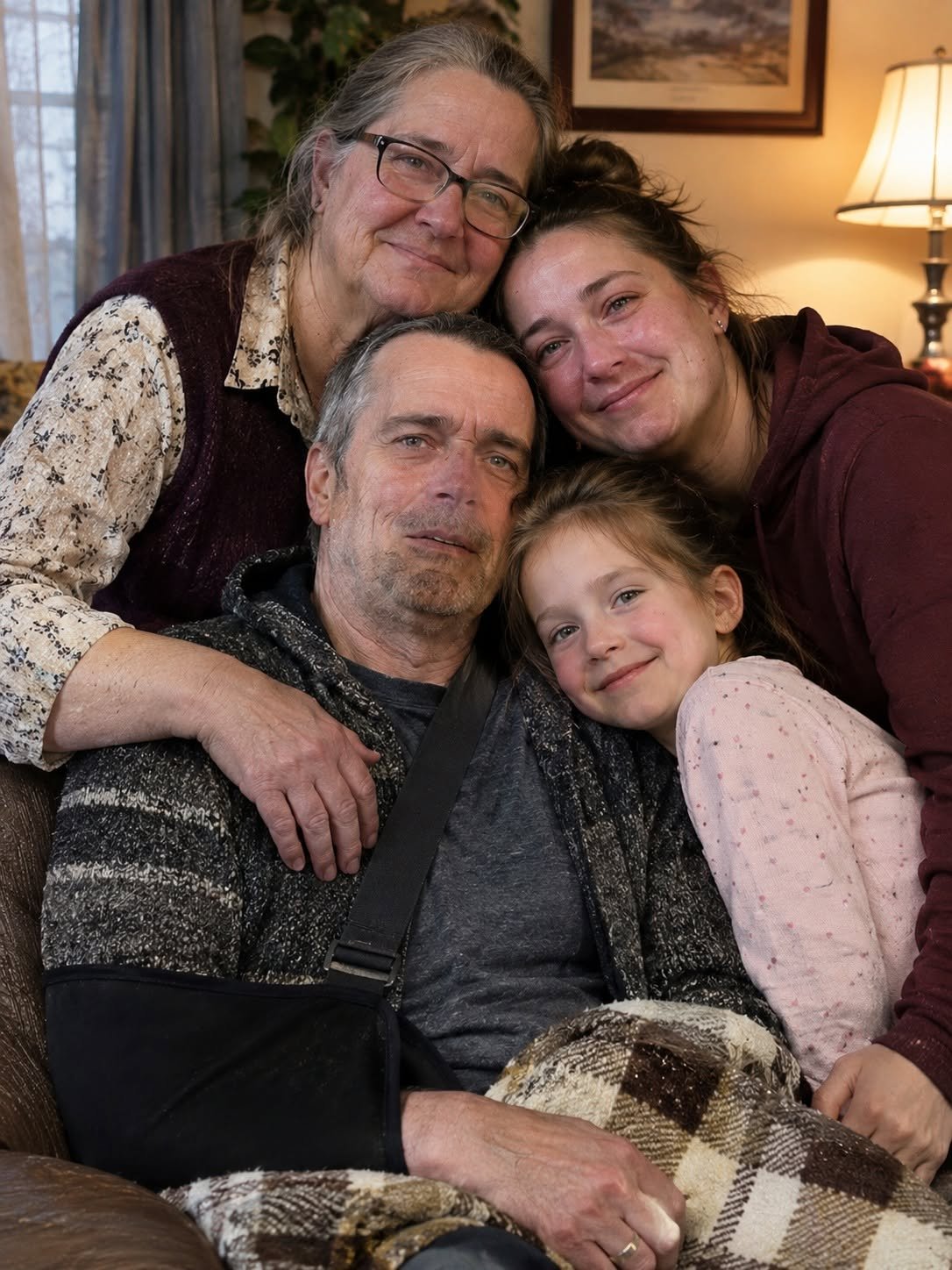
At 32 years old, Jenna had learned how to smile even when her heart was breaking. She knew how to stretch a small paycheck until it covered groceries, school supplies, and the electricity bill. She knew how to wake up before sunrise, prepare breakfast for her eight-year-old daughter, and walk her to school before heading to her job as a cleaner. She knew how to keep going when her back hurt, when her feet were swollen, and when the memories of her past became too heavy to carry.
But there was one thing Jenna still struggled to do.
She struggled to look at a family photograph without crying.
Eleven years earlier, she had walked away from a home where she had been loved, protected, and wanted. Her father had worked hard to give his children a good life. Her mother had filled their house with warmth. Her older brother had always looked after her, and her younger sister had followed her around like a little shadow.
They had never been a perfect family, but they had been a loving one.
Jenna had convinced herself otherwise.
At twenty-one, she left home after an argument, believing her parents didn’t understand her and that the world outside would finally give her the freedom she wanted. She never imagined that one decision would take her through an unwanted pregnancy, an abortion, a year of homelessness, exploitation, an abusive relationship, and years of shame.
She eventually became a mother herself. She found a man she believed would love her forever, but the relationship turned into something she barely survived. When she finally escaped, she was left raising a little girl alone, carrying memories she didn’t know how to explain.
Her parents had searched for her for years. They had contacted people, visited places, and followed every possible lead. Eventually, they were told that Jenna might have died. Her father became seriously ill, her siblings built their own families, and the house where Jenna grew up slowly lost the laughter it once held.
Then, last Thanksgiving, something happened that none of them believed would ever happen again.
Jenna came home.
She stood outside her childhood house with her little daughter holding her hand, and when the door opened, her mother looked at her as though she were seeing a ghost.
It had been eleven years.
Her father was half-paralyzed. Her brother was married and had a three-year-old daughter. Her younger sister was no longer the little girl Jenna remembered. And the people who had spent years wondering whether Jenna was alive were suddenly standing in front of her.
They forgave her.
They held her.
They welcomed her daughter.
And for the first time in eleven years, Jenna understood something she had spent most of her life refusing to believe.
Her family had never stopped loving her.
Now, one year later, as another Thanksgiving approaches, Jenna finds herself remembering that day. She remembers the sound of her mother’s crying, her father’s trembling hand, and the words that changed the rest of her life.
But to understand why that reunion meant so much, you have to understand what happened during the eleven years she was gone.
Jenna grew up in a modest two-story house in a quiet American neighborhood. Her father, Robert, worked as a maintenance supervisor for a manufacturing company, while her mother, Margaret, worked part-time at a local grocery store. They weren’t wealthy, but they made sure their children had what they needed.
There were three children.
David, the oldest, was protective and responsible. Jenna was the middle child, and Sophie was the youngest. David was five years older than Jenna, while Sophie was four years younger.
The house was always busy.
Robert left for work early in the morning, but he rarely came home without asking his children about their day. Margaret cooked most evenings, and the family usually ate together around the kitchen table. There were arguments about chores, disagreements about television, and occasional shouting when someone borrowed something without asking.
But there was also laughter.
Robert taught David how to repair a bicycle, showed Jenna how to change a flat tire, and helped Sophie with her school projects. Margaret remembered everyone’s favorite meals and made birthday cakes from scratch.
On winter evenings, the children gathered in the living room under blankets. Robert sometimes fell asleep in his chair while watching television, and Margaret would quietly place a blanket over him.
Jenna had a good childhood.
Her parents were not cruel. They did not neglect her. They did not leave her hungry or make her feel unwanted. In fact, they did everything they could to make their children feel safe.
But when Jenna reached her late teens, she began feeling as though she didn’t belong.
She wanted independence. She wanted to make her own decisions, spend time with different people, and experience life without having to explain everything to her parents.
Robert worried about her friends and the places she went. Margaret often asked where she was going and when she would return. They wanted her to finish school, find stable work, and avoid making decisions that could hurt her future.
Jenna interpreted their concern as control.
When her father asked her to come home before midnight, she believed he didn’t trust her. When her mother questioned a new relationship, she felt judged. When David warned her that some of her friends were taking advantage of her, she accused him of thinking he was better than everyone else.
The arguments became more frequent.
One evening, Robert asked Jenna to sit down at the kitchen table.
“Your mother and I are worried about you,” he said.
Jenna folded her arms.
“Here we go again.”
“You’re missing classes. You’re spending nights away from home, and you won’t tell us where you are.”
“I’m twenty-one, Dad. I don’t need to report every little thing I do.”
Robert took a breath.
“We aren’t asking you to report every little thing. We just want to know you’re safe.”
“I’m tired of everyone treating me like a child.”
Margaret tried to calm the conversation.
“Sweetheart, nobody is trying to stop you from growing up. We just don’t want you to make a decision you’ll regret.”
Jenna stood up.
“You don’t understand anything about me.”
Robert looked at her.
“Then help us understand.”
But Jenna wasn’t interested in explaining herself. She believed her parents would never accept the life she wanted, and she had become so determined to prove she could live without them that she stopped listening to anything they said.
That night, she packed a bag.
Margaret found her near the front door.
“Where are you going?”
“Somewhere I can breathe.”
“Jenna, please. Don’t leave like this.”
Jenna pulled the zipper on her bag.
“I’m not a little girl anymore.”
Her mother reached for her hand.
“You don’t have to leave to prove that.”
But Jenna pulled away.
Robert came into the hallway. He looked hurt, but he didn’t shout.
“If you walk out that door, you can still come back whenever you want. Do you understand?”
Jenna thought he was trying to frighten her.
“I’ll be fine.”
Robert nodded slowly.
“All right. Just remember that this is your home.”
Jenna opened the door.
She didn’t hug her mother. She didn’t say goodbye to Sophie, who was crying near the staircase. She walked past David, who had come out of his bedroom after hearing the argument.
“Jenna, don’t do this,” he said.
She kept walking.
That was the last time all four of them stood together in that hallway for eleven years.
### The first year away from home
At first, Jenna felt victorious.
She stayed with friends, moved between inexpensive rooms, and found temporary work. She told herself that her parents would eventually understand that she had made the right decision.
For a few months, she enjoyed the freedom.
Nobody asked where she was going. Nobody questioned her friends. Nobody expected her to be home for dinner. She could make her own decisions without hearing her father’s concerns or her mother’s advice.
But freedom became expensive very quickly.
The first job she found didn’t pay enough to cover rent, transportation, and food. The friend she was staying with eventually asked her to leave. Another person promised to help her find a room but disappeared after taking money from her.
She began moving between temporary places.
Then she discovered she was pregnant.
Jenna was only twenty-two, struggling financially, and frightened of what the future would look like. The man involved was no longer part of her life, and she didn’t feel prepared to raise a child.
She thought about calling her mother.
Several times, she picked up her phone and opened Margaret’s contact information. She imagined hearing her mother’s voice and telling her what had happened.
But then she remembered the arguments at home.
She was ashamed that she had left. She was afraid her parents would say they had warned her. She believed that returning would mean admitting she had failed.
So she didn’t call.
She made a decision about the pregnancy that she later carried with complicated feelings and private grief. The experience was difficult, both physically and emotionally, and afterward she found herself feeling more alone than ever.
She had believed that leaving home would make her stronger.
Instead, she was discovering how vulnerable a person could become when there was nobody to call.
Within months, she lost another temporary job. She couldn’t pay for the room where she had been staying, and the person who had promised to help her left town.
Jenna had nowhere to go.
She began sleeping in places where she could remain unnoticed. Sometimes she stayed at shelters, sometimes with people she barely knew, and sometimes in places that were not safe.
For nearly a year, she lived with the uncertainty of not knowing where she would sleep the following night.
She experienced hunger, humiliation, and fear. She learned to keep her belongings close and never assume that a stranger’s kindness came without conditions.
There were nights when she sat outside a closed store and watched people drive home.
She wondered whether her family was eating dinner together.
She wondered whether her mother still made the same meals.
She wondered whether Sophie had grown taller.
Most of all, she wondered whether her father still meant what he had said.
*This is your home.*
But by then, Jenna had convinced herself that she had ruined her chance to return.
### The family that kept searching
Back home, the situation was very different from what Jenna imagined.
Her parents had not forgotten her.
During the first weeks, Robert called every friend and relative he could think of. He contacted people Jenna had mentioned, visited places she used to spend time, and asked whether anyone had heard from her.
Margaret called Jenna’s phone every day.
At first, the calls rang without an answer. Eventually, the number stopped working.
David went looking for her himself. He drove to places where he thought she might be staying and spoke to people who had known her. He contacted former classmates and tried to find information through anyone who might have seen her.
Sophie, who had been only a teenager when Jenna left, kept asking when her sister would come home.
“Maybe she’s angry with us,” she said one evening.
Margaret shook her head.
“Your sister knows we love her.”
“Then why doesn’t she call?”
Margaret had no answer.
Robert became quieter as the months passed. He kept Jenna’s bedroom almost exactly as she had left it. Her old books remained on the shelf, a small lamp stayed beside the bed, and one of her favorite sweaters was still hanging behind the door.
Whenever Margaret suggested cleaning the room, Robert refused.
“Leave it,” he said. “She might come home.”
Thanksgiving was especially painful.
The first year, Margaret prepared all the usual food, but she kept looking toward the front door. She placed four plates on the table for the immediate family, then hesitated before putting a fifth one in Jenna’s old place.
David noticed.
“Mom, are you expecting her?”
Margaret looked down.
“I don’t know.”
They ate dinner, but the conversation never felt complete.
Sophie barely touched her food.
The following year, Margaret again left Jenna’s old bedroom untouched. Robert still called hospitals and shelters when he heard about unidentified patients or people who had been found without identification.
They never received a clear answer.
As years passed, the searches became harder. Jenna had changed cities, used different addresses, and stopped contacting people from her past. Her family had no reliable way to find her.
Eventually, someone suggested that she might have died.
Robert refused to accept it.
“Don’t say that,” he told David.
But the possibility entered their minds.
They began to grieve someone who might still be alive.
### The man who promised her a different life
After nearly a year of homelessness, Jenna found work at a small diner.
She washed dishes, cleaned tables, carried boxes, and accepted extra shifts whenever they were available. The manager paid her little, but it was enough to help her rent a small room.
She was exhausted, but she was beginning to rebuild.
That was where she met Michael.
He came into the diner regularly. He was charming, confident, and attentive. He remembered her name, asked about her day, and sometimes waited until her shift ended so he could walk her to the bus stop.
At first, he seemed different from everyone else.
He told her she deserved a better life. He said he admired how hard she worked. When she admitted that she had no close family nearby, he held her hand and promised she would never have to feel alone again.
Jenna wanted to believe him.
They started dating, and for a while, things seemed wonderful. Michael bought her small gifts, took her out for dinner, and spoke about their future. He told her he wanted a family and a home where nobody would ever have to struggle.
Jenna slowly began to trust him.
At twenty-four, she discovered she was pregnant.
This time, the circumstances were different. She had a job, a small room, and a man who told her he was excited to become a father.
When she showed Michael the pregnancy test, he hugged her.
“We’re going to be a family,” he said.
Jenna cried against his chest.
She thought she had finally found the life she had been searching for.
Their daughter, Lily, was born several months later.
Jenna loved her from the moment she held her. She remembered the tiny fingers, the soft hair, and the way Lily wrapped her hand around one of her mother’s fingers.
For the first time in years, Jenna felt that she had someone who needed her.
She promised herself that Lily would never experience the loneliness she had experienced.
But the happiness didn’t last.
Michael gradually changed.
At first, he became irritated when Jenna asked about money. Then he began criticizing her clothes, her friends, and the way she cared for Lily. He complained that she spent too much time with the baby and not enough time with him.
When Jenna disagreed, he accused her of being ungrateful.
The man who had once told her she deserved the world began making her feel as though she deserved nothing.
He became controlling.
He wanted to know where she went, who she spoke to, and why she took so long at the grocery store. He began checking her phone and questioning every conversation. Sometimes he disappeared for hours and returned expecting her to behave as though nothing had happened.
Then the insults became more frequent.
He called her useless. He reminded her that she had no family to turn to. During arguments, he used her past against her.
“Where would you be without me?” he would ask.
Jenna began believing that she had no other choice.
She stayed because she wanted Lily to have a father. She stayed because she had nowhere else to go. She stayed because Michael had once been the person who made her feel loved, and she kept hoping that person would return.
But the relationship became increasingly frightening.
There were arguments that ended with broken objects, threats, and moments when Jenna feared for her safety. She learned to recognize the sound of his footsteps and the tone of his voice. She learned when to remain quiet and when to take Lily into another room.
She stopped inviting people over.
She stopped talking about her problems.
And she stopped imagining a future without him because she was too busy trying to survive the present.
### The years she did whatever she could to feed her daughter
When Lily was still very young, Michael’s behavior became impossible to live with.
He would leave for days, return angry, and blame Jenna for every problem in his life. Sometimes he took money she had saved for groceries. Other times, he refused to contribute to the household at all.
Jenna tried finding work, but childcare was difficult and Michael was unreliable.
Eventually, she reached a point where she was desperate.
During one particularly difficult period, Jenna was drawn into survival sex work. She made choices under financial pressure that she had never imagined making when she was younger. She did it because she was frightened of losing the room they were staying in and because Lily needed food, diapers, and basic necessities.
She did not feel powerful or glamorous.
She felt frightened, ashamed, and trapped.
There were nights when she came home and sat in the bathroom with the water running, trying to wash away the memories of the evening. She would look at Lily sleeping and remind herself why she had kept going.
She had never wanted this life.
She had wanted a safe home, a loving husband, and a family that sat together at Thanksgiving.
Instead, she was trying to keep her daughter fed while living with a man who made her feel worthless.
Jenna eventually found cleaning work at a small office building. The hours were long, and the pay was low, but the work was honest and steady. She cleaned floors, emptied trash cans, scrubbed bathrooms, and worked late after the office staff had gone home.
Sometimes she brought Lily to a trusted neighbor’s apartment. Other times, she arranged childcare with whatever money she could spare.
She slowly stopped relying on Michael.
The day she finally left him was not dramatic.
There was no grand speech, no suitcase thrown across a room, and no sudden realization that everything would be easy.
There was simply a morning when Jenna looked at Lily and understood that staying was becoming more dangerous than leaving.
She packed a small bag, gathered her daughter’s clothes and documents, and walked out while Michael was away.
She went to a temporary shelter and asked for help.
For the first time, she began making decisions based on what would keep her daughter safe rather than what might make Michael happy.
It took time, but she found a small apartment and continued working as a cleaner.
Michael was no longer part of their daily lives.
Jenna was free of him, but she was not free of the memories.
And she still had one enormous secret.
She had a family somewhere, and they had no idea where she was.
### The guilt that kept her away
By the time Jenna reached thirty, she had built a modest life.
She worked as a janitor for a commercial cleaning company. She had a small apartment, a reliable routine, and a daughter who was growing into a cheerful little girl.
Lily was eight years old when the story of her mother’s family began to come up more often.
One evening, Lily was looking through an old box of photographs.
She found a picture of Jenna standing beside a young man and woman, with another boy and girl nearby.
“Mommy, who are these people?”
Jenna took the photograph.
For a moment, she couldn’t speak.
“That’s my family.”
“Where are they?”
Jenna sat beside her daughter.
“They live somewhere else.”
“Do they know me?”
The question hurt more than Jenna expected.
She shook her head.
“No, sweetheart.”
“Why not?”
Jenna looked at the photograph again.
“Because Mommy made some mistakes when she was younger.”
Lily thought about that.
“Can we meet them?”
Jenna smiled weakly.
“Maybe one day.”
But after Lily went to bed, Jenna cried.
She had spent years telling herself that her parents were controlling and that she had been right to leave. But as she grew older, she began to understand that her parents had been worried because they loved her.
She remembered her father standing in the hallway.
She remembered her mother’s hand reaching for hers.
She remembered David telling her not to leave.
And she remembered Sophie crying on the staircase.
The guilt became unbearable.
Jenna searched online for her family but discovered that some of the old information was outdated. The family had changed phone numbers, and the house was no longer listed under the same contact details.
She found a photograph of David at a family event. He was married now, and he had a little daughter.
She also found a photograph of Sophie, who had grown into a woman Jenna barely recognized.
Then she found something about her father.
Robert had suffered a serious stroke.
The stroke had left one side of his body partially paralyzed. He could walk short distances with assistance, but his left arm had limited movement, and his speech had become slower.
Jenna stared at the photograph of him sitting in a chair.
He looked older.
Much older.
She wondered how many times he had sat in that chair waiting for her.
She wanted to call.
But she was afraid.
What if he refused to speak to her? What if her mother had spent years crying and no longer wanted to see her? What if David blamed her for everything? What if Sophie had grown up believing she was a terrible sister?
Jenna had spent eleven years believing her family didn’t want her.
Now she was frightened to discover that she had been wrong.
### The Thanksgiving she finally came home
The decision happened almost by accident.
A few days before Thanksgiving, Jenna was cleaning the lobby of an office building when she overheard two coworkers discussing their holiday plans.
One was going to visit her parents. The other was preparing dinner with her siblings.
Jenna smiled politely and continued mopping.
But when she returned home, she couldn’t stop thinking about it.
Lily was sitting at the kitchen table drawing a picture of a house.
“What are you drawing?”
“Our family,” Lily replied.
Jenna looked at the paper.
There were two people holding hands beside a little house. One was tall, one was small, and both had smiling faces.
“Who are they?”
“Me and you.”
Jenna sat down.
“That’s beautiful, sweetheart.”
Lily looked up.
“Mommy, don’t you have a mommy and daddy too?”
Jenna felt her throat tighten.
“Yes.”
“Can we visit them?”
Jenna stared at her daughter.
For years, she had been telling herself she would go home someday. She would wait until she had a better job, a bigger apartment, more savings, and a life she could be proud of.
But she suddenly realized that there would never be a perfect time.
Her father was getting older. Her mother was getting older. Her siblings had their own families. And she had already lost eleven years.
That evening, she found the old family address.
She wasn’t sure whether the house still belonged to her parents, but she remembered every turn on the road.
She put Lily to bed and sat alone at the kitchen table.
Then she made a decision.
She was going home.
The following morning, she packed a small bag for herself and Lily. She drove for several hours, stopping twice because her hands were shaking too badly to continue.
When she finally reached the old neighborhood, she recognized the trees before she recognized the houses.
The street looked smaller than she remembered.
Some homes had new fences. Others had been painted. A few families had moved away.
But her childhood house was still there.
The same front porch.
The same driveway.
The same large window beside the living room.
Jenna parked across the street.
She sat in the car for nearly twenty minutes.
Lily looked at her.
“Is this where your mommy and daddy live?”
Jenna nodded.
“Yes.”
“Are you scared?”
Jenna looked at her daughter.
“A little.”
“Why?”
“Because I haven’t seen them in a very long time.”
Lily reached across the seat and held her mother’s hand.
“It’s okay, Mommy. I’ll stay with you.”
Jenna began crying.
She got out of the car, helped Lily down, and walked toward the front door.
Every step felt heavier than the one before.
She raised her hand and knocked.
Nothing happened.
She knocked again.
Then she heard movement inside.
The door opened.
Margaret stood there.
She was older, her hair almost completely gray, and her face carried the lines of eleven years of worry. She was holding a dish towel, as though she had been preparing something in the kitchen.
She looked at Jenna.
For several seconds, she didn’t move.
Then the dish towel slipped from her hand.
“Jenna?”
Jenna couldn’t speak.
Her mother brought one hand to her mouth.
“No…”
Jenna began crying.
“Mom.”
Margaret stepped closer.
“Jenna?”
Jenna nodded.
“It’s me.”
Her mother made a sound that was somewhere between a sob and a gasp. She reached for her daughter’s face, touching her cheeks as if she needed to make sure she was real.
“Oh, my baby.”
Then she pulled Jenna into her arms.
Jenna collapsed against her.
“I’m sorry, Mom. I’m so sorry.”
Margaret held her tightly.
“You’re here. You’re here.”
Jenna cried harder.
“I should’ve come home.”
Margaret shook her head.
“Don’t talk about that now. Just let me hold you.”
Lily stood beside them, watching with wide eyes.
Margaret finally noticed her.
She looked at the little girl.
“Who is this?”
Jenna wiped her face.
“Mom, this is Lily. She’s your granddaughter.”
Margaret stared at the child.
Her eyes filled with tears.
“My granddaughter?”
Jenna nodded.
Margaret knelt down carefully.
“Hello, sweetheart.”
Lily looked at her mother, then at the older woman.
“Are you my grandma?”
Margaret began crying again.
“Yes, baby. I’m your grandma.”
Lily stepped forward and hugged her.
Margaret wrapped both arms around the little girl.
For eleven years, she had wondered whether she would ever hold her daughter again.
Now she was holding a granddaughter she had never known existed.
### The father who had been waiting
Robert was sitting in the living room when Margaret called his name.
“Robert! Come here!”
His movements were slow. Since the stroke, one side of his body had been weaker, and he used a cane to help him walk. He had been working with a physical therapist, but he still tired easily.
“What’s wrong?” he called.
Margaret turned toward the hallway.
“Come here. Please.”
Robert slowly entered the room.
Then he saw Jenna.
He stopped.
His eyes widened.
The cane slipped slightly in his hand.
For a moment, he simply stared at her.
Jenna stood near the doorway, trembling.
“Dad.”
Robert’s lips moved.
“Jenna?”
She nodded.
He took one slow step toward her.
Then another.
Jenna moved forward, crying.
“I’m sorry, Dad.”
Robert tried to lift his arms, but his weaker side did not respond properly. He struggled, visibly frustrated with his own body.
Jenna immediately stepped closer and wrapped her arms around him.
Her father held her with the strength he still had.
“My girl,” he whispered.
Jenna pressed her face against his shoulder.
“I should’ve come back.”
Robert shook his head slowly.
“You’re here.”
He paused to catch his breath.
“You’re here.”
He touched the back of her head with his good hand.
“I prayed for this.”
Jenna cried against him.
“I thought you didn’t want me anymore.”
Robert pulled back just enough to look at her.
“Who told you that?”
Jenna couldn’t answer.
He looked at his daughter, his eyes full of tears.
“We looked everywhere, sweetheart.”
Jenna covered her mouth.
“Everywhere?”
Robert nodded.
“Your mother never stopped looking. David looked. We all looked.”
He paused.
“We thought you were dead.”
Jenna closed her eyes.
Her father continued.
“Some days, I thought I would hear your voice on the telephone. Other days, I thought I saw you walking down the street. Your mother kept your room for years.”
Jenna looked toward the staircase.
“Is it still there?”
Robert nodded.
“Some things are.”
Jenna looked at him again.
“Why?”
Her father struggled to answer.
“Because you were coming home.”
She broke down.
Robert gently touched her cheek.
“You’re not a stranger in this house, Jenna. You’re my daughter.”
### The family she thought she had lost
David arrived that afternoon with his wife and their three-year-old daughter, Emma.
He had been told that Jenna was home, but he didn’t believe it until he walked into the living room and saw her sitting beside their father.
He stopped near the doorway.
Jenna looked up.
“David.”
Her brother stared at her.
Then he walked forward.
For a moment, it seemed as though he might say something angry. He had spent eleven years carrying questions, frustration, and sadness.
But when he saw his sister’s face, the words disappeared.
He hugged her.
Jenna held on tightly.
“I’m sorry,” she whispered.
David shook his head.
“I looked for you, Jen.”
She began crying.
“I know.”
“No, you don’t. I went everywhere I could think of. I called people. I drove around places where you used to go. I didn’t know what else to do.”
Jenna lowered her head.
“I’m sorry.”
David pulled back.
“I was angry with you for a long time. I won’t pretend I wasn’t. But I never wanted you dead. I never wanted you gone forever.”
His wife stepped forward and introduced herself properly, even though Jenna had seen photographs of her online.
Then their three-year-old daughter, Emma, came running into the room.
She looked at Jenna.
“Who is she?”
David smiled through his tears.
“She’s your Aunt Jenna.”
Emma stared at her.
“Did you bring presents?”
Everyone laughed.
Jenna knelt down.
“I didn’t know I was going to meet you today, sweetheart. But I’ll bring you something next time.”
Emma nodded seriously.
“Okay.”
Jenna hugged her niece.
She had missed her brother’s wedding. She had missed the birth of his daughter. She had missed birthdays, holidays, and all the little moments that made a family.
But she was standing in the room now.
And nobody was asking her to leave.
Later, Sophie arrived.
Jenna barely recognized her younger sister.
The little girl who had once cried on the staircase was now a grown woman. She rushed into the room and hugged Jenna so tightly that both of them nearly lost their balance.
“You came back,” Sophie cried.
Jenna nodded.
“I’m here.”
Sophie pulled away, wiping her face.
“I used to think you hated us.”
Jenna shook her head.
“I never hated you. I was just too stubborn to understand what I had.”
Sophie looked toward their mother.
“Mom used to leave the porch light on.”
Jenna turned.
“What?”
“Every night. For years. She said if you came home late, you should be able to see the house.”
Margaret looked down.
Jenna began crying again.
She remembered walking away from that same porch, convinced that nobody understood her.
All those years, her mother had kept the light on.
### The room that had waited eleven years
That evening, Margaret took Jenna upstairs.
The house had changed in many ways, but some things remained familiar. The hallway carpet had been replaced. The walls had been repainted. A few photographs had been added, showing David’s wedding and Emma’s first birthday.
But when Margaret opened Jenna’s old bedroom door, Jenna stopped breathing.
The room was still there.
The old wooden bed remained against the wall. The shelves had been cleaned, and the curtains were different, but several of Jenna’s books were still stacked beside the window.
A small photograph of Jenna at sixteen sat on the dresser.
She walked slowly into the room.
“Mom…”
Margaret stood in the doorway.
“I couldn’t bring myself to change everything.”
Jenna touched the edge of the dresser.
“You kept this?”
“Of course.”
Jenna picked up the photograph.
She was sixteen, smiling with braces and long hair, standing in the backyard with Sophie.
Margaret sat on the bed.
“Your father used to come in here when he couldn’t sleep. He would sit on that chair and look at your photographs.”
Jenna turned toward her.
“Really?”
Margaret nodded.
“After his stroke, sometimes he would ask whether you had called. He couldn’t always remember what day it was, but he remembered you.”
Jenna covered her mouth.
“I didn’t know.”
Margaret reached for her hand.
“You couldn’t know. You were far away.”
Jenna sat beside her mother.
“Why didn’t you hate me?”
Margaret looked surprised.
“Because you’re my daughter.”
“But I left. I never called. I didn’t even tell you I was pregnant. You missed everything.”
Margaret began crying.
“Do you think we wanted to miss those things?”
Jenna lowered her head.
Her mother continued.
“We were hurt. We were frightened. Your father was angry sometimes, and I was angry too. But we never stopped loving you.”
Jenna leaned against her.
For the first time in eleven years, she allowed herself to be someone’s daughter again.
### The truth she finally told her family
Over the next few days, Jenna began telling her family about the life she had lived.
She didn’t tell everything at once. Some memories were too painful, and she struggled to find the words. But she eventually explained the pregnancy she had faced when she was young, the difficult decision she had made, the months she spent homeless, and the relationship that had become abusive.
She told them about Michael.
She explained how he had seemed loving at first, how he had promised to build a family with her, and how he eventually became controlling and cruel.
She told them about the years when she had been desperate for money and had entered survival sex work to provide for Lily. She described the shame she had carried, the fear she had lived with, and the cleaning jobs she eventually took to rebuild her life.
She didn’t make excuses.
She also didn’t pretend she had made every decision correctly.
She simply told them the truth.
Margaret cried as she listened.
David sat quietly, his jaw tightening whenever Jenna described the way Michael had treated her.
Sophie held her sister’s hand.
Robert listened from his chair.
When Jenna finally finished, the room was silent.
She looked at her father.
“I know you probably don’t recognize the person I became.”
Robert shook his head.
“I recognize my daughter.”
Jenna began crying.
He continued slowly.
“You were hurting. You were trying to survive. I wish you had come to us, but I can’t change what happened.”
Jenna looked down.
“I was ashamed.”
Robert took a breath.
“Of what?”
“Everything. I thought you’d be disappointed in me. I thought you’d say you warned me. I thought you wouldn’t want to see me.”
Her father looked at her for a long moment.
“Jenna, I don’t care how many mistakes you’ve made. I care that you’re alive. I care that you’re safe. I care that this little girl has her mother.”
Margaret reached across the room and took Jenna’s hand.
“And I wish you had let us help you.”
Jenna nodded.
“I know.”
David spoke next.
“I wish you’d called me. I would’ve come.”
Jenna looked at him.
“I didn’t think you would.”
He shook his head.
“You were my sister. You didn’t need to earn that.”
Sophie leaned forward.
“And you don’t have to earn it now.”
Jenna covered her face.
She had spent eleven years believing she had to become a perfect person before she could return home.
Her family was telling her that she had never needed to be perfect.
She had only needed to come back.
### The granddaughter they never knew
Lily became the center of the house almost immediately.
She was curious, energetic, and full of questions. She wanted to know where her mother had slept as a little girl, which toys belonged to her, and why there were so many photographs of people she had never met.
Emma, David’s three-year-old daughter, followed her everywhere.
The two girls quickly became friends.
Margaret loved preparing meals for them. She made pancakes in the morning, packed little snacks for their outings, and bought Lily a warm coat because she thought the one she had was too thin.
Robert had more difficulty moving around, but he enjoyed sitting with the girls while they played.
One afternoon, Lily brought him a drawing.
It showed a house with several people standing in front of it.
“That’s our family,” she explained.
Robert studied the picture carefully.
“Who’s this?”
“That’s Grandma. That’s Grandpa. That’s Mommy. That’s me. That’s Uncle David, Aunt Sophie, Emma, and Aunt David’s wife.”
Robert smiled.
“That’s a lot of people.”
Lily nodded.
“Mommy says she used to live here.”
Robert looked toward Jenna.
“She did.”
Lily looked at her grandfather.
“Are you going to get better?”
Robert smiled sadly.
“I’m working on it.”
Lily walked closer and gently touched his weaker arm.
“Then I’ll help you.”
Robert’s eyes filled with tears.
He reached out with his good hand and held hers.
Jenna watched from the doorway.
She had spent years believing she had destroyed her family’s happiness. Now she was watching her daughter bring joy into a home that had been quiet for too long.
### The father who missed eleven birthdays
One evening, after Lily had gone to bed, Jenna sat beside Robert in the living room.
He was watching an old family video on the television. It showed the children playing in the backyard many years earlier.
Jenna was in the video, laughing as David chased her around the garden. Sophie was sitting on the grass, and Margaret was calling everyone inside for dinner.
Robert watched quietly.
“That was a good day,” he said.
Jenna smiled.
“I remember it.”
He paused the video.
“Your mother and I missed eleven birthdays.”
Jenna looked down.
“I know.”
“We missed your graduation, your wedding that never happened, and meeting Lily when she was born.”
Jenna began crying.
“I’m sorry, Dad.”
Robert shook his head.
“I don’t want you to spend the rest of your life apologizing.”
She looked at him.
“Then what do you want?”
He smiled faintly.
“I want to know what you like for breakfast now. I want to see Lily start school. I want to watch you build a life you don’t have to run away from.”
Jenna leaned toward him.
“I want that too.”
Robert looked at the paused video.
“Your mother used to say that the worst part of losing you wasn’t knowing where you were. It was not knowing whether you were safe.”
Jenna covered her face.
Robert reached for her hand.
“We don’t have to solve eleven years tonight. We can start with tomorrow.”
She nodded.
For a while, they sat together without speaking.
It was not the same family life they had once known. Nothing could bring back the years they had lost. But there was a chance to create something new.
### One year later
The following year passed with small, ordinary moments that Jenna had once believed she would never experience.
She continued working as a cleaner, but she was no longer living with the constant fear that one missed paycheck would leave her and Lily without a home. Her family helped her find more stable housing, and she began taking classes to improve her employment opportunities.
She also began working through the trauma of her past with professional support. Some days were difficult. Certain memories still came back unexpectedly, and she sometimes struggled with guilt over the years she had lost.
But she no longer faced those feelings alone.
She called her mother regularly. She visited her father whenever she could. David and Sophie became part of her everyday life again.
Lily began calling Margaret “Grandma” and Robert “Grandpa” without hesitation.
Emma and Lily became inseparable.
The two girls played in the backyard, drew pictures together, and argued over toys just as Jenna and Sophie once had.
Sometimes, when Jenna watched them, she felt both happiness and sadness.
She was happy that her daughter had a family.
She was sad that she had spent so long believing she didn’t deserve one.
Robert’s condition remained difficult. He continued with physical therapy, but his movement was still limited. Some days were better than others, and he needed help with ordinary tasks.
Jenna often helped him with small things.
She would prepare his tea, arrange his medication, or sit beside him while he watched television.
One afternoon, Robert asked her to help him look through an old box in the garage.
Inside were photographs, letters, and small keepsakes from the children’s childhood.
Jenna found a birthday card she had made for him when she was twelve.
The writing was uneven, and the paper had faded.
It said:
*To the best dad in the world. I love you forever.*
Jenna stared at it.
Robert smiled.
“Your mother found that in your old room.”
She touched the words.
“I forgot I made this.”
“I didn’t.”
Jenna looked at him.
He continued.
“I kept it because I knew you loved me, even when you were angry.”
She began crying.
Robert reached for her hand.
“I never stopped being your father, Jenna.”
She leaned forward and kissed his forehead.
“I know, Dad.”
### The second Thanksgiving after her return
Now, one year after the day she came home, another Thanksgiving is approaching.
Jenna is standing in her parents’ kitchen, helping Margaret prepare dinner. The same old cabinets are there, the same window overlooks the backyard, and the same table stands in the middle of the room.
But the house feels different.
There are more photographs now.
One shows Robert and Margaret holding Lily. Another shows David, his wife, and Emma. There is a picture of Sophie with Jenna at a family gathering, both of them laughing.
And beside the front door is a new photograph.
It shows the moment Jenna returned last Thanksgiving.
Margaret is hugging her daughter, Robert is standing behind them with his cane, and Lily is holding her grandmother’s hand.
Jenna stops to look at it.
Margaret notices.
“Remember that day?”
Jenna nods.
“I don’t think I’ll ever forget it.”
Margaret smiles.
“Neither will I.”
Robert is sitting in the living room, watching football. His movement is still slow, but he is smiling as Emma and Lily play on the floor.
David is outside bringing chairs in from the garage. Sophie is carrying dessert dishes toward the kitchen.
The house is full again.
Jenna looks around and feels her eyes filling.
For eleven years, she believed she had left a family that didn’t love her. She thought they were happier without her. She imagined they had moved on, forgotten her, and stopped caring.
But the truth was that her parents had spent years waiting.
Her mother had kept her room.
Her father had kept her birthday cards.
Her brother had searched for her.
Her sister had grown up missing her.
And even when they feared she might never return, they had never stopped hoping.
That evening, after dinner preparations are finished, Jenna sits beside her father.
“Do you remember what you said to me when I left?”
Robert turns toward her.
“What?”
“You told me I could come home whenever I wanted.”
He nods slowly.
“I remember.”
Jenna takes his hand.
“I should’ve listened.”
Robert smiles gently.
“You’re listening now.”
She rests her head against his shoulder.
After a few moments, she speaks again.
“Dad, do you ever wonder what would’ve happened if I had stayed?”
He looks toward the window.
“Sometimes.”
“Would everything have been different?”
“Of course. But we can’t live in the life that didn’t happen.”
Jenna nods.
Robert continues.
“We can only love the people who are here.”
She looks at him.
“I’m here.”
He squeezes her hand.
“I know, sweetheart.”
### The Thanksgiving promise
Before dinner, Jenna asks everyone to gather around the table.
She has prepared a small speech, but when she looks at her family, she struggles to remember the words.
She takes a breath.
“Last Thanksgiving, I came through this door after eleven years. I thought you might hate me. I thought I would have to explain every mistake, every bad decision, and every year I stayed away.”
She looks at her mother.
“Mom, I remember you touching my face because you couldn’t believe I was real. I remember Dad trying to hug me even though his arm wouldn’t move the way he wanted. I remember David telling me he had searched for me, and Sophie telling me she thought I hated her.”
Her voice breaks.
“I wish I could give those eleven years back to you. I wish I could have been here when Dad got sick. I wish I could have seen David get married, met Emma when she was born, and watched Sophie become the woman she is today. I wish I could have called when Lily was born.”
She pauses.
“But I can’t change any of that.”
Margaret reaches across the table and takes her hand.
Jenna continues.
“I spent years believing that I had to become someone better before I could come home. I thought you would only accept me if I had a perfect life. I was ashamed of what I had done, and I was afraid you would look at me differently.”
She looks at Robert.
“But when I finally came home, Dad told me something I will never forget. He said he didn’t care how many mistakes I had made. He cared that I was alive, that I was safe, and that Lily had her mother.”
Jenna looks around the table.
“I want Lily to grow up knowing that she has a family. I want her to know that she can make mistakes and still be loved. I want her to understand that home isn’t a place where nobody ever gets things wrong. It’s a place where people choose to love each other even after life becomes difficult.”
Her voice trembles.
“Thank you for not giving up on me.”
Margaret begins crying.
David reaches for Jenna’s hand. Sophie moves closer and puts an arm around her sister.
Robert looks at his daughter.
Then, with some effort, he lifts his good hand.
Jenna takes it.
He speaks slowly.
“You’re home, sweetheart.”
Those three words are enough.
Jenna bends forward and kisses his hand.
“I love you, Dad.”
“I love you too.”
The family begins dinner.
There are conversations, laughter, children asking for more potatoes, and the familiar sound of Margaret telling everyone not to leave food on their plates.
For the first time in eleven years, Jenna is not remembering Thanksgiving from a distance.
She is living it.
Later that evening, after the dishes are cleared, she walks into her old bedroom with Lily.
Her daughter looks around.
“Mommy, this was your room?”
Jenna nods.
“Yes.”
“Did you have toys here?”
“Lots of them.”
“Did Grandma read you stories?”
“Every night.”
Lily climbs onto the bed and looks at the photographs.
“Are we coming back next year?”
Jenna smiles.
“Yes, sweetheart.”
“Promise?”
Jenna sits beside her and takes her hand.
“I promise.”
Then she looks toward the hallway, where her mother’s voice can be heard calling everyone to the living room.
She thinks about the young woman who walked out of this house at twenty-one, convinced that she didn’t need anyone. She thinks about the frightened girl who slept on the streets, the young mother who did whatever she could to feed her daughter, and the woman who spent years believing that shame had made her unworthy of returning.
She wishes she could go back and tell that young woman something.
She wishes she could stand in the hallway and say:
*They are still looking for you. Your mother still loves you. Your father is still waiting. Your brother and sister still remember you. You don’t have to become perfect before you come home.*
But she cannot go back.
All she can do is be present now.
And as she walks downstairs with Lily holding her hand, she hears her father laughing in the living room.
It is a sound she once thought she might never hear again.
This Thanksgiving, Jenna isn’t celebrating a perfect life. She is celebrating the fact that she survived the worst parts of hers, that her daughter has a family, and that the people she once left behind opened their arms when she finally found the courage to return.
Her past will always be part of her story. The pain, the mistakes, the years of separation, and the people she lost along the way cannot simply disappear.
But forgiveness has given her something she thought was gone forever.
A place to belong.
And when her father looks up from his chair and calls her name, Jenna turns toward him without fear.
Because this time, she knows she doesn’t have to leave.
Eleven years ago, she walked away from a home that loved her because she believed she wasn’t understood. Eleven years later, she returned with a daughter, a painful past, and a heart full of regret. Her family didn’t ask her to explain why it took so long. They simply opened the door. Sometimes the greatest gift a family can give isn’t forgetting what happened. It’s reminding someone that, no matter how far they have wandered, they are still loved enough to come home.
“I walked away when my family needed me most, and came back only after life broke me. Do I deserve the love and forgiveness they gave me, or was I selfish for returning when I had nowhere else to go?”