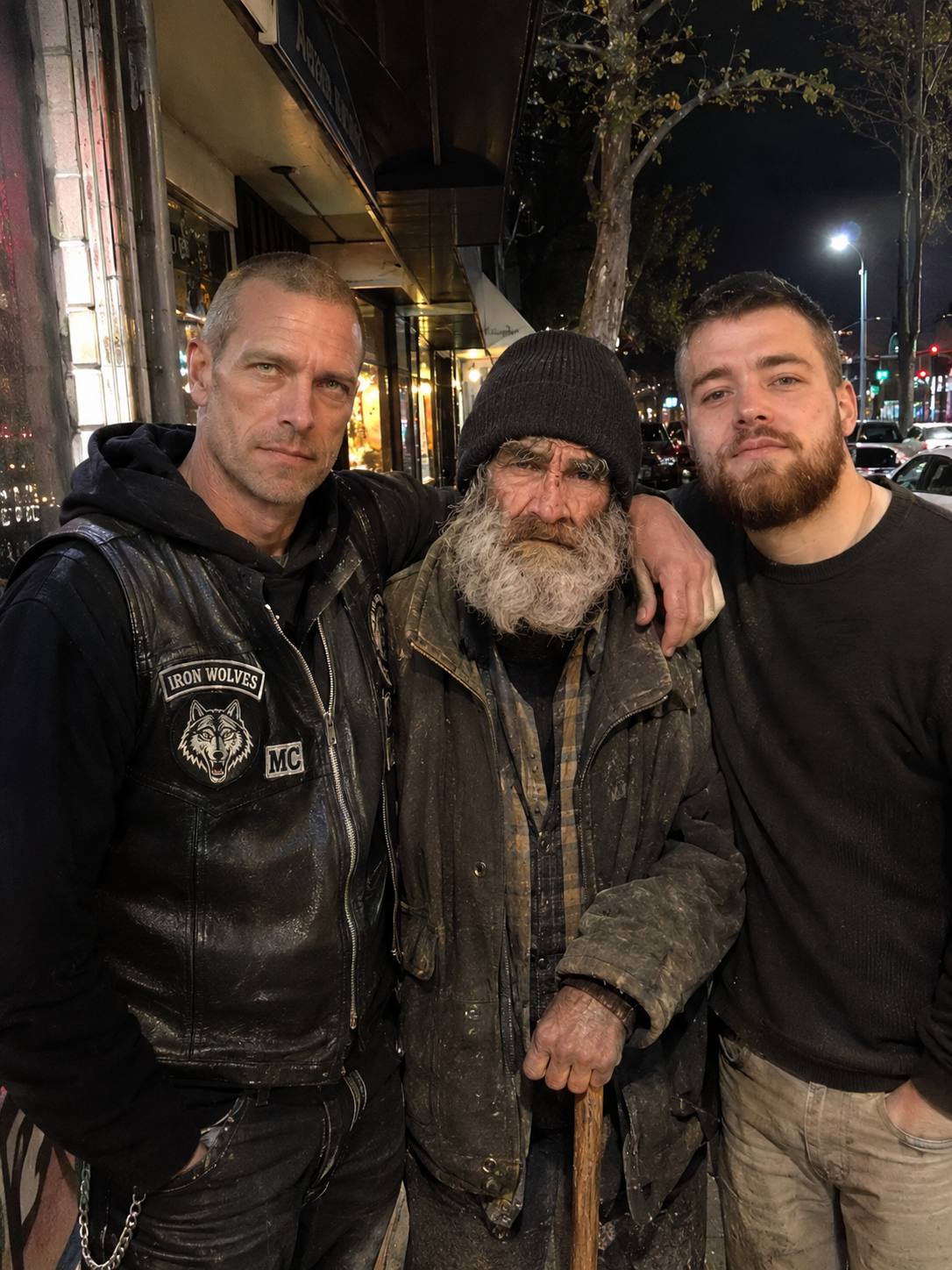
For twelve years, Randy Miller had spent Thanksgiving alone. Some years, he sat beneath a highway bridge with a blanket wrapped around his shoulders. Other years, he slept outside a closed grocery store, listening to families laugh through the windows of their warm homes. He had eaten Thanksgiving leftovers from trash cans, accepted half-eaten sandwiches from strangers, and spent entire holidays pretending he wasn’t hungry because he was too embarrassed to ask.
But the most painful part wasn’t the cold, the hunger, or the nights when his feet became so numb he could barely walk.
It was remembering the Thanksgivings he used to have.
There had been a time when Randy owned a beautiful little home, had a loving wife, and raised two sons who thought their father could fix anything. He had worked long hours to give those boys a childhood filled with birthday cakes, school supplies, family vacations, and Christmas presents. He had built their treehouse with his own hands, taught them to ride bicycles, and stayed awake beside their beds whenever they were sick.
He had even bought the house where they grew up.
But after his wife died, everything fell apart. Grief pushed him toward alcohol, alcohol cost him his job, and his life slowly collapsed until he was sleeping on the streets. His two sons left, the family home was sold, and the three of them lost contact.
Twelve years passed.
Then, five days before Thanksgiving, a group of outlaw bikers found him sitting outside a grocery store. Their president, a man named Frank Lawson, recognized something in the old man’s face that made him stop walking.
Frank had recently buried his own father.
And when he heard Randy’s story, he decided that this old man wasn’t going to spend another Thanksgiving alone.
But before Frank could bring Randy home, he would have to help him find the family he had spent twelve years searching for.
And the reunion would reveal a loss that neither father nor son was prepared to face.
—
### The father Randy used to be
Before the streets knew him as the old man with the shopping cart, Randy Miller was the kind of father children remembered long after they grew up.
He wasn’t a rich man. He never drove an expensive car or wore a fancy watch. He worked construction, repairing roofs, building porches, installing windows, and taking whatever jobs he could find. His hands were rough, his back often hurt, and his work boots were usually covered in dust, but he took pride in bringing home an honest paycheck.
His wife, Linda, worked part-time at a small medical office. Together, they raised their two boys, Daniel and Matthew, in a modest three-bedroom house on a quiet street in Ohio.
Randy had bought that house after years of saving. He remembered the day he signed the papers, standing outside with Linda and the boys while a real estate agent handed him the keys.
Daniel was nine, and Matthew was six.
“Is this really ours, Dad?” Matthew asked.
Randy lifted him into his arms.
“Every single brick, son.”
The boys ran through the empty rooms, choosing bedrooms and arguing over who would get the larger closet. Linda stood beside Randy on the front porch, smiling as she watched them.
“We did it,” she whispered.
Randy kissed her forehead.
“We did it, sweetheart.”
He never forgot that day.
Over the years, he made the house into a home. He built a wooden swing in the backyard, repaired the kitchen cabinets, planted flowers along the walkway, and constructed a treehouse for the boys. It wasn’t perfect, but it was theirs.
Randy was the father who attended school meetings even after working ten hours. He was the father who sat in the front row at football games, shouting louder than anyone else. When Daniel broke his arm falling from his bicycle, Randy drove him to the hospital and stayed awake beside him all night.
When Matthew struggled with mathematics, Randy would sit at the kitchen table with him after dinner.
“Let’s try it one more time, buddy.”
“But I don’t understand it.”
“That’s all right. We aren’t in a race. We’ll figure it out together.”
Sometimes Randy fell asleep over the homework himself, but he never gave up on his boys. He wanted them to graduate, find good jobs, and build lives that were easier than his own.
He saved money for their school expenses, paid for their football equipment, and worked extra weekends whenever they needed something. He even postponed replacing his old truck because Daniel needed a reliable car for college.
When people asked Randy what he wanted out of life, he always gave the same answer.
“I just want my boys to have a better start than I did.”
And for many years, he believed he had given them exactly that.
### The Thanksgiving that changed everything
Thanksgiving had always been Linda’s favorite holiday.
She started cooking early in the morning, filling the house with the smell of roasted turkey, potatoes, cornbread, and pumpkin pie. Randy usually handled the turkey while the boys set the table. Daniel would complain about washing dishes, Matthew would steal pieces of stuffing, and Linda would pretend to be angry when she caught them.
After dinner, the family would sit in the living room and watch football.
It wasn’t an extraordinary life, but Randy considered it a perfect one.
Then Linda became ill.
At first, she complained about tiredness and pain. Randy encouraged her to visit the doctor, believing it was something that could be treated easily. But the medical appointments became more frequent, the tests became more serious, and eventually the family received news that changed everything.
Linda had a serious illness.
Randy began spending nearly every spare hour at the hospital. He worked during the day and sat beside her at night. He sold some tools, emptied his savings, and used the money he had put aside for home repairs to help cover expenses.
His sons were older by then. Daniel was twenty-four, and Matthew was twenty-one. They loved their mother, but they were struggling to understand what was happening. Randy tried to remain strong for them, even when he was terrified.
Linda would sometimes wake during the night and find him sitting beside her bed.
“You need to sleep,” she told him.
“I’m fine.”
“Randy.”
He leaned forward and took her hand.
“I can’t sleep while you’re hurting.”
She smiled weakly.
“You’ve always been stubborn.”
“And you married me anyway.”
They laughed quietly.
But the treatments didn’t work. One winter morning, Linda passed away.
Randy held her hand until the nurse gently told him it was time to let go.
He went home that afternoon and stood in the kitchen. Her coffee mug was still beside the sink. Her favorite sweater hung over the back of a chair. A half-finished grocery list remained on the refrigerator.
He looked around the house and realized he had no idea how to live in it without her.
The first Thanksgiving after Linda died was the hardest.
Randy tried to cook the turkey himself, but he couldn’t remember exactly how she had prepared it. He burned the stuffing, forgot to buy cranberry sauce, and accidentally overcooked the potatoes.
Daniel and Matthew sat at the table with him.
Nobody spoke much.
At one point, Randy looked at the empty chair where Linda used to sit.
“She would’ve laughed at this turkey,” he said.
Matthew smiled sadly.
“She would’ve made you start over.”
For a moment, they laughed together.
But after dinner, Randy went into the bedroom and cried.
He didn’t know that this was the beginning of a much longer struggle.
### When grief became something he couldn’t control
After Linda’s death, Randy tried to return to normal life. He went back to construction work, attended appointments, paid bills, and kept the house clean. But the smallest things could bring back memories.
He would reach for two coffee mugs before remembering that Linda was gone. He would buy groceries she liked without thinking. Sometimes he woke during the night believing he had heard her calling from the kitchen.
The drinking started slowly.
One beer after work became two. Two became a bottle of whiskey on difficult nights. At first, alcohol made him feel less alone. Eventually, it became the only way he knew how to quiet his thoughts.
His sons noticed.
Daniel confronted him one evening.
“Dad, you can’t keep doing this.”
Randy was sitting in the living room, staring at the television.
“I’m not hurting anybody.”
“You’re hurting yourself.”
Matthew tried a different approach. He suggested counseling, offered to accompany him to appointments, and asked him to consider getting help.
Randy refused.
He was ashamed. He didn’t want his sons to see him as a broken old man. He thought he could stop whenever he wanted, but each attempt lasted only a few days.
His drinking began affecting his work. He missed appointments, arrived late, and eventually lost his job with a construction company he had worked for for nearly fifteen years.
Without a steady income, the mortgage became difficult to manage. The savings were already gone from Linda’s treatments, and the bills kept arriving.
Daniel and Matthew tried to help, but their patience was wearing thin. They were young men trying to build their own lives, and they didn’t know how to deal with a father who was disappearing into alcohol.
One evening, another argument erupted.
Daniel found Randy drinking in the kitchen and demanded that he stop.
“You’re losing everything, Dad!”
Randy slammed his hand against the table.
“Don’t tell me what I’m losing! I already lost your mother!”
Daniel went quiet.
Matthew stepped between them.
“We lost her too!”
Randy immediately regretted his words, but the anger had already taken over.
The argument became louder. Daniel accused Randy of refusing help. Randy accused his sons of treating him like a burden. Matthew told them both to calm down, but nobody listened.
Finally, Daniel announced that he and Matthew were leaving.
Randy stood near the kitchen doorway.
“You’re leaving me?”
“We can’t keep living like this,” Daniel replied.
“I’m your father!”
“And we’re your sons! We need you to get help!”
Randy’s eyes filled with tears.
“Give me another chance. I’ll stop. I promise.”
Daniel looked at him.
“You’ve promised that before.”
The boys packed their belongings and left.
Matthew hesitated at the front door, looking back at his father.
“Dad, please get better.”
Randy wanted to tell him he would. He wanted to apologize and ask him to stay. But pride, anger, and alcohol kept the words trapped inside his mouth.
The door closed.
That was the last time he saw both sons together.
### Losing the house
For months, Randy tried to manage alone.
He stopped drinking for short periods, found temporary work, and occasionally attended meetings recommended by Matthew. But whenever he felt overwhelmed, he returned to alcohol.
He fell behind on the mortgage.
Letters arrived. Notices followed. Eventually, the bank began foreclosure proceedings.
Randy couldn’t bring himself to call his sons. He was embarrassed and convinced they would only be angry with him. He told himself he could fix everything before they found out.
But there was no fixing it.
The house was sold.
The new owners moved in, painted the front door, replaced the old fence, and removed the wooden swing Randy had built for the boys. The treehouse disappeared too.
Randy watched from the sidewalk one afternoon as a worker carried pieces of the old wooden structure toward a truck.
He recognized every board.
He had cut them, measured them, and nailed them together on summer weekends while Daniel and Matthew watched from the yard.
He wanted to tell the worker to stop, but the house no longer belonged to him.
He walked away.
Without the house or a job, Randy moved between cheap rooms, temporary shelters, and places where he could sleep for a few nights. His drinking became worse, and he eventually lost even those temporary arrangements.
He started living on the street.
At first, he believed it would only be for a few weeks.
Then months passed.
Then years.
### Twelve Thanksgivings without a family
The first Thanksgiving Randy spent homeless, he still had a small amount of pride left.
He washed his clothes in a public restroom, combed his hair, and walked into a community center where volunteers were serving holiday meals.
He waited in line, holding a paper plate.
When he reached the serving table, a volunteer looked at his clothes and asked whether he had registered.
Randy explained that he was homeless and had heard anyone could receive a meal.
The volunteer looked uncomfortable.
“Please wait over there. We need to check.”
He waited nearly forty minutes before someone told him the food had run out.
Randy nodded politely.
“That’s all right. Thank you anyway.”
He walked back outside and sat on a bench until the center closed.
The following year, he tried a church meal. He arrived early, but when he entered the room, two people at a nearby table began whispering about his smell. One woman moved her handbag away when he sat down.
Randy finished his food quickly and left.
Another Thanksgiving, he was sitting outside a restaurant when a family came out carrying boxes of leftovers. He politely asked whether they had anything they didn’t need.
A man looked at his dirty jacket and shook his head.
“Get yourself a job instead of begging.”
Randy lowered his eyes.
“I used to have one, sir.”
The man laughed.
“Well, you don’t now.”
The family drove away.
Randy stood there for several minutes, holding the empty plastic bag he had been using to collect bottles.
He didn’t ask anyone else that evening.
One year, a security guard chased him away from a shopping center because he had been sitting near the entrance to escape the cold. Another year, a group of teenagers laughed at his beard and threw an empty drink cup toward his feet.
He learned to expect rejection.
He learned which churches served meals, which shelters had space, and which public buildings allowed people to sit inside during bad weather. He learned how to keep his shoes dry, how to sleep with one arm wrapped around his shopping cart, and how to hide his money inside the lining of his coat.
His shopping cart became his home.
It held a blanket, a few old clothes, a broken umbrella, some photographs, and a small plastic bag containing the last things he had kept from his family.
Among them was a photograph of Linda standing in the backyard with Daniel and Matthew.
He never threw it away.
Every Thanksgiving, he took it out and stared at the faces.
Sometimes he talked to Linda.
“Remember when Daniel burned the rolls?”
Or, “Matthew used to eat the cranberry sauce straight from the can.”
Then he would put the photograph away and try to sleep.
He had no idea whether his sons were alive, where they lived, or whether they ever thought about him.
He had tried finding them in the early years. He visited the old neighborhood, asked former neighbors, and went to places where Daniel and Matthew had once worked. But their phone numbers changed, and the old addresses led nowhere.
Eventually, he stopped searching.
Not because he stopped loving them.
Because he couldn’t bear another day of discovering that he was still alone.
### The biker who understood loss
Frank Lawson was the president of the Iron Wolves Motorcycle Club.
People often crossed the street when they saw him coming. He was a large man with a shaved head, a gray beard, tattooed arms, and a scar running across his left eyebrow. His black leather vest carried the club’s name and a large wolf emblem on the back.
He had spent most of his adult life riding motorcycles with his brothers. They had a reputation for being intimidating, but they also organized food drives, helped struggling veterans, repaired homes for elderly residents, and supported families who had nowhere else to turn.
Frank had recently buried his father, Thomas.
Thomas had been a mechanic who raised Frank alone after his mother died. He wasn’t a perfect father, but he had worked hard, taught Frank to stand up for himself, and remained his closest friend throughout adulthood.
When Thomas became ill, Frank spent as much time with him as possible. He sat beside his hospital bed, held his hand, and listened to stories he had heard a hundred times.
But eventually, his father passed away.
Frank was devastated.
He had been a tough man for most of his life, but after the funeral, he found himself driving to his father’s empty house just to sit in the driveway. He couldn’t bring himself to sell the old toolbox or move the chair where Thomas used to sit.
The first Thanksgiving without his father was approaching, and Frank was struggling with the thought of sitting at a table where one chair would remain empty.
He understood what it meant to miss someone who had once made a house feel like home.
He also understood something else.
Sometimes people didn’t need money or advice. They needed someone to notice that they were hurting.
That was why, when he saw Randy outside the grocery store, he stopped.
### The meeting outside the grocery store
It was a cold November afternoon.
Frank had been shopping with two club members, Marcus and Eddie. They were loading groceries into their pickup truck when Frank noticed an old man sitting near the entrance.
Randy wore a thin jacket, a blue knitted hat, and worn-out shoes. His gray beard was tangled, and his hands were trembling as he tried to open a small package of crackers.
A shopping cart sat beside him.
Frank looked at him for a moment.
“Give me a second, boys.”
He walked toward Randy.
“Hey, brother. Have you eaten today?”
Randy looked up.
“I’m all right.”
Frank smiled slightly.
“That’s not what I asked.”
Randy looked down at the crackers.
“Not today.”
Frank went back inside and bought him a hot meal, coffee, and a thick winter jacket. He also purchased socks, gloves, and a few basic supplies.
When he returned, Randy looked suspicious.
“What’s all this for?”
“Because you’re cold and hungry.”
“I can’t pay you.”
Frank shook his head.
“I didn’t ask you to.”
Randy accepted the food slowly.
The three bikers sat nearby while he ate. At first, Randy barely spoke. He seemed uncomfortable being watched, so Frank deliberately turned his attention toward the parking lot.
After a while, Frank asked whether Randy had family nearby.
Randy stopped chewing.
“I used to.”
Frank looked at him.
“Children?”
“Two boys.”
“Where are they now?”
Randy stared at the pavement.
“I don’t know.”
Frank waited.
Randy eventually told him about Linda, the house, the boys, the drinking, and the years on the street. His voice cracked when he described the last Thanksgiving he had spent with his sons.
“I know I wasn’t a good man toward the end,” he admitted. “I drank too much. I said things I shouldn’t have said. But I loved those boys. I did everything I could to give them a good life.”
Frank listened carefully.
When Randy finished, Frank looked down at his own hands.
“My father died recently,” he said quietly. “I wish I could have one more Thanksgiving with him. Even if we argued. Even if we didn’t agree about everything. I’d give just about anything to hear him complain about my cooking again.”
Randy looked at him.
“I’m sorry about your father.”
Frank nodded.
“Thank you.”
Then he looked directly at Randy.
“Have you got somewhere to sleep tonight?”
Randy shrugged.
“There’s a place under the bridge. Keeps some of the rain off.”
Frank didn’t like that answer.
“You’re not sleeping under a bridge tonight.”
Randy shook his head.
“I don’t want trouble.”
“You aren’t trouble, brother.”
Frank stood up.
“We’re having Thanksgiving dinner at our clubhouse in a few days. Families, friends, food, and enough noise to wake the dead. You’re coming with us.”
Randy looked uncertain.
“I don’t belong there.”
Frank leaned closer.
“Neither did I belong at my father’s funeral without him. But sometimes life puts us in places we never expected. That doesn’t mean we have to face them alone.”
### A little dignity before Thanksgiving
The bikers took Randy to a nearby shelter. They helped him get a shower, found him clean clothes, and bought him a proper winter coat.
Randy stood in front of the mirror for several minutes after shaving.
He barely recognized himself.
His beard was shorter, his hair was clean, and his face looked older than he remembered. He touched his cheeks and quietly said, “Linda would’ve liked this.”
The following morning, Frank arranged for Randy to visit a clinic. A nurse checked his blood pressure, examined his feet, and asked about his drinking. Randy was embarrassed, but Frank stayed beside him.
They also connected him with a recovery counselor.
Randy was frightened by the idea of changing his life after so many years, but he agreed to try.
Meanwhile, Frank asked the club members to help locate his family.
He didn’t want to make promises he couldn’t keep, but he knew that finding Randy’s sons might give the old man something he hadn’t had in twelve years.
They started with the old neighborhood.
A few former residents remembered the Miller family. One woman recalled Daniel moving away after his father’s house was sold. Another remembered that Matthew had once worked at a local auto parts store.
The bikers followed every lead.
They searched public records, contacted former neighbors, and asked people who had known the family. They discovered that Daniel had moved out of state years earlier, while Matthew had remained closer to home.
Eventually, Frank found a possible phone number for Matthew.
He waited until the next afternoon to call.
### The son who never stopped searching
Matthew Miller was thirty-three years old.
He had a steady job, a small house, and a wife named Emily. They had married two years earlier in a modest ceremony attended by a handful of friends and relatives.
Matthew had built a comfortable life, but there was one part of it that never felt complete.
He had no idea where his father was.
After leaving the old house, Matthew had regretted the way things ended. He knew his father had been struggling with grief and alcohol, but he also knew that he had been too young and overwhelmed to understand how to help him.
He had searched for Randy several times.
He returned to the old neighborhood, contacted people who had known the family, and checked shelters whenever he heard about someone who might fit his father’s description.
But Randy had moved too many times.
Eventually, Matthew learned that his brother Daniel had died in a car accident.
The news broke him.
Daniel had been living in another state, and Matthew hadn’t spoken to him regularly during the final years of his life. He had wanted to tell his father about the accident, but he couldn’t find him.
Matthew carried that regret into his marriage.
Emily knew about it.
She had seen him look through old family photographs, especially around Thanksgiving. She had listened to him explain how he wished he could find his father and apologize.
“Maybe he’s looking for you too,” she once told him.
“I hope so,” Matthew replied. “I just don’t know where to start anymore.”
When Frank called, Matthew almost didn’t answer.
“Hello?”
“Is this Matthew Miller?”
“Yes. Who’s asking?”
“My name is Frank Lawson. I’m with the Iron Wolves Motorcycle Club. I’m calling about your father.”
Matthew went completely still.
“What about him?”
“We found him.”
There was a long silence.
“Found him where?”
“He’s been living on the streets. He’s been homeless for a long time.”
Matthew’s hand began trembling.
“Is he alive?”
“Yes, son. He’s alive.”
Matthew covered his mouth.
For several seconds, he couldn’t speak.
Then he asked the question he had been carrying for years.
“Does he still remember me?”
Frank looked across the clubhouse at Randy, who was sitting quietly with a cup of coffee.
“He talks about you boys every time somebody asks about his family.”
Matthew began to cry.
“Where is he?”
“We’re having Thanksgiving dinner at our clubhouse. I think he deserves to see his son.”
Matthew agreed immediately.
But there was something he needed to tell Frank.
“My brother is gone,” he whispered. “Daniel died several years ago. Dad doesn’t know.”
Frank closed his eyes.
“I’m sorry, son.”
“I’ve been trying to find Dad for years. I wanted him to know. I wanted to tell him about Daniel. I just couldn’t find him.”
Frank promised to make sure Randy wasn’t alone when he heard the news.
Before ending the call, Matthew said one more thing.
“Can I bring my wife?”
Frank smiled.
“Bring your whole family, son.”
### Thanksgiving morning
The Iron Wolves clubhouse was busier than usual that Thanksgiving.
Members arrived with their wives, children, and relatives. Some brought pies, others brought side dishes, and a few volunteered to cook the turkey.
The long tables were covered with food.
There were roasted turkeys, mashed potatoes, stuffing, green beans, cornbread, cranberry sauce, and pumpkin pies. Children had decorated the walls with paper leaves and little drawings of motorcycles.
Frank had made sure there was a place for Randy near the center of the table.
Randy arrived wearing the warm jacket the bikers had bought him. His beard was trimmed, and his clothes were clean, but he still moved with the cautious manner of someone who had spent years expecting people to tell him to leave.
He stopped at the entrance.
The room was full of families.
Children were laughing. Couples were greeting one another. Men were carrying dishes toward the kitchen.
Randy stood quietly.
For a moment, he thought about turning around.
He didn’t want to be the old homeless man who made everyone uncomfortable. He didn’t want anyone to feel obligated to include him.
Frank noticed him.
“Randy! You’re here.”
He crossed the room and shook his hand.
“Come on. We’ve been saving your seat.”
Randy looked at the table.
“That’s a lot of food.”
“Then it’s a good thing you came hungry.”
Randy smiled faintly.
He sat down, but he barely touched his plate. He watched the families around him, listening to conversations about school, work, grandchildren, and holiday plans.
At one point, a little girl walked past him carrying a paper turkey.
“Happy Thanksgiving!”
Randy smiled.
“Happy Thanksgiving, sweetheart.”
She handed him the turkey.
“I made this.”
He held it carefully.
“That’s beautiful.”
She ran back to her parents.
Randy looked at the paper decoration for a long time. Then he placed it beside his plate.
Frank sat down next to him.
“Everything all right?”
Randy nodded.
“I just haven’t sat at a family table in a long time.”
Frank looked toward the empty chair beside Randy.
“Well, today you’re not sitting alone.”
Randy lowered his eyes.
“Thank you.”
Then he asked something that made Frank’s expression soften.
“Could I take a little food with me? Just a few things. I don’t know when I’ll have another meal like this.”
Frank put a hand on his shoulder.
“Randy, you don’t have to save your food for later anymore. Eat until you’re full.”
Randy nodded, but tears were already gathering in his eyes.
### The door opened
Just as dinner was about to begin, the clubhouse door opened.
A man in his thirties stepped inside with a woman beside him.
He wore a brown jacket and held an old photograph in his hand. The woman, Emily, looked around nervously before following him into the room.
Matthew searched the tables.
Then he saw Randy.
His father was sitting beneath a small paper decoration, wearing a clean jacket and looking down at his plate.
Matthew stopped walking.
For a moment, he couldn’t move.
Twelve years of searching, regret, and unanswered questions seemed to collapse into that one moment.
He whispered, “Dad.”
Randy didn’t hear him.
Matthew took another step.
“Dad?”
Randy looked up.
His eyes moved across the room, searching the face of the man who had spoken.
Then he recognized him.
The fork slipped from his hand.
“Matthew?”
The younger man nodded.
“Dad. It’s me.”
Randy stood so quickly that his chair moved backward.
He stared at his son, as though he were afraid this was some kind of dream.
Matthew walked toward him.
Randy’s lips began to tremble.
“My boy?”
Matthew reached him and wrapped both arms around him.
Randy held his son tightly, pressing his face against his shoulder.
“My boy. My boy. I thought I’d never see you again.”
Matthew began crying.
“I’m sorry, Dad.”
Randy shook his head.
“No, son. No.”
“I looked for you. I swear I looked for you.”
Randy held him even tighter.
“I tried too. I went back to the old street. I asked people. I didn’t know where you were.”
Matthew pulled back and looked at his father’s face.
“You’ve been living outside all this time?”
Randy nodded.
“Twelve years.”
Matthew covered his mouth.
He looked at the worn shoes, the old man’s hands, and the deep lines around his eyes.
He couldn’t imagine what his father had endured.
Emily stepped closer.
“Mr. Miller?”
Randy looked at her.
Matthew wiped his eyes.
“Dad, this is Emily. My wife.”
Randy looked at the woman beside his son.
“Your wife?”
Matthew nodded.
“We got married two years ago.”
Randy’s expression changed.
He looked at his son, then at Emily, and tears began rolling down his cheeks again.
“You got married?”
“Yes, Dad.”
Randy reached out and gently took Emily’s hand.
“I’m sorry I wasn’t there.”
Emily’s eyes filled with tears.
“Matthew told me about you. I know how much he wanted to find you.”
Randy nodded.
“I would’ve liked to have seen him get married. I would’ve liked to have been there.”
Matthew held his father’s shoulder.
“I wish you had been there too.”
For a moment, nobody spoke.
Then Emily stepped forward and hugged Randy.
He looked surprised, but slowly wrapped his arms around her.
“Welcome back to the family,” she whispered.
Randy closed his eyes.
It was the first time in twelve years someone had welcomed him into a family rather than asked him to leave.
### The question Randy was afraid to ask
After the first embrace, Matthew sat beside his father.
He told Randy about his life, his job, his marriage, and the years he had spent searching. Randy listened closely, asking questions about small details.
“What does Emily do?”
“She’s a teacher.”
“Does she like cooking?”
Matthew laughed through his tears.
“She’s better at it than I am.”
Randy smiled.
“Your mother would’ve liked her.”
Matthew looked down.
“I think so too.”
Then Randy asked the question he had been afraid to ask since the moment his son walked through the door.
“Where’s your brother?”
Matthew’s face changed.
His eyes filled with tears.
Randy noticed immediately.
“What is it?”
Matthew took a deep breath.
“Dad, I need to tell you something.”
Randy’s hand tightened around his son’s.
“What happened?”
Matthew looked toward the floor.
“Daniel died.”
Randy stared at him.
For a moment, he seemed unable to understand the words.
“What?”
Matthew began crying.
“He was in a car accident several years ago. He was living out of state. I tried to find you afterward, Dad. I wanted to tell you, but I couldn’t find you.”
Randy slowly lowered his head.
His lips moved, but no sound came out.
Then he whispered, “My Daniel?”
Matthew nodded.
Randy covered his face.
He remembered Daniel as a little boy running through the backyard with a football. He remembered teaching him to ride a bicycle, buying him his first pair of football boots, and standing in the rain at his high school games.
He remembered Daniel standing in the kitchen during their last argument.
He remembered the door closing.
And now he knew that his son was gone.
Randy began sobbing.
“I wasn’t there.”
Matthew reached for him.
“Dad…”
“I wasn’t there when my boy needed me.”
“You didn’t know.”
“I should’ve found you. I should’ve been there.”
Matthew shook his head.
“You were lost too, Dad. We all made mistakes.”
Randy looked at him through his tears.
“Did he ever ask about me?”
Matthew nodded.
“Yes. He did.”
Randy leaned forward.
“What did he say?”
Matthew reached into his jacket and took out an old photograph. It showed the three of them standing outside their childhood home. Linda was smiling, Randy had one arm around Daniel, and Matthew was sitting on his father’s shoulders.
“Daniel kept this,” Matthew said. “I found it among his belongings after the accident.”
Randy touched the photograph with trembling fingers.
“He kept it?”
Matthew nodded.
“He never threw it away.”
Randy pressed the photograph against his chest.
For twelve years, he had believed his sons had forgotten him. Now he learned that even after all the distance and pain, Daniel had carried a picture of their family.
He cried for the years he had missed.
He cried for his wife.
He cried for the son he would never see again.
And Matthew held him until the tears finally slowed.
### The father asks for forgiveness
When Randy was able to speak again, he looked at Matthew.
“There’s something I need to tell you.”
Matthew nodded.
“I know I hurt you boys. I know I drank too much. I know I said things that a father should never say. I was angry at the world, and I took it out on the people I loved most.”
He paused.
“I should’ve accepted help. I should’ve listened. I should’ve fought harder to keep that house. I should’ve been a better father after your mother died.”
Matthew shook his head.
“You were a good father for most of my life.”
Randy looked at him.
“Not at the end.”
“You were grieving, Dad. You were sick, and you didn’t know how to ask for help.”
Randy wiped his face.
“I don’t expect you to forget what happened.”
Matthew took his father’s hand.
“I haven’t forgotten it. But I don’t want to spend the rest of my life being angry about it either.”
Randy looked at him.
“Can you forgive me?”
Matthew’s voice broke.
“Dad, I came here hoping you would forgive me.”
Randy shook his head.
“There’s nothing to forgive, son.”
“I left you.”
“You were trying to survive too.”
“I should’ve come back sooner.”
Randy squeezed his hand.
“You came back.”
Matthew leaned forward and hugged him again.
For the first time in twelve years, father and son stopped trying to explain the past and simply held on to each other.
### The biker tells Randy about his own father
Frank had been standing a few feet away, giving the family privacy.
When the room quieted, he approached Randy.
“Brother, can I say something?”
Randy looked up.
Frank pulled a chair beside him.
“I told you my father died recently. I want you to know something about him.”
Frank explained that his father had been a mechanic, a man who worked long hours and rarely spoke about his feelings. When Frank was young, he had often argued with him. They had gone through years when they barely understood each other.
But when Thomas became ill, Frank realized how much time he had wasted waiting for the perfect moment to say things that mattered.
“I sat beside his hospital bed and told him I loved him,” Frank said. “I told him about all the things I should’ve said years earlier. I wish I could’ve done it sooner.”
Randy listened quietly.
Frank looked at Matthew.
“Your father has lost a lot. None of us can bring his wife back or give him another chance with Daniel. But you can still give him something.”
Matthew nodded.
Frank looked at Randy.
“You can still be a father to that boy. And he can still be your son.”
Randy’s eyes filled again.
Frank continued.
“My old man would’ve told me to stop feeling sorry for myself and get on with living. So that’s what I’m going to tell you. Don’t let the next twelve years disappear. You’ve got a family sitting right here.”
Randy looked at Frank.
“Your father must’ve been proud of you.”
Frank lowered his head.
“I hope so.”
Randy reached across the table and squeezed his hand.
“I think he was.”
Frank nodded, unable to answer.
For a moment, two men who had lost their fathers and their families in different ways sat together in silence.
### The invitation Randy never expected
Matthew and Emily stayed for the rest of Thanksgiving dinner.
The bikers brought extra chairs, and Frank made sure Randy sat beside his son. The family ate, talked, and slowly began to laugh again.
At one point, Matthew asked Randy whether he still remembered how to make the homemade pancakes he used to cook on Sunday mornings.
Randy smiled.
“Of course. Your mother used to say I made them too thick.”
Emily laughed.
“Matthew told me about those pancakes.”
Randy looked surprised.
“He did?”
“All the time.”
Matthew smiled.
“I used to tell her Dad made the best pancakes in the world.”
Randy looked down at his plate, smiling through tears.
After dinner, Matthew walked outside with his father.
The November air was cold, but the street was quiet. They stood near the clubhouse entrance, looking at the motorcycles parked along the curb.
Matthew turned toward him.
“Dad, there’s something I want to ask you.”
Randy nodded.
“Anything, son.”
“I have a house. It’s not big, but Emily and I have a spare bedroom.”
Randy looked at him.
Matthew continued.
“I want you to come live with us.”
Randy didn’t respond.
“I don’t want you sleeping outside anymore. We can help you get treatment, find a doctor, and get everything you need. You don’t have to figure it all out alone.”
Randy looked down at his hands.
“I don’t want to become a burden on your marriage.”
Matthew shook his head.
“You aren’t a burden.”
“You and Emily have your own life.”
“And we want you in it.”
Randy’s eyes filled.
“I haven’t been a very good father.”
Matthew stepped closer.
“You were my father before you lost everything. You’re still my father now.”
Randy began to cry.
Matthew wrapped his arms around him.
“I kept a room ready in my heart for you, Dad. I just didn’t know where you were.”
Randy held his son tightly.
For twelve years, he had imagined what it would feel like to see Matthew again. Sometimes he imagined his son would be angry. Sometimes he imagined he would walk past him without recognizing him.
He had never imagined that his son would invite him home.
### A visit to the graves
The following morning, Matthew and Emily took Randy to visit Linda’s grave.
Randy had not been there in many years. He had no money for transportation, and he had eventually stopped believing he would ever be able to return.
When they reached the cemetery, he stood quietly in front of the headstone.
He placed a small bouquet of flowers beside it.
“Hello, sweetheart,” he whispered.
Matthew stood behind him.
Randy looked at the engraved name.
“I know I made a mess of things. I know you would’ve wanted me to get help. I’m sorry I didn’t do it sooner.”
He wiped his eyes.
“But I found our boy.”
Matthew stepped beside him.
“Mom would’ve wanted this.”
Randy nodded.
They stood together for several minutes.
Then Matthew took him to Daniel’s grave.
Randy knelt beside the headstone and placed his hand on it.
“Hey, Danny,” he whispered. “It’s Dad.”
He struggled to continue.
“I wish I had been there. I wish I could’ve told you I was sorry. I wish I could’ve seen the man you became.”
Matthew knelt beside him.
Randy looked at the photograph he had brought from the clubhouse.
“I never stopped loving you, son.”
He stayed there for a long time.
Before leaving, Matthew placed a hand on his father’s shoulder.
“Daniel knew you loved him.”
Randy looked up.
“I hope so.”
“He kept that photograph all those years. I think that says something.”
Randy nodded.
For the first time, he didn’t feel as though he had to carry his grief entirely alone.
### Learning to live again
Going home with Matthew didn’t instantly fix everything.
Randy had spent twelve years surviving on the streets. He had become used to sleeping lightly, keeping his belongings close, and expecting people to reject him. Even in a warm bedroom, he sometimes woke during the night and checked whether his shopping cart was still nearby.
The first few weeks were difficult.
He struggled with shame and guilt. He worried that Emily would eventually become tired of having him in the house. He sometimes apologized for eating too much or using the bathroom too long.
Emily gently corrected him.
“Mr. Miller, this is your home too. You don’t need to ask permission to have breakfast.”
Randy would smile awkwardly.
“I’m just not used to it.”
Matthew helped him attend recovery appointments and kept him involved in his treatment. Frank and the Iron Wolves checked on him regularly. Sometimes they brought groceries. Sometimes they took him for coffee. Other times, they simply sat with him and talked.
Frank also invited Randy to visit the clubhouse whenever he wanted.
One afternoon, Randy arrived to find several bikers repairing an old motorcycle.
He stood nearby, watching.
Frank noticed him.
“You ever work on engines?”
Randy smiled.
“I worked construction. But I know my way around a few tools.”
Frank handed him a wrench.
“Then come help us.”
Randy laughed.
For the first time in years, he felt useful.
He began helping with small projects at the clubhouse, fixing shelves, repairing a broken bench, and helping organize donated supplies. He also volunteered at a local food distribution program.
He knew what it felt like to stand outside a building and wonder whether anyone would let him in.
He didn’t want another person to experience that if he could help it.
Matthew noticed the change.
His father still had difficult days, but he was beginning to look forward instead of backward.
One evening, Matthew came home and found Randy sitting at the kitchen table with an old photograph.
It was the picture of the family outside their old house.
Matthew sat beside him.
“Thinking about the old days?”
Randy nodded.
“I used to think losing that house meant I had lost my whole life.”
Matthew looked at the photograph.
“It was a good home.”
“It was.”
Randy paused.
“But I think I finally understand something. The house was never the most important part.”
Matthew smiled.
“No?”
Randy shook his head.
“It was the people inside it.”
Matthew put his arm around his father’s shoulders.
They sat together until Emily called them for dinner.
### The next Thanksgiving
A year later, the Iron Wolves held another Thanksgiving dinner.
This time, Randy arrived with Matthew and Emily.
He was wearing a clean jacket, a warm sweater, and a smile that reached his eyes. His beard had been trimmed, his health had improved, and he no longer carried a shopping cart filled with everything he owned.
Frank greeted him at the entrance.
“Look who’s back!”
Randy shook his hand.
“Wouldn’t miss it.”
The clubhouse was decorated just as it had been the year before. There were paper turkeys on the walls, children running around the tables, and the smell of roasted turkey coming from the kitchen.
Frank had also placed a small photograph of his father beside his chair.
Randy noticed it.
“That’s your old man?”
Frank nodded.
“That’s him.”
Randy looked at the photograph.
“He looks like a good man.”
Frank smiled.
“He was.”
Randy placed a hand on his shoulder.
“I’m glad you have his picture here.”
Frank nodded.
“I’m glad you came back, brother.”
They joined the others at the table.
Matthew sat beside his father, and Emily placed a serving dish in front of Randy.
“Would you like some more potatoes?”
Randy laughed.
“Your mother-in-law would’ve told you I always take too much.”
Matthew smiled.
“She would’ve been right.”
For a moment, the whole table laughed.
Randy looked around.
He saw Frank, the bikers, their families, and his son sitting beside him. He thought about the first Thanksgiving he had spent outside a shelter, the years of rejection, the cold nights, and the times he had believed nobody would ever remember his name.
Then he looked at Matthew.
He had lost Linda. He had lost Daniel. He could never recover the twelve years he had spent on the streets.
But he had found his son.
And that mattered.
Before dinner began, Frank stood up.
“I want to say something.”
The room became quiet.
“Last year, we invited a man named Randy to our Thanksgiving dinner. He had been living on the streets for twelve years. Most people knew him as a homeless stranger. But we learned that he was a father who had worked hard, loved his family, made mistakes, and lost nearly everything.”
Frank looked toward Randy.
“We didn’t bring him here because we thought we could fix his life in one afternoon. We brought him here because nobody should have to spend Thanksgiving believing they’re forgotten.”
He paused.
“Today, he’s sitting with his son. And that’s something worth being thankful for.”
Everyone applauded.
Randy looked down, wiping his eyes.
Frank raised his glass.
“To family. To second chances. And to the people who find their way home.”
The room raised their glasses.
Randy looked at Matthew.
His son reached across the table and held his hand.
“Happy Thanksgiving, Dad.”
Randy smiled.
“Happy Thanksgiving, son.”
Later that evening, as people began clearing the tables, Randy stepped outside with Frank.
The night was cold, but the clubhouse windows glowed warmly behind them.
Randy looked toward the street.
“Twelve years,” he said quietly.
Frank nodded.
“That’s a long time.”
“I used to think I would die out here. I thought my sons had forgotten me. I thought I had ruined everything so badly that there was no way back.”
Frank listened.
Randy turned toward him.
“Your father must’ve taught you something good.”
Frank smiled sadly.
“He taught me to look after people, even when they don’t know how to ask for help.”
Randy reached out and shook his hand.
“Thank you for looking after me.”
Frank shook his head.
“You did the hard part, brother. You kept going.”
Randy looked back through the window at Matthew and Emily.
Then he spoke softly.
“I can’t get my wife back. I can’t get my other boy back. I can’t get those twelve years back either.”
Frank nodded.
“No. You can’t.”
“But I can still be here for Matthew.”
Frank smiled.
“That’s right.”
Randy took a deep breath.
“And next Thanksgiving, I’m bringing the pumpkin pie.”
Frank laughed.
“Make sure it’s better than the turkey you told me about.”
For the first time in many years, Randy laughed without feeling that he had to hide his sadness.
He still missed Linda. He still grieved for Daniel. Some memories would always hurt, and forgiveness would never erase the past. But he was no longer facing those memories alone.
He had a home to return to, a son who wanted him there, a daughter-in-law who welcomed him, and a group of bikers who had treated him like a brother when the rest of the world had walked past.
That night, Randy went home with Matthew.
He didn’t sleep beneath a bridge. He didn’t wake up wondering where he would find breakfast. He didn’t have to protect his shopping cart from strangers.
He slept in a warm bedroom, with a family photograph on the bedside table.
And before turning off the light, he looked at the picture and whispered:
“Goodnight, Linda. I found our boy.”
Sometimes the person everyone has given up on is still someone’s father, someone’s son, and someone’s reason to hope. Randy had spent twelve Thanksgivings being treated like he didn’t belong anywhere. It took one outlaw biker, grieving the father he had recently lost, to remind him that even after twelve years, a broken family could still find its way toward forgiveness.