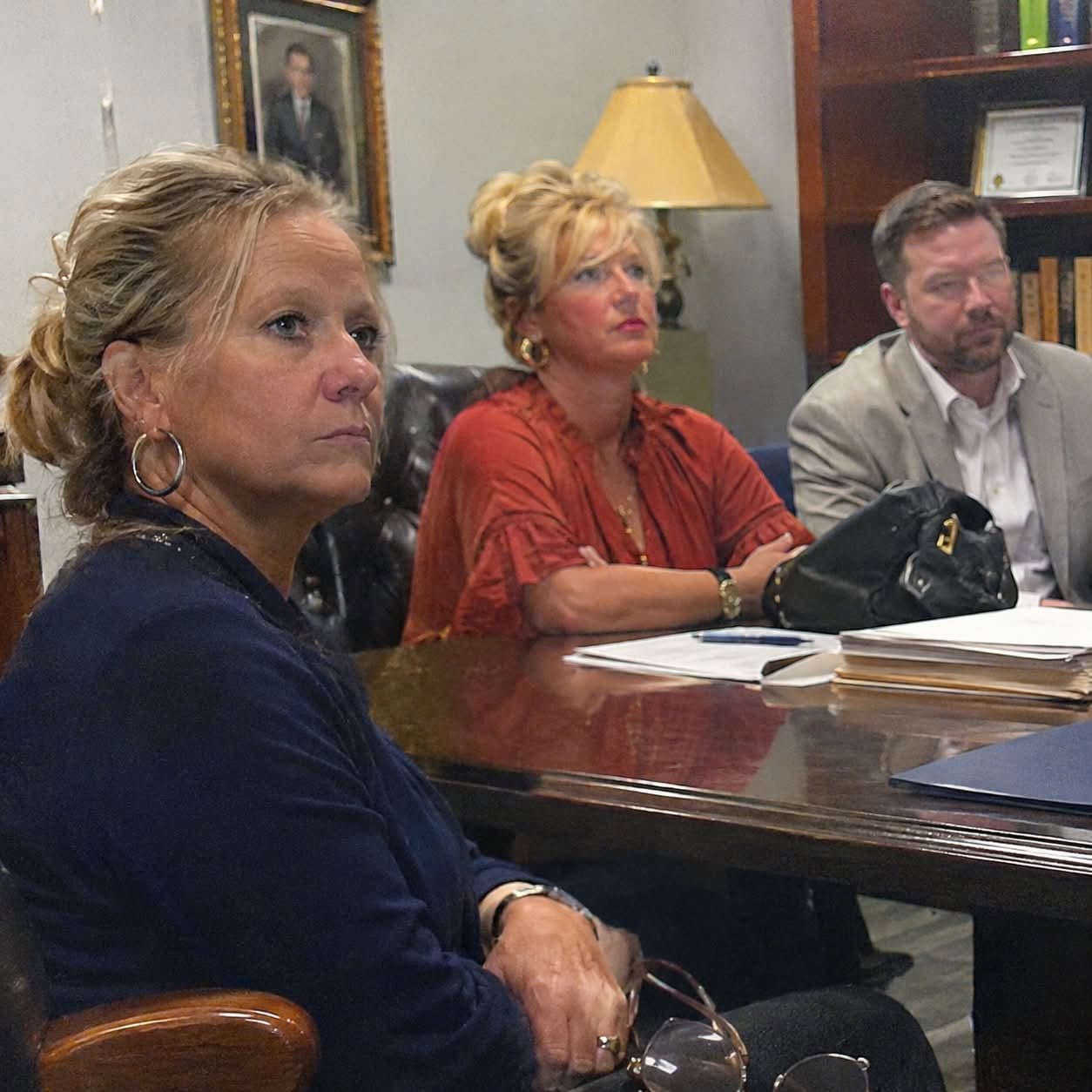
For three full seconds, nobody in that conference room moved.
Mr. Haskins kept his finger beside my name. Tammy leaned forward, her expensive bracelet sliding down her wrist.
“What does that mean?” she asked.
Mr. Haskins adjusted his glasses.
“It means Clayton R. Dobbs made specific provisions for Marlene Dobbs, his former wife, in this document.”
Tammy gave a short laugh.
“That’s impossible. They divorced twelve years ago.”
“I’m aware of that, Mrs. Dobbs.”
“Then why is she mentioned? Clay and I were married. I’m his legal wife. Whatever he owned belongs to me.”
Her attorney, a tall man in a gray suit, placed his pen on the table.
“Mr. Haskins, before you continue, I want to establish whether this is the most recent valid will.”
“It is.”
“And it was properly executed?”
“Signed in my office, witnessed by two independent witnesses, and notarized. I personally supervised the signing.”
Tammy looked at me.
For the first time since she’d entered the room, she wasn’t smiling.
I kept my hands folded over my purse.
Mr. Haskins turned the page.
“Clayton’s instructions were very clear. He wanted this document read in its entirety, without interruption.”
Tammy leaned back.
“Fine. Read it.”
Mr. Haskins began.
“To my former wife, Marlene Dobbs, I leave the sum of five million dollars, free of any conditions other than the ordinary requirements of estate administration.”
Tammy’s mouth fell open.
“Five million?”
Mr. Haskins continued.
“I also direct that the house located at 8214 West 82nd Street in Lubbock, Texas, currently occupied by Marlene, remain hers without further mortgage obligations or claims against the property.”
I looked up.
That was my house.
The house Clay and I had bought when we were young, back when he was still working oil rigs and I was keeping track of every dollar that came into our little household.
After our divorce, the house had been part of our settlement. Clay had paid the remaining mortgage, and I had lived there ever since.
I had never expected anything more.
Tammy stared at me.
“Why would he give you five million dollars?”
I didn’t answer.
Mr. Haskins turned another page.
“Additionally, Clayton has directed that a separate educational trust be established for the children of his late brother, with Marlene Dobbs named as the independent administrator, subject to the court’s approval.”
Tammy shook her head.
“Wait. What about me?”
Mr. Haskins looked at her.
“Your provisions are addressed separately.”
She sat forward.
“Then read them.”
He continued.
“To my wife, Tammy Dobbs, I leave the residence at 14 Oak Hollow Drive, together with the furnishings and personal belongings currently located there, and a cash provision of one million dollars.”
Tammy looked at her attorney.
“One million?”
Her voice was almost a whisper.
“That’s all?”
Mr. Haskins didn’t respond to her question.
He turned to the next section.
“The remaining assets of the estate, including the interests held through the Dobbs family trust, shall be distributed according to the separate trust agreement executed on March fourteenth.”
Tammy’s attorney immediately leaned forward.
“Is the trust agreement available?”
“Yes.”
“Then we need to review it before making any assumptions about the distribution.”
“Of course,” Mr. Haskins replied.
Tammy looked at me again.
Her expression had changed completely.
“You knew about this, didn’t you?”
I shook my head.
“I didn’t even know why I was invited.”
“Don’t lie to me, Marlene.”
“I’m not.”
She turned toward her attorney.
“There’s something wrong here.”
Her attorney asked for a copy of the documents. Mr. Haskins agreed, explaining that the estate would proceed through the normal legal and probate process. Nothing would be distributed immediately, and any valid objections would have to be handled through the appropriate legal channels.
Tammy stood.
“I want a private conversation with you.”
Her attorney touched her arm.
“Tammy, let’s not do anything until we’ve reviewed everything.”
She ignored him.
She looked at me.
“You and I are going to talk.”
I picked up my purse.
“I don’t think we have anything to discuss right now.”
Then I walked out.
I had no idea what Clay had written in the rest of that will, but I knew one thing.
The man I had divorced twelve years earlier had not forgotten me.
And I was beginning to understand that he had a reason for remembering.
—
### The marriage that began with a newspaper headline
To understand why Clay had left me anything at all, you need to understand the life we had before the money.
I married Clayton Dobbs in 1985.
He was twenty-five, I was twenty-three, and neither of us had much of anything.
Clay worked on oil rigs. His hands were rough, his boots were usually covered in dust, and his shirts smelled like diesel and sweat when he came home. I worked part-time at a bookkeeping office and picked up extra work whenever someone needed help balancing accounts.
We rented a small single-wide outside Lubbock.
It wasn’t much, but it was ours.
We ate hamburgers at the kitchen counter, watched television on an old secondhand set, and planned a future that seemed impossibly far away.
When Clay had a good month, we saved money. When he had a bad month, we learned how to stretch groceries.
I kept records of every royalty payment, every equipment expense, and every loan he took out to keep his work going.
He used to tease me.
“One day, Marlene, you’re going to have so many numbers in those books that you’ll need a bigger house just to store them.”
I’d tell him to find the oil first.
He eventually did.
In 1994, Clay acquired an interest in a small piece of land in Scurry County. It wasn’t a glamorous deal. There were lawyers, landowners, drilling expenses, and months of uncertainty. When the first well produced, he reinvested most of the money.
A few years later, another well came in.
Then another.
By 2008, he had built a substantial operation with fourteen producing wells, an office downtown, and employees who depended on the company for their livelihoods.
But money changed things.
Clay began traveling more. He spent time with investors and business associates. He bought expensive clothes and started attending events I didn’t enjoy.
Then there was Krystal, the woman who worked at his front desk.
I noticed the late phone calls first. Then the excuses. Eventually, I found messages that made it impossible to pretend nothing was happening.
We tried counseling.
We argued.
We separated for a while and attempted to repair the marriage, but neither of us could return to the life we had before.
In 2011, we divorced.
I didn’t take half his company. I didn’t fight over every asset. I received the house on 82nd Street, a monthly settlement, and enough money to rebuild my life.
I wanted peace more than I wanted a courtroom battle.
Clay kept the business.
For several years, we barely spoke.
Then, when his company began expanding, he occasionally called to ask whether I could help him understand an old financial record or locate paperwork from our early years.
I helped when I could.
Not because I wanted him back.
Because I knew how the business had started, and because I didn’t enjoy seeing old records lost.
My sister Tammy, however, had never been particularly interested in the difficult years.
She liked the expensive restaurants, the new cars, and the stories about successful people.
She was nine years younger than me, and she’d spent much of her life comparing what we had.
When I got a new car, she wanted one.
When I bought a nice dress, she asked where I found it.
When Clay and I were married, she sometimes joked that I had found myself a future millionaire.
I never thought she meant anything by it.
I was wrong.
### The wedding that humiliated me
In 2023, Clay’s company sold its Permian Basin acreage to a large energy company based in Houston.
The local newspaper reported that the transaction was estimated to be worth around four hundred million dollars.
The actual amount Clay personally received was never made public. The sale involved company interests, partners, taxes, outstanding obligations, and other financial arrangements.
But the headline was enough.
People who had barely spoken to Clay in years suddenly wanted to have lunch with him.
He was invited to charity events, business dinners, and private gatherings.
And three months after that article appeared, Tammy married him.
It wasn’t a large wedding.
It was a courthouse ceremony followed by a private dinner at an expensive restaurant.
Tammy sent me a photograph of her ring before she even told our mother.
I stared at the picture for a long time.
I called her.
“Is this real?”
She laughed.
“Of course it is.”
“Tammy, he’s my ex-husband.”
“And?”
I didn’t know what to say.
“Did you at least think about how this would affect me?”
She sighed.
“Marlene, you divorced him twelve years ago. You don’t own him.”
“I never said I did.”
“Then don’t make this difficult.”
She ended the call.
A few days later, I saw her at First Baptist Church in Lubbock.
She was standing near the fellowship hall with a plate of lemon bars. Several women were talking around her.
When she noticed me, she smiled.
“Well, look who came today.”
I said hello.
She looked down at her wedding ring.
Then she spoke loudly enough for the people around us to hear.
“Don’t be bitter, Marlene. You had him when he was broke. I’ve got him now that he’s somebody.”
Nobody laughed.
I set down my coffee cup.
“Congratulations, Tammy. I hope you’re happy.”
Then I walked outside.
Mrs. Peabody followed me.
She was in her seventies and had known our family for years.
“Honey, don’t let that girl get under your skin.”
I smiled weakly.
“I’m fine.”
She touched my arm.
“That girl is going to have to live with the choices she’s making.”
At the time, I thought she was simply trying to comfort me.
I had no idea how much those words would matter later.
—
### The final months of Clay’s life
Clay died in October, eleven months after marrying Tammy.
He suffered a stroke while visiting his hunting lease near Snyder, Texas. Two friends were with him, and they called for emergency help.
He was taken to the hospital.
I heard about it from a mutual acquaintance.
I called the hospital, but I wasn’t listed as a family contact. Tammy was.
I didn’t argue.
I sent a message asking whether there was anything I could do.
She replied that the family was handling things.
A few days later, I learned that Clay had died.
He was sixty-three.
I attended the funeral because, despite everything that had happened between us, he had been part of my life for twenty-six years.
I sat near the back.
Tammy sat in the front row wearing a black dress and a hat with a small veil. She didn’t look toward me.
I didn’t expect her to.
After the service, I went to the cemetery, placed a small flower near the arrangement, and left quietly.
I thought that was the end of my connection to Clay.
Three weeks later, the letter from his attorney arrived.
And now I was sitting in my car outside the law office, wondering why Clay had made those decisions.
—
### The letter he had left behind
Two days after the will reading, Mr. Haskins called me.
“Marlene, would you be willing to come back to my office?”
I hesitated.
“Is there something else?”
“Yes. Clay left a personal letter for you. He instructed me to give it to you after the initial reading.”
I agreed to meet him.
When I arrived, he handed me a sealed envelope.
My name was written on the front.
The handwriting was Clay’s.
I recognized it immediately.
I sat down before opening it.
Inside was a single sheet of paper.
*Marlene,*
*If you’re reading this, I’m gone, and I suppose that means I waited too long to say some things.*
*I know I hurt you. I know I wasn’t the husband you deserved during the final years of our marriage. I made decisions that damaged our home, and I spent too much time believing that money could fix things I had broken.*
*I have no excuse for what happened with Krystal. I have no excuse for the nights I stayed away or the times I made you feel like you were less important than the business.*
*You were there before the money. You were there when we had to count every dollar. You kept the books when nobody else believed the company would survive. You sat at our kitchen table and helped me understand what we could afford and what we couldn’t.*
*When the business finally became successful, I started acting as though I had built everything alone.*
*I didn’t.*
*I have spent years thinking about that.*
I stopped reading.
My eyes were already filling.
I continued.
*I also know about what happened at church. I heard about Tammy’s comment. I asked someone who was there because I wanted to know exactly what she said.*
*I’m sorry.*
*I should never have allowed my marriage to you to become something your sister could use to humiliate you.*
*The money in my will isn’t payment for what you endured. I can’t pay someone back for years of their life.*
*I left it because I know you will use it responsibly, and because I wanted to make sure you never had to worry about losing the home we worked so hard to buy.*
*You don’t owe me forgiveness.*
*Clay.*
I folded the letter carefully.
Mr. Haskins waited.
“Did he tell you why he wrote this?”
The attorney nodded.
“Clay came to see me several months before his death. He wanted to update his estate plan. He was very clear that he didn’t want the changes to be made because of his marriage to Tammy alone. He said he had been thinking about his responsibilities and relationships for a long time.”
I looked at the letter.
“Was he unhappy?”
Mr. Haskins considered his answer.
“He was concerned about certain things. But I don’t want to tell you something I can’t prove.”
I nodded.
Then he said:
“There is another matter you should understand. The will is only part of the estate. Some assets were held in trusts and company structures, so the distribution will take time. You shouldn’t assume that every figure you hear in the newspapers represents money available to the beneficiaries.”
I appreciated his honesty.
I wasn’t interested in chasing a newspaper headline.
I wanted to understand why Clay had remembered me.
—
### Tammy’s visit
Tammy arrived at my house the following Saturday.
She didn’t call first.
I opened the door and found her standing on the porch in a cream-colored coat.
“We need to talk.”
I stepped aside.
She walked into the living room and looked around.
“Nice place.”
“It’s the same house.”
She ignored that.
“I’ve spoken with my attorney.”
I waited.
“He says Clay’s will is unusual.”
“That’s between you and your attorney.”
She turned toward me.
“Five million dollars, Marlene. Five million. What did you do to make him leave you that much?”
I looked at her.
“I didn’t do anything.”
“Don’t pretend you don’t know.”
“I didn’t know about the will until the attorney called me.”
She paced near the window.
“Clay was my husband. I was there when he died. I took care of him.”
I stayed quiet.
“Do you know how humiliating this is? People are asking me why my husband left so much money to his ex-wife.”
I looked at her.
“Maybe you should ask him.”
Her expression hardened.
“He’s dead.”
“I know.”
For a moment, neither of us spoke.
Then she said something that surprised me.
“Did you know he still kept your old photographs?”
I looked up.
“What?”
“Photographs from when you were married. I found them in a drawer in his office.”
I didn’t answer.
Tammy shook her head.
“He kept everything. Your wedding photograph, pictures from that old trailer, even a picture of you standing beside one of his first trucks.”
I felt a strange sadness.
“He had a lot of memories.”
“Apparently.”
She sat down.
“Do you think he loved you more than me?”
I looked at her for a long moment.
“I don’t know, Tammy.”
She looked angry.
“Well, I want to know.”
I took a breath.
“Clay and I had a life together. You and Clay had a different life. I don’t know what he felt, and I’m not going to pretend I do.”
She looked away.
Then she whispered:
“I thought I had finally won.”
That sentence hurt more than I expected.
I sat across from her.
“Tammy, this isn’t a competition.”
She laughed bitterly.
“Easy for you to say. You got the money.”
I shook my head.
“No. I got a letter from a man who apologized for hurting me. That’s not the same thing as winning.”
She stood.
“I’ll be speaking with my lawyer.”
“That’s your choice.”
She walked out.
I didn’t chase her.
—
### What Clay had actually left behind
The legal process continued for months.
There were estate inventories, tax matters, company documents, trust records, and the ordinary paperwork that comes with settling a substantial estate.
Tammy challenged parts of the will.
Her attorney questioned the timing of the document and requested medical records concerning Clay’s condition when he signed it.
Mr. Haskins provided the relevant execution records, witness information, and documentation showing that Clay had received independent legal advice.
The court process took time.
There were no dramatic courtroom speeches or overnight decisions.
Eventually, the will was admitted to probate, and the provisions were upheld.
The five-million-dollar bequest to me was confirmed, along with the arrangements concerning my house.
Tammy received the home where she and Clay had lived and the one-million-dollar cash provision, subject to the estate’s administration and applicable obligations.
The remaining assets were handled through the trust according to its terms.
I didn’t celebrate.
I paid the taxes that were due, spoke with an independent financial adviser, and made arrangements to protect the money.
I kept working.
I kept my little bookkeeping clients.
I continued going to First Baptist.
I didn’t buy a mansion or a new car.
The house on 82nd Street remained exactly as it had been.
The only major change was that I no longer worried about whether I could afford to repair the roof or replace the old air-conditioning system.
For the first time in years, I had financial security without having to depend on a monthly settlement.
And I was grateful.
—
### The truth Tammy eventually discovered
Several months later, Tammy called me.
Her voice sounded different.
Not angry.
Not confident.
Just tired.
“Can I come over?”
I hesitated, then agreed.
She arrived without her expensive sunglasses. Her hair was tied back, and she looked as though she hadn’t slept well.
She sat at my kitchen table.
For a while, neither of us spoke.
Then she said:
“I found something in Clay’s desk.”
I waited.
“It was an old notebook. His business records from the early years.”
She opened her handbag and took out a photograph.
It showed Clay standing beside the first truck he had used for his oil work. I was beside him, wearing jeans and a white shirt, with my hair tied back.
We looked young.
We looked tired.
But we were smiling.
Tammy placed it on the table.
“There’s writing on the back.”
I turned it over.
It was Clay’s handwriting.
*For Marlene, who believed in me before anyone else did.*
I looked at Tammy.
She stared at the photograph.
“I never knew he wrote that.”
I didn’t answer.
She continued.
“I used to think you were lucky. You married a man who became rich. You got the house. You had all those years with him.”
I looked at her.
“Tammy, those years weren’t all happy.”
“I know that now.”
She took a breath.
“I thought if I married him, I would finally have the life you had. I thought people would look at me differently. I thought the money would make everything better.”
I waited.
“But he never talked to me the way he used to talk to you.”
I felt uncomfortable hearing that.
“Maybe you should have asked him why.”
She nodded.
“I did. He said we were different people and that I shouldn’t compare our marriage to his first one.”
She looked down.
“That made me angry.”
I folded my hands.
“Tammy, you didn’t need to marry my ex-husband to prove anything to me.”
She began crying.
“I know.”
For the first time in years, I saw my little sister rather than the woman who had stood in church and humiliated me.
But I couldn’t pretend nothing had happened.
She had hurt me deeply.
And an apology didn’t erase it.
I reached across the table.
“I’m not going to tell you everything is fine. It isn’t. But I don’t want to spend the rest of my life fighting with you.”
She nodded.
“Neither do I.”
We sat there for a while.
Then she asked whether I still had the old recipe for our mother’s peach cobbler.
I laughed despite myself.
“Of course I do.”
She smiled.
“Can I have a copy?”
I went to the kitchen drawer and found the handwritten card.
It was a small thing.
But it was the first normal conversation we’d had in years.
—
### The final thing Clay asked me to do
About a year after the will reading, Mr. Haskins contacted me again.
He had found a second envelope among Clay’s personal papers.
It contained a short note.
*Marlene,*
*If Tammy ever comes to you and admits she was wrong, don’t feel you have to forgive her immediately. But if you can find a way to make peace with her someday, I hope you will.*
*You were always better at holding a family together than I was.*
*I know I didn’t make that easy.*
*Please don’t spend the rest of your life carrying the anger I helped create.*
*Clay.*
I read it twice.
Then I placed it in the same drawer as the first letter.
I didn’t show it to Tammy.
It wasn’t my job to make her feel better about what she had done.
But I did think about Clay’s words.
I thought about the young man I had married in 1985, the years we had spent counting every dollar, the mistakes we had made, and the life we had built before money became the center of everything.
I also thought about my sister.
She had wanted something that belonged to the past, believing it would give her a better future.
Instead, she had lost a relationship with me and discovered that money couldn’t guarantee love.
I never became Tammy’s closest friend again.
Trust takes longer to rebuild than it takes to break.
But we began speaking more often. We shared family news. We visited our mother’s grave together. And at Christmas, she came to my house with a peach cobbler made from the recipe I had given her.
It wasn’t perfect.
The crust was a little too dark, and she had used too much cinnamon.
But we ate it anyway.
I still have the photograph of Clay and me beside that first truck.
Sometimes I look at it and remember the years before the money, before the divorce, before Tammy’s wedding.
I don’t miss the marriage.
I don’t wish Clay were still alive so I could ask him more questions.
And I certainly don’t think five million dollars makes up for everything that happened.
But I understand something now that I didn’t understand when Tammy stood in church and told me she had taken my place.
**She thought she had married a fortune. I had once married a man who had nothing, and together we built the beginning of everything he eventually became.**
The money was part of his final decision.
But the letter was the part I kept.
Because after all those years, Clay had finally acknowledged something he should have said long before we divorced.
I had mattered.
And that was worth more to me than the number printed on the will.