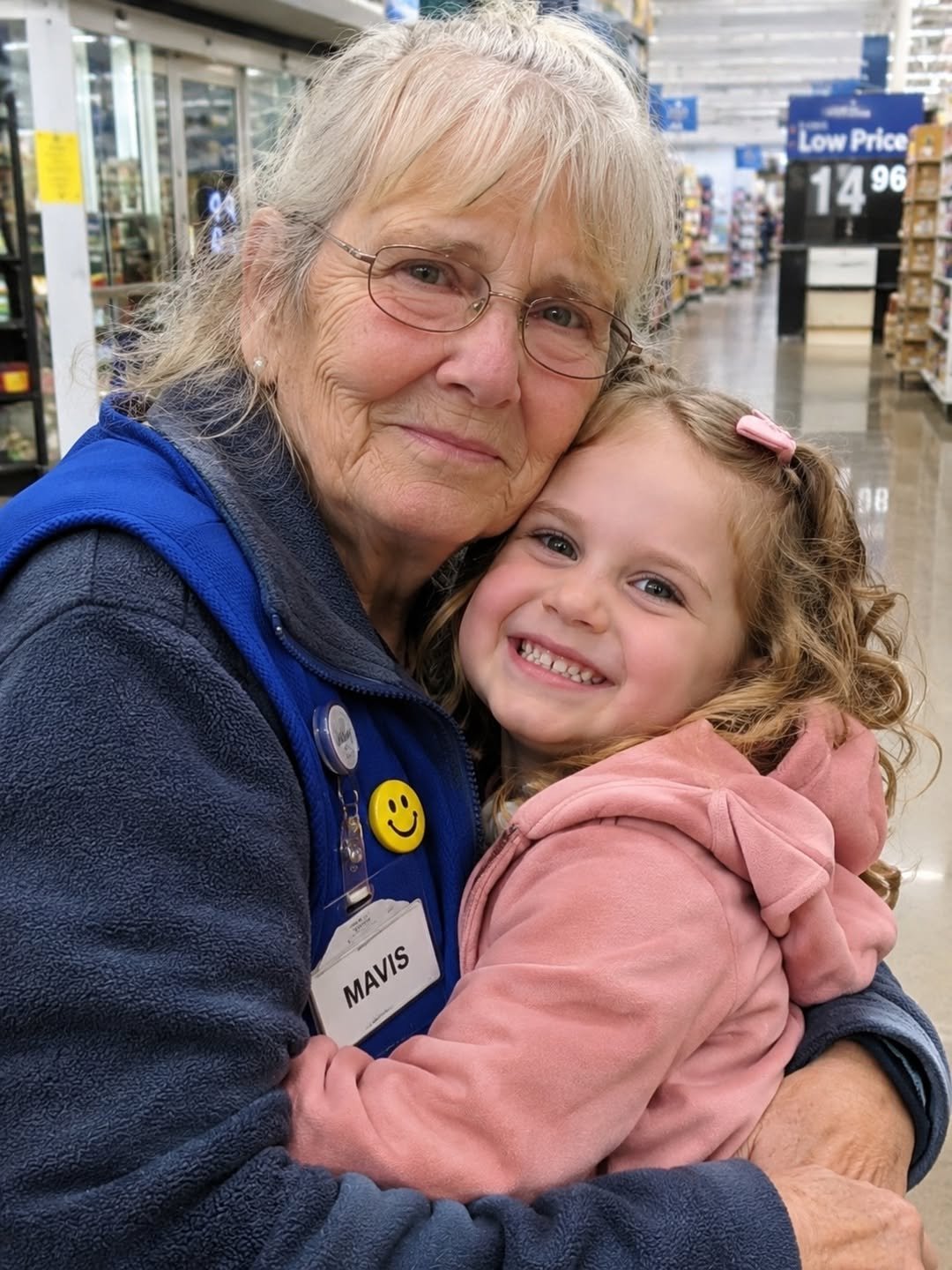
My name is Mavis Keller. I’m sixty-seven years old, and for nine years, I worked as a greeter at a big-box store in Fort Smith, Arkansas.
I wasn’t there because I needed a career. I’d already spent thirty-one years delivering mail, walking through neighborhoods in rain, snow, and summer heat. I retired at sixty, and for a while, I thought retirement would feel like freedom.
It didn’t.
My husband, Harold, had been gone for four years. Our daughter lived in Tulsa with her family, and although she called every Sunday, the house was still painfully quiet. I tried gardening, volunteering at the library, and joining a walking group, but none of it gave me the feeling that somebody was glad I had shown up.
Then a friend told me the store needed a greeter.
“All you have to do is smile and say hello,” she said.
I laughed. “I can manage that.”
So I took the job.
It became more important to me than I expected. I learned which customers came in every morning for coffee, which elderly couples needed help loading groceries, and which children ran toward the entrance because they knew I kept smiley-face stickers in my vest pocket.
Every child got one if they wanted one.
Some parents thought it was silly, but I didn’t care. A little sticker could make a child feel noticed. Sometimes that was enough.
There was a little boy named Mason who came in every Saturday with his grandmother. He always asked for two stickers, one for himself and one for his dog. There was a shy girl named Lily who wouldn’t speak to me for almost three months, but one morning she finally whispered, “Can I have a yellow one?”
I gave her three.
I liked being the woman who made people smile.
I never imagined that one Tuesday afternoon, a simple smiley-face sticker would put me in the middle of a case that would change my life.
It happened in March.
The weather had been unpredictable that week. The morning was cold, but by the afternoon the sun had come out. I was standing near the entrance, straightening a small display of shopping carts, when I noticed a man approaching the exit.
He was carrying a little girl.
She looked about three years old. She had curly brown hair, a pink jacket, and bright pink rain boots. One of her socks was slipping down, and she was holding a small stuffed rabbit by one ear.
But something was wrong.
She wasn’t simply crying. She was terrified.
Her face was red, her cheeks were wet, and she was twisting in the man’s arms so violently that he had to hold her tighter.
“You’re not my daddy!” she screamed. “I want my mommy!”
The man kept walking.
I stepped closer and held out a yellow smiley-face sticker.
“Hello, sweetheart. Would you like a sticker?”
The little girl turned toward me. For one brief moment, her eyes met mine.
Then she reached out and grabbed the front of my vest with both hands.
“You’re not my daddy!” she screamed again. “I want my mommy! I want Miss Patty!”
The man stopped.
He was probably in his late thirties, with short dark hair, a clean jacket, and a neatly trimmed beard. He looked like an ordinary customer. Nothing about his clothes or appearance would have made anyone suspicious.
He gave me a tight smile.
“Sorry about this. She’s tired. She’s been having a difficult day.”
I looked at the child.
“What’s your name, sweetheart?”
She didn’t answer. She only held my vest tighter.
The man shifted her in his arms.
“Come on, Quinn. We’re going home.”
Quinn.
I remembered the name.
“Quinn,” I said gently. “Can you tell me if this man is your daddy?”
She shook her head so hard that her curls bounced.
“No! He took me! I want Miss Patty!”
The man’s smile disappeared.
“Ma’am, she’s three years old. She doesn’t know what she’s saying.”
“She seems very frightened.”
“She’s having a tantrum. Now, please move.”
He tried to walk around me.
I stepped sideways.
“Could I ask you to wait just a moment while I get my manager?”
His expression changed completely.
“Get out of my way.”
I wasn’t a large woman. My knees weren’t what they used to be, and I had arthritis in my left hand. But thirty-one years delivering mail had taught me something about people. Sometimes you had to stand still when every instinct told you to step aside.
“I’m sure this is a misunderstanding,” I said. “Let’s just make sure everything is okay.”
He stared at me.
“Do you know who I am?”
“No, sir.”
“I’m her father.”
“Then I’m sure you won’t mind waiting while we clear this up.”
He looked toward the parking lot.
For a second, I thought he might drop the little girl and run. Instead, he tightened his grip and raised his voice.
“Get your manager. Now.”
I called for assistance.
My manager, Mr. Darby, came over a minute later. He was thirty-five, always neatly dressed, and constantly worried about customer complaints. He had worked in retail management for years and believed that the fastest way to solve a problem was to make the unhappy person go away.
The man immediately began explaining.
“This employee is harassing me. My daughter is having a tantrum, and this woman won’t let me leave.”
Mr. Darby looked at the child.
“Sir, is everything all right?”
“Of course. She’s tired.”
Then the man pulled out his wallet and showed him a driver’s license.
He also opened a photograph on his phone showing himself holding a baby.
“There’s her picture. That’s me and Quinn. I’m her father.”
Mr. Darby glanced at the license and the photograph.
I looked at the little girl.
She was still crying.
“Mr. Darby,” I said quietly, “she keeps saying he isn’t her father. She says he took her from someone named Miss Patty.”
He sighed.
“Mavis, she’s a little child. You can’t expect us to investigate every family argument.”
“I’m not asking you to investigate. I’m asking you to call the police.”
The man stepped forward.
“This is ridiculous. I’m leaving.”
Mr. Darby looked at me.
“Mavis, step aside.”
I didn’t move.
He lowered his voice.
“Please. You’re embarrassing the store.”
I looked at him.
“She’s frightened.”
“I understand, but we can’t hold customers against their will.”
The man began walking again.
Mr. Darby moved closer to me.
“Now, Mavis.”
I stepped aside.
It was the worst feeling I’d experienced in years.
The little girl reached toward me as he carried her through the doors.
“Please!” she cried. “Don’t let him!”
I stood there, watching them cross the parking lot.
I couldn’t stop thinking about those words.
Don’t let him.
I walked toward the glass doors and watched the man approach a dark blue SUV. He opened the passenger-side rear door and placed Quinn inside. She was still crying.
I pulled out my phone.
I took three photographs. One of the man’s face, one of the vehicle, and one of the license plate.
Then I called 911.
I gave the dispatcher the location, described the man and the child, and explained exactly what I had heard.
The dispatcher asked whether I had touched the man.
“No.”
“Did you physically prevent him from leaving?”
“I stood in front of him briefly, but I didn’t touch him.”
“Do you know whether he is the child’s father?”
“No. He said he was, but the little girl repeatedly said he wasn’t.”
The dispatcher told me to remain available.
I watched the SUV pull out of the parking lot.
Then I went back inside.
I didn’t know whether I had done the right thing.
But I knew I couldn’t have gone home without calling.
The next morning, Mr. Darby called me into his office.
He had a printed complaint on his desk.
“Mavis, we need to talk.”
I sat down.
He folded his hands.
“The customer contacted corporate.”
“What did he say?”
“He says you harassed him, blocked his exit, followed him into the parking lot, and took photographs of him and his vehicle.”
“I took photographs after I saw the little girl crying.”
“That isn’t the point.”
“It is the point to me.”
He sighed.
“He also says you accused him of kidnapping his own daughter.”
“I never called him a kidnapper. I asked him to wait while we made sure she was safe.”
“Mavis, you’re not a police officer.”
“I know.”
“You’re a store greeter.”
“I know that too.”
He pushed the complaint toward me.
“Corporate has reviewed the incident. They don’t want this kind of situation happening again.”
I looked at him.
“Did anyone call the police to find out what happened?”
He didn’t answer.
“Did anyone check whether the child was safe?”
“Mavis, that’s not our responsibility.”
I stared at him.
“Then whose responsibility is it?”
He looked uncomfortable.
“I’ve been instructed to end your employment effective immediately.”
For a moment, I thought I had misunderstood him.
“You’re firing me?”
“I’m sorry.”
“After nine years?”
He nodded.
I looked at the little name tag on my vest.
MAVIS.
I had worn it proudly for nine years.
“Can I at least have my personal things?”
“Of course.”
I walked to the break room, removed my photograph of Harold from my locker, collected my purse, and took the roll of smiley-face stickers from my vest pocket.
There were twenty-three left.
I held them in my hand for a moment.
Then I put them in my purse.
I drove home slowly.
My daughter, Rebecca, called that afternoon.
She could tell something was wrong before I said a word.
“Mom, what happened?”
I told her everything.
When I finished, she was quiet for a moment.
“Mom, you called the police, right?”
“Yes.”
“Then you did what you thought was right.”
“I lost my job.”
“I know.”
“I’m sixty-seven, Becca. Nobody is going to be lining up to hire me.”
“Maybe not. But I would rather have a mother who tried to protect a child than one who looked away.”
I began crying.
I hadn’t cried when Mr. Darby fired me. I hadn’t cried when I drove home. But those words broke something open.
Three weeks later, a letter arrived.
It was from an attorney representing the man from the store.
His name was Wayne Haller.
The letter said he was suing me for $250,000.
The allegations included assault, defamation, false accusations, and emotional distress. According to the complaint, I had physically intimidated him, publicly accused him of kidnapping, and caused severe emotional harm to him and his daughter.
I read the letter three times.
Then I called Rebecca.
She drove to my house that evening.
When she saw the papers, she looked furious.
“Mom, this is insane.”
“I don’t have that kind of money.”
“You’re not paying him anything.”
“I can’t afford a lawyer.”
“We’ll figure something out.”
The next morning, Rebecca helped me contact legal aid.
A young attorney named Thomas Reed agreed to review the case. He was thirty-two, wore inexpensive suits, and had the kind of serious expression that made him look older than he was.
He read the complaint carefully.
Then he asked me to tell him everything from the beginning.
I told him about the little girl, the pink boots, the stuffed rabbit, and the words she had repeated.
He listened without interrupting.
When I finished, he asked, “Did you save the photographs?”
“Yes.”
“Did you keep the 911 call information?”
“I wrote down the time and the dispatcher’s name.”
“Did the store have cameras?”
“I believe so.”
He made a note.
“Good. We need to preserve the surveillance footage before it gets overwritten.”
He looked at me.
“Mavis, I can’t promise you how this case will turn out. But a lawsuit isn’t proof that you’ve done anything wrong. We’ll answer the allegations, request the relevant evidence, and find out what actually happened.”
I nodded.
For the first time since the letter arrived, I felt I could breathe.
Then Thomas asked something that changed the entire direction of the case.
“Did anyone ever tell you what happened to the little girl after she left the store?”
I shook my head.
“No.”
He looked down at the photographs.
“Then that’s where we need to start.”
## Part 3: The Search for Quinn
The first thing Thomas did was request the original 911 recording and the incident report.
He also sent preservation requests to the store and the company that managed its security cameras.
The store responded that some footage had already been overwritten.
But one camera covering the main entrance had retained a short recording because of the incident report filed by Mr. Darby.
The video showed the man carrying Quinn toward the exit.
It showed me stepping forward.
It showed the little girl reaching toward me.
It showed me standing between the man and the doors for several seconds.
But it also showed something important.
I never touched him.
I never grabbed his arm.
I never struck him.
And I never followed him outside.
I remained inside the entrance area, took photographs through the glass, and returned to my station before making the emergency call.
Thomas watched the recording twice.
“That’s helpful,” he said.
“Does it prove I didn’t do anything wrong?”
“It supports your account. We’ll need the original footage and proper records, but it’s useful.”
The next week, Thomas received a call from the police department.
A detective had reviewed the original report and wanted to speak with me.
I went to the station with Rebecca.
Detective Laura Bennett met us in a small interview room. She was in her forties, with short brown hair and a calm voice.
She placed a photograph on the table.
It showed Quinn.
The same curly hair. The same pink rain boots.
I felt my throat tighten.
“Is she okay?” I asked.
Detective Bennett nodded.
“She’s safe.”
I closed my eyes.
“Thank goodness.”
The detective explained that the case had become more complicated than the initial report suggested.
Quinn had been reported missing from a babysitter’s home on the same afternoon I saw her.
Her mother, Rachel Mercer, had called the police after returning from work and discovering that her daughter was gone.
The babysitter was a woman named Patricia Corliss, who had been caring for Quinn for nearly a year.
Patricia had told investigators that she stepped into the backyard briefly to retrieve a delivery package. When she returned, the back door was open and Quinn was missing.
Rachel had called emergency services immediately.
A search began.
Neighbors were interviewed, nearby businesses were contacted, and officers reviewed traffic cameras.
Then my 911 call came in.
The description of the child and the vehicle matched the missing-child report.
The license plate photograph gave investigators a direction to follow.
The SUV was registered to Wayne Haller.
Detective Bennett explained that officers located the vehicle later that afternoon at a motel outside Fort Smith.
Wayne was there with Quinn.
He told officers that the child was his daughter and that he was taking her to visit relatives.
But he could not provide a convincing explanation for why the child had been reported missing from another person’s home.
He was taken in for questioning.
Quinn was placed with a child-protection worker and reunited with her mother after investigators confirmed Rachel’s identity and relationship to her daughter.
I covered my mouth.
“She was missing.”
“Yes.”
“Did he hurt her?”
The detective paused.
“We have no evidence that she suffered a physical injury during the incident. She was frightened, but she was examined by medical professionals and is now safe.”
I nodded.
“Who was he?”
“That’s still part of the investigation.”
She explained that Wayne had been acquainted with Rachel through a previous relationship. He was not Quinn’s biological father, and he had no legal parental rights.
He had once lived with Rachel for several months, before their relationship ended.
He had been allowed to spend time around Quinn when Rachel was present, but she had never given him permission to take the child.
The detective said the investigation was ongoing.
I asked whether Wayne had been arrested.
“He was arrested after officers located him. He has been charged with offenses related to the incident. The prosecutor will determine how the case proceeds.”
I sat quietly.
The detective looked at me.
“Mavis, I want you to understand something. Your call was important. Your photographs gave us information we might not otherwise have had so quickly.”
I started crying.
Not because I wanted praise.
Because the little girl was safe.
## Part 4: The Man Who Sued Me
I thought that would be the end of it.
I was wrong.
Wayne’s civil lawsuit continued.
His attorney argued that the criminal allegations were separate from the claims against me. He claimed that I had publicly humiliated him, frightened his daughter, and caused him emotional distress.
Thomas explained that the lawsuit would have to be answered on its own evidence.
“We can’t assume the civil case disappears because of the criminal case,” he told me. “But the facts from that afternoon matter. The video, your photographs, the emergency call, and the police records all support your account.”
The lawsuit made life difficult.
My neighbors began asking questions.
One woman at church said she had heard I was being sued for attacking a father in a store.
I tried to explain, but rumors travel faster than the truth.
A few people avoided me.
Others stopped by with food and kind words.
One afternoon, I found a handwritten note in my mailbox.
*You did the right thing. Don’t let them make you ashamed of it.*
There was no name.
I kept it.
The store never called to apologize.
Mr. Darby never called.
Corporate sent a letter confirming my termination and saying the company would not comment on the pending legal matter.
I found a part-time job at a small garden center, but it paid less than my old position. My knees hurt after long shifts, and the lawsuit had made me anxious every time a customer raised their voice.
Still, I kept working.
I needed something to do.
And I needed to remind myself that Wayne Haller had not taken everything from me.
One morning, Thomas called.
“Mavis, we have a development.”
“What is it?”
“Wayne’s criminal case is moving forward. The prosecutor has received the store footage, your photographs, and the emergency call. Rachel has also provided additional evidence.”
“What kind of evidence?”
“I don’t want to give you details that haven’t been entered into the record. But there are records showing Wayne had no permission to take Quinn.”
I sat down.
“Will I have to testify?”
“Possibly. The prosecutor may call you as a witness. We should prepare.”
I swallowed.
“I can do that.”
Thomas paused.
“There’s something else. Wayne’s attorney has requested a settlement conference in your civil case.”
“What does that mean?”
“They may be willing to resolve the lawsuit.”
I almost laughed.
“He wants me to pay him?”
“That’s what his complaint asks for. But we have a strong basis to defend the claims. We won’t agree to pay anything without discussing it.”
I looked at the photograph of Harold on my mantel.
He had always said that trouble was easier to face when you stopped imagining every possible ending.
“Then we don’t pay him,” I said.
Thomas chuckled softly.
“That’s a good starting position.”
## Part 5: The Courtroom
October arrived.
The civil trial was scheduled to begin on a Monday morning.
I had barely slept the night before.
Rebecca drove me to the courthouse. I wore my best dark blue dress, a small silver necklace, and the comfortable shoes I used for church.
Thomas met us outside the courtroom.
“You doing okay?”
“I’ve been better.”
He smiled.
“That’s fair.”
Wayne was already there.
He sat beside his attorney, wearing a dark suit and a striped tie. He looked exactly as he had at the store: clean, composed, and confident.
When he saw me, he leaned toward his lawyer and whispered something.
His lawyer looked at me.
I recognized him from the settlement letters. His name was Richard Cole.
He was a polished man in his fifties who spoke as though every sentence had been rehearsed.
He had described me in legal filings as a confused elderly woman who had allowed her imagination to turn an ordinary family disagreement into a public spectacle.
I tried not to look at him.
The courtroom filled slowly.
There were a few reporters, some people from the community, and several individuals I didn’t recognize.
Thomas sat beside me.
“Remember,” he whispered, “answer only what you’re asked. Don’t argue with the attorney. If you don’t know something, say so.”
I nodded.
The judge entered.
Everyone stood.
After the formalities, the judge reviewed the schedule.
“Are the parties ready to proceed?”
Both attorneys stood.
Richard Cole approached the bench.
“Your Honor, before opening statements, we have a matter involving a potential witness who has arrived this morning.”
The judge looked toward the back of the courtroom.
“Who is the witness?”
A young woman stood.
She was in her early thirties, wearing a simple gray sweater and holding a little girl by the hand.
The girl wore pink rain boots.
I stopped breathing.
I knew those curls.
I knew that little face.
It was Quinn.
The young woman took a breath.
“Your Honor, my name is Rachel Mercer. I’m Quinn’s mother.”
The courtroom became completely silent.
Wayne turned so quickly that his chair scraped across the floor.
His face had gone pale.
Rachel held Quinn’s hand and approached the front of the courtroom.
Richard Cole stood.
“Your Honor, we object to this interruption. This witness was not listed in the materials provided to us.”
The judge raised one hand.
“Counsel, sit down. I will hear the explanation.”
Rachel looked toward me.
For a moment, I thought she might cry.
Then she looked at the judge.
“I know this is unusual, but I couldn’t let this case go forward without telling the truth.”
The judge asked her to identify herself and explain why she was present.
Rachel said that she had learned about the civil trial through the prosecutor’s office. She had also received a copy of the original police report after requesting records concerning Quinn’s recovery.
When she learned that the woman who had called 911 was being sued by Wayne, she contacted the attorneys involved.
“I didn’t know Mavis before that day,” Rachel said. “But she helped save my daughter.”
Wayne stood.
“That’s not true!”
The judge looked at him.
“Mr. Haller, sit down.”
He sat.
Rachel continued.
“Quinn was at Patricia Corliss’s home that afternoon. Patricia had been her babysitter for almost a year. I trusted her. I had never given Wayne permission to pick Quinn up.”
The judge asked, “Was Wayne Haller legally authorized to take the child?”
“No, Your Honor.”
“Was he Quinn’s biological father?”
“No.”
“Did he have any court-ordered parental rights?”
“No.”
Rachel’s voice trembled.
“He used to be my boyfriend. We lived together for a short time, and he was around Quinn when we were together. But we broke up. I told him not to contact us anymore.”
She looked at Wayne.
“He kept saying he wanted to see Quinn. I told him he couldn’t.”
Wayne’s lawyer rose again.
“Your Honor, the witness’s relationship history is not relevant to whether my client was defamed by the defendant.”
The judge looked at him.
“Counsel, the identity and authority of the person who removed the child are directly relevant to the events underlying this lawsuit. We will address the procedural issues before deciding what testimony is admissible.”
Rachel nodded.
Then she did something I wasn’t prepared for.
She turned toward Quinn.
“Sweetheart, do you remember the lady at the store?”
Quinn looked around the courtroom.
Her eyes moved across the people seated behind the tables.
Then she saw me.
Her little face changed.
“Mavis!”
She let go of her mother’s hand and took two small steps toward me before Rachel gently stopped her.
I covered my mouth.
“Hello, sweetheart.”
Quinn smiled.
“Sticker lady!”
I started crying.
The judge allowed Rachel to continue, but made it clear that the court would follow the rules of evidence and give both sides an opportunity to question her.
Rachel returned to the witness area.
And then she explained what had happened after Quinn disappeared.
## Part 6: What Quinn Remembered
Rachel had been working at a medical billing office that afternoon.
She usually finished at five, but that Tuesday she had left early because Quinn had developed a mild fever the night before. She had arranged for Patricia Corliss to watch her daughter for the afternoon.
When Rachel arrived at Patricia’s home, the front door was open.
Patricia was standing in the hallway, crying.
“Where’s Quinn?”
Patricia told her that she had stepped into the backyard to retrieve a package. When she returned, Quinn was gone.
At first, Rachel thought the child had wandered into another room.
Then she searched the backyard.
The house.
The garage.
The neighboring yards.
Nothing.
Patricia said she had heard a vehicle leaving shortly before she returned inside.
Rachel called 911.
Officers arrived, took descriptions, and began searching.
Rachel provided a recent photograph of Quinn wearing her pink rain boots.
The photograph was distributed to officers and nearby businesses.
A short time later, the police received my call.
Rachel said the first officer who contacted her told her that a store employee had seen a child matching Quinn’s description being carried toward an exit by a man.
Then they received the license plate photograph.
The vehicle belonged to Wayne Haller.
Rachel knew immediately who he was.
She had ended their relationship several months earlier after repeated arguments. Wayne had been angry about the breakup and had continued trying to contact her.
She had told him not to come near Quinn.
Rachel had no idea he intended to take her.
Police located him later that day.
When officers approached the vehicle, Quinn was inside.
Wayne claimed he was taking his daughter to visit relatives.
But the officers already had the missing-child report and Rachel’s information.
Wayne was arrested.
Quinn was examined and reunited with her mother.
Rachel explained that the following weeks were difficult.
Quinn woke up crying at night. She became frightened whenever a stranger approached too quickly. She didn’t want to be carried by anyone except Rachel.
A child counselor helped her work through the fear.
“She kept talking about the woman with the yellow stickers,” Rachel said.
I wiped my eyes.
“She remembered me?”
Rachel nodded.
“She told me that a lady at the store had tried to help her. She said you gave her a smiley face, and that you wouldn’t let the man take her through the door.”
I shook my head.
“I wish I could have done more.”
Rachel looked at me.
“You did enough.”
The courtroom was silent.
Then Richard Cole began questioning her.
“Ms. Mercer, you were not present at the store, correct?”
“No.”
“So you cannot personally testify to what happened between my client and the defendant.”
“I can testify to what happened before and after, and to what my daughter told me.”
“Your daughter was three years old at the time?”
“Yes.”
“Three-year-olds can become confused, can’t they?”
Rachel looked at him.
“She was frightened. But she knew who her mother was, who her babysitter was, and that Wayne was not allowed to take her.”
“Did Mr. Haller ever provide financial support for the child?”
“No.”
“Did he ever act as a father figure?”
“For a short time, when we were together. But he was never her legal father.”
“Isn’t it true that you had a difficult breakup?”
Rachel looked directly at him.
“Yes.”
“And you were angry with him?”
“I was afraid of him.”
The lawyer paused.
“Afraid?”
Rachel nodded.
“After I ended the relationship, he kept contacting me. He showed up outside my workplace. He sent messages saying that I couldn’t keep Quinn away from him. I told him to stop.”
Richard Cole looked toward Wayne.
“Did you ever report those messages?”
“Yes.”
The attorney stopped asking questions.
Rachel continued.
“I didn’t come here because I wanted to embarrass Wayne. I came because a woman who tried to protect my child is being called a criminal for doing it.”
She looked toward me.
“She was the only person in that store who listened to my daughter.”
I lowered my head.
I didn’t want anyone to see how much I was crying.
## Part 7: The Evidence Wayne Didn’t Expect
The judge called a short recess.
Thomas leaned toward me.
“Mavis, this changes things.”
“Does it mean he’ll lose?”
“It helps establish the context, but we still have to address your claims and the evidence. Stay focused.”
When the court returned, Thomas asked permission to present the store’s surveillance footage.
The judge allowed it.
The video played on the courtroom screen.
There I was, standing beside the shopping carts.
Then Wayne appeared, carrying Quinn.
The little girl was crying.
I approached.
The footage had no sound, but the movements were clear. Quinn reached toward me. Wayne shifted her away. I stepped toward the exit.
Wayne attempted to walk around me.
I moved sideways.
Then Mr. Darby arrived.
The three of us spoke for several seconds.
Wayne showed his identification and phone.
I stepped aside.
He walked out.
The video continued.
I stayed inside the entrance area.
I took photographs through the glass.
Then I returned to my station and used my phone.
Thomas paused the recording.
“Does that footage show the defendant being struck or touched by my client?”
“No,” I said.
“Does it show my client following the defendant into the parking lot?”
“No.”
“Does it show her physically preventing him from leaving the building?”
“It shows her standing in front of him briefly, but she never touches him.”
Thomas nodded.
He then introduced the photographs.
One showed Wayne’s face.
Another showed the license plate.
The third showed Quinn sitting in the rear of the SUV, crying.
The judge examined them.
Richard Cole objected to several details, but the photographs were admitted for the purposes permitted by the court.
Then Thomas requested permission to play the 911 recording.
The judge agreed.
My voice came through the speakers.
“There’s a little girl. She’s very upset. She keeps saying the man carrying her isn’t her father.”
The dispatcher asked whether I knew the man’s name.
I answered that I did not.
Then I described the SUV and read the license plate.
The dispatcher asked whether I had touched the man.
“No. I didn’t touch him.”
“Are you certain the child is in danger?”
I paused.
Then my voice answered.
“I can’t be certain. But she’s frightened, and she keeps saying he took her. I would rather be wrong and have someone check than ignore her.”
When the recording ended, nobody spoke for several seconds.
Thomas looked toward the judge.
“Your Honor, this recording demonstrates that my client made a good-faith emergency report based on what she personally observed. She did not publicly accuse the plaintiff of a crime. She reported a possible child-safety emergency to law enforcement.”
Richard Cole stood.
“Your Honor, my client has suffered serious emotional distress from this incident. He was confronted in public and treated like a criminal by an elderly employee who had no authority to interfere.”
Thomas answered calmly.
“The defendant did not arrest the plaintiff. She did not detain him. She did not physically restrain him. She contacted emergency services after a child repeatedly said she had been taken against her will. The evidence shows that police subsequently located the child with a person who had no legal authority to remove her.”
The judge looked at Wayne.
“Mr. Haller, do you dispute that you had no legal authority to remove the child from the babysitter’s home?”
Wayne’s attorney stood.
“Your Honor, we reserve our response.”
The judge’s expression hardened.
“This is a straightforward factual question.”
Richard Cole leaned toward Wayne.
They whispered.
Finally, Wayne stood.
“I was trying to help.”
The judge looked at him.
“That was not my question.”
Wayne sat down.
The court took another recess.
## Part 8: The Manager’s Testimony
The following morning, Thomas called Mr. Darby.
I hadn’t seen him since the day he fired me.
He walked into the courtroom wearing a gray suit and carrying a folder. He looked nervous.
Thomas asked him to explain what happened at the store.
Mr. Darby said he had responded to a customer complaint involving an employee who was refusing to let a father leave with his child.
Thomas asked whether he had seen the child crying.
“Yes.”
“Did you hear her say the man wasn’t her father?”
“I heard her say something like that.”
“Did she appear frightened?”
“She was upset.”
“Did you call the police?”
“No.”
“Why not?”
Mr. Darby hesitated.
“I believed the man had shown me identification proving he was her father.”
“Did you verify the identification?”
“No.”
“Did you contact the child’s mother?”
“No.”
“Did you ask the man for any other proof?”
“No.”
Thomas paused.
“Did Mavis Keller ask you to call the police?”
“Yes.”
“And what did you tell her?”
“I told her to step aside.”
“Why?”
Mr. Darby looked uncomfortable.
“Because I believed the situation was a customer-service problem.”
Thomas nodded.
“Did you later learn that the child had been reported missing?”
“Yes.”
“Did you know that the man had no legal authority to remove her?”
“I learned that later.”
“Did you apologize to Ms. Keller for dismissing her concerns?”
Mr. Darby looked toward me.
“No.”
“Did you fire her?”
“Yes.”
“Why?”
“Because the customer filed a complaint, and corporate wanted the matter handled.”
Thomas let the silence sit.
Then he asked one final question.
“Mr. Darby, looking back, do you believe Ms. Keller was wrong to call 911?”
Mr. Darby swallowed.
“I don’t think she was wrong to call.”
“Do you believe she should have been fired for doing so?”
Richard Cole objected.
The judge sustained the objection.
Thomas nodded and moved on.
During cross-examination, Richard Cole tried to make Mr. Darby say that I had been aggressive and had interfered with a customer.
But the surveillance footage had already shown what happened.
There was no evidence I had struck Wayne, grabbed him, or followed him outside.
Mr. Darby admitted that the store had no written policy telling greeters to ignore a child who claimed to have been taken by someone who was not her parent.
When he stepped down, he looked at me.
I didn’t smile.
I didn’t glare.
I simply nodded once.
He returned the gesture.
It wasn’t an apology, but it was the first time he had acknowledged that I might have been right.
## Part 9: Quinn’s Voice
The next witness was Detective Laura Bennett.
She explained how the police received my call and matched the vehicle description to the missing-child report.
She confirmed that officers located Wayne and Quinn at a motel outside the city.
She testified that Wayne had no legal custody rights and no permission from Rachel to take the child.
The detective also explained that Wayne had initially given officers an account that did not match the information provided by Rachel and the babysitter.
The judge asked whether the criminal investigation had resulted in charges.
Detective Bennett confirmed that Wayne had been charged in connection with the incident.
The criminal proceedings were being handled separately from the civil lawsuit.
Richard Cole objected to some of the detective’s testimony, arguing that the criminal allegations should not be used to determine the civil claims.
The judge agreed that the jury could not simply assume guilt based on an arrest or charge.
But the detective’s testimony about the investigation, the child’s recovery, and the lack of parental authorization was allowed within the court’s evidentiary rules.
I understood then that the truth did not arrive as one dramatic announcement.
It came piece by piece.
A photograph.
A recording.
A witness.
A report.
A fact that could be checked.
And another fact that could not be explained away.
By the afternoon, Thomas had finished presenting our evidence.
Wayne’s attorney began his defense.
He called Wayne to the witness stand.
Wayne walked slowly to the front of the courtroom.
He looked confident again.
Richard Cole began with questions about his background, his employment, and his relationship with Rachel.
Wayne said he had loved Quinn like his own daughter.
He said Rachel had become unreasonable after their breakup.
He claimed he had only wanted to spend time with the child.
Then he described the day at the store.
“I was carrying my daughter to the car when this woman came out of nowhere and started accusing me of being a criminal.”
Thomas stood.
“Objection. Mischaracterization of the evidence.”
The judge instructed Wayne to answer the questions directly.
Richard Cole continued.
Wayne said I had frightened him and embarrassed him in front of other customers.
He claimed I had blocked his path and made him feel threatened.
His attorney asked whether he believed I had damaged his reputation.
“Absolutely,” Wayne replied. “People looked at me like I was some kind of monster.”
Then Richard Cole asked whether Wayne had ever been convicted of a crime involving Quinn.
Wayne answered, “No.”
Thomas rose.
“Your Honor, may I cross-examine?”
The judge nodded.
Thomas approached the witness stand.
“Mr. Haller, did you have legal custody of Quinn?”
“No.”
“Did Rachel Mercer give you permission to pick her up that afternoon?”
Wayne hesitated.
“Not specifically.”
“Did she tell you that you could take Quinn from the babysitter’s home?”
“No.”
“Did you tell the store manager that you were Quinn’s father?”
“Yes.”
“Are you her biological father?”
“No.”
“Are you her adoptive father?”
“No.”
“Do you have a court order granting you parental rights?”
“No.”
Thomas paused.
“Then why did you tell the store manager you were her father?”
Wayne looked at his attorney.
“I was in her life.”
“That wasn’t my question.”
Wayne shifted in his chair.
“I cared about her.”
“Did you have permission to take her?”
“No.”
The courtroom was completely silent.
Thomas looked toward the judge.
“No further questions.”
Wayne’s attorney sat down.
For the first time, Wayne no longer looked like the man who had confidently walked through the store doors.
He looked like someone who had run out of explanations.
## Part 10: The Little Girl Who Remembered
The judge had already ruled that Quinn would not be required to testify.
She was too young, and the court did not need to put her through that experience.
But Rachel asked permission to remain in the courtroom with her daughter.
During a recess, Quinn saw me sitting near the back.
She walked toward me with her mother.
I bent down slowly.
“Hello, sweetheart.”
She smiled.
“Sticker lady.”
I reached into my purse.
I still carried a few smiley-face stickers.
“Would you like one?”
She nodded.
I peeled off a yellow one and placed it on the back of her hand.
She examined it carefully.
“That’s my favorite.”
I smiled.
“Mine too.”
Then she looked at me.
“Are you sad?”
I felt my throat tighten.
“A little.”
“Why?”
I looked at Rachel.
She nodded gently.
“Because someone said I did something wrong when I was trying to help.”
Quinn thought about that.
Then she held out her hand.
“You’re good.”
I couldn’t hold back my tears.
Rachel knelt beside her daughter.
“Quinn, remember what we talked about? Sometimes people have to explain things to a judge so the judge can understand what happened.”
Quinn nodded.
Then she looked at me again.
“You helped me find Mommy.”
I kissed her little forehead.
“I was glad I could help.”
She smiled and returned to her mother’s side.
I sat down.
Rebecca, who had been watching from behind me, placed her hand on my shoulder.
“Mom.”
I looked at her.
“I know.”
She squeezed my shoulder.
For the first time in months, I felt the weight of the lawsuit begin to lift.
## Part 11: The Final Question
On the final morning, the attorneys presented their closing arguments.
Richard Cole told the jury that the case was about an elderly employee who had crossed a line. He argued that people should not be judged by a child’s emotional reaction and that Wayne had been humiliated without proof of wrongdoing.
He described the experience as a nightmare.
He asked the jury to award Wayne the full $250,000.
When Thomas stood, he didn’t raise his voice.
He didn’t insult Wayne.
He simply walked through the evidence.
He reminded the jury that the photographs had been taken from inside the store.
He reminded them that the 911 recording showed I had made a private emergency report rather than publicly accusing anyone.
He reminded them that the surveillance footage showed I had not touched Wayne or followed him into the parking lot.
He explained that the child had been reported missing, that the man had no legal authority to take her, and that police had located them after receiving the information I provided.
Then he looked at the jury.
“This case is not about whether Ms. Keller had the authority to decide who was a child’s parent. She did not. She never claimed she did. She did not arrest anyone, detain anyone, or decide anyone’s guilt. She saw a terrified three-year-old who repeatedly said the man carrying her was not her father. She made a reasonable decision to contact the authorities and let them investigate.”
He paused.
“Mr. Haller wants you to believe that the harm in this case was caused by a woman who called 911. But consider what would have happened if she had ignored that child. Consider what the evidence shows about the reason she called. The law does not require ordinary people to solve emergencies. It allows them to report genuine concerns in good faith.”
Thomas sat down.
The judge gave the jury its instructions.
Then the jurors left the courtroom.
I sat beside Rebecca and waited.
I had never been involved in a trial before. I didn’t know how long it would take. I didn’t know whether the jury would believe me.
I only knew I had told the truth.
After several hours, the bailiff announced that the jury had reached a verdict.
Everyone stood.
The jurors returned.
The judge asked the foreperson whether they had reached a decision.
“We have, Your Honor.”
The verdict was read.
The jury found in my favor.
They rejected Wayne’s claims against me.
I was not liable for the $250,000 he had demanded.
For a moment, I couldn’t move.
Then Rebecca grabbed my hand.
“Mom. You won.”
I began crying.
Thomas leaned toward me.
“You did it, Mavis.”
I shook my head.
“No. We did.”
Across the courtroom, Wayne stared straight ahead.
His attorney leaned toward him and spoke quietly.
The judge thanked the jurors and dismissed them.
But I didn’t feel like celebrating.
I felt exhausted.
I had spent months worrying about losing my savings, my home, and the little dignity I had left.
Now it was over.
I stood and turned toward Rachel.
She was holding Quinn.
The little girl saw me and smiled.
“Sticker lady!”
I laughed through my tears.
“Hello, sweetheart.”
Rachel walked toward me.
Then she did something I will never forget.
She wrapped her arms around me.
“Thank you,” she whispered.
I held her tightly.
“You’re welcome.”
She pulled back and looked at me.
“I wish I had been there that day.”
I shook my head.
“You were where you needed to be. You were looking for your daughter.”
Rachel wiped her eyes.
“And you were looking at her.”
## Part 12: The Apology
The lawsuit was over, but there was one more thing I hadn’t expected.
Two days later, my phone rang.
It was Mr. Darby.
I almost didn’t answer.
“Hello?”
“Mavis. It’s Darby.”
I waited.
“I saw the verdict.”
“Okay.”
He cleared his throat.
“I wanted to talk to you.”
“About what?”
He paused.
“I owe you an apology.”
I sat down.
He explained that the company had reviewed the incident again after receiving the court records. The security footage, emergency call, and testimony had made it clear that I had acted out of concern for the child.
He admitted that he had been too focused on avoiding a customer complaint.
“I should have listened to you,” he said.
I didn’t answer immediately.
“I was trying to protect the store,” he continued. “I thought the safest thing was to avoid getting involved.”
I looked toward the window.
“Sometimes staying out of something is how you become part of the problem.”
He sighed.
“You’re right.”
I didn’t know what to say.
Then he asked whether I would consider returning to the store.
I was surprised.
“Returning?”
“Corporate has approved an offer to bring you back. Your previous service will be recognized, and we can discuss your schedule.”
I looked at the little roll of stickers sitting on my kitchen counter.
For a moment, I considered it.
Then I thought about the day I had been fired.
I thought about Mr. Darby telling me that the frightened child wasn’t my responsibility.
I thought about walking out of the store with my husband’s photograph and twenty-three stickers in my purse.
“Thank you,” I said. “But I don’t think I want to come back.”
He was quiet.
“I understand.”
“I hope things go well for you.”
“You too, Mavis.”
The call ended.
I didn’t feel angry.
I simply knew I had moved on.
## Part 13: The Second Chance
A month later, Rachel invited me to lunch.
We met at a small family restaurant near the river. She brought Quinn, who was wearing a yellow sweater and carrying a stuffed rabbit.
The moment Quinn saw me, she climbed down from her chair and ran toward me.
“Sticker lady!”
I laughed.
“Well, look at you!”
She held up her hand.
“Look!”
On the back of her hand was a tiny faded yellow smiley face.
I smiled.
“You kept it?”
“Mommy put it in a little box.”
Rachel explained that she had saved the sticker from the day of the incident. It had been on Quinn’s hand when she was reunited with her mother.
I felt tears rise again.
“That’s a very special sticker.”
Quinn nodded.
“Because you helped me.”
Rachel looked at me.
“She’s been asking about you for weeks.”
We sat down.
Rachel told me that Quinn was doing better. She still attended counseling, but the nightmares had become less frequent. She had started sleeping in her own room again and was beginning to trust other adults.
Rachel also told me that the criminal case against Wayne was moving forward.
She didn’t go into every detail, and I didn’t ask.
I didn’t want Quinn’s life to become a courtroom story.
I wanted her to be a little girl.
I wanted her to laugh, play, go to school, and worry about ordinary things.
After lunch, Rachel asked whether I would be willing to meet Quinn occasionally.
I smiled.
“Only if you and her father—”
I stopped.
Then I corrected myself.
“Only if you, as her mother, are comfortable with it.”
Rachel smiled.
“I am.”
That was how a little friendship began.
Not every week.
Not every month.
Just occasionally.
A birthday card.
A visit to the park.
A sticker when she needed one.
I never tried to become her grandmother. She already had family. I was simply Mavis, the lady who kept yellow smiley faces in her purse.
And that was enough.
## Part 14: The Day the Store Called Again
Six months after the trial, I received another call.
This time, it was from the store’s corporate office.
A woman named Karen introduced herself as a regional human-resources representative.
She said the company wanted to discuss a new training program for employees.
I listened.
The company had reviewed its child-safety procedures after the incident. It was introducing clearer guidance for employees who encountered children in distress or customers whose behavior raised reasonable safety concerns.
Employees would be instructed to notify management and security immediately, avoid physical confrontation, and contact emergency services when a child appeared to be in immediate danger.
Karen said the company wanted to acknowledge that my actions had highlighted a gap in its procedures.
I was quiet.
Then she said something unexpected.
“We would like to invite you to speak with our store managers about what happened.”
I laughed softly.
“Me?”
“Yes. We think your experience could help people understand why listening matters.”
I considered the offer.
I didn’t want to stand in front of a room and tell people I was a hero.
I wasn’t.
I had been frightened. I had made mistakes. I had stood aside when my manager ordered me to. I had gone home wondering whether I should have done more.
But I had made one decision that mattered.
I had called for help.
“I’ll think about it,” I said.
A week later, I agreed.
The meeting was held in a conference room at the store.
There were about twenty managers and supervisors.
I stood near the front, wearing my old name tag.
I told them about the afternoon in March.
I told them about the pink rain boots, the stuffed rabbit, and the little girl who kept saying she wanted her mother.
I told them that I had not known whether the man was her father.
I told them I had not been able to prove anything.
Then I said something I had thought about for months.
“You don’t have to decide whether somebody is guilty. You don’t have to solve the whole situation. But when a child is frightened and asking for help, don’t make your first concern the inconvenience of stopping what you’re doing. Get the right people involved. Listen. Document what you see. And if you believe someone may be in danger, call the people who can help.”
Nobody spoke.
Then one of the managers asked whether I had ever regretted getting involved.
I thought about that question.
“Yes,” I answered.
Several people looked surprised.
“I regretted losing my job. I regretted being sued. I regretted the months I spent worrying about money and wondering whether people believed me. But I have never regretted calling 911.”
After the meeting, Karen thanked me.
She handed me a small envelope.
Inside was a letter acknowledging that the company had reviewed my termination and decided to remove the disciplinary notation from my employment record.
It wasn’t a public apology.
It wasn’t a large payment.
But it was an acknowledgment that I had been treated unfairly.
I folded the letter and put it in my purse.
Then I took out a yellow sticker.
I placed it on the corner of my old name tag.
## Part 15: The Last Sticker
The following spring, Quinn turned four.
Rachel invited me to her birthday party at a small park.
There were balloons, paper plates, a pink cake, and children running everywhere. I arrived with a wrapped present and a roll of smiley-face stickers.
Quinn ran toward me.
“Mavis!”
She hugged my legs.
I bent down carefully.
“Happy birthday, sweetheart.”
She took the present and immediately tried to open it.
Inside was a little stuffed rabbit wearing a yellow bow.
She hugged it.
“Thank you!”
Rachel came over and hugged me.
“She’s been talking about your present all week.”
I smiled.
We sat at a picnic table while the children played.
At one point, Quinn climbed onto the bench beside me.
She was eating a piece of cake and had frosting on her nose.
“Can I have a sticker?”
I laughed.
“Of course.”
I gave her a yellow smiley face.
She carefully placed it on the front of her shirt.
Then she looked at me.
“Do you still work at the big store?”
“No, sweetheart.”
“Why?”
I thought about how to explain it.
“Sometimes grown-ups make decisions that aren’t very kind.”
She frowned.
“That’s not nice.”
“No. It isn’t.”
She looked at the sticker on her shirt.
“But you helped me.”
I smiled.
“Yes, I did.”
She leaned against my arm.
Then she said something that I will carry with me for the rest of my life.
“Mommy said you heard me.”
I looked toward Rachel.
She was watching us from across the table, smiling through tears.
I put my arm around Quinn.
“I did, sweetheart.”
She nodded.
“Good.”
A few minutes later, she ran off to play.
I watched her go.
She was laughing now. Her pink rain boots were gone, replaced by little white sneakers. Her curls bounced as she ran across the grass.
She looked like any other four-year-old.
A child who had a birthday cake to eat, presents to open, and a whole afternoon of playing ahead of her.
Nobody looking at her would have known what happened in that store.
Nobody would have known about the courtroom, the lawsuit, the police reports, or the months her mother spent afraid.
And that was exactly how it should be.
Children shouldn’t have to carry the weight of what adults do to them.
They should get to be children.
As I drove home that evening, I thought about Harold.
He used to say that you never really knew what kind of person you were until doing the right thing became inconvenient.
I understood what he meant now.
It had been inconvenient.
It had cost me my job.
It had cost me sleep.
It had cost me months of worry and a great deal of money in legal expenses that my attorney and I had worked hard to manage.
But it had also given a little girl the chance to go home to her mother.
I pulled into my driveway and sat in the car for a moment.
On the passenger seat was my old roll of smiley-face stickers.
There were only a few left.
I took one and placed it on the dashboard.
A little yellow face smiling back at me.
I thought about the man who had carried Quinn through those doors. I thought about the manager who had told me to step aside. I thought about the lawyer who had called me confused, the people who had whispered about me, and the months I had spent wondering whether my life would ever feel normal again.
Then I thought about Rachel’s hug.
And Quinn saying, “Mommy said you heard me.”
That was the part that mattered.
I was sixty-seven years old.
I wasn’t strong enough to fight a grown man. I wasn’t important enough to make a company listen. I wasn’t wealthy enough to scare a lawyer.
But I had a phone.
I had a voice.
And when a little girl asked for help, I used both.
I never became a police officer. I never became a detective. I never received a medal.
I went back to being an ordinary woman who sometimes bought too many groceries and forgot where she put her glasses.
But I learned something I wish more people understood.
**You don’t have to be certain that something terrible is happening before you ask someone to check. You only have to care enough not to look away.**
And sometimes, the smallest person in the room is the one who needs somebody to listen the most.
I still keep smiley-face stickers in my purse.
I give them to children whenever I get the chance.
And every time I do, I remember a little girl in pink rain boots who once grabbed my vest and begged me not to let go.
I didn’t know her name when I first heard her cry.
I didn’t know what would happen next.
I only knew that she was scared.
And I knew I had to listen.
**Because the day I stopped that man from walking out of the store, I thought I was risking my job to help a little girl. I never imagined that, years later, she would be the one reminding me that one small act of kindness can stay with someone for the rest of their life.**