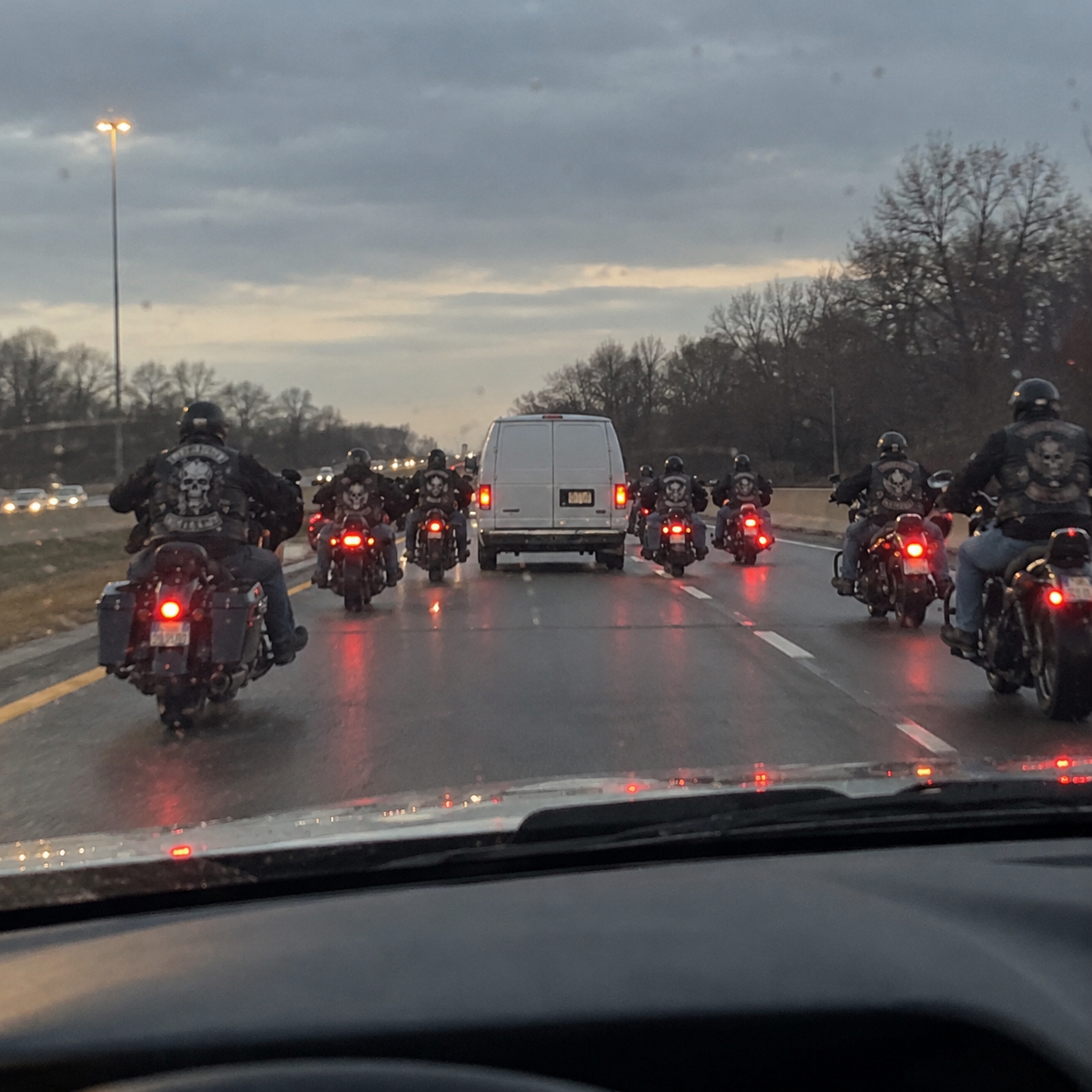
The first sign that something was wrong wasn’t the van itself. It was the way the man driving it watched the door.
He sat behind the wheel of a white cargo van outside a roadside diner in Kentucky, staring at the entrance through a rain-speckled windshield. He hadn’t ordered food. He hadn’t stepped out to smoke. He hadn’t even looked at his phone. For nearly twenty minutes, he had sat perfectly still, both hands wrapped around the steering wheel, as though he were waiting for someone to give him permission to breathe.
Then the van moved.
Not forward. Not backward.
The side door shifted open two inches.
A tiny hand appeared in the gap.
One small finger curled around the metal edge, searching for something to hold. The hand trembled, disappeared, and returned a second later.
The driver’s head snapped toward it.
He lunged across the seat and slammed the door shut so violently that the entire van rocked on its suspension.
Inside the diner, a fork stopped halfway to someone’s mouth.
My brother Tank stood up so quickly that his chair scraped across the floor and knocked over his coffee.
“Did you see that?” he whispered.
I had seen it.
I had also seen the expression on the driver’s face.
It wasn’t the expression of a man annoyed by a loose door or a broken latch. It was the expression of someone terrified that the world had almost discovered his secret.
I had been riding motorcycles for forty-five years. I’d seen men lie about everything from unpaid debts to broken marriages. I’d watched people smile while hiding the kind of anger that could turn a quiet afternoon into a funeral.
And I’d learned something over all those miles.
Sometimes trouble announces itself with a gunshot.
Sometimes it arrives in a white van and hopes nobody asks questions.
My name is Ray Mercer. I was sixty-one years old that autumn, with gray in my beard, a damaged left knee, and enough scars to remember several versions of myself that I wasn’t particularly proud of. I had spent years riding with the Iron Vultures Motorcycle Club, a brotherhood that outsiders often misunderstood and that we had given the world plenty of reasons to misunderstand.
We wore black leather. We had tattoos. We rode loud motorcycles. Some of us had served in the military, some had worked construction, and others had spent their lives doing jobs that left their hands permanently rough. A few had made serious mistakes when they were younger. Most of us had buried friends before we were old enough to understand what grief really meant.
But there was one thing every man at that table understood.
Children were never to blame for the cruelty adults inflicted on them.
And when a child needed help, the first question wasn’t whether helping would be convenient.
The question was whether we were going to do anything at all.
That morning, six of us had stopped at Miller’s Roadhouse, a little diner tucked beside a two-lane highway outside Bowling Green. We were heading north toward Indianapolis for a memorial ride. Rain had followed us since sunrise, and the smell of wet leather filled the booth where we had dropped our jackets.
Tank sat across from me. His real name was Thomas Keller, but nobody had called him Thomas since his first year in the club. He was six-foot-four, broad enough to make ordinary doorways look poorly designed, and carried a permanent crease between his eyebrows that made strangers assume he was angry.
He wasn’t always angry.
Sometimes he was simply thinking.
Doc Holloway sat beside him, stirring sugar into coffee he had already sweetened twice. Reds, our former Marine, was eating eggs and toast. The youngest among us, a thirty-four-year-old mechanic named Cal, was scrolling through his phone while pretending not to listen to the conversation.
We were ordinary men having an ordinary breakfast.
Then the van stopped being ordinary.
Tank looked at me.
“What do you think?”
“I think we don’t know enough yet.”
He nodded, though I could see the muscles working in his jaw.
That was the dangerous part. Tank could be impatient, but he wasn’t stupid. He knew the difference between suspicion and proof. He also knew that a frightened child might be in that van, and every minute we spent guessing was another minute that child might spend believing nobody would ever come.
I reached for my coffee.
“Listen to me,” I said quietly. “If we walk out there and scare him, he could take off. If there’s someone in the back, we don’t know where he’ll go or what he’ll do. We need to be smart.”
Tank looked through the window again.
The driver was watching the diner.
For half a second, our eyes met through the glass.
Then he looked away.
“Fine,” Tank said. “We finish breakfast.”
I had known Tank for twenty-three years. I knew what that sentence meant.
He wasn’t going to finish breakfast.
He was going to sit there, pretending to eat, until the man made his next move.
And when the van finally pulled away, Tank was going to follow.
I just hoped the man behind that wheel wouldn’t notice us.
Because if he did, whatever was hidden behind that metal door might disappear before we could help.
The van left the parking lot at 10:17 a.m.
I remember the time because I checked the clock above the cash register just before the driver turned onto the highway.
He didn’t accelerate quickly. He didn’t drive like someone trying to escape. He signaled, waited for traffic, and merged into the right lane with the careful patience of a man who believed that behaving normally was the same thing as being innocent.
Tank dropped a twenty-dollar bill beside his plate.
“Let’s go.”
We walked outside without running.
The rain had eased into a fine mist, leaving the asphalt black and shining. The van was already disappearing around the bend.
Our motorcycles were parked beneath the diner awning. Six machines, all wet, all covered in road grime, all familiar enough that I could identify the smallest change in their engine sounds.
I pulled on my gloves.
Tank swung a leg over his Harley.
“Distance?” he asked.
“Enough that he won’t see us in his mirrors.”
We waited for a pickup truck to pass, then rolled out separately.
We didn’t ride six abreast or roar down the highway like a parade. We stayed spread out, allowing ordinary traffic to pass between us. Tank took the lead, I stayed behind him, and the others followed at intervals.
At first, nothing happened.
The van traveled north.
It stayed below the speed limit. It didn’t swerve. It didn’t run red lights. At a gas station, the driver slowed as though he might pull in, then continued past the entrance.
Twenty minutes later, he changed lanes without any obvious reason.
I wondered whether he had spotted us.
Another ten miles passed.
Then he turned onto a secondary highway, drove through a small town, and returned to the interstate by a different entrance.
Tank’s voice crackled through the helmet communication system.
“He’s checking his tail.”
“Maybe,” I replied. “Don’t assume he knows we’re there.”
“Ray, I know what a man looks like when he’s checking his tail.”
“Then let him check. We’re not giving him anything to see.”
The van continued north.
We followed.
For the next hour, the highway stretched ahead beneath a low ceiling of clouds. Trucks thundered past. Rainwater sprayed from tires. My hands began to ache from gripping the handlebars, but I barely noticed.
I kept thinking about that little finger.
A child had been inside the van.
That much was clear.
What we didn’t know was who the child was, how many others were with them, or what the driver intended to do when he reached wherever he was going.
We didn’t know whether the child was injured.
We didn’t know whether the driver had a weapon.
And we didn’t know whether he had accomplices waiting farther up the road.
We knew only that a door had opened, a tiny hand had appeared, and a grown man had slammed it shut as though he were trying to silence the last person in the world who could expose him.
That was enough to keep us riding.
At 11:42, Tank called the rest of our club.
He didn’t tell anyone to attack the driver. He didn’t ask anyone to block the road or play police officer. He explained what we had witnessed and asked for help maintaining a safe distance while the authorities were contacted.
Two brothers were already riding north on another route. Three more were working near Louisville. Another was a retired trucker who knew the interstate system better than some state patrol officers.
Within the hour, we had enough men spread along the route to observe the van without forming an obvious procession behind it.
Fourteen bikers, all moving independently, all watching the same vehicle.
The driver had no idea.
At least, that was what we hoped.
At noon, the van stopped at a service station.
Tank pulled into a parking area across the road, where a row of delivery trucks blocked most of his view. I stopped farther down beside a closed tire shop. Reds remained behind a fuel station, while Cal watched from a diner parking lot.
The driver got out.
He was a thickset man in his early fifties, wearing a dark jacket, jeans, and work boots. His hair was short and brown, with gray beginning to show near his ears. He looked like a man you might see loading boxes into a warehouse or standing in line at a hardware store.
That was what made the sight of him so disturbing.
Cruelty doesn’t always wear a frightening face.
Sometimes it has ordinary shoes, an ordinary haircut, and a job people never think twice about.
The man walked toward the fuel pumps, then stopped.
He looked over his shoulder.
Once.
Twice.
Then he turned completely around and stared at the highway.
Tank’s voice came through my headset.
“He’s looking.”
“I see him.”
“Should we call the police now?”
“We should have called already.”
We had contacted emergency services earlier, providing the van’s description, direction of travel, and location. We had made it clear that we had seen what appeared to be a child inside and that we were not certain how many people were involved.
We had been advised to keep our distance, avoid confronting the driver, and provide updates when safe.
That was exactly what we intended to do.
The man paid for fuel with cash. He didn’t buy food. He didn’t use the restroom. He returned to the van, climbed in, and sat with the engine running for nearly a minute.
Then he pulled away.
As he passed the entrance, his eyes moved toward the motorcycles.
I lowered my head and pretended to adjust my glove.
The van continued north.
I waited five seconds, started my engine, and followed.
The afternoon wore on.
At one point, the van pulled into a rest area and parked beside a row of trucks. The driver remained inside for twelve minutes, staring at his phone.
Another time, he exited the interstate, drove through a residential neighborhood, and rejoined the highway several miles later.
Each detour made me more uneasy.
A person with nothing to hide might still be nervous, might still take strange routes, might still have a reason to avoid traffic.
But every time I remembered that small hand against the door, the explanations seemed thinner.
By two o’clock, we had crossed into Indiana.
By three, the clouds had darkened enough to make the afternoon feel like evening.
And by four, the van was moving toward Indianapolis.
I had ridden almost two million miles in my life, across mountains, deserts, frozen roads, and endless stretches of interstate. I had seen accidents that made grown men turn away. I had stood at gravesides in military cemeteries and watched mothers fold themselves over their sons’ coffins.
But I had never experienced a ride quite like that one.
There was no destination we wanted to reach.
There was no celebration waiting at the end.
We were following a man because we feared what might happen if we lost him.
Every mile brought us closer to the possibility of helping someone.
Every mile also brought us closer to the possibility that we might arrive too late.
At 4:38 p.m., the van turned into a truck stop outside Indianapolis.
It was a sprawling place with fuel pumps, a restaurant, showers for drivers, and a parking lot filled with heavy trucks. Rain had returned, and the wet pavement reflected the red and white lights of the signs.
The driver pulled up to a diesel pump, got out, and began fueling.
Tank arrived several minutes later.
He parked far enough away to avoid blocking traffic, removed his helmet, and looked across the lot.
I pulled in beside him.
“Police know where we are,” I said.
“Good.”
“Ray, if we go near that van, we do it carefully.”
“I know.”
He stared at the white vehicle.
Its side door was shut.
The rear doors were secured.
There was no sound from inside.
I suddenly wished there had been. A child’s voice, a knock, anything that would tell us the people inside were alive and able to respond.
Tank put his helmet on the seat.
“I’m going to speak to him.”
“Don’t touch the door.”
He nodded.
We walked toward the pump together.
The driver noticed us when we were still twenty feet away. His expression changed immediately. His shoulders tightened, and his hand moved toward his jacket pocket.
Tank stopped.
“Afternoon,” he said.
The man looked at Tank’s vest, then at me.
“What do you want?”
“Just a question.”
“I don’t have time.”
Tank glanced at the van.
“We saw your side door open at a diner this morning.”
The man’s face became blank.
“What diner?”
“Outside Bowling Green.”
“Never been there.”
Tank didn’t move.
“I watched a little hand come through that door.”
For one second, the man looked genuinely surprised.
Then the surprise vanished.
“You’ve got the wrong vehicle.”
He pulled the fuel nozzle from the tank, hung it up, and walked toward the driver’s door.
Tank stepped aside rather than blocking him.
“Sir, we’ve called the police. They’re on their way.”
That was when the man ran.
He didn’t head toward the highway. He didn’t run for the restaurant or the rows of trucks.
He bolted between two parked vehicles toward the far edge of the lot.
Tank shouted for him to stop.
The man kept running.
I started after him, my bad knee complaining with every stride. Doc came from the other side, moving faster than I would have believed possible for a man who complained about his back every morning.
The driver reached the end of a parked truck and slipped on the wet pavement.
He went down hard.
Doc caught up and held him there while I called out that police were on the way. Two more brothers arrived seconds later, but we didn’t strike the man or threaten him. We kept him from running again and waited for officers to take control.
The driver began shouting almost immediately.
“You don’t know what you’re doing! You’re ruining everything!”
Tank walked toward him.
“What exactly are we ruining?”
The man looked at the van.
Then he looked away.
That was the first moment I became certain that whatever was inside was worse than anything I had imagined.
Tank turned to me.
“Ray.”
I knew what he was thinking.
We needed to see inside.
But we also needed to avoid putting the children in further danger.
I called the dispatcher again, explained that the driver had attempted to flee, and told them we had reason to believe people were being held in the cargo area. I asked for officers and emergency medical personnel to respond urgently.
Then I stood beside the van, listening.
At first, there was nothing.
Rain tapped against the roof.
A truck engine rumbled somewhere behind us.
Then I heard a faint sound.
Three taps.
A pause.
Two more taps.
I moved closer.
“Did you hear that?”
Tank stopped talking.
We all listened.
The sound came again, from behind the metal door.
Three taps.
A pause.
Two more.
My stomach tightened.
Someone was inside.
Someone was trying to tell us they were still there.
I pressed my palm against the cold metal.
“Hey,” I said, trying to keep my voice calm. “My name is Ray. The police are coming. Can you hear me?”
Silence.
Then a tiny voice answered.
“Please.”
One word.
Barely audible.
But it was enough to make the entire world narrow to that door.
I looked at Tank.
He was no longer angry.
He looked frightened.
Not frightened of the driver or the police or whatever consequences would follow.
Frightened that the person inside had been waiting for help for so long that they no longer believed it would arrive.
The first state trooper reached the truck stop several minutes later.
He was young, perhaps twenty-eight, with rain shining on his uniform and a hand resting near his equipment belt. He approached cautiously, asked us to step back, and moved toward the van.
Tank immediately explained what we had seen and heard.
The trooper looked at the driver, who was now sitting on the wet pavement under the supervision of two officers who had arrived behind him.
“Are there people in the vehicle?” the trooper demanded.
The driver said nothing.
The trooper repeated the question.
Still nothing.
A second officer arrived and began photographing the vehicle. Another requested additional units and medical support. Within minutes, the entire corner of the truck stop had become a controlled scene, with officers directing traffic away from the pumps and asking bystanders to move back.
I stood beside my motorcycle, soaked through, trying not to pace.
Tank stood beside me.
Neither of us spoke.
Finally, the trooper approached the rear of the van with another officer. They examined the doors, checked the locking mechanism, and began working to open them safely.
The first door moved a few inches.
A sound escaped from inside.
Not a scream.
Not a word.
A small, frightened gasp.
The trooper stopped immediately.
“Easy,” he said, his voice changing. “You’re okay. We’re here to help.”
The door opened farther.
For a moment, I couldn’t understand what I was seeing.
The cargo area was dark and cramped. Blankets had been thrown across the floor. Water bottles and discarded food containers lay among bags and pieces of clothing. Several small figures were pressed together in the space between the wheel wells and the rear doors.
There were children inside.
Nine of them.
The oldest appeared to be around twelve. The youngest looked no older than four.
Some were crying quietly. Others stared at the officers without moving. Their faces were pale, their clothes dirty, and several had marks around their wrists and ankles.
The youngest child was clutching a faded stuffed animal with one ear missing.
A girl in a pink shirt sat near the back, her knees drawn against her chest. A cartoon pony was printed across the front of her shirt.
She looked directly at me.
I will never forget her eyes.
I have seen fear on the faces of grown men. I have watched soldiers struggle to understand what had happened to their friends. I have stood beside people who had just learned that the person they loved most would never come home.
But this was different.
The girl wasn’t merely frightened.
She seemed to have reached a place where she no longer expected anything good to happen.
She looked at the trooper, then at the paramedics gathering behind him, then at the men in leather standing near the motorcycles.
Finally, she looked back at me.
“Are you going to take us somewhere else?”
Her voice was so small that I almost didn’t hear it.
I took one step forward, then stopped when the trooper raised his hand, reminding me to give the medical team space.
I crouched where I was.
“No, sweetheart,” I said. “Nobody here is going to take you away from help. These people are here to keep you safe.”
She stared at me.
“How do I know?”
I had no clever answer.
There was no sentence that could undo what she had experienced. No promise that could make her trust a stranger simply because he had a gray beard and a leather vest.
So I told her the truth.
“You don’t have to trust me right away. You can watch what we do. We’ll stay right here while the doctors help you.”
She studied my face.
Then she looked down at her hands.
A paramedic approached her slowly and knelt near the door, introducing herself and explaining what would happen next. She asked permission before moving closer. The girl didn’t answer, but she didn’t pull away when the paramedic offered her a blanket.
That small movement felt like a victory.
Behind me, Tank turned his face away.
I saw his shoulders rise and fall once.
Then he pulled his phone from his pocket and called the rest of the club.
“Get the others here,” he said. “And tell them to stay back. Police have it now.”
His voice cracked on the last word.
Tank was a man who had once walked away from a motorcycle wreck with a broken collarbone and refused to go to the hospital until everyone else had been checked.
That afternoon, he stood in a truck-stop parking lot and struggled to finish a sentence.
The children were freed one at a time.
The paramedics checked each child before moving them. Officers documented the scene, photographed the interior, and made sure the vehicle was secured as evidence.
A boy of perhaps six began apologizing repeatedly when a medic examined his wrists.
“I’m sorry,” he whispered. “I’m sorry. I didn’t mean to.”
The paramedic paused.
“You haven’t done anything wrong,” she told him gently.
He looked unconvinced.
“I’m sorry.”
She repeated herself.
He said it again.
Finally, Reds approached the doorway after the medical team indicated that he could speak to the boy without interfering with treatment.
Reds was fifty-eight, a former Marine who had spent years learning to remain calm in situations where panic could get people hurt. His face was weathered, his hair cut short, and his arms were covered in tattoos.
He crouched so the boy wouldn’t have to look up at him.
“What’s your name, son?”
The boy didn’t answer.
“That’s okay. You don’t have to tell me yet.”
Reds held out one hand, palm upward.
“Can I sit here with you while they help?”
The boy looked at the hand.
After a long moment, he nodded.
Reds sat on the wet pavement beside the open door. He didn’t try to hug the child or ask what had happened. He simply stayed there, speaking quietly whenever the boy looked at him.
A few minutes later, the boy leaned against Reds’ shoulder.
Reds lowered his head.
I saw tears fall into his beard.
He didn’t wipe them away.
Nobody laughed. Nobody teased him. Nobody asked him to explain himself.
We all understood.
There are moments when being tough means standing your ground.
And there are moments when being tough means allowing a frightened child to see that an adult can cry without becoming dangerous.
Tank opened his saddlebags and brought out bottled water. Doc found packaged crackers and granola bars. Cal went to the truck-stop shop with an officer’s permission and returned with blankets, bottled drinks, and several small stuffed animals from a shelf near the register.
He looked embarrassed carrying them.
“I didn’t know what else to get,” he said.
“Good choice,” I told him.
One of the younger boys took a stuffed dog from the bag and held it against his chest.
He didn’t smile.
But he stopped shaking quite so badly.
That was enough.
The girl in the pink pony shirt had been moved to a stretcher. A paramedic had wrapped her in a blanket and was checking her condition.
As they prepared to lift her, she reached toward me.
I moved closer, but the paramedic stopped me long enough to ask the girl whether she wanted me nearby.
The girl nodded.
“Can he come?”
The paramedic looked at me, then at the officer coordinating the scene. After a brief discussion, they agreed I could accompany her to the ambulance as long as I followed their instructions.
I walked beside the stretcher.
She held one of my fingers with both hands.
I was careful not to squeeze too tightly.
“My name is Ray,” I reminded her.
She looked at the skull patch on my vest.
“Are you a bad man?”
The question struck me harder than anything else that day.
I could have told her that people judged us by our clothes, that most of us had families and jobs, that the world wasn’t as simple as good men and bad men.
But she was seven years old, frightened, exhausted, and trying to understand which adults could be trusted.
So I answered honestly.
“I’ve done things I’m not proud of,” I said. “But I would never hurt you.”
She looked at my face for a long time.
Then she asked, “Will you stay until my mama comes?”
I felt something break inside my chest.
“I’ll stay as long as they let me.”
She closed her eyes.
Her fingers remained wrapped around mine until the paramedic needed to move her hand to check her pulse.
The first officers had expected a disturbing case.
They hadn’t expected nine children.
As the scene expanded, state police established a perimeter around the van and began interviewing witnesses. The driver was taken into custody. His phone, vehicle, and personal belongings were secured according to procedure.
A second officer spoke to us separately, collecting our accounts of the van’s movements from the diner in Kentucky to the truck stop outside Indianapolis.
We gave them everything we could remember: the time the van left, the unusual stop at the fuel station, the detour through the residential neighborhood, and the driver’s repeated checks of the road behind him.
We explained that we had stayed at a distance and had not opened the vehicle ourselves.
The officer listened carefully.
“Did you know how many children were inside?”
“No,” I said.
“Did you know where he was taking them?”
“No.”
“Why follow him for that long?”
I looked toward the ambulance where the little girl was being examined.
“Because we saw a child trying to get out.”
The officer wrote something in his notebook.
Then he looked up.
“Most people would have called it in and kept driving.”
“Maybe,” I said. “But we couldn’t keep driving.”
He nodded and returned to his questions.
The first FBI agent arrived shortly afterward. She introduced herself as Special Agent Elena Reyes, a serious woman in her forties with tired eyes and a voice that remained steady even when the information she was receiving was not.
She spoke with the state police, examined the van from outside the perimeter, and asked for the driver’s name.
When an officer gave it to her, her expression changed.
She looked toward the van again.
“That’s him,” she said quietly.
I stepped closer.
“What do you mean?”
She glanced at me, then at the other officers.
“We’ve been investigating a trafficking network that operates across several states. We had information about a vehicle matching this description, but we didn’t have a confirmed location.”
“How long?”
“Almost two years.”
The number seemed impossible.
Two years of investigation.
Two years of following leads, checking records, interviewing witnesses, and trying to identify the people responsible.
And all that time, somewhere on the highways and back roads of America, children had been moved from one place to another by people who depended on everyone else looking away.
Reyes didn’t give us details she couldn’t discuss. She didn’t promise that every child would be reunited with family or that every person involved would be arrested by morning.
She simply told us that our observations might be important to the investigation.
Then she asked me to describe the first moment at the diner.
I told her about the driver watching the entrance.
I described the side door opening.
I told her about the little finger.
When I finished, she was quiet for several seconds.
“What made you decide to follow him?”
I thought about the question.
I could have given her a dramatic answer. I could have talked about brotherhood, courage, or the things that make a man willing to risk his life.
But none of those things explained what had happened.
The truth was simpler.
“I imagined what it would feel like if that was my granddaughter in there,” I said. “Then I imagined seeing a parking lot full of people who noticed something wrong and decided it wasn’t their business.”
Reyes lowered her eyes.
“That’s the part that keeps me awake,” she said. “How many times someone sees something and decides they don’t want trouble.”
She returned to the investigation.
I stayed beside the ambulance.
At the hospital, the waiting room smelled of disinfectant, wet clothing, and coffee that had been sitting on a warming plate for too long.
The children had been taken to different examination rooms so medical staff could assess them privately. Officers and social workers coordinated with the hospital to protect their identities and ensure they were treated with care.
We weren’t allowed to wander around looking for them.
We were asked to remain in the designated waiting area, answer any additional questions, and let the professionals do their jobs.
For once, none of us argued.
Tank sat beside me with his elbows on his knees. His leather jacket was draped over the back of a plastic chair, and his enormous hands were folded together.
He stared at the floor.
“You think they’re going to be okay?” he asked.
I took my time answering.
“I think they’re somewhere safe tonight.”
“That’s not what I asked.”
“I know.”
He rubbed his face.
“I keep thinking about that boy.”
“The one with Reds?”
Tank nodded.
“He kept saying he was sorry.”
I remembered it too.
A child who had every reason to be angry, frightened, and confused had somehow decided that he was the one who needed to apologize.
I had seen adults do the same thing after years of abuse. They learned to accept blame because accepting blame sometimes felt safer than believing the world was cruel for no reason.
But seeing it in a little boy was unbearable.
Tank leaned back.
“My daughter used to do that when she was little,” he said. “Apologize for spilling juice. Apologize for being sick. Apologize for waking me up after a nightmare.”
I had never heard him talk about that.
“What happened?”
“Nothing. That’s the point. She was a kid. Kids make messes. Kids have nightmares. She shouldn’t have been scared of disappointing me.”
He looked toward the hallway.
“I wish somebody had told those children that.”
I put my hand on his shoulder.
“They’ll hear it now.”
He nodded, but he didn’t look convinced.
A nurse came through the waiting-room door carrying a clipboard. She asked for the man who had accompanied the girl in the pink shirt.
I stood.
“That’s me.”
“She’s asking for you.”
My heart began beating harder.
“Is she all right?”
“The doctors are examining her. She’s frightened, but she’s stable. Her name is Eliza, and she keeps asking whether you’re still here.”
I followed the nurse down the corridor.
Eliza was sitting on a bed with a blanket around her shoulders. Her hair had been brushed away from her face, and someone had given her a small stuffed rabbit.
She looked impossibly small in the hospital room.
When she saw me, she tightened her grip on the rabbit.
“You came back.”
“I told you I would.”
She studied me as though she were checking whether the promise had survived the journey.
Then she pointed toward the chair beside her bed.
“Can you sit there?”
I sat.
For several minutes, neither of us said anything.
She looked at the wall, then at the window, then at the door. Whenever footsteps passed in the corridor, her shoulders tightened.
I didn’t ask her to tell me what had happened inside the van.
I didn’t ask where she had been or how she had ended up there.
Those were questions for trained professionals, asked at the right time and in the right way.
Instead, I asked her whether she liked the stuffed rabbit.
She looked down at it.
“It doesn’t have a name.”
“That’s a serious problem.”
For the first time, she seemed confused by my voice.
I leaned closer.
“Every rabbit needs a name. Otherwise, how will it know when somebody is calling it for dinner?”
Her mouth moved slightly.
Not quite a smile.
But close enough that I felt my own face soften.
“What would you call it?” I asked.
She thought for a moment.
“Button.”
“That’s a good name.”
“Because one ear looks like a button.”
I examined the rabbit.
She was right. One ear had been folded over, making it look like a little round flap.
“Then Button it is.”
She tucked the rabbit beneath her arm.
After another quiet minute, she asked a question that made me look away.
“Do you think my mama remembers me?”
I turned back toward her.
“Yes.”
“How do you know?”
“Because a mother who loves her child doesn’t stop loving her when she can’t find her.”
Eliza stared at the blanket.
“She might think I went away.”
“Then when she gets here, you can tell her you didn’t want to go.”
She swallowed.
“What if she’s mad?”
“At you?”
She nodded.
I moved my chair a little closer.
“Eliza, listen to me. Nothing that happened today is your fault. Nothing. You don’t have to apologize for being scared, and you don’t have to make anyone feel better about what happened to you. The grown-ups are responsible for keeping you safe.”
She watched me carefully.
“Even you?”
“Especially me, while I’m sitting in this chair.”
That time, she smiled.
It was tiny, uncertain, and gone almost as soon as it appeared.
But it was real.
I stayed until a nurse returned to check her condition. Before I left, Eliza asked whether I would be there in the morning.
“I’ll be nearby,” I told her. “And the doctors and nurses will be here all night.”
She looked at Button.
“Okay.”
I walked out of the room and stood in the corridor with my back against the wall.
My hands were shaking.
I had been trying to keep myself together since the truck stop. I had kept my voice calm, answered questions, followed instructions, and made sure the younger brothers didn’t do anything reckless.
Now, with nobody watching, I pressed my palm against my eyes.
I was sixty-one years old.
I had survived things I rarely discussed. I had watched friends die. I had buried people I loved and learned to continue living because the alternative was to let grief consume every part of me.
I had spent decades convincing myself that I was a hard man.
Then a seven-year-old girl asked whether her mother still remembered her, and I discovered that there was no armor strong enough to protect a person from that question.
Eliza’s mother arrived shortly after sunrise.
Her name was Hannah Brooks.
She had flown in from Tennessee after investigators contacted her family. She was still wearing the clothes she had traveled in, and her hair was tied back carelessly. Her face looked exhausted, as though she had been awake for four months rather than one night.
A social worker met her before she entered the ward.
They explained that Eliza was receiving care, that the medical team had assessed her condition, and that she would need time and support to recover. They also explained that her daughter might be frightened, withdrawn, or unwilling to talk about what had happened.
Hannah listened without interrupting.
Then she asked, “Can I see her?”
The social worker nodded.
I was sitting in the waiting room with Tank when we saw Hannah walk down the corridor.
She was moving slowly.
Not because she didn’t want to reach her daughter, but because she seemed afraid that the reunion might somehow vanish if she moved too quickly.
A nurse opened the door to Eliza’s room.
Hannah stepped inside.
For several seconds, neither of them spoke.
Then Eliza looked up from the bed.
Her face changed.
The rabbit fell from her hands.
“Mama?”
Hannah made a sound I will never forget.
It wasn’t a word. It was a broken breath, a sob that seemed to come from somewhere deeper than her lungs.
She dropped to her knees beside the bed.
“Oh, baby. Oh, my baby.”
Eliza stared at her for one impossible second.
Then she reached out.
Hannah gathered her daughter into her arms, careful of the medical equipment, careful of the blanket, careful of everything except the tears pouring down her face.
Eliza clung to her mother’s neck.
“I thought you forgot me.”
Hannah pulled back just enough to look at her.
“Never,” she whispered. “Never. I looked for you every day. Every single day.”
“I waited.”
“I know, sweetheart.”
“I waited for you.”
Hannah pressed her forehead against her daughter’s.
“I know. I’m here now.”
I turned away.
I had no right to stand in that doorway and make their reunion about my feelings.
That moment belonged to them.
But I couldn’t stop the tears.
Tank was beside me, looking at the floor. Doc stood behind us, holding a paper cup of coffee that had gone cold. Reds had his arms folded across his chest, his jaw clenched so tightly that a muscle jumped near his ear.
Nobody spoke.
We didn’t need to.
After a few minutes, I heard footsteps running down the hallway.
I turned just as Eliza appeared at the door, with a social worker close behind her. She had apparently asked whether she could come out for a moment.
Her mother was right behind her.
Eliza spotted me.
“Ray!”
She ran toward me and wrapped both arms around my leg.
I bent carefully, and she held on to my shoulders.
“You’re still here.”
“I’m still here.”
She pressed her face against my vest.
Then she whispered, “You didn’t leave.”
I closed my eyes.
“No, sweetheart. I didn’t leave.”
Her mother approached us.
She looked at my vest, the patches, the tattoos on my hands, and the gray beard I had never bothered to trim properly.
For a second, I could see her trying to understand who I was.
Then she looked at her daughter.
“Did he help you?”
Eliza nodded.
“He stayed.”
Hannah covered her mouth.
She took my hand in both of hers.
“I don’t know what to say.”
“You don’t have to say anything.”
“I thought I’d never see her again.”
Her voice broke.
“I kept thinking that maybe I should have looked somewhere else, called someone else, done something different. I kept replaying that day over and over.”
I shook my head.
“You didn’t cause this.”
She looked at me, tears running down her cheeks.
“I should have protected her.”
“You loved her. You were looking for her. Those are the things she needs to know.”
Hannah glanced down at Eliza, who was still holding my leg.
Then she knelt beside her daughter and gently reached for her hand.
“Come here, baby.”
Eliza turned.
For the second time that morning, mother and daughter held each other as though the entire world had narrowed to the space between their arms.
I stepped back.
Tank moved beside me.
We watched for a moment, then quietly returned to the waiting room.
Neither of us said anything until we reached the chairs.
Finally, Tank looked at me.
“That little girl is going to remember you.”
I shook my head.
“She should remember her mother.”
“She’ll remember both.”
I looked toward the window.
Outside, the sun was rising over Indianapolis, turning the wet parking lot gold.
For the first time since the diner, I allowed myself to believe that something good had come out of the worst day I could remember.
The investigation continued long after we left the hospital.
Special Agent Reyes contacted us several times over the following weeks. She asked for additional details about the van, the driver’s movements, and the conversations we had overheard at the truck stop.
We provided our statements and turned over any recordings or notes that might help establish the timeline.
The authorities handled the rest.
They examined the vehicle, reviewed its movements, and worked to identify the people responsible for transporting the children. Investigators also followed leads connected to other locations and possible victims.
What had initially appeared to be one disturbing incident became part of a much larger investigation.
Reyes was careful about what she told us.
She explained that the case involved multiple jurisdictions and that the evidence had to be examined properly. She warned us not to assume that every person connected to the network had been identified.
But she did tell us that the information from the van had helped investigators move forward.
Several days later, authorities announced additional arrests connected to the case.
The driver was identified as Donald Krebs, a fifty-two-year-old man from Ohio. He had worked in warehouse logistics and had maintained the kind of ordinary public life that made people less likely to question him.
His neighbors described him as quiet.
One said he had occasionally helped carry heavy boxes.
Another said he had never seemed particularly friendly, but nothing about him had appeared alarming.
The news coverage focused on the contrast between his ordinary appearance and the accusations against him.
For me, that was the most frightening part.
People like to imagine that dangerous individuals announce themselves. They picture a suspicious stranger in a dark alley, someone whose appearance makes everyone instinctively step away.
But real danger doesn’t always offer that warning.
Sometimes it looks like a familiar face.
Sometimes it looks like a person who knows exactly how to avoid attracting attention.
Sometimes it drives through a town, stops for fuel, and passes dozens of people who never realize that something terrible may be happening a few feet away.
Authorities announced that the investigation had expanded to include additional suspects and locations. They said the case involved evidence that would take time to analyze and that further developments could follow.
The children were placed with appropriate caregivers while authorities worked with their families and support services.
We didn’t receive their private medical records. We weren’t told every detail of their experiences, and we didn’t ask.
They deserved privacy.
They deserved time to recover without strangers demanding their stories.
And they deserved the chance to grow into adults who didn’t have to define their lives by the worst things other people had done to them.
The media called us heroes.
I hated that word.
Reporters contacted the club. News crews appeared near the clubhouse. People who had never spoken to us before suddenly wanted interviews.
Some brothers agreed to talk.
Tank refused every request.
When a reporter asked whether we considered ourselves rescuers, he answered, “The police and paramedics did the rescuing. We noticed something and made sure they got the chance to do their jobs.”
That was the best description anyone gave.
We weren’t trained investigators.
We weren’t emergency responders.
We were men who had seen something troubling and decided not to ignore it.
The authorities had the skills and resources to take the case further. Our responsibility was to provide accurate information, keep the children safe until help arrived, and avoid making a dangerous situation worse.
That was enough.
It had to be enough.
About three weeks after the incident, I received a phone call from Agent Reyes.
She asked whether I could come to a local office to discuss a few remaining questions. I agreed.
When I arrived, she was waiting in a conference room with a folder in front of her.
She looked more tired than she had at the truck stop.
“How are you holding up?” she asked.
“Fine.”
She raised an eyebrow.
“That’s not an answer.”
“It’s the one I’ve got.”
She smiled faintly, then opened the folder.
The discussion lasted nearly an hour. She asked about the van’s route, the time we had first seen it, and whether any of us had noticed another vehicle following it.
We reviewed the timeline carefully.
Then she closed the folder.
“I wanted to tell you something,” she said. “Your decision to stay with the vehicle gave us information we might not otherwise have had. It helped us establish a clearer picture of what happened that day.”
I nodded.
“Glad we could help.”
She studied me.
“Do you understand how unusual it is for people to remain involved after making an initial report?”
“I understand people don’t want trouble.”
“That’s part of it. They worry they’ll be wrong. They worry they’ll be sued. They worry they’ll put themselves in danger. Sometimes they simply assume somebody else will take care of it.”
I looked down at my hands.
There were old scars across my knuckles. A faded tattoo stretched from my wrist toward my forearm. My wedding ring was gone; my wife had died years earlier, and I had never found a reason to replace it.
“I wasn’t thinking about any of that,” I said.
“What were you thinking about?”
I pictured the diner window.
The van.
That tiny hand.
“I was thinking about the person who might be inside.”
Reyes nodded.
“That’s what I thought you’d say.”
She told me that the investigation remained active and that additional information might emerge as evidence was reviewed. She also reminded me not to discuss sensitive details publicly.
I promised I wouldn’t.
Before I left, she handed me a business card and told me to call if I remembered anything else.
At the door, I turned back.
“Agent Reyes?”
“Yes?”
“Do you ever get used to it?”
She didn’t pretend to misunderstand.
“No,” she said. “You learn how to do the work. You learn how to keep going. But you don’t get used to children being hurt.”
I nodded.
That answer stayed with me long after I rode home.
The Iron Vultures changed a few things after that day.
We had always looked out for one another. That was part of being in a motorcycle club. If somebody broke down on the highway, another brother stopped. If a member’s family needed help moving furniture, somebody showed up with a truck. If an old rider couldn’t afford a repair, the rest of us quietly passed around enough money to get him back on the road.
But we began talking more seriously about what it meant to look out for people who weren’t part of our circle.
We agreed that if a situation seemed dangerous, we would report it rather than trying to handle it ourselves. We reminded everyone to keep their distance, avoid confronting suspects, and provide accurate descriptions to authorities.
We also discussed how quickly suspicion could turn into a dangerous mistake.
A person might be nervous for a dozen innocent reasons. A child might be frightened for reasons unrelated to a crime. A strange vehicle might simply be a strange vehicle.
We didn’t want anyone using our story as an excuse to chase strangers, block traffic, or put themselves and others in danger.
The lesson wasn’t that bikers should become vigilantes.
The lesson was that noticing something troubling creates a responsibility to think carefully about what to do next.
Sometimes that means calling emergency services.
Sometimes it means giving a clear description of a vehicle.
Sometimes it means staying available as a witness instead of walking away.
And sometimes it means allowing trained professionals to take over, even when every instinct tells you to do something more dramatic.
Tank understood that better than anyone.
One evening, several weeks after the incident, he sat across from me in the clubhouse, staring into a cup of coffee.
“I keep thinking about what would have happened if we hadn’t stopped at that diner,” he said.
“We don’t know.”
“Maybe somebody else would have noticed.”
“Maybe.”
He shook his head.
“I hate that word.”
“So do I.”
He looked toward the window, where rain was beginning to gather on the glass.
“But we did notice.”
I nodded.
“Yeah. We did.”
For a while, we sat without speaking.
Then Tank leaned forward.
“Do you think Eliza will remember us when she’s grown?”
I thought about the question.
“I hope she remembers that people helped her.”
“That’s not quite what I asked.”
“I know.”
I took a sip of coffee.
“Maybe she’ll remember a few faces. Maybe she’ll remember the ambulance, or the blankets, or the stuffed rabbit. Maybe she’ll forget most of the details as she gets older.”
Tank waited.
“But I hope she grows up knowing that what happened to her wasn’t the whole story of her life. I hope she remembers the people who came afterward and treated her like a child who deserved to be safe.”
Tank nodded slowly.
“That’s a better answer.”
“It’s the only one I’ve got.”
A month passed.
Then another.
The news cycle moved on, as it always does. New headlines appeared. New tragedies demanded attention. The story of the white van became a short segment that people discussed at dinner and then forgot as the next day’s events took over.
But I didn’t forget.
Every time I stopped at a roadside diner, I found myself watching the parking lot.
I noticed vehicles that remained too long.
I noticed drivers who seemed unusually concerned about what was happening around them.
I noticed children in back seats, sometimes laughing, sometimes sleeping, sometimes looking out at the world with the uncomplicated curiosity that children should be allowed to have.
I didn’t assume every unusual sight meant something terrible.
I simply paid attention.
One afternoon, I was cleaning my motorcycle in the clubhouse when Tank walked in holding a small envelope.
“Mail for you.”
I looked at it.
There was no return address.
My name was written across the front in uneven blue crayon.
Ray.
Nothing else.
I wiped my hands on a rag and opened it carefully.
Inside was a folded sheet of paper.
The drawing showed fourteen motorcycles lined up beneath a bright yellow sun. The riders were stick figures with black jackets and enormous heads. One motorcycle had a blue seat. Another had three wheels, though I couldn’t tell whether that was intentional.
Near the middle of the page stood a little girl wearing a pink shirt.
Beside her was a man with a gray beard.
They were holding hands.
At the bottom, in shaky handwriting, were the words:
“Thank you for not driving past.”
I read the sentence twice.
Then I sat down.
Tank looked over my shoulder.
For once, he didn’t say anything.
I traced the edge of the paper with one finger. There was a small red heart drawn in the corner, with a line through it where the crayon had slipped.
It was the kind of picture that would have been easy to overlook among a pile of schoolwork.
But I couldn’t stop looking at it.
I had spent most of my adult life believing that the important moments in a man’s life were the big ones. The wars, the weddings, the funerals, the long rides across states, the decisions that seemed to divide the world into everything that came before and everything that came afterward.
Yet here I was, sitting in a clubhouse with grease under my fingernails, holding a child’s drawing as carefully as if it were made of glass.
I folded the paper along its original crease.
Then I opened the inside pocket of my leather vest and slipped it in.
Tank watched me do it.
“You’re keeping that?”
“Everywhere I go.”
He nodded.
“Good.”
That evening, when I rode home, the drawing rested against my chest.
I could feel it whenever I moved.
For the first time in weeks, the memory of the van didn’t arrive as a picture of metal doors and frightened children.
It arrived as a little girl holding a rabbit named Button.
A boy who had finally stopped apologizing.
A mother kneeling beside a hospital bed.
And a sheet of paper with fourteen badly drawn motorcycles.
Those were the images I wanted to carry.
Not because they made the day less terrible.
Because they reminded me that terrible things did not have to be the end of a story.
I saw Hannah and Eliza one more time.
It happened on a cool Saturday morning, several months after the incident. Agent Reyes had passed along a message through the appropriate channels, asking whether I would be comfortable meeting them at a community event where the family planned to attend with support from their care team.
I agreed, but I told Reyes I didn’t want a crowd or publicity.
She understood.
We met at a small park outside the city, away from the cameras and the noise. Hannah arrived carrying a bag with snacks and a bottle of water. Eliza walked beside her, wearing a yellow sweater and holding Button by one ear.
When she saw me, she smiled.
This time, the smile stayed.
“Ray!”
She ran toward me, then stopped a few feet away, as if remembering that she could choose how close to get.
I crouched.
“Hey, Eliza.”
She held up the rabbit.
“Button came with me.”
“I see that.”
“He’s not scared of motorcycles anymore.”
I looked at the rabbit.
“That’s a brave rabbit.”
She nodded seriously.
“He says he wants one.”
“Well, he might have to wait until he’s older.”
Eliza giggled.
The sound was small, but it was the easiest sound I had heard in months.
Hannah came over and thanked me again. I told her she didn’t owe me thanks, but she shook her head.
“I know you say that,” she replied. “But I need you to understand something. Before that day, I thought I had to carry everything by myself. I thought if I hadn’t found her, it meant I hadn’t done enough. When I met you and the others, I saw that strangers could help carry something that was too heavy for one person.”
She looked at Eliza.
“We still have difficult days. I won’t pretend everything is fixed. But she’s learning that there are people she can trust. And I’m learning to let people help us.”
I nodded.
“That takes courage.”
She smiled sadly.
“Some days it takes more courage than others.”
We sat on a bench while Eliza played nearby with a social worker. She occasionally looked back to make sure her mother was still there, and every time Hannah waved, Eliza returned to what she was doing.
There was no dramatic speech.
No reporter asking questions.
No crowd applauding.
Just a mother watching her daughter play in a park, and an old biker sitting beside her, grateful for the ordinary peace of the moment.
Before they left, Eliza handed me a folded piece of paper.
“I made another one.”
I opened it.
This drawing showed a motorcycle beneath a blue sky. A little girl stood beside it, holding the hand of a man with a gray beard. There were flowers around their feet, and Button sat on the motorcycle seat wearing what appeared to be a tiny helmet.
At the bottom, she had written:
“Ray is my road friend.”
I laughed before I could stop myself.
“Road friend?”
She nodded.
“Because you were on the road when I needed help.”
I folded the picture and placed it in my vest pocket beside the first one.
“That’s the best kind of friend to be.”
She hugged me.
Then she stepped back and took her mother’s hand.
They walked toward the parking lot together.
I watched them go until they disappeared around the trees.
For the first time, I didn’t feel the need to follow.
They were going home.
And that was exactly where they belonged.
People still ask me about the 200-mile ride.
They want to know whether I was afraid. They ask whether I expected the driver to be dangerous, whether Tank planned to confront him, whether we knew the children would be found.
The truth is that we knew very little.
We didn’t know who the driver was.
We didn’t know how many children were in the van.
We didn’t know whether other people were involved or whether we were following someone who might try to hurt us.
We didn’t know whether our suspicions would turn out to be correct.
What we knew was that a child had reached through a door and that the driver had slammed it shut.
We knew that his behavior had frightened us enough to take it seriously.
So we contacted the authorities, stayed at a distance, provided information, and kept the vehicle in sight until help could intervene.
That is what happened.
There was no secret plan.
There was no heroic speech.
There was no moment when we all looked at one another and agreed to become legends.
There was just a long road, fourteen motorcycles, and a decision not to ignore something that might be terribly wrong.
I don’t believe every suspicious situation should end with people chasing a vehicle for hundreds of miles. That could be dangerous, and it could make things worse. If you see something that concerns you, the safest course is to contact the appropriate authorities, give them the information you have, and follow their guidance.
We were fortunate that the situation ended with the children being found and the investigation moving forward.
Fortune played a part.
So did timing.
But attention mattered too.
Someone had to notice the hand.
Someone had to remember it after the van pulled away.
Someone had to be willing to say, “That wasn’t right,” and take the next sensible step.
It could have been a truck driver.
It could have been a waitress.
It could have been a mother sitting in a parked car.
It could have been anyone.
That is the part I want people to understand.
You don’t have to wear a leather vest to care about a child you have never met. You don’t need a motorcycle, a club, or a history of hard roads. You don’t have to be fearless.
You only have to be willing to pay attention and act responsibly when something seems wrong.
Sometimes the most important thing a person can do is make a phone call.
Sometimes it’s giving a witness statement.
Sometimes it’s refusing to let an uncomfortable suspicion disappear simply because ignoring it would be easier.
We didn’t save those children by being the toughest men on the highway.
We helped because we noticed something, took it seriously, and kept working with the people who could do something about it.
And the children deserved that.
They deserved more than luck.
They deserved adults who would take their safety seriously.
They deserved the chance to go home.
I still ride.
My knee hurts when the weather changes, and I need more time to get moving in the mornings than I did twenty years ago. Tank says I should buy a newer motorcycle with a more comfortable seat. I tell him that if I wanted a comfortable life, I wouldn’t have spent half a century riding machines that vibrate my teeth loose.
He laughs every time.
We still stop at diners.
We still complain about the coffee.
We still argue about routes and weather and which brother is most likely to forget his gloves.
But something changed that day, and I don’t think any of us will ever completely return to the way we were before.
When we stop for fuel, I notice the people around me.
When I enter a restaurant, I notice the exits and the faces near the windows.
When a child cries in a parking lot, I look to see whether a parent is nearby and whether anyone needs help.
I don’t assume the worst.
I don’t treat every stranger as a threat.
I simply remember that the world contains people who need help, and that the person who notices first may be the only one in a position to do something useful.
The drawing Eliza gave me is still inside my vest.
The paper has softened around the folds. The colors have faded a little, and one corner is beginning to tear. I keep it in a small plastic sleeve now so it won’t be ruined by rain.
Sometimes, before a long ride, I take it out and look at it.
Fourteen motorcycles.
One little girl.
One old man with a gray beard.
A rabbit wearing a helmet.
And a sentence written by a child who once believed that strangers only came to take her somewhere she didn’t want to go.
Thank you for not driving past.
That sentence is more important to me than any headline.
The news called us heroes, but Eliza didn’t know anything about headlines. She didn’t care how many miles we had ridden or how many years we had spent in the club. She didn’t know about the arguments we had won or lost, the mistakes we regretted, or the people we had buried.
She knew only that she had been frightened, that a door had opened, and that a group of strangers had stayed long enough for help to arrive.
That was what mattered to her.
And that is what matters to me.
I used to think freedom was the most important thing a motorcycle could give a man.
The open road.
The wind against his face.
The knowledge that he could keep moving as long as the engine kept running.
I still love those things.
But I understand something now that I didn’t understand when I was younger.
The road doesn’t belong only to the people who are free to travel it.
It also belongs to the people who are frightened, lost, or being carried somewhere against their will.
Sometimes the person who needs help is sitting in a car beside you at a traffic light.
Sometimes they are standing outside a convenience store, trying to decide whether to ask a stranger for assistance.
And sometimes they are behind a locked metal door, reaching through a narrow gap with the last bit of strength they have.
You may never know their name.
You may never learn what happens after you call for help.
You may never receive a drawing or a thank-you card.
You may never even know whether your decision made a difference.
But you can still choose not to ignore what you see.
Fourteen bikers followed a white van for 200 miles that day.
We did not know how the story would end.
We did not know whether the children would be found, whether their families would hear from them, or whether the people responsible would ever face justice.
We only knew that something was wrong.
And when the road gave us a chance to help, we didn’t turn away.
So if you ever find yourself in a place where something doesn’t feel right, don’t let embarrassment or inconvenience make the decision for you. Don’t put yourself in unnecessary danger, and don’t take the law into your own hands. Contact the authorities, give them what you know, and let them do their work.
You may be wrong about what you saw.
But you may also be the person who noticed something everyone else missed.
And somewhere, there may be a child waiting for an adult to care enough to find out.
I have ridden nearly two million miles.
I have crossed deserts, climbed mountain roads, driven through storms, and watched the sun rise over places I never expected to see.
But when people ask me which ride changed my life, I don’t tell them about the mountains or the coastlines.
I tell them about a rainy morning in Kentucky.
A white cargo van.
A tiny hand reaching through a door.
And fourteen bikers who decided that, this time, they weren’t going to drive past.
Because the most important journey we ever made wasn’t the 200 miles behind that van.
It was the distance between noticing something was wrong and deciding that somebody else’s suffering was worth our attention.
And I will carry that lesson for as long as I can still turn the key, hear the engine come alive, and feel the road beneath my wheels.