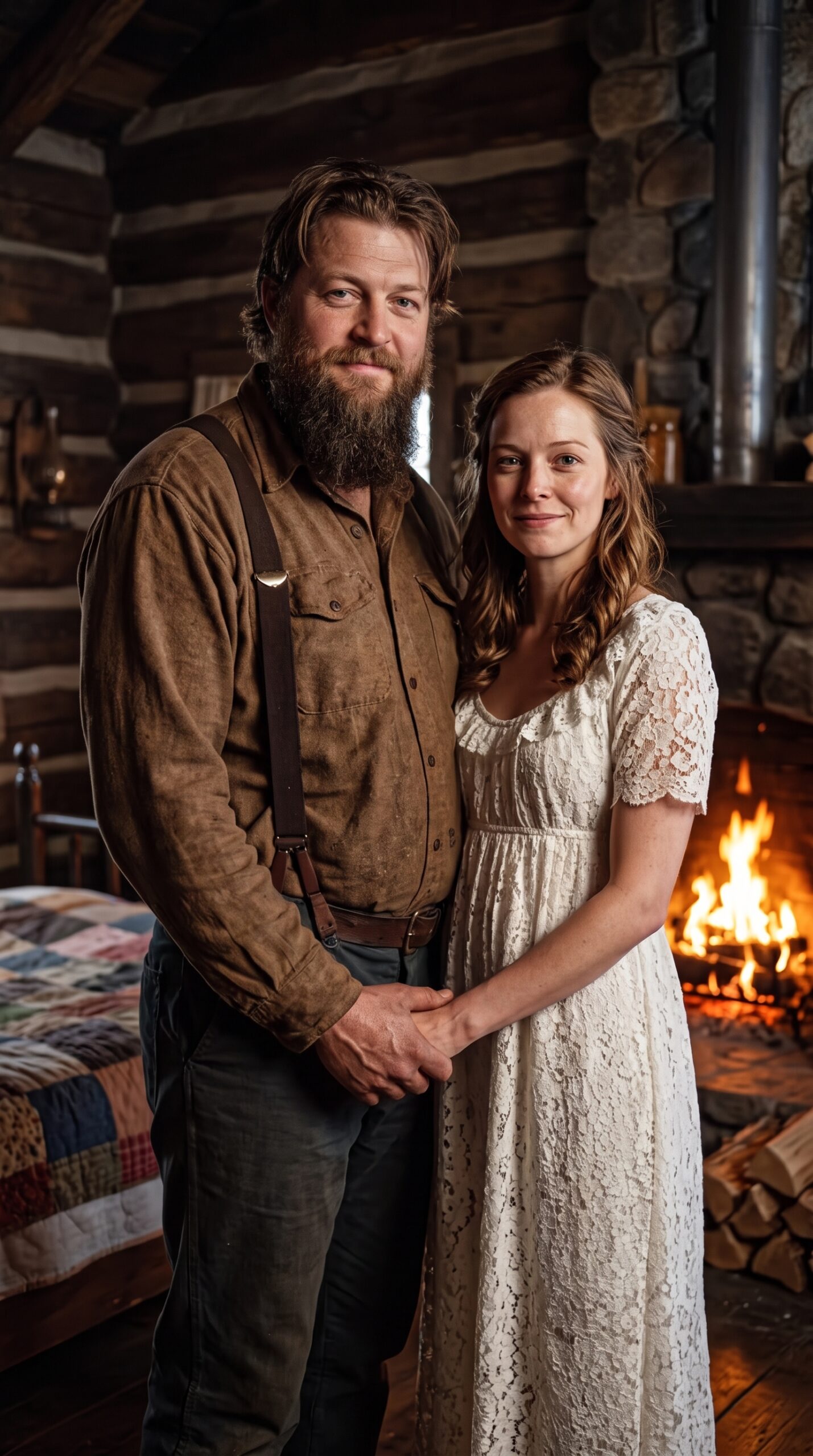
She Crossed 3,000 Miles to Marry a Stranger She’d Never Met — What He Did on Night One Left Her in Tears
*She had traveled across a continent to marry a man whose face she had never seen. She expected a cold bargain, a lonely cabin, and a lifetime of obligation. But on their first night together, the mountain man said seven words that shattered everything she believed about love.*
Chapter 1: The Woman With Forty-Three Dollars
The letter arrived on a Thursday morning, three weeks after Margaret Hale buried her husband.
It was a cold, miserable morning in Baltimore, Maryland, in the autumn of 1887. Rain tapped against the cracked windows of the boardinghouse where Margaret had been staying since the bank took possession of her home. Somewhere downstairs, a woman argued with the landlady about the price of coal. A horse-drawn wagon rattled over the wet cobblestones outside, and the smell of damp wool, horse manure, and burning coal drifted through the narrow hallway.
Margaret sat on the edge of her iron bed, wearing the same black dress she had worn to her husband’s funeral.
At twenty-eight, she looked older than she was.
Grief had hollowed her cheeks. Sleepless nights had darkened the skin beneath her eyes. Her once-beautiful brown hair, which she had carefully pinned into a fashionable arrangement when she was married, now hung in a loose braid down her back.
On the small table beside her lay everything she owned.
A hairbrush with a broken handle. Two changes of clothing. A Bible that had belonged to her mother. A photograph of her parents. And forty-three dollars and seventeen cents.
That was the sum of Margaret Hale’s entire fortune.
Six months earlier, she had lived in a respectable brick house with lace curtains, polished furniture, and a garden filled with roses. Her husband, Charles, had promised her a comfortable life. He had worn fine suits, entertained business associates, and spoken confidently about investments that would make them wealthy.
Margaret had believed him.
She had believed him when he said the business was struggling temporarily.
She had believed him when he asked her to sign papers she did not understand.
She had even believed him when he insisted that the family silver be sold to cover a debt that would supposedly be repaid within weeks.
Then Charles died of a fever.
And the truth came out.
Her husband had borrowed money from merchants, banks, private lenders, and men whose names Margaret had never heard. He had used their home as security. He had borrowed against furniture, business equipment, and property that did not even belong to him.
When he died, the creditors came for everything.
The house went first.
Then the furniture.
Then the carpets, the dining table, and the little walnut writing desk where Margaret’s mother had once written letters to her family.
The last thing they took was the silver tea set her mother had left her.
Margaret had stood in the doorway while two men carried it away.
She remembered the clatter of the silver pieces as they were placed into a wooden crate. She remembered asking whether she could keep just one cup.
The older creditor had looked at her with something that might have been pity.
“Madam, a debt is a debt.”
Those words had followed her everywhere since.
A debt is a debt.
They were the same words Charles had used whenever Margaret questioned his decisions.
When she asked why he had borrowed money without telling her, he accused her of being ungrateful.
When she questioned a purchase, he reminded her of the roof over her head.
When she refused to entertain one of his business associates because the man made her uncomfortable, Charles told her she was embarrassing him after everything he had provided.
“Kindness isn’t free, Margaret,” he had once said. “Everything a man gives his wife comes with an expectation.”
She had been too young, too trusting, and too determined to be a good wife to understand how dangerous those words were.
By the time she understood, Charles was dead.
And Margaret was left with his debts.
She had spent the previous three weeks searching for employment. She could sew, cook, mend clothing, keep accounts, and read and write beautifully. But respectable positions were scarce, and the few employers who would consider a widow offered wages too small to pay for food and lodging.
One woman who ran a dressmaking shop told her she was too old to be taken on as an apprentice and too inexperienced to manage the business.
A wealthy household offered her a position as a companion to an elderly woman, but the mistress withdrew the offer after discovering that Margaret had no references from her former husband’s business associates.
Another employer suggested that a woman with no family and no money should be grateful for any work offered to her.
Margaret had stopped asking for help after that.
She knew what happened when people believed they had rescued you.
They began to believe they owned a piece of you.
A sharp knock at the door interrupted her thoughts.
“Miss Hale?”
The landlady’s voice came through the wood.
“There’s a letter for you.”
Margaret frowned.
A letter?
She had no relatives who wrote to her. Her mother’s family had scattered years ago, and Charles had discouraged her from maintaining friendships that he considered unnecessary.
She opened the door.
The landlady handed her a thick envelope addressed in unfamiliar handwriting.
“Postman says it came all the way from Colorado.”
Colorado.
Margaret had never been farther west than Pennsylvania.
She closed the door and examined the envelope. Her name had been written carefully across the front, and the return address listed a post office in a small settlement near the Colorado mountains.
She broke the seal.
Inside was a single sheet of paper.
The letter contained only five sentences.
*Miss Margaret Hale,*
*I own a cabin, land, and horses in the Colorado mountains. I do not drink or gamble, and I have no interest in playing games with a woman’s future. I need a wife who can stand the winter and is willing to build a quiet life with me. If you agree to marry me, I will pay your outstanding debts and provide you with a home.*
*Jonah Mercer.*
Margaret read the letter twice.
Then she read it a third time.
There was no flowery declaration of affection. No promise that she was the most beautiful woman in the world. No claim that he had fallen in love with her from a distance.
There was only a straightforward offer.
A husband.
A home.
Her debts paid.
And a place in the Colorado mountains.
It was the kind of proposal that might have seemed absurd to a woman with a comfortable life and a dozen suitors.
To Margaret, it looked like a door opening in a wall that had been closing around her for months.
Still, she was not foolish enough to accept immediately.
She took a sheet of paper and wrote a reply.
*Mr. Mercer,*
*Before I can consider your proposal, I must ask why you wish to marry a woman you have never met. I must also ask what you expect from a wife. I have recently been widowed, and I have learned that a promise of security can conceal a great deal.*
*Margaret Hale.*
She sent the letter the following morning.
Six days later, his answer arrived.
*Miss Hale,*
*I want a wife because I am tired of living alone. I expect honesty, companionship, and a willingness to work together when life becomes difficult. I cannot promise an easy life, and I will not pretend to be a man of fine manners. But I will never ask you to earn your meals by pleasing me, and I will not strike you.*
*If you come, you will have your own room until you decide otherwise. If you discover you cannot live here, I will pay for your journey to the nearest town and help you find work.*
*I will pay the debts listed in the papers you send me. I do not require you to promise affection in return.*
*Jonah Mercer.*
Margaret’s hands trembled as she lowered the page.
She read the last two sentences again.
He did not require affection in return.
It was such a strange thing for a man to write that she almost suspected a trick.
Every man she had known had believed that his generosity gave him a claim over someone else. Charles had made sure she understood that. So had the creditors, who reminded her that every favor had a price.
Yet this stranger in Colorado was offering to pay her debts without demanding that she love him.
Perhaps he was lying.
Perhaps he had hidden expectations he did not wish to put into writing.
Perhaps the man was dangerous in ways she could not imagine.
But what was her alternative?
Another winter in a cheap boardinghouse, watching her money disappear? A life spent sewing until her fingers stiffened, never earning enough to feel safe? A future in which one unexpected illness or one missed payment could leave her sleeping on the street?
Margaret looked at her mother’s Bible.
Then she looked at the letter.
For the first time in months, she allowed herself to imagine a future that did not belong to Charles’s mistakes.
Three days later, she wrote her acceptance.
And two weeks after that, she boarded a train heading west.
She carried one small trunk, her mother’s Bible, and forty-three dollars.
She had no idea that the man waiting for her at the end of the journey was carrying a secret far heavier than the one she had left behind.
## Chapter 2: Three Thousand Miles From Everything She Knew
The journey west was harder than Margaret had imagined.
The first train was crowded with merchants, families, soldiers, and men who seemed to know exactly where they were going. Margaret sat beside the window, clutching her trunk key in her gloved hand and watching Baltimore disappear behind a veil of smoke.
For the first few hours, she tried to convince herself that she had made the right decision.
She had a destination.
She had a plan.
And she had a man who had promised her a home.
But as the miles accumulated, certainty gave way to fear.
What if Jonah Mercer had described himself honestly but left out the important details? What if he expected her to work from dawn until midnight? What if his promise that she would have her own room meant that he intended to keep her isolated in a place where nobody could hear her call for help?
The questions grew louder as the train carried her through unfamiliar towns.
At night, she slept poorly in the uncomfortable seat, waking whenever the wheels struck a rough section of track. In the mornings, she washed her face in station washrooms and purchased the cheapest bread she could find.
She learned quickly that travel consumed money faster than she had expected.
The first time a conductor announced a delay caused by weather, Margaret counted her remaining coins.
She had thirty-one dollars.
By the time she reached the next major station, she had twenty-six.
She began to worry that she would arrive in Colorado with nothing.
During a long stop in a crowded railway station, an elderly woman noticed Margaret staring at a small loaf of bread in a shop window.
“You look as though you haven’t eaten properly,” the woman said.
Margaret stiffened.
“I am quite well, thank you.”
The older woman glanced at the trunk beside her.
“Traveling alone?”
“Yes.”
“Going to meet someone?”
Margaret hesitated.
“My future husband.”
The woman’s eyebrows rose.
“Does he know you’re coming?”
Margaret almost smiled.
“That would make the journey rather pointless if he did not.”
The woman laughed softly, and for a moment Margaret felt less alone.
They shared a cup of tea and talked while the station clock moved toward noon. The woman told Margaret about her own marriage, about a husband who had died young, and about the difficult years that followed.
Before boarding her train, she touched Margaret’s arm.
“Remember something, dear. Being grateful for a roof over your head does not mean you must surrender the key to your own life.”
Margaret thought about those words long after the woman disappeared into the crowd.
By the time she reached the western territories, the landscape had changed beyond recognition.
The green fields and familiar towns gave way to vast plains, rocky ridges, and stretches of land that seemed to continue forever. The wind swept across the open country with a force that rattled the train windows. Sometimes the only signs of human life were a distant farmhouse, a cluster of buildings near the tracks, or a line of telegraph poles disappearing toward the horizon.
Margaret had never felt so small.
At one station, she watched a group of cowboys ride past the railway platform. Their horses kicked up dust, and their laughter carried across the open ground.
At another, a family boarded with two children, a basket of chickens, and enough luggage to fill half the carriage.
Margaret listened to their conversation and wondered whether she would ever belong anywhere again.
She had spent her whole life believing that a home was a place where people knew your name.
Now she was traveling toward a stranger who had never heard her laugh.
On the final morning, the train slowed as it approached a small mountain settlement.
The conductor called out the name of the station.
Margaret gathered her belongings.
Her heart beat so hard that she could hear it.
When she stepped down onto the wooden platform, cold mountain air rushed into her lungs. The air smelled of pine, smoke, and distant snow.
The station was little more than a weathered building with a small waiting room, a water barrel, and a hitching post.
Beyond it, the mountains rose into the clouds.
They were magnificent and terrifying, their upper slopes already dusted with white.
Margaret stood beside her trunk, waiting.
Five minutes passed.
Then ten.
A wagon rattled along the road and disappeared behind a row of buildings.
A man unloaded crates from a horse-drawn cart.
A woman hurried past with a basket under her arm.
But nobody came for Margaret.
She checked the letter in her pocket.
The date was correct.
The station was correct.
Jonah Mercer had written that he would meet her when the train arrived.
Perhaps he had been delayed.
Perhaps his horse had gone lame.
Perhaps the mountain road was blocked.
Margaret waited another twenty minutes.
At last, she approached the stationmaster.
“Excuse me, sir. Have you seen a man named Jonah Mercer?”
The stationmaster looked up from his ledger.
“Mercer? Big fellow? Dark beard?”
“Yes. I believe so.”
“He was here this morning. Said he had business in town. Told me to expect a passenger.”
Margaret’s stomach tightened.
“Did he say when he would return?”
The stationmaster looked toward the mountains.
“Roads aren’t easy this time of year, ma’am. Could be an hour. Could be longer.”
An hour became two.
The wind grew colder.
Margaret wrapped her shawl around her shoulders and sat on her trunk.
She had spent three thousand miles convincing herself that she was traveling toward a new beginning.
Now she wondered whether she had simply traveled three thousand miles to discover another way to be abandoned.
When the stationmaster finally came outside, he carried a lantern.
“Ma’am, it’ll be dark soon.”
Margaret stood.
“Then what am I supposed to do?”
The man looked uncomfortable.
“I reckon we’ll have to wait a little longer.”
She swallowed the lump in her throat.
She had no money for another long journey. No friends in the settlement. No family waiting beyond the mountains.
And somewhere in that enormous wilderness was a man who had promised to become her husband.
A man she had never seen.
A man who might not come.
Margaret looked toward the darkening road.
For the first time since leaving Baltimore, she felt the full weight of what she had done.
She had trusted a stranger with the last remaining pieces of her life.
And now she had no idea whether he intended to keep his promise.
## Chapter 3: The Mountain Man at the End of the Road
The sound of hooves reached the station just as the last light faded from the sky.
Margaret turned.
A rider emerged from the road beyond the settlement, his horse moving steadily through the dust. The man sat tall in the saddle, wrapped in a dark wool coat. A rifle was secured across his back, and a weathered hat shadowed his face.
He was enormous.
Even from a distance, Margaret could tell that he was unlike the men she had known in Baltimore.
His shoulders were broad enough to make the horse beneath him appear smaller than it was. His beard covered much of his face, and his hands, resting on the reins, looked thick and powerful.
When he reached the platform, he pulled his horse to a stop.
He looked at Margaret.
Then at the trunk beside her.
Then back at Margaret.
“Mrs. Hale?”
His voice was deep, roughened by cold air and years of speaking more often to animals than to people.
Margaret lifted her chin.
“Miss Hale. I am not married yet.”
The man blinked.
Then, to her surprise, he looked embarrassed.
“Right. Miss Hale. I’m sorry.”
He dismounted.
His boots struck the ground with a heavy thud.
“I should’ve been here sooner.”
“Yes,” Margaret said.
She had intended to sound calm, but the word came out sharper than she expected.
Jonah looked down.
“The road above the creek gave way. Had to take the long route around the ridge.”
Margaret studied his face.
There was a scar running from the edge of his left eyebrow toward his temple. Another pale line disappeared beneath his beard. His coat was worn, his boots muddy, and his clothes smelled faintly of woodsmoke and leather.
He looked like a man who belonged to the mountains, not a parlor.
“I thought you had changed your mind,” she admitted.
His eyes lifted to hers.
“No, ma’am.”
He spoke with such certainty that Margaret found herself believing him.
“I wouldn’t have let you come all this way without meeting you.”
Something about the statement eased the tightness in her chest.
Jonah turned toward her trunk.
“May I?”
Margaret nodded.
He lifted it easily, carrying it as though it weighed no more than a basket of laundry. But he did not reach for her hand, touch her elbow, or attempt to guide her toward the horse.
Instead, he walked several paces ahead and set the trunk in the back of a small wagon.
Then he stepped aside.
“Watch your footing. The ground’s uneven.”
Margaret climbed into the wagon herself.
Jonah waited until she was seated before taking his place at the front.
The journey to the cabin lasted nearly two hours.
At first, they said very little.
The road climbed through a forest of towering pines. The wheels bumped over stones, and the horses occasionally snorted at something moving in the undergrowth.
Margaret watched the shadows between the trees.
She had imagined Colorado as a place of open skies and distant mountains. She had not imagined how lonely the forest could feel after sunset.
Jonah seemed perfectly comfortable.
He drove with one hand on the reins, occasionally clicking his tongue to encourage the horses. He pointed out a stream where he collected drinking water, a ridge where elk sometimes appeared, and a narrow trail that became dangerous after heavy snow.
He spoke plainly, without trying to impress her.
When Margaret asked how far the cabin stood from the nearest settlement, he answered honestly.
“About twelve miles by the summer road. Longer when the snow comes.”
“And if I need a doctor?”
“There’s a physician in town. If the road’s passable, I can get him.”
“And if it isn’t?”
Jonah was silent for a moment.
“Then we’d have to manage until it opens.”
Margaret’s hands tightened in her lap.
“You make it sound very simple.”
“It isn’t.”
He glanced at her.
“I’d rather tell you the truth now than have you discover it when the snow is already at the door.”
She appreciated the honesty, even if it frightened her.
After another mile, he spoke again.
“If you want to turn back, I’ll take you to town. I’ll pay for a room and your ticket east.”
Margaret looked at him.
“You would do that?”
“Yes.”
“Even after paying my debts?”
“I haven’t paid them yet.”
“But you intend to.”
“If the agreement still stands.”
He returned his attention to the road.
“That doesn’t mean you can’t change your mind.”
Margaret stared at him for a long moment.
She had expected bargaining. Perhaps even a reminder that he had spent money bringing her across the country.
Instead, he was offering her the chance to leave before she had even reached his home.
She did not understand him.
That frightened her more than his size.
When they finally reached the cabin, the moon had risen above the trees.
It stood in a small clearing surrounded by pines, with a stream running nearby and a woodpile stacked neatly beneath a lean-to. A barn stood a short distance away, and beyond it lay a fenced pasture where two horses moved quietly in the darkness.
The cabin was larger than Margaret expected.
It had a stone chimney, a sturdy roof, and two windows facing the clearing. Smoke rose from the chimney, suggesting that Jonah had lit the fire before leaving to meet her.
He helped her down from the wagon without touching her.
Then he carried her trunk inside.
Margaret stopped in the doorway.
The room was warm.
A fire crackled in the stone hearth. A wooden table stood near the window, and shelves lined one wall. There were cooking pots, neatly arranged tools, folded blankets, and a small collection of books.
The cabin smelled of pine smoke, fresh bread, and something savory simmering in a pot.
It was not elegant.
But it was clean.
And after weeks of cold rooms and uncertainty, the sight of a warm fire nearly brought tears to Margaret’s eyes.
Jonah placed her trunk beside the wall.
“You must be hungry.”
“I am.”
“I made stew. Don’t know whether you’ll like it, but it’s hot.”
He moved toward the stove.
Margaret removed her gloves and looked around.
There was only one chair near the fire.
Jonah noticed her glance.
“That one’s yours.”
“What about you?”
“I’ll sit at the table.”
He carried a bowl of elk stew to the chair and set it down for her. Then he returned to the stove and filled another bowl for himself.
His portion was smaller.
Margaret noticed.
“You gave me more.”
“You’re the guest.”
“I am not a guest. I’m supposed to be your wife.”
Jonah paused.
Then he looked at her with an expression she could not quite interpret.
“You’re a person who’s traveled a long way. That’s enough reason.”
Margaret lowered her eyes to the bowl.
For a moment, she could not speak.
She had forgotten what it felt like to receive something without being reminded of its price.
They ate in silence, though not an uncomfortable one.
Afterward, Jonah washed the bowls while Margaret sat near the fire. He showed her where the water was stored, where she could find clean towels, and which cupboard contained the flour and sugar.
Then he led her to a small room at the back of the cabin.
There was a narrow bed, a wooden chest, a washbasin, and a window overlooking the forest.
“I put fresh sheets on it this morning,” he said. “Thought you might prefer your own room.”
Margaret stared at the bed.
“You have another room?”
He hesitated.
“No.”
She looked back at him.
“Then where will you sleep?”
He gestured toward the main room.
“I’ve slept beside that fire plenty of nights.”
“But it’s cold.”
“I have blankets.”
He said it as though the matter were settled.
Margaret felt something unfamiliar stirring in her chest.
Suspicion, perhaps.
Or disbelief.
“Mr. Mercer,” she said carefully, “we are planning to be married tomorrow.”
“Yes.”
“Most men would expect their wife to share their bed.”
Jonah’s face reddened beneath his beard.
He looked toward the window, then at the floor.
“Most men aren’t me.”
The answer was so unexpected that Margaret almost laughed.
Almost.
Instead, she found herself watching him with growing curiosity.
This man could ride through dangerous mountain roads after dark. He could lift her trunk without effort. He could probably split a tree with a single swing of his axe.
Yet the idea of discussing a bed with her seemed to leave him completely helpless.
She wondered what sort of life had made him this way.
Before she could ask, Jonah cleared his throat.
“You should rest. Tomorrow will be a long day.”
He started toward the main room.
“Mr. Mercer?”
He stopped.
“Jonah,” he corrected gently. “If we’re to marry, you can call me Jonah.”
She looked at him for a moment.
“Then you may call me Margaret.”
He nodded.
“Good night, Margaret.”
“Good night.”
He closed the door quietly.
Margaret sat on the edge of the bed.
She had arrived at the end of a three-thousand-mile journey and found a stranger who treated her more gently than the man she had spent years calling her husband.
But she was not ready to trust him.
Not yet.
She had learned that kindness could be a disguise.
And she was determined to discover what Jonah Mercer truly wanted from her before she gave him the one thing she could not afford to lose again.
Her trust.
## Chapter 4: A Wedding Without Witnesses
The next morning, Margaret woke to the sound of an axe striking wood.
For a few seconds, she did not remember where she was.
The unfamiliar ceiling, the scent of pine, and the pale light filtering through the window confused her. Then she heard the sharp crack of the axe again and remembered the journey, the mountains, and the man sleeping somewhere beyond her door.
She dressed quickly.
When she entered the main room, Jonah stood near the stove, pouring coffee into two tin cups.
He had shaved only a little, trimming the roughest edges of his beard. Without his hat, she could see that his dark hair was beginning to thin at the temples, though he was only thirty-two.
He looked at her and immediately stepped away from the stove.
“Morning.”
“Good morning.”
“Coffee?”
“Please.”
He handed her a cup.
Margaret took a sip and nearly smiled.
It was strong enough to wake the dead.
Jonah noticed her expression.
“Too much?”
“A little.”
“I’ll remember that.”
He looked almost pleased that she had given him something useful to remember.
Breakfast consisted of eggs, bread, and preserved apples. Afterward, Jonah explained that the minister lived in town but had agreed to perform the ceremony at the cabin.
Margaret’s stomach tightened.
“You have arranged everything?”
“Yes.”
“And the marriage papers?”
“In the drawer.”
She looked toward the table.
“May I read them?”
Jonah seemed surprised.
“Of course.”
He fetched the documents and placed them in front of her.
Margaret read every line.
The agreement stated that Jonah would pay the debts she had disclosed, provide her with a home, and cover reasonable expenses if she chose to leave. It also stated that they would be married according to the laws of the territory and that both parties understood the responsibilities of the arrangement.
There were no hidden clauses that she could see.
Still, she asked questions.
Who would own the land?
What would happen if he died?
Would she have access to money for clothing and supplies?
Could she visit the settlement alone?
Jonah answered each question without irritation.
The land would remain his property, but he would make provisions for her in his will. He had a small account at the bank in town and intended to place household money at her disposal. She could visit the settlement whenever the weather permitted, provided she took a horse or wagon and understood the risks of the road.
When she finished, she set the papers down.
“You do realize that I have almost nothing to offer you.”
Jonah frowned.
“What do you mean?”
“I have no dowry. No family connections. No property. I cannot bring you money or land.”
“I know.”
“Then why me?”
He looked uncomfortable again.
For a moment, she thought he might refuse to answer.
Finally, he sat down across from her.
“Because I wanted a wife who would tell me the truth.”
Margaret waited.
“I’ve lived alone a long time,” he continued. “I know how to build a cabin, hunt, repair a fence, and keep myself alive. But I don’t know how to build a life with another person.”
He rubbed his thumb along the edge of the table.
“I figured a woman who had already been married might know more about that than I do.”
Margaret studied him.
“And you are not concerned that I might never love you?”
His gaze dropped.
“I’d be lying if I said I didn’t hope for it.”
He looked up again.
“But hope isn’t a contract.”
Something in Margaret’s chest tightened.
She had never heard a man say such a thing.
Charles had treated love like a reward for obedience. He had insisted that a good wife should appreciate everything her husband did, even when those things hurt her.
Jonah seemed to believe that love was something a person had to be free to give.
She did not know whether that made him foolish or extraordinary.
Perhaps both.
At noon, the minister arrived in a small buggy.
He was a thin, elderly man with silver hair and a voice that carried easily through the cabin. He had known Jonah for several years and greeted him warmly before turning to Margaret.
“You’re the bride from the East.”
Margaret smiled nervously.
“I suppose I am.”
The minister glanced at Jonah.
“Well, I’ll admit, Mercer, I wasn’t sure you’d ever find someone willing to put up with you.”
Jonah’s ears turned red.
“Pastor.”
The old man chuckled.
“Don’t worry, son. I mean it as a compliment.”
The ceremony was brief.
There were no flowers, no guests, no music, and no elaborate dress. Margaret wore her black traveling dress, which she had brushed carefully that morning. Jonah wore a clean shirt and the only formal coat he owned.
When the minister asked whether they took one another as husband and wife, Margaret looked at Jonah.
He stood stiffly, his broad shoulders rigid and his hands clasped in front of him.
He seemed more nervous than she was.
“I do,” Margaret said.
Jonah swallowed.
“I do.”
The minister pronounced them married.
Then he asked Jonah to kiss his bride.
For one terrible second, Margaret saw panic flash across Jonah’s face.
He glanced at her.
“Would that be all right?” he whispered.
She almost laughed.
They were already married, and he was asking permission to kiss her.
“Yes,” she said softly.
Jonah leaned toward her.
His kiss was brief and awkward, barely more than a touch. He pulled away immediately, as though afraid he had done something wrong.
The minister watched them with an expression that suggested he was trying very hard not to smile.
“Well,” he said, gathering his papers, “may your home be blessed with peace.”
After he left, Jonah stood beside the table looking as though he had survived a dangerous encounter.
Margaret turned toward him.
“Is marriage always so frightening?”
He gave a short, embarrassed laugh.
“I hope not.”
For the first time since arriving in Colorado, Margaret laughed too.
It was a small sound, rusty from disuse, but it surprised them both.
Jonah looked at her as though she had given him a gift.
And Margaret, despite her doubts, felt the first fragile thread of something warm begin to form between them.
That evening, they ate supper together.
They spoke about the weather, the horses, and the upcoming winter. Jonah explained that he had spent the previous summer repairing the roof and stocking the cabin with enough wood to last through the cold months.
Margaret asked about his childhood.
He became quiet.
“I didn’t have much of one.”
“Why not?”
He looked at the fire.
“My father died when I was thirteen. My mother had already been gone for years. An uncle took me in for a while, but he drank most of what he earned. Eventually, he sent me west with a hunting party.”
“What happened to the hunting party?”
“Some stayed. Some went farther north. One man died in a storm. Another was killed by a bear.”
“And you?”
“I stayed.”
He said it simply.
As though surviving nineteen years in the wilderness were no more remarkable than learning to bake bread.
Margaret wanted to ask more, but something in his expression warned her not to press.
After supper, Jonah cleared the table.
Then he stood beside the fire, looking uncomfortable.
“There’s something we ought to talk about.”
Margaret’s heart began to pound.
She knew what he meant.
They were married now.
There was no reason for him to sleep in the main room forever.
She rose slowly.
“Yes.”
Jonah rubbed the back of his neck.
“I don’t want you thinking you have to do anything just because we were married today.”
Margaret stared at him.
He continued, speaking so quickly that his words nearly collided.
“I know what people expect. I know what a husband is supposed to expect. But I don’t want you frightened of me. If you need time, take it.”
She felt suddenly as though the room had become very small.
“Jonah, do you not want me?”
His face went scarlet.
“That’s not what I said.”
“Then what are you saying?”
He looked at her, helpless.
“I’m saying I don’t know what I’m doing.”
The confession was so unexpected that Margaret could only stare.
Jonah Mercer, the man who could survive a mountain blizzard, looked as though he wished the floor would open beneath him.
And suddenly Margaret understood that the man she had married was afraid of something.
Not the weather.
Not hunger.
Not wild animals.
He was afraid of hurting her.
And that was a fear she had never seen in a husband before.
## Chapter 5: The Seven Words That Changed Everything
The fire had burned low by the time Margaret finally asked the question that had been troubling her since sunset.
“Jonah, where will you sleep tonight?”
He glanced toward the hearth.
“Here.”
“On the floor?”
“I’ve slept on worse.”
Margaret looked at the narrow bed in the back room, then at the man standing before her.
They were husband and wife.
They had crossed the distance between strangers and marriage in a single day, and yet he seemed determined to keep an entire room between them.
She had spent so many years being told what she owed a man that she did not know how to understand a man who asked for nothing.
Perhaps she was being unfair.
Perhaps Jonah was simply shy.
But there was another possibility she could not ignore.
Maybe he had married her only because he wanted someone to cook his meals and keep his cabin tidy. Maybe he had no interest in her beyond the practical benefits of having a wife.
The thought hurt more than she expected.
“Jonah?”
He turned.
“Yes?”
“Do you intend for us to live like strangers?”
His face changed.
“No.”
“Then why are you acting as though I am made of glass?”
He opened his mouth, then closed it.
Margaret took a breath.
“I know I have only just arrived. I know we have not had time to learn about one another. But I cannot spend the rest of my life wondering whether my own husband can bear to stand beside me.”
Jonah looked stricken.
“I never meant to make you feel unwanted.”
“Then tell me what you mean.”
He stared at the fire for several seconds.
Finally, he spoke.
“I’ve never been with a woman, Margaret.”
The words were so quiet that she almost missed them.
She blinked.
“What?”
He swallowed hard.
“I’ve never had a sweetheart. Never courted anyone. Never shared a bed with a woman.”
He looked away.
“I was brought to these mountains at thirteen. I worked with older men, learned to hunt, and spent years moving between camps. Then I bought this land and built the cabin. I thought I might meet someone someday, but the years went by.”
He gave a humorless laugh.
“After a while, it seemed foolish to expect anyone to want a life like mine.”
Margaret stood very still.
This enormous, scarred mountain man had survived nineteen years of loneliness, and now he was embarrassed because he had no experience of love.
“I thought,” he continued, “that if I married a woman, I would somehow know what to do. That it would come naturally. But now you’re here, and I can’t stop thinking about how easy it would be to frighten you.”
He looked at his hands.
“These hands aren’t gentle. I can lift a horse’s saddle with one arm. I can break frozen branches. I’ve been in fights. I’ve hurt men when I had to.”
His voice grew rougher.
“And I don’t know how to make sure I never hurt you.”
Margaret felt something inside her shift.
She had spent years with a man who believed that being a husband gave him the right to control her. Charles had never questioned whether she felt safe. He had assumed that his position made his behavior acceptable.
Jonah was afraid of the very thing Charles had never considered.
Margaret stepped closer.
“Jonah, look at me.”
He obeyed reluctantly.
She could see the fear in his eyes.
Not fear of rejection alone, but fear of becoming the kind of man he had spent his life trying not to be.
She had come to Colorado expecting to find a husband who would provide shelter in exchange for obedience.
Instead, she had found a man who was frightened of the power he might hold over her.
She glanced toward the bed.
Then she looked back at him.
“Can you make me feel safe tonight?”
Jonah actually stepped backward.
His face went pale.
“I don’t know how.”
Margaret’s throat tightened.
He was telling her the truth.
And for reasons she could not explain, that frightened her less than any confident promise he might have made.
She walked to the chair beside the fire and sat down.
“Then sit with me.”
Jonah hesitated.
“Are you sure?”
“Yes.”
He approached the chair cautiously and sat beside her, leaving a wide space between them.
His knees nearly touched the edge of the table. His hands rested on his thighs, large and rough, the knuckles marked by old scars.
Margaret looked at them.
“May I hold your hand?”
He stared at her.
Then he turned his palm upward.
She placed her smaller hand inside his.
His skin was rough, warm, and trembling.
The discovery surprised her.
He was afraid.
Not because she had threatened him, but because he wanted so badly to do right by her that he could hardly move.
Margaret gently closed her fingers around his.
“If I don’t like something, I’ll tell you.”
He nodded.
“And if you say stop?” she asked.
He looked directly into her eyes.
“I stop. Always.”
“Even if we’re married?”
“Especially then.”
Margaret felt tears gathering behind her eyes.
She tried to look away, but Jonah noticed.
“Did I say something wrong?”
“No.”
She pressed her lips together.
“No, Jonah. You said something right.”
He did not know what to do with that answer.
So he sat quietly beside her.
For several minutes, neither spoke.
The wind moved through the trees outside. Somewhere in the distance, a wolf called to another. The fire crackled softly, filling the silence with a comforting sound.
Margaret had spent two years believing that safety was something a woman had to earn.
She had believed that if she were patient enough, obedient enough, grateful enough, her husband might eventually treat her gently.
Now a man who had known her for barely a day was offering her a choice without asking her to prove that she deserved it.
She turned toward him.
“Jonah?”
“Yes?”
“May I kiss you?”
His eyes widened.
For one moment, she thought he might faint.
Then he nodded.
“Yes.”
Margaret leaned forward.
Their lips met in a hesitant, almost uncertain kiss. Jonah’s hand remained still beside hers, and when she drew back, he did not follow her.
He waited.
She looked at him.
He was blushing so deeply that even his ears had turned red.
A small laugh escaped her.
“I’m sorry,” she whispered. “I don’t mean to laugh at you.”
“I reckon I deserve it.”
“No, you don’t.”
She touched his cheek.
The scar beneath her fingertips felt rough, but he leaned into her touch with such quiet surprise that her heart ached.
For the first time since Charles died, Margaret felt no need to calculate the price of a kind gesture.
She did not wonder what Jonah would demand tomorrow.
She did not worry that a kiss would become an obligation.
She simply wanted to sit beside him.
So she did.
That night, they remained by the fire until the logs collapsed into glowing embers. They talked about small things. Margaret told him about Baltimore, the sound of church bells, and the smell of bread from the bakery near her former home. Jonah told her about the first horse he had owned, a stubborn animal that had thrown him into a stream three times in one afternoon.
He made her laugh again.
And when she finally grew tired, he walked her to the bedroom door.
“Would you like me to stay in the other room?” he asked.
Margaret looked at the bed.
Then at him.
“I would like you to stay beside me.”
Jonah went still.
“Are you certain?”
“Yes. But only if you want to.”
He looked at her for a long moment.
Then he nodded.
“I want to.”
They lay down fully clothed beneath the blankets, leaving a little space between them. Jonah kept his hands folded against his chest as though he were afraid that even moving in his sleep might frighten her.
Margaret listened to his breathing.
She had expected marriage to feel like a door closing behind her.
Instead, for the first time in years, it felt as though a window had opened.
Before sleep claimed her, she reached across the space between them and placed her hand over his.
He turned his palm upward.
She held it.
And in the darkness of the Colorado mountains, Margaret Hale finally cried.
Not because she was afraid.
Not because she was trapped.
But because a man she had known for less than twenty-four hours had given her something she had almost forgotten existed.
The freedom to say yes.
And the certainty that she could say no.
## Chapter 6: Learning to Live Together
The first week of marriage was full of small discoveries.
Margaret learned that Jonah rose before sunrise, even when there was no urgent work to be done. He believed that a man who wasted the morning would spend the afternoon regretting it.
She learned that he disliked waste of every kind.
He saved string, sharpened tools until they could cut paper, and repaired clothing rather than replacing it. He used old flour sacks as cleaning cloths and kept the smallest scraps of leather in a box beneath the workbench.
He also talked to his horses.
Not constantly, and not in a foolish way, but with the same patient tone he used when explaining something to Margaret.
“Easy, girl,” she heard him say one morning. “No need to act like the world is ending.”
Margaret stood in the doorway and watched him brush a chestnut mare.
“Do you speak to all your animals like that?”
Jonah glanced over his shoulder.
“Only the ones that listen.”
She smiled.
He returned to brushing the horse, apparently unaware that he had made her day.
In return, Jonah discovered that Margaret was not nearly as helpless as he had imagined.
She could cook, sew, keep accounts, and organize a household with remarkable efficiency. Within days, she had rearranged the shelves, cleaned the cupboards, and begun keeping a list of supplies that needed replacing before winter.
She also discovered that Jonah could not read a complicated letter without considerable effort.
He could recognize common words, read simple notices, and understand figures, but longer passages confused him.
One evening, Margaret found him struggling with a letter from a merchant in town.
“May I see that?” she asked.
Jonah hesitated.
“It’s nothing important.”
“Then it shouldn’t matter if I read it.”
He handed it over reluctantly.
Margaret read the letter aloud.
It concerned the sale of several animal hides and the payment Jonah was owed. She explained the figures, pointed out a mistake in the merchant’s calculation, and showed him how the amounts had been recorded.
Jonah listened closely.
When she finished, he looked at her.
“How did you learn to do that?”
“My father kept accounts for a shipping company. He taught me when I was a girl.”
“Could you teach me?”
Margaret blinked.
“You want me to?”
“If you don’t mind.”
She smiled.
“I would be delighted.”
They began the following evening.
At first, Jonah was painfully self-conscious. He apologized whenever he misread a word and frowned whenever a letter refused to make sense.
Margaret quickly discovered that he had never lacked intelligence. He had simply been denied the opportunity to develop it.
He understood practical matters quickly. He could calculate the cost of supplies, estimate the amount of wood needed to heat the cabin, and determine how much food would be required to survive a long winter.
But reading required patience, and patience was not something he had ever been taught to give himself.
“Don’t rush,” Margaret told him one night.
“I’m not rushing.”
“You just tried to read three lines at once.”
He looked at the page.
Then he sighed.
“I’ve spent nineteen years doing things with my hands. Seems foolish that a few words can make me feel like a boy again.”
Margaret placed her hand over the book.
“There’s nothing foolish about learning.”
He looked at her.
“You really believe that?”
“I do.”
For the first time, he smiled without embarrassment.
They spent an hour reading that evening.
The following night, Jonah brought another book to the table.
And the night after that, he brought two.
Margaret began to look forward to their lessons almost as much as he did.
But not everything came easily.
The cabin was isolated, and winter was approaching. There were fences to repair, wood to split, food to preserve, and supplies to collect before the mountain roads became impassable.
Jonah taught Margaret how to recognize dangerous weather, how to walk safely across uneven ground, and how to use the small rifle he kept above the door.
He did not assume she would be unable to learn.
He showed her what to do, then watched while she tried.
When she made a mistake, he corrected her without laughing.
When she succeeded, he praised her as though the achievement mattered.
Margaret, in turn, taught him that a home required more than tools and supplies.
She showed him how to make a simple apple tart, how to mend a torn shirt without leaving an obvious seam, and how to fold blankets so that they occupied less space in the chest.
She persuaded him to open the windows on warm afternoons, even though he insisted that the cold air would somehow ruin the furniture.
She also introduced him to music.
One evening, she found an old harmonica in a drawer and asked whether he knew how to play.
Jonah shook his head.
“Never learned.”
“Would you like to?”
He considered the question.
Then he sat beside her while she showed him a simple tune.
He was terrible at first.
The notes came out uneven and breathy, and the melody bore only a distant resemblance to the song Margaret remembered from her childhood.
But he kept trying.
By the end of the evening, they were both laughing so hard that Jonah nearly dropped the harmonica into the fire.
It was the first time Margaret could remember laughing without feeling guilty afterward.
For months, she had believed that happiness was a luxury she no longer had the right to enjoy.
Now she began to understand that grief and happiness could occupy the same heart.
She could miss the woman she had been before Charles’s death and still become someone new.
She could remember the past without allowing it to dictate every decision in the present.
And she could learn to love a man without surrendering herself to him.
The realization did not arrive all at once.
It came in small moments.
Jonah leaving the last apple for her without mentioning it.
Margaret repairing the cuff of his coat and finding him wearing it proudly the next morning.
Their hands brushing as they reached for the same book.
The quiet comfort of sitting beside him when neither had anything to say.
They were learning one another.
And for the first time in her adult life, Margaret felt that the person she was becoming mattered just as much as the wife she had promised to be.
## Chapter 7: The Night the Storm Returned Her to the Past
The first serious snow arrived in November.
It began with a light dusting over the pasture, then thickened into a steady fall that covered the fence rails, the barn roof, and the narrow path leading to the stream.
Jonah worked for three days preparing the cabin for the coming storm.
He reinforced the shutters, checked the roof, brought extra wood inside, and made sure the horses had enough feed.
Margaret helped wherever she could.
By the fourth evening, the snow had grown so deep that the world beyond the windows appeared almost white.
They sat beside the fire after supper, Jonah reading from a book while Margaret mended one of his shirts.
Outside, the wind howled through the trees.
Inside, the cabin was warm.
Margaret had begun to think that perhaps she was finally safe.
Then something struck the roof.
A tremendous crack split the night.
Margaret dropped the shirt.
Before she understood what was happening, she was on the floor with her arms over her head.
“No!”
The word tore from her throat.
“Charles, please! I didn’t mean to! Please don’t!”
She curled into herself, trembling violently.
For an instant, she was no longer in Colorado.
She was back in Baltimore, standing in the kitchen while Charles shouted about a missing account book. She could hear his footsteps crossing the room. She could see the glass he had thrown against the wall. She could feel the terror that came whenever his anger turned toward her.
The memory was so vivid that she could not distinguish it from the present.
“Please,” she whispered. “I’ll fix it. I’ll do whatever you want.”
Jonah had risen from his chair, but he stopped several feet away.
“Margaret?”
She could not hear him.
“Margaret, it’s me.”
She pressed her hands harder against her head.
“Don’t hit me!”
Jonah went pale.
He had never seen her like this.
He wanted to pull her into his arms, to protect her from whatever terror had seized her. Every instinct told him to move closer.
But he remembered what he had promised.
He would never assume that his intentions gave him the right to touch her.
So he lowered himself to one knee, keeping several feet between them.
“Margaret,” he said softly, “it’s just Jonah.”
She continued trembling.
“It’s just Jonah, Margaret. Look at me if you can.”
He held out his hands, palms open.
“I’m not going to touch you.”
The wind rattled the shutters.
Another branch scraped across the roof.
Margaret flinched.
Jonah remained where he was.
“You’re in the cabin,” he continued. “The fire is burning. The horses are in the barn. Nobody is here but us.”
His voice was low and steady.
“You’re safe right now.”
The words did not immediately reach her.
For several minutes, she remained curled on the floor, fighting for breath.
Jonah did not move closer.
He did not tell her she was being foolish.
He did not demand that she explain herself.
He simply stayed where she could see him.
Eventually, Margaret lifted her head.
Her eyes were wide and wet.
Jonah’s hands were still open.
He looked frightened, but not angry.
“Jonah?” she whispered.
“Yes.”
“What happened?”
“A branch came down on the roof. I reckon it sounded worse than it was.”
She stared at him.
Then she looked at the fire, the table, and the familiar walls.
The present began to return.
She slowly unfolded her arms.
Jonah waited.
“May I come closer?” he asked.
Margaret nodded.
He moved toward her carefully and stopped beside her.
“May I help you up?”
She nodded again.
Only then did he offer his hand.
She took it.
He helped her to the chair beside the fire, then brought her a blanket and a cup of water.
Margaret’s hands shook so badly that she could barely hold the cup.
Jonah sat on the floor nearby.
For a long time, she said nothing.
Finally, she whispered, “I am sorry.”
His head lifted.
“For what?”
“For frightening you.”
Jonah stared at her in disbelief.
“Margaret, you don’t owe me an apology for being frightened.”
She looked down at the cup.
“I thought I had left all of that behind.”
“All of what?”
She closed her eyes.
Then, for the first time, she told him the truth about her marriage.
She told him about Charles’s temper, the way he could turn a small disagreement into a punishment, and how he had gradually convinced her that every act of kindness made her more indebted to him.
She described the nights when he returned home angry and the mornings when he behaved as though nothing had happened.
She told Jonah about the debts, the creditors, and the way Charles had blamed her for questioning him.
Most painfully, she told him that she had learned to anticipate his moods.
She could recognize the sound of his boots on the stairs, the way he closed a door, and the difference between an ordinary silence and the silence that came before an argument.
“I kept thinking that if I became better, he would become kinder,” she said. “If I cooked the right meal, wore the right dress, kept the house perfectly, and never questioned him, perhaps he would stop.”
Her voice broke.
“But he never did.”
Jonah looked at the fire.
His jaw tightened, and for a moment Margaret thought he might be angry with her.
Instead, he seemed angry with the man who had hurt her.
“I wish someone had helped you,” he said.
Margaret wiped her eyes.
“So do I.”
Jonah was silent for a while.
Then he spoke.
“I don’t know how to fix what he did.”
Margaret looked at him.
“But I can promise you this. Whatever happened before you came here, you won’t have to earn the right to be treated decently in this house.”
She began to cry again.
Jonah stayed beside her.
After a while, she reached for his hand.
He let her take it.
That night, Margaret asked him to remain beside her until she fell asleep.
He sat in the chair near her bed while she lay beneath the blankets. The fire burned low, and the storm gradually weakened outside.
She woke once in the middle of the night, startled by the wind.
Jonah was still there.
He had fallen asleep sitting upright, his head resting against the wall, one hand hanging beside the chair.
Margaret watched him for several seconds.
Then she reached for the blanket at the foot of the bed and draped it over his shoulders.
He stirred but did not wake.
She lay down again.
For the first time in two years, she slept until morning without dreaming of Charles.
When she woke, sunlight had begun to shine through the window.
Jonah was gone, but the blanket he had worn was folded neatly over the chair.
Beside it lay a small piece of paper.
In his careful, uneven handwriting, he had written:
*I checked the roof. We’re safe. I left coffee on the stove.*
Margaret held the paper for a long time.
Then she pressed it against her heart.
She had crossed an ocean of grief without believing she would ever feel safe again.
Now, in a cabin surrounded by snow, she was beginning to understand that healing did not always arrive as a grand declaration.
Sometimes it arrived as a man who stayed six feet away until you were ready to reach for his hand.
## Chapter 8: The Secret Beneath Jonah’s Silence
As winter settled over the mountains, Margaret began to understand why Jonah had spent so many years alone.
It was not because he disliked people.
He simply did not know how to belong among them.
When they visited the settlement together, he spoke only when necessary. He bought supplies, collected mail, and conducted business with an efficiency that left little room for conversation.
People recognized him, but few knew him well.
Some called him a hermit.
Others called him the bear.
A few children stared at his height and scars, whispering to one another as he passed.
Jonah pretended not to notice.
Margaret noticed everything.
She saw how he stepped aside to allow others to pass, how he avoided crowded rooms, and how he became uncomfortable whenever someone praised him.
She also noticed that he was kinder than most people gave him credit for.
When an elderly shopkeeper struggled to lift a sack of flour, Jonah carried it to her storeroom without asking for payment. When a boy fell from a fence and scraped his knee, Jonah knelt to help him despite the child’s initial fear of his enormous hands.
He was not a man without tenderness.
He was a man who had never learned how to show it without worrying that he would do it incorrectly.
One afternoon, while Margaret was buying thread, a woman approached her.
The woman was elegantly dressed, with a fashionable hat and a sharp, curious expression.
“You must be Jonah Mercer’s bride.”
Margaret turned.
“Yes.”
The woman looked her up and down.
“Well, I never thought he would find anyone willing to marry him.”
Margaret felt her smile stiffen.
“Why is that?”
The woman gave a little laugh.
“He’s not exactly a charming man, is he? He hardly speaks. And that face of his would frighten a child.”
Margaret placed the thread on the counter.
“Perhaps you have mistaken quietness for cruelty.”
The woman blinked.
Margaret continued, her voice calm.
“My husband has shown me more consideration in a few weeks than some men manage in a lifetime. I would be careful about judging a person by the face he presents to the world.”
The woman’s cheeks colored.
She muttered something about not meaning any offense and walked away.
When Margaret returned to Jonah, he was standing beside the wagon, looking toward the mountains.
“Who was that?” he asked.
“Someone who enjoys talking about people she doesn’t know.”
He glanced at her.
“Did she say something about me?”
Margaret considered lying.
Instead, she told him the truth.
Jonah’s expression barely changed.
“She’s not the first.”
“That doesn’t make it acceptable.”
He looked down at his boots.
“I’m used to it.”
Margaret stepped closer.
“Then perhaps it is time someone reminded you that being used to cruelty does not make it deserved.”
He stared at her.
For a moment, she thought he might say something.
Instead, he reached for the wagon reins.
“Let’s get home. Snow’s coming.”
But his voice sounded different.
That evening, Margaret found him sitting outside the cabin, staring toward the distant ridge.
She brought two cups of coffee and sat beside him.
“Jonah?”
He accepted the cup.
“Yes?”
“Why do you always assume people will dislike you?”
He remained silent.
The sun was setting, turning the snow-covered peaks gold.
After a long pause, he began to speak.
When he was thirteen, he had been sent west with a group of men who hunted and traded animal hides. His uncle had told him that the mountains would make a man of him.
At first, Jonah had believed the older men admired his strength. They gave him the heaviest loads, sent him to repair the most difficult equipment, and laughed whenever he struggled.
He thought it was simply how men treated boys.
Then, during a bitter winter, a man named Elias took an interest in him.
Elias was a trapper with a quick temper and a habit of drinking too much. He liked to remind Jonah that he was unwanted, uneducated, and lucky to have a place among the men.
Jonah worked harder to earn his approval.
He split more wood, carried heavier loads, and endured insults without complaint.
One night, Elias became angry after losing money in a card game. He accused Jonah of hiding a portion of the group’s earnings and struck him across the face.
Jonah fought back.
The struggle ended with Elias falling against a table and splitting his head.
The wound was not fatal, but the other men blamed Jonah for what happened. He was beaten, thrown out of the camp, and told never to return.
He survived the winter alone.
By spring, he had learned to hunt, trap, and repair his own equipment. He found work with another group of men, saved his money, and eventually bought a small piece of land.
He had spent the next nineteen years building a life in which nobody could threaten to throw him out.
“I thought if I became strong enough,” he said, “I would never have to depend on anyone again.”
Margaret listened quietly.
“Did it work?”
Jonah gave a short laugh.
“Depends on what you mean by work.”
He looked toward the cabin.
“I’ve never gone hungry for long. Never had to beg a man for a place to sleep. Never had anyone tell me I was worthless and make me believe it.”
He paused.
“But I got used to being alone. After a while, I stopped imagining anything different.”
Margaret looked at his hands.
“And then you wrote to me.”
“Yes.”
“Why?”
He stared at the mountains.
“Because I was tired of coming home to an empty cabin.”
His voice softened.
“I wanted someone to ask how my day went. Someone who might laugh at a bad joke. Someone who would sit beside me when the weather was terrible and not make me feel as though I was a burden.”
He swallowed.
“I didn’t think I would get that. I thought I might find a woman willing to make a practical arrangement. I never expected…” He stopped.
“What?” Margaret asked.
He looked at her.
“I never expected you to make this place feel like a home.”
Margaret’s eyes filled with tears.
She had spent so long believing that she was the broken one, the woman who had arrived with too much grief and too little money.
Now she was beginning to understand that Jonah had carried his own loneliness for nearly two decades.
They had not come together because one of them was strong and the other weak.
They had come together because both had spent too long believing that their lives had to be endured alone.
Margaret reached for his hand.
He turned his palm upward.
She rested her fingers against his.
“Jonah?”
“Yes?”
“I think we have both been lonely for a very long time.”
He looked at her.
For the first time, he did not try to hide the sadness in his eyes.
“Yes,” he whispered. “I think we have.”
They sat together until the last light faded from the mountains.
Neither promised that the past would disappear.
Neither pretended that love could repair every wound.
But when Jonah stood and offered Margaret his hand, she accepted it without hesitation.
And as they walked back toward the cabin, she realized that she no longer thought of it as his home.
It was theirs.
## Chapter 9: When the Mountains Tested Their Marriage
January brought the coldest weather Margaret had ever experienced.
The temperature dropped so sharply that the water in the basin froze overnight. Snow covered the fence rails, the barn roof, and the lower branches of the pine trees. The road to the settlement disappeared beneath drifts that sometimes reached Jonah’s waist.
They were isolated.
For the first time, Margaret understood why Jonah had written that he needed a wife who could stand the winter alone.
The mountain did not care whether a person was tired, frightened, or lonely.
It demanded preparation.
Every morning, Jonah checked the horses, inspected the roof, and cleared snow from the path to the woodpile. Margaret kept the fire burning, prepared meals, mended clothing, and monitored their supplies.
They worked together.
But the work was difficult, and there were days when exhaustion made them short-tempered.
One morning, Margaret discovered that the flour was running low.
She had planned to bake bread for several days, but the amount remaining in the barrel was barely enough for one loaf.
“Jonah?”
He looked up from repairing a harness.
“Yes?”
“We’re going to need more flour.”
He glanced toward the barrel.
“I know.”
“When were you planning to tell me?”
His expression changed.
“I was going to take the wagon out yesterday, but the road wasn’t safe.”
Margaret felt frustration rising.
“You could have told me before I used so much of it.”
“I thought we had more.”
“You thought?”
The words came out sharper than she intended.
Jonah set the harness down.
For a moment, they stared at one another.
Then he nodded.
“You’re right. I should have checked.”
Margaret was surprised by how quickly her anger faded.
She had expected an argument, perhaps a reminder that he had been responsible for supplies long before she arrived.
Instead, he acknowledged his mistake.
“I’ll stretch what we have,” she said quietly. “And we’ll make a list for the next trip.”
Jonah nodded.
“Thank you.”
It was such a simple exchange.
But to Margaret, it felt like learning a new language.
Disagreement did not have to become punishment.
A mistake did not have to become a weapon.
Two people could be frustrated with each other and still remain on the same side.
They had other difficulties.
Jonah sometimes became so absorbed in his work that he forgot to tell Margaret where he was going. Once, he left before dawn to inspect a trapline and did not return until late afternoon.
Margaret spent the day imagining every possible disaster.
When he finally came through the door, she was furious.
“Where have you been?”
He stopped.
“Checking the northern ridge.”
“Without telling me?”
“I left a note.”
“Where?”
Jonah looked toward the table.
The note was still there, beneath a stack of papers.
Margaret folded her arms.
“I cannot spend every day wondering whether you are lying injured in a snowbank.”
Jonah’s expression softened.
“I didn’t think of it that way.”
“Then think of it now.”
He nodded.
“You’re right. I’ll tell you before I leave.”
Margaret blinked.
She was still angry, but she no longer felt the need to defend her right to be angry.
That was new too.
Over time, they developed routines.
Jonah left a note whenever he went farther than the barn. Margaret kept a list of supplies on the kitchen wall. They checked the weather together each morning and agreed on which tasks could wait until the snow cleared.
Their marriage became less like an agreement and more like a partnership.
And then, in the middle of February, Jonah became ill.
At first, he insisted it was nothing.
He had a cough and a slight fever, but he continued working outside. By the third day, he could barely stand without becoming dizzy.
Margaret persuaded him to remain in bed.
“You need a doctor.”
“The nearest doctor is twelve miles away.”
“Then I suppose you’ll have to survive being told what to do by your wife.”
Jonah gave a weak laugh.
“That sounds worse than the fever.”
She smiled despite her worry.
But the fever continued to rise.
By evening, Jonah was shivering beneath two blankets. His face was flushed, and his breathing had become shallow.
Margaret had no way to reach the settlement safely.
She heated water, prepared broth, and stayed beside him through the night.
When he became restless, she placed a cool cloth on his forehead.
He opened his eyes briefly.
“Margaret?”
“I’m here.”
“Don’t spend all night worrying.”
She brushed his hair away from his face.
“That is an unreasonable request.”
He tried to smile.
Then his eyes closed again.
For three nights, she barely slept.
She watched his breathing, changed the cloth on his forehead, and coaxed him to drink water whenever he woke. She prayed over him when the fever became frighteningly high and held his hand when he seemed lost in a dream.
On the fourth morning, his temperature finally began to fall.
Margaret sat beside him, exhausted.
When he opened his eyes, she almost cried with relief.
“You’re awake.”
Jonah blinked.
“Seems so.”
She laughed, then covered her face with her hands.
He struggled to sit up.
“What’s wrong?”
“Nothing.”
“Margaret.”
She lowered her hands.
“I thought I was going to lose you.”
The words hung between them.
Jonah looked at her for a long time.
Then he reached for her hand.
“You didn’t.”
She held his fingers tightly.
“I know. But I was frightened.”
He looked down at their joined hands.
“I never knew anyone could be that frightened for me.”
Margaret’s heart ached.
“Then you have lived around the wrong people.”
He lifted her hand to his lips and kissed it.
It was the first time he had done so without looking embarrassed.
Margaret leaned forward and kissed his forehead.
They remained like that for a long time, holding one another’s hands in the quiet cabin.
That night, when Jonah finally slept peacefully, Margaret sat beside the fire and watched the snow fall outside.
She realized something that frightened her more than the mountains ever had.
She loved him.
Not because he had paid her debts.
Not because he had provided a roof over her head.
Not because he had promised to protect her.
She loved him because he listened when she spoke. Because he admitted when he was wrong. Because he had never made her feel small for being afraid.
She loved him because he had become the first person whose presence made her feel more like herself, not less.
And she was terrified of losing him.
But this time, fear did not make her want to run away.
It made her want to stay.
## Chapter 10: The Man Who Had Forgotten How to Read
By March, the snow had begun to soften.
The days grew longer, and sunlight returned to the clearing. Water trickled from the edges of the roof, and the stream beneath the ice began to make a quiet, rushing sound.
Margaret’s life had settled into a rhythm she could never have imagined during those desperate days in Baltimore.
She baked bread, tended the small garden near the cabin, and helped Jonah prepare for spring. In the evenings, they read together.
Jonah’s progress astonished her.
He could now read most letters without assistance. He had begun keeping his own accounts and had even written a short note to the merchant in town.
His handwriting was still rough, but his words were clear.
One evening, he placed a folded sheet of paper beside Margaret’s plate.
“What’s this?” she asked.
“Something I wrote.”
She opened it.
The note contained only a few sentences.
*Margaret,*
*I used to think a home was a place where a man could keep the cold out and survive another winter. I understand now that I was wrong. A home is where someone notices when you are tired, where you can make a mistake without being afraid, and where the silence does not feel empty.*
*Thank you for teaching me that.*
*Jonah.*
Margaret read the note twice.
Then she looked at him.
“You wrote this yourself?”
He nodded.
“With some help from the dictionary.”
She laughed softly.
“It’s beautiful.”
Jonah looked uncomfortable.
“It’s only a few sentences.”
“That doesn’t make it less beautiful.”
He stared at the table.
For a moment, Margaret thought he might change the subject.
Instead, he took a breath.
“There’s something I want to ask you.”
She waited.
“When I first wrote that letter, I thought I was asking a woman to come here because I needed a wife. I thought if I offered enough money and a decent home, someone might agree to the arrangement.”
He rubbed his hands together.
“I didn’t understand how much I was asking.”
Margaret’s heart began to pound.
“What do you mean?”
“I asked you to leave everything you knew and travel across the country to marry a man you had never seen. I asked you to trust a promise made by a stranger.”
He looked up.
“I want you to know that I understand what that cost you.”
Margaret was silent.
“I can’t give you back the years you spent with Charles. I can’t make Baltimore feel safe again. And I can’t promise that this mountain will never frighten you.”
He paused.
“But I can promise that you will never have to pretend to be happy here to keep your place.”
Margaret felt tears gather in her eyes.
“Jonah…”
He reached across the table.
She took his hand.
For several moments, neither spoke.
Then Margaret leaned forward and kissed him.
This time, there was no hesitation.
Jonah returned the kiss gently, one hand resting against her cheek. When she drew back, he looked at her with a tenderness that made her chest ache.
“I love you,” she whispered.
He went completely still.
Margaret smiled through her tears.
“You look as though I have just told you the cabin is on fire.”
He let out a startled laugh.
“I don’t know what to say.”
“Then don’t say anything.”
But he did.
He lifted her hand to his lips and pressed a kiss against her fingers.
“I love you too, Margaret.”
His voice broke on the last word.
She moved closer, resting her forehead against his.
And for the first time, Jonah Mercer did not seem frightened of what love might ask of him.
He seemed grateful that it had found him at all.
## Chapter 11: The Letter That Could Have Ended Everything
The letter from Baltimore arrived in early April.
Margaret recognized the handwriting immediately.
It belonged to a lawyer who had represented several of Charles’s creditors.
She stood at the table, holding the envelope while Jonah split wood outside.
For several minutes, she could not bring herself to open it.
She had hoped that the debts were behind her. Jonah had paid the amounts listed in their agreement, and she had received written confirmation that the creditors had accepted the payments.
She had believed the matter was settled.
But the letter was thick, and the seal bore the mark of a legal office.
When she finally broke it, she found a demand for additional payment.
The lawyer claimed that new documents had been discovered among Charles’s business papers. According to the letter, Margaret had supposedly guaranteed one of her husband’s loans before his death.
The amount was enormous.
Far more than she could ever repay.
At the bottom of the page was a warning that legal proceedings could follow if the matter was not resolved.
Margaret’s hands began to tremble.
She read the letter again.
Then a third time.
She could hear Charles’s voice in her memory.
*You signed it, Margaret. Don’t tell me you don’t remember.*
She remembered signing papers in his office. She remembered trusting him when he said they were ordinary household documents.
She did not know whether the signature on the new paper was genuine.
She did not know whether the claim was lawful.
But she knew that she could not bear the thought of Jonah losing everything because of her.
When he came inside, she had already packed her trunk.
He stopped in the doorway.
“What are you doing?”
Margaret kept her eyes on the trunk.
“I have to go.”
Jonah set down the wood.
“Why?”
She handed him the letter.
He read it slowly, moving his lips over the more difficult words.
When he finished, he looked at her.
“Do you know whether this claim is true?”
“No.”
“Did you sign the paper?”
“I signed many papers Charles put in front of me. I don’t know what this one is.”
Jonah placed the letter on the table.
“Then we’ll find out.”
Margaret shook her head.
“You don’t understand. If they take the land, the cabin, the horses—”
“They won’t take anything until we know what we’re dealing with.”
“You have already paid my debts.”
“Yes.”
“And now there are more.”
“Apparently.”
She stared at him.
“How can you be so calm?”
Jonah looked confused.
“Would being angry help?”
Margaret’s eyes filled with tears.
“I cannot let you lose everything because of me.”
He walked toward her, then stopped when he saw how tightly she was holding herself.
“Margaret, look at me.”
She did not.
“Please.”
Slowly, she lifted her eyes.
“You are not a debt,” he said.
The words struck her harder than she expected.
“You are not a bill I agreed to pay. You are not a burden I am carrying. And you are not something I can lose because I married you.”
He took a breath.
“We’ll find out whether the claim is real. If it is, we’ll speak to a lawyer. If it isn’t, we’ll fight it. But you do not have to run away to protect me from your past.”
Margaret covered her mouth.
She had spent years believing that love required sacrifice until there was nothing left of her.
She had assumed that the moment her problems became inconvenient, the people around her would begin to resent her.
Jonah was telling her that they could face a problem together without making her the problem.
She wanted to believe him.
But fear was an old habit.
“I don’t know how to do this,” she whispered.
“Neither do I.”
He looked at the packed trunk.
“But I reckon we can learn.”
That evening, Jonah wrote a letter to the lawyer in town, explaining the situation and asking for advice. Margaret gathered every document she had brought from Baltimore and arranged them on the table.
They examined the papers together.
Jonah struggled with the longer passages, but he read what he could. Margaret compared dates, names, and figures.
By midnight, they had discovered something important.
The document described in the lawyer’s letter carried a date from a week when Margaret had been staying with her sick mother in Pennsylvania.
She remembered the journey clearly.
She remembered the fever, the cramped room, and the long hours spent beside her mother’s bed.
She could not possibly have signed the document in Baltimore on the date stated.
It did not prove that the signature was false, but it gave them a reason to question the claim.
For the first time that evening, Margaret felt hope.
The next morning, Jonah rode to the settlement with the documents secured in a leather case.
He returned two days later with a lawyer’s written response.
The lawyer had examined the claim and found several irregularities. The alleged guarantee had not been properly witnessed, and the creditor had failed to produce the original document.
Further investigation would be necessary, but the demand for immediate payment could not be enforced as presented.
Margaret read the letter with shaking hands.
“Does this mean we’re safe?”
“It means we have grounds to challenge the claim,” Jonah said. “The lawyer wants copies of everything. He’ll contact the office in Baltimore.”
She sat down slowly.
For weeks, she had been waiting for the past to reach across the miles and drag her back into the life she had escaped.
Now, for the first time, she had someone standing beside her while she faced it.
She looked at Jonah.
“Thank you.”
He frowned.
“For what?”
“For not treating me like trouble.”
He sat beside her.
“You’re my wife.”
Margaret’s expression tightened.
Jonah noticed immediately.
He shook his head.
“That’s not what I meant. I don’t mean you owe me anything because we’re married.”
He took her hand.
“I mean I chose to build a life with you. That includes the difficult days.”
Margaret leaned against his shoulder.
Outside, the spring wind moved through the pines.
For the first time, the memories of Baltimore seemed a little farther away.
She was not free of the past.
But she was no longer facing it alone.
## Chapter 12: The Contract in the Fire
By late April, the snow had retreated from the clearing.
The stream ran freely again, and the first green shoots appeared near the fence. The air smelled of wet earth and pine, and the mountains no longer seemed quite so forbidding.
Margaret had begun to imagine the summer.
She pictured a small garden, fresh berries, and long evenings on the porch. She imagined helping Jonah repair the barn and perhaps persuading him to visit the settlement more often.
For the first time in years, she made plans without expecting them to collapse.
Then, one morning, Jonah asked her to sit with him at the table.
He had placed a stack of papers beside the stove.
Margaret recognized the marriage agreement immediately.
Her stomach tightened.
“Jonah?”
He sat opposite her.
“I’ve been thinking about something for a long time.”
She looked at the papers.
“All right.”
“When I wrote to you, I offered to pay your debts in exchange for marriage.”
“Yes.”
“I thought I was being fair. I thought I was giving you a chance to start over.”
He rubbed his thumb along the edge of the agreement.
“But I realize now that I was asking you to make a decision while you were frightened and desperate.”
Margaret stared at him.
“You did not force me to come.”
“No. You chose to come.”
He looked up.
“But you were running out of money. You had lost your home. You had nowhere to turn. I can’t pretend those things didn’t matter.”
He lifted the contract.
“I don’t want you to feel that the life we’ve built is something you have to repay.”
Margaret’s heart began to pound.
“What are you saying?”
Jonah stood.
He walked to the stove, opened the small iron door, and held the papers over the flames.
For one terrible moment, Margaret thought he was about to burn every legal document connected to their marriage.
“Jonah, what are you doing?”
He paused.
Then he looked at her.
“I’m ending the bargain.”
He let the papers fall into the fire.
The edges curled, blackened, and disappeared into the flames.
Margaret rose so quickly that her chair scraped against the floor.
“Why would you do that?”
Jonah watched the paper burn.
“Because I don’t want you staying here because of a promise you made when you had nowhere else to go.”
He turned toward her.
“I bought a wife on paper because I didn’t think a woman would ever choose me for free.”
His voice cracked.
“I thought if I offered enough money, I might find someone willing to share my life. And when you came, I was grateful. More grateful than I knew how to say.”
He swallowed.
“But somewhere along the way, I stopped wanting a wife who stayed because she had agreed to a bargain.”
His eyes met hers.
“I wanted you to stay because you wanted to.”
Margaret could not speak.
Jonah continued.
“When the roads are clear, I’ll give you money. Enough to travel anywhere you wish. You can return to Baltimore, move to another town, or begin a new life somewhere neither of us has ever been.”
He gestured toward the window.
“The land and cabin will remain mine, but I’ll make sure you have enough to start over. You won’t owe me a single dollar.”
Margaret felt tears sliding down her cheeks.
“Jonah…”
He shook his head.
“Please let me finish.”
She nodded.
“If you decide to leave, I won’t follow you. I won’t accuse you of betraying me. I won’t tell anyone that you took advantage of me.”
He paused, struggling to keep his voice steady.
“And if you decide to stay, I need you to know that you can still leave tomorrow. Or next month. Or ten years from now. I want you here because this is where you choose to be.”
He looked at the burning papers.
“Not because I paid for you.”
The last piece of the agreement curled into ash.
For a long time, neither spoke.
Margaret stared at the fire.
She thought of the woman she had been in Baltimore, sitting on the edge of an iron bed with forty-three dollars and a future she could barely imagine.
She thought of the letter that had carried her across three thousand miles.
She thought of the frightened man who had given her the only chair beside the fire, who had slept on the floor rather than assume he was entitled to her affection, and who had remained six feet away when she was too frightened to let him touch her.
She thought of the nights when he read beside her, the mornings when he left coffee on the stove, and the day he had admitted that he did not know how to make a home with another person.
She thought of the man who had told her that she was not a debt.
And now he was offering her the one thing she had never been able to find in her first marriage.
A choice without a price.
Margaret wiped her cheeks.
“Do you really believe I would leave?”
Jonah looked at her.
“I don’t know.”
His honesty hurt.
But it was the right answer.
“I hope you won’t,” he continued. “But I won’t make you promise.”
Margaret stepped toward him.
“What if I told you that I don’t want to go?”
His face tightened with hope and fear.
“I’d ask you to be certain.”
She moved closer.
“What if I told you that I have begun to think of this cabin as my home?”
He swallowed.
“I’d be grateful.”
“And what if I told you that I love you?”
Jonah closed his eyes.
For a moment, he seemed unable to breathe.
When he opened them again, tears were shining in his eyes.
“Then I’d spend the rest of my life trying to be worthy of that love.”
Margaret shook her head.
“No.”
He looked confused.
She took both his hands.
“That is what I used to believe. That love was something a person had to earn by being good enough, useful enough, or grateful enough.”
She stepped closer.
“But I don’t want to spend my life trying to prove that I deserve you. And I don’t want you spending yours trying to prove that you deserve me.”
Her voice softened.
“I want us to be two people who choose one another. Even when we’re tired. Even when we disagree. Even when life is difficult.”
Jonah’s tears spilled over.
Margaret had never seen him cry.
The sight broke something open inside her.
She rose onto her toes and pressed her forehead against his.
“Where would I go?” she whispered. “Home is where someone stops when I say stop.”
Jonah made a sound that was half laugh, half sob.
He wrapped his arms around her, slowly enough that she could step away if she wished.
She did not.
Instead, she held him tightly.
Outside, the snowmelt rushed down the mountainside.
Inside, the last pieces of the contract turned to ash.
And Margaret Hale finally understood that she had not crossed three thousand miles to repay a debt.
She had crossed three thousand miles to discover that love was not a transaction.
It was a choice.
And for the first time in her life, she was free to make it.
## Chapter 13: The Choice She Made Every Morning
Summer arrived slowly in the Colorado mountains.
The clearing turned green, wildflowers appeared beside the stream, and the horses grazed in the pasture beneath a sky so blue that Margaret sometimes stood outside simply to look at it.
The cabin changed too.
Margaret planted herbs near the kitchen window and flowers beside the porch. She hung curtains she had sewn from fabric Jonah had purchased in town. The shelves filled with books, and a small vase appeared on the table.
Jonah pretended not to notice how much the changes pleased him.
But whenever Margaret placed a new flower in the vase, he looked at it before going outside.
One afternoon, he returned from the barn carrying a wooden box.
“What is that?” Margaret asked.
“Something I made.”
He placed it on the table.
Inside lay a small collection of letters, each one carefully folded and tied with string.
Margaret lifted the first.
It was a letter she had written to him during their early weeks together, asking him to purchase more flour and thread in town.
The next contained a simple note about the weather.
Another was a list of books she wanted him to look for.
She looked at him in confusion.
“Why have you kept these?”
Jonah shifted his weight.
“Because they’re yours.”
“That doesn’t explain anything.”
He looked embarrassed.
“They remind me of when you first came here. You didn’t know whether you could trust me. I didn’t know how to speak to you without sounding like a fool.”
Margaret smiled.
“And now?”
“Now I can usually manage a whole sentence before sounding like one.”
She laughed.
He smiled back.
Then he reached into the box and removed a folded sheet of paper.
“This one is different.”
Margaret opened it.
The handwriting was still uneven, but the words were clear.
*Margaret,*
*I used to think I needed a wife because a man shouldn’t live alone forever. I thought a marriage would give me someone to share the work, someone to sit beside the fire, and someone to speak to when the days were long.*
*I understand now that I wanted more than that.*
*I wanted someone who would know me and stay only if she wished to. Someone who would tell me when I was wrong and trust me enough to tell me when she was afraid. Someone who would laugh with me, argue with me, and remind me that there is more to life than surviving the next winter.*
*I am grateful that you came here. But I am more grateful that you stayed after you were free to leave.*
*I love you.*
*Jonah.*
Margaret pressed the letter against her chest.
“You wrote all of this yourself?”
He nodded.
“Every word.”
She looked at him through tears.
“Then I believe I shall have to teach you to write poetry next.”
Jonah groaned.
“Please don’t.”
She laughed and kissed him.
Later that evening, they sat together on the porch.
The sun was setting behind the mountains, and the air carried the scent of pine needles and warm earth. Jonah had repaired the porch railing, and Margaret had placed two chairs beside it.
For a while, they watched the horses move through the pasture.
Then Jonah spoke.
“Do you ever regret coming here?”
Margaret turned toward him.
“Sometimes.”
He looked surprised.
She smiled gently.
“I regret the fear I felt on the journey. I regret the nights I spent wondering whether I had made a terrible mistake. I regret that I was so frightened of being alone that I almost forgot I could choose the kind of life I wanted.”
She reached for his hand.
“But I don’t regret meeting you.”
Jonah looked at their joined hands.
“Not even the winter?”
“Especially not the winter.”
He frowned.
“That makes no sense.”
“It does to me.”
She leaned against his shoulder.
“The winter taught me that I could survive more than I thought. It taught me that I could ask for help without surrendering my independence. And it taught me that being loved does not mean never being afraid.”
She looked toward the distant peaks.
“I used to think a safe home was one where nothing bad could happen. Now I think it is a place where, when something bad does happen, you don’t have to face it alone.”
Jonah was quiet.
Then he kissed the top of her head.
“I think that’s the best thing you’ve ever taught me.”
Margaret smiled.
They sat together until the first stars appeared.
For a long time, she had believed that her life was defined by the things she had lost.
Her husband.
Her home.
Her mother’s silver.
Her reputation.
Her certainty about the future.
But none of those things had been the whole of her.
She was still Margaret Hale, the woman who could read a difficult letter, manage a household, laugh at a terrible joke, and stand her ground when someone tried to make her feel small.
She was also Margaret Mercer now.
A wife, yes.
But not a possession.
Not a debt.
Not a woman who had traded her freedom for a roof.
She was a woman who had found a home and chosen to stay.
And tomorrow, she would choose it again.
## Chapter 14: The Woman Who Returned to the Settlement
In late summer, Margaret returned to the settlement without Jonah for the first time.
She wanted to purchase cloth, collect a package of books, and visit the woman who ran the small general store.
Jonah helped her prepare the wagon, checked the harness, and made certain she had enough money.
Before she climbed aboard, he asked, “Are you sure you don’t want me to come?”
Margaret smiled.
“I am quite certain.”
He nodded.
“All right.”
Then he stepped aside and allowed her to climb into the wagon herself.
She laughed.
“You know, most husbands would insist on helping.”
Jonah looked genuinely puzzled.
“Do you want help?”
“No.”
“Then I reckon we’re both satisfied.”
She leaned down and kissed him.
“I shall be back before dark.”
“I’ll be waiting.”
The road was dry, and the journey passed without difficulty.
When Margaret reached the settlement, she tied the horses near the general store and stepped inside.
Several people looked up.
The woman who had once remarked that Jonah was not a charming man stood near the counter.
She recognized Margaret immediately.
“Mrs. Mercer! How are you finding life in the mountains?”
Margaret smiled.
“Very well, thank you.”
The woman glanced toward the window.
“Your husband is quite a character.”
“He is.”
“I imagine he can be difficult to live with.”
Margaret considered the question.
“Sometimes. As can I.”
The woman seemed surprised.
Margaret continued.
“We disagree about supplies, and he forgets where he puts things. I sometimes insist on rearranging shelves he has kept in the same order for years. We are not perfect.”
She selected a length of blue fabric from the counter.
“But he listens when I speak. He apologizes when he is wrong. And he does not believe that being my husband gives him the right to decide everything for me.”
The woman looked at her thoughtfully.
“That sounds unusual.”
Margaret smiled.
“It should not be.”
She paid for the cloth and collected her books.
Before leaving, she stopped at the post office to inquire about the letter from the lawyer.
The clerk handed her a new envelope.
Inside was confirmation that the creditor’s claim had been withdrawn after the legal review. The signature could not be authenticated, and the available evidence did not support the demand.
Margaret read the letter twice.
Then she stepped outside into the sunshine.
For months, she had carried the fear that her former husband’s mistakes might follow her forever.
Now she had written proof that the matter was closed.
She stood beside the wagon, breathing the warm air.
Then she began to laugh.
A man passing with a sack of grain looked at her in confusion.
“Everything all right, ma’am?”
Margaret wiped her eyes.
“Everything is just fine.”
For once, she did not feel that she had to explain herself.
She climbed into the wagon and began the journey home.
As the road wound through the pines, she thought about the woman who had boarded the train with forty-three dollars and a trunk.
That woman had been frightened, exhausted, and desperate.
She had believed that she needed someone to rescue her.
But the truth was more complicated.
Jonah had given her shelter, yes.
He had paid her debts, taught her to live in the mountains, and helped her face the past.
Yet he had also done something more important.
He had never asked her to surrender the part of herself that could make choices.
And because he had respected that freedom, she had been able to discover what she truly wanted.
By the time she reached the cabin, the sun was beginning to sink.
Jonah stood on the porch, exactly where he had promised he would be.
When he saw her, he walked down the steps.
“Everything go well?”
Margaret held up the letter.
“The claim has been withdrawn.”
His face brightened.
“That’s good news.”
She nodded.
“Very good news.”
He took the horses’ reins while she climbed down.
Then he looked at her.
“Anything else happen?”
Margaret considered telling him about the conversation at the store.
Instead, she stepped forward and kissed him.
Jonah blinked in surprise.
“What was that for?”
“Because I wanted to.”
He smiled slowly.
“That’s a good enough reason.”
She leaned against him.
And for a moment, the mountains seemed less like a wilderness and more like the place where her life had finally begun.
## Chapter 15: The Promise That Was Never Written Down
One year after Margaret arrived in Colorado, the first autumn snow began to fall.
The cabin looked much as it had when she first entered it, but the details had changed.
There were flowers in the window, books on the shelves, and a quilt Margaret had sewn hanging over the back of the chair beside the fire. The kitchen smelled of bread, apples, and cinnamon.
Jonah had built a small writing desk near the window.
He used it to keep accounts, write letters, and practice reading aloud.
Margaret had also persuaded him to keep a journal.
At first, he complained that there was nothing worth writing about.
Then she suggested that he record the weather, the condition of the horses, and the work he completed each day.
Within a month, he had begun writing about other things.
A beautiful sunrise.
A fox crossing the clearing.
The sound of Margaret laughing while she tried to teach the horses to respond to a whistle.
He never showed her every page.
But sometimes she found him writing with a small smile on his face.
One evening, Margaret discovered a fresh sheet of paper on the desk.
At the top, Jonah had written a date.
Below it were several lines.
She read them silently.
*One year ago, a woman arrived at this cabin carrying a trunk and enough fear to fill a room.*
*I thought I was offering her a place to live.*
*I did not understand that she would teach me how to live in it.*
*She has taught me that a strong man does not have to be feared. That a mistake can be admitted without making a person weak. That love is not a thing a man owns because he has worked hard or paid a debt.*
*She has taught me that a home can be built from wood and stone, but it becomes a home only when the people inside it are free to be themselves.*
*I hope she stays.*
*I hope she always knows she is free to leave.*
*And I hope that, every morning, she wakes up and chooses to stay again.*
Margaret lowered the page.
Her eyes filled with tears.
Jonah appeared in the doorway.
“You read it.”
She turned.
“I’m sorry. I didn’t mean to invade your privacy.”
“It’s all right.”
He looked embarrassed.
“I was going to show you.”
She walked toward him.
“Jonah, this is beautiful.”
He shrugged.
“It’s only what I think.”
“Then perhaps you should write more of what you think.”
He smiled.
“I reckon I might.”
Margaret placed the paper on the desk and took his hand.
“Do you remember our first night?”
Jonah groaned softly.
“I remember being so frightened I could barely speak.”
She laughed.
“You looked as though I had asked you to fight a bear.”
“That might’ve been easier.”
She rested her forehead against his chest.
“I was frightened too.”
He wrapped his arms around her.
“I know.”
“No, Jonah. I don’t think you do.”
She looked up at him.
“I was frightened that I had made another terrible mistake. I was frightened that you would become like Charles. I was frightened that if I trusted you, I would lose the last part of myself that still belonged to me.”
His expression softened.
“And now?”
Margaret smiled.
“Now I know that trusting you has not taken anything away from me.”
She touched his cheek.
“You have given me room to become myself again.”
Jonah’s eyes shone.
He kissed her forehead.
“That’s all I ever wanted.”
“No,” Margaret whispered. “I think you wanted someone to share your bread, your books, and your terrible harmonica playing.”
He laughed.
“That too.”
She kissed him.
Outside, snow settled over the pasture, covering the fence rails and the narrow path to the barn.
Inside, the fire burned warmly.
Margaret thought of the letter that had brought her there, the five plain sentences that had changed the direction of her life.
She had crossed three thousand miles to marry a stranger.
She had expected a bargain.
Instead, she had found a man who understood something that many people spent their entire lives failing to learn.
A promise is not a license to control another person.
Marriage is not ownership.
And love is not measured by how much one person sacrifices until nothing remains.
Real love makes room.
Room to speak.
Room to disagree.
Room to heal.
Room to leave.
And, when the heart is ready, room to stay.
Margaret looked at Jonah.
“Do you know what I want for our anniversary?”
He smiled.
“What?”
“I want you to take me to the ridge tomorrow. The one where you can see the whole valley.”
Jonah nodded.
“We can do that.”
“And I want you to teach me how to ride properly.”
His eyebrows rose.
“You already know how to ride.”
“I know how to remain on a horse while it moves. That is not the same thing.”
He laughed.
“All right.”
“And I want you to promise me something.”
His smile faded slightly.
“What is it?”
Margaret took both his hands.
“Promise that if I ever become frightened, angry, or unhappy, you will listen before deciding what I need.”
Jonah looked at her seriously.
“I promise.”
“And promise that you will tell me when you are frightened or unhappy too.”
He swallowed.
“I promise.”
She nodded.
“Then I think we shall do very well.”
He leaned down and kissed her.
For a long time, they stood beside the fire, holding one another while the snow gathered outside.
Neither of them knew what the next winter would bring.
They did not know whether the horses would remain healthy, whether the crops would grow, or whether the mountain roads would be passable when spring arrived.
They did not know whether they would always agree, whether they would always be patient, or whether the years ahead would test them in ways they could not yet imagine.
But they knew something they had not known a year earlier.
They could face those uncertainties together.
Not because Margaret owed Jonah a marriage.
Not because Jonah had paid her debts.
Not because either of them had promised to remain no matter what happened.
They could face the future together because, each day, they were free to choose one another.
And that choice was the strongest promise either of them could make.
## Epilogue: The Home She Never Expected to Find
Years later, people in the settlement would tell stories about Jonah Mercer.
They would speak of the enormous mountain man who could carry a fallen tree as though it were a fence post, who knew every trail through the forest, and who could survive a winter that would send most men running for shelter.
Some would remember his scarred face and quiet manner.
Others would remember how he helped neighbors repair their roofs, carried supplies to families stranded by snow, and taught children to read whenever they visited the cabin.
But those who knew him best would remember something else.
They would remember that Jonah Mercer always listened to his wife.
If Margaret disagreed with him, he listened.
If she told him he was wrong, he considered it.
If she needed time alone, he gave it to her.
And if she reached for his hand, he took it as though it were a gift.
Margaret changed too.
She became known for her kindness, her practical wisdom, and her refusal to allow anyone to confuse gratitude with obedience.
Women who came to the settlement after difficult marriages sometimes visited her cabin. They sat beside the fire, drank tea, and told her stories they had never dared to share with anyone else.
Margaret never promised that life would become easy.
She never told them that love would solve every problem.
Instead, she reminded them that their lives belonged to them.
One spring afternoon, a young widow arrived at the cabin with a small child and a frightened expression.
She had been abandoned by her family and was searching for work.
Margaret welcomed her inside, offered her food, and helped her find a place to stay.
When the woman tried to thank her repeatedly, Margaret smiled.
“You don’t have to spend the rest of your life repaying every kindness someone shows you.”
The young widow looked at her in surprise.
Margaret glanced toward Jonah, who was repairing a chair near the window.
“Sometimes people help because they want to help. You are allowed to accept that.”
The woman began to cry.
Margaret took her hand.
And as she sat beside her, she remembered the forty-three dollars she had carried to Colorado, the letter that had brought her there, and the frightened man who had once told her that being married did not mean she owed him anything.
That evening, after the visitor had gone, Jonah joined Margaret on the porch.
The mountains glowed in the last light of the day.
He sat beside her, and she rested her head against his shoulder.
“Do you ever wonder what would have happened if I hadn’t answered your letter?” she asked.
Jonah considered the question.
“I reckon I would still be here.”
“Alone?”
“Probably.”
She lifted her head.
“And would you have been happy?”
He looked at the mountains for a long time.
“I would have survived.”
Then he turned toward her.
“But I don’t think I would have understood what I was missing.”
Margaret smiled.
She reached for his hand, and he turned his palm upward as he had done on their first night together.
The gesture had become familiar over the years.
But it had never lost its meaning.
It was not a demand.
It was an invitation.
Margaret slipped her fingers between his.
“I am glad I came,” she whispered.
Jonah kissed her forehead.
“So am I.”
The sun disappeared behind the ridge.
The cabin windows glowed with warm light, and smoke rose from the chimney into the cool mountain air.
Inside, two cups waited beside the fire. A book lay open on the table. The next day’s work had been written on a small sheet of paper, and Margaret’s sewing basket rested beside the chair.
Nothing about the scene was extraordinary.
There was no grand mansion, no fortune waiting to be discovered, and no promise that life would never hurt them again.
There was simply a home.
A home built by two people who had learned that love did not mean possession, that kindness did not create a debt, and that the strongest relationships were not those in which one person had all the power.
They were the relationships in which both people were free.
Margaret Hale had crossed three thousand miles to marry a stranger she had never met.
She had arrived believing that survival meant accepting whatever life offered her.
Instead, she found a man who taught her that she could ask questions, set boundaries, speak honestly, and choose the future she wanted.
And on their first night together, before he had earned her love, before she had learned his secrets, and before either of them could imagine the life they would build, he had given her the one thing she had needed most.
Not a ring.
Not a house.
Not even a promise of protection.
He had given her the freedom to say no.
And because he gave her that freedom, she was finally able to say yes.
**Sometimes the person who changes your life is not the one who promises to save you. It is the one who reminds you that your life was always yours to choose.**