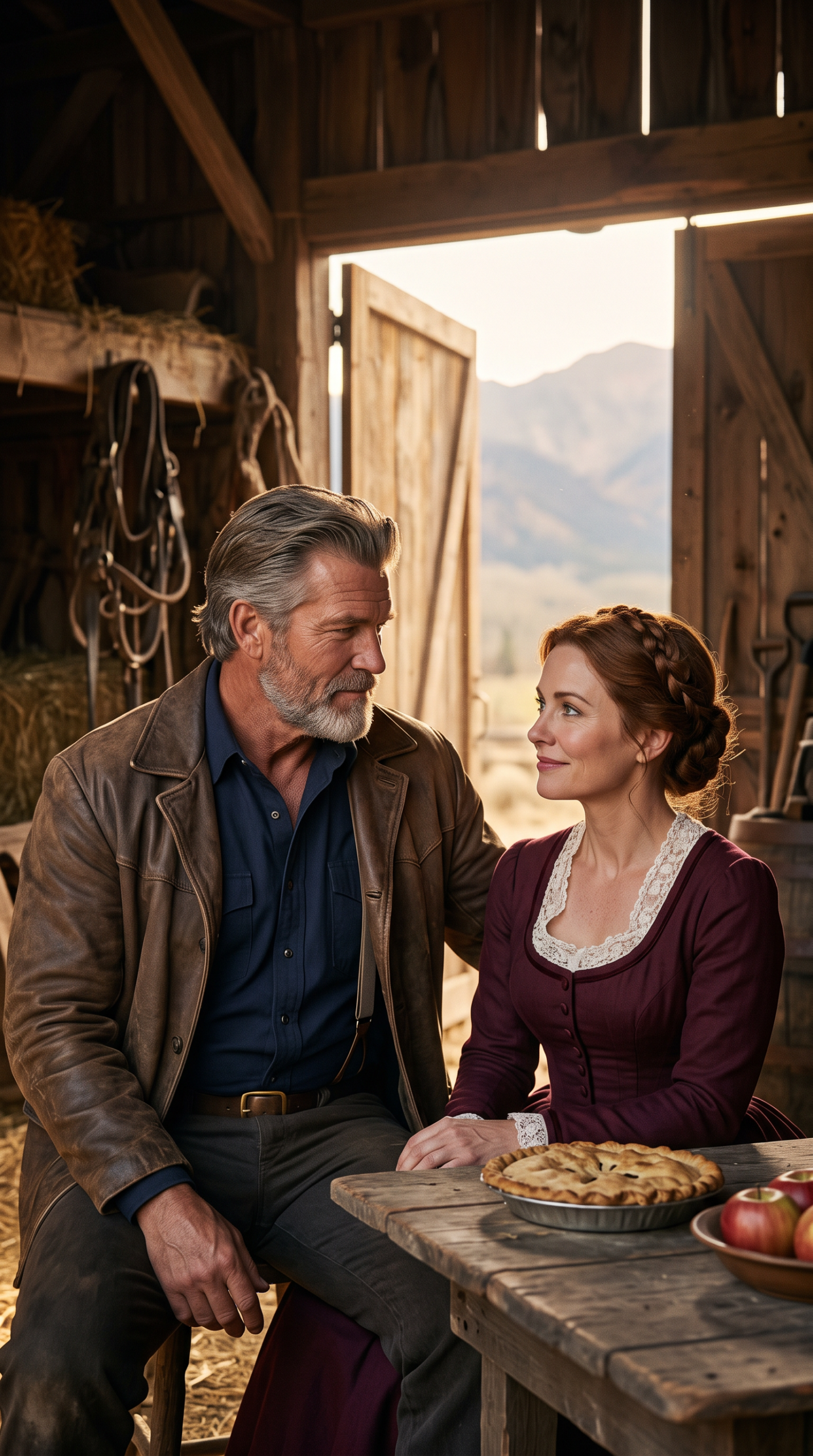
# WHY TWENTY YEARS, THOMAS?
### A Heartwarming Western Romance About Second Chances, Unexpected Love, and the Courage to Begin Again
**September 1883 — Willow Creek, Montana Territory**
## Chapter One: The Man Who Forgot How to Smile
In September 1883, the little farming community of Willow Creek was preparing for autumn.
The wheat fields had turned the color of old gold, the apple trees were heavy with fruit, and the mountains beyond the valley wore their first dusting of snow. Smoke curled from chimneys every morning, horses trotted along the dirt roads, and the church bell rang every Sunday at nine.
It was the sort of place where people knew when their neighbors bought a new horse, when a farmer’s roof needed repairing, and when someone had been seen entering the general store twice in one afternoon.
Secrets rarely survived long in Willow Creek.
But there was one thing nobody could quite understand.
Thomas Calloway, the most respected farmer in the valley, had spent three years living like a man whose life had already ended.
At fifty-five, Thomas was still an imposing figure. He stood six feet two inches tall, with broad shoulders, powerful hands, and a face weathered by years of working beneath the Montana sun. His dark hair had turned silver around the temples, and a neatly maintained grey beard framed his strong jaw.
His blue-grey eyes were steady, intelligent, and kind.
Once, those eyes had been full of laughter.
People remembered Thomas as a man who could make an entire room smile with a single sentence. He used to sing while repairing fences, whistle to his horses, and dance with his wife whenever the fiddle started playing at a barn gathering.
But that was before Eleanor.
Three years earlier, his beloved wife, Eleanor, had died after a long illness.
They had been married for twenty-seven years.
They had built their farmhouse together, planted the apple trees together, and raised a small herd of cattle together. They had endured harsh winters, failed crops, difficult harvests, and the ordinary struggles of married life.
They had never been wealthy, but they had been happy.
Eleanor had a habit of leaving little notes around the house.
Sometimes Thomas found them in his coat pocket.
Sometimes beneath his coffee cup.
Once, she had written on the flour tin:
*Thomas, if you eat the last biscuit without saving me one, you will be sleeping in the barn.*
He had laughed when he read it.
He still remembered that laugh.
When Eleanor became ill, Thomas did everything he could to save her. He sold two valuable horses to pay for medicine and traveled nearly forty miles to find a doctor who had been recommended by a rancher.
But illness did not care how much a husband loved his wife.
On a cold November morning in 1880, Eleanor closed her eyes while Thomas held her hand.
Her final words had been simple.
“Don’t let this house become lonely, my love.”
Thomas had kissed her forehead.
“I won’t,” he promised.
But after the funeral, he did exactly that.
He stopped visiting neighbors. He rarely attended church. He ate whatever was easiest to prepare and spent long evenings sitting beside the fireplace.
He continued working because the farm demanded it.
The cattle needed feeding. The horses needed tending. The fences needed repairing.
The land did not care that his heart was broken.
Every Sunday, Thomas visited Eleanor’s grave beneath the great oak east of the farmhouse. He brought fresh wildflowers and sat beside her until the afternoon light began to fade.
Some people called his behavior devotion.
Others called it stubbornness.
His closest friend, Samuel Carter, called it something else.
“You’re burying yourself beside her, Thomas.”
Thomas had not answered.
He simply looked toward the mountains.
And so the years passed.
Until a young woman began crossing the meadow with food in her hands.
Her name was Margaret Hale.
And she would eventually change everything.
## Chapter Two: The Girl Across the Meadow
Margaret Hale was twenty-five years old and lived with her widowed mother in a small white farmhouse across the meadow from Thomas’s property.
She had auburn hair that she usually arranged in a braided updo, bright green eyes, and a warm smile that made even the grumpiest shopkeeper soften.
She was not wealthy.
Her father had died when she was seventeen, leaving behind a modest farm, a few debts, and a responsibility Margaret had never expected to carry so young.
Since then, she had helped her mother keep the household running.
She planted vegetables, tended chickens, baked bread, mended clothes, and occasionally helped neighboring families when someone fell ill.
She had also learned to recognize loneliness.
Perhaps that was why she noticed Thomas.
At first, she only saw him from a distance.
He would walk across his fields before sunrise, feed his horses, and return to the farmhouse without speaking to anyone.
Sometimes she saw him sitting on the porch after sunset, staring at the empty chair beside him.
One afternoon, Margaret asked her mother about him.
“Why does Mr. Calloway never come to church anymore?”
Her mother, Ruth Hale, looked up from her sewing.
“His wife died. Some people need more time to recover from such a loss.”
“Three years is a long time to be alone.”
“Grief doesn’t follow a calendar, sweetheart.”
Margaret nodded.
She understood.
Her own father had been gone for eight years, and there were still mornings when she expected to hear his boots on the kitchen floor.
But Thomas’s loneliness seemed different.
It was as though he had stopped expecting happiness altogether.
A week later, Margaret baked an apple pie.
She made two.
One was for her mother.
The other was for Thomas.
She crossed the meadow just before noon and found him repairing a broken fence.
“Good morning, Mr. Calloway.”
Thomas looked up.
“Morning, Miss Hale.”
She held out the covered dish.
“My mother made too much pie.”
Thomas glanced at the dish, then at her.
“Your mother?”
Margaret smiled.
“Well, I helped.”
“Then I suppose I ought to thank both of you.”
“You can thank me by eating it while it’s warm.”
A faint smile appeared on his face.
“That’s a rather demanding gift.”
“Only because I don’t want you wasting it.”
He accepted the dish.
“Thank you, Margaret.”
She noticed that he had used her first name.
It was a small thing.
But she remembered it.
When Margaret returned home, her mother was waiting near the kitchen window.
“Did he like it?”
“He thanked me.”
“That isn’t quite what I asked.”
Margaret smiled.
“He looked pleased.”
Her mother returned to her sewing.
“Then perhaps you should bake another one next week.”
Margaret laughed.
And the following Tuesday, she did.
This time, she brought fresh bread.
The week after that, a small jar of blackberry preserves.
Then a basket of vegetables.
Thomas protested every time.
“You don’t need to keep feeding an old man, Margaret.”
“I know.”
“Then why do you keep doing it?”
“Because I don’t trust you to feed yourself properly.”
He chuckled.
“I managed for fifty-five years before you came along.”
“Judging by your kitchen, you managed rather badly.”
For the first time in a long while, Thomas laughed.
It was not a loud laugh.
It was not the carefree laughter people remembered from years earlier.
But it was real.
And Margaret carried the sound home with her.
## Chapter Three: Tuesday Mornings
The visits became a tradition.
Every Tuesday, Margaret crossed the meadow.
Sometimes she brought food.
Sometimes she brought nothing at all.
She would sit on the porch while Thomas drank coffee, and they would talk about the weather, the harvest, the cattle, and whatever news had traveled through Willow Creek.
Thomas discovered that Margaret had a remarkable memory for stories.
She remembered the names of every farmer’s children, the dates of the town’s summer festivals, and which family had recently welcomed a new baby.
Margaret discovered that Thomas knew more about the mountains than anyone she had ever met.
He could predict a storm by the shape of the clouds. He knew where the deer gathered during the first snowfall and which creek remained unfrozen longest in winter.
One afternoon, she asked him about the old mountains beyond his eastern pasture.
“Have you ever climbed to the top of that ridge?”
“More times than I can count.”
“What’s up there?”
“Mostly rocks.”
She frowned.
“That sounds disappointing.”
He smiled.
“There’s a view.”
“Then why didn’t you say so?”
“Because I wanted to see whether you were interested in rocks.”
She laughed.
Thomas looked at her for a moment.
It had been a long time since he had heard someone laugh so freely.
He found himself looking forward to Tuesdays.
He began preparing coffee before she arrived.
He repaired the porch chair that she preferred.
He even planted flowers beside the steps because Margaret once mentioned that the porch looked too lonely.
When Samuel Carter visited one afternoon, he noticed the changes immediately.
There were two coffee cups on the table.
A fresh apple pie sat beneath a cloth.
And a small vase of wildflowers stood near the window.
Samuel raised an eyebrow.
“Well, I’ll be.”
Thomas looked up from his newspaper.
“What?”
“Nothing.”
“Then stop looking at me like that.”
Samuel pulled out a chair.
“Who’s been visiting?”
Thomas folded the newspaper.
“Margaret Hale.”
“Every Tuesday?”
“Most Tuesdays.”
“And she brings you pie?”
“Sometimes.”
Samuel looked at the flowers.
“Does she bring those too?”
Thomas glanced toward the vase.
“She said the room needed something cheerful.”
Samuel smiled.
“Sounds like a sensible woman.”
Thomas said nothing.
His friend leaned back.
“How long has it been since you invited anyone into this house?”
Thomas’s expression changed.
“Samuel.”
“I’m only asking.”
“Then stop.”
Samuel studied him.
“You’re allowed to be happy again, you know.”
Thomas looked toward the window.
For a moment, he saw Eleanor standing there.
Her hair was pinned up, and she was holding a dish towel.
He remembered the way she used to smile when he returned from the fields.
Then the memory faded.
“Some things don’t happen twice,” he said quietly.
Samuel’s voice softened.
“Maybe not in the same way.”
Thomas returned to his newspaper.
But his eyes did not move across the page.
## Chapter Four: The Feeling Margaret Could Not Confess
Margaret had never planned to fall in love with Thomas Calloway.
At first, she simply felt sorry for him.
Then she enjoyed his company.
Then she began looking forward to Tuesdays.
And eventually, she realized that the man she had been visiting had become the man she thought about every morning.
She noticed the small things.
The way he always walked on the outside of the path when they crossed the meadow.
The way he waited until she had reached her gate before returning to his work.
The way he remembered how she liked her coffee.
The way his voice softened whenever he spoke about Eleanor.
That last part troubled her most.
Margaret did not want to replace Eleanor.
She did not want to erase the woman who had shared nearly three decades with him.
She only wanted to know whether Thomas might one day look at her and see something more than a kind neighbor.
But she was afraid.
She was twenty-five.
He was fifty-five.
The difference was impossible to ignore.
Some men in Willow Creek had already made remarks about her visits.
One afternoon, while Margaret was buying flour at the general store, a woman named Mrs. Pritchard approached her.
“You’re becoming quite familiar with Mr. Calloway, aren’t you?”
Margaret looked up.
“We’re neighbors.”
“Of course.”
Mrs. Pritchard smiled in a way that did not reach her eyes.
“Though I imagine you could find younger company.”
Margaret placed the flour on the counter.
“Perhaps I could.”
“Then why don’t you?”
Margaret met her gaze.
“Because I enjoy Mr. Calloway’s company.”
Mrs. Pritchard lowered her voice.
“People are beginning to talk.”
“People always talk.”
“He’s old enough to be your father.”
Margaret felt her cheeks warm.
“He is not my father.”
Mrs. Pritchard’s smile disappeared.
Margaret picked up her flour and walked out.
But the words followed her all the way home.
That evening, Ruth noticed her daughter’s silence.
“What happened?”
“Nothing.”
“Margaret.”
She sighed.
“People are talking about Thomas.”
Her mother put down her knitting.
“What are they saying?”
“That I’m wasting my time. That I should find someone younger.”
Ruth was quiet for a moment.
Then she asked the question Margaret had been avoiding.
“Do you love him?”
Margaret looked down.
Her silence answered.
Ruth walked over and gently took her daughter’s hands.
“Then you must be very careful.”
Margaret looked up.
“Because of his age?”
“Because he has suffered a great loss. You cannot ask someone to love you simply because you love him.”
“I know.”
“And you must never make yourself responsible for healing him.”
Margaret’s eyes filled.
“I don’t want to heal him, Mama. I only want him to know he doesn’t have to spend the rest of his life alone.”
Ruth embraced her.
“Then let him decide what he wants. And whatever happens, remember that your life matters too.”
Margaret nodded.
But that night, she lay awake thinking about Thomas.
She wondered whether he would ever see her as a woman.
Or whether she would always be the girl who brought him supper.
## Chapter Five: The Man Who Still Spoke to His Past
Thomas had his own reasons for keeping his distance.
He was not blind to Margaret’s kindness.
He noticed the way she looked at him sometimes when she thought he was not paying attention.
He noticed how she smiled when he opened the door.
And he noticed that he had begun shaving more carefully on Tuesday mornings.
That frightened him.
He had loved Eleanor with everything he had.
He had promised her that she would always be his wife, even after death.
For a long time, he believed that loving anyone else would mean breaking that promise.
He knew it was not logical.
But grief rarely listened to reason.
One evening, Thomas visited Eleanor’s grave.
The great oak stood at the edge of the eastern pasture. Its branches stretched over the small stone marker, and the grass around it had grown thick from the summer rains.
He knelt and placed fresh flowers beside the grave.
“Margaret came today,” he said.
The wind moved through the leaves.
“She brought apple pie. Said I was getting too thin.”
He smiled faintly.
“She has a way of telling a man what to do.”
He remained silent for a while.
Then he looked at the stone.
“I think she makes me happy, Eleanor.”
The words felt strange.
Almost forbidden.
He rubbed his hands together.
“I don’t know what to do with that.”
The wind grew stronger.
Thomas lowered his head.
“I haven’t forgotten you.”
He said it as though someone had accused him of doing so.
“I never could.”
He stayed beside the grave until the sky darkened.
On his way home, he passed the porch where Margaret usually sat.
Her chair was empty.
He imagined her laughing there.
And for the first time, he wondered whether the loneliness he had carried for three years had become a habit rather than a necessity.
The thought frightened him.
But it also gave him hope.
## Chapter Six: The Young Men Who Came Calling
As autumn approached, Margaret received several marriage offers.
The first came from a young farmer named Daniel Reeves.
Daniel was twenty-eight, handsome, financially comfortable, and known throughout Willow Creek as a hardworking man.
He had been courting Margaret for several months before she began visiting Thomas regularly.
One Sunday after church, Daniel approached her beside the steps.
“Margaret, could I speak with you?”
“Of course.”
He took a breath.
“I’ve been thinking about our future.”
Margaret’s expression softened.
“Daniel…”
“Let me finish.”
He smiled nervously.
“I own a good piece of land south of town. My house is small, but there’s room to build another bedroom. I thought perhaps we could marry before Christmas.”
Margaret stared at him.
She liked Daniel.
He was kind and respectful.
But she did not love him.
“That’s very generous,” she said.
“Then you’ll consider it?”
She looked down.
“I’m sorry.”
His smile faded.
“Is there someone else?”
Margaret did not answer.
Daniel followed her gaze across the churchyard.
Thomas stood near the hitching posts, speaking with Samuel Carter.
Understanding slowly crossed Daniel’s face.
“Is it him?”
Margaret swallowed.
“Daniel, I don’t want to hurt you.”
“You’re in love with Thomas Calloway?”
She looked at him.
“Yes.”
Daniel shook his head.
“Margaret, he’s thirty years older than you.”
“I know.”
“He’s already lived a whole life.”
“That doesn’t mean his life is finished.”
Daniel’s face tightened.
“Do you truly believe he’ll marry you?”
Margaret could not answer.
Daniel looked away.
“I hope you know what you’re doing.”
Then he walked toward his horse.
Margaret watched him leave.
She felt guilty.
But she did not regret telling the truth.
A second offer came from a schoolteacher who had recently moved to town.
A third came from a prosperous rancher’s son.
Margaret declined them all.
Each refusal made the rumors worse.
Some people called her foolish.
Others said Thomas must have encouraged her.
But Thomas had never made a promise.
And that was what hurt most.
He was kind to her.
He was grateful for her visits.
He laughed with her.
Yet whenever their conversations approached anything personal, he retreated behind a wall of politeness.
Margaret began to wonder whether she had mistaken friendship for something deeper.
Then came the Tuesday morning that changed everything.
## Chapter Seven: The Apple Pie and the Impossible Question
The morning was unusually beautiful.
Golden sunlight spilled across the meadow, and a light breeze carried the smell of fallen leaves.
Margaret had been awake since dawn.
She had baked Thomas’s favorite apple pie, using the recipe Eleanor had once given her.
She had considered making something else.
But Thomas always smiled when he smelled apples and cinnamon.
She placed the pie inside a covered dish, wrapped a cloth around it, and crossed the meadow.
Thomas was repairing the porch railing when she arrived.
“Morning, Margaret.”
“Good morning.”
He looked at the dish.
“What have you brought this time?”
“Something to keep you from starving.”
She uncovered the pie.
Thomas’s face brightened.
“Apple?”
“You remembered?”
He chuckled.
“Hard to forget my favorite.”
Margaret smiled.
“Of course I remembered.”
Thomas set down his hammer.
“You’re becoming rather dangerous, you know.”
She raised an eyebrow.
“How so?”
“A man gets accustomed to these things. Before long, he’ll expect a pie every Tuesday.”
“Then I suppose I’ll have to disappoint you occasionally.”
“I’d hate to see that happen.”
They laughed.
Thomas carried the pie inside and placed it on the kitchen table.
Margaret followed.
The kitchen was warm and tidy. A small fire burned in the stove, and sunlight fell across the wooden floor.
Thomas poured coffee.
“Sit down. You’ve earned a cup.”
Margaret accepted.
For a while, they spoke about the harvest.
Thomas complained that one of his horses had become stubborn.
Margaret told him that her mother was preparing for the church’s autumn supper.
Then Thomas looked at her with a tenderness she had not seen in a long time.
“I don’t know why a pretty young woman keeps bothering with an old fellow like me.”
Margaret smiled.
“Because without me, you’d survive on burnt potatoes and coffee.”
Thomas laughed.
Then, looking at her with unexpected affection, he said:
“If I were twenty years younger, Margaret, I’d marry you.”
He expected her to laugh.
He expected her to tease him.
Perhaps he expected her to tell him that fifty-five was not so old.
But Margaret did not laugh.
She slowly placed her cup on the table.
“Why twenty years?”
Thomas blinked.
“What?”
“Why would you need to be twenty years younger to marry me?”
His smile faded.
“Margaret, I was only joking.”
“I know.”
“Then what’s troubling you?”
She met his eyes.
“What if I don’t want you twenty years younger?”
Thomas stared at her.
“What if I want exactly the man standing before me?”
Silence filled the kitchen.
Thomas looked at her as though she had spoken in a language he did not understand.
“Margaret, I’m fifty-five.”
“And I’m twenty-five. Neither of us has forgotten how to count.”
“People would talk.”
“They already do.”
He looked away.
“And Eleanor?”
Margaret’s expression softened.
“I would never ask you to stop loving her, Thomas. I only wonder whether your heart might have room for someone else.”
His hands tightened around the edge of the table.
“You deserve someone young. Someone who can give you everything.”
“I’ve had young men ask for my hand.”
Thomas stared at her.
“And?”
“I refused them.”
“Why?”
Tears gathered in Margaret’s eyes.
“Because none of them were you.”
Thomas stood motionless.
For a moment, only the September wind moved through the open window.
Then Margaret stepped closer and reached for his trembling hand.
“I’ve spent three years waiting for you to see me as more than the girl bringing supper.”
Thomas opened his mouth, but no words came.
“You said you’d marry me if you were twenty years younger,” she whispered. “But Thomas… what if I’ve been waiting three years for you to realize you don’t have to be?”
Thomas stared at her.
His eyes were suddenly shining.
“Margaret…”
She gave his hand a gentle squeeze.
“I don’t expect you to answer me today. I only couldn’t keep pretending anymore.”
She stepped back.
“I should go.”
But Thomas caught her hand.
“Please.”
She stopped.
He looked down at their joined hands.
“I need a moment.”
Margaret nodded.
And for the first time in three years, Thomas Calloway was afraid of losing something that had not yet become his.
## Chapter Eight: What He Had Kept in His Pocket
Thomas released her hand slowly.
He walked toward the small cabinet beside the fireplace.
Margaret watched him.
He opened the drawer, moved aside a bundle of old letters, and took out a small wooden box.
It was dark with age.
Its brass hinges had begun to tarnish.
Thomas held it for a long moment before returning to the table.
“I was going to wait,” he said.
Margaret’s heart began to beat faster.
“Wait for what?”
“For a day when I knew what I was doing.”
He sat down.
“I’ve been carrying this around for months.”
He opened the box.
Inside lay a delicate gold ring.
It was not enormous or extravagant. It was a simple band with a small oval sapphire set in the center.
Margaret stared at it.
Thomas lifted the ring carefully.
“Eleanor’s mother gave her this ring when she was seventeen.”
Margaret looked up.
“Your wife’s ring?”
Thomas nodded.
“Eleanor wore it on a ribbon around her neck when we were first married. She told me she wanted it to stay in the family.”
He turned the ring between his fingers.
“When she became ill, she asked me to keep it safe.”
His voice faltered.
“She said that one day, if I ever found a reason to love again, I should give it to someone who understood that a heart can remember the past without being trapped inside it.”
Margaret’s eyes filled.
“She said that?”
“Those were her words.”
Thomas swallowed.
“I didn’t know whether I would ever meet such a person.”
He looked at Margaret.
“Then you started bringing me food.”
A tear slipped down her cheek.
Thomas continued.
“At first, I thought you were simply being kind. Then I began waiting for Tuesdays. I would hear your footsteps before you reached the porch.”
He smiled faintly.
“I started making coffee before you arrived. I repaired that chair because I noticed you liked sitting in it. I planted flowers because you said the porch looked lonely.”
Margaret covered her mouth.
“I thought you didn’t notice.”
“I noticed everything.”
Thomas lowered his eyes.
“And that frightened me.”
“Why?”
“Because I was afraid that if I let myself care for you, I would be betraying Eleanor.”
Margaret gently shook her head.
“Thomas, loving someone new doesn’t mean the old love disappears.”
He looked at her.
“I know that now.”
He placed the ring in his palm.
“But I need to tell you something before I ask you to consider anything.”
Margaret nodded.
“I’ve been a husband for twenty-seven years. I know what it means to make a promise. I also know that I am thirty years older than you. There may be difficult days ahead. I may become ill before you do. I may not have as many years to give you as a younger man.”
Margaret took his hand.
“I cannot promise you a lifetime without difficulties.”
“Nor can I.”
“I cannot promise that people will always be kind.”
“I don’t need them to be.”
“And I cannot promise that I will never remember Eleanor.”
Margaret’s voice was gentle.
“I would be worried if you did.”
Thomas stared at her.
She smiled through her tears.
“I don’t want to marry a man who has forgotten the woman he loved. I want to marry the man who learned how to love again.”
For a long moment, Thomas could not speak.
Then he stood.
He reached for Margaret’s hand.
“Then perhaps I ought to ask you properly.”
He took a breath.
“Margaret Hale, I am fifty-five years old. I have silver in my hair, a stubborn horse, an old farmhouse, and more memories than I know what to do with.”
She laughed through her tears.
Thomas smiled.
“I cannot give you the beginning of my life. But if you’ll have me, I would like to give you whatever remains of it.”
He lowered himself onto one knee.
“Will you marry me?”
Margaret’s hands flew to her mouth.
For a moment, she could not move.
Then she nodded.
“Yes.”
Thomas looked up.
“Yes?”
She laughed.
“Yes, Thomas! A thousand times yes!”
He slipped the sapphire ring onto her finger.
It fit perfectly.
Margaret looked down at it.
Then she looked at him.
And Thomas Calloway, who had not cried since Eleanor’s funeral, felt tears run down his weathered cheeks.
Margaret knelt beside him and wrapped her arms around his shoulders.
He held her tightly.
For the first time in three years, the farmhouse no longer felt empty.
## Chapter Nine: The News Travels Across Willow Creek
The engagement lasted less than an hour before someone discovered it.
Margaret had barely returned home when her mother noticed the ring.
Ruth was standing at the kitchen counter, preparing supper.
She looked up.
Then she looked at her daughter’s hand.
The spoon slipped from her fingers.
“Margaret?”
Margaret smiled.
“Yes, Mama.”
Ruth approached slowly.
“Is that…”
“Thomas asked me to marry him.”
Ruth stared at her.
Then she pulled her daughter into an embrace.
“Oh, sweetheart.”
Margaret began crying.
Ruth held her tightly.
“Are you certain?”
“More certain than I’ve ever been.”
Ruth pulled back and looked into her daughter’s eyes.
“And he understands what this means?”
“He does.”
“And you understand what it means?”
Margaret nodded.
“I know.”
Ruth looked at the sapphire ring.
“Then I believe your father would have liked him.”
Margaret smiled.
“Do you think so?”
“I think your father would have asked him a hundred questions before allowing him to sit at our table.”
They both laughed.
That evening, Ruth sent a message to Samuel Carter.
By breakfast the next morning, half the town knew.
By noon, the other half had heard.
And by three o’clock, Mrs. Pritchard had already visited the general store twice to discuss it.
Some people were happy.
Others were confused.
A few were openly disapproving.
At the general store, Daniel Reeves heard the news from a ranch hand.
“Thomas Calloway is marrying Margaret Hale?”
“That’s what I heard.”
Daniel shook his head.
“Well, I’ll be.”
The ranch hand grinned.
“Looks like the old fellow finally found himself a reason to smile.”
Daniel said nothing.
He remembered Margaret’s honesty and the way she had looked across the churchyard.
He had not understood it then.
Perhaps he understood now.
Meanwhile, Samuel Carter arrived at Thomas’s farmhouse with a bottle of whiskey.
He found Thomas standing on the porch.
“Well?”
Thomas looked at him.
“Well, what?”
Samuel grinned.
“Are you going to make me ask?”
Thomas held up his left hand.
Samuel stared at the ringless finger.
Then he looked at Thomas.
“You actually did it.”
Thomas smiled.
“I did.”
Samuel slapped him on the shoulder.
“About time.”
Thomas laughed.
Samuel’s expression softened.
“Are you happy?”
Thomas looked toward the meadow.
Margaret was standing near her gate, speaking with her mother.
“Yes,” he said quietly. “I believe I am.”
Samuel followed his gaze.
“Then don’t let anyone talk you out of it.”
“I don’t intend to.”
## Chapter Ten: The Town’s Judgment
The first public challenge came on Sunday.
Thomas and Margaret arrived at church together.
Margaret wore a burgundy dress with a white lace collar, and the sapphire ring shone on her finger.
Thomas wore his best navy coat, a clean white shirt, and the brass buckle Eleanor had once given him.
They walked side by side.
People turned.
Whispers followed them through the churchyard.
Margaret heard them.
Thomas heard them too.
But neither slowed down.
After the service, Reverend William Harris approached them.
He was a kind man in his early sixties, with silver hair, round spectacles, and a gentle manner.
“Thomas. Margaret.”
“Good morning, Reverend,” Thomas replied.
The minister smiled.
“I heard some wonderful news.”
Margaret blushed.
Thomas nodded.
“We’re engaged.”
“Then congratulations to you both.”
The Reverend shook Thomas’s hand, then Margaret’s.
“May I say something?”
“Of course,” Thomas answered.
The minister looked at them both.
“Marriage is not a promise that life will always be easy. It is a promise that two people will face it together. The number of years between you matters less than the honesty with which you enter them.”
Margaret smiled.
“Thank you, Reverend.”
But not everyone shared his kindness.
Mrs. Pritchard approached with two other women.
“Margaret, dear,” she said sweetly. “May we congratulate you?”
Margaret nodded.
“Thank you.”
Mrs. Pritchard looked at Thomas.
“Though I must say, this is rather unexpected.”
Thomas’s expression remained calm.
“Life has a habit of surprising people.”
One of the women glanced at Margaret’s ring.
“Are you certain you have considered the future?”
Margaret answered before Thomas could.
“I have.”
“And you understand that Mr. Calloway is considerably older?”
Margaret smiled.
“Yes.”
“Thirty years.”
“That’s correct.”
Mrs. Pritchard tilted her head.
“Well, I suppose love makes people forget practical matters.”
Thomas stepped forward.
“Margaret has not forgotten anything.”
The women looked at him.
He continued.
“She knows my age. She knows I was married before. She knows that I will always remember Eleanor. And she knows that I cannot promise her a perfect life.”
His voice remained quiet, but his words carried.
“What she has chosen is a man who respects her, values her, and intends to spend every remaining year treating her as the greatest gift he has ever received.”
Margaret looked at him.
Thomas offered his arm.
“Shall we go?”
She took it.
And they walked away.
Behind them, Mrs. Pritchard had nothing to say.
## Chapter Eleven: Eleanor’s Letter
A week after the engagement, Thomas began preparing the farmhouse for Margaret.
He repaired the upstairs bedroom, replaced the loose window latch, and built a new shelf in the kitchen.
Margaret insisted she did not need anything special.
Thomas insisted that she deserved a home that welcomed her.
One afternoon, while moving an old trunk from the bedroom, he discovered a small envelope tucked beneath a folded blanket.
His name was written across it in Eleanor’s handwriting.
He sat on the edge of the bed.
The envelope was yellowed with age.
He opened it carefully.
Inside was a letter.
*My dearest Thomas,*
*If you are reading this, then I am no longer beside you.*
*I know you. I know you will tell yourself that you must be strong, that you must keep working, and that the world has no place for a man who misses his wife.*
*But I want you to remember something.*
*You were not born only to be my husband. You were a man before you met me, and you will remain a man after I am gone.*
*I hope you will laugh again.*
*I hope you will sit on the porch with someone who enjoys your stories.*
*I hope you will have coffee with someone who knows how you take it.*
*And if you ever meet a woman who makes your heart feel warm again, do not turn away simply because you are afraid.*
*I will always be part of your life, Thomas. But I do not want to become the reason you refuse to live it.*
*Love does not become smaller when it is shared.*
*It grows.*
*Your Eleanor.*
Thomas read the letter twice.
Then a third time.
His eyes filled.
For three years, he had carried the belief that moving forward meant leaving Eleanor behind.
But she had understood him better than he understood himself.
He folded the letter and held it against his chest.
That evening, Margaret arrived with a basket of fresh bread.
She found Thomas sitting beside the fireplace.
“Are you all right?”
He looked up.
“Come here.”
She sat beside him.
Thomas handed her the letter.
Margaret read it slowly.
By the end, tears were running down her cheeks.
“She loved you very much.”
Thomas nodded.
“More than I deserved.”
Margaret looked at him.
“Don’t say that.”
He smiled faintly.
“She knew me.”
“She knew the man you were. And I am beginning to know the man you are.”
Thomas took her hand.
“I wish she could have met you.”
Margaret squeezed his fingers.
“Perhaps she already knows.”
Thomas looked toward the window.
For the first time, remembering Eleanor did not feel like stepping backward.
It felt like carrying something precious forward.
## Chapter Twelve: A Wedding Beneath the Autumn Sky
They decided to marry in October.
Margaret wanted a small wedding at the church.
Thomas agreed.
He did not want a grand celebration. He wanted something meaningful, surrounded by people who genuinely cared about them.
Ruth prepared Margaret’s dress.
It was a beautiful ivory gown with delicate lace around the neckline and cuffs.
Margaret wore her auburn hair in an elegant braided updo, with a small arrangement of white flowers tucked into it.
Thomas wore a dark navy suit, a crisp white shirt, and the brass belt buckle he had worn on the day he married Eleanor.
He considered changing it.
Then he remembered Eleanor’s letter.
He decided to keep it.
Samuel Carter stood beside him as his best man.
When the church bell rang, Thomas stood at the altar.
He looked older than he had on the day he became engaged.
Not because his hair had changed.
Because he understood how much the moment meant.
Then the doors opened.
Margaret appeared beside her mother.
Thomas forgot to breathe.
She walked slowly down the aisle.
Her eyes found his.
And she smiled.
A smile so warm that Thomas felt the last of his fear begin to disappear.
Reverend Harris began the ceremony.
“Dearly beloved, we are gathered here today…”
Thomas barely heard the first few words.
He was watching Margaret.
When the minister asked whether he would take her as his wife, Thomas answered without hesitation.
“I will.”
When Margaret was asked the same question, her voice trembled.
“I will.”
They exchanged rings.
Thomas’s was a simple gold band.
Margaret wore the sapphire Eleanor had once treasured.
The Reverend smiled.
“By the authority given to me, I now pronounce you husband and wife.”
Thomas turned toward Margaret.
He gently lifted her hand and kissed the sapphire ring.
Then he kissed her forehead.
The congregation applauded.
Samuel wiped his eyes and pretended he had dust in them.
Ruth cried openly.
And outside, beneath the autumn sky, the people of Willow Creek gathered to celebrate.
Even Daniel Reeves came.
He shook Thomas’s hand.
“Congratulations.”
Thomas smiled.
“Thank you.”
Daniel turned to Margaret.
“I hope you find every happiness.”
Margaret smiled warmly.
“Thank you, Daniel.”
For a moment, Daniel looked at the two of them.
Then he nodded and walked away.
There was no bitterness left in him.
The wedding supper was held in the church hall.
There was roasted chicken, potatoes, fresh bread, apple pie, and more coffee than anyone could drink.
Samuel gave a speech.
He talked about Thomas’s stubbornness, his terrible singing, and the time he had accidentally driven a wagon into the creek.
Everyone laughed.
Then Samuel raised his glass.
“To Thomas and Margaret. May they have enough patience to tolerate one another, enough laughter to fill their home, and enough love to make every difficult day worth facing.”
The room erupted in applause.
Thomas looked at Margaret.
She leaned closer.
“Do you regret it?”
He frowned.
“Regret what?”
“Marrying a man thirty years older.”
Thomas smiled.
“Ask me again when I’m ninety.”
Margaret laughed.
And he kissed her cheek.
## Chapter Thirteen: The First Night in Their New Life
That evening, after the guests had gone home, Thomas and Margaret returned to the farmhouse.
The house was quiet.
The fireplace was still burning.
A small vase of flowers stood on the kitchen table.
Thomas removed his coat and hung it beside the door.
Margaret looked around.
“Everything feels different.”
Thomas smiled.
“Does it?”
“Yes.”
She touched the back of the chair.
“I used to sit here as a guest.”
“And now?”
She turned toward him.
“Now I live here.”
Thomas took her hand.
“That’s right.”
He led her into the bedroom.
The room had been prepared with fresh sheets, white pillows, and a small bouquet of flowers beside the window.
Margaret smiled.
“You did all this?”
“Samuel helped.”
“Samuel?”
“He was responsible for the flowers.”
She laughed.
“That explains why they look as though someone threatened him into arranging them.”
Thomas chuckled.
Then he became serious.
“Margaret?”
“Yes?”
“I want you to know something.”
She looked at him.
“This house has many memories. Some will be happy, and some may be difficult. I don’t want you to feel as though you’re living in someone else’s shadow.”
Margaret stepped closer.
“I’m not.”
“I want us to make new memories.”
“We will.”
“And if you ever feel uncomfortable, you must tell me.”
She gently touched his cheek.
“I married you because I love the man standing before me. Not because I expect him to become someone else.”
Thomas closed his eyes briefly.
Then he kissed her.
It was a gentle kiss, filled with tenderness and the promise of a life neither had expected.
Outside, the wind moved through the apple trees.
Inside, the farmhouse was no longer a place where one man waited for the past.
It had become a home for two people.
## Chapter Fourteen: Learning to Be Husband and Wife
Marriage did not make every day perfect.
Thomas and Margaret discovered that love was not simply a collection of beautiful moments.
It was also a collection of ordinary ones.
There were mornings when Thomas woke before sunrise and accidentally made coffee for two before remembering that Margaret was still asleep.
There were afternoons when Margaret became frustrated because Thomas insisted on doing heavy work without asking for help.
There were evenings when Thomas became quiet after seeing something that reminded him of Eleanor.
At first, Margaret worried that she had done something wrong.
One night, she found him sitting on the porch.
“Are you coming inside?”
“In a minute.”
She sat beside him.
“What’s troubling you?”
Thomas looked toward the eastern pasture.
“Today is the anniversary of the day Eleanor became ill.”
Margaret nodded.
“I understand.”
“I thought I was ready for it. But the memories came back.”
She took his hand.
“You don’t have to hide them from me.”
Thomas looked at her.
“I don’t want you to think I’m comparing you.”
“I’m not afraid of being compared to Eleanor.”
“Why not?”
“Because I cannot be Eleanor. And I don’t want to be.”
Thomas studied her.
Margaret continued.
“She was your wife. She gave you twenty-seven years of love. I respect that. But I’m your wife now, Thomas. I want to give you something of my own.”
He pulled her close.
“You already have.”
She rested her head against his shoulder.
For a while, they sat together beneath the stars.
Then Thomas whispered:
“Thank you for not asking me to forget.”
Margaret smiled.
“Thank you for letting me stay.”
The next morning, Thomas made breakfast.
He burned the toast.
Margaret laughed so hard she nearly dropped her cup.
“You’re hopeless.”
“I was doing perfectly well before you arrived.”
“Clearly.”
He put another piece of bread into the pan.
“Perhaps you should take over.”
She kissed his cheek.
“Perhaps I should.”
And the farmhouse filled with laughter.
## Chapter Fifteen: The First Winter
Winter arrived early that year.
Snow covered the fields, the fence posts, and the roof of the farmhouse.
The road to Willow Creek became difficult to travel, and the neighbors began relying on one another for supplies.
Thomas and Margaret prepared for the cold together.
They stacked firewood, stored vegetables, and checked the barn.
Margaret learned how to feed the horses.
Thomas learned that she was surprisingly stubborn when it came to chopping wood.
“You’ll hurt your back,” he told her.
“I’m perfectly capable.”
“I never said you weren’t.”
“Then stop telling me to sit down.”
Thomas raised his hands.
“All right. I surrender.”
She smiled triumphantly.
But the winter tested them.
In January, Thomas caught a severe chest cold.
At first, he insisted it was nothing.
He continued working until Margaret found him leaning against the barn wall, pale and struggling to breathe.
“Thomas!”
He straightened.
“I’m fine.”
“You’re not.”
“Just need a moment.”
She rushed to him.
His knees weakened.
Margaret caught his arm and helped him inside.
For three days, he remained in bed.
Margaret sent for the doctor and stayed beside him.
She changed the cool cloth on his forehead, prepared broth, and made sure he drank water.
Thomas hated being unable to work.
He hated needing help.
Most of all, he hated seeing fear in Margaret’s eyes.
On the second night, he woke to find her sitting beside the bed.
“Margaret?”
She looked up immediately.
“You’re awake.”
“How long have you been sitting there?”
“Not long.”
He glanced at the clock.
It was nearly two in the morning.
“Go to bed.”
“I’m comfortable.”
“You’re exhausted.”
She smiled weakly.
“So are you.”
Thomas reached for her hand.
“I’m sorry.”
“For what?”
“For frightening you.”
Her eyes filled.
“Don’t apologize for being ill.”
He looked at her.
“I promised you a lifetime.”
“And I promised to be your wife. That means I stay when you’re sick.”
Thomas closed his eyes.
“I don’t want to leave you.”
Margaret leaned forward and kissed his forehead.
“Then stop arguing with the doctor and get better.”
He laughed weakly.
“You’re becoming rather bossy.”
“Someone has to keep you alive.”
The doctor returned the following morning.
He was pleased to find Thomas’s fever had begun to break.
Within a week, Thomas was sitting beside the fireplace.
Within two weeks, he was walking around the house.
Margaret continued to watch him carefully.
One morning, he found a plate of toast and eggs waiting on the table.
Beside it was a handwritten note.
*Eat properly, Mr. Calloway. Your wife insists.*
Thomas laughed.
Then he placed the note inside the wooden box where he kept Eleanor’s letter.
Not because the two women were the same.
But because both had taught him something about love.
## Chapter Sixteen: The Secret Margaret Had Been Keeping
By spring, the snow had melted.
The fields were green again, and the first flowers appeared beside the farmhouse.
Thomas had recovered fully.
He spent more time outdoors, though Margaret insisted he rest whenever his cough returned.
One afternoon, Margaret became unusually quiet.
Thomas noticed immediately.
“Something wrong?”
She shook her head.
“Not exactly.”
“Then what is it?”
She looked down at her hands.
“I have something to tell you.”
Thomas put down the newspaper.
“All right.”
Margaret took a breath.
“I went to see the doctor in town last week.”
Thomas sat forward.
“Are you ill?”
“No.”
“Then why did you go?”
She looked up.
A nervous smile appeared.
“Because I wanted to know whether I was right.”
Thomas stared at her.
“Right about what?”
Margaret took his hand.
“Thomas, we’re going to have a baby.”
For several seconds, he did not move.
He looked at her.
Then at her stomach.
Then back at her.
“A baby?”
Margaret nodded.
He stood so quickly that his chair scraped against the floor.
“Are you certain?”
“The doctor is certain.”
Thomas covered his mouth.
His eyes filled.
“Margaret…”
She laughed nervously.
“I know it’s a surprise.”
He knelt in front of her and gently placed his hand over hers.
“Are you happy?”
She nodded.
“Very.”
He lowered his forehead against her hands.
For a long moment, he could not speak.
Then he whispered:
“I thought my family was finished.”
Margaret stroked his grey hair.
“Not anymore.”
Thomas looked up.
“You’re giving me another chance.”
“No,” she said softly. “We’re giving each other one.”
He kissed her hands.
Then he stood and wrapped his arms around her.
That evening, Thomas rode into town to tell Samuel.
He found his friend repairing a wagon wheel.
“Samuel!”
Samuel looked up.
“What happened? You look like you’ve seen a ghost.”
Thomas grinned.
“I’m going to be a father again.”
Samuel dropped the wrench.
“You’re what?”
Margaret’s expecting a child.”
Samuel stared at him.
Then he burst into laughter.
“Well, I’ll be damned!”
Thomas laughed too.
Samuel slapped his shoulder.
“Thomas Calloway, you old rascal. I thought you were finished surprising me.”
Thomas smiled.
“Apparently not.”
Samuel shook his head.
“How does Margaret feel?”
“Wonderful.”
“And you?”
Thomas looked toward the mountains.
“Like the luckiest man in Montana.”
## Chapter Seventeen: A Daughter Beneath the Willow Tree
Their daughter was born in December.
The night was cold, and snow fell steadily outside the farmhouse.
Thomas paced the kitchen while Ruth helped Margaret in the bedroom.
He had faced storms, stampeding cattle, broken bones, and years of hardship.
But nothing had ever frightened him like waiting outside that bedroom door.
Samuel arrived shortly before midnight.
He found Thomas walking back and forth.
“Sit down.”
“I can’t.”
“Then stop wearing a path into the floor.”
Thomas glared at him.
Samuel smiled.
“How is she?”
“Ruth says she’s doing well.”
“Then breathe.”
Thomas stopped.
From inside the bedroom came Margaret’s voice.
Then Ruth’s.
Then a sound that made Thomas freeze.
A baby’s cry.
He turned toward the door.
Ruth opened it a moment later.
Her eyes were shining.
“Thomas.”
He stepped forward.
“Is Margaret all right?”
“She’s tired, but she’s well.”
“And the baby?”
Ruth smiled.
“You have a daughter.”
Thomas covered his face.
For a moment, he was unable to speak.
Then he entered the room.
Margaret lay against the pillows, exhausted but smiling.
A tiny baby rested in her arms.
Thomas approached slowly.
“Hello,” he whispered.
Margaret smiled.
“Would you like to meet her?”
He sat beside the bed.
The baby had a small nose, soft auburn hair, and a tiny hand curled against her cheek.
Thomas looked at his wife.
“She’s beautiful.”
Margaret laughed softly.
“She looks like you.”
Thomas raised an eyebrow.
“That would be unfortunate.”
Margaret laughed harder.
He gently touched the baby’s hand.
Her tiny fingers closed around his.
Thomas’s eyes filled.
“What shall we name her?”
Margaret looked at him.
“I was thinking Eleanor.”
Thomas lowered his head.
“Are you certain?”
“Yes. I want her to carry the name of the woman who helped make you the man I love.”
Thomas kissed Margaret’s forehead.
“Eleanor.”
He looked down at his daughter.
“Welcome home, little one.”
Outside, the snow continued to fall.
Inside, the farmhouse was filled with a new kind of happiness.
## Chapter Eighteen: The Promise Beneath the Great Oak
Spring returned to Willow Creek.
The Calloway farmhouse became a place of constant activity.
There were baby blankets drying near the stove, toys beside the fireplace, and little clothes hanging in the sunlight.
Thomas discovered that caring for an infant required more patience than managing a hundred cattle.
He could repair a wagon, build a barn, and calm a frightened horse.
But a crying baby defeated him completely.
“Margaret!”
His wife appeared from the kitchen.
“What is it?”
“She’s crying.”
“Then pick her up.”
“I have.”
“Have you checked her blanket?”
“Yes.”
“Her bottle?”
“Yes.”
Margaret smiled.
“Then perhaps she wants her father.”
Thomas looked down at the baby.
The little girl had stopped crying.
She was staring at him.
He gently rocked her.
“Well, young lady. You certainly know how to command a household.”
Margaret leaned against the doorway.
“You sound just like Samuel.”
Thomas looked offended.
“That is a terrible thing to say.”
She laughed.
Later that afternoon, Thomas carried Eleanor outside.
He walked slowly toward the great oak east of the farmhouse.
The little girl rested against his chest.
He stopped beside the grave.
The stone was clean, and fresh flowers had been placed there.
Thomas looked down.
“Hello, Eleanor.”
The wind moved softly through the branches.
“I thought you should meet someone.”
He glanced at the baby.
“This is our little Eleanor. Margaret wanted her to carry your name.”
He smiled.
“She’s a beautiful child. She has her mother’s eyes.”
Thomas remained silent for a while.
Then he continued.
“I used to think loving again meant leaving you behind.”
He looked toward the farmhouse.
Margaret stood on the porch, watching him.
“But I was wrong.”
He adjusted the blanket around his daughter.
“You gave me twenty-seven years of happiness. And now I have another kind of happiness waiting at home.”
His eyes filled.
“I still miss you.”
He paused.
“But I don’t feel guilty anymore.”
He kissed the baby’s forehead.
“Thank you for telling me to keep living.”
The wind moved through the oak leaves.
Thomas turned toward the house.
Margaret was waiting.
And for the first time, he walked away from Eleanor’s grave without feeling that he was abandoning her.
He was carrying her memory with him.
## Chapter Nineteen: The People Who Finally Understood
By the following summer, Willow Creek had grown accustomed to seeing Thomas and Margaret together.
At first, people had watched them with curiosity.
Then they had watched them with surprise.
Eventually, they began watching them with affection.
Margaret and Thomas attended church every Sunday.
They walked through the town together.
Thomas carried their daughter through the general store while Margaret selected flour and sugar.
Samuel became the baby’s unofficial godfather.
He often arrived with gifts that were entirely unsuitable for an infant.
Once, he brought a tiny pair of leather boots.
Margaret laughed.
“Samuel, she’s only six months old.”
“She’ll grow.”
“Not by tomorrow.”
“Then I’ll bring another pair next month.”
Even Mrs. Pritchard eventually softened.
One afternoon, she approached Margaret outside the church.
“I owe you an apology.”
Margaret looked surprised.
“For what?”
“For the things I said about your marriage.”
Margaret waited.
Mrs. Pritchard glanced at Thomas, who was holding little Eleanor near the churchyard gate.
“I thought I knew what was best for you.”
Margaret smiled gently.
“Most people do.”
Mrs. Pritchard sighed.
“I was wrong.”
Margaret nodded.
“Thank you for saying so.”
The older woman looked toward Thomas.
“He seems happy.”
“He is.”
“And you?”
Margaret looked at her husband.
Thomas had lifted their daughter into the air, and the baby was laughing.
Margaret smiled.
“I am too.”
Mrs. Pritchard nodded.
“Then I suppose that’s what matters.”
## Chapter Twenty: Why Twenty Years?
One autumn afternoon, Thomas and Margaret sat on the porch.
Their daughter, Eleanor, was playing with wooden blocks on a blanket nearby.
The sun was beginning to set.
The fields were golden, and the mountains glowed beneath the evening light.
Thomas sat in his favorite chair.
Margaret leaned against him.
He looked at her.
“Do you remember the first time I said I would marry you if I were twenty years younger?”
Margaret smiled.
“Of course.”
“I was an idiot.”
She laughed.
“You were frightened.”
“That too.”
He watched their daughter for a moment.
“I spent three years believing that my life had ended when Eleanor died.”
Margaret took his hand.
“And now?”
Thomas looked at her.
“Now I understand that the heart can survive things we once believed would destroy it.”
He paused.
“I wish I had spoken sooner.”
Margaret smiled.
“Perhaps you needed the time.”
“I wasted three years.”
“No,” she said gently. “You spent three years learning how to live again.”
Thomas looked at her.
“You were patient.”
“I was stubborn.”
“That too.”
They laughed.
Then Thomas turned serious.
“Can I ask you something?”
“Anything.”
“Why did you wait for me?”
Margaret looked toward the meadow.
“Because I saw the man you were when you thought nobody was watching.”
Thomas listened.
“I saw how carefully you cared for your horses. How you always helped the neighbors without asking for anything. How you spoke about Eleanor with love instead of bitterness.”
She turned back toward him.
“I didn’t fall in love with a lonely old farmer, Thomas. I fell in love with a good man who had forgotten he was allowed to be happy.”
Thomas’s eyes softened.
He kissed her forehead.
“And I fell in love with the woman who kept bringing me apple pie.”
Margaret laughed.
“That was my plan.”
“To feed me until I proposed?”
“Something like that.”
He shook his head.
“Terrifying woman.”
She leaned against his shoulder.
A little while later, their daughter crawled toward them.
Thomas lifted her onto his knee.
The three of them sat together while the last sunlight disappeared behind the mountains.
And Thomas thought about the words that had changed his life.
*If I were twenty years younger, I’d marry you.*
He had said them as a joke.
He had meant them as an excuse.
But Margaret had refused to let him hide behind the number.
She had shown him that age could measure the years a person had lived, but it could not measure the love they were still capable of giving.
## Chapter Twenty-One: The Last Apple of Autumn
Years passed.
The little girl named Eleanor grew into a bright, curious child who loved horses, wildflowers, and stories about the mountains.
Thomas taught her how to ride.
Margaret taught her how to bake.
Every autumn, the family gathered apples from the trees beside the farmhouse.
Thomas always saved the last apple for Margaret.
It became a tradition.
One evening, when their daughter was old enough to understand, she asked why her father always gave the last apple to her mother.
Thomas smiled.
“Because your mother once brought me an apple pie.”
Eleanor frowned.
“Just one?”
Thomas laughed.
“Many, actually.”
Margaret shook her head.
“Your father is exaggerating.”
“Am I?”
“Yes.”
Thomas looked at their daughter.
“Your mother used to bring me food because she thought I was too stubborn to cook.”
“Was he?”
“Very.”
Eleanor laughed.
Thomas continued.
“One day, I told her that if I were twenty years younger, I would marry her.”
The little girl looked confused.
“Why didn’t you just marry her?”
Margaret burst into laughter.
Thomas smiled.
“That is exactly what your mother asked me.”
Eleanor climbed onto her father’s lap.
“And what did you say?”
Thomas looked at Margaret.
“I discovered I didn’t need to be twenty years younger.”
He kissed his wife’s hand.
“I only needed to be brave enough to ask.”
## Chapter Twenty-Two: A Love That Never Needed to Be Young
In the years that followed, Thomas and Margaret’s marriage became an example of quiet devotion.
They were not a perfect couple.
Thomas could be stubborn.
Margaret could be impatient.
He sometimes worked too long.
She sometimes worried too much.
But they learned to listen, forgive, and make room for one another.
They celebrated birthdays.
They endured difficult winters.
They welcomed neighbors into their home.
They watched their daughter grow.
And every Tuesday, Margaret baked something special.
Sometimes it was bread.
Sometimes a fruit tart.
But most often, it was apple pie.
Thomas always pretended to be surprised.
“Apple?”
Margaret always gave him the same answer.
“Of course.”
One evening, many years after their wedding, Thomas sat beside the fireplace with Margaret’s hand in his.
His hair had turned almost completely silver.
His shoulders were not as broad as they once had been, and his steps had slowed.
But his eyes still held the same warmth.
Margaret sat beside him, her auburn hair now touched with silver.
Their daughter had married and moved to a nearby town, but she visited often with her own children.
The farmhouse was no longer quiet.
It was filled with photographs, memories, and the sound of a family that had grown beyond anything Thomas once imagined.
Margaret looked at him.
“Are you happy?”
Thomas smiled.
“More than I ever expected to be.”
She rested her head against his shoulder.
“Do you ever wonder what would have happened if I hadn’t brought that first pie?”
He chuckled.
“I’d probably still be eating burnt potatoes.”
She laughed.
“Then I saved your life.”
“You certainly improved it.”
He lifted her hand and kissed the sapphire ring.
It had remained on her finger for decades.
“I never thanked you properly,” he said.
“For what?”
“For refusing to let me use my age as an excuse.”
Margaret smiled.
“You were the one who asked me to marry you.”
“Only after you gave me a good deal of encouragement.”
She laughed softly.
Thomas looked toward the window.
Beyond it stood the old oak, the apple trees, and the fields where they had built their life together.
“I used to believe that the best part of my life was behind me,” he said.
Margaret squeezed his hand.
“And now?”
He turned toward her.
“Now I know the best part was simply waiting for me to open the door.”
She kissed his cheek.
And Thomas smiled.
Not because he had forgotten the years before her.
Not because his grief had vanished.
But because he had finally learned that a heart could hold yesterday’s love and today’s happiness at the same time.
## Epilogue: The Question That Changed Everything
Years later, their granddaughter found an old photograph inside a wooden box.
It showed Thomas and Margaret on their wedding day.
Thomas stood tall in his dark suit, silver hair shining in the sunlight.
Margaret wore her ivory dress and held a bouquet of white flowers.
The sapphire ring was visible on her hand.
Their granddaughter carried the photograph into the kitchen.
“Grandfather, why did you marry Grandmother?”
Thomas looked up from his newspaper.
“Because I loved her.”
“But you were thirty years older.”
Margaret laughed from the stove.
“That’s what everyone kept telling him.”
The little girl looked at Thomas.
“Weren’t you afraid?”
Thomas considered the question.
“Very.”
“Why?”
“Because I thought I was too old to begin again.”
The child frowned.
“But you did.”
Thomas smiled.
“Your grandmother helped me understand something.”
“What?”
He looked toward Margaret.
Then he answered:
“That love doesn’t ask how many birthdays you’ve had. It asks whether you’re brave enough to share the days you have left.”
The little girl considered this.
Then she climbed onto his lap.
“Grandfather?”
“Yes, sweetheart?”
“Would you marry Grandmother again?”
Thomas looked at Margaret.
She stood by the stove, smiling at him.
He reached for her hand.
“Every time.”
Margaret crossed the kitchen and kissed his forehead.
Thomas looked at her with the same tenderness he had shown her on that unforgettable September morning.
Then he whispered:
“You know, Margaret, I really did think I needed to be twenty years younger.”
She smiled.
“And now?”
He lifted her hand and kissed the sapphire ring.
“Now I think I was exactly the age I needed to be when I met you.”
Outside, the autumn wind moved gently through the apple trees.
The old farmhouse stood beneath the Montana sky.
And inside it lived two people who had discovered that love did not always arrive when life was young, easy, or uncomplicated.
Sometimes it arrived after loss.
Sometimes it arrived quietly, carrying an apple pie across a meadow.
And sometimes, all it needed was one brave question.
**”Why twenty years, Thomas?”**
Because the truth was simple.
He never needed to be twenty years younger.
He only needed to believe that he was still worthy of being loved.
And Margaret had known that long before he did.
**THE END.**