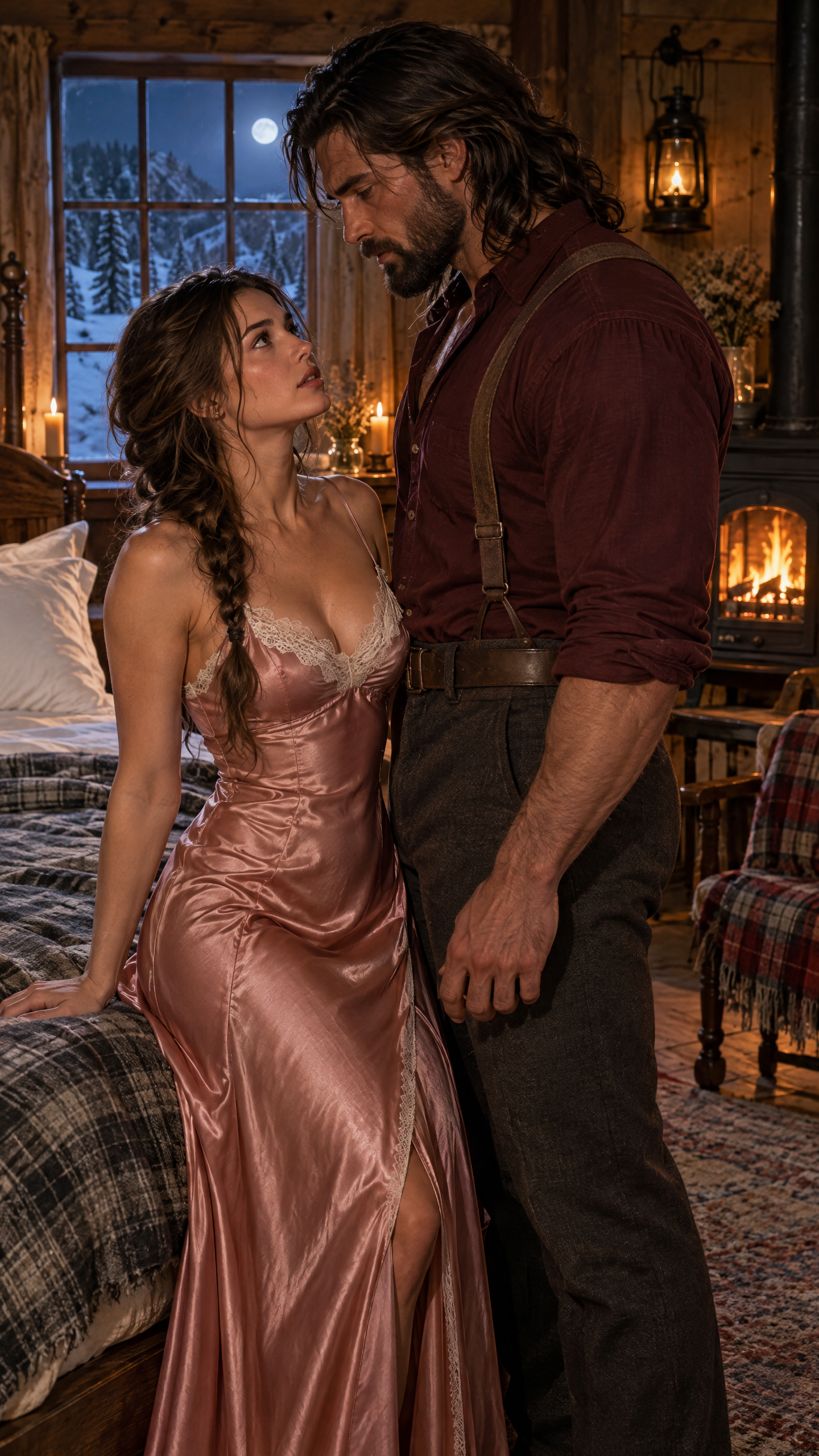
# “YOU MARRIED ME THIS MORNING. SO WHY ARE YOU AFRAID TO SHARE MY BED?”
### A Mountain Man’s Wedding-Night Secret — A Western Romance Story
“You married me this morning. So why are you afraid to share my bed?”
“Caleb, put that knife down.”
“I wasn’t going to hurt you, Eleanor.”
“Then why have you been sharpening it for twenty minutes?”
“Because I don’t know what else to do.”
Eleanor Whitmore stared at her enormous new husband, stunned by the confession.
Outside, a vicious snowstorm battered their isolated mountain cabin. Snow struck the windows like handfuls of gravel, and the wind groaned through the pine trees surrounding the little clearing.
Inside, the man everyone in town seemed to fear stood beside the iron stove, holding a knife and looking more frightened than any man Eleanor had ever seen.
And it was their wedding night.
Just hours earlier, Eleanor had married Caleb Mercer, a thirty-two-year-old mountain rancher whose reputation had frightened her long before she met him.
Now, standing before him in her pale-blue nightgown, she was beginning to wonder whether she’d misunderstood everything about him.
She turned toward the cabin door and slid the heavy wooden bolt into place.
Click.
Caleb froze.
“You locked it,” he said.
“Yes.”
“Why?”
“Because it’s dark, Caleb. And there’s a blizzard outside.”
“No one comes up here.”
“That doesn’t mean we should invite trouble.”
He nodded awkwardly and carefully set the knife down.
Eleanor studied him.
At six feet four, perhaps taller, Caleb was built like a mountain. His broad shoulders strained against his dark work shirt, and leather suspenders crossed his powerful chest.
A thick beard framed his rugged face. Dark hair brushed his collar, while a pale scar disappeared beneath his shirt.
When Eleanor first saw him at the stage station that afternoon, she’d understood why townspeople whispered his name.
He looked capable of breaking a man in half.
Yet tonight, he could barely look his own wife in the eyes.
Twenty minutes earlier, Eleanor had stepped from behind a canvas changing screen wearing the nightgown she’d nearly left behind in Baltimore.
It was modest, falling well below her knees.
Still, she had never felt so exposed.
Caleb glanced at her once.
Then immediately turned away.
First, he inspected the iron stove.
Then the chimney.
Then the door hinges.
Then his rifle.
Finally, he’d started sharpening that perfectly sharp knife.
“Caleb,” Eleanor said gently, “the stove is working.”
“Yes, ma’am.”
“The rifle is clean.”
“Yes.”
“And if you sharpen that knife any further, there won’t be anything left of it.”
For the first time, his lips almost formed a smile.
“I like keeping my tools ready.”
“So I’ve noticed.”
He lowered his gaze, then reached for a folded wool blanket.
“I reckon I’ll sleep over there.”
Eleanor followed his eyes.
He was pointing toward the floor beside the stove.
She blinked.
“On the floor?”
“Yes.”
“But there’s a bed.”
“One bed.”
“A bed large enough for two people.”
His ears reddened.
“I’ve slept in worse places.”
“That wasn’t what I asked.”
He unfolded the blanket without answering.
A strange irritation rose inside Eleanor.
For three thousand miles, she’d worried about this exact night.
She’d imagined arriving in the wilderness, marrying a stranger, and discovering that her new husband expected privileges she wasn’t ready to give.
She had rehearsed the words she’d use.
No.
Please wait.
I’m not ready.
She’d even feared that necessity might force her to surrender choices she’d once taken for granted.
After all, necessity was why she’d left Baltimore in the first place.
But Caleb had done nothing she’d feared.
He’d carried her trunk, prepared supper, kept the cabin warm, and treated her with extraordinary care.
Now he intended to spend his wedding night on freezing floorboards rather than risk making her uncomfortable.
“Caleb Mercer.”
He stopped unfolding the blanket.
“You married me this morning.”
“Yes, ma’am.”
“And I married you.”
“Yes.”
“So why are you acting as though sharing a bed with me would be a terrible crime?”
His face turned crimson.
For several seconds, he said nothing.
The wind howled. Snow rattled against the window. The fire cracked inside the stove.
Then Caleb slowly raised his eyes.
“Eleanor, there’s something you need to understand about why I married you.”
Her breath caught.
He dropped the blanket.
And when he took one step toward her, the expression on his face changed so completely that Eleanor’s heart began to race.
“Before we go any further,” he whispered, “there’s something I’ve been keeping from you.”
—
## CHAPTER ONE: THE MAN FROM THE MOUNTAINS
Three months earlier, Eleanor Whitmore had been living in a narrow apartment above a bakery in Baltimore.
At twenty-seven, she had once imagined her life would be full of books, music, family dinners, and perhaps a husband who loved her enough to make her laugh.
Instead, she had spent the last year caring for her dying father and watching his debts grow larger than the walls of their little home.
When he finally passed away, Eleanor discovered that nearly everything they owned had been used as security for a loan.
The lender was a businessman named Silas Harlan.
He was wealthy, respected in certain circles, and known for his charming smile.
He was also cruel.
He offered Eleanor a bargain.
She could repay the debt by marrying him.
He had no intention of allowing her to refuse.
Eleanor rejected him.
Within days, the threats began.
Letters arrived demanding payment. Men appeared outside her building. The bakery owner, who had been kind enough to let her work in exchange for reduced rent, warned her that strangers were asking questions about her.
Then a letter arrived from a woman named Mrs. Abigail Mercer, who lived in the mountain town of Pine Hollow, Colorado.
Abigail had known Eleanor’s father many years earlier. She explained that a rancher named Caleb Mercer was looking for a wife.
He needed someone willing to live in the mountains, manage a household, and help him build a family.
In exchange, he offered a home, financial security, and a marriage based on mutual respect.
Eleanor almost laughed when she first read the letter.
A mail-order marriage?
She had never imagined such a thing.
But the letter included a second page written in Caleb’s own handwriting.
He was direct.
He didn’t promise grand romance.
He didn’t describe himself as handsome or wealthy.
He simply wrote:
*I have a good house, enough land, and honest work. I am not looking for a servant or someone to obey me. I want a wife who can speak her mind. If you are interested, I would be glad to meet you.*
At the bottom, he had added:
*I cannot promise an easy life, Miss Whitmore, but I can promise you will always be treated as a person.*
Eleanor read that sentence many times.
She had never received such a promise from a man.
So she sold what little she could, packed her belongings, and boarded a westbound train.
She was not running toward love.
She was running away from a man who believed he could purchase her future.
She had no idea that the mountain man waiting at the end of her journey carried a secret of his own.
—
## CHAPTER TWO: THE WEDDING AT PINE HOLLOW
Caleb Mercer had not expected to feel nervous.
He had faced wolves, armed thieves, freezing rivers, and winter storms without trembling.
Yet on the morning Eleanor arrived, he stood outside the Pine Hollow stage station adjusting his hat every few seconds.
He wore his best dark coat, a clean white shirt, and boots polished until they shone.
His friend, Samuel Brooks, watched him from the steps.
“You look like you’re waiting for the governor.”
“I’m waiting for a woman.”
“Same thing, judging by your face.”
Caleb glared.
Samuel laughed.
Then the stagecoach appeared.
It rolled into the station, horses steaming in the cold air.
A young woman stepped down carefully, holding a small leather suitcase.
She wore a dark traveling dress and a brown wool coat. Her chestnut hair was pinned beneath a modest hat.
Her eyes were tired from the journey, but there was a quiet determination in them.
Caleb removed his hat.
“Miss Whitmore?”
“Mr. Mercer?”
“Caleb, please.”
“Eleanor.”
For a moment, neither knew what to say.
Then Caleb reached for her suitcase.
“That’s heavy.”
“I can carry it.”
“I don’t doubt that.”
He waited.
She finally handed it over.
“Thank you.”
“You must be hungry. I arranged for supper at the hotel.”
Eleanor looked at him carefully.
“You arranged supper?”
“Yes, ma’am.”
“Not a business meeting?”
His expression changed.
“No. Just supper.”
She smiled for the first time.
It was a small smile, but Caleb noticed it.
And he would remember it long after the snow melted.
They spent the evening talking.
Eleanor told him about Baltimore, her father, and her love of books.
Caleb told her about the ranch, the horses, and the mountain trails.
He admitted that he had spent most of his adult life alone.
“Doesn’t that bother you?” she asked.
“Sometimes.”
“Why haven’t you married before?”
He stared into his coffee.
“Never found someone who wanted to live this far from everything.”
“Perhaps they didn’t know what they were missing.”
He looked up.
“Perhaps.”
The following morning, they visited the town’s small church.
Eleanor wore a simple cream-colored dress borrowed from Abigail. Caleb stood beside her in his dark coat.
The minister asked whether they understood the promises they were making.
Caleb answered immediately.
“I do.”
Eleanor hesitated only a moment.
“I do.”
When the minister declared them husband and wife, Caleb gently took her hand.
He did not kiss her.
He simply held it as if it were something precious.
That evening, they began the journey to his cabin.
Neither knew that the most difficult part of their marriage was waiting just beyond the front door.
—
## CHAPTER THREE: THE CONFESSION
Back in the cabin, Eleanor waited for Caleb to continue.
He stood beside the stove, his enormous hands hanging awkwardly at his sides.
“I need you to understand something,” he said.
“I’m listening.”
“I didn’t ask you to marry me because I expected you to share my bed.”
Eleanor frowned.
“Then why did you?”
Caleb swallowed.
“Because I wanted you to have somewhere safe to live.”
She stared at him.
“That isn’t a reason to marry someone.”
“It was part of the reason.”
“What was the other part?”
He looked toward the window.
“Because I wanted you here.”
The answer was so quiet that she almost missed it.
“Caleb?”
He took a breath.
“Three years ago, I had a wife.”
Eleanor’s expression softened.
“You were married before?”
“Yes.”
“I’m sorry. I didn’t know.”
“Her name was Margaret.”
He sat heavily in the wooden chair.
“She was the kindest person I ever knew.”
Eleanor sat opposite him.
“What happened?”
“Winter fever. She died before the spring thaw.”
He rubbed his beard.
“She’d been ill for weeks. I took her to the doctor, but the roads were buried. By the time the physician reached us, it was too late.”
Eleanor lowered her eyes.
“I’m sorry.”
Caleb nodded.
“For a long time, I blamed myself. I kept thinking that if I’d built a better road, if I’d bought a faster horse, if I’d known how sick she really was, I could have saved her.”
“Caleb, you couldn’t have known.”
“I know that now. But knowing something and believing it are two different things.”
He looked at her.
“After Margaret died, I couldn’t stand the bedroom. I slept in the barn for nearly a year.”
Eleanor understood now why he had wanted the floor.
But there was more.
“Why are you telling me this tonight?”
“Because I don’t want you thinking my silence means I don’t want you.”
His voice cracked.
“I do. More than I know how to say.”
Eleanor felt her irritation disappear.
“Then what are you afraid of?”
Caleb stared at his hands.
“I’m afraid I’ll hurt you.”
“By sharing a bed?”
“By wanting you too much. By expecting something you don’t want to give. By making you feel trapped.”
He looked at her with a painful honesty.
“I know what happened to your father and that man in Baltimore. I know you came here because you needed somewhere safe. I don’t want you believing you owe me anything because I married you.”
Eleanor’s eyes filled.
“How did you know about Silas Harlan?”
Caleb went still.
He had not meant to say that name.
And Eleanor noticed.
“What aren’t you telling me?”
Caleb looked toward the locked door.
“Tomorrow,” he said. “I’ll explain everything tomorrow.”
“No. You brought it up. Tell me now.”
He hesitated.
Then he reached into the inside pocket of his coat and removed a folded envelope.
The paper was old and creased.
He handed it to her.
Eleanor recognized the handwriting immediately.
It belonged to her father.
Her fingers began to shake.
“Where did you get this?”
“Your father sent it to me six weeks before he died.”
She opened the letter.
*Caleb,*
*If Eleanor ever reaches you, please give her the chance to begin again. I know I have no right to ask anything more of you, but there is something I need you to know.*
*The man who is threatening my daughter is not what he appears to be. His name is Silas Harlan. He has been using false debts and forged documents to take property from people who cannot defend themselves.*
*I have evidence.*
*I was going to bring it to the authorities, but I fear he has discovered what I know.*
*Please protect Eleanor. Do not let him find her.*
The letter ended with her father’s signature.
Eleanor stared at the page.
“My father knew you?”
Caleb nodded.
“He helped me once, years ago. I was in Denver after Margaret died. Your father was working for a legal office then. He helped me recover the deed to my land after a dishonest broker tried to take it.”
“Why didn’t he tell me?”
“He was afraid Harlan would learn about our connection.”
Eleanor looked up.
“And the evidence?”
Caleb’s face darkened.
“I believe Harlan has been looking for it ever since.”
—
## CHAPTER FOUR: THE MAN AT THE DOOR
The following morning, the storm had not stopped.
Snow covered the porch, the fence, and the narrow path leading toward the stable.
Caleb was outside clearing the steps when he noticed a dark shape moving between the trees.
He reached for his rifle.
“Who’s there?”
A man stepped into the clearing.
He wore a black coat and a wide-brimmed hat. His horse was covered in snow.
“Morning, Mercer.”
Caleb’s expression hardened.
“Silas Harlan.”
Eleanor, standing in the doorway, felt the blood drain from her face.
The man smiled.
“Eleanor. There you are.”
Caleb stepped between them.
“You’re not welcome here.”
Harlan looked amused.
“I’m here to speak with my property.”
“She’s not your property.”
“Your marriage doesn’t erase her father’s debt.”
Eleanor stepped forward.
“My father owed you nothing.”
Harlan’s smile disappeared.
“Careful, girl.”
Caleb raised his rifle slightly.
“Leave.”
Harlan glanced at the weapon.
“Are you threatening me?”
“I’m giving you a chance to ride away.”
For a moment, the two men stared at each other.
Then Harlan laughed.
“You think that little cabin makes you untouchable? You think marrying a frightened woman makes you a hero?”
Caleb’s jaw tightened.
“I think you should leave before this conversation becomes something neither of us wants.”
Harlan turned his horse.
“This isn’t finished.”
He rode away through the trees.
Eleanor remained in the doorway long after he disappeared.
Caleb lowered his rifle.
“Come inside.”
She shook her head.
“He found me.”
“I know.”
“He followed me all the way here.”
“He won’t take you.”
“You don’t know what he’s capable of.”
Caleb looked at her.
“Yes, Eleanor. I do.”
—
## CHAPTER FIVE: THE SECRET IN THE FLOOR
That afternoon, Caleb finally explained why Harlan had been searching for him.
Three years earlier, after Margaret’s death, Caleb had purchased a small parcel of land near the eastern boundary of his ranch.
The previous owner had been a farmer named Thomas Bell.
Bell had lost his land after taking a loan from a financial company controlled by Harlan.
The debt had been paid, but Harlan’s office claimed the payment was never received.
Bell was forced to sell.
Caleb had suspected something was wrong and hired a lawyer.
During the investigation, he discovered that several families had been cheated in the same way.
Among them was Eleanor’s father.
Her father had gathered copies of receipts, letters, and loan agreements showing that Harlan’s company had been collecting payments and then claiming the debts remained unpaid.
He had hidden the documents somewhere.
Caleb believed the evidence was still in the mountains.
“Why didn’t you tell the sheriff?” Eleanor asked.
“I tried. The sheriff in Pine Hollow is a decent man, but Harlan has friends in Denver. Without proof, he could turn the accusation against us.”
“Where is the evidence?”
Caleb looked toward the floor.
“Your father told me it was hidden somewhere safe.”
Eleanor remembered something.
“My father used to speak about a brass compass.”
Caleb turned.
“What?”
“He carried it everywhere. It wasn’t valuable, but he said it had helped him find his way when he was young.”
“Do you have it?”
Eleanor nodded slowly.
“It’s in my trunk.”
They searched her belongings.
Beneath folded dresses and a small collection of books, Eleanor found a velvet pouch.
Inside was an old brass compass.
Its back was engraved with a tiny letter W.
Caleb examined it.
“Whitmore?”
“No. My mother’s maiden name was Wells.”
He turned the compass over.
There was a small seam around the metal casing.
With the tip of his knife, he carefully opened it.
A narrow piece of paper slipped out.
It contained a message in her father’s handwriting.
*The truth is buried where the old bell rings without a church.*
Eleanor frowned.
“What does that mean?”
Caleb stared at the note.
Then his expression changed.
“The abandoned mining camp.”
—
## CHAPTER SIX: THE OLD BELL
The abandoned mining camp lay several miles north of the cabin.
Long ago, miners had lived there in wooden cabins, digging silver from the mountain.
A small bell had once hung outside the camp’s meeting hall.
The building had burned years earlier.
Only a stone foundation remained.
Caleb explained that a large oak tree stood nearby. Beneath it, the miners had buried a bell after the fire.
“Your father must have hidden the documents near it,” he said.
“Then we should go.”
“Not in this weather.”
“Caleb, Harlan knows I’m here. If he finds the evidence first, we’ll never be able to prove anything.”
He studied her.
“You’re not used to mountain trails.”
“I can learn.”
“It’s dangerous.”
“So is staying here and waiting.”
Caleb looked at her for a long moment.
Then he nodded.
“We leave at first light.”
That evening, Eleanor prepared supper.
She had never cooked over a wood stove before, and the first batch of biscuits came out hard enough to break a plate.
Caleb ate two without complaint.
She stared at him.
“You don’t have to pretend they’re good.”
“They’re filling.”
“That’s not a compliment.”
“It’s the highest praise I know.”
She laughed.
It was the first time either of them had laughed together.
Caleb looked at her as if the sound had surprised him.
“What?” she asked.
“Nothing.”
“You’re staring.”
“Sorry.”
“Don’t apologize for looking at your wife.”
His smile appeared again, this time without effort.
Later, as they prepared for bed, Eleanor approached him.
“You don’t have to sleep on the floor tonight.”
Caleb stopped.
“Are you certain?”
“I am.”
“I don’t want you to feel pressured.”
“I don’t.”
He hesitated.
Then he placed the blanket back on the bed.
They lay on opposite sides, leaving a respectful distance between them.
The fire slowly faded.
For a long time, neither spoke.
Then Eleanor reached across the space between them.
Her fingers found his hand.
Caleb went still.
“Good night, Caleb.”
His hand closed gently around hers.
“Good night, Eleanor.”
It was not a passionate embrace.
It was something more important.
It was the first time she had reached for him because she wanted to.
—
## CHAPTER SEVEN: A JOURNEY THROUGH THE SNOW
They left before sunrise.
Caleb saddled two horses and packed food, rope, a lantern, and a small shovel.
Eleanor wore a thick wool coat, gloves, and a scarf wrapped tightly around her neck.
The journey was difficult.
Snow covered the narrow trail, and the horses moved carefully between the trees.
Caleb rode ahead, checking the ground.
Every few minutes, he looked back to make sure Eleanor was following.
“You know,” she called, “I’m beginning to think you believe I’ll disappear if you stop looking at me.”
“I’ve never taken anyone through this trail in winter.”
“Then perhaps you should trust me.”
“I do.”
“You have an unusual way of showing it.”
He smiled.
They reached the old camp shortly before noon.
The abandoned buildings stood like skeletons against the snow.
Caleb dismounted.
“Stay close.”
Eleanor followed him toward the stone foundation.
They searched beneath the oak tree.
Nothing.
Caleb dug near the roots while Eleanor examined the ground.
Then she noticed a small iron ring sticking out of the snow.
“Caleb!”
He came over.
Together, they cleared the snow and uncovered a wooden box buried beneath the frozen earth.
The lock was rusted.
Caleb forced it open.
Inside were several leather-bound folders, a collection of receipts, and a small notebook.
Eleanor recognized her father’s handwriting.
She picked up the notebook.
The first page contained a list of names.
Twenty-seven families.
Twenty-seven properties.
Twenty-seven unpaid debts that had already been settled.
Her hands trembled.
“He did it,” she whispered.
Caleb looked over her shoulder.
“Your father found everything.”
Then they heard a horse.
Caleb immediately closed the box.
A voice called from the trees.
“Step away from it.”
Silas Harlan emerged with two armed men.
He had followed them.
“Give me the documents,” he said.
Caleb moved in front of Eleanor.
“No.”
Harlan smiled.
“I was hoping you’d be reasonable.”
“You should have stayed in town.”
“I’m afraid I have business here.”
One of the men raised his rifle.
Eleanor clutched the notebook.
Caleb’s hand moved toward his weapon.
“Don’t,” Harlan warned.
For a moment, the mountain seemed completely silent.
Then Eleanor noticed something behind Harlan.
A steep slope.
A narrow path.
And a fallen tree lying across it.
She remembered the rope Caleb had packed.
She quietly slipped it from the saddlebag.
Caleb glanced at her.
He understood immediately.
While the men watched Caleb, Eleanor moved toward the tree.
She looped the rope around its thick trunk.
Then she pulled hard.
The tree shifted.
A shower of snow and loose branches slid down the slope.
One of Harlan’s horses panicked.
The men shouted.
Caleb seized the opportunity.
He knocked the nearest rifle aside and pushed the second man into the snow.
Harlan tried to reach Eleanor.
Caleb caught him by the coat and threw him against the old foundation.
The notebook fell from Eleanor’s hands.
She snatched it up.
“Caleb!”
He looked at her.
“Go!”
They mounted their horses and rode hard through the trees.
Behind them, Harlan shouted threats.
But the storm had begun again.
And the mountain swallowed the sound.
—
## CHAPTER EIGHT: THE WOUND
They rode until nightfall.
By the time they reached the cabin, Caleb was pale.
Eleanor noticed blood spreading across his sleeve.
“Caleb!”
“It’s nothing.”
“Get inside.”
He tried to dismount.
His leg buckled.
Eleanor rushed forward and helped him down.
A bullet had grazed his upper arm.
It was not deep, but the wound was bleeding heavily.
She guided him to the chair beside the stove.
“Take off your shirt.”
He stared at her.
“Eleanor—”
“Don’t argue.”
He obeyed.
She cleaned the wound with boiled water and wrapped it carefully.
Caleb watched her hands.
“You’ve done this before.”
“My father was ill for a long time. I learned.”
“You’re good at it.”
“I had a stubborn patient.”
He smiled faintly.
Then his face tightened.
“I’m sorry.”
“For what?”
“For bringing you into this.”
Eleanor looked at him.
“You didn’t bring me into anything. Harlan did.”
“I should have kept you safe.”
“You cannot control every danger in the world, Caleb.”
“I can try.”
She placed the bandage down.
“Listen to me. I didn’t marry you because I wanted a man who could fight every battle for me.”
He looked at her.
“I married you because you promised I would be treated as a person. You kept that promise.”
His eyes softened.
“And today, I fought beside you.”
“You did.”
“So stop apologizing for being human.”
Caleb lowered his head.
For a long moment, he said nothing.
Then he reached for her hand.
“I’m glad you came.”
Eleanor smiled.
“So am I.”
He leaned forward and kissed her forehead.
It was a small gesture.
But it changed something between them.
—
## CHAPTER NINE: THE LETTER FROM MARGARET
The next morning, Eleanor found Caleb sitting alone near the stove.
He held a folded piece of paper.
She recognized the delicate handwriting from the small wooden box on the mantel.
“Is that from Margaret?”
He nodded.
“I found it after she died.”
“Would you like to tell me about her?”
Caleb hesitated.
“Most people don’t ask.”
“Perhaps they don’t know how.”
He unfolded the letter.
“She wrote it during her last week.”
He read aloud.
*My dearest Caleb,*
*I know you are frightened. I can see it every time you look at me.*
*But if the day comes when I am no longer beside you, I want you to remember something.*
*You were not put on this earth to spend the rest of your life punishing yourself for loving me.*
*Love is not a debt. It is not a promise that life will never hurt us.*
*If another woman ever comes into your life, do not make her compete with my memory. Let her be herself. Let her bring her own laughter into this house.*
*And please, Caleb, do not sleep in the barn forever.*
Eleanor’s eyes filled.
Caleb folded the letter.
“She knew me too well.”
“She loved you.”
“Yes.”
“And she wanted you to live.”
He nodded.
“I know.”
Eleanor sat beside him.
“You don’t have to forget her to love someone again.”
He looked at her.
“Sometimes I feel as though I would be betraying her.”
“You wouldn’t.”
“How can you be certain?”
“Because I would never ask you to erase someone who helped make you the man you are.”
Caleb stared at her.
Then he took her hand.
“I think Margaret would have liked you.”
Eleanor smiled through her tears.
“I think I would have liked her too.”
—
## CHAPTER TEN: THE TOWN TURNS AGAINST THEM
Three days later, Caleb and Eleanor rode into Pine Hollow carrying the evidence.
They went straight to Sheriff Daniel Foster.
The sheriff examined the documents for nearly an hour.
He grew more serious with every page.
“Where did you get these?”
“My father collected them,” Eleanor answered.
The sheriff looked at her.
“Your father was a brave man.”
“He was frightened.”
“Sometimes those are the same thing.”
Caleb placed the notebook on the desk.
“There are twenty-seven families listed. Harlan’s company took their property after claiming unpaid debts.”
The sheriff closed the notebook.
“This is enough to begin an investigation.”
“Will you arrest him?” Eleanor asked.
“Not without confirming the records. But I’ll send copies to the county prosecutor.”
Before they could leave, the office door opened.
A well-dressed man entered.
Silas Harlan.
He smiled when he saw them.
“Sheriff. I see my old friends have arrived.”
Foster stood.
“Harlan, you’re going to have to answer some questions.”
“About what?”
The sheriff placed the documents on his desk.
“These.”
Harlan barely glanced at them.
“Fabrications.”
Eleanor stepped forward.
“They’re my father’s records.”
“Your father was a desperate man.”
“He was an honest man.”
Harlan laughed softly.
“You should be careful, Eleanor. You’re making accusations you cannot understand.”
“I understand perfectly.”
Harlan’s smile vanished.
He looked at Caleb.
“You’ve always been a fool, Mercer. First Margaret, now this woman.”
Caleb moved forward.
The sheriff raised a hand.
“That’s enough.”
Harlan turned toward the door.
“This town knows me better than it knows either of you.”
Then he left.
The sheriff watched him go.
“I’ll need time,” he said.
Caleb nodded.
“We understand.”
But Eleanor could see the worry in his face.
Harlan had powerful friends.
And powerful men did not surrender easily.
—
## CHAPTER ELEVEN: THE FIRE
The attack came two nights later.
Eleanor woke to the smell of smoke.
At first, she thought the stove had overheated.
Then she heard Caleb shouting.
“Eleanor! Get up!”
Flames were climbing the outside wall near the woodpile.
Someone had set fire to the shed.
Caleb grabbed his coat and rifle.
“Stay inside!”
“No.”
“Eleanor, please.”
“I’m not leaving you to fight alone.”
He looked at her, then nodded.
They rushed outside.
The wind pushed flames toward the stable.
Caleb grabbed a bucket while Eleanor ran for the water barrel.
They worked frantically.
Smoke filled the air.
A horse screamed inside the stable.
Caleb broke through the door and led it out.
Then a beam collapsed.
He stumbled.
Eleanor ran toward him.
“Caleb!”
He pushed himself up.
“I’m all right!”
But the fire had spread to the edge of the porch.
Together, they threw water over the flames.
By dawn, the fire was finally out.
The shed was destroyed.
The stable was damaged.
But the cabin remained standing.
Caleb examined the ground.
He found a boot print near the woodpile.
Then another.
He followed them to the edge of the clearing.
There, caught on a broken fence post, was a strip of black cloth.
Eleanor recognized it.
“Harlan’s coat.”
Caleb’s face became cold.
“He was here.”
Eleanor looked at the ruined shed.
“He wanted to scare us.”
“He wanted the documents.”
“Then he should have taken them when he had the chance.”
Caleb turned toward her.
“You’re not afraid?”
She looked at the burned wood.
“Of course I’m afraid.”
He stepped closer.
“But?”
“But I’m more afraid of letting him win.”
Caleb placed a hand against her cheek.
For the first time, he kissed her.
Not hurriedly.
Not desperately.
He kissed her as a man who had finally allowed himself to believe that happiness might still be possible.
When they separated, Eleanor rested her forehead against his chest.
“Caleb?”
“Yes?”
“I think I would like to share your bed tonight.”
His eyes softened.
“Are you certain?”
She smiled.
“Very.”
He kissed her forehead.
“Then I’ll make sure the fire is warm.”
—
## CHAPTER TWELVE: THE WOMAN WHO WOULD NOT RUN
The next morning, Caleb wanted Eleanor to return to town.
He believed Harlan would strike again.
But Eleanor refused.
“You can take the documents to the sheriff,” she said. “I’ll stay here.”
“No.”
“Caleb.”
“It’s too dangerous.”
“You don’t get to decide everything for me.”
His jaw tightened.
“I’m trying to protect you.”
“And I’m trying to be your wife, not a prisoner.”
The words stopped him.
Eleanor stepped closer.
“I know you lost Margaret. I know you are afraid of losing someone again. But you cannot spend the rest of your life locking every door and pushing everyone away.”
Caleb looked down.
She took his hands.
“I am not Margaret. I am not fragile glass. And I am not going to disappear because life becomes difficult.”
He closed his eyes.
“You’re right.”
“I know.”
A small smile touched his face.
“You always have an answer.”
“Someone has to.”
He laughed.
It was the kind of laugh that came from deep inside him.
And Eleanor realized she wanted to hear it for the rest of her life.
—
## CHAPTER THIRTEEN: THE TRAP
Caleb and Eleanor decided to set a trap for Harlan.
They made copies of the documents and sent them to the sheriff.
Then Caleb arranged for one copy to be delivered to a lawyer in Denver.
If anything happened to them, the evidence would become public.
But they needed one more thing.
A witness.
Thomas Bell, the farmer whose land had been stolen, lived in a small settlement south of Pine Hollow.
Caleb knew where to find him.
They traveled there together.
Bell was an elderly man with a crooked back and a suspicious expression.
When he saw Caleb, he opened the door.
“Mercer.”
“Thomas.”
His eyes moved to Eleanor.
“Who’s this?”
“My wife.”
Bell studied her.
“Pretty young woman to marry a mountain wolf.”
Eleanor smiled.
“He’s not nearly as frightening as people say.”
Bell laughed.
“That’s what they all say until he gets angry.”
Caleb rolled his eyes.
They explained the evidence.
Bell listened quietly.
Then he went to a cupboard and removed a small leather book.
“I kept the original receipts,” he said.
Caleb stared.
“You did?”
“I knew Harlan had cheated me. I just never had proof.”
Bell opened the book.
There were signatures, dates, and payment records.
Eleanor leaned closer.
“These match my father’s documents.”
Bell nodded.
“I’ll testify.”
For the first time, the case against Harlan became difficult to dismiss.
But as they left the settlement, Eleanor noticed a rider following them.
Then another.
Caleb saw them too.
“Hold on.”
They urged their horses forward.
The riders gained on them.
One fired.
The bullet struck the snow near Eleanor’s horse.
She cried out.
Caleb turned and raised his rifle.
A warning shot echoed across the valley.
The riders slowed.
Then, from a ridge above them, another horse appeared.
Sheriff Foster.
Behind him were two deputies.
“Drop your weapons!”
The men hesitated.
Then they surrendered.
Harlan had sent them to steal the witness records.
This time, they had been caught.
—
## CHAPTER FOURTEEN: THE TRUTH COMES OUT
The investigation lasted several weeks.
The sheriff sent the documents to Denver.
The county prosecutor examined the signatures and payment records.
Thomas Bell testified.
Several other families came forward.
One woman brought a receipt showing that she had paid her mortgage in full years before Harlan’s company claimed she owed more money.
Another produced letters threatening eviction.
The evidence was overwhelming.
Silas Harlan was arrested.
His office was searched.
Investigators discovered ledgers containing the names of dozens of families.
Some had lost farms.
Others had lost businesses.
Several had been forced into debt they could never repay.
The story spread through Colorado.
For the first time, Harlan’s wealth and influence could not protect him.
Eleanor received a letter from the prosecutor.
Her father’s name had been cleared.
The debts had been declared fraudulent.
The property claims against the Whitmore estate were void.
When she read the letter, she began to cry.
Caleb found her sitting at the kitchen table.
“What happened?”
She handed him the paper.
He read it slowly.
Then he looked at her.
“Your father did it.”
“He did.”
“He protected you.”
Eleanor wiped her eyes.
“I wish he could have seen this.”
Caleb pulled out a chair and sat beside her.
“I think he knows.”
She leaned against him.
For a long time, they remained quiet.
Then Caleb said something that made her smile.
“Your father would probably have liked the biscuits.”
Eleanor laughed.
“He would have been polite.”
“He would have eaten three.”
“Then he would have complained about his stomach.”
Caleb smiled.
The cabin felt warmer than it had ever felt before.
—
## CHAPTER FIFTEEN: THE MAN WHO FEARED THE BED
Spring arrived slowly in the mountains.
Snow melted from the lower trails, revealing grass and wildflowers.
The creek ran clear again.
The horses grew restless in the pasture.
And the cabin began to feel like a home rather than a shelter.
Eleanor planted flowers beside the porch.
Caleb repaired the stable.
They worked together, argued over small things, and laughed over burnt meals.
Their marriage grew in quiet moments.
A hand resting on a shoulder.
A kiss before breakfast.
A shared blanket on cold evenings.
One afternoon, Eleanor found Caleb standing beside the old oak tree near the cabin.
He was holding Margaret’s letter.
She approached quietly.
“Thinking about her?”
“Yes.”
“Do you miss her?”
“Every day.”
Eleanor nodded.
“That’s all right.”
Caleb folded the letter.
“I used to think loving someone again would mean forgetting her.”
“And now?”
“Now I think the heart has more room than I believed.”
He turned toward Eleanor.
“Margaret gave me years of happiness. You have given me a reason to look forward to tomorrow.”
Eleanor took his hand.
“You don’t have to choose between the woman you loved and the woman you love now.”
He smiled.
“I know.”
Then he reached into his pocket.
Eleanor frowned.
“What are you doing?”
He removed a small wooden box.
Inside was a ring.
Not an expensive one.
A simple gold band with a tiny blue stone.
“Caleb?”
“I know we’re already married.”
She laughed.
“That’s generally how weddings work.”
“I wanted to give you something that was yours. Not something connected to a debt or an agreement.”
He took her hand.
“I want you to know that every day I choose you. Not because you need my protection. Not because your father asked me to help. Because I love you.”
Eleanor stared at him.
Then tears filled her eyes.
“You don’t need to ask me again.”
“I know.”
“Then put the ring on.”
He did.
She kissed him beneath the oak tree while the spring wind moved softly through the branches.
—
## CHAPTER SIXTEEN: A HOUSE FULL OF LIFE
A year later, the cabin was no longer silent.
Eleanor’s books filled the shelves.
Flowers stood in jars on the windowsill.
A small rocking chair sat beside the stove.
And a new sound filled the rooms.
A baby’s cry.
Their daughter, Grace Margaret Mercer, had arrived on a cold October morning.
Caleb had been more frightened during the birth than he had ever been during a gunfight.
He paced outside the bedroom for hours.
When the midwife finally called him inside, he entered as carefully as a man walking into a church.
Eleanor lay against the pillows, exhausted but smiling.
In her arms was a tiny baby wrapped in a white blanket.
Caleb stopped.
“She’s beautiful.”
“She has your nose.”
He looked closer.
“She does?”
“And your stubborn expression.”
“I don’t believe that.”
Eleanor laughed.
He sat beside her and gently touched the baby’s hand.
Grace curled her tiny fingers around his thumb.
Caleb’s face changed.
All the strength in his body seemed to disappear.
He bent his head.
“Hello, little one.”
Eleanor watched him.
“Would you like to hold her?”
He looked uncertain.
“What if I hurt her?”
“You won’t.”
“She’s so small.”
“Caleb, she’s your daughter.”
He carefully lifted Grace into his arms.
For a long moment, he simply stared at her.
Then he whispered:
“I’ll spend my whole life trying to deserve you.”
Eleanor reached for his hand.
“You already do.”
He looked at her.
“Both of you.”
And for the first time in many years, Caleb Mercer understood that happiness did not always arrive loudly.
Sometimes it came wrapped in a blanket, sleeping against your chest.
—
## CHAPTER SEVENTEEN: THE LAST VISITOR
Two years passed.
Grace grew into a lively little girl who loved horses, flowers, and following her father around the ranch.
Caleb built her a small wooden horse.
Eleanor taught her to recognize letters.
Their home became a place of laughter.
One autumn afternoon, a visitor arrived.
He was an elderly man wearing a dark coat and carrying a walking stick.
Caleb recognized him immediately.
It was Reverend Thomas, the minister who had married them.
“Reverend!”
Caleb shook his hand.
“I heard you had a daughter,” the old man said.
“We do.”
Eleanor came out carrying Grace.
The minister smiled.
“She’s lovely.”
“Thank you.”
He looked around the cabin.
“You’ve done well, Caleb.”
Caleb glanced toward Eleanor.
“We’ve done well.”
The minister nodded.
Then he noticed the small wooden rocking chair near the stove.
“Looks like this house has changed.”
Eleanor smiled.
“It certainly has.”
After supper, the minister sat by the fire and told stories from his travels.
Before leaving, he spoke quietly to Caleb.
“Your first wife would be glad to see you.”
Caleb looked toward the bedroom.
“I think about her sometimes.”
“Of course you do.”
The minister placed a hand on his shoulder.
“Love does not disappear because life continues.”
Caleb nodded.
He had learned that lesson the hard way.
When the minister left, Eleanor stood beside him on the porch.
“Are you all right?”
“Yes.”
She rested her head against his shoulder.
“Good.”
He kissed the top of her head.
Then Grace called from inside.
“Papa! Come see!”
Caleb smiled.
“Duty calls.”
He went inside.
And Eleanor followed.
—
## CHAPTER EIGHTEEN: THE QUESTION
On their third wedding anniversary, Caleb prepared a surprise.
He had spent weeks repairing the small room at the back of the cabin.
He painted the walls a soft cream color, built a wooden bookshelf, and placed a writing desk beside the window.
Eleanor found him there that morning.
“What is this?”
“A room.”
“I can see that.”
He smiled.
“I thought you might like a place to write.”
She looked at the desk.
Then at the shelves.
“You did all this?”
“Some of it.”
“Who helped?”
“Samuel.”
She laughed.
“I should have known.”
Caleb handed her a small package.
Inside was a beautiful leather-bound journal.
On the first page, he had written:
*For Eleanor, who taught a lonely man that a house can become a home.*
She looked up.
“Caleb…”
He shrugged.
“I’m not good with words.”
“You’re better than you think.”
She kissed him.
That evening, after Grace had fallen asleep, they sat beside the fire.
Eleanor leaned against Caleb.
“Do you remember our first night?”
He laughed softly.
“Unfortunately.”
“You sharpened a knife for twenty minutes.”
“I was nervous.”
“You inspected the stove three times.”
“I wanted to make sure it was safe.”
“You tried to sleep on the floor.”
“I thought it was the right thing to do.”
She smiled.
“And I asked you why you were afraid to share my bed.”
He looked down at her.
“I was afraid of wanting a life I might lose again.”
Eleanor touched his cheek.
“And now?”
He looked toward the doorway, where Grace’s little shoes sat beside the wall.
“Now I’m grateful I was brave enough to try.”
She kissed him.
Outside, the wind moved gently through the pine trees.
The same mountains stood beyond the window.
The same cabin sheltered them.
But everything had changed.
—
## EPILOGUE: THE BED WAS NEVER THE PROBLEM
Years later, Eleanor would sometimes tell their daughter the story of the night she first arrived at the cabin.
Grace would laugh whenever she heard about her father’s knife.
“Papa was scared of you?”
Eleanor would smile.
“Very.”
Caleb would pretend to be offended.
“I was not scared.”
“You sharpened that knife until it was practically a needle.”
“I was preparing it.”
“For what?”
He would look at Eleanor.
Then he would smile.
“For the possibility that your mother might decide she had married a complete fool.”
Grace would laugh.
And Eleanor would take Caleb’s hand.
The truth was that Caleb had never been afraid of sharing a bed.
He had been afraid of sharing his heart.
He had believed that loving someone meant accepting the possibility of losing them.
For years, he had tried to protect himself from that pain by living alone.
Then a woman arrived in a snowstorm with a suitcase, a stubborn spirit, and a quiet courage that changed everything.
She had not needed a hero.
She had needed a home.
And he had not needed someone to replace the woman he lost.
He had needed permission to live again.
One winter night, many years after their wedding, Eleanor woke to find Caleb sitting beside the window.
Snow was falling outside.
The fire was low.
She reached for his hand.
“Caleb?”
He turned.
“What’s wrong?”
“Nothing.”
“Then why aren’t you sleeping?”
He smiled.
“Just thinking.”
“About what?”
He looked at her.
“About the night you locked the cabin door.”
She laughed softly.
“You looked as though I’d trapped you.”
“I thought you had.”
“And now?”
He slipped beneath the blankets and pulled her gently into his arms.
“Now I think it was the best thing that ever happened to me.”
Eleanor rested her head against his chest.
Outside, the storm continued across the mountains.
Inside, the cabin was warm.
And Caleb Mercer, who had once been afraid to share his bed, finally understood that the greatest risk was never loving someone.
It was allowing fear to keep you from living.
**THE END.**