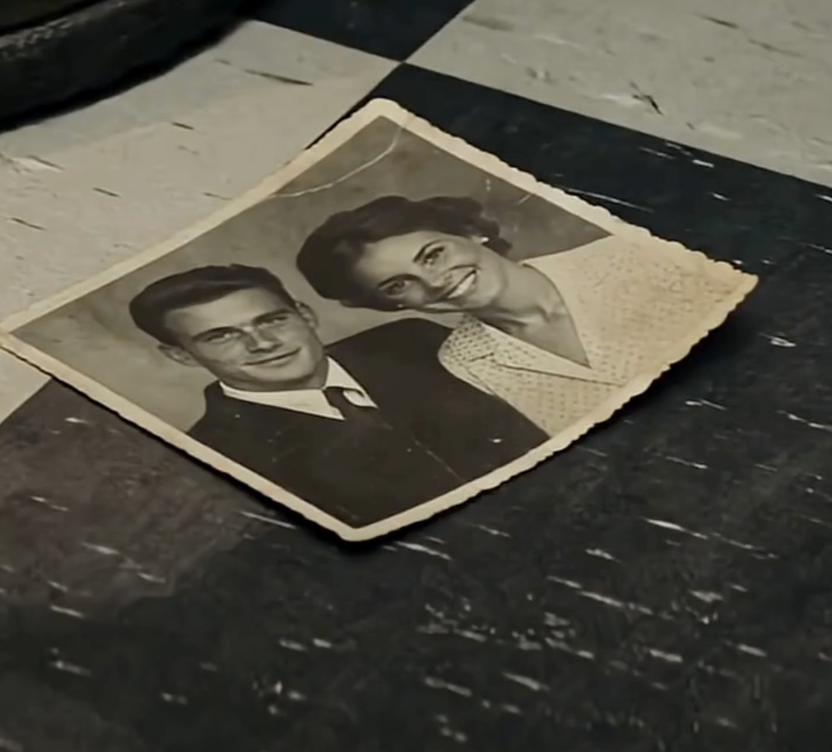
The diner sat on a dead stretch of two-lane blacktop like something the road had coughed up and forgotten. Neon in the window said EAT in letters that flickered every third pulse. Rain needled the glass. Inside, the air smelled of old grease, burnt coffee, and wet leather.
Silas “Reaper” Kane occupied the last booth, back to the wall, cut hanging open over a black thermal. The patch on his chest was faded almost to a bruise: a skull with a crown of thorns and the words FORSAKEN BROTHERHOOD beneath it. He was forty-one and looked older in the fluorescent light. Gray had started at the temples. A scar ran from the left corner of his mouth into the beard like a second, thinner smile that never moved.
He ate without tasting. Meatloaf, mashed potatoes, gravy that had skinned over. The fork made a small metallic sound each time it touched the plate. He had been riding twelve hours. The clubhouse in Flagstaff was another four if the weather held. He was not in a hurry. Hurry was for men who still believed the road owed them something.
The bell over the door gave a tired little jingle.
The man who came in was older than the diner. Seventy, maybe more. Rain had plastered thin white hair to his skull. He used a black cane with a rubber tip that squeaked on the linoleum. His left leg dragged. The right one took the weight like it resented the job. He wore a soaked gray overcoat that had once been expensive and a pair of shoes that did not match the coat. He looked at the counter, then at the empty stools, then at Silas’s booth as if choosing which disappointment to sit with.
He took two steps and the bad leg folded.
It was not dramatic. It was the quiet, ugly collapse of a body that had been arguing with gravity for years and finally lost. He hit the floor on his side. The cane clattered away. A wet cough came out of him.
Silas set the fork down.
He did not want to get up. Getting up meant touching a stranger. Touching a stranger meant questions, and questions had a way of finding the places in a man that still bled. But the old man was not getting up on his own. The waitress, a girl with a name tag that said DENISE, had frozen with a pot of coffee in her hand.
Silas slid out of the booth.
His boots were loud on the floor. He crouched. The old man’s eyes were open, pale and watery, not panicked so much as embarrassed.
“Easy,” Silas said. His voice sounded like it had been stored in a can. “I’ve got you.”
He got an arm under the man’s shoulders. The overcoat was heavier than it looked, soaked through. The old man smelled of rain and something medicinal, liniment or cheap aftershave trying to cover it. Silas lifted. The man was all bone and stubbornness. They got him sitting first, then standing, Silas taking most of the weight.
That was when the photograph fell.
It slipped from the inside pocket of the overcoat and landed face-up on the linoleum between them, a little curl of white at one corner where the paper had gotten wet.
Silas saw it the way a man sees a muzzle flash. Not all at once. In pieces.
Two people. A woman and a man. The woman laughing, head tilted, dark hair caught by wind that no longer existed. The man beside her younger, cleaner, almost smiling. His arm around her waist. Behind them a stretch of desert and a motorcycle that Silas recognized because he had sold it fourteen years ago.
He knew the dress. He knew the little silver pendant at her throat. He knew the date because he had taken the picture himself with a cheap camera bought at a gas station outside Winslow.
Mara.
His wife.
Silas did not pick the photograph up immediately. He stared at it on the floor as if it might change if he looked long enough. The old man was saying something—thank you, I think, or I’m all right—but the words arrived from a long way off.
Silas bent and took the picture between thumb and forefinger. The paper was thin, the colors faded toward amber the way old photographs do, as if time itself had a temperature. He turned it over. Nothing on the back except a faint pencil mark that might have been a date or might have been nothing.
He looked at it for a long time.
Two minutes. Three. The diner around him receded. Denise asked if everything was okay. Someone at the counter shifted on a stool. Rain hit the windows in sheets. Silas did not hear any of it the way a man hears the present. He was standing in 2012 again, Mara’s laugh still in the air, the desert smelling of creosote after a brief rain, Sophie asleep in the sidecar with a stuffed wolf under her chin.
Sophie.
He raised his eyes.
The old man was watching him with an expression that was not surprise. It was patience. The look of a man who had been waiting for this exact face to appear on another man.
Silas’s voice came out low.
“Where did you get this.”
It was not a question that expected an easy answer. It was the kind of sentence that used to come before someone got hurt.
The old man looked at the photograph in Silas’s hand, then at Silas’s face, then at the empty booth.
“We should sit,” he said. His voice was dry, used carefully, like a tool that had to last. “Before your hands start shaking enough that you drop it.”
Silas did not sit. Not yet.
“Where.”
The old man leaned on the cane. Water dripped from the hem of his coat onto the floor in a small dark circle.
“Your daughter didn’t die.”
The sentence landed in the diner and stayed there. It did not echo. It did not need to. It occupied the space between them the way a loaded gun occupies a table.
Denise had gone very still behind the counter. The cook, visible through the pass-through, had stopped scraping the grill.
Silas felt the old familiar heat start under his ribs, the one that used to mean a fight was coming and then, after Mara and Sophie, meant something worse: the moment before a man decides whether the world is still allowed to keep existing in its current shape.
He looked at the photograph again. Mara’s smile. His own younger face, the one that had not yet learned how to stay empty.
“Say that again,” Silas said.
The old man did not repeat it. He just stood there dripping, waiting to see whether Silas would hit him or listen.
Silas put the photograph in the inside pocket of his cut, over the heart, the way some men carry a spare magazine. Then he took the old man’s elbow—not gently—and steered him toward the booth.
“Sit.”
The old man sat. The cane hooked over the edge of the table. Silas sat across from him, back to the wall again, because some habits survive everything, even hope.
Denise approached like a person walking toward a dog that might or might not bite. “Coffee?” she asked.
“Leave the pot,” Silas said.
She left the pot. She left them alone.
For a while neither man spoke. The rain filled the silence. A semi passed on the highway and the windows trembled.
Silas took the photograph out again and laid it on the table between them, face up.
“That is my wife,” he said. “Mara Kane. She died in a fire in a house outside Holbrook in October of 2012. Our daughter Sophie was in that house. They told me both bodies were recovered. They showed me a closed casket and a death certificate and a plot in a cemetery I have not visited in nine years because if I stand there I will start digging with my hands.”
The old man’s eyes did not leave Silas’s face.
“They lied,” he said.
“Who.”
“The men who needed you to believe it.”
Silas’s right hand, under the table, had closed into a fist. He opened it slowly, finger by finger.
“You’re going to talk in complete sentences,” he said. “You’re going to start at the beginning. If I decide you’re running a game on a man who already lost everything, this conversation ends in the parking lot and you will not walk away from it. Do you understand me?”
The old man nodded once. A small, tired motion.
“My name is Arthur Vale,” he said. “I was a claims investigator for a company that no longer exists. Before that I was something else. In 2012 I was paid to look at a fire that did not behave like a fire. The official report said electrical. The official report was written by people who had already decided what the fire needed to be.”
He wrapped both hands around the coffee cup Denise had left, as if the heat could still reach him.
“There were two bodies,” Arthur said. “One was Mara Kane. The other was a child of approximately the same age and build as your daughter. The child’s dental records were incomplete. The child’s fingerprints were incomplete. The house had been searched before the fire department arrived. Things were missing that a fire does not take. A jewelry box. A stuffed wolf. A small backpack with a name written inside in marker.”
Silas did not move.
Sophie had a stuffed wolf. Gray, one ear chewed. She called it Smoke. She would not sleep without it.
“The second body,” Arthur said, “was not Sophie Kane.”
The meatloaf on Silas’s plate had gone cold. He pushed the plate aside.
“Then who was it.”
“A girl from a foster placement in Show Low. Six years old. Missing two days before the fire. Her name was not released because the people who arranged the substitution did not want two missing-child reports in the same week in the same county.”
Silas stared at him.
“You’re telling me they burned a house with my wife in it and put another child in my daughter’s place so I would stop looking.”
“Yes.”
“Why.”
Arthur Vale looked at the photograph.
“Because Sophie saw something she was not supposed to see. And because the men who needed her silent decided a dead child is quieter than a hidden one. A dead child closes a file. A hidden child is a problem that can still grow up.”
The diner’s fluorescent lights hummed. Somewhere in the kitchen a timer went off and no one moved to silence it.
Silas’s mind did the thing it always did when the world tilted: it went very clear and very cold. He saw the night of the fire the way he had seen it a thousand times. He had been in Nevada on a run. A phone call at 3:17 in the morning. A deputy with a practiced voice. The drive back through the dark with the speedometer buried. The house already a black skeleton. The smell.
He had identified Mara by a wedding ring that had survived. He had not been allowed to see Sophie. “The remains,” they said. “You don’t want that image.”
He had taken their word because taking their word was the only way to keep breathing.
“Where is she,” Silas said.
Arthur did not answer at once. He looked toward the windows, at the rain, at the empty lot where Silas’s bike sat under a leaking awning, chrome dull with water.
“Alive,” Arthur said. “As of six days ago. That is the last confirmation I have.”
“Where.”
“That is more complicated.”
Silas leaned forward. The table creaked.
“Uncomplicate it.”
Arthur Vale exhaled. It sounded like a man putting down a weight he had carried too far.
“After the fire, Sophie was moved. Not by police. Not by social services. By the same people who staged the scene. They put her with a couple in Utah for eleven months. Then the couple had an accident that was not an accident. She was moved again. New name. New records. She has had four names that I know of. The current one is not important yet. What is important is that two months ago she started asking questions that people in her position are not supposed to ask. She found a photograph.” He tapped the one on the table with one yellowed fingernail. “This photograph. A copy. She did not know who the man in it was. She only knew the woman looked like the face she sometimes saw in dreams she was told were nightmares.”
Silas’s throat had gone tight.
“How did she get a copy.”
“I gave it to her,” Arthur said. “Not directly. Through a dead drop and a woman who owed me a favor and is now also dead. I have been trying to reach you for three years. You are not an easy man to find when you do not want to be found. The Brotherhood moves. You move. I am old and I walk like this.” He glanced at the cane. “So I waited until the road brought you somewhere I could still reach.”
“You followed me.”
“I followed the weather and the rumor that Reaper Kane still ate in places with names like this when the club business was done. Tonight the rumor was correct.”
Silas sat back. The vinyl of the booth cracked under his weight.
Outside, a pair of headlights swept across the lot and kept going. Both men watched them until they were gone.
“Who wanted her silent,” Silas said. “Give me names.”
Arthur Vale’s mouth tightened.
“The fire was not club business,” he said. “Not Forsaken business. Not rival colors. It was cleaner than that and dirtier. There was a man named Harlan Crowe who ran transport through northern Arizona in those years. Legal on paper. The other kind off it. Your wife worked three months at a medical office that processed certain invoices. She saw a name she recognized from a conversation she was never meant to overhear. She told you she thought something was wrong. You told her to leave it. You were trying to keep the club out of federal attention. She did not leave it. She copied files. Sophie was in the back seat of the car the afternoon Mara met a man in a parking lot to hand those files over. Sophie saw faces. Sophie heard a name spoken like a threat. That night the house burned.”
Silas remembered the argument. He remembered telling Mara to stay out of things that did not have the club’s name on them. He remembered her face when she said, *Someone has to.*
He had been on the road the next night.
“Harlan Crowe is dead,” Silas said. He knew because he had looked, in the years when looking was all he had. “Car accident. 2015.”
“Harlan Crowe is dead,” Arthur agreed. “The people who sat above him are not. They have different letterheads now. Different offices. The same appetite. Your daughter is twenty. She has your jaw and her mother’s eyes and a habit of walking toward locked doors. That habit is going to get her killed if someone does not reach her first.”
“You.”
“I am a man with a cane and a failing liver,” Arthur said. “I can deliver a message. I cannot stand in a doorway when the wrong people come through it.”
Silas looked at the photograph. Mara laughing. The desert behind her endless and clean.
“You have an address,” he said.
Arthur Vale reached into the overcoat and took out a folded piece of paper, plain, no letterhead. He slid it across the table with two fingers.
Silas did not unfold it immediately.
“If this is a trap,” he said, “if you brought me here to put me on a list, you should have shot me in the parking lot. It would have been cleaner.”
Arthur almost smiled. It was not a pleasant expression.
“If I wanted you dead, Reaper, I would not have spent four years finding a diner you might walk into. Dead men do not collect their daughters.”
Silas unfolded the paper.
An address in Colorado. A name that was not Sophie Kane. A date—three days from now—and a time. A note in the same careful handwriting: *She works nights. She will be afraid of you. She has been taught to be afraid of men who look like the man in the picture.*
Silas read it twice. Then he put it in the same pocket as the photograph.
“Why now,” he said. “Why not five years ago. Ten.”
Arthur Vale looked down at his hands.
“Because five years ago I still thought the system that paid me might correct itself. Because ten years ago I still thought a hidden child was safer than a found one. Because last month a man I used to work with was found in a river with his tongue removed and a photograph of your daughter in his coat. Not this photograph. A recent one. They know she is looking. They know someone has been feeding her pieces of the truth. The window is closing. I am closing with it. So I came here to give a violent man a reason to be violent in the correct direction.”
The honesty of it sat on the table like another object.
Silas turned his coffee cup in a slow circle. The ceramic was cheap. A hairline crack ran from the rim.
“The Brotherhood,” he said. “This stays off the table until I see her. If I bring colors into this before I know what I’m walking into, I make her a target twice.”
“That is your decision.”
“It is.”
They sat with that.
Denise came back once, saw their faces, and retreated without speaking. The cook had turned the radio on low. A country song from another decade leaked through the pass-through.
Silas asked the questions that had to be asked. How Arthur had gotten the original photograph—Mara had given a copy to a friend before the fire; the friend had died of what the certificate called pneumonia; Arthur had found it in a box of things the friend should not have kept. How he had confirmed Sophie was alive—school records under the second name, a hospital visit at fourteen for a broken wrist, a driver’s license photo that Arthur had paid too much for. How close the other side was—close enough that Arthur had taken three different buses to reach this diner and had not used a phone in eleven days.
Silas listened the way he used to listen to a brother laying out a run: for the holes, for the parts that sounded too clean, for the fear underneath the facts.
There were holes. Arthur admitted them. He did not know who currently held the highest name. He did not know whether Sophie’s present guardians were protectors or jailers. He did not know if the girl who worked nights in Colorado would open a door for a man who looked like a ghost from a photograph.
“She may slam it,” Arthur said. “She may call the police. She may already be gone. I am giving you a direction, not a guarantee.”
“I’ve ridden on less.”
Arthur Vale studied him.
“You understand what happens if you go,” he said. “You do not get Mara back. You do not get the years. You get a young woman who has been told her father was either a monster or a corpse. You get people who have already killed to keep a story intact. You get the version of yourself that burned down with that house, and you will have to decide whether that version is allowed to finish what it started.”
Silas looked at the rain on the glass.
He thought of Sophie at five, sitting on the garage floor with a plastic wrench, “helping” him change oil, talking to Smoke the wolf as if the wolf had opinions about torque. He thought of the closed casket. He thought of nine years of rides that were only movement, of club votes he had cast with a dead man’s attention, of the way other brothers had stopped saying her name around him the way people stop touching a bruise.
He thought of Mara saying *Someone has to.*
“I’m going,” Silas said.
Arthur Vale nodded as if that had never been in doubt.
“Then you should leave before the weather turns worse. And you should not use the same roads twice.”
Silas stood. He put money on the table for food he had not finished and coffee that had gone cold. He looked at the old man still seated, still dripping a little into his own lap.
“You coming.”
Arthur shook his head.
“I have done the only useful thing I had left. After this I become a liability. Old men with stories get found. You do not need me found next to you.”
Silas hesitated. Then he took a napkin, wrote a number on it—not his, a burner the club kept for things that were not supposed to have names—and put it under Arthur’s saucer.
“If they come for you,” Silas said, “you call that. Someone will answer who does not care about letterheads.”
Arthur Vale looked at the napkin and did not pick it up. But he did not push it away.
Silas walked to the door. The bell jangled. The rain hit him like a second skin. His bike waited, black and dripping, the engine still holding a little heat from the ride in.
He did not look back at the diner windows.
He did look at the lot, the road, the dark beyond the neon. No extra cars. No silhouette that did not belong. That did not mean they were not already moving. It only meant they were not here yet.
He swung a leg over the bike. The cut settled against his back. In the inside pocket the photograph and the address sat together, two thin pieces of paper that weighed more than the machine under him.
He started the engine.
The sound filled the lot and then the highway, a low animal promise. He rode east because Colorado was east, and because for the first time in nine years the road was not just a way to outrun a grave.
Behind him the diner’s neon kept flickering.
Inside, Arthur Vale sat alone with the pot of coffee and the cane and the knowledge that he had just handed a grieving outlaw the one thing more dangerous than revenge.
A reason to hope.
And hope, in the kind of world that burns houses and steals children and writes tidy reports afterward, is not a soft thing.
It is a fuse.
Silas Kane rode into the rain with that fuse already lit, the photograph against his chest, and a daughter who had never stopped being six years old in his mind now twenty and somewhere ahead of him in the dark, still walking toward locked doors.
He did not know if she would recognize him.
He did not know if he would recognize himself when she did.
He knew only that the official story had been a lie, that Mara had been right, and that the men who had built the lie were about to learn what the Forsaken Brotherhood called a man who had nothing left to lose and suddenly, impossibly, something left to find.
Makes my heart glow knowing stories like this are finally telling the REAL stories about BIKERS!!
AWESOME group of folks!! Very giving and kind hearted!! Best group of Folks you will ever meet, unknown to most.
I am very grateful for being part of this world.
Thank you for the REAL stories!!