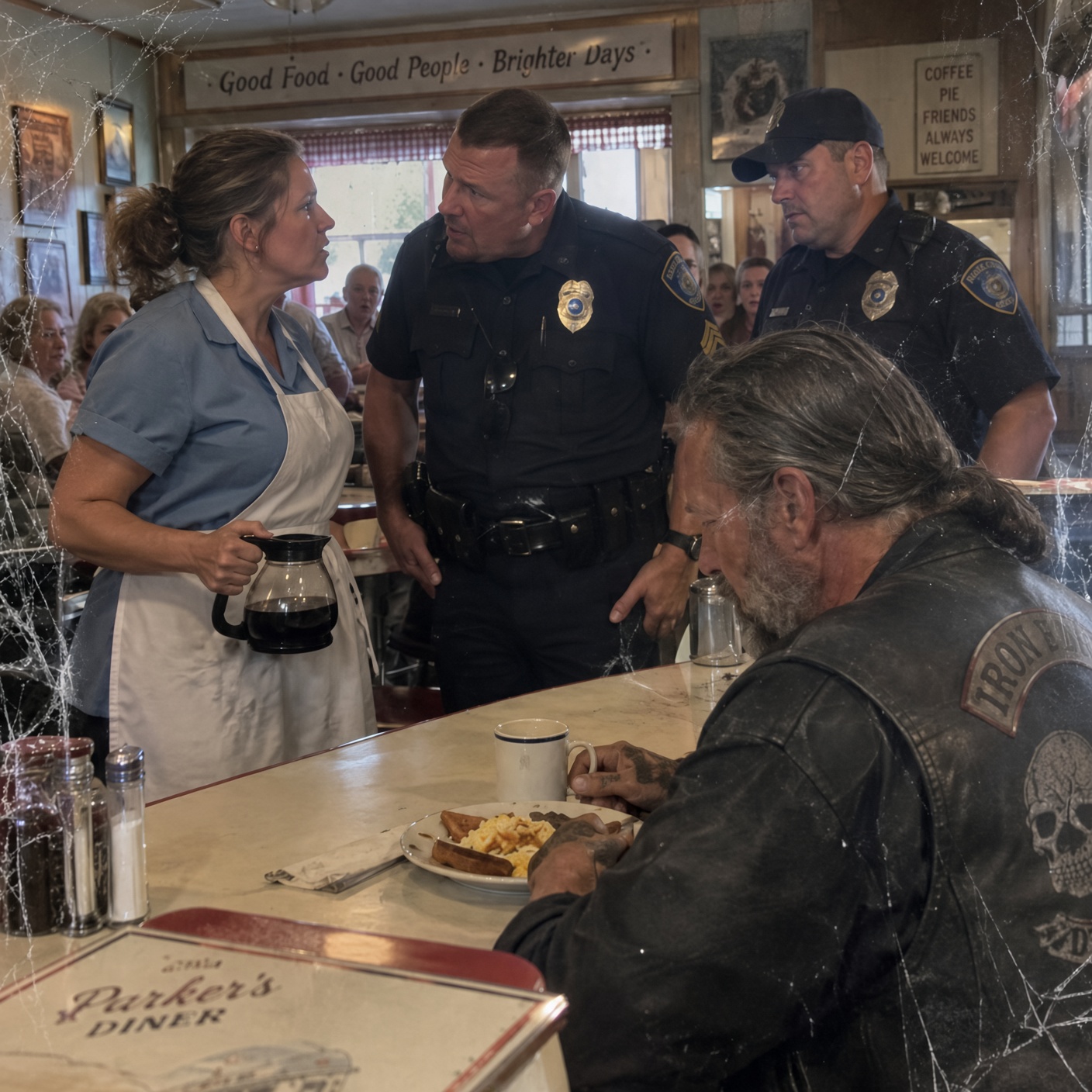
The diner went so quiet she could hear the fryer tick. Rain tapped the front windows in a thin, nervous rhythm. Haven’s Ferry was the kind of river town that remembered every rumor longer than it remembered kindness, and Deputy Harlan Pike liked that about it.
Pike leaned one elbow on the scarred maple counter like he paid the mortgage. His partner, Deputy Cole Brennan, sat two stools down and studied the sugar packets. Brennan never started the trouble. He just never stopped it.
At the last stool sat a man in road-worn black leather. Broad as a barn door. Gray in a short, rough beard. Dust on his boots. One big hand wrapped around a chipped mug as if it were the last warm thing he had touched in days. On the back of his vest was a club patch. Not Army. Not church. The kind of stitching that made decent people in Haven’s Ferry look at their plates.
Pike smiled with his teeth.
“You want to say that again, Mara?”
She set the pot down. Her fingers shook once. Only once.
“I said he’s eating in my diner. He’s done nothing. If you’re not here for food, you can go.”
Pike’s laugh was a short, ugly sound. “Your daddy ran this place with more sense.”
That one landed under her ribs, exactly where he meant it.
Walt Ellison had built The Copper Kettle with his own hands thirty-nine years earlier. He had flipped eggs through ice storms, funerals, and the year the river took half the lower street. He had raised Mara in the window booth with crayons and a little brass bell that still rang every time the door opened.
Now he lay in a narrow bed at Riverview Care after a stroke that stole most of his speech and left him fighting for every word.
Pike knew it. Everybody in town knew it.
Mara’s face burned. She did not move.
“My father taught me not to judge a man by his jacket,” she said. “He taught me to watch what he does. This customer has been polite. You haven’t.”
Brennan shifted. Pike’s jaw tightened.
The biker lifted his eyes. Pale gray. Exhausted. Not wild. Just wrung out, like somebody had squeezed him empty and set the shell down with eggs and bad coffee.
“I can go,” he said. The voice was low and careful, the voice of a large man who had learned what his size did to rooms.
“No,” Mara said. “You can eat.”
She looked at Pike. “He stays.”
For a second she thought Pike would push it. He had that look small men get when the room stops obeying. Then he slapped bills on the counter.
“Lost my appetite.”
He pointed two fingers at the man in leather. “Keep moving when you’re done.”
They left under the jingle of the bell. Nobody spoke until the cruiser’s taillights disappeared into the rain.
Mara turned back. “I’m sorry.”
He shook his head once. “Don’t be.”
Up close she saw what she had missed: raw scrapes across the knuckles, a faint hospital band tucked under a cuff, a tremor when he reached for the fork, eyes that had not closed in a long time.
“You headed somewhere?” she asked.
He swallowed. “Mercy Regional. Lexington.”
A pause.
“My daughter’s there.”
Four words. A whole weather system inside them.
Mara had spent seven years as a floor nurse before she came home to run the diner after Walt’s stroke. She knew waiting-room coffee at three in the morning. She knew the way a parent said my daughter like prayer and wound at once.
“How old?”
“Nineteen.” His thumb pressed hard into the mug handle. “Stage four. They started a last-shot trial yesterday.”
She felt her chest tighten. Not because she knew him. Because she didn’t, and the honesty still stripped him to bone.
“I’m Mara.”
“Jack Harlan.”
She slid the check away. “Lunch is on the house.”
“No.”
“It is today.”
He set a wrinkled twenty by the napkin holder. “For your dad.”
The way he said dad was not polite. It was recognition.
He stood. Every eye followed him to the door. Twenty-two years earlier a pack of riders had torn through Haven’s Ferry on a drunk July weekend, smashed the old feed-store window, and left a story that the town had retold until it hardened into fact. After that, every patch looked the same. Every beard meant trouble.
Jack stopped at the threshold.
“You didn’t have to do that.”
Mara thought of the electric bill in her purse. The mortgage notice under it. The way the town had been shrinking one closed mill, one dark porch light at a time. Her father in that narrow bed.
“Yeah,” she said. “I did.”
He nodded once and walked into the rain. The bell sounded lonelier than it should have.
By closing, half the town had heard. By supper the other half had opinions and carried them through her door like wet coats.
Daisy, the part-time waitress barely out of high school, dried forks and finally asked what everyone else was thinking.
“You think those deputies are gonna make it hard?”
Mara stacked cups. “People already are.”
That night she drove to Riverview. The hall smelled of lemon cleaner and the kind of sadness no mop could lift. Walt was awake. One side of his face drooped. Words came through mud. His eyes were still his.
She took his hand. “You would’ve told me to stay out of it.”
A sound that might have been a laugh.
She told him everything: Jack, the hospital band, the frozen room, Pike using Walt’s name like a blade.
When she finished, Walt squeezed her fingers. Weak. Clear.
Yes. You did right.
She cried for one minute. Then she kissed his forehead and drove home with her jaw locked.
Morning. A paper taped to the front glass.
CLOSED UNTIL FURTHER NOTICE
NO BIKER LOVERS IN HAVEN’S FERRY
Shame hit first. Anger burned it off. She tore the sign so hard it split. Across the street a neighbor pretended to sweep the same two feet of sidewalk.
Inside, she started the coffee and told herself she would get through breakfast. Then lunch. Then the next hour. That was how people survived.
Breakfast was thin. Lunch was worse. People she had known since grade school drove past. A contractor who ate chicken-fried steak every Tuesday parked, stared at the window, and left. Two church women ordered tea and watched her like she had invited a flood.
A few good ones came. Miss Ruthie Colton, seventy-nine, lipstick still perfect, patted Mara’s wrist. “Cowards get loud in packs.”
Bo Caldwell from the body shop sat in the front booth on purpose and said, loud enough for the street, “Best gravy in three counties didn’t change overnight.”
Support did not pay the meat man.
By two the place was empty. Mara opened the ledger she already knew by heart. Another week and she would miss the power bill. Ten more days and the supplier would cut her. After that the building, the name, the only room that still felt like home.
She braced both hands on the counter and bowed her head.
The bell rang.
A man in his fifties stood in jeans and a dark shirt, leather jacket folded over one arm, a small winged patch on the sleeve. Beside him a woman with a long silver braid and eyes kind enough to make Mara wary.
“Mara Ellison?”
She nodded.
“Cal Harlan. Jack’s brother. This is Nora.”
Grief recognized grief. The sharp edge of curiosity was missing.
“How’s Jack?”
Cal exhaled. “Hasn’t left the hospital except to shower and ride a few miles so he can think.”
“And Tessa?”
Nora’s face softened. “She made it through the night. Doctors won’t promise, but her numbers moved the right way this morning.”
Mara put a hand over her heart.
Cal looked at the empty booths, the full pot, the silence.
“Jack told us what you did.”
“It wasn’t much.”
Nora held her gaze. “No. It was.”
Cal started to reach into a pocket, then stopped. “We’re not here to insult you with cash. Jack said you’re proud. Said you’d throw me out if I waved it around.”
Despite everything, Mara laughed. “Depends how dramatic you were.”
A small smile. “Good. Then we do it another way.”
The windows rattled.
Not thunder. Engines.
One motorcycle is noise. A dozen is a statement. What rolled onto Main Street sounded like weather with chrome teeth.
Bikes from both directions. Touring rigs. Old stripped frames. Fresh paint and no paint. Men, women, gray riders, young ones, heavy, slight, bandanas, denim, army jackets, patched vests. They filled the curb, the side lot, the church overflow gravel, the alley. More kept coming.
“Cal,” Mara whispered. “What did you do?”
“Not me.”
Nora smiled. “Word travels.”
“There have to be two hundred people out there.”
“Two hundred nineteen,” Nora said. “I like numbers.”
Engines died. The silence after was almost worse. Helmets came off. The first three riders entered like they were stepping into somebody’s living room: a woman with a thin scar along her chin, a giant with white in his beard, a younger man with ink disappearing under his sleeves. Gloves off. Waiting.
“You Mara?” the woman asked.
“Yes.”
“Violet. We came to eat. Thank you for looking after one of ours.”
They filtered in. Not rowdy. Hungry. Careful. An older rider set a twenty on the register before he sat. “For the coffee.”
“You haven’t had any.”
“I’m optimistic.”
Five minutes and every booth, stool, and sliver of standing room was taken. Mara looked at the kitchen, then at Cal.
“I don’t have enough bacon in this building.”
“Already handled,” Nora said, lifting her phone. “Distributor. Warehouse two counties over. Two grocers. Truck’s ten minutes out.”
“I didn’t ask.”
“You asked for nothing. That’s why.”
The truck came in twelve. Daisy ran in from her other job with wet hair. Two weekend high-school girls appeared in panic sneakers. Cal tied on an apron. Nora worked the register, then plates. Violet bussed between bites of meatloaf. The giant—Big Red—asked where the trash bags lived.
Nobody posed. They worked. They ate. They tipped. They said thank you until the words wore thin and still meant something.
One older rider bowed his head and prayed for Walt Ellison by name because Jack had told them. That nearly undid her.
Outside, Main Street filled with townspeople under awnings, pretending errands. Some nervous. Some angry. Some unable to look away. Kids tugged toward the bikes. Deputy Brennan stood across the street with a radio and the face of a man watching a situation outgrow his opinions. Pike was not with him. Men like Pike liked small rooms and private wins.
Around three-thirty Miss Ruthie came back with her sister. Bo returned with his wife. The high-school principal “just to see.” The pastor’s boy. A farm couple from the ridge.
A rider stood and gave an older man his booth because the man’s knees were bad. Another told a little boy he could sit on a bike later if Mama said yes. The story the town had repeated for twenty-two years began to crack—not from speeches, from ketchup, from pie, from a tattooed woman named Alma who had spent fifteen years as an ICU nurse talking shop with Daisy.
Miss Ruthie ended up quilting patterns with a grandmother from Indianapolis. Bo found a Vietnam veteran in a faded vest and they named dead friends in that dry, quiet way older men cry. The principal talked welding with a community-college instructor in leather.
Late light on the floor. The bell again.
Jack Harlan walked in.
Still exhausted. Less hollow. A thin line of hope where dread had been.
The room noticed. Quiet, not fear. Recognition. Riders touched his shoulder. He went straight to the counter where Mara stood with coffee on her apron and flour on her cheek.
“You did all this?”
“I made a couple calls.”
“Jack.”
One side of his mouth lifted. “Maybe more than a couple.”
“You brought half the state.”
“Only the ones who could make it.”
He looked at her like the answer should have been obvious. “Yesterday I walked in looking like trouble and feeling like death. You were the only one in that room who saw a father.”
She had to look away. When she looked back his eyes were wet.
“Doctors called. Tessa responded better than they expected. She’s not out. I know that. But for the first time in a long time the news wasn’t bad.”
Something in Mara gave. She came around the counter and hugged him before she could think. He froze, then his arms came around her, big and careful and shaking. In a room full of riders and townspeople and pie plates, nobody spoke.
When she pulled back he wiped his face. “Tessa wants to meet you. I told her about the diner woman who scared two badges more than I ever could.”
“That is not what happened.”
“It is in my version.”
The room loosened. A little girl pressed her nose to the glass. A rider outside made a face until she giggled.
By sunset the lot looked like a county fair with better engines. Someone fired a portable grill. Bluegrass leaked from a saddlebag speaker. Neighborhood kids ate fries on the curb while their parents pretended not to enjoy themselves. Even some who had muttered ugly things that morning found reasons to stay. Curiosity outlasts pride more often than people admit. Fear thins when the person you were told to hate asks politely for extra pickles.
Near seven a man they called Bear from the Kentucky chapter handed Mara an envelope.
“I’m not taking charity.”
“This isn’t. Every rider paid for a meal. Some paid for three. Some paid for the next person. A few took rooms at the highway motel and left extra for breakfast. This is called customers.”
She looked inside. Sat down hard on a stool. More than she had made in two weeks. Enough for the power. Enough to breathe.
Through the window she saw Pike at last, half a block away by his cruiser, rigid as a fence post. Not brave enough to come in. Not with that chrome wall between him and the day he had wanted.
She went back to pouring coffee. Some victories do not need an audience.
Near closing a senior rider tapped a spoon against a glass. A broad man with a heavy silver beard rose from booth six. Face people probably crossed streets to avoid. Eyes warm.
“Dutch Rourke,” he said. “Regional road captain, which mostly means this room listens when I stand.”
He looked at riders, townspeople, Mara.
“We’re not here to make anybody nervous. We’re here because one of ours walked into this town carrying enough grief to drown a man, and this woman treated him with dignity when it would have cost her less not to.”
Silence. Even the kitchen.
“Folks see leather and patches and write whole novels. Sometimes we earn pieces of those stories. Sometimes we don’t. Anybody with a little age knows this: you learn more about a soul by how they treat somebody powerless than by what they say in church or online.”
He glanced at the windows where half of Haven’s Ferry still hovered.
“Mara Ellison stood up for a stranger. We don’t forget that. The Copper Kettle has friends on the road now. We’ll stop when we ride through. We’ll send people. We’ll bring business. And if anybody thinks about punishing this woman for serving food to a paying customer, they should remember something.”
A small smile.
“Respect travels too.”
Applause. Real. Not only the riders. Some townspeople clapped before they realized they were doing it.
Mara cut more pie because she did not know what else to do with her hands.
One by one they thanked her. Cards from shops, routes, cafés in other states. A woman hugged her and whispered she hoped Walt had a good day tomorrow.
Jack was among the last. Helmet under his arm.
“Visitation starts early.”
“Tell Tessa she’d better keep fighting. I still owe her pie.”
“She’s stubborn.”
“Good.”
He touched two fingers to the counter in a quiet salute and walked out under the bell.
After midnight Mara sat in the office and counted. Once. Twice. A third time because Walt had always said numbers deserved respect. The money was real. Stranger than the money was the feeling in the room. The diner remembered what it was: a place where strangers sat down hungry and left a little less alone.
She drove to Riverview. The night nurse smiled. “You look like somebody put air back in you.”
Walt was awake. Moonlight striped the blanket. She took his hand and told him all of it: the sign, the empty booths, Cal and Nora, the engines, the truck, the money, the applause, the quilting grandmother, the two veterans, the whole impossible mess.
He worked his mouth and pushed out two rough words.
“Proud… girl.”
She broke. Not loud. All at once. He stroked the back of her hand with his thumb, clumsy and huge.
Morning. A package against the door. Inside, a custom black vest.
THE COPPER KETTLE
FRIENDS OF THE ROAD
A note in rough handwriting:
For the bravest cook in Kentucky.
Tessa’s numbers are still rising. She asks every hour when she gets to meet you.
—Jack
Mara held the vest against her chest while the town woke. People did not stare the same way. Some still unsure. A few embarrassed. A few stubborn. Something had shifted. In a town that size, the story changing matters more than almost anything.
She hung the vest behind the counter beside Walt’s old stained apron. Cotton and leather. Grease and road dust. Two lives that should not have touched. Until they did.
At eight-fifteen Deputy Pike walked in. Alone. No smirk. A man who had slept badly.
Daisy went stiff. The room quieted, but not like before.
“Coffee,” he said.
She poured the same mug she gave everybody.
He cleared his throat. “I may have misjudged that situation.”
Not much. Probably the best he had.
Mara looked at him a long time. “My father used to say you can learn a lot about a person by what they do after they’ve been wrong.”
He nodded once. Left a five for a two-dollar coffee. Sat by the window. Nobody clapped. The moment was not for triumph. It was for proof that people can still choose differently after making a mess.
Three days later Mara drove to Lexington with two apple pies on the passenger seat and a knot in her stomach. Jack met her in the lobby. Cleaner. Still tired. Lighter.
Tessa Harlan was thinner than Mara expected. Nineteen, illness shaved down to something almost childlike under the blankets. No hair. Skin pale. Eyes bright as sparks.
She grinned. “So you’re the diner lady.”
Mara laughed through the sting. “And you’re the reason your dad scared half of Haven’s Ferry.”
“He does that in most zip codes.”
Jack groaned. “Thanks, kid.”
Lisa set the pies down. Tessa stared. “Marry me.”
They laughed in a room full of machines and one fragile thread of hope, and something settled in Mara. Not a giant lesson. Just this: people are not always the worst thing you heard about them. Sometimes the roughest hands hold the gentlest hearts. Sometimes the town that shames you on Tuesday eats pie beside your new friends on Wednesday. Sometimes courage is a waitress with overdue bills saying enough. A grieving father getting on his bike anyway. A daughter asking for pie while poison drips into her veins. Choosing not to turn away.
Weeks later the diner was busier than it had been in years. Not every day was a miracle. Bills still came. The fryer still sulked. The roof still leaked over booth four when rain came hard from the west. Walt still had good days and bad. Tessa still had a long fight.
But every Friday riders began to pass through. Six. Twenty. One old woman on a purple touring bike who tipped like a queen and wanted extra pickles. Locals came too—some curious, some ashamed and not knowing how else to repair it except by showing up hungry and behaving better.
The Copper Kettle became what Walt had always believed a diner could be: a room bigger than fear. A place where the first question was whether a person needed coffee, not whether they fit somebody else’s comfort.
On the wall the apron and the vest hung side by side.
Every time the bell rang, Mara looked up. Not with dread. With curiosity.
Because the whole town had learned what she learned in one hard afternoon:
You can ruin a place by deciding who belongs before they even sit down.
Or you can save it with one cup of coffee, one clean plate, one stubborn act of human decency at a time.