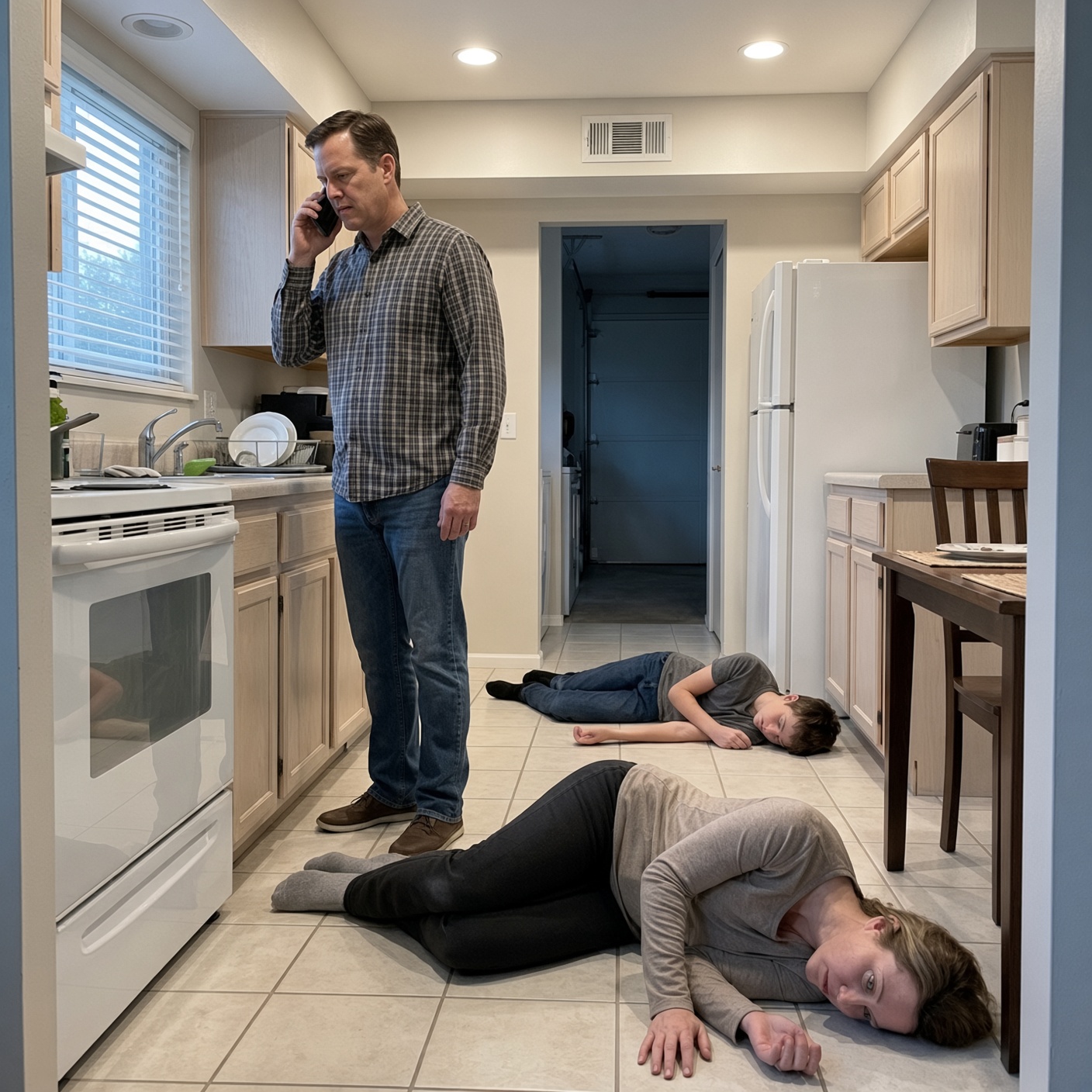
I kept my cheek against the cold kitchen tile and forced my breathing to stay slow.
A few feet away, my son Noah laying on the floor unconscious. I watched the faint rise of his ribs and counted it the way you count a lighthouse, not because the counting changes the dark, but because it gives the dark a shape you can survive. Three breaths. Then I let myself look toward the hallway where Daniel had disappeared.
His voice carried from the den. Low enough that I lost whole phrases to the dishwasher’s last tired cycle. Clear enough, when it wanted to be, that I will hear it for the rest of my life.
“It’s done,” he said. A pause. A smaller sound, like a man shifting a phone against his shoulder. “Soon they will both be gone.”
Another pause.
“They won’t be a problem after tonight.”
I let my eyelids close again when his footsteps came back toward the kitchen. The tile had already stolen the warmth from my skin. My mouth felt dry enough to hurt. Every instinct I owned wanted to sit up, to put my body between Daniel and Noah, to make a sound that would split the house open. I did none of those things. I had heard the sentence. I had understood the sentence. Understanding, in that moment, was not comfort. It was a set of instructions.
Daniel entered the kitchen and stopped beside me. I kept every muscle loose. I thought of sand. I thought of laundry left in a basket. I thought of anything that did not resist a hand.
He lifted my wrist for a moment, two fingers searching for the proof he wanted, then lowered my hand to the floor with a care that made my stomach fold. Care, I learned then, is not the opposite of harm. Care can be the method.
When he crossed to Noah, I did not turn my head. The urge was a live wire. I let it burn and did not move.
Daniel touched Noah’s shoulder.
“This will be easier for everybody,” he said, almost kindly, the way he used to say it was time to turn the light off after one more page.
I heard him collect something from the table. Ceramic whispered against wood. Then he walked away again. The garage door motor engaged, that long mechanical complaint the house had made for years, and only when it finished did I open my eyes.
Noah opened his at the same time.
There is a look children get when they have decided, without language, that the rules of the room have changed. Noah had that look. I raised one finger to my lips. Then I pushed myself onto my elbows even though my arms shook as if the bones inside them had been replaced with wire.
Noah tried to sit. I caught his sleeve before the chair could knock the cabinet.
“Phones,” he whispered.
I checked my pocket first. Empty. The counter where my phone usually sat beside a chipped bowl of mail was bare except for the charging cord, a little white tail attached to nothing. Noah’s was gone from the hook by the calendar. Daniel had not hidden them badly. He had not needed to. He had simply removed the ordinary exits.
Noah reached toward the table. I stopped him.
The blue plate was still there.
Daniel had served me on that plate for no reason I had ever asked about. It was the one with the thin gold rim that had survived three moves and a cracked cousin. Several bites of dinner remained on it, sauce beginning to dull at the edges. I stared at it the way you stare at a door that should have been locked.
If he needed us gone, and if he had already taken the phones, then whatever was left on that plate was not leftover. It was a sentence he had not finished erasing.
I pulled open the freezer drawer beneath the refrigerator. Cold air hit my knees. My heel caught a grocery receipt on the floor—milk, onions, the fish he had complained about in the aisle—and I shoved the useless strip of paper under the cabinet because my hands needed something ordinary to do or they would announce themselves by shaking apart.
I took a clean freezer bag from the box in the drawer. Noah held the drawer so it would not shriek. I scraped a portion of the untouched food into the bag without rearranging the rest of the plate. The plastic sealed with a small, final sound. I pushed the bag behind a half-empty package of frozen peas, then thought better of leaving it there while we were still in the house, then left it there anyway for one more minute because I needed both hands.
I returned the blue plate to the exact spot where Daniel had left it.
Then I opened the narrow cabinet beside the pantry and reached behind a stack of old takeout menus, a rubber-banded sheath of expired coupons, a manual for a blender we no longer owned. The corded phone was there. Cream plastic gone the color of old teeth. The cord kinked in two places. Daniel had called it a fire hazard, an antique, a thing that made the kitchen look like his mother’s. He had wanted it disconnected for months.
The dial tone was there.
I have heard orchestras. I have heard Noah laugh in another room. Nothing has ever sounded as much like a future as that ugly electronic bleat.
I called 911.
I gave our address first, because an address is a door, and a door is what we needed more than a speech. Then I told the dispatcher that my son and I had collapsed after eating the same dinner, and that my husband had spoken as if he expected us not to wake up. I used the words I had. I did not decorate them.
When she asked where Daniel was, I said I believed he had gone outside, but I could not tell whether he had actually left the property. The driveway was a blind spot from the kitchen. The side yard was another. A man who has just told someone that two people will not be a problem after tonight does not have to go far. He only has to wait.
I kept the receiver against my ear while Noah crawled to the window and lifted one corner of the blind. Streetlight. Wet asphalt. No silhouette I could name.
He looked back at me and shook his head.
The dispatcher wanted me to stay on the line. I told her I could not promise that. I told her we would move toward the back door if we could do it safely. I hung up only after she said help was coming, because a live line can also be a beacon, and I did not know who else might be listening in a house Daniel had arranged.
Noah wanted to run immediately. Running is what the body begs for when the mind has heard *soon they will both be gone*. I made him wait. I opened the freezer again, took the sealed bag from behind the peas, and tucked it inside the waistband of my sweatpants, under my shirt, flat against skin that still did not feel entirely like mine. If we left, the bag left. If we did not leave, the bag still left the drawer he had never bothered to open.
I checked the hallway.
Empty.
I helped Noah stand. His knees buckled once, and I caught him against the refrigerator until he could put weight on both legs. We crossed the kitchen slowly, his fingers around my wrist, my other hand on the counter because the floor still felt like a suggestion rather than a fact. I unlocked the back door. Night air came in, damp and ordinary, smelling of wet mulch and someone else’s dryer vent.
Then headlights swept across the blinds.
I shut the deadbolt again. I pulled Noah away from the glass.
“Floor,” I whispered.
He dropped beside his chair. I lowered myself back onto the tile and arranged his arm almost exactly where it had been, because Daniel had looked at us once already and men like Daniel notice when a picture has been disturbed. I slid the blue plate two inches closer to my place setting. I flattened my palm beside my face. I closed my eyes.
A car door closed outside.
Keys scraped the lock.
The back door—no. The front. I had been wrong about which door he would use, and the error was almost expensive. He stepped into the kitchen.
Daniel had not come back to check on us.
He went straight to the sink, grabbed the blue plate, and slipped it into a trash bag while Noah and I stayed motionless on the floor. Water ran. The disposal growled for a second as if he had fed it something it did not like. A cabinet closed. He never opened the freezer. He never looked at the peas. He never looked at the waistband of my sweatpants.
I listened as he carried the bag toward the garage.
His voice again, into the phone, smaller now, pleased with its own efficiency.
“I cleaned everything up.”
Then the distant sirens became loud enough for him to hear.
Daniel stopped.
I opened my eyes.
When he turned back toward us, Noah was already sitting up.
Daniel stared for half a second. In that half second the real face showed—not grief, not confusion. Offense. The look of a man whose evening had declined to follow the outline he had written for it.
Then his voice changed completely, as if someone had handed him a different script and he was a better actor than I had ever given him credit for.
“Thank God,” he said. “I thought you both fainted.”
I said nothing.
By the time the paramedics entered, he was already translating us into a story other people could carry without dropping it. I had been exhausted lately. I might have confused my medication. Noah had a sensitive stomach. Dinner had been rich. He had only stepped out because he panicked, because he was trying to get help, because a father does what a father can.
I interrupted once.
“Same dinner,” I said. “Same time. Test both of us.”
The paramedic looked at Daniel, then at me, then at Noah, whose lips were the wrong color around the edges. That look—the first look that did not belong to Daniel’s version—was the beginning of the rest.
At the hospital the lights were the kind that make every face look guilty of something. Noah sat on the edge of an exam bed with a blanket around his shoulders and watched the doorway as if the night might still walk through it wearing our last name. An officer waited near that doorway without leaning on the frame. Daniel stood where a concerned husband is supposed to stand and spent the minutes repeating himself with the patience of a man who believes repetition is a kind of proof.
The first screening showed a sedating drug in both our systems that neither Noah nor I had been prescribed.
Daniel’s version of the evening acquired a problem it could not charm.
Before anyone could ask where the food had gone, I pulled the sealed freezer bag from beneath my shirt and placed it in the nurse’s gloved hand.
The room changed.
Not the temperature. The authority in it. Daniel had spent the drive assembling reasonable sentences. I was tired. I mixed something up. We both reacted badly to dinner. Reasonable sentences are a kind of fog. Evidence is a window.
The doctors did not need his weather report.
They needed what he had failed to throw away.
I watched him realize it. I watched the calculation arrive too late. I have lived with that face across breakfast tables and parent-teacher nights and the small negotiations of a shared life. I had never seen it fail in public. There is a particular stillness that comes over a person when the story they brought into the room is no longer the largest object in the room. Daniel found that stillness and tried to smile his way out of it. The smile did not take.
What happened next went far beyond anything I could have imagined when I first set my fork down.
Not because the night became a movie. Because it became paperwork, and fluorescent rooms, and questions asked twice, and a child who wanted to know whether we were going home, and a house that looked exactly like itself while meaning something else. Because the ordinary objects of a kitchen were promoted, against their will, into a kind of testimony. Because I learned how much of a marriage can look like care while it is arranging an ending.
To understand the plate, you have to understand the dinner that preceded it, and to understand the dinner you have to understand how skillfully a life can look unthreatened.
That night the kitchen light was the same warm yellow it had been since we painted the walls a color the can had called *oat*. The dishwasher ran. Rain started and then changed its mind, leaving the windows dotted. Noah was talking about a science project—magnets, iron filings, the way a hidden force can make a scatter of metal choose a shape. He used his hands when he explained it. He always had. I remember thinking, with the idle love of a parent who believes the evening will remain an evening, that he would be the kind of adult who still talks with his hands.
Daniel moved between the stove and the counter like any other husband preparing a family meal. He complained about the grocery store being crowded. A woman with a cart across the aisle. The price of the fish. The way people no longer knew how to stand in line. A normal complaint. The kind you forget before the plates are rinsed.
That was what made the collapse so difficult to hold in the mind afterward. Nothing on the table had looked like a weapon. The napkins were the napkins. The salt was the salt. Daniel asked Noah about school with the interest of a man who intended to still be asking next week.
I remember setting my fork down because the metal grew heavy in a way metal should not. I looked across at Noah and saw confusion arrive on his face a half-second after it arrived on mine, as if we had both heard thunder in a clear room. Then the kitchen shifted. Not spun. Shifted, the way a hanging picture shifts when someone takes it down and returns it a fraction wrong.
My cheek found the tile.
I could hear. I could feel. I could not make my body keep the promises it had kept all my life.
After that, every second became a choice disguised as stillness.
People like to imagine courage as motion. That night courage was the decision not to move when movement would have taught him we were still in the conversation. I stayed still when he checked my wrist. I stayed still when he spoke gently to Noah. I stayed still because gentleness, I finally understood, was not a contradiction of what he was doing. It was the finish on the wood.
When we called for help I did not know if he was in the driveway with the engine running. I did not know if he was at the end of the block. I did not know if the person on the other end of his call was a voice or a plan or both. I knew only that Noah and I had to remain in the world long enough for other people to reach the door.
The bag against my skin was cold at first, then only a fact. Facts are easier to carry than interpretations. I did not need, in those minutes, to understand why a man who had once assembled a crib with an instruction sheet and a great deal of swearing would now speak of us as a problem to be cleared. Why is a long hallway. We needed a room with a lock and a clock that still belonged to someone else.
The investigation treated the kitchen as if it were a body, which in a sense it was. Detectives photographed the table, the cabinet, the freezer, the ugly phone, the grocery receipt I had kicked under the cabinet with a heel that had needed a task. They asked about the trash bag. They asked about the plate. They asked about the time between the garage door and the returning headlights. They asked Daniel why a man who believed his wife and child had fainted would first dispose of dinner.
Every answer he gave created a doorway into another question.
They asked about money. They asked about a policy I had not thought about since we signed it in an office with a fake plant. They asked about a number that appeared in his phone with a regularity that was not the regularity of a colleague. I learned these things the way you learn a language from closed doors: incompletely, and then all at once.
Noah and I did not go home at first. A cousin’s spare room with a quilt that smelled of cedar. Then a hotel where the ice machine made a sound like a distant accident. Hospital silence is full of machines agreeing to continue. Hotel silence is a blank page you are not ready to write on. Noah asked if we were going back. He asked in the morning with cereal. He asked in the afternoon when the light went gold and made the parking lot look almost kind. He asked in the dark with a seriousness that did not belong to the age of science projects and iron filings.
I did not have an answer that was both true and merciful, so I gave him the true one in pieces. Not yet. Not until the house was finished being asked questions. Not until I could walk into the kitchen without seeing the tile first.
A house can look exactly the same after something terrible happens. That is one of its talents. The same walls. The same cups, including the one with the chip I had refused to throw away because the chip had a date attached to it, a Sunday, a small argument about nothing that had ended in cheap wine. The meanings change. Objects are loyal to their new jobs.
The corded phone was no longer clutter. It was the reason a stranger’s voice had sent lights down our street. The freezer was no longer a place for peas and the forgotten end of a loaf. It had been, for a few minutes, the one room in the house Daniel’s planning had not entered. The blue plate was no longer a plate. It was a timeline. It showed what had been served. It showed what remained. It showed that a man trying to erase an evening can leave behind the one detail the evening required him to remove.
I thought often of Noah’s magnets. A hidden force. Filings choosing a shape. Daniel had believed he was the magnet under the paper. He had not accounted for the paper being lifted. He had not accounted for a child who would open his eyes at the same instant I opened mine. He had not accounted for a phone he found embarrassing. He had not accounted for the possibility that I would hear *it’s done* and decide that done was not a fact yet.
There were nights I woke certain I was still on the floor. There were mornings I reached for a phone that was not on the nightstand and felt the old spike before memory caught up. Noah had dreams he would not describe, and one he did: the blue plate sliding toward the edge of the table and never falling. I told him some images stay because they did work the night they were made. I told him he did not have to carry the plate anymore. The file could carry it.
Daniel’s lawyer used the word *alleged* the way some people use a coat in thin rain. Daniel himself used fewer words than I expected when procedure put us in the same fluorescent weather. When he did speak, he spoke as if I had misunderstood a gesture. As if a sedating drug in a child were a kind of marital miscommunication. As if the freezer bag were a theatrical prop I had invented out of stress. He was very good at sounding like a man surrounded by hysteria. That skill had probably been useful for years in smaller rooms.
I did not debate him in hallways. Debate is a duet. He had had enough music from me. I let the lab speak. I let the dispatcher’s recording speak. I let the photograph of the table speak. My work was narrower and harder: to remain a person Noah could look at without seeing only tile.
Months later I walked into the kitchen for the first time without a detective’s shoes on the grout.
The room looked ordinary. That was the obscenity and also the relief. The counter was clean. Someone—my sister, I think, who believes in the moral power of lemon oil—had rubbed the table until it remembered only polish. The lights worked. The cabinet still held the corded phone. I opened the door and looked at it for a long time. I did not pick it up. I touched the cabinet door and left it where it was.
Some things do not need to be replaced.
Some things remain because replacement would be a kind of courtesy the night did not earn.
The blue plate was gone by then, tagged and filed and reduced to a paragraph. The space where it used to sit was still there. I did not put another plate in that rectangle. I left it empty on purpose. Not as a shrine. As a refusal. Daniel had wanted the evening to look like any other evening. The empty space was the one edit I would allow myself.
People ask how I knew to save the food. They ask it as if the answer might be useful at their own tables, or as if instinct were a gift you can borrow. It was not prophecy. It was a small, hard thought arriving while my hands still belonged only halfway to me: if he needed the plate gone, the plate mattered. If the plate mattered, what was on it mattered. If what was on it mattered, then any story that did not include it was a story I was not required to inhabit.
That is all. Not the bravery people like to paint in better colors. Attention. The same attention Noah used when he lined up filings to prove a force he could not see.
What went beyond anything I could have imagined was not only the sentence in the den. It was the afterward: how many ordinary rooms a single night can occupy. Court corridors. A lab I never entered. A cousin’s kitchen where Noah would not eat fish. My own kitchen, later, with its loyal ugly phone. The inside of my head at three in the morning, replaying the kindness in Daniel’s voice when he touched Noah’s shoulder, because that kindness is the part the mind cannot file under monster and be done. Monsters would have been simpler. What I had was a man who could complain about a crowded grocery store and then say *this will be easier for everybody* as if ease were a gift he was giving the family.
He had built the night around control. He controlled the meal. He controlled the phones. He controlled the first story offered to paramedics and officers and anyone who prefers a tired wife to a husband with a trash bag. He controlled his volume on the phone. He controlled the timing of his return.
He did not control the cabinet he found embarrassing.
He did not control the peas.
He did not control a child who could be still when stillness was the only door left.
He did not control what I remembered when he believed memory had already been switched off.
He did not control the bag against my skin.
The sealed bag from the freezer was the one thing Daniel had not accounted for. Everything after that—the officer at the doorway, the tests, the questions that stood in a line, the empty place on the table—was only what happens when a plan meets a world that declines to be edited.
I keep the phone.
I keep the empty space.
I keep the knowledge that the truth does not have to shout if you refuse to throw it away.
And when Noah, older now by the width of seasons he should not have had to grow through so quickly, sometimes looks at that cabinet and then at me, we do not always speak. We remember the tile. We remember the headlights crossing the blinds. We remember that we did not spend the seconds we were given on the luxury of why.
We looked for what we needed.
We found enough to keep the night from becoming his version of it.
That, in the end, is the whole of what he failed to imagine: not that I would be heroic, but that I would be awake inside the performance he had written for a woman who was already supposed to be gone. He said it was done. He said we would not be a problem after tonight. He said he had cleaned everything up.
He was wrong on all three counts, and the proof was never a speech.
It was a dial tone.
It was a child holding a drawer steady.
It was a bag of peas, and what I hid behind them, and what I later wore out of the house against my skin, into the light, into a nurse’s glove, into a room that finally stopped belonging to his script.