My son Caleb is small for his age. Always has been. At twelve, he was the height of an average nine-year-old, which was in his genes — I’m five-four, his father is five-seven — and which had been mostly fine in elementary school, where size differentials are manageable and the social cruelties are still relatively unsophisticated. Then he started middle school and everything changed.
The group that targeted him weren’t your movie-version bullies — they weren’t enormous and stupid and cartoonishly cruel. They were twelve and thirteen-year-old boys with smartphones and a group chat and the particular viciousness that emerges when ordinary adolescent unkindness gets handed a distribution channel.
The physical stuff was minor — shoves, a stolen lunch, a backpack thrown in a trash can. The digital stuff was constant and low-grade and everywhere Caleb went, it came with him.
I did the things you’re supposed to do. I talked to the school. The school talked to the boys. The boys’ parents were contacted. Everyone was very concerned.
The behavior modified slightly for about two weeks and then returned, more careful and therefore harder to document. Caleb stopped wanting to go to school.
Caleb stopped eating dinner most nights. Caleb, who had been a reader and a tinkerer and a genuinely easy kid to be around, became someone I felt I was watching from the wrong side of glass.
I am a single mother. Caleb’s father lives in another state and is involved but not present in the practical daily sense. I have a job that requires forty hours a week and a house that requires more than that.
I was doing what I could and it was not enough and I knew it was not enough and the helplessness of knowing that and being unable to fix the gap between the help I could provide and the help that was needed was, in that year, the hardest thing in my life.
My neighbor Roy is a member of a motorcycle club called the Desert Compass Brotherhood. I’d lived next to Roy for four years. He’s in his late fifties, a retired electrician, a careful gardener, a man who waves when I get the mail and helped me when my water heater failed at eleven at night without being asked.
He also had, on weekends, the particular thunderous social life of an active club member, which I had made my peace with as the cost of having a good neighbor.
I told Roy about Caleb one evening over the fence, the way you tell neighbors things — sideways, offhand, compressed, not making a production of it. I was talking about how tired I was and it came out. Roy listened in that complete way he had that always made me feel like the words were actually being received, not just processed.
He said, “I’m sorry, Jill. That’s hard.”
I said, “Yeah.”
He said, “How old are the boys doing it?”
I told him. He nodded.
We talked about other things. I went back inside. I thought nothing further about that specific exchange, because it had felt like commiseration and I’d wanted commiseration and I had received it and that seemed like the end of the transaction.
Three weeks later, Caleb came home from school and told me something strange had happened.
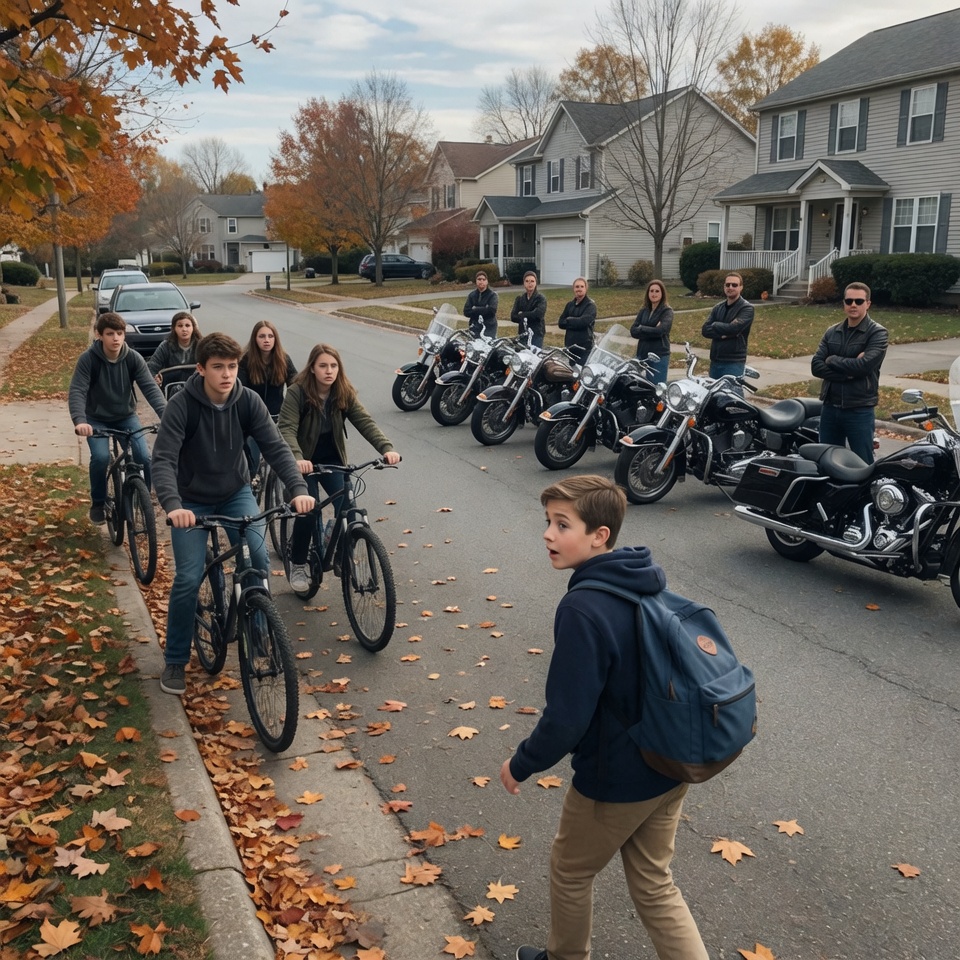
He’d been leaving school — the usual route, the one where the group sometimes waited for him at the end of the block — when he’d seen, parked along the curb across from the school entrance, five motorcycles. Not doing anything. Just parked. The men on them were just sitting. Looking at nothing in particular. Wearing Desert Compass Brotherhood vests.
The group that usually waited for Caleb was not there.
The next day, same thing. Five bikes, same spot, same nothing-in-particular. Caleb walked home untouched.
Over the next two weeks, the bikes weren’t there every day — maybe three days a week, irregular, unpredictable. Enough to establish a presence. The group that had been targeting Caleb had, in those two weeks, not said a word to him, not posted anything, not touched anything. The group chat, which Caleb had been shown screenshots of by a classmate, went quiet.
Caleb did not know for certain why this was. He suspected Roy. He came to me and said, quietly, “Did you talk to Roy?”
I said I had. Mentioned it once.
Caleb processed this for a moment.
“He didn’t have to do that,” Caleb said.
“No,” I said. “He didn’t.”
Caleb thought about this for a long time. He had the expression of someone trying to fit something new into a schema that doesn’t quite have a place for it yet. “They didn’t even say anything,” he said. “They just… were there.”
“Sometimes that’s enough,” I said.
I went over to Roy’s on a Saturday, brought a pie — a real one, homemade, apple, because I felt the situation required something beyond store-bought — and knocked on his door. He opened it, looked at the pie, looked at me.
“You didn’t have to do that,” he said.
“I know,” I said. “Thank you.”
He held the door open and we had coffee and he did not say much about the thing itself, which I understood was by design, and I did not say much about it either. We talked about the garden, about the winter coming, about Caleb’s interest in electrical work that Roy had been quietly encouraging with a tool kit he’d given him for his birthday.
Before I left I said, “He asked me if I’d talked to you. He figured it out.”
Roy nodded.
“He said to say thank you,” I said. “He was too shy to come himself.”
Roy looked out the kitchen window at the garden.
“Good kid,” he said.
“He is,” I said.
We didn’t say more than that. Nothing more needed to be said. What had been done was done without expectation of acknowledgment and received without performance of gratitude and the understanding between us was complete without requiring any of it to be spoken.
The bikes stopped appearing after about a month. The boys at school had moved on, or been sufficiently discouraged, or both. Caleb started eating dinner again. Started reading again. Started being recognizably himself again.
Roy is still my neighbor. Still waves when I get the mail. His garden looked especially good this past spring. He put in a new bed of roses along the fence line between our properties that I can see from my kitchen window, and they are, I’ll say without exaggeration, magnificent.
I’ve never mentioned it again. I don’t think I need to. The roses are there every morning when I make coffee, which feels like its own kind of ongoing conversation, quiet and sufficient, the way the best things between neighbors tend to be.