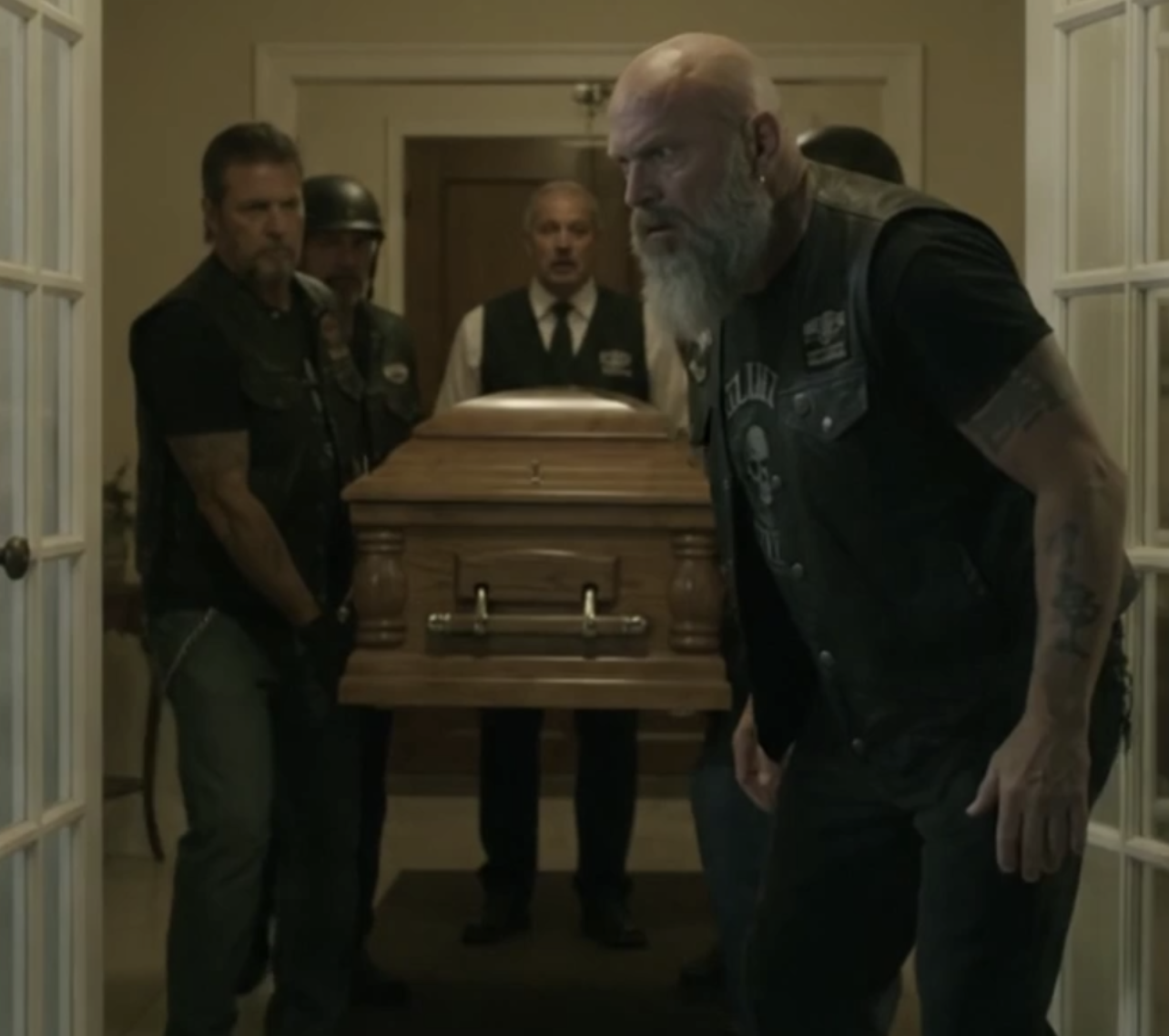
The funeral worker was halfway through lowering the coffin when someone started knocking from inside.
Three slow knocks.
Then two more.
Every man standing outside the funeral home froze.
The six outlaw bikers who had arrived on their motorcycles looked at one another. Their leader, a 58-year-old bald man with a thick gray beard named Marcus Cole, slowly removed his sunglasses.
“Stop the machine,” he ordered.
The funeral worker stared at him. “Sir, we need to finish this. The family is waiting.”
Marcus stepped closer to the coffin.
“Did you hear what I said? Stop the damn machine.”
Before anyone could respond, another knock came from inside.
This time, it was followed by a faint voice.
“Help me.”
Marcus looked at the funeral worker, whose face had turned completely white.
“Open it.”
The worker shook his head.
“I can’t. You don’t understand who this man is.”
Marcus grabbed the man’s jacket.
“Then you’d better explain it before I lose my patience.”
The worker swallowed hard.
“They told us he was dead. They told us not to open the coffin. They said the police had already signed everything.”
Marcus looked down at the coffin again.
Then he heard the voice.
“Marcus?”
His expression changed.
He knew that voice.
It belonged to a man who had been declared dead three days earlier.
A man named Walter Hayes.
And Walter Hayes was supposed to have been buried that afternoon.
But the most frightening part of the story was not that Walter was still alive.
It was that someone had spent eighteen months trying to silence him.
And now, whoever had ordered his death was about to discover that the old man had not been fighting alone.
Chapter 1: The Old Man Who Never Looked Away
Eighteen months earlier, seventy-six-year-old Walter Hayes had been riding his old Harley-Davidson along Route 18 outside the city of Blackridge.
He had been riding motorcycles for nearly fifty years. His beard had turned completely white, his left knee hurt whenever the weather changed, and his hands were covered with the marks of a lifetime spent working on engines.
Walter wasn’t a wealthy man. He lived in a modest house outside town, repaired motorcycles in a small garage, and spent most evenings drinking coffee with friends.
He had belonged to the Iron Wolves Motorcycle Club for thirty-one years.
People sometimes called them an outlaw motorcycle club. Walter never argued about the label. He had made mistakes when he was younger, but he had also spent decades helping stranded motorists, raising money for struggling families, and visiting veterans who had nobody else.
He had one rule.
“If you see somebody being crushed by someone more powerful, you don’t pretend you didn’t see it.”
That rule changed everything on a rainy Friday evening.
Walter was returning from a motorcycle repair shop when he noticed a black luxury SUV speeding through an intersection. Its headlights were moving strangely, and the vehicle crossed the center line twice.
Walter slowed down.
Then he saw three young women crossing the road.
The SUV never stopped.
The collision happened so quickly that Walter barely understood what he had witnessed. The vehicle struck all three women and continued down the road before disappearing around a bend.
Walter immediately pulled his motorcycle onto the shoulder and ran toward them.
One woman was lying near the curb. Another had fallen beside a damaged street sign. The third was still conscious, trying desperately to move her hand.
Walter dropped to his knees.
“Don’t move, sweetheart. Help is coming.”
The young woman looked at him.
“Please…”
“I’m here. Just stay with me.”
She tried to say something else, but her voice disappeared.
Walter called emergency services and remained beside the women until the first ambulance arrived. He gave the police his name, described the SUV, and explained exactly what he had seen.
He also told them something important.
The driver had not even attempted to brake.
The three women were named Lily Bennett, Sarah Miller, and Hannah Brooks.
They were twenty-one, twenty-two, and twenty-three years old.
They had been friends since high school. Lily was studying nursing, Sarah worked at a local bakery, and Hannah was preparing to start a teaching program.
Their families had been waiting for them to come home that evening.
Instead, three families received the worst phone calls of their lives.
Walter attended all three funerals.
He stood quietly at the back, wearing his old black leather vest. He watched parents hold photographs of their daughters and tried to find words that could make any of it understandable.
He couldn’t.
After the third funeral, a young man approached him.
“Sir, you’re the man who stayed with them?”
Walter nodded.
“I’m their uncle,” the young man said. “Thank you for not leaving them alone.”
Walter looked down.
“I wish I’d been able to do more.”
The young man shook his head.
“You did more than the man who killed them.”
Walter remembered those words.
He would remember them for the rest of his life.
Chapter 2: The Man Behind the Wheel
The investigation began with what appeared to be an ordinary traffic accident.
But the SUV belonged to a company registered under the name of a wealthy businessman named Richard Voss.
Voss was not just another wealthy resident of Blackridge.
He was one of the most powerful men in the city.
He owned construction companies, hotels, commercial buildings, and several private security firms. He had donated money to political campaigns, funded community events, and appeared beside the mayor at public ceremonies.
His name was on buildings.
His photograph appeared in newspapers.
His company sponsored the local police charity dinner.
And according to several witnesses, Richard Voss had been driving the SUV that night.
Walter knew what he had seen.
He told the investigators.
He described the vehicle, the direction it traveled, and the driver’s face. He also explained that the driver appeared intoxicated.
At first, the police seemed interested.
Then things began changing.
A week later, Walter received a phone call from a detective.
“Mr. Hayes, we need you to come down and clarify your statement.”
Walter arrived at the station expecting to answer a few questions.
Instead, he was told that the vehicle had been reported stolen.
The registered owner claimed that it had been taken from a private garage hours before the accident.
Walter stared at the detective.
“That’s ridiculous. I saw the man driving it.”
The detective folded his hands.
“Do you have any evidence that the registered owner was behind the wheel?”
“I have my eyes.”
“That isn’t enough.”
Walter leaned forward.
“I watched three young women die in front of me. Don’t tell me what I saw.”
The detective looked uncomfortable.
He lowered his voice.
“Mr. Hayes, I suggest you let the investigation continue.”
Walter understood what that meant.
Someone was already trying to close the case.
He refused.
Chapter 3: Eighteen Months of Fighting
Walter spent the following eighteen months trying to prove what had happened.
He contacted lawyers, visited the families, requested public records, and repeatedly asked investigators to examine the original accident report.
He was not a professional investigator. He didn’t have a law degree or political connections.
He had a motorcycle, a small garage, and a stubborn refusal to give up.
His first major discovery came from a mechanic who had worked on the damaged SUV.
The mechanic was named Daniel Price.
Daniel told Walter that the SUV had arrived at his workshop the morning after the accident.
It had damage to the front bumper, windshield, and passenger-side headlight.
But the repair order contained something strange.
The vehicle’s mileage had been recorded as considerably higher than the distance it should have traveled that night.
Walter asked Daniel what that meant.
Daniel hesitated.
“It means someone drove it somewhere before bringing it here.”
“Who?”
“I don’t know.”
Walter watched his face.
“Daniel, somebody killed three girls.”
The mechanic looked away.
“I know.”
“Then tell me what you know.”
Daniel finally admitted that a man from Voss’s private security company had delivered the vehicle. He had also been instructed to remove the original registration plates.
Walter wrote everything down.
He took the information to the police.
Nothing happened.
Two months later, Daniel suddenly left town.
His workshop closed.
His phone number stopped working.
Walter tried to find him, but nobody would say where he had gone.
The second discovery came from a restaurant employee who had seen Richard Voss drinking heavily before the crash.
She said he had been arguing with another man outside the restaurant. She also remembered him getting into the SUV while struggling to stand straight.
She agreed to speak to a lawyer.
Then she withdrew her statement.
Her employer told her that discussing the incident could cost her job.
By the sixth month, Walter had received two threatening letters.
By the ninth month, somebody had damaged his garage.
By the twelfth month, he had been followed home twice.
He told his club about the threats.
His longtime friend and fellow biker, Marcus Cole, wanted him to stop.
“You’re seventy-six years old, Walt. You’ve done enough.”
Walter sat on a stool in the garage, cleaning a wrench.
“Three girls are dead.”
“I know.”
“And their families still don’t know the truth.”
Marcus looked at him.
“You’re going to get yourself killed.”
Walter put the wrench down.
“Then at least somebody will have to explain why.”
Marcus had no answer.
Chapter 4: The Man Who Offered Him Money
The first direct offer came on a Tuesday morning.
Walter was opening his garage when a black sedan pulled into the driveway.
Two men stepped out.
One wore an expensive gray suit. The other remained near the vehicle.
The man in the suit approached Walter.
“Mr. Hayes?”
“Depends who’s asking.”
“My name is Robert Kane. I represent Richard Voss.”
Walter continued opening the garage door.
“I don’t have anything to say to him.”
Kane smiled.
“Perhaps we can make this easier.”
He placed a thick envelope on a workbench.
Walter didn’t touch it.
“What’s that?”
“Enough money to make your remaining years comfortable.”
Walter looked at the envelope.
Then he looked at Kane.
“You think I need your money?”
“Everybody needs money.”
“Not everybody needs to sell their conscience.”
Kane’s smile disappeared.
“You’re making a mistake, Mr. Hayes.”
Walter walked toward the door.
“No. I made my decision eighteen months ago.”
Kane left the envelope on the workbench.
Walter threw it into the sedan as the men drove away.
That evening, he called Marcus.
“They came to the garage.”
Marcus immediately became serious.
“Who?”
“Voss’s lawyer.”
“What did he want?”
“To buy my silence.”
Marcus was quiet for a moment.
“Where are you now?”
“Home.”
“Stay there. I’m coming over.”
Walter looked through the garage window.
A dark vehicle was parked across the road.
Its headlights were off.
He watched it for several seconds before answering.
“Bring somebody with you.”
Chapter 5: The First Betrayal
The Iron Wolves had members across several cities.
Their club was not perfect. Like any large organization, it contained different personalities, different histories, and people who disagreed about almost everything.
But they shared a bond.
They had ridden together for years.
They had attended funerals together.
They had helped one another through illness, divorce, financial problems, and loss.
Walter trusted them.
One member in particular had been his closest friend for more than twenty years.
His name was Daniel “Duke” Mercer.
Duke was fifty-three, broad-shouldered, and always willing to volunteer for difficult jobs. He had helped Walter repair his garage after the first act of vandalism.
He had also attended every club meeting concerning the three murdered girls.
But Duke had a secret.
Two years earlier, he had begun working as a paid driver and security contact for one of Richard Voss’s companies.
At first, he told himself there was nothing wrong with it.
The work paid well.
He had debts.
He needed the money.
Then he learned what Voss expected from him.
The night of the accident, Duke had been driving a second vehicle behind Voss’s SUV.
He had seen the collision.
He had helped move the damaged SUV.
He had also helped arrange the false report claiming the vehicle had been stolen.
He knew exactly what had happened.
And he knew Walter was getting dangerously close to discovering it.
Duke was the person who had been quietly passing information to Voss.
He knew when Walter visited the families.
He knew which lawyers he contacted.
He knew what evidence the old man had collected.
And he knew that Walter had begun to suspect there was another person involved.
Duke was afraid.
Not of Walter.
Of what Voss would do if the truth came out.
So he made a decision.
He would help Voss silence Walter permanently.
Chapter 6: The Night Walter Disappeared
On a cold evening in October, Walter received a phone call from an unknown number.
The caller claimed to have information about the original accident.
He said he had been working for Voss’s security company and wanted to talk privately.
Walter asked where.
“An old storage building near the industrial district.”
Walter hesitated.
“Why can’t we meet somewhere public?”
“Because they’re watching me.”
Walter should have called Marcus.
He should have contacted the lawyer.
He should have taken someone with him.
But he had spent eighteen months waiting for somebody to tell him the truth.
He didn’t want another opportunity to disappear.
He rode to the industrial district alone.
The building was almost completely dark.
A single light burned above the entrance.
Walter parked his Harley and walked inside.
“Danny?”
No answer.
He heard a door close behind him.
Then a voice.
“Still chasing that accident, old man?”
Walter turned.
Duke stepped out of the darkness.
For several seconds, Walter simply stared at him.
“Duke?”
His friend didn’t answer.
Behind him stood two men wearing dark jackets.
Walter slowly understood.
“You gave them everything.”
Duke looked uncomfortable.
“Go home, Walt.”
“You told them about the families. You told them about Daniel Price.”
“I said go home.”
Walter took a step toward him.
“Three girls are dead.”
Duke’s jaw tightened.
“I didn’t kill them.”
“But you helped the man who did.”
Nobody spoke.
Then Walter noticed something on the workbench.
A folder containing copies of his own notes.
The names of the families.
The mechanic’s address.
The lawyer’s contact information.
Everything.
Walter looked back at Duke.
“You’ve been selling me out.”
Duke looked away.
One of the men moved toward Walter.
The old biker tried to defend himself, but he was seventy-six years old, and there were three men against him.
They knocked him to the floor.
He hit his head and lost consciousness.
When Walter woke up, he was in a locked room.
His wrists were restrained.
His motorcycle was gone.
His phone was gone.
And Duke was standing near the door.
Walter’s voice was weak.
“Why?”
Duke didn’t look at him.
“Because you wouldn’t stop.”
Walter slowly lifted his head.
“You were there that night.”
Duke said nothing.
“You saw those girls.”
Duke’s face tightened.
Walter understood.
His friend hadn’t merely betrayed him.
He had been involved from the beginning.
Chapter 7: The Death Certificate
The following morning, Walter Hayes was officially declared dead.
According to the documents, he had suffered a fatal medical emergency while traveling outside the city.
His body had supposedly been transferred to a private medical facility.
His family was informed through an intermediary.
The police report was completed unusually quickly.
There was no public investigation into the circumstances.
There was no detailed explanation.
And the man who had spent eighteen months demanding justice for three murdered girls was suddenly another dead person whose case was considered closed.
But Walter wasn’t dead.
He was being held in a private property owned through one of Voss’s companies.
His condition was deteriorating.
He had a head injury, several broken ribs, and difficulty breathing.
He had been given medication that left him weak and confused.
He couldn’t tell how much time had passed.
Sometimes he heard voices outside the room.
Sometimes he heard a vehicle arriving.
Once, he heard Duke arguing with someone.
“He’s not supposed to be awake.”
Another voice answered.
“Then make sure he isn’t.”
Walter closed his eyes.
He understood what they wanted.
They weren’t just trying to stop his investigation.
They wanted to make sure he could never speak again.
But they had made one mistake.
They had left him alive.
And Walter was still paying attention.
Chapter 8: The Knock From Inside
Back at the funeral home, Marcus Cole was staring at the coffin.
He recognized Walter’s voice.
He had known the old man for thirty-one years.
He had heard him laugh, argue, complain about his knee, and tell the same motorcycle stories hundreds of times.
He knew that voice.
“Open it!” Marcus shouted.
The funeral worker stepped backward.
“Sir, I can’t do that.”
Marcus grabbed the coffin lid.
Two other bikers rushed forward to help.
The lid opened.
Inside was Walter.
His face was bruised. His lips were dry. His wrists had marks around them.
But his eyes were open.
Marcus stared at him.
“Walt?”
Walter tried to speak.
Marcus leaned closer.
“Don’t move. Don’t try to talk.”
Walter grabbed his arm.
“Duke…”
Marcus froze.
“What?”
Walter struggled to breathe.
“Duke… did it.”
Marcus looked at the other bikers.
“Get an ambulance. Now.”
One biker ran toward the funeral home’s entrance.
Another called emergency services.
Marcus took off his leather vest and placed it beneath Walter’s head.
Then Walter whispered something that made Marcus’s stomach turn.
“Three girls… Voss… Duke was there.”
Marcus leaned closer.
“What happened, brother?”
Walter looked directly at him.
“They’re going to bury the truth with me.”
Marcus shook his head.
“Not this time.”
Chapter 9: The Evidence They Forgot
Walter was taken to a hospital under police protection.
At first, the doctors weren’t sure he would survive.
He had suffered serious injuries, dehydration, and complications from the medication he had been given.
But he remained conscious.
Marcus refused to leave his side.
When Walter was strong enough to speak, he explained what had happened.
He told Marcus about the storage building, Duke, and the private property where he had been held.
He also revealed something else.
Before he was captured, he had hidden copies of his evidence in three different locations.
One was inside an old motorcycle repair manual in his garage.
Another was held by an attorney in a neighboring state.
The third was stored with a retired investigative journalist named Evelyn Carter.
Marcus asked why he hadn’t told anyone.
Walter gave a tired smile.
“Because I didn’t know who I could trust.”
Marcus looked away.
That sentence hurt more than anything else.
The following morning, Marcus contacted the attorney.
He also called Evelyn Carter.
She arrived at the hospital carrying a thick folder.
“I’ve been waiting eighteen months for someone to tell me Walter was alive.”
Marcus stared at her.
“You knew?”
“I knew something was wrong. I didn’t know where he was.”
She placed the folder on the table.
Inside were copies of accident reports, repair records, photographs of the damaged SUV, financial transfers, and handwritten statements.
There was also a document showing payments made by a company connected to Richard Voss.
Several payments had been made to individuals connected to the accident investigation.
One name appeared repeatedly.
Duke Mercer.
Marcus stared at the page.
He had shared meals with Duke.
He had ridden beside him.
He had trusted him with the lives of his brothers.
Now he understood why Walter had whispered his name.
Chapter 10: Seven Thousand Eight Hundred Brothers
The news spread through the motorcycle community.
At first, it was a handful of calls.
Then dozens.
Then hundreds.
The story was difficult to believe.
A seventy-six-year-old biker had spent eighteen months fighting for three young women killed by a drunk driver. He had been betrayed by someone inside his own club, abducted, declared dead, and nearly buried alive.
And the man accused of orchestrating the cover-up was one of the richest and most influential people in Blackridge.
Marcus made one phone call.
Then another.
He contacted club presidents, veteran riders, independent motorcycle groups, and friends who had ridden with Walter across the country.
He didn’t ask anyone to break the law.
He didn’t ask anyone to threaten witnesses.
He asked them to stand together and demand a real investigation.
Within forty-eight hours, riders from several cities began responding.
Within a week, more than 7,800 outlaw bikers and motorcycle community members had joined the movement.
They came from different states and different backgrounds.
Some rode expensive touring motorcycles.
Others arrived on old Harleys held together with replacement parts and years of hard work.
Some wore club colors.
Others wore plain black jackets.
They all had one message.
“THREE GIRLS DESERVED JUSTICE. WALTER DESERVED THE TRUTH.”
They organized peaceful rides, attended public hearings, contacted journalists, and helped the families find legal support.
They also arranged for independent attorneys to examine the documents.
The movement became known as the Ride for the Three.
Its symbol was three small white ribbons tied to motorcycle handlebars.
Marcus made a statement outside the hospital.
“Walter Hayes is seventy-six years old. He spent eighteen months trying to get justice for three young women. Somebody decided he was too old, too stubborn, and too inconvenient to keep fighting. They were wrong. He has more than 7,800 brothers and sisters standing behind him now.”
The crowd applauded.
But Marcus wasn’t celebrating.
He knew that Voss would not surrender easily.
And he knew Duke was still out there.
Chapter 11: The Man Who Came to the Hospital
Three nights after Walter woke up, Marcus noticed a man standing near the hospital elevators.
He wore a dark jacket and carried a small paper bag.
At first, Marcus thought he was another visitor.
Then the man looked toward Walter’s room.
Marcus recognized him.
Duke.
Marcus slowly stood.
“What are you doing here?”
Duke raised both hands.
“I came to see Walt.”
Marcus moved between him and the door.
“You’ve got some nerve.”
“Please. Just let me talk to him.”
“You nearly got him killed.”
Duke looked down.
“I know.”
Marcus grabbed the front of his jacket.
“Do you?”
A nurse appeared at the end of the hallway.
“Sir, you need to step away.”
Marcus released him.
Duke looked toward Walter’s room.
“I can tell you everything.”
Marcus gave a bitter laugh.
“You’ve had eighteen months.”
“I was scared.”
“Those girls were scared too.”
Duke’s eyes filled with tears.
“I know.”
Marcus stared at him.
Then he asked a question.
“Did you help Voss cover up the accident?”
Duke hesitated.
That hesitation was enough.
Marcus stepped back.
“You’re not going anywhere.”
Hospital security was called.
Duke was detained until police arrived.
But before officers took him away, he said something that changed everything.
“Voss didn’t order Walter’s death because of the accident.”
Marcus stared at him.
“Then why?”
Duke swallowed.
“Because Walter found out who was in the passenger seat.”
Chapter 12: The Passenger
For eighteen months, everyone had believed Richard Voss was the only person in the SUV.
Walter had described seeing a driver.
He had never mentioned a passenger.
But Duke explained that there had been another person in the vehicle that night.
A woman named Claire Voss.
Richard’s daughter.
She had been sitting in the passenger seat when the SUV struck the three young women.
According to Duke, Claire had tried to persuade her father to stop.
He refused.
After the accident, she had threatened to tell the police everything.
Richard had become furious.
He told her that the family would be destroyed if the truth came out.
He also warned her that she would lose everything.
For months, Claire remained silent.
Then Walter found out she had been present.
He contacted her through a lawyer.
Claire agreed to speak with him.
That was the real reason Voss had become desperate.
Walter wasn’t just a witness anymore.
He had found someone who could confirm what happened inside the SUV.
And Claire was prepared to testify.
Marcus looked at Duke.
“Where is she?”
Duke shook his head.
“I don’t know.”
“You’re lying.”
“I’m not. Voss moved her after Walter disappeared.”
Marcus turned toward the hospital room.
Walter was awake.
He had heard everything.
“Find her,” he whispered.
Marcus nodded.
“We will.”
Walter grabbed his wrist.
“No. Find her before they do.”
Chapter 13: The Daughter Who Couldn’t Sleep
Claire Voss had been living under another name in a small apartment outside the city.
She had no friends nearby.
She rarely left the building.
Her father had told her that speaking to the police would destroy her life.
But she had not slept properly since the night of the accident.
She remembered the three young women.
She remembered her father refusing to stop.
She remembered him telling her to stay quiet.
And she remembered the old man who had tried to help them.
Walter.
She had heard he was dead.
Then she saw a news report showing hundreds of bikers outside the hospital.
The headline read:
“DECLARED-DEAD MOTORCYCLIST FOUND ALIVE AFTER ALLEGED ABDUCTION.”
Claire watched the report three times.
Then she picked up her phone.
She called the attorney whose number Walter had given her.
“I want to talk.”
The attorney asked her to identify herself.
“My name is Claire Voss.”
There was a long silence.
Then the attorney said:
“Are you safe?”
Claire began crying.
“No.”
Chapter 14: The Trap
Richard Voss learned that Claire had contacted the attorney.
He immediately called his security director.
“Find her.”
The director hesitated.
“Sir, the police are already looking into the accident again.”
Voss slammed his hand against the desk.
“I don’t care what the police are doing. Find my daughter.”
He also contacted Duke’s lawyer.
But Duke had already begun cooperating with investigators.
He provided names, dates, payment records, and details about Walter’s abduction.
He also identified the private property where Walter had been held.
The authorities began preparing search warrants.
Meanwhile, Marcus received a message from an unknown number.
It contained only one sentence.
“STOP THE RIDE OR THE GIRL DISAPPEARS.”
Marcus showed the message to Walter.
The old man read it twice.
Then he looked at Marcus.
“They’re scared.”
Marcus nodded.
“Good.”
Walter shook his head.
“No. They’re desperate. That’s worse.”
He asked Marcus to contact the families of the three girls.
He wanted them to know that Claire was willing to speak.
He also wanted the movement to remain peaceful.
“We don’t give Voss an excuse to turn this into a story about bikers causing trouble,” Walter said.
Marcus understood.
The goal was not revenge.
It was justice.
Chapter 15: The Night of the Ride
The authorities announced that a major hearing would take place in Blackridge.
The three families would attend.
Claire would provide a formal statement.
Duke would cooperate with investigators.
And Walter would testify about what he had witnessed.
More than 7,800 bikers prepared to travel to the city.
They arrived from different directions.
Some came in groups of five.
Others came in groups of hundreds.
The roads leading into Blackridge filled with motorcycles.
Police officers were positioned along the main streets.
Local reporters stood outside the courthouse.
The families of Lily, Sarah, and Hannah arrived together.
Walter was brought in a wheelchair.
He was still recovering.
His head was bandaged, and his hands trembled slightly.
But he insisted on wearing his old black leather vest.
On the back was a faded patch that read:
IRON WOLVES.
Marcus walked beside him.
“You ready?”
Walter looked toward the courthouse.
“No.”
Marcus smiled faintly.
“Me neither.”
Walter took a breath.
“But we’re going in.”
Chapter 16: The Traitor’s Confession
Duke entered the courthouse under police escort.
He looked older than he had a week earlier.
His face was pale.
His hands were shaking.
When he saw Walter, he stopped.
For several seconds, neither man spoke.
Then Duke approached.
“Walt…”
Walter looked at him.
Duke struggled to continue.
“I’m sorry.”
Walter’s expression remained unchanged.
“Sorry for what?”
Duke lowered his head.
“Everything.”
Walter looked at the man he had once considered a brother.
“You were there when those girls died.”
Duke nodded.
“You helped move the vehicle.”
Another nod.
“You helped them take me.”
Duke’s eyes filled with tears.
“Yes.”
Walter leaned forward.
“Then don’t apologize to me.”
Duke looked confused.
Walter pointed toward the three families sitting near the front.
“Apologize to them.”
Duke turned.
He walked toward the families and stopped several feet away.
“I don’t expect you to forgive me,” he said. “I helped cover up what happened. I helped the man responsible. And I helped him silence Walter.”
Lily’s mother stared at him.
“Did you know my daughter was dead?”
Duke nodded.
“Yes.”
“Did you know she had plans to become a nurse?”
He couldn’t answer.
“Did you know we waited for her that night?”
Duke began crying.
Lily’s mother stood.
“Then don’t ask us for forgiveness.”
Duke lowered his head.
He didn’t ask again.
Chapter 17: The Evidence
The hearing lasted for hours.
Walter described the accident.
He explained what he had seen.
He identified the SUV and the driver.
He described the threats, the money, and the people who had tried to make him disappear.
Then the attorney presented the records.
The repair documents.
The payment transfers.
The original accident report.
The false vehicle theft claim.
And the information provided by Daniel Price, the mechanic who had finally agreed to cooperate.
The evidence was not based on rumors or angry accusations.
It was supported by records, testimony, and independent investigation.
Claire Voss entered the room shortly after noon.
She looked terrified.
Richard Voss was seated several rows away.
When she saw him, she almost turned around.
But then she looked toward the three families.
She remembered the girls.
She remembered Walter.
She took a breath and walked forward.
Her statement lasted nearly forty minutes.
She confirmed that her father had been driving the SUV.
She described his condition before the collision.
She explained that he had refused to stop afterward.
She also described the conversations that followed.
At one point, she looked directly at her father.
“You told me those girls didn’t matter because they were nobody.”
Richard Voss stood abruptly.
“That’s a lie!”
The judge ordered him to sit down.
Claire continued.
“They mattered to somebody. They mattered to their mothers. Their fathers. Their brothers. Their friends. They mattered to the old man who stayed with them when you drove away.”
The room fell silent.
Walter closed his eyes.
For the first time in eighteen months, he felt that somebody had finally heard the truth.
Chapter 18: The Last Threat
Richard Voss was taken into custody after the hearing on charges related to the alleged cover-up, obstruction, and conspiracy. The original fatal collision was also reopened for prosecution.
But before he was escorted from the courthouse, he turned toward Walter.
“You think you’ve won?”
Walter looked at him.
“No.”
Voss gave a bitter smile.
“Then what have you done?”
Walter slowly pushed himself upright in his wheelchair.
“I made sure the truth has a chance.”
Voss leaned toward him.
“You’re an old man. You should have stayed in your garage.”
Walter stared at him.
“And you should have stopped your vehicle.”
For the first time, Voss had nothing to say.
The officers led him away.
Outside, thousands of bikers were waiting.
There was no fighting.
No broken windows.
No violence.
Just thousands of people standing together.
When Walter emerged from the courthouse, the crowd became silent.
Marcus helped him stand.
Walter looked at the sea of motorcycles.
Then he saw three women holding white ribbons.
They were the mothers of Lily, Sarah, and Hannah.
Each woman walked toward him.
Lily’s mother held his hand.
“You kept your promise.”
Walter shook his head.
“I couldn’t bring them back.”
“No,” she replied. “But you didn’t let them be forgotten.”
Walter looked down.
His eyes filled with tears.
Chapter 19: The Number 7,800
The movement did not end when Voss was arrested.
The investigation continued for months.
More witnesses came forward.
Former employees provided documents.
Additional records were recovered from the private property where Walter had been held.
The authorities also investigated the people who had helped falsify his death records.
Duke faced serious charges for his involvement.
He cooperated with investigators, but cooperation did not erase what he had done.
He would have to answer for his part in the crime.
The motorcycle movement continued to grow.
More than 7,800 riders had initially joined the Ride for the Three. As the story spread, more groups began supporting the families through legal assistance, public awareness, and fundraising.
The three girls’ names appeared on banners across several cities.
Lily Bennett.
Sarah Miller.
Hannah Brooks.
Their families eventually established a foundation that helped victims of drunk-driving accidents and supported families struggling through long legal battles.
Walter was invited to become its honorary chairman.
He refused at first.
“I don’t know anything about running a foundation.”
Lily’s mother smiled.
“You know how to refuse to let people give up.”
He accepted.
Chapter 20: The Empty Chair
Six months later, Walter returned to his garage.
His recovery had been slow.
He still walked with a cane, and his left hand sometimes shook when he tried to tighten a bolt.
But he was alive.
His old Harley stood in the center of the garage.
Marcus arrived one afternoon with two cups of coffee.
“You planning on riding again?”
Walter looked at the motorcycle.
“Maybe.”
“Your doctor said you should take it easy.”
Walter laughed.
“My doctor also said I should stop drinking coffee.”
Marcus handed him a cup.
“You’re not going to listen to him, are you?”
“Not today.”
They sat quietly for a while.
Then Marcus noticed something on the workbench.
It was a small wooden box containing three white ribbons.
Beside them were three handwritten names.
Lily.
Sarah.
Hannah.
Marcus picked up the box.
“Where did you get this?”
“Their mothers gave it to me.”
Walter looked at the ribbons.
“I still think about that night.”
Marcus nodded.
“So do I.”
Walter took a slow breath.
“Sometimes I wonder whether I could have done something differently.”
Marcus turned toward him.
“You stayed with them. You told the truth. You kept fighting when everybody else wanted you to stop.”
Walter looked at the garage floor.
“That doesn’t bring them back.”
“No. But it means their story didn’t end with the accident.”
For a moment, neither man spoke.
Then Marcus asked the question that had been bothering him.
“What about Duke?”
Walter stared at the old motorcycle.
“I don’t know.”
“Do you forgive him?”
Walter took a long time to answer.
“Maybe one day. But forgiveness doesn’t mean pretending he didn’t do it.”
Marcus nodded.
Walter picked up one of the ribbons and placed it inside his leather vest.
“Some people think being a brother means wearing the same patch.”
He looked at Marcus.
“It doesn’t.”
Marcus understood.
“Being a brother means standing beside somebody when there’s something to lose.”
Walter smiled faintly.
“Exactly.”
Chapter 21: The Letter
One week later, a letter arrived at Walter’s garage.
There was no return address.
The envelope contained a single sheet of paper.
Walter opened it carefully.
The handwriting was familiar.
It belonged to Duke.
The letter read:
“Walter,
I know I have no right to ask anything from you. I helped the wrong people, and I betrayed someone who trusted me.
I have spent every night thinking about those three girls.
I remember the accident. I remember the headlights. I remember you standing beside them while I drove away.
I could have stopped.
I could have told the truth.
I did neither.
I don’t expect you to forgive me. I only want you to know that I finally understand what you were fighting for.
I was afraid of losing my life.
You were afraid of losing the truth.
I hope someday I become a better man than the one who stood in that warehouse.
Duke.”
Walter read the letter twice.
Then he folded it and placed it inside the wooden box with the ribbons.
He didn’t write back.
Some things could not be repaired with an apology.
Chapter 22: The Final Ride
The following spring, the families organized a memorial ride.
It began outside the courthouse and ended at a small memorial garden built in honor of the three young women.
More than 7,800 bikers had once joined the movement.
That day, thousands returned.
Walter arrived on his old Harley.
His hands were weaker, and his riding days were becoming limited, but he refused to sit in a support vehicle.
Marcus rode beside him.
Behind them came motorcycles from dozens of cities.
At the memorial garden, the three families stood together.
There were flowers, candles, and three small plaques.
Walter slowly walked toward them.
He placed his helmet on the ground and stood silently.
Then he spoke.
“I didn’t know your daughters. Not the way you knew them. I didn’t know their favorite songs or what they wanted to do when they grew older. I didn’t know what made them laugh or what they were afraid of.”
He paused.
“But I knew they were alive when I reached them. I knew they deserved help. And I knew somebody had to tell the truth about what happened.”
Lily’s mother began crying.
Walter continued.
“I am seventy-seven years old now. I’ve seen good people die, bad people get away with things, and honest people get tired of fighting. But I learned something from these three young women.”
He looked toward the families.
“Being forgotten is another kind of injustice.”
Nobody moved.
Walter placed three white ribbons beside the plaques.
Then he turned toward the motorcycles.
Thousands of engines started almost simultaneously.
The sound rolled through the garden and across the surrounding hills.
For several minutes, the entire area seemed to vibrate.
Walter stood beside Marcus, listening.
“That’s a lot of noise,” Marcus said.
Walter smiled.
“Sometimes the truth needs a little noise.”
Epilogue: The Man They Couldn’t Silence
A year after Walter’s discovery, the case against Richard Voss and the other people involved had advanced through the courts. The evidence gathered by investigators, witnesses, and attorneys had transformed what once appeared to be an ordinary traffic accident into a major criminal investigation.
Voss faced prosecution for his role in the fatal collision and the alleged conspiracy to conceal it. Duke and other participants also faced legal consequences for their involvement.
The Ride for the Three continued to support the families and advocate for stronger accountability in drunk-driving cases.
Walter never became famous.
He didn’t want television interviews or newspaper headlines.
He returned to his garage, repaired motorcycles, and drank coffee with Marcus.
Sometimes young riders visited him and asked why so many people had traveled hundreds of miles to support one old biker.
Walter always gave the same answer.
“Because three young women deserved justice, and one old man refused to let their names disappear.”
One afternoon, a young woman arrived at the garage.
She introduced herself as Emily.
She was the younger sister of Sarah Miller.
She carried a small envelope.
“My mother asked me to give you this.”
Walter opened it.
Inside was a handwritten note.
“Dear Walter,
We know you couldn’t save our daughters. We know you tried everything you could.
But you saved something else.
You saved the truth.
Thank you for not leaving them alone that night. Thank you for not giving up when people told you to stop. And thank you for reminding us that there are still people willing to stand up when doing the right thing becomes dangerous.
You will always be part of our family.
With love,
The families of Lily, Sarah, and Hannah.”
Walter read the note quietly.
Then he removed his glasses and wiped his eyes.
Emily looked at him.
“Are you okay?”
Walter nodded.
“Yes, sweetheart.”
He folded the letter carefully.
Then he looked at the three white ribbons hanging above his workbench.
“Your sister and her friends are still remembered.”
Emily smiled through her tears.
“I know.”
She turned toward the garage door, but Walter called her back.
“One more thing.”
She looked over her shoulder.
Walter pointed toward the old Harley.
“If you ever need somebody to teach you how to ride, come back.”
Emily laughed.
“My mother would never allow that.”
Walter smiled.
“Then we won’t tell her until you’re ready.”
For the first time in a long time, the old biker laughed without feeling the weight of what had happened.
Outside, motorcycles passed along the road.
Somewhere in the distance, another group of riders was heading toward Blackridge.
And on the wall above Walter’s workbench, beneath the three white ribbons, hung a simple wooden sign.
It contained seven words.
“WE DON’T FORGET THE PEOPLE LEFT BEHIND.”
Walter had spent eighteen months fighting for three girls.
Someone had tried to bury him.
Someone had betrayed him.
Someone had declared him dead.
But they had forgotten one thing.
A man who refuses to let the truth die is not easily silenced.
And neither are the people who stand beside him.