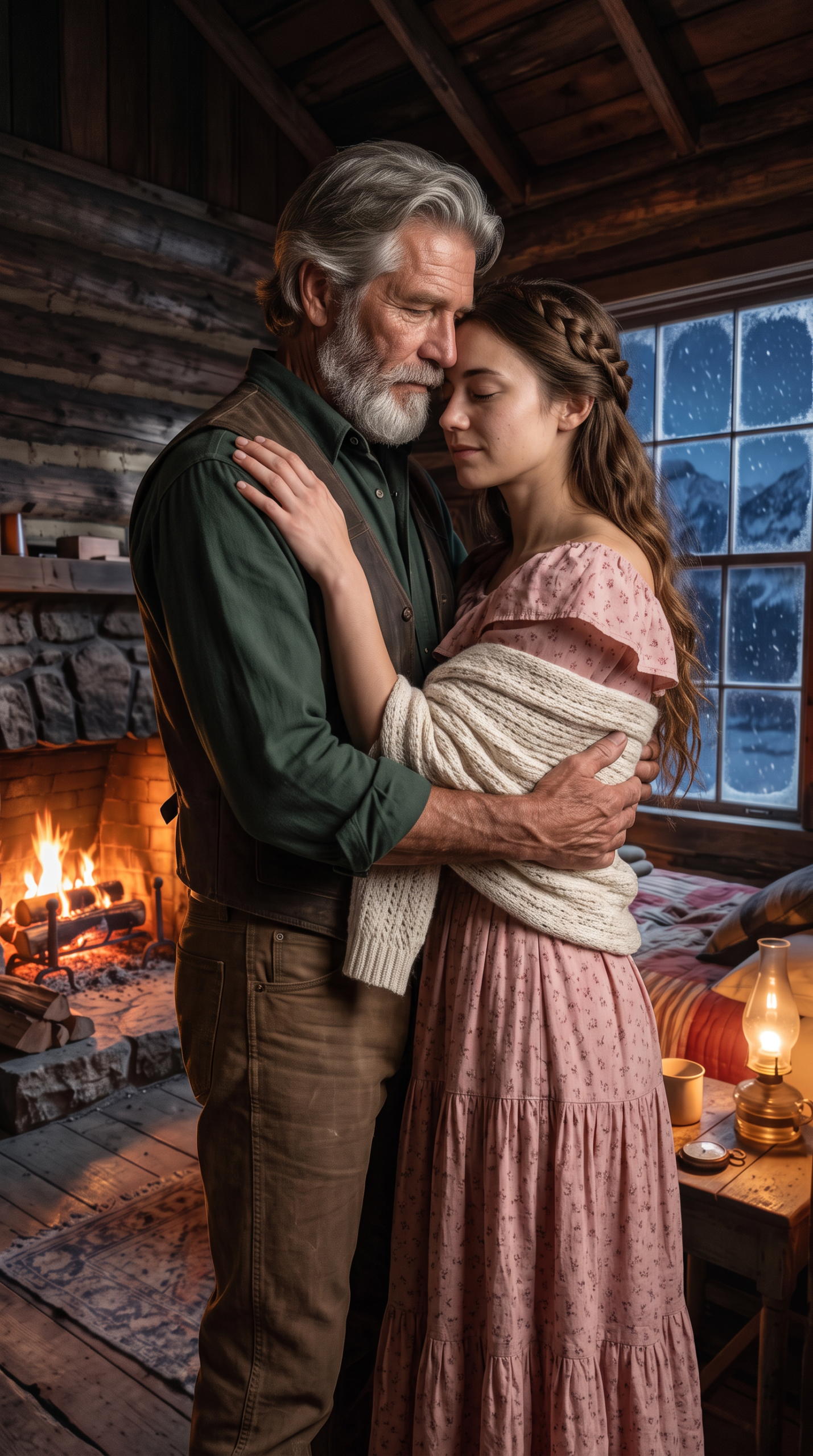
YOU’RE TOO YOUNG TO LOVE AN OLD COWBOY LIKE ME — BUT HER ANSWER BROKE HIS HEART
A Western Frontier Romance | Colorado Territory, 1876
CHAPTER 1 — THE WOMAN IN THE SNOW
“You’re too young to love an old cowboy like me,” I whispered.
Josephine stood before me, her long brown hair falling over one shoulder, her pink floral dress contrasting with the dark wooden walls of my cabin. A cream shawl rested around her shoulders. Her eyes were filled with something I had spent twenty years convincing myself I would never see again.
Love.
She reached for my weathered hand.
“Josephine, I’m fifty-four. You’re only twenty-five.”
She looked directly into my eyes.
“Does that mean a cowboy’s heart stops loving when his hair turns gray?”
I swallowed.
“You deserve a young man, a fine house, and a future. Not an old cowboy living alone in the mountains.”
She stepped closer.
“But what if the only home I’ve ever wanted is right here with you?”
I had faced stampeding cattle, charging grizzlies, armed outlaws, and deadly winter storms. I’d watched men die beneath the same endless sky that had protected me for half a century.
Yet nothing frightened me more than the tenderness in that young woman’s eyes.
Because I knew what it meant to love someone.
And I knew what it meant to lose them.
But before I tell you what happened between us, you need to understand how a woman half my age came to stand in my cabin and ask an old cowboy to stop running from his own heart.
My name is Hiram Walker.
I was fifty-four years old, and I had spent most of my life believing that a man could survive anything as long as he never allowed himself to need another person.
I was wrong.
It began four months earlier, during the coldest winter I had ever experienced in the Colorado Territory.
January 1876.
The mountains were buried beneath several feet of snow. The pine trees bent beneath the weight of ice, and the wind howled through the valleys like something alive.
I had settled into a small log cabin deep in the Rocky Mountains after spending thirty years driving cattle, breaking wild horses, and working on ranches across the Western plains.
My cabin wasn’t much to look at.
It had two small rooms, a stone fireplace, a wooden table, an old iron stove, and a narrow bedroom with a window overlooking the mountains.
There was a bed covered with a red striped quilt, a shelf filled with books I rarely opened, and an oil lamp that flickered whenever the wind slipped through the cracks.
Outside stood a small stable where my old buckskin gelding, Ranger, spent most of his days eating hay and complaining about the weather.
I had no wife.
No children.
No family waiting for me anywhere.
And, by choice, no visitors.
Most people thought I was a strange old mountain man.
I preferred that reputation.
People asked questions. They wanted explanations. They expected you to share your troubles and smile when they spoke to you.
The mountains expected nothing.
They didn’t care if I was fifty-four or twenty-four. They didn’t care whether I had loved someone or buried someone. They simply stood there, silent and enormous, reminding me how small one man could be.
For twenty years, that had been enough.
Until one morning, I heard the sound of a horse struggling through the trees.
I was checking my traps near a frozen creek when the noise reached my ears.
At first, I thought it was an elk.
Then I heard a desperate whinny.
I turned toward the forest.
A bay mare emerged between the pine trees, stumbling through the snow. Her sides were covered in frozen sweat, and her legs trembled with every step.
A rider was slumped across her back.
“Good Lord,” I muttered. “Nobody rides these mountains in January.”
The mare took another few steps before collapsing.
I dropped my rifle and hurried toward her.
The animal was already dead.
But the rider moved.
I pulled back the heavy buffalo coat and discovered a young woman beneath it.
Her dark brown hair was tangled with snow. Her face was pale, her lips nearly blue, and her breathing so faint I almost couldn’t feel it.
“Miss? Can you hear me?”
Nothing.
I pressed two fingers against her neck.
There was a pulse.
Weak, but there.
“Stay with me, sweetheart.”
I removed my gloves and rubbed her hands between mine.
Her eyelids moved.
“Please…” she whispered.
“Save your strength.”
“Don’t… leave me.”
Something inside my chest tightened.
“I ain’t going anywhere.”
I lifted her into my arms.
She was lighter than I expected, and her head fell against my shoulder as I carried her toward the cabin.
The walk took nearly forty minutes.
The snow kept falling, the wind kept fighting me, and my knees were beginning to ache.
Twice I slipped.
Once I nearly fell with her.
But I refused to let go.
When I finally reached the cabin, I kicked the door open and carried her inside.
I laid her beside the fireplace, removed her frozen boots, and wrapped her in every dry blanket I owned.
Her fingers were dangerously cold.
I warmed water, prepared a little broth, and did everything I could to keep her comfortable.
By the time the sun disappeared behind the mountains, the storm had grown worse.
I sat beside the fireplace, watching the young woman breathe.
“Whatever trouble brought you here,” I whispered, “I hope it was worth surviving.”
Two hours later, her eyes opened.
She looked around the cabin in confusion.
Then she suddenly tried to sit up.
“My horse!”
I moved closer.
“Easy. You need to rest.”
“My horse. Where is she?”
I lowered my eyes.
“I’m sorry, ma’am. She didn’t make it.”
The woman’s face crumpled.
She covered her mouth with one hand, and tears began running down her cheeks.
I had seen grown men cry over dead horses.
There was something especially painful about watching this young woman mourn the animal that had carried her through the mountains.
“She was all I had,” she whispered.
I placed a cup of warm broth on the table.
“Then she did a fine job getting you here.”
The woman looked at me.
“Who are you?”
“Hiram Walker.”
She studied my gray beard, weather-beaten face, and worn brown vest.
“Are you a doctor?”
I almost laughed.
“Do I look like a doctor?”
“No.”
“Then you have your answer.”
For the first time, I saw the smallest hint of a smile.
“I’m Josephine,” she said.
“Well, Josephine, you’re safe for tonight.”
She looked toward the window, where snow was piling against the glass.
“Where am I?”
“About forty miles from the nearest proper settlement. And judging by that storm, you won’t be going anywhere soon.”
Her smile disappeared.
“Forty miles?”
“At least.”
She closed her eyes.
And I realized that my quiet winter had just become considerably more complicated.
CHAPTER 2 — THE STRANGER WHO REFUSED TO LEAVE
Josephine spent the next three days sleeping, waking, eating a little, and sleeping again.
The first morning, she asked for her clothes.
I had hung them near the fireplace, hoping the heat would dry them.
“Those boots are ruined,” I told her.
“They belonged to my mother.”
I looked at the worn leather boots.
“I’ll see what I can do.”
She watched me carefully.
“You don’t have to do all this.”
“Somebody had to.”
“Why?”
I stopped stirring the pot.
“Why what?”
“Why help a stranger?”
I turned toward her.
“Would you rather I’d left you in the snow?”
She didn’t answer.
I returned to the stove.
Truthfully, I didn’t know why I had helped her.
Perhaps because she reminded me of someone.
Perhaps because I couldn’t bear the thought of finding another dead body in those mountains.
Or perhaps there was still a decent man somewhere beneath all those years of bitterness.
On the fourth morning, Josephine was finally able to sit at the table.
I served her oatmeal, a piece of dried apple, and coffee.
She stared at the cup.
“Coffee?”
“Unless you’d prefer whiskey.”
She smiled.
“Coffee will do.”
We ate quietly.
Then she asked the question I had been expecting.
“How far is the nearest town?”
“Depends which direction you intend to travel.”
“South. I need to reach the railhead near Ouray.”
I looked at her.
“Ouray?”
“Yes.”
“What’s waiting for you there?”
She hesitated.
“Someone.”
I waited.
She looked down at her hands.
“Someone who was supposed to meet me.”
“Family?”
“No.”
I decided not to push.
“Well, the mountain pass won’t be safe for a while. Not with all this snow.”
“How long?”
“April, if we’re lucky. Maybe May.”
Her expression changed.
“That’s three months.”
“Possibly.”
“I can’t stay here for three months.”
“Then I suggest you find a faster mountain.”
She stared at me.
I returned to my coffee.
After a moment, she said, “I can help.”
“With what?”
“Whatever needs doing.”
“You’re barely able to walk.”
“I’ll get stronger.”
“You don’t know how to live in these mountains.”
“Then teach me.”
I looked at her.
She wasn’t joking.
I noticed something about Josephine that morning.
She didn’t ask for pity.
She didn’t beg.
She simply refused to surrender.
And that was something I understood.
“All right,” I said. “But you’ll follow my instructions.”
She nodded.
“And you’ll stay away from the woodpile until you’re fully recovered.”
“Yes, sir.”
“And you won’t go wandering into the forest.”
“Yes, sir.”
“And you won’t argue with me.”
She smiled.
“I can’t promise that one.”
I almost smiled back.
Almost.
That afternoon, I repaired a pair of snowshoes for her.
The next morning, she insisted on learning how to use them.
She fell three times in the first ten minutes.
The fourth time, she landed in a snowbank and laughed so hard she couldn’t stand.
I watched from the porch.
“You enjoying yourself?”
She pushed the snow out of her hair.
“Immensely.”
“You’re going to break something.”
“Then you’ll have to rescue me again.”
“Don’t make a habit of it.”
But I was smiling.
And I hadn’t smiled like that in years.
Over the following weeks, Josephine began learning the routines of mountain life.
She helped prepare meals, gathered small pieces of kindling, mended my shirts, and learned to recognize animal tracks.
I taught her how to set a snare.
She taught herself how to make bread.
Her first loaf was hard enough to use as a hammer.
I took one bite and nearly broke a tooth.
She stood across the table, waiting for my opinion.
“Well?”
I chewed slowly.
“Remarkable.”
“Really?”
“Never tasted anything quite like it.”
She narrowed her eyes.
“You’re lying.”
“Learning already.”
She laughed.
It was a beautiful sound.
A sound that seemed strangely out of place in my lonely cabin.
And yet, little by little, I began looking forward to hearing it.
CHAPTER 3 — THE STORY SHE CARRIED
One evening, several weeks after her arrival, the snow finally stopped.
The sky turned a deep shade of purple, and the mountains glowed beneath the last light of the setting sun.
Josephine was sitting near the fireplace, repairing a tear in her dress.
I was cleaning my rifle.
She looked up.
“Hiram?”
“Yes?”
“Can I ask you something?”
“Depends.”
“Have you always lived alone?”
I kept working.
“Pretty much.”
“Have you never been married?”
The question landed harder than it should have.
“Once.”
She put down her needle.
“What happened?”
I stared at the rifle in my hands.
“Her name was Eleanor.”
Josephine waited.
“We met when I was thirty. She lived on a ranch outside Santa Fe. She had the kind of smile that could make a miserable man forget why he was miserable.”
I paused.
“She liked horses. Hated thunderstorms. Loved wildflowers. And she could cook better than anyone I’d ever known.”
Josephine smiled faintly.
“What happened?”
“Fever.”
I looked toward the fire.
“One summer, she became sick. The doctor said it was a fever. He tried everything. I rode nearly fifty miles to find medicine, but by the time I returned…”
My voice stopped.
I didn’t finish.
I didn’t need to.
Josephine lowered her eyes.
“I’m sorry.”
I shrugged.
“That was twenty years ago.”
“Doesn’t mean it stopped hurting.”
I looked at her.
She was right.
I had spent twenty years pretending that time had made the pain smaller.
It hadn’t.
It had simply taught me how to hide it.
“After she died,” I continued, “I worked. Rode cattle. Bought a little land. Sold it. Bought another horse. Eventually, I ended up here.”
“Because you wanted to be alone?”
“Because it was easier.”
Josephine looked toward the window.
“Sometimes easier isn’t the same as better.”
I didn’t answer.
A few minutes passed.
Then I asked, “What about you?”
She looked surprised.
“What about me?”
“Why were you riding through the mountains alone?”
Her fingers tightened around the needle.
For a moment, I thought she wouldn’t answer.
Then she said, “I was going to marry a man.”
I lowered the rifle.
“Going to?”
“His name was Charles Whitmore. His father owned a large business in Denver. They had money, influence, and a beautiful house.”
She gave a small, humorless laugh.
“Everything a girl was supposed to want.”
“What happened?”
“I discovered he wasn’t the man I thought he was.”
She looked down at the dress in her lap.
“Charles liked having people admire him. He liked being seen with a beautiful woman. He liked talking about how important he would become. But he didn’t like being questioned.”
“Sounds charming.”
“He was charming when he wanted something.”
Josephine took a breath.
“Three weeks before our wedding, I overheard him speaking to his father. They were discussing my family’s land.”
I frowned.
“Your family’s land?”
“My father died two years ago. He left me a small property outside Denver. It wasn’t worth a fortune, but it was enough to live on.”
“And Charles wanted it?”
“He wanted to use it to secure a loan. He planned to build a business with his father’s money. When I refused, he became angry.”
“Did he threaten you?”
“He told me that a wife should trust her husband.”
I set the rifle aside.
“That’s a fine thing to say when you’re trying to steal her property.”
She nodded.
“I ended the engagement.”
“What did he do?”
“He told everyone I was unstable. He said I had become confused after my father’s death.”
“People believed him?”
“Some did.”
I stared into the fire.
“People will believe almost anything when money is involved.”
Josephine continued.
“I had a friend near Ouray. She had offered me work and a place to stay. I planned to reach her before Charles could find me.”
“Then the storm caught you.”
“Yes.”
She looked at me.
“I thought I was going to die.”
I couldn’t find the right words.
So I did something I hadn’t done in twenty years.
I reached across the table and placed my hand over hers.
“You’re not going to die here.”
She looked at our hands.
Then she looked at me.
“I know.”
Neither of us moved for a long moment.
Finally, I released her hand and stood.
“Time for bed.”
She nodded.
“Goodnight, Hiram.”
“Goodnight, Josephine.”
I went to my room.
But I didn’t sleep easily that night.
I kept thinking about a young woman who had crossed half a frozen wilderness because she wanted to decide what happened to her own life.
And I wondered how long it had been since anyone had made me feel that the world might still hold something worth waking up for.
CHAPTER 4 — A CABIN BECOMES A HOME
February arrived with more snow.
The days were short, the nights bitter, and the mountains remained locked beneath winter.
Yet the cabin had changed.
Before Josephine, I had eaten whenever I remembered. Sometimes I went two days without cooking anything proper.
I kept my boots near the fireplace, my rifle beside the door, and my belongings scattered wherever I last used them.
Now there was a clean tablecloth.
A small vase containing dried flowers.
A basket filled with mended clothing.
And the smell of fresh bread.
I hadn’t realized how empty the place had become until someone started filling it.
Josephine also changed my daily routine.
She insisted that I eat breakfast.
She complained when I forgot to bring enough firewood inside.
She even began organizing my shelves.
One afternoon, I returned from checking the traps and discovered that she had moved nearly everything in the cabin.
“What’s happened here?”
She stood beside the table, holding a wooden spoon.
“I cleaned.”
“You moved my things.”
“I organized your things.”
“They were organized.”
“Hiram, I found a dead mouse inside your flour container.”
I stared at her.
“It wasn’t dead when I put it there.”
She laughed.
I shook my head.
“You’re getting too comfortable.”
“Perhaps your cabin needed someone to make it comfortable.”
I had no answer.
Later that afternoon, I found her sitting on the porch, watching Ranger in the stable.
She was wearing my old wool coat because hers had been damaged during the storm.
The sleeves covered most of her hands.
I stood beside her.
“Cold?”
“A little.”
I took another blanket from the porch chair and placed it around her shoulders.
“Don’t catch another chill.”
She looked up.
“You always take care of everyone?”
“No.”
“Just strangers?”
“Only troublesome ones.”
She smiled.
We sat quietly.
After a while, she said, “You know, I used to think a home was a place with expensive furniture and beautiful rooms.”
“And now?”
She looked toward the mountains.
“Now I think it’s somewhere you feel safe.”
I looked at the cabin.
The crooked porch.
The smoke rising from the chimney.
The old horse shifting in the stable.
And the young woman beside me.
For the first time, I understood what she meant.
That evening, Josephine made supper.
We ate by candlelight while the fire crackled in the stone fireplace.
She told me about her childhood.
Her father had been a carpenter who built houses around Denver. Her mother died when Josephine was twelve.
After that, her father raised her alone.
He taught her to read, ride, and repair almost anything made of wood.
“He used to say a woman should know how to stand on her own feet,” she told me.
“Smart man.”
“He also said that a good man never needs to make a woman feel small to feel important himself.”
I nodded.
“Your father understood something many men never learn.”
She studied me.
“Did Eleanor ever teach you anything?”
I smiled sadly.
“She taught me that a man can be strong enough to ride through a blizzard but too foolish to say he loves someone.”
Josephine’s expression softened.
“Did you tell her?”
“Every chance I got.”
“Then you weren’t so foolish.”
I looked at her.
She smiled.
And once again, I felt something unfamiliar stirring inside me.
Hope.
CHAPTER 5 — THE NIGHT THE MOUNTAINS TURNED AGAINST US
March brought a different kind of danger.
The snow began melting during the day and freezing again at night. The mountain trails became slippery, and fallen branches blocked the narrow paths.
I had been gathering firewood when I heard a loud crack above me.
I looked up.
A massive pine tree was breaking beneath the weight of the melting snow.
I jumped backward.
But a thick branch caught my right shoulder.
The impact sent me crashing into the snow.
For a moment, I couldn’t breathe.
Pain spread through my arm.
I tried to stand, but my shoulder refused to move.
“Damn it.”
I managed to reach the cabin after nearly an hour.
Josephine opened the door.
One look at my face was enough.
“Hiram!”
“I’m fine.”
She grabbed my good arm.
“You’re bleeding.”
“Just a scratch.”
“Sit down.”
“I said I’m fine.”
“And I said sit down.”
There was something in her voice that made me obey.
She helped me remove my coat.
My shoulder was swollen, and my right arm hung at an unnatural angle.
Josephine examined it.
“I think it’s dislocated.”
I stared at her.
“You think?”
“I’ve seen this before. My father once fell from a ladder.”
“Your father was a lucky man.”
She ignored me.
“Can you move your fingers?”
I tried.
Pain shot through my arm.
“Somewhat.”
She took a deep breath.
“I need you to trust me.”
I looked at her.
“Josephine…”
“I know what I’m doing.”
I sat on the edge of the bed.
She positioned herself beside me.
“On three.”
“Make it two.”
She almost smiled.
“One. Two. Three.”
She pulled.
The pain was blinding.
I let out a sound I hadn’t made since I was a young man fighting a wild mustang.
Then something shifted.
My shoulder slipped back into place.
I collapsed against the bed, breathing hard.
Josephine immediately brought a wet cloth.
“You’re all right.”
I looked up.
She was crying.
“What’s wrong with you?”
She wiped her eyes.
“Nothing.”
“You’re crying.”
“I’m allowed to cry.”
“Didn’t say you weren’t.”
She sat beside me.
For a moment, neither of us spoke.
Then she gently brushed a strand of gray hair away from my forehead.
“You frightened me.”
I looked into her eyes.
“I’m sorry.”
“Don’t do that again.”
“I’ll try to arrange a less dramatic accident next time.”
She laughed through her tears.
Then her expression softened.
She leaned forward and rested her forehead against mine.
I could smell the faint scent of soap in her hair.
I could feel her breath against my cheek.
And for one dangerous moment, I wanted to turn my head and kiss her.
But I didn’t.
I closed my eyes.
Because wanting something and believing you deserved it were two very different things.
CHAPTER 6 — THE LETTER FROM DENVER
Three days later, Josephine found something in her canvas bag.
It was a letter.
The envelope had been damaged by the snow, but the writing was still readable.
She sat beside the fireplace, holding it.
“Hiram?”
I looked up from the table.
“What is it?”
“A letter from my father’s lawyer.”
She opened it carefully.
I watched her face change as she read.
“What does it say?”
She handed it to me.
The letter explained that her father’s property was still legally hers. The lawyer had been trying to reach her for several weeks because a man named Charles Whitmore had submitted documents claiming Josephine had agreed to sell the land.
But there was a problem.
The documents carried her signature.
I looked at her.
“Did you sign these?”
“No.”
“Are you certain?”
She nodded firmly.
“Charles forged my name.”
I read the letter again.
It also stated that a formal hearing would take place in Denver in June.
Josephine stood.
“I have to go.”
I looked outside.
The mountains were still covered in snow.
“Not yet.”
“If I don’t appear, he’ll take everything.”
“Then we’ll find a way to get you there.”
She looked at me.
“We?”
I realized what I had said.
“Someone has to make sure you don’t ride into another storm.”
She smiled, but it quickly faded.
“Thank you.”
I folded the letter.
“Do you have any proof?”
“My father’s old account books. And the original property papers.”
“Where are they?”
“At a bank in Denver.”
“Then we’ll get them.”
She stared at me.
“You would travel all the way to Denver with me?”
“Seems like the sensible thing to do.”
“Even though the journey will be dangerous?”
I looked at her.
“Josephine, I’ve spent thirty years riding through dangerous places.”
She smiled.
“Then I suppose I’ll have to keep up.”
I turned toward the fireplace.
But inside, something was bothering me.
I had agreed to help her because it was the right thing to do.
At least, that was what I told myself.
The truth was that I had begun to fear the day she would leave more than I feared the mountains.
CHAPTER 7 — THE FIRST SIGN OF TROUBLE
By the middle of March, Josephine was strong enough to walk through the snow without assistance.
Her cheeks had regained their color, and the exhaustion that had once made her look so fragile had disappeared.
She also began asking more questions about my past.
One evening, while we were eating supper, she asked about the scar on my left hand.
“Where did you get that?”
“Arizona.”
“What happened?”
“An angry steer.”
“Did you win?”
I held up my hand.
“Wouldn’t have this scar if I hadn’t.”
She laughed.
Then she asked, “Have you ever been afraid?”
I considered the question.
“Of course.”
“Of what?”
I looked toward the window.
“Being the reason someone I love gets hurt.”
She was quiet.
“Is that why you live alone?”
I didn’t answer.
She reached across the table.
“Hiram, you can’t protect everyone from everything.”
“I know.”
“Then why do you keep trying?”
I looked at her hand.
“Because sometimes a man doesn’t know what else to do.”
She lowered her eyes.
A few days later, we went to check the trapline near the northern ridge.
I was walking ahead when I noticed fresh tracks in the snow.
Horse tracks.
Two animals.
They weren’t mine.
I crouched and examined them.
The prints were relatively fresh.
Someone had been near the cabin.
I followed the trail a short distance before finding a piece of dark blue cloth caught on a branch.
I brought it back.
Josephine recognized it immediately.
Her face went pale.
“That’s Charles’s company color.”
I looked at her.
“You’re certain?”
She nodded.
“He used to give his employees blue scarves.”
I stared toward the trees.
“How far back did these tracks go?”
“Toward the cabin.”
I felt my jaw tighten.
“Then somebody has been watching us.”
Josephine took a step closer.
“Do you think he knows where I am?”
“I don’t know.”
She looked frightened.
I put the cloth in my pocket.
“Listen carefully. From now on, you don’t go outside alone. Not even to the woodpile.”
“Hiram—”
“That’s not a suggestion.”
She nodded.
That night, I kept my rifle beside the bed.
I barely slept.
And just before dawn, I heard something outside.
A horse.
Then another.
I stood silently and looked through the window.
Two riders were approaching the cabin.
One wore a dark blue coat.
The other carried a rifle across his saddle.
I turned toward Josephine.
“Stay inside.”
She grabbed my sleeve.
“Who are they?”
“I intend to find out.”
I stepped onto the porch.
The riders stopped several yards away.
The man in the blue coat looked at me.
“Morning.”
“Depends who’s asking.”
He smiled.
“Looking for a young woman. Dark hair. About twenty-five years old.”
I kept my face expressionless.
“Never seen her.”
The man looked toward the cabin.
“Funny. We were told she came this way.”
“People get told plenty of things.”
He leaned forward.
“Her name is Josephine Whitmore.”
I felt something cold settle in my stomach.
“Don’t know anyone by that name.”
The second rider shifted his rifle.
The first man smiled again.
“Well, if you happen to see her, tell her Charles Whitmore would like to speak with her.”
I stepped down from the porch.
“And if I don’t?”
The man’s smile disappeared.
“Then we’ll have to come back.”
I looked directly at him.
“Bring more men next time.”
For several seconds, nobody moved.
Then the riders turned and disappeared between the trees.
I stood watching until the sound of their horses faded.
When I returned inside, Josephine was waiting.
She had heard everything.
Her hands were trembling.
“He’s found me.”
I locked the door.
“Looks that way.”
“What are we going to do?”
I checked the rifle.
“We’re going to make sure he understands something.”
“What?”
I looked at her.
“This cabin is not a place where men come to threaten women.”
And for the first time in twenty years, I was grateful that I had never thrown away my old rifle.
CHAPTER 8 — A PROMISE MADE BY THE FIRE
The following evening, the weather changed.
Dark clouds rolled over the mountains, and the wind began shaking the cabin walls.
Josephine was sitting beside the fireplace when I returned from checking the stable.
I closed the door and set the rifle against the wall.
“Ranger’s fine.”
She nodded.
I noticed she was holding a small photograph.
It showed a younger man standing beside a woman in a white dress.
“Eleanor?” she asked.
I nodded.
She looked at the photograph for a long time.
“She was beautiful.”
“She was.”
“Do you still love her?”
I sat across from her.
“Some part of me always will.”
Josephine lowered the photograph.
“Then perhaps you shouldn’t feel guilty about loving someone again.”
I looked at her.
She continued.
“Love doesn’t mean you have to forget the people who came before.”
I stared into the fire.
“You’re too young to understand what it means to lose someone.”
“Perhaps.”
She placed the photograph carefully on the table.
“But I’m old enough to understand what it means to be afraid of losing someone before you’ve even had the chance to love them.”
I looked at her.
There was no accusation in her voice.
Only honesty.
She stood and moved closer.
“Hiram, I know you think I’m here because I have nowhere else to go.”
I didn’t interrupt.
“But that’s not why I stay beside you.”
“Josephine…”
“Please let me finish.”
She took a breath.
“When I first arrived, you were a stranger. You were grumpy, stubborn, and you made terrible coffee.”
“Still do.”
She smiled.
“But you never once made me feel like I owed you anything. You gave me a safe place when I had nowhere to go. You taught me things without making me feel foolish. You listened when I spoke.”
She paused.
“And somewhere along the way, I started caring about you.”
I looked away.
She gently took my hand.
“I know the difference between gratitude and love.”
My throat tightened.
“Josephine, I’m fifty-four.”
“I know.”
“You’re twenty-five.”
“I know that too.”
“I have nothing to offer you.”
She shook her head.
“That’s not true.”
“I have an old cabin, a tired horse, and a lifetime of mistakes.”
She smiled sadly.
“Then perhaps you have more to offer than you realize.”
I stood.
“You’re going to have a different life someday. A life with someone your own age.”
She looked up at me.
“Why do you get to decide what my life should look like?”
I had no answer.
She stepped closer.
“Does a man’s heart stop loving when his hair turns gray?”
I looked into her eyes.
“No.”
“Then why are you treating yours as if it already has?”
I wanted to tell her everything.
That I was afraid.
That I wanted her near me.
That the thought of waking up without her voice made the cabin feel unbearably cold.
But I couldn’t.
Instead, I gently released her hand.
“Get some sleep.”
Her expression fell.
“Goodnight, Hiram.”
She turned away.
I remained beside the fireplace long after she disappeared into the bedroom.
And that night, I understood something terrible.
The mountains had never been the thing keeping me alone.
I had been.
CHAPTER 9 — THE MAN WHO CAME BACK
Three mornings later, I found a horse tied near the stable.
It was a black stallion, well-fed and expensive.
A man stood beside it, brushing snow from his coat.
He was around thirty years old, clean-shaven, and dressed in a fine dark suit that looked completely out of place in the wilderness.
When he saw me, he smiled.
“Hiram Walker?”
I stopped.
“Who’s asking?”
“Charles Whitmore.”
I didn’t move.
He glanced toward the cabin.
“Is Josephine here?”
“Depends what you want.”
He chuckled.
“I suppose she’s told you some stories.”
“Enough.”
He walked closer.
“Listen, Mr. Walker. I don’t know what she’s told you, but Josephine is confused. She has been under considerable stress.”
“She seemed clear enough when she told me you forged her signature.”
His expression changed.
“That’s a serious accusation.”
“Then you should have thought about that before doing it.”
Charles sighed.
“I understand you’ve been helping her. And I appreciate that. But she’s coming home with me.”
“She has no home with you.”
“She was engaged to me.”
“That ended.”
“Not legally.”
I stepped closer.
“She said it ended.”
Charles looked past me.
“I’d like to speak with her.”
“She’ll speak when she wants to.”
He smiled coldly.
“You seem rather protective of a woman half your age.”
I didn’t respond.
He continued.
“Tell me something, Mr. Walker. Do you really believe she wants to spend her life with a man like you?”
The words struck deeper than I wanted to admit.
Charles noticed.
He smiled.
“That’s what I thought.”
I took another step toward him.
“Get on your horse.”
He laughed.
“You’re making a mistake.”
“Maybe.”
“Josephine will regret this.”
“That’s her decision.”
Charles mounted his stallion.
Before leaving, he looked at the cabin one more time.
“She belongs in Denver. With people who can give her a proper future.”
I stared at him.
“She belongs wherever she chooses to be.”
He turned his horse and rode away.
When I entered the cabin, Josephine was standing near the table.
She had heard enough.
“Did he leave?”
“Yes.”
She looked relieved.
Then she looked at me.
“What did he say?”
“Nothing worth repeating.”
She studied my face.
“Hiram.”
I sighed.
“He asked whether you really wanted to spend your life with an old cowboy.”
Her expression changed.
“And what did you say?”
“That wasn’t his decision.”
She stepped closer.
“Was he right?”
I looked at her.
“About what?”
“About you believing I could never truly want you.”
I didn’t answer.
She shook her head.
“Sometimes I think you’re more frightened of being loved than you ever were of being alone.”
I looked toward the fireplace.
And I knew she had seen straight through me.
CHAPTER 10 — THE DISTANCE BETWEEN TWO HEARTS
The days that followed were difficult.
Josephine continued helping around the cabin, but something had changed.
She no longer hummed while cooking.
She stopped teasing me about my terrible coffee.
And when I entered a room, she sometimes found a reason to leave.
I told myself that this was for the best.
I told myself she would eventually understand.
But every evening, I found myself looking toward the bedroom door.
One afternoon, I discovered her sitting outside, writing in a small notebook.
“What are you writing?”
She closed it.
“Nothing important.”
“Looks important.”
She smiled faintly.
“Just thoughts.”
I sat beside her.
For a while, we watched the mountains.
Then she said, “I think I should leave when the pass opens.”
I felt my stomach tighten.
“That’s probably wise.”
She looked at me.
“Is that what you want?”
I looked at the forest.
“Wanting something doesn’t make it right.”
She nodded slowly.
“I see.”
I knew I had hurt her.
But I couldn’t take the words back.
She stood and walked inside.
That evening, she cooked supper without speaking.
I ate alone at the table while she sat near the fireplace.
After a while, I put down my fork.
“Josephine.”
“Yes?”
“About earlier…”
She looked up.
“Don’t worry, Hiram. I understand.”
I stared at her.
“No, you don’t.”
“Then explain it to me.”
I opened my mouth.
Nothing came out.
She looked away.
“That’s what I thought.”
The silence that followed was worse than any argument.
Later that night, I stepped outside.
The moon was bright above the mountains.
I stood near the stable, resting one hand against Ranger’s neck.
“You old fool,” I whispered.
Ranger flicked an ear.
I laughed bitterly.
“At least you don’t expect me to make sense.”
But the truth was becoming impossible to ignore.
I didn’t want Josephine to leave.
I wanted her to stay.
And I wanted her to stay because she wanted to.
Not because she needed shelter.
Not because she owed me anything.
Not because the mountains had trapped her here.
I wanted her to choose me.
The next morning, I made a decision.
I would stop trying to decide what kind of life she deserved.
I would let her decide for herself.
But before I could speak to her, trouble arrived.
CHAPTER 11 — THE FIRE IN THE FOREST
It happened just after noon.
I was splitting wood behind the cabin when I smelled smoke.
At first, I thought it was coming from our chimney.
Then I saw a thin gray column rising beyond the trees.
I dropped the axe.
“Josephine!”
She appeared at the doorway.
“What?”
“Get inside.”
She looked toward the forest.
“Is that smoke?”
“Yes.”
I grabbed my rifle and ran toward the northern ridge.
The smoke was coming from a small storage shed where I kept spare supplies and winter hay.
When I reached it, flames were already climbing the wooden walls.
Someone had started the fire deliberately.
I searched the surrounding snow.
There were fresh bootprints.
Several sets.
I followed them for a short distance and found a broken bottle near a tree.
The smell of kerosene was unmistakable.
I hurried back to the cabin.
Josephine was waiting with a bucket.
“Someone did this,” I told her.
Her face went pale.
“Charles?”
“Could be.”
She looked toward the stable.
“Ranger!”
I turned.
A second column of smoke was rising from the stable roof.
I ran.
The stable door was partly blocked by a fallen beam.
Ranger was frightened, kicking against the stall.
I grabbed the door and pulled.
It wouldn’t move.
“Hiram!”
Josephine appeared behind me.
“Get back!”
She ignored me.
Together, we lifted the beam.
The door opened just enough for me to squeeze through.
I reached Ranger and pulled him toward the entrance.
The horse resisted.
“Come on, boy!”
A burning piece of timber fell from the roof.
Josephine screamed.
I grabbed the reins and pulled hard.
Ranger finally surged forward.
We escaped seconds before the stable roof collapsed.
The horse bolted into the snow.
Josephine grabbed my coat.
“Are you hurt?”
“I’m fine.”
She looked at my bleeding forehead.
“You’re not fine.”
I barely heard her.
Across the clearing, three riders were watching.
One of them was Charles.
I raised my rifle.
“Get off my land!”
Charles laughed.
“Your land? You have no idea what you’re getting yourself into, old man.”
I aimed at the ground in front of his horse and fired.
The shot echoed across the valley.
The three riders turned and disappeared into the trees.
Josephine stood behind me, trembling.
I lowered the rifle.
“Come inside.”
She didn’t move.
“Hiram, this is happening because of me.”
I turned.
“No.”
“He wants to punish me.”
“Then he’ll have to deal with me.”
She grabbed my hand.
“I don’t want you hurt.”
I looked at her.
“Neither do I.”
For a moment, we simply stood together in the snow.
Then she stepped forward and wrapped her arms around me.
I held her carefully, afraid that if I squeezed too tightly, I might never let go.
And for the first time, I didn’t feel ashamed of wanting her close.
CHAPTER 12 — WHAT THE OLD COWBOY COULD NOT SAY
That night, we barely slept.
The fire had destroyed the storage shed and most of the stable, but the cabin remained standing.
Ranger was safe, although badly frightened.
Josephine cleaned the cut on my forehead and wrapped it with a strip of cloth.
“You need to be more careful.”
I smiled.
“Starting to sound like my mother.”
“Perhaps your mother was right.”
She finished tying the bandage.
Then she sat across from me.
“Hiram, I need to tell you something.”
I looked at her.
“When I first came here, I thought I would stay only until the snow melted.”
I nodded.
“But now, every time I imagine leaving, I feel like I’m leaving something behind.”
She looked at her hands.
“Something I don’t want to lose.”
I swallowed.
“Josephine…”
“I know you’re frightened.”
I didn’t interrupt.
“But I need you to understand that I’m not a little girl who doesn’t know what she wants.”
Her eyes filled.
“I’ve spent my whole life being told what would make me happy. My father taught me to stand on my own feet, and I intend to do exactly that.”
She paused.
“I don’t need you to decide my future. I only need you to be honest about your feelings.”
I looked at the fire.
Then I looked at her.
“I haven’t felt this way in twenty years.”
She became very still.
“Since Eleanor?”
I nodded.
“I thought that part of me died with her.”
Josephine moved closer.
“But it didn’t.”
“No.”
My voice cracked.
“It didn’t.”
She reached for my hand.
I looked down at our fingers.
“You’re twenty-five, sweetheart.”
She smiled through her tears.
“And you’re fifty-four.”
“I’m an old fool.”
“You’re a stubborn cowboy.”
“Same thing.”
She laughed softly.
I lifted her hand and held it against my chest.
For the first time, I allowed myself to say what I had been fighting for months.
“I’m afraid of hurting you.”
She looked at me.
“Then don’t lie to me.”
I nodded.
“I’m afraid you’ll wake up one morning and realize you’ve wasted your youth on an old man.”
She shook her head.
“Hiram, I would rather spend one honest year with someone who loves me than fifty years with someone who only wants to own me.”
I closed my eyes.
Those words reached somewhere deep inside me.
I had spent twenty years protecting myself from heartbreak.
And in doing so, I had forgotten that a life without love could be its own kind of heartbreak.
I lifted her hand to my lips and kissed her knuckles.
Josephine’s eyes widened.
Then she smiled.
But before either of us could say another word, there was a loud knock at the door.
Three sharp blows.
I reached for my rifle.
“Stay behind me.”
I opened the door.
A young man stood on the porch, covered in snow.
He looked exhausted.
“Mr. Walker?”
“Who wants to know?”
“My name is Samuel. I’m a deputy from Ouray.”
I lowered the rifle slightly.
“What happened?”
He glanced past me.
“I’m looking for Miss Josephine.”
She stepped forward.
“I’m here.”
The deputy removed his hat.
“Miss, I’m afraid you need to come with me.”
Josephine froze.
“Why?”
He reached into his coat and produced a folded document.
“Charles Whitmore has filed a complaint claiming you’ve stolen property and disappeared with it.”
Josephine stared at the paper.
“That’s a lie.”
The deputy looked uncomfortable.
“Perhaps. But there’s a hearing scheduled, and they want your statement.”
I stepped forward.
“She’ll give it in Denver with proper legal representation.”
The deputy nodded.
“Then you should leave as soon as the roads allow it.”
He turned toward his horse.
Before mounting, he added one more thing.
“Mr. Walker, be careful. Whitmore has friends in town.”
Then he rode away.
I closed the door.
Josephine looked at me.
“They’re going to take my father’s property.”
I shook my head.
“Not if we can prove the truth.”
She stared into the fire.
Then she looked up.
“Will you come with me?”
I didn’t hesitate.
“Every mile.”
CHAPTER 13 — THE JOURNEY THROUGH THE ROCKIES
By the end of April, the snow had begun retreating from the lower mountain trails.
The streams ran freely again, the pine trees dripped with melting ice, and patches of green grass appeared beneath the remaining snow.
It was time to leave.
I spent three days preparing for the journey.
I repaired my saddle, checked the horseshoes, packed ammunition, and filled two saddlebags with dried meat, bread, coffee, and medical supplies.
Josephine packed her canvas bag.
She also folded the red striped quilt and placed it carefully on the bed.
I watched her.
“Leaving that?”
She turned.
“It’s a little heavy.”
“Then leave it.”
She shook her head.
“I’ll come back for it.”
I looked at her.
“Come back?”
She smiled.
“If you’ll let me.”
I couldn’t help smiling.
“I suppose we’ll see.”
On the morning of our departure, I saddled Ranger and prepared a second horse for Josephine.
She came outside wearing her pink floral dress beneath a warm traveling coat, her brown hair arranged in a loose braid.
I handed her a pair of gloves.
“Your hands will freeze.”
“Thank you.”
She mounted carefully.
I checked the cabin one last time.
For a moment, I stood in the doorway.
It was strange.
I had lived there for four months with a woman who had arrived almost dead in the snow.
Now I was leaving with her.
And somehow, the place no longer felt like a prison of solitude.
It felt like somewhere I wanted to return.
We rode south.
The journey was difficult.
Some trails were muddy, others covered in broken branches. We crossed two streams and spent one night in an abandoned mining shelter.
Josephine handled the journey better than I expected.
She never complained when the horses struggled.
She helped prepare food, gathered firewood, and even insisted on taking the first watch one night.
I told her she was becoming a proper mountain woman.
She said she had learned from the best.
On the third afternoon, we reached a small settlement near the edge of the mountains.
A general store stood beside a blacksmith’s shop, and a handful of wooden buildings lined the main road.
I stopped to purchase supplies.
While I was speaking with the storekeeper, Josephine noticed a man standing outside the telegraph office.
He was watching us.
When he saw her looking, he disappeared around the corner.
I immediately became alert.
“What’s wrong?” I asked.
“That man.”
I turned.
“What about him?”
“I saw him in Denver once. He works for Charles.”
I looked toward the telegraph office.
“Did he recognize you?”
“I think so.”
I paid for the supplies and helped Josephine mount.
We rode out of town without stopping for supper.
That evening, we made camp near a narrow creek.
I built a small fire and prepared coffee.
Josephine sat beside me, watching the flames.
“Do you ever wish you hadn’t found me?”
I looked up.
“Why would you ask that?”
“Because your life was peaceful before I arrived.”
I laughed softly.
“Peaceful?”
She nodded.
“You lived alone. Nobody troubled you.”
I stirred the coffee.
“Josephine, I used to sit in that cabin every night listening to the wind. I thought I was content.”
I handed her a cup.
“Then you arrived and started burning my bread, moving my furniture, and telling me how to live.”
She smiled.
“You’re welcome.”
I laughed.
Then I became serious.
“No. I don’t regret finding you.”
She looked into my eyes.
“Not even a little?”
“Not even a little.”
She placed her hand over mine.
For a moment, I thought she might lean closer.
But she simply smiled and looked toward the stars.
I was beginning to understand that love didn’t always arrive with grand declarations.
Sometimes it arrived quietly.
In a cup of coffee.
A shared blanket.
A hand resting against yours beside a campfire.
And sometimes, it arrived on a dying horse in the middle of a winter storm.
CHAPTER 14 — THE TOWN THAT REMEMBERED HER NAME
We reached Ouray two days later.
The town was growing rapidly, with miners, merchants, blacksmiths, and travelers filling its narrow streets.
Josephine’s friend, Margaret Bell, lived above a small dressmaking shop near the center of town.
When Josephine knocked, the door opened almost immediately.
Margaret stared at her.
Then she threw her arms around her.
“Josephine!”
They embraced for a long time.
Margaret was a woman in her early thirties with red hair, bright eyes, and a voice that could probably be heard across an entire valley.
“I thought you were dead!”
Josephine laughed through her tears.
“Not quite.”
Margaret pulled back and examined her.
“Look at you! You’re thinner, your hair is a mess, and you’re wearing a dress that looks like you’ve been fighting bears.”
Josephine smiled.
“Something like that.”
Margaret finally noticed me.
She looked at my beard, my vest, and the rifle hanging from my shoulder.
“And who might this gentleman be?”
“Hiram Walker.”
Margaret raised an eyebrow.
“The mountain cowboy?”
Josephine nodded.
Margaret looked between us.
Then she smiled.
“Well, you certainly know how to find interesting men.”
I cleared my throat.
“Just brought her down safely.”
Margaret stepped aside.
“Come inside. Both of you.”
She gave Josephine a small room and prepared supper.
For the first time in months, Josephine had a proper bed and a warm bath.
I stayed in a boardinghouse across the street.
That evening, I walked past Margaret’s shop.
The window was lit.
Josephine was sitting near the glass, talking with her friend.
She looked happy.
I stood there for a moment.
Then I continued walking.
Because happiness, I reminded myself, was not something a man could claim for himself.
It was something another person had to choose.
The following morning, we visited the local lawyer.
His name was Thomas Reed.
He was a thin, serious man with spectacles and a habit of tapping his pencil against the desk.
After reading the letter from Josephine’s father’s lawyer, he frowned.
“This is more serious than I expected.”
Josephine sat straight.
“Can he take my property?”
“Not if we can establish that these documents were forged.”
“How?”
“Your father’s original property deed, examples of your genuine signature, and preferably a witness who can confirm you never agreed to the sale.”
Josephine looked at me.
“I have my father’s old account books in Denver.”
Thomas nodded.
“Those may help. We need to obtain them.”
He examined the papers again.
“One more thing. Charles Whitmore has been telling people that you disappeared voluntarily after agreeing to the sale.”
Josephine’s hands tightened.
“That’s not true.”
“I believe you. But belief isn’t evidence.”
He leaned back.
“Do you have anyone who can testify that Charles pressured you?”
Josephine thought for a moment.
Then her expression changed.
“His former bookkeeper.”
“Name?”
“Daniel Price.”
“Do you know where he is?”
“He used to work in Denver. Charles dismissed him last autumn.”
Thomas made a note.
“Then we have somewhere to start.”
I looked at Josephine.
For the first time since her arrival, I saw her beginning to feel hopeful.
But I also noticed something else.
A man stood across the street, watching the lawyer’s office.
When I stepped outside, he quickly turned away.
I recognized him.
He was one of the riders who had visited my cabin.
Charles wasn’t finished.
Not even close.
CHAPTER 15 — A LETTER THAT SHOULD NEVER HAVE ARRIVED
Two days later, Josephine received a letter.
It had been delivered to Margaret’s shop by a young messenger.
The handwriting was unmistakable.
Charles.
Josephine opened it with trembling fingers.
I was sitting at the table when she began reading.
Halfway through, she stopped.
“What does it say?” I asked.
She handed me the letter.
It was short.
Charles claimed he had no intention of hurting her. He said he wanted to settle everything privately. He offered to return the property papers if Josephine agreed to meet him alone.
At the bottom, he had written:
You know what your father wanted for you. Don’t throw away your future for a mountain drifter who has nothing to give you.
I folded the paper.
“He’s trying to frighten you.”
Josephine looked at me.
“He knows where I am.”
“He won’t get near you.”
She stood.
“I want to meet him.”
I shook my head.
“Absolutely not.”
“I want to hear what he has to say.”
“Josephine, the man set fire to my stable.”
“Then I’ll have Thomas come with me.”
I considered it.
Finally, I nodded.
“Not alone. And not without telling the sheriff.”
The meeting was arranged for the following afternoon at the lawyer’s office.
Charles arrived wearing a dark blue coat and a polished gold watch.
He looked surprised when he saw me.
“Mr. Walker.”
“Mr. Whitmore.”
Josephine stood beside Thomas.
Charles smiled at her.
“Josephine. You look well.”
“Get to the point.”
His smile disappeared.
“Always impatient.”
He placed a document on the table.
“I can make this disappear.”
Josephine examined it.
“What is it?”
“A settlement agreement.”
Thomas picked it up.
“This document would require Miss Josephine to surrender her claim to the property.”
Charles shrugged.
“In exchange for a generous payment.”
Josephine looked at him.
“You stole from me, forged my signature, and now you want me to sign away my father’s home?”
Charles sighed.
“You’re being unreasonable.”
“No. I’m being clear.”
He turned toward me.
“Perhaps you can explain something to her, Mr. Walker.”
I remained silent.
Charles leaned back.
“You have nothing. No money, no business, no family. You’re living in a wooden cabin in the wilderness. What exactly can you offer this woman?”
I felt Josephine move beside me.
She answered before I could.
“More than you ever did.”
Charles’s face darkened.
“You think he’s going to marry you?”
The room became silent.
I looked at Josephine.
She didn’t look away.
Charles laughed.
“Look at him. He’s old enough to be your father.”
Thomas interrupted.
“This meeting is over.”
Charles stood.
“You’ll regret this.”
Josephine held his gaze.
“No, Charles. I regret ever believing you.”
He walked out.
Thomas immediately began preparing a formal complaint.
But the encounter had left something behind.
A question Charles had deliberately planted.
What could an old cowboy offer a young woman?
I knew what I could offer.
Loyalty.
Honesty.
A safe place.
A hand that would never strike her.
A promise I would never break.
But I also knew that she deserved the freedom to decide whether those things were enough.
And I was determined never to take that freedom away.
CHAPTER 16 — THE MAN WHO WALKED AWAY
That evening, I found Josephine standing outside Margaret’s shop.
She was watching the sunset.
I stopped beside her.
“Cold?”
“No.”
We stood quietly.
Then she asked, “Hiram, what happens after the hearing?”
I looked toward the mountains.
“Depends what the judge decides.”
“And after that?”
I knew what she meant.
I took a breath.
“Then you decide where you want to go.”
She looked at me.
“And where will you go?”
“Back to the cabin.”
She lowered her eyes.
“Alone?”
I nodded.
She looked away.
I wanted to tell her that I didn’t want to go alone.
But I couldn’t make that decision for her.
After a while, she said, “I wish you would stop making it so easy for me to leave.”
I turned toward her.
“What?”
She faced me.
“Every time I get close to you, you remind me that I deserve something better. Every time I tell you how I feel, you tell me I’m too young.”
She wiped her eyes.
“Do you know what that feels like?”
I couldn’t speak.
“It feels like you’re rejecting me while pretending you’re doing me a kindness.”
Her words struck me harder than Charles’s insults ever could.
“Josephine, that’s not what I—”
“Then what is it?”
I looked at her.
She was crying now.
“I don’t need a perfect man, Hiram. I don’t need a rich man. I don’t need someone who promises me a beautiful house and an easy life.”
She took a shaky breath.
“I need someone who trusts me enough to believe I know my own heart.”
I reached toward her.
But she stepped back.
“I can’t keep asking you to choose me.”
Then she turned and went inside.
I stood outside for a long time.
The street was growing dark.
A wagon rolled past.
Somewhere in the distance, a church bell rang.
And I realized that I had spent so much time trying to protect Josephine from a future I couldn’t predict that I was hurting her in the present.
That night, I barely slept.
I thought about Eleanor.
I thought about the day she died.
I thought about all the years I had spent alone.
And finally, I understood that loving someone didn’t guarantee you would never lose them.
It simply meant you were willing to risk being hurt because their happiness mattered more than your fear.
The next morning, I packed my saddlebags.
I was going to the courthouse with Josephine.
And afterward, I was going to tell her the truth.
Not what I thought she wanted to hear.
Not what I thought was best for her.
The truth.
CHAPTER 17 — THE HEARING
The hearing took place in early June.
The courthouse was crowded.
Josephine sat beside Thomas Reed, dressed in a simple blue traveling dress with her brown hair braided neatly behind her shoulders.
I sat several rows back.
Charles arrived with his father and two lawyers.
He looked confident.
He smiled at Josephine as though he had already won.
The proceedings began.
Thomas presented the original property deed, the letter from Josephine’s father’s lawyer, and several documents showing examples of her genuine signature.
Charles’s lawyers argued that Josephine had voluntarily agreed to transfer the property.
Then Thomas called a witness.
Daniel Price.
He was a thin man in his forties with tired eyes and a nervous manner.
Charles immediately stiffened.
Daniel took the stand.
Thomas asked him whether he had worked for Charles Whitmore.
“Yes, sir. I was his bookkeeper for three years.”
“Why did you leave?”
Daniel glanced at Charles.
“Because I discovered irregularities in the accounts.”
“What kind of irregularities?”
“Several property transactions had been recorded without the owners’ consent.”
Charles’s lawyer stood.
“Objection.”
The judge allowed Daniel to continue.
Thomas presented copies of the forged documents.
Daniel examined them.
“These were prepared in Mr. Whitmore’s office.”
Charles leaned forward.
“That’s a lie!”
The judge struck his desk.
“Mr. Whitmore, remain silent.”
Daniel continued.
“I was instructed to prepare the transfer documents. I was told Miss Josephine had already agreed. But I never saw her sign anything.”
Thomas asked, “Did you personally witness Mr. Whitmore directing anyone to forge her signature?”
Daniel swallowed.
“Yes.”
The courtroom became silent.
Charles’s face went pale.
Thomas presented another document.
A letter written by Charles to Daniel, instructing him to make the property transfer appear legitimate.
It carried Charles’s own signature.
The judge examined it.
Charles’s lawyer requested a recess.
But the evidence was overwhelming.
After further questioning, the judge ruled that the disputed property transfer was invalid.
Josephine’s ownership remained intact.
The judge also ordered an investigation into the alleged forgery and fraudulent documents.
Josephine sat motionless.
For several seconds, she seemed unable to understand what had happened.
Then Thomas turned toward her.
“Miss Whitmore, your father’s property is yours.”
She covered her mouth.
Tears ran down her cheeks.
I stood.
And when she turned around, our eyes met.
I had never seen anyone look so relieved.
Outside the courthouse, Margaret was waiting.
She hugged Josephine and laughed.
“You did it!”
Josephine cried against her shoulder.
I stood a little apart.
Thomas approached me.
“Well, Mr. Walker, I suppose you can return to your mountains.”
I nodded.
“Looks that way.”
He smiled.
“She may have something to say about that.”
I looked toward Josephine.
She was talking with Margaret.
For the first time, she was free to choose her future without Charles’s threats.
And now I had to face the question I had been avoiding.
Would she choose me?
Or would she finally leave the mountains behind and build the life she had originally wanted?
CHAPTER 18 — THE GOODBYE I DIDN’T WANT
Two days after the hearing, I prepared to leave Denver.
I packed my belongings, saddled Ranger, and checked the weather.
The sky was clear.
The mountain trails would be difficult, but passable.
I found Josephine outside Margaret’s shop.
She was holding a small bundle wrapped in cloth.
“You’re leaving?”
I nodded.
“Time to get back.”
She looked down.
“Without saying goodbye?”
I removed my hat.
“I thought we’d already said enough.”
She stared at me.
“Is that really what you want?”
I took a breath.
“Josephine, you have your father’s property. You have friends here. You can build a life without worrying about winter storms or falling trees.”
She smiled sadly.
“And you?”
“I’ll be fine.”
She looked at me for a long moment.
Then she stepped closer.
“You really are the most stubborn man I’ve ever met.”
“Been told that.”
She handed me the bundle.
I opened it.
Inside was a small photograph.
It showed the cabin.
Someone had drawn it carefully, with the stone fireplace, the chimney, and the mountains behind it.
On the back were four words.
Where I found home.
I looked up.
Josephine’s eyes were shining.
I wanted to pull her into my arms.
I wanted to tell her that she was the first person in twenty years who had made me want to come home at the end of every day.
But the words wouldn’t come.
So I put the photograph in my vest pocket.
“Thank you.”
She nodded.
I mounted Ranger.
For a moment, neither of us moved.
Then I tipped my hat.
“Take care of yourself, sweetheart.”
She whispered something.
I couldn’t hear it.
I turned Ranger toward the road.
And rode away.
I had survived thirty years on the frontier.
I had survived the death of the woman I once loved.
I had survived winter storms, gunfights, hunger, and loneliness.
But riding away from Josephine was the hardest thing I had ever done.
And I had no idea that the hardest part was still waiting for me.
CHAPTER 19 — THE CABIN WITHOUT HER
The journey back took four days.
When I finally reached the cabin, the sun was beginning to set.
I opened the door.
Everything was exactly where we had left it.
The table.
The fireplace.
The shelves.
The old wooden chairs.
Even the small vase where Josephine had kept dried flowers.
I placed my saddlebags beside the bed.
Then I noticed the silence.
It was different now.
Before Josephine arrived, silence had been my companion.
Now it felt like an accusation.
I lit the oil lamp.
I prepared supper.
And without thinking, I took out two plates.
I stared at them.
Then I put one back.
I sat at the table and ate alone.
The next morning, I woke early and went to the stable.
Ranger looked at me.
I scratched his neck.
“Just you and me again, boy.”
He made a quiet sound.
I cleaned the cabin.
Repaired the damaged stable.
Cut firewood.
Checked the traps.
I tried to return to my old routine.
But something was missing.
At supper, I found myself remembering how Josephine used to complain about my cooking.
At night, I listened for her footsteps.
Sometimes I caught myself looking toward the doorway, expecting her to appear with that familiar smile.
She never did.
Two weeks passed.
Then three.
One evening, I took the photograph from my vest.
The picture of the cabin.
I studied it beside the fireplace.
And for the first time, I admitted something I should have said long before leaving Denver.
I loved her.
Not because she needed me.
Not because she had nowhere else to go.
Not because I wanted to replace Eleanor.
I loved Josephine because she was Josephine.
Because she laughed at my jokes even when they weren’t funny.
Because she was brave enough to disagree with me.
Because she had taught an old cowboy that a home could be more than four wooden walls.
And because when she looked at me, she didn’t see a gray beard or an aging body.
She saw a man.
A man worth loving.
I stood and walked to the window.
Snow had begun falling again on the highest peaks.
And I knew what I had to do.
I couldn’t spend the rest of my life wondering whether she might have chosen me.
I needed to ask.
CHAPTER 20 — THE JOURNEY BACK TO HER
The following morning, I saddled Ranger.
I packed a little food, a spare coat, and the photograph Josephine had given me.
Then I rode south.
I had no idea whether she would welcome me.
She might have decided I was too old, too stubborn, and too foolish to deserve another chance.
She might have found someone else.
She might have decided that the mountains were nothing more than a painful memory.
But I had to try.
I reached Ouray late the following afternoon.
Margaret was standing outside her dressmaking shop.
When she saw me, she raised both eyebrows.
“Well, look what the mountains dragged back.”
I removed my hat.
“Afternoon.”
She smiled.
“Josephine is upstairs.”
I dismounted.
“Is she well?”
“She’s been working.”
“Is she happy?”
Margaret studied me.
“That depends on whether you’re here to stop making her miserable.”
I lowered my eyes.
“Fair question.”
She stepped aside.
“Go upstairs, cowboy.”
I climbed the narrow staircase.
Josephine was sitting beside the window, reading a book.
She looked up when I entered.
For a moment, she didn’t move.
Then she stood.
“Hiram?”
I removed my hat.
“Hello, sweetheart.”
She stared at me.
“What are you doing here?”
I swallowed.
“Making another mistake, perhaps.”
She didn’t smile.
“Why?”
I took a step closer.
“Because I left without telling you the truth.”
She folded her arms.
“And what truth is that?”
I looked directly into her eyes.
“I love you.”
Her expression changed.
I continued before I lost my courage.
“I’ve been trying to convince myself that you deserve someone younger. Someone with more money. Someone who can give you a grand house and a comfortable life.”
I shook my head.
“But every time I thought about what you deserved, I forgot to ask what you wanted.”
She remained silent.
“I can’t promise you an easy life, Josephine. I’m fifty-four years old. My knees hurt when it rains, my shoulder aches in the cold, and I’m not getting any younger.”
She smiled faintly.
“You’re certainly not.”
I laughed nervously.
“But I can promise you something else.”
I reached into my vest and took out the photograph.
“I can promise that you’ll never have to earn your place beside me. You’ll never have to be afraid of speaking your mind. And you’ll never have to wonder whether I am ashamed of loving you.”
My voice cracked.
“I don’t want you to stay because of the cabin. I don’t want you to stay because of the mountains. I want you to stay only if being with me is what you truly want.”
Josephine’s eyes filled.
I took a breath.
“So I’m asking you something, and I want you to answer honestly.”
She nodded.
“Will you come home with me?”
She looked at me for a long moment.
Then she began to cry.
“Which home?”
I smiled.
“The one with the terrible coffee.”
She laughed through her tears.
“The one with the dead mouse in the flour?”
“I removed that.”
“The one with the crooked porch?”
“Still working on it.”
“The one with the old cowboy who refuses to admit when he’s wrong?”
I smiled.
“That one.”
She stepped closer.
“Yes, Hiram.”
I stared at her.
“Yes?”
She nodded.
“Yes. I’ll come home.”
I couldn’t stop smiling.
And when she wrapped her arms around me, I held her as if I had finally found the one thing I had spent twenty years trying to convince myself I no longer needed.
CHAPTER 21 — THE MAN WHO LEARNED TO HOPE AGAIN
We didn’t leave immediately.
Josephine wanted to finish arranging her father’s affairs and make sure the property was secure.
I stayed in Ouray for another week.
During that time, we visited the lawyer, collected the original documents, and arranged for a trusted caretaker to manage the property.
Josephine also received a letter from the sheriff.
Charles Whitmore was being investigated for forgery and fraud.
Several other business owners had come forward with similar complaints.
His reputation, once the pride of Denver society, was beginning to collapse.
Josephine read the letter quietly.
Then she folded it and placed it on the table.
“Do you feel better?” I asked.
She considered the question.
“Relieved.”
“That’s something.”
She looked at me.
“But I don’t want to spend the rest of my life thinking about him.”
I nodded.
“Then don’t.”
She smiled.
“You’re learning.”
I laughed.
A few days later, we left for the mountains.
This time, Josephine wasn’t a frightened young woman escaping a man who wanted to control her.
She was a woman choosing where she wanted to live.
And I was a man who had finally stopped being afraid of what that choice might mean.
The journey home was peaceful.
The sky was clear, the streams were full, and the pine trees were alive with birdsong.
When we reached the cabin, Josephine dismounted and stood in the clearing.
She looked at the wooden walls, the stone chimney, and the mountains beyond.
Then she turned toward me.
“Home.”
I smiled.
“Home.”
She walked onto the porch.
I opened the door.
Inside, everything was just as we had left it.
The red striped quilt remained folded on the bed.
The oil lamp stood on the table.
The fireplace was cold.
Josephine walked to the window and looked outside.
Then she turned toward me.
“Do you know what I want?”
I smiled.
“More furniture?”
She laughed.
“No.”
She walked closer.
“I want to plant flowers outside the cabin.”
I nodded.
“That can be arranged.”
“And I want a proper garden.”
“All right.”
“And I want you to build a bigger porch.”
I looked at the crooked wooden steps.
“Now you’re getting unreasonable.”
She laughed.
Then she reached up and touched my cheek.
“Anything else?”
I looked into her eyes.
“Yes.”
“What?”
“I want you to keep that smile.”
Her expression softened.
She leaned forward.
And this time, I didn’t pull away.
Our first kiss was gentle.
It wasn’t hurried.
It wasn’t something stolen from a moment of desperation.
It was a promise made by two people who had finally stopped running from what they felt.
When we separated, she rested her forehead against mine.
“Still think you’re too old?”
I smiled.
“Ask me again in twenty years.”
She laughed.
And for the first time in a very long while, I felt like the future was something worth looking forward to.
CHAPTER 22 — THE PROMISE UNDER THE WILDFLOWERS
Summer arrived in the mountains.
Josephine planted wildflowers beside the porch. She chose yellow mountain daisies, purple lupines, and small white flowers that grew near the creek.
I built her a garden.
She wanted carrots, potatoes, onions, and beans.
I told her nothing would grow in that rocky soil.
She told me I was welcome to prove her wrong.
Three months later, I was eating vegetables from a garden I had insisted would never work.
She never let me forget it.
Our days developed a rhythm.
I worked outside, repaired fences, cared for Ranger, and gathered wood.
Josephine cooked, tended the garden, and occasionally rode into the nearby settlement for supplies.
Sometimes she accompanied me when I checked the northern traps.
Other days, we sat together on the porch watching the sunset.
The cabin changed again.
There were fresh curtains.
A new tablecloth.
Flowers in jars.
And a small wooden shelf filled with Josephine’s books.
One evening, I came inside and found her examining the old photograph of Eleanor.
She held it carefully.
“I hope you don’t mind,” she said.
“Mind what?”
“I put her photograph beside the fireplace.”
I looked at it.
For years, I had kept the picture hidden inside a drawer.
Now it stood where the sunlight could reach it.
I walked over.
“She would have liked you.”
Josephine looked surprised.
“You think so?”
“She had a soft spot for stubborn women.”
Josephine smiled.
“Then we would have gotten along.”
I laughed.
She returned the photograph to its place.
Then she looked at me.
“Hiram?”
“Yes?”
“I don’t want you to think loving me means you have to forget her.”
I took her hand.
“I won’t forget her.”
She nodded.
“And I don’t want to compete with a memory.”
I pulled her gently closer.
“You don’t have to. Eleanor was part of my past. You’re the woman standing beside me in my present.”
She rested her head against my chest.
We stood quietly.
Outside, the wind moved through the pine trees.
And for the first time, the past no longer felt like a shadow standing between us.
It felt like a chapter that had finally found its place.
CHAPTER 23 — THE QUESTION ON THE PORCH
Autumn arrived earlier than expected.
The mornings became colder, and the first frost covered the garden.
Josephine had begun preparing the cabin for winter.
She stored vegetables in the cellar, dried herbs near the fireplace, and made several blankets from old pieces of cloth.
I spent most of my time repairing the roof and reinforcing the stable.
One afternoon, I rode into town to purchase supplies.
While I was there, I stopped at the blacksmith’s shop.
The blacksmith, an old friend named Walter, noticed something in my pocket.
“What’s that, Hiram?”
I looked down.
A small velvet box.
Walter grinned.
“Well, I’ll be damned.”
“Keep your voice down.”
“What’s in there?”
“Nothing that concerns you.”
He laughed.
“Never thought I’d see the day.”
I shook my head.
“Don’t start.”
He leaned against his workbench.
“You know, I remember when you first settled in these mountains. You told me you were done with women, done with marriage, and done with anyone who might disturb your peace.”
I sighed.
“People change.”
“Apparently.”
He looked at the box.
“Going to ask her?”
I nodded.
Walter smiled.
“Then don’t make a speech. Just tell her what you feel.”
I put the box away.
That evening, I prepared supper.
Josephine noticed immediately.
“You’re being suspicious.”
“Am I?”
“You’ve cleaned the table.”
“Table needed cleaning.”
“You made the good coffee.”
“Trying something different.”
“And you haven’t complained once about my singing.”
I looked at her.
“Perhaps I’ve lost my hearing.”
She laughed.
After supper, I asked her to come outside.
The sky was painted in shades of orange and purple.
The mountains stood quietly in the distance.
I took her hand.
“Josephine, I have something to ask you.”
She looked at me.
“What is it?”
I reached into my pocket and opened the velvet box.
Inside was a simple gold ring.
It wasn’t expensive.
It wasn’t decorated with large diamonds.
It was a small, beautiful ring that I had purchased with the money I had saved over several years.
Josephine covered her mouth.
I took a breath.
“I’ve spent most of my life thinking a man should never need anyone. I thought being alone made me strong.”
I looked into her eyes.
“You taught me otherwise.”
She began to cry.
“I can’t promise you a perfect life. I can’t promise that the winters will be easy or that the road ahead will always be kind.”
I held the ring.
“But I can promise that I’ll stand beside you through every storm. I’ll listen when you speak. I’ll respect the woman you are. And I’ll never make you feel that your love is something I don’t deserve.”
I lowered myself onto one knee.
“Josephine, will you marry this old cowboy?”
She stared at me.
For a few seconds, she couldn’t speak.
Then she laughed through her tears.
“Yes.”
I smiled.
“Yes?”
She nodded.
“Yes, Hiram Walker. I’ll marry you.”
I placed the ring on her finger.
She threw her arms around my neck.
And when I stood, she kissed me beneath the fading autumn light.
I had spent fifty-four years believing that my best days were behind me.
That evening, I realized they might have been waiting for me all along.
CHAPTER 24 — THE WEDDING IN THE ROCKY MOUNTAINS
We married in October 1876.
There was no grand church.
No expensive celebration.
No wealthy guests or fancy decorations.
There was only a small wooden chapel near the settlement, a few neighbors, Margaret, Thomas Reed, and the old blacksmith Walter.
Josephine wore a beautiful white dress with a cream shawl.
Her long brown hair was braided and decorated with small white flowers.
I wore my cleanest dark green shirt, brown vest, and the only pair of polished boots I owned.
Walter stood beside me.
He leaned close and whispered.
“Never thought I’d see you dressed like a respectable gentleman.”
I gave him a warning look.
He laughed.
Then the doors opened.
Josephine appeared.
For a moment, I forgot everyone else was there.
She walked toward me with a smile that made the entire room seem brighter.
When she reached my side, she took my hand.
The minister began speaking.
He talked about love, patience, loyalty, and the promises two people make when they choose to share their lives.
I listened carefully.
I had heard those words once before, twenty years earlier.
But this time, they meant something different.
When the minister asked whether I would take Josephine as my wife, I answered immediately.
“I will.”
Then he turned toward her.
“Josephine, do you take Hiram Walker to be your husband?”
She looked at me.
“I do.”
The minister smiled.
“Then I pronounce you husband and wife.”
I lifted her hand and kissed her.
The small chapel erupted in applause.
Margaret was crying.
Walter was laughing.
And I was standing beside the woman who had entered my life during the coldest winter and somehow brought spring with her.
After the ceremony, we returned to the cabin.
Margaret had prepared a small cake.
Walter brought a bottle of whiskey.
Thomas brought a book of poems.
We celebrated until the stars appeared above the mountains.
Later, after everyone had left, Josephine and I sat together near the fireplace.
She rested her head against my shoulder.
“Are you happy, Hiram?”
I kissed her forehead.
“More than I ever thought possible.”
She smiled.
“Good.”
I looked around the cabin.
The flowers.
The books.
The red striped quilt.
The fire.
The woman beside me.
And I understood that happiness wasn’t always something a man found by traveling farther, working harder, or earning more money.
Sometimes happiness was simply having someone waiting for you when you came home.
CHAPTER 25 — THE WINTER THAT NO LONGER FELT COLD
Our first winter as husband and wife was the hardest the mountains had seen in years.
Snow covered the trails.
The wind shook the cabin.
Several times, we were unable to leave the property for days.
But I no longer dreaded winter.
Josephine and I prepared together.
We stacked firewood, stored food, checked the roof, and made sure Ranger had enough hay.
One evening, a particularly violent storm rolled across the mountains.
The wind rattled the windows, and snow piled against the front door.
Josephine was sitting on the bed, wearing a thick wool dress.
I was adding wood to the fireplace.
“Hiram?”
“Yes, sweetheart?”
“Do you remember the first night I woke up here?”
I smiled.
“Hard to forget.”
“I thought I was going to die.”
I turned toward her.
“You nearly did.”
She looked at the fire.
“I remember hearing your voice. You kept telling me to stay awake.”
I sat beside her.
“You listened.”
She smiled.
“Not very well.”
“No. You were a stubborn thing.”
She laughed.
Then she took my hand and placed it against her cheek.
“Do you remember what I said when you told me you were too old to love me?”
I nodded.
“Then don’t love me.”
She smiled.
“That wasn’t the whole conversation.”
“No?”
She shook her head.
“I told you to let me love you.”
I looked into her eyes.
“I remember.”
She leaned closer.
“And you finally listened.”
I kissed her forehead.
“Best decision I ever made.”
She rested against me.
Outside, the wind continued howling.
But inside the cabin, the fire was warm.
And for once, I wasn’t listening to the storm alone.
EPILOGUE — THE OLD COWBOY AND THE WOMAN WHO CHANGED EVERYTHING
Years passed.
The little cabin remained in the Rocky Mountains.
The garden grew larger.
The porch was rebuilt.
Ranger eventually grew too old to work, and we let him spend his final years grazing peacefully near the stable.
We adopted another horse, a beautiful chestnut mare that Josephine named Daisy.
I grew older.
My beard turned almost completely white, my knees became worse, and my shoulder ached whenever the weather changed.
Josephine still teased me about my age.
And I still complained about her cooking whenever she burned the bread.
But she never stopped making it.
One spring morning, I was sitting on the porch when Josephine came outside carrying two cups of coffee.
She sat beside me.
The mountains were covered in fresh snow, and the morning sun was shining over the peaks.
She handed me a cup.
“Something on your mind?”
I looked at her.
“Just remembering something.”
“What?”
“The day I found you.”
She smiled.
“The day you rescued me?”
“The day you rescued me.”
She laughed.
I took her hand.
“You know, sweetheart, I used to think the best thing a man could do was survive.”
She looked at me.
“And now?”
I watched the sunlight move across the mountains.
“Now I think it’s having someone worth coming home to.”
She rested her head against my shoulder.
We sat quietly.
And I thought about the man I had been before she arrived.
A lonely cowboy.
A man who believed that his heart had already lived its best days.
A man who thought gray hair meant the end of romance.
Then I looked at my wife.
Twenty-five years old when she first entered my cabin.
A woman who had survived a frozen wilderness, a dishonest fiancé, and a future someone else had tried to choose for her.
She had never asked me to become a younger man.
She had only asked me to stop believing I was too old to be loved.
And she had taught me that sometimes the greatest adventure of a man’s life doesn’t begin when he rides into the wilderness.
Sometimes it begins when he finally allows someone to ride into his heart.
I kissed her hand.
“Thank you, Josephine.”
“For what?”
“For staying.”
She smiled.
“I told you, Hiram. I wasn’t looking for a young man with a fine house.”
She leaned closer.
“I was looking for a good man who felt like home.”
And as the morning sun warmed our little cabin, I realized something I wished I had understood twenty years earlier.
A man isn’t too old to love simply because his hair turns gray. And a woman isn’t foolish for choosing a heart that makes her feel safe, respected, and cherished.
Sometimes love doesn’t arrive when we expect it.
Sometimes it arrives in the middle of a snowstorm, riding a dying horse, with frozen hands and a heart that refuses to give up.
And sometimes, the person you spend your whole life waiting for is the person you almost sent away.
THE END.
If this story touched your heart, share it with someone who still believes that love can find us at any age. ❤️