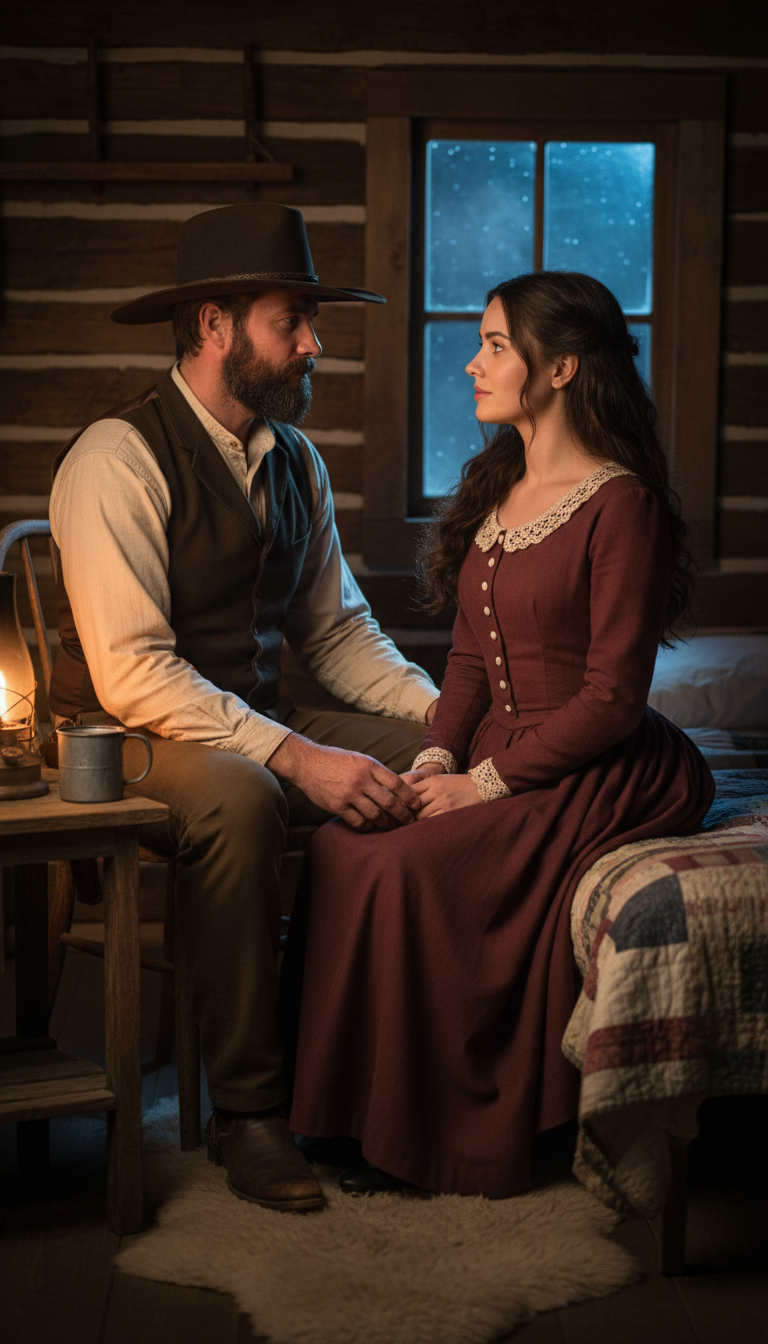
He Said “You Sleep Here. I Sleep By The Fire” — But At Midnight She Whispered His Name
A Western Historical Romance | A Story of a Mail-Order Bride, a Lonely Mountain Cowboy, and a Love Neither Expected
Chapter 1: The Woman in the Red Dress
The snow was falling when Eliza Bennett first saw the cabin.
It was not the gentle kind of snow she remembered from Christmas mornings in St. Louis. This snow was different. It came down heavily, almost angrily, covering the mountain trail, swallowing the pine trees, and turning the world into something white, silent, and frightening.
Her fingers were numb around the handle of her small brown suitcase.
Inside it were two dresses, three pairs of stockings, a hairbrush, a little Bible, and the last letter her mother had ever written.
She had been traveling for six days.
Six days on trains, in stagecoaches, and finally on the back of a horse belonging to a man who had barely spoken to her.
And now she was standing in front of a wooden cabin belonging to a man she had never met.
Callaway Mercer.
Thirty-eight years old.
A mountain cowboy.
Widower.
And, according to the advertisement that had brought her across half the country, a man looking for a wife.
Eliza looked down at her dress.
It was deep wine red, with delicate white lace around the neckline and cuffs. Her mother had sewn it for her when Eliza turned seventeen. It was the nicest thing she owned, and she had worn it because she wanted to arrive looking respectable.
She had no idea what a woman was supposed to wear when meeting the man she had agreed to marry.
Especially when that man was practically a stranger.
The cabin door opened.
A tall man stepped outside.
He wore a brown cowboy hat, a dark leather vest, a gun belt, and a thick wool coat. His beard was beginning to show gray around the chin, and his shoulders were so broad that the doorway seemed smaller when he stood in it.
His eyes moved from her face to the suitcase in her hand.
“Miss Bennett?”
“Yes, sir.”
“Callaway Mercer.”
He did not offer his hand immediately.
Instead, he looked at her frozen fingers.
“Lord, woman. You’re half frozen.”
“I’m all right.”
“That’s what people say when they ain’t.”
He stepped aside.
“Come inside.”
Eliza hesitated.
It was a small hesitation, but he noticed.
His expression changed.
“Door’s open, Miss Bennett. Nobody’s going to drag you through it.”
She lowered her eyes.
“I’m sorry.”
“Don’t apologize for being careful.”
Those words surprised her.
She followed him inside.
The cabin was warmer than she expected. A large stone fireplace stood against the far wall, with burning logs sending golden light across the wooden floor. There was a small kitchen, a rough wooden table, two chairs, a shelf filled with books, and a narrow window looking out toward the mountains.
A lantern burned on the table.
Another stood beside the fireplace.
The place smelled of pinewood, coffee, leather, and something that reminded her of clean winter air.
Callaway took her suitcase.
“Sit down.”
“I can carry it.”
“I know you can. But you’re shaking.”
He placed the suitcase beside the stairs and pulled a chair closer to the fire.
Eliza sat.
He poured hot coffee into a tin mug and placed it in front of her.
“Careful. It’s hot.”
“Thank you.”
He returned to the kitchen.
For several minutes, neither spoke.
Eliza held the mug between both hands, letting the warmth reach her fingers.
She had imagined this meeting many times.
In some versions, Callaway was an old, unpleasant man who had answered the advertisement because he wanted a woman to cook and clean.
In others, he was handsome but impatient, someone who would expect her to become his wife immediately.
She had prepared herself for either possibility.
But she had not prepared herself for a man who noticed that her hands were cold.
Finally, he turned toward her.
“How was the journey?”
“Long.”
“Road’s worse this time of year.”
“I noticed.”
A faint smile touched his mouth.
“That so?”
She almost smiled back.
Then he asked the question she had been dreading.
“Did you come here because you wanted to?”
Eliza looked at him.
“What?”
“To marry me. Did you want to come, or did somebody make you?”
She lowered her eyes toward the coffee.
“My father wanted me to marry a man in St. Louis. He was a business associate. Much older. I didn’t want to.”
“And?”
“He said I had no choice.”
Callaway’s jaw tightened.
“Did he hurt you?”
“Not exactly.”
“That ain’t an answer.”
Eliza swallowed.
“He never struck me. But he made it clear that my wishes didn’t matter.”
Callaway looked at the fire.
“Well, your wishes matter here.”
She stared at him.
He seemed uncomfortable with the attention.
“I sent that advertisement because I wanted a wife,” he continued. “Someone to share this place with. Someone who might enjoy a quiet life. But I ain’t buying a woman, Miss Bennett.”
“My name is Eliza.”
He nodded.
“Eliza, then.”
She looked at his hands.
They were large, rough, and marked with small scars.
“What happens now?”
“Now you eat something, get warm, and sleep.”
“Sleep?”
He nodded toward the narrow staircase.
“There’s a bed upstairs.”
Eliza looked toward the stairs, then back at him.
“Where will you sleep?”
“Down here.”
“But this is your cabin.”
“Still is.”
“And the bed?”
“Mine.”
She felt her cheeks grow warm.
Callaway seemed to understand.
He rubbed the back of his neck.
“Listen, darlin’. You traveled a long way. You’re tired. I’m not expecting anything from you tonight.”
He pointed toward the staircase.
“You sleep there. I sleep by the fire.”
And for the first time since leaving St. Louis, Eliza felt something she had almost forgotten how to feel.
Relief.
Not happiness.
Not love.
Just relief.
And sometimes, for a woman who had spent years being afraid, relief was the beginning of everything.
Chapter 2: The Rules of the Cabin
Dinner was simple.
Beef stew, fresh bread, and potatoes cooked in a cast-iron pot.
Eliza sat at the table while Callaway served her. He placed a generous portion in her bowl and sat opposite her.
She waited for him to begin eating.
He noticed.
“You don’t have to wait for me.”
“I was taught it was polite.”
“Well, whoever taught you that forgot to mention that hungry people ought to eat.”
She picked up her spoon.
The stew was delicious.
She had not realized how hungry she was until the first mouthful reached her stomach.
Callaway ate quietly. Every now and then, he looked toward the window, checking the falling snow.
“Does it snow this heavily every year?” she asked.
“Not always.”
“How long does it usually last?”
“Depends.”
“On what?”
“Whether the mountain likes us.”
She looked up.
For a second, she thought he was serious.
Then she noticed the small smile beneath his beard.
Eliza laughed.
It was a quiet laugh, almost unfamiliar to her.
Callaway looked at her.
“What?”
“Nothing.”
“You laughed.”
“Am I not allowed?”
“Didn’t say that.”
He returned to his stew, but she noticed something different about his expression.
He looked pleased.
After dinner, Eliza offered to wash the dishes.
Callaway immediately shook his head.
“You’ve been traveling for six days.”
“I can wash a few plates.”
“I’ve got two hands. They work just fine.”
“But I don’t want you thinking I came here to do nothing.”
He stopped.
“Eliza.”
She looked at him.
“You came here because we agreed to see whether we could build a life together. That doesn’t mean you owe me every waking hour of yours.”
She lowered her eyes.
“Most men don’t say things like that.”
“Most men aren’t me.”
He took the plates.
She watched him carry them toward the kitchen.
Something about the simplicity of the gesture troubled her more than cruelty would have.
She knew how to respond to anger.
She knew how to avoid an impatient man.
But kindness?
Kindness left her uncertain.
When the dishes were finished, Callaway brought her suitcase upstairs.
The bedroom was small but comfortable.
A wooden bed stood against the wall, covered with a thick quilt. There was a wardrobe, a washstand, a little mirror, and a window overlooking the snowy forest.
On the bedside table stood a lantern.
It was already lit.
Eliza looked at it.
“Why are there so many lanterns?”
Callaway placed her suitcase beside the wardrobe.
“Mountain gets dark early.”
“I can see that.”
“And I don’t like people stumbling around in the dark.”
He adjusted the wick.
“There’s oil in the cabinet. If it runs low, tell me.”
She nodded.
He turned toward the door.
“There’s a lock on the inside.”
He pointed to the small metal latch.
“You can use it.”
Eliza looked at him.
“Would that offend you?”
“No.”
“But what if you need something?”
“I’ll knock.”
“And if I don’t answer?”
“Then I’ll wait.”
He said it so naturally that she almost forgot to be afraid.
Callaway stood at the doorway.
“One more thing.”
“Yes?”
“If you hear the wind tonight, don’t worry. It makes the whole cabin sound like an old ship.”
She smiled.
“I’ll remember.”
He nodded and started down the stairs.
“Good night, Eliza.”
“Good night, Callaway.”
She heard his boots cross the wooden floor.
Then came the soft sound of a log being moved in the fireplace.
A chair creaked.
The cabin settled.
Eliza closed the door and turned the lock.
For a long moment, she simply stood there.
She was alone in a bedroom.
A real bedroom.
With a bed that nobody expected her to share.
She touched the quilt.
It was warm.
She sat on the edge and looked at the lantern.
Her mother had once told her that a woman’s safety should never depend on a man’s promises.
But her mother had also told her that good people sometimes existed in places where she least expected to find them.
Eliza wondered whether Callaway Mercer was one of those people.
She changed into her nightdress, folded her red dress carefully over the chair, and climbed beneath the quilt.
Downstairs, the fire crackled.
She could hear Callaway moving occasionally, but he never came upstairs.
Eventually, her eyes grew heavy.
For the first time in months, she fell asleep without listening for footsteps outside her door.
Chapter 3: The Nightmare at Midnight
The nightmare began with a door.
A heavy wooden door.
Eliza was standing in her father’s house in St. Louis. The hallway was dark, and the clock was ticking.
She could hear a man’s voice.
“You’re going to marry him whether you like it or not.”
She backed away.
“I don’t want to.”
“You don’t get to decide.”
The door opened.
Her father stood there with a furious expression.
Behind him was Mr. Whitcomb, the man she had refused to marry.
He smiled.
Eliza tried to run, but her feet would not move.
Then somebody grabbed her wrist.
She screamed.
And woke up.
Her eyes flew open.
The bedroom was dark except for the lantern.
Her heart hammered against her chest.
For several seconds, she couldn’t remember where she was.
Then she heard the fire downstairs.
The wind.
The cabin.
Callaway.
She pulled the quilt around herself and tried to breathe.
But the nightmare had brought everything back.
Her father’s voice.
The locked room.
The wedding arrangements she had never agreed to.
The fear of being trapped again.
She sat up.
Her hands were trembling.
She looked toward the door.
Callaway had told her what to do.
If you have a nightmare, call my name.
She swallowed.
“Callaway?”
Her voice was barely audible.
Nothing happened.
She tried again.
“Callaway?”
A moment later, she heard movement.
A chair scraped against the floor.
Boots crossed the room.
Then his voice came through the door.
“Eliza?”
She covered her mouth.
“Yes.”
“Are you hurt?”
“No.”
“Can I come in?”
She looked at the lock.
Then at the door.
“Yes.”
She heard the latch turn.
Callaway opened the door slowly.
He was still wearing his dark trousers, shirt, vest, and gun belt. His brown hat sat on the small table downstairs, but his hair was disheveled.
He had clearly been sleeping.
He looked at her face.
“What happened?”
“Nothing.”
He frowned.
“Darlin’, you called my name in the middle of the night. Something happened.”
She tried to speak.
Her throat tightened.
“I had a dream.”
Callaway’s expression softened.
He stepped inside but stayed near the doorway.
“About what?”
“My father.”
He waited.
She wiped her eyes.
“He wanted me to marry a man I didn’t love. He said I had no choice. And I dreamed he found me here.”
Callaway looked at the locked door.
Then back at her.
“Your father doesn’t know where you are?”
“No.”
“Doesn’t have your address?”
“No.”
“Then he ain’t coming through that door tonight.”
She nodded, but the fear remained.
Callaway glanced at the chair beside the bed.
“Would you like me to sit there?”
She looked at him.
“Would you?”
“That’s why I asked.”
He pulled the chair closer and sat down.
He didn’t touch her.
He didn’t tell her to stop crying.
He simply remained there.
For a while, the only sound was the wind against the windows.
Then Eliza whispered something that made his expression change.
“Would you mind leaving the door open?”
Callaway looked at her.
“Of course.”
He pushed it open a little farther.
She watched him.
“Can you see me from there?”
“Yes.”
“Even if I fall asleep?”
“Especially then.”
Her lower lip trembled.
“Thank you.”
Callaway leaned back in the chair.
“Try to sleep, sweetheart.”
She lay down.
But when she closed her eyes, the nightmare returned in fragments.
Her father’s voice.
Mr. Whitcomb’s smile.
The feeling of being trapped.
After several minutes, she opened her eyes again.
“Callaway?”
“I’m here.”
“Can I ask you something?”
“Anything.”
“Why did you sleep by the fire?”
He looked toward the bedroom door.
“Because that’s where I sleep.”
“But why?”
He was quiet for a moment.
Then he answered.
“My wife died in that bed.”
Eliza’s eyes softened.
“I’m sorry.”
“Fever. Five years ago.”
“Was she young?”
“Thirty-one.”
He looked at the fire downstairs.
“She was the kind of woman who could make a place feel like home just by walking into it.”
Eliza didn’t know what to say.
“After she died,” he continued, “I couldn’t sleep in that room. So I moved downstairs.”
“Have you never wanted to marry again?”
“No.”
“Why not?”
He looked at her.
“Didn’t think I had another heart to give.”
Eliza felt something move inside her chest.
She knew what it was like to lose the feeling that life could become something different.
She reached out from beneath the quilt.
Not far.
Just enough for her fingers to touch the edge of his hand.
Callaway looked down.
He did not move.
After a moment, Eliza whispered:
“Thank you for coming when I called.”
His voice became rough.
“You call, I’ll come.”
She closed her eyes.
This time, when sleep returned, she did not dream of her father.
And Callaway remained in the chair until the first gray light appeared beyond the window.
Chapter 4: The Morning After
Eliza woke to the smell of coffee.
For a moment, she forgot where she was.
Then she noticed the open bedroom door.
The chair beside the bed.
And a folded blanket resting across its back.
Callaway was gone.
She sat up and looked at the window.
The storm had finally stopped.
Sunlight spilled across the snow, making the mountains look like they were covered in diamonds.
She dressed quickly and went downstairs.
Callaway was outside splitting wood.
His brown hat was pulled low over his forehead. His sleeves were rolled to his elbows, and his boots were planted firmly in the snow.
The axe rose.
Fell.
A log split cleanly in two.
He didn’t notice her immediately.
She stood on the porch, watching him.
Finally, he looked up.
“Morning.”
“Good morning.”
“Sleep all right?”
“Eventually.”
He leaned the axe against the chopping block.
“Coffee’s on the table.”
She nodded.
Then she hesitated.
“Callaway?”
“Yes?”
“Thank you for staying with me last night.”
He picked up another log.
“Didn’t mind.”
“You must have been tired.”
“Been tired before.”
She smiled.
He looked at her for another moment.
Then he said, “You look better in daylight.”
Eliza raised an eyebrow.
“Was I frightening last night?”
“No.”
“Then what did you mean?”
He cleared his throat.
“Nothing. Just saying you look rested.”
She laughed.
And this time, Callaway smiled too.
It was a small smile, but she noticed it.
He seemed like a man who had forgotten how to use his face for anything other than seriousness.
After breakfast, he showed her around the cabin.
The kitchen had a small wood-burning stove, a pantry, and a shelf containing jars of preserved vegetables.
There was a second room downstairs filled with saddles, ropes, tools, and old supplies.
He showed her where the flour was kept and where she could find blankets.
Then he pointed toward a narrow door.
“That’s the storage room.”
“What’s inside?”
“Things I haven’t needed in years.”
She noticed that he didn’t open it.
She didn’t ask.
Outside, the property stretched across a beautiful mountain valley.
There was a stable, a small barn, a woodpile, and a fenced area where two horses stood.
One was a dark brown gelding.
The other was a gray mare.
“What’s her name?” Eliza asked.
“June.”
“And him?”
“Whiskey.”
She laughed.
“That’s a strange name for a horse.”
“He’s got a strange personality.”
As if understanding the insult, Whiskey shook his head.
Callaway smiled.
“See?”
Eliza approached the mare carefully.
June lowered her head and sniffed her hand.
“She’s beautiful.”
“She likes apples.”
“Then I shall have to bring her some.”
Callaway watched her stroke the mare’s neck.
Something about the sight of Eliza standing in the snow, her red scarf bright against the white landscape, stirred a feeling he had spent years trying to bury.
He looked away.
He had invited a woman into his cabin.
He had told himself it was a practical decision.
A companion.
A wife.
Someone to share the work.
But he was beginning to understand that Eliza’s presence might change much more than the empty space at his table.
And that frightened him.
Because the last time he had allowed himself to love someone, the mountain had taken her away.
Chapter 5: A Letter Beneath the Floorboards
Three days passed.
Eliza began learning the rhythm of the mountain.
She woke early, helped prepare breakfast, and sometimes accompanied Callaway to the barn.
He taught her how to feed the horses, how to recognize approaching storms, and how to walk safely across icy ground.
She taught him that coffee tasted better with a little cinnamon.
He pretended not to like it.
But every morning, he drank the entire cup.
Their conversations became longer.
He told her about the valley, the nearest town, and the ranch he had once owned with his younger brother.
She told him about St. Louis, her mother, and the little garden they had kept behind their house.
But there were still things she couldn’t explain.
And Callaway didn’t force her.
On the fourth morning, she was cleaning the bedroom when she noticed something beneath the bed.
A small wooden box.
It was old and dusty.
She pulled it out and saw a brass latch.
She did not open it.
Instead, she carried it downstairs.
“Callaway?”
He was repairing a saddle.
He looked up.
“Yes?”
“I found this beneath the bed.”
The moment he saw the box, his hands stopped moving.
For several seconds, he simply stared.
“Where?”
“Under the bed.”
He stood.
“That’s my wife’s.”
Eliza immediately stepped back.
“I’m sorry. I shouldn’t have touched it.”
“It’s all right.”
He took the box gently.
Then he carried it to the table.
He sat down and opened it.
Inside were several letters, a small silver comb, a faded photograph, and a dried wildflower pressed between two pieces of paper.
Callaway lifted the photograph.
A beautiful dark-haired woman stood beside him.
He looked younger in the picture.
Happier.
Eliza recognized the expression on his face immediately.
It was the expression of a man who had once believed the world could never hurt him.
“Her name was Margaret,” he said.
Eliza sat across from him.
“She was beautiful.”
“She was stubborn.”
“Those things can go together.”
A small smile appeared on his face.
“She’d have liked you.”
Eliza looked at the photograph.
“Did she like the mountains?”
“More than I did.”
He turned the photograph over.
There was a date written on the back.
Five years earlier.
“She wanted children,” he said quietly.
Eliza looked at him.
“Did you?”
“Yes.”
He paused.
“But it never happened.”
She felt the sadness in his voice.
“Did she know you loved her?”
Callaway looked at the photograph.
“Every day.”
“Then she was fortunate.”
He looked up.
“How so?”
“Because some people spend their entire lives wondering whether they’re loved.”
For a long moment, he said nothing.
Then he closed the box.
He didn’t put it back beneath the bed.
Instead, he placed it on the shelf beside his books.
Eliza noticed.
She didn’t comment.
But she understood that something important had happened.
For five years, Callaway had kept his wife’s memory hidden beneath the bed.
Now, for the first time, he had allowed another person to see it.
Chapter 6: The Cowboy Who Never Asked
A week after Eliza arrived, Callaway took her into town.
The nearest settlement was called Pine Hollow.
It consisted of a general store, a blacksmith, a small church, a post office, and a hotel.
The journey took nearly two hours by wagon.
Eliza wore her red dress beneath a thick brown coat. She had tied her hair with a white ribbon.
Callaway wore his usual hat and vest.
When they entered the general store, the owner looked up.
“Well, I’ll be.”
Callaway nodded.
“Morning, Samuel.”
Samuel’s eyes moved toward Eliza.
“And who’s this?”
“Eliza.”
Samuel wiped his hands on his apron.
“Your wife?”
Callaway glanced at her.
“That’s the arrangement.”
Eliza felt her cheeks warm.
Samuel smiled.
“Well, welcome to Pine Hollow, Mrs. Mercer.”
She opened her mouth to correct him.
But Callaway answered first.
“Thank you.”
The words surprised her.
He had called her Mrs. Mercer without hesitation.
She didn’t know why that small thing made her heart beat faster.
While Callaway purchased supplies, Eliza wandered toward the fabric section.
She stopped in front of a display of blue cotton.
It was beautiful.
She touched it lightly.
“Like that?”
She turned.
Callaway stood behind her.
“It’s lovely.”
“Then get it.”
“Oh, no. I don’t need it.”
“Didn’t ask whether you needed it.”
She smiled.
“I have enough dresses.”
“That ain’t what I asked.”
He placed the fabric on the counter.
Eliza tried to protest.
But Callaway had already paid.
Outside, she walked beside him.
“You shouldn’t have bought that.”
“Why?”
“Because it wasn’t necessary.”
“Maybe I wanted to.”
She looked up.
“Why?”
He adjusted his hat.
“Because I like seeing you smile.”
Eliza stopped walking.
Callaway took another step before noticing.
He turned.
“What?”
She looked at him for a moment.
Then smiled.
“Nothing.”
But it wasn’t nothing.
It was the first time a man had bought her something simply because he wanted to make her happy.
Not because he expected something afterward.
Not because he wanted to remind her who paid for it.
Just because he liked seeing her smile.
And Callaway, who had spent five years avoiding the possibility of another heartbreak, was beginning to discover that making Eliza happy was becoming one of his favorite things.
Chapter 7: The Stranger at the Hotel
They were preparing to leave Pine Hollow when a man stepped out of the hotel.
He was dressed in a dark suit and carried a polished walking stick.
His eyes moved across the street.
Then stopped on Eliza.
For a second, his expression changed.
“Well, I’ll be damned.”
Eliza froze.
She knew that voice.
She knew that smile.
Mr. Henry Whitcomb.
The man her father had wanted her to marry.
“Eliza Bennett.”
Her fingers tightened around the fabric package.
Callaway noticed immediately.
“Know him?”
She couldn’t answer.
Whitcomb walked toward them.
“I’ve been looking for you.”
Eliza stepped backward.
Callaway moved slightly in front of her.
“Who are you?”
Whitcomb ignored him.
“Your father has been terribly worried.”
Eliza finally found her voice.
“I don’t belong to him.”
Whitcomb laughed.
“Still dramatic, I see.”
Callaway’s expression hardened.
“I asked who you are.”
Whitcomb looked him up and down.
“Henry Whitcomb. A businessman from St. Louis.”
“And what business do you have with my wife?”
Whitcomb’s eyebrows rose.
“Your wife?”
He laughed again.
“Well, this is interesting.”
Eliza’s face had gone pale.
Callaway turned slightly.
“Eliza, get in the wagon.”
She didn’t move.
“Darlin’.”
His voice was gentle.
“Go on.”
She climbed into the wagon.
Callaway waited until she was seated before turning back.
Whitcomb leaned closer.
“Listen carefully, cowboy. That girl has a family. Her father made arrangements. She has no right to disappear and marry some mountain nobody.”
Callaway stared at him.
“She made her own decision.”
“She is twenty-one. She doesn’t understand what she’s doing.”
“Funny. She seems to understand perfectly well.”
Whitcomb’s smile disappeared.
“Her father will pay handsomely for her return.”
Callaway’s hand moved toward his gun belt.
Not to draw.
Only to rest there.
“You should leave.”
“You’re making a mistake.”
“Maybe.”
Callaway stepped closer.
“But I ain’t the one who came looking for a woman who already told him no.”
Whitcomb looked toward the wagon.
“Eliza! Your father expects you home!”
She flinched.
Callaway noticed.
His voice became colder.
“One more word to her and you’ll be explaining yourself to the sheriff.”
Whitcomb stepped back.
“This isn’t finished.”
Callaway climbed onto the wagon.
“You’re right.”
He took the reins.
“Not until you learn to leave her alone.”
The horses moved.
Eliza sat silently beside him.
For several minutes, neither spoke.
Then Callaway asked:
“Was he the man?”
She nodded.
“The one your father wanted you to marry?”
“Yes.”
“Did he ever hurt you?”
She looked down.
“He grabbed my arm once. When I refused to attend dinner with him.”
Callaway’s jaw tightened.
“Anything else?”
“He told me that after marriage, I would learn to behave.”
Callaway stared ahead.
His hands tightened around the reins.
“Well, he won’t be coming near you again.”
Eliza looked at him.
“You don’t know that.”
“No.”
“Then why say it?”
He turned toward her.
“Because I’ll make sure he understands.”
She swallowed.
“Callaway?”
“Yes?”
“Please don’t fight him because of me.”
He looked at her for a long moment.
Then he answered quietly.
“I won’t start a fight, sweetheart.”
He turned back toward the trail.
“But I won’t let him frighten you in my presence.”
And Eliza realized that the man sitting beside her was not simply protecting the woman he had agreed to marry.
He was protecting the woman he was beginning to love.
Chapter 8: The First Time She Called Him Her Husband
The ride home was quieter than the journey into town.
Eliza kept looking behind them, expecting to see Whitcomb’s carriage following the wagon.
Callaway noticed.
“He’s not there.”
“How can you be sure?”
“Because I’d hear him.”
She nodded.
But her hands remained folded tightly in her lap.
After another mile, Callaway stopped the wagon beside a frozen creek.
“Come here.”
Eliza looked at him.
“Why?”
“Because you’ve been holding your breath for the last twenty minutes.”
She hadn’t realized it.
He climbed down and offered her his hand.
She took it.
He helped her step onto the snow-covered ground.
The creek was almost completely frozen. Tall pine trees surrounded it, and the afternoon sun shone through their branches.
Callaway leaned against the wagon.
“Tell me what happened in St. Louis.”
Eliza looked at the water.
“My father owned a small furniture business. It wasn’t doing well. He owed money to several people, including Mr. Whitcomb.”
Callaway listened.
“Whitcomb offered to clear the debts if I married him. My father thought it was a wonderful arrangement.”
“And you?”
“I thought it was terrible.”
Callaway almost smiled.
“Understandable.”
“He was forty-six. He had already been married twice. He spoke about me as if I were something he had purchased.”
Her voice began to shake.
“When I refused, my father said I was selfish. He told me that my mother would have been ashamed of me.”
Callaway’s expression changed.
“Don’t let a dead woman’s name be used to make you feel guilty.”
Eliza looked at him.
“My mother would never have wanted that.”
“Then don’t carry the guilt.”
She lowered her head.
“I left three days later. I used the money my mother had hidden in an old sewing box. It was enough for the journey.”
Callaway nodded slowly.
“Good woman.”
“Who?”
“Your mother.”
Eliza smiled sadly.
“She was.”
He looked toward the mountain.
“You’re safe here.”
She looked at him.
“Callaway, you keep saying that.”
“Because I mean it.”
“But what if Whitcomb comes here?”
“Then he’ll find me.”
“What if my father comes?”
“He’ll find me too.”
She stared at him.
“You make it sound so simple.”
“It ain’t simple.”
He stepped closer.
“But some things are worth standing for.”
She looked down at his hand.
Then, without thinking, she reached for it.
Callaway went still.
Her fingers slipped between his.
For a moment, neither moved.
Then he closed his hand gently around hers.
“Thank you,” she whispered.
He looked at her.
“For what?”
“For calling me your wife.”
His eyes softened.
“You are my wife, Eliza.”
She smiled.
“But you don’t have to say it like that if you don’t mean it.”
Callaway’s expression became serious.
“I don’t say things I don’t mean.”
The words stayed with her all the way home.
That evening, while Callaway was tending the fire, Eliza brought him a cup of coffee.
He accepted it.
“Thank you, sweetheart.”
She smiled.
It was the first time he had called her that without sounding as though he were afraid of the word.
And when he looked up, she surprised him.
“You’re welcome, husband.”
The cup nearly slipped from his hand.
Eliza laughed.
Callaway shook his head.
“Careful, woman.”
“Why?”
“You’re going to give an old cowboy a heart attack.”
She laughed harder.
And for the first time in five years, the cabin was filled with the sound of a woman laughing.
Chapter 9: A Dress for Sunday
Sunday arrived with clear skies.
Eliza had spent the previous evening sewing a small tear in her red dress.
She also finished the blue cotton dress Callaway had purchased in Pine Hollow.
It was simple, with a modest neckline and long sleeves.
She wore it to church.
Callaway was waiting outside the cabin.
He had brushed his horse, polished his boots, and worn a clean white shirt beneath his dark vest.
When Eliza stepped onto the porch, he looked at her.
Then he forgot what he had been about to say.
She looked different.
Not because of the dress.
Because she was smiling.
“Is something wrong?” she asked.
“No.”
“Then why are you staring?”
He adjusted his hat.
“Trying to remember what I was doing.”
She laughed.
He offered his arm.
She took it.
The church was small, with wooden benches and a little bell above the entrance.
People greeted Callaway as they entered.
Some looked surprised to see him accompanied by a woman.
Mrs. Hensley, the pastor’s wife, approached them.
“Callaway Mercer. I haven’t seen you in church for years.”
“Morning, Martha.”
Her eyes moved to Eliza.
“And who is this lovely young lady?”
“Eliza. My wife.”
Martha’s face brightened.
“Your wife! Well, I never.”
She shook Eliza’s hand warmly.
“Welcome to our little town, dear.”
During the service, Eliza noticed that Callaway didn’t sing.
He sat quietly, his hands resting on his knees.
But when the pastor spoke about forgiveness and the courage to begin again, Callaway looked toward her.
Their eyes met.
She smiled.
He looked away.
After the service, several women invited Eliza to join them for tea.
Callaway waited outside.
When she finally came out, she found him leaning against the fence.
“Enjoy yourself?”
“Very much.”
“Good.”
“Mrs. Hensley invited me to help with the church sewing circle.”
“That sounds like something you’d enjoy.”
She smiled.
“Would you mind?”
He looked almost offended.
“Why would I mind?”
“I don’t know. Perhaps you prefer me at home.”
“Eliza.”
He shook his head.
“I married a woman. Not a piece of furniture.”
She laughed.
Then she slipped her arm through his.
They walked toward the wagon.
Callaway glanced down at her.
“You’re fitting in.”
“Perhaps.”
“Perhaps?”
“I haven’t decided whether I like everyone yet.”
He chuckled.
“That’s probably wise.”
For a moment, she felt like an ordinary young woman.
A woman with a husband.
A church to attend.
A community to discover.
A future that had not already been decided by someone else.
And that feeling was worth more than she could explain.
Chapter 10: The Man Who Feared Another Goodbye
That night, Callaway could not sleep.
He sat beside the fire, staring at the flames.
Eliza had gone upstairs an hour earlier.
She had kissed his cheek before leaving the room.
It was a small kiss.
Barely more than a touch.
But it had unsettled him more than any gunfight or dangerous mountain ride.
He touched the place where her lips had been.
Then he shook his head.
“You’re a fool, Mercer.”
The fire answered with a crackle.
He thought about Margaret.
About the years they had spent together.
About the last winter, when fever had taken hold of her.
He remembered carrying her downstairs because she wanted to sit near the fire.
He remembered her fingers gripping his hand.
He remembered promising that she would get better.
She hadn’t.
And now Eliza was upstairs.
A woman with frightened eyes and a heart that had already endured too much.
He couldn’t lose another woman.
He couldn’t watch another person he loved disappear while he stood helpless.
That was why he had been careful.
That was why he slept on the floor.
That was why he had promised not to touch her unless she asked.
He had told himself it was about her safety.
But perhaps it was also about his fear.
“Callaway?”
He looked up.
Eliza stood at the top of the stairs.
She wore her nightdress and had wrapped a shawl around her shoulders.
“Can’t sleep?”
“No.”
“May I come down?”
“Of course.”
She descended slowly.
When she reached him, she noticed his expression.
“What’s wrong?”
“Nothing.”
She sat in the chair beside him.
“You’re a terrible liar.”
He almost smiled.
“That so?”
“Yes.”
She looked at the fire.
“Are you thinking about Margaret?”
His face changed.
“Yes.”
Eliza folded her hands.
“Do you miss her?”
“Every day.”
She nodded.
“Then don’t stop.”
He looked at her.
“What?”
“Remembering her. Missing her. Loving her. You don’t have to forget someone to make room for another person.”
Callaway stared at her.
No one had ever said that to him.
He had spent five years believing that moving forward meant betraying the woman he had lost.
But Eliza was telling him something different.
She was telling him that love did not have to erase love.
“You’re a strange woman,” he said quietly.
She smiled.
“Why?”
“Because you make things sound easier than they are.”
“They aren’t easy.”
She looked at him.
“But perhaps they don’t have to be impossible.”
Callaway reached for her hand.
This time, he did not hesitate.
He held it between both of his.
“Eliza?”
“Yes?”
“I don’t know how to do this again.”
She looked into his eyes.
“Neither do I.”
He laughed softly.
“Well, that’s encouraging.”
She squeezed his fingers.
“We can learn.”
For a long moment, they sat together.
Then Eliza leaned against his shoulder.
Callaway remained still at first.
Then he slowly placed his arm around her.
She rested her head against his chest.
And he realized something.
For the first time in five years, he was no longer sitting beside the fire because he was afraid to enter the bedroom.
He was sitting beside it because the woman he loved had chosen to sit with him.
Chapter 11: The Storm That Changed Everything
The storm arrived three days later.
It began with wind.
Then rain.
Then snow.
By evening, the mountain trail had disappeared beneath a thick white blanket.
Callaway spent the afternoon securing the barn and checking the horses.
Eliza prepared soup and kept the fire burning.
When he returned, his coat was covered in snow.
“Bad?”
“Bad enough.”
“Will it last?”
“Could be two days. Could be four.”
She looked toward the window.
“Four?”
He nodded.
“Mountain doesn’t care what we want.”
She smiled.
“Perhaps we should ask it politely.”
“Go ahead. See how that works.”
They laughed.
After dinner, Callaway checked the doors and windows.
Eliza watched him.
“Are you worried?”
“About the storm?”
“Yes.”
“Not for myself.”
She understood.
“The horses?”
“And you.”
She looked at him.
“I’m safe.”
He nodded.
“Good.”
But the storm grew worse during the night.
The wind shook the cabin.
Snow struck the windows.
A loud crack came from somewhere outside.
Callaway immediately stood.
“What was that?”
“Tree branch, maybe.”
He grabbed his coat.
“Stay inside.”
“Callaway—”
“Lock the door behind me.”
He stepped outside.
Eliza went to the window.
She could barely see through the snow.
Minutes passed.
Then ten.
Then twenty.
Her worry grew.
She paced between the table and the window.
At last, the door opened.
Callaway stumbled inside.
His left sleeve was torn, and blood covered his forearm.
Eliza rushed toward him.
“Good heavens! What happened?”
“Tree came down near the barn.”
“You’re bleeding!”
“Just a scratch.”
“Sit down.”
“Eliza—”
“Sit.”
He stared at her.
Then, surprisingly, obeyed.
She brought warm water, clean cloth, and the small medical box from the kitchen cupboard.
The cut was deep enough to require attention.
“What happened to your arm?”
“Branch caught me.”
“You could have been killed.”
“Wasn’t.”
“That is not the point!”
He looked up.
Eliza was trembling.
Her eyes were full of tears.
He reached for her hand.
“Hey.”
She shook her head.
“Don’t.”
“Darlin’—”
“Don’t tell me it was nothing.”
He became quiet.
She cleaned the wound.
Her hands were careful, but her expression was furious.
“You frightened me.”
“I’m sorry.”
She tied the bandage.
Then she looked at him.
“I thought you weren’t coming back.”
Callaway stared at her.
And suddenly he understood.
She wasn’t angry because he had been careless.
She was terrified because she had begun to love him.
He reached for her face.
“Eliza.”
She looked at him.
“I’m here.”
She closed her eyes.
Then she leaned forward and pressed her forehead against his.
“Don’t make me lose you.”
His good hand settled against her cheek.
“I’ll do everything I can to come back to you.”
She opened her eyes.
“Promise?”
He hesitated.
He had learned that promises could not always control the world.
So he gave her the truth instead.
“I promise I’ll never take a foolish risk when I don’t have to.”
She nodded.
Then, slowly, she kissed his cheek.
Callaway closed his eyes.
He wanted to kiss her.
But he waited.
He waited until she looked at him again.
And when she leaned closer, he understood.
“Are you sure?” he whispered.
She nodded.
He touched his lips to hers.
The kiss was gentle.
Careful.
Almost uncertain.
It lasted only a few seconds.
But when they separated, Eliza smiled.
And Callaway felt something inside him finally begin to heal.
Chapter 12: The Night She Chose His Arms
The storm continued through the next day.
The trail remained blocked.
The horses were safe, and the cabin was warm.
Callaway’s arm hurt, but he refused to complain.
Eliza insisted on doing most of the work.
She cooked breakfast, brought him fresh bandages, and made him sit near the fire.
“You are enjoying this,” he said.
“Enjoying what?”
“Ordering me around.”
She smiled.
“Perhaps.”
“Didn’t know I married a tyrant.”
She raised an eyebrow.
“You could always sleep in the barn.”
He laughed.
It was a deep, genuine laugh.
Eliza loved hearing it.
That evening, they ate dinner together.
Afterward, she washed the dishes while Callaway sat near the fireplace.
When she finished, she approached him.
“Callaway?”
“Hmm?”
“Would you like to come upstairs?”
He looked at her.
She was standing beside the staircase, her fingers resting on the wooden railing.
He understood what she meant.
But he didn’t move immediately.
“Eliza.”
“Yes?”
“I need you to know something.”
She waited.
“I want to be close to you. More than I’ve wanted anything in a long time.”
Her cheeks turned pink.
“But I don’t want you doing something because you think it’s expected.”
She smiled softly.
“I know.”
“I mean it.”
“I know, Callaway.”
He stood carefully.
“Then tell me what you want.”
She looked toward the bedroom.
Then back at him.
“I want you beside me tonight.”
He studied her expression.
“Just beside you?”
She smiled.
“Just beside me.”
He nodded.
“Then that’s what I’ll do.”
They climbed the stairs together.
Eliza turned the lantern wick lower.
Callaway stopped at the foot of the bed.
“Still want the door open?”
She shook her head.
“Not tonight.”
He waited.
She stepped closer and took his hand.
“I feel safe with you.”
Something moved in his expression.
“That’s all I ever wanted you to feel.”
They lay beneath the quilt.
Callaway remained on top of the blanket at first, careful not to crowd her.
Eliza moved closer.
Then closer still.
Eventually, she rested her head against his chest.
His arm settled around her shoulders.
Neither spoke for several minutes.
Then she whispered:
“Callaway?”
“Yes, sweetheart?”
“Do you think you could ever love me?”
He looked toward the ceiling.
The question was simple.
But his answer had been waiting inside him for days.
“Eliza, I think I already do.”
She lifted her head.
He looked down at her.
“I didn’t plan on it. Didn’t expect it. And I sure as hell didn’t think I was capable of it anymore.”
He brushed a loose strand of hair from her face.
“But when you walk into a room, I notice. When you laugh, I want to hear it again. When you go outside, I find myself watching until you’re back.”
Her eyes filled with tears.
“That’s love?”
He smiled.
“Looks like it.”
She leaned forward and kissed him.
This time, he kissed her back without fear.
And when she finally fell asleep in his arms, Callaway stayed awake for a little while.
Not because he was afraid.
But because he wanted to remember the feeling.
For the first time in five years, he had someone beside him.
And he didn’t want the night to end.
Chapter 13: The Letter From St. Louis
The following week, the weather improved.
Callaway rode into Pine Hollow to purchase supplies and collect the mail.
When he returned, Eliza was preparing bread.
He placed a small bundle on the table.
“Mail for you.”
She wiped her hands and looked through the letters.
One envelope had her name written across it in familiar handwriting.
Her father’s.
Her smile disappeared.
Callaway noticed.
“Want me to leave you alone?”
She shook her head.
“No. Stay.”
She opened the envelope.
The letter was short.
Eliza,
You have embarrassed this family enough. Mr. Whitcomb has informed me of your marriage. I cannot believe you would throw away your future for a man living in the wilderness.
You will return to St. Louis immediately. Your belongings are still here, and I expect you to correct this mistake.
If you refuse, you should understand that I will not welcome you back.
Your father.
Eliza read it twice.
Then she folded it.
Callaway stood near the table.
“What does he want?”
“For me to come home.”
“Are you going?”
She looked at him.
“No.”
He nodded.
“All right.”
She seemed surprised.
“That’s all?”
“What else?”
“You aren’t going to tell me what I should do?”
“No.”
She looked at the letter.
“He says I’m no longer welcome.”
Callaway leaned against the table.
“Then perhaps you ought to stop trying to be welcome in a place where nobody respected you.”
Her eyes filled.
She turned away.
Callaway stepped closer.
“Eliza.”
She shook her head.
“I know I shouldn’t care.”
“Didn’t say that.”
“He was my father.”
“I know.”
“I wanted him to be proud of me.”
Callaway gently touched her shoulder.
“Wanting your father’s love doesn’t make you foolish.”
She began to cry.
He turned her toward him.
“But you don’t have to earn it by giving up your happiness.”
She buried her face against his chest.
Callaway held her.
And for the first time, Eliza allowed herself to mourn the father she wished she had.
Not the man who had sent that letter.
But the father who might have protected her.
The one who might have told her that she deserved a choice.
The one who might have been proud when she found the courage to make one.
When her tears finally stopped, Callaway kissed the top of her head.
“You’re home, sweetheart.”
She looked up.
“Am I?”
He nodded.
“Long as you want to be.”
Eliza held him tighter.
And for the first time, she believed him.
Chapter 14: The Man Who Came Up the Mountain
Spring arrived slowly in the mountains.
The snow began melting along the lower trails, revealing patches of brown earth and fresh green grass.
Eliza loved watching the changes.
She planted flowers beside the porch, helped Callaway repair the fence, and began keeping a small notebook of the birds she saw near the cabin.
Callaway pretended not to notice how much she had changed his life.
But he noticed everything.
He noticed that she hummed while cooking.
That she talked to June as if the mare were an old friend.
That she always left a little bread outside for the birds.
And that she had begun sleeping with the bedroom door closed.
Not because she feared him.
Because she no longer needed to keep it open.
One afternoon, Callaway returned from checking the upper pasture.
His horse was sweating, and his expression was unusually serious.
Eliza stepped onto the porch.
“What’s wrong?”
“There’s a man coming up the trail.”
“Who?”
“Don’t know yet.”
He dismounted and secured the horse.
“Stay inside for a while.”
Eliza looked toward the trail.
A small cloud of dust was rising between the trees.
Then she saw the rider.
Her stomach dropped.
It was Henry Whitcomb.
He had come back.
Callaway stepped in front of her.
“Inside, Eliza.”
She didn’t move.
“Callaway, I won’t hide from him.”
He looked at her.
She was frightened.
He could see that.
But she was standing straight.
Her hands were trembling, yet she hadn’t stepped backward.
He nodded.
“All right.”
He placed his hand on her shoulder.
“But you stand behind me until we know what he wants.”
Whitcomb stopped his horse near the porch.
He looked at the cabin, then at Callaway.
“Mercer.”
“Whitcomb.”
Whitcomb dismounted.
“I came to settle this matter.”
Callaway crossed his arms.
“What matter?”
“The girl.”
Callaway’s expression became cold.
“Her name is Eliza.”
Whitcomb ignored him.
“Her father has agreed to pay for her return.”
Eliza stepped forward.
“I am not going anywhere.”
Whitcomb looked at her.
“Eliza, you’re making this much more difficult than it needs to be.”
“No. I made my decision months ago.”
“You’re confused.”
“I am not.”
He shook his head.
“Your father is ashamed of you.”
Eliza swallowed.
“That is his choice.”
Whitcomb laughed.
“You think this man loves you? Look at him. He’s a widower living in the wilderness. You have no idea what sort of life you’re condemning yourself to.”
Callaway moved forward.
“That’s enough.”
Whitcomb looked at him.
“Perhaps you should let the lady speak.”
“I have been speaking,” Eliza said.
Both men turned.
She stepped beside Callaway.
“I came here because I wanted a different life. I agreed to marry Callaway because I believed his letter. And everything I have experienced since arriving has shown me that I made the right decision.”
Whitcomb’s face darkened.
“You’re making a mistake.”
“Perhaps I made one when I listened to my father. But I will not make that mistake again.”
Whitcomb grabbed her wrist.
It happened quickly.
Eliza gasped.
Callaway moved faster.
He caught Whitcomb’s arm and forced him to release her.
“Take your hand off my wife.”
Whitcomb stumbled backward.
“Are you threatening me?”
“I’m telling you.”
Callaway’s voice was low.
“You’ve been told twice to leave this woman alone. There won’t be a third time.”
Whitcomb reached toward his coat.
Callaway’s hand went to his gun belt.
But before either man could move further, Eliza spoke.
“Callaway.”
He looked at her.
“Please.”
Something in her voice made him stop.
He released Whitcomb.
Then he stepped aside.
Eliza rubbed her wrist.
“Mr. Whitcomb, listen carefully. I am not a debt. I am not a business arrangement. I am not a payment your friend expects to collect.”
Whitcomb said nothing.
“I am a person. I have a husband. I have a home. And I am not returning to St. Louis.”
She looked directly into his eyes.
“If you come here again, I will go to the sheriff myself.”
Whitcomb glanced at Callaway.
Then at Eliza.
He seemed to realize that the frightened young woman he remembered was gone.
He climbed onto his horse.
“This isn’t over.”
Eliza didn’t answer.
Callaway watched him ride away.
Only when the sound of the horse disappeared did he turn toward her.
“Are you all right?”
She nodded.
Then she began shaking.
Callaway opened his arms.
She stepped into them.
He held her close.
“You were brave,” he whispered.
She pressed her face against his chest.
“I was terrified.”
“Brave people usually are.”
She looked up.
“Thank you for letting me speak.”
Callaway brushed his thumb across her cheek.
“Wasn’t my place to speak for you.”
She smiled through her tears.
And he kissed her forehead.
Chapter 15: The Secret Margaret Left Behind
A few days after Whitcomb’s visit, Eliza was cleaning the storage room.
Callaway had finally agreed to let her organize it.
There were old saddles, boxes of tools, winter supplies, and several pieces of furniture covered with sheets.
At the back stood a wooden chest.
It was larger than the little box she had found in the bedroom.
Eliza pulled the sheet away.
There was a small envelope resting on top.
Her name wasn’t written on it.
Neither was Callaway’s.
Instead, the front simply said:
For the day this house feels like home again.
Eliza stared at the handwriting.
She recognized it from the letters in Margaret’s box.
She carried the envelope downstairs.
Callaway was repairing a fence post near the fireplace.
“Callaway?”
He looked up.
“What’s wrong?”
She held out the envelope.
He recognized the handwriting immediately.
His face changed.
“Where did you find that?”
“In the storage room.”
He took it.
For several seconds, he didn’t open it.
Then he sat at the table.
Eliza sat beside him.
He unfolded the paper.
The letter was written in Margaret’s delicate handwriting.
My dearest Callaway,
If you’re reading this, then perhaps the house has finally welcomed someone into it again.
I know you, my stubborn cowboy. I know you will tell yourself that loving someone after me would be a betrayal.
It isn’t.
You gave me the happiest years of my life. You built this cabin with your own hands. You taught me to ride, to laugh at storms, and to love the mountains.
But I never wanted you to spend the rest of your life sitting beside a fire because you were afraid of an empty bed.
If another woman comes into your life, don’t make her feel she is competing with a ghost.
Give her the same kindness you gave me. Let her have her own dreams. Let her laugh loudly. And when she calls your name, don’t make her wait.
You deserve to be happy again.
With all my love,
Margaret.
Callaway stopped reading.
His hand trembled.
Eliza looked at him.
“She loved you very much.”
He nodded.
“More than I deserved.”
“No.”
He looked at her.
“Don’t say that.”
She reached for his hand.
“She wanted you to be happy.”
He stared at the letter.
For five years, he had believed that the memory of Margaret was something he had to protect from the future.
But now he understood.
Margaret had never asked him to remain lonely.
She had asked him to live.
He pressed the letter against his chest.
And for the first time since her death, he cried.
Not quietly.
Not with his face turned toward the wall.
He cried like a man who had finally allowed himself to put down something heavy.
Eliza moved closer and wrapped her arms around him.
He held her tightly.
“I’m sorry,” he whispered.
“For what?”
“For bringing so much sadness into this house.”
She pulled back enough to look at him.
“Callaway, this house already had sadness. It also had love. You didn’t have to throw one away to make room for the other.”
He closed his eyes.
Then he kissed her forehead.
“How’d I get so lucky?”
She smiled.
“Perhaps the mountain finally liked you.”
He laughed through his tears.
And together, they placed Margaret’s letter beside her photograph on the shelf.
Not hidden.
Not forgotten.
Simply part of the home.
Chapter 16: The Proposal He Had Already Made
The following morning, Callaway disappeared before breakfast.
Eliza found a note on the kitchen table.
Gone to check the upper pasture. Back before sundown. Don’t worry about me.
She smiled.
He was becoming more comfortable with leaving little messages.
But she still worried.
At noon, she fed the horses.
At two, she prepared dinner.
At four, she stood on the porch looking down the trail.
At five, she heard hoofbeats.
Callaway appeared around the bend.
But he wasn’t riding his usual horse.
He was leading a small chestnut mare.
Eliza stepped off the porch.
“Who is that?”
“Her name’s Daisy.”
“She’s beautiful.”
“Thought you might like her.”
Eliza looked from the horse to Callaway.
“For me?”
He nodded.
“She’s gentle. Good on mountain trails. Thought you might enjoy riding.”
Eliza walked toward the mare.
Daisy lowered her head.
She stroked the animal’s neck.
Then she turned to Callaway.
“You bought me a horse?”
“Bought her from a rancher down the valley.”
“But why?”
He dismounted.
“Because I want you to have something of your own here.”
Eliza looked at him.
He reached into his coat pocket.
Then he pulled out a small velvet box.
Her breath caught.
Callaway opened it.
Inside was a simple gold ring.
Nothing extravagant.
A small round stone sat in the center.
“My first wife wore a ring like this,” he said. “Not the same one. But she liked simple things.”
Eliza looked at the ring.
“Callaway…”
“I know we already married.”
He rubbed the back of his neck.
“And I know we made that decision before we knew each other.”
He paused.
“But I want to ask you something now.”
He stepped closer.
“Not because you needed a place to go. Not because I needed someone to cook for me. And not because we signed an agreement.”
He took her hand.
“Eliza Bennett, would you marry me again?”
She stared at him.
He continued.
“Not as a stranger. Not as a woman who needed shelter. But as the woman I love. The woman I want beside me when the winters are long and the summers are short. The woman I want to argue with over coffee and laugh with when the roof leaks.”
His voice softened.
“I want to grow old with you.”
Eliza’s eyes filled.
“Callaway…”
“That’s not a yes.”
She laughed through her tears.
“Yes.”
He blinked.
“Yes?”
“Yes, you foolish cowboy.”
He smiled.
She threw her arms around him.
He lifted her slightly off the ground, careful of his injured arm.
Then he kissed her.
When they finally separated, he slipped the ring onto her finger.
She held it up to the sunlight.
“It’s beautiful.”
“Not as beautiful as the woman wearing it.”
She laughed.
“You’re becoming quite the romantic.”
“Don’t tell anyone.”
“I might.”
He shook his head.
Then he looked at her with a seriousness that made her smile disappear.
“I mean it, Eliza. I choose you.”
She touched his cheek.
“And I choose you.”
That evening, they ate dinner beside the fire.
But this time, when they went upstairs, Callaway didn’t stop at the bedroom door.
He walked beside her.
And when she took his hand, he understood that he no longer had to sleep on the floor to prove that he was a good man.
He could simply be her husband.
Chapter 17: The Night the Lantern Went Out
Spring turned into summer.
The snow disappeared from the lower mountains.
Wildflowers grew along the trails, and the valley filled with the sound of birds.
Eliza’s little garden began producing vegetables.
Callaway built a small wooden fence around it.
He also repaired the roof, painted the stable, and made a second chair for the porch.
The cabin was changing.
Not in its structure.
In its feeling.
There were flowers on the table.
Two coffee cups beside the stove.
A woman’s shawl hanging near the door.
And laughter where silence had lived for years.
One evening, Eliza was sitting beside the window, sewing a new shirt for Callaway.
The lantern burned on the table.
Callaway came upstairs.
“Darlin’?”
“Yes?”
“Come outside.”
She placed the sewing aside.
“Why?”
“Just come.”
He led her to the porch.
The sky was filled with stars.
The mountains stood dark against the evening.
Callaway had placed two blankets on the porch swing.
They sat together.
Eliza rested her head on his shoulder.
“Beautiful, isn’t it?”
“Yes.”
She looked up.
“You weren’t looking at the sky.”
He smiled.
“Maybe I wasn’t.”
She laughed.
For a while, they watched the stars.
Then Callaway spoke.
“You remember your first night here?”
Eliza nodded.
“I remember everything.”
“You were scared of me.”
“I was scared of almost everything.”
“Not anymore?”
She thought about it.
Then she shook her head.
“Sometimes.”
He looked at her.
“Of what?”
“Of losing the people I love.”
His expression softened.
He kissed her hair.
“I can’t promise life won’t bring hard days.”
“I know.”
“But I can promise you won’t have to face them alone.”
She held his hand.
“That’s enough.”
They returned inside.
Callaway lit the bedroom lantern.
Then he turned toward her.
“Want me to leave it burning?”
Eliza smiled.
“Not tonight.”
He looked at her.
“Are you sure?”
She nodded.
“I don’t need it anymore.”
He reached for the lantern.
But before he could lower the wick, she caught his hand.
“Wait.”
He looked at her.
“I want you to understand something.”
“All right.”
“That first night, when I saw the lantern, I thought it meant you were different.”
He listened.
“Now I know it wasn’t really the lantern.”
“What was it?”
“It was that you wanted me to feel safe. You didn’t expect me to be grateful for being treated like a person.”
Callaway’s eyes softened.
“Eliza…”
She smiled.
“That’s what I fell in love with.”
He leaned forward and kissed her.
Then she lowered the lantern wick herself.
The room became dark.
But it wasn’t frightening.
It was warm.
And for the first time in her life, Eliza understood that darkness did not always mean danger.
Sometimes it simply meant that the person beside you was someone you trusted.
Chapter 18: The Return to Pine Hollow
By late summer, Eliza had become well known in Pine Hollow.
She helped Martha Hensley organize the church sewing circle.
She volunteered at the small school, teaching children to read and write.
And she often visited the general store to purchase supplies.
One afternoon, she entered the store alone.
Samuel greeted her.
“Afternoon, Mrs. Mercer.”
“Good afternoon, Samuel.”
He placed a small package on the counter.
“Your husband asked me to keep this aside.”
She opened it.
Inside was a beautiful silver hair comb.
She smiled.
“Did he say why?”
Samuel laughed.
“Only that he thought you’d like it.”
Eliza shook her head.
“That man.”
She paid for her purchases and walked toward the door.
But someone was standing outside.
A familiar figure.
Her father.
For a moment, Eliza couldn’t breathe.
He looked older than she remembered.
His hair had turned almost completely gray.
He held his hat in both hands.
“Eliza.”
She stopped.
“Father.”
He looked at her dress.
Then at the ring on her finger.
“You look well.”
“Thank you.”
There was an uncomfortable silence.
Finally, he spoke.
“I received your letter.”
Eliza had written to him two months earlier.
She had told him she was safe.
She had told him she was happy.
And she had told him that she would not return to St. Louis.
He looked down.
“I shouldn’t have sent that letter.”
Eliza said nothing.
“I was angry. Whitcomb told me you had ruined everything.”
“Mr. Whitcomb was never my responsibility.”
“I know that now.”
Her father looked at her.
“Your mother would have been proud of you.”
Eliza felt tears forming.
“Don’t say that unless you mean it.”
“I do.”
He stepped closer.
“I thought I was protecting you. I thought I knew what was best.”
“You didn’t ask me what I wanted.”
He nodded.
“No. I didn’t.”
She looked toward the street.
“Why are you here?”
He swallowed.
“Because I wanted to see you. And because I wanted to apologize.”
Eliza studied his face.
She had imagined this moment many times.
Sometimes she imagined shouting at him.
Sometimes she imagined refusing to speak.
Sometimes she imagined him begging her to return.
But now that he was standing before her, she felt something unexpected.
Sadness.
She had wanted his approval for so long.
But she had built a life without it.
“Do you know Callaway?” she asked.
“I’ve heard of him.”
“He’s a good man.”
Her father nodded.
“I hope he treats you well.”
“He does.”
She paused.
“He treats me like my thoughts matter. He listens when I speak. He doesn’t decide what I should feel.”
Her father looked down.
“I wish I’d done that.”
“So do I.”
For several moments, neither spoke.
Then Eliza said:
“You can visit us.”
He looked up.
“Really?”
“Yes. But you must understand something.”
“What’s that?”
“I am not returning to St. Louis. I am not leaving my husband. And I am not going to apologize for choosing my own life.”
Her father nodded slowly.
“I understand.”
She wasn’t ready to forgive him completely.
Perhaps she never would be.
But she was willing to let him try.
And sometimes, that was the beginning of forgiveness.
Chapter 19: A Home Built for Two
When Eliza returned to the cabin, Callaway was repairing the porch railing.
He looked up.
“You’re late.”
She smiled.
“Had someone to talk to.”
He put down his hammer.
“Everything all right?”
“My father came to town.”
Callaway’s expression changed.
“Your father?”
She nodded.
“He wanted to apologize.”
Callaway waited.
“How do you feel about that?”
Eliza thought for a moment.
“Confused. A little sad. But not frightened.”
He nodded.
“That’s something.”
“He said my mother would have been proud of me.”
Callaway smiled.
“She would have.”
Eliza walked toward him.
“How do you know?”
“Because I am.”
She stopped.
Callaway looked almost embarrassed by his own words.
Then he reached for her hand.
“You’re a stronger woman than you know.”
Eliza leaned forward and kissed his cheek.
“You’re a better man than you believe.”
He laughed softly.
“Seems we’re both learning something.”
That evening, they sat on the porch.
Eliza told him everything her father had said.
Callaway listened without interrupting.
When she finished, he rested his hand over hers.
“Do you want him to visit?”
“Perhaps. One day.”
“Then one day he’ll be welcome.”
She looked toward the mountains.
“Do you ever regret marrying me?”
Callaway turned.
“Where’d that come from?”
“I don’t know.”
He shook his head.
“Eliza, I regret a great many things.”
She looked at him.
“I regret not visiting Margaret’s grave sooner. I regret spending five years hiding from the world. I regret not knowing you earlier.”
He smiled.
“But marrying you?”
He lifted her hand and kissed her ring.
“Not for one second.”
She leaned against him.
And the sun disappeared behind the mountains.
Chapter 20: The Midnight Whisper
One year later, the first snow of winter returned.
It fell gently across the valley, covering the roof, the stable, and the little garden Eliza had planted.
The cabin looked almost exactly as it had on the night she arrived.
The same wooden walls.
The same stone fireplace.
The same table.
The same lantern.
But everything else had changed.
There were two pairs of boots beside the door.
Two coats hanging on the wall.
Two coffee cups on the table.
And two people who had learned how to love without fear.
Eliza stood in front of the bedroom mirror.
She was wearing her mother’s red dress.
The same deep wine-red dress with white lace around the neckline.
She had kept it carefully folded for months.
Tonight, she had taken it out.
Callaway appeared in the doorway.
He stopped.
For several seconds, he simply looked at her.
“Well.”
She turned.
“What?”
He shook his head.
“Nothing.”
“Callaway.”
He smiled.
“You’re beautiful.”
She laughed.
“You said that when I first arrived.”
“I was right then too.”
She walked toward him.
“Do you remember that night?”
“Every second.”
“You were wearing that enormous leather vest.”
“Still wear it.”
“You looked terrifying.”
He laughed.
“Thank you.”
“And you told me I could sleep in your bed while you slept by the fire.”
He nodded.
“Best decision I ever made.”
She touched his cheek.
“Why?”
“Because it brought you here.”
He kissed her forehead.
Then he looked toward the lantern.
It was burning brightly.
“Want me to turn it down?”
Eliza smiled.
“Leave it.”
He raised an eyebrow.
“Still?”
She nodded.
“Some traditions are worth keeping.”
He took her hand.
They went downstairs together.
Dinner was waiting on the table.
Afterward, they sat beside the fire, listening to the wind outside.
Callaway had fallen asleep in his chair.
His head rested against the wooden back, and one hand lay open beside his coffee cup.
Eliza watched him.
She remembered the first night.
The frightening journey.
The unfamiliar cabin.
The large man with the rough voice.
The bed that smelled of pine and leather.
And the lantern.
She remembered waking from her nightmare and whispering his name.
She remembered how quickly he had appeared.
How he had asked permission before entering.
How he had sat beside her until she could sleep again.
She had arrived at the mountain believing she was going to marry a stranger.
She had found a man who understood that love did not begin with taking.
It began with giving someone the freedom to say no.
Eliza stood and approached him.
“Callaway?”
He opened one eye.
“Hmm?”
“Come upstairs.”
He smiled sleepily.
“Yes, ma’am.”
He stood and followed her.
At the bedroom door, he stopped.
For a moment, he looked at the bed.
Then at her.
“Still my favorite room in this cabin.”
She smiled.
“Why?”
He wrapped his arms around her waist.
“Because it’s where you first decided you weren’t afraid of me.”
She shook her head.
“I was still afraid.”
“Then what changed?”
Eliza reached up and touched the brim of his hat.
“You didn’t make me feel ashamed of being afraid.”
He looked at her.
Then he kissed her.
They climbed into bed together.
The lantern remained burning on the bedside table.
Outside, snow tapped gently against the window.
Callaway pulled the quilt over them.
Eliza rested her head against his chest.
After a while, she whispered:
“Callaway?”
“Yes, sweetheart?”
“Do you remember what you told me that first night?”
He smiled.
“Which part?”
“You said if I had a nightmare, I should call your name.”
“I remember.”
She lifted her head.
“And you said you’d come.”
He brushed her hair away from her face.
“I said that.”
She smiled.
“Then I have one more thing to ask.”
“Anything.”
“Will you still come when I call your name, even when I’m old and gray?”
Callaway laughed softly.
“Darlin’, I’ll come when you’re ninety and I’m ninety-seven.”
She giggled.
“And what if you can’t walk?”
“Then I’ll crawl.”
She kissed him.
“What if you can’t hear?”
“I’ll learn to read your lips.”
She kissed him again.
“And what if you forget my name?”
He became quiet.
Then he placed his palm against her cheek.
“Eliza, I spent five years trying to forget what it felt like to love someone.”
His eyes softened.
“I don’t intend to forget you.”
Her eyes filled with tears.
She buried her face against his chest.
“I love you, Callaway.”
He held her close.
“I love you too, sweetheart.”
The lantern burned beside them.
And somewhere in the middle of the night, Eliza woke briefly.
The wind was moving through the pine trees.
The cabin creaked.
For one moment, she was back in that first nightmare.
But then she felt Callaway’s arm around her.
She heard his steady breathing.
She looked at the lantern.
And she smiled.
She didn’t need to whisper his name that night.
He was already there.
Epilogue: Five Years Later
Five years passed.
The mountain cabin was no longer the lonely place it had once been.
There were flowers beside the porch, vegetables in the garden, and a little wooden swing hanging from the largest pine tree.
Callaway had built a small room beside the cabin.
It had a cradle, a rocking chair, and shelves filled with children’s books.
Because Eliza had given birth to a daughter.
They named her Margaret.
Not because they wanted to replace the woman Callaway had lost.
But because he wanted his daughter to grow up knowing that the woman who came before her had been loved.
Margaret had Callaway’s dark eyes and Eliza’s smile.
She was a curious little girl who loved horses, hated cold mornings, and insisted on carrying a tiny wooden lantern around the cabin.
One evening, Eliza was preparing supper when she heard a small voice from upstairs.
“Papa!”
Callaway was sitting beside the fireplace, repairing a saddle.
He immediately stood.
“Coming, little one!”
Eliza smiled.
Some things never changed.
A few moments later, Callaway appeared at the top of the stairs with their daughter in his arms.
“What’s wrong, sweetheart?”
Margaret pointed toward the bedroom.
“The lantern!”
Callaway looked at Eliza.
“What’s wrong with the lantern?”
“Too dark!”
Eliza laughed.
Callaway carried his daughter to the bedside table and lit the little lamp.
“There you go.”
Margaret smiled.
“Better.”
He kissed her forehead.
“Always leave a light on, little one.”
Eliza stood in the doorway.
“That’s what you told me once.”
Callaway turned.
“I remember.”
She walked toward him.
“Do you remember the night I first called your name?”
He looked at her.
“Every second.”
She smiled.
“And you came running.”
“Still would.”
She leaned against him.
Their daughter fell asleep between them.
Outside, snow began falling over the mountain.
The same mountain.
The same cabin.
The same lantern.
But the loneliness was gone.
Callaway looked at his wife.
“Eliza?”
“Yes?”
“Thank you.”
She smiled.
“For what?”
“For choosing to come up that mountain.”
She touched his cheek.
“Thank you for leaving the lantern burning.”
He kissed her.
And in the little cabin where a lonely cowboy had once slept beside the fire for five long years, a family finally slept beneath one roof.
The man who had once believed his heart was buried with his first wife had learned that love could return without erasing the past.
And the woman who had once been afraid of the dark had found something she had never known existed.
A place where she could close her eyes without fear.
A man who would come when she called.
And a home where the light was always left burning.
The End.