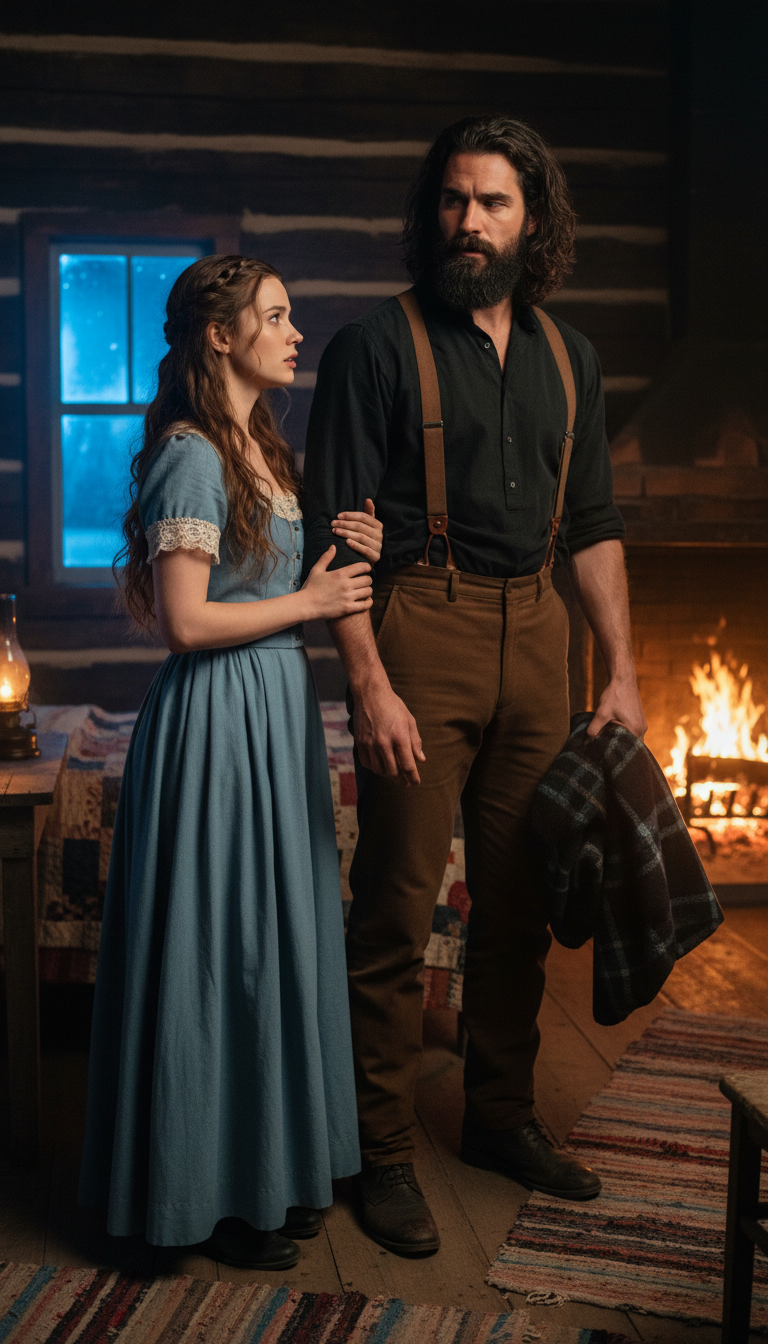
# You Married Me This Morning. So Why Are You Afraid to Share My Bed?
“Caleb, put that knife down.”
“I wasn’t going to hurt you, Eleanor.”
“Then why have you been sharpening it for twenty minutes?”
“Because I don’t know what else to do.”
Eleanor Whitmore stared at her enormous new husband, stunned by the confession.
Outside, a vicious snowstorm battered their isolated mountain cabin. Inside, the man everyone in town seemed to fear stood blushing like a schoolboy.
And it was their wedding night.
Just hours earlier, Eleanor had married Caleb Mercer, a thirty-two-year-old mountain man whose reputation had frightened her long before she met him. Now, standing before him in her pale-blue nightgown, she was beginning to wonder whether she’d misunderstood everything about him.
She turned toward the cabin door and slid the heavy wooden bolt into place.
Click.
Caleb froze.
The knife remained in one massive hand, the whetstone in the other.
“You locked it,” he said.
“Yes.”
“Why?”
“Because it’s dark, Caleb. And there’s a blizzard outside.”
“No one comes up here.”
“That doesn’t mean we should invite trouble.”
He nodded awkwardly and carefully set the knife down.
Eleanor studied him.
At six feet four, perhaps taller, Caleb was built like a mountain. His broad shoulders strained against his dark work shirt, and leather suspenders crossed his powerful chest. A thick beard framed his rugged face. Dark hair brushed his collar, while a pale scar disappeared beneath his shirt.
When Eleanor first saw him at the stage station that afternoon, she’d understood why townspeople whispered his name.
He looked capable of breaking a man in half.
Yet tonight, he could barely look his own wife in the eyes.
Twenty minutes earlier, Eleanor had stepped from behind a canvas changing screen wearing the nightgown she’d nearly left behind in Baltimore. It was modest, falling well below her knees. Still, she had never felt so exposed.
Caleb glanced at her once.
Then immediately turned away.
First, he inspected the iron stove. Then the chimney. Then the door hinges. Then his rifle. Finally, he’d started sharpening that perfectly sharp knife.
“Caleb,” Eleanor said gently, “the stove is working.”
“Yes, ma’am.”
“The rifle is clean.”
“Yes.”
“And if you sharpen that knife any further, there won’t be anything left of it.”
For the first time, his lips almost formed a smile.
“I like keeping my tools ready.”
“So I’ve noticed.”
He lowered his gaze, then reached for a folded wool blanket.
“I reckon I’ll sleep over there.”
Eleanor followed his eyes.
He was pointing toward the floor beside the stove.
She blinked.
“On the floor?”
“Yes.”
“But there’s a bed.”
“One bed.”
“A bed large enough for two people.”
His ears reddened.
“I’ve slept in worse places.”
“That wasn’t what I asked.”
He unfolded the blanket without answering.
A strange irritation rose inside Eleanor.
For three thousand miles, she’d worried about this exact night. She’d imagined arriving in the wilderness, marrying a stranger, and discovering that her new husband expected privileges she wasn’t ready to give.
She had rehearsed the words she’d use.
No.
Please wait.
I’m not ready.
She’d even feared that necessity might force her to surrender choices she’d once taken for granted.
After all, necessity was why she’d left Baltimore in the first place.
But Caleb had done nothing she’d feared. He’d carried her trunk, prepared supper, kept the cabin warm, and treated her with extraordinary care.
Now he intended to spend his wedding night on freezing floorboards rather than risk making her uncomfortable.
“Caleb Mercer.”
He stopped unfolding the blanket.
“You married me this morning.”
“Yes, ma’am.”
“And I married you.”
“Yes.”
“So why are you acting as though sharing a bed with me would be a terrible crime?”
His face turned crimson.
For several seconds, he said nothing.
The wind howled. Snow rattled against the window. The fire cracked inside the stove.
Then Caleb slowly raised his eyes.
“Eleanor, there’s something you need to understand about why I married you.”
Her breath caught.
He dropped the blanket.
And when he took one step toward her, the expression on his face changed so completely that Eleanor’s heart began to race.
“Before we go any further,” he whispered, “there’s something I’ve been keeping from you.”
## Chapter One: The Man Who Lived Alone
Eleanor’s fingers tightened around the edge of her nightgown.
“What is it?”
Caleb looked toward the dark window. Snow had buried the lower half of the glass, and the wind seemed determined to tear the little cabin from the mountainside.
“I should have told you before we stood in front of that preacher.”
“Then tell me now.”
He rubbed a hand over his beard.
“My first wife died six years ago.”
Eleanor went still.
For a moment, she could hear nothing but the storm.
“Your first wife?”
Caleb nodded.
“Her name was Abigail. We were married for four years.”
Eleanor swallowed. She had known almost nothing about his past. Their correspondence had consisted of six letters, most of them brief and practical. He’d written about the cabin, the weather, the cost of supplies, and the nearest settlement. He had never mentioned a wife.
“Why didn’t you tell me?”
“Because I was ashamed.”
“Of having been married?”
“No.” His voice was rough. “Of what happened to her.”
He sat heavily on the edge of a wooden chair, his enormous hands hanging between his knees.
“Abigail caught pneumonia during the winter. I rode through a storm to fetch the doctor, but the road was blocked. By the time I reached town and brought him back, she was too sick. She died three days later.”
Eleanor’s irritation dissolved into something quieter.
“I’m sorry.”
Caleb stared at the floor.
“I was working at a logging camp when she first became ill. She told me she had a cough, but I thought it was nothing. I told her I’d be home in two days. I came back after four.”
“You couldn’t have known.”
“I should’ve known.”
“You aren’t responsible for every terrible thing that happens.”
He looked at her then, and she saw how deeply he had buried himself beneath that belief.
“That’s what the preacher said at her funeral,” he replied. “Didn’t help much.”
Eleanor sat opposite him.
“Is that why you live alone?”
“Partly.”
“And the scar?”
His hand rose instinctively to his chest.
“An accident with a logging saw. Years ago.”
“And the rumors?”
That made him look up.
“What rumors?”
“That you once broke a man’s jaw in town. That you threatened a rancher who tried to buy your land. That nobody visits you because you don’t tolerate company.”
Caleb let out a breath that might almost have been a laugh.
“I broke a man’s jaw because he struck a boy who worked at the livery. The rancher tried to take my land by changing the boundary markers. And I don’t get many visitors because I live fourteen miles from the nearest decent road.”
He leaned back.
“Rumors grow better than potatoes around here.”
Despite herself, Eleanor smiled.
Then she remembered his confession.
“You said there was something you had been keeping from me. Is Abigail the secret?”
“No.”
His answer came too quickly.
Eleanor felt the room grow colder.
“What else?”
Caleb looked toward a small wooden chest beneath the window. He hesitated, then crossed the room and knelt beside it. From inside, he removed a folded piece of paper, worn soft at the creases.
He returned to the table and placed it between them.
“This came from your father.”
Eleanor stared at the handwriting.
For a moment, the cabin seemed to tilt.
She knew those letters. She had read them a thousand times, in happier years, before sickness and debt had turned her father’s final months into a struggle.
“Where did you get this?”
“Your father sent it to me last autumn.”
“My father died nearly a year ago.”
“I know.”
She looked up sharply.
“You knew my father?”
“Not personally. We exchanged letters for a few months.”
Eleanor opened the paper with trembling fingers.
*Mr. Mercer,*
*My daughter Eleanor is a good woman, but she’s been left with more responsibility than anyone should have to bear alone. She has spent the past two years caring for me and keeping our household together while creditors gather at the door.*
*I understand that you have lost someone you loved. I understand that you may never wish to marry again. But if you have room in your life for a companion, I ask you to consider writing to my daughter.*
*She is not looking for a fortune. She needs a home where she will be safe, work that will allow her to live honestly, and a man who will treat her as a person rather than a possession.*
*I cannot promise that she will love you. I cannot promise that you will love her. But I know she deserves a chance to begin again.*
*If you decide to contact her, please do so because you want her in your life. Not because you feel sorry for her.*
*Thomas Whitmore.*
Eleanor read the letter twice.
Then a third time.
When she finally raised her eyes, Caleb was watching her with an expression she couldn’t interpret.
“My father arranged this?”
“He suggested we write to one another. I answered because I was lonely, and because I thought perhaps we could build something decent together.”
“And you knew about my debts?”
“Some of them.”
“Some?”
“I knew you needed somewhere to live. I knew you had sold most of your belongings. Your father mentioned the house.”
Eleanor felt heat rise into her cheeks.
“So you married me because you felt sorry for me.”
“No.”
“Because my father asked you to rescue me?”
“No.”
“Then why?”
Caleb opened his mouth, but no words came.
Eleanor stood so abruptly that her chair scraped across the floor.
“I left everything I knew. I traveled across half the country. I married a stranger because I believed we might have a chance at a life together. And now I discover that my dead father negotiated my future with a man I barely know.”
“Eleanor—”
“Did you even want me?”
The question hung between them.
Caleb rose, but he did not approach her.
“Yes.”
The word was quiet.
Certain.
It frightened her more than any denial could have.
“Then why didn’t you tell me about Abigail?”
“Because I thought you’d be afraid I was marrying you to replace her.”
“Would I be wrong?”
“No.”
The honesty of the answer struck harder than a lie.
Caleb looked down at his hands.
“I thought I could start over. I thought I could offer you a good home, a warm bed, enough food, and a place where no one could threaten you with debt. I told myself that would be enough. I didn’t think about what you might need from me beyond that.”
Eleanor looked at the folded blanket beside the stove.
“And now you’re sleeping on the floor because you think I’m made of glass?”
“No.”
“Then explain it to me.”
He lifted his head.
“Because the last woman who slept beside me died in my arms, and I have spent six years wondering whether I could bear to watch that happen again.”
For the first time that night, Eleanor had no answer.
Caleb took a slow breath.
“I’m not afraid of you, Eleanor. I’m afraid of what happens when someone begins to matter enough to lose.”
The storm struck the cabin with a sudden roar.
Neither of them moved.
Then Eleanor picked up the folded paper and returned it to the table.
“I need time to think.”
Caleb nodded.
“You can have all the time you need.”
He picked up the blanket again.
This time, she didn’t tell him to put it down.
But when he settled beside the stove, Eleanor remained awake long after the fire had burned low, listening to the steady sound of his breathing and wondering whether the man who had frightened her most was the only man who had ever tried so hard not to frighten her at all.
## Chapter Two: A Morning Without Promises
The storm had not stopped by dawn.
Eleanor woke to the sound of wood being split outside. For several seconds, she didn’t recognize the room. Then she saw the unfamiliar rafters, the rough stone fireplace, and the empty side of the bed.
Her wedding night returned in a rush.
She dressed quickly and went to the window.
Caleb stood beyond the cabin, bareheaded in the snow, swinging an axe through a log with the same measured strength he’d used to carry her trunk. His breath rose in clouds. Snow clung to his dark hair and beard.
He looked like a man who had been born in the mountains and had no intention of allowing the mountains to defeat him.
Eleanor watched him for a long moment.
Then she noticed the fresh tracks leading from the woods to the cabin.
There were more than Caleb’s.
Her stomach tightened.
She opened the door.
“Caleb?”
He turned immediately, lowering the axe.
“You shouldn’t be standing in the doorway. Cold’ll get in.”
“Someone’s been here.”
His expression changed.
“Where?”
She pointed toward the tracks.
He crossed the yard, studied them, and crouched to examine the snow.
“Those are mine,” he said. “I went to check the lower fence.”
“And the other ones?”
He looked farther into the trees.
“Deer, most likely.”
“Most likely?”
He straightened.
“Go inside, Eleanor.”
She bristled at the command.
“I’m not one of your logging hands.”
“No, ma’am. You’re my wife, and I’d rather you didn’t freeze.”
It was such an absurdly practical answer that she nearly laughed.
Instead, she went inside.
A few minutes later, Caleb followed, carrying two armfuls of wood. He placed them beside the stove and began preparing breakfast without looking at her.
Eleanor sat at the table.
“Are you going to speak to me today?”
He stopped cutting bread.
“Of course.”
“Then look at me.”
He did.
His face was tired. There were shadows beneath his eyes, and a faint line of worry between his brows.
“I’m sorry about last night,” he said.
“Which part?”
“All of it. The letter. Abigail. Not telling you before we married.”
“Why didn’t you tell me before the ceremony?”
“Because I thought if I told you, you’d leave.”
“And if I had?”
His jaw tightened.
“Then I would’ve helped you find somewhere else to go.”
“You would have let me walk away?”
“Yes.”
Eleanor searched his face for evidence of deception.
She found none.
“Even after you paid for my journey?”
“Yes.”
“Even after you bought my wedding dress?”
His gaze dropped to the pale-blue fabric hanging from a chair.
“I didn’t buy it to trap you.”
She remembered the dress. It had arrived in a parcel two weeks before her departure, with a note saying that she should wear whatever made her feel comfortable. He hadn’t chosen the color. He hadn’t even asked to see her in it.
“Caleb, why did you agree to marry me?”
He turned back to the stove.
“Because I wanted a wife.”
“That isn’t an answer.”
“It’s the only one I have.”
“No. You wanted someone in your house. Someone to cook your meals and keep you company. Someone to make the cabin feel less empty.”
He looked at her sharply.
“Maybe.”
“And you thought I could do that without needing anything in return?”
“I never thought that.”
“Then what did you expect?”
He was silent for so long that Eleanor thought he wouldn’t answer.
Finally, he said, “I expected to try.”
The words were simple, but there was something painful in them.
“I expected to give you a home. To make sure you had food, warmth, and enough money to buy what you needed. I expected to be fair to you. I didn’t expect you to love me. I wasn’t sure I could ask that of anyone again.”
Eleanor looked at the breakfast he’d prepared. Eggs, bread, fried potatoes, and a small dish of preserved peaches. Everything was arranged neatly, as though he had put more thought into feeding her than into feeding himself.
“Do you know what I expected?” she asked.
He shook his head.
“I expected a man who might not love me yet, but who would at least try to know me. I expected someone who would speak to me instead of making decisions on my behalf. I expected to be treated as a wife, not a guest who might break if the door slammed too hard.”
Caleb absorbed her words without interruption.
Then he nodded.
“You’re right.”
She hadn’t expected that.
“I am?”
“Yes.”
He pulled out the chair opposite her and sat down.
“I don’t know how to be married anymore. Maybe I never knew how to do it properly in the first place. But I can learn, if you’ll give me the chance.”
Eleanor looked at him across the table.
“And the bed?”
He blinked.
“What about it?”
“Are you planning to sleep on the floor forever?”
His ears turned red again.
“No, ma’am.”
“Good. Because I didn’t travel three thousand miles to marry a man who can’t manage a mattress.”
For a moment, Caleb stared at her.
Then he laughed.
It was a deep, startled sound, as if it had escaped from somewhere he’d kept locked for years. Eleanor found herself smiling before she could stop.
The laugh faded, but something in the room had changed.
Caleb reached for the coffee pot.
“There’s something else I should tell you.”
Eleanor’s smile disappeared.
“Another secret?”
“No. Not exactly.”
“Caleb.”
He rubbed the back of his neck.
“I made a promise to your father.”
Her heart sank.
“What promise?”
“That I’d make sure you had a choice.”
She frowned.
“When I wrote to him, he told me you might feel you owed me something because I’d given you a home. He made me promise that if you ever wanted to leave, I’d give you enough money to reach a place where you could support yourself.”
Eleanor stared at him.
“He asked you to do that?”
“He did.”
“And you agreed?”
“Yes.”
“Without telling me?”
“I should have told you. I thought it would sound as though I expected you to leave.”
She looked away, overwhelmed by the tangle of feelings inside her.
Her father had worried about her future until his final days. Caleb had agreed to help a woman he had never met, then spent months writing letters and preparing a home for her. And yet neither man had trusted her enough to let her decide what kind of life she wanted.
“You both seem to have forgotten something,” she said.
Caleb waited.
“I am not a parcel to be delivered safely from one man to another.”
“No,” he said quietly. “You’re not.”
“And if I stay here, it will be because I choose to stay. Not because I owe you anything.”
“I understand.”
“Do you?”
He held her gaze.
“I’ll spend the rest of my life trying to.”
Eleanor didn’t know whether to believe him.
But when he pushed the plate of warm food toward her, she sat down and ate breakfast with her husband.
It wasn’t love.
Not yet.
But it was a beginning.
## Chapter Three: The Locked Chest
By the third day, the storm had weakened enough for the mountains to reappear through the clouds.
Eleanor discovered that the cabin was larger than it had first seemed. There was a kitchen, a main room, a small pantry, a bedroom, and a narrow loft where Caleb kept tools and supplies. The bedroom had a sturdy pine bed, a washstand, and a window overlooking a stand of fir trees.
There was also a locked chest at the foot of the bed.
Eleanor had noticed it on the first night but assumed it contained clothing or hunting equipment. Now, while Caleb was outside clearing snow from the roof, she found herself wondering why he kept it locked.
She had no intention of opening it.
She merely wanted to know what was inside.
That distinction seemed perfectly reasonable until she noticed a small brass key lying beside the washstand.
She picked it up.
Then she put it down.
Then she picked it up again.
Finally, she carried it to the chest.
The lock turned easily.
Inside lay a collection of letters tied with faded blue ribbon, a woman’s ivory comb, a small silver locket, and a photograph in a wooden frame.
Eleanor lifted the photograph.
A young woman stood beside Caleb in front of the same cabin. She was pretty, with dark hair, bright eyes, and a smile that seemed to fill the little picture. Caleb stood behind her with one hand resting on her shoulder. He looked younger, less guarded, and astonishingly happy.
Abigail.
Eleanor’s fingers trembled.
She set the photograph down and reached for the letters. The first was dated six years earlier. The handwriting was neat and delicate.
*My dearest Caleb,*
*The doctor says I must rest, which is a fine thing to tell a woman who has a husband forever bringing home half a forest and expecting supper before the logs are stacked. I have told him that if I am to be an invalid, I shall be the most troublesome invalid he has ever met.*
*Come home soon. I miss you.*
Eleanor swallowed.
She read another.
*Caleb,*
*I know you worry when I cough, but it is only the cold. I am keeping warm, and I have made the soup you like. You always complain that it is too salty, but you eat two bowls anyway.*
*I have been thinking about children again. I know you say we should wait until the cabin is finished, but the cabin will never be finished. You are always finding something else to build.*
*I want a little girl with your stubbornness and my good sense. If she has your eyes, I shall forgive her almost anything.*
Eleanor closed her eyes.
She had expected sadness when she learned about Abigail. She had not expected the sharp, unwelcome feeling of jealousy toward a woman who had been dead for six years.
She had never known Caleb when he was happy. She had never seen him laugh without surprise or speak without measuring every word. She had no memories of him that belonged only to her.
And the woman in the photograph had once possessed all of those things.
Eleanor placed the letters back in the chest.
At the bottom lay one final envelope, unopened and addressed to Caleb.
The date was written in the same hand, only a few days before Abigail’s death.
Eleanor hesitated.
She knew she should leave it alone.
But as she started to close the chest, the envelope slipped against the edge, revealing a line written on the back.
*If anything happens to me, promise you will not turn our love into a punishment.*
Eleanor froze.
She read the sentence again.
Then she closed the chest, locked it, and returned the key to the washstand.
She had just stepped away when the cabin door opened.
Caleb entered with snow in his hair and a bundle of split wood under one arm.
He looked at her.
Then at the chest.
Then at the key.
Neither spoke.
Finally, Eleanor said, “I’m sorry.”
Caleb put the wood down.
“You opened it.”
“Yes.”
He took off his gloves slowly.
“Did you read the letters?”
“Only a few.”
He looked away.
“I shouldn’t have.”
“No,” he agreed. “You shouldn’t have.”
The bluntness of his answer stung.
“I didn’t mean to intrude.”
“But you did.”
Eleanor’s cheeks burned.
She could have argued that she had been curious, that the locked chest had invited questions, that she had wanted to understand the woman who had come before her. None of those things would make it right.
“I apologize,” she said. “I won’t touch it again.”
Caleb stood very still.
After a moment, he crossed to the chest and rested his hand on the lid.
“Abigail used to keep her sewing in here,” he said. “She said she couldn’t trust me not to lose her needles.”
Eleanor remained silent.
“She wanted children. We tried for a while, but it never happened. She was disappointed. I was too, though I never said it properly.”
His fingers tightened on the wood.
“When she got sick, I kept thinking about everything we’d put off. The garden she wanted. The second room we never finished. The trip to the coast we kept promising ourselves we’d take when the weather improved.”
He looked at Eleanor.
“After she died, I couldn’t bring myself to throw any of it away. I couldn’t bring myself to move it, either.”
“Then don’t.”
He seemed surprised.
“You don’t have to keep everything locked away,” she continued. “But you don’t have to erase her to make room for me.”
Something in his expression softened.
“I don’t know how to do both.”
“Neither do I.”
She stepped closer, leaving a careful distance between them.
“But I know I don’t want to live in a house where every memory is a locked door.”
Caleb studied her for a long time.
Then he reached into his pocket and took out the key.
He unlocked the chest, lifted the photograph, and placed it on the mantel above the stove.
Eleanor watched him.
“Are you sure?”
“No,” he admitted. “But I think Abigail would have liked the light there.”
He returned the letters to the chest, then closed it without locking it.
For the first time, the past did not seem like something he was guarding against her.
It seemed like something he was allowing her to see.
That evening, they sat at the table together while Eleanor read aloud from a battered novel she’d found on the shelf. Caleb listened while repairing a leather strap, occasionally asking questions about characters whose names he struggled to remember.
When she finished the chapter, he said, “You have a fine reading voice.”
“My father used to say that.”
“He was right.”
She looked up.
It was the first compliment Caleb had given her that had nothing to do with her cooking, her clothes, or whether she was warm enough.
She held on to it longer than she intended.
## Chapter Four: What the Town Said
The following week, the snow finally began to melt.
Caleb announced that he needed to ride into town for flour, lamp oil, and a replacement hinge for the pantry door. Eleanor asked to go with him.
He frowned.
“The road’s rough.”
“I’ve survived worse than a rough road.”
“It’s a long ride.”
“I know.”
“You’ll be cold.”
“I have a coat.”
He looked at her for a moment, then nodded.
“All right.”
They left shortly after breakfast, riding in a small wagon pulled by Caleb’s steady brown horse. Eleanor sat beside him beneath a wool blanket, watching the mountains open into valleys and scattered farms.
For the first hour, they barely spoke.
Then Caleb pointed out a hawk circling above a ridge. Eleanor told him about the birds she’d seen in Baltimore’s public gardens. He asked whether she’d liked living in the city.
“Sometimes,” she said. “I liked the libraries. The music. The shops. I liked walking along streets where I could see a hundred different lives unfolding at once.”
“And the crowds?”
“I could do without those.”
He nodded as though this were a perfectly sensible opinion.
“What did you do before your father became ill?” he asked.
“I taught children. Mostly reading and arithmetic. I loved it.”
“Why did you stop?”
“My father’s health declined, and the family needed money. I took in sewing and sold whatever we could spare.”
“Do you miss teaching?”
“Every day.”
Caleb considered that.
“The schoolhouse in town has been looking for someone to help with the younger children. The teacher’s wife had a baby, and she can’t manage all the little ones alone.”
Eleanor turned toward him.
“You knew that?”
“I heard about it at the general store.”
“And you didn’t mention it?”
“I thought you might want to rest first.”
She gave him a look.
“Caleb.”
“I know. I know.” He sighed. “I keep trying to decide what’s best for you before asking what you want.”
“It’s a habit you should break.”
“Yes, ma’am.”
By the time they reached town, Eleanor felt lighter than she had in days.
The settlement consisted of a general store, a blacksmith, a church, a small schoolhouse, and a row of wooden buildings along the main road. People stopped to watch as Caleb drove past.
Some nodded to him.
Others stared at Eleanor.
At the general store, a woman in a green bonnet approached them with a smile that looked practiced.
“You must be Caleb’s new wife.”
“Eleanor Whitmore,” Eleanor replied.
“Margaret Bell. I’ve known Caleb since he was a boy.”
Margaret looked Eleanor up and down.
“Well, you’ve certainly come a long way to settle in these mountains.”
“I have.”
“I hope you understand what you’re getting into. Caleb isn’t an easy man.”
Eleanor glanced toward her husband, who was speaking with the shopkeeper.
“No man is easy all the time.”
Margaret’s smile tightened.
“Perhaps. But Caleb has always been… particular. His first wife was a lovely woman. Such a shame what happened.”
Eleanor felt her shoulders stiffen.
“Yes. It was.”
Margaret lowered her voice.
“He never really recovered, you know. Some people think he married you because he was lonely. Others say your father persuaded him to take you in.”
Eleanor looked directly at her.
“People seem to have a great deal to say about a marriage they weren’t invited to.”
Margaret blinked.
Then she gave a small, embarrassed laugh.
“Of course. I didn’t mean to offend.”
“Then perhaps you should stop trying.”
Eleanor turned away before the woman could respond.
Caleb had witnessed the exchange from the doorway.
When Eleanor joined him, he said nothing until they were back in the wagon.
“Margaret has always had a sharp tongue.”
“So I’ve noticed.”
“You handled her well.”
“I shouldn’t have to defend my marriage to strangers.”
“No,” he said. “You shouldn’t.”
He drove for a while in silence.
Then he reached beneath the seat and produced a small paper parcel.
“I bought you something.”
Eleanor stared at it.
“What is it?”
“Open it.”
Inside was a narrow notebook with a brown leather cover and a small pencil tucked into the binding.
She looked at him.
“What is this for?”
“For your teaching plans. Or your stories. Or whatever you like writing in it.”
She ran her thumb over the smooth cover.
“You bought this for me?”
“I thought you might need it.”
The simplicity of the gift made her throat tighten.
She had spent years giving up small pleasures because there was always something more important to pay for. A new dress could wait. A book could wait. A notebook could wait.
Everything could wait.
Now a man who barely knew her had remembered that she loved teaching and bought her something that might help her begin again.
“Thank you,” she whispered.
Caleb nodded and turned his attention to the road.
But Eleanor noticed the faint color rising beneath his beard.
That evening, she placed the notebook on the bedside table beside her wedding ring.
For the first time since arriving at the cabin, she began to imagine a future that belonged to her.
And when Caleb asked whether she would like to visit the schoolhouse the following morning, she answered without hesitation.
“Yes.”
His smile was small.
But it was real.
## Chapter Five: The Room Between Them
The schoolhouse stood at the edge of town, a modest building with two windows, a blackboard, and a stove that smoked whenever the wind changed direction.
Eleanor met the teacher, Mr. Harlan, and spent the morning helping children sound out words, practice sums, and copy sentences from a book.
By lunchtime, she had forgotten the mountain cabin, the locked chest, and the rumors about her husband.
She was simply herself again.
When she returned home that afternoon, she found Caleb repairing a broken chair near the window.
“How was it?” he asked.
“Wonderful.”
He glanced up.
“You look different.”
“I feel different.”
She told him about the children, about a little boy who had insisted that the word *mountain* must contain two extra letters because it was such a large thing, and about a girl who had written her name for the first time without help.
Caleb listened to every word.
When Eleanor finished, he said, “You should keep doing it.”
“I intend to.”
“Good.”
She stood beside the table, suddenly uncertain.
“Caleb?”
“Yes?”
“Would you mind if I taught three days a week? Mr. Harlan says he can use the help.”
“Of course not.”
“You wouldn’t mind my being away from the cabin?”
He set down the chair.
“Eleanor, you don’t need permission to do something that makes you happy.”
She looked at him.
“I’m beginning to think you say that because you don’t know what else to do with me.”
He considered the statement.
“Maybe I say it because I want you to be happy, and I don’t know how to help except by getting out of your way.”
The honesty made her smile.
“You could try standing beside me instead.”
Caleb stared at her.
Then, slowly, he nodded.
“I can do that.”
That night, Eleanor found herself thinking about him while she prepared supper. She noticed the way he moved carefully around her in the narrow kitchen, how he always left room for her to reach the cupboards, how he placed the sharpest tools away from the edge of the table.
He had begun asking questions, too.
What kind of books did she like? What had she wanted to do when she was a girl? Did she prefer music or silence while she worked? What foods reminded her of home?
He remembered her answers.
The following morning, he brought her a small tin of black tea from town because she’d mentioned that it was the kind her mother used to make.
It was not a grand declaration of affection.
But it was attention.
And Eleanor had begun to understand that attention could be a kind of tenderness.
On the eighth night after their wedding, she found Caleb sitting on the edge of the bed, staring at the floor.
She paused in the doorway.
“What’s wrong?”
“Nothing.”
She folded her arms.
“You’re a poor liar.”
He gave her a tired look.
“I was thinking.”
“Dangerous business.”
That earned a faint smile.
Eleanor sat beside him, leaving a few inches between them.
“About Abigail?”
“Yes.”
She waited.
“Her birthday is tomorrow,” he said. “She would have been thirty.”
Eleanor’s heart softened.
“Do you usually do something to remember her?”
“I used to ride to the ridge behind the cabin. We watched the sunset there the first time I brought her up the mountain.”
“Would you like to go tomorrow?”
He turned toward her.
“You wouldn’t mind?”
“Why would I?”
“Because it’s our marriage. Because I don’t want you to think I’m asking you to share something that belongs only to us.”
Eleanor thought about the photograph above the mantel.
“Your memories of Abigail belong to you, Caleb. But you don’t have to be alone with them.”
For a long moment, he said nothing.
Then he reached for her hand.
It was the first time he’d touched her without a practical reason.
His fingers were warm and rough, and his grip was careful enough that she could have withdrawn whenever she wanted.
She didn’t.
“Thank you,” he said.
They sat together until the stove began to cool.
Later, when they prepared for bed, Caleb picked up his blanket from beside the stove.
Eleanor watched him.
“Are you going to sleep down there again?”
He hesitated.
“I don’t want to presume.”
“Then don’t presume. Ask.”
He looked at her, his face turning red.
“Would you mind if I slept in the bed tonight?”
She felt her heart beat faster.
“No. I wouldn’t mind.”
“Are you sure?”
“Yes, Caleb.”
He nodded, looking as though she’d granted him a difficult and important favor.
They climbed into bed from opposite sides, leaving a careful space between them. Caleb lay stiffly on his back, his hands folded over his chest.
Eleanor turned toward him.
“Are you comfortable?”
“Yes.”
“Your shoulders are touching your ears.”
He exhaled.
“I’m trying not to crowd you.”
“You aren’t crowding me.”
“Good.”
Silence settled between them.
Then Eleanor reached across the space and placed her hand on his forearm.
Caleb went still.
She could feel the tension in him, the effort it took not to move.
“Caleb?”
“Yes?”
“You may hold my hand.”
He turned his head toward her.
“Are you certain?”
She smiled faintly.
“If you ask me that every time, we’ll both grow old before you touch me.”
A startled laugh escaped him.
Then he turned his hand beneath hers, letting their fingers fit together.
They stayed that way until sleep found them.
For Eleanor, it was the first night since the wedding that the bed did not feel like a place of uncertainty.
For Caleb, it was the first night in six years that he had fallen asleep beside someone without feeling he was betraying the woman he’d lost.
Neither knew what the morning would bring.
But for the first time, they were beginning to find out together.
## Chapter Six: The Storm Returns
The next afternoon, Caleb took Eleanor to the ridge where he and Abigail had once watched the sunset.
The trail wound through fir trees and climbed toward a rocky overlook. Snow remained in the shaded hollows, but the sky was clear, and the distant peaks shone beneath the winter sun.
Caleb carried a small bundle of wildflowers he’d saved from a sheltered patch near the cabin.
Eleanor walked beside him.
At the ridge, he placed the flowers beneath a stone.
“Happy birthday, Abigail,” he whispered.
Then he stood very still.
Eleanor did not interrupt.
After a while, Caleb said, “I used to think that if I loved someone again, I’d be taking something away from her.”
“From Abigail?”
He nodded.
“But you aren’t,” Eleanor said. “You can’t take away a love that already happened.”
He stared at the valley.
“What if I forget something about her?”
“You won’t forget everything.”
“What if I stop feeling sad when I think of her?”
“Then perhaps the sadness will finally stop being the only thing you feel.”
He turned toward her.
“How do you know that?”
Eleanor looked down at her gloves.
“Because I spent years believing that if I ever stopped worrying about my father, it meant I didn’t love him enough. I worried about his medicine, his meals, his breathing. I worried about bills and doctors and whether I could keep the house another month.”
She swallowed.
“When he died, I felt guilty every time I laughed. It took me a long time to understand that grief isn’t a measure of love.”
Caleb listened quietly.
“Your father wanted you to live,” he said.
“Yes.”
“And Abigail wanted the same for me.”
Eleanor looked at him.
“How do you know?”
He gave a small, sad smile.
“Because she told me. The night before she died, she made me promise that I wouldn’t spend the rest of my life punishing myself.”
His voice faltered.
“I promised her. Then I broke that promise for six years.”
Eleanor reached for his hand.
“Maybe you can start keeping it now.”
He held her fingers tightly.
For a long time, they stood together beneath the open sky.
Then Caleb leaned down and kissed her forehead.
It was a small gesture, but Eleanor felt it everywhere.
She looked up at him, and he seemed suddenly unsure.
“I’m sorry,” he said. “I should’ve asked.”
She smiled.
“You may kiss my forehead, Caleb.”
His expression softened.
“And your cheek?”
“Perhaps.”
He gave a quiet laugh, and this time Eleanor laughed with him.
The sound followed them down the mountain.
But when they reached the cabin, they found a horse tied near the gate.
A man stood beside it, stamping his boots against the cold. He was well dressed, with a dark coat and a narrow face Eleanor recognized from town.
Mr. Bell, the local attorney.
Caleb’s expression hardened.
“What brings you up here?”
Bell removed his gloves.
“Business, Mercer. I wouldn’t have come in this weather if it weren’t important.”
He glanced at Eleanor.
“Mrs. Mercer, I believe.”
“Yes.”
“I’m sorry to intrude, but I need a word with your husband.”
Caleb stepped between them.
“Whatever you have to say, you can say in front of my wife.”
Bell’s mouth tightened.
“As you wish.”
He produced a folded document.
“The bank has reviewed the outstanding debt attached to this property. The original agreement was signed several years ago, and the final payment was due last month.”
Caleb stared at him.
“I paid what I owed.”
“You paid the interest. Not the principal.”
“That isn’t what the agreement says.”
Bell unfolded the document.
“According to this copy, the principal remains outstanding. The bank has decided to begin foreclosure proceedings unless the full amount is paid within thirty days.”
Eleanor felt Caleb’s hand close into a fist.
“That paper is wrong.”
“Then you should have no difficulty proving it.”
Caleb took the document and read it. His face changed as he reached the bottom.
“What is this signature?”
“Your signature.”
“No.”
Bell shrugged.
“Perhaps you don’t remember signing it.”
“I remember every paper I sign.”
The attorney’s gaze shifted toward Eleanor.
“Your wife may wish to consider her position. If the property is lost, she could find herself without a home.”
Caleb stepped forward.
“You leave her out of this.”
“I’m merely offering practical advice.”
“Then offer it from the bottom of the mountain.”
Bell’s face reddened.
“You have thirty days, Mercer. After that, the bank will take possession.”
He mounted his horse and rode away.
For several seconds, neither Eleanor nor Caleb spoke.
Then she reached for the document.
“Let me see.”
He handed it over.
She read the terms carefully. Her father had taught her to keep accounts and examine every contract before signing it. The document contained a list of payments, a balance, and a signature that looked remarkably like Caleb’s.
But something was wrong.
She looked again.
“Caleb, where is the original agreement?”
“In the desk.”
“Then we need to compare them.”
He stared at her.
“There’s no point. The bank has made up its mind.”
“Perhaps. But the document has a date from last year, and you told me you paid the principal in full two years ago.”
“I did.”
“Then let’s prove it.”
He shook his head.
“You don’t understand how these men work.”
“Then explain it to me.”
“They have money, lawyers, and friends in town. I have a cabin, a horse, and a few acres of timber.”
“And you have a wife who knows how to read a contract.”
His expression softened, but the worry remained.
“Eleanor, I won’t have you dragged into a fight that isn’t yours.”
She stepped closer.
“Caleb, if this cabin is our home, then this fight is mine too.”
He looked at her as though he wanted to believe her but had no idea how.
Finally, he opened the door.
“Come inside.”
## Chapter Seven: The Signature
They spent the evening examining Caleb’s papers.
The original loan agreement was kept in a wooden drawer beneath the desk, along with receipts, tax records, and a map of the property. Eleanor spread everything across the table while Caleb lit another lamp.
She discovered that Caleb had paid the bank every month for years. The receipts were carefully arranged by date, each marked with the amount and the remaining balance.
The final payment had been made two years earlier.
It was the principal, not merely the interest.
Eleanor compared the original agreement with the document Bell had brought.
The numbers did not match.
Neither did the wording.
Most importantly, the signature at the bottom of the new document had been copied from an older form. The capital C in Caleb’s name was too narrow, and the final stroke of the M was missing the small hook that appeared on every other signature.
“This isn’t your signature,” she said.
Caleb leaned over her shoulder.
“I told you.”
“I believe you. But we need more than belief.”
She checked the date again.
The document claimed to have been signed three months earlier, yet it referred to a payment schedule that had ended two years before.
Eleanor tapped the page.
“Someone used an old agreement to make it look as though you still owed money.”
Caleb’s jaw tightened.
“Bell.”
“Perhaps. But we need to know who benefits.”
She studied the property map. A large portion of Caleb’s land bordered a timber route that had become valuable after a new road was built through the valley. The bank had been trying to acquire several parcels nearby.
“Has anyone tried to buy your land recently?”
“Mr. Whitcomb. He owns the largest sawmill in the county.”
“Did you refuse?”
“Three times.”
“Why?”
“Because he offered less than half what the property is worth. He wants the timber and the road access. If he gets my land, he can move logs without paying the neighboring ranchers for passage.”
Eleanor looked at the document again.
“Then perhaps he wants the bank to take it and sell it to him.”
Caleb was silent.
The possibility seemed to settle over the room like a second storm.
“What do we do?” he asked.
Eleanor was surprised by the question.
Not because she knew the answer, but because he was asking her.
“We go to the bank with the original agreement and every receipt. We ask for the ledger showing your payments. If they refuse, we speak to the county clerk.”
“They’ll tell us to hire a lawyer.”
“Then we find one who isn’t afraid of Whitcomb.”
Caleb gave a grim smile.
“Those are rare around here.”
“Then we may have to be brave enough for two people.”
He looked at her for a long moment.
Then he nodded.
“All right.”
The next morning, they left for town before sunrise.
At the bank, the manager listened politely while Eleanor explained the discrepancy. He examined the receipts, then the original agreement, and finally the document Bell had delivered.
His expression grew increasingly uncomfortable.
“This will require further review,” he said.
“How long?” Eleanor asked.
“A few weeks, perhaps.”
“We have thirty days.”
“Mrs. Mercer, these matters take time.”
“Then you should have begun reviewing them before threatening to take a man’s home.”
The manager stiffened.
Caleb placed both hands on the desk.
“My payments were made. Your records should show that.”
The manager glanced at him, then looked back at the papers.
“I’ll have the ledger brought up from the records room.”
It took nearly an hour.
When the ledger arrived, the truth became impossible to ignore. Every payment had been recorded. The principal had been cleared, and the account should have been closed two years earlier.
The manager rubbed his forehead.
“There appears to have been an administrative error.”
Eleanor looked at him steadily.
“An error that happened to benefit a man who wants to buy the property?”
He said nothing.
“We want a written statement confirming that the debt is paid,” she continued. “We want the foreclosure notice withdrawn. And we want a copy of every record connected to this account.”
The manager’s expression hardened.
“You’re making serious accusations.”
“Then investigate them seriously.”
Caleb glanced at his wife.
There was unmistakable pride in his eyes.
The manager finally agreed to suspend the foreclosure while the bank investigated. He also promised to provide certified copies of the ledger and original agreement.
It was not a complete victory.
But it was enough to begin.
Outside, Caleb stopped beside the wagon.
“I don’t know what to say.”
“You could say I was right.”
He laughed.
“You were right.”
“Thank you.”
He looked at her, his expression suddenly solemn.
“You stood up for me in there.”
“We stood up for our home.”
He nodded slowly.
Then he took her hand and kissed her knuckles.
Eleanor felt a warmth rise in her chest that had nothing to do with the winter sun.
She had not fallen in love with him all at once.
She had fallen in love with the small moments: the way he remembered her tea, the way he listened when she spoke, the way he was learning to ask instead of decide.
And now she had seen something else.
Caleb was beginning to trust her with the parts of his life he had always tried to carry alone.
## Chapter Eight: The Night He Finally Asked
They returned to the cabin after sunset.
Caleb was quieter than usual. He fed the horse, checked the stove, and brought in enough wood for the night. Eleanor prepared supper, but she noticed that he barely touched his food.
Finally, she put down her fork.
“Tell me what’s wrong.”
He looked at her.
“Nothing.”
She raised an eyebrow.
He sighed.
“I keep thinking about what might have happened if you hadn’t noticed the signature.”
“Then we’d have found another way.”
“You don’t know that.”
“No. But I know we would have tried.”
He looked toward the window.
“I spent six years believing that the only way to protect someone was to keep them away from anything that might hurt them. I kept Abigail from worrying about money. I didn’t tell her how bad the roads were when she got sick. I thought I was sparing her trouble.”
His voice grew rough.
“Maybe I should have listened more and hidden less.”
Eleanor reached across the table.
“Perhaps.”
He gave her a pained smile.
“You don’t make it easy to feel like a good man.”
“I’m not trying to make you feel bad, Caleb. I’m trying to know you.”
He looked at her hand beneath his.
“And what if you don’t like everything you find?”
“Then I’ll tell you.”
The answer seemed to unsettle him more than reassurance would have.
“What if I fail you?”
“Then we talk about it.”
“What if I hurt you without meaning to?”
“Then you apologize, and we work out what needs to change.”
He stared at her.
“You make marriage sound simple.”
“It isn’t simple. But it shouldn’t be a mystery either.”
For a moment, the only sound was the fire.
Then Caleb stood and walked to the mantel. He picked up Abigail’s photograph and studied it.
“I loved her,” he said.
“I know.”
“I’ll always love her in some way.”
“I know that too.”
He turned toward Eleanor.
“But I don’t want to spend the rest of my life living as though loving someone again means I’m leaving her behind.”
Eleanor’s eyes filled.
“Then don’t.”
He set the photograph down.
“I want to build a life with you. Not because your father asked me to. Not because you needed a home. Not because I’m lonely.”
He took a careful breath.
“Because when something happens, you’re the person I want to tell. When I come in from the cold, I look for you. When I hear you laugh in the kitchen, the whole cabin feels different. And when I think about the future, for the first time in years, I can see something beyond the next winter.”
Eleanor stood slowly.
“Caleb—”
“I know I have no right to ask you for anything. I know I haven’t given you much reason to trust me. But I need to ask you one question, and I need you to answer honestly.”
She nodded.
He approached her, stopping just close enough for her to see the uncertainty in his eyes.
“Do you want to stay married to me?”
Eleanor’s breath caught.
The question was so simple.
Yet no one had ever asked her something so important without telling her what the answer ought to be.
She thought about Baltimore, the debts, the loneliness of watching her father grow weaker. She thought about the long journey west and the fear she’d felt at the stage station. She thought about the man who had slept on the floor because he was terrified of making her uncomfortable.
Then she thought about the man who had listened to her, learned from her, and stood beside her in the bank.
“Yes,” she whispered.
Caleb closed his eyes.
For one terrible second, she thought he might cry.
When he opened them again, his face had softened in a way she had never seen.
“Are you sure?”
She laughed through her tears.
“Caleb, if you ask me one more time, I may change my mind just to make you stop.”
A startled laugh escaped him.
Then he lifted his hand, stopping just short of her cheek.
“May I kiss you?”
Eleanor’s heart seemed to turn over.
“Yes.”
He touched her cheek gently, as though he were still learning the shape of her face. Then he leaned down and kissed her.
The kiss was careful at first, almost hesitant. Eleanor felt the question inside it, the fear of doing too much, the hope that she would not pull away.
She rested her hands against his chest.
When she leaned closer, he understood.
The second kiss was warmer, more certain. He held her as though he had been waiting years to discover that tenderness could be something other than grief.
When they finally drew apart, Caleb rested his forehead against hers.
“I should have asked you that on our wedding night,” he whispered.
“Yes,” Eleanor replied. “You should have.”
He smiled.
“I’ll do better next time.”
She brushed a stray lock of hair away from his eyes.
“You may begin by sharing the bed.”
His smile faded into a look of startled hope.
“Tonight?”
“Unless you’ve grown attached to the floor.”
“No, ma’am.”
“Good.”
He kissed her forehead, then her cheek, and finally her lips again.
That night, they climbed into bed together without a blanket spread beside the stove. There was no grand promise that fear would disappear or that their marriage would become effortless.
There was only a warm room, a steady fire, and two people learning that trust was built one choice at a time.
For the first time since Abigail’s death, Caleb fell asleep without keeping watch over the door.
And Eleanor, listening to the quiet rhythm of his breathing, knew that the stranger she’d married was becoming the man she wanted to know for the rest of her life.
## Chapter Nine: A Man Comes Calling
The bank’s investigation continued for several days.
During that time, Caleb and Eleanor returned to their ordinary routines. She taught at the schoolhouse three days a week, and Caleb repaired the cabin’s roof, tended the horses, and helped a neighboring farmer rebuild a damaged fence.
Their life was not easy, but it was becoming theirs.
Then, on a cold Thursday afternoon, a black carriage appeared on the road.
A well-dressed man climbed down and approached the cabin. He carried a silver-topped cane and wore a coat too fine for the muddy track.
Caleb recognized him immediately.
“Whitcomb.”
Eleanor came to the doorway.
The timber owner removed his hat with a smile.
“Mercer. Mrs. Mercer. I hope I’m not interrupting.”
“You are,” Caleb said.
Whitcomb’s smile did not change.
“I’ll be brief. I’ve heard there has been some confusion concerning your property.”
“There’s no confusion. The bank has the records.”
“Banks make mistakes.”
“Then they can correct them.”
Whitcomb glanced at Eleanor.
“You seem to have found yourself a spirited wife.”
“She doesn’t need your opinion of her.”
The smile finally thinned.
“Very well. I’ll come to the point. I am prepared to offer you a generous sum for the land. Enough to buy a fine house in town and live comfortably for years.”
Caleb folded his arms.
“I’ve already refused.”
“Perhaps you refused because my previous offer was too low. This one is substantially higher.”
“I’m not selling.”
Whitcomb tapped his cane against the porch.
“Think carefully. You have no children, no family nearby, and a wife who has only just arrived. The mountains are a hard place to live. A man can spend his whole life struggling against winter and still lose everything.”
Eleanor stepped beside Caleb.
“We’re quite capable of deciding where we wish to live.”
Whitcomb looked at her with mild amusement.
“I’m sure you believe that, Mrs. Mercer. But marriage is not always a matter of affection. Sometimes a woman must think of security.”
Eleanor felt Caleb tense beside her.
She placed her hand on his arm.
Then she turned to Whitcomb.
“Security is not the same thing as allowing a stranger to decide our future.”
His eyes narrowed.
“You may regret that confidence.”
“Perhaps. But I would regret surrendering my home because a man frightened me into it.”
Whitcomb looked between them.
“Very well. I offered you an opportunity, Mercer. Don’t come looking for it again.”
He put on his hat and descended the steps.
Caleb watched the carriage disappear down the road.
“I ought to have thrown him off the porch,” he muttered.
“No,” Eleanor said. “You ought to have invited him in for tea and made him explain why he wants our land so badly.”
Caleb looked at her.
“Tea?”
“People say astonishing things when they think they’ve come to intimidate someone.”
He shook his head in admiration.
“I’m glad you’re on my side.”
Eleanor smiled.
“I’m not merely on your side, Caleb. I’m standing with you.”
He took her hand.
And this time, he did not seem surprised by the difference.
## Chapter Ten: The Truth Comes Out
A week later, the bank sent a letter confirming that Caleb’s debt had been paid in full. The foreclosure notice was withdrawn, and an internal review had been opened into the handling of his account.
The manager also enclosed copies of two letters from Whitcomb’s office requesting information about the property.
One had been written shortly before the false document appeared.
The other had asked whether the bank would be willing to sell the land if the account went into default.
Caleb read the letters twice.
Then he looked at Eleanor.
“You were right.”
She smiled.
“I intend to enjoy hearing you say that for many years.”
He laughed and pulled her into a hug.
For several moments, they stood together in the middle of the cabin, laughing like people who had escaped something much larger than a financial dispute.
But the victory brought another question.
“What do we do now?” Caleb asked.
Eleanor looked around the room.
“We live here.”
He glanced toward the window.
“Even after everything that’s happened?”
“Especially after everything that’s happened. This is our home, Caleb. I’m not giving it up because someone thought I might be frightened into leaving.”
He held her gaze.
“Then we’ll make it a good one.”
They began with the small room beside the bedroom. It had been used for storage for years, but Eleanor wanted to turn it into a proper study where she could prepare lessons and keep books.
Caleb cleared the old tools and repaired the window. Eleanor scrubbed the floor, painted the shelves, and arranged her books along the wall.
When the room was finished, she placed the notebook he’d given her on the desk.
Then she turned to find Caleb standing in the doorway.
“What do you think?”
He looked around the room.
“I think it suits you.”
“That’s all?”
He walked over and picked up a book.
“I think the children at the schoolhouse are lucky to have you. I think you’re the best thing that has happened to this cabin in a long time. And I think I should have built you a desk before you had to ask.”
Eleanor laughed.
“You’re learning.”
“Slowly.”
She stepped closer.
“Caleb, there’s something I’ve been meaning to ask you.”
His expression grew cautious.
“What is it?”
“Would you ever want children?”
He went very still.
Eleanor immediately regretted asking.
“You don’t have to answer now.”
“No,” he said. “It’s a fair question.”
He looked toward the window, where snow still clung to the trees.
“Abigail and I wanted them. We tried. It never happened. After she died, I convinced myself that wanting a family was something I’d lost the right to do.”
Eleanor felt a quiet ache in her chest.
“Do you still want one?”
He took a long breath.
“Yes.”
The answer was almost inaudible.
Then he looked at her.
“But I won’t ask you to give up the life you want to make that happen. I won’t decide for you. If we have children, I want it to be because we both want them, not because I think a family will fix what’s broken in me.”
Eleanor touched his cheek.
“You aren’t broken, Caleb.”
He gave a faint smile.
“Some days I feel like I am.”
“Then on those days, I’ll remind you.”
He covered her hand with his.
“And if we never have children?”
“Then we’ll build a good life anyway.”
He stared at her, his eyes shining.
“You make me feel as though there might still be time.”
“There is.”
He leaned down and kissed her.
The kiss was no longer hesitant. It held affection, gratitude, and a growing confidence that their future was not something they had to fear.
When they drew apart, Eleanor rested her forehead against his chest.
“There’s one more thing,” she murmured.
“What?”
“If we do have a daughter, I hope she has your eyes.”
Caleb’s arms tightened around her.
“And if she has your stubbornness?”
“Then you’ll be in trouble.”
He laughed, and she felt the sound vibrate through him.
For the first time, the future did not seem like a distant place waiting to punish them.
It seemed like a door they could open together.
## Chapter Eleven: The Bed by the Fire
By the time spring reached the mountains, the cabin had changed.
Eleanor’s books filled the new study. A small garden had been marked out near the southern wall, and Caleb had built a bench beneath the window so she could read in the afternoon sun.
Abigail’s photograph remained on the mantel.
The locked chest stood open in the bedroom, its letters carefully arranged inside. Eleanor never touched them without Caleb’s permission, but sometimes he would take one out and read it aloud. He told her stories about Abigail’s laughter, her stubbornness, and the way she sang while kneading bread.
Eleanor listened.
She no longer felt that every memory was a rival.
She understood that Caleb’s past was part of the man she loved. It had shaped his kindness, his fear, his silence, and the care with which he held her hand.
And Caleb had begun to understand that loving Eleanor did not require him to forget the woman who had come before her.
One evening, as rain tapped softly against the roof, Eleanor found him standing beside the bed with a folded blanket in his hands.
She stopped in the doorway.
“What are you doing?”
He looked down at the blanket.
“Old habit.”
“Are you planning to sleep on the floor?”
“Not unless you want me to.”
She crossed the room and took the blanket from him.
“Then why are you holding it?”
He looked embarrassed.
“I suppose I was remembering the first night.”
Eleanor smiled.
“The night you sharpened a knife for twenty minutes?”
“I wasn’t sharpening it for twenty minutes.”
“You were.”
“Perhaps fifteen.”
She laughed.
He put the blanket aside.
“I was so afraid of getting everything wrong that I couldn’t think of anything else to do. I thought if I kept busy, I wouldn’t have to face the fact that I’d married a woman I wanted to love but didn’t know how to approach.”
Eleanor stepped closer.
“You could have asked me what I wanted.”
“I know.”
“You could have told me you were frightened.”
“I know.”
“And you could have stopped sharpening that poor knife.”
He laughed, then grew serious.
“I still think about that night. About how you looked at me and asked why I was afraid to share my bed.”
She touched his beard.
“And what would you answer now?”
He took her hand and kissed the palm.
“Because I was afraid you’d see how much I wanted you to stay.”
Her eyes filled.
“Caleb, I stayed.”
“I know.”
“No. I don’t think you do. I stayed because you gave me the chance to choose. I stayed because you listened when I told you what I needed. I stayed because you began to trust me with your fears instead of hiding them behind work and silence.”
He held her gaze.
“And because I love you,” she whispered.
Caleb went completely still.
The words seemed to reach a place inside him that had been waiting years to hear them.
“You love me?”
She smiled through her tears.
“Yes.”
He searched her face, as if he were afraid the answer might disappear if he moved too quickly.
“Eleanor, I—”
She placed a finger against his lips.
“You don’t have to answer just because I said it.”
He gently took her hand away.
“I want to answer.”
He drew her close.
“I love you. I think I began loving you before I knew what to call it. When you challenged me at breakfast. When you stood up to Margaret. When you insisted that the bank show us its records. When you laughed in the kitchen and made this cabin feel like a home again.”
He swallowed.
“I love your courage. I love your stubbornness. I love the way you notice things other people miss. And I love that you never let me hide from myself.”
Eleanor’s tears spilled over.
Caleb brushed them away with his thumb.
“I can’t promise I’ll never be afraid,” he said. “I can’t promise I’ll always know what to do. But I can promise that when fear comes, I’ll try to talk to you instead of shutting you out.”
She smiled.
“That’s all I’ve ever asked.”
He kissed her.
Outside, the rain continued to fall, washing the last traces of snow from the mountain paths. Inside, the cabin was warm, the bed was ready, and the man who had once been terrified of sharing it with her held her as though he had finally discovered that love was not a danger to survive.
It was a life to build.
And when they lay down together that night, there was no space between them except the quiet understanding that they had chosen one another freely.
## Epilogue: The Promise at Sunrise
A year later, the first light of dawn touched the mountain peaks.
Eleanor woke to find Caleb sitting beside the window, pulling on his boots.
She pushed herself up against the pillows.
“Where are you going?”
“Just outside.”
“At sunrise?”
“It’s a fine morning.”
She narrowed her eyes.
“Are you hiding something?”
Caleb gave her an innocent look that fooled no one.
“No, ma’am.”
“Caleb Mercer.”
He laughed.
“All right. Come and see.”
Eleanor wrapped herself in a shawl and followed him outside. The air was cold and clear, and the valley below was covered in mist. A small wooden box rested on the bench he’d built beneath the window.
She looked at him.
“What is that?”
“Open it.”
Inside lay a silver ring, simple and beautiful, with a small blue stone set into the band.
Eleanor stared at it.
“Caleb, I already have a wedding ring.”
“I know.”
“Then why—”
“Because I wanted to ask you something again.”
He took the box from her and knelt in the snow.
For a moment, she could only stare at him. The enormous mountain man who had once sharpened a knife because he didn’t know what else to do was kneeling before her with the nervous expression of a boy asking for his first dance.
“I can’t undo the way we began,” he said. “I can’t give you back the journey you took or the nights you spent wondering whether you’d made a terrible mistake. But I can ask you again, now that you know me better.”
He looked up at her.
“Eleanor Whitmore Mercer, if you had a choice today, knowing everything you know about me, would you marry me again?”
Her eyes filled with tears.
She thought of the first wedding, the first night, the secrets and fears that had nearly driven them apart. She thought of the man who had learned to share his memories, the husband who now asked before making decisions, and the partner who stood beside her rather than trying to protect her from every difficulty.
Then she smiled.
“Yes, Caleb. I would marry you again.”
He rose, slipped the ring onto her finger, and kissed her beneath the pale morning sky.
When they returned to the cabin, Eleanor found a small note beside the stove.
It was written in Caleb’s careful handwriting.
*For my wife, who taught me that courage isn’t the absence of fear. It’s opening the door anyway.*
She looked up at him.
“Did you write this?”
He nodded.
“It’s beautiful.”
“I had help.”
“From whom?”
He smiled.
“Your father. Abigail. You.”
Eleanor took his hand.
For a long moment, neither spoke.
Then she glanced toward the bedroom.
“Caleb?”
“Yes, ma’am?”
“Do you remember our wedding night?”
His ears turned red.
“I do.”
“Do you remember what you said when I asked why you were afraid to share my bed?”
“I said I didn’t know what else to do.”
“And what would you say now?”
He drew her close, resting his forehead against hers.
“I’d say that I was afraid because I’d forgotten how to hope. And that you gave me a reason to try again.”
Eleanor kissed him softly.
“Good answer.”
He smiled.
“Can I ask you something?”
“Of course.”
“Would you like to go back to bed?”
She laughed, wrapped her arms around his neck, and kissed him again.
“Yes, Caleb. I would.”
Outside, the mountains stood silent beneath the morning sun. The cabin that had once held one man’s grief now held two people’s laughter, their disagreements, their plans, and the quiet certainty of a love they had chosen day after day.
Caleb had once believed that the safest way to love someone was to keep them at a distance.
Eleanor had taught him that safety did not come from distance.
It came from trust.
And as he took his wife’s hand and led her back inside, Caleb Mercer finally understood the answer to the question that had frightened him on their wedding night.
He had been afraid to share his bed because he was afraid to share his heart.
Now he knew that the heart was not made safer by being locked away.
It was made stronger by being given freely to someone who chose to stay.