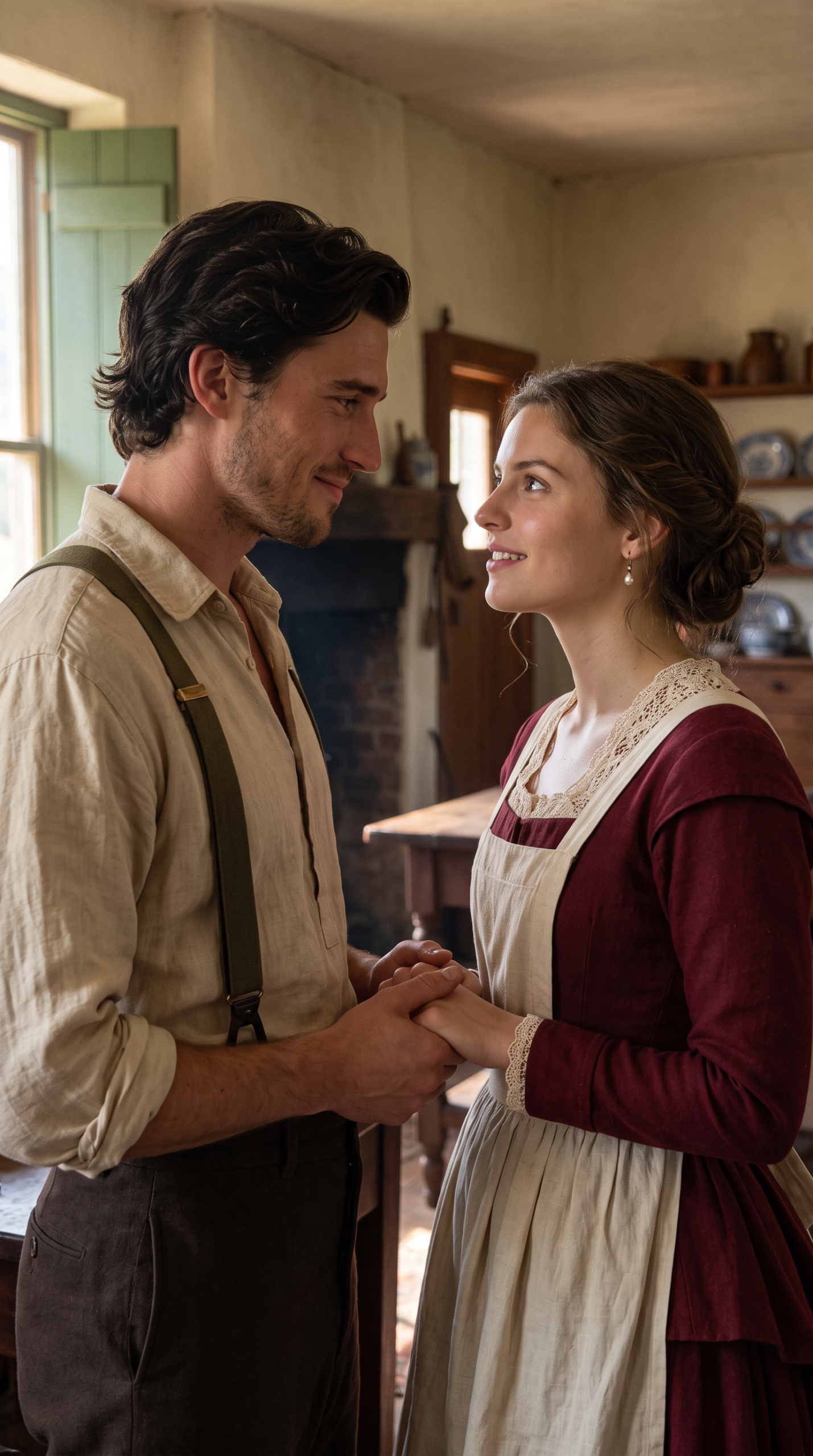
# HE RENTED HIS EMPTY HOUSE TO A STRUGGLING WOMAN FOR $2.50 A MONTH. FIVE WEEKS LATER, HER UNEXPECTED EMBRACE CHANGED EVERYTHING.
## Chapter 1: The Question Behind the Embrace
“Vernon, when you offered me this house for two dollars and fifty cents, did you ever imagine I’d want something from you that money couldn’t buy?”
Vernon Kincaid stared at Myrtle Holmes.
The blue-rimmed plate rested forgotten in his hands. A clean white towel hung over his shoulder, and the afternoon sunlight coming through the kitchen window illuminated the loose strands of Myrtle’s brown hair. Her arms were still around his waist, and her gray-blue eyes searched his face with a mixture of courage and uncertainty.
For a moment, he could not find a single word.
He had expected her to laugh at his awkward question. Perhaps she would have told him that he was becoming too comfortable in her kitchen. He might even have expected her to step away and remind him that she was his tenant.
But he had never expected this.
“What exactly are you asking me, Myrtle?” he finally whispered.
She lowered her eyes.
“I’m asking whether you ever thought this arrangement might become something more.”
Vernon carefully placed the plate on the wooden table.
“I offered you a house because you needed one.”
“I know.”
“And I charged you two dollars and fifty cents because I thought it was fair.”
“I know that too.”
“Then what else could there be?”
Myrtle gave a small, nervous smile.
“Perhaps I wanted to know whether you ever looked forward to coming here as much as I looked forward to hearing your horse outside.”
The confession seemed to settle between them.
Vernon looked toward the window. Beyond the glass, the green Oregon hills stretched beneath a pale May sky. His horse stood near the fence, occasionally swishing its tail at the flies.
He had spent fourteen years learning how to live without expecting anyone to welcome him home.
His wife, Elizabeth, had died eleven years earlier after a fever that spread through the valley. Their son had been stillborn. After that, Vernon had buried himself in cattle, fencing, and the endless responsibilities of ranch life.
He had not planned to love anyone again.
“I don’t know when it started,” he admitted. “But lately, I find myself making excuses to come here.”
Myrtle’s expression softened.
“What sort of excuses?”
“Broken fences. Firewood. A gate that doesn’t need fixing. Sometimes I ride all the way here just to ask whether your stove is working.”
She laughed quietly.
“Your stove works perfectly.”
“I’ve noticed.”
“And the fence?”
“Perfectly straight.”
“The gate?”
“Never worked better.”
Myrtle shook her head, smiling.
“Then perhaps you should stop inventing reasons.”
Vernon looked at her.
“Perhaps I should.”
For several seconds, neither moved.
Then Myrtle slowly released him, although her fingers remained against his hands.
“I don’t want you to feel obligated,” she said. “You gave me a chance when I needed one. I will always be grateful for that. But I don’t want gratitude to become something you mistake for affection.”
“I don’t.”
“Are you certain?”
Vernon reached for her hands.
“Myrtle, I have spent eleven years eating supper alone. I know the difference between gratitude and wanting someone beside me.”
Her eyes filled slightly.
“Then what do you want?”
He took a breath.
“I want to know whether you would let me court you.”
Myrtle looked at him as if she had been waiting for those words longer than she wanted to admit.
“Properly?”
“Properly.”
“With Sunday visits and awkward conversations?”
“I expect several awkward conversations.”
“And flowers?”
Vernon glanced at the little vase on the table.
“I could probably manage flowers.”
She laughed.
Then, before he could say anything else, she stepped forward and wrapped her arms around him again.
This time, Vernon did not stand motionless.
He returned the embrace.
And for the first time in eleven years, the rancher’s heart felt as though it had finally found somewhere to rest.
But neither of them knew that their happiness would soon be tested by a man who believed Myrtle had no right to build a new life.
## Chapter 2: The Woman Who Had Nowhere to Go
Five weeks earlier, Myrtle Holmes had been counting coins above a tailor’s shed in John Day, Oregon.
The room was small, cold, and poorly ventilated. Its single window overlooked a narrow alley where wagons passed throughout the day. A thin mattress occupied one corner, and an old wooden table served as her kitchen, workspace, and dining area.
On that particular morning, Myrtle had counted the same coins three times.
One dollar and seventy cents.
That was everything she had.
Her rent was due in four days, and the owner of the building had already warned her that he would not accept another delay.
Myrtle was thirty-two years old. She had spent most of her adult life working in other people’s homes, cooking meals, managing supplies, and keeping household accounts.
For several years, she had worked for the Miller family. Mrs. Miller had treated her kindly, and Myrtle had developed a reputation for excellent bread and practical cooking.
But when Mr. Miller died, his widow moved to Portland to live with her daughter. The household was closed, and Myrtle suddenly found herself without employment.
She had tried working for another family, but the position lasted only three months.
Then she began accepting baking orders.
It was honest work, but her little room had an unreliable stove. She could bake only a limited number of loaves at a time, and she had no proper place to store ingredients.
Still, she refused to give up.
She had learned long ago that circumstances could take away a great deal, but they could not decide how hard she was willing to work.
That morning, she carried four fresh loaves to Sutton’s General Store.
Mabel Sutton inspected them carefully.
“Your bread is getting better every week,” she said.
“Thank you.”
“The freighters like it. So do the families near the station.”
Myrtle smiled.
“I’m glad.”
“I could sell twice as much if you brought more.”
Myrtle looked down at her basket.
“I can promise twelve loaves by Saturday.”
“Twenty-four would bring twice the money.”
“So would twelve loaves baked properly.”
Mabel raised an eyebrow.
“You’re stubborn.”
“I prefer careful.”
Mabel laughed.
“Very well. Twelve loaves, then.”
While they discussed the order, Vernon Kincaid entered the store.
He was thirty-six, tall, broad-shouldered, and weathered by years of ranch work. His dark brown hair was beginning to show a few lighter strands near the temples, and his quiet expression made him appear more serious than he actually was.
He had come to purchase oats and replacement leather for a harness.
But the conversation caught his attention.
He watched Myrtle carefully examine the flour sack before accepting it. She asked about its weight, checked the stitching, and refused to pay until Mabel corrected a small mistake in the account.
She was polite, but she was not easily persuaded.
Vernon respected that.
He had known too many people who promised more than they could deliver.
When Myrtle finally collected her basket and stepped outside, Vernon finished paying for his supplies and followed.
“Miss Holmes?”
She turned.
“Yes?”
“Would you mind speaking with me for a moment?”
Her expression immediately became cautious.
“What about?”
“I own a small house on the northern side of my ranch. It’s been empty for several years.”
Myrtle waited.
“Four rooms,” he continued. “A decent stove, a well, a storage shed, and enough space for a small vegetable garden.”
“Why are you telling me this?”
“Because I heard you talking about your baking business.”
Her eyes narrowed slightly.
“And?”
“And I thought you might need somewhere better to work.”
Myrtle studied him.
“Are you offering me employment?”
“No, ma’am.”
“Then what?”
“A place to live.”
She looked genuinely surprised.
“I cannot afford an expensive house.”
“I wasn’t planning to charge an expensive rent.”
“How much?”
“Two dollars and fifty cents a month.”
Myrtle blinked.
“That’s all?”
“That’s the amount.”
“Why?”
“Because the house is empty, and I’d rather see someone use it than leave it gathering dust.”
She crossed her arms.
“Does that price include expectations?”
Vernon frowned.
“What sort of expectations?”
“Cooking for your ranch hands? Cleaning your house? Washing your clothes? Anything else a man might suddenly decide his tenant owes him?”
“No.”
“Then why is it so cheap?”
“Because I said it was.”
Myrtle looked at him for another moment.
She had learned not to trust kindness too quickly. Sometimes generosity came with a price that was not mentioned until a person had nowhere else to go.
“Mr. Kincaid, I pay my own rent. I don’t want a landlord who thinks he owns my time because he owns the building.”
“You’ll have your own key.”
“And you won’t enter without permission?”
“I’ll knock.”
“Even if you think something needs repairing?”
“I’ll knock first.”
She studied his face.
There was no suggestive smile, no attempt to stand too close, and no hidden amusement in his expression.
He seemed almost uncomfortable discussing the matter.
Finally, she asked, “When could I see it?”
“Tomorrow morning, if you’re available.”
“I am.”
“I’ll bring the wagon.”
Myrtle nodded.
“Thank you, Mr. Kincaid.”
“Vernon.”
She hesitated.
“Thank you, Vernon.”
He tipped his hat and returned to the store.
Myrtle watched him walk away.
For the first time in months, she allowed herself to imagine a kitchen with a proper stove, a table that did not double as a bed, and a place where she could work without worrying about the landlord.
She had no idea that the man who had offered her that house would eventually become the person she most wanted beside her.
## Chapter 3: The Empty House
The following morning, Vernon arrived shortly after eight.
Myrtle had packed her belongings into two wooden boxes and a worn leather suitcase. She had also brought her baking utensils, a small collection of cookbooks, and a photograph of her mother.
When Vernon saw the luggage, he immediately climbed down from the wagon.
“That’s everything?”
“Almost.”
“Do you need help?”
“I can manage the suitcase.”
“I wasn’t asking whether you could.”
Myrtle looked at him.
Then she smiled.
“You may take the heavier box.”
He lifted it easily.
The journey to the ranch took less than half an hour. The road passed through open grassland, scattered pine trees, and gentle hills dotted with wildflowers.
Myrtle sat beside Vernon, holding her suitcase between her knees.
“Have you lived here long?” she asked.
“Most of my life.”
“Did your family own the property?”
“My father did. I bought the remaining land from my brothers after he died.”
“Are your brothers nearby?”
“One moved east. The other settled near Boise.”
“And you stayed?”
Vernon nodded.
“Someone had to look after the cattle.”
Myrtle looked at the landscape.
“Doesn’t it get lonely?”
He kept his eyes on the road.
“Sometimes.”
She waited for him to say more, but he did not.
When they reached the northern side of the property, Vernon turned onto a narrow path.
The house stood beneath two large pine trees.
It was a modest white-painted building with a green front door, a small porch, and four windows. A wooden shed stood behind it, and a well was located several yards away.
The garden had been neglected, but the soil was good.
Myrtle stepped down from the wagon.
“Oh.”
Vernon watched her expression.
“Is something wrong?”
She shook her head.
“No. It’s lovely.”
The house was larger than she had expected.
Inside, there was a sitting room, two small bedrooms, a kitchen, and a narrow pantry. The furniture was simple but sturdy. A wooden table stood near the window, and an old iron stove occupied the far wall.
Myrtle approached it immediately.
“Does this work?”
“Roy cleaned it last autumn.”
“Roy?”
“My hired hand.”
“Does he live here?”
“No. He has a small cabin closer to the barn.”
She examined the stove, opened its door, and checked the iron fittings.
“It’s in good condition.”
“I thought you’d be pleased.”
“I am.”
She walked through the rooms slowly.
The first bedroom had a narrow bed and a wooden wardrobe. The second contained an old desk and a chair.
The sitting room was nearly empty, but sunlight filled it through the front windows.
Myrtle stood in the middle of the kitchen.
“I could bake here.”
“That was the idea.”
“I could store flour in the pantry.”
“Yes.”
“And the customers could collect their orders without crossing the cattle pens?”
“There’s a separate path from the road.”
She turned toward him.
“You thought of all that?”
Vernon shrugged.
“I heard you discussing your difficulties yesterday.”
For a moment, Myrtle said nothing.
Then she walked to the front door and looked outside.
“Two dollars and fifty cents?”
“Every month.”
“And I can paint the shutters if I want?”
“You can do whatever you like, provided you don’t burn the place down.”
She laughed.
“I’ll try to avoid that.”
He handed her a small brass key.
Myrtle closed her fingers around it.
“Thank you.”
“You don’t have to thank me every time I do something decent.”
“I’ll decide when I’m finished thanking you.”
Vernon smiled.
Then he carried her belongings inside.
By noon, the boxes were unpacked, the bed was made, and Myrtle had begun cleaning the kitchen.
Before leaving, Vernon stopped at the doorway.
“If you need anything, I’m at the main ranch house. It’s about half a mile south.”
“I’ll remember.”
“And if something breaks, tell me.”
“I can repair small things myself.”
“I know.”
She looked at him.
“How?”
“You examined the stove before you examined the bedrooms.”
Myrtle laughed.
“Perhaps I know what matters.”
Vernon tipped his hat.
“Welcome home, Miss Holmes.”
After he left, Myrtle stood alone in the kitchen.
The word stayed with her.
Home.
She had not heard anyone use it about a place belonging to her in a very long time.
## Chapter 4: The First Loaf
Myrtle spent the next three days making the house her own.
She washed the curtains, scrubbed the floors, polished the stove, and cleaned every shelf in the pantry.
She found a set of blue-rimmed plates in a cupboard. Some were chipped, but most were perfectly usable.
She arranged them carefully.
On the fourth morning, she baked her first twelve loaves.
The smell of fresh bread drifted through the open kitchen window and spread across the yard.
Roy Jasper noticed it while returning from the barn.
He was twenty-eight, cheerful, and endlessly curious.
“Morning, Miss Holmes!”
Myrtle looked up from the dough.
“Good morning, Roy.”
“That bread smells better than anything I’ve eaten all week.”
“Have you been eating properly?”
Roy grinned.
“Depends on what you call properly.”
“I suspect your answer would disappoint your mother.”
He laughed.
“Probably.”
She placed a small loaf on a clean cloth.
“Take this with you.”
“Are you certain?”
“It’s a test loaf. I need an honest opinion.”
Roy accepted it.
He broke off a piece, tasted it, and closed his eyes.
“Ma’am, if this is a test, I hope you never stop testing.”
Myrtle laughed.
Within an hour, Vernon appeared.
He had been riding along the northern fence, but the smell of bread had apparently reached him.
“Something smells good.”
“Good morning to you too.”
He glanced at the table.
“How many did you make?”
“Twelve.”
“That’s a lot of bread.”
“It’s my business.”
“I remember.”
Myrtle placed another loaf on the table.
“Would you like to try one?”
Vernon removed his hat.
“I wouldn’t want to interfere with your orders.”
“It’s not an order. It’s a question.”
He accepted a slice.
The bread was warm, with a crisp golden crust and a soft interior.
Vernon took a second bite.
“Well?”
Myrtle waited.
“It’s excellent.”
“That’s all?”
“Would you prefer a detailed report?”
“Perhaps.”
He considered it seriously.
“The crust is good. The inside is soft. It smells better than anything Roy has managed to cook in three years.”
From outside came Roy’s offended voice.
“I heard that!”
Myrtle burst into laughter.
Vernon smiled.
For several minutes, the three of them stood in the kitchen discussing the bread.
It was the first time the house had felt truly alive.
When Vernon finally left, he carried two loaves for the ranch hands.
Myrtle watched him walk toward the barn.
She realized she had begun looking forward to his visits.
She told herself it was because he was a good landlord.
That explanation became harder to believe with every passing day.
## Chapter 5: A Different Kind of Routine
By the end of the first week, Myrtle had established a routine.
She rose before sunrise, lit the stove, prepared the dough, and began baking. Customers collected their bread between breakfast and noon.
She also made pies, biscuits, and small cakes for families who placed special orders.
Her income was modest, but it was finally steady.
Vernon continued visiting.
Sometimes he brought firewood. Sometimes he delivered flour. Once, he arrived with a repaired latch for the pantry door.
“You didn’t have to do that,” Myrtle told him.
“It was loose.”
“I could have fixed it.”
“I know.”
“Then why did you?”
“Because I was passing.”
She glanced through the window.
“Your ranch is in the opposite direction.”
Vernon looked toward the door.
“Then I must have taken the wrong road.”
Myrtle laughed.
He was not a man who spoke easily about feelings, but she was beginning to understand his silences.
They were not signs of indifference.
They were simply the spaces where he had learned to keep things he did not know how to express.
One afternoon, she found him sitting on the porch.
He was holding a small wooden box.
“What’s that?” she asked.
“Nothing important.”
He quickly closed it.
Myrtle noticed his expression change.
“Something from your family?”
He nodded.
“My wife’s.”
Myrtle sat beside him.
“I didn’t know you had been married.”
“Her name was Elizabeth.”
“Was?”
“She died eleven years ago.”
Myrtle lowered her voice.
“I’m sorry.”
Vernon looked at the box.
“She was a good woman.”
“I imagine she was.”
“She liked flowers. Especially wildflowers. She used to gather them whenever we rode into the hills.”
Myrtle looked toward the garden.
“Then perhaps I should plant some.”
Vernon shook his head.
“You don’t have to.”
“I know.”
He looked at her.
For the first time, he seemed willing to speak about the past.
“She was expecting a child when she became ill. The fever came quickly. I rode to town for the doctor, but by the time I returned…”
He stopped.
Myrtle did not interrupt.
“Neither of them survived.”
His voice was steady, but his fingers tightened around the wooden box.
“I buried them beside the old cottonwood tree.”
Myrtle felt a heaviness settle in her chest.
“I’m sorry you had to lose them.”
Vernon nodded.
“After that, I kept busy.”
“Work can fill a day.”
“Yes.”
“But it cannot always fill a home.”
He looked at her.
She did not take his hand or tell him that everything would be fine.
Instead, she sat quietly beside him.
And somehow, that was enough.
## Chapter 6: The Man from Myrtle’s Past
The following Saturday, Myrtle delivered her bread to Sutton’s General Store.
Mabel was pleased with the quality.
“I told you people would buy it.”
“I’m glad they do.”
“You should increase your orders.”
“Perhaps next month.”
While Myrtle was arranging the payment, a man entered the store.
He was neatly dressed, with a dark coat, polished boots, and a narrow mustache. His appearance was respectable, but his eyes were cold.
He stopped when he saw her.
“Myrtle?”
Her fingers tightened around the basket.
She turned slowly.
“Edward.”
Edward Price had been her employer before she began baking independently. For nearly two years, she had worked in his household, managing the kitchen and accounts.
At first, he had seemed generous.
Then his wife died, and his behavior changed.
He began making personal remarks, questioning her movements, and treating her as though her wages gave him ownership over her life.
When Myrtle refused his advances, he accused her of being ungrateful.
Eventually, he dismissed her without paying the full amount he owed.
She had left quietly because she feared what he might do if she challenged him.
Now he stood in the general store, smiling as if nothing had happened.
“I heard you were still in town,” he said.
“I am.”
“You look well.”
“Thank you.”
“I also heard you’ve found yourself a new arrangement.”
Myrtle said nothing.
Edward stepped closer.
“Living on a ranch now, are you?”
“That’s none of your concern.”
He smiled.
“Still proud, I see.”
Mabel watched the exchange carefully.
“Mr. Price, is there something you need?”
Edward ignored her.
“I was hoping we could speak privately, Myrtle.”
“We have nothing to discuss.”
“You owe me an explanation.”
“I owe you nothing.”
His smile disappeared.
“You left my employment without properly settling your account.”
“I worked for you for two years. You still owe me wages.”
“Be careful.”
Myrtle lifted her chin.
“I have nothing more to say.”
She collected her payment and left.
Outside, her hands were trembling.
She hated that he could still make her feel frightened.
She hated even more that she had allowed herself to believe he could never find her again.
A voice came from behind her.
“Miss Holmes?”
She turned.
Vernon was standing beside his horse.
He had arrived to collect supplies and had seen the end of the conversation through the store window.
“Are you all right?”
“Yes.”
He studied her face.
“Who was that man?”
“Someone I used to work for.”
“He didn’t look pleased to see you.”
“He rarely is.”
Vernon waited.
Myrtle looked down.
“I don’t want to trouble you with old matters.”
“You’re not troubling me.”
She forced a smile.
“Then perhaps I’ll tell you another day.”
Vernon nodded.
“All right.”
He did not demand an explanation.
He simply walked beside her toward the wagon.
And Myrtle found herself wishing she could tell him everything.
## Chapter 7: The Sunday Invitation
The following Sunday, Vernon arrived carrying a small bouquet of wildflowers.
Myrtle opened the door.
For a moment, she simply stared.
“Those are for you,” he said.
“I can see that.”
“I wasn’t certain which flowers you liked.”
“They’re beautiful.”
He handed them over.
“I found them near the northern creek.”
Myrtle placed them in a vase.
“Would you like to come inside?”
“If you’re not busy.”
“I have finished baking.”
“Then perhaps you’d allow me to take you to town for supper.”
She looked at him.
“Is this one of those proper courtship visits?”
“I was hoping it might be.”
Myrtle smiled.
“Then I should probably change my dress.”
“I can wait.”
She returned a few minutes later wearing a simple blue dress.
Vernon had brought his best coat.
They rode into town together, stopping at a small restaurant near the main road.
Their conversation was awkward at first.
Vernon asked about her baking business. Myrtle asked about the cattle. They discussed the weather, the condition of the roads, and whether the coming summer would be particularly dry.
Then Myrtle laughed.
“Do you always talk about the weather when you’re nervous?”
Vernon nearly dropped his fork.
“I’m not nervous.”
“Of course not.”
“I’m perfectly comfortable.”
“Your hand has been holding that fork in the same position for nearly a minute.”
He looked down.
She laughed again.
Vernon shook his head.
“You’re enjoying this.”
“Very much.”
He finally smiled.
After supper, they walked along the street.
Several people greeted Vernon. A few looked surprised to see him with a woman.
Myrtle noticed.
“Do people always stare at you?”
“Only when I’m doing something unusual.”
“Like having supper with a woman?”
“Exactly.”
She laughed.
As they reached the wagon, Vernon offered his hand.
Myrtle accepted.
The touch was brief, but neither released immediately.
On the ride home, the moon rose above the hills.
Vernon stopped near the northern creek.
“Would you like to see something?”
Myrtle nodded.
He led her to a small rise overlooking the valley.
Wildflowers covered the grass, and the creek reflected the moonlight.
“My wife used to come here,” he said.
Myrtle looked at him.
“Thank you for bringing me.”
“I wasn’t certain whether you’d mind.”
“I don’t.”
They stood together for a while.
Then Vernon said, “I don’t expect you to become someone else because I’m courting you.”
Myrtle turned toward him.
“I wouldn’t know how.”
“I only want you to be comfortable.”
She smiled.
“Then I think we’re beginning rather well.”
He walked her to the front door.
Before leaving, he touched her hand.
“Good night, Myrtle.”
“Good night, Vernon.”
She watched his horse disappear down the road.
That night, she placed the wildflowers beside her bed.
## Chapter 8: A Warning
Edward Price returned to the ranch three days later.
Myrtle was preparing dough when she heard a horse approaching.
She looked through the window.
The same dark coat.
The same polished boots.
Her stomach tightened.
Edward dismounted near the porch.
Myrtle stepped outside but kept the door open behind her.
“What do you want?”
“Good afternoon to you too.”
“I have work to do.”
“I came to discuss something important.”
“Then speak.”
Edward glanced toward the main ranch house.
“Your landlord has quite a reputation.”
“He’s a good man.”
“Perhaps. But you don’t know him.”
“I know enough.”
Edward laughed.
“You’ve always been too trusting when someone gives you a little attention.”
Myrtle’s expression hardened.
“You should leave.”
“I could tell him certain things about your past.”
“You have no right.”
“I have every right to protect my reputation.”
“You dismissed me and withheld my wages.”
Edward stepped closer.
“Lower your voice.”
“No.”
His face changed.
“Do you think a man like Kincaid will want you when he learns what people might say?”
Myrtle felt anger replace her fear.
“I don’t care what you tell him.”
“Then you won’t mind if I visit again.”
“I would mind very much.”
Edward smiled.
“Good day, Myrtle.”
He mounted his horse and rode away.
Myrtle remained on the porch until he disappeared.
That evening, Vernon came to check the water pump.
He noticed immediately that something was wrong.
“What’s happened?”
“Nothing.”
He looked at her.
“Myrtle.”
She sighed.
“Edward came here.”
Vernon’s expression became serious.
“The man from the store?”
“Yes.”
“What did he want?”
“To frighten me.”
“Did he threaten you?”
“He suggested he could damage my reputation.”
Vernon set down his tools.
“What does he know?”
“Enough about my former employment to make me uncomfortable. Nothing that I’m ashamed of.”
“Then he has no power over you.”
“I know that.”
Vernon looked toward the road.
“If he comes again, tell me.”
Myrtle shook her head.
“I don’t want you fighting my battles.”
“I didn’t say I would.”
“Your face suggests otherwise.”
He exhaled.
“I won’t do anything without speaking to you first.”
She studied him.
“Thank you.”
Vernon reached for her hand.
“You don’t have to face unpleasant people alone.”
Myrtle squeezed his fingers.
“I know.”
But she was beginning to understand that Edward would not disappear simply because she had asked him to.
## Chapter 9: The Storm
The first major storm of June arrived unexpectedly.
Dark clouds gathered over the valley, and the wind began shaking the pine trees.
Myrtle hurried to bring her laundry inside.
She secured the shutters and checked the roof.
A loud crack sounded outside.
She looked through the window.
A large branch had fallen near the well.
Then she saw Vernon riding toward the house.
He dismounted quickly.
“Are you all right?”
“Yes.”
“There’s a tree down near the northern fence. I wanted to make sure nothing had happened here.”
“The roof seems fine.”
He glanced at the sky.
“You should stay inside.”
“Are you going back to the ranch?”
“I need to secure the barn.”
“Then be careful.”
He nodded and turned away.
A moment later, the rain began.
It came down heavily, almost hiding the road.
Myrtle watched through the window as Vernon struggled with his horse.
The animal suddenly reared at a loud crack of thunder.
Vernon managed to steady it, but the rain had already soaked his coat.
He turned toward the house.
Myrtle opened the door.
“Come inside!”
“I need to get back.”
“You’ll get struck by lightning before you reach the barn.”
He hesitated.
Then he tied the horse beneath the porch and entered.
Myrtle brought him a towel.
“You look like you’ve fallen into the creek.”
“Feels about right.”
She laughed and handed him a dry shirt that belonged to her late father. It was slightly too small across his shoulders, but Vernon accepted it.
While he changed in the sitting room, Myrtle prepared coffee.
They sat beside the kitchen window and watched the storm.
For the first time, Vernon spoke openly about his wife.
He told Myrtle how Elizabeth had laughed when he brought home a muddy calf. He remembered her singing while she worked and how she had wanted to plant roses beside the porch.
“I never planted them,” he admitted.
“Why not?”
“I suppose I didn’t want to change anything.”
Myrtle looked at him.
“Keeping everything the same doesn’t bring someone back.”
“I know.”
“But remembering them doesn’t mean you have to remain unhappy.”
Vernon looked down at his cup.
“You make difficult things sound simple.”
“They aren’t simple. They’re just worth thinking about.”
He smiled faintly.
Then the wind shook the windows.
Myrtle reached for his hand.
“Stay until the storm passes.”
Vernon looked at her.
“I can do that.”
For another hour, they sat together.
The storm eventually weakened.
But neither seemed eager to return to the silence waiting beyond the kitchen walls.
## Chapter 10: The Secret in the Ledger
Several days later, Myrtle discovered an old account book in the pantry.
It had been left by the previous occupants, and its pages were filled with household purchases from more than a decade earlier.
While cleaning, she noticed a folded letter tucked between two pages.
The handwriting was delicate.
It was addressed to Vernon.
Myrtle recognized the name Elizabeth from their conversation.
She hesitated before opening it.
The letter was not sealed.
But she still felt it was private.
She carried it to the main ranch house.
Vernon was working near the barn.
“Is this yours?”
He examined the paper.
His expression changed.
“Where did you find it?”
“In the pantry ledger.”
He unfolded it carefully.
“My wife’s handwriting.”
Myrtle looked away.
“I’m sorry. I didn’t read it.”
Vernon sat on a wooden bench.
“It’s all right.”
He read the letter silently.
Then he read it again.
His eyes became wet.
“What does it say?” Myrtle asked gently.
He handed it to her.
Myrtle read the final lines.
*My dearest Vernon,*
*If you are reading this, I hope you have found a reason to smile again. I know how deeply you love me, and I would never ask you to forget our life together. But I don’t want my absence to become a wall between you and the rest of the world.*
*You deserve laughter in your kitchen. You deserve someone to walk beside you. If another woman ever makes your heart feel alive again, please do not turn away simply because I am no longer there.*
*Love does not become smaller because it is shared with another person.*
*Your Elizabeth.*
Myrtle returned the letter.
Vernon stared at the paper.
“I kept it for years.”
“Perhaps you weren’t ready to read it.”
He nodded.
“Maybe.”
Myrtle sat beside him.
“Elizabeth sounds like she understood you.”
“She understood me better than anyone.”
“Then perhaps she would want you to be happy.”
Vernon folded the letter.
For the first time, he seemed to accept that moving forward did not mean abandoning the woman he had loved.
He placed the letter carefully inside his coat.
Then he turned toward Myrtle.
“Would you stay for supper tonight?”
She smiled.
“I’d like that.”
## Chapter 11: The First Kiss
By the middle of June, Vernon and Myrtle had begun spending most evenings together.
They ate supper on the porch, walked beside the creek, and sometimes sat in the kitchen discussing their plans for the coming months.
Vernon had started bringing flowers.
Myrtle had started baking his favorite biscuits.
Neither mentioned how quickly the relationship was changing.
One evening, they walked through the garden.
Myrtle had planted wildflowers near the fence, and the first blossoms had appeared.
Vernon stopped beside them.
“They look like the ones Elizabeth used to gather.”
Myrtle smiled.
“I hoped you’d recognize them.”
He looked at her.
“Thank you.”
She brushed a strand of hair away from her face.
“You don’t need to thank me for flowers.”
“I do when they mean something.”
They stood quietly.
Then Vernon reached for her hand.
“Myrtle, I have something to ask.”
She smiled.
“You seem to ask me something every time we stand together.”
“This one matters.”
Her expression softened.
“All right.”
“I want to kiss you.”
Myrtle’s heart began beating faster.
“Then why are you asking?”
“Because I don’t want to assume.”
She stepped closer.
“Then you have my permission.”
Vernon leaned forward slowly.
Their first kiss was gentle and uncertain.
When they separated, Myrtle smiled.
“Well?”
He looked almost embarrassed.
“I believe I should have asked sooner.”
She laughed.
He kissed her again.
This time, neither was in a hurry.
From that evening onward, something changed between them.
Their hands found each other naturally. Their smiles lasted longer, and the silences became comfortable rather than awkward.
They were no longer simply a rancher and his tenant.
They were two people discovering that happiness could arrive even after years of disappointment.
## Chapter 12: A Man Who Would Not Let Go
Edward Price heard about the relationship from Mabel Sutton.
He was furious.
He had convinced himself that Myrtle would eventually return to town and ask him for help.
Instead, she was building a business, living independently, and receiving the attention of a respected rancher.
Edward considered it an insult.
He rode to the ranch on a warm afternoon.
Vernon was repairing a gate when he approached.
“Mr. Kincaid.”
Vernon looked up.
“What can I do for you?”
“I’d like a word about your tenant.”
Vernon set down his hammer.
“Myrtle?”
“Yes.”
“What about her?”
Edward smiled.
“I believe you should know something about the woman you’re entertaining.”
Vernon’s expression remained neutral.
“Then say it.”
“She has a history of leaving employers without notice.”
“Is that so?”
“She is difficult, ungrateful, and far too proud for someone in her position.”
Vernon looked at him carefully.
“Did she steal from you?”
Edward hesitated.
“No.”
“Did she damage your property?”
“Not exactly.”
“Then I don’t see what business this is.”
Edward’s face reddened.
“You don’t understand.”
“I understand that you’re standing on my property discussing a woman who has done nothing to harm you.”
“She owes me money.”
“Then take the matter to court.”
Edward stepped closer.
“You should be careful. Women like her can ruin a man’s reputation.”
Vernon moved forward.
His voice became quiet.
“Do not speak about her that way.”
Edward laughed nervously.
“Are you threatening me?”
“No. I’m telling you to leave.”
Edward mounted his horse.
“This isn’t finished.”
Vernon watched him ride away.
Then he returned to the gate.
But his hands were tighter around the hammer than before.
That evening, he told Myrtle what had happened.
She looked worried.
“I’m sorry.”
“You have nothing to apologize for.”
“He’ll keep coming.”
“Then we’ll deal with it.”
Myrtle looked at him.
“I don’t want your life becoming difficult because of me.”
Vernon took her hands.
“My life was already difficult when I had nobody to share it with.”
She looked down.
He lifted her chin gently.
“You are not a burden, Myrtle.”
For a moment, she could not speak.
Then she leaned against his chest.
## Chapter 13: The Missing Money
A week later, Edward attempted something more serious.
Myrtle had saved nearly eighteen dollars from her baking business. She kept the money inside a small tin beneath a loose floorboard in the pantry.
It was meant for flour, sugar, and the purchase of a larger oven.
One afternoon, she discovered that the tin was missing.
At first, she thought she had misplaced it.
She searched the pantry, checked the cupboard, and examined every box.
Nothing.
When Vernon arrived, he found her sitting at the kitchen table with tears in her eyes.
“What happened?”
“My savings are gone.”
He immediately looked around.
“Did someone enter the house?”
“The back door was unlocked yesterday. I thought I had secured it.”
“Did anything else disappear?”
“No.”
Vernon examined the door.
The latch had been forced.
He crouched near the floor and noticed a muddy boot print.
“I’ll speak with the sheriff.”
Myrtle looked worried.
“Do you think it was Edward?”
“I don’t know.”
“But he knows about my savings.”
Vernon nodded.
“I’ll tell the sheriff what happened.”
The sheriff arrived that evening.
He examined the latch and questioned Roy, who had been working near the barn.
Roy remembered seeing a stranger riding near the northern road two days earlier.
The description matched a man who sometimes worked for Edward.
The sheriff took the information seriously.
“Do you have proof of who entered the house?” he asked.
“Not yet,” Vernon replied.
“We’ll investigate.”
Myrtle felt sick with worry.
That money represented months of work.
Vernon placed a hand on her shoulder.
“We’ll find out what happened.”
She looked at him.
“I don’t want you paying for everything.”
“I wasn’t planning to.”
“Good.”
“But I will help you recover what was taken.”
Myrtle nodded.
That night, Vernon stayed until she felt comfortable locking the doors.
Before leaving, he checked every window.
Then he looked at her.
“Would you like me to bring Roy over tomorrow to repair the latch?”
“Yes, please.”
“All right.”
He touched her cheek gently.
“Try to sleep.”
She held his hand.
“Good night, Vernon.”
“Good night, sweetheart.”
It was the first time he had called her that.
Myrtle smiled even after the door closed.
## Chapter 14: The Truth Comes Out
Three days later, the sheriff returned.
He had questioned the man who had been seen near the ranch.
The stranger eventually admitted that Edward had paid him to enter the house and retrieve the money.
Edward had promised him a share.
The sheriff had also found evidence that Edward was involved in withholding Myrtle’s wages from her former employment.
When the sheriff confronted him, Edward denied everything.
But the evidence was enough to justify further investigation.
He was ordered to appear before the local magistrate.
Myrtle was asked to provide a statement.
She described her employment, the unpaid wages, the threats, and the theft.
Her voice trembled at first.
Then she grew stronger.
She was no longer the frightened woman who had left Edward’s household without a word.
She had a home, a business, and people who believed her.
The magistrate ordered Edward to repay the stolen money and the wages he had withheld. He was also warned against contacting Myrtle again.
When the proceedings ended, Myrtle stepped outside.
Vernon waited beside the wagon.
“How do you feel?” he asked.
“Exhausted.”
“That’s understandable.”
She looked at him.
“I was afraid he would make everyone believe something terrible about me.”
“Did he?”
“No.”
“Then let that be the end of it.”
Myrtle smiled.
They rode home together.
That evening, she baked a pie.
Not because anyone had ordered it, but because she finally felt free enough to celebrate.
Roy came over after supper.
When he heard the news, he raised his cup.
“To Miss Holmes, who makes better bread than anyone in the county and has more courage than most men I know.”
Myrtle laughed.
Vernon lifted his cup.
“To Myrtle.”
They ate pie beneath the warm kitchen light.
And for the first time since moving into the little house, Myrtle felt completely safe.
## Chapter 15: The Question of the Rent
At the end of June, Myrtle placed two dollars and fifty cents on Vernon’s desk.
He looked at the coins.
“What’s this?”
“July rent.”
He stared at her.
“You’re still paying?”
“Of course.”
“I thought we had discussed this.”
“We discussed courtship. Not rent.”
Vernon smiled.
“You are a difficult woman.”
“I prefer independent.”
He picked up the coins.
Then he placed them back on the desk.
“I have a proposal.”
Myrtle raised an eyebrow.
“I’m listening.”
“I’d like you to continue living in the house, whether we’re courting or not.”
“That sounds familiar.”
“But I’d also like to ask whether you would consider making a home with me in the main ranch house.”
Myrtle looked surprised.
“Already?”
“Not tomorrow.”
“Good.”
“I don’t want to rush you.”
She sat down.
“Vernon, I love my little house.”
“I know.”
“It was the first place in years where I felt I could make my own decisions.”
“I would never take that away.”
“And my baking business?”
“You can keep it.”
“My customers?”
“They can still come to your kitchen.”
She smiled.
“Then what exactly are you asking?”
He took her hand.
“I’m asking whether, someday, you might want us to live together as husband and wife.”
Myrtle’s eyes filled.
He continued quickly.
“You don’t have to answer today.”
She squeezed his fingers.
“I don’t need to answer today because I already know.”
Vernon looked at her.
“Yes?”
“Yes.”
For several seconds, he simply stared.
Then his smile appeared slowly.
“Are you certain?”
Myrtle leaned forward.
“Vernon Kincaid, I have never been more certain of anything.”
He kissed her forehead.
Then he held her close.
The little house remained hers.
But now she knew that she would never again have to face the world entirely alone.
## Chapter 16: The Wedding Proposal
Vernon wanted to propose properly.
He spent several days considering how to do it.
Roy suggested a large dinner.
Mabel Sutton suggested flowers.
The blacksmith suggested buying a ring and asking the question before Vernon found another reason to postpone it.
Vernon listened to everyone.
Then he decided to do something simple.
On a Sunday evening, he asked Myrtle to ride with him to the northern creek.
The wildflowers were beginning to fade, but the grass remained green.
He had brought a small picnic basket.
They sat beneath a cottonwood tree.
Myrtle noticed that Vernon was unusually quiet.
“Are you worried about something?”
“No.”
“Are you certain?”
“Yes.”
She smiled.
“Then why have you barely spoken?”
He reached into his coat.
“I’ve been trying to find the right words.”
Myrtle looked at him.
Vernon removed a small velvet box.
Her breath caught.
“Myrtle Holmes, I know we haven’t known each other for very long.”
She smiled through sudden tears.
“But I also know that every day since you came into my life has felt different. My house is no longer just a place where I sleep. My evenings are no longer something I simply have to endure.”
He opened the box.
Inside was a modest gold ring with a small blue stone.
“I cannot promise you a perfect life. There will be difficult seasons. The cattle will get sick, the roof will leak, and Roy will probably continue burning his breakfast.”
Myrtle laughed through her tears.
“But I can promise to respect you, listen to you, and stand beside you. I can promise that you will never have to wonder whether you belong in my home.”
He took her hand.
“Will you marry me?”
Myrtle looked at the ring.
Then at him.
“Yes.”
Vernon exhaled as if he had been holding his breath for several minutes.
“Yes?” he repeated.
“Yes, Vernon.”
He slipped the ring onto her finger.
Myrtle threw her arms around him.
He laughed and held her close.
Then she kissed him.
The sun was setting behind the hills, and the creek reflected the last golden light of the day.
Neither needed to say anything else.
## Chapter 17: A New Beginning
Their wedding took place in August 1881.
Myrtle wanted a small ceremony.
She wore a simple ivory dress with a high collar and delicate lace around the sleeves. Her brown hair was pinned neatly, and she carried a bouquet of wildflowers.
Vernon wore a dark suit and polished boots.
Roy stood beside him.
Mabel stood beside Myrtle.
The minister arrived shortly before noon.
Only a few friends and neighbors attended.
There was no grand celebration, no expensive decorations, and no elaborate reception.
But the little church was filled with warmth.
When Myrtle walked toward Vernon, he smiled in a way that made her heart ache.
He took her hands.
The minister spoke about commitment, patience, and the meaning of building a life together.
Then Vernon repeated his vows.
“I promise to respect you, protect your freedom, and love you through every season of our lives.”
Myrtle’s voice trembled when it was her turn.
“I promise to stand beside you, share your burdens, celebrate your happiness, and make our home a place where kindness always has room.”
When the minister pronounced them husband and wife, Vernon kissed her.
Roy cheered loudly.
Mabel wiped her eyes.
And Myrtle Holmes became Myrtle Kincaid.
After the ceremony, everyone gathered at the ranch.
Myrtle had prepared a large meal with roast chicken, potatoes, fresh bread, and two pies.
Roy ate enough for three people.
“You’ll need to bake twice as much now,” he told her.
Myrtle laughed.
“Then perhaps you should help wash the dishes.”
Roy immediately became interested in something outside.
Vernon caught Myrtle’s hand.
“Are you happy?”
She looked around the kitchen.
The blue-rimmed plates were arranged on the table. Flowers stood near the window. The afternoon sunlight fell across the wooden floor.
“Yes,” she whispered.
“Good.”
She leaned closer.
“Very happy.”
## Chapter 18: The House That Became a Home
Marriage did not change Myrtle’s determination to run her baking business.
She continued taking orders and eventually purchased a larger oven.
The ranch became known for its bread, pies, and Sunday dinners.
Vernon supported her work without interfering.
He built additional shelves in the pantry and helped construct a small covered area where customers could collect their orders during bad weather.
Myrtle also began teaching two young women in town how to bake.
They were both struggling to find work, and she wanted to give them the same opportunity she had received.
One afternoon, Vernon watched her instructing them.
“You’re becoming quite the businesswoman,” he said.
Myrtle smiled.
“I always was.”
He laughed.
“I suppose you were.”
She wiped flour from her hands.
“Do you regret renting me that house?”
Vernon looked at her.
“Not for one moment.”
“Even though I have taken over half your kitchen?”
“Especially because of that.”
She kissed his cheek.
The following spring, they planted roses near the main house.
Vernon chose the spot himself.
He explained that Elizabeth had once wanted roses there.
Myrtle helped him prepare the soil.
They planted several bushes together.
When the first flowers appeared, Vernon stood quietly beside them.
Myrtle slipped her hand into his.
“Beautiful, aren’t they?”
“Yes.”
He looked at her.
“Thank you for helping me do this.”
She squeezed his hand.
“You don’t have to leave the past behind to enjoy the present.”
He nodded.
For the first time, the memory of Elizabeth no longer felt like a locked room.
It was simply part of the life that had brought him here.
And he was grateful.
## Chapter 19: A Knock at the Door
Nearly a year after Myrtle first arrived, another woman came to the ranch.
Her name was Anna Bell.
She was twenty-six, recently widowed, and traveling with a little boy named Peter.
They had been staying in a rented room in town, but the landlord had decided to raise the rent beyond what Anna could afford.
She had heard about Myrtle’s baking business and hoped to find work.
Myrtle welcomed her inside.
“Would you like some tea?”
Anna nodded.
Peter stood quietly beside her, holding a small wooden horse.
Vernon entered a few minutes later.
He greeted them politely and listened while Anna explained her situation.
“I can work,” she said. “I know how to cook, sew, and keep accounts. I don’t expect charity.”
Myrtle smiled.
“Neither do I.”
She explained that she needed help with baking orders and customer deliveries.
Anna’s face brightened.
“Would you really consider hiring me?”
“Of course.”
Vernon looked toward Myrtle.
They exchanged a glance.
They both understood what this meant.
A few years earlier, Myrtle had stood in a general store wondering how she would survive another month.
Now she was able to offer someone else a chance.
Anna began working the following week.
Peter quickly became friends with Roy.
The little boy followed him around the ranch, asking endless questions about horses and cattle.
Roy pretended to be annoyed.
But everyone knew he enjoyed the company.
## Chapter 20: The Meaning of Two Dollars and Fifty Cents
One evening, after the ranch had grown quiet, Myrtle and Vernon sat together on the porch.
The sun had disappeared behind the hills.
A warm breeze moved through the trees.
Vernon held a cup of coffee while Myrtle rested her head against his shoulder.
“Do you remember the day you offered me that house?” she asked.
“Very clearly.”
“You looked so serious.”
“I was serious.”
“You made it sound like the mice were the greatest problem I would face.”
“They were a considerable problem.”
She laughed.
“Two dollars and fifty cents.”
“Every month.”
“Do you know what that money meant to me?”
Vernon turned toward her.
“What?”
“It meant I could stop worrying about being thrown out of my room. It meant I could bake properly. It meant I could earn enough to stand on my own feet.”
He nodded.
“I hoped it would help.”
“It did more than help.”
Myrtle looked across the yard.
“It gave me a place to begin again.”
Vernon took her hand.
“And what did you give me?”
She smiled.
“Better bread?”
He laughed.
“Certainly.”
“Cleaner dishes?”
“Absolutely.”
“More flowers?”
“More than I ever expected.”
She looked at him.
“And a reason to come home?”
Vernon grew quiet.
Then he lifted her hand and kissed it.
“That was the greatest gift.”
Myrtle rested her cheek against his shoulder.
For a long moment, neither spoke.
The ranch was peaceful.
The kitchen windows glowed warmly behind them. The roses moved gently in the evening breeze, and somewhere near the barn, Roy was singing badly while finishing his work.
Vernon looked at the woman beside him.
He remembered the first day she had arrived with two wooden boxes and a worn suitcase. He remembered how carefully she had examined the stove and questioned him about the rent.
He remembered her first loaf of bread.
Her laughter.
Her courage.
The day she had told him that she looked forward to hearing his horse outside.
And the afternoon she had wrapped her arms around his waist and changed everything.
“Myrtle?”
“Yes?”
“Do you ever wonder what would have happened if I hadn’t offered you that house?”
She thought for a moment.
“I suppose I would have found somewhere else eventually.”
“Perhaps.”
“But I don’t think I would have found you.”
Vernon smiled.
“No, probably not.”
She turned toward him.
“Would you have been happy?”
He considered the question.
“I would have continued working. I would have fed the cattle, repaired the fences, and eaten my supper alone.”
“That isn’t what I asked.”
He looked into her eyes.
“No,” he said quietly. “I wouldn’t have been happy.”
Myrtle leaned forward and kissed him.
Then she wrapped her arms around his waist.
“Good thing you offered me that house, then.”
Vernon held her close.
“Good thing you accepted.”
They remained on the porch until the stars appeared.
And inside the little house where Myrtle had first learned to feel safe, the kitchen still smelled faintly of fresh bread.
The rent had been two dollars and fifty cents a month.
But the kindness that came with it had been worth far more than either of them could ever measure.
**THE END**