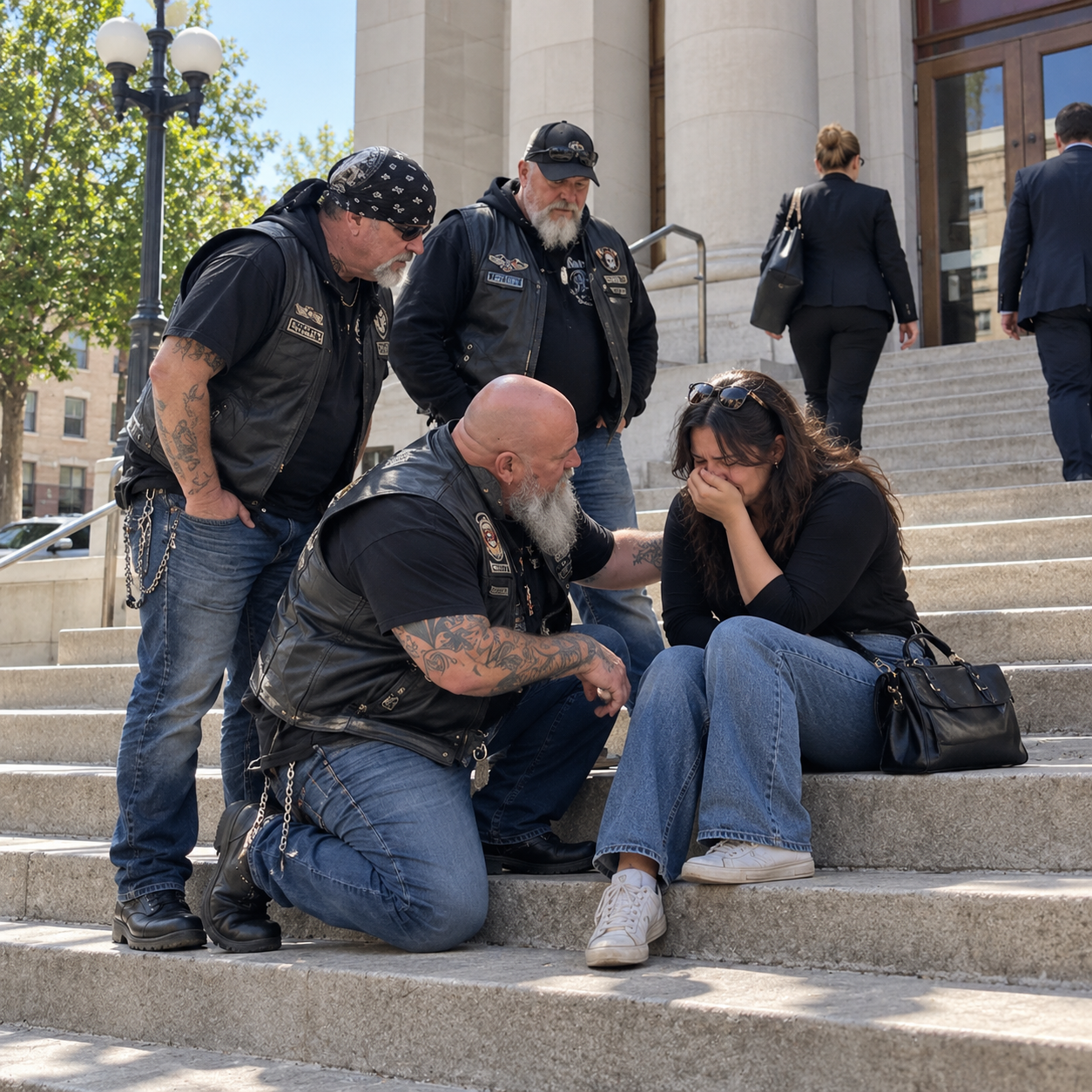
“Please. Somebody. Anybody. He’s going to take me home, and nobody will believe me because he wears a badge.”
The girl was sitting on the courthouse steps with her knees pulled against her chest, clutching a phone with a cracked screen. She couldn’t have been older than fifteen. Her sweatshirt was too big for her, her shoelaces were untied, and she kept looking over her shoulder at the courthouse doors as if someone might come through them at any second.
People walked past her without stopping.
A woman in a gray business suit stepped around her. Two men carrying folders glanced down and continued toward the parking garage. A uniformed security guard looked in her direction, then turned to speak to someone near the entrance.
Nobody asked why she was crying.
Nobody except a three-hundred-pound biker named Big Mike.
I was standing beside him that morning, holding a parking ticket I had come to dispute. My name is Frank. I was fifty-nine years old, had been riding motorcycles for thirty-two years, and had learned that the world often makes its biggest mistakes when everyone is too busy to notice the person standing right in front of them.
Mike had been watching the girl for nearly a minute.
Then he put his coffee on the hood of his truck.
“Excuse me, sweetheart,” he said gently. “Are you hurt?”
The girl jerked backward so violently that her phone nearly slipped from her hand.
Mike stopped immediately and raised both palms.
“It’s okay. I’m not going to touch you.”
She stared at his leather vest, his tattooed arms, and the enormous silver ring on his right hand. Then her eyes moved toward the other bikers standing near the motorcycles.
For a moment, I thought she might run.
Instead, she whispered, “My father is coming.”
Mike glanced toward the courthouse.
“All right. Is that a good thing or a bad thing?”
Her lips trembled.
“He’s a police sergeant.”
Mike didn’t move.
The girl looked down at the cracked phone in her hands.
“His name is Kyle Davidson. He’s inside telling the judge that I made everything up. My foster mom was supposed to come, but she texted me that three police cars stopped her on the highway. They won’t tell her why. She thinks they’re doing it so she can’t get here.”
She swallowed hard.
“And when this hearing is over, he’s taking me home.”
The last two words came out almost soundlessly.
Mike crouched down several feet away from her, making himself smaller without coming any closer.
“What’s your name, kiddo?”
“Maya.”
“Okay, Maya. I’m Mike. That fellow over there is Frank. The skinny one pretending he isn’t listening is Snake, and the old man with the cane is Preacher.”
“I can hear you perfectly well,” Preacher called from behind us.
Under any other circumstances, Maya might have smiled.
She didn’t.
Mike looked at her again.
“Can you tell me why you’re afraid to go home?”
Maya stared at the courthouse doors.
Then she pulled the collar of her sweatshirt aside just enough for us to see the fading bruises around her neck.
“My dad says nobody believes a girl who lies about a police officer,” she whispered. “He says that if I keep talking, he’ll make sure I disappear somewhere nobody will look.”
Mike’s expression changed.
It wasn’t anger exactly. I had seen Mike angry. I had seen him throw a man twice his size out of a bar for putting his hands on a waitress. I had seen him stand beside a grieving mother at a funeral when everyone else had run out of words.
This was different.
He looked at Maya as though someone had handed him something fragile and precious, something that had already been broken too many times.
“How long have you been dealing with this?” he asked.
“Since I was little.”
“Does anyone know?”
“My foster mom. My old school counselor. A lady at the hospital.” Maya rubbed her thumb over the cracked edge of her phone. “But my dad knows people. Every time I tell someone, he finds out. Then he tells them I’m troubled, and they stop listening.”
She looked up at Mike.
“Please don’t tell him you talked to me.”
Mike’s jaw tightened.
“We won’t make any promises we can’t keep,” he said. “But we can help you find someone who knows how to protect you.”
Maya’s eyes filled with tears.
“He says the judge already believes him.”
Mike looked at the courthouse again.
“Then I guess we’d better make sure the judge hears the whole story.”
He pulled out his phone.
I watched him type a message into our club’s group chat.
“Emergency at the courthouse. Minor in danger. Need witnesses, legal support, and anyone who can help get proper protection in place. No threats. No trouble. Bring identification.”
Then he looked at me.
“Call Casey.”
Casey Williams was an attorney who had helped our club with several community projects. She had a reputation for being calm under pressure and absolutely relentless when somebody tried to intimidate a witness.
I called her.
She answered on the second ring.
“Frank, I’m about to walk into a meeting.”
“Cancel it.”
There was a pause.
“What’s happened?”
I looked at Maya.
“There’s a fifteen-year-old girl sitting outside the courthouse. Her father is a police sergeant, and she’s terrified the court is going to send her back to him. Her appointed attorney hasn’t shown up.”
Casey’s voice changed instantly.
“Don’t let anyone question her about the details without proper support. Don’t confront her father. Call the courthouse’s child-protection contact and tell security there’s a possible immediate safety concern. I’m coming.”
She hung up.
Mike put his phone away.
Then he sat down on the courthouse steps, leaving an empty space between himself and Maya.
For several minutes, neither of them spoke.
Finally, Maya asked a question that made my stomach tighten.
“Are you really going to stay?”
Mike looked at her.
“Yes.”
“Even if my dad tells you to leave?”
“Yes.”
“Even if he says you’re criminals?”
Mike glanced at the leather vest covering his chest.
“Well, sweetheart, some of us have made mistakes in our lives. But nobody gets to decide you’re not worth protecting just because they don’t like the way we look.”
Maya stared at him.
Then she began to cry.
Not loudly. Not dramatically.
She simply covered her face with both hands and cried like a child who had spent years trying to convince herself she could survive alone.
Mike didn’t touch her.
He just stayed where he was.
And within twenty minutes, the courthouse parking lot began filling with motorcycles.
By the time the courtroom doors opened, forty-seven bikers had arrived.
None of us knew that the most important person in that room would turn out to be a quiet courthouse clerk who had been afraid to speak for nearly a year.
And none of us knew that Maya’s father had already begun making his next move.
***
## The Man in the Uniform
Sergeant Kyle Davidson looked exactly like the kind of man people trusted.
He was tall, broad-shouldered, and clean-shaven, with perfectly combed hair and a uniform that appeared to have been pressed minutes before he entered the courthouse. His service ribbons were arranged neatly above his pocket. His polished shoes reflected the overhead lights.
When he smiled, it was warm enough to make strangers smile back.
I watched him walk through the courthouse lobby, greeting two officers by their first names and shaking hands with a man who appeared to be a local official.
Then he saw Maya.
His smile disappeared.
Only for a second.
He crossed the lobby toward her, and she immediately stood up. Her shoulders rose toward her ears, and she took one step backward.
“Sweetheart,” Davidson said, extending his arms as though he were greeting a daughter returning from summer camp. “There you are. I’ve been looking everywhere for you.”
Maya didn’t move.
He lowered his voice.
“Come here.”
She looked at Mike.
That small movement told me more than any bruise could have.
Davidson noticed it too.
His eyes traveled over Mike’s beard, his leather vest, and the line of bikers standing several feet away.
“What’s going on here?”
Mike rose slowly.
“She’s waiting for her hearing.”
“I didn’t ask you.”
“No,” Mike replied. “You asked what’s going on. I answered.”
Davidson’s smile returned, but there was no warmth in it.
“You’re interfering in a family matter. This child is confused. She’s been having emotional problems for some time, and certain people have been encouraging her to act out.”
Maya lowered her eyes.
I had heard men use that tone before. It was the voice of someone who believed he could turn a room against another person simply by describing them first.
Davidson turned toward the courthouse security guard.
“Could you have these men moved along? They’re upsetting my daughter.”
The guard hesitated.
There were forty-seven of us. We filled a good portion of the lobby, but nobody was shouting or blocking the entrance. Several bikers had already spoken with courthouse staff about the hearing, and Casey was on her way.
The guard glanced at Maya.
“Is that what you want, young lady?”
Davidson answered before she could speak.
“She’s a minor. I’ll answer for her.”
The guard frowned.
“That wasn’t my question.”
For the first time, Davidson looked genuinely irritated.
Maya’s lips parted.
Then she whispered, “No.”
The guard looked at her.
“No, what?”
“I don’t want to go with him.”
The lobby went quiet.
Davidson’s face changed so quickly that I almost missed it.
Then he laughed.
It was a short, disbelieving laugh, the kind a person uses when they want everyone nearby to understand that something ridiculous has just happened.
“See?” he said. “This is what I’ve been dealing with. She gets an idea in her head, and suddenly everyone around her is part of some imaginary conspiracy.”
He leaned toward Maya.
“You’re embarrassing yourself.”
Mike took one step forward.
Casey had warned us not to confront him, and Mike remembered. He stopped immediately.
Instead, he looked toward the security guard.
“Sir, could you please contact whoever is responsible for the hearing and make sure Maya isn’t taken anywhere until her situation has been reviewed?”
The guard nodded and reached for his radio.
Davidson’s expression hardened.
“You people have no idea who you’re dealing with.”
Mike met his eyes.
“Maybe not. But we know who we’re standing beside.”
A courthouse employee appeared at the lobby desk and asked everyone to proceed to the assigned courtroom.
Davidson straightened his uniform and walked away without another word.
Maya remained where she was.
When he disappeared around the corner, she pressed a hand against her chest and took several shallow breaths.
Mike turned toward her.
“You’re doing fine.”
She shook her head.
“No, I’m not.”
“That’s okay,” he said. “You don’t have to pretend you’re fine to deserve help.”
She looked at him for a long moment.
Then she asked, “What happens if the judge sends me back?”
Mike didn’t give her a false promise.
“We’ll keep working with the people who can protect you. But first, we’re going to make sure your side of the story gets heard.”
Maya nodded, although I could see she was still frightened.
At that moment, Casey Williams hurried through the entrance carrying a leather briefcase and a thick folder.
She was in her early forties, with dark hair tied behind her head and the expression of someone who had already decided that the day was going to be difficult.
She introduced herself to Maya, asked whether she had a lawyer assigned to her case, and immediately began contacting the appropriate court staff.
Within minutes, she discovered something troubling.
Maya’s appointed attorney had not simply been delayed.
He had filed a request to withdraw from the case the previous afternoon.
The request had not yet been processed.
Nobody had informed Maya.
Nobody had arranged a replacement.
And the hearing was about to begin.
Casey stared at the paperwork.
“That’s unacceptable,” she said.
Maya’s face went pale.
“Does that mean I have to go home?”
“No,” Casey answered. “It means we need to make sure the court knows you don’t have proper representation and that your safety has to be considered before any decision is made.”
She turned toward the courtroom doors.
“Come on. Let’s get this straightened out.”
Maya took one step, then stopped.
“What if he gets angry?”
Casey looked directly at her.
“Then the adults in that courtroom will have to handle his anger. That is not your responsibility.”
For the first time that morning, Maya lifted her head.
And she walked through the doors.
***
## Forty-Seven Seats
The courtroom was smaller than I expected.
Dark wooden benches filled the center, with a raised platform at the front and a long table for the attorneys. A clock hung above the judge’s bench. Its second hand made a tiny clicking sound that seemed louder every time the room fell silent.
Maya sat beside Casey.
Her father sat across the aisle with his attorney, a polished man named Richard Bell who had the expensive suit and practiced confidence of someone accustomed to winning arguments before anyone finished making them.
The judge entered.
He was in his sixties, with silver hair and a tired expression. He reviewed the paperwork, looked toward Davidson, and then turned to Maya.
“Young lady, do you understand why we’re here today?”
Maya nodded.
“Please speak clearly for the record.”
“I’m here because my father wants me to live with him again.”
“And you don’t want that?”
“No, sir.”
The judge glanced at the file in front of him.
“I see references to allegations of abuse, but I also see a report describing you as emotionally distressed and uncooperative at home.”
Maya’s hands tightened around each other.
“That’s what he says about me.”
Bell rose.
“Your Honor, my client has dedicated his life to public service. These allegations emerged after a period of escalating conflict between father and daughter. We believe the child has been influenced by outside parties, and we are requesting immediate reunification.”
Casey stood.
“Your Honor, before any decision is made, I would ask the court to address the fact that Maya currently lacks properly assigned representation. I have spoken with the court clerk, and the previous attorney’s withdrawal has not been finalized.”
Bell frowned.
“Counsel, are you formally entering an appearance?”
“Yes. Subject to the court’s approval, I am prepared to represent Maya and request sufficient time to review the records.”
The judge looked toward Davidson.
“Sergeant, are you aware that your daughter’s attorney had requested to withdraw?”
Davidson rose.
“I was informed that her attorney had concerns about the reliability of her statements.”
Casey opened her folder.
“That is not what the filing says.”
Bell stood quickly.
“Your Honor, we object to this becoming a public spectacle. There are forty-seven bikers in the gallery, many of whom appear to have a personal interest in the case. Their presence could intimidate the parties.”
The judge looked over the crowded benches.
“Are any of you here to testify?”
Several hands rose.
The judge paused.
“Then I suggest you remain quiet until you’re called.”
Mike nodded.
“Yes, Your Honor.”
“And no commentary from the gallery.”
“Understood.”
Bell looked dissatisfied.
Casey continued.
“We are requesting that Maya remain in her current placement while the allegations are investigated, that no unsupervised contact occur with her father, and that the court preserve any records relating to prior complaints.”
Davidson’s attorney rose again.
“Your Honor, this is an extraordinary request based on unverified allegations.”
Casey didn’t look at him.
“Then the court should have no difficulty ordering an independent review of the evidence.”
The judge leaned back.
“Before I rule on temporary arrangements, I want to understand the history. Maya, have you previously reported being hurt by your father?”
“Yes, sir.”
“To whom?”
“School staff. A doctor. A counselor.”
“Did you receive assistance?”
Maya hesitated.
“Sometimes. But then Dad would find out, and he’d say I was lying. After a while, people stopped asking me questions.”
The judge made a note.
“Do you have any medical records?”
Casey answered.
“We are requesting access to the records already referenced in the case file. We also have a copy of a message Maya received that appears to contain a threat. We would like permission to submit it for review.”
Bell objected.
The judge raised a hand.
“I’ll review the request. But I want to be clear about something. This court will not make a final determination based on allegations alone, and it will not dismiss them simply because the accused is a police officer.”
Davidson shifted in his seat.
Casey noticed.
So did I.
Then the courtroom clerk approached the judge and whispered something in his ear.
His expression changed.
He read the note, then looked toward Davidson.
“Sergeant, were you involved in a domestic incident at your residence last month?”
Davidson answered immediately.
“No, Your Honor.”
The judge looked down at the paper again.
“This note says a patrol unit was dispatched to your address following a call from a neighbor.”
“That was a misunderstanding.”
“Was a report filed?”
“I don’t know.”
The judge turned to the clerk.
“Please obtain the incident number and make sure the report is included in the file.”
Bell rose.
“Your Honor, we cannot allow unrelated allegations to be introduced without proper foundation.”
“Then you may challenge the evidence when it is presented,” the judge replied. “For now, I want the record preserved.”
Maya was staring at the table.
Her breathing had become shallow again.
Mike shifted slightly on the bench behind her, but he didn’t speak.
Then Maya raised her hand.
The judge looked at her.
“Yes?”
“Can I say something?”
“Of course.”
She looked toward her father.
“He told me that call never happened.”
Davidson turned sharply.
“Maya—”
The judge struck the bench with his gavel.
“Sergeant, you will not address the child directly.”
Maya swallowed.
“He told me the police would never come to our house because everybody knew him. He said if I ever called them, they’d report me for making a false accusation.”
Her voice shook, but she kept speaking.
“And when they did come, he went outside and talked to them. After they left, he took my phone away for three weeks.”
The judge made another note.
For the first time, Davidson looked less like a confident officer and more like a man trying to calculate how much of his carefully constructed story had already fallen apart.
But Casey had not yet introduced the evidence she had come to present.
And neither she nor Maya knew that someone in the courthouse had been waiting for the right moment to speak.
***
## The Missing Report
During the first recess, Casey asked to review the file in a private consultation room.
I stayed in the hallway with Mike, Preacher, and several other bikers. Maya sat inside with Casey and a court-appointed child advocate who had arrived after being contacted by the clerk.
Through the open doorway, I could see Casey arranging papers across a table.
There were medical records, school notes, printed messages, and copies of reports that had been mentioned in earlier filings.
The problem was that several pages were missing.
A hospital record referred to a report number that did not appear anywhere in the court file. A school counselor’s note mentioned a referral to child-protection services, but the corresponding response was absent. A police incident number appeared in an email, yet there was no complete report attached.
Casey looked increasingly frustrated.
“These aren’t minor gaps,” she told the child advocate. “We need the original records and a proper chain of custody. I can’t responsibly tell the court what happened in documents I haven’t been allowed to verify.”
The advocate nodded.
“I’ll contact the relevant agencies.”
At that moment, a woman appeared in the doorway.
She was wearing a plain navy cardigan and carried a stack of files against her chest. She looked to be in her fifties. Her hair was tied back, and her eyes kept moving toward the hallway as if she expected someone to call her name.
“Excuse me,” she said. “Are you Ms. Williams?”
Casey stood.
“Yes.”
The woman glanced toward the courtroom.
“My name is Evelyn Price. I work in the courthouse records office.”
Casey waited.
Evelyn lowered her voice.
“I don’t know if this will help, but there are documents that were requested last month and never transferred to the hearing file.”
Casey’s expression sharpened.
“What documents?”
Evelyn looked down at the files.
“Records connected to the prior domestic calls. There are at least two entries that were marked as resolved without the usual supporting paperwork.”
The child advocate moved closer.
“Do you have copies?”
“I have the records that were submitted to our office. I haven’t removed anything, and I haven’t altered anything. But I noticed the case file references documents that aren’t in the packet the judge received.”
Casey spoke carefully.
“Ms. Price, I need you to understand that we can’t rely on an informal explanation. If records are missing, the court needs to know where they came from, who handled them, and why they weren’t included.”
“I understand.”
Evelyn looked toward Maya.
“I’ve seen her here before. She came with a woman from her school last year. She was sitting in that same hallway, crying. I remember because she kept asking if there was a way to make a complaint without her father finding out.”
Maya looked up.
“You remember me?”
Evelyn nodded.
“I do.”
The girl’s eyes filled.
“Nobody remembered.”
Evelyn’s face tightened.
“I’m sorry.”
She set the files on the table.
“I can’t tell you what the missing records prove. That’s for the investigators and the court to determine. But I can tell you that the court’s copy appears incomplete, and I can explain which records were logged into our office.”
Casey thanked her and asked the advocate to document the conversation.
Then she requested that the judge be informed that the record might be incomplete and that no final decision should be made until the missing documents had been located.
Evelyn remained in the room while the advocate made the call.
Outside, Mike listened as I explained what had happened.
He rubbed his beard.
“That woman just risked making herself unpopular with somebody powerful.”
“Maybe she was tired of watching a kid get ignored,” I said.
Mike looked through the doorway at Maya.
“Sometimes that’s all it takes. Somebody finally decides they’re more afraid of staying quiet than speaking up.”
He didn’t know how right he was.
Because within ten minutes, Davidson’s attorney came into the hallway and asked to speak privately with Evelyn.
She refused.
Then he asked whether she had taken documents from the records office.
She said she had brought only properly logged files for review.
He asked whether she understood the seriousness of interfering in a custody case.
She looked him in the eye.
“I understand the seriousness of leaving relevant records out of one.”
Bell’s face hardened.
“I suggest you speak to your supervisor before making any further statements.”
Evelyn picked up her files.
“I intend to.”
Then she walked back into the consultation room and closed the door.
For the first time that day, I saw something other than fear in Maya’s expression.
I saw hope.
***
## The Message on the Phone
When the hearing resumed, Casey asked the judge to consider the newly identified record gaps before making any decision about Maya’s placement.
The judge agreed to postpone a final ruling and ordered the relevant agencies to preserve the original records.
Davidson’s attorney objected.
The judge overruled him.
Then Casey asked permission to submit a series of messages sent to Maya’s phone.
The first was ordinary enough.
*You need to stop telling people private family business.*
The second was more direct.
*You don’t understand what you’re doing to this family.*
The third had been sent at 11:48 p.m. on a Thursday.
*If you say one more word in that courtroom, you will wish you had listened to me.*
Bell argued that the messages could have been taken out of context or sent by someone else.
Casey agreed that the sender would need to be established and the messages authenticated.
“We are not asking the court to treat them as conclusive proof at this stage,” she said. “We are asking that they be preserved, reviewed, and considered in determining whether contact between Maya and her father presents a risk.”
The judge nodded.
“That request is granted.”
Maya watched the judge’s face as if she were trying to determine whether he believed her.
Then she spoke.
“There’s another message.”
Casey turned toward her.
“What message?”
Maya reached into her bag and took out a folded piece of paper.
“I printed it at the library because he took my phone.”
She handed it to Casey.
The message had been sent from an unfamiliar number.
*Your father is trying to help you. If you continue these lies, you may lose the only family you have left.*
Below it was a second message.
*Your foster placement can change. Think carefully before you make things worse.*
Casey read both messages twice.
“Do you know who sent these?”
“No.”
“Did you tell anyone about them?”
“My foster mom.”
“Do you still have the original messages?”
“I took screenshots before my phone was taken.”
Casey looked toward the judge.
“Your Honor, we would like to submit these for preservation and investigation. We are also asking that Maya’s placement information remain confidential and that no changes be made without a documented review.”
The judge examined the page.
“Granted.”
Davidson shifted in his seat.
Bell rose again.
“Your Honor, this is becoming an exercise in speculation. Anyone could have sent these messages.”
“That is why the court is preserving them for investigation,” the judge replied. “We are not conducting a criminal trial in this hearing. We are deciding what temporary arrangements are necessary to protect a minor while the allegations are examined.”
He looked toward Maya.
“Miss Davidson, do you believe these messages were sent to frighten you?”
Maya nodded.
“Yes, sir.”
“Why?”
She took a breath.
“Because they sound like things my father says. He tells me that nobody else will take care of me. He says my foster mom will get tired of me, and that I’ll end up alone if I don’t do what he wants.”
She looked at the judge.
“He says that if I tell people what happens at home, I’m the one destroying the family.”
The courtroom became very still.
Then Maya added something that made even Bell stop moving.
“But I didn’t destroy our family. I was just trying to survive it.”
Mike lowered his head.
Preacher closed his eyes.
I stared at the floor, remembering the morning we had found her sitting alone on the courthouse steps.
She had been frightened that nobody would believe her.
Now forty-seven bikers were sitting behind her, a lawyer was standing beside her, and a court was finally listening.
But the hardest part was still ahead.
Because Davidson had heard every word she said.
And he was not a man accustomed to losing control of a room.
***
## The Moment He Lost His Temper
The judge called another recess to review the documents and speak with the child advocate.
Maya remained at the table while Casey gathered her papers.
Davidson stood and walked toward the aisle.
He was allowed to approach his attorney, but instead he turned toward Maya.
“Look at me,” he said.
The judge was still in the room.
Casey immediately stepped between them.
“Sergeant, do not approach my client.”
Davidson ignored her.
“You’ve got everyone feeling sorry for you now, don’t you?”
Maya froze.
“Sergeant Davidson,” the judge warned.
Davidson continued.
“You think these people are going to take care of you? You think a bunch of bikers will be there when you need money, when you’re sick, when you get into trouble? They’ll disappear the second you become inconvenient.”
Mike rose from the gallery.
“Your Honor, I’d ask that he stop addressing her.”
The judge struck his gavel.
“Sergeant Davidson, return to your seat immediately.”
Davidson turned toward Mike.
“This is my daughter.”
“And she has a lawyer,” Casey replied. “You may communicate through the proper channels.”
Davidson looked at Maya again.
“You have no idea what you’ve done.”
Maya’s hands began to tremble.
For a second, I thought she would collapse into the chair.
Then she lifted her head.
“I know exactly what I did.”
Davidson stared at her.
“I told the truth.”
The words were quiet, but the whole courtroom heard them.
Davidson’s face reddened.
“You ungrateful little—”
“Sergeant!” the judge shouted.
A court officer moved into the aisle.
Davidson stopped.
He looked around the courtroom and seemed to realize, perhaps for the first time, that his uniform could not command every person present to agree with him.
He returned to his seat.
Casey placed a hand on the back of Maya’s chair, careful not to touch her without permission.
“You did well,” she whispered.
Maya shook her head.
“I thought I was going to throw up.”
“That doesn’t mean you did badly.”
Maya looked at her.
“Does being brave mean you’re not scared?”
Casey smiled sadly.
“No. It means you keep telling the truth even when you’re scared.”
Maya looked toward the gallery.
Mike gave her a small nod.
Preacher raised two fingers in a quiet salute.
Snake, who had spent most of the morning looking like he would rather be repairing a motorcycle than sitting in a courtroom, offered her a crooked smile.
Maya finally smiled back.
It was small, but it was real.
Then the courtroom doors opened.
A woman in a dark suit entered with two investigators.
The judge looked up.
“Who are you?”
The woman approached the clerk and presented her identification.
“Deputy Chief Alvarez, Your Honor. I’m here at the request of the district attorney’s office regarding an active investigation involving Sergeant Davidson.”
Davidson’s attorney stood immediately.
“Your Honor, we object to this interruption.”
Alvarez remained calm.
“We are not asking the court to determine criminal liability today. We are notifying the court that evidence has been received requiring an independent review. We also have reason to believe certain records may have been improperly withheld from the original case file.”
Davidson’s face went white.
The judge asked for the paperwork.
Alvarez handed it over.
The judge read the first page.
Then he read it again.
He looked toward Davidson.
“Sergeant, I am ordering you not to contact Maya directly or indirectly while this matter is under review. The court will also maintain her current placement until a further hearing.”
Davidson’s attorney rose.
“Your Honor—”
“The order is entered.”
The gavel struck.
Maya closed her eyes.
For the first time that morning, she allowed herself to breathe.
But Deputy Chief Alvarez had not come merely to discuss the custody hearing.
She had come because the records found by Evelyn Price had opened a much larger investigation.
And one of the people under scrutiny was sitting only a few feet from the judge.
***
## The Report Nobody Was Supposed to Find
The investigation did not end that afternoon.
It had barely begun.
Over the following days, investigators reviewed the missing domestic-call records, contacted the hospital, interviewed school staff, and examined the messages sent to Maya.
They did not assume that every allegation was true simply because it had been made in court. They did not dismiss the allegations because Davidson wore a uniform.
They checked.
A hospital record documented an injury that Maya had described as the result of a fall. A school counselor’s notes recorded that Maya had asked whether a child could report a parent without the parent being told immediately. Another document showed that a report had been made after a neighbor called for help.
The original police report from that incident had been marked resolved, but the supporting paperwork was incomplete.
Investigators also found that the officer assigned to the call had later written a statement describing the visit as a routine welfare check.
That officer was interviewed.
He denied being told to alter the report, but he admitted that Davidson had contacted him after the visit and asked him to “keep a family issue from becoming a department problem.”
The interview was recorded.
Then another officer came forward.
He said he had been present during a conversation in which Davidson joked that people always believed a uniform before they believed a child.
He had not reported the conversation at the time.
When asked why, he said he feared losing his position and being ostracized by the department.
The investigation widened.
The department placed Davidson on administrative leave while the allegations were reviewed. Investigators searched for records related to earlier complaints and interviewed people who had worked with him.
Some allegations could not be substantiated. Others were supported by records or witness accounts. Investigators continued to distinguish between what could be proved and what remained uncertain.
Meanwhile, Maya stayed with her foster mother, Denise.
Denise was a former school nurse who had taken Maya into her home eight months earlier. She was in her fifties, wore reading glasses on a chain, and had a habit of humming while cooking.
She had been trying to help Maya rebuild a sense of normal life.
They made pancakes on Sundays. They watched old comedies. Denise let Maya choose the paint color for her bedroom and didn’t complain when the girl left books stacked all over the floor.
But the weeks before the hearing had been difficult.
Denise had received calls from unknown numbers. A police cruiser had followed her home one evening. Two officers had stopped her car on the highway and questioned her about Maya’s placement.
She had not known whether the encounters were connected to Davidson.
Now she was cooperating with investigators and keeping a record of every contact.
One evening, Maya sat at the kitchen table while Denise prepared dinner.
“Do you think he’s going to come back?” Maya asked.
Denise turned off the stove.
“I don’t know what the court will decide in the long term. But right now, there are orders in place, and we’re following the safety plan.”
Maya stared at the table.
“What if he gets away with it?”
Denise sat across from her.
“Then we keep doing what we can to make sure the truth is heard. We don’t stop just because the process is hard.”
Maya picked at a loose thread on her sleeve.
“I hate that I have to be brave all the time.”
Denise reached across the table, stopping short of Maya’s hand.
“You don’t have to be brave every minute. You can be tired. You can be angry. You can cry. You can have a bad day. None of that makes you less deserving of help.”
Maya began to cry.
Denise moved around the table and hugged her when Maya leaned forward.
That evening, Maya slept for seven hours without waking up.
It was the first full night of sleep she had managed in weeks.
***
## The Forty-Seven
People began calling us the Forty-Seven after photographs of the courthouse gathering circulated online.
The images showed a row of motorcycles parked along the street, leather-clad riders entering the courthouse, and Mike sitting on the steps beside a frightened girl.
Some people praised us.
Others accused us of trying to intimidate a judge.
A few claimed that the entire story had been staged.
We ignored the arguments and focused on what actually mattered.
We did not want Maya’s case turned into a spectacle. We didn’t publish her address, share private records, or reveal details that could identify her school. We asked people not to contact her directly.
Mike was particularly firm about that.
“She’s a kid,” he told the club. “She doesn’t owe the internet her pain.”
The club helped arrange practical support through Denise and Casey. Members offered transportation to appointments, contributed to legal expenses through a properly managed fund, and helped locate counseling resources.
Nobody promised to solve Maya’s life.
We simply made sure she didn’t have to navigate every difficult step alone.
One Saturday, Maya visited the clubhouse with Denise.
She stood just inside the entrance, looking at the motorcycles, the workbenches, and the old photographs covering the walls.
Mike was repairing a broken cabinet hinge.
He looked up.
“Well, look who’s here.”
Maya smiled.
“Hi, Mike.”
He wiped his hands on a rag.
“Want to see something?”
She followed him to a long workbench, where an old motorcycle engine sat partially disassembled.
“Know what this is?”
Maya shook her head.
“An engine?”
Mike laughed.
“Technically correct. You’re going to fit right in.”
He showed her how the parts connected and explained what each one did. Snake joined them and demonstrated how to use a torque wrench.
For almost an hour, Maya asked questions.
She didn’t mention the hearing. Nobody asked her to.
At one point, she looked at the club members gathered around the workbench.
“Why are you all helping me?”
Mike set down the wrench.
“Because you needed help.”
“But you don’t know me.”
“We know enough.”
She frowned.
“What does that mean?”
Mike considered his answer.
“It means you don’t have to earn basic kindness by proving you’re a perfect person. You’re fifteen. You’re supposed to be figuring things out. The adults around you are supposed to help you stay safe while you do that.”
Maya looked down at the engine.
“My dad says nobody does anything for free.”
Mike nodded slowly.
“Sometimes people expect something in return. That’s why it’s okay to ask questions and take your time deciding whom to trust. But some people help because they remember what it felt like when nobody helped them.”
He looked around the clubhouse.
“Most of us have made mistakes. Some of us had rough childhoods. A few of us know what it’s like to be afraid of somebody who was supposed to protect us.”
Preacher joined them.
“Being strong doesn’t mean pretending nothing hurt you,” he said. “It means learning what to do with the hurt without passing it on to somebody else.”
Maya thought about that.
Then she asked whether she could help clean the workbench.
Mike handed her a rag.
“Now you’re talking.”
Denise watched from a chair near the door.
Later, she told me it was the first time she had seen Maya do something without first asking whether she was allowed to.
That small change mattered more than any photograph online.
***
## The Hearing That Changed Everything
Six weeks after the original hearing, the court reconvened.
This time, Maya had proper legal representation, the child advocate was present, and the judge had received additional records from the relevant agencies.
Davidson arrived without his uniform.
He wore a dark suit and sat beside Bell, his attorney. He looked tired, and his usual confidence seemed diminished.
The hearing lasted several hours.
Casey presented the records in chronological order. She explained which documents had been verified, which witnesses had been interviewed, and which questions still required investigation.
The judge heard from the child advocate and reviewed the safety assessment.
Davidson’s attorney challenged several points, arguing that some records were incomplete and that the court should not draw conclusions before the criminal investigation was finished.
Casey agreed that the criminal case needed its own process.
“But the court does not need to decide whether every allegation has been proved beyond a reasonable doubt to recognize that an immediate return could place this child at risk,” she said. “The question today is whether the proposed arrangement is safe while the investigation continues.”
The judge nodded.
He asked Davidson whether he understood the no-contact order.
“Yes, Your Honor.”
“Have you contacted Maya directly or through another person since the order was entered?”
“No.”
Casey submitted a set of call records and messages that investigators were still reviewing.
Davidson’s attorney objected to their admission at that stage.
The judge allowed the relevant portions to be considered for the limited purpose of the temporary-placement decision, while making clear that their authenticity and significance would need to be addressed through the proper process.
Then the judge turned to Maya.
“Miss Davidson, I know you’ve been asked to speak about difficult things. I want you to understand that you are not responsible for deciding what happens to your father. That is the court’s responsibility.”
Maya nodded.
“Do you feel safe in your current placement?”
“Yes, sir.”
“Do you wish to return to your father’s home?”
“No.”
“Can you explain why?”
Maya took a breath.
“Because I’m afraid of him. And because when I tell him I’m afraid, he says I’m trying to hurt him. When I ask him to stop, he says I’m disrespecting him. When I tell somebody else, he says I’m lying.”
She looked at the judge.
“I don’t know how to make him understand that I’m not trying to destroy his life. I’m trying to have my own.”
Nobody spoke.
The judge glanced down at the file.
Then he issued his ruling.
Maya would remain with Denise under the existing protective arrangement. Davidson would have no direct or indirect contact pending further review. The court ordered continued independent assessment, preservation of relevant records, and a future hearing after the agencies completed the required evaluations.
It was not a final termination of parental rights.
It was not a criminal conviction.
But it meant Maya would not be sent home that day.
The judge looked directly at her.
“Miss Davidson, you have done the right thing by telling the court what you believe is necessary for your safety. You are not responsible for the actions of the adults around you.”
Maya pressed her lips together.
Then she began to cry.
Casey put a box of tissues on the table.
Mike lowered his head.
Preacher wiped his eyes with the back of his hand and pretended he had dust in them.
When the hearing ended, Maya walked out of the courtroom beside Denise.
She paused in the hallway and looked at the forty-seven bikers waiting near the entrance.
“Does this mean I’m safe now?” she asked Mike.
He didn’t lie.
“It means the court has put protections in place, and there are people making sure those protections are followed. We’ll keep working with Denise and Casey if you need help.”
Maya nodded.
Then she surprised him by smiling.
“That’s a better answer than my dad ever gave me.”
Mike looked away for a moment.
“Then let’s keep making sure you get better answers.”
***
## The Badge Could Not Answer the Questions
The investigation continued through the summer.
Davidson was eventually charged in connection with evidence investigators believed supported allegations of abuse and interference with the reporting process. The exact charges were determined by prosecutors after reviewing the evidence, and the case proceeded through the court system.
The police department also conducted its own review.
Some officers were cleared of wrongdoing. Others received discipline for failing to follow reporting procedures. The department changed how domestic calls involving its own personnel were assigned and reviewed, creating a process intended to reduce conflicts of interest.
The changes did not erase what Maya had experienced.
But they made it harder for future complaints to disappear without scrutiny.
Evelyn Price gave a formal statement about the records she had identified. She was not treated as a hero by everyone in the building. Some colleagues avoided her, and one supervisor questioned whether she had exceeded her responsibilities by raising concerns about the file.
She remained professional.
She documented what she had done, cooperated with the review, and refused to speculate about anything she had not personally observed.
Months later, Maya sent her a handwritten thank-you card.
It said:
*Thank you for remembering me when I thought everybody had forgotten.*
Evelyn kept it in her desk.
When I asked her why, she said, “Because I want to remember that a small decision can matter. I can’t promise every person who comes through this building will get the outcome they deserve. But I can make sure I don’t become another person who looks away.”
That sentence stayed with me.
Not every part of the investigation produced the result Maya wanted. Some questions remained unanswered. Some records were incomplete. Some witnesses could not remember details clearly enough to help.
The law was slower and more complicated than the stories people shared online.
But the process continued.
And Maya was no longer facing it alone.
***
## The Day Maya Returned to School
The first day Maya returned to school after the hearing, Denise drove her to the entrance.
Maya sat in the passenger seat for several minutes without opening the door.
“What if everyone knows?” she asked.
“Some people may have heard rumors,” Denise replied. “You don’t have to explain your private life to anyone.”
“What if they ask?”
“You can say you’re dealing with a family matter and leave it there. You can also talk to your counselor if you need support.”
Maya looked at the building.
“I used to like school.”
“You can like it again.”
“What if I can’t?”
Denise smiled gently.
“Then we’ll figure out what helps. You don’t have to solve the whole year before you walk through the door.”
Maya took a breath.
Then she opened the car door.
She made it to her first class.
At lunch, she sat with a girl from her science class who had saved her a seat. They talked about a project involving plants and a teacher who insisted on giving too much homework.
Nobody asked about the courthouse.
Nobody mentioned her father.
For forty minutes, Maya was simply a student.
When she got home, she told Denise that the day had been “mostly normal.”
Denise smiled.
“Mostly normal is a good start.”
That weekend, Maya came to the clubhouse again.
She helped Preacher sort donations for a local youth shelter. She learned how to identify a few motorcycle parts and spent an hour arguing with Snake about whether a particular old bike was worth restoring.
Before she left, she approached Mike.
“Can I ask you something?”
“Anything.”
“Do you think people can change?”
Mike leaned against the workbench.
“Yes. But not because somebody tells them to. They have to decide what kind of person they want to be, and then they have to keep making choices that prove it.”
Maya nodded.
“Do you think my dad can change?”
Mike took a moment before answering.
“I don’t know what your dad will do. That’s up to him. But I do know you don’t have to put yourself in danger while waiting to find out.”
She looked at him for a long time.
Then she said, “I think I needed to hear that.”
Mike gave her a small smile.
“Most of us need to hear it sometimes.”
***
## The Trial
The criminal case took months to prepare.
There were interviews, hearings, motions, and arguments over the admissibility of evidence. Prosecutors reviewed the records that had been recovered and worked with witnesses who had agreed to testify.
Maya did not have to carry the entire case on her shoulders.
Her statements were important, but investigators also relied on medical documentation, messages, witness accounts, and records created before the court dispute began.
That distinction mattered.
It meant the case was not simply a contest between a police sergeant’s reputation and a frightened girl’s word.
It was an examination of evidence.
During the months before trial, Maya attended counseling and continued living with Denise. She had difficult days. Some nights she woke from nightmares. Sometimes a police siren outside the house made her freeze.
But she also began planning for the future.
She wanted to finish school. She wanted to learn more about social work. She had started helping at the youth shelter, where she organized books and prepared activity packs for children who arrived with little more than a bag of clothes.
One afternoon, she asked Casey whether she could sit in on a public session about children’s legal rights.
Casey helped arrange it.
Maya listened to professionals discuss how young people could report concerns, what happened when a parent was accused of abuse, and why children sometimes needed an independent advocate.
Afterward, she approached Casey.
“I used to think adults knew exactly what to do,” Maya said.
Casey smiled sadly.
“Some do. Some don’t. And some are still learning.”
“How do kids know which adults to trust?”
“That’s a very good question,” Casey replied. “Look for people who listen carefully, explain what they can and cannot do, respect your boundaries, and don’t ask you to keep unsafe secrets.”
Maya wrote that down in her notebook.
Then she added another line.
*If someone says you owe them silence because they’re family, ask for help.*
Casey read it over her shoulder.
“That’s worth remembering.”
The trial began the following spring.
Davidson arrived at the courthouse with his attorney. He did not wear his uniform. He looked toward the gallery and saw several of the bikers sitting in the back rows.
They did not stare him down or make comments.
They simply took their seats.
Maya arrived with Denise and Casey.
Before entering the courtroom, she stopped near the doors.
“I’m scared,” she said.
Casey nodded.
“That’s understandable.”
“What if I forget something?”
“You answer honestly. If you don’t remember, you say you don’t remember. If you don’t understand a question, ask for it to be explained.”
Maya looked at Denise.
“What if he looks at me?”
“You can focus on the lawyer asking the questions,” Denise said. “You don’t have to manage his feelings.”
Maya took a deep breath.
Then she walked inside.
The testimony was difficult.
The prosecution presented the evidence it believed supported the charges. Witnesses explained the records they had created or reviewed. Investigators described how the missing documents had been identified and preserved.
The defense challenged the reliability of certain statements and questioned whether the records proved what the prosecution claimed.
Maya testified about her experiences and answered questions from both sides.
She did not tell a perfect story.
She paused. She cried. Once, she asked for a break because she couldn’t catch her breath.
The judge allowed it.
When she returned, she continued.
At one point, the defense attorney asked whether she had ever argued with her father about school, friends, or household rules.
“Yes,” Maya said.
“Had you ever been grounded?”
“Yes.”
“Had you ever been angry with him?”
“Yes.”
The attorney paused.
“So it is possible that you are making these allegations because you are angry with your father.”
Maya looked at him.
“I’m angry with him now.”
The attorney nodded as though he had proved something.
Maya continued.
“But I was afraid of him before I was angry enough to tell anyone.”
The courtroom became quiet.
She looked at the jury.
“I didn’t tell people because I wanted him to get in trouble. I told people because I wanted him to stop hurting me.”
She swallowed.
“I wanted to be able to go home without wondering what mood he would be in. I wanted to get a bad grade without being scared. I wanted to make a mistake and still feel like I was safe.”
Her voice shook.
“I don’t know what you will decide about him. But I know what happened to me. And I know I didn’t deserve it.”
Nobody interrupted her.
When she finished, she stepped down from the witness stand and walked past the gallery.
Mike stood quietly as she passed.
He didn’t touch her or say anything that might draw attention to her.
He simply nodded.
Maya nodded back.
That was enough.
***
## What the Verdict Could and Could Not Do
The trial lasted several weeks.
There were days when the evidence seemed clear and others when the legal arguments became so complicated that even the people following the case closely struggled to understand what would happen next.
Maya continued attending school when she could. Denise made sure she had time away from the courthouse, and Casey reminded her that she was allowed to have a life beyond the trial.
The verdict came on a gray Thursday afternoon.
Maya sat beside Denise, holding a tissue in one hand and a small notebook in the other.
The jury returned its findings on the charges before it.
Davidson was found guilty on several counts connected to the abuse and misconduct established by the evidence. The jury did not find him guilty on every allegation, and the judge made clear that the verdict applied to the specific charges that had been proved.
Maya listened without moving.
When the clerk finished reading, she looked at Casey.
“Is it over?”
“The trial is over,” Casey said gently. “There may be more legal steps, and there are still decisions to be made about your long-term arrangements. But the jury has made its decision.”
Maya looked down at her notebook.
She had imagined this moment many times.
In some versions, she had cried with relief. In others, she had felt powerful, certain that everything that had happened would finally make sense.
Instead, she felt exhausted.
The verdict did not give her back the years she had spent afraid. It did not erase the memories that still woke her at night. It did not make her father into the man she had wanted him to be.
But it did establish that the evidence supported serious wrongdoing.
It meant she had not imagined everything.
It meant the adults who had ignored her would have to confront the consequences of their decisions.
And it meant she could begin thinking about her future without every plan being shaped by the fear of going home.
Outside the courtroom, reporters waited behind a barrier.
Casey advised Maya not to answer questions unless she wanted to. Maya declined to make a public statement.
She walked through the doors with Denise and the child advocate.
The bikers were waiting near the far end of the hallway.
Mike approached only when Maya nodded to him.
“How are you doing, kiddo?”
She thought about it.
“Tired.”
Mike smiled.
“That’s fair.”
She looked at him.
“I thought I would feel different.”
“You might feel different tomorrow. Or next week. You don’t have to feel one particular thing just because the jury reached a decision.”
Maya nodded.
Then she surprised him by asking, “Can we go to the clubhouse?”
Mike glanced toward Denise.
Denise smiled.
“If Maya wants to, and if she has the energy.”
Maya looked back at Mike.
“I don’t want a party. I just want to sit somewhere where nobody asks me questions.”
Mike nodded.
“We can do that.”
That evening, Maya sat at the clubhouse table with a mug of hot chocolate while the bikers went about their ordinary business.
Snake repaired a headlight. Preacher sorted a box of donated books. Mike argued with someone about a football game.
Nobody asked Maya to tell the story again.
Nobody asked her to be brave.
She sat quietly, listening to the familiar sounds of tools, conversation, and motorcycles outside.
For the first time in a long while, she was able to rest without wondering what she would have to explain when she woke up.
***
## The Patch
Two years later, Maya was seventeen.
She was still living with Denise, who had become a permanent part of her support system. The court had approved a long-term arrangement that kept Maya safe and allowed her to continue building a stable life.
She was doing well in school and volunteering at the youth shelter. She had become interested in social work and wanted to learn more about how children could get help when the adults responsible for protecting them failed.
She still visited the clubhouse most Sundays.
The first time she arrived, she had been frightened by the noise, the leather, and the size of the men who filled the room.
Now she walked through the entrance as if she belonged there.
One Sunday morning, Mike called her over.
“I’ve got something for you.”
He placed a small leather patch on the table.
It was dark blue, with a simple silver outline of a shield. Across the top were the words “STAND BESIDE.”
Maya picked it up.
“What is this?”
“A patch we made for our community volunteers. It doesn’t make you a member of the motorcycle club. It means you’ve helped us with the youth-shelter work, and you’re part of that project if you want to be.”
She turned it over in her hands.
“Why a shield?”
Preacher answered from the other side of the table.
“Because a shield is supposed to protect something. It isn’t a weapon.”
Maya looked at the patch for a long time.
Then she asked, “Can I wear it on my jacket?”
“That’s what it’s for,” Mike said.
She smiled.
That afternoon, the club held a small event at the youth shelter. Members delivered donated supplies, repaired bicycles, and helped set up a study area for children who needed a quiet place to work.
Maya spent most of the day with a ten-year-old girl who had recently entered foster care.
The girl was shy and kept looking toward the entrance whenever someone opened the door.
Maya recognized the expression immediately.
She sat beside the girl and began helping her sort colored pencils.
After a while, the child asked, “Are you scared of the bikers?”
Maya looked across the room at Snake trying to assemble a bookshelf with the instructions upside down.
“Sometimes,” she said honestly.
The girl stared at her.
“Really?”
“Well, not because they’re going to hurt me. Sometimes they’re just loud, and Mike has a laugh that could wake the dead.”
The girl giggled.
Maya smiled.
“But I learned something. You don’t have to decide whether someone is safe just by looking at them. You pay attention to what they do. Do they listen? Do they respect you when you say no? Do they help you get the right kind of support?”
The girl thought about that.
Then she asked, “What if you’re not sure?”
“Then you talk to someone you trust. You don’t have to figure it out alone.”
The girl nodded and returned to the pencils.
Maya looked at the patch on her jacket.
She had once believed that being protected meant somebody bigger would come and fight her battles for her.
Now she understood that real protection could mean many things.
It could mean someone sitting beside you while you made a difficult phone call. It could mean a lawyer making sure your rights were respected. It could mean a nurse documenting an injury, a teacher taking a disclosure seriously, or a clerk refusing to ignore a missing record.
Sometimes it meant a biker standing quietly in a courthouse hallway.
Sometimes it meant a foster mother leaving the porch light on.
And sometimes it meant telling a frightened child that they did not have to earn the right to be safe.
***
## Forty-Seven People, One Promise
The club never officially named itself the Forty-Seven.
We didn’t want Maya’s life reduced to a number or a dramatic moment in a courtroom.
But the name stuck among the people who knew the story.
Over time, other motorcycle clubs joined the community project. Some helped with transportation to hearings. Others raised money for counseling services or donated bicycles, school supplies, and winter coats.
The project grew slowly.
We didn’t promise to rescue every child who contacted us. We were not trained investigators, social workers, or lawyers, and we made sure the people we helped were connected with professionals who could provide the right support.
Our job was to help create a bridge between a frightened family and the people equipped to protect them.
That distinction mattered.
One of the first lessons Casey taught us was that good intentions were not enough.
“If you want to help a child,” she told us, “you have to put the child’s needs ahead of your desire to be the hero. You follow the law. You respect confidentiality. You don’t make promises you can’t keep.”
Mike listened carefully.
Then he told the entire club that anyone who ignored those rules would no longer be allowed to participate in the project.
Nobody argued.
We had learned that protecting someone was not about taking control of their story.
It was about helping them regain control of their own life.
Maya became one of the project’s youngest volunteers.
She spoke at community events about recognizing signs of abuse and making sure children knew how to seek help. She never shared more details about her own experience than she wanted to.
When someone asked why she had trusted a group of bikers, she would smile.
“I didn’t trust them all at once,” she said. “I watched what they did. They didn’t ask me to prove I was a good person before they helped me. They didn’t tell me I had to forgive my father. And they didn’t ask me to keep secrets for them.”
Then she would add, “They helped me find people who knew how to protect me.”
That was the part she wanted people to understand.
The bikers had not saved her by being the toughest people in the courthouse.
They had helped because they stayed long enough for the right people to hear her.
***
## The Girl on the Courthouse Steps
Three years after the original hearing, Mike and I returned to the courthouse to attend a public meeting about improvements to the way child-protection concerns were handled.
We parked the motorcycles along the street and walked toward the entrance.
The weather was cold, and the courthouse steps were crowded with people carrying folders, coffee cups, and briefcases.
Then Mike stopped.
A young girl was sitting near the bottom step.
She looked about fourteen. She was wearing a school uniform beneath a thin jacket, and her hands were wrapped around a phone. She kept glancing at the doors.
Mike didn’t rush toward her.
He stopped several feet away.
“Hey, kiddo. Are you all right?”
The girl looked up.
Her eyes moved over his beard, his leather vest, and the motorcycles behind him.
For a second, I thought she might run.
Then she whispered, “I don’t know.”
Mike nodded.
“That’s an honest answer.”
She looked toward the courthouse.
“My mom’s boyfriend is inside. He says I have to go home with him, but I’m scared.”
Mike glanced at me.
I took out my phone and contacted the appropriate courthouse staff member while Mike remained at a respectful distance. We asked whether a child-protection professional could speak with the girl and made sure she wasn’t taken anywhere before her immediate safety concerns were assessed.
The girl began talking slowly.
We listened without interrupting.
When the staff member arrived, Mike introduced himself and explained what the girl had said. He did not promise that we could solve the situation, and he did not ask her to tell her story in front of a crowd.
He simply stayed nearby while the professional spoke with her.
Before they went inside, the girl looked back at Mike.
“Are you going to leave?”
Mike shook his head.
“Not until I know you’ve been connected with someone who can help.”
She nodded.
Then she followed the staff member through the courthouse doors.
I stood beside Mike, watching them disappear down the hallway.
After a moment, I said, “You know, three years ago, you asked Maya almost the same question.”
Mike smiled faintly.
“Yeah.”
“Do you ever think about that morning?”
“Every week.”
He looked toward the doors.
“I used to think being a protector meant being willing to fight. And sometimes people do need someone willing to stand up for them. But I’ve learned that the hardest part is often staying calm enough to do the right thing.”
He put his hands in his pockets.
“You can’t promise a kid that life will never hurt them. You can’t promise every court will get it right the first time. You can’t promise that every adult will be honest.”
He paused.
“But you can make sure the kid doesn’t have to stand there alone while the adults figure it out.”
I looked at the courthouse.
Somewhere inside, another frightened child was beginning to tell a story she had probably rehearsed a hundred times in her head.
This time, someone had stopped to listen.
***
Maya is twenty now.
She is studying social work and hopes to work with children who need protection and support. She still lives close enough to visit Denise regularly, and she still joins us for community events when her schedule allows.
She has not forgotten what happened to her.
Some memories remain difficult. Some days are harder than others. Healing has never been a straight line, and she doesn’t pretend that a courtroom verdict fixed everything.
But she has built a life that belongs to her.
She has friends. She has plans. She has a future she can imagine without first calculating what might happen if her father gets angry.
When she visits the clubhouse, she still wears the blue patch on her jacket.
One evening, she sat with Mike and me outside the garage while the sun disappeared behind the buildings.
“Can I ask you something?” she said.
Mike leaned back in his chair.
“You’re getting good at that.”
She smiled.
“Why did you stop that morning? You could’ve just walked past me like everyone else.”
Mike looked at the street.
For a moment, he didn’t answer.
Then he said, “Because I heard you asking for help.”
“That’s all?”
“That’s enough.”
Maya looked down at the patch.
“I thought I had to be brave enough to save myself.”
Mike shook his head.
“You were brave enough to ask for help. That’s different.”
She was quiet for a while.
Then she said, “I used to think the people who could protect me would always look like my father. People with uniforms, authority, and everyone listening when they spoke.”
Mike nodded.
“And now?”
She looked toward the garage, where Snake was arguing with Preacher about a motorcycle that refused to start.
“Now I think you find out who someone is by what they do when they have the chance to look away.”
Mike smiled.
“That’s a pretty good way to put it.”
Maya stood and brushed the dust from her jeans.
Before she left, she hugged Mike.
He wrapped his arms around her carefully, the same way he had learned to do when she was fifteen and frightened of every stranger who came too close.
Then she hugged me.
“See you Sunday, Frank.”
“Wouldn’t miss it.”
She walked toward her car, carrying her books beneath one arm.
Mike watched until she had driven away.
Then he sat down again.
I thought about the courthouse steps, the forty-seven motorcycles, the missing records, the courtroom, and the long investigation that followed.
People often tell the story as if forty-seven bikers showed up and defeated a powerful police officer in a single dramatic afternoon.
That’s not what happened.
We did not replace the law. We did not decide the verdict. We did not make Maya’s fear disappear with a few speeches.
We stood beside her while the process began. We helped her reach people who could protect her. We listened when she spoke. We kept showing up when the story stopped being exciting and became difficult, slow, and painfully ordinary.
That was the real promise.
Not that we could solve every problem.
Not that we could defeat every person who had done harm.
Just that when someone was frightened enough to ask for help, we would take them seriously.
And if the first person they told didn’t listen, we’d help them find someone who would.
Because the most dangerous thing in Maya’s life had never been a motorcycle, a leather vest, or a tattooed man standing outside a courthouse.
It had been the belief that nobody would believe her.
That belief had kept her quiet for years.
It had made her think she was alone.
And it had allowed the people around her to keep walking past.
Forty-seven bikers could not change everything that had happened to Maya.
But we could help change what happened next.
We could make sure she had someone beside her when she told the truth.
We could make sure her safety mattered more than her father’s reputation.
And we could remind her, again and again, that she did not have to be fearless to deserve protection.
Sometimes courage looks like a fifteen-year-old girl standing in a courtroom and saying what happened to her.
Sometimes it looks like a lawyer refusing to let a missing document disappear.
Sometimes it looks like a courthouse clerk deciding that a record deserves another look.
And sometimes it looks like a group of rough-looking bikers sitting quietly in the back of a courtroom, waiting for a frightened child to finish speaking.
We were forty-seven that morning.
But the number was never the important part.
The important part was that Maya looked around the room and realized she no longer had to face the truth alone.
And as long as there are people who need someone to stand beside them while they find their voice, we’ll keep making room on the bench.
We’ll keep answering the phone.
We’ll keep showing up.
Not because we’re heroes.
Because nobody should have to beg the world to believe them before the world decides they deserve to be safe.