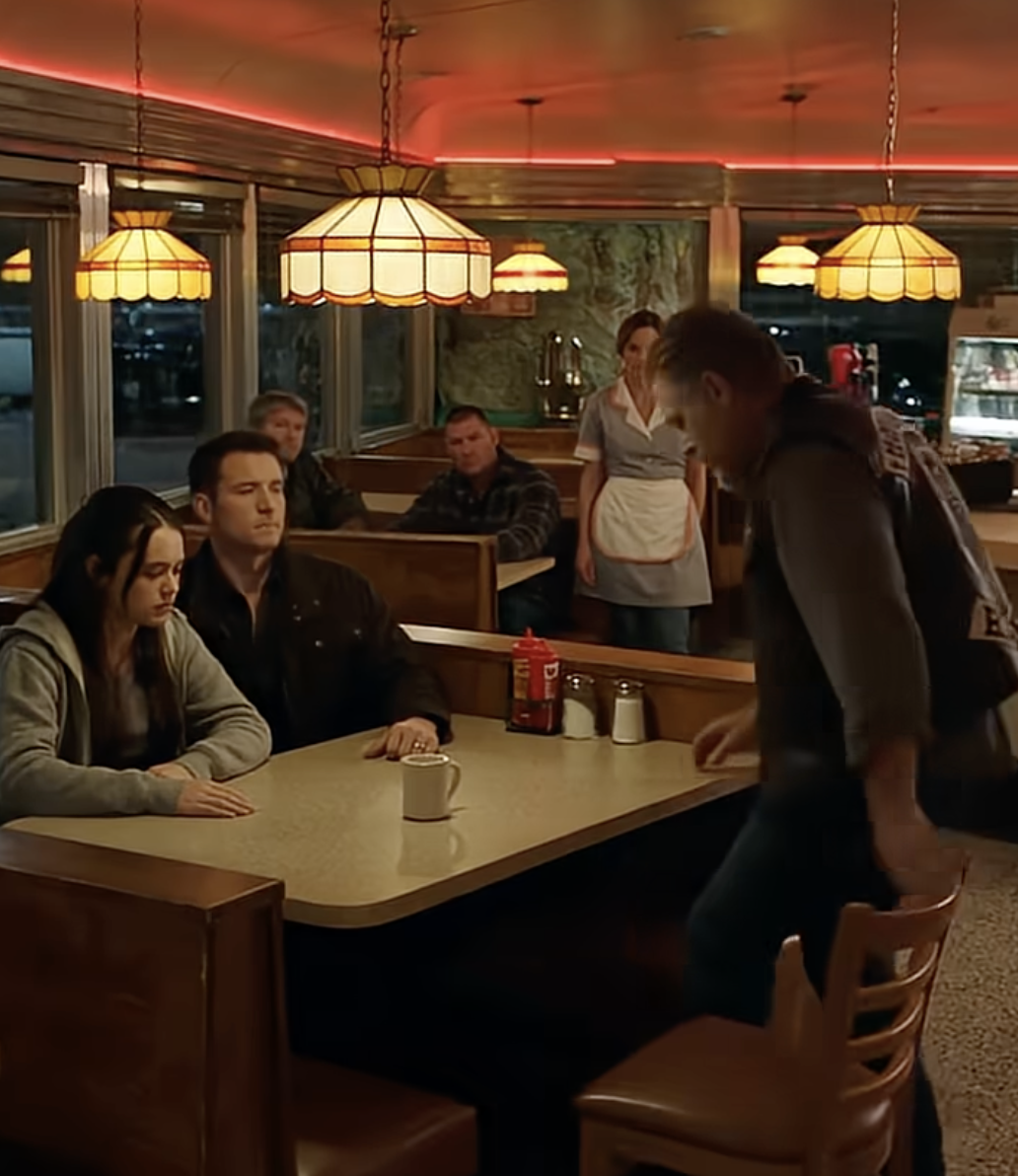
The young woman had been sitting in Booth 6 for forty-three minutes when I realized she wasn’t waiting for her food.
She hadn’t touched her coffee. She hadn’t looked at the menu. Every time the bell above the diner’s front door rang, her shoulders tightened, and her eyes darted toward the parking lot.
Then she caught my wrist as I reached for her empty water glass.
“Ma’am,” she whispered, barely moving her lips. “If a man comes in asking for me, please tell him you haven’t seen me.”
I looked at her properly for the first time.
She was maybe twenty-five, with tired eyes, a faded green jacket, and a small cut above her left eyebrow. Her hands trembled beneath the table. A silver ring sat on her right hand, and she kept twisting it around her finger as if she were trying to pull it off.
Before I could ask another question, she released my wrist and stared at the window.
A black pickup truck had just turned into the parking lot.
She went completely still.
I had been a waitress at Miller’s Roadside Diner outside Knoxville, Tennessee, for seventeen years. I had served truckers who drove through three states without sleeping, construction workers who came in covered in dust, and elderly couples who shared one slice of pie because they couldn’t afford two.
I had learned to recognize hunger, exhaustion, loneliness, and the particular kind of sadness that makes a person sit alone in a crowded room.
But that morning, I saw something different.
I saw a young woman who believed that the moment someone found her, her life would be over.
My name is Evelyn Carter. I was fifty-two years old that autumn, and until that Thursday morning, I thought the most difficult thing I would face that day was covering a double shift because our morning cook had called in sick.
I was wrong.
Because the young woman in Booth 6 had no idea that, before the afternoon was over, twenty-two motorcycles would pull into our parking lot, a dozen strangers would become witnesses, and a man who had frightened an entire family would discover that there were still people in this world he couldn’t intimidate.
And it all started with a folded napkin.
## 1. The Woman in Booth 6
The diner opened at five-thirty every morning.
By six, the coffee was brewing, the griddle was sizzling, and the first wave of customers had settled into their usual seats. Our windows faced Route 11, where eighteen-wheelers thundered past on their way toward the interstate.
The sign outside had lost two letters years earlier. The red vinyl booths were cracked, the floor tiles were permanently stained near the kitchen entrance, and the bell above the door rang so loudly that customers often turned their heads when someone entered.
It wasn’t a beautiful place.
But it was honest.
People came there because they knew what to expect. Hot coffee, affordable breakfasts, and a waitress who remembered whether they took cream or sugar.
The young woman had arrived shortly after seven.
She ordered a black coffee and a slice of toast.
When I asked whether she wanted eggs, she shook her head.
“Just the toast, please.”
Her voice was polite, almost apologetic.
I brought her order and watched her stare at the food without eating. Every few minutes, she looked at the clock above the counter.
At first, I assumed she was waiting for someone.
Then I noticed she had placed her handbag on the seat beside her, with the strap wrapped around her wrist.
She never took off her jacket, despite the warmth inside the diner.
When I returned to refill her coffee, I saw a faint purple mark near her wrist.
She pulled her sleeve down immediately.
“Sorry,” she said.
I frowned. “For what, sweetheart?”
She looked confused by the question.
“For taking up the booth.”
That answer stayed with me.
I had served people who sat in booths for hours over a single cup of coffee. Nobody apologized for that. Yet this young woman seemed to believe that simply occupying a seat was something she needed to justify.
I poured her coffee.
“You can sit as long as you need.”
She nodded without looking at me.
Five minutes later, the black pickup entered the parking lot.
It was an ordinary truck, dark paint, tinted windows, and a small dent in the rear bumper. Nothing about it would have attracted my attention if I hadn’t seen what happened to the woman when it appeared.
Her coffee cup rattled against its saucer.
She slipped out of the booth, ducked behind the seat, and crouched low enough that anyone looking through the window would have seen only an empty table.
I hurried over.
“Are you all right?”
She shook her head rapidly.
“Please.”
That was all she said.
One word.
But there was so much fear inside it that I stopped asking questions.
The pickup rolled past the front windows, slowed near the entrance, and continued toward the far side of the parking lot.
The woman stayed crouched until it disappeared.
When she finally sat upright, tears were running down her face.
I pulled into the opposite side of the booth.
“Listen to me,” I said softly. “You’re safe in here for the moment. But I need to know whether someone is threatening you.”
She stared at me.
Then she whispered, “His name is Travis.”
I waited.
“He’s my husband.”
She swallowed hard.
“And he’s not supposed to know where I am.”
## 2. The Man Who Always Smiled
Her name was Hannah Brooks.
She had married Travis Miller three years earlier, when she was twenty-two.
According to Hannah, he had been charming when they first met. He remembered small details about her, brought her flowers without being asked, and told her that he had never felt so understood by anyone.
He worked in construction management and drove an expensive truck. His family owned a successful landscaping business, and he seemed to know everyone in their county.
At their wedding, he cried during his vows.
Hannah’s father had pulled Travis aside afterward and told him to take good care of his daughter.
Travis had promised he would.
For the first year, Hannah believed him.
Then the rules began.
He wanted to know where she was going, whom she was meeting, and why she had taken longer than expected to return home. He complained about her friends, criticized her clothes, and insisted that her family was trying to turn her against him.
At first, the arguments were followed by apologies.
He would bring home flowers, make dinner, and tell her that stress at work had made him act like someone he wasn’t.
Hannah accepted those apologies because she remembered the man she had married.
She believed that if she could be more patient, less argumentative, and more careful with her words, the old Travis would return.
But the apologies became shorter, and the frightening moments became more frequent.
Eventually, she stopped inviting friends over.
She stopped calling her sister.
She learned to recognize his truck from the sound of its engine and could tell his mood from the way he shut the front door.
The night she finally decided to leave, Travis had accused her of hiding money.
He emptied her handbag onto the kitchen floor, searched her phone, and demanded to know why she had been speaking to her older sister.
When Hannah tried to walk away, he grabbed her arm hard enough to leave bruises.
She managed to lock herself in the bathroom.
For the first time, she called the police.
By the time officers arrived, Travis had calmed down. He told them they had been arguing and that Hannah was emotionally unstable. He spoke so reasonably that one of the officers asked whether she had somewhere else to stay for the night.
She went to her sister’s apartment.
Two days later, she filed for a protective order and began the process of leaving the marriage.
Travis responded by sending messages to her family, claiming that Hannah had suffered a breakdown. He told friends she was stealing from him. He even contacted her employer and said she might be dangerous.
Then he began showing up wherever she went.
Hannah had spent the previous night at a small motel outside town. She left before sunrise because she saw his truck parked near the entrance.
She drove until her fuel gauge was almost empty, then pulled into our diner.
“I thought if I stayed somewhere public, he wouldn’t try anything,” she told me.
I glanced toward the front windows.
“Did you contact the police?”
She nodded.
“They said they’d send someone to speak with me. But I don’t know how long it’ll take.”
“Did he threaten you today?”
Her eyes dropped to her hands.
“He told me yesterday that if I made him look like a criminal, he’d make sure everyone knew what kind of woman I really was.”
She took a shaky breath.
“He said nobody would believe me.”
I wanted to tell her that he was wrong.
I wanted to promise that everything would be fine.
But I had lived long enough to know that empty reassurance doesn’t make a frightened person feel safe.
So I asked the only question I could think of.
“Has he ever hurt you before?”
Hannah looked at me for several seconds.
Then she nodded.
I reached across the table and gently covered her hand.
“You don’t have to prove anything to me right now.”
Her face crumpled.
She bent forward, pressing both hands against her mouth, trying desperately not to make a sound.
I sat beside her until she could breathe normally again.
Across the diner, a man in a faded leather vest lowered his newspaper.
He had been sitting at the counter for nearly an hour.
I recognized him immediately.
Everyone in town knew the motorcycle club that met at the old garage on the edge of Miller Creek. They weren’t the kind of men who spent their time talking loudly about themselves. They fixed motorcycles, raised money for veterans, and occasionally organized food drives.
Their leader was a broad-shouldered man named Walter Hayes.
He was sixty-eight, with a gray beard, weathered skin, and a scar running from his left ear to his jaw.
Walter had been coming to our diner for twelve years.
He ordered two eggs, wheat toast, and black coffee.
He also had a habit of noticing things other people overlooked.
That morning, he had noticed Hannah.
And he had noticed me watching the parking lot.
## 3. The Folded Napkin
At eight-fifteen, the bell above the door rang.
A delivery driver entered carrying a clipboard. Behind him came an elderly couple who always ordered pancakes on Thursdays.
Hannah flinched at every sound.
I knew she couldn’t stay hidden in the booth forever. If Travis returned and saw her, I had no idea what he might do.
I also knew that I couldn’t simply tell twenty customers to leave while I called the police.
I needed help, but I had to get it without making Hannah feel that I was exposing her to even more danger.
I walked to the counter and stood beside Walter.
“How’s the coffee?” I asked.
He looked into his cup.
“Could strip paint off a tractor.”
“That’s because Manny made it.”
Walter smiled slightly.
Our cook, Manny, had been making coffee too strong for as long as I had known him.
I lowered my voice.
“That young woman in Booth 6 is frightened. Someone may be following her.”
Walter’s smile disappeared.
“Have you called the police?”
“She’s already contacted them. I’m worried the man will come back before they arrive.”
He glanced toward Hannah.
“Does she know you’re talking to me?”
“No.”
“Then don’t make her feel surrounded.”
I appreciated that answer more than I could explain.
Walter didn’t offer to confront anyone. He didn’t suggest chasing the truck or teaching the man a lesson. He simply asked what Hannah needed at that moment.
I told him she needed time, privacy, and a way to signal me if Travis returned.
Walter considered that for a few seconds.
Then he pushed his empty cup aside.
“Give her a napkin,” he said. “Something she can fold without anybody thinking twice about it.”
I understood.
We needed a quiet signal.
Nothing dramatic. Nothing that would attract attention.
I took a clean paper napkin from the dispenser and carried it to Hannah’s booth with her water.
“You don’t have to explain anything else to me,” I told her. “But if you see the man you’re afraid of, fold this napkin into a triangle and leave it beside your cup.”
She stared at me.
“What happens then?”
“I’ll know you need help.”
She looked toward the counter.
Walter was reading his newspaper again, apparently uninterested in anything happening around him.
I continued, “There are people here who will help you contact the police. You won’t have to face him alone.”
Hannah picked up the napkin.
Her fingers trembled as she folded it once, then twice, creating a small triangle.
“Like this?”
“Exactly like that.”
She placed it beside her cup.
Then she looked at me with frightened, searching eyes.
“What if he comes in?”
I took a breath.
“Then we’ll take it one step at a time.”
For the first time that morning, Hannah managed a small smile.
It lasted less than a second.
But it was there.
At eight-twenty-seven, my phone vibrated in my apron pocket.
It was a message from my daughter, asking whether I could pick up her son after school.
I typed a quick reply and slipped the phone away.
When I looked up, Walter had folded his newspaper and was watching the parking lot.
Across the street, a black pickup had stopped beside the gas station.
The driver was looking directly at our diner.
I turned toward Hannah.
She had seen it too.
Her hand moved toward the napkin.
Then she folded it into a triangle.
## 4. Twenty-Two Engines
Walter noticed the signal before I reached the booth.
He stood, placed a few bills beneath his coffee cup, and walked toward the front window.
He didn’t hurry.
He didn’t look angry.
He simply studied the pickup for several seconds before taking his phone from his pocket.
I couldn’t hear the conversation, but I saw him speak briefly, listen, and then put the phone away.
A minute later, he turned to me.
“Evelyn, would you mind checking whether Manny needs anything from the storeroom?”
I understood that he wanted to speak with Hannah without drawing attention to her.
I went into the kitchen.
Manny was standing beside the grill, flipping eggs with a spatula.
“What’s going on?” he asked.
I told him enough to make him understand that someone might be in danger, but I didn’t share details Hannah hadn’t agreed to disclose.
Manny’s face tightened.
“Should I call the police?”
“She’s already called. Walter is helping us keep things calm.”
Manny nodded and turned off one section of the grill.
“Then I’ll keep the back hallway clear.”
When I returned to the dining room, Walter was sitting across from Hannah.
He had moved to the next booth rather than sitting directly beside her. He was giving her space.
“I don’t need you to tell me anything you don’t want to,” he said. “But I want you to know that you’re allowed to ask for help.”
Hannah nodded.
“My father used to say that asking for help was weakness.”
Walter rested his hands on the table.
“Your father was wrong about that.”
She looked at him.
He continued, “There’s a difference between being weak and being exhausted from carrying something alone.”
Hannah began to cry again, but this time she didn’t hide her face.
Walter slid a paper napkin across the table.
He didn’t touch her or ask her to stop crying.
He simply waited.
Outside, the black pickup pulled away from the gas station.
I thought the immediate danger had passed.
Then Walter’s phone rang.
He answered, listened, and said, “All right. Keep it orderly. Nobody comes inside unless the woman asks for assistance or the police request it.”
He ended the call.
I frowned.
“What’s happening?”
Walter looked through the window toward the road.
“My brothers were already meeting at the garage this morning. I told them we had a possible safety concern at the diner and asked whether a few people could come by to support the situation.”
He paused.
“They’re on their way.”
“How many?”
Walter glanced at me.
“Twenty-two, counting me.”
My mouth fell open.
“Twenty-two?”
He nodded.
“Nobody’s coming here to fight. I made that very clear. They’ll park, stay outside, and let the authorities handle the situation.”
I looked toward the window again.
I had seen the motorcycle club arrive for charity rides before. Their annual toy drive filled the parking lot with bikes, families, and children wearing oversized helmets.
But this was different.
This was a frightened woman, a man who might return, and twenty-two bikers who had agreed to stand nearby without knowing the full story.
“Why would they do that for a stranger?” I asked.
Walter looked at Hannah.
“Because somebody once did it for one of us.”
He didn’t elaborate.
He didn’t need to.
At eight-forty-three, the first motorcycle appeared at the end of the road.
Then another.
Then three more.
They came in a loose line, engines rumbling beneath the gray sky. Their headlights flashed across the diner’s windows as they turned into the parking lot.
The riders pulled into spaces one after another.
No revving engines.
No shouting.
No dramatic display.
They parked their motorcycles, switched off the ignition, removed their helmets, and stood quietly beside their bikes.
Twenty-two men and women.
Twenty-two motorcycles.
Twenty-two people who had stopped whatever they were doing because someone might need help.
The engines fell silent almost together.
Inside the diner, every conversation stopped.
A truck driver set down his fork.
The elderly couple at the counter turned toward the windows.
Manny appeared at the kitchen doorway holding a dish towel.
Hannah stared at the parking lot as if she couldn’t understand what she was seeing.
“Are they here because of me?” she whispered.
Walter nodded.
“They’re here so you won’t have to feel alone.”
She pressed both hands over her mouth.
Outside, the bikers remained where they were.
Some stood with their arms folded. Others leaned against their motorcycles. One older woman with silver hair took a thermos from her saddlebag and poured herself a cup of coffee.
Nobody surrounded the building.
Nobody blocked the driveway.
They simply waited.
For the first time that morning, Hannah looked toward the front door without immediately shrinking back.
Then the black pickup turned into the parking lot again.
## 5. Travis Comes Back
The truck rolled slowly past the first row of motorcycles.
Its windows were tinted, but I could see the driver looking from one rider to another.
He stopped near the entrance.
For several seconds, nothing happened.
Then the driver’s door opened.
Travis stepped out.
He was tall, clean-shaven, and dressed in a dark jacket over a button-down shirt. He looked like the sort of man who might be attending a business meeting rather than searching for his frightened wife.
He glanced at the motorcycles.
Then he smiled.
It was the same kind of smile Hannah had described earlier: confident, practiced, and intended to make everyone believe he was the reasonable person in the room.
He walked toward the entrance.
Walter stepped outside before he reached the door.
The two men stood several feet apart.
“Morning,” Walter said.
Travis looked him up and down.
“Is there a problem?”
“Not if you can keep things calm.”
Travis laughed under his breath.
“I’m looking for my wife. She’s been having some emotional difficulties, and I think she’s confused about where she’s supposed to be.”
Walter didn’t move.
“Have you contacted the police?”
“That’s a family matter.”
“Then the police can help you sort it out.”
Travis’s smile tightened.
“Listen, old man. I don’t know who you are, but I don’t need a crowd of bikers interfering with my marriage.”
Walter glanced at the riders standing beside their motorcycles.
“They aren’t interfering. They’re waiting.”
“For what?”
“For the authorities.”
Travis looked toward the diner windows.
I saw the exact moment he spotted Hannah.
His expression changed.
He took a step toward the entrance.
Walter remained where he was.
“Don’t come any closer until the officers arrive.”
Travis’s face reddened.
“Move.”
“No.”
It was a single word, spoken without anger.
Travis looked at the people standing outside. He seemed to be calculating how much he could say, how loudly he could speak, and whether he could turn the situation into something that made him look like the victim.
Then he pointed toward the window.
“She’s my wife. You have no right to keep her from me.”
From inside, Hannah began to shake.
I moved closer to her booth.
“You don’t have to go outside,” I told her.
Travis raised his voice.
“Hannah! Come out here. You’re embarrassing yourself.”
She closed her eyes.
“He’s going to make everyone think I’m crazy.”
I crouched beside her.
“Let him say whatever he wants. You don’t have to answer him.”
She looked at me through tears.
“What if nobody believes me?”
I took her hand.
“You’re not alone in this room.”
Outside, Walter had heard enough.
He spoke calmly, making sure Travis could hear him without turning the exchange into a shouting match.
“The best thing you can do right now is step away from the door and wait for the police.”
Travis sneered.
“Are you threatening me?”
“No. I’m telling you what will keep this situation from getting worse.”
For a moment, I thought Travis might push past him.
Instead, he looked at the line of silent motorcycles and backed away.
He walked toward his truck, took out his phone, and began making a call.
Walter returned to the diner.
“He’s waiting outside,” he told Hannah. “The police are on their way.”
She nodded, but her breathing was quick and shallow.
Walter pulled out a chair at the next booth.
“Would you like some water?”
Hannah nodded again.
I brought her a fresh glass.
She held it with both hands until the trembling began to ease.
Then she said something that made my heart ache.
“I used to think that if I were a better wife, he wouldn’t act like this.”
Walter looked at her.
“Someone else’s cruelty isn’t a measure of your worth.”
Hannah stared at the water.
“My mother always told me marriage meant staying through the hard times.”
Walter paused before answering.
“Staying through hard times is one thing. Being made afraid in your own home is another.”
She began to cry quietly.
Nobody told her to stop.
Nobody asked her why she hadn’t left sooner.
Nobody asked what she had done to make him angry.
For the first time in months, she was surrounded by people who didn’t demand that she defend herself before they would listen.
## 6. The Truth in Her Handbag
The first police cruiser arrived eleven minutes later.
A second followed close behind.
Two officers entered the diner while another approached Travis outside.
Walter explained what he had observed without embellishment. I gave my statement about Hannah’s arrival, the pickup, and the napkin signal.
Hannah spoke with a female officer in a quiet booth near the kitchen.
At first, she struggled to get the words out.
Then she reached into her handbag and removed a small folder.
Inside were copies of the protective-order paperwork, photographs of injuries, printed messages, and a list of dates.
She had been documenting what happened for months.
The officer read the papers carefully and asked Hannah whether she was willing to provide a formal statement.
Hannah nodded.
“Yes.”
Her voice was still shaking, but it was stronger than it had been that morning.
Outside, Travis continued insisting that the bikers had intimidated him and that his wife had been manipulated by strangers.
One officer asked him to remain by his truck while they verified the paperwork.
He objected.
He demanded to speak to a supervisor.
He claimed that the entire situation was a misunderstanding.
But the officers had documents to review, and they were no longer relying solely on his version of events.
A few minutes later, the female officer returned to Hannah’s booth.
“We’ve confirmed the active order,” she said. “You were right to seek help. We’ll explain the next steps to you privately.”
Hannah covered her face with her hands.
The relief was so overwhelming that she could barely speak.
I sat beside her while the officer explained how she could arrange safe transportation and contact a local domestic violence advocate.
There were still questions to answer. There would be paperwork, court dates, and difficult decisions ahead.
But she would not be forced to handle them that morning in the parking lot.
Travis was taken away for further questioning after the officers determined that the situation required additional investigation. I later learned that his violations and the evidence Hannah provided became part of a broader legal case.
The officers did not promise Hannah that everything would be easy.
They did promise to help her understand her options and make a safety plan.
Sometimes, that is what the first step toward freedom looks like.
Not a dramatic victory.
Not a perfect ending.
Just a frightened person finally being taken seriously.
When the last officer returned to the parking lot, Walter stepped aside to let him pass.
Travis glanced toward the diner one final time.
His eyes settled on Hannah through the window.
She stiffened.
Walter noticed.
He moved to stand where she could see him, not blocking the entire window, but reminding her that she was no longer alone.
Travis was led toward the cruiser.
The door closed.
The vehicle pulled away.
And for the first time that day, the black pickup sat empty in the parking lot.
Hannah watched until the cruiser disappeared around the bend.
Then she looked at me.
“Is he really gone?”
“For now,” I said. “And we’ll make sure you have help deciding what comes next.”
She nodded slowly.
Outside, twenty-two bikers were still waiting.
## 7. The Brotherhood
When the police had finished their work, Walter stepped outside to speak with the others.
I expected the bikers to celebrate, exchange high-fives, or make loud jokes about how they had scared Travis away.
They did none of those things.
They gathered quietly near the motorcycles while Walter explained that the immediate situation had been handled and that Hannah was speaking with an advocate.
He reminded them that she deserved privacy.
Nobody was to photograph her, post about her, or tell the story without her permission.
One of the younger riders nodded.
“Understood.”
Another asked whether Hannah needed a ride to a safe location.
Walter said the police and advocate were arranging transportation, but he appreciated the offer.
Then the group began preparing to leave.
Before they did, Walter came back inside.
Hannah was still sitting in Booth 6, holding her glass of water.
He stopped a respectful distance from the table.
“Ma’am, my name is Walter. I wanted you to know that nobody here expects anything from you.”
Hannah looked up.
“Why did you all come?”
Walter considered the question.
“Years ago, a woman in our community needed help. Some of us knew something was wrong, but we convinced ourselves it wasn’t our business. We thought someone else would step in.”
He paused.
“We were wrong to wait.”
Hannah listened without moving.
“After that, our club started taking community safety more seriously. We learned how to contact the right people, how to support someone without making decisions for them, and how to be present without turning ourselves into the center of the story.”
He glanced toward the window.
“Today, we were able to show up. That’s all.”
Hannah wiped her eyes.
“Thank you.”
Walter nodded.
“You don’t owe us anything.”
She hesitated.
“Not even a cup of coffee?”
A faint smile appeared beneath his beard.
“Well, I wouldn’t turn one down.”
For the first time all morning, Hannah laughed.
It wasn’t loud. It wasn’t carefree.
But it was real.
I poured Walter a fresh cup and brought Hannah another slice of toast.
This time, she ate.
Outside, the motorcycles began starting one by one.
Their engines filled the parking lot, but nobody revved them aggressively or tried to frighten anyone. The riders pulled out in small groups, leaving the entrance clear.
Walter was the last to leave.
Before he put on his helmet, he looked through the window and raised one hand.
Hannah raised hers in return.
Then the final motorcycle turned onto the road, and the parking lot fell quiet.
Twenty-two bikes had arrived.
Twenty-two people had stood nearby.
And not one of them had asked Hannah to tell her story before deciding that she deserved help.
## 8. A Place to Begin Again
The following weeks were not easy.
I wish I could tell you that Hannah left the diner that morning, found a new apartment, and never felt afraid again.
But real life doesn’t work that way.
She spent several days with her sister while a domestic violence advocate helped her arrange longer-term housing. She attended appointments, answered questions, and gathered the documents she needed for court.
Some mornings, she felt strong.
Other mornings, she could barely get out of bed.
She worried about money. She worried about what Travis might say to their mutual friends. She worried that people would judge her for staying as long as she had.
The advocate helped her work through those fears and connected her with practical support.
Hannah also started seeing a counselor.
She told me later that the hardest part wasn’t leaving the house.
It was learning that she could make decisions without first imagining how angry someone else might become.
For months, she had measured every word, every movement, and every ordinary choice against Travis’s reaction.
Now, she was learning how to ask herself what she wanted.
It began with small things.
She bought a blue mug because she liked the color.
She cut her hair shorter.
She went for a walk without checking her phone every thirty seconds.
And one Saturday, she returned to Miller’s Diner.
I saw her standing outside the front window before she entered.
She was wearing jeans, a cream-colored sweater, and a pair of boots I hadn’t seen before.
She looked different.
Not because her fear had disappeared, but because she was no longer trying to make herself invisible.
When she came inside, I hurried around the counter.
“Hannah!”
She hugged me tightly.
Then she sat in Booth 6.
The same booth where she had once crouched below the window, terrified that someone would see her.
I brought her coffee and toast.
She smiled at the folded napkin beside the cup.
“I still remember how you taught me to do that.”
I sat across from her.
“Do you ever think about that morning?”
“Every day,” she said. “But not always the way you might expect.”
She looked through the window.
“I remember the fear. Of course I do. But I also remember the moment I saw all those motorcycles. I remember thinking that I had spent so long believing nobody would help me that I didn’t know what to do when people actually did.”
She took a breath.
“I thought I had to convince everyone that I deserved to be safe.”
Her eyes filled with tears.
“That day, nobody asked me to prove I was a good person first.”
I reached across the table and held her hand.
“You never had to.”
She nodded.
Then she took a small envelope from her handbag.
Inside was a handwritten note addressed to Walter Hayes and the members of his motorcycle club.
She had written it herself.
She wanted to thank them for showing up, for respecting her privacy, and for leaving the decisions in her hands.
She asked whether I could pass it along.
I promised I would.
A week later, Walter returned to the diner.
He read Hannah’s note twice, folded it carefully, and placed it in his vest pocket.
Then he asked me whether she was doing all right.
I told him she was making progress, one day at a time.
He nodded.
“That’s how it happens.”
He ordered his usual breakfast.
Two eggs, wheat toast, and black coffee.
Then he looked toward Booth 6.
“Funny thing about that booth,” he said. “Some days, it’s just a place to eat. Other days, it’s the first safe place someone has had in a long time.”
I looked at the empty seat across from him.
“Maybe that’s what a diner is supposed to be.”
Walter smiled.
“Maybe.”
## 9. The Twenty-Third Person
About six months later, Hannah asked me whether she could help with a community event at the diner.
She had been volunteering with a local support organization, helping prepare welcome bags for people who needed emergency accommodation. The bags contained basic toiletries, notebooks, phone chargers, and information about local services.
She wanted to organize a small fundraiser.
I said yes.
We cleared the tables on a Sunday afternoon, put out folding chairs, and invited customers to donate supplies or money.
Walter and several club members arrived early.
They carried boxes, set up tables, and helped Manny move a heavy refrigerator away from the wall so we could clean behind it.
By noon, the diner was full.
Families came in with bags of toiletries. A retired teacher donated blankets. A local mechanic offered to repair a vehicle for someone who needed transportation to appointments.
The motorcycle club organized a ride to collect additional supplies from nearby towns.
Hannah stood near the counter, greeting people as they arrived.
She was still shy in crowds, but she no longer kept her eyes fixed on the floor.
At one point, I saw her speaking with a young woman who had come alone.
The woman was in her early twenties and wore a gray hoodie despite the warm weather. She kept her handbag on her lap and looked toward the entrance whenever someone opened the door.
Hannah didn’t crowd her.
She offered her a chair and asked whether she’d like something to drink.
The woman said no.
Hannah nodded and sat nearby.
They spoke quietly for several minutes.
I couldn’t hear their conversation, but I noticed the young woman gradually relax. Her hands stopped gripping the handbag quite so tightly.
Then Hannah reached into her pocket and took out a paper napkin.
She folded it once.
Then twice.
She placed it beside the young woman’s untouched glass of water.
The woman stared at it.
Hannah leaned closer and said something I couldn’t hear.
The young woman looked up.
And then she began to cry.
I watched Hannah pull her chair closer, offering comfort without demanding an explanation.
Walter had seen it too.
He stood beside me at the counter.
“She’s helping someone else now,” I whispered.
He nodded.
“That’s how it should be.”
The young woman eventually agreed to speak with the support organization’s coordinator, who explained the available services and helped her make a plan for the evening.
Nobody promised that every problem would be solved immediately.
But she left the diner with a phone number, a safe place to go, and people who knew she might need further assistance.
Before she walked out, she stopped beside Hannah.
“Thank you,” she whispered.
Hannah smiled.
“You don’t have to thank me.”
The woman hesitated.
“Why did you help me?”
Hannah glanced at Booth 6.
“Because somebody helped me when I couldn’t find the words.”
Then she opened the door and watched the woman leave.
Walter stood beside his motorcycle in the parking lot, his hands resting on the handlebars.
He looked older than he had that first morning.
His beard had grown whiter, and his shoulders seemed a little heavier beneath his leather vest.
But when Hannah walked outside, he straightened.
She approached him and offered a small folded piece of paper.
He opened it.
Inside was a photograph of the diner, taken on the morning of the fundraiser. The motorcycles stood in a line outside the building, and sunlight reflected off the windows.
On the back, Hannah had written:
You showed up when I thought nobody would.
Now I know how important it is to show up for someone else.
Walter read the note quietly.
Then he folded it and placed it beside the first letter she had given him.
“Thank you,” he said.
Hannah hugged him.
For a moment, the old biker closed his eyes.
He had spent much of his life believing that strength meant being the person who could carry the heaviest burden.
But standing there beside the woman who had once hidden beneath a diner window, he understood something different.
Sometimes strength meant making room for someone else’s pain.
Sometimes it meant listening.
And sometimes it meant showing up, then stepping aside so another person could find her own way forward.
## 10. The Napkin Beside the Coffee
Today, the folded napkin is still there.
I keep a clean one beside the register, tucked beneath the small wooden box where I store spare pens and order pads.
Most customers never notice it.
Some assume it’s just another napkin.
But I know what it represents.
It reminds me of the morning a frightened woman walked into my diner believing that she had nowhere safe to turn.
It reminds me of the way she flinched whenever the bell above the door rang, how she twisted a ring around her finger, and how she apologized for occupying a booth.
It reminds me that fear doesn’t always look like screaming.
Sometimes it looks like a person sitting quietly in a crowded room, hoping nobody notices them.
And it reminds me of twenty-two motorcycles rolling into a parking lot, their engines going silent as their riders waited to help without demanding attention or praise.
People still talk about that morning.
Some remember the motorcycles.
Others remember Travis standing outside the diner, realizing that his wife was no longer isolated.
A few remember the sight of Walter Hayes, a gray-bearded biker in a worn leather vest, standing beside the front door while a frightened woman spoke with a police officer.
But the part I remember most is what happened after everyone else had gone home.
Hannah came back to the diner three weeks later and ordered eggs for the first time.
She sat in Booth 6, ate her breakfast, and laughed when Manny accidentally put too much pepper in the potatoes.
It was an ordinary moment.
That was what made it beautiful.
She was no longer measuring every movement against someone else’s anger. She was simply a woman eating breakfast in a diner.
Over the following year, she rebuilt her life slowly. She found work, moved into a small apartment, and reconnected with friends she had lost touch with.
There were difficult days, and there were setbacks. Healing didn’t follow a straight line.
But she learned that she could ask for help without surrendering her independence.
She learned that being afraid didn’t mean she was weak.
And she learned that leaving a frightening situation was not a failure to save a marriage.
It was an act of protecting herself.
Walter continued visiting the diner every Thursday morning until his health made the ride too difficult. When he finally stopped coming, the club members brought his usual breakfast to his house and sat with him on the porch.
He passed away peacefully the following winter.
At his memorial, Hannah stood beside his motorcycle and read a short letter.
She spoke about the folded napkin, the silent parking lot, and the people who had come without asking her to explain why she needed them.
Then she said something that made the entire gathering quiet.
“For a long time, I believed my life was divided into two parts: the years when I was afraid and the years after I finally escaped. But now I understand there was another moment in between. It was the morning I discovered that my fear didn’t make me invisible.”
She paused, looking at the people gathered around her.
“Someone noticed. Someone listened. And twenty-two people decided that showing up mattered more than looking away.”
After the service, I returned to the diner.
I stood behind the counter and looked toward Booth 6.
The afternoon sunlight fell across the cracked red vinyl seat. A truck driver sat at the counter, drinking coffee. An elderly couple shared a slice of pie. Manny was arguing with the delivery man about the price of eggs.
Everything looked ordinary.
And I was grateful for that.
Because the greatest thing that happened that morning wasn’t that twenty-two motorcycles arrived.
It wasn’t that a frightening man finally faced questions he couldn’t answer with a smile.
It wasn’t even that a frightened woman found the courage to ask for help.
The greatest thing was that, for a few hours, a room full of ordinary people refused to pretend they hadn’t seen what was happening.
They didn’t need to know every detail.
They didn’t need to solve every problem.
They simply needed to recognize that someone was frightened and help her reach people who could keep her safe.
That’s what the folded napkin meant.
Not revenge.
Not intimidation.
Not a promise that one group of people could fix everything.
It was a quiet signal that said, I need help, but I’m not ready to say it out loud.
And the response was just as simple.
We see you.
We’re listening.
You don’t have to face this alone.
I still keep a napkin beside the register.
Sometimes, when a customer comes in looking exhausted or frightened, I find myself glancing toward it.
I don’t assume I know their story. I don’t force them to talk. And I don’t promise things I can’t guarantee.
I simply make sure they know where to find help.
Because I learned something that Thursday morning that seventeen years of waiting tables had never taught me.
You can serve a thousand people a day and still fail to notice the one who needs you most.
You can know every customer’s order and still miss the fear in someone’s eyes.
And you can spend your whole life believing that courage belongs to extraordinary people, only to discover that it often begins with an ordinary person deciding not to look away.
The woman in Booth 6 didn’t need twenty-two bikers to rescue her life.
She needed someone to notice.
She needed someone to listen.
And when the moment came, she needed people willing to stand beside her while she took the next step herself.
The motorcycles were gone before lunchtime.
The coffee was refilled.
The tables were wiped clean.
And the diner returned to its ordinary rhythm.
But something had changed.
From that day forward, whenever the bell above the door rang and someone walked inside looking like they were carrying more than they could bear, I tried to remember Hannah.
I tried to remember Walter.
And I tried to remember the silent parking lot where twenty-two engines went quiet, not because anyone had ordered them to, but because twenty-two people had decided that a frightened stranger deserved to be heard.
Sometimes, that is where a new life begins.
Not with a speech.
Not with a fight.
Not with a miracle.
Just a folded napkin beside a cup of untouched coffee.
And one person finally noticing.