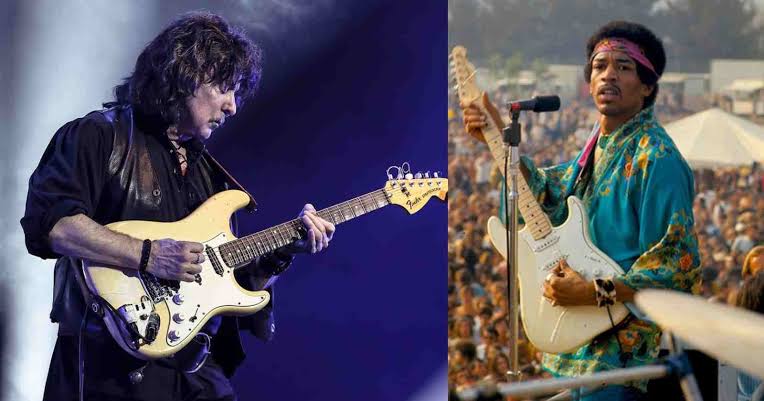
The Guitar Legend Who Changed Rock Music Forever
Ritchie Blackmore is one of the most influential guitarists in rock history. Through his work with Deep Purple, he helped shape the sound of hard rock, combining powerful guitar riffs with classical influences and a distinctive musical style. Throughout his career, Blackmore was never afraid to experiment, constantly exploring new ways to push rock music beyond its traditional boundaries.
His interest in different musical styles played a major role in shaping his approach to guitar playing. While Deep Purple became famous for their heavy sound, the band also experimented with softer arrangements and classical elements, creating a musical identity that stood apart from many of their contemporaries.
“My interest in classical music overall is what led me in the direction of trying to combine blues, rock and classical ideas into the stylistic statement,” Blackmore explained.
He also recalled being inspired as a teenager by Nero and the Gladiators, a band known for performing rock versions of classical compositions.
“At the age of 15, I saw a band that did rocked-up classical tunes, called Nero and the Gladiators. They all wore togas, and you would think they must have looked really silly, but it worked.”
That early experience helped shape Blackmore’s musical imagination, encouraging him to bring together seemingly different styles and create something distinctive.
Why Blackmore Believed Jimi Hendrix Was Ahead of His Time
Among the many musicians Blackmore admired, few stood out quite like Jimi Hendrix. Hendrix transformed the electric guitar through his innovative playing, experimental sound and extraordinary stage presence. His approach to the instrument went far beyond traditional techniques, influencing generations of guitarists who followed him.
For Blackmore, Hendrix was not simply an exceptional guitarist. He was an artist whose ideas seemed to belong to a different era.
“Hendrix came out in 1966, and he was probably 20 years ahead of his time,” Blackmore said.
He went on to explain what made Hendrix such a remarkable musician.
“What makes him a genius is his phrasing and his originality; his construction of songs, his very innovative riffs, like those of ‘Purple Haze’ and ‘Manic Depression’; his presence on stage.”
Hendrix’s playing was unlike anything many listeners had experienced before. He used feedback, distortion and unconventional guitar techniques to create sounds that seemed almost impossible at the time. His ability to combine blues foundations with psychedelic experimentation helped redefine what the electric guitar could achieve in rock music.
Yet Blackmore also highlighted something that is sometimes overlooked when discussing Hendrix’s legacy: his voice.
“But, oddly enough, one of the things that I think made him so special was his voice, since he never wanted to be a vocalist.”
Although Hendrix is often celebrated primarily for his guitar playing, his singing and songwriting were essential parts of his artistic identity. His voice brought a raw, personal quality to his music, while his lyrics explored themes of love, imagination, freedom and the changing world around him.
The Poet Behind the Guitar
Hendrix’s extraordinary guitar skills sometimes overshadowed his abilities as a songwriter and poet. His performances were so captivating that it could be easy to overlook the thought and creativity behind his lyrics.
However, other artists recognised this side of his talent. Patti Smith, the influential poet and musician, once spoke about Hendrix’s love of poetry and his modesty regarding his own writing.
“I got to talk to him once about 50 years ago. And for a young girl, he was everything you would want in your rock and roll star,” Smith recalled.
She continued:
“[He] loved poetry. He often spoke not in the most favourable way about his poetry. He didn’t think he was the greatest writer. He really admired Bob Dylan, but he was a wonderful poet.”
Smith’s reflections offer another perspective on Hendrix, revealing an artist whose creativity extended well beyond the guitar. Like many great musicians, he drew inspiration from different art forms and used music as a way to express ideas that words alone could not fully capture.
His songwriting, vocal delivery and guitar playing worked together to create a sound that remains instantly recognisable decades later.
Vanilla Fudge: Another Influence on Blackmore
Jimi Hendrix was not the only artist Blackmore considered ahead of his time. He also admired Vanilla Fudge, the American rock band known for their dramatic arrangements, heavy sound and reinterpretations of existing songs.
Their experimental approach made a strong impression on Blackmore and his fellow Deep Purple musicians during the band’s early years.
“We loved Vanilla Fudge – they were our heroes,” Blackmore said.
He remembered how the band’s performances at London’s Speakeasy attracted prominent musicians and members of the rock scene.
“They used to play London’s Speakeasy, and all the hippies used to go there to hang out – Clapton, The Beatles – everybody went there to pose.”
Blackmore was particularly impressed by the band’s originality and willingness to approach rock music differently.
“The group was ahead of its time,” he explained, before admitting just how much Vanilla Fudge had influenced Deep Purple’s early direction.
“So, initially we wanted to be a Vanilla Fudge clone.”
The admission offers an interesting glimpse into the band’s beginnings. Even musicians who later develop highly distinctive styles often start by learning from the artists they admire. For Blackmore, Vanilla Fudge provided an example of how heavy guitar music, dramatic arrangements and experimentation could come together in a fresh way.
A Legacy That Continues to Inspire
Ritchie Blackmore’s admiration for Jimi Hendrix reflects the enormous impact Hendrix had on rock music. His originality, expressive guitar playing and fearless experimentation helped expand the possibilities of the instrument, leaving an influence that continues to be felt across generations.
For Blackmore, Hendrix’s genius was not simply about technical ability. It was about having a unique musical voice, creating unforgettable riffs, commanding the stage and bringing together elements that other musicians had yet to explore in the same way.
Hendrix’s career was tragically short, but his influence remains immense. From his groundbreaking recordings to his unforgettable performances, he changed the way musicians and audiences understood the electric guitar.
And as Blackmore’s own career demonstrates, musical innovation rarely happens in isolation. The artists who push rock forward are often inspired by those who dared to do something different before them.
Hendrix was one of those rare musicians who seemed to glimpse the future of rock music long before the rest of the world caught up.