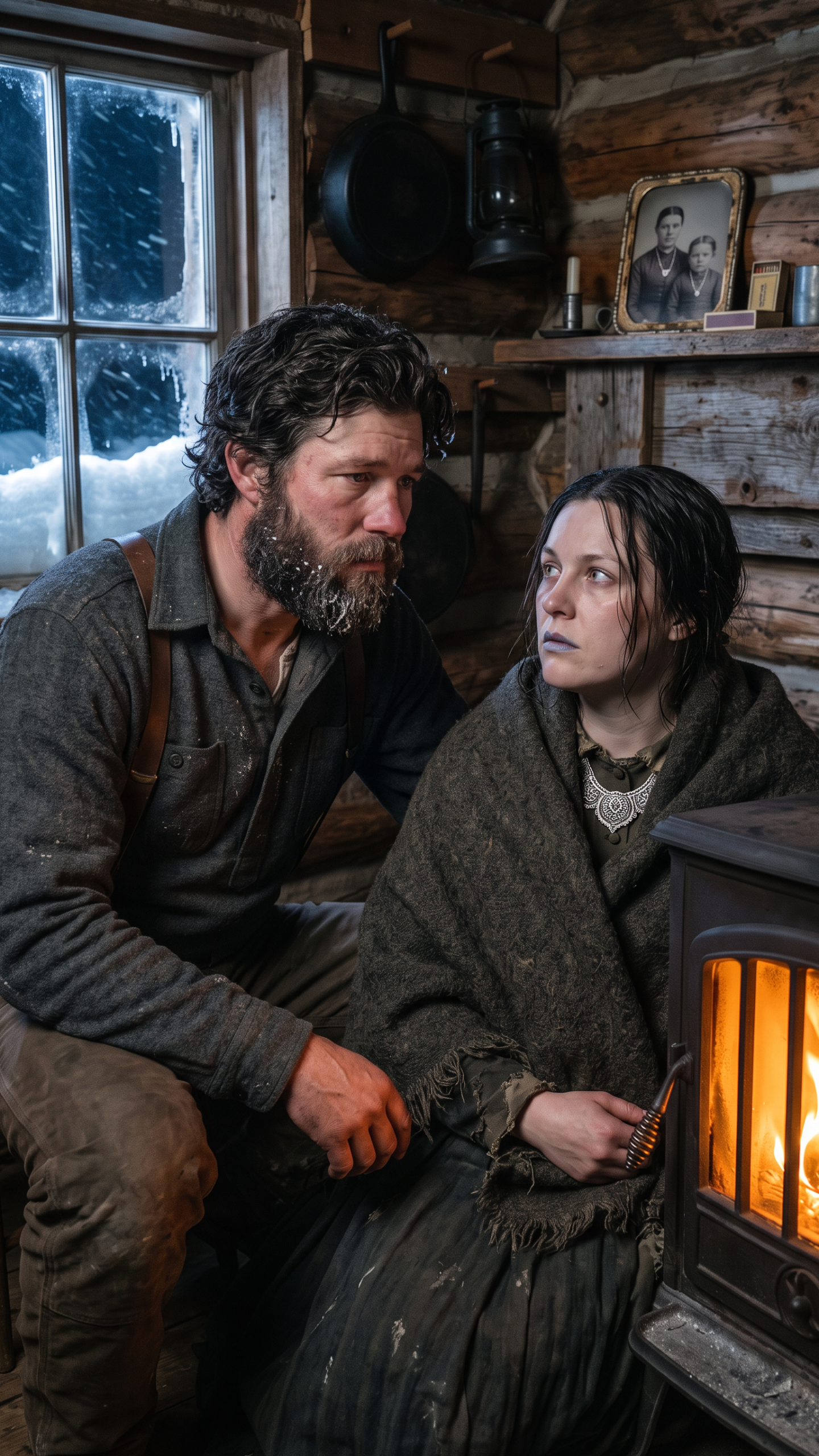
# THE WHOLE TOWN CALLED HER CURSED—UNTIL A LONELY MOUNTAIN MAN CARRIED HER THROUGH A DEADLY BLIZZARD
## Chapter 1: The Woman Beneath the Snow
The whole town of Bellweather called Eleanor Whitmore cursed.
They whispered it behind lace curtains, muttered it over cups of coffee, and repeated it in churchyards where they pretended their words were prayers rather than cruelty. Some believed her unusual size had brought misfortune upon her family. Others claimed that every man who showed her kindness eventually suffered for it.
Eleanor had stopped asking people to explain their accusations years ago.
At twenty-nine, she had learned that cruelty rarely required a reason. Sometimes people simply needed someone to blame for the unhappiness they carried inside themselves.
She had a gentle face, striking green eyes, and dark hair that fell in soft waves around her shoulders. She was full-figured, with a body that drew attention wherever she went, and she had spent nearly her entire life being reminded that she did not look the way other people expected a woman to look.
When she entered a shop, conversations grew quiet. When she walked down the street, men exchanged smirks. When she attended church, certain women looked at her with pity that felt worse than hatred.
But Eleanor had not always been so quiet.
As a little girl, she had loved to laugh. She had climbed apple trees, chased chickens around her father’s farm, and danced barefoot in the kitchen whenever her mother played the fiddle.
Her mother, Margaret, had always told her that a person’s worth could never be measured by the space she occupied.
“Some people have small hearts, Ellie,” she would say while brushing her daughter’s hair. “They need to make other people feel smaller so they can pretend their own hearts are bigger.”
Eleanor had believed her.
Then Margaret died when Eleanor was sixteen, and her father followed three years later.
After that, the world seemed determined to prove her mother wrong.
Her father’s farm was swallowed by debt. The relatives who had promised to help disappeared when help became inconvenient. Eleanor found work wherever she could, but employers frequently dismissed her after customers complained about having to look at her.
Eventually, she settled in Bellweather, Montana Territory, where she worked in the kitchen of the town’s boardinghouse.
She cooked, scrubbed floors, mended sheets, and washed dishes until her fingers cracked in the winter cold.
Even then, people complained.
“She eats too much,” one woman whispered, although Eleanor never touched food that did not belong to her.
“She takes up too much room,” another said, squeezing past her in a hallway wide enough for two people.
And when a terrible accident killed the son of a local merchant several months earlier, the town found an even crueler story to tell.
Eleanor had served him coffee the morning he left Bellweather.
That was enough for some people.
By autumn, the whispers had become unbearable.
The boardinghouse owner, Mrs. Pritchard, finally dismissed Eleanor with a thin envelope containing six dollars and a warning.
“I cannot afford the trouble you bring, child.”
“What trouble have I brought?” Eleanor asked.
Mrs. Pritchard looked away.
“You know what people say.”
“Yes,” Eleanor replied. “I know what they say. I have never understood why you believe them.”
The older woman said nothing.
Eleanor packed the few things she owned into a battered leather case. She had a spare dress, two books, her mother’s shawl, a hairbrush, a little money, and a silver necklace that had belonged to her mother.
The necklace was unusual. A small oval pendant hung from a delicate chain, engraved with a mountain beneath a crescent moon. On the back were three tiny initials: E.W.
Her mother had given it to her shortly before dying.
“Keep this close,” Margaret had whispered. “One day, it may lead you to someone who has been waiting a very long time.”
Eleanor had asked what she meant.
Her mother had smiled sadly and closed her daughter’s fingers around the pendant.
“Not every family story ends when the people who remember it are gone.”
Then Margaret had fallen asleep, and by morning she was dead.
Eleanor had carried the necklace ever since.
Now, with winter approaching and no money for another room, she purchased a stagecoach ticket westward. A distant acquaintance had written that there might be work in a small settlement beyond the mountains, where a hotel needed a cook.
It was not a grand hope.
But it was a hope.
On the morning she departed, Eleanor stood outside the stagecoach office while the townspeople gathered nearby to watch her leave.
One woman crossed herself.
A man laughed.
“Perhaps the mountains will finally swallow her.”
Eleanor tightened her shawl around her shoulders.
She wanted to answer them. She wanted to tell them that she had never cursed anyone, that she had never asked to be born into a world that treated her body like a public offense, and that she was tired of apologizing for existing.
Instead, she climbed into the stagecoach.
As the horses began to move, she looked through the window at the town that had spent years convincing her she was unwanted.
She did not cry until Bellweather disappeared behind the trees.
She had no idea that, before the next sunrise, everyone who had called her cursed would be the least of her worries.
Because the storm was already gathering beyond the mountains.
And somewhere in those mountains, a man who had sworn never to save another soul was preparing to break his promise.
## Chapter 2: The Mountain Man Who Feared the Living
Caleb Ward had not spoken to another human being in eleven days.
He considered that a respectable stretch.
At thirty-eight, he lived alone in a cedar cabin two miles beyond the northern ridge, where the mountains rose in jagged lines against the sky and winter arrived without asking permission.
His cabin stood beside a narrow stream that froze solid each December. A woodpile leaned against the southern wall, a small barn housed two horses, and a line of traps stretched through the surrounding forest.
He sold furs when weather allowed, traded meat for flour, and repaired his own clothes whenever the seams gave way.
He did not visit town unless supplies forced him to.
People had learned not to expect conversation from him. He answered questions with a nod, purchased what he needed, and left before anyone could invite him to sit down.
Some called him a hermit.
Others called him dangerous.
Caleb did not care what they called him.
He had once been a different man.
Eight years earlier, he had owned a modest ranch south of the ridge with his wife, Sarah, and their four-year-old daughter, Grace.
Sarah had been bright, stubborn, and fond of singing while she worked. Grace had inherited her mother’s laugh and her father’s dark eyes. She believed every animal in the world existed because it wanted to become her friend.
Caleb had been happy in a way he had never thought to question.
Then came the winter of 1878.
A brutal storm swept across the territory, burying roads and snapping trees beneath the weight of ice. Sarah had been visiting her sister when word arrived that her family was trapped in a settlement on the far side of the pass.
Caleb hitched his horses to the wagon and prepared to leave.
Sarah begged him to wait.
“The road is gone, Caleb. You cannot see ten feet ahead.”
“My daughter is over there.”
“And if you die trying to reach her, what will that leave her?”
He had kissed Sarah’s forehead and promised to return before dawn.
He never reached the settlement.
A fallen tree crushed the wagon’s front axle halfway up the pass. One horse broke its leg. The other bolted into the storm. Caleb spent hours trying to free the animal before the wind forced him to abandon it.
By the time he reached a remote shelter, he was half frozen.
The storm lasted three days.
When he finally returned home, a neighbor was waiting outside his cabin.
The settlement had been struck by an avalanche.
Sarah and Grace had been traveling back toward the ranch when the road collapsed beneath them. Their wagon had disappeared into a ravine.
No bodies were recovered.
Only a piece of Sarah’s blue scarf was found caught between two rocks.
Caleb buried an empty coffin beneath the pines.
For months, he searched the ravine whenever the weather allowed. He followed every rumor, questioned every traveler, and rode into neighboring settlements until his horses could barely stand.
Eventually, even hope began to feel like another form of punishment.
He blamed the storm. He blamed the broken wagon. He blamed the neighbor who had told him to turn back when he first set out.
Most of all, he blamed himself.
He had spent his life believing that a strong man could protect the people he loved.
The mountains had taught him otherwise.
One spring morning, he removed his wedding ring and placed it inside a small wooden box. He packed his belongings, sold the ranch, and moved north into the wilderness.
He told himself that loneliness was a fair price for survival.
If he never loved anyone again, he would never have to watch another person disappear into the snow.
For eight years, he kept that promise.
Then, on a December afternoon in 1886, he found a stagecoach buried beneath the storm.
And inside it was a woman who was still breathing.
Caleb was checking his trapline when he heard the faint sound of timber cracking.
The blizzard had swallowed the trail so completely that even familiar trees looked like strangers. He pulled his scarf over his mouth and leaned into the wind.
Then came another sound.
A horse screamed somewhere beyond the ridge.
Caleb turned toward it.
He knew the sound of a frightened animal. He knew the difference between wind passing through branches and a tree splitting beneath too much snow.
And he knew that no stagecoach should have been traveling through the pass in such weather.
He tied his trapline bag to his saddle and headed toward the sound.
The trail narrowed between two steep banks. Snow reached his knees, and the wind drove ice against his face. Twice, his horse stumbled.
When Caleb rounded a bend, he saw the wreckage.
The stagecoach had slid sideways into a stand of pine trees. Its roof was broken, one wheel had snapped off, and the horses lay tangled in their harnesses beneath a drift.
The driver had been thrown from his seat.
Caleb dismounted.
He checked the driver first, then the two men trapped beneath a collapsed section of the coach. Neither moved. An elderly woman sat slumped against the opposite door, her velvet hat still pinned to her silver hair.
Caleb lowered his head.
He had seen enough winter deaths to recognize when the cold had finished its work.
He was about to leave when something shifted inside the wreckage.
A hand.
It appeared briefly beneath a torn curtain, then disappeared.
Caleb froze.
He climbed over a broken wheel and pushed aside the splintered wood.
A woman lay facedown between the seats. Her dark hair was frozen against her cheek, and her lips had turned blue. One arm was trapped beneath a fallen board.
Caleb pressed two fingers against her neck.
Nothing.
He tried again, searching more carefully.
Then he felt it.
A faint pulse.
“Lord help me,” he whispered.
The woman drew a shallow breath.
Caleb looked toward the storm, then back at her.
For eight years, he had promised himself he would never again become responsible for another human life.
He had built his entire existence around that promise.
But the woman was alive.
He pulled the board away, wrapped his coat around her, and lifted her into his arms.
She was heavier than he expected, but the thought barely crossed his mind. Her head fell against his shoulder, and a faint sound escaped her lips.
“Easy,” he muttered. “I’ve got you.”
He carried her toward his horse, then stopped.
The animal was shivering violently. The trail back to the cabin was nearly impassable, and the horse could barely move through the drifts.
Caleb looked at the woman.
Her breathing was growing weaker.
There was only one choice.
He tightened his arms around her and started walking.
Two miles had never seemed so far.
Snow swallowed his boots. Wind struck his face like broken glass. The woman’s wet clothes grew heavier as ice formed along their edges, and his muscles began to tremble beneath her weight.
Twice, he fell.
The second time, he landed hard enough to drive the breath from his lungs. He lay in the snow for several seconds, staring at the gray sky.
For one terrible moment, he thought about staying there.
He was tired. His hands were numb. His legs no longer felt entirely his own.
Then the woman made a small sound against his chest.
Caleb forced himself upright.
“Not today,” he growled. “You hear me? You are not dying today.”
He did not know her name.
He did not know where she came from or why she had been traveling through the mountains.
He did not know whether she had a family waiting for her or whether the world had already forgotten she existed.
But she was breathing.
And for reasons he could not explain, that was enough.
When the cabin finally appeared through the trees, Caleb’s beard was coated with ice and his legs could barely support him.
He kicked open the door, carried her inside, and laid her beside the hearth.
Then he shut out the storm.
He had broken his promise.
And he had no idea what it would cost him.
## Chapter 3: The Stranger Beneath His Blankets
Caleb worked quickly.
He removed the woman’s soaked outer garments, wrapped her in dry wool blankets, and placed warm—not hot—water bottles near her body. He brought the room temperature up gradually, fed the fire, and checked her breathing repeatedly.
He knew enough about exposure to understand that a person could appear beyond saving and still recover, provided warmth returned slowly and the heart continued beating.
He also knew that he could not do everything alone.
The nearest settlement was many miles away, and the blizzard made a journey impossible. His only option was to keep her warm, watch her carefully, and pray that the storm would loosen its grip before her condition worsened.
He placed a chair beside the bed and sat down.
Hours passed.
The woman did not wake.
At some point, Caleb noticed that her hands were clenched around something beneath her blouse. He gently checked that the fabric was not cutting off circulation, but he did not attempt to remove whatever she was holding.
He had no right to take the little she had managed to keep.
Near midnight, the storm intensified.
The cabin groaned beneath the wind. Snow struck the windows, and a branch scraped repeatedly against the roof.
Caleb rose to secure the shutters.
When he returned, the woman was shivering.
He added another blanket and adjusted the fire.
“Come on,” he whispered, although he had no idea whether she could hear him. “You made it this far.”
For the first time in years, he found himself speaking to someone who could not answer.
He told her about the cabin. He told her that the storm would pass. He even told her about the two horses waiting in the barn, as if the promise of ordinary life might give her a reason to return to it.
He did not mention Sarah or Grace.
Those names remained locked behind a door in his mind that he rarely opened.
Near dawn, the woman coughed.
Caleb stood so quickly that his chair fell backward.
Her eyelids fluttered.
“Easy,” he said, moving toward the bed before stopping himself. “You’re safe. Don’t try to sit up.”
Her green eyes opened.
For several seconds, she stared at the ceiling, confused by the rough-hewn beams and the orange glow of the fire.
Then she turned toward him.
Fear crossed her face.
“Where am I?”
“My cabin. North of the ridge.”
She tried to move, but pain tightened her features.
“The stagecoach?”
Caleb’s expression changed.
She saw it immediately.
“The others,” she whispered. “Where are the others?”
He lowered his eyes.
“I’m sorry.”
She stared at him.
“No.”
“I’m sorry.”
“Please tell me they survived.”
Caleb could not lie to her.
The woman’s lips trembled. She turned her face toward the wall, and a sound escaped her that seemed to come from somewhere deeper than grief.
She did not cry loudly. She did not ask him to comfort her.
She simply lay beneath the blankets and shook.
Caleb stood helplessly beside the bed.
He had carried a living stranger through a deadly storm, but he had no idea how to help her face the world waiting outside.
After a long silence, she spoke again.
“What is your name?”
“Caleb Ward.”
“Eleanor,” she whispered. “Eleanor Whitmore.”
He nodded.
“Thank you, Mr. Ward.”
“For what?”
“For bringing me here.”
He looked toward the fire.
“You were breathing.”
It was the only explanation he could offer.
Eleanor studied him for a moment. He was broad-shouldered, with dark hair threaded with gray and a scar running from his left temple toward his cheek. His beard made him appear older than he was, and his hands were rough from years of trapping and hard labor.
He looked like a man who had survived things he did not care to discuss.
“Why are you alone out here?” she asked.
“Because I prefer it.”
“Do you?”
The question surprised him.
Caleb frowned.
“What does that mean?”
“Nothing. I suppose people say they prefer all sorts of things when they have no choice.”
For the first time that morning, he looked directly at her.
There was no accusation in her voice.
Only understanding.
It unsettled him more than anger would have.
Eleanor tried to sit up again.
Caleb stepped forward, then stopped when she flinched.
“I won’t touch you without asking,” he said.
She looked at him in surprise.
“No one ever taught you that?” she asked.
“Taught me what?”
“That a person can be frightened without wanting to be difficult.”
He had no answer.
She settled back against the pillow.
A few minutes later, her gaze moved toward the mantel.
There stood a small framed photograph.
A woman with bright eyes and a gentle smile stood beside Caleb outside the cabin. In her arms was a little girl wearing a wool dress.
The child looked about four years old.
Eleanor stared at the photograph.
Then she noticed the silver necklace around the girl’s neck.
An oval pendant. A mountain beneath a crescent moon.
Her breath caught.
Slowly, she reached beneath the blankets and drew out her own necklace.
The two pendants were identical.
Not similar.
Identical.
Even the tiny engraving on the back appeared to match.
“Mr. Ward?”
Caleb turned.
Eleanor held the pendant in her palm.
“Who was that little girl?”
The color drained from his face.
He crossed the room in two strides, then stopped when he saw the necklace clearly.
For a long moment, he could not speak.
Finally, he whispered, “Where did you get that?”
“It belonged to my mother.”
Caleb stared at her.
“What was her name?”
“Margaret Whitmore. Before she married my father, she was Margaret Wren.”
The photograph slipped from Caleb’s fingers.
It struck the floor, and the glass shattered.
He did not look down.
He was staring at Eleanor as if the dead had returned to accuse him.
“Margaret Wren,” he repeated.
“Yes.”
His lips parted, but no words came.
Then he backed away from her bed.
“No,” he whispered. “That cannot be.”
Eleanor tightened her grip on the pendant.
“What is it? Who was she to you?”
Caleb looked at the photograph lying among the broken glass.
When he finally answered, his voice sounded as though it had been dragged from somewhere buried deep beneath the snow.
“Your mother,” he said, “was supposed to have died thirty years ago.”
## Chapter 4: The Family That Disappeared
Eleanor thought the fever had returned.
She had heard strange things while recovering from illness before, and grief could make even sensible people speak as if the world had turned upside down.
But Caleb was not feverish.
He was standing beside the fireplace with his hands braced against the mantel, staring at a photograph he seemed afraid to touch.
“Tell me what you mean,” Eleanor said.
Caleb shook his head.
“I cannot.”
“You just told me my mother was supposed to be dead.”
“I know what I said.”
“Then explain it.”
He looked at her, and she saw something in his expression she recognized immediately.
Fear.
Not fear of her.
Fear of the truth.
“Your mother was my sister,” he said at last.
Eleanor stopped breathing for a moment.
“No.”
“Her name was Margaret Wren. She was born in 1840, in a small settlement east of here. Our parents died when I was young. Margaret was fourteen when she left home.”
“My mother was born in 1857.”
Caleb’s eyes narrowed.
“That is what she told you?”
“That is what is written in her family Bible.”
He looked toward the window, where the blizzard continued to rage.
“Then someone changed the dates.”
Eleanor pushed herself higher against the pillows.
“You’re telling me you knew my mother?”
“I knew the girl she was before she disappeared.”
“Disappeared where?”
Caleb swallowed.
“She left after an argument with our father. She wanted to marry a man he considered unworthy of her. When she refused to change her mind, he told her she was no longer welcome in his house.”
Eleanor had never heard this story.
Her mother had spoken very little about her childhood. Whenever Eleanor asked about her grandparents, Margaret would become quiet and say that some people were easier to forgive from a distance.
“She never mentioned a brother,” Eleanor said.
“Perhaps she believed I had died.”
“Did you?”
“No.”
“Then why didn’t you find her?”
The question struck harder than she intended.
Caleb turned away.
“I was eighteen when she left. I searched for her for years. I wrote letters to every settlement I could reach. I asked travelers, merchants, and stagecoach drivers. I even went east once, but I had no money and no reliable address.”
He paused.
“Eventually, I heard that a woman matching her description had died in a river accident. There was no body to identify. A man who claimed to know her family said she had been buried near the coast.”
Eleanor shook her head.
“My mother never lived near the coast.”
“I know that now.”
“How could a stranger tell you such a thing?”
“Because I was desperate enough to believe him.”
Silence filled the cabin.
Eleanor thought of her mother’s stories, the things she had refused to explain, and the necklace she had guarded all her life.
“Why did she have this pendant?”
Caleb sat slowly in the chair beside the bed.
“Our mother owned two. One was given to Margaret, the other to me. She said they were made for her children so that, if the world ever separated us, we would have a way to recognize each other.”
He reached beneath his shirt and drew out a chain.
An oval silver pendant hung from it.
The same mountain.
The same crescent moon.
The same tiny initials engraved on the back.
Eleanor stared at it.
“My mother told me it might lead me to someone who had been waiting a very long time.”
Caleb’s fingers closed around his pendant.
“Then she knew.”
“Knew what?”
“That I was still alive.”
His voice broke on the final word.
For several seconds, neither spoke.
Then Eleanor asked the question that had begun to trouble her more than the others.
“If you were my mother’s brother, why did you look at me as if I had come back from the dead?”
Caleb’s gaze dropped.
“Because I thought I had lost everyone in my family.”
He told her about Sarah and Grace.
He spoke of the storm, the broken wagon, and the avalanche that had swallowed the road. He explained that neither body had been recovered, but the search had lasted months and no one had found evidence that either had survived.
He did not describe the worst nights, when he had awakened reaching for a wife who was no longer there.
He did not tell her how often he had heard a child’s laughter in the wind.
Those things remained too painful to share.
But Eleanor understood enough.
“You believed you were responsible for their deaths.”
Caleb’s jaw tightened.
“I should have been there.”
“You were trying to reach them.”
“I failed.”
“You survived a storm.”
“And they did not.”
Eleanor looked at him for a long moment.
Then she said, “That is not the same as killing them.”
Caleb stared at her.
No one had ever spoken to him that way.
For eight years, every person who had tried to comfort him had offered some version of the same useless words. Everything happened for a reason. God had a plan. Time would heal what grief had broken.
Eleanor offered none of those things.
She simply refused to accept the blame he had placed upon himself.
It made him angry.
It made him hopeful.
And hope, he had learned, was dangerous.
“Rest,” he said abruptly. “You are not strong enough for this conversation.”
She wanted to argue, but exhaustion pulled her back against the pillow.
As Caleb turned away, she noticed something else on the mantel.
A small wooden box sat beside the photograph.
Its lid was carved with a mountain and crescent moon.
The same symbol appeared on both necklaces.
“Caleb?”
He stopped.
“Does that box belong to your mother?”
“No. It belonged to Sarah.”
“May I see it?”
His face hardened.
“No.”
Eleanor fell silent.
He regretted the answer almost immediately, but he did not take it back.
Some memories could be opened only once.
And Caleb had spent eight years making certain that his remained closed.
## Chapter 5: The Woman Everyone Blamed
Eleanor remained in the cabin for twelve days.
The blizzard buried the trail, covered the barn’s lower walls, and turned the stream into a white ribbon beneath the ice. Caleb’s supplies were limited, but he had stored enough flour, dried meat, beans, and preserved vegetables to survive until the weather improved.
He prepared broth for Eleanor and insisted she eat small portions until her strength returned.
She disliked being treated as fragile.
He disliked watching her struggle to stand.
They argued about it almost every morning.
“You cannot carry water yet,” he told her.
“I can carry a bucket.”
“You nearly fainted walking to the chair.”
“I was dizzy because I hadn’t eaten.”
“You were dizzy because you nearly froze to death.”
“Then perhaps you should stop reminding me of it.”
Caleb would stare at her, apparently searching for a response, then turn back to the stove.
Eleanor discovered that his silence was not always disapproval. Sometimes it was simply the only language he trusted.
She also discovered that he could be unexpectedly gentle.
He placed her mother’s shawl beside the bed without asking why she wanted it. He brought her books from a small shelf, even though he confessed he had read most of them so many times that he could remember whole passages.
When she struggled to fasten the buttons on her dress, he left the room rather than make her feel embarrassed.
And every evening, before the fire burned low, he checked the shutters twice.
At first, Eleanor thought it was ordinary caution.
Then, one night, a branch crashed against the roof.
She screamed.
The sound escaped before she could stop it. Her body folded inward, and she threw her arms over her head.
“Please,” she gasped. “Please don’t hit me.”
Caleb froze.
Eleanor stared at the floor, trembling so violently that the blankets slipped from her shoulders.
“Ellie?”
She could not answer.
He took one step toward her, then stopped.
He had seen men become frightened in battle. He had seen animals panic when trapped in burning barns. But this was different.
Eleanor was not afraid of the noise.
She was afraid of what she believed would happen next.
Caleb lowered himself slowly to one knee, several feet away from the bed.
“My name is Caleb,” he said quietly. “You are in my cabin. The branch fell against the roof. Nothing else happened.”
She shook her head.
“Look at me, Ellie.”
She raised her eyes.
He held out his hands, palms open.
“I am not going to touch you.”
Her breathing remained ragged.
“You’re safe here,” he continued. “You can tell me to leave, and I will leave. You can tell me to stop speaking, and I will stop.”
Eleanor stared at his empty hands.
Little by little, her breathing slowed.
When she finally reached for the blanket, Caleb stood and moved back toward the fireplace.
He did not ask what had frightened her.
He did not demand an explanation.
He simply gave her room to recover.
The next morning, she apologized.
“I must have frightened you.”
“No.”
“I behaved like a child.”
“No,” he repeated, more firmly this time.
She looked down at her hands.
“My husband used to say I made him angry just by being in the room.”
Caleb’s expression changed.
“Your husband?”
“Not a husband. A man I worked for in Bellweather. He was the boardinghouse owner’s nephew. He thought he was doing me a kindness by offering me extra work.”
She hesitated.
“He would stand too close. He would take hold of my arm when I tried to leave. If I objected, he told everyone I was ungrateful. Once, he struck me because I refused to let him kiss me.”
Caleb went very still.
“Did you report him?”
“To whom? His uncle owned the boardinghouse. His friends owned the shops. The sheriff told me not to make trouble for respectable people.”
She gave a bitter laugh.
“After that, I learned to apologize before anyone had a reason to accuse me.”
Caleb looked toward the window.
The man she described was not present, and there was nothing Caleb could do to change what had happened.
That helplessness filled him with a familiar anger.
But Eleanor did not need another man making decisions on her behalf.
So he asked the only question that mattered.
“Do you want to tell me more?”
She studied him.
“Yes,” she said. “But not tonight.”
“Then not tonight.”
It was a small answer.
To Eleanor, it felt enormous.
For years, people had treated her pain as something they were entitled to inspect. They asked questions in order to judge her answers, then used those answers as proof that she deserved what had happened.
Caleb did not demand anything.
He let her decide when to speak.
That evening, Eleanor sat beside the fire and watched him mend a leather strap.
“Why do you live alone?” she asked.
He glanced up.
“You know why.”
“I know what happened to Sarah and Grace. I don’t know why you decided that losing them meant you had to lose everyone else.”
His hands stopped moving.
“People leave.”
“Sometimes.”
“People die.”
“Yes.”
“And sometimes, no matter what you do, you cannot save them.”
Eleanor’s voice softened.
“That does not mean you should stop trying to love the living.”
Caleb put down the strap.
For a moment, she thought he might order her to stop speaking.
Instead, he looked at her with an expression she had never seen on his face before.
He looked wounded.
“You talk as though love is something a person can simply choose.”
“No,” Eleanor said. “I talk as though loneliness is not the same thing as safety.”
The fire cracked between them.
Caleb looked away first.
That night, Eleanor slept through until morning.
No nightmare woke her.
No familiar voice dragged her back into the past.
When she opened her eyes, she found a fresh cup of water on the bedside table and a small plate of bread beside it.
Caleb was outside chopping wood.
For the first time in years, Eleanor woke without feeling that she had to earn the right to remain alive.
She sat up, touched the silver pendant beneath her nightdress, and whispered a prayer of thanks to the mother she had lost.
She had come into the mountains hoping to find work.
Instead, she had found a man who understood what it meant to survive a loss.
And she was beginning to suspect that he needed saving almost as much as she did.
## Chapter 6: The Secret in the Wooden Box
The storm finally began to weaken on the thirteenth morning.
Sunlight appeared between the clouds, turning the snow into a field of diamonds. The trees stood heavy with white branches, and the air outside the cabin was so cold that every breath seemed to burn.
Caleb checked the horses and inspected the roof.
Eleanor stood near the doorway, wrapped in her mother’s shawl.
“How far is the nearest settlement?” she asked.
“About eighteen miles south, if the pass is clear.”
“And Bellweather?”
“Farther.”
She nodded.
She should have been thinking about finding work, arranging passage, and rebuilding the life the storm had interrupted.
Instead, she kept looking at the wooden box on the mantel.
The box Sarah had owned.
The box Caleb refused to open.
When he returned from the barn, Eleanor was sitting at the table with a cup of tea.
“May I ask you something?”
“You usually do.”
She smiled faintly.
“That box. Why is it so difficult for you to look at it?”
Caleb removed his gloves.
“Because it contains things I cannot change.”
“Letters?”
He hesitated.
“Letters. A ribbon. A child’s drawing.”
“Grace’s?”
He nodded.
Eleanor lowered her eyes.
“I would never ask you to open it if you didn’t want to.”
Caleb studied her.
“Why do you want to see it?”
“Because my mother left me so many unanswered questions. I thought perhaps the necklace was the answer. Now I wonder whether there are other things she wanted me to know.”
He looked at the box for a long time.
Then, to Eleanor’s surprise, he lifted it from the mantel and placed it on the table.
His fingers trembled as he opened the lid.
Inside lay a faded blue ribbon, several folded letters, a small wooden horse, and a child’s drawing made with uneven lines of charcoal.
Eleanor touched nothing.
Caleb picked up the drawing.
It showed a cabin, three stick figures, and a large yellow sun. One figure had been drawn with a beard so enormous that it covered half the page.
“Grace made that when she was four,” he said.
“She thought you were a giant?”
“She thought I was the strongest man in the world.”
His mouth moved as if he might smile.
Then the expression disappeared.
Caleb set the drawing down and picked up a folded letter.
“This was written by my sister.”
Eleanor leaned forward.
“Margaret?”
He nodded.
“The letter arrived shortly before the storm that took Sarah and Grace. I had not seen my sister in years. She was living somewhere east of the mountains, and she had heard that I had married.”
“May I read it?”
He looked at the letter.
“I have read it hundreds of times.”
“Then perhaps you could read it aloud.”
Caleb unfolded the paper.
The ink had faded, but the handwriting remained clear.
“Dear Caleb,” he began. “I do not know whether you will forgive me for leaving as I did. I was young, and I believed that choosing love meant rejecting everyone who had ever loved me before. I was wrong about many things, but I have never stopped thinking of you.”
His voice grew quieter.
“I have a daughter now. Her name is Eleanor. She has your mother’s eyes and a stubbornness that would make our father laugh, if he were still alive. I hope that one day you will meet her. I hope she will know her uncle and learn that family can be lost without being destroyed.”
Caleb stopped reading.
Eleanor pressed a hand to her mouth.
The letter continued.
“I am sending her with a pendant that belonged to our mother. I have kept the other half safe for years, but I no longer know where you live. If this letter finds you, please write. If it does not, perhaps the necklace will one day do what words could not.”
At the bottom was a date.
October 1878.
The year Sarah and Grace disappeared.
Caleb stared at it.
“I never received this letter,” he whispered.
Eleanor reached for the paper, then stopped.
“Who sent it?”
“I do not know.”
“Was it delivered to the wrong address?”
“Perhaps.”
He turned the page over.
A second piece of paper had been folded behind the letter. It contained a short note in unfamiliar handwriting.
Caleb read it once.
Then again.
His face became pale.
“What is it?” Eleanor asked.
He handed her the note.
It read:
*The woman who carried this letter has been told that Caleb Ward died in the winter of 1878. There is no reason to disturb his family with an old grievance. I have taken the liberty of keeping this correspondence private.*
The note was unsigned.
Eleanor felt cold despite the fire.
“Someone told my mother you were dead.”
“Yes.”
“Someone deliberately kept you apart.”
Caleb rose from his chair.
He walked to the window and stood with his back to her.
For eight years, he had believed that his sister had forgotten him. For eight years, Margaret had believed her brother was dead.
Both had been wrong.
And somewhere between them, a person had decided that the truth was not worth delivering.
“Who wrote this?” Eleanor whispered.
“I don’t know.”
“Could it have been someone who knew your family?”
Caleb said nothing.
Eleanor studied the note again.
The handwriting was neat and formal. The paper was expensive. Whoever had written it had not been a poor traveler or a careless messenger.
The note had come from someone with money, education, and a reason to interfere.
“Caleb, do you recognize the handwriting?”
He shook his head.
“No.”
But he was lying.
Eleanor could see it in the way his jaw tightened.
He had recognized something.
Perhaps not the hand itself, but the words.
He had seen that style of writing before.
A man who spoke of family duty while hiding cruelty behind polite phrases.
A man who had once told Caleb that the world would be safer if certain people stayed apart.
Caleb folded the note and placed it back inside the box.
“Some things are better left buried.”
Eleanor looked at him.
“That is what people always say when the truth might cost them something.”
He turned sharply.
“You do not know what you are asking.”
“Then tell me.”
“I cannot.”
“Because you are protecting someone?”
“Because I am trying to protect you.”
Eleanor’s eyes narrowed.
“I survived a stagecoach wreck, a blizzard, and a lifetime of being told I was cursed. I do not need protection from a letter.”
Caleb looked as though she had struck him.
For a moment, neither moved.
Then he shut the box.
“Your strength does not make you invulnerable.”
“No,” she replied. “But it does mean I deserve to know the truth.”
Caleb carried the box back to the mantel.
He did not answer.
And Eleanor understood that whatever secret he was hiding, it was older and darker than the winter that had brought them together.
## Chapter 7: The Truth Behind the Curse
Three days later, Caleb took Eleanor to the nearest settlement.
The road was passable, though snow still covered the ditches and the trees leaned beneath their frozen branches. He placed extra blankets in the wagon, helped her climb aboard, and drove slowly through the mountains.
Eleanor watched the landscape change.
The wilderness was beautiful in a way that made her feel very small. Mountains rose on both sides of the trail, their peaks disappearing into clouds. The pines stood dark against the snow, and streams glittered beneath sheets of ice.
She had spent years being told that she took up too much room.
Here, beneath the enormous sky, she felt no need to apologize for existing.
The settlement was called Mercy Creek.
It consisted of a general store, a blacksmith’s shop, a church, a telegraph office, and several houses scattered along a muddy street. Smoke rose from the chimneys, and children chased one another through the snow.
When Caleb entered the store, the shopkeeper looked up in surprise.
“Ward? Thought the mountains had swallowed you.”
“Not yet.”
The man laughed nervously.
Then he noticed Eleanor.
His expression changed.
“Who is this?”
“Eleanor Whitmore.”
The shopkeeper stared at her pendant.
“Whitmore?”
“Yes.”
He looked at Caleb.
For one strange moment, the two men seemed to be communicating without words.
Then the shopkeeper turned away.
“We’ve no rooms available,” he said quickly.
Caleb frowned.
“We didn’t ask for a room.”
“Well, there aren’t any.”
Eleanor felt the familiar pressure of humiliation settle over her shoulders.
She knew that look.
The slight tightening of a mouth. The careful avoidance of her eyes. The sudden discovery of a reason she could not be served.
She had seen it in Bellweather for years.
Caleb stepped forward.
“She needs supplies, not your opinion.”
The shopkeeper’s face reddened.
“I didn’t say anything about her.”
“You didn’t need to.”
The room fell silent.
Eleanor touched Caleb’s sleeve.
“Please. I don’t want trouble.”
He looked at her.
She expected him to insist that she stay while he confronted the man.
Instead, he nodded.
“All right.”
He gathered the supplies they needed and paid in full.
When they stepped outside, Eleanor stopped beside the wagon.
“You didn’t have to defend me.”
“Yes, I did.”
“No. You could have bought the flour and left.”
Caleb looked at her.
“Would that have made it right?”
She had no answer.
He climbed onto the wagon seat and held out his hand.
Eleanor took it.
As they drove away, she realized that he had not defended her because he thought she was helpless.
He had defended her because he believed she deserved better.
The difference was something she was only beginning to understand.
On the return journey, they passed a small cemetery on a hill above the settlement.
Caleb slowed the wagon.
Eleanor noticed a weathered stone near the entrance bearing the name WREN.
“Is that your family name?”
He nodded.
“Our parents are buried there.”
“May we stop?”
He hesitated.
Then he guided the wagon through the gate.
The cemetery was covered in snow. A few headstones leaned at awkward angles, and the iron fence had begun to rust.
Caleb led Eleanor toward a large stone beneath a pine tree.
Two names were carved into it.
Thomas Wren.
Abigail Wren.
Beneath them, someone had added a smaller inscription:
*Their children, Caleb and Margaret, loved beyond distance.*
Eleanor knelt beside the stone.
She brushed snow from the inscription with her gloved hand.
“My mother never told me where they were buried.”
“Perhaps she never knew.”
Caleb stood beside her, his hands buried in his coat pockets.
For several minutes, neither spoke.
Then Eleanor noticed a smaller marker nearby.
It was almost hidden beneath the snow.
She brushed it clear.
The name on the stone made her blood run cold.
Margaret Wren.
Below it were two dates, followed by a single sentence.
*Beloved daughter, lost to the family in 1859.*
Eleanor stared.
“My mother was born in 1857.”
Caleb crouched beside her.
The dates made no sense.
“Someone placed this marker long after she left,” he said.
“Why would they do that?”
“To make it appear she had died.”
Eleanor looked at him.
“Someone wanted your family to believe my mother was dead.”
Caleb nodded slowly.
“And someone wanted her to believe I was dead.”
The pieces began to settle into place.
A letter had been withheld. A false death had been reported. A grave marker had been erected for a living woman.
This was not an accident.
It was a deliberate attempt to erase a person.
But why?
They returned to the cabin before sunset.
That evening, Caleb searched through a small chest beneath his bed. He removed old account books, letters, and a folded document bearing a seal.
Eleanor watched from the table.
“What are you looking for?”
“A name.”
“Whose?”
“My father’s business partner.”
He unfolded the document.
“His name was Silas Harlan. He owned land east of the pass and traded cattle with merchants in several settlements. When our father died, Silas offered to help manage the family property.”
“Did he?”
“He managed it until there was nothing left to manage.”
Caleb’s voice was flat.
“Our father had debts, but not enough to justify losing everything. Silas claimed the land had been sold to pay creditors. He showed me papers I did not understand. I was young, and Margaret had already left.”
Eleanor felt a chill.
“Do you think he had something to do with the letters?”
“I think he had the means to do it.”
“Is he still alive?”
Caleb stared at the name.
“He moved south years ago. I heard he became a respected businessman.”
Eleanor leaned forward.
“Then we should find him.”
Caleb shook his head.
“No.”
“Why not?”
“Because men like Silas Harlan do not become respectable by telling the truth.”
“That doesn’t mean they should be allowed to keep lying.”
Caleb folded the document.
He looked tired.
“I have spent eight years trying to live without the past. I will not drag you into it.”
Eleanor met his gaze.
“You did not drag me anywhere, Caleb. I walked into your cabin with my own two feet, even if you had to carry me through the snow.”
For the first time, a genuine smile touched his face.
It vanished quickly, but she saw it.
And she knew she had reached a part of him that had not entirely disappeared.
## Chapter 8: A Place at the Table
Winter settled over the mountains with renewed determination.
The trails closed again, the creek froze deeper, and the cabin became a small world of firelight, wood smoke, and the sound of wind moving through the pines.
Eleanor recovered slowly.
At first, she could walk only from the bed to the table. By the end of the month, she could help prepare meals and carry small bundles of wood.
Caleb tried to stop her from doing too much.
She ignored him whenever she believed he was being unreasonable.
“You are the most stubborn woman I have ever met,” he told her one morning.
“You have known me for less than a month.”
“I have known enough.”
“Then perhaps you should learn more before making judgments.”
He stared at her.
Then he laughed.
It was a rough, unfamiliar sound, as if his voice had forgotten the shape of it.
Eleanor looked up from the bread dough.
“Was that a laugh?”
“No.”
“It certainly sounded like one.”
“You must be hearing things.”
She smiled, and for a moment the cabin felt brighter.
They developed small routines.
Caleb rose before dawn to check the animals. Eleanor prepared breakfast and set aside a portion for him before he went outside. He brought in wood, repaired the roof, and taught her how to recognize tracks in the snow.
She taught him to read aloud from the old books he kept on the shelf.
He had never been unable to read, but years of isolation had left him slow and uncertain with unfamiliar words. Eleanor discovered that he remembered more than he realized.
They spent evenings reading newspapers saved from previous trips to Mercy Creek.
Sometimes they discussed politics, weather, or the prices of cattle.
Sometimes they said nothing at all.
For Caleb, silence had once been a wall separating him from the world.
With Eleanor, it became a place where he could rest.
One evening, she found him standing beside the mantel, looking at Sarah’s photograph.
“Would you like me to put it away?” she asked.
He shook his head.
“No.”
“Would you like to tell me about her?”
Caleb looked at the photograph.
“She used to sing while she cooked. Terribly.”
Eleanor smiled.
“Perhaps she was expressing herself.”
“She was expressing something. I never figured out what.”
His mouth twitched.
“Grace used to dance around the table whenever she heard her mother’s voice. She would hold a wooden spoon like a queen’s scepter and demand that I bow.”
“What did you do?”
“I bowed.”
“Of course you did.”
He glanced at Eleanor.
“You sound surprised.”
“I am surprised that a mountain man once bowed to a little girl with a wooden spoon.”
“She was a formidable queen.”
Eleanor laughed.
Caleb looked at her for a long time.
The sound reminded him of something he had almost forgotten: that grief could coexist with happiness. That remembering the dead did not require him to abandon the living.
He reached toward the photograph.
For the first time in eight years, he lifted it from the mantel and wiped away the dust.
Eleanor did not speak.
She understood that he had done something difficult, and she did not want to diminish it with unnecessary words.
Later that night, Caleb found a small piece of paper on the table.
Eleanor had drawn three figures beside a cabin.
One was tall and broad-shouldered. One had dark hair and a full skirt. The third was a little girl holding a wooden spoon.
Beneath the drawing, she had written:
*Some families are separated by storms. Some find their way back.*
Caleb stared at it.
He knew Eleanor had drawn it for him.
He also knew that accepting it meant allowing himself to imagine a future again.
He folded the paper carefully and placed it inside Sarah’s wooden box.
It was the first new thing he had added to it in eight years.
That night, as Eleanor sat beside the fire, he brought her a small wooden stool he had repaired.
“You do not have to stand while you work,” he said.
She looked at the stool.
“Thank you.”
He hesitated.
“I also wanted to ask you something.”
“Go ahead.”
“When the pass opens, what will you do?”
The question landed between them.
Eleanor looked down at her hands.
“I don’t know.”
“Will you return to Bellweather?”
“No.”
“Do you have family elsewhere?”
“Not that I know of.”
Caleb nodded slowly.
“There may be work in Mercy Creek. The innkeeper needs someone to manage the kitchen. I could take you there when the road clears.”
She looked at him.
“Is that what you want?”
His face tightened.
“I want you to have a choice.”
“That wasn’t my question.”
He looked away.
For a long moment, he said nothing.
Then he answered quietly.
“I want you to stay.”
Eleanor’s heart began to beat faster.
“Why?”
“Because the cabin is not so empty when you are in it.”
He swallowed.
“Because I have started looking forward to mornings again. Because I find myself saving stories to tell you. Because when something happens outside, I want to come back and tell you about it.”
His voice grew rough.
“And because I am afraid of what will happen when you leave.”
Eleanor stood slowly.
She crossed the room, stopping several feet from him.
“Caleb, I cannot promise never to leave.”
He nodded, looking at the floor.
“I know.”
“But I can promise that if I stay, it will be because I want to.”
He lifted his eyes.
She smiled.
“You have given me more kindness in a few weeks than I received in Bellweather in several years. I do not know what that means yet. But I would like the chance to find out.”
Caleb did not move.
He looked almost frightened.
“All right,” he whispered.
It was not a declaration of love.
Not yet.
It was something smaller and perhaps more important.
It was permission for hope to enter the room.
And neither of them knew how much courage that would require.
## Chapter 9: The Man at the Door
The visitor arrived in late January.
Caleb heard the horses before he saw them.
He was repairing a broken harness when the sound of hooves carried through the trees. He stood, wiped his hands, and reached for the rifle beside the door.
Eleanor looked up from the table.
“Someone is coming.”
“I know.”
“Could it be the sheriff?”
“Not likely.”
Caleb stepped onto the porch.
A man in a dark wool coat was approaching through the snow. He rode a black horse and carried a leather case secured to the saddle.
He was perhaps fifty-five, with silver hair, a narrow face, and the polished manners of someone accustomed to being welcomed wherever he went.
When he reached the cabin, he dismounted and removed his gloves.
“Caleb Ward.”
Caleb raised the rifle slightly.
“Silas Harlan.”
The man’s smile faltered.
“So you remember me.”
“I remember enough.”
Silas glanced toward the cabin.
“I was told you lived alone.”
“I do.”
“Then who is inside?”
“None of your concern.”
Silas’s eyes narrowed.
He stepped closer.
“I have come to discuss a matter of family importance.”
Caleb did not lower the rifle.
“You had eight years to discuss family matters.”
“Perhaps you should hear me out.”
“Perhaps you should turn around.”
Silas looked past him again.
This time, Eleanor appeared in the doorway.
She had heard the name.
Silas Harlan.
The man whose handwriting might have been on the note hidden in Caleb’s box.
The man who might have convinced her mother that her brother was dead.
Silas stared at Eleanor’s necklace.
For the first time, his polished expression disappeared completely.
“Where did you get that pendant?” he demanded.
Eleanor stepped onto the porch.
“It belonged to my mother.”
“Who was your mother?”
“Margaret Whitmore. Before she married, she was Margaret Wren.”
Silas went pale.
Caleb lowered the rifle just enough to see the man’s face clearly.
“You knew she was alive.”
Silas recovered quickly.
“I have no idea what you mean.”
“Do not lie to me.”
The words came out with such force that the horses shifted nervously.
Silas straightened his coat.
“I came here to offer you an opportunity to resolve an old misunderstanding. Nothing more.”
“What misunderstanding?”
“Your father’s estate was complicated. There were debts, disputes, and documents that were never properly settled.”
“You stole our land.”
“I acted according to the law.”
“You told me Margaret was dead.”
Silas’s mouth tightened.
“I told you what I had been informed.”
“And you told her I was dead.”
Silence.
Eleanor watched the man’s face.
He did not look like someone surprised by a false accusation.
He looked like someone calculating how much of the truth he could safely reveal.
Silas glanced toward the cabin.
“Perhaps we should speak privately.”
“No,” Eleanor said.
He turned toward her.
“This is a family matter.”
“It became my matter when you helped erase my mother from her own family.”
Silas stared at her.
Then he gave a short, unpleasant laugh.
“You are an emotional young woman. You do not understand the circumstances.”
Eleanor had heard those words before.
They were always spoken by people who hoped that dismissing her intelligence would make their lies easier to maintain.
“Then explain them,” she said.
Silas looked at Caleb.
“Your sister left this family willingly. She rejected her obligations, abandoned her name, and married a man who could not provide for her.”
“You told her I was dead.”
“I told her what was necessary.”
Caleb’s grip tightened on the rifle.
“What was necessary for whom?”
Silas said nothing.
Eleanor stepped forward.
“You took a letter meant for Caleb. You kept my mother from knowing her brother was alive. Then you put up a grave marker so everyone would believe she was dead.”
Silas’s face hardened.
“You should be careful about making accusations you cannot prove.”
“Then perhaps you should be careful about admitting to them.”
For a moment, the only sound was the wind moving through the pines.
Silas looked at her with open contempt.
“You have your mother’s stubbornness.”
Eleanor went still.
“You knew her.”
“I knew enough.”
“Then tell me why you separated us.”
Silas’s expression became cold.
“Because your mother was the only person who knew what your father had done.”
Caleb stepped closer.
“What did he do?”
Silas looked at him.
“Your father did not lose his property through bad luck. He concealed debts, falsified accounts, and borrowed money he could never repay. When the creditors came, I protected what remained of the estate.”
“By taking it for yourself?”
“By ensuring it remained in responsible hands.”
Caleb’s voice dropped.
“And Margaret?”
“Your sister discovered the account books. She threatened to expose everything. I told her that no one would believe a young woman accusing a respected businessman of fraud.”
Silas paused.
“When she left, I thought the matter was finished.”
Eleanor felt sick.
Her mother had spent her life carrying a secret that had not belonged to her.
She had been separated from her brother, forced to begin again under another name, and made to believe that the family she left behind no longer existed.
All because a powerful man had wanted to protect his reputation.
“What do you want now?” Caleb asked.
Silas drew a folded paper from his coat.
“A settlement. You sign this document, agree that the property dispute is closed, and I will pay you enough money to establish yourself somewhere comfortable.”
Caleb stared at the paper.
“You think I can be bought?”
“I think everyone has a price.”
Silas held out the document.
Eleanor looked at Caleb.
For the first time since she had known him, she saw the temptation in his face.
Not the temptation of money.
The temptation to end the struggle.
To bury the past and return to the quiet life he had built around his grief.
Silas saw it too.
“Sign the papers,” he said softly. “You can go back to your mountains. The woman can find work elsewhere. No one needs to know what happened.”
Caleb looked at Eleanor.
She did not tell him what to do.
She simply waited.
He took the paper.
Silas smiled.
Then Caleb tore it in half.
He tore it again, then dropped the pieces into the snow.
“Get off my land.”
Silas’s smile vanished.
“You will regret this.”
“Perhaps.”
“You have no idea what you are risking.”
Caleb raised the rifle.
“I know exactly what I am risking.”
Silas mounted his horse.
Before riding away, he looked at Eleanor.
“Your mother should have kept her mouth shut.”
Caleb took one step forward.
“Say another word about her.”
Silas turned his horse and rode into the trees.
Caleb remained on the porch until the sound of hoofbeats disappeared.
Then he lowered the rifle.
His hands were shaking.
Eleanor moved toward him.
“Caleb?”
He looked at her.
“I thought I had buried that man with the rest of my past.”
“You didn’t.”
“No.”
She reached for his hand.
He let her take it.
For a long moment, they stood together in the snow.
Then Caleb said something that frightened her more than Silas’s threats.
“He will come back.”
Eleanor squeezed his hand.
“Then we will be ready.”
## Chapter 10: The Letter That Changed Everything
Silas returned to Mercy Creek before sunset.
He did not come alone.
By morning, word had spread that Caleb Ward was harboring a woman connected to a notorious family scandal. Some said she was a thief. Others claimed she had forged the necklace to gain access to Caleb’s property.
A few people remembered stories about Margaret Wren and began whispering that the family curse had returned.
Eleanor heard the rumors when she and Caleb visited the settlement to speak with the sheriff.
The sheriff, a tired man named Thomas Bell, listened without interrupting.
When Caleb finished explaining the withheld letters, the false death report, and the stolen estate, Bell rubbed his chin.
“Do you have proof that Harlan wrote the note?”
“No,” Caleb admitted.
“Proof that he took the letter?”
“Not yet.”
“Then all we have is an old family dispute and a man’s word against another man’s.”
Eleanor leaned forward.
“What about the grave marker?”
Bell looked at her.
“Anyone could have placed it there.”
“What about the letter itself?”
“If the handwriting can be identified, perhaps. But that does not prove who kept it.”
Caleb’s jaw tightened.
“So he gets away with everything.”
“Not necessarily,” Bell replied. “But I cannot arrest a man because his actions make sense to you.”
It was a fair answer.
Eleanor hated it anyway.
As they left the sheriff’s office, a young woman approached them.
She was perhaps twenty, with a baby wrapped against her chest.
“Mr. Ward?”
Caleb turned.
“Yes?”
The woman looked around nervously.
“My father told me to stay away from you. He said you were a dangerous man.”
“Who is your father?”
“Silas Harlan.”
Caleb and Eleanor exchanged a glance.
The young woman swallowed.
“My name is Ruth. I am his daughter.”
She looked at Eleanor’s necklace.
“I knew your mother.”
Eleanor felt her heart leap.
“You did?”
“Not well. I was a child when she visited our house, but I remember her. She came to see my father after she learned that Caleb was alive.”
Caleb stepped closer.
“When?”
“Eight years ago. Shortly before the winter storm.”
Eleanor gripped the edge of her coat.
“What happened?”
Ruth looked down at the baby.
“My father told her that Caleb had died in an accident. He showed her a letter from a man claiming to have witnessed it. She did not believe him at first. She argued with my father for hours.”
“Then what?”
“She left. I never saw her again.”
“Did she know about the letter she had sent Caleb?”
Ruth shook her head.
“I don’t know. But I remember her saying that she had entrusted a letter to my father months earlier. She believed he had delivered it.”
Caleb’s expression darkened.
“He kept it.”
“Yes.”
Ruth began to cry.
“I was young, and I did nothing. I heard him tell the servants not to speak of her visit. I knew he was lying, but I was afraid of him.”
Eleanor looked at the baby in Ruth’s arms.
“You were a child. You are not responsible for what your father chose to do.”
Ruth wiped her cheeks.
“There is something else.”
She reached inside her coat and produced a small envelope.
“My mother gave this to me before she died. She told me to keep it hidden until I was old enough to understand why my father was so afraid of it.”
Caleb took the envelope.
The handwriting on the front was unmistakable.
Margaret Wren.
His sister’s name.
He opened it carefully.
Inside was a letter addressed to Silas Harlan.
*You have taken my father’s land, lied about my brother, and used my name to protect your own reputation. I know what you did to the accounts. I know you altered the papers after our father’s death. If you do not return what belongs to our family, I will take the evidence to the authorities.*
Beneath the letter was a list of dates, payments, and signatures.
Eleanor leaned over Caleb’s shoulder.
The evidence was not complete, but it was enough to show that Margaret had suspected fraud long before she disappeared from the family’s life.
At the bottom of the page was one final sentence.
*If anything happens to me, my daughter must know the truth. She must never believe that her family abandoned her.*
Eleanor covered her mouth.
Her mother had known.
She had known that someone might try to erase her history, and she had left behind the only proof she could preserve.
Caleb read the final line again.
His eyes filled with tears.
For years, he had believed Margaret had forgotten him.
She had never forgotten him.
She had searched for him, written to him, and tried to restore the family that Silas had broken apart.
And now her daughter stood beside him, carrying the same determination.
Ruth looked at Caleb.
“I am sorry.”
He folded the letter.
“Your father is responsible for his actions, not you.”
She nodded, crying silently.
They returned to the sheriff’s office with the evidence.
This time, Bell listened more carefully.
He arranged for the documents to be examined by a clerk familiar with property records. He also sent a message to a territorial judge who had authority over the original estate dispute.
Silas was summoned to answer questions.
He denied everything.
He claimed the letter was forged, the accounts misunderstood, and the family’s losses caused by irresponsible borrowing.
But the documents carried signatures that matched surviving records.
The false death report had been written by a clerk Silas employed.
The grave marker had been paid for from an account connected to the disputed property.
And Ruth was willing to testify that her father had concealed correspondence from Margaret Wren.
For the first time in eight years, Caleb had a chance to learn what had really happened.
He should have felt victorious.
Instead, he felt afraid.
Because the truth had opened a door he had spent years trying to keep closed.
And beyond that door stood the possibility that he might finally stop living as though every person he loved was destined to disappear.
## Chapter 11: When the Mountains Began to Melt
By March, the snow had begun to retreat from the southern slopes.
Water trickled from the roof in the afternoons, and the stream beside the cabin broke free of its ice. The air smelled of wet earth and pine needles.
Caleb spent long hours repairing fences and preparing the horses for spring.
Eleanor helped wherever she could.
She was stronger now, though the memory of the stagecoach wreck still returned in dreams. Some nights, she woke reaching for her mother’s pendant. Other nights, she sat by the fire until the first light appeared between the trees.
Caleb never told her to stop being afraid.
He simply made room for the fear without allowing it to become the whole of her life.
One morning, Eleanor found him outside the barn holding a small wooden box.
He was staring at the silver pendant around his neck.
“What is it?” she asked.
He looked up.
“I have been thinking.”
“That sounds dangerous.”
He gave a quiet laugh.
Then he opened the box.
Inside lay Sarah’s wedding ring, Grace’s wooden horse, and a folded paper bearing a faded drawing.
It was the drawing Eleanor had made weeks earlier.
The one showing three figures beside the cabin.
Caleb had added something.
Beside the tall man and the woman stood a little girl holding a wooden spoon. Beneath them, he had written a name.
Grace.
Eleanor’s eyes filled with tears.
“You drew her.”
“I tried.”
“She would have liked it.”
He looked at the drawing.
“I hope so.”
For a long moment, they stood in silence.
Then Caleb closed the box.
“I want to take you somewhere.”
He led her through the pines to a small clearing overlooking the valley.
A simple wooden cross stood beneath an old tree. It marked the place where he had buried the belongings recovered after the avalanche.
Sarah’s scarf. Grace’s little boot. A fragment of the wagon.
Caleb had come here every spring for eight years.
He had never brought anyone with him.
Eleanor stood beside him while he removed his hat.
“I used to think that if I stopped blaming myself, I would be abandoning them,” he said.
She waited.
“I thought guilt was the only thing I had left that proved I loved them.”
His voice shook.
“But I am beginning to understand that loving them does not require me to punish myself forever.”
Eleanor took his hand.
“No.”
He looked toward the valley.
“I still miss them.”
“You always will.”
“I still wonder what would have happened if I had reached them sooner.”
“So do I.”
He turned toward her.
“You do not think I failed them?”
Eleanor’s eyes softened.
“I think you loved them. I think you tried to reach them. And I think you have spent eight years treating a tragedy as if it were a crime you committed.”
Caleb lowered his head.
A tear fell onto his glove.
He did not wipe it away.
Eleanor stood beside him until he was ready to leave.
When they returned to the cabin, something between them had changed.
Not because grief had disappeared.
Because Caleb had finally allowed himself to carry it without carrying it alone.
That evening, they ate supper beside the open window.
The air was warm enough that Eleanor no longer needed a blanket around her shoulders.
Afterward, Caleb cleared the dishes and returned to the table.
“I have something to ask you.”
She smiled.
“You seem to have many questions lately.”
“This one matters.”
He sat opposite her.
“When the pass opens, I want you to know that you are free to go wherever you wish. I will help you find work. I will give you money for the journey. If you want a house in Mercy Creek, I will help you arrange it.”
Eleanor listened carefully.
“But I also want you to know that I would be grateful if you stayed.”
He looked down at his hands.
“I cannot promise that I will always know what to say. I cannot promise that I will never be frightened. I have spent too long alone to pretend I know how to share a life with someone.”
He swallowed.
“But I want to learn.”
Eleanor’s heart ached.
She had once believed that love meant being chosen by someone powerful enough to protect her from the world.
Now she understood that love could also mean being given the freedom to leave.
She reached across the table and took Caleb’s hand.
“I do not need you to know everything.”
He looked up.
“I need you to listen when I speak. I need you to trust me enough to tell me when you are afraid. And I need you to remember that I am not a debt you have to repay.”
His eyes glistened.
“You are not.”
“Then do not treat my staying as another responsibility you must carry.”
Caleb smiled sadly.
“I will try.”
Eleanor squeezed his hand.
“That is all I ask.”
Outside, the last snow slid from the roof.
For the first time since the avalanche, Caleb looked toward spring without feeling that it was something he had no right to enjoy.
## Chapter 12: The Choice No One Expected
In April, the territorial judge’s decision arrived.
The disputed land could not be restored in full. Years had passed, records had been lost, and several properties had changed hands too many times to untangle easily.
But the court found that Silas Harlan had withheld correspondence, misrepresented certain documents, and used false statements to conceal the circumstances surrounding the Wren estate.
He was ordered to return a portion of the proceeds and pay compensation to the surviving heirs.
The ruling did not restore the years Margaret had lost.
It did not give Caleb back the sister he had been denied.
And it did not undo the winter that had taken Sarah and Grace.
But it established the truth.
Margaret Wren had not abandoned her family.
She had been separated from it by deliberate lies.
Caleb received the news without celebration.
He sat at the table, read the judgment twice, and folded the paper.
Then he placed it inside the wooden box beside the drawing Eleanor had made.
“What will you do now?” she asked.
He looked around the cabin.
For years, he had imagined that peace meant never having to answer that question.
Now he understood that peace required him to make choices.
“I think I will repair the south fence.”
Eleanor laughed.
“That is not what I meant.”
“I know.”
He reached for her hand.
“I would like to build another room.”
She blinked.
“Another room?”
“The cabin is small. If you stay, you deserve a room of your own. Somewhere you can keep your things and read without listening to me snore.”
“You snore?”
“Like a bear.”
“I had begun to suspect.”
He smiled.
“I want you to have a place here that belongs to you. Not because I rescued you. Not because you owe me anything. Because you choose to live here.”
Eleanor looked around the cabin.
She remembered waking beneath his blankets, terrified and confused. She remembered the way he had stepped backward when she flinched, the way he had listened when she spoke, and the way he had refused to let Silas buy their silence.
She also remembered the nights she had sat beside the fire, laughing at his terrible reading and listening to stories about a little girl who had once ruled the world with a wooden spoon.
She had arrived as a stranger.
She had become a witness to his grief.
And somewhere along the way, she had become part of his hope.
“I would like that,” she said.
Caleb’s expression softened.
“Then I will start tomorrow.”
“Tomorrow?”
“Unless you prefer today.”
She shook her head, smiling.
“Tomorrow is fine.”
He stood, walked around the table, and stopped in front of her.
“May I kiss you?”
The question was so simple that it brought tears to her eyes.
For years, men had treated her affection as something they were entitled to demand. They had assumed that her gratitude meant surrender, that kindness created an obligation, and that a woman who had nowhere else to go should be grateful for whatever treatment she received.
Caleb had never made those assumptions.
He had carried her through a blizzard, but he had never treated her as something he owned.
He had offered her shelter, but he had never demanded that she repay him with obedience.
He had given her the freedom to leave even when the thought frightened him.
Eleanor rose onto her toes and placed her hands against his chest.
“Yes,” she whispered.
Their first kiss was gentle.
Caleb’s hands rested carefully at her waist, and Eleanor leaned toward him because she wanted to.
When they drew apart, he looked almost bewildered.
“Was that all right?”
She laughed through her tears.
“It was wonderful.”
His face turned red.
“I have no experience with this.”
“I had noticed.”
He gave a startled laugh.
She kissed him again.
This time, he did not look afraid.
Outside, the mountains were shedding their winter coats. Snowmelt ran through the gullies, birds returned to the trees, and the first green shoots appeared beneath the cabin windows.
Eleanor had once believed that happiness belonged to people who looked a certain way, lived in respectable houses, and received approval from the right neighbors.
Now she understood that happiness could begin in a rough wooden cabin with a man who was still learning how to trust the future.
She did not know whether their life would be easy.
She knew there would be hard winters, difficult memories, and days when the past returned without warning.
But she also knew that when she spoke, Caleb listened.
When she said no, he stopped.
When she needed space, he gave it.
And when she chose to stay, he welcomed her without turning her choice into a debt.
That was more than she had ever expected.
It was also more than enough.
## Chapter 13: The Town That Called Her Cursed
Eleanor returned to Bellweather in June.
She did not go back because she missed the town.
She went because she had left behind a few personal belongings, and because she wanted to see the place that had once convinced her she would never be welcome anywhere.
Caleb offered to accompany her.
She accepted.
They arrived in a wagon with fresh wheels, carrying a small trunk and a basket of food. The town looked almost unchanged. The same church stood at the end of the main street, the same shops lined the road, and the same people gathered outside the boardinghouse to exchange gossip.
But Eleanor was no longer the woman who had left.
She stood straighter. She wore a clean blue dress she had sewn herself, and her mother’s silver necklace rested openly at her throat.
The first person to recognize her was Mrs. Pritchard.
The boardinghouse owner stood in the doorway, staring as though she had seen a ghost.
“Eleanor?”
“Good afternoon, Mrs. Pritchard.”
The older woman’s eyes moved to Caleb.
“Who is this?”
“Caleb Ward. My uncle.”
Mrs. Pritchard blinked.
“Your uncle?”
“Yes. I discovered that my mother had a brother.”
The woman looked uncomfortable.
“I see.”
Eleanor doubted that she did.
Within minutes, several townspeople had gathered nearby.
Whispers moved through the crowd.
The cursed woman had returned.
She had survived the stagecoach accident.
She had lived through the worst blizzard in years.
She had somehow found a wealthy relative in the mountains.
People who had once laughed at her now wanted to know whether she had inherited money. People who had dismissed her as a burden suddenly called her brave.
Eleanor listened without interrupting.
Then a man stepped forward.
He was the same merchant whose son had died months earlier, the one who had blamed Eleanor because she had served him coffee before his final journey.
“I always said you were trouble,” he announced.
Caleb moved forward, but Eleanor touched his arm.
“I would like to answer him myself.”
Caleb stepped back.
The merchant looked pleased.
Eleanor faced the gathered crowd.
“You called me cursed because a man died after drinking coffee I served. You called me lazy because I could not find work in a town that refused to hire me. You called me ungrateful when I objected to being mistreated.”
No one spoke.
“You looked at my body and decided you knew the kind of person I was. You looked at my loneliness and decided it was proof that I deserved to be alone.”
Her voice trembled, but she continued.
“You never asked whether I was kind. You never asked whether I worked hard. You never asked what I had survived.”
She looked at Mrs. Pritchard.
“You told me I brought trouble into your house. But I cooked your meals, cleaned your rooms, and cared for your guests. When I needed help, you turned me away because you were afraid of what people might say.”
Mrs. Pritchard lowered her eyes.
Eleanor turned back to the crowd.
“I survived the stagecoach wreck because a stranger saw that I was still breathing. He carried me through a deadly blizzard when he could barely stand himself. He gave me shelter without asking what I could offer in return.”
She reached for Caleb’s hand.
“He did not call me cursed. He did not tell me I was a burden. He did not ask me to become smaller so he could feel larger.”
Caleb’s fingers closed around hers.
“He simply helped me.”
The crowd remained silent.
Eleanor looked at the people who had spent years making her feel ashamed of her own existence.
“I do not need your approval anymore.”
Then she turned and walked toward the wagon.
No one tried to stop her.
As they left Bellweather, Caleb glanced at her.
“Are you all right?”
Eleanor watched the town disappear behind the trees.
“I think I am.”
“That was brave.”
She shook her head.
“No. I was afraid the entire time.”
“Bravery and fear can live in the same person.”
She smiled.
“Who taught you that?”
He looked at the road.
“A stubborn woman who refused to let me remain miserable.”
Eleanor laughed.
They continued toward the mountains.
Behind them, Bellweather remained exactly what it had always been: a town full of people who believed that judging others was easier than examining themselves.
But Eleanor no longer carried their opinions as though they were facts.
She had discovered something they could never take away.
Her worth had never depended on their willingness to see it.
## Chapter 14: The Promise Beneath the Pines
Summer arrived in the mountains with wildflowers and warm evenings.
Caleb built the new room beside the cabin, using cedar logs and carefully fitted boards. Eleanor chose the window placement, painted the door a soft blue, and filled the shelves with books.
She planted herbs near the kitchen and learned to preserve vegetables for winter.
Caleb repaired the barn and expanded the garden.
They worked together, argued over small things, and gradually learned the rhythm of sharing a life.
Sometimes Eleanor still woke from nightmares.
Sometimes Caleb grew quiet when the wind rose at night.
They did not pretend those memories had disappeared.
Instead, they learned to recognize them.
When Eleanor woke frightened, Caleb would ask whether she wanted company or space.
When Caleb grew distant, Eleanor would ask whether he wanted to talk or simply sit together.
Neither had all the answers.
But they were no longer alone with their questions.
In August, Caleb took Eleanor to the clearing beneath the pines.
The wooden cross marking Sarah and Grace’s resting place had weathered through another winter. Wildflowers grew around its base, and sunlight moved through the branches overhead.
Eleanor placed a small bouquet beside the marker.
“I wish I could have met them,” she said.
Caleb looked at the flowers.
“So do I.”
He reached into his coat and removed Sarah’s wedding ring.
“I have carried this for eight years.”
Eleanor looked at him.
“I thought I was keeping it because I could not bear to let her go. But I think I was also afraid that moving forward would mean forgetting her.”
He held the ring in his palm.
“I will never forget her. I will never forget Grace. But I do not believe they would want me to spend the rest of my life refusing happiness.”
Eleanor’s eyes filled with tears.
“What are you saying?”
Caleb took a breath.
“I am asking whether you would marry me.”
She stared at him.
He looked suddenly nervous.
“I know it is not a grand proposal. I have no diamond ring, and I cannot offer you a fine house in town. I have a cabin, some land, two horses, and more work than I can finish in a lifetime.”
He swallowed.
“But I can offer you a home where you will never have to earn your right to be treated kindly. I can offer you a husband who will listen when you speak and stop when you ask him to stop. I can offer you a life that we build together, one day at a time.”
His voice broke.
“And I can promise that I will never ask you to stay because you owe me anything.”
Eleanor began to cry.
Not from sadness.
Not from fear.
She cried because, for the first time, someone was asking her to choose a future without demanding that she surrender herself to it.
“Caleb,” she whispered.
He looked at her.
“Yes.”
“Yes, I will marry you.”
He closed his eyes.
For several seconds, he could not speak.
Then Eleanor stepped forward and wrapped her arms around him.
He held her gently, his face buried in her hair.
They remained beneath the pines while the wind moved through the branches.
No minister stood beside them. No crowd watched. No one demanded proof that their love was respectable.
There was only the mountain, the sky, and the quiet presence of the people Caleb had lost.
For the first time, he did not feel that his happiness was an insult to their memory.
He felt that he was carrying their love forward.
They married three weeks later in a small ceremony at Mercy Creek.
Ruth Harlan attended with her baby. The sheriff stood beside the minister, and a few neighbors from the valley brought food for the celebration.
Caleb wore his best coat.
Eleanor wore a simple ivory dress she had sewn herself, with her mother’s silver pendant resting at her throat.
When the minister asked whether she took Caleb Ward as her husband, she answered clearly.
“I do.”
When Caleb was asked the same question, his voice shook.
“I do.”
They exchanged rings made by the blacksmith from a small piece of silver Caleb had kept for years.
Afterward, they returned to the cabin.
Eleanor stood in the doorway, looking at the rooms she had helped make into a home.
Caleb came to stand beside her.
“What are you thinking?” he asked.
She smiled.
“That I crossed a long distance to find a place where I could finally breathe.”
He took her hand.
“You found it.”
“No,” she said softly. “We built it.”
And that, Eleanor believed, was the truest thing either of them had ever said.
## Epilogue: The Woman Who Was Never Cursed
Years later, travelers passing through the northern Montana mountains sometimes stopped at the Ward homestead to ask for directions, shelter, or a hot meal.
They found a sturdy cedar cabin surrounded by gardens, a well-kept barn, and a woman with green eyes who welcomed strangers as though she had been expecting them.
Eleanor became known throughout the valley for her cooking and her kindness. She helped travelers who arrived injured or exhausted, and she never asked what mistakes had brought them to her door.
When people asked why she was so willing to help, she would smile and say, “Because someone once refused to leave me in the snow.”
Caleb remained a quiet man, but the people who knew him learned that his silence was no longer a wall. He laughed more often. He visited the settlement without rushing home. He taught children to recognize animal tracks and helped neighbors repair their roofs before winter.
Every year, on the anniversary of the stagecoach wreck, he and Eleanor walked to the clearing beneath the pines.
They placed flowers beside the marker for Sarah and Grace.
They spoke of the people they had lost, the years they could not recover, and the small joys that had returned when neither expected them.
And every winter, when the first heavy snow fell, Caleb checked the trail near the ridge.
He never forgot the sight of that broken stagecoach or the woman lying beneath its shattered timbers.
He never forgot how close he had come to walking away.
One evening, many years after their wedding, Eleanor found him standing at the cabin window, watching snow settle over the pines.
“What is it?” she asked.
He turned toward her.
“Nothing.”
She raised an eyebrow.
“You have never been convincing when you say that.”
He smiled.
“I was thinking about the day I found you.”
“The day you carried me through the blizzard?”
“Yes.”
She walked over and slipped her hand into his.
“Do you regret it?”
Caleb looked at her as if the question were impossible.
“Not for one moment.”
“Even though I talk too much?”
“Especially then.”
She laughed.
He drew her closer.
“I used to believe that loving someone meant accepting the risk of losing them,” he said. “I thought the only way to protect myself was to stop loving anyone at all.”
Eleanor rested her head against his chest.
“And now?”
“Now I know that fear can keep you alive, but it cannot teach you how to live.”
She looked up at him.
“Who taught you that?”
He kissed her forehead.
“You did.”
Outside, snow covered the trail where he had once carried her through the darkness.
The storm had not spared Eleanor because she was beautiful, wealthy, or favored by fortune. It had not spared her because she deserved more than the passengers who died beside her.
She had survived because a wounded man saw that she was still alive and chose not to abandon her.
And Caleb had begun to heal because the woman he carried into his cabin refused to believe that grief had the right to imprison him forever.
The people of Bellweather had called Eleanor cursed because they could not understand a woman who refused to disappear beneath their judgment.
The mountains had taught her something different.
She was not cursed.
She was not a burden.
She was not a mistake.
She was a woman who had survived cruelty, loss, and a deadly blizzard—and who had found a home with a man brave enough to offer love without ownership.
Long after the town’s cruelest whispers had faded, one truth remained in the valley.
Sometimes the person everyone rejects is the very person who teaches the loneliest heart how to live again.
And sometimes, when a storm destroys everything you thought your life would be, the hand that reaches through the darkness leads you toward the home you never knew you were allowed to have.
**THE END**