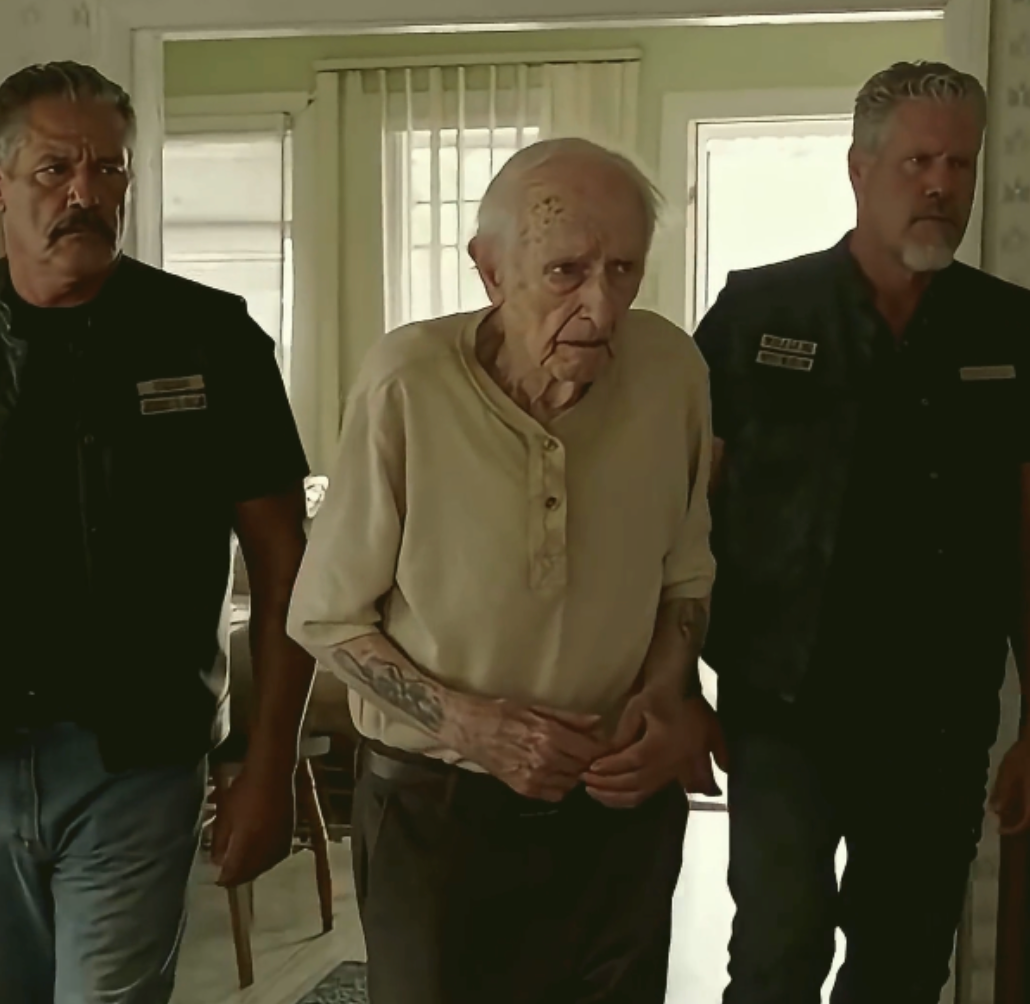
The first time the old man tried to stop a motorcycle, he was standing in the rain with a dish towel wrapped around his bleeding hand.
He was eighty-five years old, wearing slippers, an old brown coat, and trousers that were too short for him. He stood beside a narrow country road with his left hand raised, trying to wave down the three bikers passing through town. The motorcycles slowed, but before any of the riders could stop, a man came running out of the house behind him.
“Get back inside!” the man shouted.
The old man flinched so violently that he nearly fell.
One of the bikers, a gray-bearded man named Ray, noticed the movement. He noticed the old man’s face, too. It wasn’t the expression of someone embarrassed about being caught outside in bad weather. It was the expression of someone who had just realized he had made a terrible mistake.
The man running toward him was in his mid-forties, tall, broad, wearing a gray sweatshirt and jeans. He grabbed the old man’s shoulder and pulled him toward the house.
“Sorry about that, fellas,” he said, forcing a smile toward the bikers. “My father gets confused. He’s not supposed to be out here.”
The old man turned his head toward Ray.
For a fraction of a second, their eyes met.
And the old man mouthed two words.
“Help me.”
The man pulled him inside before Ray could say anything.
The door slammed.
Ray sat on his motorcycle for several seconds, staring at the house.
“Did you see that?” he asked the two men behind him.
Danny, one of the riders, nodded.
“Yeah. I saw it.”
Cole, the quietest of the three, looked toward the window. The curtain had moved, but there was no one visible now.
“That wasn’t confusion,” Cole said. “That old man was scared to death.”
They had no idea that the brief moment would become the beginning of a nine-month search, a criminal investigation, and a discovery that would eventually reopen the case of a woman who had been missing for years.
And they had no idea that the old man had been trying to ask for help for nearly nine months.
Chapter 1: The Man Who Called Himself Family
The farmhouse sat at the end of a narrow road outside a small American town. It was the kind of place where people knew which truck belonged to which neighbor, where the postman sometimes left packages on the porch, and where most residents had lived long enough to remember who built which house.
The old man was named Walter Hayes. He had spent almost his entire life in that house. His wife, Evelyn, had died six years earlier, and his only daughter had moved to another state after getting married. Walter had no close relatives nearby. His knees were bad, his hearing was fading, and he was beginning to struggle with some ordinary tasks, but he was still mentally sharp.
He knew the date.
He knew his bank balance.
He knew the names of the people who lived on his road.
And he knew the man living in his house was not his son.
The man’s name was Grant Miller. He was forty-six years old, and he had arrived at Walter’s door nine months earlier carrying a duffel bag, a worn jacket, and a story that sounded believable enough to make an old man feel sorry for him.
Grant had told Walter that he was the son of an old friend who had died. He claimed he had been struggling with work, had recently lost his apartment, and was trying to get his life back together. He said he had heard Walter was lonely and needed someone around the house.
At first, Walter thought it was a strange coincidence.
Grant knew the name of Walter’s late wife. He knew the street. He even mentioned a small hardware store that Walter had once owned with his brother decades earlier.
Walter didn’t ask too many questions. He assumed Grant had known someone from his past.
“Just a few nights,” Grant had said. “I’ll get back on my feet. I don’t want to be a burden.”
Walter had looked at the young man’s tired face and remembered what it felt like to be struggling.
“There’s a spare room upstairs,” he told him. “You can stay until you find work.”
Grant smiled.
“You’re a good man, Walter. I won’t forget this.”
For the first two weeks, Grant was polite. He cooked occasionally, carried groceries, took out the trash, and drove Walter to the pharmacy. He acted like the kind of son Walter had always wished he had nearby.
Then the little changes began.
Grant started asking Walter when his pension arrived.
He asked which bank Walter used, whether he had savings, and how much money he spent on groceries. At first, Walter didn’t think much of it. He assumed Grant was trying to understand how to help manage the household.
But one afternoon, Grant sat at the kitchen table with a notebook.
“You’re paying too much for electricity,” he said. “And you’re wasting money on this insurance.”
Walter looked over his glasses.
“I’ve had that insurance for twenty years.”
“That’s the problem. You’ve been doing things the same way for twenty years.”
Grant laughed, but Walter didn’t.
A few days later, Grant asked him to sign a paper.
“It’s just so I can help with your banking. You don’t have to drive into town every time.”
Walter refused.
“I’ve managed my own money all my life.”
Grant’s smile disappeared for a moment.
“Fine. I was only trying to help.”
Walter apologized, even though he hadn’t done anything wrong.
That was the first time he noticed how quickly Grant could turn a simple conversation into something that made him feel guilty.
By the end of the first month, Grant had stopped looking for work.
By the end of the second, he had stopped pretending he was going to leave.
And by the beginning of the third month, Walter had realized that the man had moved into his house without any intention of moving out.
Chapter 2: The Pension That Disappeared
Walter’s pension arrived on the first Wednesday of every month.
For years, it had been enough to cover his bills, groceries, medication, and the occasional visit to the diner. He didn’t live extravagantly. He had a television, an old pickup truck, a modest house, and a little money saved for emergencies.
But after Grant arrived, Walter began noticing that his money wasn’t lasting.
The first month, Grant asked for forty dollars.
“I need gas to get to a job interview,” he explained.
Walter handed him the money.
The second month, it was two hundred dollars.
“Something came up with the apartment deposit. I’ll pay you back.”
Walter gave him the money because he still believed Grant would eventually leave.
The third month, Grant began asking for the bank card.
“Let me take care of groceries,” he said. “You shouldn’t be going out in this weather.”
Walter handed it over reluctantly.
When the card came back, he noticed several withdrawals he couldn’t remember making.
“What’s this?” Walter asked, holding up the bank statement.
Grant barely glanced at it.
“Household expenses.”
“Three hundred dollars at a gas station?”
“Cash. I needed it.”
Walter stared at the paper.
“I don’t remember agreeing to that.”
Grant leaned back in his chair.
“Are you calling me a thief?”
“No. I’m just asking.”
“You’re asking because you don’t trust me.”
Walter looked down.
“I didn’t say that.”
“Then stop treating me like a stranger. I’m the only person here helping you.”
That sentence became Grant’s favorite weapon.
Whenever Walter questioned the money, Grant reminded him that he was alone. Whenever Walter complained about something, Grant told him that nobody else would put up with his behavior. Whenever Walter said he wanted to call his daughter, Grant would sigh and say that she was busy with her own family.
Soon, Walter stopped asking questions.
His pension would arrive. Grant would take the bank card. The money would disappear. Walter would be left with a few dollars in his wallet and whatever food Grant decided to buy.
Sometimes Grant brought home expensive cigarettes.
Sometimes he came back with new shoes.
Sometimes he ordered food for himself while telling Walter that groceries were too expensive.
Walter began keeping a small amount of cash inside an old tin box beneath the kitchen sink. It was the only money Grant didn’t know about.
But even that didn’t last.
One evening, Walter came into the kitchen and found Grant holding the tin.
“What’s this?” Grant asked.
Walter stopped.
“That’s mine.”
Grant shook the box.
“How much have you been hiding from me?”
“It’s emergency money.”
Grant laughed.
“Emergency money? What emergency? I’m the one keeping this place running.”
Walter reached for the tin.
Grant pulled it away.
“Don’t touch me.”
“I’m asking you to give it back.”
Grant’s expression changed.
He shoved Walter backward.
The old man’s hip struck the edge of the counter, and he fell to the floor.
For a moment, neither of them moved.
Walter lay there, breathing heavily, his hand pressed against his side.
Grant looked down at him.
“Look what you made me do.”
Then he picked up the tin, walked out of the kitchen, and left Walter on the floor.
Walter didn’t call anyone.
He sat there for almost twenty minutes before he could pull himself up using the kitchen chair.
That night, he slept in his clothes.
And for the first time since Grant arrived, Walter began thinking seriously about how to get him out of the house.
Chapter 3: Nine Months of Asking
Walter tried to get help in ways that were almost invisible.
He was afraid of Grant. He was afraid that if he made one wrong move, the man would hurt him worse. But he also knew that if he did nothing, the rest of his life would be spent inside a house that no longer felt like his.
His first attempt was at the grocery store.
He waited until Grant walked toward the freezer section and approached a young cashier who knew him from years of shopping there.
“Could you call somebody for me?” he whispered.
The cashier looked confused.
“Who, Mr. Hayes?”
“Police. Or someone. I don’t know. I just need help.”
Before she could ask anything else, Grant returned.
“What are you doing?”
Walter stepped back.
“Nothing. I was asking about the price.”
Grant looked at the cashier.
“He’s forgetful. Sorry about that.”
He took Walter’s arm and walked him out.
That night, Grant didn’t let Walter watch television. He told him he was going to bed early and locked the front door.
The next week, Walter tried to speak to his mail carrier.
He wrote a note on a piece of paper that said:
PLEASE CALL THE POLICE. I AM NOT SAFE IN MY HOME.
He folded it and placed it beneath the mailbox.
But Grant found it before the mail carrier arrived.
Walter heard the paper being torn in the kitchen.
Then Grant came into the living room.
“You think I’m stupid?”
Walter didn’t answer.
Grant held up the pieces of paper.
“Who were you trying to send this to?”
Walter’s mouth trembled.
“No one.”
Grant walked closer.
“Nine months ago, you let me in. You said I could stay. Now you’re trying to make me look like a criminal?”
“I just want you to leave.”
Grant stared at him.
Then he slapped him across the face.
Walter fell against the arm of his chair.
Grant leaned down.
“You don’t get to tell me to leave. This is my home too now.”
It was the second time Grant had hit him.
After that, Walter stopped writing notes.
But he didn’t stop trying.
He tried talking to a neighbor when Grant was outside smoking. He tried asking a woman at the pharmacy to call someone. He tried leaving a message on a voicemail when Grant’s phone was charging in the kitchen and he had briefly managed to use the house phone.
Every time, something went wrong.
Sometimes Grant caught him.
Sometimes the person he asked didn’t understand.
Sometimes Walter simply couldn’t find the courage to say the words out loud.
Nine months passed.
Nine months of sleeping with the bedroom door locked.
Nine months of pretending everything was fine when someone asked.
Nine months of watching his pension disappear.
Nine months of bruises that he explained as falls.
Nine months of being told he was old, confused, useless, and lucky to have someone living with him.
And then came the rainy afternoon when three motorcycles passed his house.
Walter had been watching from the window.
He recognized the bikers from a distance. They had ridden through the town several times over the past few months. He remembered seeing them at the gas station and at a diner near the highway.
He didn’t know their names.
He didn’t know if they were good people.
But he knew they weren’t Grant.
And for the first time in nine months, he thought he might have a chance.
He ran outside.
He waved.
He begged.
And he was pulled back into the house before the bikers could stop.
But Ray had seen his face.
And Ray wasn’t the kind of man who forgot a face like that.
Chapter 4: The Bikers Came Back
Ray didn’t ride away from the farmhouse feeling satisfied.
He rode for another twenty minutes, but the image of the old man kept coming back to him. He remembered the way Walter had raised his hand. He remembered the way he looked at them. And most of all, he remembered the way Grant had grabbed him.
At a gas station outside town, Ray pulled into a parking space and shut off his engine.
Danny parked beside him.
“You’re thinking about that old man, aren’t you?”
Ray nodded.
“That wasn’t right.”
Cole took off his helmet.
“Could be family trouble. Could be dementia. Could be the guy’s just a caretaker with a temper.”
Ray looked at him.
“Did you see the old man’s eyes?”
Cole nodded.
“Yeah.”
“That wasn’t confusion.”
Danny rubbed his beard.
“So what do you want to do?”
Ray pulled his phone out.
“We’re going back. But we’re not going in there swinging our weight around. We find out who that man is. We find out if the old man is safe. And if something’s wrong, we get the proper people involved.”
They returned to town and stopped at a diner. Ray had been through the area before and remembered a local mechanic mentioning an elderly man who lived on a road near the old feed store.
They asked the waitress if she knew Walter Hayes.
“Everybody knows Walter,” she said. “He used to own Hayes Hardware. His wife died years ago. He’s a good man.”
Ray asked if she knew the man living with him.
The waitress’s face changed.
“Grant? That man gives me the creeps.”
“Why?”
“He’s been coming here sometimes. Never pays for his own coffee. He tells people Walter’s his father, but I don’t think anyone has ever seen them together before he moved in.”
Ray leaned forward.
“Do you know how long he’s been there?”
“Maybe eight or nine months. Something like that.”
Ray exchanged a look with Danny.
The waitress continued.
“Walter used to come in every Saturday morning. He’d sit at that booth, drink coffee, read the newspaper. Since that man moved in, I haven’t seen him once.”
Ray thanked her.
Then he asked the question that would change everything.
“Has anybody tried checking on him?”
The waitress shook her head.
“People don’t like getting involved in other people’s families.”
Ray looked out the window toward the road.
“Sometimes that’s exactly how people get hurt.”
Chapter 5: The Town That Looked Away
The following morning, Ray and Cole went back to town without their motorcycles. They wore ordinary clothes and visited the hardware store that had once belonged to Walter.
The current owner, a man named Frank, recognized Walter immediately.
“Walter? Haven’t seen him in months.”
Ray asked about Grant.
Frank shook his head.
“That guy came in once asking about Walter’s property taxes. Said he was helping with his father’s paperwork. I thought it was strange because Walter never mentioned having a son.”
“Did he say his name?”
“Grant. Grant Miller, I think.”
Frank took a moment to remember.
“Actually, he asked me something weird. Wanted to know if I knew anyone who bought old farm equipment. Said Walter had some things he wanted to sell.”
“Did Walter ask to sell them?”
“No. That’s the strange part.”
Ray and Cole visited two more businesses. At the pharmacy, the clerk remembered Grant picking up Walter’s medication and asking whether some prescriptions could be transferred into his name. At the bank, they were told they couldn’t get information about Walter’s accounts, but a teller remembered an older man who had once come in looking upset because his card had been used repeatedly.
They didn’t ask for private account details. They didn’t need them.
The pattern was already becoming clear.
Grant had been isolating Walter, taking his money, and convincing the town that he was a family member and caretaker.
But the bikers didn’t yet have enough to prove a crime.
That afternoon, Ray went to the sheriff’s office.
He sat across from Deputy Miller, a tired-looking man in his early fifties, and explained what they had witnessed.
“We saw an elderly man trying to flag us down. He looked frightened. The man living with him grabbed him and dragged him back inside. The old man mouthed the words ‘help me.'”
The deputy listened.
“Did you see any injuries?”
“His hand was bleeding. And he looked like he’d been hurt before.”
“Did the resident refuse to let you speak with him?”
“He didn’t give us a chance.”
Deputy Miller wrote something down.
“What’s the address?”
Ray gave it to him.
The deputy leaned back.
“Walter Hayes. I know him. His wife passed. He’s been living alone for years.”
“Not anymore.”
Ray told him what the waitress and local businesses had said.
The deputy listened carefully.
“We’ll do a welfare check.”
Ray stood.
“Please make sure you talk to the old man alone.”
Deputy Miller looked up.
“That’s the plan.”
Ray didn’t ask how long it would take.
He simply said, “He’s been trying to get someone to help him. Don’t let him think nobody heard him.”
Chapter 6: The Welfare Check
The sheriff’s department arrived at Walter’s house the next morning.
Grant opened the door before the officers knocked a second time.
“Can I help you?”
Deputy Miller introduced himself.
“We’re here to check on Walter.”
Grant smiled.
“He’s fine. He’s sleeping.”
“We’d like to speak with him.”
“He’s not feeling well.”
The deputy’s expression remained neutral.
“Then we’ll keep it brief.”
Grant hesitated.
Behind him, Walter appeared in the hallway.
He was wearing the same brown coat from the day before. His face looked pale, and his left cheek was swollen.
Deputy Miller noticed it immediately.
“Walter, how are you doing today?”
Walter looked at Grant.
“I’m fine.”
The deputy waited.
“Walter, can I speak with you privately?”
Grant laughed.
“He’s got memory problems. He gets confused. I need to be there to help him answer.”
The deputy turned toward Grant.
“Sir, I’m asking to speak with him alone.”
For the first time, Grant’s smile disappeared.
He stepped back, but his eyes stayed on Walter.
“Walter, tell them you’re fine.”
Walter stood still.
The deputy gently guided him toward the porch.
“Let’s take a minute outside.”
When the door closed behind them, the deputy looked at Walter.
“Are you safe in this house?”
Walter stared at him.
For nine months, he had rehearsed this moment in his head. He had imagined someone asking the question. He had imagined himself answering. He had imagined the door opening and Grant being gone forever.
But when the question finally came, he couldn’t speak.
His lips moved.
Nothing came out.
Deputy Miller waited.
Then Walter began crying.
“I don’t want him here anymore.”
The deputy kept his voice gentle.
“Okay. Tell me what’s been happening.”
Walter looked back at the house.
“He takes my money. He hits me. He says I’m crazy. He tells everyone he’s my son.”
“Is he your son?”
Walter shook his head.
“No.”
“Has he hurt you?”
Walter slowly rolled up his sleeve.
A bruise ran along his forearm. Another dark mark was visible near his wrist.
Deputy Miller’s jaw tightened.
“Walter, we’re going to help you. But I need you to tell me what happened.”
Walter looked down at his hands.
“He pushed me. He hit me. He took my pension. I tried to make him leave, but he said he’d make sure nobody believed me.”
The deputy asked if Walter was willing to make a statement.
Walter nodded.
Then he whispered something that made the deputy stop writing.
“He said he’d kill me if I told anyone.”
Chapter 7: The Man Who Thought He Owned the House
Deputy Miller returned inside with another officer.
Grant was sitting in the living room, watching television.
He looked up.
“What’s going on?”
The deputy asked him to stand.
“We need to speak with you about the injuries on Walter’s arm and the allegations he has made.”
Grant laughed.
“Allegations? From that old man? He falls all the time.”
The deputy explained that Walter had reported physical abuse, financial exploitation, and threats.
Grant stood up.
“You’re going to arrest me because an old man had a bad day?”
“Nobody said that.”
Grant pointed toward the front door.
“You need to get out of my house.”
The deputy looked around the room.
“Is this your house?”
Grant hesitated.
“It’s my father’s.”
“Then why did you say it was yours?”
Grant’s face hardened.
“He’s my father.”
Deputy Miller asked him to provide identification and explain his relationship to Walter.
Grant became increasingly angry.
“Are you people serious? I have been taking care of him for months. I cook for him. I get his medicine. I keep him from wandering off. And now he says I’m abusing him?”
The deputy asked Walter whether Grant had been taking care of him.
Walter was standing near the doorway.
“He doesn’t cook for me,” Walter said quietly. “He takes my money. I make my own food when I can.”
Grant turned toward him.
“Shut up!”
The officer immediately stepped between them.
“Don’t threaten him.”
Grant began pacing.
“You don’t know what you’re doing. He has no idea what he’s saying.”
But the deputy had already seen the bruises. He had already spoken to Walter privately. He had already heard the story that Grant was a son, despite the lack of any evidence of that relationship.
The officers told Grant he was being detained while they investigated the assault allegations and financial exploitation.
Grant tried to pull away.
“You’re making a mistake!”
The officers restrained him.
Walter stood in the hallway, trembling.
As Grant was led outside, he turned his head toward the old man.
“You’ll regret this!”
Walter didn’t answer.
For the first time in nine months, the house was quiet.
And when the police vehicle pulled away, Walter sat down on the porch and began crying—not because he was afraid, but because he couldn’t believe the man was actually gone.
Chapter 8: The Bikers Return
Ray, Danny, and Cole arrived about twenty minutes after the officers had taken Grant away. They had been waiting nearby, not interfering with the welfare check, but ready to help if Walter needed someone.
When Ray saw Walter sitting on the porch, he stopped walking.
“Hey, Walter.”
The old man looked up.
For a moment, he didn’t recognize him.
Then he remembered the motorcycles.
“You came back.”
Ray nodded.
“We told you we’d check.”
Walter stood slowly.
“I thought nobody would believe me.”
Ray shook his head.
“We believe you.”
Walter started crying again.
Danny looked toward the house.
“Do you need anything? Food? Medicine? Someone to stay with you?”
Walter nodded.
“I haven’t eaten since yesterday.”
Cole immediately turned toward his motorcycle.
“Let’s get some groceries.”
Ray sat beside Walter.
“You’re going to have to tell the officers everything. The money, the bruises, the threats. Don’t leave anything out.”
Walter looked down.
“I was ashamed.”
“Of what?”
“Of letting a man do that to me. I thought I should have been able to stop him.”
Ray shook his head.
“That’s not your fault.”
Walter looked at the three bikers standing in front of his house.
For nine months, he had believed he was completely alone.
He had watched people drive past. He had seen neighbors wave. He had heard church bells on Sunday mornings. He had sat at his kitchen table while Grant took his pension.
And now three strangers had come back because they remembered his face.
“I tried so many times,” Walter whispered. “I tried to ask for help. I thought I was going to die in that house.”
Ray put a hand on his shoulder.
“Not today, old man.”
But what none of them knew was that Grant’s arrest had just opened a door to something far darker.
Chapter 9: The Name That Made the Detective Stop
Grant Miller was taken to the county jail and booked on charges connected to the assault and threats against Walter. Investigators began looking into the pension withdrawals and the circumstances surrounding his move into the farmhouse.
At first, the case looked like an ordinary elder-abuse investigation. The detectives expected to find a man who had taken advantage of a vulnerable homeowner, perhaps someone with previous theft charges or a history of domestic violence.
But when Detective Laura Bennett began checking Grant’s identity, she discovered that his story didn’t match the records.
His address history was scattered. He had used several different mailing addresses over the past few years. He had no stable employment record, and some of the names associated with his previous residences were unfamiliar to the local authorities.
She found an old complaint from another county.
It had been filed by a woman named Margaret Collins, who was eighty-one years old. The complaint described a man who had moved into her house claiming to be the son of a friend. He had helped her with groceries at first, then began controlling her money and telling neighbors he was her family.
The complaint had been closed without charges.
Margaret had withdrawn her statement.
Three months after the complaint was filed, Margaret Collins was found dead inside her home.
The death had been ruled accidental at the time. There were no signs of forced entry, and the man who had been living with her had disappeared before investigators could locate him.
Detective Bennett looked at the old photograph attached to the report.
The man in the photograph was younger, clean-shaven, and wearing a baseball cap.
But the eyes were unmistakable.
Grant Miller.
Bennett stared at the photograph, then at the name on the current booking sheet.
She called the detective who had handled the original case.
“Tell me about Margaret Collins.”
There was a long pause on the other end.
“Why are you asking?”
“We have a man in custody who may have been living with her before she died.”
Another pause.
Then the detective said, “You need to come see the file.”
Chapter 10: The Woman Who Died Three Months After He Moved In
Margaret Collins had lived in a small house on the edge of a neighboring town. She was eighty-one, a widow, and had no children living nearby. She volunteered at a church thrift store and was known for making pies for people who couldn’t afford groceries.
Grant had appeared at her house one winter evening, claiming he was the son of a woman Margaret had once known.
He told Margaret that his mother had died and that he had nowhere to go. He said he was trying to find work but had been sleeping in his car.
Margaret let him stay.
The first few weeks were uneventful. Grant repaired a broken fence, carried wood, and helped Margaret shovel snow from her driveway.
Then he began telling people she was his mother.
When a neighbor questioned the relationship, Grant said Margaret had been suffering from memory problems and sometimes forgot her own family.
Margaret reportedly laughed about it at first.
But later, she told someone at the church that Grant had begun acting strangely. He would ask about her savings. He wanted to know whether she had a will. He asked if her house was paid off.
One afternoon, Margaret went to the bank and discovered that several withdrawals had been made from her account.
She confronted Grant.
He told her she had given him permission.
She said she hadn’t.
That evening, a neighbor heard shouting from Margaret’s house.
The following morning, Margaret was found dead.
Grant was gone.
At the time, investigators couldn’t prove he had been involved. Margaret’s death was considered suspicious by some people, but the evidence wasn’t enough to establish a crime. The complaint she had filed weeks earlier was never connected to her death.
The detective who had handled the case remembered Grant.
“He was very calm,” he told Bennett. “Almost too calm. He told us he was her son. We couldn’t prove otherwise, and she had withdrawn her complaint.”
Bennett asked what happened to the money.
“We never got far enough to establish theft. The bank had flagged some transactions, but the paperwork was incomplete.”
Bennett closed the file.
Then she opened Walter Hayes’s case.
Nine months.
A pension.
A frightened old man.
A man who claimed to be family.
And a name that had already appeared in a death investigation.
She called the county prosecutor.
“This is no longer just an elder-abuse case.”
Chapter 11: The Questions Grant Wouldn’t Answer
Grant sat in an interview room with his hands cuffed to the table. He had been told he could speak with an attorney, and he had refused to answer questions about Walter until one arrived.
But when Detective Bennett placed a photograph of Margaret Collins in front of him, his expression changed.
“Do you know this woman?” she asked.
Grant looked at the picture.
“No.”
Bennett slid another photograph across the table. It showed Margaret standing in front of her house, smiling beside a church volunteer.
“You lived with her three months before she died.”
Grant leaned back.
“That was years ago.”
“Why did you tell people you were her son?”
“I was helping her.”
“She filed a complaint against you.”
Grant shrugged.
“She was confused.”
Bennett watched him.
“That’s interesting. You used the same explanation about Walter Hayes.”
Grant said nothing.
The detective placed a copy of the old complaint on the table.
“Margaret said you took money from her account. She said you threatened her when she confronted you.”
Grant looked at the paper, then pushed it away.
“She was old.”
Bennett leaned forward.
“She was eighty-one. She was found dead three months after you moved into her house. You disappeared. Now you’ve been living with another elderly man, taking his pension, and assaulting him.”
Grant smiled faintly.
“You have nothing.”
The detective didn’t respond.
She had learned something from the way he said it.
He wasn’t worried about the woman who died.
He wasn’t surprised by the photograph.
He was simply waiting to see how much they knew.
The interview ended when Grant’s attorney arrived.
But before he was taken back to his cell, Detective Bennett said one more thing.
“We’re reopening Margaret Collins’s case.”
Grant stopped walking.
Just for a second.
But the detective saw it.
And she knew she had touched something.
Chapter 12: Walter Remembers
Walter was taken to the hospital for a medical examination. The doctors documented his injuries, including bruising and a painful injury to his hip that had never properly healed. He was given medication, food, and a place to rest while social workers began arranging support.
Ray visited the following afternoon.
He brought a bag of groceries and a small radio.
Walter was sitting near the hospital window.
“You didn’t have to bring all that,” Walter said.
Ray put the bag on the table.
“Didn’t know what you needed. Figured food was a good place to start.”
Walter smiled for the first time.
They talked about motorcycles. About the old hardware store. About Walter’s wife Evelyn and how she used to make coffee so strong that Walter joked it could remove rust from a wrench.
For a while, it felt like an ordinary conversation between two people who had known each other for years.
Then Walter asked a question.
“Did they tell you about the woman?”
Ray looked at him.
“What woman?”
“The one who died.”
Ray slowly sat down.
Walter explained that Grant had once mentioned an old woman he had lived with. He had said she was difficult, that she had accused him of stealing, and that she had died after a fall.
Grant had used the story as a warning.
“One night, he was angry because I wouldn’t give him money,” Walter said. “He told me, ‘You don’t want to end up like Margaret.'”
Ray’s expression changed.
“Did he say her last name?”
Walter thought for a moment.
“Collins. I think. Margaret Collins.”
Ray didn’t speak.
Walter continued.
“He said nobody believed her when she accused him. He said she died alone, and nobody even knew what happened.”
Ray stood up and walked toward the window.
He looked out at the parking lot.
Then he pulled out his phone and called Detective Bennett.
“Walter just gave us the name of the woman in your reopened case.”
Bennett listened.
Ray added, “Grant used her death to threaten him.”
The detective was silent for a moment.
Then she said, “We’re coming back to speak with Walter.”
Chapter 13: The Evidence in the Old House
Investigators returned to Walter’s farmhouse with a search warrant.
They searched the bedroom Grant had been using, the living room, the kitchen, and the garage. They found receipts, bank records, several prepaid phones, and documents bearing Walter’s signature.
Some of the signatures appeared inconsistent.
There were also handwritten notes showing the dates of pension deposits and withdrawals.
In a drawer beneath Grant’s bed, detectives found an old photograph of Margaret Collins and a small envelope containing a key.
The key was traced to a storage unit in a neighboring county.
The unit had been rented under a false name.
Inside, investigators found boxes of documents, clothing, jewelry, and photographs belonging to several elderly people.
Some of the items were clearly personal belongings.
One box contained letters from Margaret Collins.
Another contained bank statements.
A third contained a small notebook.
The notebook was the most disturbing discovery.
Grant had written down the names of elderly people he had met, notes about their living situations, whether they lived alone, whether they had family nearby, and whether they appeared to have savings or property.
It wasn’t a diary.
It looked like a list of potential victims.
Investigators began contacting the people whose names appeared in the notebook.
Several said Grant had approached them over the years.
One man remembered Grant offering to help him with yard work.
A woman remembered him asking whether her husband had left her any money.
Another person said Grant had offered to move in and help with daily care after a medical procedure.
The detectives began to suspect that Margaret Collins had not been his only victim.
And Walter Hayes might not have been the last.
Chapter 14: The Truth About Margaret
The reopened investigation into Margaret Collins’s death took several weeks.
Detectives reviewed the original evidence, interviewed witnesses again, and obtained records that had not been available during the first investigation. They found that Grant had been using Margaret’s bank card during the weeks before her death.
They also found that he had purchased items that Margaret had never used.
A witness who had previously been afraid to speak came forward.
She was a neighbor who had seen Grant leaving Margaret’s house late at night. She remembered a vehicle parked behind the garage and a conversation she had overheard in which Grant said he needed to “get out before things got complicated.”
The investigators also found an old message Margaret had left for her church friend.
“I don’t think the man staying with me is who he says he is. He keeps asking about my money. I’m afraid if I ask him to leave, he’ll get angry.”
The message had been saved on the friend’s answering machine.
For years, it had been forgotten.
Now it became part of the reopened case.
Investigators found that Margaret had died after suffering injuries that were inconsistent with the original explanation of a simple accidental fall. The forensic review raised questions about the timing and the circumstances.
The case was no longer being treated as an accidental death.
Grant was now a suspect in Margaret Collins’s murder.
But the detectives still needed stronger evidence.
And Grant knew it.
When Bennett returned to the jail to speak with him, she placed a photograph of Margaret’s house on the table.
“You lived there for three months,” she said.
Grant looked at the photograph.
“You have the bank records. You have the witness. You have the complaint she filed.”
He didn’t answer.
Bennett continued.
“She was afraid of you. Walter Hayes was afraid of you. How many people have you convinced to let you into their homes?”
Grant’s jaw tightened.
“You’re trying to make me into something I’m not.”
The detective slid the notebook across the table.
“Then explain this.”
Grant looked down.
For the first time, he seemed unable to find an answer.
Chapter 15: The Man Who Finally Spoke
Grant spent the next several days refusing to answer questions. His attorney told him not to speak to investigators, and he followed that advice until Detective Bennett brought Walter’s statement into the room.
She didn’t show him the photographs of the injuries.
She didn’t show him the bank records.
She simply read Walter’s words.
“He told me I was too old to do anything about it. He said nobody would believe an old man over someone younger. He said if I tried to get him arrested, I’d end up dead in my own house.”
Grant stared at the wall.
Bennett continued reading.
“He took my money. He hurt me. I was afraid to sleep. I was afraid to eat when he was angry. I was afraid to speak when somebody came to the door.”
Grant closed his eyes.
The detective stopped reading.
“Why did you do it?”
He didn’t answer.
“Why Margaret Collins?”
Grant suddenly laughed.
It was a short, ugly laugh.
“You think you’re going to solve everything because an old man told you a story?”
Bennett leaned forward.
“Margaret Collins is dead.”
Grant looked at her.
“She was supposed to give me money.”
The detective didn’t move.
Grant continued, almost as if he were talking to himself.
“She kept saying she was going to call somebody. She kept threatening to throw me out. I had nowhere to go.”
Bennett asked, “What happened that night?”
Grant looked down at the table.
“She wouldn’t stop.”
The detective waited.
Grant began explaining what had happened inside Margaret’s house. He admitted that he had been living there under a false identity. He admitted that he had taken her money. He admitted that when she threatened to expose him and force him to leave, he attacked her.
He described the argument.
He described the moment he lost control.
He described leaving the house afterward.
Then he said something that made Bennett’s stomach turn.
“I knew nobody would look for me. She was old. She lived alone. People forget old people.”
The detective stared at him.
“Did you kill Margaret Collins?”
Grant didn’t answer immediately.
Then he nodded.
The confession was recorded. Investigators continued verifying every detail against the evidence, but they finally had what they had been searching for.
The man who had spent three months pretending to be Margaret’s son had admitted that he had killed her.
And the same man had spent another nine months living with Walter Hayes, pretending to be family again.
Chapter 16: Walter Hears the Truth
Detective Bennett visited Walter at his farmhouse after the investigation had progressed.
Walter was sitting in the living room with the curtains open. The television was off. A cup of coffee sat on the table beside him.
He looked healthier than he had when the officers first arrived, but he was still recovering.
The detective sat across from him.
“Walter, I need to tell you something about Grant.”
Walter looked at her.
“Did he do something before?”
Bennett nodded.
“We found evidence connecting him to another elderly woman named Margaret Collins. He lived with her before he came here.”
Walter’s face became pale.
“Was she the woman he told me about?”
“Yes.”
Walter swallowed.
“What happened to her?”
The detective paused, choosing her words carefully.
“Margaret was killed. Grant has admitted that he attacked her. We’re investigating the case further, and he will face charges.”
Walter stared at his coffee.
For a long time, he didn’t speak.
Then he whispered, “He told me she fell.”
Bennett nodded.
“He told me she was difficult. That nobody believed her. That she had nobody.”
Walter’s hands began trembling.
“He told me that because he wanted me to know what would happen if I tried to get him out.”
The detective gently placed her hand on the table.
“Walter, he is not coming back to your house.”
Walter looked up.
“Are you sure?”
“Yes. He is in custody. You’re safe.”
Walter started crying.
Not loudly.
He simply lowered his head and covered his face with both hands.
For nine months, he had carried the fear that he might become another Margaret Collins.
Now, for the first time, someone had told him that the man was gone.
And this time, he believed them.
Chapter 17: The Day the Bikers Came to His House
A week later, Walter was back home.
The farmhouse looked different, even though nothing had changed. The same wooden porch. The same cracked driveway. The same kitchen window. The same old chair beside the television.
But Grant was gone.
The locks had been changed. A social worker had helped arrange a safer financial plan. Walter’s bank had been notified, and the pension withdrawals were under investigation. His daughter had been contacted, and she was coming to visit.
On Saturday morning, Walter heard motorcycles approaching.
He looked through the window.
Three bikes turned into the driveway.
Ray was in front.
Danny and Cole followed.
Walter opened the door before they reached the porch.
“Well, look who’s here.”
Ray smiled.
“How you doing, old man?”
Walter looked at the motorcycles.
“I never thought I’d be happy to hear those things coming down my road.”
Danny laughed.
“We brought breakfast.”
Cole held up a paper bag.
“Coffee, eggs, biscuits. Ray said you weren’t allowed to eat another sad bowl of oatmeal this morning.”
Walter laughed.
It was the first time Ray had heard him laugh like that.
They sat at the kitchen table. Danny made coffee. Cole fixed a loose cabinet hinge. Ray listened while Walter talked about the old hardware store and the things he wanted to repair around the house.
At one point, Walter became quiet.
“I never asked your names the first day.”
Ray introduced them again.
“Walter, I’m Ray. This is Danny. That’s Cole.”
Walter nodded.
“I know. I remember.”
He looked at Ray.
“I just didn’t know whether you’d come back.”
Ray took a sip of coffee.
“We told you we’d check.”
Walter looked down at his hands.
“You know, I had people drive past this house every day. Neighbors. Delivery trucks. People who knew me. I tried asking for help, but I couldn’t get anyone to understand.”
Danny leaned back.
“Sometimes people don’t see what’s happening until someone says it out loud.”
Walter nodded.
“Sometimes people don’t want to see it.”
Nobody argued with him.
Chapter 18: The Courtroom
Grant Miller’s case eventually went before the court.
The prosecution presented the bank records, the handwritten notebook, the witness statements, the medical evidence from Walter, and the confession connected to Margaret Collins’s death.
Walter was called to testify.
He wore a clean shirt, a dark jacket, and the old brown shoes he had worn for years. His daughter sat behind him in the courtroom. Ray, Danny, and Cole sat quietly in the back.
Walter was nervous.
When the prosecutor asked him how Grant had entered his home, Walter explained that he had believed the man needed help.
“When he first came to my door, I thought he was a good young man who had fallen on hard times. I didn’t want him sleeping in a car. I didn’t think I was doing anything dangerous.”
The prosecutor asked what happened afterward.
Walter described the pension withdrawals, the threats, the physical abuse, and the attempts to ask for help.
He told the court about the grocery store.
The note beneath the mailbox.
The bruises.
The night he had fallen in the kitchen.
The day he tried to flag down the motorcycles.
When the prosecutor asked what he had felt during those nine months, Walter looked at the jury.
“I felt like I was disappearing.”
The courtroom became quiet.
Walter continued.
“I used to think my house was the safest place in the world. My wife and I lived there for fifty years. We raised our daughter there. We buried our memories in every room. Then one day, I was afraid to walk into my own kitchen.”
He paused.
“I didn’t want money. I didn’t want revenge. I just wanted him to leave.”
Grant sat at the defense table, staring down.
Walter looked at him for a moment.
“I wanted to live in my own house without being afraid.”
He stepped down from the witness stand.
And when he returned to his seat, his daughter took his hand.
Chapter 19: The Verdict
The jury found Grant guilty of the charges related to Walter’s assault and financial exploitation. The evidence in Margaret Collins’s case also led to a conviction for her murder.
The judge sentenced Grant to a lengthy prison term, ensuring he would spend the rest of his life behind bars.
When the verdict was read, Grant didn’t react.
He didn’t look at Walter.
He didn’t look at the families.
He simply stood as the officers took him away.
Walter remained seated.
His daughter asked if he wanted to leave.
He nodded.
Outside the courthouse, reporters were waiting, but Walter didn’t stop. He walked slowly, holding his daughter’s arm. Ray and the other bikers were standing near the parking lot.
Ray stepped forward.
“How you feeling?”
Walter looked at the courthouse.
“Like I can breathe again.”
Ray nodded.
“That’s good.”
Walter looked at the three bikers.
“I never thought three men on motorcycles would be the people who saved me.”
Danny shook his head.
“We didn’t save you, Walter. You kept trying. You never stopped asking for help.”
Walter looked at him.
“I almost did.”
Cole spoke quietly.
“But you didn’t.”
Walter nodded.
He looked toward the road.
For nine months, he had believed nobody would come.
But someone had seen him.
Someone had remembered.
And someone had returned.
Chapter 20: Nine Months Later
Nine months after Grant’s arrest, Walter’s house was still standing at the end of the same narrow road.
The porch had been repaired. The old railing had been painted. A new light had been installed beside the front door. Walter’s daughter had helped him organize his finances, and he had begun attending a weekly community lunch in town.
He still lived alone, but he no longer felt abandoned.
On a Saturday afternoon, three motorcycles turned onto his road.
Walter was sitting on the porch with a cup of coffee.
He heard the engines and smiled before he even looked up.
Ray pulled into the driveway.
Danny parked beside him.
Cole stopped near the mailbox.
Walter stood slowly, holding the porch railing.
“You’re late!”
Danny laughed.
“Traffic.”
Walter shook his head.
“On this road? There’s nothing but cows and two tractors.”
They laughed together.
Ray walked toward the porch carrying a small wooden box.
“We brought you something.”
Walter looked at it.
“What is it?”
Ray handed it over.
Inside was an old-fashioned brass bell.
Walter frowned.
“What am I supposed to do with this?”
Ray pointed toward the front door.
“Put it by your chair. If you ever need anything, ring it. We’re not always going to be riding past here, but we know where you live now.”
Walter looked at the bell.
Then he looked at Ray.
His eyes filled with tears.
“You boys don’t know what that means to me.”
Ray shrugged.
“Probably not.”
Walter placed the bell on the table beside his chair.
He sat down.
The three bikers stayed for lunch. They talked about motorcycles, weather, old music, and the town. Danny complained about his knees. Cole told a story about getting lost on a back road. Ray mostly listened.
When they finally stood to leave, Walter walked them to the driveway.
He watched them put on their helmets.
Then he raised his hand.
Not because he was scared.
Not because he was desperate.
Just because he was saying goodbye to friends.
The motorcycles started.
Walter stood beside the mailbox until they disappeared around the bend.
Then he turned toward his house.
For the first time in nine months, he walked through the front door without looking over his shoulder.
And on the table beside his chair sat a small brass bell.
He didn’t need it that afternoon.
But he knew it was there.
And that was enough.
Final closing narration
Sometimes the people who need help the most aren’t screaming. They are standing quietly beside a road, hoping someone will notice that something is wrong. Walter had spent nine months trying to tell people he wasn’t safe, and for nine months, he had been afraid that nobody would believe him.
Three bikers didn’t know him. They didn’t owe him anything. They could have kept riding that rainy afternoon.
But they remembered his face.
They came back.
And that changed everything.
The most frightening thing about Grant Miller wasn’t that he was a stranger who walked into an old man’s house. It was how easily he convinced everyone around him that he belonged there.
And the most powerful thing Walter did wasn’t fighting him.
It was refusing to give up asking for help.
Because sometimes, one person noticing the truth is all it takes to stop a nightmare—and give someone their life back.