# THEY SOLD THE SACK-COVERED BRIDE AS A MONSTER—BUT WHEN THE MOUNTAIN MAN REMOVED THE CLOTH, HE STUMBLED BACKWARD IN SHOCK
## Chapter One: The Woman on the Wagon
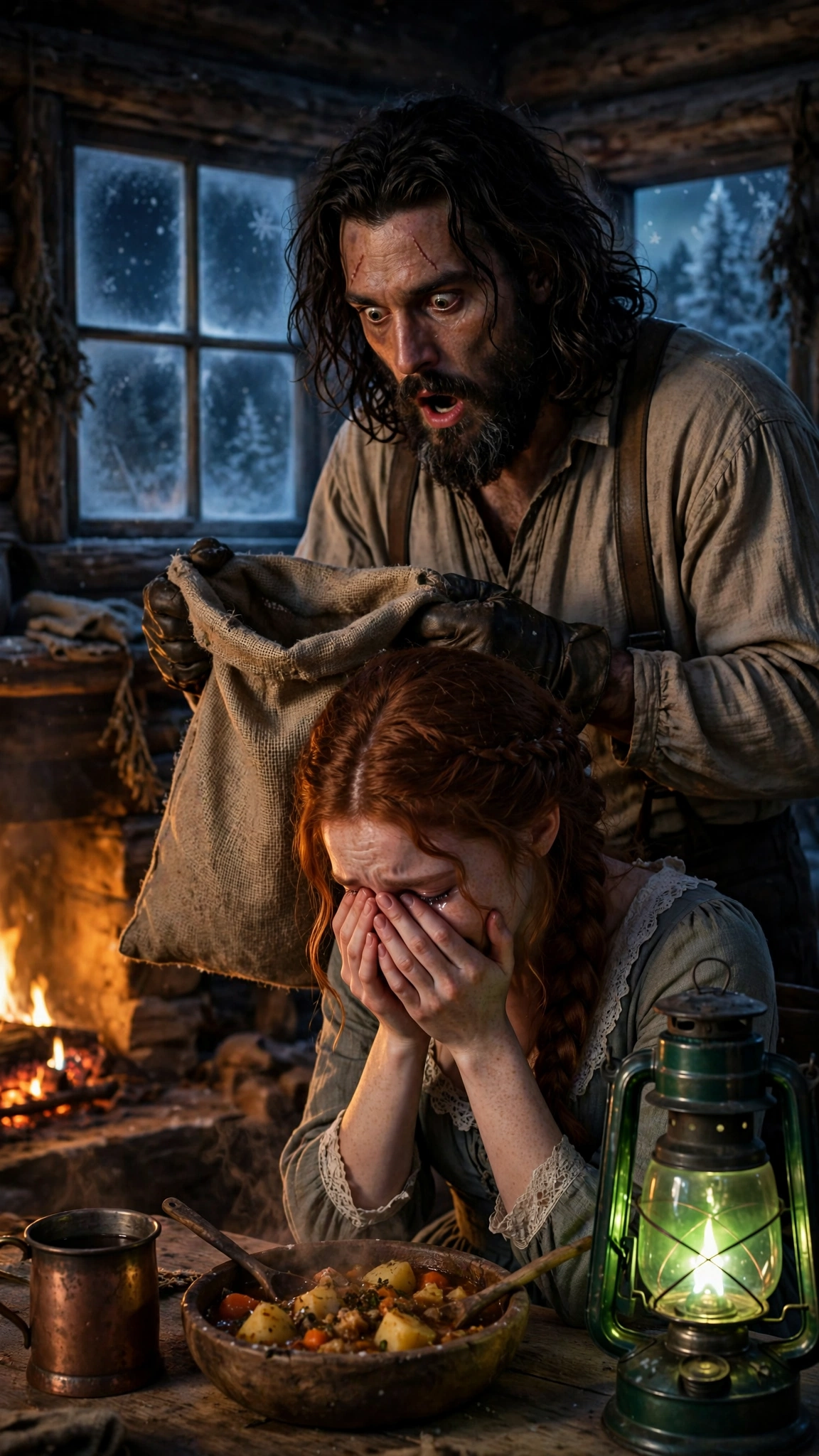
Cyrus Creed had survived a cougar attack, brutal winters, and years of living alone in the mountains. He had faced hungry wolves, falling trees, and men who believed a gun made them powerful. But nothing had prepared him for the moment he lifted a burlap sack from a young woman’s head.
His eyes widened.
He stumbled backward and caught the edge of the table. The woman immediately covered her face with both hands and began to sob.
“I know I’m hideous,” she whispered. “I’m sorry.”
But Cyrus wasn’t looking at a monster. He was looking at a frightened young woman whose dignity had been stolen by cruel men, and he suddenly understood that the story told in Orofino was a terrible lie.
Five hours earlier, on a bitter November afternoon in 1884, Cyrus had wanted nothing more than to finish his business in Orofino, Idaho Territory, and return to his mountain cabin. Winter was approaching, and the first heavy snowfall had already covered the higher trails.
He stood six feet three inches tall, wore a heavy buffalo-hide coat, and carried a pale cougar scar down his jaw. His dark hair reached the collar of his coat, and his beard was thick from weeks without a proper trim.
Most townspeople stepped aside when he approached. Some nodded politely, while others stared at the scar and whispered about the mountain man who lived beyond the timberline.
Cyrus preferred it that way. He had never been particularly fond of crowds, and he had learned that a quiet life was easier when people kept their distance.
He had come into town for salt, gunpowder, coffee, flour, and a few supplies before winter closed the mountain trails. He had also planned to collect a small payment from a merchant who had purchased several hides from him.
He was fastening a sack of supplies to his horse when laughter erupted near the freight wagons.
“Gentlemen! Here’s a bargain!”
Cyrus turned.
Thaddeus Cooper stood on the back of a wagon, waving a marriage paper above his head. He was a narrow-faced man in his forties, with a pointed beard, restless eyes, and a smile that seemed to disappear whenever anyone looked at him too closely.
Beside the wagon stood a young woman in a mud-stained gray dress. A coarse feed sack covered her head, with two crooked holes cut into it for her eyes.
Through those holes, Cyrus could see that she was trembling.
“This woman came all the way from St. Louis to marry Jeremiah Higgins,” Cooper announced. “But Higgins took one look at her face and refused her. Said she was too disfigured to marry.”
The crowd roared with laughter.
Someone threw a lump of frozen mud. It struck the woman’s shoulder, and she flinched but said nothing.
“Twenty dollars!” Cooper shouted. “She can scrub floors or feed hogs. Just keep the sack on!”
No one offered a penny.
“Ten dollars!”
A man near the wagon laughed and shook his head. Another called out that he wouldn’t take her even if Cooper paid him.
Cooper’s smile vanished.
“Then somebody take her, or I’ll leave her right here to freeze!”
A small, muffled cry escaped beneath the burlap.
Cyrus stopped walking.
He had spent years being judged by the scar on his own face. He knew what it was to have strangers decide what kind of man stood before them without asking a single question.
But this was something worse.
A frightened woman was being treated like an animal, and the entire crowd was enjoying it.
Cyrus pushed through the men.
He reached inside his coat, pulled out a leather pouch, and threw it at Cooper. It struck the man’s chest and dropped into his hands.
“There’s fifty dollars in there,” Cyrus said. “Write the bill.”
The laughter stopped.
Cooper stared at the money. “Fifty dollars? For her?”
“Write it.”
For a moment, Cooper looked as though he might refuse. Then greed overcame whatever suspicion he had.
He hurriedly scribbled a receipt and handed it down.
“She’s yours, Creed. But don’t take that hood off without some whiskey nearby.”
Cyrus ignored him.
He turned toward the woman and extended his gloved hand.
She stared at it through the two ragged eyeholes.
“Come on,” he said quietly. “Let’s get you out of the wind.”
For several seconds, she didn’t move. Then her trembling fingers settled into his palm.
Cyrus helped her down from the wagon. He noticed that she was thinner than he had first thought, and that her hands were red from the cold.
He removed his spare wool blanket from the saddle and placed it around her shoulders.
“Can you ride?”
She nodded.
“Good. We’ll take the trail slowly.”
As he helped her onto the horse, Cyrus glanced back at Cooper.
“Keep your receipt,” he said. “It may be the only honest piece of paper you’ve written today.”
Cooper’s smile tightened.
“Watch your tongue, Creed. You don’t know what you’re taking home.”
Cyrus mounted behind the woman.
“Neither do you.”
He turned his horse toward the mountain road and left the laughter behind.
## Chapter Two: The Journey Into the Mountains
The journey took five hours.
Snow thickened around the trees, and the narrow trail became increasingly difficult to follow. Their horse picked its way over icy ground while Cyrus watched every dangerous patch and every bend in the path.
The woman sat stiffly in front of him. The sack remained tied around her head, and she kept both hands folded beneath the blanket.
Cyrus had offered to remove it more than once.
Each time, she shook her head.
He never forced her.
After the first hour, he noticed that she was shivering despite the blanket.
“Are you cold?”
“A little.”
“There’s another blanket in the saddlebag. I’ll get it when we stop.”
“Thank you.”
Her voice was quiet and educated. She pronounced every word carefully, as though she had been taught that even a small mistake could invite criticism.
Cyrus wondered what kind of life had brought her to that wagon. He wondered why a woman from St. Louis had traveled so far to marry a man who apparently had never cared enough to meet her properly.
But he kept those questions to himself.
At a narrow stream, he stopped the horse and helped her down.
“Stretch your legs,” he said. “We’ll rest for a few minutes.”
She stood beside the trail, holding the blanket tightly around herself. The sack moved slightly as she turned her head toward the sound of running water.
“Is it always this quiet here?”
“Most days.”
“Do you live alone?”
“I do.”
“Have you always?”
Cyrus looked toward the dark trees.
“No.”
She waited, but he offered nothing more.
He removed the second blanket and wrapped it around her shoulders. Then he poured a little water into a tin cup and handed it to her.
“What’s your name?” he asked.
“Josephine.”
“Josephine what?”
“Josephine Bell.”
“I’m Cyrus Creed.”
“I know.”
He raised an eyebrow.
“You know?”
“Mr. Cooper said your name when you came forward. He said you were the mountain man who lived beyond the northern ridge.”
“Cooper knows too much about people he doesn’t know.”
Josephine lowered her head.
“I’m sorry.”
“Why are you apologizing?”
“For bringing trouble to you.”
Cyrus looked at her for a moment.
“You haven’t brought me any trouble, Miss Bell. I walked into that crowd because I didn’t like what I saw.”
She said nothing.
He noticed that her fingers were moving nervously against the edge of the blanket.
“Did you know Cooper before today?”
“Yes.”
“Was he the man who brought you from St. Louis?”
“He arranged the journey.”
“Did you want to come?”
“Yes,” she answered quickly. Then, after a pause, she added, “At first.”
Cyrus studied her.
“That’s a strange answer.”
“I know.”
He decided not to push.
They continued along the trail.
As the light faded, Josephine began asking questions about the mountains. She wanted to know whether wolves came close to the cabin, whether the snow lasted until spring, and whether Cyrus ever became frightened living so far from other people.
“Sometimes,” he admitted.
“Really?”
“Anyone who says he never gets frightened is either lying or foolish.”
She seemed surprised by that answer.
“What frightens you?”
Cyrus considered the question.
“Being unable to help someone who needs it.”
Josephine looked down at her hands.
“Then perhaps we are both frightened of the same thing.”
He did not ask what she meant.
By the time they reached his cabin, darkness had settled over the mountains. A warm glow shone through the small windows, and a thin line of smoke rose from the chimney.
Cyrus dismounted and helped Josephine down.
“Welcome to my home,” he said.
She stood still, listening to the wind moving through the trees.
“It’s very far from town.”
“That’s why I chose it.”
He opened the door and led her inside.
The cabin was simple but comfortable. A stone fireplace stood along the left wall, with a heavy wooden table in the center. Shelves held jars of preserved vegetables, flour, coffee, and dried herbs. A small bedroom stood behind a half-height partition.
Josephine could hear the fire crackling.
Cyrus placed another log into the flames.
“You can sit near the hearth. I’ll get supper.”
She remained standing.
“Miss Bell?”
“I’m sorry. I don’t know where I’m supposed to go.”
“Wherever you’re comfortable.”
She slowly moved toward the bench.
Cyrus took a pot from the stove and began heating venison stew. He placed warm coffee and bread on the table, then sat opposite her.
Josephine kept the sack over her head.
“I didn’t buy you to own you,” he said.
Her hands tightened around the cup.
“What do you want from me?”
“To see you warm enough to eat supper.”
“Everyone wants something.”
Cyrus studied her for a moment.
“You can leave when you choose. When the weather clears, I’ll help you get wherever you want to go.”
Josephine stared at him through the holes in the sack.
She had spent the entire journey wondering what fifty dollars had purchased.
Labor?
Obedience?
Another marriage she didn’t want?
But Cyrus had asked for none of those things.
Instead, he broke his bread in half and placed some beside her bowl.
Then he glanced at the sack.
“You’re going to have trouble eating supper through that.”
Josephine lowered her head.
“He told everyone what I looked like.”
“Higgins?”
She nodded.
Cyrus leaned back.
“I’ve seen worse than most men. Whatever’s beneath that cloth, you don’t have to hide from me.”
Her breathing became uneven.
“You don’t understand.”
“Then explain it to me.”
“He said I should never let anyone see my face.”
“Why?”
“Because people would be frightened.”
Cyrus’s expression hardened.
“Did he say that before or after he decided he didn’t want to marry you?”
Josephine did not answer.
Slowly, she raised her hands behind her head and tried to untie the knot. Her fingers shook so badly that she couldn’t loosen it.
Cyrus stood.
“May I?”
She hesitated.
Then she nodded.
He moved carefully behind her and loosened the twine without pulling her hair.
Josephine squeezed her eyes shut.
The knot finally came free.
Cyrus lifted the burlap from her head.
It slipped from his hands and fell beside the bench.
Firelight illuminated Josephine’s face.
And the enormous mountain man froze.
For one terrible second, he couldn’t speak.
Then he stepped backward so abruptly that his hand struck the table.
Josephine heard the movement.
When she opened her eyes and saw his expression, her worst fear seemed to come true.
She covered her face with both hands.
“I know,” she sobbed. “I know I’m hideous. I’m sorry.”
Cyrus stared at her.
She was not disfigured.
She had a delicate face, clear blue eyes, and auburn hair that had escaped from a loose braid during the journey. A small, pale scar crossed the edge of her left eyebrow, barely visible beneath her hair.
There was nothing monstrous about her.
But Cyrus wasn’t simply surprised by her appearance.
He had seen that scar before.
Not on Josephine.
On a photograph.
A photograph he had found years earlier in a small wooden box belonging to a man named Elias Bell.
Cyrus looked at her again.
“Josephine,” he said slowly. “Did your father ever live in Idaho?”
She lowered her hands slightly.
“My father was Elias Bell.”
Cyrus felt the room grow suddenly smaller.
“Elias Bell?”
“Yes.”
“Was he a surveyor?”
Josephine nodded.
“He worked with land records and timber claims. He died when I was sixteen.”
Cyrus stared at the young woman.
He had known Elias Bell.
Not well, but well enough to remember him.
And he knew that Elias had spent his final months searching for someone who had stolen a document from him.
Cyrus pulled out a chair.
“Miss Bell, I think we need to talk.”
## Chapter Three: The Name on the Photograph
Josephine sat quietly while Cyrus placed another piece of wood into the fireplace.
He seemed to have forgotten about supper.
“Why did you know my father?” she asked.
“Several years ago, I worked with a survey crew near the Clearwater River. Your father was one of the men who mapped the northern timber country.”
Josephine leaned forward.
“He never told me much about Idaho.”
“He was a careful man. Quiet. He didn’t trust easily.”
“That sounds like him.”
Cyrus walked to a small cabinet near the bedroom partition. He opened a drawer and searched through several folded papers.
At last, he removed a wooden box.
Josephine watched him return to the table.
“This belonged to a man named Elias Bell,” he said. “He left it with me before he went east.”
Josephine’s fingers trembled.
“Why would my father leave something with you?”
“He said he might not return. He wanted someone trustworthy to keep it safe.”
Cyrus opened the box.
Inside were a few letters, a small brass compass, and a photograph of a younger man standing beside a river. The man had dark hair and a narrow mustache.
Josephine gasped.
“That’s my father.”
Cyrus turned the photograph toward her.
“I thought it might be.”
She touched the picture carefully.
“Where did you find this?”
“He gave it to me himself.”
“When?”
“Seven years ago.”
Josephine stared at him.
“Then he was still alive.”
“Yes.”
She looked down at the photograph.
“My father died three years ago.”
Cyrus said nothing.
“He became ill in St. Louis,” she continued. “He had worked too hard, and his health never recovered after a fever. Before he died, he told me that he had unfinished business in Idaho.”
Cyrus sat down.
“Did he mention a man named Jeremiah Higgins?”
Josephine’s face changed.
“Yes.”
“Tell me.”
She folded her hands in her lap.
“Mr. Higgins came to our home in St. Louis last year. He said he had known my father in Idaho. He told me that Father had left behind a valuable property claim, and that I might have inherited something.”
“Did he show you any papers?”
“He showed me a copy of a land document. He said he needed my signature to complete the transfer.”
“Did you sign it?”
“No.”
“Why not?”
“Because the document said I was giving away my inheritance permanently. Mr. Higgins told me it was only a temporary arrangement, but the wording was clear.”
Cyrus nodded.
“What happened next?”
“He became angry. He said I was being foolish and that I would lose everything if I refused. Then he suggested that we marry. He said a husband could manage the property for me.”
“And you refused?”
“Yes.”
Josephine looked toward the fireplace.
“I told him I would rather lose the land than marry a man I didn’t trust.”
Cyrus leaned back.
That sounded like something Elias Bell’s daughter would say.
“What did Higgins do?”
“He left. But a few weeks later, Mr. Cooper arrived. He claimed he was helping Higgins settle the matter. He said there had been a misunderstanding and offered to take me to Idaho so I could inspect the property myself.”
“Did you believe him?”
“I wanted to believe him.”
Her voice grew quieter.
“I had very little family left. My father was gone, and my aunt had died the previous winter. I thought perhaps the land would give me a chance to begin again.”
Cyrus looked at the wooden box.
“Cooper brought you here to get your signature.”
Josephine nodded.
“I believe so.”
“Did you sign anything?”
“No.”
“Not even the marriage paper?”
Josephine hesitated.
“I signed a document before leaving St. Louis. Cooper said it was a travel authorization. I later discovered it was a statement confirming that I had agreed to marry Jeremiah Higgins.”
Cyrus’s jaw tightened.
“And you never agreed to that?”
“Never.”
“Why didn’t you tell the people in town?”
Josephine looked at him.
“Would anyone have believed me?”
He had no answer.
She continued.
“Cooper told everyone that I was disfigured. He said Higgins had agreed to marry me out of kindness, but had changed his mind after seeing my face. He said I had become unstable and needed someone to take responsibility for me.”
“That’s why he covered your head.”
“He said it was better for everyone.”
Cyrus glanced at the burlap sack lying on the floor.
“And the town believed him.”
Josephine nodded.
“I tried to explain, but he told them I was lying. He said I had frightened Higgins and that I was dangerous.”
Cyrus looked toward the door.
He was beginning to understand.
Cooper had not merely humiliated Josephine. He had deliberately destroyed her credibility before anyone could hear her side of the story.
“Do you know what your father owned?” he asked.
Josephine shook her head.
“He mentioned timber rights, a water claim, and a piece of land near a river. I never saw the original documents.”
Cyrus reached into the wooden box and removed a folded letter.
“Your father gave me this.”
Josephine recognized the handwriting immediately.
“It’s his.”
She opened the letter with trembling fingers.
*My dear friend Cyrus,*
*If this letter ever reaches you after I am gone, I ask that you protect the papers enclosed in the box. They concern a claim along the Clearwater River that belongs to my daughter, Josephine.*
*There are men who believe the land is worth more than the people who live upon it. One of them has already attempted to alter the original survey record. I do not trust Jeremiah Higgins, and I fear he has found a way to make the false document appear legitimate.*
*If my daughter comes to Idaho, make certain she understands that she has no obligation to sign anything she does not fully understand.*
*She is stronger than she knows. Please remind her of that if the world tries to convince her otherwise.*
*Elias Bell.*
Josephine pressed the letter against her chest.
For a long moment, she could not speak.
Then she began to cry again, but these were different tears.
“My father trusted you.”
Cyrus nodded.
“I wish I had known you were coming.”
“Why didn’t he tell me about you?”
“He may have believed there would be no need.”
Josephine looked at the photograph.
“He always said there were good people in the world, even when they were difficult to find.”
Cyrus glanced at the sack.
“He was right.”
## Chapter Four: A Place Without a Price
The next morning, snow covered the cabin roof and the surrounding trees.
Cyrus rose before sunrise, fed the fire, and prepared breakfast. He made oatmeal, fried two eggs, and heated yesterday’s bread.
Josephine entered the kitchen wearing a borrowed wool dress that Cyrus had found in an old trunk. Her auburn hair was brushed and tied loosely behind her neck.
She looked different without the sack.
Not because her appearance had changed, but because she no longer had to hide behind something that was never hers to carry.
Cyrus placed a plate before her.
“Eat. We’ll need to decide what happens next.”
Josephine sat down.
“Are you going to take me back to town?”
“Not until we know what Cooper and Higgins are planning.”
“I’m afraid they’ll come here.”
“They might.”
“Then perhaps I should leave.”
Cyrus looked at her.
“Where would you go?”
“I don’t know.”
“That’s not much of a plan.”
“I don’t want to put you in danger.”
He poured coffee into his cup.
“Miss Bell, I’ve lived alone in these mountains for years. A little trouble from two dishonest men isn’t going to frighten me out of my home.”
She gave him a faint smile.
“Do you always speak so confidently?”
“Only when I know what I’m talking about.”
For the first time, Josephine laughed.
It was a small sound, but it changed the room.
Cyrus found himself smiling before he realized he was doing it.
After breakfast, he showed her the cabin.
There was a small bedroom behind the partition, a washroom, and a narrow storage room. He explained that she could have the bedroom while he slept on the bed near the fireplace.
“You don’t have to do that,” she said.
“I have slept in worse places.”
“I don’t want you to be uncomfortable.”
“I’ll survive.”
She looked at him thoughtfully.
“You seem determined to make me feel welcome.”
“Someone should.”
Josephine lowered her eyes.
Cyrus realized that she had probably not heard those words in a very long time.
He showed her where the flour was kept and where she could find clean towels. He also placed the burlap sack into the fireplace.
Josephine watched it burn.
“Are you certain?” she asked.
“Would you like to keep it?”
“No.”
“Then it has no reason to remain.”
She watched the flames consume the coarse cloth.
When it was gone, she seemed to breathe more easily.
That afternoon, Cyrus brought wood inside and repaired a loose shutter. Josephine prepared a simple meal, insisting that she could at least help with the cooking.
He did not argue.
As they worked, she asked him about his life.
Cyrus told her that he had grown up in Montana and had worked as a trapper, guide, and occasional ranch hand. He had spent several years traveling between settlements before finally building his cabin in the mountains.
“Why did you choose to live alone?” she asked.
He paused while sharpening a knife.
“Because I became tired of people.”
“Did someone hurt you?”
“Several people.”
She waited.
“My wife died,” he finally said. “Her name was Margaret.”
Josephine looked at him gently.
“I’m sorry.”
“She was a good woman. We were married only two years.”
“What happened?”
“Fever. There was a doctor in town, but he arrived too late.”
Cyrus returned to his knife.
“I thought if I stayed away from people, I wouldn’t have to lose anyone else.”
Josephine understood more than he knew.
She had also learned to make herself small after losing the people who once made her feel safe.
“Do you think being alone protects you?” she asked.
“Sometimes.”
“And other times?”
He looked at her.
“Other times, it makes the silence louder.”
Josephine nodded.
Neither spoke for a while.
That evening, they ate supper beside the fire.
For the first time in months, Josephine finished a meal without worrying that someone might punish her for taking too much.
And for the first time in years, Cyrus found himself looking forward to another person’s presence.
## Chapter Five: The Men Who Came Looking
Three days passed.
The weather remained bitter, and the mountain trail was almost impossible to travel. Cyrus spent most of his time chopping wood, checking the animals, and repairing small things around the cabin.
Josephine helped where she could.
She cleaned the kitchen, mended a torn shirt, and organized the shelves. She also discovered a small collection of books beneath Cyrus’s bed.
One afternoon, she found a worn copy of *The Adventures of Robinson Crusoe*.
“You read this?”
“Years ago.”
“May I borrow it?”
“It’s yours if you want it.”
She smiled.
Cyrus noticed that she had begun to smile more often. Her shoulders were less tense, and she no longer looked toward the door every time the wind struck the cabin.
But the peace did not last.
On the fourth morning, Cyrus heard a horse approaching.
He stepped outside and saw two riders coming up the trail.
One was a broad-shouldered man with a gray mustache. The other was Thaddeus Cooper.
Cyrus’s expression hardened.
He went back inside and closed the door.
“Josephine, stay in the bedroom.”
She stood immediately.
“Who is it?”
“Cooper.”
Her face went pale.
“Don’t let him take me.”
“He won’t.”
Cyrus took his rifle from the wall and stood beside the door.
A moment later, someone knocked.
“Creed!” Cooper called. “Open up. We need to talk.”
Cyrus opened the door but kept one hand on the frame.
“What do you want?”
Cooper looked past him.
“I’ve come to collect the woman.”
“She isn’t going anywhere.”
The other rider shifted in his saddle.
“Now, Cyrus, let’s not make this difficult,” he said. “I’m Deputy Marshal Harlan Pike. There’s been a complaint that you took a woman against her will.”
Cyrus stared at him.
“Who filed it?”
“Mr. Cooper.”
“Then perhaps you should ask the woman whether she wants to leave.”
Cooper stepped forward.
“She isn’t in a condition to make decisions. She’s unstable.”
Josephine appeared behind Cyrus.
“I am perfectly capable of making my own decisions.”
Cooper’s expression changed.
“Josephine, don’t make this worse.”
“You lied about me.”
“I was trying to protect you.”
“You covered my head and sold me to strangers.”
“I found you a home!”
“You found me a cage.”
The deputy marshal looked uncomfortable.
“Miss Bell, are you saying you came here willingly?”
“Yes.”
“Did Mr. Creed threaten you?”
“No.”
“Did he force you to remain?”
“No.”
Cooper interrupted.
“She doesn’t understand what she’s saying.”
Josephine stepped forward.
“I understand very well. You brought me to Idaho because you wanted my signature. When I refused, you told everyone I was disfigured and dangerous.”
Cooper’s face reddened.
“That’s enough.”
Cyrus moved slightly, placing himself between them.
“Let her finish.”
Josephine continued.
“You and Jeremiah Higgins tried to make me believe I had no choice. You told me I was worthless unless I married him. Then you put a sack over my head and made the town laugh.”
The deputy marshal looked at Cooper.
“Is that true?”
“Of course not.”
“Then why did you cover her face?”
Cooper hesitated.
The silence told Cyrus more than any answer.
The deputy marshal removed his hat.
“I’ll need to speak with the sheriff in Orofino before I make any decision.”
“Then speak with him,” Cyrus said.
Cooper glared at Josephine.
“You’re making a mistake, girl.”
“No,” she replied. “I made one when I trusted you.”
The two riders eventually turned back down the trail.
Before leaving, the deputy marshal looked at Cyrus.
“Keep your rifle close. I don’t think this matter is finished.”
Cyrus nodded.
When the horses disappeared between the trees, Josephine sank onto the bench.
Her hands were shaking.
Cyrus set the rifle aside.
“It’s over for today.”
“He’ll come back.”
“Perhaps.”
“What if he brings more men?”
“Then we’ll deal with them.”
She looked up at him.
“Why are you helping me?”
Cyrus pulled a chair closer.
“Because your father trusted me. Because Cooper is a liar. And because I don’t intend to watch another person get crushed by men who think they can do whatever they please.”
Josephine’s eyes filled with tears.
“Thank you.”
He looked away, uncomfortable with the emotion in her voice.
“You’re welcome.”
## Chapter Six: The Secret of Clearwater
That evening, Cyrus returned to the wooden box.
He removed the remaining papers and spread them across the table.
Josephine joined him.
Among the letters was a folded survey map showing a stretch of land along the Clearwater River. A red line marked a large section of forest, while a smaller boundary followed a creek that ran through the property.
“Is this what my father owned?” she asked.
“Part of it.”
Cyrus pointed to the map.
“Your father surveyed this area before the territory became more settled. He discovered that the creek could supply water to a mill, and the surrounding timber was valuable.”
“Then why didn’t he return?”
“He believed someone was trying to steal the claim. He went east to gather evidence.”
Josephine studied the map.
“Who?”
“Jeremiah Higgins was involved in the original survey work. He had access to the records.”
Cyrus removed another letter.
“This one was written after your father left.”
He read it silently before passing it to Josephine.
*Jeremiah has presented a second map that changes the northern boundary. The original survey shows the water rights belong to my claim. The new document gives them to a company connected to Higgins.*
*I have not signed anything. I will not allow him to take what I worked to secure for my daughter.*
Josephine read the words twice.
“Father knew.”
“He suspected.”
“Then why did he leave the papers with you?”
“He wanted someone to have the original records if anything happened to him.”
Josephine looked at the map.
“How much is the property worth?”
“More than fifty dollars.”
She gave a brief, humorless laugh.
“I imagine so.”
Cyrus pointed to a small mark near the river.
“There’s an old survey marker here. If it’s still standing, we can compare the boundary with the copy Higgins has been using.”
“Can we prove the document is false?”
“Possibly. But we’ll need the original record from the county office.”
Josephine sat back.
“Then we must go to Orofino.”
“When the weather clears.”
She looked at him.
“I’m not afraid to face them.”
“I know.”
“I’m tired of running.”
Cyrus studied her face.
“You don’t have to prove your courage to me.”
“I’m not trying to prove anything. I want my father’s name cleared.”
He nodded.
“Then we’ll do it properly.”
For the next hour, they examined every paper in the box.
They found receipts, old survey notes, and a letter addressed to a lawyer in Lewiston. One document showed that Elias Bell had paid the original filing fees for the land claim.
Another contained the signature of a witness named Samuel Rusk.
Josephine recognized the name.
“He was Father’s friend.”
“Do you know where he is?”
“He lived in Lewiston. I don’t know whether he’s still alive.”
Cyrus placed the paper beside the map.
“If we can find him, he may remember the original survey.”
Josephine looked toward the window.
The wind had begun to rise.
For the first time, the mystery seemed to have a shape.
The men in Orofino had not humiliated her because they believed she was ugly. They had humiliated her because they needed her to be powerless.
And the property her father had left behind was the reason.
## Chapter Seven: A Woman Begins Again
The following week, the weather improved enough for Cyrus to travel to a small settlement near the lower trail.
He needed supplies, and Josephine needed proper clothes.
Before leaving, he placed a revolver on the table.
“Do you know how to use one?”
“My father taught me to shoot when I was younger.”
“Good. Keep it close, but don’t use it unless you have no other choice.”
Josephine nodded.
Cyrus hesitated.
“I’ll be back before dark.”
“I’ll be here.”
He rode down the mountain.
Josephine spent the morning cleaning the cabin and preparing bread. She had discovered that Cyrus kept a small supply of flour, yeast, and dried apples, and she decided to make something that reminded her of home.
The smell of baking filled the cabin.
When Cyrus returned, he stopped in the doorway.
“What is that?”
“Apple bread.”
He set down his supplies.
“It smells better than anything I’ve eaten in months.”
“That’s because you’ve been eating too much venison.”
“I’ve never heard a complaint about venison.”
“Then you’ve been speaking to the wrong people.”
He laughed.
Josephine smiled.
They ate the bread with coffee, and Cyrus told her about the settlement. He had spoken with a merchant who remembered Elias Bell and had heard that Samuel Rusk still lived near Lewiston.
“That’s good news,” Josephine said.
“It is.”
“Did you tell anyone about the papers?”
“Only the merchant. I didn’t mention Higgins.”
She nodded.
“Perhaps we should be careful.”
“That’s my plan.”
After supper, Cyrus brought a small parcel from his saddlebag.
“I found this.”
Josephine opened it.
Inside was a simple dark blue dress, a wool shawl, and a pair of leather gloves.
She looked up.
“You bought these for me?”
“You needed clothes.”
“I could have paid you back.”
“Then you can do that when you have a proper place of your own.”
Josephine touched the fabric.
“No one has bought me something simply because I needed it in a long time.”
Cyrus shifted uncomfortably.
“It’s only a dress.”
“To you, perhaps.”
She stood and held the dress against herself.
“Thank you, Cyrus.”
He nodded.
That night, Josephine slept without waking from a nightmare.
And Cyrus, who had grown used to the silence of his cabin, found himself listening for the quiet sounds of another person moving through the room.
## Chapter Eight: The Scar Beneath the Beard
Several days later, Josephine was helping Cyrus repair a broken fence when she noticed him rubbing his jaw.
“Does it hurt?”
“What?”
“Your scar.”
He lowered his hand.
“Sometimes when the weather changes.”
“May I ask how you got it?”
“A cougar.”
Josephine stopped working.
“A cougar?”
“Seven years ago. I was tracking a wounded animal. It turned on me before I could raise my rifle.”
She looked at the pale line running from his cheek toward his jaw.
“You survived?”
“Barely.”
“Were you alone?”
“Yes.”
“How did you get back?”
“Crawled.”
Josephine shook her head.
“You must have been terrified.”
“I was more concerned about bleeding to death.”
She smiled slightly.
“That’s a very practical answer.”
“Fear doesn’t make much difference when you’re bleeding.”
They continued repairing the fence.
After a while, Cyrus asked, “What about your scar?”
Josephine touched the faint mark near her eyebrow.
“An accident when I was a child. I fell against the edge of a wooden table.”
“That’s all?”
“Yes.”
“Then I suppose Higgins must have had a difficult time inventing his story.”
Josephine’s smile faded.
“He told people I had been burned.”
Cyrus looked at her.
“He said that?”
“Yes. He told Cooper that my face was ruined and that I should be grateful anyone would consider marrying me.”
Cyrus tightened the wire around the fence post.
“Some men have a remarkable talent for making their own cruelty sound like kindness.”
Josephine watched him.
“Did people ever say cruel things about your scar?”
“Most of my life.”
“Did it bother you?”
“Once.”
“What changed?”
Cyrus looked toward the mountains.
“I realized the people who judged me by it weren’t worth spending my days trying to impress.”
Josephine considered his words.
“I hope I can learn to feel that way.”
“You will.”
She looked at him.
“You sound certain.”
“I’ve seen you face more than most people could endure.”
He returned to his work, but his words stayed with her.
That evening, Josephine stood before the small mirror in the bedroom.
She looked at her reflection for a long time.
For months, she had seen herself through the eyes of men who wanted to control her. She had begun to believe that there was something wrong with her simply because they had repeated it often enough.
Now, for the first time, she wondered whether she had been wrong to believe them.
She brushed her hair, pinned it neatly, and walked into the kitchen.
Cyrus looked up.
“You look different.”
“Is that good?”
“Very.”
She smiled.
“Then perhaps I’ll keep doing it.”
## Chapter Nine: Jeremiah Higgins Arrives
The first clear day after the storm brought unexpected visitors.
Cyrus was outside splitting wood when he heard several horses approaching. He turned and saw three riders coming up the trail.
The man in front was dressed in a dark coat and a polished hat. His beard was trimmed neatly, and his expression carried the confidence of someone accustomed to being obeyed.
Cyrus recognized him immediately.
Jeremiah Higgins.
He had not seen the man in years, but he remembered his narrow eyes and the way he smiled whenever he believed he had won an argument.
Higgins dismounted.
“Creed.”
“Higgins.”
“I’ve come for Miss Bell.”
“She isn’t going anywhere with you.”
Higgins smiled.
“That’s not your decision.”
“Then perhaps you should ask her.”
Josephine appeared in the doorway.
Her face turned pale, but she did not step back.
Higgins removed his hat.
“Josephine. You’ve caused quite a disturbance.”
“You caused it.”
“Now, now. There’s no need for accusations.”
“You lied about my appearance.”
Higgins looked at her face.
For a brief moment, something like irritation crossed his expression.
“You should have kept the sack on.”
Josephine stiffened.
Cyrus stepped forward.
“Choose your next words carefully.”
Higgins ignored him.
“Miss Bell, your father left unfinished business. I have been trying to settle it for your benefit.”
“You wanted my signature.”
“Of course. The property needs proper management.”
“I never gave you permission to manage it.”
“You don’t understand the legal arrangements.”
“I understand that you tried to make me sign away my inheritance.”
Higgins’s smile disappeared.
“Your father was a difficult man. He left behind a complicated claim.”
“He left behind documents proving the claim was his.”
Higgins looked at Cyrus.
“So you’ve been showing her those old papers.”
“I showed her what belonged to her.”
“You have no idea what you’re involved in.”
Cyrus stepped closer.
“I know enough.”
Higgins lowered his voice.
“You’re a mountain hermit, Creed. You don’t understand business or property law. Stay out of matters that don’t concern you.”
Cyrus remained calm.
“I understand a forged signature when I see one.”
One of the men behind Higgins shifted uneasily.
Higgins noticed.
“Let’s be reasonable,” he said. “Miss Bell can return to town. We can arrange a proper agreement.”
“No,” Josephine replied.
“You’re making a mistake.”
“I made a mistake when I trusted you.”
Higgins’s face hardened.
“Then perhaps you should learn what happens to people who interfere with my affairs.”
Cyrus reached for his rifle.
“Get back on your horse.”
Higgins looked at the weapon.
For several seconds, no one moved.
Then he smiled again, but there was no warmth in it.
“This isn’t finished.”
He mounted and turned his horse.
As the three men rode away, Josephine released a breath she had been holding.
Cyrus lowered his rifle.
“Are you all right?”
She nodded.
“I think so.”
“Good.”
“He looked angry.”
“He should.”
Josephine looked at the trail.
“Do you think he’ll come back?”
Cyrus followed her gaze.
“Yes.”
She swallowed.
“Then we need to be ready.”
## Chapter Ten: The Witness
Two days later, Cyrus traveled to Lewiston with the original survey documents.
Josephine wanted to go with him, but he insisted that she remain at the cabin until he knew whether Higgins was watching the roads.
He promised to return within three days.
Before he left, he placed the wooden box in her hands.
“Keep this hidden.”
“Where?”
“Under the loose floorboard beside the bed.”
She looked at him.
“Are you expecting trouble?”
“I’m expecting Higgins to do whatever he believes he can get away with.”
Josephine nodded.
Cyrus rode away at sunrise.
The journey was long, but he reached Lewiston before evening. He asked several merchants about Samuel Rusk and eventually found a small carpenter’s shop near the river.
An elderly man was working outside, sanding a wooden chair.
“Samuel Rusk?” Cyrus asked.
The man looked up.
“Who wants to know?”
“My name is Cyrus Creed. I knew Elias Bell.”
The old man’s expression changed.
“Elias?”
“Yes.”
Samuel put down the sandpaper.
“Come inside.”
The shop smelled of cedar and fresh sawdust. Samuel offered Cyrus a chair and poured him a cup of coffee.
“What happened to Elias?”
“He died three years ago.”
Samuel closed his eyes.
“I feared as much.”
“His daughter is alive. Her name is Josephine.”
Samuel looked up sharply.
“Josephine?”
“You knew her?”
“I met her when she was a little girl. Elias used to bring her to the survey office when he had no one to watch her.”
Cyrus placed the papers on the table.
“Do you remember this claim?”
Samuel examined the map.
“I remember it very well.”
“Did Higgins have anything to do with it?”
Samuel’s expression darkened.
“He tried to change the boundary records.”
“Can you prove it?”
“I kept a copy of the original survey.”
Samuel went to a cabinet and removed a leather folder.
Inside was a second map, along with a signed statement from the survey office.
“This is the original,” he said. “The northern boundary was never changed. Higgins presented a false copy after Elias left.”
Cyrus studied the documents.
“Why didn’t you report it?”
“I did. But the county office said there wasn’t enough evidence to accuse him. Higgins had friends, and I had no money to fight him.”
“Would you testify now?”
Samuel looked at the papers.
“For Elias, yes.”
Cyrus nodded.
“His daughter deserves the truth.”
Samuel placed the documents in a protective envelope.
“Then let’s make certain she gets it.”
Before Cyrus left, Samuel told him something else.
“There’s one more thing. Higgins wasn’t working alone.”
“Who was helping him?”
“Thaddeus Cooper.”
Cyrus’s expression hardened.
“I suspected as much.”
“Cooper used to work as a clerk. He knew how to prepare documents and make false copies look official. He also knew how to frighten people into signing things.”
“Why did he bring Josephine here?”
Samuel looked toward the window.
“Because Higgins needed her signature before the claim could be challenged. If she signed the transfer, the land would belong to the company. If she refused, they needed to make her appear incapable of making decisions.”
Cyrus thought of the sack.
“They made the town believe she was insane.”
“Worse. They made them believe she was something less than human.”
Cyrus stood.
“Then it’s time the town heard the truth.”
## Chapter Eleven: The Night of the Broken Window
Cyrus returned to the cabin on the third evening.
Josephine was waiting by the window.
When she saw him, she hurried to the door.
“You’re back.”
“I said I would be.”
She smiled with relief.
He placed the envelope on the table.
“I found Samuel Rusk.”
Josephine covered her mouth.
“He’s alive?”
“Yes. And he remembers your father.”
Cyrus showed her the original survey and the signed statement.
Josephine read every page carefully.
“Then we can prove it.”
“We can try.”
She looked up.
“Thank you for going all that way.”
“Your father asked me to protect these papers. I should have done more sooner.”
“You did what you promised.”
He met her eyes.
For a moment, neither spoke.
Then a sudden crash shattered the quiet.
The window beside the kitchen broke inward.
Cyrus pulled Josephine down behind the table.
A stone struck the wall and fell to the floor.
“Stay here,” he ordered.
He moved toward the door with his rifle.
Outside, a horse galloped away through the snow.
Cyrus stepped onto the porch and fired one warning shot into the air.
The rider disappeared between the trees.
Josephine stood behind him.
“Was it Higgins?”
“I couldn’t see.”
He examined the broken window.
A folded piece of paper lay beneath the stone.
He picked it up and opened it.
*Return the documents. Leave Idaho. The next warning will not be so gentle.*
Josephine read the message over his shoulder.
“They know about the papers.”
“Yes.”
“What are we going to do?”
Cyrus looked toward the dark forest.
“We’re going to town.”
She stared at him.
“Tomorrow?”
“Tomorrow.”
“But Higgins may be waiting.”
“Then we’ll make sure the sheriff is waiting too.”
Josephine looked at the broken window.
For the first time, she felt something stronger than fear.
Anger.
She had traveled hundreds of miles believing she might build a new life. Instead, two men had tried to take her inheritance, her dignity, and her freedom.
She was finished allowing them to decide what happened to her.
## Chapter Twelve: The Truth in Orofino
The following morning, Cyrus and Josephine rode into Orofino.
The town was busy despite the cold. Merchants were preparing for winter, and several wagons stood outside the general store.
When Josephine entered the main street, conversations stopped.
Some people recognized her.
A few looked embarrassed.
Others whispered.
She kept her head high.
Cyrus walked beside her, carrying the envelope containing the survey documents.
They went directly to the sheriff’s office.
Sheriff Thomas McBride was a broad, silver-haired man with a careful manner. He listened while Josephine explained what had happened.
She told him about St. Louis, the marriage paper, the false promise of an inheritance settlement, and the sack.
She did not leave out the humiliation.
When she finished, the sheriff leaned back.
“That’s a serious accusation.”
“I know.”
“Do you have proof?”
Cyrus placed the envelope on the desk.
“We have the original survey, a signed statement from Samuel Rusk, and letters from Elias Bell.”
The sheriff examined the documents.
His expression changed as he read.
“Where did you get these?”
“From the man who witnessed the original survey.”
The sheriff looked at Josephine.
“Miss Bell, if these documents are genuine, Higgins may have committed fraud.”
“And Cooper helped him,” she said.
“Do you have evidence of that?”
“Cooper brought me here under false pretenses. He told people I was disfigured and dangerous because I refused to sign the transfer.”
The sheriff rubbed his chin.
“I heard about the incident near the freight wagons.”
“Did you hear what they said about me?”
“Yes.”
“Did anyone ask me whether it was true?”
The sheriff did not answer.
Josephine continued.
“I was standing right there. I could hear every word. They laughed while someone threw mud at me. Nobody asked why I was being sold.”
The sheriff looked uncomfortable.
“You’re right. They should have.”
He gathered the documents.
“I’ll send for Higgins and Cooper. We’ll need their statements.”
Cyrus shook his head.
“They won’t come willingly.”
“Then I’ll bring them.”
The sheriff sent a deputy to Higgins’s office.
But before the deputy returned, Cooper appeared at the doorway.
He stopped when he saw Josephine.
“Well,” he said. “You’ve made quite a performance of yourself.”
The sheriff stood.
“Mr. Cooper, come inside.”
Cooper glanced at the papers.
“What is this about?”
“Fraud,” the sheriff replied.
Cooper laughed.
“That’s absurd.”
“Then you won’t mind answering a few questions.”
Cooper looked at Cyrus.
“You’ve made a mistake, Creed.”
“I’m beginning to think you’ve made several.”
The sheriff asked Cooper why he had brought Josephine to Idaho.
“To settle a family matter.”
“Did she agree to marry Jeremiah Higgins?”
“She signed the agreement.”
Josephine shook her head.
“I signed a travel authorization. You told me it was not a marriage contract.”
Cooper turned toward her.
“You’re confused.”
“No. I’m remembering.”
The sheriff placed the marriage paper on the desk.
“Is this your handwriting?”
Cooper looked at it.
“Yes.”
“Did you write that Miss Bell agreed to marry Higgins?”
“I prepared the document based on her instructions.”
“Did she give those instructions?”
Cooper hesitated.
The sheriff noticed.
“Answer the question.”
“I don’t recall.”
Josephine stepped forward.
“You remember very well. You told me that if I did not sign, I would be sent back to St. Louis with nothing.”
Cooper’s face reddened.
“You should be grateful someone tried to help you.”
“Help me?”
“You were alone.”
“I was not helpless.”
The sheriff raised a hand.
“That will be enough.”
He turned to the deputy.
“Find Jeremiah Higgins. Bring him here.”
Cooper’s confidence began to disappear.
## Chapter Thirteen: The Man Who Wanted the Land
Jeremiah Higgins arrived an hour later.
He entered the sheriff’s office wearing a polished black coat and a look of irritation.
“What is the meaning of this?”
The sheriff gestured toward the chair.
“Sit down.”
“I have business to attend to.”
“You can attend to it later.”
Higgins looked at Josephine.
“You’ve been busy.”
She met his gaze.
“Yes.”
The sheriff placed the original survey on the desk.
“Mr. Higgins, do you recognize this document?”
Higgins glanced at it.
“It’s an old map.”
“It’s the original survey of the Bell property.”
“I have no interest in that claim.”
Samuel Rusk’s signed statement lay beside it.
The sheriff pointed to the signature.
“Do you recognize this man’s name?”
Higgins’s jaw tightened.
“Samuel Rusk.”
“He says you altered the property boundary and presented a false copy to the county office.”
“Samuel is an old drunk.”
“Then perhaps you can explain why the original survey differs from the document you submitted.”
Higgins looked at the map again.
For a moment, he said nothing.
Then he leaned back.
“Elias Bell was a difficult man. He made several mistakes. I was simply trying to settle the matter.”
“By taking his daughter’s property?”
“By managing it.”
Josephine stepped forward.
“You wanted me to sign away the land.”
“You don’t understand the value of it.”
“I understand that it belonged to my father.”
Higgins turned toward her.
“Your father was dead. Someone had to handle his affairs.”
“I was his heir.”
“You were a young woman living alone in St. Louis. You had no experience with land claims.”
“And you thought that made me easy to deceive.”
Higgins’s face hardened.
“You have no idea what you’re accusing me of.”
“I know exactly what I’m accusing you of.”
The sheriff opened another document.
“This is a statement from Samuel Rusk. He is willing to testify that the original survey was altered.”
Higgins stood.
“This is ridiculous.”
“Sit down.”
“I will not be questioned by a man who doesn’t understand business.”
The sheriff reached for his handcuffs.
“You’re being detained while I investigate the fraudulent filing and attempted coercion of Miss Bell.”
Higgins stared at him.
“You can’t do that.”
“I can, and I am.”
Cooper suddenly moved toward the door.
The deputy blocked his path.
“Not so fast.”
For the first time, Josephine saw fear in both men’s faces.
The men who had once stood over her on a wagon were now sitting in a sheriff’s office, unable to control the room.
She felt no desire to laugh.
She only felt relief.
## Chapter Fourteen: A Different Kind of Strength
The investigation lasted several weeks.
Samuel Rusk traveled to Orofino and gave a formal statement. The county clerk confirmed that the original filing had been altered, and a second witness identified Cooper as the man who had delivered the false copy.
A search of Higgins’s office uncovered letters discussing the property transfer.
One letter contained instructions to make Josephine appear unstable if she refused to sign.
Another suggested that the sack would prevent her from identifying people who might help her.
The sheriff read the letters aloud during the hearing.
Josephine sat quietly beside Cyrus.
When the proceedings ended, Higgins and Cooper were formally charged with fraud, coercion, and conspiracy to obtain property through deception. Their case would continue before the territorial court.
The town learned the truth.
Some people apologized.
Others avoided Josephine altogether.
One elderly woman approached her outside the courthouse.
“My dear, I am ashamed of how I behaved.”
Josephine looked at her.
“Did you believe what they said?”
The woman lowered her eyes.
“I did.”
“Why?”
“Because everyone else did.”
Josephine considered that answer.
“Then perhaps the lesson is to ask questions before joining a crowd.”
The woman nodded.
“I deserve that.”
Josephine did not offer easy forgiveness.
But she accepted the apology.
As they walked away, Cyrus looked at her.
“You handled that well.”
“I didn’t feel brave.”
“You don’t have to feel brave to do the right thing.”
She smiled.
“That’s something you would say.”
“Probably.”
They reached the edge of town.
Cyrus held the reins while Josephine climbed onto the horse.
Before mounting, she looked back at the street where she had once stood beneath the sack.
“I don’t think I’ll ever forget that day.”
“You don’t have to.”
She turned toward him.
“But I don’t want it to be the first thing I remember when I think of this place.”
“Then make a better memory.”
She looked around.
The general store stood beside the freight office. Children were running near the church, and a woman was carrying a basket of apples across the street.
For the first time, Orofino looked like a town rather than a place where she had been humiliated.
“I think I can do that,” she said.
## Chapter Fifteen: The House on the Hill
The court eventually confirmed Josephine’s inheritance.
The false transfer was declared invalid, and the property remained in her name. Higgins was convicted of fraud and sentenced to imprisonment. Cooper received a separate sentence for his role in the conspiracy.
The news reached the mountain cabin on a cold December morning.
Josephine read the official letter twice.
Then she folded it carefully and placed it beside her father’s photograph.
“It’s finished,” she whispered.
Cyrus stood near the stove.
“It’s finished.”
She looked up at him.
“I have my father’s land.”
“You do.”
“I have enough money to build a home.”
“You could.”
“And I suppose I should leave.”
Cyrus stopped moving.
“Is that what you want?”
Josephine looked toward the window.
“I don’t know.”
He placed the kettle on the stove.
“You don’t have to decide today.”
She watched him.
“Would you want me to stay?”
The question surprised him.
He had spent years believing that wanting someone to stay was dangerous. He had learned to accept the quiet because it was easier than risking another loss.
But Josephine had changed the cabin.
There were flowers on the table now, books beside the fireplace, and the smell of fresh bread in the kitchen. He had begun to notice the small sounds of her laughter, the way she hummed while working, and the way she looked at him when she thought he wasn’t paying attention.
He could not imagine returning to the old silence.
“I would like you to stay,” he said.
Josephine’s eyes softened.
“As what?”
Cyrus looked at her.
“As yourself.”
She waited.
He took a breath.
“I don’t want you to stay because you owe me something. You owe me nothing. I want you here because I have grown fond of having you beside me.”
Josephine’s lips parted.
“Cyrus…”
“I know I am not an easy man to understand. I have spent most of my life keeping people at a distance. But I don’t want to pretend I haven’t started looking forward to every morning when I hear you moving around this cabin.”
She smiled through tears.
“I look forward to those mornings too.”
He stepped closer.
“Then perhaps we should talk about what happens next.”
Josephine nodded.
But before he could continue, she reached for his hand.
“I would like to stay.”
He looked down at their joined hands.
“Are you certain?”
“Yes.”
“Because of the land?”
“No.”
“Because you feel you have nowhere else to go?”
“No.”
She moved closer.
“Because when I was standing beneath that sack, I believed my life was over. You gave me a warm place to sleep, but you also gave me something I had forgotten how to feel.”
“What was that?”
“Safe.”
Cyrus closed his eyes briefly.
He had wanted to protect her from the world, but he had not realized how much she had begun to matter to him.
He lifted her hand and kissed her knuckles.
“Then we’ll take things slowly.”
Josephine smiled.
“I would like that.”
## Chapter Sixteen: The Woman Who Stayed
Winter settled over the mountains.
Snow covered the cabin roof and filled the spaces between the trees. The trail to Orofino became difficult to travel, and Cyrus spent most days cutting wood and caring for the animals.
Josephine remained with him.
She did not become a servant, and Cyrus never treated her as one. They divided the work according to what each could do, and when one was tired, the other took over.
Josephine continued baking bread, and Cyrus repaired a small table so she could keep her supplies organized. She also began keeping a journal, recording the events of each day.
Sometimes she read aloud beside the fire.
Cyrus pretended he was not listening, but he always asked her to continue when she stopped.
One evening, she found him sitting outside beneath the porch roof, watching snow fall through the trees.
“Why are you out here?”
“Thinking.”
“About what?”
“Things I should have done years ago.”
She sat beside him.
“Such as?”
“Perhaps building a proper house. Perhaps learning to cook something besides stew.”
She laughed.
“You can learn.”
“Perhaps.”
He looked at her.
“Do you ever think about your life before Idaho?”
“Every day.”
“Do you miss St. Louis?”
“Sometimes. I miss my father. I miss the sound of the street in the morning. I miss the bakery where I worked as a girl.”
Cyrus nodded.
“Would you like to return?”
Josephine thought about it.
“Not permanently.”
“What would you like?”
She looked toward the forest.
“I would like to build something here. A home. Perhaps a small school for children who live too far from town. There are families in these mountains who have no easy way to send their children to lessons.”
Cyrus considered the idea.
“There’s room near the lower meadow.”
Josephine turned toward him.
“You think so?”
“I know so.”
Her face brightened.
“Then perhaps we could build a small schoolhouse.”
“We could.”
She smiled.
“Would you help?”
“Of course.”
The word came so easily that she almost laughed.
For months, Cyrus had believed he was simply sheltering a woman who needed help. Now he was planning a future with her, and the thought no longer frightened him.
## Chapter Seventeen: The Question Beneath the Stars
By early spring, the snow began to melt.
The creek ran faster, birds returned to the trees, and the mountain air carried the smell of wet earth.
Cyrus and Josephine spent several afternoons walking along the lower meadow. They discussed where the schoolhouse might stand and how they could bring supplies from town.
One evening, they stopped beside a large pine tree overlooking the valley.
The sun was setting behind the distant mountains.
Josephine leaned against the tree.
“It’s beautiful here.”
Cyrus stood beside her.
“Yes.”
“Do you ever miss the world below?”
“Not much.”
“Why?”
He looked at her.
“Because the best part of it is standing right here.”
Josephine turned toward him.
For a moment, neither spoke.
Then Cyrus reached into his coat and removed a small wooden box.
Josephine stared at it.
“What’s that?”
“Something I’ve been carrying for several weeks.”
He opened the box.
Inside was a simple gold ring with a small blue stone.
Josephine’s eyes filled with tears.
“Cyrus…”
“I know we’ve only known each other a short time. And I know you’ve been through more than anyone should have to endure. I don’t want to rush you, and I don’t want you to think this is something you owe me.”
He took a breath.
“I love you, Josephine. I didn’t expect it, and I certainly didn’t plan for it. But I do.”
She covered her mouth.
“I want to build a life with you. Not because you need protection, and not because I need someone to fill this cabin. I want you because you are the woman who makes me believe there is still something worth looking forward to.”
Josephine began to cry.
Cyrus looked suddenly worried.
“Those aren’t the tears I hoped for.”
She laughed through them.
“They’re happy tears.”
He smiled.
“Then I’ll ask.”
He lowered himself onto one knee.
“Josephine Bell, would you marry me?”
She looked at him for a long moment.
Then she reached down and took his hand.
“Yes.”
Cyrus slipped the ring onto her finger.
She leaned forward and kissed him.
It was a gentle kiss, but it carried everything they had been too afraid to say.
When they separated, Josephine rested her forehead against his.
“I never imagined I would find love in these mountains.”
“Neither did I.”
She smiled.
“Especially not after being sold beneath a feed sack.”
Cyrus’s expression softened.
“You were never something to be sold.”
“I know.”
He kissed her again.
“And I hope you never forget it.”
## Chapter Eighteen: A Wedding Without a Crowd
They married in May.
The ceremony took place near the lower meadow, beneath the same pine tree where Cyrus had proposed.
Sheriff McBride attended, along with Samuel Rusk and a few neighbors from the settlement. A small group of children stood near the front, excited by the occasion and curious about the mountain man who had chosen to marry.
Josephine wore a simple ivory dress with a blue ribbon around her waist. Her auburn hair was braided and pinned with small white flowers.
She carried no veil.
Cyrus wore a clean dark suit that he had purchased in town. His hair was neatly trimmed, and the pale scar along his jaw remained visible.
When Josephine approached, he looked at her as though the entire valley had disappeared.
Sheriff McBride smiled.
“Ready, Cyrus?”
Cyrus nodded.
Josephine stood before him.
“I never thought I would be standing here,” she whispered.
“Neither did I.”
The sheriff began the ceremony.
He spoke about trust, patience, and the promises two people made when they chose to build a life together.
When it came time for the vows, Cyrus took Josephine’s hands.
“I promise to respect you, to listen to you, and to stand beside you. I will never ask you to become smaller so that I can feel bigger. I will never make you believe that your worth depends on what you can give me.”
Josephine’s eyes shone.
“I promise to trust you, to care for you, and to build a home where neither of us has to hide. I will remember that love is not ownership, and that kindness is something we must choose every day.”
They exchanged rings.
The sheriff smiled.
“You may kiss your bride.”
Cyrus lifted Josephine’s hand and kissed her gently.
The small group applauded.
For the first time in many years, Cyrus felt no desire to retreat into the mountains and disappear.
He wanted the world to know that he had found something worth protecting.
And Josephine, who had once stood on a wagon while strangers decided what she was worth, stood beside the man who had reminded her that no one else had the right to make that decision.
## Chapter Nineteen: The Schoolhouse
The following summer, Cyrus and Josephine began building the schoolhouse.
It was a modest wooden building near the lower meadow, with two large windows, a stove, and a small porch. Cyrus did most of the heavy work, while Josephine planned the interior and collected books.
Several families from nearby settlements helped.
Children arrived with their parents, carrying small bags and looking shyly through the doorway.
Josephine welcomed each one.
She taught reading, writing, arithmetic, and basic geography. She also taught the children that questions were not signs of weakness and that learning should never be something to fear.
Cyrus built desks and benches.
He claimed that he was only helping because the children needed somewhere to sit, but Josephine knew he enjoyed watching them learn.
One afternoon, a little girl named Clara approached him.
“Mr. Creed?”
“Yes?”
“Are you afraid of anything?”
Cyrus looked down at her.
“Of course.”
“What?”
“Making a mistake.”
Clara frowned.
“But you’re so big.”
Cyrus smiled.
“Being big doesn’t mean you never make mistakes.”
The girl thought about that.
“Then I suppose I don’t have to be afraid either.”
“No,” he said. “You don’t.”
Josephine watched from the doorway.
She had wanted to build a place where children could feel safe asking questions. She had not expected the schoolhouse to become a place where Cyrus learned to answer them.
At the end of the first term, the children performed a small reading for their families.
Josephine stood beside the stove, listening as they read from their books.
Cyrus stood near the back.
When the last child finished, he applauded louder than anyone.
Josephine looked at him.
“You’re proud.”
“Very.”
“Of the children?”
“Of you.”
She smiled.
“You helped build it.”
“I built the walls. You made it a school.”
She crossed the room and took his hand.
“Then I suppose we both did.”
## Chapter Twenty: The Last Shadow of the Past
Not every memory disappeared with the arrival of happiness.
Sometimes Josephine still woke from dreams of the wagon. She would remember the laughter, the mud striking her shoulder, and the feeling of being displayed before strangers.
Cyrus learned not to tell her that it was over.
Instead, he would sit beside her until she felt steady again.
One night, she woke suddenly and reached for his hand.
“Cyrus?”
“I’m here.”
“I dreamed I was back in town.”
He sat up.
“Do you want to talk about it?”
She nodded.
“I could hear them laughing. I tried to speak, but no sound came out. Then Cooper pulled the sack over my head again.”
Cyrus held her hand.
“Look at me.”
She turned toward him.
“Where are you?”
“In our cabin.”
“What can you hear?”
“The fire.”
“What else?”
“The wind.”
“And what do you feel?”
She looked down at their joined hands.
“Your hand.”
He nodded.
“That’s where you are. Not on that wagon.”
Josephine took a slow breath.
“I know.”
He brushed a strand of hair away from her face.
“You don’t have to forget what happened. But you don’t have to live there either.”
She leaned against him.
“Sometimes I wish I could erase that day.”
“I understand.”
“Do you?”
He looked toward the fire.
“I still remember the cougar. I remember the pain, the blood, and the fear. I can’t erase it. But it doesn’t decide what I do tomorrow.”
Josephine rested her head against his shoulder.
“Then perhaps I can learn the same thing.”
“You already have.”
She looked up.
“How?”
“Because you came back to town. You stood before the sheriff. You told the truth. You built a school. You married a stubborn mountain man.”
She laughed softly.
“That last one may have been the hardest.”
“I’m aware.”
He kissed her forehead.
And slowly, the memories became less powerful.
They remained part of her story, but they no longer controlled its ending.
## Chapter Twenty-One: A Knock at the Door
Two years passed.
The schoolhouse grew, and more families moved into the valley. Cyrus and Josephine added a small room to their cabin and planted a garden beside the porch.
They had a daughter, whom they named Eleanor, after Josephine’s mother.
The child had dark auburn hair and bright blue eyes. She laughed easily and seemed fascinated by everything in the world.
Cyrus was a patient father, though he had never expected to become one.
He built Eleanor a small wooden horse and taught her to recognize animal tracks. Josephine taught her songs and stories, and sometimes read aloud while Cyrus repaired tools beside the fire.
One evening in November, snow began falling again.
Josephine was preparing supper when someone knocked at the door.
Cyrus looked up.
“Were you expecting anyone?”
“No.”
He took his coat and opened the door.
A young woman stood on the porch, holding a little boy in her arms. Her dress was torn, and her face was pale from the cold.
“Please,” she whispered. “I don’t know where else to go.”
Cyrus stepped aside immediately.
“Come inside.”
The woman hesitated.
“Are you certain?”
“There’s a fire.”
Josephine hurried forward with a blanket.
“Sit down. Your boy is freezing.”
The woman began to cry.
“My husband died last month. I was traveling to my sister’s home, but the wagon broke near the river. I walked for hours.”
Josephine wrapped the blanket around the child.
“What is your name?”
“Anna.”
“And your little boy?”
“Peter.”
Josephine looked toward Cyrus.
He was already preparing another place near the fire.
“There’s room,” he said.
Anna lowered her head.
“I don’t have money.”
Josephine knelt beside her.
“You don’t need money to be warm tonight.”
Anna looked at her with disbelief.
“Why would you help a stranger?”
Josephine glanced toward the old burlap sack that no longer existed, toward the memories of the wagon, and toward the man who had once paid fifty dollars to give her a chance.
“Because someone helped me when I had nowhere else to go.”
She placed a bowl of warm stew before Anna.
“Eat first. We’ll talk about tomorrow in the morning.”
Peter began to cry, and Josephine gently rocked him until he settled.
Cyrus stood near the fireplace, watching his wife.
He remembered the afternoon in Orofino when he had heard a crowd laughing at a woman beneath a sack.
He remembered the fifty dollars.
He remembered the moment he had lifted the cloth and stumbled backward.
But the memory that mattered most was not the humiliation.
It was the moment Josephine had looked at him through the two ragged holes and placed her trembling hand in his.
That small act of trust had changed both their lives.
## Chapter Twenty-Two: What the Mountains Remember
Years later, the people of the valley still told the story of the mountain man who paid fifty dollars for a woman everyone else had rejected.
Some told it as a story about a beautiful bride who had been hidden beneath a sack. Others told it as a story about a land claim, two dishonest men, and a town that had been fooled by a lie.
But Cyrus and Josephine remembered it differently.
They remembered the cold afternoon when a frightened woman had been offered for sale.
They remembered the first warm meal in the cabin, the letters from Elias Bell, the broken window, and the long ride to Orofino.
They remembered the schoolhouse, the wedding beneath the pine tree, and the children who learned to read in a valley where few people had once believed a school could stand.
Most of all, they remembered the lesson that had taken both of them years to understand.
A person’s worth was never determined by the way strangers described them.
One autumn evening, Josephine sat on the porch with Eleanor asleep in her arms. The mountains were turning gold beneath the setting sun, and the first cold wind of the season moved through the trees.
Cyrus came outside carrying two cups of coffee.
He placed one beside her.
“Thinking?”
She smiled.
“Remembering.”
“Anything unpleasant?”
“Not tonight.”
He sat beside her.
After a while, Josephine looked toward the valley.
“Do you remember what Cooper said when you paid the fifty dollars?”
Cyrus nodded.
“He told me not to take the sack off without some whiskey nearby.”
Josephine laughed.
“He was very wrong.”
“He was.”
She rested her head against his shoulder.
“Do you ever wonder what would have happened if you had kept walking?”
Cyrus considered the question.
“I might have returned to my cabin, eaten supper, and gone to bed.”
“And I might have frozen in the town square.”
He looked at her.
“Perhaps.”
She touched the ring on her finger.
“I’m glad you stopped.”
“So am I.”
Josephine watched the last light disappear behind the mountains.
“I used to believe that the worst thing that happened to me was being called a monster.”
Cyrus waited.
“Now I think the worst thing was believing them.”
He took her hand.
“And what do you believe now?”
She looked at him.
“That I was never a monster. I was never broken. I was simply a woman who needed someone to see the truth.”
Cyrus kissed her forehead.
“I saw it.”
“No,” she said gently. “You gave me the chance to see it myself.”
They sat together while the stars appeared above the mountains.
Inside the cabin, the fire burned warmly. Their daughter slept peacefully, and a fresh loaf of bread cooled on the kitchen table.
The old wooden box containing Elias Bell’s letters rested safely on a shelf. Beside it stood a small framed photograph of Josephine’s father, smiling beside the Clearwater River.
His daughter had kept the land.
She had cleared his name.
And she had built a life that he would have been proud to see.
Cyrus had entered Orofino that November afternoon expecting to buy salt, coffee, and gunpowder. He had returned with a frightened woman, a mystery, and a responsibility he had never expected to carry.
He had paid fifty dollars to stop a crowd from treating a human being like an animal.
But the truth was that the money had purchased nothing.
Josephine had never belonged to Cooper, Higgins, or Cyrus. She had belonged to herself from the beginning.
What Cyrus had given her was something far more valuable than ownership.
He had given her a moment in which someone finally stood beside her instead of judging her.
And what she gave him in return was a home that no winter could empty.
The mountains remembered many things: storms, wild animals, lonely cabins, and the footsteps of people who came and went.
But the people of the valley remembered one story above all others.
The story of the mountain man who paid fifty dollars for a woman beneath a burlap sack.
The story of the bride who was called a monster.
And the story of the woman who lifted her head, faced the world, and proved that the ugliest thing about her story had never been her face.
It had been the lies told by the men who feared her strength.
**THE END**